A cross-country analysis to investigate
the true role of microfinance
institutions in developed and
developing economies
Presented by:
Sarita Sigdel
Arpana Bhujel
Mahima Shrestha
Sushmita Tiwari
Durga Gautam
Introduction
This study has conducted a cross-country comparison
among three Asian developing countries (Bangladesh,
Pakistan, and India) and two developed economies (UK and
USA) to evaluate the effectiveness of their Microfinance
institutions in serving low-income people.
Introduction
 Muhammad Yunus is the founder of Grameen Bank, first
microfinance.
 MFIs have served millions of poor people by providing
them easy access to loans with better repayment rates,
and also improving their health and welfare.
 Majority of poor families gained countless benefits from
microfinance schemes all around the world.
 Due to lack of appropriate institutional abilities to
control, too many MFIs rapidly expanded worldwide
until 2009.
Introduction
 Some particular MFIs in developing economies, such as
Bangladesh and Ghana, have achieved considerable
success in using microfinance as a tool to reduce
poverty level.
 However, a majority of MFIs in developing economies
are responsible of putting beneficiaries in debt.
 It is also a matter of concern that MFIs are not effective
in reaching the ‘core poor.’
Literature Review
 In general, MFIs play a positive role in reducing poverty
while some perceive that they significantly contributed
to the financial crisis of 2008.
Types of Microfinance:
1) Commercial banks
2) Specialized financial institutions
3) State-owned banks
4) Finance organizations
Literature Review contd…
 In general, commercial banks participate in
microfinance activities in four ways: direct lending,
partnership with MFIs, microfinance subsidiary, or
securitisation (Ledgerwood 1999; Rhyne 2009).
 The direct lending ability of commercial banks allows
them to serve the microfinance sector without any issue
or delay.
 The group-lending procedure involves a responsibility of
borrowers to reimburse their credits on time and in a
disciplined way (Ledgerwood 1999).
Literature Review
 Commercial banks also establish a partnership with MFIs and
lend them in a variety of ways such as retail and wholesale
banking.
 Subsidiaries help commercial banks to alleviate the level of
risk while lending to low-income people.
 Commercial banks also play a significant role in the context
of microfinance by generating capital in local and
international markets to support and strengthen the
operations of MFIs (Ledgerwood 1999).
Research design and
Methodology
This research is based on exploratory research design due to the
non- experimental nature and Logical use of the qualitative
nature of data.
Another reasons for using exploratory design is strong need of
exploring the MFIs which is still unclear due to lack of study in
this domain.
It is not on the basis of any hypothesis and does not employ large
sample of data.
It is based on the existing data on cross country analysis of Asian
country like Pakistan, India and Bangladesh and USA, UK.
The population of the research mainly MFIs
operating in developed and developing countries.
These countries include: Asian countries including
Bangladesh, India and Pakistan and the UK, and
the USA.
All MFIs operating in these countries are chosen
to assess their true role in reducing proverty.
The qualitative approach is followed in this
research on the ground of its nature and core
research aim.
In addition, empirical data about various MFIs of
selected countries also allows the researcher to
conduct cross country analysis.
Data collection and analysis
The work in this study is primarily based on meaningful
secondary data.
In order to support qualitative reasoning during cross- country
analysis the empirical data from 2006 to 2011 are collected
form web site.
These data collected about MFIs are based on 10 microfinance
indicators are microfinance borrowings , gross loan portfolio,
no. of active borrowers, ROA,ROE, deposit to loan, average
loan balance per borrower and cost per loan. Early basis of
data has been collected from each country.
Data analysis is the backbone of this research . Each country ‘s
MFIs are analysed and evaluated on the basis of empirical
information that indicates the effectiveness and productivity
of those institutes in reaching and serving low income people.
Furthermore, Karl person’s coefficient is used to find
correlation between microfinance indicator of each country.
The graphs and tables are constructed in MS excel.
Cross –country analysis
Analyzing gross loan portfolio
Gross loan portfolio represents all outstanding principal
amounts that are due for entire outstanding client loans.
Apart from interest receivable, this undertakes all
renegotiated loans, delinquent and current loans.
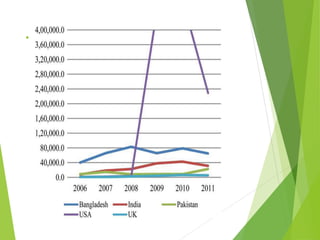
 USA has provided a greater number of microloans to low-
income people between 2008 and 2009.
 Bangladesh is comparatively ahead of other countries in
providing microloans to poorer people as of continuous
increasing trend from 2006 to 2008.
 The trend line of developing countries looks stable
throughout the period.
 Loan portfolios of the USA, UK and India are strongly
correlated with each other at 0.01 level.
.
Analysis outreach
Borrowings
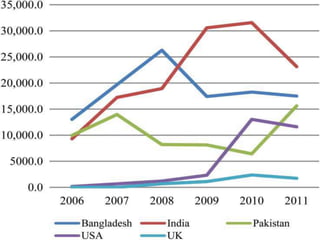
 Borrowings represent the loans made by MFIs in a
particular time period.
 Apart from Pakistan( due to political instability), all
other selected countries significantly increased their
borrowings after 2008 recession and then normalized
them in next years.
 Borrowings of Bangladesh and India are far high
compared to other countries due to the familiarity and
popularity of microcredit in these countries.
 Correlation between Bangladesh and UK is positive, but
it is insignificant at 0.01 and 0.05 levels due to
differences in demand of microfinance in both
countries.
.
Number of active borrowers
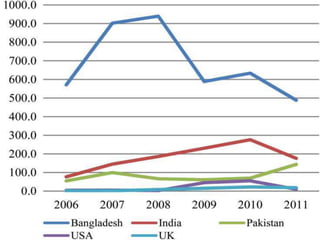
 The number of active borrowers means individuals or
groups who presently have an outstanding loan balance.
 Also refers outstanding balances with MFIs that people
are responsible to repay on time in the proportion of
the gross loan portfolio.
 Bangladesh leads other countries in having maximum
number of borrowers each year from 2006 to 2011, India
due to its extensive poverty level is at the second
position followed by Pakistan.
 There is significant positive relationship among the USA,
Uk and India and negative relationship between
Bangladesh and other countries.
.
Average loan balance per
borrower
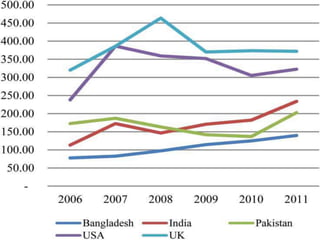
 It is computed as dividing the gross loan portfolio by the
number of active borrowers.
 Both UK and USA have the highest average per borrower
because of the difference of exchange rates between
developed and developing countries. However, UK has a
high average loan balance per borrower.
 There is positive correlation among Bangladesh India
and USA at 0.01 significance level which means average
loan balance per borrower is somehow similar among
these countries.
.
Analyzing Financial Stability
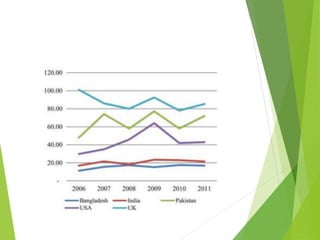
ROA ratio
 ROA is expressed as deducting taxes from net operating income and
dividing it by total assets.
 High ROA ratio is better because it indicates the efficient use of
assets in generating funds.
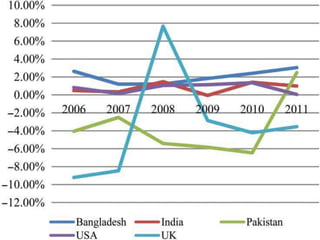
 ROA of UK MFIs was negative except 2008 (where it increased 200%
due to changes in financial policies to mitigate the impact of
recession.
 Bangladesh performed well in keeping the balance between assets
and earnings and has a higher ROA compared to other countries.
 India and USA achieved positive ROA whereas Pakistan faced
negative ROA from 2006 to 2010.
 There is only one positive correlation between USA and India at
0.01 level. All other values are not significant with each other but
they do have positive or negative associations.
.
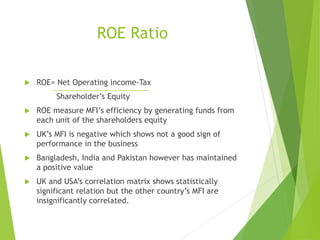
ROE Ratio
 ROE= Net Operating income-Tax
Shareholder’s Equity
 ROE measure MFI’s efficiency by generating funds from
each unit of the shareholders equity
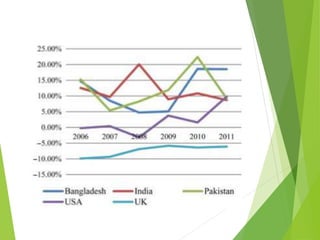
 UK’s MFI is negative which shows not a good sign of
performance in the business
 Bangladesh, India and Pakistan however has maintained
a positive value
 UK and USA’s correlation matrix shows statistically
significant relation but the other country’s MFI are
insignificantly correlated.
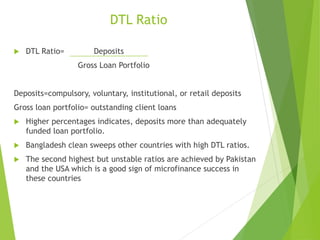
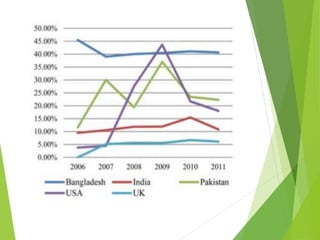
DTL Ratio
 DTL Ratio= Deposits
Gross Loan Portfolio
Deposits=compulsory, voluntary, institutional, or retail deposits
Gross loan portfolio= outstanding client loans
 Higher percentages indicates, deposits more than adequately
funded loan portfolio.
 Bangladesh clean sweeps other countries with high DTL ratios.
 The second highest but unstable ratios are achieved by Pakistan
and the USA which is a good sign of microfinance success in
these countries
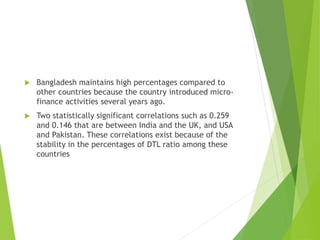
 Bangladesh maintains high percentages compared to
other countries because the country introduced micro-
finance activities several years ago.
 Two statistically significant correlations such as 0.259
and 0.146 that are between India and the UK, and USA
and Pakistan. These correlations exist because of the
stability in the percentages of DTL ratio among these
countries
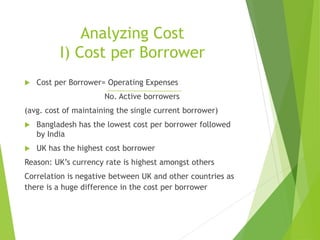
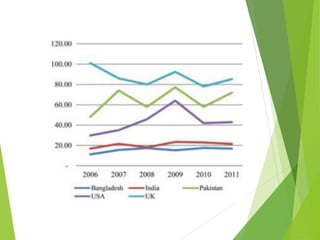
Analyzing Cost
I) Cost per Borrower
 Cost per Borrower= Operating Expenses
No. Active borrowers
(avg. cost of maintaining the single current borrower)
 Bangladesh has the lowest cost per borrower followed
by India
 UK has the highest cost borrower
Reason: UK’s currency rate is highest amongst others
Correlation is negative between UK and other countries as
there is a huge difference in the cost per borrower
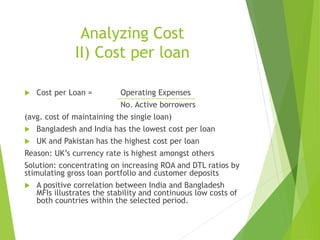
Analyzing Cost
II) Cost per loan
 Cost per Loan = Operating Expenses
No. Active borrowers
(avg. cost of maintaining the single loan)
 Bangladesh and India has the lowest cost per loan
 UK and Pakistan has the highest cost per loan
Reason: UK’s currency rate is highest amongst others
Solution: concentrating on increasing ROA and DTL ratios by
stimulating gross loan portfolio and customer deposits
 A positive correlation between India and Bangladesh
MFIs illustrates the stability and continuous low costs of
both countries within the selected period.
Conclusion
 The article is all about cross-country
analysis to investigate the true role of
microfinance institutions in developed and
developing economies.
 The overall analysis reveals that Bangladesh
and India are comparatively ahead in the
success rate of microfinance implementation
among all countries taken as case studies.
 India and Bangladesh have strong position in
acquiring borrowings to facilitate microfinance
activities.
 Both the countries have dominating positions in
terms of performance, cost of loans and individual
borrowers.
 Bangladesh dominates all other countries in terms of
active borrowers and average loan balance per
borrower.
 Microfinance performance in developed countries is
not satisfactory.
 The concept of microfinance is new in developed
countries.
 In fact, the concept became popular only after the crisis
of 2008.
 Despite the fact, microfinance implementation is good
in developed countries as well (average gross loan
portfolio of the USA followed by Bangladesh).
 However, there is a strong need to increase
awareness and knowledge about microfinance in
developed countries to intensify microfinance
activities.
THANK YOU

microfinance institutions in developed and developing economies

  • 1.
    A cross-country analysisto investigate the true role of microfinance institutions in developed and developing economies Presented by: Sarita Sigdel Arpana Bhujel Mahima Shrestha Sushmita Tiwari Durga Gautam
  • 2.
    Introduction This study hasconducted a cross-country comparison among three Asian developing countries (Bangladesh, Pakistan, and India) and two developed economies (UK and USA) to evaluate the effectiveness of their Microfinance institutions in serving low-income people.
  • 3.
    Introduction  Muhammad Yunusis the founder of Grameen Bank, first microfinance.  MFIs have served millions of poor people by providing them easy access to loans with better repayment rates, and also improving their health and welfare.  Majority of poor families gained countless benefits from microfinance schemes all around the world.  Due to lack of appropriate institutional abilities to control, too many MFIs rapidly expanded worldwide until 2009.
  • 4.
    Introduction  Some particularMFIs in developing economies, such as Bangladesh and Ghana, have achieved considerable success in using microfinance as a tool to reduce poverty level.  However, a majority of MFIs in developing economies are responsible of putting beneficiaries in debt.  It is also a matter of concern that MFIs are not effective in reaching the ‘core poor.’
  • 5.
    Literature Review  Ingeneral, MFIs play a positive role in reducing poverty while some perceive that they significantly contributed to the financial crisis of 2008. Types of Microfinance: 1) Commercial banks 2) Specialized financial institutions 3) State-owned banks 4) Finance organizations
  • 6.
    Literature Review contd… In general, commercial banks participate in microfinance activities in four ways: direct lending, partnership with MFIs, microfinance subsidiary, or securitisation (Ledgerwood 1999; Rhyne 2009).  The direct lending ability of commercial banks allows them to serve the microfinance sector without any issue or delay.  The group-lending procedure involves a responsibility of borrowers to reimburse their credits on time and in a disciplined way (Ledgerwood 1999).
  • 7.
    Literature Review  Commercialbanks also establish a partnership with MFIs and lend them in a variety of ways such as retail and wholesale banking.  Subsidiaries help commercial banks to alleviate the level of risk while lending to low-income people.  Commercial banks also play a significant role in the context of microfinance by generating capital in local and international markets to support and strengthen the operations of MFIs (Ledgerwood 1999).
  • 8.
    Research design and Methodology Thisresearch is based on exploratory research design due to the non- experimental nature and Logical use of the qualitative nature of data. Another reasons for using exploratory design is strong need of exploring the MFIs which is still unclear due to lack of study in this domain. It is not on the basis of any hypothesis and does not employ large sample of data. It is based on the existing data on cross country analysis of Asian country like Pakistan, India and Bangladesh and USA, UK.
  • 9.
    The population ofthe research mainly MFIs operating in developed and developing countries. These countries include: Asian countries including Bangladesh, India and Pakistan and the UK, and the USA. All MFIs operating in these countries are chosen to assess their true role in reducing proverty. The qualitative approach is followed in this research on the ground of its nature and core research aim. In addition, empirical data about various MFIs of selected countries also allows the researcher to conduct cross country analysis.
  • 10.
    Data collection andanalysis The work in this study is primarily based on meaningful secondary data. In order to support qualitative reasoning during cross- country analysis the empirical data from 2006 to 2011 are collected form web site. These data collected about MFIs are based on 10 microfinance indicators are microfinance borrowings , gross loan portfolio, no. of active borrowers, ROA,ROE, deposit to loan, average loan balance per borrower and cost per loan. Early basis of data has been collected from each country. Data analysis is the backbone of this research . Each country ‘s MFIs are analysed and evaluated on the basis of empirical information that indicates the effectiveness and productivity of those institutes in reaching and serving low income people.
  • 11.
    Furthermore, Karl person’scoefficient is used to find correlation between microfinance indicator of each country. The graphs and tables are constructed in MS excel.
  • 12.
    Cross –country analysis Analyzinggross loan portfolio Gross loan portfolio represents all outstanding principal amounts that are due for entire outstanding client loans. Apart from interest receivable, this undertakes all renegotiated loans, delinquent and current loans.  USA has provided a greater number of microloans to low- income people between 2008 and 2009.  Bangladesh is comparatively ahead of other countries in providing microloans to poorer people as of continuous increasing trend from 2006 to 2008.  The trend line of developing countries looks stable throughout the period.  Loan portfolios of the USA, UK and India are strongly correlated with each other at 0.01 level.
  • 13.
  • 14.
    Analysis outreach Borrowings  Borrowingsrepresent the loans made by MFIs in a particular time period.  Apart from Pakistan( due to political instability), all other selected countries significantly increased their borrowings after 2008 recession and then normalized them in next years.  Borrowings of Bangladesh and India are far high compared to other countries due to the familiarity and popularity of microcredit in these countries.  Correlation between Bangladesh and UK is positive, but it is insignificant at 0.01 and 0.05 levels due to differences in demand of microfinance in both countries.
  • 15.
  • 16.
    Number of activeborrowers  The number of active borrowers means individuals or groups who presently have an outstanding loan balance.  Also refers outstanding balances with MFIs that people are responsible to repay on time in the proportion of the gross loan portfolio.  Bangladesh leads other countries in having maximum number of borrowers each year from 2006 to 2011, India due to its extensive poverty level is at the second position followed by Pakistan.  There is significant positive relationship among the USA, Uk and India and negative relationship between Bangladesh and other countries.
  • 17.
  • 18.
    Average loan balanceper borrower  It is computed as dividing the gross loan portfolio by the number of active borrowers.  Both UK and USA have the highest average per borrower because of the difference of exchange rates between developed and developing countries. However, UK has a high average loan balance per borrower.  There is positive correlation among Bangladesh India and USA at 0.01 significance level which means average loan balance per borrower is somehow similar among these countries.
  • 19.
  • 20.
    Analyzing Financial Stability ROAratio  ROA is expressed as deducting taxes from net operating income and dividing it by total assets.  High ROA ratio is better because it indicates the efficient use of assets in generating funds.  ROA of UK MFIs was negative except 2008 (where it increased 200% due to changes in financial policies to mitigate the impact of recession.  Bangladesh performed well in keeping the balance between assets and earnings and has a higher ROA compared to other countries.  India and USA achieved positive ROA whereas Pakistan faced negative ROA from 2006 to 2010.  There is only one positive correlation between USA and India at 0.01 level. All other values are not significant with each other but they do have positive or negative associations.
  • 21.
  • 22.
    ROE Ratio  ROE=Net Operating income-Tax Shareholder’s Equity  ROE measure MFI’s efficiency by generating funds from each unit of the shareholders equity  UK’s MFI is negative which shows not a good sign of performance in the business  Bangladesh, India and Pakistan however has maintained a positive value  UK and USA’s correlation matrix shows statistically significant relation but the other country’s MFI are insignificantly correlated.
  • 24.
    DTL Ratio  DTLRatio= Deposits Gross Loan Portfolio Deposits=compulsory, voluntary, institutional, or retail deposits Gross loan portfolio= outstanding client loans  Higher percentages indicates, deposits more than adequately funded loan portfolio.  Bangladesh clean sweeps other countries with high DTL ratios.  The second highest but unstable ratios are achieved by Pakistan and the USA which is a good sign of microfinance success in these countries
  • 25.
     Bangladesh maintainshigh percentages compared to other countries because the country introduced micro- finance activities several years ago.  Two statistically significant correlations such as 0.259 and 0.146 that are between India and the UK, and USA and Pakistan. These correlations exist because of the stability in the percentages of DTL ratio among these countries
  • 27.
    Analyzing Cost I) Costper Borrower  Cost per Borrower= Operating Expenses No. Active borrowers (avg. cost of maintaining the single current borrower)  Bangladesh has the lowest cost per borrower followed by India  UK has the highest cost borrower Reason: UK’s currency rate is highest amongst others Correlation is negative between UK and other countries as there is a huge difference in the cost per borrower
  • 29.
    Analyzing Cost II) Costper loan  Cost per Loan = Operating Expenses No. Active borrowers (avg. cost of maintaining the single loan)  Bangladesh and India has the lowest cost per loan  UK and Pakistan has the highest cost per loan Reason: UK’s currency rate is highest amongst others Solution: concentrating on increasing ROA and DTL ratios by stimulating gross loan portfolio and customer deposits  A positive correlation between India and Bangladesh MFIs illustrates the stability and continuous low costs of both countries within the selected period.
  • 31.
    Conclusion  The articleis all about cross-country analysis to investigate the true role of microfinance institutions in developed and developing economies.  The overall analysis reveals that Bangladesh and India are comparatively ahead in the success rate of microfinance implementation among all countries taken as case studies.
  • 32.
     India andBangladesh have strong position in acquiring borrowings to facilitate microfinance activities.  Both the countries have dominating positions in terms of performance, cost of loans and individual borrowers.  Bangladesh dominates all other countries in terms of active borrowers and average loan balance per borrower.  Microfinance performance in developed countries is not satisfactory.
  • 33.
     The conceptof microfinance is new in developed countries.  In fact, the concept became popular only after the crisis of 2008.  Despite the fact, microfinance implementation is good in developed countries as well (average gross loan portfolio of the USA followed by Bangladesh).  However, there is a strong need to increase awareness and knowledge about microfinance in developed countries to intensify microfinance activities.
  • 34.