MICROFINANCE IN INDIA
By:
Chaitra Mhatre(101)
Mohammad Faizan(103)
Priyanka More(105)
Rahul Kumar(107)
Sapna Hajare(109)
Introduction
 According to famous economist Robinson, Microfinance refers to small-scale financial
services for both credits and deposits - that are provided to unemployed or low-
income individuals or groups who would otherwise have no other means of gaining
financial services .
 Ultimately, the goal of microfinance is to give low income people an opportunity to
become self- sufficient by providing a means of saving money, borrowing money and
insurance.
 “Microfinance is thus an economic Development approach that involves providing
financial services through institutions to low income clients”.
Example:
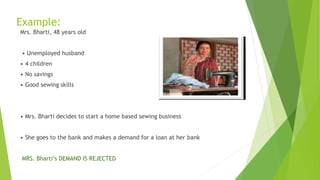
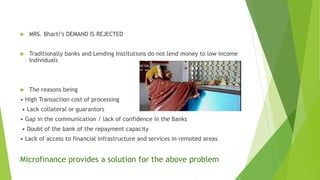
Mrs. Bharti, 48 years old
• Unemployed husband
• 4 children
• No savings
• Good sewing skills
• Mrs. Bharti decides to start a home based sewing business
• She goes to the bank and makes a demand for a loan at her bank
MRS. Bharti’s DEMAND IS REJECTED
 MRS. Bharti’s DEMAND IS REJECTED
 Traditionally banks and Lending Institutions do not lend money to low income
Individuals
 The reasons being
• High Transaction cost of processing
• Lack collateral or guarantors
• Gap in the communication / lack of confidence in the Banks
• Doubt of the bank of the repayment capacity
• Lack of access to financial infrastructure and services in remoted areas
Microfinance provides a solution for the above problem
Need for Microfinance
 Reluctant to provide financial services to clients.
 Lack of loan and other financial services from banks and other institutes.
 According to a 1995 World Bank estimate, in most developing countries the
formal financial system reaches only the top 25% of the economically active
population.
 India is said to be the home of one third of the world’s poor.
 About 87 percent of the poorest households do not have access to credit.
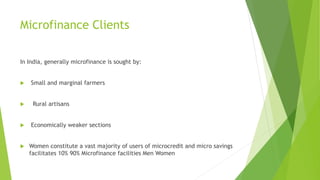
Microfinance Clients
In India, generally microfinance is sought by:
 Small and marginal farmers
 Rural artisans
 Economically weaker sections
 Women constitute a vast majority of users of microcredit and micro savings
facilitates 10% 90% Microfinance facilities Men Women
Microfinance In India
Major Microfinance activities followed in India are -
Micro
Credit
Micro
Savings
Small Scale
Insurance
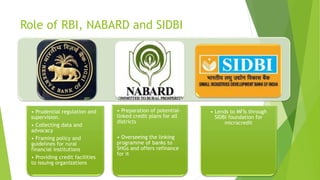
Role of RBI, NABARD and SIDBI
• Prudential regulation and
supervision.
• Collecting data and
advocacy
• Framing policy and
guidelines for rural
financial Institutions
• Providing credit facilities
to issuing organizations
• Preparation of potential-
linked credit plans for all
districts
• Overseeing the linking
programme of banks to
SHGs and offers refinance
for it
• Lends to MFIs through
SIDBI foundation for
microcredit
MICRO-FINANCE LENDING MODELS
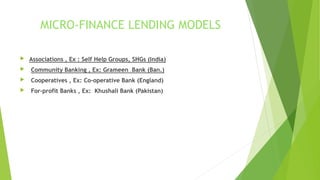
 Associations , Ex : Self Help Groups, SHGs (India)
 Community Banking , Ex: Grameen Bank (Ban.)
 Cooperatives , Ex: Co-operative Bank (England)
 For-profit Banks , Ex: Khushali Bank (Pakistan)
GRAMEEN BANK
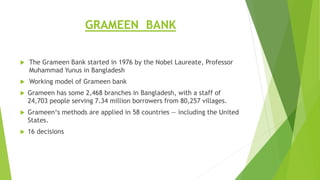
 The Grameen Bank started in 1976 by the Nobel Laureate, Professor
Muhammad Yunus in Bangladesh
 Working model of Grameen bank
 Grameen has some 2,468 branches in Bangladesh, with a staff of
24,703 people serving 7.34 million borrowers from 80,257 villages.
 Grameen‘s methods are applied in 58 countries — including the United
States.
 16 decisions
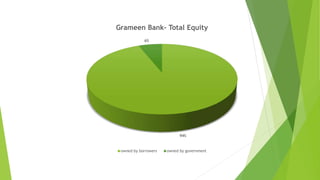
94%
6%
Grameen Bank- Total Equity
owned by borrowers owned by government
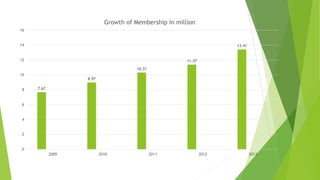
7.67
8.97
10.31
11.37
13.41
0
2
4
6
8
10
12
14
16
2009 2010 2011 2012 2013
Growth of Membership in million
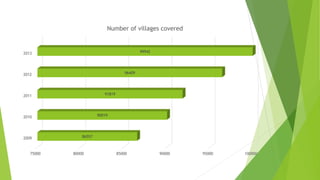
75000 80000 85000 90000 95000 100000
2009
2010
2011
2012
2013
86557
90019
91819
96409
99942
Number of villages covered
SELF HELP GROUPS
 A self-help group (SHG) is a village-based financial intermediary committee usually
composed of 10–20 local women or men
 Formation and development of SHG
 Operational models :
i. NABARD's 'SHG Bank Linkage' program
ii. By banks directly
iii. MFI-bank linkage model
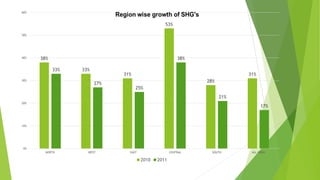
38%
33%
31%
53%
28%
31%
33%
27%
25%
38%
21%
17%
0%
10%
20%
30%
40%
50%
60%
NORTH WEST EAST CENTRAL SOUTH ALL INDIA
2010 2011
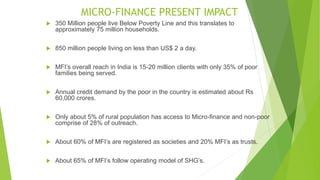
MICRO-FINANCE PRESENT IMPACT
 350 Million people live Below Poverty Line and this translates to
approximately 75 million households.
 850 million people living on less than US$ 2 a day.
 MFI’s overall reach in India is 15-20 million clients with only 35% of poor
families being served.
 Annual credit demand by the poor in the country is estimated about Rs
60,000 crores.
 Only about 5% of rural population has access to Micro-finance and non-poor
comprise of 28% of outreach.
 About 60% of MFI’s are registered as societies and 20% MFI’s as trusts.
 About 65% of MFI’s follow operating model of SHG’s.
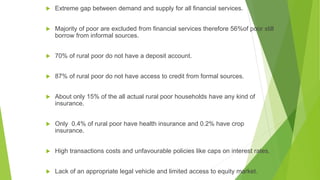
 Extreme gap between demand and supply for all financial services.
 Majority of poor are excluded from financial services therefore 56%of poor still
borrow from informal sources.
 70% of rural poor do not have a deposit account.
 87% of rural poor do not have access to credit from formal sources.
 About only 15% of the all actual rural poor households have any kind of
insurance.
 Only 0.4% of rural poor have health insurance and 0.2% have crop
insurance.
 High transactions costs and unfavourable policies like caps on interest rates.
 Lack of an appropriate legal vehicle and limited access to equity market.
0
2
4
6
8
10
12
14
16
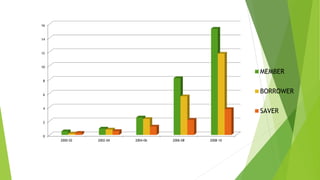
2000-02 2002-04 2004-06 2006-08 2008-10
MEMBER
BORROWER
SAVER
0
20,000
40,000
60,000
80,000
100,000
120,000
140,000
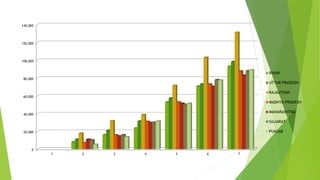
1 2 3 4 5 6 7
BIHAR
UTTAR PRADESH
RAJASTHAN
MADHYA PRADESH
MAHARASHTRA
GUJARAT
PUNJAB
CHALLENGES FACED BY MICRO-FINANCE
 Appropriate legal structures for structured growth of Micro-finance operations.
 Ability to access loan funds at reasonably low rates of interest.
 Appropriate loan products for different segments and Ability to innovate, adapt and
grow.
 Bring out a compendium of small and micro enterprises for micro-finance clients.
 Ability to attract and retain professional and committed human resources.
 Identify and prepare a panel of locally available trainers and Ability to train trainers.
 Capacity to provide backward linkages or create support structures for marketing.
 Finding adequate levels of equity for the new entities to leverage loan funds.
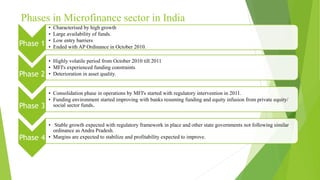
Phases in Microfinance sector in India
Phase 1
• Characterised by high growth
• Large availability of funds.
• Low entry barriers
• Ended with AP Ordinance in October 2010.
Phase 2
• Highly volatile period from October 2010 till 2011
• MFI's experienced funding constraints
• Deterioration in asset quality.
Phase 3
• Consolidation phase in operations by MFI's started with regulatory intervention in 2011.
• Funding environment started improving with banks resuming funding and equity infusion from private equity/
social sector funds.
Phase 4
• Stable growth expected with regulatory framework in place and other state governments not following similar
ordinance as Andra Pradesh.
• Margins are expected to stabilize and profitability expected to improve.
0
10000
20000
30000
40000
50000
60000
FY09 FY10 FY11 FY12 FY13
Marketsize(inRs.Crore)
Axis Title
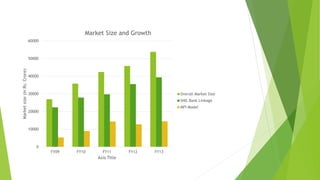
Market Size and Growth
Overall Market Size
SHG Bank Linkage
MFI Model
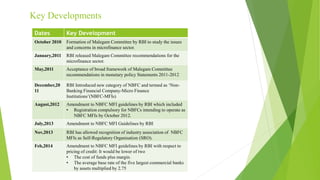
Key Developments
Dates Key Development
October 2010 Formation of Malegam Committee by RBI to study the issues
and concerns in microfinance sector.
January,2011 RBI released Malegam Committee recommendations for the
microfinance sector.
May,2011 Acceptance of broad framework of Malegam Committee
recommendations in monetary policy Statements 2011-2012
December,20
11
RBI Introduced new category of NBFC and termed as ‘Non-
Banking Financial Company-Micro Finance
Institutions’(NBFC-MFIs)
August,2012 Amendment to NBFC MFI guidelines by RBI which included
• Registration compulsory for NBFCs intending to operate as
NBFC MFIs by October 2012.
July,2013 Amendment to NBFC MFI Guidelines by RBI
Nov,2013 RBI has allowed recognition of industry association of NBFC
MFIs as Self-Regulatory Organisation (SRO).
Feb,2014 Amendment to NBFC MFI guidelines by RBI with respect to
pricing of credit: It would be lower of two
• The cost of funds plus margin.
• The average base rate of the five largest commercial banks
by assets multiplied by 2.75
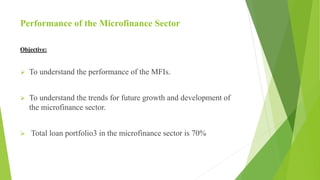
Performance of the Microfinance Sector
Objective:
 To understand the performance of the MFIs.
 To understand the trends for future growth and development of
the microfinance sector.
 Total loan portfolio3 in the microfinance sector is 70%
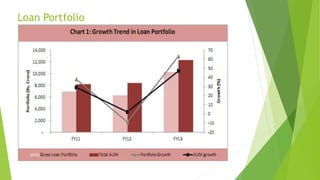
Loan Portfolio
Future Aspects
 Microfinance Companies in India to witness strong growth in 2014 – 2015 –
Crisis
 Loan Portfolio is set to grow at a annual rate of 35% (to reach Rs.450 billion
by end-March 2016
 MFIs will have to raise equity.
 A CRISIL analysis indicates that the MFIs need to raise equity of at least Rs.18
billion over the next two years to maintain growth momentum and gearing at
current levels.
 For this, the sector needs to address the following two elements:
1. Promoter Shareholding.
2. Potential reduction in investor appetite.
Conclusion
 Microfinance is not just giving credits but also providing services. Gone are
the days when poor people were believed to be non-bankable. Microfinance
has proved that poor are bankable.
 Microfinance mainly came into existence with an intention to relieve the poor
people from the clutches of money lenders.
Thank you

final - micro

  • 1.
    MICROFINANCE IN INDIA By: ChaitraMhatre(101) Mohammad Faizan(103) Priyanka More(105) Rahul Kumar(107) Sapna Hajare(109)
  • 2.
    Introduction  According tofamous economist Robinson, Microfinance refers to small-scale financial services for both credits and deposits - that are provided to unemployed or low- income individuals or groups who would otherwise have no other means of gaining financial services .  Ultimately, the goal of microfinance is to give low income people an opportunity to become self- sufficient by providing a means of saving money, borrowing money and insurance.  “Microfinance is thus an economic Development approach that involves providing financial services through institutions to low income clients”.
  • 3.
    Example: Mrs. Bharti, 48years old • Unemployed husband • 4 children • No savings • Good sewing skills • Mrs. Bharti decides to start a home based sewing business • She goes to the bank and makes a demand for a loan at her bank MRS. Bharti’s DEMAND IS REJECTED
  • 4.
     MRS. Bharti’sDEMAND IS REJECTED  Traditionally banks and Lending Institutions do not lend money to low income Individuals  The reasons being • High Transaction cost of processing • Lack collateral or guarantors • Gap in the communication / lack of confidence in the Banks • Doubt of the bank of the repayment capacity • Lack of access to financial infrastructure and services in remoted areas Microfinance provides a solution for the above problem
  • 5.
    Need for Microfinance Reluctant to provide financial services to clients.  Lack of loan and other financial services from banks and other institutes.  According to a 1995 World Bank estimate, in most developing countries the formal financial system reaches only the top 25% of the economically active population.  India is said to be the home of one third of the world’s poor.  About 87 percent of the poorest households do not have access to credit.
  • 6.
    Microfinance Clients In India,generally microfinance is sought by:  Small and marginal farmers  Rural artisans  Economically weaker sections  Women constitute a vast majority of users of microcredit and micro savings facilitates 10% 90% Microfinance facilities Men Women
  • 7.
    Microfinance In India MajorMicrofinance activities followed in India are - Micro Credit Micro Savings Small Scale Insurance
  • 8.
    Role of RBI,NABARD and SIDBI • Prudential regulation and supervision. • Collecting data and advocacy • Framing policy and guidelines for rural financial Institutions • Providing credit facilities to issuing organizations • Preparation of potential- linked credit plans for all districts • Overseeing the linking programme of banks to SHGs and offers refinance for it • Lends to MFIs through SIDBI foundation for microcredit
  • 9.
    MICRO-FINANCE LENDING MODELS Associations , Ex : Self Help Groups, SHGs (India)  Community Banking , Ex: Grameen Bank (Ban.)  Cooperatives , Ex: Co-operative Bank (England)  For-profit Banks , Ex: Khushali Bank (Pakistan)
  • 10.
    GRAMEEN BANK  TheGrameen Bank started in 1976 by the Nobel Laureate, Professor Muhammad Yunus in Bangladesh  Working model of Grameen bank  Grameen has some 2,468 branches in Bangladesh, with a staff of 24,703 people serving 7.34 million borrowers from 80,257 villages.  Grameen‘s methods are applied in 58 countries — including the United States.  16 decisions
  • 11.
    94% 6% Grameen Bank- TotalEquity owned by borrowers owned by government
  • 12.
  • 13.
    75000 80000 8500090000 95000 100000 2009 2010 2011 2012 2013 86557 90019 91819 96409 99942 Number of villages covered
  • 14.
    SELF HELP GROUPS A self-help group (SHG) is a village-based financial intermediary committee usually composed of 10–20 local women or men  Formation and development of SHG  Operational models : i. NABARD's 'SHG Bank Linkage' program ii. By banks directly iii. MFI-bank linkage model
  • 15.
  • 16.
    MICRO-FINANCE PRESENT IMPACT 350 Million people live Below Poverty Line and this translates to approximately 75 million households.  850 million people living on less than US$ 2 a day.  MFI’s overall reach in India is 15-20 million clients with only 35% of poor families being served.  Annual credit demand by the poor in the country is estimated about Rs 60,000 crores.  Only about 5% of rural population has access to Micro-finance and non-poor comprise of 28% of outreach.  About 60% of MFI’s are registered as societies and 20% MFI’s as trusts.  About 65% of MFI’s follow operating model of SHG’s.
  • 17.
     Extreme gapbetween demand and supply for all financial services.  Majority of poor are excluded from financial services therefore 56%of poor still borrow from informal sources.  70% of rural poor do not have a deposit account.  87% of rural poor do not have access to credit from formal sources.  About only 15% of the all actual rural poor households have any kind of insurance.  Only 0.4% of rural poor have health insurance and 0.2% have crop insurance.  High transactions costs and unfavourable policies like caps on interest rates.  Lack of an appropriate legal vehicle and limited access to equity market.
  • 18.
    0 2 4 6 8 10 12 14 16 2000-02 2002-04 2004-062006-08 2008-10 MEMBER BORROWER SAVER
  • 19.
    0 20,000 40,000 60,000 80,000 100,000 120,000 140,000 1 2 34 5 6 7 BIHAR UTTAR PRADESH RAJASTHAN MADHYA PRADESH MAHARASHTRA GUJARAT PUNJAB
  • 20.
    CHALLENGES FACED BYMICRO-FINANCE  Appropriate legal structures for structured growth of Micro-finance operations.  Ability to access loan funds at reasonably low rates of interest.  Appropriate loan products for different segments and Ability to innovate, adapt and grow.  Bring out a compendium of small and micro enterprises for micro-finance clients.  Ability to attract and retain professional and committed human resources.  Identify and prepare a panel of locally available trainers and Ability to train trainers.  Capacity to provide backward linkages or create support structures for marketing.  Finding adequate levels of equity for the new entities to leverage loan funds.
  • 21.
    Phases in Microfinancesector in India Phase 1 • Characterised by high growth • Large availability of funds. • Low entry barriers • Ended with AP Ordinance in October 2010. Phase 2 • Highly volatile period from October 2010 till 2011 • MFI's experienced funding constraints • Deterioration in asset quality. Phase 3 • Consolidation phase in operations by MFI's started with regulatory intervention in 2011. • Funding environment started improving with banks resuming funding and equity infusion from private equity/ social sector funds. Phase 4 • Stable growth expected with regulatory framework in place and other state governments not following similar ordinance as Andra Pradesh. • Margins are expected to stabilize and profitability expected to improve.
  • 22.
    0 10000 20000 30000 40000 50000 60000 FY09 FY10 FY11FY12 FY13 Marketsize(inRs.Crore) Axis Title Market Size and Growth Overall Market Size SHG Bank Linkage MFI Model
  • 23.
    Key Developments Dates KeyDevelopment October 2010 Formation of Malegam Committee by RBI to study the issues and concerns in microfinance sector. January,2011 RBI released Malegam Committee recommendations for the microfinance sector. May,2011 Acceptance of broad framework of Malegam Committee recommendations in monetary policy Statements 2011-2012 December,20 11 RBI Introduced new category of NBFC and termed as ‘Non- Banking Financial Company-Micro Finance Institutions’(NBFC-MFIs) August,2012 Amendment to NBFC MFI guidelines by RBI which included • Registration compulsory for NBFCs intending to operate as NBFC MFIs by October 2012. July,2013 Amendment to NBFC MFI Guidelines by RBI Nov,2013 RBI has allowed recognition of industry association of NBFC MFIs as Self-Regulatory Organisation (SRO). Feb,2014 Amendment to NBFC MFI guidelines by RBI with respect to pricing of credit: It would be lower of two • The cost of funds plus margin. • The average base rate of the five largest commercial banks by assets multiplied by 2.75
  • 24.
    Performance of theMicrofinance Sector Objective:  To understand the performance of the MFIs.  To understand the trends for future growth and development of the microfinance sector.  Total loan portfolio3 in the microfinance sector is 70%
  • 25.
  • 26.
    Future Aspects  MicrofinanceCompanies in India to witness strong growth in 2014 – 2015 – Crisis  Loan Portfolio is set to grow at a annual rate of 35% (to reach Rs.450 billion by end-March 2016  MFIs will have to raise equity.  A CRISIL analysis indicates that the MFIs need to raise equity of at least Rs.18 billion over the next two years to maintain growth momentum and gearing at current levels.  For this, the sector needs to address the following two elements: 1. Promoter Shareholding. 2. Potential reduction in investor appetite.
  • 27.
    Conclusion  Microfinance isnot just giving credits but also providing services. Gone are the days when poor people were believed to be non-bankable. Microfinance has proved that poor are bankable.  Microfinance mainly came into existence with an intention to relieve the poor people from the clutches of money lenders.
  • 28.

Editor's Notes

  • #15  http://www.ruralfinance.org/fileadmin/templates/rflc/documents/1100879155210_formingshgs.pdf http://rbidocs.rbi.org.in/rdocs/Publications/PDFs/FHB160913FLS.pdf