An Overview,
   Fundamental
Concepts, Principles
and Characteristics,
 best practices of
   Microfinance


   Tejhari Ghimire
Resource contents


• An Overview of Microfinance Sector
• Fundamental Concept of
  Microfinance
• Key Principles of microfinance
• Characteristics of Microfinance
• Best practices of microfinance


09/16/12
Overview….Country
                Scenario
• More than 31% of the Nepal's
  population lives in extreme poverty.
• Informal financial system remains
  dominant
• The sector has experienced growth of
  microfinance institutions (MFIs) and
  significant progress in terms of clientele,
  outreach, savings and credit
  management.
• Microfinance Development Banks (22)
  are providing microfinance services to
  8,46,517 rural poor women across 57
  districts through self-managed centers
  and groups[1];
  [1] Source: NRB, Mid-July, 2011


09/16/12
Overview….Country
                 Scenario
• 10,558 Savings and Credit Cooperatives and Credit
  Unions provide services to 14,06,021 clients (female
  651,512 and male 754,509) in 75 districts[1] ( this
  includes urban saving and credit cooperatives that may
  not represent microfinance services);

• Small Farmers Cooperative Limiteds (SFCLs: 243) are
  providing financial services to 1,69,686 clients-SKBBL,
    Mid-June, 2011

• 38 Financial Intermediary NGOs are providing financial
  services to a further 454,026 predominately poor people[2]
  .

• This shows that 25,95, 046 of the rural population have
  access to microfinance services in Nepal, which
  contributes 10.25 % of the total population and 33.05 %
  of those is living below the poverty line. This is the 20%
  reduction in total clients of saving and credit clients. It is
  assumed that 20% urban population do not represent
  MF clients that was also included in the total clients of
  saving and credit coops.


[1] Department of Cooperative, 2011
  09/16/12
[2] Compiled by CMF, 2011
Overview….Country
                    Scenario
• A total of 2,048,742 of the rural population
  have access to microfinance services in
  Nepal, which contributes 8.09% of the
  total population[1] and 26.1% of those is
  living below the poverty line[2],

• Of which 1,233,058 are women,
  representing 9.73% of all Nepalese
  women[3]. Data shows that the majority of
  microfinance service recipients are
  women

• Nevertheless, the women led MFIs are
  approximately 2545 saving & credit
  cooperatives.

•    [1] Total population about 25,296,537 as of 2005 Projection ( Informal Sector Research
     and Study Center: 2004)
•    [2] 31% of total population ( NLSS:2003/04)
•    [3]( NIDI, CMF: 2006)


    09/16/12
Fundamental concepts

 •   Meaning of Microfinance
 •   Myth and Facts of Microfinance
 •   Why microfinance
 •   Goal of microfinance


09/16/12
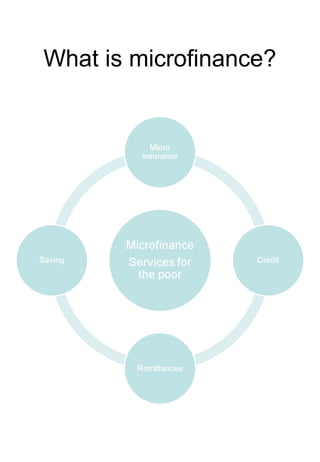
What is microfinance?
Definition

• Microfinance is the provision of
  financial access to low-income
  people or solidarity groups
  including consumers and the small
  entrepreneurs , who traditionally
  lack access to banking and related
  services.
Meaning of Microfinance
• "Microfinance is the supply of loans,
  savings, and other basic financial
  services to the poor." (CGAP).

• A microfinance institution (MFI) is
  defined as an organization that provides
  microfinance services, ranging from
  small non-profit organizations to large
  commercial banks.

• CGAP broadly defines MFI as any
  organization—credit union, downscaled
  commercial bank, financial NGO, or
  credit cooperative that provides financial
  services for the poor.


09/16/12
Myth and Facts
       • Poor people do not repay
         loan
           – Myth     or   Fact

       • Poor people can not pay the
         interest rates necessary to
         cover the cost of delivering
         the services
           – Myth     or   Fact


09/16/12
Myth and Facts

• MFIs cannot access commercial
  sources of funding
     – Myth    or      Fact


09/16/12
Myth and Facts

• MFIs cannot reach the very poorest
  of the poor only through credit
     – Myth     or        Fact


• Financial sustainability is necessary
  for an MFI to reach large number of
  people
     – Myth     or        Fact


09/16/12
Myth and Facts

• MFIs only extend services to the
  very poor
     – Myth    or   Fact


• Microfinance alone does not
  alleviate poverty
     – Myth    or   Fact


09/16/12
Myth and Facts

• The Goal of microfinance is
  institutional sustainability
     – Myth    or    Fact


• Many microfinance operation will
  not become sustainable
     – Myth    or    Fact


09/16/12
Myth and Facts

• A solid understanding of the facts
  about microfinance is critical to
  making good investment decision


09/16/12
Why Microfinance

• Development of micro-enterprise
     – Microenterprise creates job
• Supply of goods and services to
  low- income population is increased
• Increase the productive use of
  capital


09/16/12
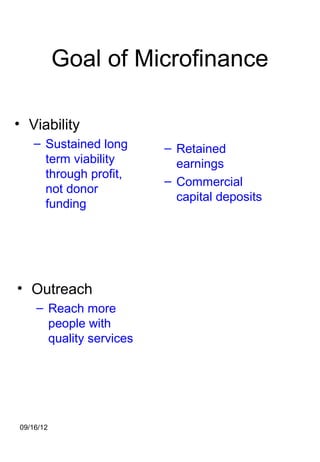
Goal of Microfinance

• Viability
   – Sustained long      – Retained
     term viability        earnings
     through profit,
                         – Commercial
     not donor
                           capital deposits
     funding


• Outreach
    – Reach more
      people with
      quality services


09/16/12
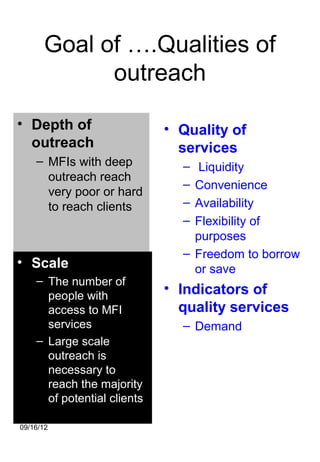
Goal of ….Qualities of
            outreach

• Depth of                   • Quality of
  outreach                     services
    – MFIs with deep           –  Liquidity
      outreach reach
                               – Convenience
      very poor or hard
      to reach clients         – Availability
                               – Flexibility of
                                 purposes
                               – Freedom to borrow
• Scale                          or save
    – The number of
      people with
                             • Indicators of
      access to MFI            quality services
      services                 – Demand
    – Large scale
      outreach is
      necessary to
      reach the majority
      of potential clients

09/16/12
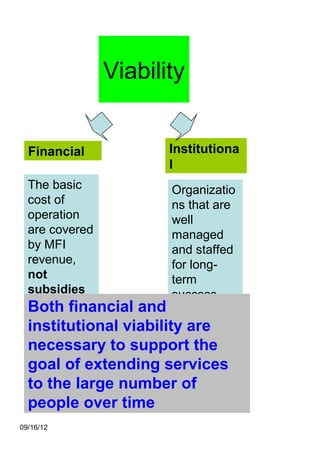
Viability


  Financial            Institutiona
                       l
  The basic            Organizatio
  cost of              ns that are
  operation            well
  are covered          managed
  by MFI               and staffed
  revenue,             for long-
  not                  term
  subsidies            success
  Both financial and
  institutional viability are
  necessary to support the
  goal of extending services
  to the large number of
  people over time
09/16/12
Benefits of financial
                viability
• Services can be maintained in the
  future without being subject to
  unpredictable fluctuations in donor
  funding

• Access to commercial sources of
  funding


09/16/12
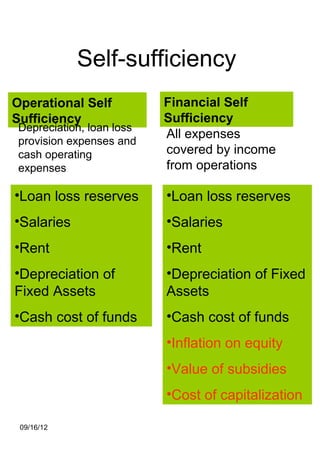
Self-sufficiency
Operational Self           Financial Self
Sufficiency                Sufficiency
 Depreciation, loan loss
                           All expenses
 provision expenses and
 cash operating            covered by income
 expenses                  from operations

•Loan loss reserves        •Loan loss reserves
•Salaries                  •Salaries
•Rent                      •Rent
•Depreciation of           •Depreciation of Fixed
Fixed Assets               Assets
•Cash cost of funds        •Cash cost of funds
                           •Inflation on equity
                           •Value of subsidies
                           •Cost of capitalization

 09/16/12
Level of Financial Viability
• Level I: Characteristics
   – MFIs that have not achieved
      operational self sufficiency
   – They rely on outside donation for
      continued operation
   – Revenues fall short of operating
      expenses
   – Inflation will erode the loan fund
   – Poor performers are subject to erosion
      of loan fund through delinquency and
      default
   – Many have high operating costs, are
      reluctant to charge sustainable interest
      rates, and have high delinquency and
      default rates, especially older
      organization
• It is estimated that 90% MFIs operate at
  level I
09/16/12
Level of Financial Viability
• Level II: Characteristics
   – MFIs that are operationally, but
     not financially, self-reliant
   – They apply proven principles,
     are generally efficient, have
     higher client to staff ratios, an
     increasing scale of operation,
     and good control of delinquency
     and default
   – Interest and fee income cover
     operating expenses, but
     inflation can erode equity
   – Funds are borrowed on terms
     near, but still below, market
     rates
• Level II organizations can vary
  widely from those that rely on soft
  money.
09/16/12
Level of Financial Viability
• Level III: Characteristics
   – MFIs that are financially self-
     sufficient
   – Operation is fully financed from
     retained earnings, client savings,
     or commercial funds
   – Interest rates and fees cover the
     full cost of service delivery and
     return on savings
   – Interest rates and fees cover the
     real cost of funds
   – MFIs can increase their equity
     base through profits and attract
     outside equity participation
• So far only a few MFIs have reached
  at Level III, but many poised to do
  so.
09/16/12
Institutional Viability
• Capacity
• Governance
• Types
     – Specialized financial institutions

     – Specialized services within commercial
       financial institutions

     – Non-governmental organization (NGOs)

     – Credit unions or other member owned
       institutions


09/16/12
Principles of Microfinance

• Consultative Group for Assistance
  to the Poorest (CGAP)- 2004
  (Principles)

• Key operating principles of
  microfinance

• International Credit Union
  Operating Principles-1984


09/16/12
Consultative Group for Assistance
  to the Poorest (CGAP)- 2004

• Poor people need a variety of financial
  services, not just loans.

• Microfinance is a powerful tool to fight
  poverty.

• Microfinance means building financial
  systems that serve the poor.

• Microfinance can pay for itself, and must
  do so if it is to reach very large numbers
  of poor people.

• Microfinance is about building
  permanent local financial institutions.


09/16/12
Consultative Group for
     Assistance to the Poorest
          (CGAP)- 2004
• Micro-credit is not always the
    answer.
• Interest rate ceilings hurt poor
    people by making it harder for
    them to get credit.
• The role of government is to
    enable financial services, not to
    provide them directly.
• Donor funds should complement
    private capital, not compete with it.
• The key bottleneck is the shortage
    of strong institutions and
    managers.
• Microfinance works best when it
    measures—and discloses—its
    performance.
09/16/12
Key operating principles of
          microfinance
• Understanding the Market
   – A successful MFI understands
     its market and designs products
     that serve its clients
• Streamlined Operations
   – Streamlined operations help
     MFIs make efficient use of
     resources and keep cost low
• Informal Sector Practices
   – This practices help an MFI
     manage risk, motivate
     repayment, and lower
     administrative costs.
09/16/12
Key operating principles of
          microfinance
• Repayment Incentives
  – The ability to get another loan
    when it is needed is a powerful
    incentive for the clients to repay
    current loan.
• Saving Services
  – Saving services should be
    liquid, secure, convenient, offer
    competitive returns, and not to
    be limited to borrowers.
• Viability and Growth
  – MFI staff should be focused on
    achieving efficiency, financial
    productivity, and financial
    viability.
09/16/12
Key operating principles of
          microfinance
• No Delinquency tolerated
   – Successful MFIs do not tolerate
     delinquency
• Sustainable Interest Rates
   – Interest must be set high
     enough to cover all costs of
     delivering services
• Linkage to Financial Market
   – Leveraging resources from
     commercial markets is essential
     to achieving significant outreach


09/16/12
International Credit Union
   Operating Principles-1984

• Democratic Structure
  – Open and volunteer
    membership
  – Democratic control
  – Non-discrimination
• Service to Members
  – Service to members
  – Distribution to members
  – Building financial stability


09/16/12
International Credit Union
   Operating Principles-1984

• Social Goals
  – Ongoing education
  – Cooperation among
    cooperatives
  – Social Responsibility


09/16/12
Characteristics of
             Microfinance
• Mostly it is collateral free
• MFIs go to clients rather than
  clients go to MFIs
• Simplified savings and loan
  procedures
• Small sizes of loans and
  savings
• Repeat Loans
• Loan size increases in the
  repeated loans or subsequent
  cycles

09/16/12
Characteristics of
             Microfinance
• Interest rate is usually in
  between money lenders and
  formal banks
• Free use of loans (no
  restrictions on specified
  purpose)
• Repayment considers incomes
  from business as well as other
  sources
• Loan and savings products
  within manageable numbers


09/16/12
Best
practices of
Microfinance


09/16/12
Best practices of MFIs

• Build effective
  Management Information
  System (MIS)
• Reach large number of
  clients (Vision of growth)
• Promote savings services,
  diversify savings products


09/16/12
Best practices of MFIs

• Offer services that fit the
  clients’ needs, diversify
  loan products
• Simplify loan products to
  reduce operational costs
• Motivate clients to repay
  loans, focus on high
  repayments


09/16/12
Best practices of MFIs

• Attain financial
  sustainability by charging
  sufficient (above market)
  interest rates and fees
• Involve clients when
  designing services
• Promote effective
  governance, characterized
  by democratic and
  transparent decision-
  making
09/16/12
Best practices of MFIs


• Target clients properly
• Focus on financial
  services only
• Develop institutional
  linkages.


09/16/12
Lessons learned from
   Women managed Savings
    and Credit Cooperative
• Lesson -1 Women managed
  saving and credit cooperatives
  are the best microfinance
  institutions that can exist even in
  an insurgency situations

• Lesson -2 Adaptive mix of
  training and technical assistance
  can ensure capacity building
  even in case of uneducated/rural
  women owned institutions:


09/16/12
Lessons learned from
    Women managed Savings
    and Credit Cooperatives

  • Lesson-3     Participatory
    monitoring helps MFIs to
    develop need based products
    and services

  • Lesson-4     Enhanced
    capacity of MFIs creates
    demand for enterprise
    development services and
    entrepreneurs


09/16/12
Lessons learned from
  Women managed Savings
  and Credit Cooperatives

• Lesson-5    Installment
  repayment system helped to
  reduce delinquency rate

• Lesson-6    Healthy
  competition among MFIs
  encourages self-regulation in
  the market

• Lesson-7 Rural and only literate
  women managed saving and
  credit cooperatives are able to
  attain OSS 108% and FSS 92%.
09/16/12

Microfinance 1-notes

  • 1.
    An Overview, Fundamental Concepts, Principles and Characteristics, best practices of Microfinance Tejhari Ghimire
  • 2.
    Resource contents • AnOverview of Microfinance Sector • Fundamental Concept of Microfinance • Key Principles of microfinance • Characteristics of Microfinance • Best practices of microfinance 09/16/12
  • 3.
    Overview….Country Scenario • More than 31% of the Nepal's population lives in extreme poverty. • Informal financial system remains dominant • The sector has experienced growth of microfinance institutions (MFIs) and significant progress in terms of clientele, outreach, savings and credit management. • Microfinance Development Banks (22) are providing microfinance services to 8,46,517 rural poor women across 57 districts through self-managed centers and groups[1]; [1] Source: NRB, Mid-July, 2011 09/16/12
  • 4.
    Overview….Country Scenario • 10,558 Savings and Credit Cooperatives and Credit Unions provide services to 14,06,021 clients (female 651,512 and male 754,509) in 75 districts[1] ( this includes urban saving and credit cooperatives that may not represent microfinance services); • Small Farmers Cooperative Limiteds (SFCLs: 243) are providing financial services to 1,69,686 clients-SKBBL, Mid-June, 2011 • 38 Financial Intermediary NGOs are providing financial services to a further 454,026 predominately poor people[2] . • This shows that 25,95, 046 of the rural population have access to microfinance services in Nepal, which contributes 10.25 % of the total population and 33.05 % of those is living below the poverty line. This is the 20% reduction in total clients of saving and credit clients. It is assumed that 20% urban population do not represent MF clients that was also included in the total clients of saving and credit coops. [1] Department of Cooperative, 2011 09/16/12 [2] Compiled by CMF, 2011
  • 5.
    Overview….Country Scenario • A total of 2,048,742 of the rural population have access to microfinance services in Nepal, which contributes 8.09% of the total population[1] and 26.1% of those is living below the poverty line[2], • Of which 1,233,058 are women, representing 9.73% of all Nepalese women[3]. Data shows that the majority of microfinance service recipients are women • Nevertheless, the women led MFIs are approximately 2545 saving & credit cooperatives. • [1] Total population about 25,296,537 as of 2005 Projection ( Informal Sector Research and Study Center: 2004) • [2] 31% of total population ( NLSS:2003/04) • [3]( NIDI, CMF: 2006) 09/16/12
  • 6.
    Fundamental concepts • Meaning of Microfinance • Myth and Facts of Microfinance • Why microfinance • Goal of microfinance 09/16/12
  • 7.
  • 8.
    Definition • Microfinance isthe provision of financial access to low-income people or solidarity groups including consumers and the small entrepreneurs , who traditionally lack access to banking and related services.
  • 9.
    Meaning of Microfinance •"Microfinance is the supply of loans, savings, and other basic financial services to the poor." (CGAP). • A microfinance institution (MFI) is defined as an organization that provides microfinance services, ranging from small non-profit organizations to large commercial banks. • CGAP broadly defines MFI as any organization—credit union, downscaled commercial bank, financial NGO, or credit cooperative that provides financial services for the poor. 09/16/12
  • 10.
    Myth and Facts • Poor people do not repay loan – Myth or Fact • Poor people can not pay the interest rates necessary to cover the cost of delivering the services – Myth or Fact 09/16/12
  • 11.
    Myth and Facts •MFIs cannot access commercial sources of funding – Myth or Fact 09/16/12
  • 12.
    Myth and Facts •MFIs cannot reach the very poorest of the poor only through credit – Myth or Fact • Financial sustainability is necessary for an MFI to reach large number of people – Myth or Fact 09/16/12
  • 13.
    Myth and Facts •MFIs only extend services to the very poor – Myth or Fact • Microfinance alone does not alleviate poverty – Myth or Fact 09/16/12
  • 14.
    Myth and Facts •The Goal of microfinance is institutional sustainability – Myth or Fact • Many microfinance operation will not become sustainable – Myth or Fact 09/16/12
  • 15.
    Myth and Facts •A solid understanding of the facts about microfinance is critical to making good investment decision 09/16/12
  • 16.
    Why Microfinance • Developmentof micro-enterprise – Microenterprise creates job • Supply of goods and services to low- income population is increased • Increase the productive use of capital 09/16/12
  • 17.
    Goal of Microfinance •Viability – Sustained long – Retained term viability earnings through profit, – Commercial not donor capital deposits funding • Outreach – Reach more people with quality services 09/16/12
  • 18.
    Goal of ….Qualitiesof outreach • Depth of • Quality of outreach services – MFIs with deep – Liquidity outreach reach – Convenience very poor or hard to reach clients – Availability – Flexibility of purposes – Freedom to borrow • Scale or save – The number of people with • Indicators of access to MFI quality services services – Demand – Large scale outreach is necessary to reach the majority of potential clients 09/16/12
  • 19.
    Viability Financial Institutiona l The basic Organizatio cost of ns that are operation well are covered managed by MFI and staffed revenue, for long- not term subsidies success Both financial and institutional viability are necessary to support the goal of extending services to the large number of people over time 09/16/12
  • 20.
    Benefits of financial viability • Services can be maintained in the future without being subject to unpredictable fluctuations in donor funding • Access to commercial sources of funding 09/16/12
  • 21.
    Self-sufficiency Operational Self Financial Self Sufficiency Sufficiency Depreciation, loan loss All expenses provision expenses and cash operating covered by income expenses from operations •Loan loss reserves •Loan loss reserves •Salaries •Salaries •Rent •Rent •Depreciation of •Depreciation of Fixed Fixed Assets Assets •Cash cost of funds •Cash cost of funds •Inflation on equity •Value of subsidies •Cost of capitalization 09/16/12
  • 22.
    Level of FinancialViability • Level I: Characteristics – MFIs that have not achieved operational self sufficiency – They rely on outside donation for continued operation – Revenues fall short of operating expenses – Inflation will erode the loan fund – Poor performers are subject to erosion of loan fund through delinquency and default – Many have high operating costs, are reluctant to charge sustainable interest rates, and have high delinquency and default rates, especially older organization • It is estimated that 90% MFIs operate at level I 09/16/12
  • 23.
    Level of FinancialViability • Level II: Characteristics – MFIs that are operationally, but not financially, self-reliant – They apply proven principles, are generally efficient, have higher client to staff ratios, an increasing scale of operation, and good control of delinquency and default – Interest and fee income cover operating expenses, but inflation can erode equity – Funds are borrowed on terms near, but still below, market rates • Level II organizations can vary widely from those that rely on soft money. 09/16/12
  • 24.
    Level of FinancialViability • Level III: Characteristics – MFIs that are financially self- sufficient – Operation is fully financed from retained earnings, client savings, or commercial funds – Interest rates and fees cover the full cost of service delivery and return on savings – Interest rates and fees cover the real cost of funds – MFIs can increase their equity base through profits and attract outside equity participation • So far only a few MFIs have reached at Level III, but many poised to do so. 09/16/12
  • 25.
    Institutional Viability • Capacity •Governance • Types – Specialized financial institutions – Specialized services within commercial financial institutions – Non-governmental organization (NGOs) – Credit unions or other member owned institutions 09/16/12
  • 26.
    Principles of Microfinance •Consultative Group for Assistance to the Poorest (CGAP)- 2004 (Principles) • Key operating principles of microfinance • International Credit Union Operating Principles-1984 09/16/12
  • 27.
    Consultative Group forAssistance to the Poorest (CGAP)- 2004 • Poor people need a variety of financial services, not just loans. • Microfinance is a powerful tool to fight poverty. • Microfinance means building financial systems that serve the poor. • Microfinance can pay for itself, and must do so if it is to reach very large numbers of poor people. • Microfinance is about building permanent local financial institutions. 09/16/12
  • 28.
    Consultative Group for Assistance to the Poorest (CGAP)- 2004 • Micro-credit is not always the answer. • Interest rate ceilings hurt poor people by making it harder for them to get credit. • The role of government is to enable financial services, not to provide them directly. • Donor funds should complement private capital, not compete with it. • The key bottleneck is the shortage of strong institutions and managers. • Microfinance works best when it measures—and discloses—its performance. 09/16/12
  • 29.
    Key operating principlesof microfinance • Understanding the Market – A successful MFI understands its market and designs products that serve its clients • Streamlined Operations – Streamlined operations help MFIs make efficient use of resources and keep cost low • Informal Sector Practices – This practices help an MFI manage risk, motivate repayment, and lower administrative costs. 09/16/12
  • 30.
    Key operating principlesof microfinance • Repayment Incentives – The ability to get another loan when it is needed is a powerful incentive for the clients to repay current loan. • Saving Services – Saving services should be liquid, secure, convenient, offer competitive returns, and not to be limited to borrowers. • Viability and Growth – MFI staff should be focused on achieving efficiency, financial productivity, and financial viability. 09/16/12
  • 31.
    Key operating principlesof microfinance • No Delinquency tolerated – Successful MFIs do not tolerate delinquency • Sustainable Interest Rates – Interest must be set high enough to cover all costs of delivering services • Linkage to Financial Market – Leveraging resources from commercial markets is essential to achieving significant outreach 09/16/12
  • 32.
    International Credit Union Operating Principles-1984 • Democratic Structure – Open and volunteer membership – Democratic control – Non-discrimination • Service to Members – Service to members – Distribution to members – Building financial stability 09/16/12
  • 33.
    International Credit Union Operating Principles-1984 • Social Goals – Ongoing education – Cooperation among cooperatives – Social Responsibility 09/16/12
  • 34.
    Characteristics of Microfinance • Mostly it is collateral free • MFIs go to clients rather than clients go to MFIs • Simplified savings and loan procedures • Small sizes of loans and savings • Repeat Loans • Loan size increases in the repeated loans or subsequent cycles 09/16/12
  • 35.
    Characteristics of Microfinance • Interest rate is usually in between money lenders and formal banks • Free use of loans (no restrictions on specified purpose) • Repayment considers incomes from business as well as other sources • Loan and savings products within manageable numbers 09/16/12
  • 36.
  • 37.
    Best practices ofMFIs • Build effective Management Information System (MIS) • Reach large number of clients (Vision of growth) • Promote savings services, diversify savings products 09/16/12
  • 38.
    Best practices ofMFIs • Offer services that fit the clients’ needs, diversify loan products • Simplify loan products to reduce operational costs • Motivate clients to repay loans, focus on high repayments 09/16/12
  • 39.
    Best practices ofMFIs • Attain financial sustainability by charging sufficient (above market) interest rates and fees • Involve clients when designing services • Promote effective governance, characterized by democratic and transparent decision- making 09/16/12
  • 40.
    Best practices ofMFIs • Target clients properly • Focus on financial services only • Develop institutional linkages. 09/16/12
  • 41.
    Lessons learned from Women managed Savings and Credit Cooperative • Lesson -1 Women managed saving and credit cooperatives are the best microfinance institutions that can exist even in an insurgency situations • Lesson -2 Adaptive mix of training and technical assistance can ensure capacity building even in case of uneducated/rural women owned institutions: 09/16/12
  • 42.
    Lessons learned from Women managed Savings and Credit Cooperatives • Lesson-3 Participatory monitoring helps MFIs to develop need based products and services • Lesson-4 Enhanced capacity of MFIs creates demand for enterprise development services and entrepreneurs 09/16/12
  • 43.
    Lessons learned from Women managed Savings and Credit Cooperatives • Lesson-5 Installment repayment system helped to reduce delinquency rate • Lesson-6 Healthy competition among MFIs encourages self-regulation in the market • Lesson-7 Rural and only literate women managed saving and credit cooperatives are able to attain OSS 108% and FSS 92%. 09/16/12

Editor's Notes

  • #3 Tejhari Ghimire
  • #5 Tejhari Ghimire
  • #8 A. Small saving helps to build assets for the poor B. Rented in money from services provider with collateral or with out collateral by the poor C. Transfer of money , skills and culture D. Protection from risks Microfinance works in solidarity group and group provides guarantee to the service providers.