Microfinance
With focus on Financial Inclusion
Adityasinh Chudasama Vivek Mehta Siddharth Shah
Development Innovations-2014
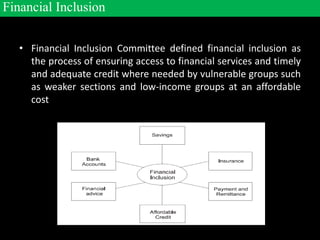
• Financial Inclusion Committee defined financial inclusion as
the process of ensuring access to financial services and timely
and adequate credit where needed by vulnerable groups such
as weaker sections and low-income groups at an affordable
cost
Financial Inclusion
• 2.5 million adults lack formal bank account & most of them
concentrated in developing countries
• Only 35% Indians have access to formal bank accounts
• Rural poor, illiterate, women and the workers in unorganized
sectors are those who are severely deprived of financial
services from formal financial institutions
• Time and travel costs, distance/physical access,
documentation requirements and bank charges for opening
bank account are some barriers
• Informal sources of finance are dominant among the poor
• Microfinance sector in India is considered to be one of the
main contributors to financial inclusion in the country
Financial Inclusion
• Means of extending financial service, usually in the form of
small loans with no collateral, to non traditional borrowers
such as the poor in rural or undeveloped areas.
• It is essentially for promoting self-employment, generally used
for:
– Direct income generation
– Rearrangement of assets and liabilities for the household to
participate in future opportunities
• Main Microfinance models are:
– SHG-Bank Linkage Model
– Grameen Bank Model
– NBFC-SKS model
Microfinance
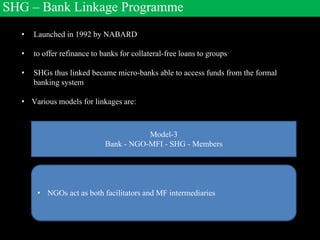
• Launched in 1992 by NABARD
• to offer refinance to banks for collateral-free loans to groups
• SHGs thus linked became micro-banks able to access funds from the formal
banking system
• Various models for linkages are:
• the bank itself promotes and nurtures the SHGs until they reach maturity
Model-1
Bank - SHG - Members
Model-2
Bank - Facilitating Agency - SHG - Members
• groups are formed and supported by NGOs or government agencies
Model-3
Bank - NGO-MFI - SHG - Members
• NGOs act as both facilitators and MF intermediaries
SHG – Bank Linkage Programme
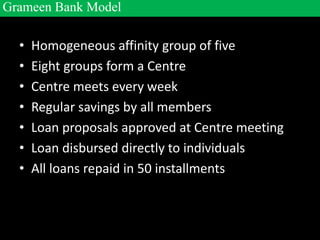
• Homogeneous affinity group of five
• Eight groups form a Centre
• Centre meets every week
• Regular savings by all members
• Loan proposals approved at Centre meeting
• Loan disbursed directly to individuals
• All loans repaid in 50 installments
Grameen Bank Model
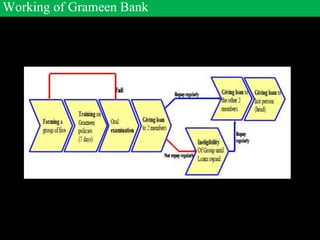
Working of Grameen Bank
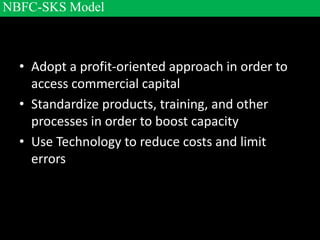
• Adopt a profit-oriented approach in order to
access commercial capital
• Standardize products, training, and other
processes in order to boost capacity
• Use Technology to reduce costs and limit
errors
NBFC-SKS Model
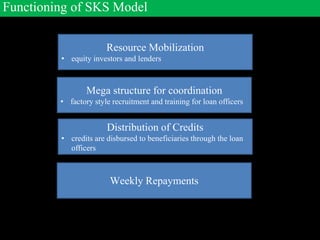
Resource Mobilization
• equity investors and lenders
Mega structure for coordination
• factory style recruitment and training for loan officers
Distribution of Credits
• credits are disbursed to beneficiaries through the loan
officers
Weekly Repayments
Functioning of SKS Model
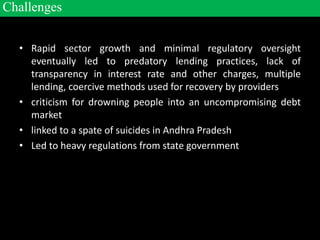
• Rapid sector growth and minimal regulatory oversight
eventually led to predatory lending practices, lack of
transparency in interest rate and other charges, multiple
lending, coercive methods used for recovery by providers
• criticism for drowning people into an uncompromising debt
market
• linked to a spate of suicides in Andhra Pradesh
• Led to heavy regulations from state government
Challenges
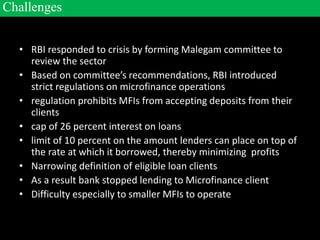
• RBI responded to crisis by forming Malegam committee to
review the sector
• Based on committee’s recommendations, RBI introduced
strict regulations on microfinance operations
• regulation prohibits MFIs from accepting deposits from their
clients
• cap of 26 percent interest on loans
• limit of 10 percent on the amount lenders can place on top of
the rate at which it borrowed, thereby minimizing profits
• Narrowing definition of eligible loan clients
• As a result bank stopped lending to Microfinance client
• Difficulty especially to smaller MFIs to operate
Challenges
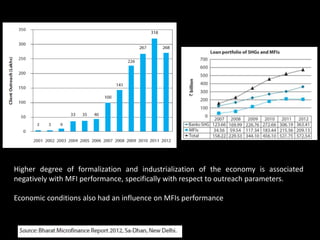
Higher degree of formalization and industrialization of the economy is associated
negatively with MFI performance, specifically with respect to outreach parameters.
Economic conditions also had an influence on MFIs performance
• Acknowledged role of MFIs in Financial inclusion
• Recommendations include:
– Universal reporting to credit bureaus to be mandated for all loans
– report data on a quarterly basis at the level of each one of their
access points such as branches, outlets, BCs, ATMs, and POS terminals,
as applicable
– creating an access point within 15 minutes of walking distance to
every resident by 01.01.2016
– Other important recommendations are dependent heavily on Aadhar
card scheme
Mor Committee on Financial Inclusion
• Microfinance still has a major role to play in achieving financial
inclusion targets.
• Though regulations posed challenge to the industry, it was
important to bring transparency to the sector
• New regulation ensures that it is only the serious players who
operates
• RBI’s decision to accord Self Regulatory Organisation status to the
industry association for NBFC-MFIs boosted the sector.
• Microfinance sector has already started recovering
• Some flexibility w.r.t interest rates can help MFIs to receive finance
for its operations.
• So Microfinance seems to be back on right path with regulations
bringing people back into the picture dominated by profit.
Conclusion
• Focus Note- Andhra Pradesh 2010: Global Implications of crisis in Indian
Microfinance, CGAP, No-67 (November-2010)
• Report of the Sub-Committee of the Central Board of Directors of Reserve
Bank of India to Study Issues and Concerns in the MFI Sector headed by
Dr. Y.H. Malegam (January-2011)
• Report of the Committee on Comprehensive Financial Services for Small
Businesses and Low-Income Households headed by Dr. Nachiket Mor
(January-2014)
• Venugopalan Puhazhendhi (2012): Microfinance India State of the Sector
Report, SAGE Publications
References

Microfinance and Financial Inclusion

  • 1.
    Microfinance With focus onFinancial Inclusion Adityasinh Chudasama Vivek Mehta Siddharth Shah Development Innovations-2014
  • 2.
    • Financial InclusionCommittee defined financial inclusion as the process of ensuring access to financial services and timely and adequate credit where needed by vulnerable groups such as weaker sections and low-income groups at an affordable cost Financial Inclusion
  • 3.
    • 2.5 millionadults lack formal bank account & most of them concentrated in developing countries • Only 35% Indians have access to formal bank accounts • Rural poor, illiterate, women and the workers in unorganized sectors are those who are severely deprived of financial services from formal financial institutions • Time and travel costs, distance/physical access, documentation requirements and bank charges for opening bank account are some barriers • Informal sources of finance are dominant among the poor • Microfinance sector in India is considered to be one of the main contributors to financial inclusion in the country Financial Inclusion
  • 4.
    • Means ofextending financial service, usually in the form of small loans with no collateral, to non traditional borrowers such as the poor in rural or undeveloped areas. • It is essentially for promoting self-employment, generally used for: – Direct income generation – Rearrangement of assets and liabilities for the household to participate in future opportunities • Main Microfinance models are: – SHG-Bank Linkage Model – Grameen Bank Model – NBFC-SKS model Microfinance
  • 5.
    • Launched in1992 by NABARD • to offer refinance to banks for collateral-free loans to groups • SHGs thus linked became micro-banks able to access funds from the formal banking system • Various models for linkages are: • the bank itself promotes and nurtures the SHGs until they reach maturity Model-1 Bank - SHG - Members Model-2 Bank - Facilitating Agency - SHG - Members • groups are formed and supported by NGOs or government agencies Model-3 Bank - NGO-MFI - SHG - Members • NGOs act as both facilitators and MF intermediaries SHG – Bank Linkage Programme
  • 6.
    • Homogeneous affinitygroup of five • Eight groups form a Centre • Centre meets every week • Regular savings by all members • Loan proposals approved at Centre meeting • Loan disbursed directly to individuals • All loans repaid in 50 installments Grameen Bank Model
  • 7.
  • 8.
    • Adopt aprofit-oriented approach in order to access commercial capital • Standardize products, training, and other processes in order to boost capacity • Use Technology to reduce costs and limit errors NBFC-SKS Model
  • 9.
    Resource Mobilization • equityinvestors and lenders Mega structure for coordination • factory style recruitment and training for loan officers Distribution of Credits • credits are disbursed to beneficiaries through the loan officers Weekly Repayments Functioning of SKS Model
  • 10.
    • Rapid sectorgrowth and minimal regulatory oversight eventually led to predatory lending practices, lack of transparency in interest rate and other charges, multiple lending, coercive methods used for recovery by providers • criticism for drowning people into an uncompromising debt market • linked to a spate of suicides in Andhra Pradesh • Led to heavy regulations from state government Challenges
  • 11.
    • RBI respondedto crisis by forming Malegam committee to review the sector • Based on committee’s recommendations, RBI introduced strict regulations on microfinance operations • regulation prohibits MFIs from accepting deposits from their clients • cap of 26 percent interest on loans • limit of 10 percent on the amount lenders can place on top of the rate at which it borrowed, thereby minimizing profits • Narrowing definition of eligible loan clients • As a result bank stopped lending to Microfinance client • Difficulty especially to smaller MFIs to operate Challenges
  • 12.
    Higher degree offormalization and industrialization of the economy is associated negatively with MFI performance, specifically with respect to outreach parameters. Economic conditions also had an influence on MFIs performance
  • 13.
    • Acknowledged roleof MFIs in Financial inclusion • Recommendations include: – Universal reporting to credit bureaus to be mandated for all loans – report data on a quarterly basis at the level of each one of their access points such as branches, outlets, BCs, ATMs, and POS terminals, as applicable – creating an access point within 15 minutes of walking distance to every resident by 01.01.2016 – Other important recommendations are dependent heavily on Aadhar card scheme Mor Committee on Financial Inclusion
  • 14.
    • Microfinance stillhas a major role to play in achieving financial inclusion targets. • Though regulations posed challenge to the industry, it was important to bring transparency to the sector • New regulation ensures that it is only the serious players who operates • RBI’s decision to accord Self Regulatory Organisation status to the industry association for NBFC-MFIs boosted the sector. • Microfinance sector has already started recovering • Some flexibility w.r.t interest rates can help MFIs to receive finance for its operations. • So Microfinance seems to be back on right path with regulations bringing people back into the picture dominated by profit. Conclusion
  • 15.
    • Focus Note-Andhra Pradesh 2010: Global Implications of crisis in Indian Microfinance, CGAP, No-67 (November-2010) • Report of the Sub-Committee of the Central Board of Directors of Reserve Bank of India to Study Issues and Concerns in the MFI Sector headed by Dr. Y.H. Malegam (January-2011) • Report of the Committee on Comprehensive Financial Services for Small Businesses and Low-Income Households headed by Dr. Nachiket Mor (January-2014) • Venugopalan Puhazhendhi (2012): Microfinance India State of the Sector Report, SAGE Publications References