Paper Presentation
                                  On

                  “Microfinance in India”

                              Presented By


Deepak Tiwari                                             Ravichandra.G


            Sir M. Visvesvaraya Institute of Technology
                               Bangalore
 03/18/13                                                                 1
CONTENTS
Introduction
Facts
Regulatory Bodies and their activities.
 Status of Micro Finance.
Self Help Groups
Role of Banks to MFI’s
Problems in MFI’s
Solutions
Conclusion
INTRODUCTION
Provision of financial services such as credit, saving, and
insurance
Poor individuals which fall below the poverty line
Impact of improving livelihood opportunities through the
provision of capital
Founded of the Grameen bank in Bangladesh by Yusuf
Group lending, individual lending , the provision of savings
and insurance, capacity building, and agricultural business
development services
Creation of social value
Facts
 
Due to its large size and population of around 1000 million, India's
GDP ranks among the top 15 economies of the world

A group of micro-finance practitioners estimated the annualized credit
usage of all poor families Sat over Rs 45,000 crores, of which some 80
percent is met by informal sources.

There are about 60 million households below or just above the
austerely defined poverty line and with more than 80 percent unable to
access credit at reasonable rate.

As on 31 March 2009, there are more than 61 lakh saving-linked
SHGs and more than 42 lakh credit-linked SHGs and thus, about 8.6
crore poor households are covered under the programme and 4 out of 5
microfinance clients in India are women.
Regulatory Bodies And Their Activities

SHGs, NGOs,NABARD,1995

The National Microfinance Taskforce,1999

Working Groups on Financial Flows to the Informal Sector.2002

Microfinance Development and Equity Fund,NABARD,2005

Working group on Financing NBFC’s by Banks-RBI

Activities include Microcredit, Micro savings, Micro insurance and
Remittances
Micro Finance In India
SELF HELP GROUPS(SHGs)
Major role on poverty alleviation in rural India as they Actively
engage in saving and credit

Create some control over capital-very small amounts

Gradually away form exploitation and isolation

10-25 members and collect savings from members typically once a
week

Government of government and non-governmental agencies, they non-
governmental agencies, they now make up 90 % of all SHG’s.

Start without any external financial capital

Small internal loans for micro finance enterprise
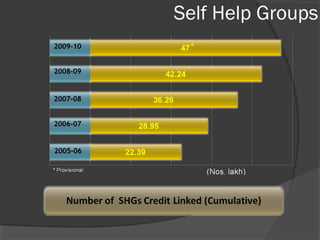
Self Help Groups
2009-10


2008-09


2007-08


2006-07


2005-06
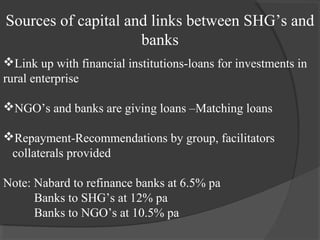
Sources of capital and links between SHG’s and
                     banks
Link up with financial institutions-loans for investments in
rural enterprise

NGO’s and banks are giving loans –Matching loans

Repayment-Recommendations by group, facilitators
 collaterals provided

Note: Nabard to refinance banks at 6.5% pa
      Banks to SHG’s at 12% pa
      Banks to NGO’s at 10.5% pa
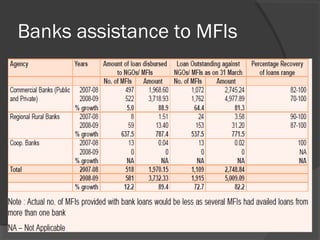
Banks assistance to MFIs
Comparative Analysis of Micro finance services
             offered to the poor:
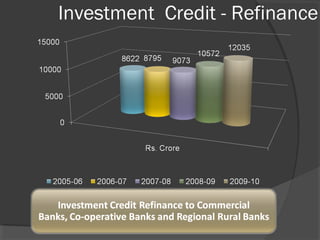
Investment Credit - Refinance
The Problems of Mainstream MFIs
Borrower Unfriendly Products and Procedures

Inflexibility and Delay

High Transaction Costs, both Legitimate and Illegal

Social Obligation and not a Business Opportunity

Financing to Alternative MFIs

Complexity in Legal and Regulatory Framework
Problems for Alternative Micro-Finance
                   Institutions
The alternative finance institutions have not been fully
successful in reaching the needy. There are many reasons for
this:

1. Financial problems leading to setting up of inappropriate
legal structures and Inappropriate Legal Forms
 
2. Lack of commercial orientation

3. Lack of proper governance and accountability

4. Isolated and scattered
Solutions
 Greater legitimacy, accountability and transparency in MFIs

 There is a need to recognize a separate category of Microfinance

 It should be specified that at least 80% of the assets of MF-NBFCs
  should be in the form of microcredit of upto Rs. 50,000 for
  agriculture, allied and non farm activities and in case of housing,
  loans upto Rs. 1,50,000, per individual borrower.

 MF-NBFCs as Business Correspondents (BCs) for a local feel.

 Relaxation in FIPB guidelines and Unifying regulatory oversight

 Tax Concessions and Accounting and Disclosure Norms.

 As micro-insurance agents
CONCLUSION
India’s achievement of the MDG of halving the population of poor by
2015 as well as achieving a broad based economic growth also hinges on
a successful poverty alleviation strategy. In this backdrop, the impressive
gains made by SHG-Bank linkage programme in coverage of rural
population with financial services offers a ray of hope.

Underlying Belief of Self Help Groups..............
“Give a man a fish and you feed him a day but teach him how to fish and
you feed him a lifetime”

Many little things done in many little places, by many little people,
will change the face of the world. - An old Chinese saying
Any


      Questions
Micro finance in India

Micro finance in India

  • 1.
    Paper Presentation On “Microfinance in India” Presented By Deepak Tiwari Ravichandra.G Sir M. Visvesvaraya Institute of Technology Bangalore 03/18/13 1
  • 2.
    CONTENTS Introduction Facts Regulatory Bodies andtheir activities.  Status of Micro Finance. Self Help Groups Role of Banks to MFI’s Problems in MFI’s Solutions Conclusion
  • 3.
    INTRODUCTION Provision of financialservices such as credit, saving, and insurance Poor individuals which fall below the poverty line Impact of improving livelihood opportunities through the provision of capital Founded of the Grameen bank in Bangladesh by Yusuf Group lending, individual lending , the provision of savings and insurance, capacity building, and agricultural business development services Creation of social value
  • 4.
    Facts   Due to itslarge size and population of around 1000 million, India's GDP ranks among the top 15 economies of the world A group of micro-finance practitioners estimated the annualized credit usage of all poor families Sat over Rs 45,000 crores, of which some 80 percent is met by informal sources. There are about 60 million households below or just above the austerely defined poverty line and with more than 80 percent unable to access credit at reasonable rate. As on 31 March 2009, there are more than 61 lakh saving-linked SHGs and more than 42 lakh credit-linked SHGs and thus, about 8.6 crore poor households are covered under the programme and 4 out of 5 microfinance clients in India are women.
  • 5.
    Regulatory Bodies AndTheir Activities SHGs, NGOs,NABARD,1995 The National Microfinance Taskforce,1999 Working Groups on Financial Flows to the Informal Sector.2002 Microfinance Development and Equity Fund,NABARD,2005 Working group on Financing NBFC’s by Banks-RBI Activities include Microcredit, Micro savings, Micro insurance and Remittances
  • 6.
  • 7.
    SELF HELP GROUPS(SHGs) Majorrole on poverty alleviation in rural India as they Actively engage in saving and credit Create some control over capital-very small amounts Gradually away form exploitation and isolation 10-25 members and collect savings from members typically once a week Government of government and non-governmental agencies, they non- governmental agencies, they now make up 90 % of all SHG’s. Start without any external financial capital Small internal loans for micro finance enterprise
  • 8.
  • 9.
    Sources of capitaland links between SHG’s and banks Link up with financial institutions-loans for investments in rural enterprise NGO’s and banks are giving loans –Matching loans Repayment-Recommendations by group, facilitators collaterals provided Note: Nabard to refinance banks at 6.5% pa Banks to SHG’s at 12% pa Banks to NGO’s at 10.5% pa
  • 10.
  • 11.
    Comparative Analysis ofMicro finance services offered to the poor:
  • 12.
  • 13.
    The Problems ofMainstream MFIs Borrower Unfriendly Products and Procedures Inflexibility and Delay High Transaction Costs, both Legitimate and Illegal Social Obligation and not a Business Opportunity Financing to Alternative MFIs Complexity in Legal and Regulatory Framework
  • 14.
    Problems for AlternativeMicro-Finance Institutions The alternative finance institutions have not been fully successful in reaching the needy. There are many reasons for this: 1. Financial problems leading to setting up of inappropriate legal structures and Inappropriate Legal Forms   2. Lack of commercial orientation 3. Lack of proper governance and accountability 4. Isolated and scattered
  • 15.
    Solutions  Greater legitimacy,accountability and transparency in MFIs  There is a need to recognize a separate category of Microfinance  It should be specified that at least 80% of the assets of MF-NBFCs should be in the form of microcredit of upto Rs. 50,000 for agriculture, allied and non farm activities and in case of housing, loans upto Rs. 1,50,000, per individual borrower.  MF-NBFCs as Business Correspondents (BCs) for a local feel.  Relaxation in FIPB guidelines and Unifying regulatory oversight  Tax Concessions and Accounting and Disclosure Norms.  As micro-insurance agents
  • 16.
    CONCLUSION India’s achievement ofthe MDG of halving the population of poor by 2015 as well as achieving a broad based economic growth also hinges on a successful poverty alleviation strategy. In this backdrop, the impressive gains made by SHG-Bank linkage programme in coverage of rural population with financial services offers a ray of hope. Underlying Belief of Self Help Groups.............. “Give a man a fish and you feed him a day but teach him how to fish and you feed him a lifetime” Many little things done in many little places, by many little people, will change the face of the world. - An old Chinese saying
  • 17.
    Any Questions