

Micro Finance in India
1
A PRESENTATION ON
Microfinance: what is it?
2
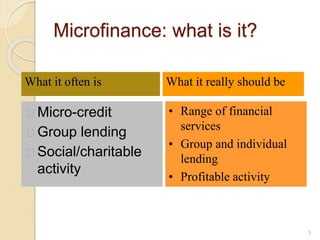
Microfinance: what is it?
 Micro-credit
 Group lending
 Social/charitable
activity
3
• Range of financial
services
• Group and individual
lending
• Profitable activity
What it often is What it really should be
Providing financial services to the poor:
. challenges
4
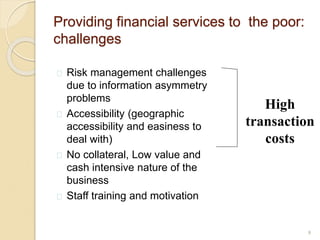
Providing financial services to the poor:
challenges
 Risk management challenges
due to information asymmetry
problems
 Accessibility (geographic
accessibility and easiness to
deal with)
 No collateral, Low value and
cash intensive nature of the
business
 Staff training and motivation
5
High
transaction
costs
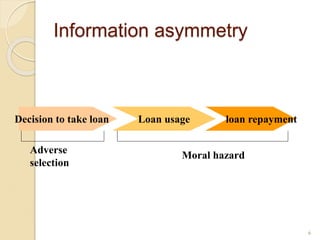
Information asymmetry
6
Decision to take loan Loan usage loan repayment
Adverse
selection
Moral hazard
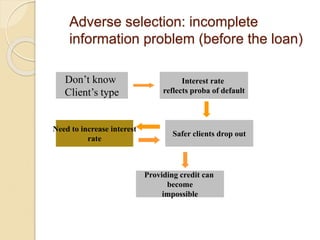
Adverse selection: incomplete
information problem (before the loan)
Don’t know
Client’s type
Interest rate
reflects proba of default
Safer clients drop out
Need to increase interest
rate
Providing credit can
become
impossible
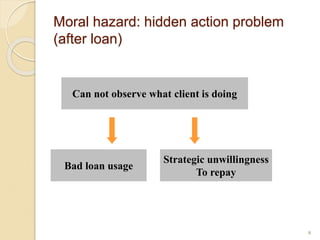
Moral hazard: hidden action problem
(after loan)
8
Can not observe what client is doing
Bad loan usage
Strategic unwillingness
To repay
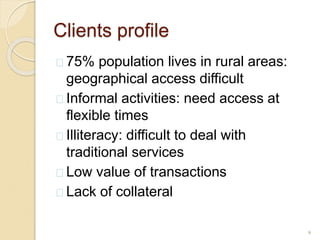
Clients profile
 75% population lives in rural areas:
geographical access difficult
 Informal activities: need access at
flexible times
 Illiteracy: difficult to deal with
traditional services
 Low value of transactions
 Lack of collateral
9
Staff
 Lack of trained staff
 Lack of motivated staff
 Difficult to incentives staff
10
Delivering financial services to the poor in
India: an overview
Providing financial services to the poor:
occupied India
Deccan, late 19th Century:
peasant riots on account of coercive
alienation of land by moneylenders.
12
Organization of cooperative societies as
alternative institutions for providing crédit
by british government
Results
 Access in terms of rural branches increased
from 1,833 in 1969 to around 32,538 at
present: 49% of all scheduled commercial
bank branches are rural
 The population per rural branch declined from
2,01,854 in 1969 to around 16,000 at present.
 The proportion of borrowings of rural
households from institutional sources
increased from 7 per cent in 1951 to more than
60 per cent at present.
13
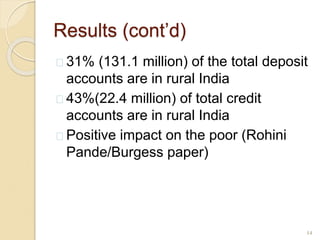
Results (cont’d)
 31% (131.1 million) of the total deposit
accounts are in rural India
 43%(22.4 million) of total credit
accounts are in rural India
 Positive impact on the poor (Rohini
Pande/Burgess paper)
14
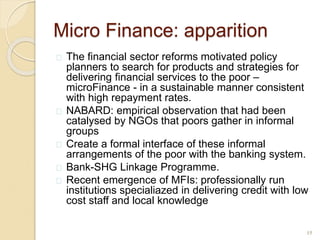
Micro Finance: apparition
 The financial sector reforms motivated policy
planners to search for products and strategies for
delivering financial services to the poor –
microFinance - in a sustainable manner consistent
with high repayment rates.
 NABARD: empirical observation that had been
catalysed by NGOs that poors gather in informal
groups
 Create a formal interface of these informal
arrangements of the poor with the banking system.
 Bank-SHG Linkage Programme.
 Recent emergence of MFIs: professionally run
institutions specialiazed in delivering credit with low
cost staff and local knowledge
15
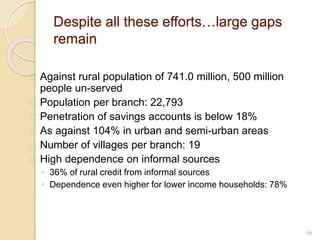
Despite all these efforts…large gaps
remain
 Against rural population of 741.0 million, 500 million
people un-served
 Population per branch: 22,793
 Penetration of savings accounts is below 18%
 As against 104% in urban and semi-urban areas
 Number of villages per branch: 19
 High dependence on informal sources
◦ 36% of rural credit from informal sources
◦ Dependence even higher for lower income households: 78%
16
Microfinance ahead:
challenges
17
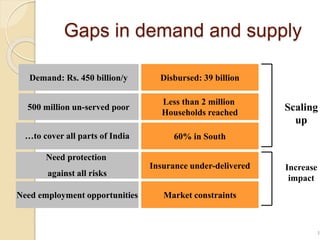
Gaps in demand and supply
1
Demand: Rs. 450 billion/y
60% in South…to cover all parts of India
Less than 2 million
Households reached
500 million un-served poor
Disbursed: 39 billion
Need employment opportunities
Need protection
against all risks
Market constraints
Insurance under-delivered
Scaling
up
Increase
impact
Technology
Role of technology in microfinance:
 MIS
 Cash handling
 Data capture and subsequent
management
19
Range of Microfinancial
services:
 Health insurance
◦ Reimbursement model
◦ Cashless model
◦ How to identify illness?
◦ How to avoid fraud?
 Livestock insurance
◦ Recognize cause of death
◦ Identify animal (role of technology)
20
Range of Microfinancial services:
 Weather insurance
 Index-based: index created by assigning
weights to critical time periods
 Past weather data mapped to this index
to arrive at normal treshhold index
 If deviation: compensation
 Commodity price derivatives
 NCDEX: offers price discovery services:
offer farmers instruments to hedge pre
and post harvest risks
 Makes using commodity as collateral
possible
21
Range of Microfinancial services:
 Savings and investments products
◦ Could be offered through Money Market
Mutual Fund: MFI acts as agent
 Remittances
◦ 10 million seasonal and circular migrants
(National Commission on Rural Labour)
◦ Adhikar, Orissa
◦ ICICI: remittance product through internet
kiosks
22

A PPT ON MICRO FINANCE BY :- GAURAV BHUT

  • 1.
    Micro Finance inIndia 1 A PRESENTATION ON
  • 2.
  • 3.
    Microfinance: what isit?  Micro-credit  Group lending  Social/charitable activity 3 • Range of financial services • Group and individual lending • Profitable activity What it often is What it really should be
  • 4.
    Providing financial servicesto the poor: . challenges 4
  • 5.
    Providing financial servicesto the poor: challenges  Risk management challenges due to information asymmetry problems  Accessibility (geographic accessibility and easiness to deal with)  No collateral, Low value and cash intensive nature of the business  Staff training and motivation 5 High transaction costs
  • 6.
    Information asymmetry 6 Decision totake loan Loan usage loan repayment Adverse selection Moral hazard
  • 7.
    Adverse selection: incomplete informationproblem (before the loan) Don’t know Client’s type Interest rate reflects proba of default Safer clients drop out Need to increase interest rate Providing credit can become impossible
  • 8.
    Moral hazard: hiddenaction problem (after loan) 8 Can not observe what client is doing Bad loan usage Strategic unwillingness To repay
  • 9.
    Clients profile  75%population lives in rural areas: geographical access difficult  Informal activities: need access at flexible times  Illiteracy: difficult to deal with traditional services  Low value of transactions  Lack of collateral 9
  • 10.
    Staff  Lack oftrained staff  Lack of motivated staff  Difficult to incentives staff 10
  • 11.
    Delivering financial servicesto the poor in India: an overview
  • 12.
    Providing financial servicesto the poor: occupied India Deccan, late 19th Century: peasant riots on account of coercive alienation of land by moneylenders. 12 Organization of cooperative societies as alternative institutions for providing crédit by british government
  • 13.
    Results  Access interms of rural branches increased from 1,833 in 1969 to around 32,538 at present: 49% of all scheduled commercial bank branches are rural  The population per rural branch declined from 2,01,854 in 1969 to around 16,000 at present.  The proportion of borrowings of rural households from institutional sources increased from 7 per cent in 1951 to more than 60 per cent at present. 13
  • 14.
    Results (cont’d)  31%(131.1 million) of the total deposit accounts are in rural India  43%(22.4 million) of total credit accounts are in rural India  Positive impact on the poor (Rohini Pande/Burgess paper) 14
  • 15.
    Micro Finance: apparition The financial sector reforms motivated policy planners to search for products and strategies for delivering financial services to the poor – microFinance - in a sustainable manner consistent with high repayment rates.  NABARD: empirical observation that had been catalysed by NGOs that poors gather in informal groups  Create a formal interface of these informal arrangements of the poor with the banking system.  Bank-SHG Linkage Programme.  Recent emergence of MFIs: professionally run institutions specialiazed in delivering credit with low cost staff and local knowledge 15
  • 16.
    Despite all theseefforts…large gaps remain  Against rural population of 741.0 million, 500 million people un-served  Population per branch: 22,793  Penetration of savings accounts is below 18%  As against 104% in urban and semi-urban areas  Number of villages per branch: 19  High dependence on informal sources ◦ 36% of rural credit from informal sources ◦ Dependence even higher for lower income households: 78% 16
  • 17.
  • 18.
    Gaps in demandand supply 1 Demand: Rs. 450 billion/y 60% in South…to cover all parts of India Less than 2 million Households reached 500 million un-served poor Disbursed: 39 billion Need employment opportunities Need protection against all risks Market constraints Insurance under-delivered Scaling up Increase impact
  • 19.
    Technology Role of technologyin microfinance:  MIS  Cash handling  Data capture and subsequent management 19
  • 20.
    Range of Microfinancial services: Health insurance ◦ Reimbursement model ◦ Cashless model ◦ How to identify illness? ◦ How to avoid fraud?  Livestock insurance ◦ Recognize cause of death ◦ Identify animal (role of technology) 20
  • 21.
    Range of Microfinancialservices:  Weather insurance  Index-based: index created by assigning weights to critical time periods  Past weather data mapped to this index to arrive at normal treshhold index  If deviation: compensation  Commodity price derivatives  NCDEX: offers price discovery services: offer farmers instruments to hedge pre and post harvest risks  Makes using commodity as collateral possible 21
  • 22.
    Range of Microfinancialservices:  Savings and investments products ◦ Could be offered through Money Market Mutual Fund: MFI acts as agent  Remittances ◦ 10 million seasonal and circular migrants (National Commission on Rural Labour) ◦ Adhikar, Orissa ◦ ICICI: remittance product through internet kiosks 22