Microfinance


                                                                        Sarinee Achavanuntakul
                                                                            17 September 2010
        งานนี้เผยแพร่ภายใต้ลขสิทธิ ์ Creative Commons แบบ Attribution Non-commercial Share Alike (by-nc-sa) โดย
                              ิ
                                                                                                                  1
        ผูสร้างอนุญาตให้ทาซา แจกจ่าย แสดง และสร้างงานดัดแปลงจากส่วนใดส่วนหนึ่งของงานนี้ได้โดยเสรี แต่เฉพาะใน
          ้                 ้
        กรณีทให้เครดิตผูสร้าง ไม่นาไปใช้ในทางการค้า และเผยแพร่งานดัดแปลงภายใต้ลขสิทธิเดียวกันนี้เท่านัน
               ่ี       ้                                                       ิ     ์               ้
Topics
 The concept and models of microfinance
 Does microfinance really help the poor?

 Microfinance in Thailand: some preliminary findings
  from field research


                                                        2
The concept and models of microfinance


                                         3
What is microfinance?
 Microfinance institutions (MFIs) provide financial services for the
  poor
 Not ‚informal players‛ e.g. moneylenders, self-help groups

 Definition of ‚the poor‛ varies
       People living below poverty line
       People who have little access to formal banking, especially in rural areas
   Two kinds of incentives
       ‚Social business‛ : social mission at the core, aims to be financially
        sustainable -- most MFIs. This will be the subject of these slides
       ‚Commercial microfinance‛ : profit-oriented MFIs
                                                                                 4
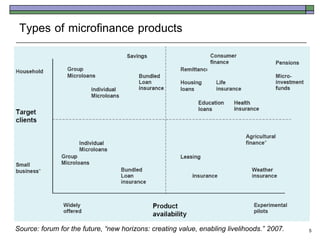
Types of microfinance products


Source: forum for the future, “new horizons: creating value, enabling livelihoods.” 2007.   5
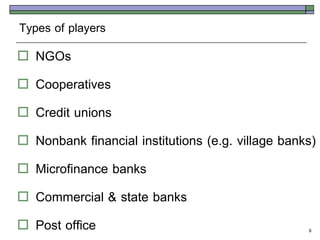
Types of players
   NGOs
   Cooperatives
   Credit unions
   Nonbank financial institutions (e.g. village banks)
   Microfinance banks
   Commercial & state banks
   Post office                                      6
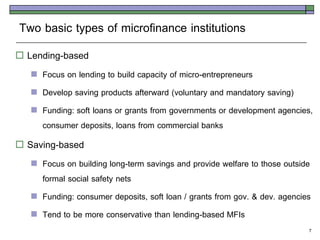
Two basic types of microfinance institutions
   Lending-based
       Focus on lending to build capacity of micro-entrepreneurs
       Develop saving products afterward (voluntary and mandatory saving)
       Funding: soft loans or grants from governments or development agencies,
        consumer deposits, loans from commercial banks
   Saving-based
       Focus on building long-term savings and provide welfare to those outside
        formal social safety nets
       Funding: consumer deposits, soft loan / grants from gov. & dev. agencies
       Tend to be more conservative than lending-based MFIs
                                                                               7
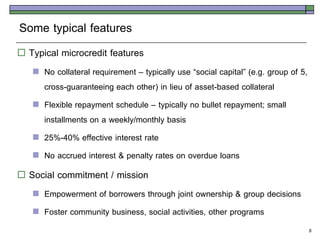
Some typical features
   Typical microcredit features
       No collateral requirement – typically use ‚social capital‛ (e.g. group of 5,
        cross-guaranteeing each other) in lieu of asset-based collateral
       Flexible repayment schedule – typically no bullet repayment; small
        installments on a weekly/monthly basis
       25%-40% effective interest rate
       No accrued interest & penalty rates on overdue loans
   Social commitment / mission
       Empowerment of borrowers through joint ownership & group decisions
       Foster community business, social activities, other programs
                                                                                       8
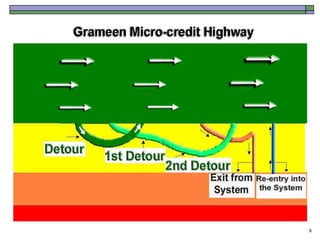
‚Grameen microcredit highway‛


                                9
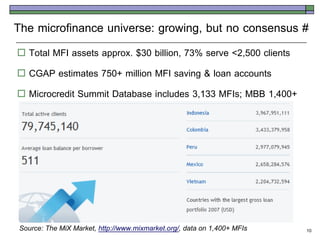
The microfinance universe: growing, but no consensus #
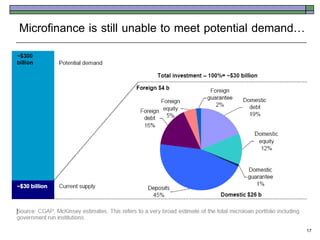
 Total MFI assets approx. $30 billion, 73% serve <2,500 clients
 CGAP estimates 750+ million MFI saving & loan accounts

 Microcredit Summit Database includes 3,133 MFIs; MBB 1,400+


Source: The MiX Market, http://www.mixmarket.org/, data on 1,400+ MFIs   10
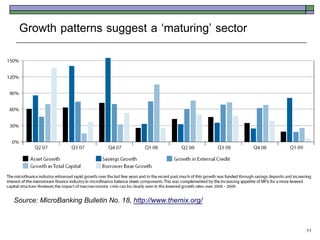
Growth patterns suggest a ‘maturing’ sector


Source: MicroBanking Bulletin No. 18, http://www.themix.org/

                                                               11
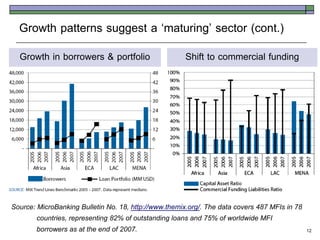
Growth patterns suggest a ‘maturing’ sector (cont.)
  Growth in borrowers & portfolio                      Shift to commercial funding


Source: MicroBanking Bulletin No. 18, http://www.themix.org/. The data covers 487 MFIs in 78
        countries, representing 82% of outstanding loans and 75% of worldwide MFI
        borrowers as at the end of 2007.                                                       12
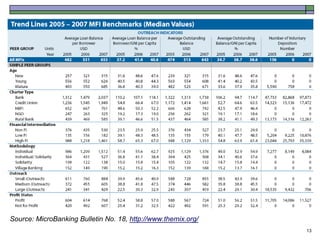
Source: MicroBanking Bulletin No. 18, http://www.themix.org/
                                                               13
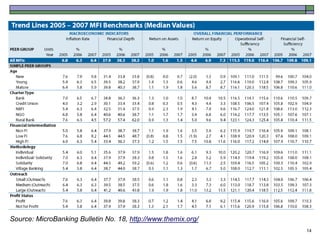
Source: MicroBanking Bulletin No. 18, http://www.themix.org/
                                                               14
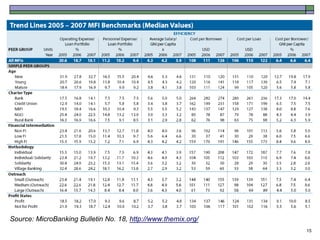
Source: MicroBanking Bulletin No. 18, http://www.themix.org/
                                                               15
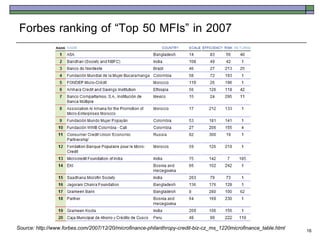
Forbes ranking of ‚Top 50 MFIs‛ in 2007


Source: http://www.forbes.com/2007/12/20/microfinance-philanthropy-credit-biz-cz_ms_1220microfinance_table.html   16
Microfinance is still unable to meet potential demand…


                                                         17
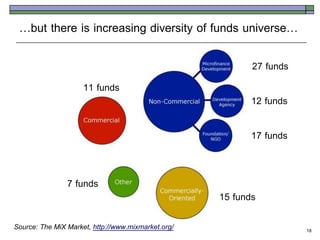
…but there is increasing diversity of funds universe…

                                                           27 funds
                     11 funds
                                                           12 funds

                                                           17 funds


                7 funds
                                                    15 funds

Source: The MiX Market, http://www.mixmarket.org/                     18
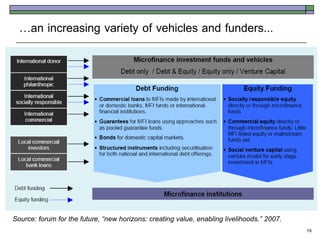
…an increasing variety of vehicles and funders...


Source: forum for the future, “new horizons: creating value, enabling livelihoods.” 2007.
                                                                                            19
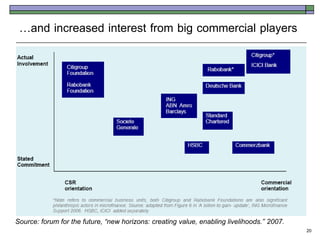
…and increased interest from big commercial players


Source: forum for the future, “new horizons: creating value, enabling livelihoods.” 2007.
                                                                                            20
Recent trends
   Increase in local competition amongst MFIs
   Increase in competition from local commercial banks
   Growing interest of international banks and investors
   Greater transparency, allows for measurement and
    benchmarking of financial performance
   Increasing role played by microfinance rating agencies
Current issues
On the positive side:
 Growing industry – number of institutions & clients.
 Largely survived the food (2007) financial (2008) and economic (2009) crises.
 But challenges remain: economic turmoil, approx. 2.5 billion people still don’t
  have access.
Weakness & downsides:
 Development impact – does it really help the poor?
 Excessive (or not?) profit-making behavior
     Exorbitant interest rates
     Over-indebtedness
     Microfinance ‚bubbles‛?
‚Mission Drift‛ in microfinance
Cull, Demirgüc-Kunt, and Morduch (2007) define mission drift as
‚… a shift in the composition of new clients, or a reorientation from
poorer to wealthier clients among existing clients.‛

Armendáriz and Szafarz (2009) define mission drift as
“ … a phenomenon whereby an MFI increases its average loan size
by reaching out wealthier clients neither for progressive lending nor
for cross subsidization reasons.”
Does microfinance really help the poor?


                                          24
CGAP: Principles of microfinance
   The poor need a variety of financial services, not just loans.
    Just like everyone else, poor people need a wide range of
    financial services that are convenient, flexible, and reasonably
    priced. Depending on their circumstances, poor people need not
    only credit, but also savings, cash transfers, and insurance.
   Microfinance is a powerful instrument against poverty. Access
    to sustainable financial services enables the poor to increase
    incomes, build assets, and reduce their vulnerability to external
    shocks. Microfinance allows poor households to move from
    everyday survival to planning for the future.
                                                                    25
CGAP: Principles of microfinance (cont.)
   Microfinance means building financial systems that serve the
    poor. Poor people constitute the vast majority of the population in
    most developing countries. Yet, an overwhelming number of the
    poor continue to lack access to basic financial services.
   Financial sustainability is necessary to reach significant
    numbers of poor people. Most poor people are not able to
    access financial services because of the lack of strong retail
    financial intermediaries. Building financially sustainable institutions
    is not an end in itself. It is the only way to reach significant scale
    and impact far beyond what donor agencies can fund.
                                                                          26
CGAP: Principles of microfinance (cont.)
   Microfinance is about building permanent local financial
    institutions. Building financial systems for the poor means
    building sound domestic financial intermediaries that can provide
    financial services to poor people on a permanent basis. Such
    institutions should be able to mobilize and recycle domestic
    savings, extend credit, and provide a range of services.
   Microcredit is not always the answer. Microcredit is not
    appropriate for everyone or every situation. The destitute and
    hungry who have no income or means of repayment need other
    forms of support before they can make use of loans.
                                                                        27
CGAP: Principles of microfinance (cont.)
   Interest rate ceilings can damage poor people’s access to
    financial services. It costs much more to make many small loans
    than a few large loans. Unless microlenders can charge interest
    rates that are well above average bank loan rates, they cannot
    cover their costs, and their growth and sustainability will be limited
    by the scarce and uncertain supply of subsidized funding.
   The government’s role is as an enabler, not as a direct
    provider of financial services. National governments play an
    important role in setting a supportive policy environment that
    stimulates the development of financial services while protecting
    poor people’s savings.                                               28
CGAP: Principles of microfinance (cont.)
   Donor subsidies should complement, not compete with
    private sector capital. Donors should use appropriate grant, loan,
    and equity instruments on a temporary basis to build the
    institutional capacity of financial providers, develop supporting
    infrastructure (like rating agencies, credit bureaus, audit capacity,
    etc.), and support experimental services and products.
   The lack of institutional and human capacity is the key
    constraint. Microfinance is a specialized field that combines
    banking with social goals, and capacity needs to be built at all
    levels. Most investments in the sector, both public and private,
    should focus on this capacity building.                             29
CGAP: Principles of microfinance (cont.)
   The importance of financial and outreach transparency.
    Accurate, standardized, and comparable information on the
    financial and social performance of financial institutions providing
    services to the poor is imperative. Bank supervisors and
    regulators, donors, investors, and more importantly, the poor who
    are clients of microfinance need this information to adequately
    assess risk and returns.


                                                                           30
Some latest findings: the story vs. the reality
 The story: ‚Microfinance funds creation and expansion of
  microenterprises, producing additional income that lifts the
  borrowers’ households out of poverty.‛
 The truth, naturally, is more complicated. One problem is the
  complex issue of causality – Randomized Controlled Trials (RCTs)
  is still new to this field.
 The verdict is still out on whether microfinance reduces poverty on
  average (i.e. not making some poor worse off the way credit cards
  made some middle income consumers worse off).
 Income may not increase, but ‚consumption smoothing‛ is a benefit.
                                                                   31
The real benefit of microfinance
 The problem with being poor is not just that income is low, but
  also that it tends to be uneven and vulnerable to disruption.
  Given the variability and vulnerability of their income, poor
  households have to save and borrow constantly in order to put
  food on the table and meet other consumption needs.
 Since informal credit and savings mechanisms tend to be
  unreliable, microfinance customers value formal microfinance
  highly because it is more reliable, even if it is often less flexible
  than their other tools to manage their cash flow.
 Millions of microfinance customers are ‚voting with their feet.‛
                                                                          32
Looking at microfinance from ‚capabilities approach‛
 Applying Amartya Sen’s capabilities approach as described in
  ‚Development as Freedom‛ to microfinance leads to some
  interesting issues:
 Good research question: when does microfinance gives people
  more control over their lives and when less?
 Also, from the perspective that development is a tool for institution-
  building, one important contribution of microfinance is the
  enrichment of important institutions: enhancing social cohesion,
  encouraging civic participation, etc.

                                                                       33
Microfinance in Thailand: some preliminary
findings from field research


                                             34
‚Grassroots finance‛ in Thailand
There are 3 kinds of players in Thailand’s ‚grassroots finance‛ space
1. State-owned banks: Bank for Agriculture and Agricultural Cooperatives
    (BAAC), Krung Thai Bank, Government Savings Bank, Government
    Housing Bank
2. Semi-formal groups (set up as government’s initiatives): 78,013 Baht 1
    million village funds (some upgraded to ‚community banks‛), 1,227 saving
    cooperatives, credit unions, and saving-for-production groups. The assets
    of these groups total approx. Baht 900 billion.
3. Informal groups (set up as villagers’ own initiatives): one-Baht savings
    groups, one-Baht expense reduction groups, etc. Total assets approx.
    Baht 30 billion.
Semi-formal groups and informal groups serve approx. 12 million people.
Some preliminary findings from field research
   Very few grassroots finance groups in Thailand aim to make financial
    profits. Most only want to ‚safeguard‛ their capital and fulfill social mission.
    Therefore, financial stability remains more important than profitability.
   Many of the groups’ concerns are governance issues, e.g. the difficulty of
    finding ‚new blood‛ to succeed directors, lack of accounting training.
   Benefits to clients from savings-based groups seem to be more tangible in
    the form of welfare (e.g. childbirth stipend, sickness allowance, funeral
    rites allowance) paid from clients’ collective savings. Operational
    sufficiency is major risk.
   Benefits to clients from loan-based groups are less clear. Major risk lies in
    the inability of clients to use loans to raise living standards. Delinquency is
    not so much a problem since most clients ‘refinance’ from other groups.
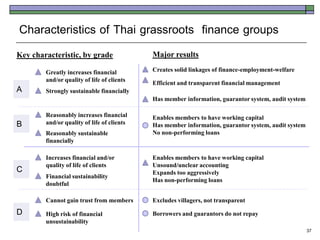
Characteristics of Thai grassroots finance groups
Key characteristic, by grade                Major results

        Greatly increases financial         Creates solid linkages of finance-employment-welfare
        and/or quality of life of clients
                                            Efficient and transparent financial management
A       Strongly sustainable financially
                                            Has member information, guarantor system, audit system

        Reasonably increases financial      Enables members to have working capital
B       and/or quality of life of clients   Has member information, guarantor system, audit system
        Reasonably sustainable              No non-performing loans
        financially

        Increases financial and/or          Enables members to have working capital
C       quality of life of clients          Unsound/unclear accounting
                                            Expands too aggressively
        Financial sustainability
                                            Has non-performing loans
        doubtful

        Cannot gain trust from members      Excludes villagers, not transparent
D       High risk of financial              Borrowers and guarantors do not repay
        unsustainability
                                                                                                     37
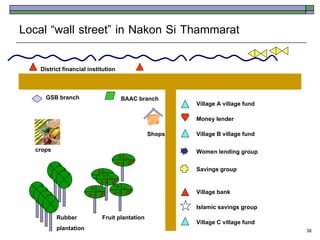
Local ‚wall street‛ in Nakon Si Thammarat

   District financial institution


     GSB branch                     BAAC branch
                                                      Village A village fund
                                                      Money lender
                                              Shops   Village B village fund
  crops                                               Women lending group
                                                      Savings group

                                                      Village bank
                                                      Islamic savings group
          Rubber           Fruit plantation
                                                      Village C village fund
          plantation                                                           38
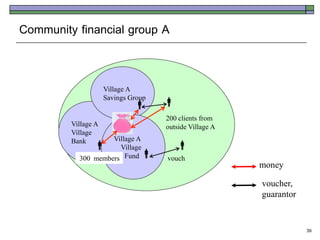
Community financial group A


                     Village A
                     Savings Group
                                    
                                     200 clients from
         Village A                   outside Village A
         Village
         Bank       Village A
                     Village            
           300 members Fund         vouch
                                                         money

                                                         voucher,
                                                         guarantor


                                                                     39
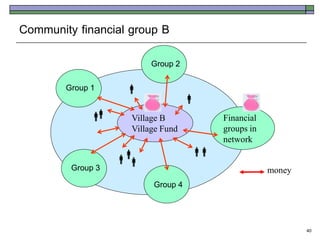
Community financial group B
                         Group 2


        Group 1    
                                   
             
                   Village B           Financial
                    Village Fund        groups in
                                        network
                                  
                   
         Group 3                                    money
                         Group 4


                                                            40
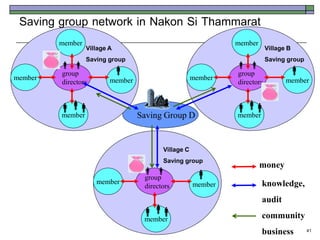
Saving group network in Nakon Si Thammarat
         member                                                member
                  Village A                                                Village B
                  Saving group                                             Saving group
                                                                              
         group                                                 group
member                    member                      member                      member
         directors                                             directors


                                                            
         member                    Saving Group D              member


                                          Village C
                                          Saving group
                                                                        money
                                    
                                    group              
                     member                           member            knowledge,
                                    directors
                                                                        audit
                                                                     community
                                    member
                                                                        business          41
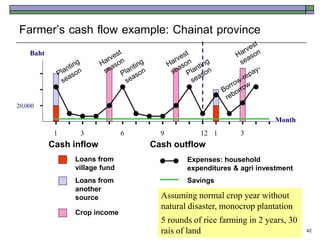
Farmer’s cash flow example: Chainat province
    Baht


20,000

                                                                     Month
            1     3            6     9          12 1       3
           Cash inflow             Cash outflow
                Loans from                  Expenses: household
                village fund                expenditures & agri investment
                Loans from                  Savings
                another
                source               Assuming normal crop year without
                                     natural disaster, monocrop plantation
                Crop income
                                     5 rounds of rice farming in 2 years, 30
                                     rais of land                              42
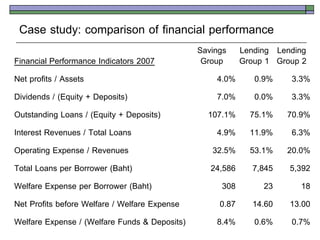
Case study: comparison of financial performance
                                             Savings Lending Lending
Financial Performance Indicators 2007         Group Group 1 Group 2
Net profits / Assets                              4.0%  0.9%    3.3%
Dividends / (Equity + Deposits)                   7.0%  0.0%    3.3%
Outstanding Loans / (Equity + Deposits)        107.1% 75.1% 70.9%
Interest Revenues / Total Loans                   4.9% 11.9%    6.3%
Operating Expense / Revenues                     32.5% 53.1% 20.0%
Total Loans per Borrower (Baht)                 24,586 7,845 5,392
Welfare Expense per Borrower (Baht)                308     23      18
Net Profits before Welfare / Welfare Expense       0.87 14.60 13.00
Welfare Expense / (Welfare Funds & Deposits)      8.4%  0.6%    0.7%
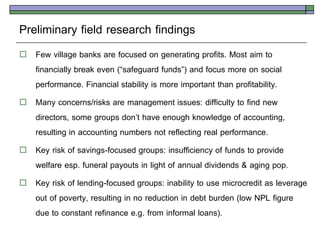
Preliminary field research findings
   Few village banks are focused on generating profits. Most aim to
    financially break even (‚safeguard funds‛) and focus more on social
    performance. Financial stability is more important than profitability.
   Many concerns/risks are management issues: difficulty to find new
    directors, some groups don’t have enough knowledge of accounting,
    resulting in accounting numbers not reflecting real performance.
   Key risk of savings-focused groups: insufficiency of funds to provide
    welfare esp. funeral payouts in light of annual dividends & aging pop.
   Key risk of lending-focused groups: inability to use microcredit as leverage
    out of poverty, resulting in no reduction in debt burden (low NPL figure
    due to constant refinance e.g. from informal loans).
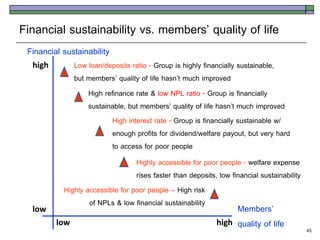
Financial sustainability vs. members’ quality of life
 Financial sustainability
  high         Low loan/deposits ratio - Group is highly financially sustainable,
               but members’ quality of life hasn’t much improved
                   High refinance rate & low NPL ratio - Group is financially
                   sustainable, but members’ quality of life hasn’t much improved
                           High interest rate - Group is financially sustainable w/
                           enough profits for dividend/welfare payout, but very hard
                           to access for poor people
                                  Highly accessible for poor people - welfare expense
                                  rises faster than deposits, low financial sustainability
           Highly accessible for poor people – High risk
                   of NPLs & low financial sustainability
  low                                                               Members’
         low                                                 high   quality of life          45

Microfinance

  • 1.
    Microfinance Sarinee Achavanuntakul 17 September 2010 งานนี้เผยแพร่ภายใต้ลขสิทธิ ์ Creative Commons แบบ Attribution Non-commercial Share Alike (by-nc-sa) โดย ิ 1 ผูสร้างอนุญาตให้ทาซา แจกจ่าย แสดง และสร้างงานดัดแปลงจากส่วนใดส่วนหนึ่งของงานนี้ได้โดยเสรี แต่เฉพาะใน ้ ้ กรณีทให้เครดิตผูสร้าง ไม่นาไปใช้ในทางการค้า และเผยแพร่งานดัดแปลงภายใต้ลขสิทธิเดียวกันนี้เท่านัน ่ี ้ ิ ์ ้
  • 2.
    Topics  The conceptand models of microfinance  Does microfinance really help the poor?  Microfinance in Thailand: some preliminary findings from field research 2
  • 3.
    The concept andmodels of microfinance 3
  • 4.
    What is microfinance? Microfinance institutions (MFIs) provide financial services for the poor  Not ‚informal players‛ e.g. moneylenders, self-help groups  Definition of ‚the poor‛ varies  People living below poverty line  People who have little access to formal banking, especially in rural areas  Two kinds of incentives  ‚Social business‛ : social mission at the core, aims to be financially sustainable -- most MFIs. This will be the subject of these slides  ‚Commercial microfinance‛ : profit-oriented MFIs 4
  • 5.
    Types of microfinanceproducts Source: forum for the future, “new horizons: creating value, enabling livelihoods.” 2007. 5
  • 6.
    Types of players  NGOs  Cooperatives  Credit unions  Nonbank financial institutions (e.g. village banks)  Microfinance banks  Commercial & state banks  Post office 6
  • 7.
    Two basic typesof microfinance institutions  Lending-based  Focus on lending to build capacity of micro-entrepreneurs  Develop saving products afterward (voluntary and mandatory saving)  Funding: soft loans or grants from governments or development agencies, consumer deposits, loans from commercial banks  Saving-based  Focus on building long-term savings and provide welfare to those outside formal social safety nets  Funding: consumer deposits, soft loan / grants from gov. & dev. agencies  Tend to be more conservative than lending-based MFIs 7
  • 8.
    Some typical features  Typical microcredit features  No collateral requirement – typically use ‚social capital‛ (e.g. group of 5, cross-guaranteeing each other) in lieu of asset-based collateral  Flexible repayment schedule – typically no bullet repayment; small installments on a weekly/monthly basis  25%-40% effective interest rate  No accrued interest & penalty rates on overdue loans  Social commitment / mission  Empowerment of borrowers through joint ownership & group decisions  Foster community business, social activities, other programs 8
  • 9.
  • 10.
    The microfinance universe:growing, but no consensus #  Total MFI assets approx. $30 billion, 73% serve <2,500 clients  CGAP estimates 750+ million MFI saving & loan accounts  Microcredit Summit Database includes 3,133 MFIs; MBB 1,400+ Source: The MiX Market, http://www.mixmarket.org/, data on 1,400+ MFIs 10
  • 11.
    Growth patterns suggesta ‘maturing’ sector Source: MicroBanking Bulletin No. 18, http://www.themix.org/ 11
  • 12.
    Growth patterns suggesta ‘maturing’ sector (cont.) Growth in borrowers & portfolio Shift to commercial funding Source: MicroBanking Bulletin No. 18, http://www.themix.org/. The data covers 487 MFIs in 78 countries, representing 82% of outstanding loans and 75% of worldwide MFI borrowers as at the end of 2007. 12
  • 13.
    Source: MicroBanking BulletinNo. 18, http://www.themix.org/ 13
  • 14.
    Source: MicroBanking BulletinNo. 18, http://www.themix.org/ 14
  • 15.
    Source: MicroBanking BulletinNo. 18, http://www.themix.org/ 15
  • 16.
    Forbes ranking of‚Top 50 MFIs‛ in 2007 Source: http://www.forbes.com/2007/12/20/microfinance-philanthropy-credit-biz-cz_ms_1220microfinance_table.html 16
  • 17.
    Microfinance is stillunable to meet potential demand… 17
  • 18.
    …but there isincreasing diversity of funds universe… 27 funds 11 funds 12 funds 17 funds 7 funds 15 funds Source: The MiX Market, http://www.mixmarket.org/ 18
  • 19.
    …an increasing varietyof vehicles and funders... Source: forum for the future, “new horizons: creating value, enabling livelihoods.” 2007. 19
  • 20.
    …and increased interestfrom big commercial players Source: forum for the future, “new horizons: creating value, enabling livelihoods.” 2007. 20
  • 21.
    Recent trends  Increase in local competition amongst MFIs  Increase in competition from local commercial banks  Growing interest of international banks and investors  Greater transparency, allows for measurement and benchmarking of financial performance  Increasing role played by microfinance rating agencies
  • 22.
    Current issues On thepositive side:  Growing industry – number of institutions & clients.  Largely survived the food (2007) financial (2008) and economic (2009) crises.  But challenges remain: economic turmoil, approx. 2.5 billion people still don’t have access. Weakness & downsides:  Development impact – does it really help the poor?  Excessive (or not?) profit-making behavior  Exorbitant interest rates  Over-indebtedness  Microfinance ‚bubbles‛?
  • 23.
    ‚Mission Drift‛ inmicrofinance Cull, Demirgüc-Kunt, and Morduch (2007) define mission drift as ‚… a shift in the composition of new clients, or a reorientation from poorer to wealthier clients among existing clients.‛ Armendáriz and Szafarz (2009) define mission drift as “ … a phenomenon whereby an MFI increases its average loan size by reaching out wealthier clients neither for progressive lending nor for cross subsidization reasons.”
  • 24.
    Does microfinance reallyhelp the poor? 24
  • 25.
    CGAP: Principles ofmicrofinance  The poor need a variety of financial services, not just loans. Just like everyone else, poor people need a wide range of financial services that are convenient, flexible, and reasonably priced. Depending on their circumstances, poor people need not only credit, but also savings, cash transfers, and insurance.  Microfinance is a powerful instrument against poverty. Access to sustainable financial services enables the poor to increase incomes, build assets, and reduce their vulnerability to external shocks. Microfinance allows poor households to move from everyday survival to planning for the future. 25
  • 26.
    CGAP: Principles ofmicrofinance (cont.)  Microfinance means building financial systems that serve the poor. Poor people constitute the vast majority of the population in most developing countries. Yet, an overwhelming number of the poor continue to lack access to basic financial services.  Financial sustainability is necessary to reach significant numbers of poor people. Most poor people are not able to access financial services because of the lack of strong retail financial intermediaries. Building financially sustainable institutions is not an end in itself. It is the only way to reach significant scale and impact far beyond what donor agencies can fund. 26
  • 27.
    CGAP: Principles ofmicrofinance (cont.)  Microfinance is about building permanent local financial institutions. Building financial systems for the poor means building sound domestic financial intermediaries that can provide financial services to poor people on a permanent basis. Such institutions should be able to mobilize and recycle domestic savings, extend credit, and provide a range of services.  Microcredit is not always the answer. Microcredit is not appropriate for everyone or every situation. The destitute and hungry who have no income or means of repayment need other forms of support before they can make use of loans. 27
  • 28.
    CGAP: Principles ofmicrofinance (cont.)  Interest rate ceilings can damage poor people’s access to financial services. It costs much more to make many small loans than a few large loans. Unless microlenders can charge interest rates that are well above average bank loan rates, they cannot cover their costs, and their growth and sustainability will be limited by the scarce and uncertain supply of subsidized funding.  The government’s role is as an enabler, not as a direct provider of financial services. National governments play an important role in setting a supportive policy environment that stimulates the development of financial services while protecting poor people’s savings. 28
  • 29.
    CGAP: Principles ofmicrofinance (cont.)  Donor subsidies should complement, not compete with private sector capital. Donors should use appropriate grant, loan, and equity instruments on a temporary basis to build the institutional capacity of financial providers, develop supporting infrastructure (like rating agencies, credit bureaus, audit capacity, etc.), and support experimental services and products.  The lack of institutional and human capacity is the key constraint. Microfinance is a specialized field that combines banking with social goals, and capacity needs to be built at all levels. Most investments in the sector, both public and private, should focus on this capacity building. 29
  • 30.
    CGAP: Principles ofmicrofinance (cont.)  The importance of financial and outreach transparency. Accurate, standardized, and comparable information on the financial and social performance of financial institutions providing services to the poor is imperative. Bank supervisors and regulators, donors, investors, and more importantly, the poor who are clients of microfinance need this information to adequately assess risk and returns. 30
  • 31.
    Some latest findings:the story vs. the reality  The story: ‚Microfinance funds creation and expansion of microenterprises, producing additional income that lifts the borrowers’ households out of poverty.‛  The truth, naturally, is more complicated. One problem is the complex issue of causality – Randomized Controlled Trials (RCTs) is still new to this field.  The verdict is still out on whether microfinance reduces poverty on average (i.e. not making some poor worse off the way credit cards made some middle income consumers worse off).  Income may not increase, but ‚consumption smoothing‛ is a benefit. 31
  • 32.
    The real benefitof microfinance  The problem with being poor is not just that income is low, but also that it tends to be uneven and vulnerable to disruption. Given the variability and vulnerability of their income, poor households have to save and borrow constantly in order to put food on the table and meet other consumption needs.  Since informal credit and savings mechanisms tend to be unreliable, microfinance customers value formal microfinance highly because it is more reliable, even if it is often less flexible than their other tools to manage their cash flow.  Millions of microfinance customers are ‚voting with their feet.‛ 32
  • 33.
    Looking at microfinancefrom ‚capabilities approach‛  Applying Amartya Sen’s capabilities approach as described in ‚Development as Freedom‛ to microfinance leads to some interesting issues:  Good research question: when does microfinance gives people more control over their lives and when less?  Also, from the perspective that development is a tool for institution- building, one important contribution of microfinance is the enrichment of important institutions: enhancing social cohesion, encouraging civic participation, etc. 33
  • 34.
    Microfinance in Thailand:some preliminary findings from field research 34
  • 35.
    ‚Grassroots finance‛ inThailand There are 3 kinds of players in Thailand’s ‚grassroots finance‛ space 1. State-owned banks: Bank for Agriculture and Agricultural Cooperatives (BAAC), Krung Thai Bank, Government Savings Bank, Government Housing Bank 2. Semi-formal groups (set up as government’s initiatives): 78,013 Baht 1 million village funds (some upgraded to ‚community banks‛), 1,227 saving cooperatives, credit unions, and saving-for-production groups. The assets of these groups total approx. Baht 900 billion. 3. Informal groups (set up as villagers’ own initiatives): one-Baht savings groups, one-Baht expense reduction groups, etc. Total assets approx. Baht 30 billion. Semi-formal groups and informal groups serve approx. 12 million people.
  • 36.
    Some preliminary findingsfrom field research  Very few grassroots finance groups in Thailand aim to make financial profits. Most only want to ‚safeguard‛ their capital and fulfill social mission. Therefore, financial stability remains more important than profitability.  Many of the groups’ concerns are governance issues, e.g. the difficulty of finding ‚new blood‛ to succeed directors, lack of accounting training.  Benefits to clients from savings-based groups seem to be more tangible in the form of welfare (e.g. childbirth stipend, sickness allowance, funeral rites allowance) paid from clients’ collective savings. Operational sufficiency is major risk.  Benefits to clients from loan-based groups are less clear. Major risk lies in the inability of clients to use loans to raise living standards. Delinquency is not so much a problem since most clients ‘refinance’ from other groups.
  • 37.
    Characteristics of Thaigrassroots finance groups Key characteristic, by grade Major results Greatly increases financial Creates solid linkages of finance-employment-welfare and/or quality of life of clients Efficient and transparent financial management A Strongly sustainable financially Has member information, guarantor system, audit system Reasonably increases financial Enables members to have working capital B and/or quality of life of clients Has member information, guarantor system, audit system Reasonably sustainable No non-performing loans financially Increases financial and/or Enables members to have working capital C quality of life of clients Unsound/unclear accounting Expands too aggressively Financial sustainability Has non-performing loans doubtful Cannot gain trust from members Excludes villagers, not transparent D High risk of financial Borrowers and guarantors do not repay unsustainability 37
  • 38.
    Local ‚wall street‛in Nakon Si Thammarat District financial institution GSB branch BAAC branch Village A village fund Money lender Shops Village B village fund crops Women lending group Savings group Village bank Islamic savings group Rubber Fruit plantation Village C village fund plantation 38
  • 39.
    Community financial groupA Village A Savings Group   200 clients from Village A outside Village A Village Bank Village A  Village  300 members Fund  vouch money voucher, guarantor 39
  • 40.
    Community financial groupB Group 2 Group 1     Village B Financial Village Fund groups in network    Group 3 money Group 4 40
  • 41.
    Saving group networkin Nakon Si Thammarat member member Village A Village B Saving group Saving group     group group member member member member directors directors   member Saving Group D member Village C Saving group money  group  member member knowledge, directors audit  community member business 41
  • 42.
    Farmer’s cash flowexample: Chainat province Baht 20,000 Month 1 3 6 9 12 1 3 Cash inflow Cash outflow Loans from Expenses: household village fund expenditures & agri investment Loans from Savings another source Assuming normal crop year without natural disaster, monocrop plantation Crop income 5 rounds of rice farming in 2 years, 30 rais of land 42
  • 43.
    Case study: comparisonof financial performance Savings Lending Lending Financial Performance Indicators 2007 Group Group 1 Group 2 Net profits / Assets 4.0% 0.9% 3.3% Dividends / (Equity + Deposits) 7.0% 0.0% 3.3% Outstanding Loans / (Equity + Deposits) 107.1% 75.1% 70.9% Interest Revenues / Total Loans 4.9% 11.9% 6.3% Operating Expense / Revenues 32.5% 53.1% 20.0% Total Loans per Borrower (Baht) 24,586 7,845 5,392 Welfare Expense per Borrower (Baht) 308 23 18 Net Profits before Welfare / Welfare Expense 0.87 14.60 13.00 Welfare Expense / (Welfare Funds & Deposits) 8.4% 0.6% 0.7%
  • 44.
    Preliminary field researchfindings  Few village banks are focused on generating profits. Most aim to financially break even (‚safeguard funds‛) and focus more on social performance. Financial stability is more important than profitability.  Many concerns/risks are management issues: difficulty to find new directors, some groups don’t have enough knowledge of accounting, resulting in accounting numbers not reflecting real performance.  Key risk of savings-focused groups: insufficiency of funds to provide welfare esp. funeral payouts in light of annual dividends & aging pop.  Key risk of lending-focused groups: inability to use microcredit as leverage out of poverty, resulting in no reduction in debt burden (low NPL figure due to constant refinance e.g. from informal loans).
  • 45.
    Financial sustainability vs.members’ quality of life Financial sustainability high Low loan/deposits ratio - Group is highly financially sustainable, but members’ quality of life hasn’t much improved High refinance rate & low NPL ratio - Group is financially sustainable, but members’ quality of life hasn’t much improved High interest rate - Group is financially sustainable w/ enough profits for dividend/welfare payout, but very hard to access for poor people Highly accessible for poor people - welfare expense rises faster than deposits, low financial sustainability Highly accessible for poor people – High risk of NPLs & low financial sustainability low Members’ low high quality of life 45