Microbial Taxonomy
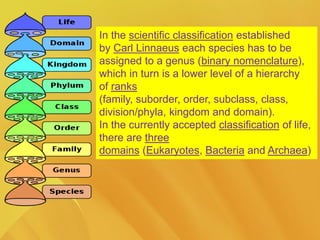
In the scientific classification established
by Carl Linnaeus each species has to be
assigned to a genus (binary nomenclature),
which in turn is a lower level of a hierarchy
of ranks
(family, suborder, order, subclass, class,
division/phyla, kingdom and domain).
In the currently accepted classification of life,
there are three
domains (Eukaryotes, Bacteria and Archaea)
Microbial taxonomy is a means by which
microorganisms can be grouped together.
Organisms having similarities with respect to the criteria
used are in the same group and are separated from the
other groups of microorganisms that have different
characteristics
What is Taxonomy
Taxonomy is the science of the Classification
of organisms with the goal
of showing relationships
Among organisms.
Bacterial taxonomy is the taxonomy,
i.e. the rank-based classification, of bacteria.
The aim of classifications to
delineate group of organisms
about which one can
generalize knowledge
obtained from studding few
strains
such group is called ataxon
Taxonomy includes
(a) Identification.
(b) Nomenclature.
(c) Classification.
Identification is the process of
studying and recording the identical
and distinguishing features
Nomenclature is the process of
assigning names to the various
taxonomic ranking of each living
organism.
Classification is the orderly
arrangement of organisms into groups,
preferably in a format, that shows
relationships.
Basis of Taxonomy
Phenetic system groups organisms
Based on mutual similarity of
Phenotypic characteristics
Phylogenetic system
groups
Organisms based on shared
genetic heritage.
Taxonomy of bacteria
Living organisms were once divided into
only two kingdoms: plantae and
animaliae: bacteria, fungi, and algae were
classified with plants; protozoa were
classified as animals.
Haeckel in 1865 proposed third kingdom
Protista for unicellular microorganisms
such as bacteria, algae, fungi and
protozoa.
Bacteria were separated into the
Kingdom Procaryotae or Monera in 1969
by Whittaker – five kingdoms
Taxonomy of bacteria
Living organisms were once divided into
only two kingdoms: plantae and
animaliae: bacteria, fungi, and algae were
classified with plants protozoa were
classified as animals.
Haeckel in 1865 proposed third kingdom
Protista for unicellular microorganisms
such as bacteria, algae, fungi and
protozoa.
Bacteria were separated into the
Kingdom Procaryotae or Monera in 1969
by Whittaker – five kingdoms
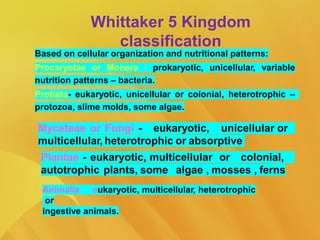
Whittaker 5 Kingdom
classification
Based on cellular organization and nutritional patterns:
Procaryotae or Monera - prokaryotic, unicellular, variable
nutrition patterns – bacteria.
Protista- eukaryotic, unicellular or colonial, heterotrophic –
protozoa, slime molds, some algae.
Myceteae or Fungi - eukaryotic, unicellular or
multicellular, heterotrophic or absorptive
Plantae - eukaryotic, multicellular or colonial,
autotrophic plants, some algae , mosses , ferns
Animalia eukaryotic, multicellular, heterotrophic
or
ingestive animals.
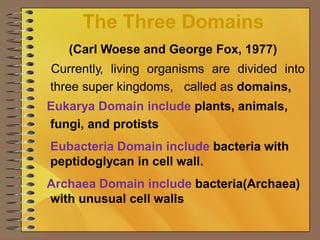
The Three Domains
(Carl Woese and George Fox, 1977)
Currently, living organisms are divided into
three super kingdoms, called as domains,
Eukarya Domain include plants, animals,
fungi, and protists
Eubacteria Domain include bacteria with
peptidoglycan in cell wall.
Archaea Domain include bacteria(Archaea)
with unusual cell walls
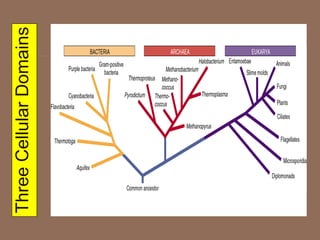
Three
Cellular
Domains
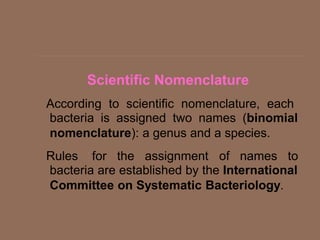
Scientific Nomenclature
According to scientific nomenclature, each
bacteria is assigned two names (binomial
nomenclature): a genus and a species.
Rules for the assignment of names to
bacteria are established by the International
Committee on Systematic Bacteriology.
Nomencalture of Bacteria
According to scientific nomenclature, each
bacteria is assigned two names (binomial
nomenclature): a genus and a species.
Criteria used for bacterial
classification
phenotypic characters
morphological character
stained film wet film
microscope exam
Biochemical characters
biochemical test
Culture characters
culture on solid and liquid media
culture on selective media
cultivation on blood agar
Serological characters
depend on somatic flagellar
capsular antigen
FAT ELISA RIA
Classification depend on
bacterial DNA
Genome size
G+C content
DNA relatedness
DNA homology
Rules for the assignment of names to
Bacteria reestablished by the International
Committee on Systematic Bacteriology
The Bergey’s Manual
Bergey’s Manual of Determinative Bacteriology
International standard for bacterial taxonomy.
First published in 1923.
9 editions have been published.
From 1980 it is renamed as Bergey’s Manual of
Systemic Bacteriology published as a 4 volume set
from 1984.
In 2012 – 5 volume set.
Currently Bergey's Manual of Systematics of Archaea
and Bacteria (2015), an online book, replaces the five-
volume set.
In the original 4 volumes of Bergey’s Manual of Systematic
Bacteriology, bacteria were classified in 33 sections based
on phenotypic, not phylogenetic characteristics.
Kingdom: Procaryotae
Divisions:
Gracilicutes (thin skin): Procaryotes with a Gram-
negative cell wall.
Firmicutes (thick skin): Procaryotes with a Gram-
positive cell wall.
Tenericutes (soft or tender skin): Procaryotes that
lack a cell wall.
Mendosicutes (skin with faults): Procaryotes with
unusual cell wall.
The current 5 volumes define taxa not in terms of
phenotype, but solely on 16S phylogeny

Microbial Taxonomy2.pdf

  • 1.
  • 2.
    In the scientificclassification established by Carl Linnaeus each species has to be assigned to a genus (binary nomenclature), which in turn is a lower level of a hierarchy of ranks (family, suborder, order, subclass, class, division/phyla, kingdom and domain). In the currently accepted classification of life, there are three domains (Eukaryotes, Bacteria and Archaea)
  • 3.
    Microbial taxonomy isa means by which microorganisms can be grouped together. Organisms having similarities with respect to the criteria used are in the same group and are separated from the other groups of microorganisms that have different characteristics
  • 4.
    What is Taxonomy Taxonomyis the science of the Classification of organisms with the goal of showing relationships Among organisms.
  • 5.
    Bacterial taxonomy isthe taxonomy, i.e. the rank-based classification, of bacteria.
  • 6.
    The aim ofclassifications to delineate group of organisms about which one can generalize knowledge obtained from studding few strains such group is called ataxon
  • 7.
    Taxonomy includes (a) Identification. (b)Nomenclature. (c) Classification.
  • 8.
    Identification is theprocess of studying and recording the identical and distinguishing features
  • 9.
    Nomenclature is theprocess of assigning names to the various taxonomic ranking of each living organism.
  • 10.
    Classification is theorderly arrangement of organisms into groups, preferably in a format, that shows relationships.
  • 11.
    Basis of Taxonomy Pheneticsystem groups organisms Based on mutual similarity of Phenotypic characteristics
  • 12.
    Phylogenetic system groups Organisms basedon shared genetic heritage.
  • 13.
    Taxonomy of bacteria Livingorganisms were once divided into only two kingdoms: plantae and animaliae: bacteria, fungi, and algae were classified with plants; protozoa were classified as animals. Haeckel in 1865 proposed third kingdom Protista for unicellular microorganisms such as bacteria, algae, fungi and protozoa. Bacteria were separated into the Kingdom Procaryotae or Monera in 1969 by Whittaker – five kingdoms
  • 14.
    Taxonomy of bacteria Livingorganisms were once divided into only two kingdoms: plantae and animaliae: bacteria, fungi, and algae were classified with plants protozoa were classified as animals.
  • 15.
    Haeckel in 1865proposed third kingdom Protista for unicellular microorganisms such as bacteria, algae, fungi and protozoa.
  • 16.
    Bacteria were separatedinto the Kingdom Procaryotae or Monera in 1969 by Whittaker – five kingdoms
  • 17.
    Whittaker 5 Kingdom classification Basedon cellular organization and nutritional patterns: Procaryotae or Monera - prokaryotic, unicellular, variable nutrition patterns – bacteria. Protista- eukaryotic, unicellular or colonial, heterotrophic – protozoa, slime molds, some algae. Myceteae or Fungi - eukaryotic, unicellular or multicellular, heterotrophic or absorptive Plantae - eukaryotic, multicellular or colonial, autotrophic plants, some algae , mosses , ferns Animalia eukaryotic, multicellular, heterotrophic or ingestive animals.
  • 18.
    The Three Domains (CarlWoese and George Fox, 1977) Currently, living organisms are divided into three super kingdoms, called as domains, Eukarya Domain include plants, animals, fungi, and protists Eubacteria Domain include bacteria with peptidoglycan in cell wall. Archaea Domain include bacteria(Archaea) with unusual cell walls
  • 19.
  • 20.
    Scientific Nomenclature According toscientific nomenclature, each bacteria is assigned two names (binomial nomenclature): a genus and a species. Rules for the assignment of names to bacteria are established by the International Committee on Systematic Bacteriology.
  • 21.
    Nomencalture of Bacteria Accordingto scientific nomenclature, each bacteria is assigned two names (binomial nomenclature): a genus and a species.
  • 22.
    Criteria used forbacterial classification phenotypic characters morphological character stained film wet film microscope exam
  • 23.
  • 24.
    Culture characters culture onsolid and liquid media culture on selective media cultivation on blood agar
  • 25.
    Serological characters depend onsomatic flagellar capsular antigen FAT ELISA RIA
  • 26.
    Classification depend on bacterialDNA Genome size G+C content DNA relatedness DNA homology
  • 27.
    Rules for theassignment of names to Bacteria reestablished by the International Committee on Systematic Bacteriology
  • 28.
    The Bergey’s Manual Bergey’sManual of Determinative Bacteriology International standard for bacterial taxonomy. First published in 1923. 9 editions have been published. From 1980 it is renamed as Bergey’s Manual of Systemic Bacteriology published as a 4 volume set from 1984. In 2012 – 5 volume set. Currently Bergey's Manual of Systematics of Archaea and Bacteria (2015), an online book, replaces the five- volume set.
  • 29.
    In the original4 volumes of Bergey’s Manual of Systematic Bacteriology, bacteria were classified in 33 sections based on phenotypic, not phylogenetic characteristics. Kingdom: Procaryotae Divisions: Gracilicutes (thin skin): Procaryotes with a Gram- negative cell wall. Firmicutes (thick skin): Procaryotes with a Gram- positive cell wall. Tenericutes (soft or tender skin): Procaryotes that lack a cell wall. Mendosicutes (skin with faults): Procaryotes with unusual cell wall. The current 5 volumes define taxa not in terms of phenotype, but solely on 16S phylogeny