Classification of
Microorganisms
Taxonomy
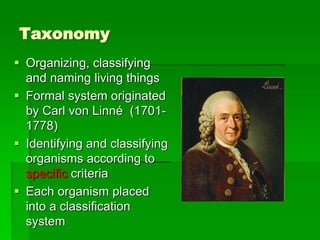
 Organizing, classifying
and naming living things
 Formal system originated
by Carl von Linné (1701-
1778)
 Identifying and classifying
organisms according to
specific criteria
 Each organism placed
into a classification
system
Taxonomy
 Domain
 Kingdom
 Phylum
 Class
 Order
 Family
 Genus
 species
3 Domains
 Eubacteria
 true bacteria, peptidoglycan
 Archaea
 odd bacteria that live in extreme
environments, high salt, heat, etc. (usually
called extremophiles)
 Eukarya
 have a nucleus & organelles (humans,
animals, plants)
Taxonomy
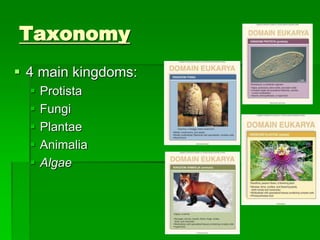
 4 main kingdoms:
 Protista
 Fungi
 Plantae
 Animalia
 Algae
Naming Micoorganisms
 Binomial (scientific) nomenclature
 Gives each microbe 2 names:
 Genus - noun, always capitalized
 species - adjective, lowercase
 Both italicized or underlined
 Staphylococcus aureus (S. aureus)
 Bacillus subtilis (B. subtilis)
 Escherichia coli (E. coli)
Evolution - living things change
gradually over millions of years
 Changes favoring survival are retained and less
beneficial changes are lost
 All new species originate from preexisting
species
 Closely related organism have similar features
because they evolved from common ancestral
forms
 Evolution usually progresses toward greater
complexity
Insert figure 1.15
Woese-Fox System
Classification
Systems in the
Procaryotae
Classification Systems in
the Procaryotae
1. Microscopic morphology
2. Macroscopic morphology – colony
appearance
3. Physiological / biochemical characteristics
4. Chemical analysis
5. Serological analysis
6. Genetic and molecular analysis
• G + C base composition
• DNA analysis using genetic probes
• Nucleic acid sequencing and rRNA analysis
Bacterial Taxonomy Based
on Bergey’s Manual
 Bergey’s Manual of Determinative
Bacteriology – five volume resource
covering all known procaryotes
 classification based on genetic information –
phylogenetic
 two domains: Archaea and Bacteria
 five major subgroups with 25 different phyla
Major Taxonomic Groups of
Bacteria
 Vol 1A: Domain Archaea
 primitive, adapted to extreme habitats and
modes of nutrition
 Vol 1B: Domain Bacteria
 Vol 2-5:
 Phylum Proteobacteria – Gram-negative cell
walls
 Phylum Firmicutes – mainly Gram-positive
with low G + C content
 Phylum Actinobacteria – Gram-positive with
high G + C content
Diagnostic Scheme for
Medical Use
 Uses phenotypic qualities in
identification
 restricted to bacterial disease agents
 divides based on cell wall structure, shape,
arrangement, and physiological traits
Species and Subspecies
 Species
 collection of bacterial cells which share an overall
similar pattern of traits in contrast to other bacteria
whose pattern differs significantly
 Strain or variety
 culture derived from a single parent that differs in
structure or metabolism from other cultures of that
species (biovars, morphovars)
 Type
 subspecies that can show differences in antigenic
makeup (serotype or serovar), susceptibility to
bacterial viruses (phage type) and in pathogenicity
(pathotype)
Archaea: The Other
Procaryotes
 Constitute third Domain Archaea
 Seem more closely related to Domain Eukarya than to
bacteria
 Contain unique genetic sequences in their rRNA
 Have unique membrane lipids and cell wall construction
 Live in the most extreme habitats in nature,
extremophiles
 Adapted to heat, salt, acid pH, pressure and
atmosphere
 Includes: methane producers, hyperthermophiles,
extreme halophiles, and sulfur reducers
Eukaryotes
Eukaryotes
 Protista
 Fungi
 Plantae
 Animalia
 Algae
Fungal Classification
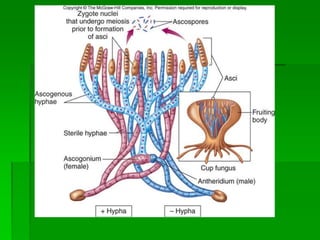
 Sexual reproduction
 Spores are formed following fusion of male and
female strains and formation of sexual structure
 Sexual spores and spore-forming structures
are one basis for classification
 Zygospores
 Ascospores
 Basidiospores
Fungal Classification
 Subkingdom Amastigomycota
 Terrestrial inhabitants including those of
medical importance:
1. Zygomycota – zygospores; sporangiospores and
some conidia
2. Ascomycota – ascospores; conidia
3. Basidiomycota – basidiospores; conidia
4. Deuteromycota – majority are yeasts and molds;
no sexual spores known; conidia
Protozoan Classification
 Difficult because of diversity
 Simple grouping is based on method of motility,
reproduction, and life cycle
1. Mastigophora – primarily flagellar motility, some
flagellar and amoeboid; sexual reproduction; cyst
and trophozoite
2. Sarcodina – primarily ameba; asexual by fission;
most are free-living
3. Ciliophora – cilia; trophozoites and cysts; most are
free-living, harmless
4. Apicomplexa – motility is absent except male
gametes; sexual and asexual reproduction; complex
life cycle – all parasitic
Classification of Microorganisms/ different types

Classification of Microorganisms/ different types

  • 1.
  • 2.
    Taxonomy  Organizing, classifying andnaming living things  Formal system originated by Carl von Linné (1701- 1778)  Identifying and classifying organisms according to specific criteria  Each organism placed into a classification system
  • 3.
    Taxonomy  Domain  Kingdom Phylum  Class  Order  Family  Genus  species
  • 4.
    3 Domains  Eubacteria true bacteria, peptidoglycan  Archaea  odd bacteria that live in extreme environments, high salt, heat, etc. (usually called extremophiles)  Eukarya  have a nucleus & organelles (humans, animals, plants)
  • 7.
    Taxonomy  4 mainkingdoms:  Protista  Fungi  Plantae  Animalia  Algae
  • 8.
    Naming Micoorganisms  Binomial(scientific) nomenclature  Gives each microbe 2 names:  Genus - noun, always capitalized  species - adjective, lowercase  Both italicized or underlined  Staphylococcus aureus (S. aureus)  Bacillus subtilis (B. subtilis)  Escherichia coli (E. coli)
  • 9.
    Evolution - livingthings change gradually over millions of years  Changes favoring survival are retained and less beneficial changes are lost  All new species originate from preexisting species  Closely related organism have similar features because they evolved from common ancestral forms  Evolution usually progresses toward greater complexity
  • 10.
  • 11.
  • 12.
    Classification Systems in theProcaryotae 1. Microscopic morphology 2. Macroscopic morphology – colony appearance 3. Physiological / biochemical characteristics 4. Chemical analysis 5. Serological analysis 6. Genetic and molecular analysis • G + C base composition • DNA analysis using genetic probes • Nucleic acid sequencing and rRNA analysis
  • 13.
    Bacterial Taxonomy Based onBergey’s Manual  Bergey’s Manual of Determinative Bacteriology – five volume resource covering all known procaryotes  classification based on genetic information – phylogenetic  two domains: Archaea and Bacteria  five major subgroups with 25 different phyla
  • 14.
    Major Taxonomic Groupsof Bacteria  Vol 1A: Domain Archaea  primitive, adapted to extreme habitats and modes of nutrition  Vol 1B: Domain Bacteria  Vol 2-5:  Phylum Proteobacteria – Gram-negative cell walls  Phylum Firmicutes – mainly Gram-positive with low G + C content  Phylum Actinobacteria – Gram-positive with high G + C content
  • 15.
    Diagnostic Scheme for MedicalUse  Uses phenotypic qualities in identification  restricted to bacterial disease agents  divides based on cell wall structure, shape, arrangement, and physiological traits
  • 16.
    Species and Subspecies Species  collection of bacterial cells which share an overall similar pattern of traits in contrast to other bacteria whose pattern differs significantly  Strain or variety  culture derived from a single parent that differs in structure or metabolism from other cultures of that species (biovars, morphovars)  Type  subspecies that can show differences in antigenic makeup (serotype or serovar), susceptibility to bacterial viruses (phage type) and in pathogenicity (pathotype)
  • 17.
    Archaea: The Other Procaryotes Constitute third Domain Archaea  Seem more closely related to Domain Eukarya than to bacteria  Contain unique genetic sequences in their rRNA  Have unique membrane lipids and cell wall construction  Live in the most extreme habitats in nature, extremophiles  Adapted to heat, salt, acid pH, pressure and atmosphere  Includes: methane producers, hyperthermophiles, extreme halophiles, and sulfur reducers
  • 18.
  • 19.
    Eukaryotes  Protista  Fungi Plantae  Animalia  Algae
  • 20.
    Fungal Classification  Sexualreproduction  Spores are formed following fusion of male and female strains and formation of sexual structure  Sexual spores and spore-forming structures are one basis for classification  Zygospores  Ascospores  Basidiospores
  • 24.
    Fungal Classification  SubkingdomAmastigomycota  Terrestrial inhabitants including those of medical importance: 1. Zygomycota – zygospores; sporangiospores and some conidia 2. Ascomycota – ascospores; conidia 3. Basidiomycota – basidiospores; conidia 4. Deuteromycota – majority are yeasts and molds; no sexual spores known; conidia
  • 25.
    Protozoan Classification  Difficultbecause of diversity  Simple grouping is based on method of motility, reproduction, and life cycle 1. Mastigophora – primarily flagellar motility, some flagellar and amoeboid; sexual reproduction; cyst and trophozoite 2. Sarcodina – primarily ameba; asexual by fission; most are free-living 3. Ciliophora – cilia; trophozoites and cysts; most are free-living, harmless 4. Apicomplexa – motility is absent except male gametes; sexual and asexual reproduction; complex life cycle – all parasitic