By -
Ishanee Sharma (15/252)
Nilim Kumar Sarma (15/256)
Dhritiman Bhuyan (15/263)
Department of Chemical Engineering
Assam Engineering College, Jalukbari
Dextran
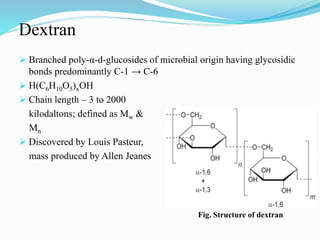
 Branched poly-α-d-glucosides of microbial origin having glycosidic
bonds predominantly C-1 → C-6
 H(C6H10O5)xOH
 Chain length – 3 to 2000
kilodaltons; defined as Mw &
Mn
 Discovered by Louis Pasteur,
mass produced by Allen Jeanes
Fig. Structure of dextran
Properties
 Biodegradable
 Water soluble, as well as methyl sulphoxide, formamide, ethylene
glycol
 Produced by fermentation
1
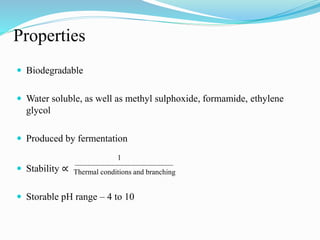
 Stability ∝ Thermal conditions and branching
 Storable pH range – 4 to 10
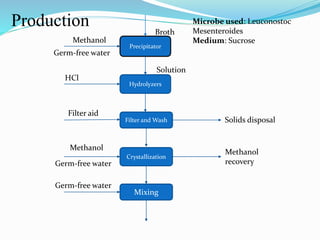
Precipitator
Broth
Germ-free water
Methanol
Hydrolyzers
Filter and Wash
Crystallization
Mixing
Solution
Solids disposal
HCl
Filter aid
Methanol
Germ-free water
Methanol
recovery
Germ-free water
Production Microbe used: Leuconostoc
Mesenteroides
Medium: Sucrose
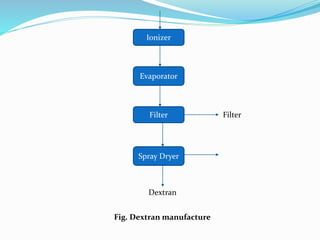
Ionizer
Evaporator
Filter
Spray Dryer
Dextran
Filter
Fig. Dextran manufacture
Applications
 1. In Medical field
• Dextran is used to decrease vascular thrombosis.
• It is occasionally used to replace lost blood in emergency
situations where replacement of blood is no available.
• The iron dextran solution is applied for treatment of human
anaemic deficiency.
 2. In food Industry
• Dextran improves softness, crum texture and loaf volume in
bakery products.
• Dextran is used as a stabilizer for confectionery as it prevents
crystallisation, increases viscosity and maintains flavour.
• Dextran prevents frozen foods from oxidation and also help to
preserve texture or flavour.
 3. Laboratory uses
• Fluorescently labelled dextran can be used to visualise
endosomes under a fluorescent microscope as it binds to early
endosomes.
• It can also be used as stabilising coating to potent nanoparticles
from oxidation and improve biocompatibility.
 4. Wastewater Treatment
• Dextran offers many useful features like stable alkali and acids. It
binds with metal ions in alkali pH and is biodegradable. It is used
during the flocculation process in wastewater treatment.

Production of Dextran

  • 1.
    By - Ishanee Sharma(15/252) Nilim Kumar Sarma (15/256) Dhritiman Bhuyan (15/263) Department of Chemical Engineering Assam Engineering College, Jalukbari
  • 2.
    Dextran  Branched poly-α-d-glucosidesof microbial origin having glycosidic bonds predominantly C-1 → C-6  H(C6H10O5)xOH  Chain length – 3 to 2000 kilodaltons; defined as Mw & Mn  Discovered by Louis Pasteur, mass produced by Allen Jeanes Fig. Structure of dextran
  • 3.
    Properties  Biodegradable  Watersoluble, as well as methyl sulphoxide, formamide, ethylene glycol  Produced by fermentation 1  Stability ∝ Thermal conditions and branching  Storable pH range – 4 to 10
  • 4.
    Precipitator Broth Germ-free water Methanol Hydrolyzers Filter andWash Crystallization Mixing Solution Solids disposal HCl Filter aid Methanol Germ-free water Methanol recovery Germ-free water Production Microbe used: Leuconostoc Mesenteroides Medium: Sucrose
  • 5.
  • 6.
    Applications  1. InMedical field • Dextran is used to decrease vascular thrombosis. • It is occasionally used to replace lost blood in emergency situations where replacement of blood is no available. • The iron dextran solution is applied for treatment of human anaemic deficiency.  2. In food Industry • Dextran improves softness, crum texture and loaf volume in bakery products. • Dextran is used as a stabilizer for confectionery as it prevents crystallisation, increases viscosity and maintains flavour.
  • 7.
    • Dextran preventsfrozen foods from oxidation and also help to preserve texture or flavour.  3. Laboratory uses • Fluorescently labelled dextran can be used to visualise endosomes under a fluorescent microscope as it binds to early endosomes. • It can also be used as stabilising coating to potent nanoparticles from oxidation and improve biocompatibility.  4. Wastewater Treatment • Dextran offers many useful features like stable alkali and acids. It binds with metal ions in alkali pH and is biodegradable. It is used during the flocculation process in wastewater treatment.