STUDY OF PRODUCTION, OPTIMIZATION OF
PULLULAN WITH DIFFERENT SUBSTRATE AND
THEIR VARIOUS APPLICATION
BY
NITINJAY SINGH
SUPERVISOR- ER ABHISHEK SHARAN
DEPARTMENT OF BIOCHEMISTRY AND BIOCHEMICAL
ENGINEERING
OBJECTIVE
•Finding of cheap substrate for pullulan
production
Recent advances in the applications of
pullulan
WHAT IS PULLULAN ?
• Pullulan is a neutral, linear and water-soluble exopolysaccharide.
• Pullulan is a fungal polysaccharide, synthesized by Aureobasidium
pullulans.
• Pullulan is being used extensively in the food industry as a food
ingredient in Japan since 1976, and has GRAS status in the USA.
• Applications in industrial sectors like food, pharmaceutical and cosmetic
industries.
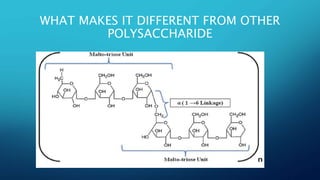
WHAT MAKES IT DIFFERENT FROM
OTHER POLYSACCHARIDE
 Pullulan films are clear and highly oxygen-impermeable and have excellent mechanical
properties
 Pullulan are edible, biodegradable and highly water-soluble.
 Dry pullulan powders are white and non-hygroscopic
 Pullulan is non-toxic, non-mutagenic, odorless, tasteless, non-carcinogenic
 Pullulan decomposes at high temperatures (250-280 °C)
WHAT MAKES IT DIFFERENT FROM OTHER
POLYSACCHARIDE
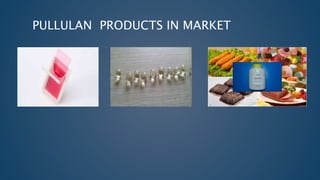
PULLULAN PRODUCTS IN MARKET
MAJOR PRODUCERS
Freda
Hayashibara
Jinmei
Biotechnology
Hierand
Biotech
Kangnaxi
n
Meihua
Group
KOPL
130
2017 2023
Global Pullulan Market
2017 2023 USD 130 Million
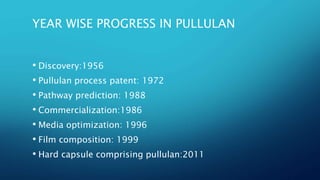
YEAR WISE PROGRESS IN PULLULAN
• Discovery:1956
• Pullulan process patent: 1972
• Pathway prediction: 1988
• Commercialization:1986
• Media optimization: 1996
• Film composition: 1999
• Hard capsule comprising pullulan:2011
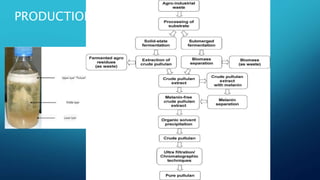
PRODUCTION
R.S. Singh, et al.
EFFECT OF DIFFERENT CARBON SOURCES
36
18
34
31
26
0
5
10
15
20
25
30
35
40
Sucrose Maltose Glucose Fructose Mannose
Pullulan gm/l
(source: Long Sheng
EFFECTS OF VARIOUS NITROGEN SOURCES
47
42
48
55
75
0
10
20
30
40
50
60
70
80
soy bean oil cake Rice bran cake cotton seed oil cake mustard seed oil cake corn steep liquor
Pullulan g/l
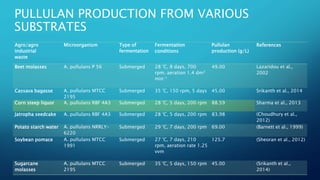
PULLULAN PRODUCTION FROM VARIOUS
SUBSTRATES
Agro/agro
industrial
waste
Microorganism Type of
fermentation
Fermentation
conditions
Pullulan
production (g/L)
References
Beet molasses A. pullulans P 56 Submerged 28 °C, 8 days, 700
rpm, aeration 1.4 dm3
min-1
49.00 Lazaridou et al.,
2002
Cassava bagasse A. pullulans MTCC
2195
Submerged 35 °C, 150 rpm, 5 days 45.00 Srikanth et al., 2014
Corn steep liquor A. pullulans RBF 4A3 Submerged 28 °C, 5 days, 200 rpm 88.59 Sharma et al., 2013
Jatropha seedcake A. pullulans RBF 4A3 Submerged 28 °C, 5 days, 200 rpm 83.98 (Choudhury et al.,
2012)
Potato starch water A. pullulans NRRLY-
6220
Submerged 29 °C, 7 days, 200 rpm 69.00 (Barnett et al., 1999)
Soybean pomace A. pullulans MTCC
1991
Submerged 27 °C, 7 days, 210
rpm, aeration rate 1.25
vvm
125.7 (Sheoran et al., 2012)
Sugarcane
molasses
A. pullulans MTCC
2195
Submerged 35 °C, 5 days, 150 rpm 45.00 (Srikanth et al.,
2014)
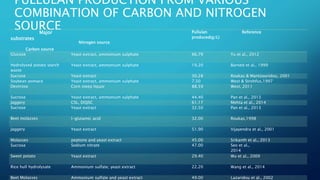
PULLULAN PRODUCTION FROM VARIOUS
COMBINATION OF CARBON AND NITROGEN
SOURCE
Major
substrates
Carbon source
Nitrogen source
Pullulan
produced(g/L)
Reference
Glucose Yeast extract, ammonium sulphate 66.79 Yu et al., 2012
Hydrolysed potato starch
waste
Yeast extract, ammonium sulphate 19.20 Barnett et al., 1999
Sucrose Yeast extract 30.28 Roukas & Mantzouridou, 2001
Soybean pomace Yeast extract, ammonium sulphate 7.50 West & Strohfus,1997
Dextrose Corn steep liquor 88.59 West, 2011
Sucrose Yeast extract, ammonium sulphate 44.40 Pan et al., 2013
Jaggery CSL, DOJSC 61.17 Mehta et al., 2014
Sucrose Yeast extract 32.50 Pan et al., 2013
Beet molasses l-glutamic acid 32.00 Roukas,1998
Jaggery Yeast extract 51.90 Vijayendra et al., 2001
Molasses peptone and yeast extract 45.00 Srikanth et al., 2013
Sucrose Sodium nitrate 47.00 Seo et al.,
2014
Sweet potato Yeast extract 29.40 Wu et al., 2009
Rice hull hydrolysate Ammonium sulfate; yeast extract 22.20 Wang et al., 2014
Beet Molasses Ammonium sulfate and yeast extract 49.00 Lazaridou et al., 2002
APPLICATIONS OF
PULLULAN
Modified pullulan Drug(s) Target/Application Reference
Cholesterol bearing pullulan Human recombinant erythropoietin; Glucagon-fluorescein
labeled insulin
T. Hirakura et.al
Carboxymethyl pullulan Immuno-suppressant S. Shen et.al
Carboxylated pullulan Insulin L. Yuan et.al
Succinylated pullulan Intestine targeting Constantin et al.
(2007)
Diethylene triamine penta
acetic acid pullulan
Liver targeting Yim et al. (2011)
Poly(DL-Lactide-coglycolide)-
grafted pullulan
Cancer cells treatment Jeong et al. (2006)
Maleilated pullulan Tumor cells treatment Zhang et al. (2011)
Polyethylenimine Pullulan Liver cell gene delivery Rekha & Sharma (2011}
Pullulan-g-poly(L-lactide)
Nanoparticles
Cancer cells treatment Cho et al. (2009)
Pullulan/deoxycholic acid Cancer cells treatment Na et al. (2006)
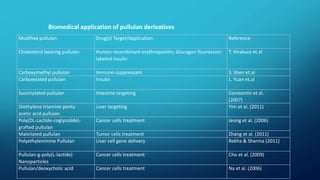
Biomedical application of pullulan derivatives
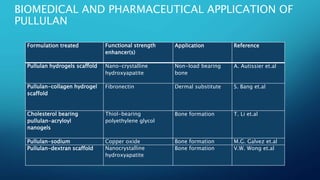
BIOMEDICAL AND PHARMACEUTICAL APPLICATION OF
PULLULAN
Formulation treated Functional strength
enhancer(s)
Application Reference
Pullulan hydrogels scaffold Nano-crystalline
hydroxyapatite
Non-load bearing
bone
A. Autissier et.al
Pullulan-collagen hydrogel
scaffold
Fibronectin Dermal substitute S. Bang et.al
Cholesterol bearing
pullulan-acryloyl
nanogels
Thiol-bearing
polyethylene glycol
Bone formation T. Li et.al
Pullulan-sodium Copper oxide Bone formation M.G. Galvez et.al
Pullulan-dextran scaffold Nanocrystalline
hydroxyapatite
Bone formation V.W. Wong et.al
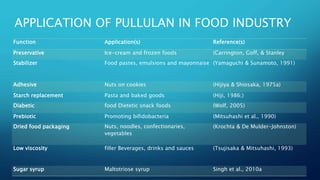
APPLICATION OF PULLULAN IN FOOD INDUSTRY
Function Application(s) Reference(s)
Preservative Ice-cream and frozen foods (Carrington, Goff, & Stanley
Stabilizer Food pastes, emulsions and mayonnaise (Yamaguchi & Sunamoto, 1991)
Adhesive Nuts on cookies (Hijiya & Shiosaka, 1975a)
Starch replacement Pasta and baked goods (Hiji, 1986;)
Diabetic food Dietetic snack foods (Wolf, 2005)
Prebiotic Promoting bifidobacteria (Mitsuhashi et al., 1990)
Dried food packaging Nuts, noodles, confectionaries,
vegetables
(Krochta & De Mulder-Johnston)
Low viscosity filler Beverages, drinks and sauces (Tsujisaka & Mitsuhashi, 1993)
Sugar syrup Maltotriose syrup Singh et al., 2010a
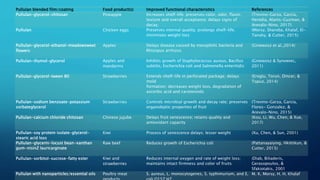
Pullulan blended film/coating Food product(s) Improved functional characteristics References
Pullulan-glycerol-chitosan Pineapple Increases shelf-life; preserves color, odor, flavor,
texture and overall acceptance; delays signs of
decay;
(Trevino-Garza, Garcia,
Heredia, Alanis-Guzman, &
Arevalo-Nino, 2017)
Pullulan Chicken eggs Preserves internal quality; prolongs shelf-life;
minimizes weight loss
(Morsy, Sharoba, Khalaf, El-
Tanahy, & Cutter, 2015)
Pullulan-glycerol-ethanol-meadowsweet
flowers
Apples Delays disease caused by mesophilic bacteria and
Rhizopus arrhizus
(Gniewosz et al.,2014)
Pullulan-thymol-glycerol Apples and
mandarins
Inhibits growth of Staphylococcus aureus, Bacillus
subtilis, Escherichia coli and Salmonella enteritidis
(Gniewosz & Synowiec,
2011)
Pullulan-glycerol-tween 80 Strawberries Extends shelf-life in perforated package; delays
mold
formation; decreases weight loss, degradation of
ascorbic acid and carotenoids
(Eroglu, Torun, Dincer, &
Topuz, 2014)
Pullulan-sodium benzoate-potassium
sorbateglycerol
Strawberries Controls microbial growth and decay rate; preserves
organoleptic properties of fruit
(Trevino-Garza, Garcia,
Flores- Gonzalez, &
Arevalo-Nino, 2015)
Pullulan-calcium chloride chitosan Chinese jujube Delays fruit senescence; retains quality and
antioxidant capacity
(Kou, Li, Wu, Chen, & Xue,
2017)
Pullulan-soy protein isolate-glycerol-
stearic acid loss
Kiwi Process of senescence delays; lesser weight (Xu, Chen, & Sun, 2001)
Pullulan-glycerin-locust bean-xanthan
gum-nisinZ lauricarginate
Raw beef Reduces growth of Escherichia coli (Pattanayaiying, Hkittikun, &
Cutter, 2015)
Pullulan-sorbitol-sucrose-fatty ester Kiwi and
strawberries
Reduces internal oxygen and rate of weight loss;
maintains intact firmness and color of fruits
(Diab, Biliaderis,
Gerasopoulos, &
Sfakiotakis, 2001
Pullulan with nanoparticles/essential oils Poultry meat S. aureus, L. monocytogenes, S. typhimurium, and E. M. K. Morsy, H. H. Khalaf
RESULTS
• The study shows that best carbon source for production of pullulan is jaggery because it is the best source of
sucrose and it is easily available in the market at a cheap rate.
• The study shows that best nitrogen source for production of pullulan is corn steep liquor because it shows
higher production of pullulan and it is easily available as agriculture byproduct.
• It has a widespread application in drug delivery which is largely attributable to its biodegradability, non-
immunogenicity and inherent targeting ability to the liver cells. These derivatives can carry drugs, therapeutic
proteins, nucleotides and genes through encapsulation, covalent linkage and/or non-covalent interactions.
Besides, bulk properties, such as hydrolytic susceptibility; and responsiveness to physiological stimuli
(temperature, pH and ionic strength) can be tailored by linking appropriate residues. Hydrophobically modified
pullulan form self-assembled nanoparticles which are of use in drug delivery.
• Pullulan has very important applications in surface modification of polymeric materials so that they can be
made more blood compatible and bioinert. Pullulan being adhesive is also tried for wound dressing
application. Thermal stability and elastic property of pullulan allows them to be utilized in many different ways.
• Pullulan coating is effective in preserving the interior quality of eggs. as compared with that of non-coated
eggs. pullulan/chitosan multilayer coatings maintained the physiological and nutritional attributes of papayas
and extended the fruit shelf life if compared with uncoated and single-coated fruits.
• In wastewater Treatment the higher separation efficiency proved by the pullulan derivatives investigated
recommends their use as well as of other new derivatives of this polysaccharide, both in the soluble form and
as hydrogel for the removal of different contaminants (clays, dyes, pesticides (insecticides, fungicides,
herbicides) drugs, cosmetics, etc.
FUTURE ASPECTS
• The future challenge is to outline pullulan applications at industrial level
• Understanding this pathway would open up new avenues to obtain higher yield of the product during fermentative
production of pullulan.
• Metabolic engineering of the different strains result in high yielding bioprocesses.
• The potential applications of pullulan in food items are mostly identified and acknowledged, but they are not
explored at industrial scale.
• In the fermentation process when pullulan is synthesized at the same time melanin is also produced which makes
broth blackish and use of the melanin is still unexplored.
• Human enzymes can slowly digest pullulan and gradually convert into glucose, so it can be incorporated in dietetic
snack foods designed for diabetic patients who have impaired glucose tolerance.
• Pullulan can use by blending it with pectin, chitosan to increase self life of fruits and vegetables because it retains
moisture and also make barrier for oxygen.

Pullulan

  • 1.
    STUDY OF PRODUCTION,OPTIMIZATION OF PULLULAN WITH DIFFERENT SUBSTRATE AND THEIR VARIOUS APPLICATION BY NITINJAY SINGH SUPERVISOR- ER ABHISHEK SHARAN DEPARTMENT OF BIOCHEMISTRY AND BIOCHEMICAL ENGINEERING
  • 2.
    OBJECTIVE •Finding of cheapsubstrate for pullulan production Recent advances in the applications of pullulan
  • 3.
    WHAT IS PULLULAN? • Pullulan is a neutral, linear and water-soluble exopolysaccharide. • Pullulan is a fungal polysaccharide, synthesized by Aureobasidium pullulans. • Pullulan is being used extensively in the food industry as a food ingredient in Japan since 1976, and has GRAS status in the USA. • Applications in industrial sectors like food, pharmaceutical and cosmetic industries.
  • 4.
    WHAT MAKES ITDIFFERENT FROM OTHER POLYSACCHARIDE  Pullulan films are clear and highly oxygen-impermeable and have excellent mechanical properties  Pullulan are edible, biodegradable and highly water-soluble.  Dry pullulan powders are white and non-hygroscopic  Pullulan is non-toxic, non-mutagenic, odorless, tasteless, non-carcinogenic  Pullulan decomposes at high temperatures (250-280 °C)
  • 5.
    WHAT MAKES ITDIFFERENT FROM OTHER POLYSACCHARIDE
  • 6.
  • 7.
  • 8.
    130 2017 2023 Global PullulanMarket 2017 2023 USD 130 Million
  • 9.
    YEAR WISE PROGRESSIN PULLULAN • Discovery:1956 • Pullulan process patent: 1972 • Pathway prediction: 1988 • Commercialization:1986 • Media optimization: 1996 • Film composition: 1999 • Hard capsule comprising pullulan:2011
  • 10.
  • 11.
    EFFECT OF DIFFERENTCARBON SOURCES 36 18 34 31 26 0 5 10 15 20 25 30 35 40 Sucrose Maltose Glucose Fructose Mannose Pullulan gm/l (source: Long Sheng
  • 12.
    EFFECTS OF VARIOUSNITROGEN SOURCES 47 42 48 55 75 0 10 20 30 40 50 60 70 80 soy bean oil cake Rice bran cake cotton seed oil cake mustard seed oil cake corn steep liquor Pullulan g/l
  • 13.
    PULLULAN PRODUCTION FROMVARIOUS SUBSTRATES Agro/agro industrial waste Microorganism Type of fermentation Fermentation conditions Pullulan production (g/L) References Beet molasses A. pullulans P 56 Submerged 28 °C, 8 days, 700 rpm, aeration 1.4 dm3 min-1 49.00 Lazaridou et al., 2002 Cassava bagasse A. pullulans MTCC 2195 Submerged 35 °C, 150 rpm, 5 days 45.00 Srikanth et al., 2014 Corn steep liquor A. pullulans RBF 4A3 Submerged 28 °C, 5 days, 200 rpm 88.59 Sharma et al., 2013 Jatropha seedcake A. pullulans RBF 4A3 Submerged 28 °C, 5 days, 200 rpm 83.98 (Choudhury et al., 2012) Potato starch water A. pullulans NRRLY- 6220 Submerged 29 °C, 7 days, 200 rpm 69.00 (Barnett et al., 1999) Soybean pomace A. pullulans MTCC 1991 Submerged 27 °C, 7 days, 210 rpm, aeration rate 1.25 vvm 125.7 (Sheoran et al., 2012) Sugarcane molasses A. pullulans MTCC 2195 Submerged 35 °C, 5 days, 150 rpm 45.00 (Srikanth et al., 2014)
  • 14.
    PULLULAN PRODUCTION FROMVARIOUS COMBINATION OF CARBON AND NITROGEN SOURCE Major substrates Carbon source Nitrogen source Pullulan produced(g/L) Reference Glucose Yeast extract, ammonium sulphate 66.79 Yu et al., 2012 Hydrolysed potato starch waste Yeast extract, ammonium sulphate 19.20 Barnett et al., 1999 Sucrose Yeast extract 30.28 Roukas & Mantzouridou, 2001 Soybean pomace Yeast extract, ammonium sulphate 7.50 West & Strohfus,1997 Dextrose Corn steep liquor 88.59 West, 2011 Sucrose Yeast extract, ammonium sulphate 44.40 Pan et al., 2013 Jaggery CSL, DOJSC 61.17 Mehta et al., 2014 Sucrose Yeast extract 32.50 Pan et al., 2013 Beet molasses l-glutamic acid 32.00 Roukas,1998 Jaggery Yeast extract 51.90 Vijayendra et al., 2001 Molasses peptone and yeast extract 45.00 Srikanth et al., 2013 Sucrose Sodium nitrate 47.00 Seo et al., 2014 Sweet potato Yeast extract 29.40 Wu et al., 2009 Rice hull hydrolysate Ammonium sulfate; yeast extract 22.20 Wang et al., 2014 Beet Molasses Ammonium sulfate and yeast extract 49.00 Lazaridou et al., 2002
  • 15.
  • 16.
    Modified pullulan Drug(s)Target/Application Reference Cholesterol bearing pullulan Human recombinant erythropoietin; Glucagon-fluorescein labeled insulin T. Hirakura et.al Carboxymethyl pullulan Immuno-suppressant S. Shen et.al Carboxylated pullulan Insulin L. Yuan et.al Succinylated pullulan Intestine targeting Constantin et al. (2007) Diethylene triamine penta acetic acid pullulan Liver targeting Yim et al. (2011) Poly(DL-Lactide-coglycolide)- grafted pullulan Cancer cells treatment Jeong et al. (2006) Maleilated pullulan Tumor cells treatment Zhang et al. (2011) Polyethylenimine Pullulan Liver cell gene delivery Rekha & Sharma (2011} Pullulan-g-poly(L-lactide) Nanoparticles Cancer cells treatment Cho et al. (2009) Pullulan/deoxycholic acid Cancer cells treatment Na et al. (2006) Biomedical application of pullulan derivatives
  • 17.
    BIOMEDICAL AND PHARMACEUTICALAPPLICATION OF PULLULAN Formulation treated Functional strength enhancer(s) Application Reference Pullulan hydrogels scaffold Nano-crystalline hydroxyapatite Non-load bearing bone A. Autissier et.al Pullulan-collagen hydrogel scaffold Fibronectin Dermal substitute S. Bang et.al Cholesterol bearing pullulan-acryloyl nanogels Thiol-bearing polyethylene glycol Bone formation T. Li et.al Pullulan-sodium Copper oxide Bone formation M.G. Galvez et.al Pullulan-dextran scaffold Nanocrystalline hydroxyapatite Bone formation V.W. Wong et.al
  • 18.
    APPLICATION OF PULLULANIN FOOD INDUSTRY Function Application(s) Reference(s) Preservative Ice-cream and frozen foods (Carrington, Goff, & Stanley Stabilizer Food pastes, emulsions and mayonnaise (Yamaguchi & Sunamoto, 1991) Adhesive Nuts on cookies (Hijiya & Shiosaka, 1975a) Starch replacement Pasta and baked goods (Hiji, 1986;) Diabetic food Dietetic snack foods (Wolf, 2005) Prebiotic Promoting bifidobacteria (Mitsuhashi et al., 1990) Dried food packaging Nuts, noodles, confectionaries, vegetables (Krochta & De Mulder-Johnston) Low viscosity filler Beverages, drinks and sauces (Tsujisaka & Mitsuhashi, 1993) Sugar syrup Maltotriose syrup Singh et al., 2010a
  • 19.
    Pullulan blended film/coatingFood product(s) Improved functional characteristics References Pullulan-glycerol-chitosan Pineapple Increases shelf-life; preserves color, odor, flavor, texture and overall acceptance; delays signs of decay; (Trevino-Garza, Garcia, Heredia, Alanis-Guzman, & Arevalo-Nino, 2017) Pullulan Chicken eggs Preserves internal quality; prolongs shelf-life; minimizes weight loss (Morsy, Sharoba, Khalaf, El- Tanahy, & Cutter, 2015) Pullulan-glycerol-ethanol-meadowsweet flowers Apples Delays disease caused by mesophilic bacteria and Rhizopus arrhizus (Gniewosz et al.,2014) Pullulan-thymol-glycerol Apples and mandarins Inhibits growth of Staphylococcus aureus, Bacillus subtilis, Escherichia coli and Salmonella enteritidis (Gniewosz & Synowiec, 2011) Pullulan-glycerol-tween 80 Strawberries Extends shelf-life in perforated package; delays mold formation; decreases weight loss, degradation of ascorbic acid and carotenoids (Eroglu, Torun, Dincer, & Topuz, 2014) Pullulan-sodium benzoate-potassium sorbateglycerol Strawberries Controls microbial growth and decay rate; preserves organoleptic properties of fruit (Trevino-Garza, Garcia, Flores- Gonzalez, & Arevalo-Nino, 2015) Pullulan-calcium chloride chitosan Chinese jujube Delays fruit senescence; retains quality and antioxidant capacity (Kou, Li, Wu, Chen, & Xue, 2017) Pullulan-soy protein isolate-glycerol- stearic acid loss Kiwi Process of senescence delays; lesser weight (Xu, Chen, & Sun, 2001) Pullulan-glycerin-locust bean-xanthan gum-nisinZ lauricarginate Raw beef Reduces growth of Escherichia coli (Pattanayaiying, Hkittikun, & Cutter, 2015) Pullulan-sorbitol-sucrose-fatty ester Kiwi and strawberries Reduces internal oxygen and rate of weight loss; maintains intact firmness and color of fruits (Diab, Biliaderis, Gerasopoulos, & Sfakiotakis, 2001 Pullulan with nanoparticles/essential oils Poultry meat S. aureus, L. monocytogenes, S. typhimurium, and E. M. K. Morsy, H. H. Khalaf
  • 20.
    RESULTS • The studyshows that best carbon source for production of pullulan is jaggery because it is the best source of sucrose and it is easily available in the market at a cheap rate. • The study shows that best nitrogen source for production of pullulan is corn steep liquor because it shows higher production of pullulan and it is easily available as agriculture byproduct. • It has a widespread application in drug delivery which is largely attributable to its biodegradability, non- immunogenicity and inherent targeting ability to the liver cells. These derivatives can carry drugs, therapeutic proteins, nucleotides and genes through encapsulation, covalent linkage and/or non-covalent interactions. Besides, bulk properties, such as hydrolytic susceptibility; and responsiveness to physiological stimuli (temperature, pH and ionic strength) can be tailored by linking appropriate residues. Hydrophobically modified pullulan form self-assembled nanoparticles which are of use in drug delivery. • Pullulan has very important applications in surface modification of polymeric materials so that they can be made more blood compatible and bioinert. Pullulan being adhesive is also tried for wound dressing application. Thermal stability and elastic property of pullulan allows them to be utilized in many different ways. • Pullulan coating is effective in preserving the interior quality of eggs. as compared with that of non-coated eggs. pullulan/chitosan multilayer coatings maintained the physiological and nutritional attributes of papayas and extended the fruit shelf life if compared with uncoated and single-coated fruits. • In wastewater Treatment the higher separation efficiency proved by the pullulan derivatives investigated recommends their use as well as of other new derivatives of this polysaccharide, both in the soluble form and as hydrogel for the removal of different contaminants (clays, dyes, pesticides (insecticides, fungicides, herbicides) drugs, cosmetics, etc.
  • 21.
    FUTURE ASPECTS • Thefuture challenge is to outline pullulan applications at industrial level • Understanding this pathway would open up new avenues to obtain higher yield of the product during fermentative production of pullulan. • Metabolic engineering of the different strains result in high yielding bioprocesses. • The potential applications of pullulan in food items are mostly identified and acknowledged, but they are not explored at industrial scale. • In the fermentation process when pullulan is synthesized at the same time melanin is also produced which makes broth blackish and use of the melanin is still unexplored. • Human enzymes can slowly digest pullulan and gradually convert into glucose, so it can be incorporated in dietetic snack foods designed for diabetic patients who have impaired glucose tolerance. • Pullulan can use by blending it with pectin, chitosan to increase self life of fruits and vegetables because it retains moisture and also make barrier for oxygen.