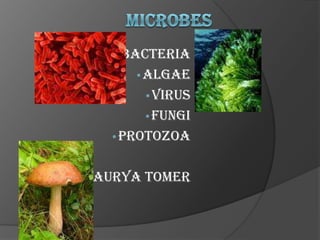
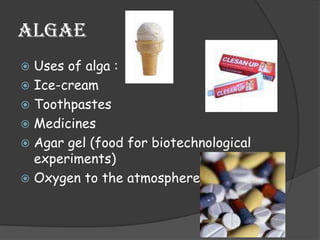
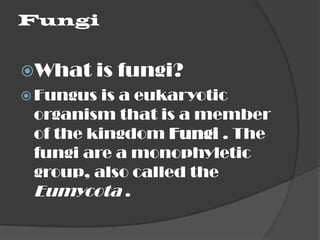
MicrobesBacteria
Algae
Virus
Fungi
Protozoa
By Shaurya TomerBacteriaWhat are bacteria?Bacteria  are a large group of unicellular microorganisms. Typically a few micrometers in length, bacteria have a wide range of shapes, ranging from spheres to rods and spirals.
BacteriaShapes of bacteria:Bacillus : Bacillus is a genus of rod-shaped bacteria and a member of the division Firmicutes. Coccus :  Cocci(singular) are any bacteria whose shape is spherical or nearly spherical.Comma shaped:  It’s name says for itself it is some way like a comma .
BacteriaBinary fission of bacteria:Binary fission :This process results in the reproduction of a living prokaryotic cell by division into two parts which each have the potential to grow to the size of the original cell.
BacteriaUses of bacteria :Medicine Industry (antibiotics)Tanning of leatherWine IndustryLactobacillus (converts curd into milk)Bacteria living in the gut of herbivore animals break down cellulose.Synthesis of vitamin b complexDecompose matterNitrogen fixation
AlgaeWhat is algae?Algae are a large and diverse group of simple, autotrophic organisms (organisms that can make their own food), ranging from unicellular to multicellular forms.
AlgaeWhere are they found ?Algae are usually  found in moist, damp or aquatic placesDoes algae have chlorophyll or not?Alga is the only being other than plants containing chlorophyll . Alga also is the only being except plants to photosynthesize.
AlgaeSome algae :SpirogyraChlamydomonasVolvoxKelp
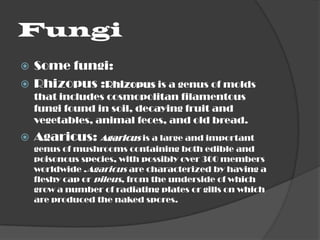
AlgaeUses of alga :Ice-creamToothpastesMedicinesAgar gel (food for biotechnological experiments)Oxygen to the atmosphere
AlgaeHarmful aspect:Eutrophication  or algal bloom :When excess fertilizers enter the sea from agricultural fields, it creates a big layer of algae called algal bloom, which is very harmful for aquatic or marine life as the algae completely cuts out sunlight from the water beneath it, and for a matter of fact, it also reduce oxygen in the water, which cause the fish and other aquatic animals to die. This process is called Eutrophication.
FungiWhat is fungi?Fungus is a eukaryotic organism that is a member of the kingdom Fungi . The fungi are a monophyletic group, also called the Eumycota .
FungiSome fungi:Rhizopus :Rhizopus is a genus of molds that includes cosmopolitan filamentous fungi found in soil, decaying fruit and vegetables, animal feces, and old bread. Agaricus: Agaricus is a large and important genus of mushrooms containing both edible and poisonous species, with possibly over 300 members worldwide .Agaricus are characterized by having a fleshy cap or pileus, from the underside of which grow a number of radiating plates or gills on which are produced the naked spores.
FungiUseful aspectsEdible mushrooms Yeast (baking products)Penicillium is antibioticCheese

micro organisms

  • 1.
  • 2.
  • 3.
  • 4.
  • 5.
  • 6.
    By Shaurya TomerBacteriaWhatare bacteria?Bacteria are a large group of unicellular microorganisms. Typically a few micrometers in length, bacteria have a wide range of shapes, ranging from spheres to rods and spirals.
  • 7.
    BacteriaShapes of bacteria:Bacillus: Bacillus is a genus of rod-shaped bacteria and a member of the division Firmicutes. Coccus : Cocci(singular) are any bacteria whose shape is spherical or nearly spherical.Comma shaped: It’s name says for itself it is some way like a comma .
  • 8.
    BacteriaBinary fission ofbacteria:Binary fission :This process results in the reproduction of a living prokaryotic cell by division into two parts which each have the potential to grow to the size of the original cell.
  • 9.
    BacteriaUses of bacteria:Medicine Industry (antibiotics)Tanning of leatherWine IndustryLactobacillus (converts curd into milk)Bacteria living in the gut of herbivore animals break down cellulose.Synthesis of vitamin b complexDecompose matterNitrogen fixation
  • 10.
    AlgaeWhat is algae?Algaeare a large and diverse group of simple, autotrophic organisms (organisms that can make their own food), ranging from unicellular to multicellular forms.
  • 11.
    AlgaeWhere are theyfound ?Algae are usually found in moist, damp or aquatic placesDoes algae have chlorophyll or not?Alga is the only being other than plants containing chlorophyll . Alga also is the only being except plants to photosynthesize.
  • 12.
  • 13.
    AlgaeUses of alga:Ice-creamToothpastesMedicinesAgar gel (food for biotechnological experiments)Oxygen to the atmosphere
  • 14.
    AlgaeHarmful aspect:Eutrophication or algal bloom :When excess fertilizers enter the sea from agricultural fields, it creates a big layer of algae called algal bloom, which is very harmful for aquatic or marine life as the algae completely cuts out sunlight from the water beneath it, and for a matter of fact, it also reduce oxygen in the water, which cause the fish and other aquatic animals to die. This process is called Eutrophication.
  • 15.
    FungiWhat is fungi?Fungusis a eukaryotic organism that is a member of the kingdom Fungi . The fungi are a monophyletic group, also called the Eumycota .
  • 16.
    FungiSome fungi:Rhizopus :Rhizopusis a genus of molds that includes cosmopolitan filamentous fungi found in soil, decaying fruit and vegetables, animal feces, and old bread. Agaricus: Agaricus is a large and important genus of mushrooms containing both edible and poisonous species, with possibly over 300 members worldwide .Agaricus are characterized by having a fleshy cap or pileus, from the underside of which grow a number of radiating plates or gills on which are produced the naked spores.
  • 17.
    FungiUseful aspectsEdible mushroomsYeast (baking products)Penicillium is antibioticCheese