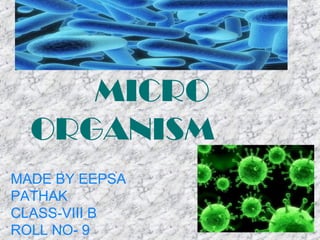
MICRO
ORGANISM
MADE BY EEPSA
PATHAK
CLASS-VIII B
ROLL NO- 9
Microbes
• Are invisible to the naked eye, you need a
powerful microscope to see them.
• Are everywhere around us, inside us, on
us, in our food, in our homes, in the air we
breathe and the water we wash in.
• Are mostly useful, but some are harmful
• Have been around for 3.8 bn years.
• Are vital for life on Earth.
What do Microbes look like ?
Magnified 1000’s of times and coloured using
dye, we see -
Microbes exist in huge numbers
In one single teaspoon of garden soil, there are
over 100,000 microbes. In 1ltr of seawater, there
are over 1bn microbes.
On your hands there are more microbes than there
are people in the world.
There are so many microbes, that scientists have
only named 0.5% of them.
Microbes outnumber all other species and make
up most of the living matter on the planet. See
Microbes – three types
• Bacteria strep bacteria
• Virus rotavirus
• Fungi
mould
Bacteria
• Have three main shapes
spira l(boriella) little balls(-cocci) rods (-bacilli)
• Can move about on their own
• Join up together to form chains
called ‘bio-films’. As on teeth !
What can bacteria do ?
Bacteria in the Cafeteria - lets find out using this
webpage.
We have learnt that bacteria do many good things,
such as decompose waste and give texture and
flavour to food. However, they can also cause
illness. They give off oxygen when they ‘eat’.
Half of all the oxygen in the world, comes from
bacteria.
Virus
Come in 1000s of different shapes and sizes.
They hang about waiting to meet a ‘host’ which
they then invade, hijacking the host’s cells.
Beware the air you breathe and door handles !
Fungi
Not just mushrooms –
athlete’s foot, penicillin, and yeast.
Yeast is used in bread making,
and brewing
Algae are also Microbes
• Algae photosynthesise – taking their
energy from the sun, and producing
oxygen in the process. Algae are thought
to produce over 50% of the oxygen in the
world.
Microbes live among us
• In our food
• Cleaning up our waste
• Killing pests
• Making medicines
• In the making of such things as leather,
soy sauce, cheese and paper.
• In our bodies. Microbes in
our mouths
MICRO ORGANISMS
MERRITS AND DEMERRITS
Eepsa pathak ppt
Eepsa pathak ppt
Eepsa pathak ppt
Eepsa pathak ppt
Eepsa pathak ppt
Eepsa pathak ppt

Eepsa pathak ppt

  • 1.
  • 2.
    Microbes • Are invisibleto the naked eye, you need a powerful microscope to see them. • Are everywhere around us, inside us, on us, in our food, in our homes, in the air we breathe and the water we wash in. • Are mostly useful, but some are harmful • Have been around for 3.8 bn years. • Are vital for life on Earth.
  • 3.
    What do Microbeslook like ? Magnified 1000’s of times and coloured using dye, we see -
  • 4.
    Microbes exist inhuge numbers In one single teaspoon of garden soil, there are over 100,000 microbes. In 1ltr of seawater, there are over 1bn microbes. On your hands there are more microbes than there are people in the world. There are so many microbes, that scientists have only named 0.5% of them. Microbes outnumber all other species and make up most of the living matter on the planet. See
  • 5.
    Microbes – threetypes • Bacteria strep bacteria • Virus rotavirus • Fungi mould
  • 6.
    Bacteria • Have threemain shapes spira l(boriella) little balls(-cocci) rods (-bacilli) • Can move about on their own • Join up together to form chains called ‘bio-films’. As on teeth !
  • 7.
    What can bacteriado ? Bacteria in the Cafeteria - lets find out using this webpage. We have learnt that bacteria do many good things, such as decompose waste and give texture and flavour to food. However, they can also cause illness. They give off oxygen when they ‘eat’. Half of all the oxygen in the world, comes from bacteria.
  • 8.
    Virus Come in 1000sof different shapes and sizes. They hang about waiting to meet a ‘host’ which they then invade, hijacking the host’s cells. Beware the air you breathe and door handles !
  • 9.
    Fungi Not just mushrooms– athlete’s foot, penicillin, and yeast. Yeast is used in bread making, and brewing
  • 10.
    Algae are alsoMicrobes • Algae photosynthesise – taking their energy from the sun, and producing oxygen in the process. Algae are thought to produce over 50% of the oxygen in the world.
  • 11.
    Microbes live amongus • In our food • Cleaning up our waste • Killing pests • Making medicines • In the making of such things as leather, soy sauce, cheese and paper. • In our bodies. Microbes in our mouths
  • 12.