What are micro-
organisms?
A microorganism is a microscopic
organism which may be single cell or
multicellular organism . The study of
microorganisms is called
microbiology.
Microorganisms are very diverse and
include all the bacteria and archaea
and almost all the protozoa. They
also include some members of the
fungi, algae, and animals such as
rotifers. Many macro animals and
plants have juvenile stages which are
also microorganisms. Some
microbiologists also classify viruses
as microorganisms, but others
consider these as nonliving.
Most microorganism are
microscopic ,but there are
some bacteria such as
Thiomargarita namibienis
and some protozoa such as
Sentor which are
macroscopic and visible to
the naked eyes.
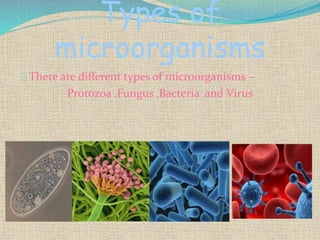
Types of
microorganisms
There are different types of microorganisms –
Protozoa ,Fungus ,Bacteria and Virus
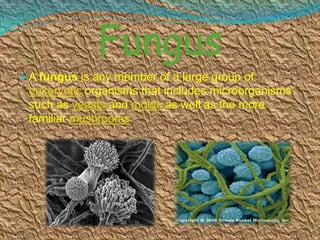
Fungus
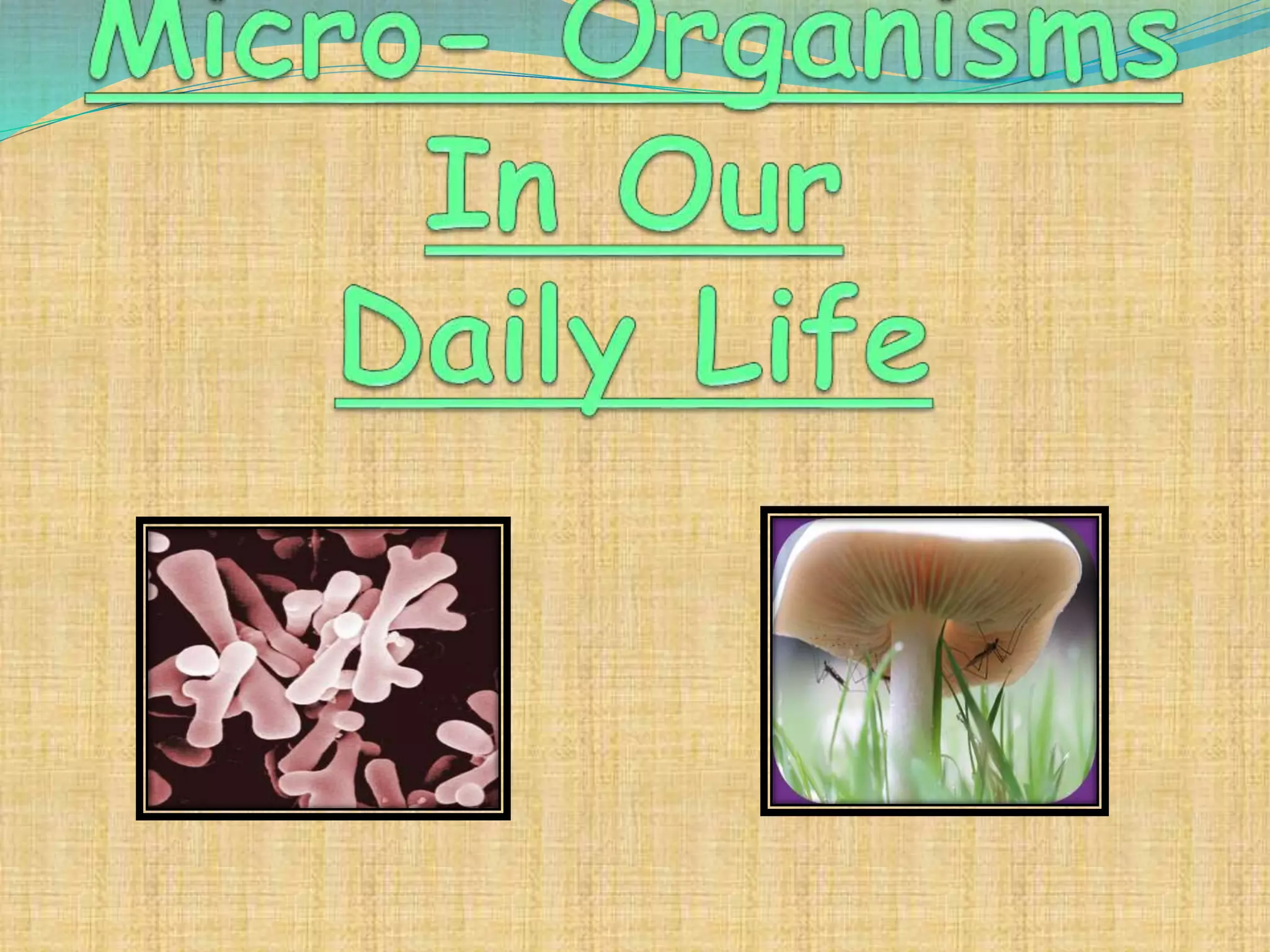
A fungus is any member of a large group of
eukaryotic organisms that includes microorganisms
such as yeasts and molds as well as the more
familiar mushrooms.
One major difference is that fungal cells have cell
walls that contain chitin, unlike the cell walls of
plants and some protists, which contain cellulose,
and unlike the cell walls of bacteria. These and
other differences show that the fungi form a
single group of related organisms, named the
Eumycota that share a common ancestor. This
fungal group is distinct from the structurally
similar myxomycetes This fungal group is distinct
from the structurally si milar myxomycetes The
discipline of biology devoted to the study of fungi
is known as mycology
Mycology has often been regarded as a branch
of botany, even though it is a separate
kingdom in biological taxonomy. Genetic
studies have shown that fungi are more closely
related to animals than to plants. Abundant
worldwide, most fungi are inconspicuous
because of the small size of their structures,
and their cryptic lifestyles in soil, on dead
matter, and as symbionts of plants, animals, or
other fungi. They may become noticeable when
fruiting, either as mushrooms or as molds.
Fungi perform an essential role in the
decomposition of organic matter and have
fundamental roles in nutrient cycling and
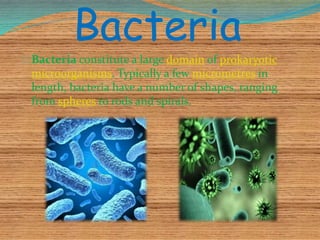
Bacteria
Bacteria constitute a large domain of prokaryotic
microorganisms. Typically a few micrometres in
length, bacteria have a number of shapes, ranging
from spheres to rods and spirals.
Bacteria were among the first life forms to
appear on Earth, and are present in most of
its habitats. Bacteria inhabit soil, water,
acidic hot springs, radioactive waste,and the
deep portions of Earth's crust. Bacteria also
live in symbiotic and parasitic relationships
with plants and animals. They are also known
to have flourished in manned spacecraft.
There are typically 40 million bacterial cells in
a gram of soil and a million bacterial cells in a
millilitre of fresh water. There are
approximately 5×1030 bacteria on
Earth,forming a biomass which exceeds that
of all plants and animals.Bacteria are vital in
In the biological communities surrounding
hydrothermal vents and cold seeps, bacteria provide
the nutrients needed to sustain life by converting
dissolved compounds such as hydrogen sulphide and
methane to energy. On 17 March 2013, researchers
reported data that suggested bacterial life forms
thrive in the Mariana Trench, the deepest spot on the
Earth. Other researchers reported related studies
that microbes thrive inside rocks up to 1900 feet
below the sea floor under 8500 feet of ocean off the
coast of the northwestern United States. According
to one of the researchers,"You can find microbes
everywhere — they're extremely adaptable to
conditions, and survive wherever they are.
Virus
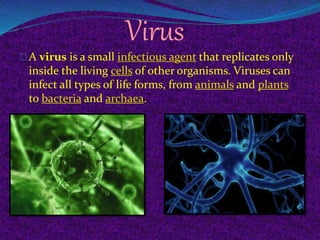
A virus is a small infectious agent that replicates only
inside the living cells of other organisms. Viruses can
infect all types of life forms, from animals and plants
to bacteria and archaea.
Since Dmitri Ivanovsky's 1892 article
describing a non-bacterial pathogen
infecting tobacco plants, and the
discovery of the tobacco mosaic virus by
Martinus Beijerinck in 1898 about 5,000
viruses have been described in detail,
although there are millions of different
types. Viruses are found in almost every
ecosystem on Earth and are the most
abundant type of biological entity. The
study of viruses is known as virology, a
sub-speciality of microbiology
Virus particles consist of two or three parts: i) the
genetic material made from either DNA or RNA,
long molecules that carry genetic information; ii)
a protein coat that protects these genes; and in
some cases iii) an envelope of lipids that
surrounds the protein coat when they are outside
a cell. The shapes of viruses range from simple
helical and icosahedral forms to more complex
structures. The average virus is about one-
hundredth the size of the average bacterium.
Most viruses are too small to be seen directly
with an optical microscope.
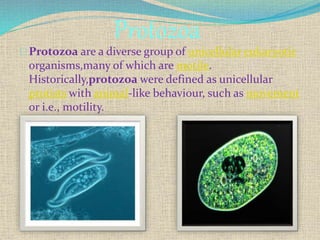
Protozoa
Protozoa are a diverse group of unicellular eukaryotic
organisms,many of which are motile.
Historically,protozoa were defined as unicellular
protists with animal-like behaviour, such as movement
or i.e., motility.
Protozoa were regarded as the partner group
of protists to protophyta, which have plant-
like behavior, e.g. photosynthesis. The term
protozoan has become highly problematic due
to the introduction of modern ultrastructural,
biochemical, and genetic techniques. Today,
protozoan are usually single-celled and
heterotrophic eukaryotes containing non-
filamentous structures that belong to any of
the major lineages of protists. They are
restricted to moist or aquatic habitats. Many
protozoan species are symbionts, some are
parasites, and some are predators of faeces
bacteria and algae. There are an estimated
30,000 protozoan species.
Some protozoa have life stages alternating
between proliferative stages and dormant cysts.
As cysts, protozoa can survive harsh conditions,
such as exposure to extreme temperatures or
harmful chemicals, or long periods without access
to nutrients, water, or oxygen for a period of
time. Being a cyst enables parasitic species to
survive outside of a host, and allows their
transmission from one host to another. When
protozoa are in the form of trophozoites , they
actively feed. The conversion of a trophozoite to
cyst form is known as encystation, while the
process of transforming back into a trophozoite is
known as excystation. Protozoa can reproduce by
binary fission or multiple fission. Some protozoa
reproduce sexually, some asexually, while some
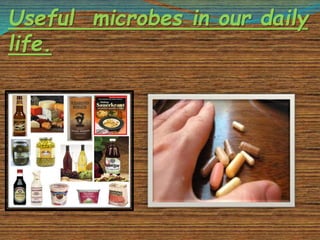
Useful microbes in our daily
life.
Making curd and bread .
Medicinal use of microorganism.
Increasing soil fertility.
Cleaning the environment.
Vaccines
Commercial production of alcohol and wine.
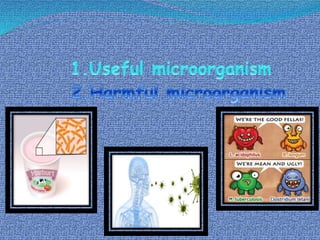
Microorganisms can be harmful
Some microorganism that enter the body can cause
illness.
Eating food contaminated by microorganism can
cause food-poising.
Bacteria can act on food left between the teeth. This
produce acid which causes tooth decay.
Food turns bad because of bacteria and fungi.
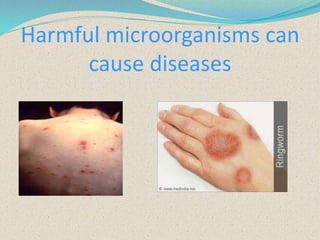
Harmful microorganisms can
cause diseases
How do microorganisms spread
from one person to another?
THROUGH FOOD AND DRINK .
SNEEZING OR COUGHING.
DIRECT CONTACT.
CARRIED BY MOSQUITOES AND FLIES.
MICROORGANISMS CAN ALSO SPREAD THROUGH
AIR.
How to prevent disease from
spreading
Wash your hand before handling food especially
after toilet.
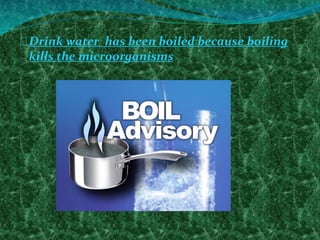
Drink water has been boiled because boiling
kills the microorganisms
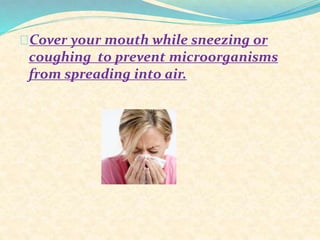
Cover your mouth while sneezing or
coughing to prevent microorganisms
from spreading into air.
Cover your wound with bandage to
prevent it from infection
the
end
created by-harshita mehta
class-8th -d
roll no. 15

Micro organisms

  • 2.
    What are micro- organisms? Amicroorganism is a microscopic organism which may be single cell or multicellular organism . The study of microorganisms is called microbiology.
  • 3.
    Microorganisms are verydiverse and include all the bacteria and archaea and almost all the protozoa. They also include some members of the fungi, algae, and animals such as rotifers. Many macro animals and plants have juvenile stages which are also microorganisms. Some microbiologists also classify viruses as microorganisms, but others consider these as nonliving.
  • 4.
    Most microorganism are microscopic,but there are some bacteria such as Thiomargarita namibienis and some protozoa such as Sentor which are macroscopic and visible to the naked eyes.
  • 5.
    Types of microorganisms There aredifferent types of microorganisms – Protozoa ,Fungus ,Bacteria and Virus
  • 6.
    Fungus A fungus isany member of a large group of eukaryotic organisms that includes microorganisms such as yeasts and molds as well as the more familiar mushrooms.
  • 7.
    One major differenceis that fungal cells have cell walls that contain chitin, unlike the cell walls of plants and some protists, which contain cellulose, and unlike the cell walls of bacteria. These and other differences show that the fungi form a single group of related organisms, named the Eumycota that share a common ancestor. This fungal group is distinct from the structurally similar myxomycetes This fungal group is distinct from the structurally si milar myxomycetes The discipline of biology devoted to the study of fungi is known as mycology
  • 8.
    Mycology has oftenbeen regarded as a branch of botany, even though it is a separate kingdom in biological taxonomy. Genetic studies have shown that fungi are more closely related to animals than to plants. Abundant worldwide, most fungi are inconspicuous because of the small size of their structures, and their cryptic lifestyles in soil, on dead matter, and as symbionts of plants, animals, or other fungi. They may become noticeable when fruiting, either as mushrooms or as molds. Fungi perform an essential role in the decomposition of organic matter and have fundamental roles in nutrient cycling and
  • 9.
    Bacteria Bacteria constitute alarge domain of prokaryotic microorganisms. Typically a few micrometres in length, bacteria have a number of shapes, ranging from spheres to rods and spirals.
  • 10.
    Bacteria were amongthe first life forms to appear on Earth, and are present in most of its habitats. Bacteria inhabit soil, water, acidic hot springs, radioactive waste,and the deep portions of Earth's crust. Bacteria also live in symbiotic and parasitic relationships with plants and animals. They are also known to have flourished in manned spacecraft. There are typically 40 million bacterial cells in a gram of soil and a million bacterial cells in a millilitre of fresh water. There are approximately 5×1030 bacteria on Earth,forming a biomass which exceeds that of all plants and animals.Bacteria are vital in
  • 11.
    In the biologicalcommunities surrounding hydrothermal vents and cold seeps, bacteria provide the nutrients needed to sustain life by converting dissolved compounds such as hydrogen sulphide and methane to energy. On 17 March 2013, researchers reported data that suggested bacterial life forms thrive in the Mariana Trench, the deepest spot on the Earth. Other researchers reported related studies that microbes thrive inside rocks up to 1900 feet below the sea floor under 8500 feet of ocean off the coast of the northwestern United States. According to one of the researchers,"You can find microbes everywhere — they're extremely adaptable to conditions, and survive wherever they are.
  • 12.
    Virus A virus isa small infectious agent that replicates only inside the living cells of other organisms. Viruses can infect all types of life forms, from animals and plants to bacteria and archaea.
  • 13.
    Since Dmitri Ivanovsky's1892 article describing a non-bacterial pathogen infecting tobacco plants, and the discovery of the tobacco mosaic virus by Martinus Beijerinck in 1898 about 5,000 viruses have been described in detail, although there are millions of different types. Viruses are found in almost every ecosystem on Earth and are the most abundant type of biological entity. The study of viruses is known as virology, a sub-speciality of microbiology
  • 14.
    Virus particles consistof two or three parts: i) the genetic material made from either DNA or RNA, long molecules that carry genetic information; ii) a protein coat that protects these genes; and in some cases iii) an envelope of lipids that surrounds the protein coat when they are outside a cell. The shapes of viruses range from simple helical and icosahedral forms to more complex structures. The average virus is about one- hundredth the size of the average bacterium. Most viruses are too small to be seen directly with an optical microscope.
  • 15.
    Protozoa Protozoa are adiverse group of unicellular eukaryotic organisms,many of which are motile. Historically,protozoa were defined as unicellular protists with animal-like behaviour, such as movement or i.e., motility.
  • 16.
    Protozoa were regardedas the partner group of protists to protophyta, which have plant- like behavior, e.g. photosynthesis. The term protozoan has become highly problematic due to the introduction of modern ultrastructural, biochemical, and genetic techniques. Today, protozoan are usually single-celled and heterotrophic eukaryotes containing non- filamentous structures that belong to any of the major lineages of protists. They are restricted to moist or aquatic habitats. Many protozoan species are symbionts, some are parasites, and some are predators of faeces bacteria and algae. There are an estimated 30,000 protozoan species.
  • 17.
    Some protozoa havelife stages alternating between proliferative stages and dormant cysts. As cysts, protozoa can survive harsh conditions, such as exposure to extreme temperatures or harmful chemicals, or long periods without access to nutrients, water, or oxygen for a period of time. Being a cyst enables parasitic species to survive outside of a host, and allows their transmission from one host to another. When protozoa are in the form of trophozoites , they actively feed. The conversion of a trophozoite to cyst form is known as encystation, while the process of transforming back into a trophozoite is known as excystation. Protozoa can reproduce by binary fission or multiple fission. Some protozoa reproduce sexually, some asexually, while some
  • 19.
    Useful microbes inour daily life.
  • 20.
    Making curd andbread . Medicinal use of microorganism. Increasing soil fertility. Cleaning the environment. Vaccines Commercial production of alcohol and wine.
  • 21.
    Microorganisms can beharmful Some microorganism that enter the body can cause illness. Eating food contaminated by microorganism can cause food-poising. Bacteria can act on food left between the teeth. This produce acid which causes tooth decay. Food turns bad because of bacteria and fungi.
  • 22.
  • 23.
    How do microorganismsspread from one person to another? THROUGH FOOD AND DRINK . SNEEZING OR COUGHING. DIRECT CONTACT. CARRIED BY MOSQUITOES AND FLIES. MICROORGANISMS CAN ALSO SPREAD THROUGH AIR.
  • 24.
    How to preventdisease from spreading Wash your hand before handling food especially after toilet.
  • 25.
    Drink water hasbeen boiled because boiling kills the microorganisms
  • 26.
    Cover your mouthwhile sneezing or coughing to prevent microorganisms from spreading into air.
  • 27.
    Cover your woundwith bandage to prevent it from infection
  • 28.