THE FUTURE
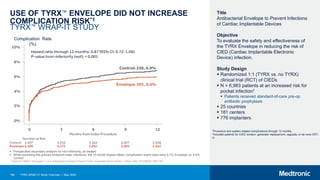
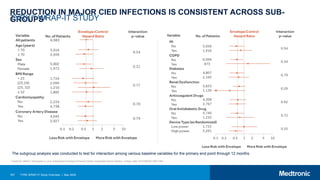
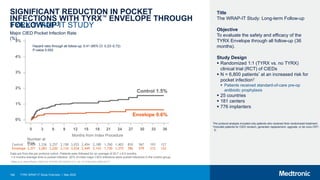
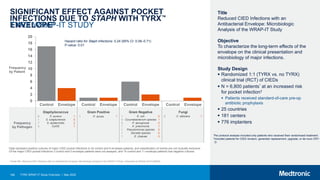
IS HERE
Now Offering Two Leadless Pacing Options
Micra™ AV and Micra™ VR
Transcatheter Pacing Systems
Meet Micra AV
Now with AV Synchrony1
Micra VR
The World’s Smallest Pacemaker2
2
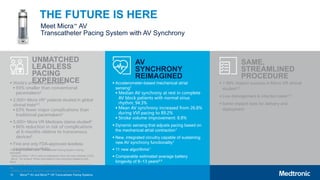
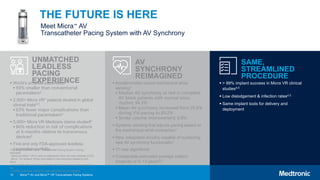
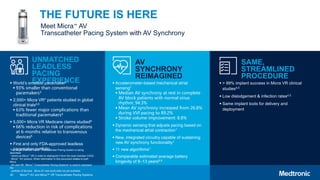
Meet Micra™ AV
Transcatheter Pacing System with AV Synchrony
THE FUTURE IS HERE
UNMATCHED
LEADLESS
PACING
EXPERIENCE
 World’s smallest pacemaker2
 93% smaller than conventional
pacemakers3
 2,500+ Micra VR* patients studied in global
clinical trials4,5
 63% fewer major complications than
traditional pacemakers4
 5,000+ Micra VR Medicare claims studied6
 66% reduction in risk of complications
at 6-months relative to transvenous
devices6
 First and only FDA-approved leadless
pacemaker portfolio
AV
SYNCHRONY
REIMAGINED
 Accelerometer-based mechanical atrial
sensing7
 Median AV synchrony at rest in complete
AV block patients with normal sinus
rhythm: 94.3%
 Mean AV synchrony increased from 26.8%
during VVI pacing to 89.2%
 Stroke volume improvement: 8.8%
 Dynamic sensing that adjusts pacing based on
the mechanical atrial contraction1
 New, integrated circuitry capable of sustaining
new AV synchrony functionality1
 11 new algorithms1
 Comparable estimated average battery
longevity of 8–13 years8,9
SAME,
STREAMLINED
PROCEDURE
 > 99% implant success in Micra VR clinical
studies4,5
 Low dislodgement & infection rates4,5
 Same implant tools for delivery and
deployment
*The single chamber Micra™ Transcatheter Pacing System is being
described
herein as Micra™ VR in order to distinguish it from the dual chamber (VDD)
Micra™ AV product. When information in this document relates to both
Micra
AV and VR, “Micra™ Transcatheter Pacing Systems” is used to represent
the
portfolio of devices. Micra AV real world data not yet available.
Micra™ AV and Micra™ VR Transcatheter Pacing Systems
3
Meet Micra™ AV
Transcatheter Pacing System with AV Synchrony
THE FUTURE IS HERE
UNMATCHED
LEADLESS
PACING
EXPERIENCE
 World’s smallest pacemaker2
 93% smaller than conventional
pacemakers3
 2,500+ Micra VR* patients studied in global
clinical trials4,5
 63% fewer major complications than
traditional pacemakers4
 5,000+ Micra VR Medicare claims studied6
 66% reduction in risk of complications
at 6-months relative to transvenous
devices6
 First and only FDA-approved leadless
pacemaker portfolio
AV
SYNCHRONY
REIMAGINED
 Accelerometer-based mechanical atrial
sensing7
 Median AV synchrony at rest in complete
AV block patients with normal sinus
rhythm: 94.3%
 Mean AV synchrony increased from 26.8%
during VVI pacing to 89.2%
 Stroke volume improvement: 8.8%
 Dynamic sensing that adjusts pacing based on
the mechanical atrial contraction1
 New, integrated circuitry capable of sustaining
new AV synchrony functionality1
 11 new algorithms1
 Comparable estimated average battery
longevity of 8–13 years8,9
SAME,
STREAMLINED
PROCEDURE
 > 99% implant success in Micra VR clinical
studies4,5
 Low dislodgement & infection rates4,5
 Same implant tools for delivery and
deployment
*The single chamber Micra™ Transcatheter Pacing System is being
described
herein as Micra™ VR in order to distinguish it from the dual chamber (VDD)
Micra™ AV product. When information in this document relates to both
Micra
AV and VR, “Micra™ Transcatheter Pacing Systems” is used to represent
the
portfolio of devices. Micra AV real world data not yet available.
Micra™ AV and Micra™ VR Transcatheter Pacing Systems
TRANSVENOUS PACEMAKERS
STILL ENCOUNTER
CHALLENGES, INCLUDING
POCKET- AND LEAD-RELATED
COMPLICATIONS
LEADLESS PACING REMOVES
THE POCKET AND LEAD,
WHICH ACCOUNT FOR TWO-
THIRDS OF TRANSVENOUS
PACEMAKER
COMPLICATIONS10
5
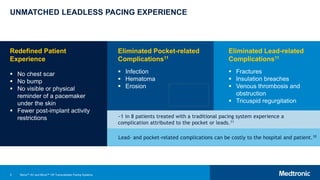
UNMATCHED LEADLESS PACING EXPERIENCE
Redefined Patient
Experience
 No chest scar
 No bump
 No visible or physical
reminder of a pacemaker
under the skin
 Fewer post-implant activity
restrictions
Eliminated Pocket-related
Complications11
 Infection
 Hematoma
 Erosion
Eliminated Lead-related
Complications11
 Fractures
 Insulation breaches
 Venous thrombosis and
obstruction
 Tricuspid regurgitation
Lead- and pocket-related complications can be costly to the hospital and patient.10
~1 in 8 patients treated with a traditional pacing system experience a
complication attributed to the pocket or leads.11
Micra™ AV and Micra™ VR Transcatheter Pacing Systems
6
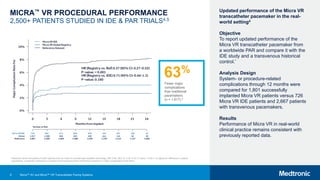
MICRA™ VR PROCEDURAL PERFORMANCE
2,500+ PATIENTS STUDIED IN IDE & PAR TRIALS4,5
Updated performance of the Micra VR
transcatheter pacemaker in the real-
world setting4
Objective
To report updated performance of the
Micra VR transcatheter pacemaker from
a worldwide PAR and compare it with the
IDE study and a transvenous historical
control.*
Analysis Design
System- or procedure-related
complications through 12 months were
compared for 1,801 successfully
implanted Micra VR patients versus 726
Micra VR IDE patients and 2,667 patients
with transvenous pacemakers.
Results
Performance of Micra VR in real-world
clinical practice remains consistent with
previously reported data.
63%
Fewer major
complications
than traditional
pacemakers
(n = 1,817).4
*Historical cohort comprised of 2,667 patients from six trials of commercially available technology (HR: 0.46, 95% CI: 0.30–0.72; P-value < 0.001). To adjust for difference in patient
populations, propensity matching to a subset of the historical control confirmed a reduction in major complications with Micra.
Micra™ AV and Micra™ VR Transcatheter Pacing Systems
0
2
4
6
8
10
0 30 60 90 120 150 180
Patients
with
a
chronic
complication
(%)
Time to chronic complication following device implant (days)
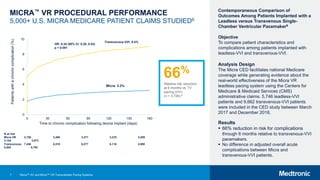
HR: 0.34 (95% CI: 0.28, 0.43)
p < 0.001
N at risk
Micra 3726 3480 3371 3278 3209
3144 3073
Micra: 3.3%
Transvenous-VVI: 9.4%
Transvenous 7246 6510 6277 6116 5990
5883 5792
7
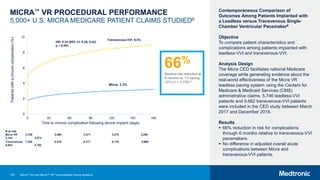
Contemporaneous Comparison of
Outcomes Among Patients Implanted with a
Leadless versus Transvenous Single-
Chamber Ventricular Pacemaker6
Objective
To compare patient characteristics and
complications among patients implanted with
leadless-VVI and transvenous-VVI.
Analysis Design
The Micra CED facilitates national Medicare
coverage while generating evidence about the
real-world effectiveness of the Micra VR
leadless pacing system using the Centers for
Medicare & Medicaid Services (CMS)
administrative claims. 5,746 leadless-VVI
patients and 9,662 transvenous-VVI patients
were included in the CED study between March
2017 and December 2018.
Results
 66% reduction in risk for complications
through 6 months relative to transvenous-VVI
pacemakers.
 No difference in adjusted overall acute
complications between Micra and
transvenous-VVI patients.
66%
Relative risk reduction
at 6 months vs. TV
pacing (VVI)
(n = 3,726).6
N at risk
Micra VR 3,726 3,480 3,371 3,278 3,209
3,144 3,073
Transvenous 7,246 6,510 6,277 6,116 5,990
5,883 5,792
MICRA™ VR PROCEDURAL PERFORMANCE
5,000+ U.S. MICRA MEDICARE PATIENT CLAIMS STUDIED6
Micra™ AV and Micra™ VR Transcatheter Pacing Systems
8
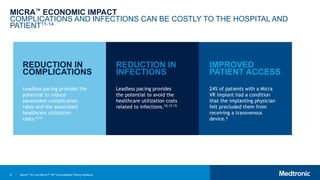
MICRA™ ECONOMIC IMPACT
COMPLICATIONS AND INFECTIONS CAN BE COSTLY TO THE HOSPITAL AND
PATIENT11-14
IMPROVED
PATIENT ACCESS
REDUCTION IN
COMPLICATIONS
REDUCTION IN
INFECTIONS
24% of patients with a Micra
VR implant had a condition
that the implanting physician
felt precluded them from
receiving a transvenous
device.4
Leadless pacing provides the
potential to reduce
pacemaker complication
rates and the associated
healthcare utilization
costs.4,10
Leadless pacing provides
the potential to avoid the
healthcare utilization costs
related to infections.10,12-15
Micra™ AV and Micra™ VR Transcatheter Pacing Systems
9
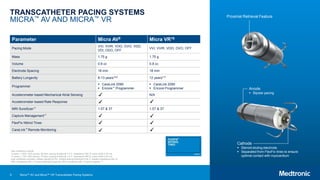
TRANSCATHETER PACING SYSTEMS
MICRA™ AV AND MICRA™ VR
Parameter Micra AV9 Micra VR16
Pacing Mode
VVI, VVIR, VOO, OVO, VDD,
VDI, ODO, OFF
VVI, VVIR, VOO, OVO, OFF
Mass 1.75 g 1.75 g
Volume 0.8 cc 0.8 cc
Electrode Spacing 18 mm 18 mm
Battery Longevity 8-13 years*8,9 12 years†17
Programmer
 CareLink 2090
 Encore™ Programmer
 CareLink 2090
 Encore Programmer
Accelerometer-based Mechanical Atrial Sensing N/A
Accelerometer-based Rate Response
MRI SureScan™ 1.5T & 3T 1.5T & 3T
Capture Management™
FlexFix Nitinol Tines
CareLink™ Remote Monitoring
Proximal Retrieval Feature
Anode
 Bipolar pacing
Cathode
 Steroid-eluting electrode
 Separated from FlexFix tines to ensure
optimal contact with myocardium
*Use conditions include:
8 years = 100% VDD pacing, 60 bpm, pacing amplitude 1.5 V, impedance 500 Ω, pulse width 0.24 ms.
13 years = 15% VDD pacing, 70 bpm, pacing amplitude 1.5 V, impedance 600 Ω, pulse width 0.24 ms.
†Use conditions included: median pacing 53.5%, median pacing threshold 0.50 V, median impedance 543 Ω;
89% of patients with > 10-year projected longevity; 99% of patients with > 5-year longevity.18
Micra™ AV and Micra™ VR Transcatheter Pacing Systems
10
Meet Micra™ AV
Transcatheter Pacing System with AV Synchrony
THE FUTURE IS HERE
UNMATCHED
LEADLESS
PACING
EXPERIENCE
 World’s smallest pacemaker2
 93% smaller than conventional
pacemakers3
 2,500+ Micra VR* patients studied in global
clinical trials4,5
 63% fewer major complications than
traditional pacemakers4
 5,000+ Micra VR Medicare claims studied6
 66% reduction in risk of complications
at 6-months relative to transvenous
devices6
 First and only FDA-approved leadless
pacemaker portfolio
AV
SYNCHRONY
REIMAGINED
 Accelerometer-based mechanical atrial
sensing7
 Median AV synchrony at rest in complete
AV block patients with normal sinus
rhythm: 94.3%
 Mean AV synchrony increased from 26.8%
during VVI pacing to 89.2%
 Stroke volume improvement: 8.8%
 Dynamic sensing that adjusts pacing based on
the mechanical atrial contraction1
 New, integrated circuitry capable of sustaining
new AV synchrony functionality1
 11 new algorithms1
 Comparable estimated average battery
longevity of 8–13 years8,9
SAME,
STREAMLINED
PROCEDURE
 > 99% implant success in Micra VR clinical
studies4,5
 Low dislodgement & infection rates4,5
 Same implant tools for delivery and
deployment
*The single chamber Micra™ Transcatheter Pacing System is being
described
herein as Micra™ VR in order to distinguish it from the dual chamber (VDD)
Micra™ AV product. When information in this document relates to both
Micra
AV and VR, “Micra™ Transcatheter Pacing Systems” is used to represent
the
portfolio of devices. Micra AV real world data not yet available.
Micra™ AV and Micra™ VR Transcatheter Pacing Systems
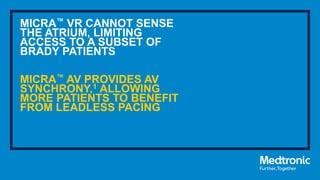
MICRA™ VR CANNOT SENSE
THE ATRIUM, LIMITING
ACCESS TO A SUBSET OF
BRADY PATIENTS
MICRA™ AV PROVIDES AV
SYNCHRONY,1 ALLOWING
MORE PATIENTS TO BENEFIT
FROM LEADLESS PACING
12
AV SYNCHRONY REIMAGINED
MEET MICRA™ AV
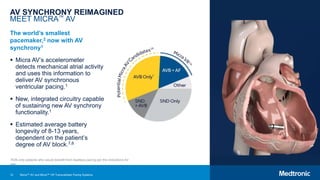
The world’s smallest
pacemaker,2 now with AV
synchrony1
 Micra AV’s accelerometer
detects mechanical atrial activity
and uses this information to
deliver AV synchronous
ventricular pacing.1
 New, integrated circuitry capable
of sustaining new AV synchrony
functionality.1
 Estimated average battery
longevity of 8-13 years,
dependent on the patient’s
degree of AV block.7,8
*AVB-only patients who would benefit from leadless pacing per the indications for
use.
Micra™ AV and Micra™ VR Transcatheter Pacing Systems
13
AV SYNCHRONY REIMAGINED
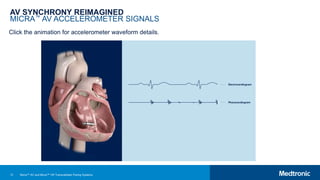
MICRA™ AV ACCELEROMETER SIGNALS
Click the animation for accelerometer waveform details.
Micra™ AV and Micra™ VR Transcatheter Pacing Systems
14
AV SYNCHRONY REIMAGINED
MICRA™ AV ACCELEROMETER SIGNALS
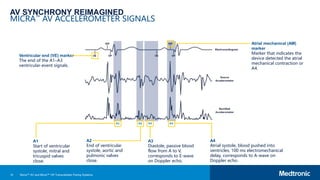
A1
Start of ventricular
systole, mitral and
tricuspid valves
close.
A2
End of ventricular
systole, aortic and
pulmonic valves
close.
A3
Diastole, passive blood
flow from A to V,
corresponds to E-wave
on Doppler echo.
A4
Atrial systole, blood pushed into
ventricles, 100 ms electromechanical
delay, corresponds to A-wave on
Doppler echo.
Ventricular end (VE) marker
The end of the A1–A3
ventricular-event signals.
Atrial mechanical (AM)
marker
Marker that indicates the
device detected the atrial
mechanical contraction or
A4.
Micra™ AV and Micra™ VR Transcatheter Pacing Systems
15
AV SYNCHRONY REIMAGINED
MICRA™ AV ACCELEROMETER SIGNALS
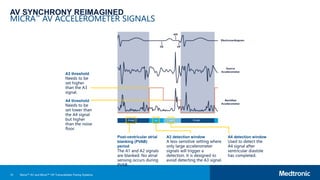
Post-ventricular atrial
blanking (PVAB)
period
The A1 and A2 signals
are blanked. No atrial
sensing occurs during
PVAB.
A3 detection window
A less-sensitive setting where
only large accelerometer
signals will trigger a
detection. It is designed to
avoid detecting the A3 signal.
A3 threshold
Needs to be
set higher
than the A3
signal.
A4 detection window
Used to detect the
A4 signal after
ventricular diastole
has completed.
A4 threshold
Needs to be
set lower than
the A4 signal
but higher
than the noise
floor.
Micra™ AV and Micra™ VR Transcatheter Pacing Systems
16
AV SYNCHRONY REIMAGINED
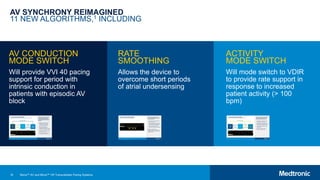
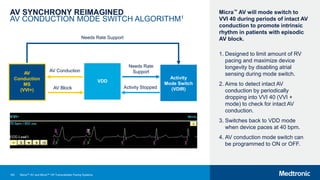
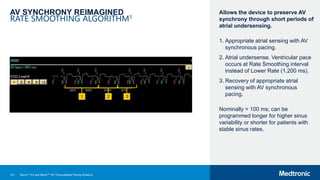
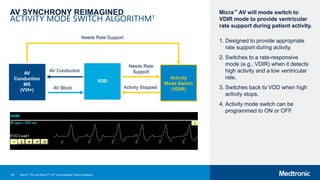
11 NEW ALGORITHMS,1 INCLUDING
AV CONDUCTION
MODE SWITCH
Will provide VVI 40 pacing
support for period with
intrinsic conduction in
patients with episodic AV
block
RATE
SMOOTHING
Allows the device to
overcome short periods
of atrial undersensing
ACTIVITY
MODE SWITCH
Will mode switch to VDIR
to provide rate support in
response to increased
patient activity (> 100
bpm)
Micra™ AV and Micra™ VR Transcatheter Pacing Systems
17
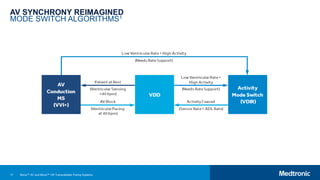
AV SYNCHRONY REIMAGINED
MODE SWITCH ALGORITHMS1
Micra™ AV and Micra™ VR Transcatheter Pacing Systems
18
AV SYNCHRONY REIMAGINED
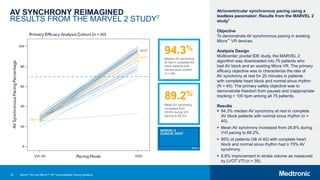
RESULTS FROM THE MARVEL 2 STUDY7
Atrioventricular synchronous pacing using a
leadless pacemaker: Results from the MARVEL 2
study7
Objective
To demonstrate AV synchronous pacing in existing
Micra™ VR devices.
Analysis Design
Multicenter, pivotal IDE study, the MARVEL 2
algorithm was downloaded into 75 patients who
had AV block and an existing Micra VR. The primary
efficacy objective was to characterize the rate of
AV synchrony at rest for 20 minutes in patients
with complete heart block and normal sinus rhythm
(N = 40). The primary safety objective was to
demonstrate freedom from pauses and inappropriate
tracking > 100 bpm among all 75 patients.
Results
 94.3% median AV synchrony at rest in complete
AV block patients with normal sinus rhythm (n =
40).
 Mean AV synchrony increased from 26.8% during
VVI pacing to 89.2%.
 95% of patients (38 of 40) with complete heart
block and normal sinus rhythm had ≥ 70% AV
synchrony.
 8.8% improvement in stroke volume as measured
by LVOT VTI (n = 39).
94.3%
Median AV synchrony
at rest in complete AV
block patients with
normal sinus rhythm
(n = 40).
89.2%
Mean AV synchrony
increased from
26.8% during VVI
pacing to 89.2%.
Micra™ AV and Micra™ VR Transcatheter Pacing Systems
19
Meet Micra™ AV
Transcatheter Pacing System with AV Synchrony
THE FUTURE IS HERE
UNMATCHED
LEADLESS
PACING
EXPERIENCE
 World’s smallest pacemaker2
 93% smaller than conventional
pacemakers3
 2,500+ Micra VR* patients studied in global
clinical trials4,5
 63% fewer major complications than
traditional pacemakers4
 5,000+ Micra VR Medicare claims studied6
 66% reduction in risk of complications
at 6-months relative to transvenous
devices6
 First and only FDA-approved leadless
pacemaker portfolio
AV
SYNCHRONY
REIMAGINED
 Accelerometer-based mechanical atrial
sensing7
 Median AV synchrony at rest in complete
AV block patients with normal sinus
rhythm: 94.3%
 Mean AV synchrony increased from 26.8%
during VVI pacing to 89.2%
 Stroke volume improvement: 8.8%
 Dynamic sensing that adjusts pacing based on
the mechanical atrial contraction1
 New, integrated circuitry capable of sustaining
new AV synchrony functionality1
 11 new algorithms1
 Comparable estimated average battery
longevity of 8–13 years8,9
SAME,
STREAMLINED
PROCEDURE
 > 99% implant success in Micra VR clinical
studies4,5
 Low dislodgement & infection rates4,5
 Same implant tools for delivery and
deployment
*The single chamber Micra™ Transcatheter Pacing System is being
described
herein as Micra™ VR in order to distinguish it from the dual chamber (VDD)
Micra™ AV product. When information in this document relates to both
Micra
AV and VR, “Micra™ Transcatheter Pacing Systems” is used to represent
the
portfolio of devices. Micra AV real world data not yet available.
Micra™ AV and Micra™ VR Transcatheter Pacing Systems
AV SYNCHRONY WITH A
LEADLESS PACEMAKER,
WHILE MAINTAINING THE
SAME, STREAMLINED
IMPLANT PROCEDURE
21
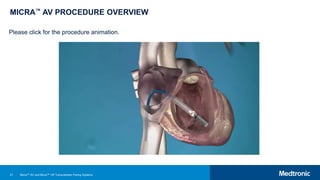
MICRA™ AV PROCEDURE OVERVIEW
Please click for the procedure animation.
Micra™ AV and Micra™ VR Transcatheter Pacing Systems
22
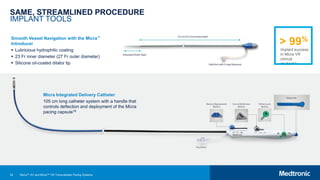
SAME, STREAMLINED PROCEDURE
IMPLANT TOOLS
Micra Integrated Delivery Catheter
105 cm long catheter system with a handle that
controls deflection and deployment of the Micra
pacing capsule16
> 99%
Implant success
in Micra VR
clinical
studies4,5
Smooth Vessel Navigation with the Micra™
Introducer
 Lubricious hydrophilic coating
 23 Fr inner diameter (27 Fr outer diameter)
 Silicone oil-coated dilator tip
Micra™ AV and Micra™ VR Transcatheter Pacing Systems
23
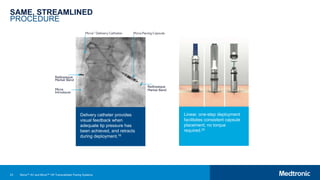
SAME, STREAMLINED
PROCEDURE
Delivery catheter provides
visual feedback when
adequate tip pressure has
been achieved, and retracts
during deployment.16
Linear, one-step deployment
facilitates consistent capsule
placement; no torque
required.20
Micra™ AV and Micra™ VR Transcatheter Pacing Systems
APPENDIX
25
Meet Micra™ AV
Transcatheter Pacing System with AV Synchrony
THE FUTURE IS HERE
UNMATCHED
LEADLESS
PACING
EXPERIENCE
 World’s smallest pacemaker2
 93% smaller than conventional
pacemakers3
 2,500+ Micra VR* patients studied in global
clinical trials4,5
 63% fewer major complications than
traditional pacemakers4
 5,000+ Micra VR Medicare claims studied6
 66% reduction in risk of complications
at 6-months relative to transvenous
devices6
 First and only FDA-approved leadless
pacemaker portfolio
AV
SYNCHRONY
REIMAGINED
 Accelerometer-based mechanical atrial
sensing7
 Median AV synchrony at rest in complete
AV block patients with normal sinus
rhythm: 94.3%
 Mean AV synchrony increased from 26.8%
during VVI pacing to 89.2%
 Stroke volume improvement: 8.8%
 Dynamic sensing that adjusts pacing based on
the mechanical atrial contraction1
 New, integrated circuitry capable of sustaining
new AV synchrony functionality1
 11 new algorithms1
 Comparable estimated average battery
longevity of 8–13 years8,9
SAME,
STREAMLINED
PROCEDURE
 > 99% implant success in Micra VR clinical
studies4,5
 Low dislodgement & infection rates4,5
 Same implant tools for delivery and
deployment
*The single chamber Micra™ Transcatheter Pacing System is being
described
herein as Micra™ VR in order to distinguish it from the dual chamber (VDD)
Micra™ AV product. When information in this document relates to both
Micra
AV and VR, “Micra™ Transcatheter Pacing Systems” is used to represent
the
portfolio of devices. Micra AV real world data not yet available.
Micra™ AV and Micra™ VR Transcatheter Pacing Systems
FLEXFIX™
NITINOL
TINES
27
UNMATCHED LEADLESS PACING EXPERIENCE
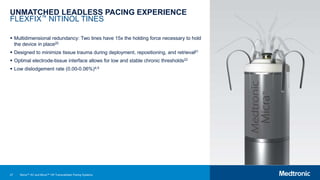
FLEXFIX™ NITINOL TINES
 Multidimensional redundancy: Two tines have 15x the holding force necessary to hold
the device in place20
 Designed to minimize tissue trauma during deployment, repositioning, and retrieval21
 Optimal electrode-tissue interface allows for low and stable chronic thresholds22
 Low dislodgement rate (0.00-0.06%)4,5
Micra™ AV and Micra™ VR Transcatheter Pacing Systems
MARVEL 2
CLINICAL
DATA*
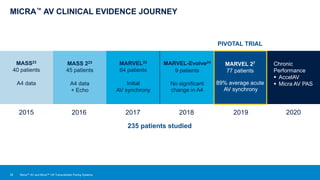
MICRA™ AV CLINICAL EVIDENCE JOURNEY
2015 2016 2017 2018 2019 2020
29
MASS23
40 patients
A4 data
MASS 223
45 patients
A4 data
+ Echo
MARVEL23
64 patients
Initial
AV synchrony
MARVEL-Evolve24
9 patients
No significant
change in A4
MARVEL 27
77 patients
89% average acute
AV synchrony
PIVOTAL TRIAL
Chronic
Performance
 AccelAV
 Micra AV PAS
235 patients studied
Micra™ AV and Micra™ VR Transcatheter Pacing Systems
30
Clemens Steinwender, M.D.; Surinder Kaur Khelae, M.D.; Christophe Garweg, M.D.;
Joseph Yat Sun Chan, M.D.; Philippe Ritter, M.D.; Jens Brock Johansen, M.D., Ph.D.;
Venkata Sagi, M.D.; Laurence M. Epstein, M.D.; Jonathan P. Piccini, M.D., M.H.S.;
Mario Pascual, M.D.; Lluis Mont, M.D.; Todd Sheldon, M.S.; Vincent Splett, M.S.;
Kurt Stromberg, M.S.; Nicole Wood, B.S.; Larry Chinitz, M.D.
ATRIOVENTRICULAR SYNCHRONOUS
PACING USING A LEADLESS
VENTRICULAR PACEMAKER:
RESULTS FROM THE MARVEL 2 STUDY
Note: MARVEL 2 clinical data slides were presented at AHA 2019.25
Micra™ AV and Micra™ VR Transcatheter Pacing Systems
31
PRIMARY RESULTS FROM THE MARVEL 2 STUDY
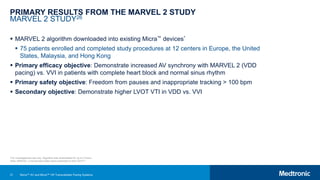
MARVEL 2 STUDY26
 MARVEL 2 algorithm downloaded into existing Micra™ devices*
 75 patients enrolled and completed study procedures at 12 centers in Europe, the United
States, Malaysia, and Hong Kong
 Primary efficacy objective: Demonstrate increased AV synchrony with MARVEL 2 (VDD
pacing) vs. VVI in patients with complete heart block and normal sinus rhythm
 Primary safety objective: Freedom from pauses and inappropriate tracking > 100 bpm
 Secondary objective: Demonstrate higher LVOT VTI in VDD vs. VVI
*For investigational use only. Algorithm was downloaded for up to 5 hours.
Note: MARVEL 2 clinical data slides were presented at AHA 2019.25
Micra™ AV and Micra™ VR Transcatheter Pacing Systems
32
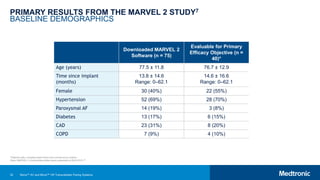
PRIMARY RESULTS FROM THE MARVEL 2 STUDY7
BASELINE DEMOGRAPHICS
Downloaded MARVEL 2
Software (n = 75)
Evaluable for Primary
Efficacy Objective (n =
40)*
Age (years) 77.5 ± 11.8 76.7 ± 12.9
Time since implant
(months)
13.8 ± 14.6
Range: 0–62.1
14.6 ± 16.6
Range: 0–62.1
Female 30 (40%) 22 (55%)
Hypertension 52 (69%) 28 (70%)
Paroxysmal AF 14 (19%) 3 (8%)
Diabetes 13 (17%) 6 (15%)
CAD 23 (31%) 8 (20%)
COPD 7 (9%) 4 (10%)
*Patients with complete heart block and normal sinus rhythm.
Note: MARVEL 2 clinical data slides were presented at AHA 2019.25
Micra™ AV and Micra™ VR Transcatheter Pacing Systems
33
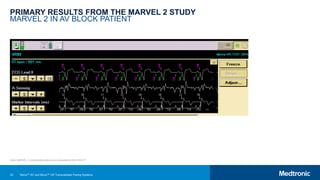
PRIMARY RESULTS FROM THE MARVEL 2 STUDY
MARVEL 2 IN AV BLOCK PATIENT
Note: MARVEL 2 clinical data slides were presented at AHA 2019.25
Micra™ AV and Micra™ VR Transcatheter Pacing Systems
34
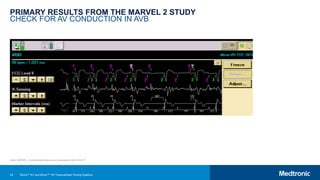
PRIMARY RESULTS FROM THE MARVEL 2 STUDY
CHECK FOR AV CONDUCTION IN AVB
Note: MARVEL 2 clinical data slides were presented at AHA 2019.25
Micra™ AV and Micra™ VR Transcatheter Pacing Systems
35
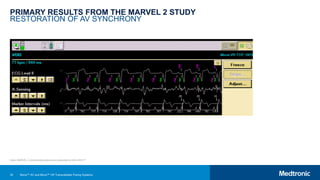
PRIMARY RESULTS FROM THE MARVEL 2 STUDY
RESTORATION OF AV SYNCHRONY
Note: MARVEL 2 clinical data slides were presented at AHA 2019.25
Micra™ AV and Micra™ VR Transcatheter Pacing Systems
36
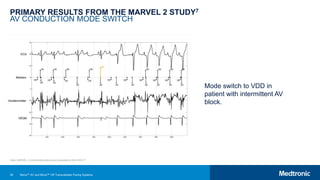
PRIMARY RESULTS FROM THE MARVEL 2 STUDY7
AV CONDUCTION MODE SWITCH
Mode switch to VDD in
patient with intermittent AV
block.
Note: MARVEL 2 clinical data slides were presented at AHA 2019.25
Micra™ AV and Micra™ VR Transcatheter Pacing Systems
37
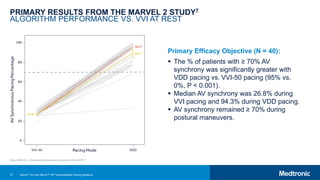
PRIMARY RESULTS FROM THE MARVEL 2 STUDY7
ALGORITHM PERFORMANCE VS. VVI AT REST
Primary Efficacy Objective (N = 40):
 The % of patients with ≥ 70% AV
synchrony was significantly greater with
VDD pacing vs. VVI-50 pacing (95% vs.
0%, P < 0.001).
 Median AV synchrony was 26.8% during
VVI pacing and 94.3% during VDD pacing.
 AV synchrony remained ≥ 70% during
postural maneuvers.
Note: MARVEL 2 clinical data slides were presented at AHA 2019.25
Micra™ AV and Micra™ VR Transcatheter Pacing Systems
38
PRIMARY RESULTS FROM THE MARVEL 2 STUDY7
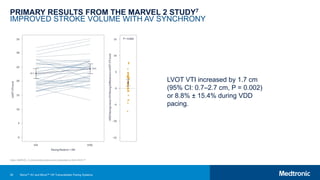
IMPROVED STROKE VOLUME WITH AV SYNCHRONY
LVOT VTI increased by 1.7 cm
(95% CI: 0.7–2.7 cm, P = 0.002)
or 8.8% ± 15.4% during VDD
pacing.
Note: MARVEL 2 clinical data slides were presented at AHA 2019.25
Micra™ AV and Micra™ VR Transcatheter Pacing Systems
39
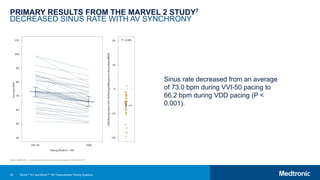
PRIMARY RESULTS FROM THE MARVEL 2 STUDY7
DECREASED SINUS RATE WITH AV SYNCHRONY
Sinus rate decreased from an average
of 73.0 bpm during VVI-50 pacing to
66.2 bpm during VDD pacing (P <
0.001).
Note: MARVEL 2 clinical data slides were presented at AHA 2019.25
Micra™ AV and Micra™ VR Transcatheter Pacing Systems
40
PRIMARY RESULTS FROM THE MARVEL 2 STUDY
MODE SWITCHING AND AUTOMATICITY
 The pacing mode remained in VVI-40 during periods of intrinsic
AV conduction and appropriately switched to VDD during AV
block.
 Activity mode switching showed appropriate pacing support
during hallwalk exercise.
 The automatic algorithm was effective in choosing and adjusting
most detection parameters throughout the study.
Note: MARVEL 2 clinical data slides were presented at AHA 2019.25
Micra™ AV and Micra™ VR Transcatheter Pacing Systems
41
PRIMARY RESULTS FROM THE MARVEL 2 STUDY
MARVEL 2 MODE SAFETY
 No pauses observed.
 No instances of oversensing-induced tachycardia observed.
 Six adverse events collected; none related to the
investigational algorithm.
 No adverse events reported due to lack of synchrony.
Note: MARVEL 2 clinical data slides were presented at AHA 2019.25
Micra™ AV and Micra™ VR Transcatheter Pacing Systems
42
PRIMARY RESULTS FROM THE MARVEL 2 STUDY
LIMITATIONS
 Acute download study of research algorithm.
 Performance over time has yet to be evaluated.
 Current Micra™ VVIR device unable to efficiently process
accelerometer signal for AV synchrony long-term.
Note: MARVEL 2 clinical data slides were presented at AHA 2019.25
Micra™ AV and Micra™ VR Transcatheter Pacing Systems
43
PRIMARY RESULTS FROM THE MARVEL 2 STUDY
CONCLUSIONS
 Accelerometer-based atrial sensing with a novel, automated,
enhanced algorithm significantly improves AV synchrony in patients
with AV block and a single chamber leadless pacemaker implanted
in the right ventricle.
 Improvements in AV synchrony led to significant improvements in
stroke volume.
 AV synchrony remained ≥ 70% during postural maneuvers.
 AV conduction and activity mode switches performed as intended.
 No adverse events reported due to lack of synchrony.
Note: MARVEL 2 clinical data slides were presented at AHA 2019.25
Micra™ AV and Micra™ VR Transcatheter Pacing Systems
44
Christophe Garweg, M.D.; Surinder Kaur Khelae, M.D.; Joseph Yat Sun Chan, M.D.;
Larry Chinitz, M.D.; Philippe Ritter, M.D.; Jens Brock Johansen, M.D., Ph.D.;
Venkata Sagi, M.D.; Laurence M. Epstein, M.D.; Jonathan P. Piccini, M.D., M.H.S.;
Mario Pascual, M.D.; Lluis Mont, M.D.; Vincent Splett, M.S.; Kurt Stromberg, M.S.;
Clemens Steinwender, M.D.
PREDICTORS OF ACCELEROMETER-
BASED ATRIAL DETECTION IN A
LEADLESS VENTRICULAR PACEMAKER:
INSIGHTS FROM THE MARVEL 2 STUDY27
Micra™ AV and Micra™ VR Transcatheter Pacing Systems
45
METHODS27
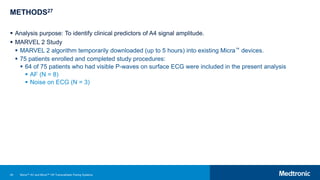
 Analysis purpose: To identify clinical predictors of A4 signal amplitude.
 MARVEL 2 Study
 MARVEL 2 algorithm temporarily downloaded (up to 5 hours) into existing Micra™ devices.
 75 patients enrolled and completed study procedures:
 64 of 75 patients who had visible P-waves on surface ECG were included in the present analysis
 AF (N = 8)
 Noise on ECG (N = 3)
Micra™ AV and Micra™ VR Transcatheter Pacing Systems
46
METHODS — MODEL27
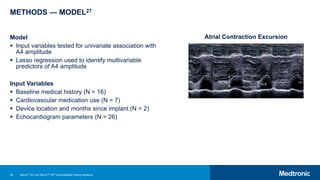
Model
 Input variables tested for univariate association with
A4 amplitude
 Lasso regression used to identify multivariable
predictors of A4 amplitude
Input Variables
 Baseline medical history (N = 16)
 Cardiovascular medication use (N = 7)
 Device location and months since implant (N = 2)
 Echocardiogram parameters (N = 26)
Atrial Contraction Excursion
Micra™ AV and Micra™ VR Transcatheter Pacing Systems
47
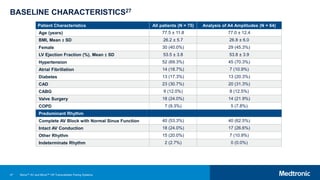
BASELINE CHARACTERISTICS27
Patient Characteristics All patients (N = 75) Analysis of A4 Amplitudes (N = 64)
Age (years) 77.5 ± 11.8 77.0 ± 12.4
BMI, Mean ± SD 26.2 ± 5.7 26.8 ± 6.0
Female 30 (40.0%) 29 (45.3%)
LV Ejection Fraction (%), Mean ± SD 53.5 ± 3.8 53.8 ± 3.9
Hypertension 52 (69.3%) 45 (70.3%)
Atrial Fibrillation 14 (18.7%) 7 (10.9%)
Diabetes 13 (17.3%) 13 (20.3%)
CAD 23 (30.7%) 20 (31.3%)
CABG 9 (12.0%) 8 (12.5%)
Valve Surgery 18 (24.0%) 14 (21.9%)
COPD 7 (9.3%) 5 (7.8%)
Predominant Rhythm
Complete AV Block with Normal Sinus Function 40 (53.3%) 40 (62.5%)
Intact AV Conduction 18 (24.0%) 17 (26.6%)
Other Rhythm 15 (20.0%) 7 (10.9%)
Indeterminate Rhythm 2 (2.7%) 0 (0.0%)
Micra™ AV and Micra™ VR Transcatheter Pacing Systems
48
RESULTS27
Variable Type Variables Summary
Univariate Models Multivariable Model
β (95% CI) P-value R2 β (95% CI) P-value
Baseline and
Medical History
Male 54.7% -0.57 (-1.25–0.10) 0.099 0.04
Systolic blood pressure 137 ± 20 [92–176] 0.02 (0.00–0.04) 0.036 0.07
History of atrial arrhythmias 15.6% -0.81 (-1.73–0.11) 0.089 0.05
CABG 12.5% -1.41 (-2.38 to -0.44) 0.006 0.12 -1.01 (-1.8 to -0.13) 0.025
Prior valve surgery 21.9% -0.80 (-1.60–0.00) 0.056 0.06
Echocardiography
4-chamber TR jet area 3 ± 2 [0–12] -0.15 (-0.32–0.01) 0.077 0.05
LV ejection fraction 54 ± 4 [40–61] 0.21 (0.02–0.39) 0.030 0.08
LA end-diastolic volume 52 ± 19 [19–92] -0.12 (-0.25–0.02) 0.088 0.05
LA end-systolic volume 25 ± 10 [8–44] -0.13 (-0.25–0.00) 0.055 0.06
LA ejection fraction 53.23 ± 3.99 [46.15–63.04] 0.13 (-0.01–0.28) 0.070 0.05
E/A (mitral valve) 1.18 ± 0.62 [0.48–3.43] -0.25 (-0.39 to -0.10) 0.002 0.15 -0.13 (-0.28–0.02) 0.092
RV TAPSE 2.4 ± 0.5 [1.4–3.4] 0.23 (0.10–0.37) 0.001 0.15
Atrial contraction excursion
(ACE)
1.0 ± 0.2 [0.5–1.7] 0.34 (0.18–0.49) < 0.001 0.23 0.26 (0.11–0.42) 0.001
E/e’ 12.67 ± 6.27 [4.10–31.41] -0.12 (-0.27–0.02) 0.097 0.05
e/a’ lateral 1.25 ± 0.85 [0.47–4.57] -0.19 (-0.34 to -0.03) 0.024 0.08
e’/a’ septal 1.27 ± 1.01 [0.45–5.00] -0.16 (-0.31 to -0.01) 0.039 0.07
e’/a’ average 1.18 ± 0.66 [0.54–3.90] -0.24 (-0.41 to -0.08) 0.005 0.12
Atrial strain Ԑa 8.3 ± 4.4 [1.2–21.6] 0.16 (0.01–0.32) 0.045 0.06 0.11 (-0.03–0.24) 0.117
Micra™ AV and Micra™ VR Transcatheter Pacing Systems
49
RESULTS27
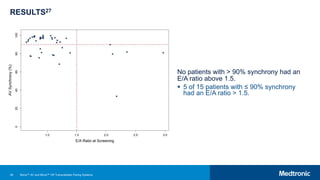
No patients with > 90% synchrony had an
E/A ratio above 1.5.
 5 of 15 patients with ≤ 90% synchrony
had an E/A ratio > 1.5.
Micra™ AV and Micra™ VR Transcatheter Pacing Systems
50
LIMITATIONS27
 Acute download study of MARVEL 2 algorithm for a short duration.
 Small number of patients (N = 64).
 Assessment of the predictors of the A4 amplitude was performed in patients
already implanted, and chronic ventricular pacing may have altered the
echocardiograph parameters.
 Validation in a larger population with a longer follow-up is required.
Micra™ AV and Micra™ VR Transcatheter Pacing Systems
51
CONCLUSIONS AND PERSPECTIVES27
 Easily measurable parameters of atrial function (ACE and E/A ratio) were
associated with A4 amplitude.
 Echocardiographic assessment of atrial function before the implant procedure
may predict a higher percentage of AV synchrony.
 Device location had no influence on the A4 signal amplitude.
Micra™ AV and Micra™ VR Transcatheter Pacing Systems
MICRA™ VR
CLINICAL
DATA
53
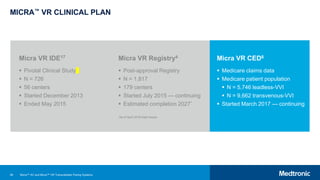
MICRA™ VR CLINICAL PLAN
Micra VR IDE17
 Pivotal Clinical Study
 N = 726
 56 centers
 Started December 2013
 Ended May 2015
Micra VR Registry4
 Post-approval Registry
 N = 1,817
 179 centers
 Started July 2015 — continuing
 Estimated completion 2027*
*As of April 2018 data freeze.
Micra VR CED6
 Medicare claims data
 Medicare patient population
 N = 5,746 leadless-VVI
 N = 9,662 transvenous-VVI
 Started March 2017 — continuing
Micra™ AV and Micra™ VR Transcatheter Pacing Systems
54
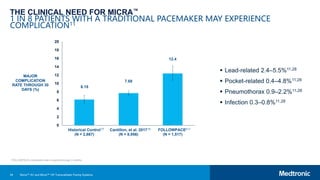
THE CLINICAL NEED FOR MICRA™
1 IN 8 PATIENTS WITH A TRADITIONAL PACEMAKER MAY EXPERIENCE
COMPLICATION11
6.15
7.68
12.4
0
2
4
6
8
10
12
14
16
18
20
Historical Control
(N = 2,667)
Cantillon, et al. 2017
(N = 8,956)
FOLLOWPACE*
(N = 1,517)
MAJOR
COMPLICATION
RATE THROUGH 30
DAYS (%)
*FOLLOWPACE complication rate is reported through 2 months.
 Lead-related 2.4–5.5%11,28
 Pocket-related 0.4–4.8%11,28
 Pneumothorax 0.9–2.2%11,28
 Infection 0.3–0.8%11,28
17 10 11
Micra™ AV and Micra™ VR Transcatheter Pacing Systems
55
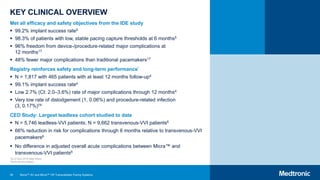
KEY CLINICAL OVERVIEW
Met all efficacy and safety objectives from the IDE study
 99.2% implant success rate5
 98.3% of patients with low, stable pacing capture thresholds at 6 months5
 96% freedom from device-/procedure-related major complications at
12 months17
 48% fewer major complications than traditional pacemakers17
Registry reinforces safety and long-term performance*
 N = 1,817 with 465 patients with at least 12 months follow-up4
 99.1% implant success rate4
 Low 2.7% (CI: 2.0–3.6%) rate of major complications through 12 months4
 Very low rate of dislodgement (1, 0.06%) and procedure-related infection
(3, 0.17%)†4
CED Study: Largest leadless cohort studied to date
 N = 5,746 leadless-VVI patients; N = 9,662 transvenous-VVI patients6
 66% reduction in risk for complications through 6 months relative to transvenous-VVI
pacemakers6
 No difference in adjusted overall acute complications between Micra™ and
transvenous-VVI patients6
*As of April 2018 data freeze.
†None device-related.
Micra™ AV and Micra™ VR Transcatheter Pacing Systems
56
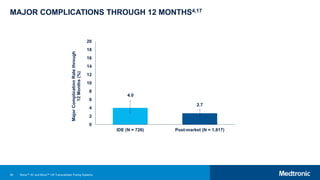
MAJOR COMPLICATIONS THROUGH 12 MONTHS4,17
4.0
2.7
0
2
4
6
8
10
12
14
16
18
20
IDE (N = 726) Post-market (N = 1,817)
Major
Complication
Rate
through
12
Months
(%)
Micra™ AV and Micra™ VR Transcatheter Pacing Systems
57
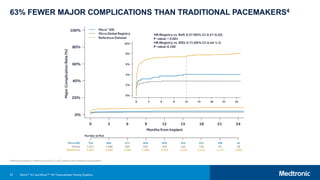
63% FEWER MAJOR COMPLICATIONS THAN TRADITIONAL PACEMAKERS4
Reference dataset = historical control of 2,667 patients with traditional pacemakers.
Micra™ AV and Micra™ VR Transcatheter Pacing Systems
58
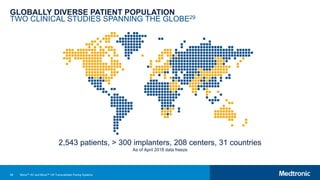
GLOBALLY DIVERSE PATIENT POPULATION
TWO CLINICAL STUDIES SPANNING THE GLOBE29
2,543 patients, > 300 implanters, 208 centers, 31 countries
As of April 2018 data freeze
Micra™ AV and Micra™ VR Transcatheter Pacing Systems
59
METHODOLOGY
 VVIR patients: Class I or II guideline indication for ventricular
pacing with no restriction by comorbidity (e.g., COPD)*30,31
 Predefined historical control group for comparison (2000–2012) for
IDE trial17
 Safety: Major complication criteria consistent across IDE, Registry,
and historical control groups†4,17
*IDE study was restricted to de novo therapy.
†Major complication definition: events leading to death, hospitalization, prolonged hospitalization by 48 hours, system revision, or loss of device therapy.
Micra™ AV and Micra™ VR Transcatheter Pacing Systems
60
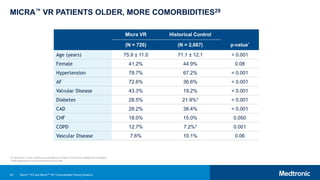
MICRA™ VR PATIENTS OLDER, MORE COMORBIDITIES29
Micra VR Historical Control
(N = 726) (N = 2,667) p-value*
Age (years) 75.9 ± 11.0 71.1 ± 12.1 < 0.001
Female 41.2% 44.9% 0.08
Hypertension 78.7% 67.2% < 0.001
AF 72.6% 36.6% < 0.001
Valvular Disease 43.3% 19.2% < 0.001
Diabetes 28.5% 21.9%† < 0.001
CAD 28.2% 38.4% < 0.001
CHF 18.0% 15.0% 0.050
COPD 12.7% 7.2%† 0.001
Vascular Disease 7.6% 10.1% 0.06
*P-value from T-test (continuous variables) or Fisher’s Exact test (categorical variables).
†Data parameter not collected across all 6 trials.
Micra™ AV and Micra™ VR Transcatheter Pacing Systems
61
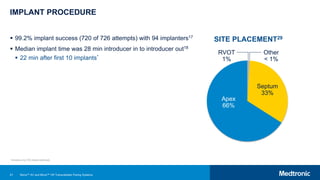
IMPLANT PROCEDURE
 99.2% implant success (720 of 726 attempts) with 94 implanters17
 Median implant time was 28 min introducer in to introducer out18
 22 min after first 10 implants*
SITE PLACEMENT29
Apex
66%
Septum
33%
RVOT
1%
Other
< 1%
*Includes only 725 implant attempts.
Micra™ AV and Micra™ VR Transcatheter Pacing Systems
62
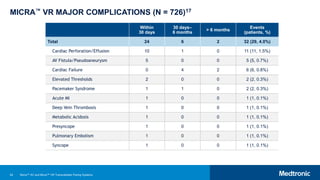
MICRA™ VR MAJOR COMPLICATIONS (N = 726)17
Within
30 days
30 days–
6 months
> 6 months
Events
(patients, %)
Total 24 6 2 32 (29, 4.0%)
Cardiac Perforation/Effusion 10 1 0 11 (11, 1.5%)
AV Fistula/Pseudoaneurysm 5 0 0 5 (5, 0.7%)
Cardiac Failure 0 4 2 6 (6, 0.8%)
Elevated Thresholds 2 0 0 2 (2, 0.3%)
Pacemaker Syndrome 1 1 0 2 (2, 0.3%)
Acute MI 1 0 0 1 (1, 0.1%)
Deep Vein Thrombosis 1 0 0 1 (1, 0.1%)
Metabolic Acidosis 1 0 0 1 (1, 0.1%)
Presyncope 1 0 0 1 (1, 0.1%)
Pulmonary Embolism 1 0 0 1 (1, 0.1%)
Syncope 1 0 0 1 (1, 0.1%)
Micra™ AV and Micra™ VR Transcatheter Pacing Systems
63
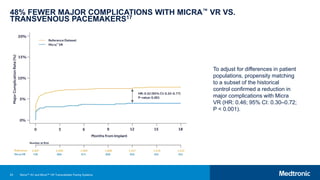
48% FEWER MAJOR COMPLICATIONS WITH MICRA™ VR VS.
TRANSVENOUS PACEMAKERS17
To adjust for differences in patient
populations, propensity matching
to a subset of the historical
control confirmed a reduction in
major complications with Micra
VR (HR: 0.46; 95% CI: 0.30–0.72;
P < 0.001).
Micra™ AV and Micra™ VR Transcatheter Pacing Systems
64
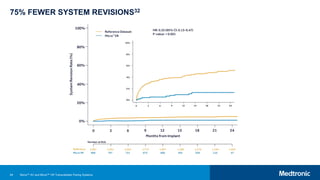
75% FEWER SYSTEM REVISIONS32
Micra™ AV and Micra™ VR Transcatheter Pacing Systems
65
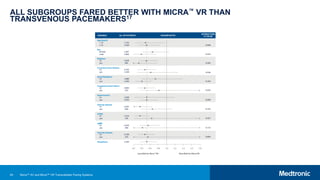
ALL SUBGROUPS FARED BETTER WITH MICRA™ VR THAN
TRANSVENOUS PACEMAKERS17
Micra™ AV and Micra™ VR Transcatheter Pacing Systems
66
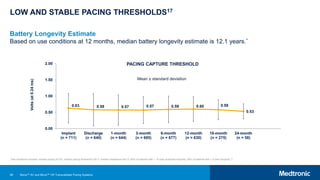
LOW AND STABLE PACING THRESHOLDS17
Battery Longevity Estimate
Based on use conditions at 12 months, median battery longevity estimate is 12.1 years.*
0.63 0.58 0.57 0.57 0.59 0.60 0.58
0.53
0.00
0.50
1.00
1.50
2.00
Implant
(n = 711)
Discharge
(n = 640)
1-month
(n = 644)
3-month
(n = 685)
6-month
(n = 677)
12-month
(n = 630)
18-month
(n = 275)
24-month
(n = 58)
Volts
(at
0.24
ms)
PACING CAPTURE THRESHOLD
*Use conditions included: median pacing 53.5%, median pacing threshold 0.50 V, median impedance 543 Ω; 89% of patients with > 10-year projected longevity; 99% of patients with > 5-year longevity.18
Mean ± standard deviation
Micra™ AV and Micra™ VR Transcatheter Pacing Systems
67
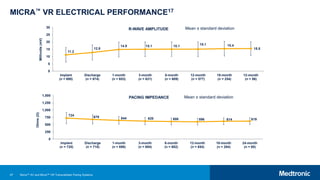
MICRA™ VR ELECTRICAL PERFORMANCE17
11.2
12.8
14.9 15.1 15.1 15.1 15.4
15.5
0
5
10
15
20
25
30
Implant
(n = 690)
Discharge
(n = 674)
1-month
(n = 653)
3-month
(n = 631)
6-month
(n = 609)
12-month
(n = 577)
18-month
(n = 254)
12-month
(n = 56)
Millivolts
(mV)
R-WAVE AMPLITUDE
724 679 644 620 606 596 614 619
0
250
500
750
1,000
1,250
1,500
Implant
(n = 720)
Discharge
(n = 718)
1-month
(n = 698)
3-month
(n = 694)
6-month
(n = 682)
12-month
(n = 654)
18-month
(n = 284)
24-month
(n = 60)
Ohms
(Ω)
PACING IMPEDANCE
Mean ± standard deviation
Micra™ AV and Micra™ VR Transcatheter Pacing Systems
68
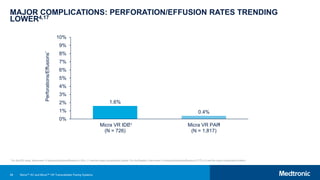
MAJOR COMPLICATIONS: PERFORATION/EFFUSION RATES TRENDING
LOWER4,17
1.6%
0.4%
0%
1%
2%
3%
4%
5%
6%
7%
8%
9%
10%
Micra VR IDE
(N = 726)
Micra VR PAR
(N = 1,817)
*For the IDE study, there were 13 total perforations/effusions (1.8%), 11 met the major complication criteria. For the Registry, there were 14 total perforations/effusions (0.77%), 8 met the major complication criteria.
Perforations/Effusions
*
17 4
Micra™ AV and Micra™ VR Transcatheter Pacing Systems
69
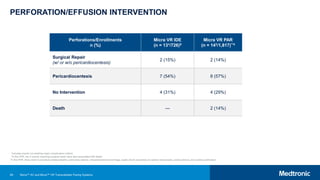
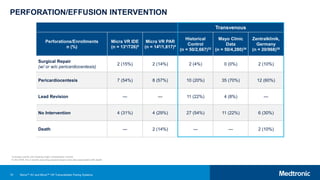
PERFORATION/EFFUSION INTERVENTION
Perforations/Enrollments
n (%)
Micra VR IDE
(n = 13*/726)5
Micra VR PAR
(n = 14†/1,817)**4
Surgical Repair
(w/ or w/o pericardiocentesis)
2 (15%) 2 (14%)
Pericardiocentesis 7 (54%) 8 (57%)
No Intervention 4 (31%) 4 (29%)
Death — 2 (14%)
*Includes events not meeting major complication criteria.
†In the PAR, the 2 events requiring surgical repair were also associated with death.
**In the PAR, there were 5 procedure-related deaths: pulmonary edema, retroperitoneal hemorrhage, septic shock secondary to cardiac tamponade, cardiac failure, and cardiac perforation.
Micra™ AV and Micra™ VR Transcatheter Pacing Systems
70
PERFORATION/EFFUSION INTERVENTION
Transvenous
Perforations/Enrollments
n (%)
Micra VR IDE
(n = 13*/726)5
Micra VR PAR
(n = 14†/1,817)4
Historical
Control
(n = 50/2,667)33
Mayo Clinic
Data
(n = 50/4,280)34
Zentralklinik,
Germany
(n = 20/968)35
Surgical Repair
(w/ or w/o pericardiocentesis)
2 (15%) 2 (14%) 2 (4%) 0 (0%) 2 (10%)
Pericardiocentesis 7 (54%) 8 (57%) 10 (20%) 35 (70%) 12 (60%)
Lead Revision — — 11 (22%) 4 (8%) —
No Intervention 4 (31%) 4 (29%) 27 (54%) 11 (22%) 6 (30%)
Death — 2 (14%) — — 2 (10%)
*Includes events not meeting major complication criteria.
†In the PAR, the 2 events requiring surgical repair were also associated with death.
Micra™ AV and Micra™ VR Transcatheter Pacing Systems
71
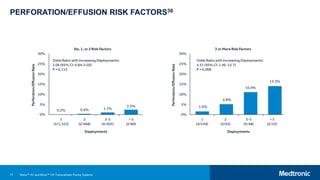
PERFORATION/EFFUSION RISK FACTORS36
Micra™ AV and Micra™ VR Transcatheter Pacing Systems
72
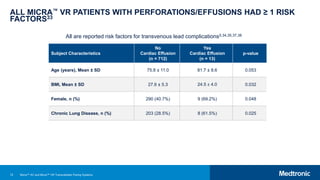
ALL MICRA™ VR PATIENTS WITH PERFORATIONS/EFFUSIONS HAD ≥ 1 RISK
FACTORS33
Subject Characteristics
No
Cardiac Effusion
(n = 712)
Yes
Cardiac Effusion
(n = 13)
p-value
Age (years), Mean ± SD 75.8 ± 11.0 81.7 ± 8.6 0.053
BMI, Mean ± SD 27.6 ± 5.3 24.5 ± 4.0 0.032
Female, n (%) 290 (40.7%) 9 (69.2%) 0.048
Chronic Lung Disease, n (%) 203 (28.5%) 8 (61.5%) 0.025
All are reported risk factors for transvenous lead complications5,34,35,37,38
Micra™ AV and Micra™ VR Transcatheter Pacing Systems
73
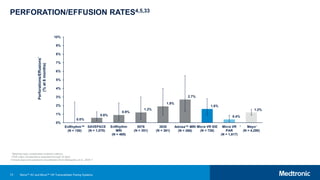
PERFORATION/EFFUSION RATES4,5,33
0.0%
0.6%
0.9%
1.2%
1.9%
2.7%
1.6%
0.4%
1.2%
0%
1%
2%
3%
4%
5%
6%
7%
8%
9%
10%
EnRhythm™
(N = 150)
SAVEPACE
(N = 1,070)
EnRhythm
MRI
(N = 469)
5076
(N = 351)
3830
(N = 361)
Advisa™ MRI
(N = 266)
Micra VR IDE
(N = 726)
Micra VR
PAR
(N = 1,817)
Mayo
(N = 4,280)
Perforations/Effusions
*
(%
at
6
months)
*Meeting major complication endpoint criterion.
†PAR major complications assessed through 30 days.
**Clinical signs and symptoms of perforation from Mahapatra, et al., 2005.31
**
†
Micra™ AV and Micra™ VR Transcatheter Pacing Systems
74
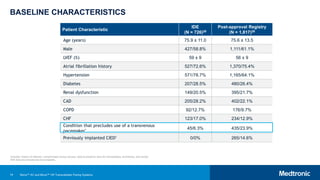
BASELINE CHARACTERISTICS
Patient Characteristic
IDE
(N = 726)29
Post-approval Registry
(N = 1,817)29
Age (years) 75.9 ± 11.0 75.6 ± 13.5
Male 427/58.8% 1,111/61.1%
LVEF (%) 59 ± 9 56 ± 9
Atrial fibrillation history 527/72.6% 1,370/75.4%
Hypertension 571/78.7% 1,165/64.1%
Diabetes 207/28.5% 480/26.4%
Renal dysfunction 149/20.5% 395/21.7%
CAD 205/28.2% 402/22.1%
COPD 92/12.7% 176/9.7%
CHF 123/17.0% 234/12.9%
Condition that precludes use of a transvenous
pacemaker* 45/6.3% 435/23.9%
Previously implanted CIED† 0/0% 265/14.6%
*Includes: History of infection, compromised venous access, need to preserve veins for hemodialysis, thrombosis, and cancer.
†IDE trial only included de novo implants.
Micra™ AV and Micra™ VR Transcatheter Pacing Systems
75
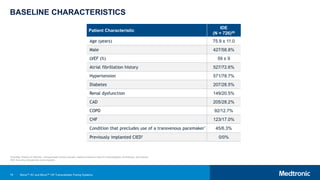
BASELINE CHARACTERISTICS
Patient Characteristic
IDE
(N = 726)29
Age (years) 75.9 ± 11.0
Male 427/58.8%
LVEF (%) 59 ± 9
Atrial fibrillation history 527/72.6%
Hypertension 571/78.7%
Diabetes 207/28.5%
Renal dysfunction 149/20.5%
CAD 205/28.2%
COPD 92/12.7%
CHF 123/17.0%
Condition that precludes use of a transvenous pacemaker* 45/6.3%
Previously implanted CIED† 0/0%
*Includes: History of infection, compromised venous access, need to preserve veins for hemodialysis, thrombosis, and cancer.
†IDE trial only included de novo implants.
Micra™ AV and Micra™ VR Transcatheter Pacing Systems
76
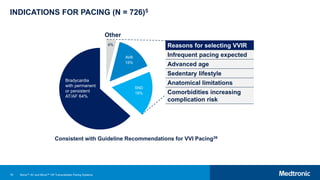
INDICATIONS FOR PACING (N = 726)5
Consistent with Guideline Recommendations for VVI Pacing39
Reasons for selecting VVIR
Infrequent pacing expected
Advanced age
Sedentary lifestyle
Anatomical limitations
Comorbidities increasing
complication risk
Other
4%
AVB
15%
SND
18%
Bradycardia
with permanent
or persistent
AT/AF 64%
Micra™ AV and Micra™ VR Transcatheter Pacing Systems
77
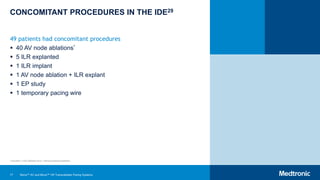
CONCOMITANT PROCEDURES IN THE IDE29
49 patients had concomitant procedures
 40 AV node ablations*
 5 ILR explanted
 1 ILR implant
 1 AV node ablation + ILR explant
 1 EP study
 1 temporary pacing wire
*Includes 1 HIS ablation and 1 atrial junctional ablation.
Micra™ AV and Micra™ VR Transcatheter Pacing Systems
78
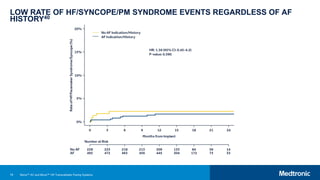
LOW RATE OF HF/SYNCOPE/PM SYNDROME EVENTS REGARDLESS OF AF
HISTORY40
Micra™ AV and Micra™ VR Transcatheter Pacing Systems
79
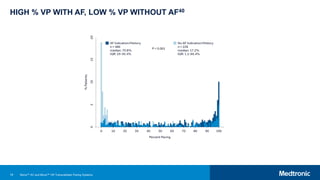
HIGH % VP WITH AF, LOW % VP WITHOUT AF40
Micra™ AV and Micra™ VR Transcatheter Pacing Systems
80
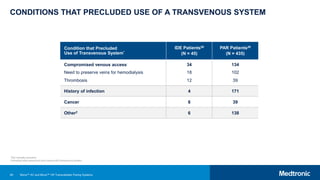
CONDITIONS THAT PRECLUDED USE OF A TRANSVENOUS SYSTEM
Condition that Precluded
Use of Transvenous System*
IDE Patients29
(N = 45)
PAR Patients29
(N = 435)
Compromised venous access 34 134
Need to preserve veins for hemodialysis 18 102
Thrombosis 12 39
History of infection 4 171
Cancer 6 39
Other† 6 138
*Not mutually exclusive.
†Including valve issues and prior issues with transvenous system.
Micra™ AV and Micra™ VR Transcatheter Pacing Systems
81
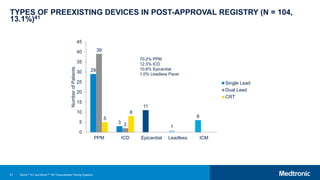
TYPES OF PREEXISTING DEVICES IN POST-APPROVAL REGISTRY (N = 104,
13.1%)41
29
3
11
1
6
39
2
5
8
0
5
10
15
20
25
30
35
40
45
PPM ICD Epicardial Leadless ICM
Number
of
Patients
Single Lead
Dual Lead
CRT
70.2% PPM
12.5% ICD
10.6% Epicardial
1.0% Leadless Pacer
Micra™ AV and Micra™ VR Transcatheter Pacing Systems
82
MICRA™ VR IMPLANT IN PATIENTS WITH
PRIOR CIED INFECTION (N = 105)42
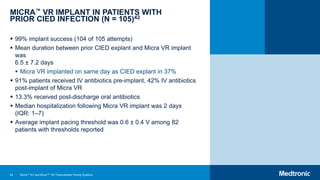
 99% implant success (104 of 105 attempts)
 Mean duration between prior CIED explant and Micra VR implant
was
6.5 ± 7.2 days
 Micra VR implanted on same day as CIED explant in 37%
 91% patients received IV antibiotics pre-implant, 42% IV antibiotics
post-implant of Micra VR
 13.3% received post-discharge oral antibiotics
 Median hospitalization following Micra VR implant was 2 days
(IQR: 1–7)
 Average implant pacing threshold was 0.6 ± 0.4 V among 82
patients with thresholds reported
Micra™ AV and Micra™ VR Transcatheter Pacing Systems
83
TYPES OF PREVIOUS DEVICES IN PATIENTS WITH PRIOR CIED INFECTION42
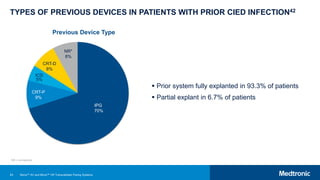
 Prior system fully explanted in 93.3% of patients
 Partial explant in 6.7% of patients
Previous Device Type
ICD
5%
CRT-P
9%
IPG
70%
CRT-D
8%
NR*
8%
*NR = not reported.
Micra™ AV and Micra™ VR Transcatheter Pacing Systems
84
MICRA™ VR IMPLANT IN PATIENTS WITH
PRIOR CIED INFECTION (N = 105)42
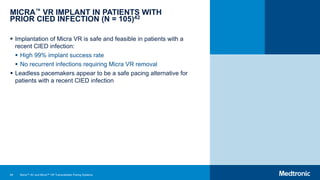
 Implantation of Micra VR is safe and feasible in patients with a
recent CIED infection:
 High 99% implant success rate
 No recurrent infections requiring Micra VR removal
 Leadless pacemakers appear to be a safe pacing alternative for
patients with a recent CIED infection
Micra™ AV and Micra™ VR Transcatheter Pacing Systems
85
PROCEDURE OVERVIEW
IDE AND REGISTRY
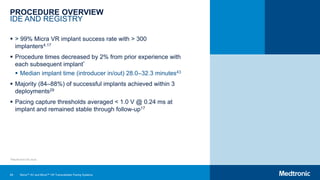
 > 99% Micra VR implant success rate with > 300
implanters4,17
 Procedure times decreased by 2% from prior experience with
each subsequent implant*
 Median implant time (introducer in/out) 28.0–32.3 minutes43
 Majority (84–88%) of successful implants achieved within 3
deployments29
 Pacing capture thresholds averaged < 1.0 V @ 0.24 ms at
implant and remained stable through follow-up17
*Results from IDE study.
Micra™ AV and Micra™ VR Transcatheter Pacing Systems
86
PROCEDURE TIMES REDUCED WITH EXPERIENCE43
After 12
implants,
median
implant time
reduced to
25.9 minutes.
Micra™ AV and Micra™ VR Transcatheter Pacing Systems
87
IMPLANT SITE PLACEMENT
Apex
66%
Septum
33%
RVOT
1%
Other
1%
NR
1%
IDE Site Placement (N = 720)29 Post-approval Site Placement (N = 1,801)29
Septum
64%
Apex
32%
RVOT
1%
Other
< 1%
Micra™ AV and Micra™ VR Transcatheter Pacing Systems
88
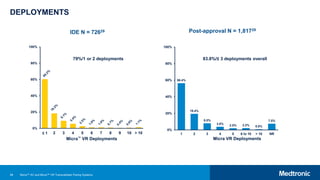
DEPLOYMENTS
56.4%
19.4%
8.0%
3.8% 2.0% 2.2% 0.8%
7.5%
0%
20%
40%
60%
80%
100%
1 2 3 4 5 6 to 10 > 10 NR
Micra VR Deployments
IDE N = 72629
0%
20%
40%
60%
80%
100%
≤ 1 2 3 4 5 6 7 8 9 10 > 10
Micra™ VR Deployments
79%/1 or 2 deployments
Post-approval N = 1,81729
83.8%/≤ 3 deployments overall
Micra™ AV and Micra™ VR Transcatheter Pacing Systems
89
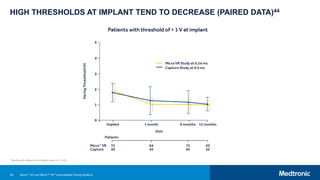
HIGH THRESHOLDS AT IMPLANT TEND TO DECREASE (PAIRED DATA)44
*Significantly different from implant value (p < 0.05).
Micra™ AV and Micra™ VR Transcatheter Pacing Systems
90
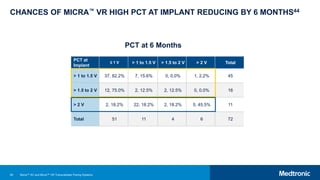
CHANCES OF MICRA™ VR HIGH PCT AT IMPLANT REDUCING BY 6 MONTHS44
PCT at
Implant
≤ 1 V > 1 to 1.5 V > 1.5 to 2 V > 2 V Total
> 1 to 1.5 V 37, 82.2% 7, 15.6% 0, 0.0% 1, 2.2% 45
> 1.5 to 2 V 12, 75.0% 2, 12.5% 2, 12.5% 0, 0.0% 16
> 2 V 2, 18.2% 22, 18.2% 2, 18.2% 5, 45.5% 11
Total 51 11 4 6 72
PCT at 6 Months
Micra™ AV and Micra™ VR Transcatheter Pacing Systems
91
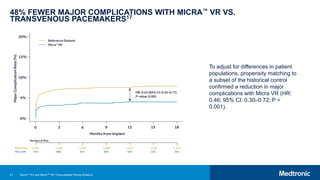
48% FEWER MAJOR COMPLICATIONS WITH MICRA™ VR VS.
TRANSVENOUS PACEMAKERS17
To adjust for differences in patient
populations, propensity matching to
a subset of the historical control
confirmed a reduction in major
complications with Micra VR (HR:
0.46; 95% CI: 0.30–0.72; P <
0.001).
Micra™ AV and Micra™ VR Transcatheter Pacing Systems
92
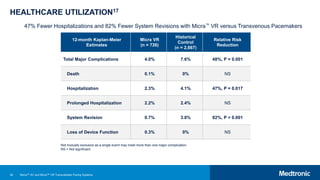
HEALTHCARE UTILIZATION17
12-month Kaplan-Meier
Estimates
Micra VR
(n = 726)
Historical
Control
(n = 2,667)
Relative Risk
Reduction
Total Major Complications 4.0% 7.6% 48%, P = 0.001
Death 0.1% 0% NS
Hospitalization 2.3% 4.1% 47%, P = 0.017
Prolonged Hospitalization 2.2% 2.4% NS
System Revision 0.7% 3.8% 82%, P < 0.001
Loss of Device Function 0.3% 0% NS
47% Fewer Hospitalizations and 82% Fewer System Revisions with Micra™ VR versus Transvenous Pacemakers
Not mutually exclusive as a single event may meet more than one major complication.
NS = Not significant.
Micra™ AV and Micra™ VR Transcatheter Pacing Systems
93
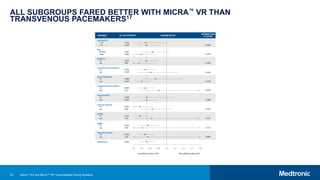
ALL SUBGROUPS FARED BETTER WITH MICRA™ VR THAN
TRANSVENOUS PACEMAKERS17
Micra™ AV and Micra™ VR Transcatheter Pacing Systems
94
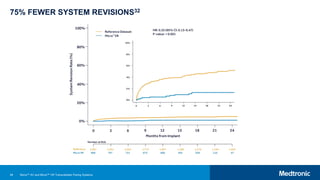
75% FEWER SYSTEM REVISIONS32
Micra™ AV and Micra™ VR Transcatheter Pacing Systems
95
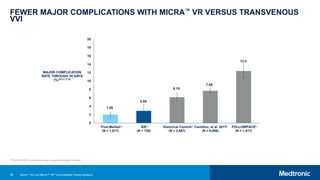
FEWER MAJOR COMPLICATIONS WITH MICRA™ VR VERSUS TRANSVENOUS
VVI
1.98
2.89
6.15
7.68
12.4
0
2
4
6
8
10
12
14
16
18
20
Post-Market
(N = 1,817)
IDE
(N = 726)
Historical Control
(N = 2,667)
Cantillon, et al. 2017
(N = 8,956)
FOLLOWPACE
(N = 1,517)
MAJOR COMPLICATION
RATE THROUGH 30 DAYS
(%)10,11,17,29
29 17 29 10 *11
*FOLLOWPACE complication rate is reported through 2 months.
Micra™ AV and Micra™ VR Transcatheter Pacing Systems
96
MICRA™ VR CLINICAL PLAN
Micra VR IDE17
 Pivotal Clinical Study
 N = 726
 56 centers
 Started December 2013
 Ended May 2015
Micra VR Registry4
 Post-approval Registry
 N = 1,817
 179 centers
 Started July 2015 — continuing
 Estimated completion 2027*
*As of April 2018 data freeze.
Micra VR CED6
 Medicare claims data
 Medicare patient population
 N = 5,746 leadless-VVI
 N = 9,662 transvenous-VVI
 Started March 2017 — continuing
Micra™ AV and Micra™ VR Transcatheter Pacing Systems
97
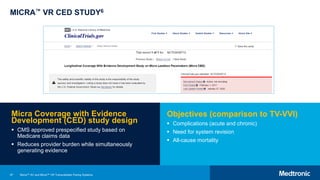
MICRA™ VR CED STUDY6
Micra Coverage with Evidence
Development (CED) study design
 CMS approved prespecified study based on
Medicare claims data
 Reduces provider burden while simultaneously
generating evidence
Objectives (comparison to TV-VVI)
 Complications (acute and chronic)
 Need for system revision
 All-cause mortality
Micra™ AV and Micra™ VR Transcatheter Pacing Systems
98
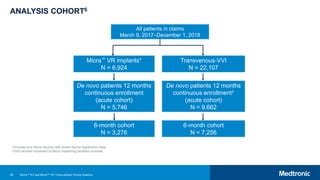
ANALYSIS COHORT6
All patients in claims
March 9, 2017–December 1, 2018
Micra™ VR implants*
N = 6,924
Transvenous-VVI
N = 22,107
De novo patients 12 months
continuous enrollment
(acute cohort)
N = 5,746
De novo patients 12 months
continuous enrollment†
(acute cohort)
N = 9,662
6-month cohort
N = 3,276
6-month cohort
N = 7,256
*Includes only Micra devices with linked device registration data.
†Only devices implanted at Micra implanting facilities included.
Micra™ AV and Micra™ VR Transcatheter Pacing Systems
99
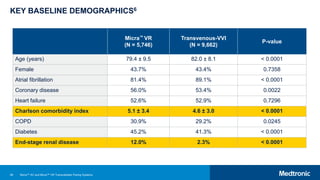
KEY BASELINE DEMOGRAPHICS6
Micra™ VR
(N = 5,746)
Transvenous-VVI
(N = 9,662)
P-value
Age (years) 79.4 ± 9.5 82.0 ± 8.1 < 0.0001
Female 43.7% 43.4% 0.7358
Atrial fibrillation 81.4% 89.1% < 0.0001
Coronary disease 56.0% 53.4% 0.0022
Heart failure 52.6% 52.9% 0.7296
Charlson comorbidity index 5.1 ± 3.4 4.6 ± 3.0 < 0.0001
COPD 30.9% 29.2% 0.0245
Diabetes 45.2% 41.3% < 0.0001
End-stage renal disease 12.0% 2.3% < 0.0001
Micra™ AV and Micra™ VR Transcatheter Pacing Systems
100
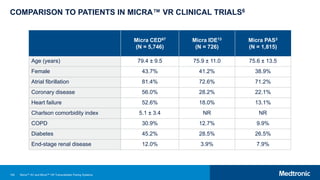
COMPARISON TO PATIENTS IN MICRA™ VR CLINICAL TRIALS6
Micra CED67
(N = 5,746)
Micra IDE13
(N = 726)
Micra PAS3
(N = 1,815)
Age (years) 79.4 ± 9.5 75.9 ± 11.0 75.6 ± 13.5
Female 43.7% 41.2% 38.9%
Atrial fibrillation 81.4% 72.6% 71.2%
Coronary disease 56.0% 28.2% 22.1%
Heart failure 52.6% 18.0% 13.1%
Charlson comorbidity index 5.1 ± 3.4 NR NR
COPD 30.9% 12.7% 9.9%
Diabetes 45.2% 28.5% 26.5%
End-stage renal disease 12.0% 3.9% 7.9%
Micra™ AV and Micra™ VR Transcatheter Pacing Systems
7.7%
3.2%
1.2%
0.8%
1.4%
2.1%
7.4%
3.1%
0.3% 0.4%
2.5%
1.7%
0.0%
1.0%
2.0%
3.0%
4.0%
5.0%
6.0%
7.0%
8.0%
9.0%
10.0%
Overall Acute Complications Embolism and Thrombosis Events at Puncture Site Cardiac Effusion/Perforation Device-related Complication Other Complications†
Adjusted
%
Complications
Micra™ VR Transvenous-VVI
101
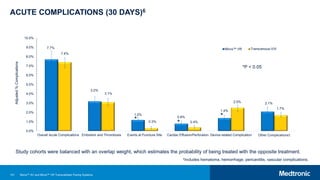
ACUTE COMPLICATIONS (30 DAYS)6
†Includes hematoma, hemorrhage, pericarditis, vascular complications.
Study cohorts were balanced with an overlap weight, which estimates the probability of being treated with the opposite treatment.
*
*
*
*P < 0.05
Micra™ AV and Micra™ VR Transcatheter Pacing Systems
102
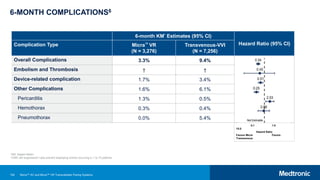
6-MONTH COMPLICATIONS6
6-month KM* Estimates (95% CI)
Hazard Ratio (95% CI)
Complication Type Micra™ VR
(N = 3,276)
Transvenous-VVI
(N = 7,256)
Overall Complications 3.3% 9.4%
Embolism and Thrombosis † †
Device-related complication 1.7% 3.4%
Other Complications 1.6% 6.1%
Pericarditis 1.3% 0.5%
Hemothorax 0.3% 0.4%
Pneumothorax 0.0% 5.4%
0.1 1.0
10.0
Hazard Ratio
Favors Micra Favors
Transvenous
*KM: Kaplan-Meier.
†CMS cell suppression rules prevent displaying events occurring in 1 to 10 patients.
Micra™ AV and Micra™ VR Transcatheter Pacing Systems
0
2
4
6
8
10
0 30 60 90 120 150 180
Patients
with
a
chronic
complication
(%)
Time to chronic complication following device implant (days)
HR: 0.34 (95% CI: 0.28, 0.43)
p < 0.001
N at risk
Micra 3726 3480 3371 3278 3209
3144 3073
Micra: 3.3%
Transvenous-VVI: 9.4%
Transvenous 7246 6510 6277 6116 5990
5883 5792
103
Contemporaneous Comparison of
Outcomes Among Patients Implanted with
a Leadless versus Transvenous Single-
Chamber Ventricular Pacemaker6
Objective
To compare patient characteristics and
complications among patients implanted with
leadless-VVI and transvenous-VVI.
Analysis Design
The Micra CED facilitates national Medicare
coverage while generating evidence about the
real-world effectiveness of the Micra VR
leadless pacing system using the Centers for
Medicare & Medicaid Services (CMS)
administrative claims. 5,746 leadless-VVI
patients and 9,662 transvenous-VVI patients
were included in the CED study between March
2017 and December 2018.
Results
 66% reduction in risk for complications
through 6 months relative to transvenous-VVI
pacemakers.
 No difference in adjusted overall acute
complications between Micra and
transvenous-VVI patients.
66%
Relative risk reduction at
6 months vs. TV pacing
(VVI) (n = 3,726).6
N at risk
Micra VR 3,726 3,480 3,371 3,278 3,209
3,144 3,073
Transvenous 7,246 6,510 6,277 6,116 5,990
5,883 5,792
MICRA™ VR PROCEDURAL PERFORMANCE
5,000+ U.S. MICRA MEDICARE PATIENT CLAIMS STUDIED6
Micra™ AV and Micra™ VR Transcatheter Pacing Systems
104
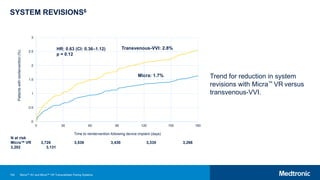
SYSTEM REVISIONS6
0
0.5
1
1.5
2
2.5
3
0 30 60 90 120 150 180
Patients
with
reintervention
(%)
Time to reintervention following device implant (days)
HR: 0.63 (CI: 0.36–1.12)
p = 0.12
N at risk
Micra™ VR 3,726 3,536 3,430 3,335 3,266
3,202 3,131
Trend for reduction in system
revisions with Micra™ VR versus
transvenous-VVI.
Transvenous-VVI: 2.8%
Micra: 1.7%
Micra™ AV and Micra™ VR Transcatheter Pacing Systems
105
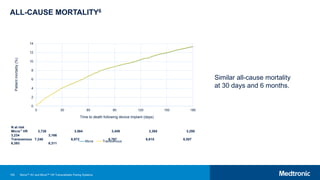
ALL-CAUSE MORTALITY6
0
2
4
6
8
10
12
14
0 30 60 90 120 150 180
Patient
mortality
(%)
Time to death following device implant (days)
Micra Transvenous
HR: 1.00 (CI: 0.89 - 1.12)
p = 0.93
N at risk
Micra™ VR 3,726 3,564 3,459 3,365 3,295
3,234 3,166
Transvenous 7,246 6,972 6,767 6,615 6,507
6,393 6,311
Similar all-cause mortality
at 30 days and 6 months.
Micra™ AV and Micra™ VR Transcatheter Pacing Systems
106
LIMITATIONS6
 Complications may be missed in claims.
 Previous analysis suggests this probability is low.45
 Risk adjustment does not completely eliminate residual confounding.
 Falsification tests suggest this is unlikely.
 Results from this U.S. Medicare cohort may not be generalizable to other populations.
Micra™ AV and Micra™ VR Transcatheter Pacing Systems
107
CONCLUSIONS6
 In the largest leadless pacing cohort to-date, patients in clinical practice have substantially greater
comorbidity compared with the pivotal IDE study.
 There was no difference in the adjusted rate of acute complications or survival at 30 days in patients
treated with Micra™ VR versus transvenous-VVI.
 Higher rate of perforations/effusions (0.8% vs. 0.4%)
 Lower rate of device-related complications (1.4% vs. 2.5%)
 Complications were 66% lower at 6 months in Micra patients (3.3% vs. 9.4%).
 The Micra™ VR CED Study illustrates the feasibility of utilizing real-world data to generate evidence
measuring the effectiveness of new technology.
Micra™ AV and Micra™ VR Transcatheter Pacing Systems
MICRA™
PROCEDURE
109
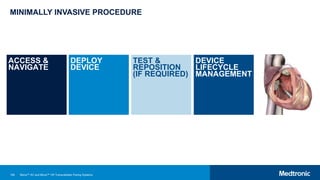
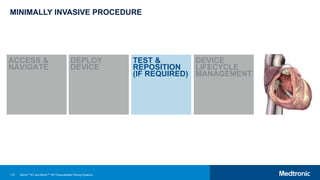
MINIMALLY INVASIVE PROCEDURE
ACCESS &
NAVIGATE
DEPLOY
DEVICE
TEST &
REPOSITION
(IF REQUIRED)
DEVICE
LIFECYCLE
MANAGEMENT
Micra™ AV and Micra™ VR Transcatheter Pacing Systems
110
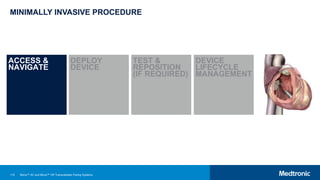
MINIMALLY INVASIVE PROCEDURE
ACCESS &
NAVIGATE
DEPLOY
DEVICE
TEST &
REPOSITION
(IF REQUIRED)
DEVICE
LIFECYCLE
MANAGEMENT
Micra™ AV and Micra™ VR Transcatheter Pacing Systems
111
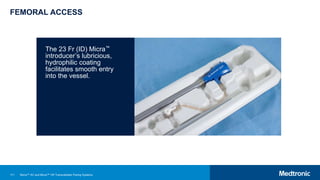
FEMORAL ACCESS
The 23 Fr (ID) Micra™
introducer’s lubricious,
hydrophilic coating
facilitates smooth entry
into the vessel.
Micra™ AV and Micra™ VR Transcatheter Pacing Systems
112
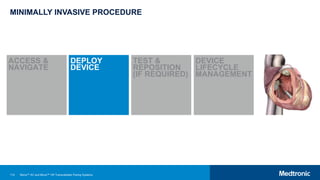
MINIMALLY INVASIVE PROCEDURE
ACCESS &
NAVIGATE
DEPLOY
DEVICE
TEST &
REPOSITION
(IF REQUIRED)
DEVICE
LIFECYCLE
MANAGEMENT
Micra™ AV and Micra™ VR Transcatheter Pacing Systems
113
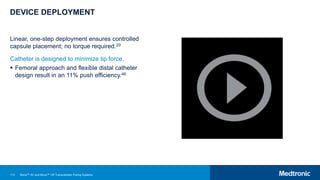
DEVICE DEPLOYMENT
Linear, one-step deployment ensures controlled
capsule placement; no torque required.20
Catheter is designed to minimize tip force.
 Femoral approach and flexible distal catheter
design result in an 11% push efficiency.46
Micra™ AV and Micra™ VR Transcatheter Pacing Systems
114
DEVICE DEPLOYMENT
Delivery system provides visual feedback when
adequate tip pressure is achieved, and retracts
during device deployment.16
Micra™ AV and Micra™ VR Transcatheter Pacing Systems
115
MINIMALLY INVASIVE PROCEDURE
ACCESS &
NAVIGATE
DEPLOY
DEVICE
TEST &
REPOSITION
(IF REQUIRED)
DEVICE
LIFECYCLE
MANAGEMENT
Micra™ AV and Micra™ VR Transcatheter Pacing Systems
116
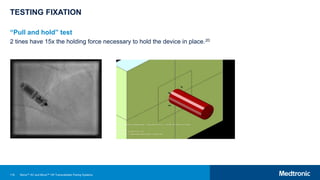
TESTING FIXATION
“Pull and hold” test
2 tines have 15x the holding force necessary to hold the device in place.20
Micra™ AV and Micra™ VR Transcatheter Pacing Systems
117
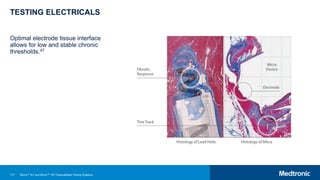
TESTING ELECTRICALS
Optimal electrode tissue interface
allows for low and stable chronic
thresholds.47
Micra™ AV and Micra™ VR Transcatheter Pacing Systems
118
ATRAUMATIC TINES
DESIGNED FOR REPOSITIONING
Micra™ AV and Micra™ VR Transcatheter Pacing Systems
119
NAVIGATION TO TARGET LOCATION
Minimally invasive, integrated delivery
system facilitates a streamlined implant
procedure.
Micra™ AV and Micra™ VR Transcatheter Pacing Systems
120
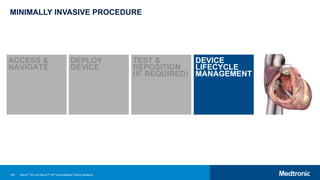
MINIMALLY INVASIVE PROCEDURE
ACCESS &
NAVIGATE
DEPLOY
DEVICE
TEST &
REPOSITION
(IF REQUIRED)
DEVICE
LIFECYCLE
MANAGEMENT
Micra™ AV and Micra™ VR Transcatheter Pacing Systems
121
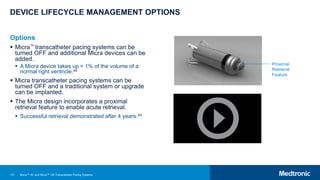
DEVICE LIFECYCLE MANAGEMENT OPTIONS
Options
 Micra™ transcatheter pacing systems can be
turned OFF and additional Micra devices can be
added.
 A Micra device takes up < 1% of the volume of a
normal right ventricle.48
 Micra transcatheter pacing systems can be
turned OFF and a traditional system or upgrade
can be implanted.
 The Micra design incorporates a proximal
retrieval feature to enable acute retrieval.
 Successful retrieval demonstrated after 4 years.49
Proximal
Retrieval
Feature
Micra™ AV and Micra™ VR Transcatheter Pacing Systems
122
MICRA™ VR DESIGNED FOR OPTIONS
Clinical trial experience (n = 725)5
 2 patients experienced increased thresholds and 1 patient
required a CRT upgrade.
 In all cases, it was possible to successfully either turn Micra
VR OFF or retrieve the device.
 One Micra VR device was retrieved (17 days post-implant)
and replaced; two devices were turned OFF and
successfully replaced with transvenous systems.
Micra™ AV and Micra™ VR Transcatheter Pacing Systems
CIED
INFECTIONS
&
ECONOMICS
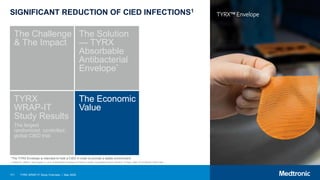
124
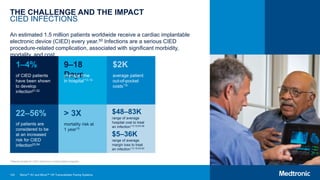
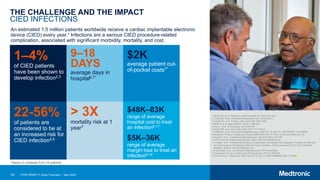
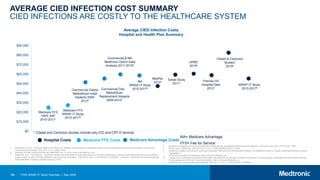
THE CHALLENGE AND THE IMPACT
CIED INFECTIONS
An estimated 1.5 million patients worldwide receive a cardiac implantable
electronic device (CIED) every year.50 Infections are a serious CIED
procedure-related complication, associated with significant morbidity,
mortality, and cost.
1–4%
22–56%
9–18
Days
> 3X
$2K
$48–83K
of CIED patients
have been shown
to develop
infection51,52
average time
in hospital*13,15
average patient
out-of-pocket
costs*15
of patients are
considered to be
at an increased
risk for CIED
infection53,54
mortality risk at
1 year15
range of average
hospital cost to treat
an infection*13,15,53-58
range of average
margin loss to treat
an infection*13-15,53-60
$5–36K
*Patients treated for CIED infections in United States hospitals.
Micra™ AV and Micra™ VR Transcatheter Pacing Systems
125
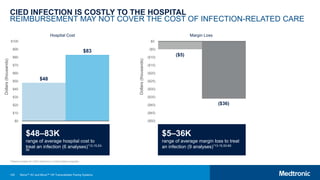
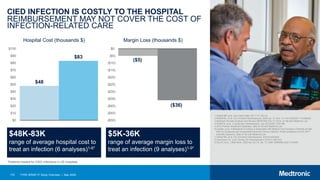
CIED INFECTION IS COSTLY TO THE HOSPITAL
REIMBURSEMENT MAY NOT COVER THE COST OF INFECTION-RELATED CARE
$48
$83
$0
$10
$20
$30
$40
$50
$60
$70
$80
$90
$100
($50)
($45)
($40)
($35)
($30)
($25)
($20)
($15)
($10)
($5)
$0
Hospital Cost Margin Loss
$48–83K
range of average hospital cost to
treat an infection (6 analyses)*13,15,53-
58
$5–36K
range of average margin loss to treat
an infection (9 analyses)*13-15,53-60
*Patients treated for CIED infections in United States hospitals.
($36)
($5)
Dollars
(thousands)
Dollars
(thousands)
Micra™ AV and Micra™ VR Transcatheter Pacing Systems
OTHER
MICRA™ AV
CLINICAL
EVIDENCE
127
AV SYNCHRONY REIMAGINED
AMBULATORY PERFORMANCE — POSTURAL VARIATIONS IN AVS
MARVEL 2 — 2-minute posture tests7
MARVEL — 1-minute posture tests23
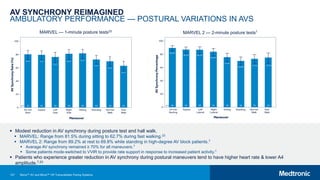
 Modest reduction in AV synchrony during posture test and hall walk.
 MARVEL: Range from 81.5% during sitting to 62.7% during fast walking.23
 MARVEL 2: Range from 89.2% at rest to 69.8% while standing in high-degree AV block patients.7
 Average AV synchrony remained ≥ 70% for all maneuvers.7
 Some patients mode-switched to VVIR to provide rate support in response to increased patient activity.7
 Patients who experience greater reduction in AV synchrony during postural maneuvers tend to have higher heart rate & lower A4
amplitude.7,23
Micra™ AV and Micra™ VR Transcatheter Pacing Systems
128
AV SYNCHRONY REIMAGINED
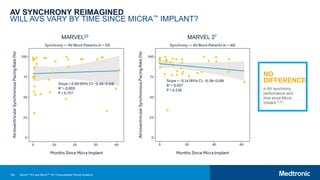
WILL AVS VARY BY TIME SINCE MICRA™ IMPLANT?
MARVEL23 MARVEL 27
NO
DIFFERENCE
in AV synchrony
performance and
time since Micra
implant.7,23
Micra™ AV and Micra™ VR Transcatheter Pacing Systems
129
AV SYNCHRONY REIMAGINED
PRELIMINARY CHRONIC PERFORMANCE:
WILL AVS PERFORMANCE VARY OVER TIME?
Closed circles represent A4 amplitudes at visit
1.
Open circles represent A4 amplitudes at visit 2.
NO
DIFFERENC
E
In AV synchrony
performance in
patients restudied
after 6 months.24
Behavior of leadless AV synchronous pacing
during atrial arrhythmias and stability of the
atrial signals over time-Results of the
MARVEL Evolve subanalysis24
Methods
This prospective single-center study compared
AV synchrony and accelerometer signals at two
visits ≥ 6 months apart. Custom software was
temporarily downloaded into the Micra™ at each
visit and AVS was measured during 30 minutes
at rest.
Results
9 patients from the MARVEL study were
enrolled. Micra was implanted for 6.0 ± 6.4
months. The mean interval between visits was
7.1 ± 0.6 months. 7 patients had normal sinus
node function between both visits and were
included in a paired analysis. Both
accelerometer signal amplitude (visit 2–visit 1 =
1.4 mG; 95% confidence interval [CI] [-25.8 to
28.4 mG]; P = 0.933) and AVS (visit 1: 90.8%,
95% CI [72.4, 97.4] and visit 2: 91.4%, 95% CI
[63.8, 98.5]; P = 0.740) remained stable.
Conclusion
Accelerometer signals amplitude and
performance of AVS pacing were stable over
time.
Micra™ AV and Micra™ VR Transcatheter Pacing Systems
130
AV SYNCHRONY REIMAGINED
PRELIMINARY CHRONIC
PERFORMANCE: WILL AVS
PERFORMANCE VARY OVER TIME?
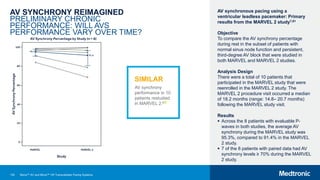
AV synchronous pacing using a
ventricular leadless pacemaker: Primary
results from the MARVEL 2 study7,61
Objective
To compare the AV synchrony percentage
during rest in the subset of patients with
normal sinus node function and persistent,
third-degree AV block that were studied in
both MARVEL and MARVEL 2 studies.
Analysis Design
There were a total of 10 patients that
participated in the MARVEL study that were
reenrolled in the MARVEL 2 study. The
MARVEL 2 procedure visit occurred a median
of 18.2 months (range: 14.8– 20.7 months)
following the MARVEL study visit.
Results
 Across the 8 patients with evaluable P-
waves in both studies, the average AV
synchrony during the MARVEL study was
95.3%, compared to 91.4% in the MARVEL
2 study.
 7 of the 8 patients with paired data had AV
synchrony levels ≥ 70% during the MARVEL
2 study.
SIMILAR
AV synchrony
performance in 10
patients restudied
in MARVEL 2.61
Micra™ AV and Micra™ VR Transcatheter Pacing Systems
131
AV SYNCHRONY REIMAGINED
PRELIMINARY CHRONIC
PERFORMANCE: WILL AVS
PERFORMANCE VARY OVER TIME?
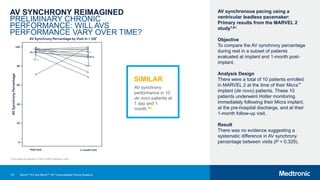
SIMILAR
AV synchrony
performance in 10
de novo patients at
1 day and 1
month.61
AV synchronous pacing using a
ventricular leadless pacemaker:
Primary results from the MARVEL 2
study7,61
Objective
To compare the AV synchrony percentage
during rest in a subset of patients
evaluated at implant and 1-month post-
implant.
Analysis Design
There were a total of 10 patients enrolled
in MARVEL 2 at the time of their Micra™
implant (de novo) patients. These 10
patients underwent Holter monitoring
immediately following their Micra implant,
at the pre-hospital discharge, and at their
1-month follow-up visit.
Result
There was no evidence suggesting a
systematic difference in AV synchrony
percentage between visits (P = 0.329).
*Four patients changed in their rhythm between visits.
Micra™ AV and Micra™ VR Transcatheter Pacing Systems
132
AV SYNCHRONY REIMAGINED
AV SYNCHRONY BY IMPLANT LOCATION
Atrioventricular synchronous pacing using
a leadless pacemaker: Results from the
MARVEL 2 study7, 62
Objective
To determine if the AV synchrony percentage
differed based on device implant location.
Analysis Design
The average AV synchrony percentage was
compared based on the physician-reported
implant location for the 40 patients included in
the primary efficacy analysis cohort.
Results
 Average AV synchrony was ≥ 70% for all
implant locations.
 The average AV synchrony percentage
ranged from 95.4% among the 7 patients
where the device was placed in the high
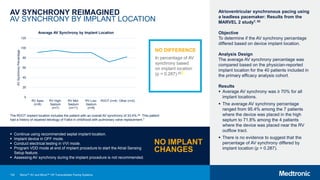
septum to 71.8% among the 4 patients
where the device was placed near the RV
outflow tract.
 There is no evidence to suggest that the
percentage of AV synchrony differed by
implant location (p = 0.287).
0
20
40
60
80
100
120
RV Apex
(n=8)
RV High-
Septum
(n=7)
RV Mid-
Septum
(n=11)
RV Low-
Septum
(n=8)
RVOT (n=4) Other (n=2)
AV
Synchrony
Percentage
Average AV Synchrony by Implant Location
NO DIFFERENCE
In percentage of AV
synchrony based
on implant location
(p = 0.287).62
The RVOT implant location includes the patient with an overall AV synchrony of 33.4%.62 This patient
had a history of repaired tetralogy of Fallot in childhood with pulmonary valve replacement.7
NO IMPLANT
CHANGES
 Continue using recommended septal implant location.
 Implant device in OFF mode.
 Conduct electrical testing in VVI mode.
 Program VDD mode at end of implant procedure to start the Atrial Sensing
Setup feature.
 Assessing AV synchrony during the implant procedure is not recommended.
Micra™ AV and Micra™ VR Transcatheter Pacing Systems
AV SYNCHRONY
CLINICAL
CONSIDERATIONS
134
AV SYNCHRONY REIMAGINED
DOES AV SYNCHRONY OR HEART RATE
MATTER MORE DURING EXERCISE?
75%
Of the increment in
cardiac output
achievable with exercise
is due to a positive
chronotropic response.63
Relative contributions of rate-responsiveness,
AV synchrony and cardiac contractility to
increase in cardiac output associated with
upright exercise in an average paced patient63
Several studies demonstrated that
during exercise, heart rate increase is
more important than AV synchrony64
 A positive chronotropic response
provides approximately 75% of the
increment in cardiac output achievable
with exercise. Maintenance of AV
synchrony and increased contractility
account for the remaining 25%.63
 Among patients studied by Karloff, et al.,
cardiac output increased on average
three-fold between rest and exercise,
but only 8% of this increment was
attributed to AV synchrony; most was
due to increased heart rate.65
 Fananapazir, et al., noted the
approximate 40% increase in exercise
capacity (chronotropic response)
associated with heart rate response in
their patients (compared to VOO pacing)
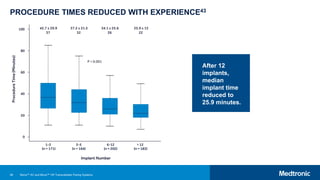
was independent of whether the
increased rate was provided in
combination with AV synchrony.66
Micra™ AV and Micra™ VR Transcatheter Pacing Systems
135
AV SYNCHRONY REIMAGINED
AMBULATORY PERFORMANCE: HOW ACTIVE ARE
BRADYCARDIA PATIENTS?
Objective
To assess the activity level of Medtronic
bradycardia patients.67
Analysis Design
50 Medtronic dual chamber pacemaker
patients wore a Holter monitor capable of
recording patient activity count data. An
activity count of 0 reflects periods of
patient inactivity.
Results
95% of bradycardia patients are inactive
> 75% of the time.
95%
Of bradycardia
patients are
inactive > 75% of
the time.67
0%
10%
20%
30%
40%
50%
60%
70%
80%
90%
100%
> 95% > 90% > 85% > 80% > 75% > 70% > 65%
Percentage of Accelerometer Activity Counts = 0
Percentage
of
Patients
Micra™ AV and Micra™ VR Transcatheter Pacing Systems
136
AV SYNCHRONY REIMAGINED
DOES LOSS OF AV SYNCHRONY LEAD
TO PACEMAKER SYNDROME?
1.3%
Absolute risk of
pacemaker
syndrome through 24
months in the non-
AF Micra VR
group.40
Rate of heart failure/pacemaker syndrome/syncope events in
Micra™ VR patients with and without AF indication or history40
Patient selection, pacing indications, and
subsequent outcomes with de novo
leadless single-chamber VVI pacing40
Objective
To compare patient characteristics and
outcomes of Micra VR patients with and without
a primary pacing indication associated with AF
in the Micra IDE trial.
Analysis Design
720 Micra VR implanted patients were divided
into 2 groups: AF group and non-AF group.
Adverse events, including risk of cardiac
failure, pacemaker syndrome, and syncope
related to the Micra VR system or procedure,
were compared between the two groups.
Results
 106 patients in the non-AF group and 2
patients in the AF group had a primary pacing
indication of AV block without
permanent/persistent AF.
 The absolute risk of pacemaker syndrome
through 24 months in the AF group was
0.4%, and 1.3% in the non-AF group (P =
0.176).
Micra™ AV and Micra™ VR Transcatheter Pacing Systems
137
AV SYNCHRONY REIMAGINED
DOES LOSS OF AV SYNCHRONY LEAD
TO PACEMAKER SYNDROME?
3.1% Crossover rate from single- to dual-chamber pacing
due to pacemaker syndrome in elderly AV block
patients at median follow-up period of 3 years.68
NO
DIFFERENC
E
In mortality benefit
for dual- versus
single-chamber
pacing in elderly
AV block
patients.68
Single-Chamber versus Dual-Chamber
Pacing for High-Grade Atrioventricular
Block68
Objective
To determine whether there is a benefit of dual-
chamber pacing versus single-chamber pacing
in elderly patients with high-grade AV block.
Analysis Design
2,021 patients (70+ years) who were receiving
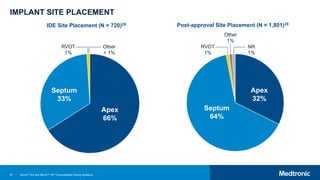
their first pacemaker implantation were
randomized to either single- or dual-chamber
pacemaker. Primary outcome was death from
all causes and secondary outcomes included
atrial fibrillation, heart failure, and a composite
of stroke, transient ischemic attack, or other
thromboembolism.
Results
 3.1% of patients had crossed over from
single-chamber to dual-chamber pacing due
to suspected intolerance of the pacing mode.
 Dual-chamber pacing provided no survival
advantage over single-chamber pacing in
elderly patients with high-grade AV block.
Micra™ AV and Micra™ VR Transcatheter Pacing Systems
138
AV SYNCHRONY REIMAGINED
WILL ATRIAL UNDERSENSING HAVE A CLINICAL
IMPACT?
Long-term follow-up of DDD and VDD pacing:
a prospective non-randomized single-centre
comparison of patients with symptomatic
atrioventricular block69
Objective
To compare clinical outcomes, pacing parameters,
and long-term survival in patients receiving VDD or
DDD pacemaker for symptomatic AV block.
Analysis Design
Single-lead VDD (n = 166) and DDD (n = 254)
pacemakers were implanted in 420 successive
patients with isolated AV block. Patients were
followed for a median of 25 months.
Results
 There was no difference in the incidence of atrial
fibrillation, myocardial infarction, or dilated
cardiomyopathy between the VDD and DDD
patients.
 3 VDD patients required an upgrade due to atrial
undersensing and AV dissociation.
Conclusions
 A significantly larger number of VDD-paced
patients developed poor atrial signal without
clinical impact.
 Atrial undersensing did not influence the incidence
of atrial fibrillation, myocardial infarction, dilated
cardiomyopathy, or mortality.
NO
CLINICAL
IMPACT
A significantly larger number of VDD-paced patients
developed poor atrial signal without clinical impact.
NO
DIFFERENC
E
In age-adjusted
survival in the VDD
and DDD
patients.69
Micra™ AV and Micra™ VR Transcatheter Pacing Systems
139
AV SYNCHRONY REIMAGINED
DO AV BLOCK PATIENTS WITH VDD PACING
PROGRESS TO SINUS NODE DYSFUNCTION?
Value of VDD-pacing systems in
patients with atrioventricular block:
Experience over a decade70
Objective
To assess the long-term performance of
VDD pacing in patients with AV block.
Analysis Design
320 patients received a VDD pacemaker
for AV block indications. All VDD
pacemakers were evaluated regarding
atrial sensing, maintenance of AV
synchrony, incidence of AF, or the need for
the system upgrade. Follow-up duration
was 6.1 ± 2.5 years.
Results
3 patients required a DDD upgrade for
secondary sinus node dysfunction (1%).
Conclusions
VDD pacemakers have excellent long-term
performance in patients with AV block.
1%
Of patients with AV
block received a DDD
upgrade for secondary
sinus node dysfunction
over the follow-up
period of 6.1 years.70
Micra™ AV and Micra™ VR Transcatheter Pacing Systems
140
AV SYNCHRONY REIMAGINED
AV CONDUCTION MODE SWITCH ALGORITHM1
Micra™ AV will mode switch to
VVI 40 during periods of intact AV
conduction to promote intrinsic
rhythm in patients with episodic
AV block.
1. Designed to limit amount of RV
pacing and maximize device
longevity by disabling atrial
sensing during mode switch.
2. Aims to detect intact AV
conduction by periodically
dropping into VVI 40 (VVI +
mode) to check for intact AV
conduction.
3. Switches back to VDD mode
when device paces at 40 bpm.
4. AV conduction mode switch can
be programmed to ON or OFF.
Needs Rate Support
AV Conduction
AV Block
Activity
Mode Switch
(VDIR)
VDD
Needs Rate
Support
Activity Stopped
AV
Conduction
MS
(VVI+)
Micra™ AV and Micra™ VR Transcatheter Pacing Systems
141
AV SYNCHRONY REIMAGINED
RATE SMOOTHING ALGORITHM1
Allows the device to preserve AV
synchrony through short periods of
atrial undersensing.
1. Appropriate atrial sensing with AV
synchronous pacing.
2. Atrial undersense. Ventricular pace
occurs at Rate Smoothing interval
instead of Lower Rate (1,200 ms).
3. Recovery of appropriate atrial
sensing with AV synchronous
pacing.
Nominally = 100 ms; can be
programmed longer for higher sinus
variability or shorter for patients with
stable sinus rates.
1 2 3
Micra™ AV and Micra™ VR Transcatheter Pacing Systems
142
AV SYNCHRONY REIMAGINED
ACTIVITY MODE SWITCH ALGORITHM1
Micra™ AV will mode switch to
VDIR mode to provide ventricular
rate support during patient activity.
1. Designed to provide appropriate
rate support during activity.
2. Switches to a rate-responsive
mode (e.g., VDIR) when it detects
high activity and a low ventricular
rate.
3. Switches back to VDD when high
activity stops.
4. Activity mode switch can be
programmed to ON or OFF.
Needs Rate Support
AV Conduction
AV Block
Activity
Mode Switch
(VDIR)
VDD
Needs Rate
Support
Activity Stopped
AV
Conduction
MS
(VVI+)
Micra™ AV and Micra™ VR Transcatheter Pacing Systems
143
REFERENCES
1 Medtronic Micra™ AV MC1AVR1 Reference Manual. January 2020.
2 Nippoldt D, Whiting J. Micra Transcatheter Pacing System Device Volume Characterization Comparison. November
2014. Medtronic data on file.
3 Williams E, Whiting J. Micra Transcatheter Pacing System Size Comparison. November 2014. Medtronic data on
file.
4 El-Chami MF, Al-Samadi F, Clementy N, et al. Updated performance of the Micra transcatheter pacemaker in the
real
world setting: A comparison to the investigational study and a transvenous historical control. Heart Rhythm.
December
2018;15(12):1800-1807.
5 Reynolds D, Duray GZ, Omar R, et al. A Leadless Intracardiac Transcatheter Pacing System. N Engl J Med.
February 11,
2016;374(6):533-541.
6 Picinni JP, et al. Comparison of Outcomes Among Patients Implanted with a Tined, Leadless Versus Transvenous
Single-Chamber Ventricular Pacemaker in the Novel Micra Coverage with Evidence Development Study. Heart
Rhythm.
2020 May 08. doi: 10.1016/j.hrthm.2020.04.044. [Epub ahead of print].
7 Steinwender C, Khelae SK, Garweg C, et al. Atrioventricular synchronous pacing using a leadless ventricular
pacemaker:
Results from the MARVEL 2 Study. JACC Clin Electrophysiol. 2020;6(1):94-106.
8 Pender J, Whiting J. Micra AV Battery Longevity. January 2020. Medtronic data on file.
9 Medtronic Micra™ AV MC1AVR1 Device Manual. January 2020.
10 Cantillon DJ, Exner DV, Badie N, et al. Complications and Health Care Costs Associated With Transvenous Cardiac
Pacemakers in a Nationwide Assessment. JACC Clin Electrophysiol. November 2017;3(11):1296-1305.
11 Udo EO, Zuithoff NP, van Hemel NM et al. Incidence and predictors of short- and long-term complications in
pacemaker
therapy: the FOLLOWPACE study. Heart Rhythm. May 2012;9(5):728-735.
12 Tarakji KG, Wilkoff BL. Management of cardiac implantable electronic device infections: the challenges of
understanding
the scope of the problem and its associated mortality. Expert Rev Cardiovasc Ther. May 2013;11(5):607-616.
13 Sohail MR, Henrikson CA, Braid-Forbes MJ, Forbes KF, Lerner DJ. Mortality and cost associated with
cardiovascular
implantable electronic device infections. Arch Intern Med. November 14, 2011;171(20):1821-1828.
14 Sohail MR, Eby EL, Ryan MP, Gunnarsson C, Wright LA, Greenspon AJ. Incidence, Treatment Intensity, and
Incremental
Annual Expenditures for Patients Experiencing a Cardiac Implantable Electronic Device Infection: Evidence From a
Large
US Payer Database 1-Year Post Implantation. Circ Arrhythm Electrophysiol. August 2016;9(8).
15 Wilkoff BL, et al. Impact of CIED Infection: A Clinical and Economic Analysis of the Wrap-It Study. Presentation
Su3088
at AHA Scientific Sessions 2019; Philadelphia, PA.
16 Medtronic Micra™ MC1VR01 Clinician Manual. October 2016.
17 Duray GZ, Ritter P, El-Chami M, et al. Long-term performance of a transcatheter pacing system: 12-Month results
from
Pacemaker.
IEEE Trans Biomed Eng. September 2015;62(9):2316-2323.
21 Eggen M. FlexFix Tine Design. April 2015. Medtronic data on file.
22 Bonner M, Eggen M, Haddad T, Sheldon T, Williams E. Early Performance and Safety of the Micra Transcatheter
Pacemaker in Pigs. Pacing Clin Electrophysiol. November 2015;38(11):1248-1259.
23 Chinitz L, Ritter P, Khelae SK, et al. Accelerometer-based atrioventricular synchronous pacing with a ventricular
leadless pacemaker: Results from the Micra atrioventricular feasibility studies. Heart Rhythm. September
2018;15(9):1363-1371.
24 Garweg C, Splett V, Sheldon TJ, et al. Behavior of leadless AV synchronous pacing during atrial arrhythmias and
stability
of the atrial signals over time-Results of the MARVEL Evolve subanalysis. Pacing Clin Electrophysiol. March
2019;42(3):381-387.
25 Chinitz LA, et al. AV Synchronous Pacing Using a Ventricular Leadless Pacemaker: Primary Results from the
MARVEL 2
Study. Presented at AHA 2019; Philadelphia, PA.
26 Micra Atrial TRacking Using A Ventricular AccELerometer 2 (MARVEL2). Clinical trial identifier NCT03752151.
Available
at: https://clinicaltrials.gov/ct2/show/NCT03752151. Accessed December 3, 2019.
27 Garweg C, et al. Predictors of Accelerometer-Based Atrial Detection in a Leadless Ventricular Pacemaker. Heart
Rhythm. 2020;17(5S):S12.
28 Kirkfeldt RE, Johansen JB, Nohr EA, Jørgensen OD, Nielsen JC. Complications after cardiac implantable electronic
device implantations: an analysis of a complete, nationwide cohort in Denmark. Eur Heart J. May 2014;35(18):
1186-1194.
29 Nesse H. Micra Clinical Evidence from IDE Trial and Post-Approval Registry. May 2018. Medtronic data on file.
30 Epstein AE, DiMarco JP, Ellenbogen KA, et al. ACC/AHA/HRS 2008 Guidelines for Device-Based Therapy of
Cardiac
Rhythm Abnormalities: a report of the American College of Cardiology/American Heart Association Task Force on
Practice Guidelines (Writing Committee to Revise the ACC/AHA/NASPE 2002 Guideline Update for Implantation of
Cardiac Pacemakers and Antiarrhythmia Devices) developed in collaboration with the American Association for
Thoracic Surgery and Society of Thoracic Surgeons. J Am Coll Cardiol. May 27, 2008;51(21):e1-e62.
31 European Heart Rhythm Association, Heart Rhythm Society, Zipes DP, et al. ACC/AHA/ESC 2006 guidelines for
management of patients with ventricular arrhythmias and the prevention of sudden cardiac death: a report of the
American College of Cardiology/American Heart Association Task Force and the European Society of Cardiology
Committee for Practice Guidelines (Writing Committee to Develop Guidelines for Management of Patients With
Ventricular Arrhythmias and the Prevention of Sudden Cardiac Death). J Am Coll Cardiol. September 5, 2006;48(5):
e247-e346.
32 Grubman E, Ritter P, Ellis CR, et al. To retrieve, or not to retrieve: System revisions with the Micra transcatheter
pacemaker. Heart Rhythm. December 2017;14(12):1801-1806.
33 Medtronic Micra FDA Panel Pack.
34 Mahapatra S, Bybee KA, Bunch TJ, et al. Incidence and predictors of cardiac perforation after permanent
pacemaker
placement. Heart Rhythm. September 2005;2(9):907-911.
35 Ohlow MA, Lauer B, Brunelli M, Geller JC. Incidence and predictors of pericardial effusion after permanent heart
Micra™ AV and Micra™ VR Transcatheter Pacing Systems
144
REFERENCES
37 Hsu JC, Varosy PD, Bao H, Dewland TA, Curtis JP, Marcus GM. Cardiac perforation from implantable cardioverter
defibrillator lead placement: insights from the national cardiovascular data registry. Circ Cardiovasc Qual
Outcomes.
September 1, 2013;6(5):582-590.
38 Ellenbogen KA, Hellkamp AS, Wilkoff BL, et al. Complications arising after implantation of DDD pacemakers: the
MOST
experience. Am J Cardiol. September 15, 2003;92(6):740-741.
39 Gillis AM, Russo AM, Ellenbogen KA, et al. HRS/ACCF expert consensus statement on pacemaker device and
mode
selection. Developed in partnership between the Heart Rhythm Society (HRS) and the American College of
Cardiology
Foundation (ACCF) and in collaboration with the Society of Thoracic Surgeons. Heart Rhythm. August 2012;9(8):
1344-1365.
40 Piccini JP, Stromberg K, Jackson KP, et al. Patient selection, pacing indications, and subsequent outcomes with de
novo
leadless single-chamber VVI pacing. Europace. November 1, 2019;21(11):1686-1693.
41 El-Chami MF, et al. Safety and Effectiveness of Micra TPS in Patients with Preexisting Cardiac Implantable
Electronic
Devices. Presented at HRS 2017; Chicago, IL.
42 El-Chami MF, Johansen JB, Zaidi A, et al. Leadless pacemaker implant in patients with pre-existing infections:
Results
from the Micra postapproval registry. J Cardiovasc Electrophysiol. April 2019;30(4):569-574.
43 El-Chami M, Kowal RC, Soejima K, et al. Impact of operator experience and training strategy on procedural
outcomes
with leadless pacing: Insights from the Micra Transcatheter Pacing Study. Pacing Clin Electrophysiol. July
2017;40(7):
834-842.
44 Piccini JP, Stromberg K, Jackson KP, et al. Long-term outcomes in leadless Micra transcatheter pacemakers with
elevated thresholds at implantation: Results from the Micra Transcatheter Pacing System Global Clinical Trial.
Heart
Rhythm. May 2017;14(5):685-691.
45 Wherry K, et al. Using Medicare Claims to Identify Acute Clinical Events Following Implantation of Leadless
Pacemakers. Prgmat Obs Res. 2020;11:19-26.
46 Bonner M. Evaluation of Risk of Micra Delivery System Perforation. November 2014. Medtronic data on file.
47 Bonner MD, Eggen M, Hilpisch K, et al. Performance of the Medtronic Micra Transcatheter Pacemaker in a GLP
Study.
Heart Rhythm. May 2014:11(5):S19.
48 Omdahl P, Eggen MD, Bonner MD, Iaizzo PA, Wika K. Right Ventricular Anatomy Can Accommodate Multiple Micra
Transcatheter Pacemakers. Pacing Clin Electrophysiol. April 2016;39(4):393-397.
49 Kiani S, Merchant FM, El-Chami MF. Extraction of a 4-year-old leadless pacemaker with a tine-based fixation. Heart
Rhythm Case Rep. August 2019;5(8):424-425.
50 Mond HG, Proclemer A. The 11th world survey of cardiac pacing and implantable cardioverter-defibrillators:
calendar
year 2009--a World Society of Arrhythmia's project. Pacing Clin Electrophysiol. August 2011;34(8):1013-1027.
Engl
J Med. May 16, 2019;380(20):1895-1905.
53 Mittal S, Shaw RE, Michel K, et al. Cardiac implantable electronic device infections: incidence, risk factors, and the
effect
of the AigisRx antibacterial envelope. Heart Rhythm. April 2014;11(4):595-601.
54 Eby E, Johnson M, Bengtson M, et al. Predictors of cardiac implantable electronic device infection from a large
United
States healthcare organisation. Europace. 2018;20:i106.
53 Shariff N, Eby E, Adelstein E, et al. Health and Economic Outcomes Associated with Use of an Antimicrobial
Envelope as
a Standard of Care for Cardiac Implantable Electronic Device Implantation. J Cardiovasc Electrophysiol. July 2015;
26(7):783-789.
56 2012 Premier Healthcare Database. Data on file with Medtronic plc.
57 Lopatto, et al. Antibacterial Envelope is Associated with Medical Cost Savings in Patients at High Risk for
Cardiovascular
Implantable Electronic Device Infection. Presented at ACC 2017; Washington, DC.
58 Greenspon AJ, Eby EL, Petrilla AA, Sohail MR. Treatment patterns, costs, and mortality among Medicare
beneficiaries
with CIED infection. Pacing Clin Electrophysiol. May 2018;41(5):495-503.
59 Medicare Provider Analysis and Review (MEDPAR) File, FY 2012, on file with Medtronic plc.
60 2011-15 large U.S. healthcare claims analysis. Data on file with Medtronic plc.
61 Fagan D, Whiting J. Micra Clinical Evidence from MARVEL 2. January 2020. Medtronic data on file.
62 Fagan D, Whiting J. Micra Clinical Evidence from MARVEL 2. March 2020. Medtronic data on file
63 Benditt DG, Milstein S, Buetikofer J, Gornick CC, Mianulli M, Fetter J. Sensor-triggered, rate-variable cardiac
pacing.
Current technologies and clinical implications. Ann Intern Med. November 1987;107(5):714-724.
64 Buckingham TA, Janosik DL, Pearson AC. Pacemaker hemodynamics: clinical implications. Prog Cardiovasc Dis.
March-
April 1992;34(5):347-366.
65 Karlöf I. Haemodynamic effect of atrial triggered versus fixed rate pacing at rest and during exercise in complete
heart
block. Acta Med Scand. March 1975;197(3):195-206.
66 Fananapazir L, Bennett DH, Monks P. Atrial synchronized ventricular pacing: contribution of the chronotropic
response
to improved exercise performance. Pacing Clin Electrophysiol. May 1983;6(3 Pt 1):601-608.
67 Sheldon T. Bradycardia Patient Activity Analysis. January 2020. Medtronic data on file.
68 Toff WD, Camm AJ, Skehan JD. Single-chamber versus dual-chamber pacing for high-grade atrioventricular block.
N Engl J Med. July 14, 2005;353(2):145-155.
69 Marchandise S, Scavée C, le Polain de Waroux JB, de Meester C, Vanoverschelde JL, Debbas N. Long-term follow-
up of
DDD and VDD pacing: a prospective non-randomized single-centre comparison of patients with symptomatic
atrioventricular block. Europace. April 2012;14(4):496-501.
Micra™ AV and Micra™ VR Transcatheter Pacing Systems
145
Economic Disclaimer
Medtronic provides this information for your convenience only. It does not constitute legal advice or a recommendation
regarding clinical practice. Information provided is gathered from third-party sources and is subject to change without notice
due to frequently changing laws, rules, and regulations. The provider has the responsibility to determine medical necessity and
to submit appropriate codes and charges for care provided. Medtronic makes no guarantee that the use of this information will
prevent differences of opinion or disputes with Medicare or other payers as to the correct form of billing or the amount that
will be paid to providers of service. Please contact your Medicare contractor, other payers, reimbursement specialists and/or
legal counsel for interpretation of coding, coverage and payment policies. This document provides assistance for FDA approved
or cleared indications. Where reimbursement is sought for use of a product that may be inconsistent with, or not expressly
specified in, the FDA cleared or approved labeling (e.g., instructions for use, operator’s manual or package insert), consult with
your billing advisors or payers on handling such billing issues. Some payers may have policies that make it inappropriate to
submit claims for such items or related service.
Micra™ AV and Micra™ VR Transcatheter Pacing Systems
146
Medtronic
710 Medtronic Parkway
Minneapolis, MN 55432-5604
USA
Toll-free in USA: 800.633.8766
Worldwide: +763.514.4000
medtronic.com
UC202003984a EN ©2020 Medtronic.
Minneapolis, MN. All Rights Reserved.
06/2020
Brief Statement
Indications (or Intended Use)
Micra™ devices, Micra Model MC1VR01 and Micra™ AV Model MC1AVR1, are indicated for use in patients who have
experienced one or more of the following conditions:
 Paroxysmal or permanent high-grade AV block in the presence of AF
 Paroxysmal or permanent high-grade AV block in the absence of AF, as an alternative to dual chamber pacing, when a
dual-chamber transvenous pacing system is considered difficult, high risk, or not deemed necessary for effective therapy
 Symptomatic bradycardia-tachycardia syndrome or sinus node dysfunction (sinus bradycardia or sinus pauses), as an
alternative to atrial or dual chamber pacing, when a dual-chamber transvenous pacing system is considered difficult, high
risk, or not deemed necessary for effective therapy
Micra AV Model MC1AVR1 is also indicated for VDD pacing in patients with adequate sinus rates who may benefit from
maintenance of AV synchrony. The Micra AV device provides AV synchronous ventricular pacing similar to a transvenous
VDD system. The implanted device depends on the appropriate sensing of atrial mechanical signals to achieve AV
synchrony. The level of AV synchrony may vary in individual patients and may not be predictable prior to implant.
Rate-responsive pacing is indicated to provide increased heart rate appropriate to increasing levels of activity. The device is
designed to be used only in the right ventricle.
Contraindications
Micra Model MC1VR01 and Micra AV Model MC1AVR1 are contraindicated for patients who have the following types of
medical devices implanted: an implanted device that would interfere with the implant of the Micra device in the judgment of
the implanting physician, an implanted inferior vena cava filter, a mechanical tricuspid valve, or an implanted cardiac device
providing active cardiac therapy that may interfere with the sensing performance of the Micra device.
The device is contraindicated for patients who have the following conditions: femoral venous anatomy unable to
accommodate a 7.8 mm
(23 French) introducer sheath or implant on the right side of the heart (for example, due to obstructions or severe tortuosity),
morbid obesity that prevents the implanted device from obtaining telemetry communication within ≤ 12.5 cm (4.9 in), or
known intolerance to the materials listed in the Instruction for Use, or to heparin, or sensitivity to contrast media that cannot
be adequately premedicated, or if the steroid dose from this device cannot be tolerated.
Warnings and Precautions
End of Service (EOS) — When the EOS condition is met, the clinician has the option of permanently programming the device
to Off and leaving it in the heart, or retrieving the device, provided the device has not yet become encapsulated. Removal of
the Micra device after it has become encapsulated may be difficult because of the development of fibrotic tissue. If removal
of the device is required, it is recommended that the removal be performed by a clinician who has expertise in the removal
of implanted leads.
MRI conditions for use — Before an MRI scan is performed on a patient implanted with the Micra device, the cardiology and
radiology professionals involved in this procedure must understand the requirements specific to their tasks as defined in the
device manuals.
Rate-responsive mode may not be appropriate for patients who cannot tolerate pacing rates above the programmed Lower
Rate. For Micra Model MC1VR01, asynchronous VVIR pacing with sinus rhythm may not be appropriate when competitive
pacing is considered undesirable or causes symptoms of pacemaker syndrome. The patient’s age and medical condition
should be considered by physicians and patients as they select the pacing system, mode of operation, and implant technique
best suited to the individual.
Precautions should be taken before administering anticoagulant agents, antiplatelet agents, or contrast media in patients
with known hypersensitivity to these agents.
The use of deactivated Micra devices in situ and an active Micra device, or an active transvenous pacemaker or defibrillator,
has not been clinically tested to determine whether EMI or physical interaction is clinically significant. Bench testing supports
that implantation of an active Micra device, or an active transvenous pacemaker or defibrillator, next to an inactivated Micra
device is unlikely to cause EMI or physical interaction. Post-approval studies are planned to characterize risks of co-
implanted, deactivated Micra devices. Currently recommended end of device life care for a Micra device may include the
addition of a replacement device with or without explanation of the Micra device, which should be turned off.
For Micra AV Model MC1AVR1, patient activities and environments which present mechanical vibrations to the patient can
interfere with the mechanical sensing of atrial contractions. This can result in a loss of AV synchrony.
Potential Adverse Events or Potential Complications
Potential complications include, but are not limited to, toxic/allergic reaction, oversensing, pacemaker syndrome, cardiac
arrest, acceleration of tachycardia, necrosis, myocardial infarction and surgical complications such as cardiac perforation,
pericardial effusion, cardiac tamponade, device embolization, hematoma, AV fistula, vessel dissection, infection, cardiac
inflammation, and thrombosis.
See the device manuals for detailed information regarding the implant procedure, indications, contraindications, warnings,
precautions, MRI conditions for use, and potential complications/adverse events. For further information, please call
Medtronic at 1-800-328-2518 and/or consult the Medtronic website at medtronic.com.
Caution: Federal law (USA) restricts these devices to sale by or on the order of a physician.
Medtronic, Medtronic logo, and Further, Together are trademarks of
Medtronic. ™Third party brands are trademarks of their respective
owners. All other brands are trademarks of a Medtronic company.
Micra™ AV and Micra™ VR Transcatheter Pacing Systems
SIGNIFICAN
T
REDUCTION
OF CIED*
INFECTIONS1
TYRX™
 absorbable antibacterial envelope
*Cardiac Implantable Electronic Device
1Tarakji KG, Mittal S, Kennergren C, et al. Antibacterial Envelope to Prevent Cardiac Implantable Device
Infection. N Engl J Med. 2019;380(20):1895-1905.
148 TYRX WRAP-IT Study Overview | May 2020
SIGNIFICANT REDUCTION OF CIED INFECTIONS1
The Challenge
& The Impact
The Solution
— TYRX
Absorbable
Antibacterial
Envelope*
TYRX
WRAP-IT
Study Results
The largest
randomized, controlled,
global CIED trial
The Economic
Value
TYRX™ Envelope
1 Tarakji KG, Mittal S, Kennergren C, et al. Antibacterial Envelope to Prevent Cardiac Implantable Device Infection. N Engl J Med. 2019;380(20):1895-1905.
*The TYRX Envelope is intended to hold a CIED in order to provide a stable environment.
149 TYRX WRAP-IT Study Overview | May 2020
SIGNIFICANT REDUCTION OF CIED INFECTIONS1
The Challenge
& The Impact
The Solution
— TYRX
Absorbable
Antibacterial
Envelope*
TYRX
WRAP-IT
Study Results
The largest
randomized, controlled,
global CIED trial
The Economic
Value
TYRX™ Envelope
1 Tarakji KG, Mittal S, Kennergren C, et al. Antibacterial Envelope to Prevent Cardiac Implantable Device Infection. N Engl J Med. 2019;380(20):1895-1905.
*The TYRX Envelope is intended to hold a CIED in order to provide a stable environment.
> 3X
mortality risk at 1
year7
22-56%
of patients are
considered to be at
an increased risk for
CIED infection4,5
150
THE CHALLENGE AND THE IMPACT
CIED INFECTIONS
1–4%
of CIED patients
have been shown to
develop infection2,3
$48K–83K
range of average
hospital cost to treat
an infection6-11*
$5K–36K
range of average
margin loss to treat an
infection6-14*
$2K
average patient out-
of-pocket costs7*
9–18
DAYS
average days in
hospital6,7*
An estimated 1.5 million patients worldwide receive a cardiac implantable electronic
device (CIED) every year.1 Infections are a serious CIED procedure-related
complication, associated with significant morbidity, mortality, and cost.
TYRX WRAP-IT Study Overview | May 2020
1.Mond HG, et al. Pacing Clin Electrophysiol. 2011;34:1013-1027.
2.Tarakji KG, et al. Arrhythm Electrophysiol Rev. 2016;5:65-71.
3.Tarakji KG, et al. N Engl J Med. 2019;380:1895-1905.
4.Mittal S, et al. Heart Rhythm. 2014;11:595-601.
5.Eby E, et al. EP Europace. 2018;20:i106.
6.Sohail MR, et al. Arch Intern Med. 2011;171:1821-8.
7.Wilkoff BL, et al. Circ Arrhythm Electrophysiol. 2020 Apr 12. DOI:10.1161/CIRCEP.119.008280.
8.Medicare Provider Analysis and Review (MEDPAR) File, FY 2012, on file with Medtronic, plc.
9.Shariff N, et al. J Cardiovasc Electrophysiol. July 2015;26(7):783-789.
10.2012 Premier Healthcare Database, data on file with Medtronic plc.
11.Lopatto, et al. Antibacterial Envelope is Associated with Medical Cost Savings in Patients at High Risk
for Cardiovascular Implantable Electronic Device Infection. Poster presented at ACC 2017 Scientific
Sessions. Data on file with Medtronic plc
12.Sohail MR, et al. Circ Arrhythm Electrophysiol. 2016;9:e003929.
13.Greenspon AJ, et al. Pacing Clin Electrophysiol. 2018;41:495-503.
14.Eby EL et al. J Med Econ. 2020 Apr 22;1-8. doi: 10.1080/13696998.2020.1751649.
*Based on analyses from US patients
151
MORTALITY RISK AT 1 YEAR IS > 3X FOR PATIENTS
WITH A MAJOR CIED INFECTION1
1 Wilkoff BL, et al. Circ Arrhythm Electrophysiol. 2020 Apr 12. DOI: 10.1161/CIRCEP.119.008280.
Mortality Rate (%)
Hazard ratio through 12 months: 3.41 (95% Cl: 1.81–6.41); P-value: < 0.001)
Hazard ratio through all follow-up: 2.30 (95% Cl: 1.29–4.07); P-value: 0.004)
0 3 6 9 12 15 18 21 24 27 30 33 36
67
6836
59
6680
54
6546
52
6361
46
6142
39
4963
30
4373
26
3528
19
2808
10
1613
6
1157
1
411
1
253
Infection
No infection
Number at
Risk
Months from Index Procedure
Patients with major infections within first 12 months
Patients with no major infection within first 12 months
16%
5%
11%
19%
25%
18%
40%
30%
20%
10%
0%
TYRX WRAP-IT Study Overview | May 2020
*Analysis included only patients with successful CIED procedures.
†Included patients for CIED revision, generator replacement, upgrade, or de novo CRT-
D.
Title
Impact of CIED Infection: A Clinical and
Economic Analysis of the WRAP-IT Study
Objective
To evaluate the clinical and economic impact
of CIED infection from prospectively
collected, longitudinal data.
Study Design
 Pre-specified analysis of WRAP-IT Study
patients with major CIED infections
 N = 6,903 patients* at an increased risk for
pocket infection†
 Patients received standard-of-care pre-op
antibiotic prophylaxis
 25 countries
 181 centers
 776 implanters
152 TYRX WRAP-IT Study Overview | May 2020
SIGNIFICANT REDUCTION OF CIED INFECTIONS1
The Challenge
& The Impact
The Solution
— TYRX
Absorbable
Antibacterial
Envelope*
TYRX
WRAP-IT
Study Results
The largest
randomized, controlled,
global CIED trial
The Economic
Value
TYRX™ Envelope
1 Tarakji KG, Mittal S, Kennergren C, et al. Antibacterial Envelope to Prevent Cardiac Implantable Device Infection. N Engl J Med. 2019;380(20):1895-1905.
*The TYRX Envelope is intended to hold a CIED in order to provide a stable environment.
153 TYRX WRAP-IT Study Overview | May 2020
TYRX™ ENVELOPE
DEMONSTRATED CIED STABILIZATION, REDUCED INFECTION1-9
1Tarakji KG, et al. N Engl J Med. 2019;380:1895-1905.
2 Huntingdon Life Sciences Study TR-2011-054.
3 Osoro M, et al. Pacing Clin Electrophysiol. 2018;41:136-142.
4 Bloom HL, et al. Pacing Clin Electrophysiol. 2011;34:133-142.
5 Mittal S, et al. Heart Rhythm. 2014;11:595-601.
6 Kolek MJ, et al. J Cardiovasc Electrophysiol. 2015;26:1111-1116.
Now available with up to 12 months shelf life.
Locally delivered
minocycline and
rifampin10
Multifilament knitted
mesh fully absorbs in
approximately 9 weeks10,
11
Polymer-controlled
antibiotic elution,
sustained for 7 days10
Minimum Inhibitory Concentration
7 Shariff N, et al. J Cardiovasc Electrophysiol. 2015;26:783-789.
8 Henrikson CA, et al. JACC Clin Electrophysiol. 2017;3:1158-1167.
9 Kolek MJ, et al. Pacing Clin Electrophysiol. 2013;36:354-361.
10 Huntingdon Life Sciences Study TR-2013-001.
11 Sinclair Labs Study D13599.
154 TYRX WRAP-IT Study Overview | May 2020
DEMONSTRATED CIED STABILIZATION1,2
TYRX™ ENVELOPE
 Implantable devices such as CIEDs and Implantable Neurostimulators (INSs)
elicit a host response which triggers formation of a fibrous capsule around the
device. This response is typically observed approximately 30 days after
implantation.1
 In vivo models demonstrate that the porous mesh of the TYRX Envelope
enables dense fibrous connective tissue ingrowth immediately after implant
which firmly anchors the device in 7-14 days.2
 The TYRX Envelope is present for ~9 weeks (63 days), long after tissue
ingrowth has taken place to anchor the device and stabilize the implant.2,3
 The TYRX absorbable material has a significant advantage over non-
absorbable materials due to the absence of any permanent implant material,
which could become a nidus for bacterial infection in the long term.4,5
*Huntingdon Life Sciences Study TR-2011-054 (Photos from in vivo animal implants).
†Photo courtesy of Francois Philippon, M.D. Laval University Hospital, Quebec City, Canada
1 Klinge U, et al. Biomaterials. 1999;20:613-623.
2 Ferrando JM, et al. World J Surg. 2001;25:840-847.
3 Huntingdon Life Sciences Study TR-2011-054.
4 Huntingdon Life Sciences Study TR-2013-001.
5 Sinclair Labs Study D13599.
TYRX Envelope Explant at 1 day*
Fibrous Connective Tissue
Response
TYRX Envelope Explant at 7 days*
Immediate Tissue Ingrowth Anchors
Device
TYRX Envelope Absorbed at 5 weeks**
TYRX Absorbed After Pocket
Formation
155 TYRX WRAP-IT Study Overview | May 2020
POLYMER CONTROLLED ELUTION
TYRX™ ENVELOPE
 Proprietary combination of polymer with antibiotic agents minocycline and rifampin
 Tyrosine-based polymer controls the drug release
 Minimum inhibitory concentration (MIC) is reached within 2 hours, and maintained for a
minimum of 7 days1
1 Huntingdon Life Sciences Study TR-2013-001.
TYRX Envelope
156 TYRX WRAP-IT Study Overview | May 2020
UNIQUE COMBINATION OF
MINOCYCLINE AND RIFAMPIN
TYRX™ ENVELOPE
This unique combination of minocycline and rifampin protects against the 2 bacteria that
account for > 70% of all CIED infections1-7
50
45
40
35
30
25
20
15
10
5
0
Coag(-)
staph
S
aureus
Gram(-)
rods
Other Fung
i
Poly-
microbial
Culture
(-)
%
of
CIED
Infections
1
1 Wisplinghoff H, et al. Clin Infect Dis. 2004;39:309-317.
2 Klug D, et al. Circulation. 2007;116:1349-1355.
3 Da Costa A, et al. Circulation. 1998;97:1791-1795.
4 De Oliveira JC, et al. Circ Arrhythm Electrophysiol. 2009;2:29-34.
5 NNIS System Report. Am J Infect Control. 2004;32:470-485.
6 Lekkerkerker JC, et al. Heart. 2009;95:715-720.
7 Chua JD, et al. Ann Intern Med. 2000;133:604-608.
43
26
8 8 9
3
TYRX Envelope
157 TYRX WRAP-IT Study Overview | May 2020
LOCALIZED DELIVERY OF SYNERGISTIC, BROAD-SPECTRUM ANTIBIOTICS
TYRX™ ENVELOPE
 TYRX reaches a minimum inhibitory concentration (MIC) within 2 hours of implant, maintained for a minimum of 7 days2
 Uses <5% of recommended oral daily dosage, non-systemic1,2
 Medium size envelope: 8.0 mg rifampin, 5.1 mg minocycline
 Large size envelope: 11.9 mg rifampin, 7.6 mg minocycline
MINOCYCLINE activity against CIED infection pathogens1
RIFAMPIN activity against CIED infection pathogens1
GRAM (+) BACTERIA GRAM (-) BACTERIA GRAM (+) BACTERIA GRAM (-) BACTERIA
S aureus
S pneumoniae
E coli
M catarrhalis
S aureus (including
MRSA)
S epidermidis
C jeikeium
S pneumoniae
H influenzae
M catarrhalis
MECHANISM OF ACTION
Bacteriostatic; inhibits protein synthesis
MECHANISM OF ACTION
Bacteriocidal; inhibits DNA-dependent RNA
polymerase activity
1 Gilbert DN, et al. The Sanford Guide to Antimicrobial Therapy. 39th ed. 2012: Antimicrobial Therapy Inc.; Hyde Park, VT.
2 Huntingdon Life Sciences Study TR-2013-001.
GRAM (+) BACTERIA GRAM (-) BACTERIA
MECHANISM OF ACTION
Bacteriostatic; inhibits protein synthesis
GRAM (+) BACTERIA GRAM (-) BACTERIA
MECHANISM OF ACTION
Bacteriocidal; inhibits DNA-dependent RNA
polymerase activity
158 TYRX WRAP-IT Study Overview | May 2020
SIGNIFICANT REDUCTION OF CIED INFECTIONS1
The Challenge
& The Impact
The Solution
— TYRX
Absorbable
Antibacterial
Envelope*
TYRX
WRAP-IT
Study Results
The largest
randomized, controlled,
global CIED trial
The Economic
Value
TYRX™ Envelope
1 Tarakji KG, Mittal S, Kennergren C, et al. Antibacterial Envelope to Prevent Cardiac Implantable Device Infection. N Engl J Med. 2019;380(20):1895-1905.
*The TYRX Envelope is intended to hold a CIED in order to provide a stable environment.
159 TYRX WRAP-IT Study Overview | May 2020
THE LARGEST RANDOMIZED, CONTROLLED, GLOBAL CIED TRIAL1
TYRX™ WRAP-IT STUDY
181
centers
25
countries
776
implanters
6,983
patients at an
increased risk
for pocket
infection*
*Included patients for CIED revision, generator replacement, upgrade, or de novo CRT-D.
U.S. AND
CANADA:
5,143
LATIN
AMERICA:
5
EUROPE AND
MIDDLE
EAST: 1,696
ASIA
PACIFIC:
139
1 Tarakji KG, Mittal S, Kennergren C, et al. Antibacterial Envelope to Prevent Cardiac Implantable Device Infection. N Engl J Med. 2019;380(20):1895-1905.
160 TYRX WRAP-IT Study Overview | May 2020
STUDY AIM1
TYRX™ WRAP-IT STUDY
To evaluate the safety and effectiveness of the
TYRX Envelope in reducing CIED infections in
addition to standard infection prevention strategies
TYRX™ Envelope
1 Tarakji KG, Mittal S, Kennergren C, et al. Antibacterial Envelope to Prevent Cardiac Implantable Device Infection. N Engl J Med. 2019;380(20):1895-1905.
161 TYRX WRAP-IT Study Overview | May 2020
STUDY DESIGN & PATIENT SELECTION1
TYRX™ WRAP-IT STUDY
Study Design
 Prospective, randomized, controlled, multicenter, global trial
 Randomized 1:1 to TYRX Envelope vs Control (no TYRX)
 Independent Clinical Events Committee
 Electrophysiologists & Infectious Disease specialists
 Independent Data Monitoring Committee
 Independent validation of results
 The Cleveland Clinic Coordinating Center for Clinical Research
Patient Selection
 Included patient at increased risk of pocket infection due to
 Any CIED generator replacement, system upgrade, or revision*
 Initial CRT-D implantation*
 Excluded patients at highest risk of systemic infection due to
 Hemodialysis or peritoneal dialysis
 Immunosuppressive agents (chronic oral or ≥20mg of prednisone)
 Recent (<12 months) or existing infection
TYRX™ Envelope
*Medtronic CIEDs Only
162 TYRX WRAP-IT Study Overview | May 2020
CIED INFECTIONS DEFINITIONS1
TYRX™ WRAP-IT STUDY
The TYRX WRAP-IT Study defined CIED infections as:
 Superficial cellulitis with wound dehiscence, erosion, or purulent drainage, or
 Deep incisional or generator pocket infection
 Persistent bacteremia, or
 Endocarditis
Major CIED infections are defined as those resulting in one or more of
the following:
 CIED system removal
 Any invasive procedure (e.g. pocket opened) without system removal
 Extended antibiotic therapy if the subject is not a candidate for system removal
 Death
TYRX™ Envelope
Note: All other CIED infections including superficial incisional SSIs that meet the CDC criteria,
independent of the time from surgery, were defined as minor CIED infections unless they met the
major CIED infection criteria.
1 Tarakji KG, Mittal S, Kennergren C, et al. Antibacterial Envelope to Prevent Cardiac Implantable Device Infection. N Engl J Med. 2019;380(20):1895-1905.
163 TYRX WRAP-IT Study Overview | May 2020
SIGNIFICANT REDUCTION OF CIED INFECTIONS1
TYRX™ WRAP-IT STUDY
61%
reduction of
pocket infections1
40%
reduction of major
CIED infections,*
meeting the
primary objective1
SAFETY
ENDPOINT
MET
No increased risk
of complications
with use of TYRX
through 12 months1
*Primary endpoint included CIED infections requiring system extraction or revision, long-term antibiotic therapy
with infection recurrence, or death within 12 months of the CIED procedure.
TYRX™ Envelope
Conclusion
Adjunctive use of an antibacterial envelope
resulted in a significantly lower incidence of
major CIED infections than standard-of-care
infection-prevention strategies alone, without a
higher incidence of complications.1
1 Tarakji KG, Mittal S, Kennergren C, et al. Antibacterial Envelope to Prevent Cardiac Implantable Device Infection. N Engl J Med. 2019;380(20):1895-1905.
THE NEW ENGLAND
JOURNAL OF
MEDICINE
164 TYRX WRAP-IT Study Overview | May 2020
40% REDUCTION OF MAJOR INFECTIONS*
WITH TYRX™ ENVELOPE1
TYRX™ WRAP-IT STUDY
Title
Antibacterial Envelope to Prevent Infections
of Cardiac Implantable Devices
Objective
To evaluate the safety and effectiveness of
the TYRX Envelope in reducing the risk of
CIED (Cardiac Implantable Electronic
Device) infection.
Study Design
 Randomized 1:1 (TYRX vs. no TYRX)
clinical trial (RCT) of CIEDs
 N = 6,983 patients at an increased risk for
pocket infection†
 Patients received standard-of-care pre-op
antibiotic prophylaxis
 25 countries
 181 centers
 776 implanters
*Primary endpoint included CIED infections requiring system extraction or revision, long-
term antibiotic therapy with infection recurrence, or death within 12 months of the CIED
procedure.
†Included patients for CIED revision, generator replacement, upgrade, or de novo CRT-D.
Major CIED Infection Rate (%)
1 Tarakji KG, Mittal S, Kennergren C, et al. Antibacterial Envelope to Prevent Cardiac Implantable Device Infection. N Engl J Med. 2019;380(20):1895-1905.
165 TYRX WRAP-IT Study Overview | May 2020
61% REDUCTION OF POCKET INFECTIONS
WITH TYRX™ ENVELOPE1
TYRX™ WRAP-IT STUDY
*Included patients for CIED revision, generator replacement, upgrade, or de novo CRT-D
Major CIED Pocket Infection Rate (%)
75% of initial major CIED infections were pocket infections.
Title
Antibacterial Envelope to Prevent Infections
of Cardiac Implantable Devices
Objective
To evaluate the safety and effectiveness of
the TYRX Envelope in reducing the risk of
CIED (Cardiac Implantable Electronic
Device) infection.
Study Design
 Randomized 1:1 (TYRX vs. no TYRX)
clinical trial (RCT) of CIEDs
 N = 6,983 patients at an increased risk for
pocket infection†
 Patients received standard-of-care pre-op
antibiotic prophylaxis
 25 countries
 181 centers
 776 implanters
1 Tarakji KG, Mittal S, Kennergren C, et al. Antibacterial Envelope to Prevent Cardiac Implantable Device Infection. N Engl J Med. 2019;380(20):1895-1905.
166 TYRX WRAP-IT Study Overview | May 2020
USE OF TYRX™ ENVELOPE DID NOT INCREASE
COMPLICATION RISK*1
TYRX™ WRAP-IT STUDY
*Procedure and system-related complications through 12 months.
†Included patients for CIED revision, generator replacement, upgrade, or de novo CRT-
D.
Complication Rate
(%)
 Prespecified secondary analysis for non-inferiority, as treated
 When excluding the primary endpoint major infections, the 12-month Kaplan-Meier complication event rates were 5.7% Envelope vs. 5.9%
Control.
Title
Antibacterial Envelope to Prevent Infections
of Cardiac Implantable Devices
Objective
To evaluate the safety and effectiveness of
the TYRX Envelope in reducing the risk of
CIED (Cardiac Implantable Electronic
Device) infection.
Study Design
 Randomized 1:1 (TYRX vs. no TYRX)
clinical trial (RCT) of CIEDs
 N = 6,983 patients at an increased risk for
pocket infection†
 Patients received standard-of-care pre-op
antibiotic prophylaxis
 25 countries
 181 centers
 776 implanters
1 Tarakji KG, Mittal S, Kennergren C, et al. Antibacterial Envelope to Prevent Cardiac Implantable Device Infection. N Engl J Med. 2019;380(20):1895-1905.
167 TYRX WRAP-IT Study Overview | May 2020
REDUCTION IN MAJOR CIED INFECTIONS IS CONSISTENT ACROSS SUB-
GROUPS1
TYRX™ WRAP-IT STUDY
The subgroup analysis was conducted to test for interaction among various baseline variables for the primary end point through 12 months.
1 Tarakji KG, Mittal S, Kennergren C, et al. Antibacterial Envelope to Prevent Cardiac Implantable Device Infection. N Engl J Med. 2019;380(20):1895-1905.
Control 1.5%
168
SIGNIFICANT REDUCTION IN POCKET
INFECTIONS WITH TYRX™ ENVELOPE THROUGH
FOLLOW-UP1
TYRX WRAP-IT STUDY
1 Mittal, et al. Heart Rhythm. 2020 Feb 19:S1547-5271(20)30113-2. doi: 10.1016/j.hrthm.2020.02.011.
Data are from the per-protocol cohort. Patients were followed for an average of 20.7 ± 8.5 months.
< 6 months average time to pocket infection. 82% of initial major CIED infections were pocket infections in the control group.
Title
The WRAP-IT Study: Long-term Follow-up
Objective
To evaluate the safety and efficacy of the
TYRX Envelope through all follow-up (36
months).
Study Design
 Randomized 1:1 (TYRX vs. no TYRX)
clinical trial (RCT) of CIEDs
 N = 6,800 patients* at an increased risk for
pocket infection†
 Patients received standard-of-care pre-op
antibiotic prophylaxis
 25 countries
 181 centers
 776 implanters
*Per protocol analysis included only patients who received their randomized treatment.
†Included patients for CIED revision, generator replacement, upgrade, or de novo CRT-
D.
Envelope 0.6%
Hazard ratio through all follow-up: 0.41 (95% Cl: 0.23–0.72)
P-value 0.002
TYRX WRAP-IT Study Overview | May 2020
5%
4%
3%
2%
1%
0%
0 3 6 9 12 15 18 21 24 27 30 33 36
3,429
3,371
3,336
3,283
3,257
3,220
3,158
3,134
3,033
3,034
2,454
2,449
2,180
2,143
1,760
1,730
1,403
1,375
810
786
567
579
193
212
127
122
Control
Envelope
Number at
Risk
Months from Index Procedure
Major CIED Pocket Infection Rate
(%)
169
SIGNIFICANT EFFECT AGAINST POCKET
INFECTIONS DUE TO STAPH WITH TYRX™
ENVELOPE1
TYRX WRAP-IT STUDY
1 Sohail MR. Reduced CIED Infections with an Antibacterial Envelope: Microbiologic Analysis of the WRAP-IT Study. Presented at IDWeek 2019 (AB849).
Title
Reduced CIED Infections with an
Antibacterial Envelope: Microbiologic
Analysis of the WRAP-IT Study
Objective
To characterize the long-term effects of the
envelope on the clinical presentation and
microbiology of major infections.
Study Design
 Randomized 1:1 (TYRX vs. no TYRX)
clinical trial (RCT) of CIEDs
 N = 6,800 patients* at an increased risk
for pocket infection†
 Patients received standard-of-care pre-op
antibiotic prophylaxis
 25 countries
 181 centers
 776 implanters
*Per protocol analysis included only patients who received their randomized treatment.
†Included patients for CIED revision, generator replacement, upgrade, or de novo CRT-
D.
0
2
4
6
8
10
12
14
16
18
20
Data represent positive cultures of major CIED pocket infections in 24 control and 6 envelope patients, and classification of events are not mutually exclusive.
Of the major CIED pocket infections 3 control and 0 envelope patients were not assayed, and 15 control and 11 envelope patients had negative cultures.
Frequency
by Patient
Frequency
by Pathogen
Staphylococcus
S. aureus
S. ludgdunensis
S. epidermidis
CoNS
Gram Positive
P. acnes
Gram Negative
E. coli
Corynebacterium species
P. aeruginosa
K. pneumonia
Pseudomonas species
Serratia species
E. cloacae
Fungi
C. albicans
Control Envelope Control Envelope Control Envelope Control Envelope
Hazard ratio for Staph infections: 0.24 (95% Cl: 0.08–0.71)
P-value: 0.01
8
1
7
3
1
0
2
1
1 1 1
0
2
1
1
1
1
0
1
0
1
0
0
0
0 1
TYRX WRAP-IT Study Overview | May 2020
170
TYRX™ ENVELOPE RECOMMENDED TO REDUCE
CIED INFECTION1
EHRA INTERNATIONAL CONSENSUS DOCUMENT
1 Blomström-Lundqvist C, Traykov V, Erba PA, et al. European Heart Rhythm Association (EHRA) international consensus document on how to prevent, diagnose, and treat cardiac
implantable electronic device infections-endorsed by the Heart Rhythm Society (HRS), the Asia Pacific Heart Rhythm Society (APHRS), the Latin American Heart Rhythm Society
(LAHRS), International Society for Cardiovascular Infectious Diseases (ISCVID) and the European Society of Clinical Microbiology and Infectious Diseases (ESCMID) in
collaboration with the European Association for Cardio-Thoracic Surgery (EACTS). Europace. Published online November 8, 2019.
 European Heart Rhythm Society published an international consensus
document on how to prevent, diagnose and treat CIED infections
 TYRX Envelope recommended for:
1. WRAP-IT study population
2. Patients with other high-risk factors
 Recommendation provided with a ‘Green Heart’ (i.e. should do this),
based upon randomized, controlled trial data from the WRAP-IT study
 The EHRA Consensus Document is endorsed by the following:
 European Heart Rhythm Association (EHRA)
 Heart Rhythm Society (HRS)
 Asia Pacific Heart Rhythm Society (APHRS)
 Latin American Heart Rhythm Society (LAHRS)
 International Society for Cardiovascular Infectious Diseases (ISCVID)
 European Society of Clinical Microbiology and Infectious Diseases (ESCMID)
 European Association for Cardio-Thoracic Surgery (EACTS)
TYRX WRAP-IT Study Overview | May 2020
171 TYRX WRAP-IT Study Overview | May 2020
SIGNIFICANT REDUCTION OF CIED INFECTIONS1
The Challenge
& The Impact
The Solution
— TYRX
Absorbable
Antibacterial
Envelope*
TYRX
WRAP-IT
Study Results
The largest
randomized, controlled,
global CIED trial
The Economic
Value
TYRX™ Envelope
1 Tarakji KG, Mittal S, Kennergren C, et al. Antibacterial Envelope to Prevent Cardiac Implantable Device Infection. N Engl J Med. 2019;380(20):1895-1905.
*The TYRX Envelope is intended to hold a CIED in order to provide a stable environment.
172
CIED INFECTION IS COSTLY TO THE HOSPITAL
REIMBURSEMENT MAY NOT COVER THE COST OF
INFECTION-RELATED CARE
$48
$83
$0
$10
$20
$30
$40
$50
$60
$70
$80
$90
$100
($50)
($45)
($40)
($35)
($30)
($25)
($20)
($15)
($10)
($5)
$0
Hospital Cost (thousands $) Margin Loss (thousands $)
$48K-83K
range of average hospital cost to
treat an infection (6 analyses)1-6*
$5K-36K
range of average margin loss to
treat an infection (9 analyses)1-9*
TYRX WRAP-IT Study Overview | May 2020
($5)
($36)
1.Sohail MR, et al. Arch Intern Med. 2011;171:1821-8.
2.Wilkoff BL, et al. Circ Arrhythm Electrophysiol. 2020 Apr 12. DOI: 10.1161/CIRCEP.119.008280.
3.Medicare Provider Analysis and Review (MEDPAR) File, FY 2012, on file with Medtronic, plc.
4.Shariff N, et al. J Cardiovasc Electrophysiol. July 2015;26(7):783-789.
5.2012 Premier Healthcare Database, data on file with Medtronic plc.
6.Lopatto, et al. Antibacterial Envelope is Associated with Medical Cost Savings in Patients at High
Risk for Cardiovascular Implantable Electronic Device Infection. Poster presented at ACC 2017
Scientific Sessions. Data on file with Medtronic plc
7.Sohail MR, et al. Circ Arrhythm Electrophysiol. 2016;9:e003929.
8.Greenspon AJ, et al. Pacing Clin Electrophysiol. 2018;41:495-503.
9.Eby EL et al. J Med Econ. 2020 Apr 22;1-8. doi: 10.1080/13696998.2020.1751649.
*Patients treated for CIED infections in US hospitals
173 TYRX WRAP-IT Study Overview | May 2020
TYRX IS A COST-EFFECTIVE THERAPY
TO REDUCE CIED INFECTION1
TYRX™ Envelope
Conclusion
The absorbable antibacterial envelope is
cost-effective for the WRAP-IT Study
population.
HRS 2020
Scientific Sessions
Cost-Effectiveness Analysis – tool to indicate which interventions
provide the highest ”value for money”2
TYRX™ WRAP-IT Study Cost-Effectiveness Analysis1
 Based on costs and patient outcomes in the US healthcare system
 Aligns with ACC/AHA practice guideline on cost/value methodology3
1 Wilkoff BL, et al. Cost-Effectiveness of Envelope in WRAP-IT. Accessed at Heart Rhythm 365 on May 6, 2020. (D-PO05-207).
2 World Health Organization. Website – Cost effectiveness and strategic planning (WHO-CHOICE). Accessed May 1, 2020. https://www.who.int/choice/description/importance/en/
3 Anderson JL, et al. ACC/AHA Statement on Cost/Value Methodology in Clinical Practice Guidelines and Performance Measures. Circulation. 2014;129:2329-2345.
174 TYRX WRAP-IT Study Overview | May 2020
INTERNATIONAL CONSENSUS DOCUMENT RECOMMENDS TYRX™ ENVELOPE
INCREASED RISK2
(Randomized, Controlled
Trial Data)
 > 1.0% major CIED
infection rate through
12 months
 40% reduction of major
CIED infection and 61%
reduction of pocket
infection with TYRX
HIGHEST RISK
(Real-world Data)
 1-4% major CIED
infection rate through
12 months3
 70-100% reduction of
major CIED infection
with TYRX†4-9
† Studies included the non-absorbable antibacterial
envelope.
CIED Infection Risk
CRT-D  Increased*  Increased*
 Highest
ICD Low  Increased*
Pacemaker/
CRT-P
Low  Increased*
 Initial Procedure  Replacement
 Revision
 Upgrade
 Dialysis
 Immunosuppressive Agents
 Recent Infection
3 Tarakji KG, et al. Arrhythm Electrophysiol Rev. 2016;5:65-71.
4 Bloom HL, et al. Pacing Clin Electrophysiol. 2011;34:133-142.
5 Mittal S, et al. Heart Rhythm. 2014;11:595-601.
6 Kolek MJ, et al. J Cardiovasc Electrophysiol. 2015;26:1111-1116.
7 Shariff N, et al. J Cardiovasc Electrophysiol. 2015;26:783-789.
8 Henrikson CA, et al. JACC Clin Electrophysiol. 2017;3:1158-1167.
9 Kolek MJ, et al. Pacing Clin Electrophysiol. 2013;36:354-361.
*Included in the WRAP-IT Study patient cohort.
Considerations for patient selection include use of
TYRX to hold a CIED securely in order to provide
a stable environment.
FOR THE WRAP-IT STUDY POPULATION AND PATIENTS WITH HIGHEST RISK OF CIED
INFECTION1
1 Blomström-Lundqvist C, Traykov V, Erba PA, et al. European Heart Rhythm Association (EHRA)
international consensus document on how to prevent, diagnose, and treat cardiac implantable
electronic device infections-endorsed by the Heart Rhythm Society (HRS), the Asia Pacific Heart
Rhythm Society (APHRS), the Latin American Heart Rhythm Society (LAHRS), International Society
for Cardiovascular Infectious Diseases (ISCVID) and the European Society of Clinical Microbiology
and Infectious Diseases (ESCMID) in collaboration with the European Association for Cardio-
Thoracic Surgery (EACTS). Europace. Published online November 8, 2019.
2 Tarakji KG, et al. Antibacterial Envelope to Prevent Cardiac Implantable Device Infection.
N Engl J Med. 2019;380(20):1895-1905.
175 TYRX WRAP-IT Study Overview | May 2020
SIGNIFICANT REDUCTION OF CIED INFECTIONS1
TYRX™ WRAP-IT STUDY
61%
reduction of
pocket infections1
40%
reduction of major
CIED infections,*
meeting the
primary objective1
SAFETY
ENDPOINT
MET
No increased risk
of complications
with use of TYRX
through 12 months1
*Primary endpoint included CIED infections requiring system extraction or revision, long-term antibiotic therapy
with infection recurrence, or death within 12 months of the CIED procedure.
TYRX™ Envelope
Conclusion
Adjunctive use of an antibacterial envelope
resulted in a significantly lower incidence of
major CIED infections than standard-of-care
infection-prevention strategies alone, without a
higher incidence of complications.1
1 Tarakji KG, Mittal S, Kennergren C, et al. Antibacterial Envelope to Prevent Cardiac Implantable Device Infection. N Engl J Med. 2019;380(20):1895-1905.
THE NEW ENGLAND
JOURNAL OF
MEDICINE
176
TYRX™ OUTCOMES PROTECTION
PROGRAM
1,200 PARTICIPATING HOSPITALS
TYRX WRAP-IT Study Overview | May 2020
OVERVIEW 5-STEP APPROACH
OPP agreement executed
Patient treated for
Qualifying Event
Physician completes and
signs claim, emails
Medtronic
Claim eligibility reviewed
on quarterly basis
Rebate issued to
Participating Facility
SINCE PROGRAM INCEPTION IN 2017:
1,200+
Participating Hospitals1
30,000+
Procedures Covered1
$54.5M
Estimated Healthcare System Costs Avoided1
60+
Claims Received (estimated 0.2% occurrence rate in 2 years)1
1 Meredith M, Weber R. TYRX Outcomes Protection Program Metrics. Medtronic data on file. April 2019.
APPENDIX
178 TYRX WRAP-IT Study Overview | May 2020
BASELINE CHARACTERISTICS BETWEEN GROUPS1
TYRX™ WRAP-IT STUDY
Characteristic
Envelope
(N = 3,495)
Control
(N = 3,488)
Age, (years) [Mean ± SD] 70.0 ± 12.6 70.1 ± 12.4
Female (%) 997 (28.6%) 976 (28.0%)
BMI (%) [Mean ± SD] 29.1 ± 6.1 29.2 ± 6.3
Diabetes 1,080 (30.9%) 1,085 (31.1%)
Renal dysfunction 585 (16.8%) 554 (15.9%)
Baseline Medications
Antiplatelets 2,007 (57.5%) 1,972 (56.6%)
Anticoagulants 1,377 (39.5%) 1,390 (39.9%)
Antibiotics 36 (1.0%) 37 (1.1%)
Immunosuppressive* 48 (1.4%) 85 (2.4%)
Insulin 348 (10.0%) 375 (10.8%)
Oral antidiabetic 615 (17.6%) 620 (17.8%)
*No significant differences between groups except for the use of immunosuppressive agents (p=0.001); standardized difference does not suggest imbalance
1 Tarakji KG, Mittal S, Kennergren C, et al. Antibacterial Envelope to Prevent Cardiac Implantable Device Infection. N Engl J Med. 2019;380(20):1895-1905.
179 TYRX WRAP-IT Study Overview | May 2020
BALANCED PROCEDURE CHARACTERISTICS BETWEEN GROUPS1
TYRX™ WRAP-IT STUDY
Characteristic Envelope (N = 3,495) Control (N = 3,488)
Infection Management
Strategy*
Peri-procedure antibiotic 3,402 (98.6%) 3,413 (98.7%)
Post-procedure antibiotic 987 (28.6%) 1,058 (30.6%)
Pocket wash 2,539 (73.6%) 2,610 (75.5%)
CIED Low Power†
Pacemaker 723 (20.7%) 709 (20.3%)
CRT-P 133 (3.8%) 157 (4.5%)
CIED High Power†
ICD 964 (27.6%) 909 (26.1%)
CRT-D 1,675 (47.9%) 1,713 (49.1%)
Procedure attempted, no
CIED
2 (0.1%) 3 (0.1%)
No procedure attempted 44 (1.3%) 31 (0.9%)
*Counts and percentages reflect subjects with procedure attempts.
†Device type planned at randomization
**Envelope group patients with successful CIED procedure and TYRX implant attempt by 646 implanters
Very low
cross-over rate
(0.7% Control;
2.3% Envelope)
99.7% implant
procedure
success rate
with TYRX**
1 Tarakji KG, Mittal S, Kennergren C, et al. Antibacterial Envelope to Prevent Cardiac Implantable Device Infection. N Engl J Med. 2019;380(20):1895-1905.
180 TYRX WRAP-IT Study Overview | May 2020
EFFECT SUSTAINED WITH TYRX™
ENVELOPE THROUGH FOLLOW-UP1
TYRX™ WRAP-IT STUDY
†Included patients for CIED revision, generator replacement, upgrade, or de novo CRT-
D.
Title
Antibacterial Envelope to Prevent Infections
of Cardiac Implantable Devices
Objective
To evaluate the safety and effectiveness of
the TYRX Envelope in reducing the risk of
CIED (Cardiac Implantable Electronic
Device) infection.
Study Design
 Randomized 1:1 (TYRX vs. no TYRX)
clinical trial (RCT) of CIEDs
 N = 6,983 patients at an increased risk for
pocket infection†
 Patients received standard-of-care pre-op
antibiotic prophylaxis
 25 countries
 181 centers
 776 implanters
1 Tarakji KG, Mittal S, Kennergren C, et al. Antibacterial Envelope to Prevent Cardiac Implantable Device Infection. N Engl J Med. 2019;380(20):1895-1905.
Major CIED Infection Rate
(%)
Secondary Endpoint: Major CIED Infections All Follow-up. P-value shown was not adjusted for multiple comparisons. After the prespecified
adjustment for multiple comparison was done, the adjusted p-value was not significant. Patients were followed for an average of 20.7±8.5
months.
Months from Procedure
181
IMPAIRED QUALITY OF LIFE THROUGH 6 MONTHS
FOR PATIENTS WITH A MAJOR CIED INFECTION1
TYRX™ WRAP-IT STUDY
1 Wilkoff BL, et al. Circ Arrhythm Electrophysiol. 2020 Apr 12. DOI: 10.1161/CIRCEP.119.008280.
Mean EQ-5D Utility
EQ-5D Assessment Time
Baseline Infection
Diagnosis
1 Month
Post-infection
3 Months
Post-infection
6 Months
Post-infection
0.90
0.85
0.80
0.75
0.70
0.65
P = 0.004
P =
0.001
P = .020
P =
0.423
All P-values compared to baseline
Dots represent the mean and error bars represent the 95% CI.
Title
Impact of CIED Infection: A Clinical and
Economic Analysis of the WRAP-IT Study
Objective
To evaluate the clinical and economic impact
of CIED infection from prospectively
collected, longitudinal data.
Study Design
 Pre-specified analysis of WRAP-IT Study
patients with major CIED infections
 N = 6,903 patients* at an increased risk for
pocket infection†
 Patients received standard-of-care pre-op
antibiotic prophylaxis
 25 countries
 181 centers
 776 implanters
*Analysis included only patients with successful CIED procedures.
†Included patients for CIED revision, generator replacement, upgrade, or de novo CRT-
D.
TYRX WRAP-IT Study Overview | May 2020
182
$56K U.S. HOSPITAL COST TO TREAT MAJOR CIED
INFECTION, SUBSTANTIAL MARGIN LOSS1
TYRX™ WRAP-IT STUDY
1 Wilkoff BL, et al. Circ Arrhythm Electrophysiol. 2020 Apr 12. DOI: 10.1161/CIRCEP.119.008280.
Costs (U.S. Dollars)
Hospital
Admission Cost
-$200,000
-$100,000
$0
$100,000
$200,000
Margin Medicare FFS Margin Medicare
Advantage
Mean = $55,547
Median = $45,206
Mean = ($30,828)
Median =-($18,664)
Mean = ($6,055)
Median =$6,392
Box-and-whisker plots represent distribution of data as follows: solid line = median; dashed line = mean; box = interquartile range; whiskers =
minimum and maximum within 1.5 times interquartile range; dots = outliers (outside of 1.5 times interquartile range).
TYRX WRAP-IT Study Overview | May 2020
Title
Impact of CIED Infection: A Clinical and
Economic Analysis of the WRAP-IT Study
Objective
To evaluate the clinical and economic impact
of CIED infection from prospectively
collected, longitudinal data.
Study Design
 Pre-specified analysis of WRAP-IT Study
patients with major CIED infections
 N = 6,903 patients* at an increased risk for
pocket infection†
 Patients received standard-of-care pre-op
antibiotic prophylaxis
 25 countries
 181 centers
 776 implanters
*Analysis included only patients with successful CIED procedures.
†Included patients for CIED revision, generator replacement, upgrade, or de novo CRT-
D.
183 TYRX WRAP-IT Study Overview | May 2020
PARTICIPATING CENTERS
TYRX™ WRAP-IT STUDY
1. Edward Schloss, MD, The Lindner Research Center, US
2. Jose Gallastegui, MD, Clearwater Cardiovascular & Interventional Consultants, US
3. Robert A. Pickett, MD, Saint Thomas Research Institute LLC, US
4. Rudolph Evonich, MD, Upper Michigan Cardiovascular Associates, US
5. Francois Philippon, MD, IUCPQ - Institut Universitaire de Cardiologie et de Pneumologie,
Canada
6. Janet McComb, MD, The Newcastle upon Tyne Hospitals, UK
7. Steven Roark, MD, Cardiology Associates of Gainesville, US
8. Denise Sorrentino, MD, Iowa Heart Center, P.C. (West Des Moines), US
9. Darius Sholevar, MD, Lourdes Cardiology Services, US
10. Khaldoun Tarakji, MD MPH, Cleveland Clinic, US
11. Edmond Cronin, MD, Hartford Hospital, US
12. Brett Berman, MD, Chula Vista Cardiac Center, US
13. David Riggio, MD, AZ Arrhythmia Consultants, US
14. Mauro Biffi, MD / Igor Diemberger, MD, Policlinico Sant' Orsola,
Malpighi, Italy
15. Hafiza Khan, MD, Baylor Research Institute, US
16. Marc Silver, MD, WakeMed Heart and Vascular, US
17. Jack Collier, MD, Oklahoma Heart Hospital, US
18. Zayd Eldadah, MD, MedStar Heart and Vascular Institute, US
19. David Justin Wright, MD, Liverpool Heart and Chest Hospital, UK
20. JoEllyn Moore, MD, Minneapolis Heart Institute, US
21. Kamel Addo, MD, Mount Carmel East, US
22. R. Chris Jones, MD, Centennial Heart Cardiovascular Consultants, US
23. Robert Schaller, MD, University of Pennsylvania, US
24. Joaquin Martinez-Arraras, MD / Ismaile Abdalla, MD,
Amarillo Heart Group, US
25. Ziad Issa, MD, Prairie Education & Research Cooperative, US
26. Calum Redpath, MD, Ottawa Heart Institute, Canada
27. Jean Moubarak, MD, Hamot Medical Center / Medicor Associates, US
28. Surinder Kaur Khelea, MD, Institute Jantung Negara, Malaysia
29. Berit Thornvig Philbert, MD, Rigshospitalet, Denmark
30. Timothy A.Simmers, MD, Catharina Ziekenhuis, Netherlands
31. Lucas V.A. Boersma, MD, St. Antonius Ziekenhuis, Netherlands
32. Panagiotis Korantzopoulos, MD, University Hospital of Ioannina, Greece
33. John Love, MD, Maine Medical Center, US
34. Ralph Augostini, MD, The Ohio State University, US
35. Havard Keilegavlen, MD / Svein Faerestrand, MD, Haukeland Universitetssjukehus,
Norway
36. Suneet Mittal, MD, The Valley Hospital, US
37. Scott Wiggins, MD, Ark-La-Tex Cardiology, US
38. Jeff Healey, MD, Hamilton General Hospital, Canada
39. Brian Ramza, MD, Mid America Heart Institute, US
40. Riple Hansalia, MD, Jersey Shore University Medical Center, US
41. Chad Brodt, MD / Paul Wang, MD, Stanford Hospital & Clinics, US
42. Attila Mihalcz, MD, Universitatsklinikum Krems, Austria
43. Daniel Gras, MD, Nouvelles Cliniques Nantaises, France
44. Ulrika Maria Birgersdotter-Green, MD, University of California San Diego, US
45. Ethan Fruechte, MD / Douglas Hodgkin, MD, North Memorial Health Heart & Vascular
Center, US
46. Daniel Lustgarten, MD, Fletcher Allen Health Care, US
47. Gery Tomassoni, MD, Lexington Cardiac Research Foundation, US
48. Fozia Ahmed, MD, Central Manchester University Hospital NHS, UK
49. Cecilia Rorsman, MD, Sjukhuset i Varberg, Sweden
50. Pugazhendhi Vijayaraman, MD, Geisinger Clinic, US
51. Judith Mackall, MD / Harish Manyam, MD, University Hospitals Case
Medical Center, US
52. Allan Nichols, MD, Ohio Health Corporation, US
53. Serge David Bar-Lev, MD, Sheba Medical Center Tel Hashomer, Israel
54. James Merrill, MD, Wellmont CVA Heart Institute, US
55. Wayne Adkisson, MD, University of Minnesota, US
56. Juan José Olalla, MD, Hospital Marques de Valdecilla, Spain
57. Nagib Chalfoun, MD, Spectrum Health, US
58. Eric Johnson, MD, The Stern Cardiovascular Center, US
59. Jorge Massare, MD, Longview Regional Medical Center, US
60. Camille-Frazier Mills, MD, Duke University Medical Center, US
61. John Chenarides, MD, Allegheny General Hospital, US
62. Mohammad Jazayeri, MD, Bellin Health, US
63. Kevin Boran, MD, Cardiovascular Consultants Heart Center, US
64. John Schoenhard, MD / Simon Milstein, MD, CentraCare Heart & Vascular
Center, US
65. John Bailey, MD / Mark Kremers, MD, Novant Health Heart and Vascular
Institute, US
66. Thomas Burkart, MD, University of Florida Health Sciences Center
Gainesville, US
67. Wilfried Mullens, MD, ZOL, Belgium
68. Jay Franklin, MD, Baylor Research Institute, US
69. Frederick Ehlert, MD, New York Presbyterian Hospital, US
70. Charles Henrikson, MD, Oregon Health & Science University (OHSU), US
71. Ilana Kutinsky, MD, William Beaumont Hospital, US
72. Ignasi Anguera, MD, Hospital Universitari Bellvitge, Spain
73. Michael Springer, MD, Norton Cardiovascular Associates
74. Grant Simons, MD, Englewood Hospital & Medical Center, US
75. Frederic Anselme, MD, Hopital Charles Nicolle - CHU Rouen, France
76. David Sandler, MD, Oklahoma Heart Institute, US
77. Luca Bontempi, MD Azienda Ospedaliera Spedali Civili di Brescia, Italy
78. Laurence Marie-Pierre Guedon-Moreau, MD, CHRU de Lille, France
79. Sei Iwai, MD, Westchester Medical Center, US
80. John McAnulty, MD / Eric Putz, MD, Legacy Medical Group, US
81. Gregory Golovchiner, MD, Rabin Medical Center - Beilinson Hospital, Israel
82. David Juang, MD, University of Rochester Medical Center, US
83. Peter Ammann, MD, Kantonsspital St.Gallen, Switzerland
84. Randy Jones, MD, Providence Health & Services, US
85. Allan Katz, MD, Saint Elizabeth Health Center, US
86. Malini Madhavan, MD, Mayo Clinic, US
87. Martin Emert, MD, The University Kansas Medical Center Research
Institute, US
88. António Cãndido de Freitas Fernandes Hipólito Reis, MD, Centro Hospitalar
do Porto, Portugal
89. Tina Salo, MD, Sisataudit TYKS, Finland,
90. Christopher Cole, MD, Penrose Hospital, US
91. Stephen Keim, MD, Delmarva Heart, LLC, US
92. George Thomas, MD, Cornell University, US
93. Chanta Chakrabarti, MD, Saint Paul’s Hospital, Vancouver, BC, Canada
94. Christina Murray, MD, Oklahoma University Health Science Center, US
95. Pierce Vatterott, MD, United Heart and Vascular Clinic, US
96. Robert Sangrigoli, MD, Doylestown Cardiology Associates – VIAA, US
97. Theofanie Mela, MD, Massachusetts General Hospital, US
98. Mark John Mason, MD, Royal Brompton & Harefield NHS
Foundation Trust, UK
99. Robert Winslow, MD, Danbury Hospital, US
100. Shang-Chiun Lee, MD, Mercy Hospital Springfield, US
101. Przemyslaw Mitkowski, MD, Szpital Kliniczny Przemienienia Panskiego,
Poland
102. Antoine Da Costa, MD, Cen Hosp Univ Saint Etienne - Hopital Nord, France
103. Girish Nair, MD, Saint Vincent Heart Center of Indiana, US
104. Westby Fisher, MD, NorthShore University Health System, US
105. Jean-Claude Deharo, MD, Hopital de la Timone - CHU de Marseille, France
106. Mark Castellani, MD / David Rhine, MD, Sparrow Clinical Research
Institute, US
107. Hamid Ghanbari, MD, University of Michigan Cardiovascular Center, US
108. Gautham Kalahasty, MD, Virginia Commonwealth University Medical
Center, US
109. Daniel Anderson, MD, University of Nebraska, US
110. Daniel Frisch, MD, Thomas Jefferson University, US
111. Larry Chinitz, MD / Charles Love, MD, NYU – Langone Medical Center, US
112. Andrew Rubin, MD, Eisenhower Medical Center, US
113. Timothy Lessmeier, MD, Heart Clinics Northwest, P.S., US
114. Steven Compton, MD, Alaska Heart Institute, US
115. Mark Mitchell, MD, Forsyth Medical Center, US
116. Katherine Fan, MD, Grantham Hospital, Hong Kong
117. Saeed Bandar Al Ghamdi, MD, King Faisal Specialist Hospital, Saudi
Arabia
118. Gabriela Kaliska, MD, Stredoslovensky Ustav srdcovych a cievnych
chorob (SUSCCH), Slovakia
119. Peter Margitfalvi, MD, NUSCH a.s. Bratislava, Slovakia
120. Glenn Meininger, MD, MedStar Health Research Institute, US
121. Aamir Cheema, MD, Saint Mary's Medical Center, US
122. Maria Grazia Bongiorni, MD, Azienda Ospedaliero Univ Pisana -
Stabilimento di Cisanello, Italy
123. Jeffrey Luebbert, MD, Pennsylvania Hospital, US
124. Michael Pelini, MD, Northeast Ohio Cardiovascular Specialists, US
125. Silvia Misikova, MD, VUSCH, Slovakia
126. Jerome Kuhnlein, MD, Great Lakes Heart & Vascular Institute, PC, US
127. Robert Schweikert, MD, Akron General Medical Center, US
128. Jean-Manuel Herzet, MD, CHR La Citadelle, Belgium
129. Stefano Pedretti, MD, Presidio Ospedaliero Sant Anna, Italy
130. Byron Lee, MD, University of California San Francisco, US
131. Peter Santucci, MD, Loyola University Medical Center, US
132. Jonas Hörnsten, MD, Karolinska Universitetssjukhuset, Sweden
133. Samir Saba, MD / Evan Adelstein, MD / Stuart Mendenhall, MD,
University of Pittsburgh Medical Center
134. Ngai-Yin Chan, MD, Princess Margaret Hospital, Hong Kong
135. Shabbar Jamaly, MD, Sahlgrenska Universitetssjukhuset, Sweden
136. Javier Moreno, MD, Hospital Universitario Ramon y Cajal, Spain
137. Tiziano Moccetti, MD, Cardio Centro Ticino, Switzerland
138. Paresh Shah, MD, Sinai Hospital of Baltimore, US
139. John Douglas Pappas, MD, Cardiology Associates of Corpus Christi, US
140. Thomas Blum, MD, Universitaets-Herzzentrum Freiburg Bad Krotzingen,
Germany
141. Etienne Pruvot, MD, CHUV - University Hospital, Switzerland
142. Anthony Chu, MD, The Miriam Hospital, US
143. Chetan Gangireddy, MD / Joshua Cooper, MD, Temple University Hospital,
US
144. Walter Chien, MD, Saint Joseph’s Medical Center, US
145. Ali Al-Mugamgha, MD, Saint Joseph's Hospital Health Center, US
146. Matthew Smelley, MD, Asheville Cardiology Associates, PA, US
147. Heath Saltzman, MD, Drexel University College of Medicine, US
148. Arun Kolli, MD, Tri-City Cardiology Consultants, US
149. William Kostis, MD / Sluja Amardeep, MD, Robert Wood Johnson Medical
School, US
150. Charles Kennergren, MD, Sahlgrenska University Hospital, Sweden
151. Rajiv Handa, MD, Saint Anthony’s Medical Center, US
152. Emmanuel Simantirakis, MD, University Hospital of Heraklion, Greece
153. Tony Simmons, MD, Wake Forest University Health System, US
154. Randel Smith, MD, Hattiesburg Clinic/Forrest General, US
155. Marye Gleve, MD, Washington University School of Medicine, US
156. George N. Theodorakis, MD, Onassis Cardiac Surgery Center, Greece
157. Emad Aziz, MD, Mount Sinai Saint Luke’s Hospital, US
158. Scott Burke, MD, St. Mary’s Medical Center, US
159. Kah Leng Ho, MD, National Heart Center, Singapore
160. Carlo De Asmundis, MD, Heart Rhythm Management Centre, UZ Brussels
VUB Brussel, Belgium
161. Kenneth Civello, MD, Our Lady of the Lake, US
162. Tan Vern Hsen, MD, Changi General Hospital, Singapore
163. Darryl Wells, MD, Swedish Medical Center Cherry Hill, US
164. Hüseyin Ince, MD, Universitatsklinikum Rostock, Germany
165. Sami Pakarinen, MD, Helsingin Seudun Yliopistollinen Keskussairaala,
Finland
166. Jodie Hurwitz, MD, North Texas Heart Center, US
167. Vinay Mehta, MD, Aurora BayCare Medical Center, US
168. Imra Zainal Abidin, MD, Universiti Malaya Medical Centre, Malaysia
169. Michael Osayamen, MD, Jackson Clinic, US
170. Javier Banchs, MD, Scott & White Hospital, US
171. Kelly Kim, MD, SCL Physicians Heart Institute of Colo, US
172. Andrzej Kutarski, MD, Samodzielny Publiczny Szpital Kliniczny nr 4 w
Lublinie, Poland
173. João Manuel Frazão Rodrigues de Sousa, MD, Hospital de Santa Maria-
Centro
Hospitalar Lisboa Norte, EPE, Portugal
174. Senthil Tambidorai, MD, Plaza Medical Center of Fort Worth, US
175. James Sandberg, MD, Lehigh Valley Hospital, US
176. Rubén Aguayo, MD, Hospital San Juan de Dios, Chile
177. Darren Traub, MD, St. Lukes Hospital and Health Network, US
178. Siddarth Mukerji, MD / Rajesh Venaktaraman, MD /
Ramesh Hariharan, MD, EP Heart LLC, US
179. Saravanan Krishinan, MD, Hospital Sultanah Bahiyah, Malaysia
180. Jorge Silvestre, MD, Hospital Universitario La Paz, Spain
181. Vladimir Rankovic, MD, Florida Electrophysiology Associates, US
184 TYRX WRAP-IT Study Overview | May 2020
STUDY COMMITTEES
TYRX™ WRAP-IT STUDY
Steering Committee Clinical Events Data Monitoring
Bruce Wilkoff, MD (Chair)
Cleveland Clinic
Ralph Corey, MD
Duke Clinical Research Institute
Charles Kennergren, MD
Sahlgrenska University Hospital
Suneet Mittal, MD
Valley Health System
Jeanne Poole, MD
University of Washington
Khaldoun Tarakji, MD
Cleveland Clinic
Ken Ellenbogen, MD (Chair)
Medical College of Virginia
Frank Bracke, MD
Catharina Hospital
Antonio Curnis, MD
University of Brescia
Arnold Greenspon, MD
Jefferson University
Rizwan Sohail, MD
Mayo Clinic
Charles Swerdlow, MD
UCLA
Andrew Krahn, MD (Chair)
University of British Columbia
Helen Boucher, MD
Tufts Medical Center
Anne Curtis, MD
Buffalo General Medical Center
Thomas Heywood, MD
Scripps Clinic
Kerry Lee, PhD
Duke Clinical Research Institute
185 TYRX WRAP-IT Study Overview | May 2020
STUDY LIMITATIONS
TYRX™ WRAP-IT STUDY
Study limitations included1:
 Medtronic devices only, not sequential
patients
 Commercial availability of TYRX Envelope
allowed for possible selection bias
 Immunosuppressive use was not balanced
between cohorts
 Did not collect antibiotic susceptibility data
 Did not control for peri- and post-procedure
infection prevention strategies
TYRX™ Envelope
1 Tarakji KG, Mittal S, Kennergren C, et al. Antibacterial Envelope to Prevent Cardiac Implantable Device Infection. N Engl J Med. 2019;380(20):1895-1905.
COMPREHENSIVE DATA ON OVER 14,000 PATIENTS
TYRX™ ENVELOPE CLINICAL EVIDENCE SUMMARY
REAL-WORLD,
CLINICAL EVIDENCE
 8 original research peer-reviewed, published
manuscripts:1-8
 > 7,500 patients
 > 70 centers
 High implant success (99.5%)1
 Reduced rate of “re-twiddling” with TYRX,8 no evidence of
increased complications1-8
 Very low rate of CIED infections with TYRX (0.44%):6
 70-100% relative reduction in infection vs. without TYRX2-6
 Meta-analysis: 69% relative reduction in infection vs. without
TYRX (P = 0.0002)9
 86% relative reduction in infection after Propensity Score Matching
(P = 0.003)9
 No performance difference between TYRX Absorbable and
non-absorbable Envelopes5
 TYRX was cost-effective with all CIEDs10:
 When used at a baseline probability of infection exceeding
1.95%
RANDOMIZED, CONTROLLED
CLINICAL EVIDENCE11
 The largest randomized, controlled, global CIED trial
 6,983 patients randomized
 25 countries
 181 centers
 776 implanters
 40% reduction of major CIED infections, meeting the
primary objective
 61% reduction of pocket infections
 No increased risk of complications through 12
months, meeting the safety objective
 No difference in procedure time
 99.7% implant procedure success rate with TYRX
1 Bloom, et al. (COMMAND) Pacing Clin Electrophysiol. 2011;34:133-
142.
2 Kolek, et al. Pacing Clin Electrophysiol. 2013;36:354-361.
3 Mittal, et al. Heart Rhythm. 2014;11:595-601.
4 Shariff, et al. J Cardiovasc Electrophysiol. 2015;26:783-789.
5 Kolek, et al. J Cardiovasc Electrophysiol. 2015;26:1111-1116.
6 Henrikson, et al. (Citadel, Centurian). JACC: CEP. 2017;3:1158-67.
7 Hassoun, et al. J Hosp Infect. 2017;95:286-291.
8 Osoro, et al. PACE. 2018;41:136-142.
9 Koerber, et al. J Cardiov Elect. 2018;29:609-615.
10 Kay, et al. J Med Econ. 2018;21:294-300.
11 Tarakji KG, et al. Antibacterial Envelope to Prevent Cardiac Implantable
Device Infection. N Engl J Med. 2019;380(20):1895-1905.
186 TYRX WRAP-IT Study Overview | May 2020
SIGNIFICANT REDUCTION OF CIED INFECTIONS
TYRX™ ENVELOPE CLINICAL EVIDENCE SUMMARY
3.56%
3.00%
3.60%
3.10%
1.70%
2.20%
1.20%
1.05%
0.40%
1.10%
0.00% 0.00%
0.44%
0.70%
0.0%
1.0%
2.0%
3.0%
4.0%
5.0%
COMMAND*
(Non-absorbable)
Vanderbilt*
(Non-absorbable)
Valley*
(Non-absorbable)
Vanderbilt† (Absorbable) UPMC*
(Non-absorbable)
Citadel & Centurion*
(Non-absorbable)
WRAP-IT Study
(RCT)
Control TYRX
70%
87%
69%
100%
80%
40%
100%
N=624
N=899
P=0.044
N=1,240
P=0.048
N=1,126
P=0.002
N=1,476
P=0.006
N=1,129
P=0.002
N=6983
P=0.04
NNT=200
NNT=57
NNT=59
NNT=32
NNT=40
NNT=38
NNT=40
% CIED Infection Reduction
1 Henrikson CA, et al. JACC Clin Electrophysiol. 2017;3:1158-1167.
2 Bloom HL, et al. Pacing Clin Electrophysiol. 2011;34:133-142.
3 Mittal S, et al. Heart Rhythm. 2014;11:595-601.
4 Kolek MJ, et al. Pacing Clin Electrophysiol. 2013;36:354-361.
RANDOMIZED CONTROL TRIAL
(EXCLUDED HIGHEST RISK
PATIENTS)
REAL WORLD (INCLUDED HIGHEST RISK PATIENTS)
*The COMMAND, C&C (Citadel & Centurion), Valley, Vanderbilt (Non-absorbable) and UPMC
Studies were performed utilizing the TYRX™ Non-absorbable Antibacterial Envelope.
†The Vanderbilt (Absorbable) Study was performed utilizing the Absorbable TYRX Absorbable
Antibacterial Envelope.
5 Kolek MJ, et al. J Cardiovasc Electrophysiol. 2015;26:1111-1116.
6 Shariff N, et al. J Cardiovasc Electrophysiol. 2015;26:783-789.
7 Tarakji KG, et al. Antibacterial Envelope to Prevent Cardiac
Implantable Device Infection. N Engl J Med. 2019;380(20):1895-1905.
187 TYRX WRAP-IT Study Overview | May 2020
(Absorbable)
$0
$10,000
$20,000
$30,000
$40,000
$50,000
$60,000
$70,000
$80,000
$90,000
Average CIED Infection Costs
Hospital and Health Plan Summary
Commercial Claims
MarketScan Initial
Implants 2009-
20123
Commercial Claims
MarketScan
Replacement Implants
2009-20123
Sohail Study
20114
Commercial & MA
Medtronic Optum Data
Analysis 2011-20155
UPMC
20156
Premier US
Hospital Data
20127
Citadel & Centurion
Studies*
20158
MA
WRAP-IT Study
2015-20179
Medicare FFS
WRAP-IT Study
2015-20179
WRAP-IT Study
2015-20179
188
AVERAGE CIED INFECTION COST SUMMARY
CIED INFECTIONS ARE COSTLY TO THE HEALTHCARE SYSTEM
1. Greenspon AJ, et al. Treatment Patterns and Resource Utilization among Medicare Beneficiaries with Cardiac Implantable Electronic Device Infection. Pacing and
Clinical Electrophysiology. 2018. DOI: 10.1111/pace.13300
2. Medicare Provider Analysis and Review (MEDPAR) File, FY 2012, on file with Medtronic, plc.
3. Sohail MR, et al. The Incidence, Treatment Intensity and Incremental Annual Expenditures for Patients Experiencing a Cardiac Implantable Electronic Device Infection:
Evidence from a Large US Payer Database One-Year Post Implantation. http://dx.doi.org/10.1161/CIRCEP.116.003929. Circulation: Arrhythmia and Electrophysiology.
2016;9:e003929. Originally published August 9, 2016.
4. Sohail et al. Mortality and Cost Associated With Cardiovascular Implantable Electronic Device Infections. Arch Intern Med. 2011;171(20):1821-1828.
5. Eby EL et al. J Med Econ. 2020 Apr 22;1-8. doi: 10.1080/13696998.2020.1751649.
6. Shariff et al. Health and Economic Outcomes Associated with Use of an Antimicrobial Envelope as a Standard of Care for Cardiac Implantable Electronic Device
Implantation.
7. 2012 Premier Healthcare Database. Data on file with Medtronic plc.
8. Lopatto, et al. Antibacterial Envelope is Associated with Medical Cost Savings in Patients at High Risk for Cardiovascular Implantable Electronic Device Infection.
Poster presented at ACC 2017 Scientific Sessions. Data on file with Medtronic plc
9. Wilkoff BL, et al. Circ Arrhythm Electrophysiol. 2020 Apr 12. DOI: 10.1161/CIRCEP.119.008280.
Hospital Costs Medicare FFS Costs
Medicare FFS
100% SAF
2010-20131
MedPar
20122
* Citadel and Centurion studies include only ICD and CRT-D devices
MA= Medicare Advantage
FFS= Fee for Service
Medicare Advantage Costs
TYRX WRAP-IT Study Overview | May 2020
189 TYRX WRAP-IT Study Overview | May 2020
Medtronic
710 Medtronic Parkway
Minneapolis, MN 55432-5604
USA
Toll-free in USA: 800.633.8766
Worldwide: +763.514.4000
UC201910733c EN ©2020 Medtronic.
Minneapolis, MN. All Rights Reserved.
05/2020
medtronic.com
Brief Statement
The TYRX™ Absorbable Antibacterial Envelope is intended to hold a pacemaker pulse generator or defibrillator securely in order to provide a stable environment
when implanted in the body. The TYRX Absorbable Antibacterial Envelope contains the antimicrobial agents minocycline and rifampin, which have been shown to
reduce infection in an in vivo model of bacterial challenge following surgical implantation of the generator or defibrillator. The TYRX Absorbable Antibacterial Envelope
is NOT indicated for use in patients who have an allergy or history of allergies to tetracyclines, rifampin, or absorbable sutures. The TYRX Absorbable Antibacterial
Envelope is also NOT indicated for use in patients with contaminated or infected wounds, or Systemic Lupus Erythematosus (SLE). The use of this product in
patients with compromised hepatic and renal function, or in the presence of hepatotoxic or renal toxic medications, should be considered carefully, because
minocycline and rifampin can cause additional stress on the hepatic and renal systems. Patients who receive the TYRX Absorbable Antibacterial Envelope and who
are also taking methoxyflurane should be monitored carefully for signs of renal toxicity.

Micra and Tyrx Customer Presentation (1).pptx

  • 1.
    THE FUTURE IS HERE NowOffering Two Leadless Pacing Options Micra™ AV and Micra™ VR Transcatheter Pacing Systems Meet Micra AV Now with AV Synchrony1 Micra VR The World’s Smallest Pacemaker2
  • 2.
    2 Meet Micra™ AV TranscatheterPacing System with AV Synchrony THE FUTURE IS HERE UNMATCHED LEADLESS PACING EXPERIENCE  World’s smallest pacemaker2  93% smaller than conventional pacemakers3  2,500+ Micra VR* patients studied in global clinical trials4,5  63% fewer major complications than traditional pacemakers4  5,000+ Micra VR Medicare claims studied6  66% reduction in risk of complications at 6-months relative to transvenous devices6  First and only FDA-approved leadless pacemaker portfolio AV SYNCHRONY REIMAGINED  Accelerometer-based mechanical atrial sensing7  Median AV synchrony at rest in complete AV block patients with normal sinus rhythm: 94.3%  Mean AV synchrony increased from 26.8% during VVI pacing to 89.2%  Stroke volume improvement: 8.8%  Dynamic sensing that adjusts pacing based on the mechanical atrial contraction1  New, integrated circuitry capable of sustaining new AV synchrony functionality1  11 new algorithms1  Comparable estimated average battery longevity of 8–13 years8,9 SAME, STREAMLINED PROCEDURE  > 99% implant success in Micra VR clinical studies4,5  Low dislodgement & infection rates4,5  Same implant tools for delivery and deployment *The single chamber Micra™ Transcatheter Pacing System is being described herein as Micra™ VR in order to distinguish it from the dual chamber (VDD) Micra™ AV product. When information in this document relates to both Micra AV and VR, “Micra™ Transcatheter Pacing Systems” is used to represent the portfolio of devices. Micra AV real world data not yet available. Micra™ AV and Micra™ VR Transcatheter Pacing Systems
  • 3.
    3 Meet Micra™ AV TranscatheterPacing System with AV Synchrony THE FUTURE IS HERE UNMATCHED LEADLESS PACING EXPERIENCE  World’s smallest pacemaker2  93% smaller than conventional pacemakers3  2,500+ Micra VR* patients studied in global clinical trials4,5  63% fewer major complications than traditional pacemakers4  5,000+ Micra VR Medicare claims studied6  66% reduction in risk of complications at 6-months relative to transvenous devices6  First and only FDA-approved leadless pacemaker portfolio AV SYNCHRONY REIMAGINED  Accelerometer-based mechanical atrial sensing7  Median AV synchrony at rest in complete AV block patients with normal sinus rhythm: 94.3%  Mean AV synchrony increased from 26.8% during VVI pacing to 89.2%  Stroke volume improvement: 8.8%  Dynamic sensing that adjusts pacing based on the mechanical atrial contraction1  New, integrated circuitry capable of sustaining new AV synchrony functionality1  11 new algorithms1  Comparable estimated average battery longevity of 8–13 years8,9 SAME, STREAMLINED PROCEDURE  > 99% implant success in Micra VR clinical studies4,5  Low dislodgement & infection rates4,5  Same implant tools for delivery and deployment *The single chamber Micra™ Transcatheter Pacing System is being described herein as Micra™ VR in order to distinguish it from the dual chamber (VDD) Micra™ AV product. When information in this document relates to both Micra AV and VR, “Micra™ Transcatheter Pacing Systems” is used to represent the portfolio of devices. Micra AV real world data not yet available. Micra™ AV and Micra™ VR Transcatheter Pacing Systems
  • 4.
    TRANSVENOUS PACEMAKERS STILL ENCOUNTER CHALLENGES,INCLUDING POCKET- AND LEAD-RELATED COMPLICATIONS LEADLESS PACING REMOVES THE POCKET AND LEAD, WHICH ACCOUNT FOR TWO- THIRDS OF TRANSVENOUS PACEMAKER COMPLICATIONS10
  • 5.
    5 UNMATCHED LEADLESS PACINGEXPERIENCE Redefined Patient Experience  No chest scar  No bump  No visible or physical reminder of a pacemaker under the skin  Fewer post-implant activity restrictions Eliminated Pocket-related Complications11  Infection  Hematoma  Erosion Eliminated Lead-related Complications11  Fractures  Insulation breaches  Venous thrombosis and obstruction  Tricuspid regurgitation Lead- and pocket-related complications can be costly to the hospital and patient.10 ~1 in 8 patients treated with a traditional pacing system experience a complication attributed to the pocket or leads.11 Micra™ AV and Micra™ VR Transcatheter Pacing Systems
  • 6.
    6 MICRA™ VR PROCEDURALPERFORMANCE 2,500+ PATIENTS STUDIED IN IDE & PAR TRIALS4,5 Updated performance of the Micra VR transcatheter pacemaker in the real- world setting4 Objective To report updated performance of the Micra VR transcatheter pacemaker from a worldwide PAR and compare it with the IDE study and a transvenous historical control.* Analysis Design System- or procedure-related complications through 12 months were compared for 1,801 successfully implanted Micra VR patients versus 726 Micra VR IDE patients and 2,667 patients with transvenous pacemakers. Results Performance of Micra VR in real-world clinical practice remains consistent with previously reported data. 63% Fewer major complications than traditional pacemakers (n = 1,817).4 *Historical cohort comprised of 2,667 patients from six trials of commercially available technology (HR: 0.46, 95% CI: 0.30–0.72; P-value < 0.001). To adjust for difference in patient populations, propensity matching to a subset of the historical control confirmed a reduction in major complications with Micra. Micra™ AV and Micra™ VR Transcatheter Pacing Systems
  • 7.
    0 2 4 6 8 10 0 30 6090 120 150 180 Patients with a chronic complication (%) Time to chronic complication following device implant (days) HR: 0.34 (95% CI: 0.28, 0.43) p < 0.001 N at risk Micra 3726 3480 3371 3278 3209 3144 3073 Micra: 3.3% Transvenous-VVI: 9.4% Transvenous 7246 6510 6277 6116 5990 5883 5792 7 Contemporaneous Comparison of Outcomes Among Patients Implanted with a Leadless versus Transvenous Single- Chamber Ventricular Pacemaker6 Objective To compare patient characteristics and complications among patients implanted with leadless-VVI and transvenous-VVI. Analysis Design The Micra CED facilitates national Medicare coverage while generating evidence about the real-world effectiveness of the Micra VR leadless pacing system using the Centers for Medicare & Medicaid Services (CMS) administrative claims. 5,746 leadless-VVI patients and 9,662 transvenous-VVI patients were included in the CED study between March 2017 and December 2018. Results  66% reduction in risk for complications through 6 months relative to transvenous-VVI pacemakers.  No difference in adjusted overall acute complications between Micra and transvenous-VVI patients. 66% Relative risk reduction at 6 months vs. TV pacing (VVI) (n = 3,726).6 N at risk Micra VR 3,726 3,480 3,371 3,278 3,209 3,144 3,073 Transvenous 7,246 6,510 6,277 6,116 5,990 5,883 5,792 MICRA™ VR PROCEDURAL PERFORMANCE 5,000+ U.S. MICRA MEDICARE PATIENT CLAIMS STUDIED6 Micra™ AV and Micra™ VR Transcatheter Pacing Systems
  • 8.
    8 MICRA™ ECONOMIC IMPACT COMPLICATIONSAND INFECTIONS CAN BE COSTLY TO THE HOSPITAL AND PATIENT11-14 IMPROVED PATIENT ACCESS REDUCTION IN COMPLICATIONS REDUCTION IN INFECTIONS 24% of patients with a Micra VR implant had a condition that the implanting physician felt precluded them from receiving a transvenous device.4 Leadless pacing provides the potential to reduce pacemaker complication rates and the associated healthcare utilization costs.4,10 Leadless pacing provides the potential to avoid the healthcare utilization costs related to infections.10,12-15 Micra™ AV and Micra™ VR Transcatheter Pacing Systems
  • 9.
    9 TRANSCATHETER PACING SYSTEMS MICRA™AV AND MICRA™ VR Parameter Micra AV9 Micra VR16 Pacing Mode VVI, VVIR, VOO, OVO, VDD, VDI, ODO, OFF VVI, VVIR, VOO, OVO, OFF Mass 1.75 g 1.75 g Volume 0.8 cc 0.8 cc Electrode Spacing 18 mm 18 mm Battery Longevity 8-13 years*8,9 12 years†17 Programmer  CareLink 2090  Encore™ Programmer  CareLink 2090  Encore Programmer Accelerometer-based Mechanical Atrial Sensing N/A Accelerometer-based Rate Response MRI SureScan™ 1.5T & 3T 1.5T & 3T Capture Management™ FlexFix Nitinol Tines CareLink™ Remote Monitoring Proximal Retrieval Feature Anode  Bipolar pacing Cathode  Steroid-eluting electrode  Separated from FlexFix tines to ensure optimal contact with myocardium *Use conditions include: 8 years = 100% VDD pacing, 60 bpm, pacing amplitude 1.5 V, impedance 500 Ω, pulse width 0.24 ms. 13 years = 15% VDD pacing, 70 bpm, pacing amplitude 1.5 V, impedance 600 Ω, pulse width 0.24 ms. †Use conditions included: median pacing 53.5%, median pacing threshold 0.50 V, median impedance 543 Ω; 89% of patients with > 10-year projected longevity; 99% of patients with > 5-year longevity.18 Micra™ AV and Micra™ VR Transcatheter Pacing Systems
  • 10.
    10 Meet Micra™ AV TranscatheterPacing System with AV Synchrony THE FUTURE IS HERE UNMATCHED LEADLESS PACING EXPERIENCE  World’s smallest pacemaker2  93% smaller than conventional pacemakers3  2,500+ Micra VR* patients studied in global clinical trials4,5  63% fewer major complications than traditional pacemakers4  5,000+ Micra VR Medicare claims studied6  66% reduction in risk of complications at 6-months relative to transvenous devices6  First and only FDA-approved leadless pacemaker portfolio AV SYNCHRONY REIMAGINED  Accelerometer-based mechanical atrial sensing7  Median AV synchrony at rest in complete AV block patients with normal sinus rhythm: 94.3%  Mean AV synchrony increased from 26.8% during VVI pacing to 89.2%  Stroke volume improvement: 8.8%  Dynamic sensing that adjusts pacing based on the mechanical atrial contraction1  New, integrated circuitry capable of sustaining new AV synchrony functionality1  11 new algorithms1  Comparable estimated average battery longevity of 8–13 years8,9 SAME, STREAMLINED PROCEDURE  > 99% implant success in Micra VR clinical studies4,5  Low dislodgement & infection rates4,5  Same implant tools for delivery and deployment *The single chamber Micra™ Transcatheter Pacing System is being described herein as Micra™ VR in order to distinguish it from the dual chamber (VDD) Micra™ AV product. When information in this document relates to both Micra AV and VR, “Micra™ Transcatheter Pacing Systems” is used to represent the portfolio of devices. Micra AV real world data not yet available. Micra™ AV and Micra™ VR Transcatheter Pacing Systems
  • 11.
    MICRA™ VR CANNOTSENSE THE ATRIUM, LIMITING ACCESS TO A SUBSET OF BRADY PATIENTS MICRA™ AV PROVIDES AV SYNCHRONY,1 ALLOWING MORE PATIENTS TO BENEFIT FROM LEADLESS PACING
  • 12.
    12 AV SYNCHRONY REIMAGINED MEETMICRA™ AV The world’s smallest pacemaker,2 now with AV synchrony1  Micra AV’s accelerometer detects mechanical atrial activity and uses this information to deliver AV synchronous ventricular pacing.1  New, integrated circuitry capable of sustaining new AV synchrony functionality.1  Estimated average battery longevity of 8-13 years, dependent on the patient’s degree of AV block.7,8 *AVB-only patients who would benefit from leadless pacing per the indications for use. Micra™ AV and Micra™ VR Transcatheter Pacing Systems
  • 13.
    13 AV SYNCHRONY REIMAGINED MICRA™AV ACCELEROMETER SIGNALS Click the animation for accelerometer waveform details. Micra™ AV and Micra™ VR Transcatheter Pacing Systems
  • 14.
    14 AV SYNCHRONY REIMAGINED MICRA™AV ACCELEROMETER SIGNALS A1 Start of ventricular systole, mitral and tricuspid valves close. A2 End of ventricular systole, aortic and pulmonic valves close. A3 Diastole, passive blood flow from A to V, corresponds to E-wave on Doppler echo. A4 Atrial systole, blood pushed into ventricles, 100 ms electromechanical delay, corresponds to A-wave on Doppler echo. Ventricular end (VE) marker The end of the A1–A3 ventricular-event signals. Atrial mechanical (AM) marker Marker that indicates the device detected the atrial mechanical contraction or A4. Micra™ AV and Micra™ VR Transcatheter Pacing Systems
  • 15.
    15 AV SYNCHRONY REIMAGINED MICRA™AV ACCELEROMETER SIGNALS Post-ventricular atrial blanking (PVAB) period The A1 and A2 signals are blanked. No atrial sensing occurs during PVAB. A3 detection window A less-sensitive setting where only large accelerometer signals will trigger a detection. It is designed to avoid detecting the A3 signal. A3 threshold Needs to be set higher than the A3 signal. A4 detection window Used to detect the A4 signal after ventricular diastole has completed. A4 threshold Needs to be set lower than the A4 signal but higher than the noise floor. Micra™ AV and Micra™ VR Transcatheter Pacing Systems
  • 16.
    16 AV SYNCHRONY REIMAGINED 11NEW ALGORITHMS,1 INCLUDING AV CONDUCTION MODE SWITCH Will provide VVI 40 pacing support for period with intrinsic conduction in patients with episodic AV block RATE SMOOTHING Allows the device to overcome short periods of atrial undersensing ACTIVITY MODE SWITCH Will mode switch to VDIR to provide rate support in response to increased patient activity (> 100 bpm) Micra™ AV and Micra™ VR Transcatheter Pacing Systems
  • 17.
    17 AV SYNCHRONY REIMAGINED MODESWITCH ALGORITHMS1 Micra™ AV and Micra™ VR Transcatheter Pacing Systems
  • 18.
    18 AV SYNCHRONY REIMAGINED RESULTSFROM THE MARVEL 2 STUDY7 Atrioventricular synchronous pacing using a leadless pacemaker: Results from the MARVEL 2 study7 Objective To demonstrate AV synchronous pacing in existing Micra™ VR devices. Analysis Design Multicenter, pivotal IDE study, the MARVEL 2 algorithm was downloaded into 75 patients who had AV block and an existing Micra VR. The primary efficacy objective was to characterize the rate of AV synchrony at rest for 20 minutes in patients with complete heart block and normal sinus rhythm (N = 40). The primary safety objective was to demonstrate freedom from pauses and inappropriate tracking > 100 bpm among all 75 patients. Results  94.3% median AV synchrony at rest in complete AV block patients with normal sinus rhythm (n = 40).  Mean AV synchrony increased from 26.8% during VVI pacing to 89.2%.  95% of patients (38 of 40) with complete heart block and normal sinus rhythm had ≥ 70% AV synchrony.  8.8% improvement in stroke volume as measured by LVOT VTI (n = 39). 94.3% Median AV synchrony at rest in complete AV block patients with normal sinus rhythm (n = 40). 89.2% Mean AV synchrony increased from 26.8% during VVI pacing to 89.2%. Micra™ AV and Micra™ VR Transcatheter Pacing Systems
  • 19.
    19 Meet Micra™ AV TranscatheterPacing System with AV Synchrony THE FUTURE IS HERE UNMATCHED LEADLESS PACING EXPERIENCE  World’s smallest pacemaker2  93% smaller than conventional pacemakers3  2,500+ Micra VR* patients studied in global clinical trials4,5  63% fewer major complications than traditional pacemakers4  5,000+ Micra VR Medicare claims studied6  66% reduction in risk of complications at 6-months relative to transvenous devices6  First and only FDA-approved leadless pacemaker portfolio AV SYNCHRONY REIMAGINED  Accelerometer-based mechanical atrial sensing7  Median AV synchrony at rest in complete AV block patients with normal sinus rhythm: 94.3%  Mean AV synchrony increased from 26.8% during VVI pacing to 89.2%  Stroke volume improvement: 8.8%  Dynamic sensing that adjusts pacing based on the mechanical atrial contraction1  New, integrated circuitry capable of sustaining new AV synchrony functionality1  11 new algorithms1  Comparable estimated average battery longevity of 8–13 years8,9 SAME, STREAMLINED PROCEDURE  > 99% implant success in Micra VR clinical studies4,5  Low dislodgement & infection rates4,5  Same implant tools for delivery and deployment *The single chamber Micra™ Transcatheter Pacing System is being described herein as Micra™ VR in order to distinguish it from the dual chamber (VDD) Micra™ AV product. When information in this document relates to both Micra AV and VR, “Micra™ Transcatheter Pacing Systems” is used to represent the portfolio of devices. Micra AV real world data not yet available. Micra™ AV and Micra™ VR Transcatheter Pacing Systems
  • 20.
    AV SYNCHRONY WITHA LEADLESS PACEMAKER, WHILE MAINTAINING THE SAME, STREAMLINED IMPLANT PROCEDURE
  • 21.
    21 MICRA™ AV PROCEDUREOVERVIEW Please click for the procedure animation. Micra™ AV and Micra™ VR Transcatheter Pacing Systems
  • 22.
    22 SAME, STREAMLINED PROCEDURE IMPLANTTOOLS Micra Integrated Delivery Catheter 105 cm long catheter system with a handle that controls deflection and deployment of the Micra pacing capsule16 > 99% Implant success in Micra VR clinical studies4,5 Smooth Vessel Navigation with the Micra™ Introducer  Lubricious hydrophilic coating  23 Fr inner diameter (27 Fr outer diameter)  Silicone oil-coated dilator tip Micra™ AV and Micra™ VR Transcatheter Pacing Systems
  • 23.
    23 SAME, STREAMLINED PROCEDURE Delivery catheterprovides visual feedback when adequate tip pressure has been achieved, and retracts during deployment.16 Linear, one-step deployment facilitates consistent capsule placement; no torque required.20 Micra™ AV and Micra™ VR Transcatheter Pacing Systems
  • 24.
  • 25.
    25 Meet Micra™ AV TranscatheterPacing System with AV Synchrony THE FUTURE IS HERE UNMATCHED LEADLESS PACING EXPERIENCE  World’s smallest pacemaker2  93% smaller than conventional pacemakers3  2,500+ Micra VR* patients studied in global clinical trials4,5  63% fewer major complications than traditional pacemakers4  5,000+ Micra VR Medicare claims studied6  66% reduction in risk of complications at 6-months relative to transvenous devices6  First and only FDA-approved leadless pacemaker portfolio AV SYNCHRONY REIMAGINED  Accelerometer-based mechanical atrial sensing7  Median AV synchrony at rest in complete AV block patients with normal sinus rhythm: 94.3%  Mean AV synchrony increased from 26.8% during VVI pacing to 89.2%  Stroke volume improvement: 8.8%  Dynamic sensing that adjusts pacing based on the mechanical atrial contraction1  New, integrated circuitry capable of sustaining new AV synchrony functionality1  11 new algorithms1  Comparable estimated average battery longevity of 8–13 years8,9 SAME, STREAMLINED PROCEDURE  > 99% implant success in Micra VR clinical studies4,5  Low dislodgement & infection rates4,5  Same implant tools for delivery and deployment *The single chamber Micra™ Transcatheter Pacing System is being described herein as Micra™ VR in order to distinguish it from the dual chamber (VDD) Micra™ AV product. When information in this document relates to both Micra AV and VR, “Micra™ Transcatheter Pacing Systems” is used to represent the portfolio of devices. Micra AV real world data not yet available. Micra™ AV and Micra™ VR Transcatheter Pacing Systems
  • 26.
  • 27.
    27 UNMATCHED LEADLESS PACINGEXPERIENCE FLEXFIX™ NITINOL TINES  Multidimensional redundancy: Two tines have 15x the holding force necessary to hold the device in place20  Designed to minimize tissue trauma during deployment, repositioning, and retrieval21  Optimal electrode-tissue interface allows for low and stable chronic thresholds22  Low dislodgement rate (0.00-0.06%)4,5 Micra™ AV and Micra™ VR Transcatheter Pacing Systems
  • 28.
  • 29.
    MICRA™ AV CLINICALEVIDENCE JOURNEY 2015 2016 2017 2018 2019 2020 29 MASS23 40 patients A4 data MASS 223 45 patients A4 data + Echo MARVEL23 64 patients Initial AV synchrony MARVEL-Evolve24 9 patients No significant change in A4 MARVEL 27 77 patients 89% average acute AV synchrony PIVOTAL TRIAL Chronic Performance  AccelAV  Micra AV PAS 235 patients studied Micra™ AV and Micra™ VR Transcatheter Pacing Systems
  • 30.
    30 Clemens Steinwender, M.D.;Surinder Kaur Khelae, M.D.; Christophe Garweg, M.D.; Joseph Yat Sun Chan, M.D.; Philippe Ritter, M.D.; Jens Brock Johansen, M.D., Ph.D.; Venkata Sagi, M.D.; Laurence M. Epstein, M.D.; Jonathan P. Piccini, M.D., M.H.S.; Mario Pascual, M.D.; Lluis Mont, M.D.; Todd Sheldon, M.S.; Vincent Splett, M.S.; Kurt Stromberg, M.S.; Nicole Wood, B.S.; Larry Chinitz, M.D. ATRIOVENTRICULAR SYNCHRONOUS PACING USING A LEADLESS VENTRICULAR PACEMAKER: RESULTS FROM THE MARVEL 2 STUDY Note: MARVEL 2 clinical data slides were presented at AHA 2019.25 Micra™ AV and Micra™ VR Transcatheter Pacing Systems
  • 31.
    31 PRIMARY RESULTS FROMTHE MARVEL 2 STUDY MARVEL 2 STUDY26  MARVEL 2 algorithm downloaded into existing Micra™ devices*  75 patients enrolled and completed study procedures at 12 centers in Europe, the United States, Malaysia, and Hong Kong  Primary efficacy objective: Demonstrate increased AV synchrony with MARVEL 2 (VDD pacing) vs. VVI in patients with complete heart block and normal sinus rhythm  Primary safety objective: Freedom from pauses and inappropriate tracking > 100 bpm  Secondary objective: Demonstrate higher LVOT VTI in VDD vs. VVI *For investigational use only. Algorithm was downloaded for up to 5 hours. Note: MARVEL 2 clinical data slides were presented at AHA 2019.25 Micra™ AV and Micra™ VR Transcatheter Pacing Systems
  • 32.
    32 PRIMARY RESULTS FROMTHE MARVEL 2 STUDY7 BASELINE DEMOGRAPHICS Downloaded MARVEL 2 Software (n = 75) Evaluable for Primary Efficacy Objective (n = 40)* Age (years) 77.5 ± 11.8 76.7 ± 12.9 Time since implant (months) 13.8 ± 14.6 Range: 0–62.1 14.6 ± 16.6 Range: 0–62.1 Female 30 (40%) 22 (55%) Hypertension 52 (69%) 28 (70%) Paroxysmal AF 14 (19%) 3 (8%) Diabetes 13 (17%) 6 (15%) CAD 23 (31%) 8 (20%) COPD 7 (9%) 4 (10%) *Patients with complete heart block and normal sinus rhythm. Note: MARVEL 2 clinical data slides were presented at AHA 2019.25 Micra™ AV and Micra™ VR Transcatheter Pacing Systems
  • 33.
    33 PRIMARY RESULTS FROMTHE MARVEL 2 STUDY MARVEL 2 IN AV BLOCK PATIENT Note: MARVEL 2 clinical data slides were presented at AHA 2019.25 Micra™ AV and Micra™ VR Transcatheter Pacing Systems
  • 34.
    34 PRIMARY RESULTS FROMTHE MARVEL 2 STUDY CHECK FOR AV CONDUCTION IN AVB Note: MARVEL 2 clinical data slides were presented at AHA 2019.25 Micra™ AV and Micra™ VR Transcatheter Pacing Systems
  • 35.
    35 PRIMARY RESULTS FROMTHE MARVEL 2 STUDY RESTORATION OF AV SYNCHRONY Note: MARVEL 2 clinical data slides were presented at AHA 2019.25 Micra™ AV and Micra™ VR Transcatheter Pacing Systems
  • 36.
    36 PRIMARY RESULTS FROMTHE MARVEL 2 STUDY7 AV CONDUCTION MODE SWITCH Mode switch to VDD in patient with intermittent AV block. Note: MARVEL 2 clinical data slides were presented at AHA 2019.25 Micra™ AV and Micra™ VR Transcatheter Pacing Systems
  • 37.
    37 PRIMARY RESULTS FROMTHE MARVEL 2 STUDY7 ALGORITHM PERFORMANCE VS. VVI AT REST Primary Efficacy Objective (N = 40):  The % of patients with ≥ 70% AV synchrony was significantly greater with VDD pacing vs. VVI-50 pacing (95% vs. 0%, P < 0.001).  Median AV synchrony was 26.8% during VVI pacing and 94.3% during VDD pacing.  AV synchrony remained ≥ 70% during postural maneuvers. Note: MARVEL 2 clinical data slides were presented at AHA 2019.25 Micra™ AV and Micra™ VR Transcatheter Pacing Systems
  • 38.
    38 PRIMARY RESULTS FROMTHE MARVEL 2 STUDY7 IMPROVED STROKE VOLUME WITH AV SYNCHRONY LVOT VTI increased by 1.7 cm (95% CI: 0.7–2.7 cm, P = 0.002) or 8.8% ± 15.4% during VDD pacing. Note: MARVEL 2 clinical data slides were presented at AHA 2019.25 Micra™ AV and Micra™ VR Transcatheter Pacing Systems
  • 39.
    39 PRIMARY RESULTS FROMTHE MARVEL 2 STUDY7 DECREASED SINUS RATE WITH AV SYNCHRONY Sinus rate decreased from an average of 73.0 bpm during VVI-50 pacing to 66.2 bpm during VDD pacing (P < 0.001). Note: MARVEL 2 clinical data slides were presented at AHA 2019.25 Micra™ AV and Micra™ VR Transcatheter Pacing Systems
  • 40.
    40 PRIMARY RESULTS FROMTHE MARVEL 2 STUDY MODE SWITCHING AND AUTOMATICITY  The pacing mode remained in VVI-40 during periods of intrinsic AV conduction and appropriately switched to VDD during AV block.  Activity mode switching showed appropriate pacing support during hallwalk exercise.  The automatic algorithm was effective in choosing and adjusting most detection parameters throughout the study. Note: MARVEL 2 clinical data slides were presented at AHA 2019.25 Micra™ AV and Micra™ VR Transcatheter Pacing Systems
  • 41.
    41 PRIMARY RESULTS FROMTHE MARVEL 2 STUDY MARVEL 2 MODE SAFETY  No pauses observed.  No instances of oversensing-induced tachycardia observed.  Six adverse events collected; none related to the investigational algorithm.  No adverse events reported due to lack of synchrony. Note: MARVEL 2 clinical data slides were presented at AHA 2019.25 Micra™ AV and Micra™ VR Transcatheter Pacing Systems
  • 42.
    42 PRIMARY RESULTS FROMTHE MARVEL 2 STUDY LIMITATIONS  Acute download study of research algorithm.  Performance over time has yet to be evaluated.  Current Micra™ VVIR device unable to efficiently process accelerometer signal for AV synchrony long-term. Note: MARVEL 2 clinical data slides were presented at AHA 2019.25 Micra™ AV and Micra™ VR Transcatheter Pacing Systems
  • 43.
    43 PRIMARY RESULTS FROMTHE MARVEL 2 STUDY CONCLUSIONS  Accelerometer-based atrial sensing with a novel, automated, enhanced algorithm significantly improves AV synchrony in patients with AV block and a single chamber leadless pacemaker implanted in the right ventricle.  Improvements in AV synchrony led to significant improvements in stroke volume.  AV synchrony remained ≥ 70% during postural maneuvers.  AV conduction and activity mode switches performed as intended.  No adverse events reported due to lack of synchrony. Note: MARVEL 2 clinical data slides were presented at AHA 2019.25 Micra™ AV and Micra™ VR Transcatheter Pacing Systems
  • 44.
    44 Christophe Garweg, M.D.;Surinder Kaur Khelae, M.D.; Joseph Yat Sun Chan, M.D.; Larry Chinitz, M.D.; Philippe Ritter, M.D.; Jens Brock Johansen, M.D., Ph.D.; Venkata Sagi, M.D.; Laurence M. Epstein, M.D.; Jonathan P. Piccini, M.D., M.H.S.; Mario Pascual, M.D.; Lluis Mont, M.D.; Vincent Splett, M.S.; Kurt Stromberg, M.S.; Clemens Steinwender, M.D. PREDICTORS OF ACCELEROMETER- BASED ATRIAL DETECTION IN A LEADLESS VENTRICULAR PACEMAKER: INSIGHTS FROM THE MARVEL 2 STUDY27 Micra™ AV and Micra™ VR Transcatheter Pacing Systems
  • 45.
    45 METHODS27  Analysis purpose:To identify clinical predictors of A4 signal amplitude.  MARVEL 2 Study  MARVEL 2 algorithm temporarily downloaded (up to 5 hours) into existing Micra™ devices.  75 patients enrolled and completed study procedures:  64 of 75 patients who had visible P-waves on surface ECG were included in the present analysis  AF (N = 8)  Noise on ECG (N = 3) Micra™ AV and Micra™ VR Transcatheter Pacing Systems
  • 46.
    46 METHODS — MODEL27 Model Input variables tested for univariate association with A4 amplitude  Lasso regression used to identify multivariable predictors of A4 amplitude Input Variables  Baseline medical history (N = 16)  Cardiovascular medication use (N = 7)  Device location and months since implant (N = 2)  Echocardiogram parameters (N = 26) Atrial Contraction Excursion Micra™ AV and Micra™ VR Transcatheter Pacing Systems
  • 47.
    47 BASELINE CHARACTERISTICS27 Patient CharacteristicsAll patients (N = 75) Analysis of A4 Amplitudes (N = 64) Age (years) 77.5 ± 11.8 77.0 ± 12.4 BMI, Mean ± SD 26.2 ± 5.7 26.8 ± 6.0 Female 30 (40.0%) 29 (45.3%) LV Ejection Fraction (%), Mean ± SD 53.5 ± 3.8 53.8 ± 3.9 Hypertension 52 (69.3%) 45 (70.3%) Atrial Fibrillation 14 (18.7%) 7 (10.9%) Diabetes 13 (17.3%) 13 (20.3%) CAD 23 (30.7%) 20 (31.3%) CABG 9 (12.0%) 8 (12.5%) Valve Surgery 18 (24.0%) 14 (21.9%) COPD 7 (9.3%) 5 (7.8%) Predominant Rhythm Complete AV Block with Normal Sinus Function 40 (53.3%) 40 (62.5%) Intact AV Conduction 18 (24.0%) 17 (26.6%) Other Rhythm 15 (20.0%) 7 (10.9%) Indeterminate Rhythm 2 (2.7%) 0 (0.0%) Micra™ AV and Micra™ VR Transcatheter Pacing Systems
  • 48.
    48 RESULTS27 Variable Type VariablesSummary Univariate Models Multivariable Model β (95% CI) P-value R2 β (95% CI) P-value Baseline and Medical History Male 54.7% -0.57 (-1.25–0.10) 0.099 0.04 Systolic blood pressure 137 ± 20 [92–176] 0.02 (0.00–0.04) 0.036 0.07 History of atrial arrhythmias 15.6% -0.81 (-1.73–0.11) 0.089 0.05 CABG 12.5% -1.41 (-2.38 to -0.44) 0.006 0.12 -1.01 (-1.8 to -0.13) 0.025 Prior valve surgery 21.9% -0.80 (-1.60–0.00) 0.056 0.06 Echocardiography 4-chamber TR jet area 3 ± 2 [0–12] -0.15 (-0.32–0.01) 0.077 0.05 LV ejection fraction 54 ± 4 [40–61] 0.21 (0.02–0.39) 0.030 0.08 LA end-diastolic volume 52 ± 19 [19–92] -0.12 (-0.25–0.02) 0.088 0.05 LA end-systolic volume 25 ± 10 [8–44] -0.13 (-0.25–0.00) 0.055 0.06 LA ejection fraction 53.23 ± 3.99 [46.15–63.04] 0.13 (-0.01–0.28) 0.070 0.05 E/A (mitral valve) 1.18 ± 0.62 [0.48–3.43] -0.25 (-0.39 to -0.10) 0.002 0.15 -0.13 (-0.28–0.02) 0.092 RV TAPSE 2.4 ± 0.5 [1.4–3.4] 0.23 (0.10–0.37) 0.001 0.15 Atrial contraction excursion (ACE) 1.0 ± 0.2 [0.5–1.7] 0.34 (0.18–0.49) < 0.001 0.23 0.26 (0.11–0.42) 0.001 E/e’ 12.67 ± 6.27 [4.10–31.41] -0.12 (-0.27–0.02) 0.097 0.05 e/a’ lateral 1.25 ± 0.85 [0.47–4.57] -0.19 (-0.34 to -0.03) 0.024 0.08 e’/a’ septal 1.27 ± 1.01 [0.45–5.00] -0.16 (-0.31 to -0.01) 0.039 0.07 e’/a’ average 1.18 ± 0.66 [0.54–3.90] -0.24 (-0.41 to -0.08) 0.005 0.12 Atrial strain Ԑa 8.3 ± 4.4 [1.2–21.6] 0.16 (0.01–0.32) 0.045 0.06 0.11 (-0.03–0.24) 0.117 Micra™ AV and Micra™ VR Transcatheter Pacing Systems
  • 49.
    49 RESULTS27 No patients with> 90% synchrony had an E/A ratio above 1.5.  5 of 15 patients with ≤ 90% synchrony had an E/A ratio > 1.5. Micra™ AV and Micra™ VR Transcatheter Pacing Systems
  • 50.
    50 LIMITATIONS27  Acute downloadstudy of MARVEL 2 algorithm for a short duration.  Small number of patients (N = 64).  Assessment of the predictors of the A4 amplitude was performed in patients already implanted, and chronic ventricular pacing may have altered the echocardiograph parameters.  Validation in a larger population with a longer follow-up is required. Micra™ AV and Micra™ VR Transcatheter Pacing Systems
  • 51.
    51 CONCLUSIONS AND PERSPECTIVES27 Easily measurable parameters of atrial function (ACE and E/A ratio) were associated with A4 amplitude.  Echocardiographic assessment of atrial function before the implant procedure may predict a higher percentage of AV synchrony.  Device location had no influence on the A4 signal amplitude. Micra™ AV and Micra™ VR Transcatheter Pacing Systems
  • 52.
  • 53.
    53 MICRA™ VR CLINICALPLAN Micra VR IDE17  Pivotal Clinical Study  N = 726  56 centers  Started December 2013  Ended May 2015 Micra VR Registry4  Post-approval Registry  N = 1,817  179 centers  Started July 2015 — continuing  Estimated completion 2027* *As of April 2018 data freeze. Micra VR CED6  Medicare claims data  Medicare patient population  N = 5,746 leadless-VVI  N = 9,662 transvenous-VVI  Started March 2017 — continuing Micra™ AV and Micra™ VR Transcatheter Pacing Systems
  • 54.
    54 THE CLINICAL NEEDFOR MICRA™ 1 IN 8 PATIENTS WITH A TRADITIONAL PACEMAKER MAY EXPERIENCE COMPLICATION11 6.15 7.68 12.4 0 2 4 6 8 10 12 14 16 18 20 Historical Control (N = 2,667) Cantillon, et al. 2017 (N = 8,956) FOLLOWPACE* (N = 1,517) MAJOR COMPLICATION RATE THROUGH 30 DAYS (%) *FOLLOWPACE complication rate is reported through 2 months.  Lead-related 2.4–5.5%11,28  Pocket-related 0.4–4.8%11,28  Pneumothorax 0.9–2.2%11,28  Infection 0.3–0.8%11,28 17 10 11 Micra™ AV and Micra™ VR Transcatheter Pacing Systems
  • 55.
    55 KEY CLINICAL OVERVIEW Metall efficacy and safety objectives from the IDE study  99.2% implant success rate5  98.3% of patients with low, stable pacing capture thresholds at 6 months5  96% freedom from device-/procedure-related major complications at 12 months17  48% fewer major complications than traditional pacemakers17 Registry reinforces safety and long-term performance*  N = 1,817 with 465 patients with at least 12 months follow-up4  99.1% implant success rate4  Low 2.7% (CI: 2.0–3.6%) rate of major complications through 12 months4  Very low rate of dislodgement (1, 0.06%) and procedure-related infection (3, 0.17%)†4 CED Study: Largest leadless cohort studied to date  N = 5,746 leadless-VVI patients; N = 9,662 transvenous-VVI patients6  66% reduction in risk for complications through 6 months relative to transvenous-VVI pacemakers6  No difference in adjusted overall acute complications between Micra™ and transvenous-VVI patients6 *As of April 2018 data freeze. †None device-related. Micra™ AV and Micra™ VR Transcatheter Pacing Systems
  • 56.
    56 MAJOR COMPLICATIONS THROUGH12 MONTHS4,17 4.0 2.7 0 2 4 6 8 10 12 14 16 18 20 IDE (N = 726) Post-market (N = 1,817) Major Complication Rate through 12 Months (%) Micra™ AV and Micra™ VR Transcatheter Pacing Systems
  • 57.
    57 63% FEWER MAJORCOMPLICATIONS THAN TRADITIONAL PACEMAKERS4 Reference dataset = historical control of 2,667 patients with traditional pacemakers. Micra™ AV and Micra™ VR Transcatheter Pacing Systems
  • 58.
    58 GLOBALLY DIVERSE PATIENTPOPULATION TWO CLINICAL STUDIES SPANNING THE GLOBE29 2,543 patients, > 300 implanters, 208 centers, 31 countries As of April 2018 data freeze Micra™ AV and Micra™ VR Transcatheter Pacing Systems
  • 59.
    59 METHODOLOGY  VVIR patients:Class I or II guideline indication for ventricular pacing with no restriction by comorbidity (e.g., COPD)*30,31  Predefined historical control group for comparison (2000–2012) for IDE trial17  Safety: Major complication criteria consistent across IDE, Registry, and historical control groups†4,17 *IDE study was restricted to de novo therapy. †Major complication definition: events leading to death, hospitalization, prolonged hospitalization by 48 hours, system revision, or loss of device therapy. Micra™ AV and Micra™ VR Transcatheter Pacing Systems
  • 60.
    60 MICRA™ VR PATIENTSOLDER, MORE COMORBIDITIES29 Micra VR Historical Control (N = 726) (N = 2,667) p-value* Age (years) 75.9 ± 11.0 71.1 ± 12.1 < 0.001 Female 41.2% 44.9% 0.08 Hypertension 78.7% 67.2% < 0.001 AF 72.6% 36.6% < 0.001 Valvular Disease 43.3% 19.2% < 0.001 Diabetes 28.5% 21.9%† < 0.001 CAD 28.2% 38.4% < 0.001 CHF 18.0% 15.0% 0.050 COPD 12.7% 7.2%† 0.001 Vascular Disease 7.6% 10.1% 0.06 *P-value from T-test (continuous variables) or Fisher’s Exact test (categorical variables). †Data parameter not collected across all 6 trials. Micra™ AV and Micra™ VR Transcatheter Pacing Systems
  • 61.
    61 IMPLANT PROCEDURE  99.2%implant success (720 of 726 attempts) with 94 implanters17  Median implant time was 28 min introducer in to introducer out18  22 min after first 10 implants* SITE PLACEMENT29 Apex 66% Septum 33% RVOT 1% Other < 1% *Includes only 725 implant attempts. Micra™ AV and Micra™ VR Transcatheter Pacing Systems
  • 62.
    62 MICRA™ VR MAJORCOMPLICATIONS (N = 726)17 Within 30 days 30 days– 6 months > 6 months Events (patients, %) Total 24 6 2 32 (29, 4.0%) Cardiac Perforation/Effusion 10 1 0 11 (11, 1.5%) AV Fistula/Pseudoaneurysm 5 0 0 5 (5, 0.7%) Cardiac Failure 0 4 2 6 (6, 0.8%) Elevated Thresholds 2 0 0 2 (2, 0.3%) Pacemaker Syndrome 1 1 0 2 (2, 0.3%) Acute MI 1 0 0 1 (1, 0.1%) Deep Vein Thrombosis 1 0 0 1 (1, 0.1%) Metabolic Acidosis 1 0 0 1 (1, 0.1%) Presyncope 1 0 0 1 (1, 0.1%) Pulmonary Embolism 1 0 0 1 (1, 0.1%) Syncope 1 0 0 1 (1, 0.1%) Micra™ AV and Micra™ VR Transcatheter Pacing Systems
  • 63.
    63 48% FEWER MAJORCOMPLICATIONS WITH MICRA™ VR VS. TRANSVENOUS PACEMAKERS17 To adjust for differences in patient populations, propensity matching to a subset of the historical control confirmed a reduction in major complications with Micra VR (HR: 0.46; 95% CI: 0.30–0.72; P < 0.001). Micra™ AV and Micra™ VR Transcatheter Pacing Systems
  • 64.
    64 75% FEWER SYSTEMREVISIONS32 Micra™ AV and Micra™ VR Transcatheter Pacing Systems
  • 65.
    65 ALL SUBGROUPS FAREDBETTER WITH MICRA™ VR THAN TRANSVENOUS PACEMAKERS17 Micra™ AV and Micra™ VR Transcatheter Pacing Systems
  • 66.
    66 LOW AND STABLEPACING THRESHOLDS17 Battery Longevity Estimate Based on use conditions at 12 months, median battery longevity estimate is 12.1 years.* 0.63 0.58 0.57 0.57 0.59 0.60 0.58 0.53 0.00 0.50 1.00 1.50 2.00 Implant (n = 711) Discharge (n = 640) 1-month (n = 644) 3-month (n = 685) 6-month (n = 677) 12-month (n = 630) 18-month (n = 275) 24-month (n = 58) Volts (at 0.24 ms) PACING CAPTURE THRESHOLD *Use conditions included: median pacing 53.5%, median pacing threshold 0.50 V, median impedance 543 Ω; 89% of patients with > 10-year projected longevity; 99% of patients with > 5-year longevity.18 Mean ± standard deviation Micra™ AV and Micra™ VR Transcatheter Pacing Systems
  • 67.
    67 MICRA™ VR ELECTRICALPERFORMANCE17 11.2 12.8 14.9 15.1 15.1 15.1 15.4 15.5 0 5 10 15 20 25 30 Implant (n = 690) Discharge (n = 674) 1-month (n = 653) 3-month (n = 631) 6-month (n = 609) 12-month (n = 577) 18-month (n = 254) 12-month (n = 56) Millivolts (mV) R-WAVE AMPLITUDE 724 679 644 620 606 596 614 619 0 250 500 750 1,000 1,250 1,500 Implant (n = 720) Discharge (n = 718) 1-month (n = 698) 3-month (n = 694) 6-month (n = 682) 12-month (n = 654) 18-month (n = 284) 24-month (n = 60) Ohms (Ω) PACING IMPEDANCE Mean ± standard deviation Mean ± standard deviation Micra™ AV and Micra™ VR Transcatheter Pacing Systems
  • 68.
    68 MAJOR COMPLICATIONS: PERFORATION/EFFUSIONRATES TRENDING LOWER4,17 1.6% 0.4% 0% 1% 2% 3% 4% 5% 6% 7% 8% 9% 10% Micra VR IDE (N = 726) Micra VR PAR (N = 1,817) *For the IDE study, there were 13 total perforations/effusions (1.8%), 11 met the major complication criteria. For the Registry, there were 14 total perforations/effusions (0.77%), 8 met the major complication criteria. Perforations/Effusions * 17 4 Micra™ AV and Micra™ VR Transcatheter Pacing Systems
  • 69.
    69 PERFORATION/EFFUSION INTERVENTION Perforations/Enrollments n (%) MicraVR IDE (n = 13*/726)5 Micra VR PAR (n = 14†/1,817)**4 Surgical Repair (w/ or w/o pericardiocentesis) 2 (15%) 2 (14%) Pericardiocentesis 7 (54%) 8 (57%) No Intervention 4 (31%) 4 (29%) Death — 2 (14%) *Includes events not meeting major complication criteria. †In the PAR, the 2 events requiring surgical repair were also associated with death. **In the PAR, there were 5 procedure-related deaths: pulmonary edema, retroperitoneal hemorrhage, septic shock secondary to cardiac tamponade, cardiac failure, and cardiac perforation. Micra™ AV and Micra™ VR Transcatheter Pacing Systems
  • 70.
    70 PERFORATION/EFFUSION INTERVENTION Transvenous Perforations/Enrollments n (%) MicraVR IDE (n = 13*/726)5 Micra VR PAR (n = 14†/1,817)4 Historical Control (n = 50/2,667)33 Mayo Clinic Data (n = 50/4,280)34 Zentralklinik, Germany (n = 20/968)35 Surgical Repair (w/ or w/o pericardiocentesis) 2 (15%) 2 (14%) 2 (4%) 0 (0%) 2 (10%) Pericardiocentesis 7 (54%) 8 (57%) 10 (20%) 35 (70%) 12 (60%) Lead Revision — — 11 (22%) 4 (8%) — No Intervention 4 (31%) 4 (29%) 27 (54%) 11 (22%) 6 (30%) Death — 2 (14%) — — 2 (10%) *Includes events not meeting major complication criteria. †In the PAR, the 2 events requiring surgical repair were also associated with death. Micra™ AV and Micra™ VR Transcatheter Pacing Systems
  • 71.
    71 PERFORATION/EFFUSION RISK FACTORS36 Micra™AV and Micra™ VR Transcatheter Pacing Systems
  • 72.
    72 ALL MICRA™ VRPATIENTS WITH PERFORATIONS/EFFUSIONS HAD ≥ 1 RISK FACTORS33 Subject Characteristics No Cardiac Effusion (n = 712) Yes Cardiac Effusion (n = 13) p-value Age (years), Mean ± SD 75.8 ± 11.0 81.7 ± 8.6 0.053 BMI, Mean ± SD 27.6 ± 5.3 24.5 ± 4.0 0.032 Female, n (%) 290 (40.7%) 9 (69.2%) 0.048 Chronic Lung Disease, n (%) 203 (28.5%) 8 (61.5%) 0.025 All are reported risk factors for transvenous lead complications5,34,35,37,38 Micra™ AV and Micra™ VR Transcatheter Pacing Systems
  • 73.
    73 PERFORATION/EFFUSION RATES4,5,33 0.0% 0.6% 0.9% 1.2% 1.9% 2.7% 1.6% 0.4% 1.2% 0% 1% 2% 3% 4% 5% 6% 7% 8% 9% 10% EnRhythm™ (N =150) SAVEPACE (N = 1,070) EnRhythm MRI (N = 469) 5076 (N = 351) 3830 (N = 361) Advisa™ MRI (N = 266) Micra VR IDE (N = 726) Micra VR PAR (N = 1,817) Mayo (N = 4,280) Perforations/Effusions * (% at 6 months) *Meeting major complication endpoint criterion. †PAR major complications assessed through 30 days. **Clinical signs and symptoms of perforation from Mahapatra, et al., 2005.31 ** † Micra™ AV and Micra™ VR Transcatheter Pacing Systems
  • 74.
    74 BASELINE CHARACTERISTICS Patient Characteristic IDE (N= 726)29 Post-approval Registry (N = 1,817)29 Age (years) 75.9 ± 11.0 75.6 ± 13.5 Male 427/58.8% 1,111/61.1% LVEF (%) 59 ± 9 56 ± 9 Atrial fibrillation history 527/72.6% 1,370/75.4% Hypertension 571/78.7% 1,165/64.1% Diabetes 207/28.5% 480/26.4% Renal dysfunction 149/20.5% 395/21.7% CAD 205/28.2% 402/22.1% COPD 92/12.7% 176/9.7% CHF 123/17.0% 234/12.9% Condition that precludes use of a transvenous pacemaker* 45/6.3% 435/23.9% Previously implanted CIED† 0/0% 265/14.6% *Includes: History of infection, compromised venous access, need to preserve veins for hemodialysis, thrombosis, and cancer. †IDE trial only included de novo implants. Micra™ AV and Micra™ VR Transcatheter Pacing Systems
  • 75.
    75 BASELINE CHARACTERISTICS Patient Characteristic IDE (N= 726)29 Age (years) 75.9 ± 11.0 Male 427/58.8% LVEF (%) 59 ± 9 Atrial fibrillation history 527/72.6% Hypertension 571/78.7% Diabetes 207/28.5% Renal dysfunction 149/20.5% CAD 205/28.2% COPD 92/12.7% CHF 123/17.0% Condition that precludes use of a transvenous pacemaker* 45/6.3% Previously implanted CIED† 0/0% *Includes: History of infection, compromised venous access, need to preserve veins for hemodialysis, thrombosis, and cancer. †IDE trial only included de novo implants. Micra™ AV and Micra™ VR Transcatheter Pacing Systems
  • 76.
    76 INDICATIONS FOR PACING(N = 726)5 Consistent with Guideline Recommendations for VVI Pacing39 Reasons for selecting VVIR Infrequent pacing expected Advanced age Sedentary lifestyle Anatomical limitations Comorbidities increasing complication risk Other 4% AVB 15% SND 18% Bradycardia with permanent or persistent AT/AF 64% Micra™ AV and Micra™ VR Transcatheter Pacing Systems
  • 77.
    77 CONCOMITANT PROCEDURES INTHE IDE29 49 patients had concomitant procedures  40 AV node ablations*  5 ILR explanted  1 ILR implant  1 AV node ablation + ILR explant  1 EP study  1 temporary pacing wire *Includes 1 HIS ablation and 1 atrial junctional ablation. Micra™ AV and Micra™ VR Transcatheter Pacing Systems
  • 78.
    78 LOW RATE OFHF/SYNCOPE/PM SYNDROME EVENTS REGARDLESS OF AF HISTORY40 Micra™ AV and Micra™ VR Transcatheter Pacing Systems
  • 79.
    79 HIGH % VPWITH AF, LOW % VP WITHOUT AF40 Micra™ AV and Micra™ VR Transcatheter Pacing Systems
  • 80.
    80 CONDITIONS THAT PRECLUDEDUSE OF A TRANSVENOUS SYSTEM Condition that Precluded Use of Transvenous System* IDE Patients29 (N = 45) PAR Patients29 (N = 435) Compromised venous access 34 134 Need to preserve veins for hemodialysis 18 102 Thrombosis 12 39 History of infection 4 171 Cancer 6 39 Other† 6 138 *Not mutually exclusive. †Including valve issues and prior issues with transvenous system. Micra™ AV and Micra™ VR Transcatheter Pacing Systems
  • 81.
    81 TYPES OF PREEXISTINGDEVICES IN POST-APPROVAL REGISTRY (N = 104, 13.1%)41 29 3 11 1 6 39 2 5 8 0 5 10 15 20 25 30 35 40 45 PPM ICD Epicardial Leadless ICM Number of Patients Single Lead Dual Lead CRT 70.2% PPM 12.5% ICD 10.6% Epicardial 1.0% Leadless Pacer Micra™ AV and Micra™ VR Transcatheter Pacing Systems
  • 82.
    82 MICRA™ VR IMPLANTIN PATIENTS WITH PRIOR CIED INFECTION (N = 105)42  99% implant success (104 of 105 attempts)  Mean duration between prior CIED explant and Micra VR implant was 6.5 ± 7.2 days  Micra VR implanted on same day as CIED explant in 37%  91% patients received IV antibiotics pre-implant, 42% IV antibiotics post-implant of Micra VR  13.3% received post-discharge oral antibiotics  Median hospitalization following Micra VR implant was 2 days (IQR: 1–7)  Average implant pacing threshold was 0.6 ± 0.4 V among 82 patients with thresholds reported Micra™ AV and Micra™ VR Transcatheter Pacing Systems
  • 83.
    83 TYPES OF PREVIOUSDEVICES IN PATIENTS WITH PRIOR CIED INFECTION42  Prior system fully explanted in 93.3% of patients  Partial explant in 6.7% of patients Previous Device Type ICD 5% CRT-P 9% IPG 70% CRT-D 8% NR* 8% *NR = not reported. Micra™ AV and Micra™ VR Transcatheter Pacing Systems
  • 84.
    84 MICRA™ VR IMPLANTIN PATIENTS WITH PRIOR CIED INFECTION (N = 105)42  Implantation of Micra VR is safe and feasible in patients with a recent CIED infection:  High 99% implant success rate  No recurrent infections requiring Micra VR removal  Leadless pacemakers appear to be a safe pacing alternative for patients with a recent CIED infection Micra™ AV and Micra™ VR Transcatheter Pacing Systems
  • 85.
    85 PROCEDURE OVERVIEW IDE ANDREGISTRY  > 99% Micra VR implant success rate with > 300 implanters4,17  Procedure times decreased by 2% from prior experience with each subsequent implant*  Median implant time (introducer in/out) 28.0–32.3 minutes43  Majority (84–88%) of successful implants achieved within 3 deployments29  Pacing capture thresholds averaged < 1.0 V @ 0.24 ms at implant and remained stable through follow-up17 *Results from IDE study. Micra™ AV and Micra™ VR Transcatheter Pacing Systems
  • 86.
    86 PROCEDURE TIMES REDUCEDWITH EXPERIENCE43 After 12 implants, median implant time reduced to 25.9 minutes. Micra™ AV and Micra™ VR Transcatheter Pacing Systems
  • 87.
    87 IMPLANT SITE PLACEMENT Apex 66% Septum 33% RVOT 1% Other 1% NR 1% IDESite Placement (N = 720)29 Post-approval Site Placement (N = 1,801)29 Septum 64% Apex 32% RVOT 1% Other < 1% Micra™ AV and Micra™ VR Transcatheter Pacing Systems
  • 88.
    88 DEPLOYMENTS 56.4% 19.4% 8.0% 3.8% 2.0% 2.2%0.8% 7.5% 0% 20% 40% 60% 80% 100% 1 2 3 4 5 6 to 10 > 10 NR Micra VR Deployments IDE N = 72629 0% 20% 40% 60% 80% 100% ≤ 1 2 3 4 5 6 7 8 9 10 > 10 Micra™ VR Deployments 79%/1 or 2 deployments Post-approval N = 1,81729 83.8%/≤ 3 deployments overall Micra™ AV and Micra™ VR Transcatheter Pacing Systems
  • 89.
    89 HIGH THRESHOLDS ATIMPLANT TEND TO DECREASE (PAIRED DATA)44 *Significantly different from implant value (p < 0.05). Micra™ AV and Micra™ VR Transcatheter Pacing Systems
  • 90.
    90 CHANCES OF MICRA™VR HIGH PCT AT IMPLANT REDUCING BY 6 MONTHS44 PCT at Implant ≤ 1 V > 1 to 1.5 V > 1.5 to 2 V > 2 V Total > 1 to 1.5 V 37, 82.2% 7, 15.6% 0, 0.0% 1, 2.2% 45 > 1.5 to 2 V 12, 75.0% 2, 12.5% 2, 12.5% 0, 0.0% 16 > 2 V 2, 18.2% 22, 18.2% 2, 18.2% 5, 45.5% 11 Total 51 11 4 6 72 PCT at 6 Months Micra™ AV and Micra™ VR Transcatheter Pacing Systems
  • 91.
    91 48% FEWER MAJORCOMPLICATIONS WITH MICRA™ VR VS. TRANSVENOUS PACEMAKERS17 To adjust for differences in patient populations, propensity matching to a subset of the historical control confirmed a reduction in major complications with Micra VR (HR: 0.46; 95% CI: 0.30–0.72; P < 0.001). Micra™ AV and Micra™ VR Transcatheter Pacing Systems
  • 92.
    92 HEALTHCARE UTILIZATION17 12-month Kaplan-Meier Estimates MicraVR (n = 726) Historical Control (n = 2,667) Relative Risk Reduction Total Major Complications 4.0% 7.6% 48%, P = 0.001 Death 0.1% 0% NS Hospitalization 2.3% 4.1% 47%, P = 0.017 Prolonged Hospitalization 2.2% 2.4% NS System Revision 0.7% 3.8% 82%, P < 0.001 Loss of Device Function 0.3% 0% NS 47% Fewer Hospitalizations and 82% Fewer System Revisions with Micra™ VR versus Transvenous Pacemakers Not mutually exclusive as a single event may meet more than one major complication. NS = Not significant. Micra™ AV and Micra™ VR Transcatheter Pacing Systems
  • 93.
    93 ALL SUBGROUPS FAREDBETTER WITH MICRA™ VR THAN TRANSVENOUS PACEMAKERS17 Micra™ AV and Micra™ VR Transcatheter Pacing Systems
  • 94.
    94 75% FEWER SYSTEMREVISIONS32 Micra™ AV and Micra™ VR Transcatheter Pacing Systems
  • 95.
    95 FEWER MAJOR COMPLICATIONSWITH MICRA™ VR VERSUS TRANSVENOUS VVI 1.98 2.89 6.15 7.68 12.4 0 2 4 6 8 10 12 14 16 18 20 Post-Market (N = 1,817) IDE (N = 726) Historical Control (N = 2,667) Cantillon, et al. 2017 (N = 8,956) FOLLOWPACE (N = 1,517) MAJOR COMPLICATION RATE THROUGH 30 DAYS (%)10,11,17,29 29 17 29 10 *11 *FOLLOWPACE complication rate is reported through 2 months. Micra™ AV and Micra™ VR Transcatheter Pacing Systems
  • 96.
    96 MICRA™ VR CLINICALPLAN Micra VR IDE17  Pivotal Clinical Study  N = 726  56 centers  Started December 2013  Ended May 2015 Micra VR Registry4  Post-approval Registry  N = 1,817  179 centers  Started July 2015 — continuing  Estimated completion 2027* *As of April 2018 data freeze. Micra VR CED6  Medicare claims data  Medicare patient population  N = 5,746 leadless-VVI  N = 9,662 transvenous-VVI  Started March 2017 — continuing Micra™ AV and Micra™ VR Transcatheter Pacing Systems
  • 97.
    97 MICRA™ VR CEDSTUDY6 Micra Coverage with Evidence Development (CED) study design  CMS approved prespecified study based on Medicare claims data  Reduces provider burden while simultaneously generating evidence Objectives (comparison to TV-VVI)  Complications (acute and chronic)  Need for system revision  All-cause mortality Micra™ AV and Micra™ VR Transcatheter Pacing Systems
  • 98.
    98 ANALYSIS COHORT6 All patientsin claims March 9, 2017–December 1, 2018 Micra™ VR implants* N = 6,924 Transvenous-VVI N = 22,107 De novo patients 12 months continuous enrollment (acute cohort) N = 5,746 De novo patients 12 months continuous enrollment† (acute cohort) N = 9,662 6-month cohort N = 3,276 6-month cohort N = 7,256 *Includes only Micra devices with linked device registration data. †Only devices implanted at Micra implanting facilities included. Micra™ AV and Micra™ VR Transcatheter Pacing Systems
  • 99.
    99 KEY BASELINE DEMOGRAPHICS6 Micra™VR (N = 5,746) Transvenous-VVI (N = 9,662) P-value Age (years) 79.4 ± 9.5 82.0 ± 8.1 < 0.0001 Female 43.7% 43.4% 0.7358 Atrial fibrillation 81.4% 89.1% < 0.0001 Coronary disease 56.0% 53.4% 0.0022 Heart failure 52.6% 52.9% 0.7296 Charlson comorbidity index 5.1 ± 3.4 4.6 ± 3.0 < 0.0001 COPD 30.9% 29.2% 0.0245 Diabetes 45.2% 41.3% < 0.0001 End-stage renal disease 12.0% 2.3% < 0.0001 Micra™ AV and Micra™ VR Transcatheter Pacing Systems
  • 100.
    100 COMPARISON TO PATIENTSIN MICRA™ VR CLINICAL TRIALS6 Micra CED67 (N = 5,746) Micra IDE13 (N = 726) Micra PAS3 (N = 1,815) Age (years) 79.4 ± 9.5 75.9 ± 11.0 75.6 ± 13.5 Female 43.7% 41.2% 38.9% Atrial fibrillation 81.4% 72.6% 71.2% Coronary disease 56.0% 28.2% 22.1% Heart failure 52.6% 18.0% 13.1% Charlson comorbidity index 5.1 ± 3.4 NR NR COPD 30.9% 12.7% 9.9% Diabetes 45.2% 28.5% 26.5% End-stage renal disease 12.0% 3.9% 7.9% Micra™ AV and Micra™ VR Transcatheter Pacing Systems
  • 101.
    7.7% 3.2% 1.2% 0.8% 1.4% 2.1% 7.4% 3.1% 0.3% 0.4% 2.5% 1.7% 0.0% 1.0% 2.0% 3.0% 4.0% 5.0% 6.0% 7.0% 8.0% 9.0% 10.0% Overall AcuteComplications Embolism and Thrombosis Events at Puncture Site Cardiac Effusion/Perforation Device-related Complication Other Complications† Adjusted % Complications Micra™ VR Transvenous-VVI 101 ACUTE COMPLICATIONS (30 DAYS)6 †Includes hematoma, hemorrhage, pericarditis, vascular complications. Study cohorts were balanced with an overlap weight, which estimates the probability of being treated with the opposite treatment. * * * *P < 0.05 Micra™ AV and Micra™ VR Transcatheter Pacing Systems
  • 102.
    102 6-MONTH COMPLICATIONS6 6-month KM*Estimates (95% CI) Hazard Ratio (95% CI) Complication Type Micra™ VR (N = 3,276) Transvenous-VVI (N = 7,256) Overall Complications 3.3% 9.4% Embolism and Thrombosis † † Device-related complication 1.7% 3.4% Other Complications 1.6% 6.1% Pericarditis 1.3% 0.5% Hemothorax 0.3% 0.4% Pneumothorax 0.0% 5.4% 0.1 1.0 10.0 Hazard Ratio Favors Micra Favors Transvenous *KM: Kaplan-Meier. †CMS cell suppression rules prevent displaying events occurring in 1 to 10 patients. Micra™ AV and Micra™ VR Transcatheter Pacing Systems
  • 103.
    0 2 4 6 8 10 0 30 6090 120 150 180 Patients with a chronic complication (%) Time to chronic complication following device implant (days) HR: 0.34 (95% CI: 0.28, 0.43) p < 0.001 N at risk Micra 3726 3480 3371 3278 3209 3144 3073 Micra: 3.3% Transvenous-VVI: 9.4% Transvenous 7246 6510 6277 6116 5990 5883 5792 103 Contemporaneous Comparison of Outcomes Among Patients Implanted with a Leadless versus Transvenous Single- Chamber Ventricular Pacemaker6 Objective To compare patient characteristics and complications among patients implanted with leadless-VVI and transvenous-VVI. Analysis Design The Micra CED facilitates national Medicare coverage while generating evidence about the real-world effectiveness of the Micra VR leadless pacing system using the Centers for Medicare & Medicaid Services (CMS) administrative claims. 5,746 leadless-VVI patients and 9,662 transvenous-VVI patients were included in the CED study between March 2017 and December 2018. Results  66% reduction in risk for complications through 6 months relative to transvenous-VVI pacemakers.  No difference in adjusted overall acute complications between Micra and transvenous-VVI patients. 66% Relative risk reduction at 6 months vs. TV pacing (VVI) (n = 3,726).6 N at risk Micra VR 3,726 3,480 3,371 3,278 3,209 3,144 3,073 Transvenous 7,246 6,510 6,277 6,116 5,990 5,883 5,792 MICRA™ VR PROCEDURAL PERFORMANCE 5,000+ U.S. MICRA MEDICARE PATIENT CLAIMS STUDIED6 Micra™ AV and Micra™ VR Transcatheter Pacing Systems
  • 104.
    104 SYSTEM REVISIONS6 0 0.5 1 1.5 2 2.5 3 0 3060 90 120 150 180 Patients with reintervention (%) Time to reintervention following device implant (days) HR: 0.63 (CI: 0.36–1.12) p = 0.12 N at risk Micra™ VR 3,726 3,536 3,430 3,335 3,266 3,202 3,131 Trend for reduction in system revisions with Micra™ VR versus transvenous-VVI. Transvenous-VVI: 2.8% Micra: 1.7% Micra™ AV and Micra™ VR Transcatheter Pacing Systems
  • 105.
    105 ALL-CAUSE MORTALITY6 0 2 4 6 8 10 12 14 0 3060 90 120 150 180 Patient mortality (%) Time to death following device implant (days) Micra Transvenous HR: 1.00 (CI: 0.89 - 1.12) p = 0.93 N at risk Micra™ VR 3,726 3,564 3,459 3,365 3,295 3,234 3,166 Transvenous 7,246 6,972 6,767 6,615 6,507 6,393 6,311 Similar all-cause mortality at 30 days and 6 months. Micra™ AV and Micra™ VR Transcatheter Pacing Systems
  • 106.
    106 LIMITATIONS6  Complications maybe missed in claims.  Previous analysis suggests this probability is low.45  Risk adjustment does not completely eliminate residual confounding.  Falsification tests suggest this is unlikely.  Results from this U.S. Medicare cohort may not be generalizable to other populations. Micra™ AV and Micra™ VR Transcatheter Pacing Systems
  • 107.
    107 CONCLUSIONS6  In thelargest leadless pacing cohort to-date, patients in clinical practice have substantially greater comorbidity compared with the pivotal IDE study.  There was no difference in the adjusted rate of acute complications or survival at 30 days in patients treated with Micra™ VR versus transvenous-VVI.  Higher rate of perforations/effusions (0.8% vs. 0.4%)  Lower rate of device-related complications (1.4% vs. 2.5%)  Complications were 66% lower at 6 months in Micra patients (3.3% vs. 9.4%).  The Micra™ VR CED Study illustrates the feasibility of utilizing real-world data to generate evidence measuring the effectiveness of new technology. Micra™ AV and Micra™ VR Transcatheter Pacing Systems
  • 108.
  • 109.
    109 MINIMALLY INVASIVE PROCEDURE ACCESS& NAVIGATE DEPLOY DEVICE TEST & REPOSITION (IF REQUIRED) DEVICE LIFECYCLE MANAGEMENT Micra™ AV and Micra™ VR Transcatheter Pacing Systems
  • 110.
    110 MINIMALLY INVASIVE PROCEDURE ACCESS& NAVIGATE DEPLOY DEVICE TEST & REPOSITION (IF REQUIRED) DEVICE LIFECYCLE MANAGEMENT Micra™ AV and Micra™ VR Transcatheter Pacing Systems
  • 111.
    111 FEMORAL ACCESS The 23Fr (ID) Micra™ introducer’s lubricious, hydrophilic coating facilitates smooth entry into the vessel. Micra™ AV and Micra™ VR Transcatheter Pacing Systems
  • 112.
    112 MINIMALLY INVASIVE PROCEDURE ACCESS& NAVIGATE DEPLOY DEVICE TEST & REPOSITION (IF REQUIRED) DEVICE LIFECYCLE MANAGEMENT Micra™ AV and Micra™ VR Transcatheter Pacing Systems
  • 113.
    113 DEVICE DEPLOYMENT Linear, one-stepdeployment ensures controlled capsule placement; no torque required.20 Catheter is designed to minimize tip force.  Femoral approach and flexible distal catheter design result in an 11% push efficiency.46 Micra™ AV and Micra™ VR Transcatheter Pacing Systems
  • 114.
    114 DEVICE DEPLOYMENT Delivery systemprovides visual feedback when adequate tip pressure is achieved, and retracts during device deployment.16 Micra™ AV and Micra™ VR Transcatheter Pacing Systems
  • 115.
    115 MINIMALLY INVASIVE PROCEDURE ACCESS& NAVIGATE DEPLOY DEVICE TEST & REPOSITION (IF REQUIRED) DEVICE LIFECYCLE MANAGEMENT Micra™ AV and Micra™ VR Transcatheter Pacing Systems
  • 116.
    116 TESTING FIXATION “Pull andhold” test 2 tines have 15x the holding force necessary to hold the device in place.20 Micra™ AV and Micra™ VR Transcatheter Pacing Systems
  • 117.
    117 TESTING ELECTRICALS Optimal electrodetissue interface allows for low and stable chronic thresholds.47 Micra™ AV and Micra™ VR Transcatheter Pacing Systems
  • 118.
    118 ATRAUMATIC TINES DESIGNED FORREPOSITIONING Micra™ AV and Micra™ VR Transcatheter Pacing Systems
  • 119.
    119 NAVIGATION TO TARGETLOCATION Minimally invasive, integrated delivery system facilitates a streamlined implant procedure. Micra™ AV and Micra™ VR Transcatheter Pacing Systems
  • 120.
    120 MINIMALLY INVASIVE PROCEDURE ACCESS& NAVIGATE DEPLOY DEVICE TEST & REPOSITION (IF REQUIRED) DEVICE LIFECYCLE MANAGEMENT Micra™ AV and Micra™ VR Transcatheter Pacing Systems
  • 121.
    121 DEVICE LIFECYCLE MANAGEMENTOPTIONS Options  Micra™ transcatheter pacing systems can be turned OFF and additional Micra devices can be added.  A Micra device takes up < 1% of the volume of a normal right ventricle.48  Micra transcatheter pacing systems can be turned OFF and a traditional system or upgrade can be implanted.  The Micra design incorporates a proximal retrieval feature to enable acute retrieval.  Successful retrieval demonstrated after 4 years.49 Proximal Retrieval Feature Micra™ AV and Micra™ VR Transcatheter Pacing Systems
  • 122.
    122 MICRA™ VR DESIGNEDFOR OPTIONS Clinical trial experience (n = 725)5  2 patients experienced increased thresholds and 1 patient required a CRT upgrade.  In all cases, it was possible to successfully either turn Micra VR OFF or retrieve the device.  One Micra VR device was retrieved (17 days post-implant) and replaced; two devices were turned OFF and successfully replaced with transvenous systems. Micra™ AV and Micra™ VR Transcatheter Pacing Systems
  • 123.
  • 124.
    124 THE CHALLENGE ANDTHE IMPACT CIED INFECTIONS An estimated 1.5 million patients worldwide receive a cardiac implantable electronic device (CIED) every year.50 Infections are a serious CIED procedure-related complication, associated with significant morbidity, mortality, and cost. 1–4% 22–56% 9–18 Days > 3X $2K $48–83K of CIED patients have been shown to develop infection51,52 average time in hospital*13,15 average patient out-of-pocket costs*15 of patients are considered to be at an increased risk for CIED infection53,54 mortality risk at 1 year15 range of average hospital cost to treat an infection*13,15,53-58 range of average margin loss to treat an infection*13-15,53-60 $5–36K *Patients treated for CIED infections in United States hospitals. Micra™ AV and Micra™ VR Transcatheter Pacing Systems
  • 125.
    125 CIED INFECTION ISCOSTLY TO THE HOSPITAL REIMBURSEMENT MAY NOT COVER THE COST OF INFECTION-RELATED CARE $48 $83 $0 $10 $20 $30 $40 $50 $60 $70 $80 $90 $100 ($50) ($45) ($40) ($35) ($30) ($25) ($20) ($15) ($10) ($5) $0 Hospital Cost Margin Loss $48–83K range of average hospital cost to treat an infection (6 analyses)*13,15,53- 58 $5–36K range of average margin loss to treat an infection (9 analyses)*13-15,53-60 *Patients treated for CIED infections in United States hospitals. ($36) ($5) Dollars (thousands) Dollars (thousands) Micra™ AV and Micra™ VR Transcatheter Pacing Systems
  • 126.
  • 127.
    127 AV SYNCHRONY REIMAGINED AMBULATORYPERFORMANCE — POSTURAL VARIATIONS IN AVS MARVEL 2 — 2-minute posture tests7 MARVEL — 1-minute posture tests23  Modest reduction in AV synchrony during posture test and hall walk.  MARVEL: Range from 81.5% during sitting to 62.7% during fast walking.23  MARVEL 2: Range from 89.2% at rest to 69.8% while standing in high-degree AV block patients.7  Average AV synchrony remained ≥ 70% for all maneuvers.7  Some patients mode-switched to VVIR to provide rate support in response to increased patient activity.7  Patients who experience greater reduction in AV synchrony during postural maneuvers tend to have higher heart rate & lower A4 amplitude.7,23 Micra™ AV and Micra™ VR Transcatheter Pacing Systems
  • 128.
    128 AV SYNCHRONY REIMAGINED WILLAVS VARY BY TIME SINCE MICRA™ IMPLANT? MARVEL23 MARVEL 27 NO DIFFERENCE in AV synchrony performance and time since Micra implant.7,23 Micra™ AV and Micra™ VR Transcatheter Pacing Systems
  • 129.
    129 AV SYNCHRONY REIMAGINED PRELIMINARYCHRONIC PERFORMANCE: WILL AVS PERFORMANCE VARY OVER TIME? Closed circles represent A4 amplitudes at visit 1. Open circles represent A4 amplitudes at visit 2. NO DIFFERENC E In AV synchrony performance in patients restudied after 6 months.24 Behavior of leadless AV synchronous pacing during atrial arrhythmias and stability of the atrial signals over time-Results of the MARVEL Evolve subanalysis24 Methods This prospective single-center study compared AV synchrony and accelerometer signals at two visits ≥ 6 months apart. Custom software was temporarily downloaded into the Micra™ at each visit and AVS was measured during 30 minutes at rest. Results 9 patients from the MARVEL study were enrolled. Micra was implanted for 6.0 ± 6.4 months. The mean interval between visits was 7.1 ± 0.6 months. 7 patients had normal sinus node function between both visits and were included in a paired analysis. Both accelerometer signal amplitude (visit 2–visit 1 = 1.4 mG; 95% confidence interval [CI] [-25.8 to 28.4 mG]; P = 0.933) and AVS (visit 1: 90.8%, 95% CI [72.4, 97.4] and visit 2: 91.4%, 95% CI [63.8, 98.5]; P = 0.740) remained stable. Conclusion Accelerometer signals amplitude and performance of AVS pacing were stable over time. Micra™ AV and Micra™ VR Transcatheter Pacing Systems
  • 130.
    130 AV SYNCHRONY REIMAGINED PRELIMINARYCHRONIC PERFORMANCE: WILL AVS PERFORMANCE VARY OVER TIME? AV synchronous pacing using a ventricular leadless pacemaker: Primary results from the MARVEL 2 study7,61 Objective To compare the AV synchrony percentage during rest in the subset of patients with normal sinus node function and persistent, third-degree AV block that were studied in both MARVEL and MARVEL 2 studies. Analysis Design There were a total of 10 patients that participated in the MARVEL study that were reenrolled in the MARVEL 2 study. The MARVEL 2 procedure visit occurred a median of 18.2 months (range: 14.8– 20.7 months) following the MARVEL study visit. Results  Across the 8 patients with evaluable P- waves in both studies, the average AV synchrony during the MARVEL study was 95.3%, compared to 91.4% in the MARVEL 2 study.  7 of the 8 patients with paired data had AV synchrony levels ≥ 70% during the MARVEL 2 study. SIMILAR AV synchrony performance in 10 patients restudied in MARVEL 2.61 Micra™ AV and Micra™ VR Transcatheter Pacing Systems
  • 131.
    131 AV SYNCHRONY REIMAGINED PRELIMINARYCHRONIC PERFORMANCE: WILL AVS PERFORMANCE VARY OVER TIME? SIMILAR AV synchrony performance in 10 de novo patients at 1 day and 1 month.61 AV synchronous pacing using a ventricular leadless pacemaker: Primary results from the MARVEL 2 study7,61 Objective To compare the AV synchrony percentage during rest in a subset of patients evaluated at implant and 1-month post- implant. Analysis Design There were a total of 10 patients enrolled in MARVEL 2 at the time of their Micra™ implant (de novo) patients. These 10 patients underwent Holter monitoring immediately following their Micra implant, at the pre-hospital discharge, and at their 1-month follow-up visit. Result There was no evidence suggesting a systematic difference in AV synchrony percentage between visits (P = 0.329). *Four patients changed in their rhythm between visits. Micra™ AV and Micra™ VR Transcatheter Pacing Systems
  • 132.
    132 AV SYNCHRONY REIMAGINED AVSYNCHRONY BY IMPLANT LOCATION Atrioventricular synchronous pacing using a leadless pacemaker: Results from the MARVEL 2 study7, 62 Objective To determine if the AV synchrony percentage differed based on device implant location. Analysis Design The average AV synchrony percentage was compared based on the physician-reported implant location for the 40 patients included in the primary efficacy analysis cohort. Results  Average AV synchrony was ≥ 70% for all implant locations.  The average AV synchrony percentage ranged from 95.4% among the 7 patients where the device was placed in the high septum to 71.8% among the 4 patients where the device was placed near the RV outflow tract.  There is no evidence to suggest that the percentage of AV synchrony differed by implant location (p = 0.287). 0 20 40 60 80 100 120 RV Apex (n=8) RV High- Septum (n=7) RV Mid- Septum (n=11) RV Low- Septum (n=8) RVOT (n=4) Other (n=2) AV Synchrony Percentage Average AV Synchrony by Implant Location NO DIFFERENCE In percentage of AV synchrony based on implant location (p = 0.287).62 The RVOT implant location includes the patient with an overall AV synchrony of 33.4%.62 This patient had a history of repaired tetralogy of Fallot in childhood with pulmonary valve replacement.7 NO IMPLANT CHANGES  Continue using recommended septal implant location.  Implant device in OFF mode.  Conduct electrical testing in VVI mode.  Program VDD mode at end of implant procedure to start the Atrial Sensing Setup feature.  Assessing AV synchrony during the implant procedure is not recommended. Micra™ AV and Micra™ VR Transcatheter Pacing Systems
  • 133.
  • 134.
    134 AV SYNCHRONY REIMAGINED DOESAV SYNCHRONY OR HEART RATE MATTER MORE DURING EXERCISE? 75% Of the increment in cardiac output achievable with exercise is due to a positive chronotropic response.63 Relative contributions of rate-responsiveness, AV synchrony and cardiac contractility to increase in cardiac output associated with upright exercise in an average paced patient63 Several studies demonstrated that during exercise, heart rate increase is more important than AV synchrony64  A positive chronotropic response provides approximately 75% of the increment in cardiac output achievable with exercise. Maintenance of AV synchrony and increased contractility account for the remaining 25%.63  Among patients studied by Karloff, et al., cardiac output increased on average three-fold between rest and exercise, but only 8% of this increment was attributed to AV synchrony; most was due to increased heart rate.65  Fananapazir, et al., noted the approximate 40% increase in exercise capacity (chronotropic response) associated with heart rate response in their patients (compared to VOO pacing) was independent of whether the increased rate was provided in combination with AV synchrony.66 Micra™ AV and Micra™ VR Transcatheter Pacing Systems
  • 135.
    135 AV SYNCHRONY REIMAGINED AMBULATORYPERFORMANCE: HOW ACTIVE ARE BRADYCARDIA PATIENTS? Objective To assess the activity level of Medtronic bradycardia patients.67 Analysis Design 50 Medtronic dual chamber pacemaker patients wore a Holter monitor capable of recording patient activity count data. An activity count of 0 reflects periods of patient inactivity. Results 95% of bradycardia patients are inactive > 75% of the time. 95% Of bradycardia patients are inactive > 75% of the time.67 0% 10% 20% 30% 40% 50% 60% 70% 80% 90% 100% > 95% > 90% > 85% > 80% > 75% > 70% > 65% Percentage of Accelerometer Activity Counts = 0 Percentage of Patients Micra™ AV and Micra™ VR Transcatheter Pacing Systems
  • 136.
    136 AV SYNCHRONY REIMAGINED DOESLOSS OF AV SYNCHRONY LEAD TO PACEMAKER SYNDROME? 1.3% Absolute risk of pacemaker syndrome through 24 months in the non- AF Micra VR group.40 Rate of heart failure/pacemaker syndrome/syncope events in Micra™ VR patients with and without AF indication or history40 Patient selection, pacing indications, and subsequent outcomes with de novo leadless single-chamber VVI pacing40 Objective To compare patient characteristics and outcomes of Micra VR patients with and without a primary pacing indication associated with AF in the Micra IDE trial. Analysis Design 720 Micra VR implanted patients were divided into 2 groups: AF group and non-AF group. Adverse events, including risk of cardiac failure, pacemaker syndrome, and syncope related to the Micra VR system or procedure, were compared between the two groups. Results  106 patients in the non-AF group and 2 patients in the AF group had a primary pacing indication of AV block without permanent/persistent AF.  The absolute risk of pacemaker syndrome through 24 months in the AF group was 0.4%, and 1.3% in the non-AF group (P = 0.176). Micra™ AV and Micra™ VR Transcatheter Pacing Systems
  • 137.
    137 AV SYNCHRONY REIMAGINED DOESLOSS OF AV SYNCHRONY LEAD TO PACEMAKER SYNDROME? 3.1% Crossover rate from single- to dual-chamber pacing due to pacemaker syndrome in elderly AV block patients at median follow-up period of 3 years.68 NO DIFFERENC E In mortality benefit for dual- versus single-chamber pacing in elderly AV block patients.68 Single-Chamber versus Dual-Chamber Pacing for High-Grade Atrioventricular Block68 Objective To determine whether there is a benefit of dual- chamber pacing versus single-chamber pacing in elderly patients with high-grade AV block. Analysis Design 2,021 patients (70+ years) who were receiving their first pacemaker implantation were randomized to either single- or dual-chamber pacemaker. Primary outcome was death from all causes and secondary outcomes included atrial fibrillation, heart failure, and a composite of stroke, transient ischemic attack, or other thromboembolism. Results  3.1% of patients had crossed over from single-chamber to dual-chamber pacing due to suspected intolerance of the pacing mode.  Dual-chamber pacing provided no survival advantage over single-chamber pacing in elderly patients with high-grade AV block. Micra™ AV and Micra™ VR Transcatheter Pacing Systems
  • 138.
    138 AV SYNCHRONY REIMAGINED WILLATRIAL UNDERSENSING HAVE A CLINICAL IMPACT? Long-term follow-up of DDD and VDD pacing: a prospective non-randomized single-centre comparison of patients with symptomatic atrioventricular block69 Objective To compare clinical outcomes, pacing parameters, and long-term survival in patients receiving VDD or DDD pacemaker for symptomatic AV block. Analysis Design Single-lead VDD (n = 166) and DDD (n = 254) pacemakers were implanted in 420 successive patients with isolated AV block. Patients were followed for a median of 25 months. Results  There was no difference in the incidence of atrial fibrillation, myocardial infarction, or dilated cardiomyopathy between the VDD and DDD patients.  3 VDD patients required an upgrade due to atrial undersensing and AV dissociation. Conclusions  A significantly larger number of VDD-paced patients developed poor atrial signal without clinical impact.  Atrial undersensing did not influence the incidence of atrial fibrillation, myocardial infarction, dilated cardiomyopathy, or mortality. NO CLINICAL IMPACT A significantly larger number of VDD-paced patients developed poor atrial signal without clinical impact. NO DIFFERENC E In age-adjusted survival in the VDD and DDD patients.69 Micra™ AV and Micra™ VR Transcatheter Pacing Systems
  • 139.
    139 AV SYNCHRONY REIMAGINED DOAV BLOCK PATIENTS WITH VDD PACING PROGRESS TO SINUS NODE DYSFUNCTION? Value of VDD-pacing systems in patients with atrioventricular block: Experience over a decade70 Objective To assess the long-term performance of VDD pacing in patients with AV block. Analysis Design 320 patients received a VDD pacemaker for AV block indications. All VDD pacemakers were evaluated regarding atrial sensing, maintenance of AV synchrony, incidence of AF, or the need for the system upgrade. Follow-up duration was 6.1 ± 2.5 years. Results 3 patients required a DDD upgrade for secondary sinus node dysfunction (1%). Conclusions VDD pacemakers have excellent long-term performance in patients with AV block. 1% Of patients with AV block received a DDD upgrade for secondary sinus node dysfunction over the follow-up period of 6.1 years.70 Micra™ AV and Micra™ VR Transcatheter Pacing Systems
  • 140.
    140 AV SYNCHRONY REIMAGINED AVCONDUCTION MODE SWITCH ALGORITHM1 Micra™ AV will mode switch to VVI 40 during periods of intact AV conduction to promote intrinsic rhythm in patients with episodic AV block. 1. Designed to limit amount of RV pacing and maximize device longevity by disabling atrial sensing during mode switch. 2. Aims to detect intact AV conduction by periodically dropping into VVI 40 (VVI + mode) to check for intact AV conduction. 3. Switches back to VDD mode when device paces at 40 bpm. 4. AV conduction mode switch can be programmed to ON or OFF. Needs Rate Support AV Conduction AV Block Activity Mode Switch (VDIR) VDD Needs Rate Support Activity Stopped AV Conduction MS (VVI+) Micra™ AV and Micra™ VR Transcatheter Pacing Systems
  • 141.
    141 AV SYNCHRONY REIMAGINED RATESMOOTHING ALGORITHM1 Allows the device to preserve AV synchrony through short periods of atrial undersensing. 1. Appropriate atrial sensing with AV synchronous pacing. 2. Atrial undersense. Ventricular pace occurs at Rate Smoothing interval instead of Lower Rate (1,200 ms). 3. Recovery of appropriate atrial sensing with AV synchronous pacing. Nominally = 100 ms; can be programmed longer for higher sinus variability or shorter for patients with stable sinus rates. 1 2 3 Micra™ AV and Micra™ VR Transcatheter Pacing Systems
  • 142.
    142 AV SYNCHRONY REIMAGINED ACTIVITYMODE SWITCH ALGORITHM1 Micra™ AV will mode switch to VDIR mode to provide ventricular rate support during patient activity. 1. Designed to provide appropriate rate support during activity. 2. Switches to a rate-responsive mode (e.g., VDIR) when it detects high activity and a low ventricular rate. 3. Switches back to VDD when high activity stops. 4. Activity mode switch can be programmed to ON or OFF. Needs Rate Support AV Conduction AV Block Activity Mode Switch (VDIR) VDD Needs Rate Support Activity Stopped AV Conduction MS (VVI+) Micra™ AV and Micra™ VR Transcatheter Pacing Systems
  • 143.
    143 REFERENCES 1 Medtronic Micra™AV MC1AVR1 Reference Manual. January 2020. 2 Nippoldt D, Whiting J. Micra Transcatheter Pacing System Device Volume Characterization Comparison. November 2014. Medtronic data on file. 3 Williams E, Whiting J. Micra Transcatheter Pacing System Size Comparison. November 2014. Medtronic data on file. 4 El-Chami MF, Al-Samadi F, Clementy N, et al. Updated performance of the Micra transcatheter pacemaker in the real world setting: A comparison to the investigational study and a transvenous historical control. Heart Rhythm. December 2018;15(12):1800-1807. 5 Reynolds D, Duray GZ, Omar R, et al. A Leadless Intracardiac Transcatheter Pacing System. N Engl J Med. February 11, 2016;374(6):533-541. 6 Picinni JP, et al. Comparison of Outcomes Among Patients Implanted with a Tined, Leadless Versus Transvenous Single-Chamber Ventricular Pacemaker in the Novel Micra Coverage with Evidence Development Study. Heart Rhythm. 2020 May 08. doi: 10.1016/j.hrthm.2020.04.044. [Epub ahead of print]. 7 Steinwender C, Khelae SK, Garweg C, et al. Atrioventricular synchronous pacing using a leadless ventricular pacemaker: Results from the MARVEL 2 Study. JACC Clin Electrophysiol. 2020;6(1):94-106. 8 Pender J, Whiting J. Micra AV Battery Longevity. January 2020. Medtronic data on file. 9 Medtronic Micra™ AV MC1AVR1 Device Manual. January 2020. 10 Cantillon DJ, Exner DV, Badie N, et al. Complications and Health Care Costs Associated With Transvenous Cardiac Pacemakers in a Nationwide Assessment. JACC Clin Electrophysiol. November 2017;3(11):1296-1305. 11 Udo EO, Zuithoff NP, van Hemel NM et al. Incidence and predictors of short- and long-term complications in pacemaker therapy: the FOLLOWPACE study. Heart Rhythm. May 2012;9(5):728-735. 12 Tarakji KG, Wilkoff BL. Management of cardiac implantable electronic device infections: the challenges of understanding the scope of the problem and its associated mortality. Expert Rev Cardiovasc Ther. May 2013;11(5):607-616. 13 Sohail MR, Henrikson CA, Braid-Forbes MJ, Forbes KF, Lerner DJ. Mortality and cost associated with cardiovascular implantable electronic device infections. Arch Intern Med. November 14, 2011;171(20):1821-1828. 14 Sohail MR, Eby EL, Ryan MP, Gunnarsson C, Wright LA, Greenspon AJ. Incidence, Treatment Intensity, and Incremental Annual Expenditures for Patients Experiencing a Cardiac Implantable Electronic Device Infection: Evidence From a Large US Payer Database 1-Year Post Implantation. Circ Arrhythm Electrophysiol. August 2016;9(8). 15 Wilkoff BL, et al. Impact of CIED Infection: A Clinical and Economic Analysis of the Wrap-It Study. Presentation Su3088 at AHA Scientific Sessions 2019; Philadelphia, PA. 16 Medtronic Micra™ MC1VR01 Clinician Manual. October 2016. 17 Duray GZ, Ritter P, El-Chami M, et al. Long-term performance of a transcatheter pacing system: 12-Month results from Pacemaker. IEEE Trans Biomed Eng. September 2015;62(9):2316-2323. 21 Eggen M. FlexFix Tine Design. April 2015. Medtronic data on file. 22 Bonner M, Eggen M, Haddad T, Sheldon T, Williams E. Early Performance and Safety of the Micra Transcatheter Pacemaker in Pigs. Pacing Clin Electrophysiol. November 2015;38(11):1248-1259. 23 Chinitz L, Ritter P, Khelae SK, et al. Accelerometer-based atrioventricular synchronous pacing with a ventricular leadless pacemaker: Results from the Micra atrioventricular feasibility studies. Heart Rhythm. September 2018;15(9):1363-1371. 24 Garweg C, Splett V, Sheldon TJ, et al. Behavior of leadless AV synchronous pacing during atrial arrhythmias and stability of the atrial signals over time-Results of the MARVEL Evolve subanalysis. Pacing Clin Electrophysiol. March 2019;42(3):381-387. 25 Chinitz LA, et al. AV Synchronous Pacing Using a Ventricular Leadless Pacemaker: Primary Results from the MARVEL 2 Study. Presented at AHA 2019; Philadelphia, PA. 26 Micra Atrial TRacking Using A Ventricular AccELerometer 2 (MARVEL2). Clinical trial identifier NCT03752151. Available at: https://clinicaltrials.gov/ct2/show/NCT03752151. Accessed December 3, 2019. 27 Garweg C, et al. Predictors of Accelerometer-Based Atrial Detection in a Leadless Ventricular Pacemaker. Heart Rhythm. 2020;17(5S):S12. 28 Kirkfeldt RE, Johansen JB, Nohr EA, Jørgensen OD, Nielsen JC. Complications after cardiac implantable electronic device implantations: an analysis of a complete, nationwide cohort in Denmark. Eur Heart J. May 2014;35(18): 1186-1194. 29 Nesse H. Micra Clinical Evidence from IDE Trial and Post-Approval Registry. May 2018. Medtronic data on file. 30 Epstein AE, DiMarco JP, Ellenbogen KA, et al. ACC/AHA/HRS 2008 Guidelines for Device-Based Therapy of Cardiac Rhythm Abnormalities: a report of the American College of Cardiology/American Heart Association Task Force on Practice Guidelines (Writing Committee to Revise the ACC/AHA/NASPE 2002 Guideline Update for Implantation of Cardiac Pacemakers and Antiarrhythmia Devices) developed in collaboration with the American Association for Thoracic Surgery and Society of Thoracic Surgeons. J Am Coll Cardiol. May 27, 2008;51(21):e1-e62. 31 European Heart Rhythm Association, Heart Rhythm Society, Zipes DP, et al. ACC/AHA/ESC 2006 guidelines for management of patients with ventricular arrhythmias and the prevention of sudden cardiac death: a report of the American College of Cardiology/American Heart Association Task Force and the European Society of Cardiology Committee for Practice Guidelines (Writing Committee to Develop Guidelines for Management of Patients With Ventricular Arrhythmias and the Prevention of Sudden Cardiac Death). J Am Coll Cardiol. September 5, 2006;48(5): e247-e346. 32 Grubman E, Ritter P, Ellis CR, et al. To retrieve, or not to retrieve: System revisions with the Micra transcatheter pacemaker. Heart Rhythm. December 2017;14(12):1801-1806. 33 Medtronic Micra FDA Panel Pack. 34 Mahapatra S, Bybee KA, Bunch TJ, et al. Incidence and predictors of cardiac perforation after permanent pacemaker placement. Heart Rhythm. September 2005;2(9):907-911. 35 Ohlow MA, Lauer B, Brunelli M, Geller JC. Incidence and predictors of pericardial effusion after permanent heart Micra™ AV and Micra™ VR Transcatheter Pacing Systems
  • 144.
    144 REFERENCES 37 Hsu JC,Varosy PD, Bao H, Dewland TA, Curtis JP, Marcus GM. Cardiac perforation from implantable cardioverter defibrillator lead placement: insights from the national cardiovascular data registry. Circ Cardiovasc Qual Outcomes. September 1, 2013;6(5):582-590. 38 Ellenbogen KA, Hellkamp AS, Wilkoff BL, et al. Complications arising after implantation of DDD pacemakers: the MOST experience. Am J Cardiol. September 15, 2003;92(6):740-741. 39 Gillis AM, Russo AM, Ellenbogen KA, et al. HRS/ACCF expert consensus statement on pacemaker device and mode selection. Developed in partnership between the Heart Rhythm Society (HRS) and the American College of Cardiology Foundation (ACCF) and in collaboration with the Society of Thoracic Surgeons. Heart Rhythm. August 2012;9(8): 1344-1365. 40 Piccini JP, Stromberg K, Jackson KP, et al. Patient selection, pacing indications, and subsequent outcomes with de novo leadless single-chamber VVI pacing. Europace. November 1, 2019;21(11):1686-1693. 41 El-Chami MF, et al. Safety and Effectiveness of Micra TPS in Patients with Preexisting Cardiac Implantable Electronic Devices. Presented at HRS 2017; Chicago, IL. 42 El-Chami MF, Johansen JB, Zaidi A, et al. Leadless pacemaker implant in patients with pre-existing infections: Results from the Micra postapproval registry. J Cardiovasc Electrophysiol. April 2019;30(4):569-574. 43 El-Chami M, Kowal RC, Soejima K, et al. Impact of operator experience and training strategy on procedural outcomes with leadless pacing: Insights from the Micra Transcatheter Pacing Study. Pacing Clin Electrophysiol. July 2017;40(7): 834-842. 44 Piccini JP, Stromberg K, Jackson KP, et al. Long-term outcomes in leadless Micra transcatheter pacemakers with elevated thresholds at implantation: Results from the Micra Transcatheter Pacing System Global Clinical Trial. Heart Rhythm. May 2017;14(5):685-691. 45 Wherry K, et al. Using Medicare Claims to Identify Acute Clinical Events Following Implantation of Leadless Pacemakers. Prgmat Obs Res. 2020;11:19-26. 46 Bonner M. Evaluation of Risk of Micra Delivery System Perforation. November 2014. Medtronic data on file. 47 Bonner MD, Eggen M, Hilpisch K, et al. Performance of the Medtronic Micra Transcatheter Pacemaker in a GLP Study. Heart Rhythm. May 2014:11(5):S19. 48 Omdahl P, Eggen MD, Bonner MD, Iaizzo PA, Wika K. Right Ventricular Anatomy Can Accommodate Multiple Micra Transcatheter Pacemakers. Pacing Clin Electrophysiol. April 2016;39(4):393-397. 49 Kiani S, Merchant FM, El-Chami MF. Extraction of a 4-year-old leadless pacemaker with a tine-based fixation. Heart Rhythm Case Rep. August 2019;5(8):424-425. 50 Mond HG, Proclemer A. The 11th world survey of cardiac pacing and implantable cardioverter-defibrillators: calendar year 2009--a World Society of Arrhythmia's project. Pacing Clin Electrophysiol. August 2011;34(8):1013-1027. Engl J Med. May 16, 2019;380(20):1895-1905. 53 Mittal S, Shaw RE, Michel K, et al. Cardiac implantable electronic device infections: incidence, risk factors, and the effect of the AigisRx antibacterial envelope. Heart Rhythm. April 2014;11(4):595-601. 54 Eby E, Johnson M, Bengtson M, et al. Predictors of cardiac implantable electronic device infection from a large United States healthcare organisation. Europace. 2018;20:i106. 53 Shariff N, Eby E, Adelstein E, et al. Health and Economic Outcomes Associated with Use of an Antimicrobial Envelope as a Standard of Care for Cardiac Implantable Electronic Device Implantation. J Cardiovasc Electrophysiol. July 2015; 26(7):783-789. 56 2012 Premier Healthcare Database. Data on file with Medtronic plc. 57 Lopatto, et al. Antibacterial Envelope is Associated with Medical Cost Savings in Patients at High Risk for Cardiovascular Implantable Electronic Device Infection. Presented at ACC 2017; Washington, DC. 58 Greenspon AJ, Eby EL, Petrilla AA, Sohail MR. Treatment patterns, costs, and mortality among Medicare beneficiaries with CIED infection. Pacing Clin Electrophysiol. May 2018;41(5):495-503. 59 Medicare Provider Analysis and Review (MEDPAR) File, FY 2012, on file with Medtronic plc. 60 2011-15 large U.S. healthcare claims analysis. Data on file with Medtronic plc. 61 Fagan D, Whiting J. Micra Clinical Evidence from MARVEL 2. January 2020. Medtronic data on file. 62 Fagan D, Whiting J. Micra Clinical Evidence from MARVEL 2. March 2020. Medtronic data on file 63 Benditt DG, Milstein S, Buetikofer J, Gornick CC, Mianulli M, Fetter J. Sensor-triggered, rate-variable cardiac pacing. Current technologies and clinical implications. Ann Intern Med. November 1987;107(5):714-724. 64 Buckingham TA, Janosik DL, Pearson AC. Pacemaker hemodynamics: clinical implications. Prog Cardiovasc Dis. March- April 1992;34(5):347-366. 65 Karlöf I. Haemodynamic effect of atrial triggered versus fixed rate pacing at rest and during exercise in complete heart block. Acta Med Scand. March 1975;197(3):195-206. 66 Fananapazir L, Bennett DH, Monks P. Atrial synchronized ventricular pacing: contribution of the chronotropic response to improved exercise performance. Pacing Clin Electrophysiol. May 1983;6(3 Pt 1):601-608. 67 Sheldon T. Bradycardia Patient Activity Analysis. January 2020. Medtronic data on file. 68 Toff WD, Camm AJ, Skehan JD. Single-chamber versus dual-chamber pacing for high-grade atrioventricular block. N Engl J Med. July 14, 2005;353(2):145-155. 69 Marchandise S, Scavée C, le Polain de Waroux JB, de Meester C, Vanoverschelde JL, Debbas N. Long-term follow- up of DDD and VDD pacing: a prospective non-randomized single-centre comparison of patients with symptomatic atrioventricular block. Europace. April 2012;14(4):496-501. Micra™ AV and Micra™ VR Transcatheter Pacing Systems
  • 145.
    145 Economic Disclaimer Medtronic providesthis information for your convenience only. It does not constitute legal advice or a recommendation regarding clinical practice. Information provided is gathered from third-party sources and is subject to change without notice due to frequently changing laws, rules, and regulations. The provider has the responsibility to determine medical necessity and to submit appropriate codes and charges for care provided. Medtronic makes no guarantee that the use of this information will prevent differences of opinion or disputes with Medicare or other payers as to the correct form of billing or the amount that will be paid to providers of service. Please contact your Medicare contractor, other payers, reimbursement specialists and/or legal counsel for interpretation of coding, coverage and payment policies. This document provides assistance for FDA approved or cleared indications. Where reimbursement is sought for use of a product that may be inconsistent with, or not expressly specified in, the FDA cleared or approved labeling (e.g., instructions for use, operator’s manual or package insert), consult with your billing advisors or payers on handling such billing issues. Some payers may have policies that make it inappropriate to submit claims for such items or related service. Micra™ AV and Micra™ VR Transcatheter Pacing Systems
  • 146.
    146 Medtronic 710 Medtronic Parkway Minneapolis,MN 55432-5604 USA Toll-free in USA: 800.633.8766 Worldwide: +763.514.4000 medtronic.com UC202003984a EN ©2020 Medtronic. Minneapolis, MN. All Rights Reserved. 06/2020 Brief Statement Indications (or Intended Use) Micra™ devices, Micra Model MC1VR01 and Micra™ AV Model MC1AVR1, are indicated for use in patients who have experienced one or more of the following conditions:  Paroxysmal or permanent high-grade AV block in the presence of AF  Paroxysmal or permanent high-grade AV block in the absence of AF, as an alternative to dual chamber pacing, when a dual-chamber transvenous pacing system is considered difficult, high risk, or not deemed necessary for effective therapy  Symptomatic bradycardia-tachycardia syndrome or sinus node dysfunction (sinus bradycardia or sinus pauses), as an alternative to atrial or dual chamber pacing, when a dual-chamber transvenous pacing system is considered difficult, high risk, or not deemed necessary for effective therapy Micra AV Model MC1AVR1 is also indicated for VDD pacing in patients with adequate sinus rates who may benefit from maintenance of AV synchrony. The Micra AV device provides AV synchronous ventricular pacing similar to a transvenous VDD system. The implanted device depends on the appropriate sensing of atrial mechanical signals to achieve AV synchrony. The level of AV synchrony may vary in individual patients and may not be predictable prior to implant. Rate-responsive pacing is indicated to provide increased heart rate appropriate to increasing levels of activity. The device is designed to be used only in the right ventricle. Contraindications Micra Model MC1VR01 and Micra AV Model MC1AVR1 are contraindicated for patients who have the following types of medical devices implanted: an implanted device that would interfere with the implant of the Micra device in the judgment of the implanting physician, an implanted inferior vena cava filter, a mechanical tricuspid valve, or an implanted cardiac device providing active cardiac therapy that may interfere with the sensing performance of the Micra device. The device is contraindicated for patients who have the following conditions: femoral venous anatomy unable to accommodate a 7.8 mm (23 French) introducer sheath or implant on the right side of the heart (for example, due to obstructions or severe tortuosity), morbid obesity that prevents the implanted device from obtaining telemetry communication within ≤ 12.5 cm (4.9 in), or known intolerance to the materials listed in the Instruction for Use, or to heparin, or sensitivity to contrast media that cannot be adequately premedicated, or if the steroid dose from this device cannot be tolerated. Warnings and Precautions End of Service (EOS) — When the EOS condition is met, the clinician has the option of permanently programming the device to Off and leaving it in the heart, or retrieving the device, provided the device has not yet become encapsulated. Removal of the Micra device after it has become encapsulated may be difficult because of the development of fibrotic tissue. If removal of the device is required, it is recommended that the removal be performed by a clinician who has expertise in the removal of implanted leads. MRI conditions for use — Before an MRI scan is performed on a patient implanted with the Micra device, the cardiology and radiology professionals involved in this procedure must understand the requirements specific to their tasks as defined in the device manuals. Rate-responsive mode may not be appropriate for patients who cannot tolerate pacing rates above the programmed Lower Rate. For Micra Model MC1VR01, asynchronous VVIR pacing with sinus rhythm may not be appropriate when competitive pacing is considered undesirable or causes symptoms of pacemaker syndrome. The patient’s age and medical condition should be considered by physicians and patients as they select the pacing system, mode of operation, and implant technique best suited to the individual. Precautions should be taken before administering anticoagulant agents, antiplatelet agents, or contrast media in patients with known hypersensitivity to these agents. The use of deactivated Micra devices in situ and an active Micra device, or an active transvenous pacemaker or defibrillator, has not been clinically tested to determine whether EMI or physical interaction is clinically significant. Bench testing supports that implantation of an active Micra device, or an active transvenous pacemaker or defibrillator, next to an inactivated Micra device is unlikely to cause EMI or physical interaction. Post-approval studies are planned to characterize risks of co- implanted, deactivated Micra devices. Currently recommended end of device life care for a Micra device may include the addition of a replacement device with or without explanation of the Micra device, which should be turned off. For Micra AV Model MC1AVR1, patient activities and environments which present mechanical vibrations to the patient can interfere with the mechanical sensing of atrial contractions. This can result in a loss of AV synchrony. Potential Adverse Events or Potential Complications Potential complications include, but are not limited to, toxic/allergic reaction, oversensing, pacemaker syndrome, cardiac arrest, acceleration of tachycardia, necrosis, myocardial infarction and surgical complications such as cardiac perforation, pericardial effusion, cardiac tamponade, device embolization, hematoma, AV fistula, vessel dissection, infection, cardiac inflammation, and thrombosis. See the device manuals for detailed information regarding the implant procedure, indications, contraindications, warnings, precautions, MRI conditions for use, and potential complications/adverse events. For further information, please call Medtronic at 1-800-328-2518 and/or consult the Medtronic website at medtronic.com. Caution: Federal law (USA) restricts these devices to sale by or on the order of a physician. Medtronic, Medtronic logo, and Further, Together are trademarks of Medtronic. ™Third party brands are trademarks of their respective owners. All other brands are trademarks of a Medtronic company. Micra™ AV and Micra™ VR Transcatheter Pacing Systems
  • 147.
    SIGNIFICAN T REDUCTION OF CIED* INFECTIONS1 TYRX™  absorbableantibacterial envelope *Cardiac Implantable Electronic Device 1Tarakji KG, Mittal S, Kennergren C, et al. Antibacterial Envelope to Prevent Cardiac Implantable Device Infection. N Engl J Med. 2019;380(20):1895-1905.
  • 148.
    148 TYRX WRAP-ITStudy Overview | May 2020 SIGNIFICANT REDUCTION OF CIED INFECTIONS1 The Challenge & The Impact The Solution — TYRX Absorbable Antibacterial Envelope* TYRX WRAP-IT Study Results The largest randomized, controlled, global CIED trial The Economic Value TYRX™ Envelope 1 Tarakji KG, Mittal S, Kennergren C, et al. Antibacterial Envelope to Prevent Cardiac Implantable Device Infection. N Engl J Med. 2019;380(20):1895-1905. *The TYRX Envelope is intended to hold a CIED in order to provide a stable environment.
  • 149.
    149 TYRX WRAP-ITStudy Overview | May 2020 SIGNIFICANT REDUCTION OF CIED INFECTIONS1 The Challenge & The Impact The Solution — TYRX Absorbable Antibacterial Envelope* TYRX WRAP-IT Study Results The largest randomized, controlled, global CIED trial The Economic Value TYRX™ Envelope 1 Tarakji KG, Mittal S, Kennergren C, et al. Antibacterial Envelope to Prevent Cardiac Implantable Device Infection. N Engl J Med. 2019;380(20):1895-1905. *The TYRX Envelope is intended to hold a CIED in order to provide a stable environment.
  • 150.
    > 3X mortality riskat 1 year7 22-56% of patients are considered to be at an increased risk for CIED infection4,5 150 THE CHALLENGE AND THE IMPACT CIED INFECTIONS 1–4% of CIED patients have been shown to develop infection2,3 $48K–83K range of average hospital cost to treat an infection6-11* $5K–36K range of average margin loss to treat an infection6-14* $2K average patient out- of-pocket costs7* 9–18 DAYS average days in hospital6,7* An estimated 1.5 million patients worldwide receive a cardiac implantable electronic device (CIED) every year.1 Infections are a serious CIED procedure-related complication, associated with significant morbidity, mortality, and cost. TYRX WRAP-IT Study Overview | May 2020 1.Mond HG, et al. Pacing Clin Electrophysiol. 2011;34:1013-1027. 2.Tarakji KG, et al. Arrhythm Electrophysiol Rev. 2016;5:65-71. 3.Tarakji KG, et al. N Engl J Med. 2019;380:1895-1905. 4.Mittal S, et al. Heart Rhythm. 2014;11:595-601. 5.Eby E, et al. EP Europace. 2018;20:i106. 6.Sohail MR, et al. Arch Intern Med. 2011;171:1821-8. 7.Wilkoff BL, et al. Circ Arrhythm Electrophysiol. 2020 Apr 12. DOI:10.1161/CIRCEP.119.008280. 8.Medicare Provider Analysis and Review (MEDPAR) File, FY 2012, on file with Medtronic, plc. 9.Shariff N, et al. J Cardiovasc Electrophysiol. July 2015;26(7):783-789. 10.2012 Premier Healthcare Database, data on file with Medtronic plc. 11.Lopatto, et al. Antibacterial Envelope is Associated with Medical Cost Savings in Patients at High Risk for Cardiovascular Implantable Electronic Device Infection. Poster presented at ACC 2017 Scientific Sessions. Data on file with Medtronic plc 12.Sohail MR, et al. Circ Arrhythm Electrophysiol. 2016;9:e003929. 13.Greenspon AJ, et al. Pacing Clin Electrophysiol. 2018;41:495-503. 14.Eby EL et al. J Med Econ. 2020 Apr 22;1-8. doi: 10.1080/13696998.2020.1751649. *Based on analyses from US patients
  • 151.
    151 MORTALITY RISK AT1 YEAR IS > 3X FOR PATIENTS WITH A MAJOR CIED INFECTION1 1 Wilkoff BL, et al. Circ Arrhythm Electrophysiol. 2020 Apr 12. DOI: 10.1161/CIRCEP.119.008280. Mortality Rate (%) Hazard ratio through 12 months: 3.41 (95% Cl: 1.81–6.41); P-value: < 0.001) Hazard ratio through all follow-up: 2.30 (95% Cl: 1.29–4.07); P-value: 0.004) 0 3 6 9 12 15 18 21 24 27 30 33 36 67 6836 59 6680 54 6546 52 6361 46 6142 39 4963 30 4373 26 3528 19 2808 10 1613 6 1157 1 411 1 253 Infection No infection Number at Risk Months from Index Procedure Patients with major infections within first 12 months Patients with no major infection within first 12 months 16% 5% 11% 19% 25% 18% 40% 30% 20% 10% 0% TYRX WRAP-IT Study Overview | May 2020 *Analysis included only patients with successful CIED procedures. †Included patients for CIED revision, generator replacement, upgrade, or de novo CRT- D. Title Impact of CIED Infection: A Clinical and Economic Analysis of the WRAP-IT Study Objective To evaluate the clinical and economic impact of CIED infection from prospectively collected, longitudinal data. Study Design  Pre-specified analysis of WRAP-IT Study patients with major CIED infections  N = 6,903 patients* at an increased risk for pocket infection†  Patients received standard-of-care pre-op antibiotic prophylaxis  25 countries  181 centers  776 implanters
  • 152.
    152 TYRX WRAP-ITStudy Overview | May 2020 SIGNIFICANT REDUCTION OF CIED INFECTIONS1 The Challenge & The Impact The Solution — TYRX Absorbable Antibacterial Envelope* TYRX WRAP-IT Study Results The largest randomized, controlled, global CIED trial The Economic Value TYRX™ Envelope 1 Tarakji KG, Mittal S, Kennergren C, et al. Antibacterial Envelope to Prevent Cardiac Implantable Device Infection. N Engl J Med. 2019;380(20):1895-1905. *The TYRX Envelope is intended to hold a CIED in order to provide a stable environment.
  • 153.
    153 TYRX WRAP-ITStudy Overview | May 2020 TYRX™ ENVELOPE DEMONSTRATED CIED STABILIZATION, REDUCED INFECTION1-9 1Tarakji KG, et al. N Engl J Med. 2019;380:1895-1905. 2 Huntingdon Life Sciences Study TR-2011-054. 3 Osoro M, et al. Pacing Clin Electrophysiol. 2018;41:136-142. 4 Bloom HL, et al. Pacing Clin Electrophysiol. 2011;34:133-142. 5 Mittal S, et al. Heart Rhythm. 2014;11:595-601. 6 Kolek MJ, et al. J Cardiovasc Electrophysiol. 2015;26:1111-1116. Now available with up to 12 months shelf life. Locally delivered minocycline and rifampin10 Multifilament knitted mesh fully absorbs in approximately 9 weeks10, 11 Polymer-controlled antibiotic elution, sustained for 7 days10 Minimum Inhibitory Concentration 7 Shariff N, et al. J Cardiovasc Electrophysiol. 2015;26:783-789. 8 Henrikson CA, et al. JACC Clin Electrophysiol. 2017;3:1158-1167. 9 Kolek MJ, et al. Pacing Clin Electrophysiol. 2013;36:354-361. 10 Huntingdon Life Sciences Study TR-2013-001. 11 Sinclair Labs Study D13599.
  • 154.
    154 TYRX WRAP-ITStudy Overview | May 2020 DEMONSTRATED CIED STABILIZATION1,2 TYRX™ ENVELOPE  Implantable devices such as CIEDs and Implantable Neurostimulators (INSs) elicit a host response which triggers formation of a fibrous capsule around the device. This response is typically observed approximately 30 days after implantation.1  In vivo models demonstrate that the porous mesh of the TYRX Envelope enables dense fibrous connective tissue ingrowth immediately after implant which firmly anchors the device in 7-14 days.2  The TYRX Envelope is present for ~9 weeks (63 days), long after tissue ingrowth has taken place to anchor the device and stabilize the implant.2,3  The TYRX absorbable material has a significant advantage over non- absorbable materials due to the absence of any permanent implant material, which could become a nidus for bacterial infection in the long term.4,5 *Huntingdon Life Sciences Study TR-2011-054 (Photos from in vivo animal implants). †Photo courtesy of Francois Philippon, M.D. Laval University Hospital, Quebec City, Canada 1 Klinge U, et al. Biomaterials. 1999;20:613-623. 2 Ferrando JM, et al. World J Surg. 2001;25:840-847. 3 Huntingdon Life Sciences Study TR-2011-054. 4 Huntingdon Life Sciences Study TR-2013-001. 5 Sinclair Labs Study D13599. TYRX Envelope Explant at 1 day* Fibrous Connective Tissue Response TYRX Envelope Explant at 7 days* Immediate Tissue Ingrowth Anchors Device TYRX Envelope Absorbed at 5 weeks** TYRX Absorbed After Pocket Formation
  • 155.
    155 TYRX WRAP-ITStudy Overview | May 2020 POLYMER CONTROLLED ELUTION TYRX™ ENVELOPE  Proprietary combination of polymer with antibiotic agents minocycline and rifampin  Tyrosine-based polymer controls the drug release  Minimum inhibitory concentration (MIC) is reached within 2 hours, and maintained for a minimum of 7 days1 1 Huntingdon Life Sciences Study TR-2013-001. TYRX Envelope
  • 156.
    156 TYRX WRAP-ITStudy Overview | May 2020 UNIQUE COMBINATION OF MINOCYCLINE AND RIFAMPIN TYRX™ ENVELOPE This unique combination of minocycline and rifampin protects against the 2 bacteria that account for > 70% of all CIED infections1-7 50 45 40 35 30 25 20 15 10 5 0 Coag(-) staph S aureus Gram(-) rods Other Fung i Poly- microbial Culture (-) % of CIED Infections 1 1 Wisplinghoff H, et al. Clin Infect Dis. 2004;39:309-317. 2 Klug D, et al. Circulation. 2007;116:1349-1355. 3 Da Costa A, et al. Circulation. 1998;97:1791-1795. 4 De Oliveira JC, et al. Circ Arrhythm Electrophysiol. 2009;2:29-34. 5 NNIS System Report. Am J Infect Control. 2004;32:470-485. 6 Lekkerkerker JC, et al. Heart. 2009;95:715-720. 7 Chua JD, et al. Ann Intern Med. 2000;133:604-608. 43 26 8 8 9 3 TYRX Envelope
  • 157.
    157 TYRX WRAP-ITStudy Overview | May 2020 LOCALIZED DELIVERY OF SYNERGISTIC, BROAD-SPECTRUM ANTIBIOTICS TYRX™ ENVELOPE  TYRX reaches a minimum inhibitory concentration (MIC) within 2 hours of implant, maintained for a minimum of 7 days2  Uses <5% of recommended oral daily dosage, non-systemic1,2  Medium size envelope: 8.0 mg rifampin, 5.1 mg minocycline  Large size envelope: 11.9 mg rifampin, 7.6 mg minocycline MINOCYCLINE activity against CIED infection pathogens1 RIFAMPIN activity against CIED infection pathogens1 GRAM (+) BACTERIA GRAM (-) BACTERIA GRAM (+) BACTERIA GRAM (-) BACTERIA S aureus S pneumoniae E coli M catarrhalis S aureus (including MRSA) S epidermidis C jeikeium S pneumoniae H influenzae M catarrhalis MECHANISM OF ACTION Bacteriostatic; inhibits protein synthesis MECHANISM OF ACTION Bacteriocidal; inhibits DNA-dependent RNA polymerase activity 1 Gilbert DN, et al. The Sanford Guide to Antimicrobial Therapy. 39th ed. 2012: Antimicrobial Therapy Inc.; Hyde Park, VT. 2 Huntingdon Life Sciences Study TR-2013-001. GRAM (+) BACTERIA GRAM (-) BACTERIA MECHANISM OF ACTION Bacteriostatic; inhibits protein synthesis GRAM (+) BACTERIA GRAM (-) BACTERIA MECHANISM OF ACTION Bacteriocidal; inhibits DNA-dependent RNA polymerase activity
  • 158.
    158 TYRX WRAP-ITStudy Overview | May 2020 SIGNIFICANT REDUCTION OF CIED INFECTIONS1 The Challenge & The Impact The Solution — TYRX Absorbable Antibacterial Envelope* TYRX WRAP-IT Study Results The largest randomized, controlled, global CIED trial The Economic Value TYRX™ Envelope 1 Tarakji KG, Mittal S, Kennergren C, et al. Antibacterial Envelope to Prevent Cardiac Implantable Device Infection. N Engl J Med. 2019;380(20):1895-1905. *The TYRX Envelope is intended to hold a CIED in order to provide a stable environment.
  • 159.
    159 TYRX WRAP-ITStudy Overview | May 2020 THE LARGEST RANDOMIZED, CONTROLLED, GLOBAL CIED TRIAL1 TYRX™ WRAP-IT STUDY 181 centers 25 countries 776 implanters 6,983 patients at an increased risk for pocket infection* *Included patients for CIED revision, generator replacement, upgrade, or de novo CRT-D. U.S. AND CANADA: 5,143 LATIN AMERICA: 5 EUROPE AND MIDDLE EAST: 1,696 ASIA PACIFIC: 139 1 Tarakji KG, Mittal S, Kennergren C, et al. Antibacterial Envelope to Prevent Cardiac Implantable Device Infection. N Engl J Med. 2019;380(20):1895-1905.
  • 160.
    160 TYRX WRAP-ITStudy Overview | May 2020 STUDY AIM1 TYRX™ WRAP-IT STUDY To evaluate the safety and effectiveness of the TYRX Envelope in reducing CIED infections in addition to standard infection prevention strategies TYRX™ Envelope 1 Tarakji KG, Mittal S, Kennergren C, et al. Antibacterial Envelope to Prevent Cardiac Implantable Device Infection. N Engl J Med. 2019;380(20):1895-1905.
  • 161.
    161 TYRX WRAP-ITStudy Overview | May 2020 STUDY DESIGN & PATIENT SELECTION1 TYRX™ WRAP-IT STUDY Study Design  Prospective, randomized, controlled, multicenter, global trial  Randomized 1:1 to TYRX Envelope vs Control (no TYRX)  Independent Clinical Events Committee  Electrophysiologists & Infectious Disease specialists  Independent Data Monitoring Committee  Independent validation of results  The Cleveland Clinic Coordinating Center for Clinical Research Patient Selection  Included patient at increased risk of pocket infection due to  Any CIED generator replacement, system upgrade, or revision*  Initial CRT-D implantation*  Excluded patients at highest risk of systemic infection due to  Hemodialysis or peritoneal dialysis  Immunosuppressive agents (chronic oral or ≥20mg of prednisone)  Recent (<12 months) or existing infection TYRX™ Envelope *Medtronic CIEDs Only
  • 162.
    162 TYRX WRAP-ITStudy Overview | May 2020 CIED INFECTIONS DEFINITIONS1 TYRX™ WRAP-IT STUDY The TYRX WRAP-IT Study defined CIED infections as:  Superficial cellulitis with wound dehiscence, erosion, or purulent drainage, or  Deep incisional or generator pocket infection  Persistent bacteremia, or  Endocarditis Major CIED infections are defined as those resulting in one or more of the following:  CIED system removal  Any invasive procedure (e.g. pocket opened) without system removal  Extended antibiotic therapy if the subject is not a candidate for system removal  Death TYRX™ Envelope Note: All other CIED infections including superficial incisional SSIs that meet the CDC criteria, independent of the time from surgery, were defined as minor CIED infections unless they met the major CIED infection criteria. 1 Tarakji KG, Mittal S, Kennergren C, et al. Antibacterial Envelope to Prevent Cardiac Implantable Device Infection. N Engl J Med. 2019;380(20):1895-1905.
  • 163.
    163 TYRX WRAP-ITStudy Overview | May 2020 SIGNIFICANT REDUCTION OF CIED INFECTIONS1 TYRX™ WRAP-IT STUDY 61% reduction of pocket infections1 40% reduction of major CIED infections,* meeting the primary objective1 SAFETY ENDPOINT MET No increased risk of complications with use of TYRX through 12 months1 *Primary endpoint included CIED infections requiring system extraction or revision, long-term antibiotic therapy with infection recurrence, or death within 12 months of the CIED procedure. TYRX™ Envelope Conclusion Adjunctive use of an antibacterial envelope resulted in a significantly lower incidence of major CIED infections than standard-of-care infection-prevention strategies alone, without a higher incidence of complications.1 1 Tarakji KG, Mittal S, Kennergren C, et al. Antibacterial Envelope to Prevent Cardiac Implantable Device Infection. N Engl J Med. 2019;380(20):1895-1905. THE NEW ENGLAND JOURNAL OF MEDICINE
  • 164.
    164 TYRX WRAP-ITStudy Overview | May 2020 40% REDUCTION OF MAJOR INFECTIONS* WITH TYRX™ ENVELOPE1 TYRX™ WRAP-IT STUDY Title Antibacterial Envelope to Prevent Infections of Cardiac Implantable Devices Objective To evaluate the safety and effectiveness of the TYRX Envelope in reducing the risk of CIED (Cardiac Implantable Electronic Device) infection. Study Design  Randomized 1:1 (TYRX vs. no TYRX) clinical trial (RCT) of CIEDs  N = 6,983 patients at an increased risk for pocket infection†  Patients received standard-of-care pre-op antibiotic prophylaxis  25 countries  181 centers  776 implanters *Primary endpoint included CIED infections requiring system extraction or revision, long- term antibiotic therapy with infection recurrence, or death within 12 months of the CIED procedure. †Included patients for CIED revision, generator replacement, upgrade, or de novo CRT-D. Major CIED Infection Rate (%) 1 Tarakji KG, Mittal S, Kennergren C, et al. Antibacterial Envelope to Prevent Cardiac Implantable Device Infection. N Engl J Med. 2019;380(20):1895-1905.
  • 165.
    165 TYRX WRAP-ITStudy Overview | May 2020 61% REDUCTION OF POCKET INFECTIONS WITH TYRX™ ENVELOPE1 TYRX™ WRAP-IT STUDY *Included patients for CIED revision, generator replacement, upgrade, or de novo CRT-D Major CIED Pocket Infection Rate (%) 75% of initial major CIED infections were pocket infections. Title Antibacterial Envelope to Prevent Infections of Cardiac Implantable Devices Objective To evaluate the safety and effectiveness of the TYRX Envelope in reducing the risk of CIED (Cardiac Implantable Electronic Device) infection. Study Design  Randomized 1:1 (TYRX vs. no TYRX) clinical trial (RCT) of CIEDs  N = 6,983 patients at an increased risk for pocket infection†  Patients received standard-of-care pre-op antibiotic prophylaxis  25 countries  181 centers  776 implanters 1 Tarakji KG, Mittal S, Kennergren C, et al. Antibacterial Envelope to Prevent Cardiac Implantable Device Infection. N Engl J Med. 2019;380(20):1895-1905.
  • 166.
    166 TYRX WRAP-ITStudy Overview | May 2020 USE OF TYRX™ ENVELOPE DID NOT INCREASE COMPLICATION RISK*1 TYRX™ WRAP-IT STUDY *Procedure and system-related complications through 12 months. †Included patients for CIED revision, generator replacement, upgrade, or de novo CRT- D. Complication Rate (%)  Prespecified secondary analysis for non-inferiority, as treated  When excluding the primary endpoint major infections, the 12-month Kaplan-Meier complication event rates were 5.7% Envelope vs. 5.9% Control. Title Antibacterial Envelope to Prevent Infections of Cardiac Implantable Devices Objective To evaluate the safety and effectiveness of the TYRX Envelope in reducing the risk of CIED (Cardiac Implantable Electronic Device) infection. Study Design  Randomized 1:1 (TYRX vs. no TYRX) clinical trial (RCT) of CIEDs  N = 6,983 patients at an increased risk for pocket infection†  Patients received standard-of-care pre-op antibiotic prophylaxis  25 countries  181 centers  776 implanters 1 Tarakji KG, Mittal S, Kennergren C, et al. Antibacterial Envelope to Prevent Cardiac Implantable Device Infection. N Engl J Med. 2019;380(20):1895-1905.
  • 167.
    167 TYRX WRAP-ITStudy Overview | May 2020 REDUCTION IN MAJOR CIED INFECTIONS IS CONSISTENT ACROSS SUB- GROUPS1 TYRX™ WRAP-IT STUDY The subgroup analysis was conducted to test for interaction among various baseline variables for the primary end point through 12 months. 1 Tarakji KG, Mittal S, Kennergren C, et al. Antibacterial Envelope to Prevent Cardiac Implantable Device Infection. N Engl J Med. 2019;380(20):1895-1905.
  • 168.
    Control 1.5% 168 SIGNIFICANT REDUCTIONIN POCKET INFECTIONS WITH TYRX™ ENVELOPE THROUGH FOLLOW-UP1 TYRX WRAP-IT STUDY 1 Mittal, et al. Heart Rhythm. 2020 Feb 19:S1547-5271(20)30113-2. doi: 10.1016/j.hrthm.2020.02.011. Data are from the per-protocol cohort. Patients were followed for an average of 20.7 ± 8.5 months. < 6 months average time to pocket infection. 82% of initial major CIED infections were pocket infections in the control group. Title The WRAP-IT Study: Long-term Follow-up Objective To evaluate the safety and efficacy of the TYRX Envelope through all follow-up (36 months). Study Design  Randomized 1:1 (TYRX vs. no TYRX) clinical trial (RCT) of CIEDs  N = 6,800 patients* at an increased risk for pocket infection†  Patients received standard-of-care pre-op antibiotic prophylaxis  25 countries  181 centers  776 implanters *Per protocol analysis included only patients who received their randomized treatment. †Included patients for CIED revision, generator replacement, upgrade, or de novo CRT- D. Envelope 0.6% Hazard ratio through all follow-up: 0.41 (95% Cl: 0.23–0.72) P-value 0.002 TYRX WRAP-IT Study Overview | May 2020 5% 4% 3% 2% 1% 0% 0 3 6 9 12 15 18 21 24 27 30 33 36 3,429 3,371 3,336 3,283 3,257 3,220 3,158 3,134 3,033 3,034 2,454 2,449 2,180 2,143 1,760 1,730 1,403 1,375 810 786 567 579 193 212 127 122 Control Envelope Number at Risk Months from Index Procedure Major CIED Pocket Infection Rate (%)
  • 169.
    169 SIGNIFICANT EFFECT AGAINSTPOCKET INFECTIONS DUE TO STAPH WITH TYRX™ ENVELOPE1 TYRX WRAP-IT STUDY 1 Sohail MR. Reduced CIED Infections with an Antibacterial Envelope: Microbiologic Analysis of the WRAP-IT Study. Presented at IDWeek 2019 (AB849). Title Reduced CIED Infections with an Antibacterial Envelope: Microbiologic Analysis of the WRAP-IT Study Objective To characterize the long-term effects of the envelope on the clinical presentation and microbiology of major infections. Study Design  Randomized 1:1 (TYRX vs. no TYRX) clinical trial (RCT) of CIEDs  N = 6,800 patients* at an increased risk for pocket infection†  Patients received standard-of-care pre-op antibiotic prophylaxis  25 countries  181 centers  776 implanters *Per protocol analysis included only patients who received their randomized treatment. †Included patients for CIED revision, generator replacement, upgrade, or de novo CRT- D. 0 2 4 6 8 10 12 14 16 18 20 Data represent positive cultures of major CIED pocket infections in 24 control and 6 envelope patients, and classification of events are not mutually exclusive. Of the major CIED pocket infections 3 control and 0 envelope patients were not assayed, and 15 control and 11 envelope patients had negative cultures. Frequency by Patient Frequency by Pathogen Staphylococcus S. aureus S. ludgdunensis S. epidermidis CoNS Gram Positive P. acnes Gram Negative E. coli Corynebacterium species P. aeruginosa K. pneumonia Pseudomonas species Serratia species E. cloacae Fungi C. albicans Control Envelope Control Envelope Control Envelope Control Envelope Hazard ratio for Staph infections: 0.24 (95% Cl: 0.08–0.71) P-value: 0.01 8 1 7 3 1 0 2 1 1 1 1 0 2 1 1 1 1 0 1 0 1 0 0 0 0 1 TYRX WRAP-IT Study Overview | May 2020
  • 170.
    170 TYRX™ ENVELOPE RECOMMENDEDTO REDUCE CIED INFECTION1 EHRA INTERNATIONAL CONSENSUS DOCUMENT 1 Blomström-Lundqvist C, Traykov V, Erba PA, et al. European Heart Rhythm Association (EHRA) international consensus document on how to prevent, diagnose, and treat cardiac implantable electronic device infections-endorsed by the Heart Rhythm Society (HRS), the Asia Pacific Heart Rhythm Society (APHRS), the Latin American Heart Rhythm Society (LAHRS), International Society for Cardiovascular Infectious Diseases (ISCVID) and the European Society of Clinical Microbiology and Infectious Diseases (ESCMID) in collaboration with the European Association for Cardio-Thoracic Surgery (EACTS). Europace. Published online November 8, 2019.  European Heart Rhythm Society published an international consensus document on how to prevent, diagnose and treat CIED infections  TYRX Envelope recommended for: 1. WRAP-IT study population 2. Patients with other high-risk factors  Recommendation provided with a ‘Green Heart’ (i.e. should do this), based upon randomized, controlled trial data from the WRAP-IT study  The EHRA Consensus Document is endorsed by the following:  European Heart Rhythm Association (EHRA)  Heart Rhythm Society (HRS)  Asia Pacific Heart Rhythm Society (APHRS)  Latin American Heart Rhythm Society (LAHRS)  International Society for Cardiovascular Infectious Diseases (ISCVID)  European Society of Clinical Microbiology and Infectious Diseases (ESCMID)  European Association for Cardio-Thoracic Surgery (EACTS) TYRX WRAP-IT Study Overview | May 2020
  • 171.
    171 TYRX WRAP-ITStudy Overview | May 2020 SIGNIFICANT REDUCTION OF CIED INFECTIONS1 The Challenge & The Impact The Solution — TYRX Absorbable Antibacterial Envelope* TYRX WRAP-IT Study Results The largest randomized, controlled, global CIED trial The Economic Value TYRX™ Envelope 1 Tarakji KG, Mittal S, Kennergren C, et al. Antibacterial Envelope to Prevent Cardiac Implantable Device Infection. N Engl J Med. 2019;380(20):1895-1905. *The TYRX Envelope is intended to hold a CIED in order to provide a stable environment.
  • 172.
    172 CIED INFECTION ISCOSTLY TO THE HOSPITAL REIMBURSEMENT MAY NOT COVER THE COST OF INFECTION-RELATED CARE $48 $83 $0 $10 $20 $30 $40 $50 $60 $70 $80 $90 $100 ($50) ($45) ($40) ($35) ($30) ($25) ($20) ($15) ($10) ($5) $0 Hospital Cost (thousands $) Margin Loss (thousands $) $48K-83K range of average hospital cost to treat an infection (6 analyses)1-6* $5K-36K range of average margin loss to treat an infection (9 analyses)1-9* TYRX WRAP-IT Study Overview | May 2020 ($5) ($36) 1.Sohail MR, et al. Arch Intern Med. 2011;171:1821-8. 2.Wilkoff BL, et al. Circ Arrhythm Electrophysiol. 2020 Apr 12. DOI: 10.1161/CIRCEP.119.008280. 3.Medicare Provider Analysis and Review (MEDPAR) File, FY 2012, on file with Medtronic, plc. 4.Shariff N, et al. J Cardiovasc Electrophysiol. July 2015;26(7):783-789. 5.2012 Premier Healthcare Database, data on file with Medtronic plc. 6.Lopatto, et al. Antibacterial Envelope is Associated with Medical Cost Savings in Patients at High Risk for Cardiovascular Implantable Electronic Device Infection. Poster presented at ACC 2017 Scientific Sessions. Data on file with Medtronic plc 7.Sohail MR, et al. Circ Arrhythm Electrophysiol. 2016;9:e003929. 8.Greenspon AJ, et al. Pacing Clin Electrophysiol. 2018;41:495-503. 9.Eby EL et al. J Med Econ. 2020 Apr 22;1-8. doi: 10.1080/13696998.2020.1751649. *Patients treated for CIED infections in US hospitals
  • 173.
    173 TYRX WRAP-ITStudy Overview | May 2020 TYRX IS A COST-EFFECTIVE THERAPY TO REDUCE CIED INFECTION1 TYRX™ Envelope Conclusion The absorbable antibacterial envelope is cost-effective for the WRAP-IT Study population. HRS 2020 Scientific Sessions Cost-Effectiveness Analysis – tool to indicate which interventions provide the highest ”value for money”2 TYRX™ WRAP-IT Study Cost-Effectiveness Analysis1  Based on costs and patient outcomes in the US healthcare system  Aligns with ACC/AHA practice guideline on cost/value methodology3 1 Wilkoff BL, et al. Cost-Effectiveness of Envelope in WRAP-IT. Accessed at Heart Rhythm 365 on May 6, 2020. (D-PO05-207). 2 World Health Organization. Website – Cost effectiveness and strategic planning (WHO-CHOICE). Accessed May 1, 2020. https://www.who.int/choice/description/importance/en/ 3 Anderson JL, et al. ACC/AHA Statement on Cost/Value Methodology in Clinical Practice Guidelines and Performance Measures. Circulation. 2014;129:2329-2345.
  • 174.
    174 TYRX WRAP-ITStudy Overview | May 2020 INTERNATIONAL CONSENSUS DOCUMENT RECOMMENDS TYRX™ ENVELOPE INCREASED RISK2 (Randomized, Controlled Trial Data)  > 1.0% major CIED infection rate through 12 months  40% reduction of major CIED infection and 61% reduction of pocket infection with TYRX HIGHEST RISK (Real-world Data)  1-4% major CIED infection rate through 12 months3  70-100% reduction of major CIED infection with TYRX†4-9 † Studies included the non-absorbable antibacterial envelope. CIED Infection Risk CRT-D  Increased*  Increased*  Highest ICD Low  Increased* Pacemaker/ CRT-P Low  Increased*  Initial Procedure  Replacement  Revision  Upgrade  Dialysis  Immunosuppressive Agents  Recent Infection 3 Tarakji KG, et al. Arrhythm Electrophysiol Rev. 2016;5:65-71. 4 Bloom HL, et al. Pacing Clin Electrophysiol. 2011;34:133-142. 5 Mittal S, et al. Heart Rhythm. 2014;11:595-601. 6 Kolek MJ, et al. J Cardiovasc Electrophysiol. 2015;26:1111-1116. 7 Shariff N, et al. J Cardiovasc Electrophysiol. 2015;26:783-789. 8 Henrikson CA, et al. JACC Clin Electrophysiol. 2017;3:1158-1167. 9 Kolek MJ, et al. Pacing Clin Electrophysiol. 2013;36:354-361. *Included in the WRAP-IT Study patient cohort. Considerations for patient selection include use of TYRX to hold a CIED securely in order to provide a stable environment. FOR THE WRAP-IT STUDY POPULATION AND PATIENTS WITH HIGHEST RISK OF CIED INFECTION1 1 Blomström-Lundqvist C, Traykov V, Erba PA, et al. European Heart Rhythm Association (EHRA) international consensus document on how to prevent, diagnose, and treat cardiac implantable electronic device infections-endorsed by the Heart Rhythm Society (HRS), the Asia Pacific Heart Rhythm Society (APHRS), the Latin American Heart Rhythm Society (LAHRS), International Society for Cardiovascular Infectious Diseases (ISCVID) and the European Society of Clinical Microbiology and Infectious Diseases (ESCMID) in collaboration with the European Association for Cardio- Thoracic Surgery (EACTS). Europace. Published online November 8, 2019. 2 Tarakji KG, et al. Antibacterial Envelope to Prevent Cardiac Implantable Device Infection. N Engl J Med. 2019;380(20):1895-1905.
  • 175.
    175 TYRX WRAP-ITStudy Overview | May 2020 SIGNIFICANT REDUCTION OF CIED INFECTIONS1 TYRX™ WRAP-IT STUDY 61% reduction of pocket infections1 40% reduction of major CIED infections,* meeting the primary objective1 SAFETY ENDPOINT MET No increased risk of complications with use of TYRX through 12 months1 *Primary endpoint included CIED infections requiring system extraction or revision, long-term antibiotic therapy with infection recurrence, or death within 12 months of the CIED procedure. TYRX™ Envelope Conclusion Adjunctive use of an antibacterial envelope resulted in a significantly lower incidence of major CIED infections than standard-of-care infection-prevention strategies alone, without a higher incidence of complications.1 1 Tarakji KG, Mittal S, Kennergren C, et al. Antibacterial Envelope to Prevent Cardiac Implantable Device Infection. N Engl J Med. 2019;380(20):1895-1905. THE NEW ENGLAND JOURNAL OF MEDICINE
  • 176.
    176 TYRX™ OUTCOMES PROTECTION PROGRAM 1,200PARTICIPATING HOSPITALS TYRX WRAP-IT Study Overview | May 2020 OVERVIEW 5-STEP APPROACH OPP agreement executed Patient treated for Qualifying Event Physician completes and signs claim, emails Medtronic Claim eligibility reviewed on quarterly basis Rebate issued to Participating Facility SINCE PROGRAM INCEPTION IN 2017: 1,200+ Participating Hospitals1 30,000+ Procedures Covered1 $54.5M Estimated Healthcare System Costs Avoided1 60+ Claims Received (estimated 0.2% occurrence rate in 2 years)1 1 Meredith M, Weber R. TYRX Outcomes Protection Program Metrics. Medtronic data on file. April 2019.
  • 177.
  • 178.
    178 TYRX WRAP-ITStudy Overview | May 2020 BASELINE CHARACTERISTICS BETWEEN GROUPS1 TYRX™ WRAP-IT STUDY Characteristic Envelope (N = 3,495) Control (N = 3,488) Age, (years) [Mean ± SD] 70.0 ± 12.6 70.1 ± 12.4 Female (%) 997 (28.6%) 976 (28.0%) BMI (%) [Mean ± SD] 29.1 ± 6.1 29.2 ± 6.3 Diabetes 1,080 (30.9%) 1,085 (31.1%) Renal dysfunction 585 (16.8%) 554 (15.9%) Baseline Medications Antiplatelets 2,007 (57.5%) 1,972 (56.6%) Anticoagulants 1,377 (39.5%) 1,390 (39.9%) Antibiotics 36 (1.0%) 37 (1.1%) Immunosuppressive* 48 (1.4%) 85 (2.4%) Insulin 348 (10.0%) 375 (10.8%) Oral antidiabetic 615 (17.6%) 620 (17.8%) *No significant differences between groups except for the use of immunosuppressive agents (p=0.001); standardized difference does not suggest imbalance 1 Tarakji KG, Mittal S, Kennergren C, et al. Antibacterial Envelope to Prevent Cardiac Implantable Device Infection. N Engl J Med. 2019;380(20):1895-1905.
  • 179.
    179 TYRX WRAP-ITStudy Overview | May 2020 BALANCED PROCEDURE CHARACTERISTICS BETWEEN GROUPS1 TYRX™ WRAP-IT STUDY Characteristic Envelope (N = 3,495) Control (N = 3,488) Infection Management Strategy* Peri-procedure antibiotic 3,402 (98.6%) 3,413 (98.7%) Post-procedure antibiotic 987 (28.6%) 1,058 (30.6%) Pocket wash 2,539 (73.6%) 2,610 (75.5%) CIED Low Power† Pacemaker 723 (20.7%) 709 (20.3%) CRT-P 133 (3.8%) 157 (4.5%) CIED High Power† ICD 964 (27.6%) 909 (26.1%) CRT-D 1,675 (47.9%) 1,713 (49.1%) Procedure attempted, no CIED 2 (0.1%) 3 (0.1%) No procedure attempted 44 (1.3%) 31 (0.9%) *Counts and percentages reflect subjects with procedure attempts. †Device type planned at randomization **Envelope group patients with successful CIED procedure and TYRX implant attempt by 646 implanters Very low cross-over rate (0.7% Control; 2.3% Envelope) 99.7% implant procedure success rate with TYRX** 1 Tarakji KG, Mittal S, Kennergren C, et al. Antibacterial Envelope to Prevent Cardiac Implantable Device Infection. N Engl J Med. 2019;380(20):1895-1905.
  • 180.
    180 TYRX WRAP-ITStudy Overview | May 2020 EFFECT SUSTAINED WITH TYRX™ ENVELOPE THROUGH FOLLOW-UP1 TYRX™ WRAP-IT STUDY †Included patients for CIED revision, generator replacement, upgrade, or de novo CRT- D. Title Antibacterial Envelope to Prevent Infections of Cardiac Implantable Devices Objective To evaluate the safety and effectiveness of the TYRX Envelope in reducing the risk of CIED (Cardiac Implantable Electronic Device) infection. Study Design  Randomized 1:1 (TYRX vs. no TYRX) clinical trial (RCT) of CIEDs  N = 6,983 patients at an increased risk for pocket infection†  Patients received standard-of-care pre-op antibiotic prophylaxis  25 countries  181 centers  776 implanters 1 Tarakji KG, Mittal S, Kennergren C, et al. Antibacterial Envelope to Prevent Cardiac Implantable Device Infection. N Engl J Med. 2019;380(20):1895-1905. Major CIED Infection Rate (%) Secondary Endpoint: Major CIED Infections All Follow-up. P-value shown was not adjusted for multiple comparisons. After the prespecified adjustment for multiple comparison was done, the adjusted p-value was not significant. Patients were followed for an average of 20.7±8.5 months. Months from Procedure
  • 181.
    181 IMPAIRED QUALITY OFLIFE THROUGH 6 MONTHS FOR PATIENTS WITH A MAJOR CIED INFECTION1 TYRX™ WRAP-IT STUDY 1 Wilkoff BL, et al. Circ Arrhythm Electrophysiol. 2020 Apr 12. DOI: 10.1161/CIRCEP.119.008280. Mean EQ-5D Utility EQ-5D Assessment Time Baseline Infection Diagnosis 1 Month Post-infection 3 Months Post-infection 6 Months Post-infection 0.90 0.85 0.80 0.75 0.70 0.65 P = 0.004 P = 0.001 P = .020 P = 0.423 All P-values compared to baseline Dots represent the mean and error bars represent the 95% CI. Title Impact of CIED Infection: A Clinical and Economic Analysis of the WRAP-IT Study Objective To evaluate the clinical and economic impact of CIED infection from prospectively collected, longitudinal data. Study Design  Pre-specified analysis of WRAP-IT Study patients with major CIED infections  N = 6,903 patients* at an increased risk for pocket infection†  Patients received standard-of-care pre-op antibiotic prophylaxis  25 countries  181 centers  776 implanters *Analysis included only patients with successful CIED procedures. †Included patients for CIED revision, generator replacement, upgrade, or de novo CRT- D. TYRX WRAP-IT Study Overview | May 2020
  • 182.
    182 $56K U.S. HOSPITALCOST TO TREAT MAJOR CIED INFECTION, SUBSTANTIAL MARGIN LOSS1 TYRX™ WRAP-IT STUDY 1 Wilkoff BL, et al. Circ Arrhythm Electrophysiol. 2020 Apr 12. DOI: 10.1161/CIRCEP.119.008280. Costs (U.S. Dollars) Hospital Admission Cost -$200,000 -$100,000 $0 $100,000 $200,000 Margin Medicare FFS Margin Medicare Advantage Mean = $55,547 Median = $45,206 Mean = ($30,828) Median =-($18,664) Mean = ($6,055) Median =$6,392 Box-and-whisker plots represent distribution of data as follows: solid line = median; dashed line = mean; box = interquartile range; whiskers = minimum and maximum within 1.5 times interquartile range; dots = outliers (outside of 1.5 times interquartile range). TYRX WRAP-IT Study Overview | May 2020 Title Impact of CIED Infection: A Clinical and Economic Analysis of the WRAP-IT Study Objective To evaluate the clinical and economic impact of CIED infection from prospectively collected, longitudinal data. Study Design  Pre-specified analysis of WRAP-IT Study patients with major CIED infections  N = 6,903 patients* at an increased risk for pocket infection†  Patients received standard-of-care pre-op antibiotic prophylaxis  25 countries  181 centers  776 implanters *Analysis included only patients with successful CIED procedures. †Included patients for CIED revision, generator replacement, upgrade, or de novo CRT- D.
  • 183.
    183 TYRX WRAP-ITStudy Overview | May 2020 PARTICIPATING CENTERS TYRX™ WRAP-IT STUDY 1. Edward Schloss, MD, The Lindner Research Center, US 2. Jose Gallastegui, MD, Clearwater Cardiovascular & Interventional Consultants, US 3. Robert A. Pickett, MD, Saint Thomas Research Institute LLC, US 4. Rudolph Evonich, MD, Upper Michigan Cardiovascular Associates, US 5. Francois Philippon, MD, IUCPQ - Institut Universitaire de Cardiologie et de Pneumologie, Canada 6. Janet McComb, MD, The Newcastle upon Tyne Hospitals, UK 7. Steven Roark, MD, Cardiology Associates of Gainesville, US 8. Denise Sorrentino, MD, Iowa Heart Center, P.C. (West Des Moines), US 9. Darius Sholevar, MD, Lourdes Cardiology Services, US 10. Khaldoun Tarakji, MD MPH, Cleveland Clinic, US 11. Edmond Cronin, MD, Hartford Hospital, US 12. Brett Berman, MD, Chula Vista Cardiac Center, US 13. David Riggio, MD, AZ Arrhythmia Consultants, US 14. Mauro Biffi, MD / Igor Diemberger, MD, Policlinico Sant' Orsola, Malpighi, Italy 15. Hafiza Khan, MD, Baylor Research Institute, US 16. Marc Silver, MD, WakeMed Heart and Vascular, US 17. Jack Collier, MD, Oklahoma Heart Hospital, US 18. Zayd Eldadah, MD, MedStar Heart and Vascular Institute, US 19. David Justin Wright, MD, Liverpool Heart and Chest Hospital, UK 20. JoEllyn Moore, MD, Minneapolis Heart Institute, US 21. Kamel Addo, MD, Mount Carmel East, US 22. R. Chris Jones, MD, Centennial Heart Cardiovascular Consultants, US 23. Robert Schaller, MD, University of Pennsylvania, US 24. Joaquin Martinez-Arraras, MD / Ismaile Abdalla, MD, Amarillo Heart Group, US 25. Ziad Issa, MD, Prairie Education & Research Cooperative, US 26. Calum Redpath, MD, Ottawa Heart Institute, Canada 27. Jean Moubarak, MD, Hamot Medical Center / Medicor Associates, US 28. Surinder Kaur Khelea, MD, Institute Jantung Negara, Malaysia 29. Berit Thornvig Philbert, MD, Rigshospitalet, Denmark 30. Timothy A.Simmers, MD, Catharina Ziekenhuis, Netherlands 31. Lucas V.A. Boersma, MD, St. Antonius Ziekenhuis, Netherlands 32. Panagiotis Korantzopoulos, MD, University Hospital of Ioannina, Greece 33. John Love, MD, Maine Medical Center, US 34. Ralph Augostini, MD, The Ohio State University, US 35. Havard Keilegavlen, MD / Svein Faerestrand, MD, Haukeland Universitetssjukehus, Norway 36. Suneet Mittal, MD, The Valley Hospital, US 37. Scott Wiggins, MD, Ark-La-Tex Cardiology, US 38. Jeff Healey, MD, Hamilton General Hospital, Canada 39. Brian Ramza, MD, Mid America Heart Institute, US 40. Riple Hansalia, MD, Jersey Shore University Medical Center, US 41. Chad Brodt, MD / Paul Wang, MD, Stanford Hospital & Clinics, US 42. Attila Mihalcz, MD, Universitatsklinikum Krems, Austria 43. Daniel Gras, MD, Nouvelles Cliniques Nantaises, France 44. Ulrika Maria Birgersdotter-Green, MD, University of California San Diego, US 45. Ethan Fruechte, MD / Douglas Hodgkin, MD, North Memorial Health Heart & Vascular Center, US 46. Daniel Lustgarten, MD, Fletcher Allen Health Care, US 47. Gery Tomassoni, MD, Lexington Cardiac Research Foundation, US 48. Fozia Ahmed, MD, Central Manchester University Hospital NHS, UK 49. Cecilia Rorsman, MD, Sjukhuset i Varberg, Sweden 50. Pugazhendhi Vijayaraman, MD, Geisinger Clinic, US 51. Judith Mackall, MD / Harish Manyam, MD, University Hospitals Case Medical Center, US 52. Allan Nichols, MD, Ohio Health Corporation, US 53. Serge David Bar-Lev, MD, Sheba Medical Center Tel Hashomer, Israel 54. James Merrill, MD, Wellmont CVA Heart Institute, US 55. Wayne Adkisson, MD, University of Minnesota, US 56. Juan José Olalla, MD, Hospital Marques de Valdecilla, Spain 57. Nagib Chalfoun, MD, Spectrum Health, US 58. Eric Johnson, MD, The Stern Cardiovascular Center, US 59. Jorge Massare, MD, Longview Regional Medical Center, US 60. Camille-Frazier Mills, MD, Duke University Medical Center, US 61. John Chenarides, MD, Allegheny General Hospital, US 62. Mohammad Jazayeri, MD, Bellin Health, US 63. Kevin Boran, MD, Cardiovascular Consultants Heart Center, US 64. John Schoenhard, MD / Simon Milstein, MD, CentraCare Heart & Vascular Center, US 65. John Bailey, MD / Mark Kremers, MD, Novant Health Heart and Vascular Institute, US 66. Thomas Burkart, MD, University of Florida Health Sciences Center Gainesville, US 67. Wilfried Mullens, MD, ZOL, Belgium 68. Jay Franklin, MD, Baylor Research Institute, US 69. Frederick Ehlert, MD, New York Presbyterian Hospital, US 70. Charles Henrikson, MD, Oregon Health & Science University (OHSU), US 71. Ilana Kutinsky, MD, William Beaumont Hospital, US 72. Ignasi Anguera, MD, Hospital Universitari Bellvitge, Spain 73. Michael Springer, MD, Norton Cardiovascular Associates 74. Grant Simons, MD, Englewood Hospital & Medical Center, US 75. Frederic Anselme, MD, Hopital Charles Nicolle - CHU Rouen, France 76. David Sandler, MD, Oklahoma Heart Institute, US 77. Luca Bontempi, MD Azienda Ospedaliera Spedali Civili di Brescia, Italy 78. Laurence Marie-Pierre Guedon-Moreau, MD, CHRU de Lille, France 79. Sei Iwai, MD, Westchester Medical Center, US 80. John McAnulty, MD / Eric Putz, MD, Legacy Medical Group, US 81. Gregory Golovchiner, MD, Rabin Medical Center - Beilinson Hospital, Israel 82. David Juang, MD, University of Rochester Medical Center, US 83. Peter Ammann, MD, Kantonsspital St.Gallen, Switzerland 84. Randy Jones, MD, Providence Health & Services, US 85. Allan Katz, MD, Saint Elizabeth Health Center, US 86. Malini Madhavan, MD, Mayo Clinic, US 87. Martin Emert, MD, The University Kansas Medical Center Research Institute, US 88. António Cãndido de Freitas Fernandes Hipólito Reis, MD, Centro Hospitalar do Porto, Portugal 89. Tina Salo, MD, Sisataudit TYKS, Finland, 90. Christopher Cole, MD, Penrose Hospital, US 91. Stephen Keim, MD, Delmarva Heart, LLC, US 92. George Thomas, MD, Cornell University, US 93. Chanta Chakrabarti, MD, Saint Paul’s Hospital, Vancouver, BC, Canada 94. Christina Murray, MD, Oklahoma University Health Science Center, US 95. Pierce Vatterott, MD, United Heart and Vascular Clinic, US 96. Robert Sangrigoli, MD, Doylestown Cardiology Associates – VIAA, US 97. Theofanie Mela, MD, Massachusetts General Hospital, US 98. Mark John Mason, MD, Royal Brompton & Harefield NHS Foundation Trust, UK 99. Robert Winslow, MD, Danbury Hospital, US 100. Shang-Chiun Lee, MD, Mercy Hospital Springfield, US 101. Przemyslaw Mitkowski, MD, Szpital Kliniczny Przemienienia Panskiego, Poland 102. Antoine Da Costa, MD, Cen Hosp Univ Saint Etienne - Hopital Nord, France 103. Girish Nair, MD, Saint Vincent Heart Center of Indiana, US 104. Westby Fisher, MD, NorthShore University Health System, US 105. Jean-Claude Deharo, MD, Hopital de la Timone - CHU de Marseille, France 106. Mark Castellani, MD / David Rhine, MD, Sparrow Clinical Research Institute, US 107. Hamid Ghanbari, MD, University of Michigan Cardiovascular Center, US 108. Gautham Kalahasty, MD, Virginia Commonwealth University Medical Center, US 109. Daniel Anderson, MD, University of Nebraska, US 110. Daniel Frisch, MD, Thomas Jefferson University, US 111. Larry Chinitz, MD / Charles Love, MD, NYU – Langone Medical Center, US 112. Andrew Rubin, MD, Eisenhower Medical Center, US 113. Timothy Lessmeier, MD, Heart Clinics Northwest, P.S., US 114. Steven Compton, MD, Alaska Heart Institute, US 115. Mark Mitchell, MD, Forsyth Medical Center, US 116. Katherine Fan, MD, Grantham Hospital, Hong Kong 117. Saeed Bandar Al Ghamdi, MD, King Faisal Specialist Hospital, Saudi Arabia 118. Gabriela Kaliska, MD, Stredoslovensky Ustav srdcovych a cievnych chorob (SUSCCH), Slovakia 119. Peter Margitfalvi, MD, NUSCH a.s. Bratislava, Slovakia 120. Glenn Meininger, MD, MedStar Health Research Institute, US 121. Aamir Cheema, MD, Saint Mary's Medical Center, US 122. Maria Grazia Bongiorni, MD, Azienda Ospedaliero Univ Pisana - Stabilimento di Cisanello, Italy 123. Jeffrey Luebbert, MD, Pennsylvania Hospital, US 124. Michael Pelini, MD, Northeast Ohio Cardiovascular Specialists, US 125. Silvia Misikova, MD, VUSCH, Slovakia 126. Jerome Kuhnlein, MD, Great Lakes Heart & Vascular Institute, PC, US 127. Robert Schweikert, MD, Akron General Medical Center, US 128. Jean-Manuel Herzet, MD, CHR La Citadelle, Belgium 129. Stefano Pedretti, MD, Presidio Ospedaliero Sant Anna, Italy 130. Byron Lee, MD, University of California San Francisco, US 131. Peter Santucci, MD, Loyola University Medical Center, US 132. Jonas Hörnsten, MD, Karolinska Universitetssjukhuset, Sweden 133. Samir Saba, MD / Evan Adelstein, MD / Stuart Mendenhall, MD, University of Pittsburgh Medical Center 134. Ngai-Yin Chan, MD, Princess Margaret Hospital, Hong Kong 135. Shabbar Jamaly, MD, Sahlgrenska Universitetssjukhuset, Sweden 136. Javier Moreno, MD, Hospital Universitario Ramon y Cajal, Spain 137. Tiziano Moccetti, MD, Cardio Centro Ticino, Switzerland 138. Paresh Shah, MD, Sinai Hospital of Baltimore, US 139. John Douglas Pappas, MD, Cardiology Associates of Corpus Christi, US 140. Thomas Blum, MD, Universitaets-Herzzentrum Freiburg Bad Krotzingen, Germany 141. Etienne Pruvot, MD, CHUV - University Hospital, Switzerland 142. Anthony Chu, MD, The Miriam Hospital, US 143. Chetan Gangireddy, MD / Joshua Cooper, MD, Temple University Hospital, US 144. Walter Chien, MD, Saint Joseph’s Medical Center, US 145. Ali Al-Mugamgha, MD, Saint Joseph's Hospital Health Center, US 146. Matthew Smelley, MD, Asheville Cardiology Associates, PA, US 147. Heath Saltzman, MD, Drexel University College of Medicine, US 148. Arun Kolli, MD, Tri-City Cardiology Consultants, US 149. William Kostis, MD / Sluja Amardeep, MD, Robert Wood Johnson Medical School, US 150. Charles Kennergren, MD, Sahlgrenska University Hospital, Sweden 151. Rajiv Handa, MD, Saint Anthony’s Medical Center, US 152. Emmanuel Simantirakis, MD, University Hospital of Heraklion, Greece 153. Tony Simmons, MD, Wake Forest University Health System, US 154. Randel Smith, MD, Hattiesburg Clinic/Forrest General, US 155. Marye Gleve, MD, Washington University School of Medicine, US 156. George N. Theodorakis, MD, Onassis Cardiac Surgery Center, Greece 157. Emad Aziz, MD, Mount Sinai Saint Luke’s Hospital, US 158. Scott Burke, MD, St. Mary’s Medical Center, US 159. Kah Leng Ho, MD, National Heart Center, Singapore 160. Carlo De Asmundis, MD, Heart Rhythm Management Centre, UZ Brussels VUB Brussel, Belgium 161. Kenneth Civello, MD, Our Lady of the Lake, US 162. Tan Vern Hsen, MD, Changi General Hospital, Singapore 163. Darryl Wells, MD, Swedish Medical Center Cherry Hill, US 164. Hüseyin Ince, MD, Universitatsklinikum Rostock, Germany 165. Sami Pakarinen, MD, Helsingin Seudun Yliopistollinen Keskussairaala, Finland 166. Jodie Hurwitz, MD, North Texas Heart Center, US 167. Vinay Mehta, MD, Aurora BayCare Medical Center, US 168. Imra Zainal Abidin, MD, Universiti Malaya Medical Centre, Malaysia 169. Michael Osayamen, MD, Jackson Clinic, US 170. Javier Banchs, MD, Scott & White Hospital, US 171. Kelly Kim, MD, SCL Physicians Heart Institute of Colo, US 172. Andrzej Kutarski, MD, Samodzielny Publiczny Szpital Kliniczny nr 4 w Lublinie, Poland 173. João Manuel Frazão Rodrigues de Sousa, MD, Hospital de Santa Maria- Centro Hospitalar Lisboa Norte, EPE, Portugal 174. Senthil Tambidorai, MD, Plaza Medical Center of Fort Worth, US 175. James Sandberg, MD, Lehigh Valley Hospital, US 176. Rubén Aguayo, MD, Hospital San Juan de Dios, Chile 177. Darren Traub, MD, St. Lukes Hospital and Health Network, US 178. Siddarth Mukerji, MD / Rajesh Venaktaraman, MD / Ramesh Hariharan, MD, EP Heart LLC, US 179. Saravanan Krishinan, MD, Hospital Sultanah Bahiyah, Malaysia 180. Jorge Silvestre, MD, Hospital Universitario La Paz, Spain 181. Vladimir Rankovic, MD, Florida Electrophysiology Associates, US
  • 184.
    184 TYRX WRAP-ITStudy Overview | May 2020 STUDY COMMITTEES TYRX™ WRAP-IT STUDY Steering Committee Clinical Events Data Monitoring Bruce Wilkoff, MD (Chair) Cleveland Clinic Ralph Corey, MD Duke Clinical Research Institute Charles Kennergren, MD Sahlgrenska University Hospital Suneet Mittal, MD Valley Health System Jeanne Poole, MD University of Washington Khaldoun Tarakji, MD Cleveland Clinic Ken Ellenbogen, MD (Chair) Medical College of Virginia Frank Bracke, MD Catharina Hospital Antonio Curnis, MD University of Brescia Arnold Greenspon, MD Jefferson University Rizwan Sohail, MD Mayo Clinic Charles Swerdlow, MD UCLA Andrew Krahn, MD (Chair) University of British Columbia Helen Boucher, MD Tufts Medical Center Anne Curtis, MD Buffalo General Medical Center Thomas Heywood, MD Scripps Clinic Kerry Lee, PhD Duke Clinical Research Institute
  • 185.
    185 TYRX WRAP-ITStudy Overview | May 2020 STUDY LIMITATIONS TYRX™ WRAP-IT STUDY Study limitations included1:  Medtronic devices only, not sequential patients  Commercial availability of TYRX Envelope allowed for possible selection bias  Immunosuppressive use was not balanced between cohorts  Did not collect antibiotic susceptibility data  Did not control for peri- and post-procedure infection prevention strategies TYRX™ Envelope 1 Tarakji KG, Mittal S, Kennergren C, et al. Antibacterial Envelope to Prevent Cardiac Implantable Device Infection. N Engl J Med. 2019;380(20):1895-1905.
  • 186.
    COMPREHENSIVE DATA ONOVER 14,000 PATIENTS TYRX™ ENVELOPE CLINICAL EVIDENCE SUMMARY REAL-WORLD, CLINICAL EVIDENCE  8 original research peer-reviewed, published manuscripts:1-8  > 7,500 patients  > 70 centers  High implant success (99.5%)1  Reduced rate of “re-twiddling” with TYRX,8 no evidence of increased complications1-8  Very low rate of CIED infections with TYRX (0.44%):6  70-100% relative reduction in infection vs. without TYRX2-6  Meta-analysis: 69% relative reduction in infection vs. without TYRX (P = 0.0002)9  86% relative reduction in infection after Propensity Score Matching (P = 0.003)9  No performance difference between TYRX Absorbable and non-absorbable Envelopes5  TYRX was cost-effective with all CIEDs10:  When used at a baseline probability of infection exceeding 1.95% RANDOMIZED, CONTROLLED CLINICAL EVIDENCE11  The largest randomized, controlled, global CIED trial  6,983 patients randomized  25 countries  181 centers  776 implanters  40% reduction of major CIED infections, meeting the primary objective  61% reduction of pocket infections  No increased risk of complications through 12 months, meeting the safety objective  No difference in procedure time  99.7% implant procedure success rate with TYRX 1 Bloom, et al. (COMMAND) Pacing Clin Electrophysiol. 2011;34:133- 142. 2 Kolek, et al. Pacing Clin Electrophysiol. 2013;36:354-361. 3 Mittal, et al. Heart Rhythm. 2014;11:595-601. 4 Shariff, et al. J Cardiovasc Electrophysiol. 2015;26:783-789. 5 Kolek, et al. J Cardiovasc Electrophysiol. 2015;26:1111-1116. 6 Henrikson, et al. (Citadel, Centurian). JACC: CEP. 2017;3:1158-67. 7 Hassoun, et al. J Hosp Infect. 2017;95:286-291. 8 Osoro, et al. PACE. 2018;41:136-142. 9 Koerber, et al. J Cardiov Elect. 2018;29:609-615. 10 Kay, et al. J Med Econ. 2018;21:294-300. 11 Tarakji KG, et al. Antibacterial Envelope to Prevent Cardiac Implantable Device Infection. N Engl J Med. 2019;380(20):1895-1905. 186 TYRX WRAP-IT Study Overview | May 2020
  • 187.
    SIGNIFICANT REDUCTION OFCIED INFECTIONS TYRX™ ENVELOPE CLINICAL EVIDENCE SUMMARY 3.56% 3.00% 3.60% 3.10% 1.70% 2.20% 1.20% 1.05% 0.40% 1.10% 0.00% 0.00% 0.44% 0.70% 0.0% 1.0% 2.0% 3.0% 4.0% 5.0% COMMAND* (Non-absorbable) Vanderbilt* (Non-absorbable) Valley* (Non-absorbable) Vanderbilt† (Absorbable) UPMC* (Non-absorbable) Citadel & Centurion* (Non-absorbable) WRAP-IT Study (RCT) Control TYRX 70% 87% 69% 100% 80% 40% 100% N=624 N=899 P=0.044 N=1,240 P=0.048 N=1,126 P=0.002 N=1,476 P=0.006 N=1,129 P=0.002 N=6983 P=0.04 NNT=200 NNT=57 NNT=59 NNT=32 NNT=40 NNT=38 NNT=40 % CIED Infection Reduction 1 Henrikson CA, et al. JACC Clin Electrophysiol. 2017;3:1158-1167. 2 Bloom HL, et al. Pacing Clin Electrophysiol. 2011;34:133-142. 3 Mittal S, et al. Heart Rhythm. 2014;11:595-601. 4 Kolek MJ, et al. Pacing Clin Electrophysiol. 2013;36:354-361. RANDOMIZED CONTROL TRIAL (EXCLUDED HIGHEST RISK PATIENTS) REAL WORLD (INCLUDED HIGHEST RISK PATIENTS) *The COMMAND, C&C (Citadel & Centurion), Valley, Vanderbilt (Non-absorbable) and UPMC Studies were performed utilizing the TYRX™ Non-absorbable Antibacterial Envelope. †The Vanderbilt (Absorbable) Study was performed utilizing the Absorbable TYRX Absorbable Antibacterial Envelope. 5 Kolek MJ, et al. J Cardiovasc Electrophysiol. 2015;26:1111-1116. 6 Shariff N, et al. J Cardiovasc Electrophysiol. 2015;26:783-789. 7 Tarakji KG, et al. Antibacterial Envelope to Prevent Cardiac Implantable Device Infection. N Engl J Med. 2019;380(20):1895-1905. 187 TYRX WRAP-IT Study Overview | May 2020 (Absorbable)
  • 188.
    $0 $10,000 $20,000 $30,000 $40,000 $50,000 $60,000 $70,000 $80,000 $90,000 Average CIED InfectionCosts Hospital and Health Plan Summary Commercial Claims MarketScan Initial Implants 2009- 20123 Commercial Claims MarketScan Replacement Implants 2009-20123 Sohail Study 20114 Commercial & MA Medtronic Optum Data Analysis 2011-20155 UPMC 20156 Premier US Hospital Data 20127 Citadel & Centurion Studies* 20158 MA WRAP-IT Study 2015-20179 Medicare FFS WRAP-IT Study 2015-20179 WRAP-IT Study 2015-20179 188 AVERAGE CIED INFECTION COST SUMMARY CIED INFECTIONS ARE COSTLY TO THE HEALTHCARE SYSTEM 1. Greenspon AJ, et al. Treatment Patterns and Resource Utilization among Medicare Beneficiaries with Cardiac Implantable Electronic Device Infection. Pacing and Clinical Electrophysiology. 2018. DOI: 10.1111/pace.13300 2. Medicare Provider Analysis and Review (MEDPAR) File, FY 2012, on file with Medtronic, plc. 3. Sohail MR, et al. The Incidence, Treatment Intensity and Incremental Annual Expenditures for Patients Experiencing a Cardiac Implantable Electronic Device Infection: Evidence from a Large US Payer Database One-Year Post Implantation. http://dx.doi.org/10.1161/CIRCEP.116.003929. Circulation: Arrhythmia and Electrophysiology. 2016;9:e003929. Originally published August 9, 2016. 4. Sohail et al. Mortality and Cost Associated With Cardiovascular Implantable Electronic Device Infections. Arch Intern Med. 2011;171(20):1821-1828. 5. Eby EL et al. J Med Econ. 2020 Apr 22;1-8. doi: 10.1080/13696998.2020.1751649. 6. Shariff et al. Health and Economic Outcomes Associated with Use of an Antimicrobial Envelope as a Standard of Care for Cardiac Implantable Electronic Device Implantation. 7. 2012 Premier Healthcare Database. Data on file with Medtronic plc. 8. Lopatto, et al. Antibacterial Envelope is Associated with Medical Cost Savings in Patients at High Risk for Cardiovascular Implantable Electronic Device Infection. Poster presented at ACC 2017 Scientific Sessions. Data on file with Medtronic plc 9. Wilkoff BL, et al. Circ Arrhythm Electrophysiol. 2020 Apr 12. DOI: 10.1161/CIRCEP.119.008280. Hospital Costs Medicare FFS Costs Medicare FFS 100% SAF 2010-20131 MedPar 20122 * Citadel and Centurion studies include only ICD and CRT-D devices MA= Medicare Advantage FFS= Fee for Service Medicare Advantage Costs TYRX WRAP-IT Study Overview | May 2020
  • 189.
    189 TYRX WRAP-ITStudy Overview | May 2020 Medtronic 710 Medtronic Parkway Minneapolis, MN 55432-5604 USA Toll-free in USA: 800.633.8766 Worldwide: +763.514.4000 UC201910733c EN ©2020 Medtronic. Minneapolis, MN. All Rights Reserved. 05/2020 medtronic.com Brief Statement The TYRX™ Absorbable Antibacterial Envelope is intended to hold a pacemaker pulse generator or defibrillator securely in order to provide a stable environment when implanted in the body. The TYRX Absorbable Antibacterial Envelope contains the antimicrobial agents minocycline and rifampin, which have been shown to reduce infection in an in vivo model of bacterial challenge following surgical implantation of the generator or defibrillator. The TYRX Absorbable Antibacterial Envelope is NOT indicated for use in patients who have an allergy or history of allergies to tetracyclines, rifampin, or absorbable sutures. The TYRX Absorbable Antibacterial Envelope is also NOT indicated for use in patients with contaminated or infected wounds, or Systemic Lupus Erythematosus (SLE). The use of this product in patients with compromised hepatic and renal function, or in the presence of hepatotoxic or renal toxic medications, should be considered carefully, because minocycline and rifampin can cause additional stress on the hepatic and renal systems. Patients who receive the TYRX Absorbable Antibacterial Envelope and who are also taking methoxyflurane should be monitored carefully for signs of renal toxicity.

Editor's Notes

  • #30 Prior to Micra AV release, we performed 4 download clinical studies, on existing Micra VR patients. The first study was MASS, which was a substudy of the Micra VR trial. We collected accelerometer signals in this study. We supplemented that with MASS 2, which collected accelerometer data from additional patients and also echocardiograms, to look for early indications of screening factors. The data from these two studies were the basis for designing a VDD pacing algorithm. MARVEL was the first study that incorporated atrial mechanical sensing and measured acute AV synchrony. The core elements of Micra AV (like VDD mode, A4 Threshold, A3 Threshold, rate smoothing) were present, but the device had no automaticity and a fully manual setup. Dr. Garweg, one of our MARVEL investigators, proposed the MARVEL-Evolve substudy where he brought back his patients a 2nd time to see if there were differences in A4, approximately 6 months apart. Finally, we took the results from MARVEL, and added features like automaticity and mode switching and created MARVEL 2 which is the pivotal clinical trial for Micra AV. At launch, 235 patients total have been studied with all the algorithms. We are continuing to study these algorithms through several post-market studies.
  • #98 By way of background, the Coverage with Evidence Development (or CED) is a Centers for Medicare & Medicaid Services program that provides coverage for services in the context of ongoing clinical studies. The Micra CED study was a pre-specified comparative effectiveness and safety study that was approved by CMS. The full rationale and design of this study have been published. The objectives of the Micra CED study were to compare outcomes between patients treated with a Micra leadless pacemaker versus conventional tranvenous VVI pacemakers, including (1) complications at 30-days and 6-months, (2) need for system revision, and (3) all-cause mortality.
  • #99 Shown here is the development of the CED cohort. All patients undergoing de novo VVI pacemaker implantation were identified from CMI claims between March, 2017 and December, 2018. In order to ascertain patient comorbidities, 12 months of continuous enrollment was required. Additionally, given the objectives of the study a subset was identified that had 6-months of follow-up data for longer outcomes assessment.
  • #100 Notably, the Micra patients had higher Charlson comorbidity index scores and were 4-times more likely to have ESRD.
  • #102 Given the pre-specified safety objective, we compared adverse events at 30-days as illustrated in this bar graph. There was no significant difference in the rate of overall complications between the Micra patients and the transvenous VVI patients. However, Micra patients experiences lower rates of device-related complicaitons. Micra patients experienced higher rates of access site related complications and cardiac effusions/perforations. Notably, the rate of cardiac effusion/perforation was less than 1% in the Micra group.
  • #103 The second key safety objective was to compare complication rates at 6-months. At 6-months, the adjusted hazard or risk of complications was 2/3’rds lower in the Micra patients when compared with the transvenous patients. Device-related complications were 1.7% in the Micra paitents and 3.4% in the transvenous VVI patients.
  • #105 The second key objective of the CED study was to evaluate the need for system revision between the Micra and transvenous VVI patients at 6-months. As shown here in this cumulative incidence plot, after adjustment there was a numerically lower rate of system revision, however this difference was not statistically significant with a p-value of 0.12.
  • #106 Finally, the last outcome of interest was all-cause mortality. As shown here in this cumulative incidence plot, there was no difference in the rate of all-cause mortality. The rates were superimposable.
  • #107 While the CED study has several strengths, including the use of a nationwide representative cohort and a pragmatic approach to data collection, there are several limitations that should be kept in mind when considering the results. First, complications and outcomes may be missed in claims data, though prior investigation suggests that the probability of this is low. Second, while we utilized propensity-based techniques for matching and adjustment, we cannot exclude the possibility that residual confounding remains. Finally, given the nature of the CMS cohort, the results of this study may not be generalizable to younger patients.
  • #108 In conclusion, in the largest leadless pacing cohort to date, we found no difference in the rate of overall complications at 30-days. Micra patients had a higher risk of pericardial effusion with an event rate less than 1 percent. Micra patients also had a lower rate of device-related complications. There was no difference in mortality between those treated with Micra versus transvenous VVI pacemakers. The risk of complications at 6-months were lower in Micra-treated patients. Finally, the Micra CED study illustrates the feasibility of utilizing real-world data in a pragmatic fashion to evaluate the comparative safety and effectiveness of new device technology.
  • #133 In the MARVEL 2 trial, AV synchrony was achieved in all implant locations, and no difference was found based on implant location. The graph appears like there is a reduction in the RVOT position, but this is based on a small sample size of 4 patients, one of whom was the Tetralogy of Fallot patient with AV synchrony of 33.4%.
  • #182 APPENDIX
  • #183 APPENDIX