Verizon‘s Requirements for IP/MPLS-Based
         Carrier Ethernet Networks
         Andrew G. Malis & Drew Rexrode
            Verizon Communications

          andrew.g.malis@verizon.com
         charles.a.rexrode@verizon.com


             Future-Net 2010
Introduction

• Public Ethernet services are exploding in popularity
• External Ethernet interface to the customer does not necessarily
  mean ―Ethernet inside‖
    – The Internet Engineering Task Force (IETF) has standardized
      mechanisms for providing point-to-point and multipoint public Ethernet
      services over IP/MPLS-based infrastructures
• This talk discusses Verizon‘s requirements for such solutions,
  including functionality, conformance to Metro Ethernet forum (MEF)
  service definitions, reliability, scalability, QoS, performance
  monitoring, OAM, testing, and certification


                                                                               2
Why Are Ethernet Services
                                              Popular?

• Ubiquity and low cost of Ethernet interfaces in customer equipment,
  universal experience with Ethernet in LANs, and perceived simplicity
• Successful marketing of the ―Ethernet‖ brand by vendors, IEEE,
  MEF, and others
    – Little resemblance with original DIX Ethernet specifications, from
      physical layer on up (e.g., today‘s Ethernet is mostly point-to-point or
      ring-based rather than CSMA-CD at the physical layer)
    – Most everything has changed except for the basic frame format – and
      jumbograms (large frames up to 9K bytes) change even that
• Plenty of competition and favorable pricing by service providers


                                                                                 3
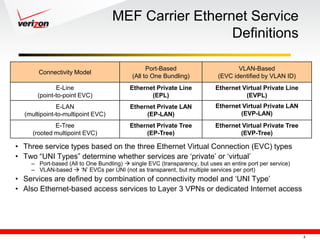
MEF Carrier Ethernet Service
                                                     Definitions

                                                Port-Based                        VLAN-Based
       Connectivity Model
                                          (All to One Bundling)            (EVC identified by VLAN ID)
             E-Line                      Ethernet Private Line            Ethernet Virtual Private Line
      (point-to-point EVC)                      (EPL)                               (EVPL)
              E-LAN                      Ethernet Private LAN             Ethernet Virtual Private LAN
  (multipoint-to-multipoint EVC)              (EP-LAN)                            (EVP-LAN)
             E-Tree                      Ethernet Private Tree            Ethernet Virtual Private Tree
     (rooted multipoint EVC)                  (EP-Tree)                           (EVP-Tree)

• Three service types based on the three Ethernet Virtual Connection (EVC) types
• Two ―UNI Types‖ determine whether services are ‗private‘ or ‗virtual‘
    – Port-based (All to One Bundling)  single EVC (transparency, but uses an entire port per service)
    – VLAN-based  ‗N‘ EVCs per UNI (not as transparent, but multiple services per port)
• Services are defined by combination of connectivity model and ‗UNI Type‘
• Also Ethernet-based access services to Layer 3 VPNs or dedicated Internet access


                                                                                                          4
―Enterprise-Class‖ Ethernet
                                            Limitations

• ―Enterprise-class‖ Ethernet switching has shortcomings as a basic
  for public Ethernet services
    – Few features for high availability in protocols or equipment
    – Scaling limits on MAC addresses, VLAN IDs, and spanning tree
      topology limit the size of native Ethernet networks
    – Spanning tree routing may take seconds to (occasionally) minutes to re-
      converge
• Early Ethernet providers found that enterprise-class Ethernet cannot
  naively be deployed for reliable carrier services


                                                                                5
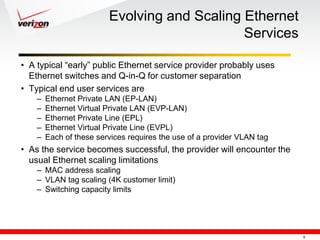
Evolving and Scaling Ethernet
                                              Services

• A typical ―early‖ public Ethernet service provider probably uses
  Ethernet switches and Q-in-Q for customer separation
• Typical end user services are
    –   Ethernet Private LAN (EP-LAN)
    –   Ethernet Virtual Private LAN (EVP-LAN)
    –   Ethernet Private Line (EPL)
    –   Ethernet Virtual Private Line (EVPL)
    –   Each of these services requires the use of a provider VLAN tag
• As the service becomes successful, the provider will encounter the
  usual Ethernet scaling limitations
    – MAC address scaling
    – VLAN tag scaling (4K customer limit)
    – Switching capacity limits


                                                                         6
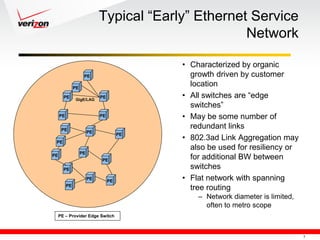
Typical ―Early‖ Ethernet Service
                                                      Network

                                             • Characterized by organic
                     PE                        growth driven by customer
               PE
                                               location
       PE
               GigE/LAG
                              PE             • All switches are ―edge
                                               switches‖
     PE                       PE             • May be some number of
      PE
                                               redundant links
                         PE
                                        PE
 PE
                                             • 802.3ad Link Aggregation may
                                               also be used for resiliency or
                    PE
PE
                              PE               for additional BW between
       PE                                      switches
                         PE
                                   PE        • Flat network with spanning
          PE
                                               tree routing
                                                 – Network diameter is limited,
                                                   often to metro scope
     PE – Provider Edge Switch


                                                                                  7
Emergence of ―Carrier Ethernet‖

• Limitations in enterprise-class Ethernet have led to the development
  of ―Carrier Ethernet‖
• Meant to address unique requirements for carrier Ethernet services,
  including Verizon‘s services
    – Scaling to support a large number of customers
    – Scaling to support large numbers of switches and customer interfaces
    – Support both point-to-point (E-Line) and multipoint (E-LAN and E-Tree)
      services
    – Support for both port-based and VLAN-based services
    – Support for QoS other than best-effort to support QoS-based SLAs
    – Sub-second outage restoration and routing convergence to support
      availability SLAs
    – Policing and shaping to support sub-rate services (e.g., 200 Mbps
      service on a physical GigE interface)


                                                                               8
IETF Ethernet Services Support

• Point-to-point pseudowires (PWs) to carry layer two frames,
  including Ethernet, over IP/MPLS networks
• Extends the MPLS LDP protocol to signal pseudowire establishment
• IETF extended PWs to a multipoint Ethernet service, VPLS (Virtual
  Private LAN Service)
• PWs and VPLS extremely popular, implemented by most every
  router vendor and in wide use by service providers world-wide
• Verizon uses both point-to-point PWs and VPLS to provide customer
  Ethernet services


                                                                      9
IP/MPLS Forum Ethernet Services
                                       Support

• Extended IETF-defined PWs to support non-similar endpoint
  interworking
   – Supports point-to-point Ethernet-to-Frame Relay, Ethernet-to-ATM, and
     ATM-to-Frame Relay interworking over MPLS PWs
   – Very useful for multiservice convergence, and to support customers with
     a variety of access methods
   – Can support applications such as hub location with GigE access, and
     low-speed Frame Relay spokes
   – Supports interworking of IP packets via ARP Mediation, and bridged
     services by interworking native Ethernet with Ethernet frames
     encapsulated by FR or ATM
   – Can also support VPLS endpoints with FR or ATM-attached customer
     equipment


                                                                               10
H-VPLS vs. VPLS+PBB

• VPLS and H-VPLS as originally defined by the IETF cannot meet
  Carrier Ethernet service scaling requirements:
   – 10s to 100s of thousands of EVCs
   – Number of E-LAN bridging instances per edge switch/LER
   – Up to millions of customer MAC addresses
• For these reasons, the IETF is now defining the combination of
  VPLS in the core with Provider Backbone Bridges (PBB, 802.1ah) at
  the edge


                                                                      11
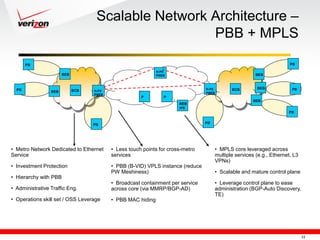
Scalable Network Architecture –
                                                     PBB + MPLS

       PB                                                                                                               PB

                                                             N-PE
                       BEB                                   PBEB                                        BEB


  PB                                                                            N-PE          BCB        BEB             PB
                 BEB         BCB   N-PE
                                                                                PBEB
                                   PBEB
                                                      P         P
                                                                                                        BEB
                                                                      BEB
                                                                      /PE
                                                                                                                       PB


                                   PB                                           PB


• Metro Network Dedicated to Ethernet     • Less touch points for cross-metro          • MPLS core leveraged across
Service                                   services                                     multiple services (e.g., Ethernet, L3
                                                                                       VPNs)
• Investment Protection                   • PBB (B-VID) VPLS instance (reduce
                                          PW Meshiness)                                • Scalable and mature control plane
• Hierarchy with PBB
                                          • Broadcast containment per service          • Leverage control plane to ease
• Administrative Traffic Eng.             across core (via MMRP/BGP-AD)                administration (BGP-Auto Discovery,
                                                                                       TE)
• Operations skill set / OSS Leverage     • PBB MAC hiding


                                                                                                                               12
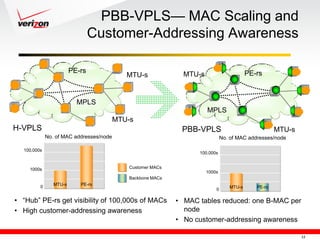
PBB-VPLS— MAC Scaling and
                                Customer-Addressing Awareness

                        PE-rs                                                             PE-rs
                                            MTU-s              MTU-s


                          MPLS
                                                                       MPLS
                                         MTU-s
H-VPLS                                                        PBB-VPLS                               MTU-s
             No. of MAC addresses/node                                         No. of MAC addresses/node

  100,000s
                                                                   100,000s


    1000s                                    Customer MACs
                                                                       1000s
                                             Backbone MACs
                MTU-s      PE-rs
         0                                                                        MTU-s      PE-rs
                                                                           0

• ―Hub‖ PE-rs get visibility of 100,000s of MACs             • MAC tables reduced: one B-MAC per
• High customer-addressing awareness                           node
                                                             • No customer-addressing awareness

                                                                                                             13
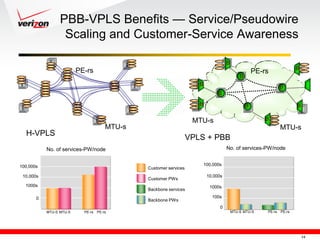
PBB-VPLS Benefits — Service/Pseudowire
                  Scaling and Customer-Service Awareness

                                                                                     B
                                                                                                                         B
                         PE-rs                                                                       PE-rs
                                                                                             B
                                                                      B
                                                                                                                 B
                                                                                B

                                                                      B                          B                       B

                                                                    MTU-s                                B
                                       MTU-s                                                                     MTU-s
  H-VPLS
                                                                   VPLS + PBB
           No. of services-PW/node                                                   No. of services-PW/node


100,000s                                                                  100,000s
                                               Customer services
 10,000s                                                                   10,000s
                                               Customer PWs
  1000s                                                                     1000s
                                               Backbone services

       0                                                                     100s
                                               Backbone PWs
                                                                                 0
           MTU-S MTU-S     PE-rs   PE-rs                                                 MTU-S MTU-S     PE-rs   PE-rs


                                                                                                                             14
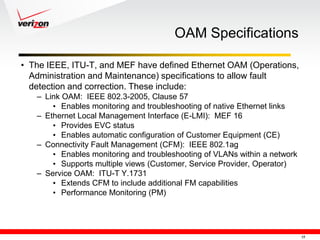
OAM Specifications

• The IEEE, ITU-T, and MEF have defined Ethernet OAM (Operations,
  Administration and Maintenance) specifications to allow fault
  detection and correction. These include:
   – Link OAM: IEEE 802.3-2005, Clause 57
       • Enables monitoring and troubleshooting of native Ethernet links
   – Ethernet Local Management Interface (E-LMI): MEF 16
       • Provides EVC status
       • Enables automatic configuration of Customer Equipment (CE)
   – Connectivity Fault Management (CFM): IEEE 802.1ag
       • Enables monitoring and troubleshooting of VLANs within a network
       • Supports multiple views (Customer, Service Provider, Operator)
   – Service OAM: ITU-T Y.1731
       • Extends CFM to include additional FM capabilities
       • Performance Monitoring (PM)


                                                                            15
Carrier Ethernet over MPLS
                                                 Testing

• Requires documentation and references
   – MEF, BBF, IETF, IEEE

• Automation
   – Definitive Parameters


                                                           16
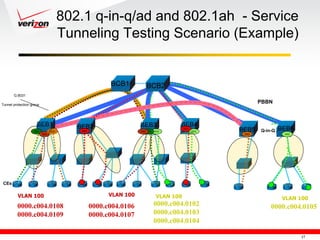
802.1 q-in-q/ad and 802.1ah - Service
                                        Tunneling Testing Scenario (Example)


                                                         BCB1            BCB2
       G.8031

Tunnel protection group
                                                                                                                  PBBN


                     BEB1                  BEB2                     BEB3                BEB4
                   ISID          ISID       ISID                    ISID ISID   ISID
                                                                                            ISID
                                                                                                   ISID   BEB5            BEB6
                                                                                                                  Q-in-Q /82.1ad
                          ISID                                                                             ISID             ISID


 CEs

         VLAN 100                                        VLAN 100                VLAN 100                                 VLAN 100
         0000.c004.0108                            0000.c004.0106               0000.c004.0102                        0000.c004.0105
         0000.c004.0109                            0000.c004.0107               0000.c004.0103
                                                                                0000.c004.0104

                                                                                                                                   17
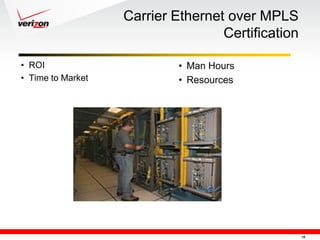
Carrier Ethernet over MPLS
                                   Certification

• ROI                       • Man Hours
• Time to Market            • Resources


                                                   18
Conclusions

• Verizon‘s Carrier Ethernet services must meet stringent
  requirements for:

    – Conformance to Metro Ethernet forum (MEF) service definitions

    – Scalability to support customer growth

    – Reliability, resilience, OAM for troubleshooting and performance
      monitoring, to support high service availability

    – Standards-based certification

    – Pre-deployment and post-deployment testing


                                                                         19
Questions?


        Thank you!

 andrew.g.malis@verizon.com
charles.a.rexrode@verizon.com


                                      20

10 fn s21

  • 1.
    Verizon‘s Requirements forIP/MPLS-Based Carrier Ethernet Networks Andrew G. Malis & Drew Rexrode Verizon Communications andrew.g.malis@verizon.com charles.a.rexrode@verizon.com Future-Net 2010
  • 2.
    Introduction • Public Ethernetservices are exploding in popularity • External Ethernet interface to the customer does not necessarily mean ―Ethernet inside‖ – The Internet Engineering Task Force (IETF) has standardized mechanisms for providing point-to-point and multipoint public Ethernet services over IP/MPLS-based infrastructures • This talk discusses Verizon‘s requirements for such solutions, including functionality, conformance to Metro Ethernet forum (MEF) service definitions, reliability, scalability, QoS, performance monitoring, OAM, testing, and certification 2
  • 3.
    Why Are EthernetServices Popular? • Ubiquity and low cost of Ethernet interfaces in customer equipment, universal experience with Ethernet in LANs, and perceived simplicity • Successful marketing of the ―Ethernet‖ brand by vendors, IEEE, MEF, and others – Little resemblance with original DIX Ethernet specifications, from physical layer on up (e.g., today‘s Ethernet is mostly point-to-point or ring-based rather than CSMA-CD at the physical layer) – Most everything has changed except for the basic frame format – and jumbograms (large frames up to 9K bytes) change even that • Plenty of competition and favorable pricing by service providers 3
  • 4.
    MEF Carrier EthernetService Definitions Port-Based VLAN-Based Connectivity Model (All to One Bundling) (EVC identified by VLAN ID) E-Line Ethernet Private Line Ethernet Virtual Private Line (point-to-point EVC) (EPL) (EVPL) E-LAN Ethernet Private LAN Ethernet Virtual Private LAN (multipoint-to-multipoint EVC) (EP-LAN) (EVP-LAN) E-Tree Ethernet Private Tree Ethernet Virtual Private Tree (rooted multipoint EVC) (EP-Tree) (EVP-Tree) • Three service types based on the three Ethernet Virtual Connection (EVC) types • Two ―UNI Types‖ determine whether services are ‗private‘ or ‗virtual‘ – Port-based (All to One Bundling)  single EVC (transparency, but uses an entire port per service) – VLAN-based  ‗N‘ EVCs per UNI (not as transparent, but multiple services per port) • Services are defined by combination of connectivity model and ‗UNI Type‘ • Also Ethernet-based access services to Layer 3 VPNs or dedicated Internet access 4
  • 5.
    ―Enterprise-Class‖ Ethernet Limitations • ―Enterprise-class‖ Ethernet switching has shortcomings as a basic for public Ethernet services – Few features for high availability in protocols or equipment – Scaling limits on MAC addresses, VLAN IDs, and spanning tree topology limit the size of native Ethernet networks – Spanning tree routing may take seconds to (occasionally) minutes to re- converge • Early Ethernet providers found that enterprise-class Ethernet cannot naively be deployed for reliable carrier services 5
  • 6.
    Evolving and ScalingEthernet Services • A typical ―early‖ public Ethernet service provider probably uses Ethernet switches and Q-in-Q for customer separation • Typical end user services are – Ethernet Private LAN (EP-LAN) – Ethernet Virtual Private LAN (EVP-LAN) – Ethernet Private Line (EPL) – Ethernet Virtual Private Line (EVPL) – Each of these services requires the use of a provider VLAN tag • As the service becomes successful, the provider will encounter the usual Ethernet scaling limitations – MAC address scaling – VLAN tag scaling (4K customer limit) – Switching capacity limits 6
  • 7.
    Typical ―Early‖ EthernetService Network • Characterized by organic PE growth driven by customer PE location PE GigE/LAG PE • All switches are ―edge switches‖ PE PE • May be some number of PE redundant links PE PE PE • 802.3ad Link Aggregation may also be used for resiliency or PE PE PE for additional BW between PE switches PE PE • Flat network with spanning PE tree routing – Network diameter is limited, often to metro scope PE – Provider Edge Switch 7
  • 8.
    Emergence of ―CarrierEthernet‖ • Limitations in enterprise-class Ethernet have led to the development of ―Carrier Ethernet‖ • Meant to address unique requirements for carrier Ethernet services, including Verizon‘s services – Scaling to support a large number of customers – Scaling to support large numbers of switches and customer interfaces – Support both point-to-point (E-Line) and multipoint (E-LAN and E-Tree) services – Support for both port-based and VLAN-based services – Support for QoS other than best-effort to support QoS-based SLAs – Sub-second outage restoration and routing convergence to support availability SLAs – Policing and shaping to support sub-rate services (e.g., 200 Mbps service on a physical GigE interface) 8
  • 9.
    IETF Ethernet ServicesSupport • Point-to-point pseudowires (PWs) to carry layer two frames, including Ethernet, over IP/MPLS networks • Extends the MPLS LDP protocol to signal pseudowire establishment • IETF extended PWs to a multipoint Ethernet service, VPLS (Virtual Private LAN Service) • PWs and VPLS extremely popular, implemented by most every router vendor and in wide use by service providers world-wide • Verizon uses both point-to-point PWs and VPLS to provide customer Ethernet services 9
  • 10.
    IP/MPLS Forum EthernetServices Support • Extended IETF-defined PWs to support non-similar endpoint interworking – Supports point-to-point Ethernet-to-Frame Relay, Ethernet-to-ATM, and ATM-to-Frame Relay interworking over MPLS PWs – Very useful for multiservice convergence, and to support customers with a variety of access methods – Can support applications such as hub location with GigE access, and low-speed Frame Relay spokes – Supports interworking of IP packets via ARP Mediation, and bridged services by interworking native Ethernet with Ethernet frames encapsulated by FR or ATM – Can also support VPLS endpoints with FR or ATM-attached customer equipment 10
  • 11.
    H-VPLS vs. VPLS+PBB •VPLS and H-VPLS as originally defined by the IETF cannot meet Carrier Ethernet service scaling requirements: – 10s to 100s of thousands of EVCs – Number of E-LAN bridging instances per edge switch/LER – Up to millions of customer MAC addresses • For these reasons, the IETF is now defining the combination of VPLS in the core with Provider Backbone Bridges (PBB, 802.1ah) at the edge 11
  • 12.
    Scalable Network Architecture– PBB + MPLS PB PB N-PE BEB PBEB BEB PB N-PE BCB BEB PB BEB BCB N-PE PBEB PBEB P P BEB BEB /PE PB PB PB • Metro Network Dedicated to Ethernet • Less touch points for cross-metro • MPLS core leveraged across Service services multiple services (e.g., Ethernet, L3 VPNs) • Investment Protection • PBB (B-VID) VPLS instance (reduce PW Meshiness) • Scalable and mature control plane • Hierarchy with PBB • Broadcast containment per service • Leverage control plane to ease • Administrative Traffic Eng. across core (via MMRP/BGP-AD) administration (BGP-Auto Discovery, TE) • Operations skill set / OSS Leverage • PBB MAC hiding 12
  • 13.
    PBB-VPLS— MAC Scalingand Customer-Addressing Awareness PE-rs PE-rs MTU-s MTU-s MPLS MPLS MTU-s H-VPLS PBB-VPLS MTU-s No. of MAC addresses/node No. of MAC addresses/node 100,000s 100,000s 1000s Customer MACs 1000s Backbone MACs MTU-s PE-rs 0 MTU-s PE-rs 0 • ―Hub‖ PE-rs get visibility of 100,000s of MACs • MAC tables reduced: one B-MAC per • High customer-addressing awareness node • No customer-addressing awareness 13
  • 14.
    PBB-VPLS Benefits —Service/Pseudowire Scaling and Customer-Service Awareness B B PE-rs PE-rs B B B B B B B MTU-s B MTU-s MTU-s H-VPLS VPLS + PBB No. of services-PW/node No. of services-PW/node 100,000s 100,000s Customer services 10,000s 10,000s Customer PWs 1000s 1000s Backbone services 0 100s Backbone PWs 0 MTU-S MTU-S PE-rs PE-rs MTU-S MTU-S PE-rs PE-rs 14
  • 15.
    OAM Specifications • TheIEEE, ITU-T, and MEF have defined Ethernet OAM (Operations, Administration and Maintenance) specifications to allow fault detection and correction. These include: – Link OAM: IEEE 802.3-2005, Clause 57 • Enables monitoring and troubleshooting of native Ethernet links – Ethernet Local Management Interface (E-LMI): MEF 16 • Provides EVC status • Enables automatic configuration of Customer Equipment (CE) – Connectivity Fault Management (CFM): IEEE 802.1ag • Enables monitoring and troubleshooting of VLANs within a network • Supports multiple views (Customer, Service Provider, Operator) – Service OAM: ITU-T Y.1731 • Extends CFM to include additional FM capabilities • Performance Monitoring (PM) 15
  • 16.
    Carrier Ethernet overMPLS Testing • Requires documentation and references – MEF, BBF, IETF, IEEE • Automation – Definitive Parameters 16
  • 17.
    802.1 q-in-q/ad and802.1ah - Service Tunneling Testing Scenario (Example) BCB1 BCB2 G.8031 Tunnel protection group PBBN BEB1 BEB2 BEB3 BEB4 ISID ISID ISID ISID ISID ISID ISID ISID BEB5 BEB6 Q-in-Q /82.1ad ISID ISID ISID CEs VLAN 100 VLAN 100 VLAN 100 VLAN 100 0000.c004.0108 0000.c004.0106 0000.c004.0102 0000.c004.0105 0000.c004.0109 0000.c004.0107 0000.c004.0103 0000.c004.0104 17
  • 18.
    Carrier Ethernet overMPLS Certification • ROI • Man Hours • Time to Market • Resources 18
  • 19.
    Conclusions • Verizon‘s CarrierEthernet services must meet stringent requirements for: – Conformance to Metro Ethernet forum (MEF) service definitions – Scalability to support customer growth – Reliability, resilience, OAM for troubleshooting and performance monitoring, to support high service availability – Standards-based certification – Pre-deployment and post-deployment testing 19
  • 20.
    Questions? Thank you! andrew.g.malis@verizon.com charles.a.rexrode@verizon.com 20