LSA Types Explained


    Complete Understanding of LSA Types Is The
    Cornerstone To Understanding OSPF Areas
    and OSPF Area Behaviors

    Complete Understanding of OSPF Area
    Behaviors Is The Cornerstone of Good OSPF
    Network Design and Traffic Flow
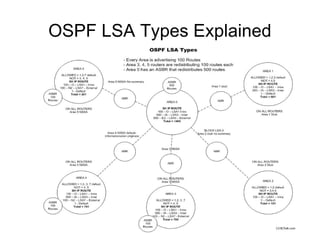
OSPF LSA Types Explained
LSA Type 1 (Router LSA)


Generated by all routers in an area to describe their directly attached
  links (Intra-area routes). These do not leave the area.
LSA Type 2 (Network LSA)


Generated by the DR of a broadcast or Nonbroadcast segment to
  describe the neighbors connected to the segment. These do not
  leave the area.
LSA Type 3 (Summary LSA)


Generated by the ABR to describe a route to neighbors outside the
  area. (Inter-area routes)
LSA Type 4 (Summary LSA)


Generated by the ABR to describe a route to an ASBR to neighbors
  outside the area.
LSA Type 5 (External LSA)


Generated by ASBR to describe routes redistributed into the area.
  These routes appear as E1 or E2 in the routing table. E2 (default)
  uses a static cost throughout the OSPF domain as it only takes the
  cost into account that is reported at redistribution. E1 uses a
  cumulative cost of the cost reported into the OSPF domain at
  redistribution plus the local cost to the ASBR.
LSA Type 6 (Multicast LSA)


Not supported on Cisco routers
LSA Type 7 (NSSA LSA)


Generated by an ASBR inside a NSSA to describe routes redistributed
  into the NSSA. LSA 7 is translated into LSA 5 as it leaves the NSSA.
  These routes appear as N1 or N2 in the ip routing table inside the
  NSSA. Much like LSA 5, N2 is a static cost while N1 is a cumulative
  cost that includes the cost up to the ASBR.

OSPF LSA Types Explained

  • 1.
    LSA Types Explained  Complete Understanding of LSA Types Is The Cornerstone To Understanding OSPF Areas and OSPF Area Behaviors  Complete Understanding of OSPF Area Behaviors Is The Cornerstone of Good OSPF Network Design and Traffic Flow
  • 2.
    OSPF LSA TypesExplained
  • 3.
    LSA Type 1(Router LSA) Generated by all routers in an area to describe their directly attached links (Intra-area routes). These do not leave the area.
  • 4.
    LSA Type 2(Network LSA) Generated by the DR of a broadcast or Nonbroadcast segment to describe the neighbors connected to the segment. These do not leave the area.
  • 5.
    LSA Type 3(Summary LSA) Generated by the ABR to describe a route to neighbors outside the area. (Inter-area routes)
  • 6.
    LSA Type 4(Summary LSA) Generated by the ABR to describe a route to an ASBR to neighbors outside the area.
  • 7.
    LSA Type 5(External LSA) Generated by ASBR to describe routes redistributed into the area. These routes appear as E1 or E2 in the routing table. E2 (default) uses a static cost throughout the OSPF domain as it only takes the cost into account that is reported at redistribution. E1 uses a cumulative cost of the cost reported into the OSPF domain at redistribution plus the local cost to the ASBR.
  • 8.
    LSA Type 6(Multicast LSA) Not supported on Cisco routers
  • 9.
    LSA Type 7(NSSA LSA) Generated by an ASBR inside a NSSA to describe routes redistributed into the NSSA. LSA 7 is translated into LSA 5 as it leaves the NSSA. These routes appear as N1 or N2 in the ip routing table inside the NSSA. Much like LSA 5, N2 is a static cost while N1 is a cumulative cost that includes the cost up to the ASBR.