

 Must have a standard.
 A standard is an exact quantity people agree to use
for comparison.
 A standard means two people using the same object
should get close to the same results.
Measurement
Standards of the past
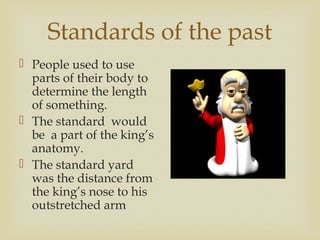
 People used to use
parts of their body to
determine the length
of something.
 The standard would
be a part of the king’s
anatomy.
 The standard yard
was the distance from
the king’s nose to his
outstretched arm
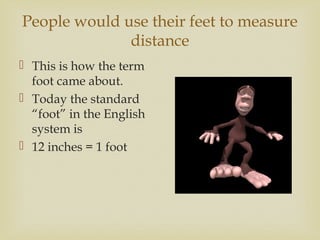
People would use their feet to measure
distance
 This is how the term
foot came about.
 Today the standard
“foot” in the English
system is
 12 inches = 1 foot
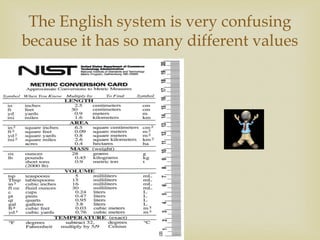
The English system is very confusing
because it has so many different values

America is the only country that still
uses the old English system

Scientists give the English system the
thumbs down
Scientists needed an exact and uniform system of weights
and measurements

How did the metric system come
about?
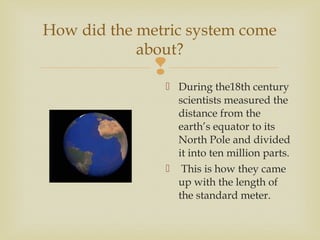
 During the18th century
scientists measured the
distance from the
earth’s equator to its
North Pole and divided
it into ten million parts.
 This is how they came
up with the length of
the standard meter.

The Meter
 The standard for the meter is kept in a safe in France.
 The meter stick is a replica of that standard
 A meter is made up of 100 centimeters and 1000
millimeters

 Scientists needed a way to measure liquids so they
took 10 cm and multiplied it by its length x width x
height to come up with a standard for measuring
volume
 The liter is the size of 10 cm(3)
 10cm x 10 cm x 10 cm
 Length x Width x Height = Volume
 The liter is used to measure liquids
How the liter came
about

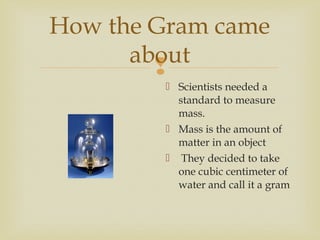
How the Gram came
about
 Scientists needed a
standard to measure
mass.
 Mass is the amount of
matter in an object
 They decided to take
one cubic centimeter of
water and call it a gram
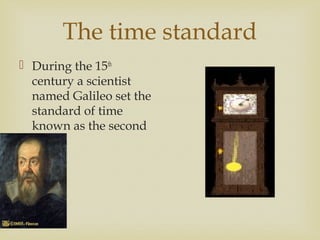
The time standard
 During the 15th
century a scientist
named Galileo set the
standard of time
known as the second

The Mistake
Two different groups of
scientists were working
on the calculations to
send a probe to Mars.
The American team did
their calculations in the
English standard and the
other team did it in the
metric system (OOPS!)
 MARS

 This made scientists
very upset.

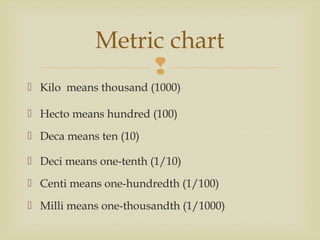
 Kilo  means thousand (1000)
 Hecto means hundred (100)
 Deca means ten (10)
 Deci means one-tenth (1/10)
 Centi means one-hundredth (1/100)
 Milli means one-thousandth (1/1000)
Metric chart

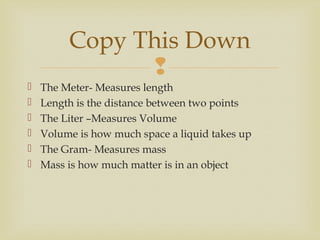
 The Meter- Measures length
 Length is the distance between two points
 The Liter –Measures Volume
 Volume is how much space a liquid takes up
 The Gram- Measures mass
 Mass is how much matter is in an object
Copy This Down

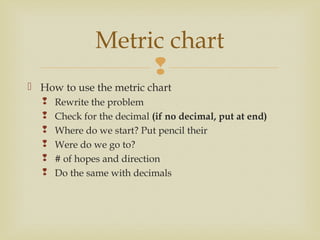
 How to use the metric chart
 Rewrite the problem
 Check for the decimal (if no decimal, put at end)
 Where do we start? Put pencil their
 Were do we go to?
 # of hopes and direction
 Do the same with decimals
Metric chart
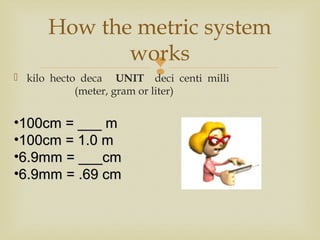
 kilo  hecto  deca     UNIT    deci  centi  milli
   (meter, gram or liter)   
How the metric system
works
•100cm = ___ m100cm = ___ m
•100cm = 1.0 m100cm = 1.0 m
•6.9mm = ___cm6.9mm = ___cm
•6.9mm = .69 cm6.9mm = .69 cm

The metricsystem

  • 1.
      Must havea standard.  A standard is an exact quantity people agree to use for comparison.  A standard means two people using the same object should get close to the same results. Measurement
  • 2.
    Standards of thepast  People used to use parts of their body to determine the length of something.  The standard would be a part of the king’s anatomy.  The standard yard was the distance from the king’s nose to his outstretched arm
  • 3.
    People would usetheir feet to measure distance  This is how the term foot came about.  Today the standard “foot” in the English system is  12 inches = 1 foot
  • 4.
    The English systemis very confusing because it has so many different values
  • 5.
     America is theonly country that still uses the old English system
  • 6.
     Scientists give theEnglish system the thumbs down Scientists needed an exact and uniform system of weights and measurements
  • 7.
     How did themetric system come about?  During the18th century scientists measured the distance from the earth’s equator to its North Pole and divided it into ten million parts.  This is how they came up with the length of the standard meter.
  • 8.
     The Meter  Thestandard for the meter is kept in a safe in France.  The meter stick is a replica of that standard  A meter is made up of 100 centimeters and 1000 millimeters
  • 9.
      Scientists neededa way to measure liquids so they took 10 cm and multiplied it by its length x width x height to come up with a standard for measuring volume  The liter is the size of 10 cm(3)  10cm x 10 cm x 10 cm  Length x Width x Height = Volume  The liter is used to measure liquids How the liter came about
  • 10.
     How the Gramcame about  Scientists needed a standard to measure mass.  Mass is the amount of matter in an object  They decided to take one cubic centimeter of water and call it a gram
  • 11.
    The time standard During the 15th century a scientist named Galileo set the standard of time known as the second
  • 12.
     The Mistake Two differentgroups of scientists were working on the calculations to send a probe to Mars. The American team did their calculations in the English standard and the other team did it in the metric system (OOPS!)  MARS
  • 13.
      This madescientists very upset.
  • 14.
      Kilo  meansthousand (1000)  Hecto means hundred (100)  Deca means ten (10)  Deci means one-tenth (1/10)  Centi means one-hundredth (1/100)  Milli means one-thousandth (1/1000) Metric chart
  • 15.
      The Meter-Measures length  Length is the distance between two points  The Liter –Measures Volume  Volume is how much space a liquid takes up  The Gram- Measures mass  Mass is how much matter is in an object Copy This Down
  • 16.
      How touse the metric chart  Rewrite the problem  Check for the decimal (if no decimal, put at end)  Where do we start? Put pencil their  Were do we go to?  # of hopes and direction  Do the same with decimals Metric chart
  • 17.
     kilo  hecto deca     UNIT    deci  centi  milli    (meter, gram or liter)    How the metric system works •100cm = ___ m100cm = ___ m •100cm = 1.0 m100cm = 1.0 m •6.9mm = ___cm6.9mm = ___cm •6.9mm = .69 cm6.9mm = .69 cm