Considering the Snail
          The snail pushes through a green
             night, for the grass is heavy
             with water and meets over
        the bright path he makes, where rain
          has darkened the earth’s dark. He
             moves in a wood of desire,

               pale antlers barely stirring
                as he hunts. I cannot tell
        what power is at work, drenched there
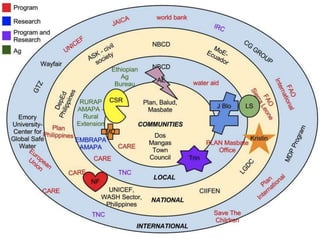
           with purpose, knowing nothing.
                What is a snail’s fury? All
                   I think is that if later
I parted the blades above the tunnel and saw the thin
              trail of broken white across
                litter, I would never have
               imagined the slow passion
              to that deliberate progress.

                    Thom Gunn
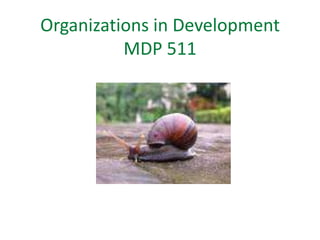
Organizations in Development
          MDP 511
Session 1 Plan
A. Introductions and welcome
B. Why Organizations in Development – Review of
   the session’s readings
C. Brief overview of the course
   • Objectives
   • Themes and the snail
   • Trajectory of the course
D. Organizational landscape
E. Power
Introductions and Learning Influences
Organization and country name
One word that describes your summer
  internship experience
Think about the people who were an important
  part of your learning over the course of your
  field internship.….
Can you identify a specific person or group of
  people that you learned a lot from or learned
  together with?
Paying Attention to Language
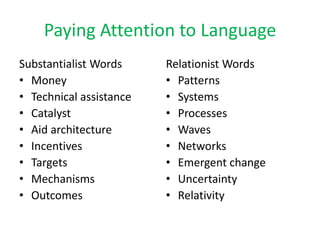
Substantialist Words     Relationist Words
• Money                  • Patterns
• Technical assistance   • Systems
• Catalyst               • Processes
• Aid architecture       • Waves
• Incentives             • Networks
• Targets                • Emergent change
• Mechanisms             • Uncertainty
• Outcomes               • Relativity
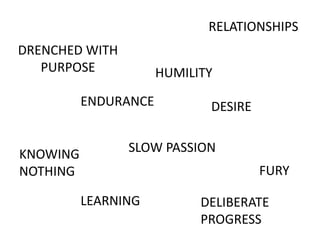
RELATIONSHIPS
DRENCHED WITH
   PURPOSE            HUMILITY
          ENDURANCE          DESIRE


KNOWING         SLOW PASSION
NOTHING                               FURY

          LEARNING          DELIBERATE
                            PROGRESS
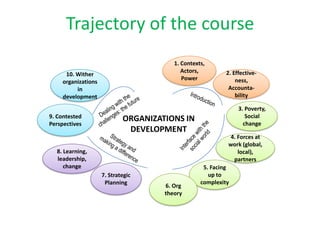
Trajectory of the course
                                        1. Contexts,
                                           Actors,         2. Effective-
     10. Wither
                                           Power               ness,
    organizations
         in                                                 Accounta-
    development                                                bility

                                                                3. Poverty,
9. Contested                ORGANIZATIONS IN                       Social
Perspectives                                                      change
                             DEVELOPMENT
                                                            4. Forces at
                                                           work (global,
  8. Learning,                                                 local),
  leadership,                                                partners
     change                                        5. Facing
                    7. Strategic                     up to
                     Planning                     complexity
                                     6. Org
                                     theory
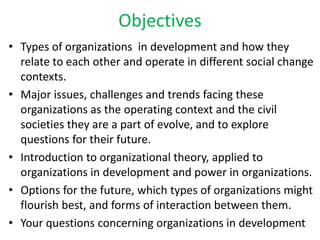
Objectives
• Types of organizations in development and how they
  relate to each other and operate in different social change
  contexts.
• Major issues, challenges and trends facing these
  organizations as the operating context and the civil
  societies they are a part of evolve, and to explore
  questions for their future.
• Introduction to organizational theory, applied to
  organizations in development and power in organizations.
• Options for the future, which types of organizations might
  flourish best, and forms of interaction between them.
• Your questions concerning organizations in development
Key Themes
• Power and power relations
• Engagement in complex processes of social
  change (what we say and what we do)
• Effectiveness and accountability
• Organizational learning, leadership and
  change
• Diversity and differentiation
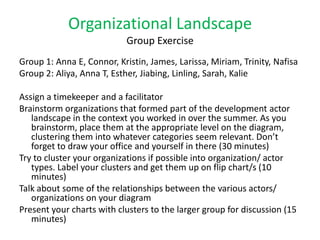
Organizational Landscape
                            Group Exercise
Group 1: Anna E, Connor, Kristin, James, Larissa, Miriam, Trinity, Nafisa
Group 2: Aliya, Anna T, Esther, Jiabing, Linling, Sarah, Kalie

Assign a timekeeper and a facilitator
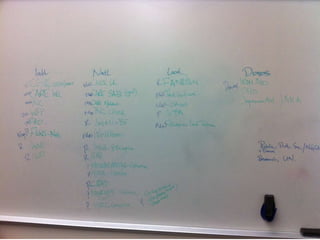
Brainstorm organizations that formed part of the development actor
   landscape in the context you worked in over the summer. As you
   brainstorm, place them at the appropriate level on the diagram,
   clustering them into whatever categories seem relevant. Don’t
   forget to draw your office and yourself in there (30 minutes)
Try to cluster your organizations if possible into organization/ actor
   types. Label your clusters and get them up on flip chart/s (10
   minutes)
Talk about some of the relationships between the various actors/
   organizations on your diagram
Present your charts with clusters to the larger group for discussion (15
   minutes)
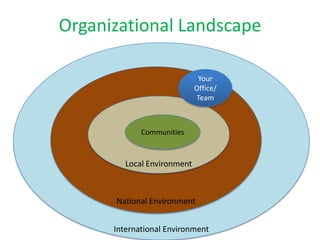
Organizational Landscape

                              Your
                             Office/
                             Team


             Communities


         Local Environment


      National Environment


      International Environment
Understanding Power (JASS)
Dynamic, Relational, Multi-dimensional

• Power over – repression, force, coercion,
  discrimination, corruption, abuse. Those who control
  resources and decisions have power over those who
  do not. (Controlling)

But there are other more collaborative ways of
  exercising and using power affirming people’s
  capacity to act collaboratively and creatively
Understanding Power (JASS)
• Power with: Finding common ground among
  different interests to build collective strength.
  Engenders mutual support, collaboration,
  solidarity, recognition and respect for differences
• Power to: Unique potential of every person/
  group to shape his or her life in the world – new
  skills, knowledge, awareness.
• Power within: Self-worth and self-knowledge; the
  capacity to imagine and to have hope
Dimensions of Power Over
• Visible power: Observable unrepresentative
  decision making
• Hidden power: Controlling who gets to make
  decisions. Excludes/ devalues concerns of less
  powerful groups. Framing the narrative and
  process behind the scenes
• Invisible power: Shapes the psychological and
  ideological boundaries of change. Prevent
  issues from being put on the table
Intersecting Realms – Understanding
    layers of experience with power
PUBLIC: Women, men at work and in their
  communities

PRIVATE: Relationships/ roles among family,
  friends, sexual partners, marriage

INTIMATE: Sense of self-worth, confidence,
  relationship to body
Preparing for week 2 – Readings
    Effectiveness and Accountability
Required:
Edwards, Michael, 2005, ‘Have NGOs “Made a difference”?
  From Manchester to Birmingham with an elephant in the
  room’, University of Manchester, 27-29 June 2005
Eyben, Rosalind, May 2008, ‘Power, Mutual Accountability
  and Responsibility in the Practice of International Aid
Ho, Wenny, 2011. From Reimagining to Repositioning
  Accountability, IDS Bulletin, September 2011
Brown, David L. and Mark H. Moore, Accountability,
  Strategy and International Nongovernmental
  Organizations, Nonprofit and Voluntary Sector Quarterly
  2001 30: 569
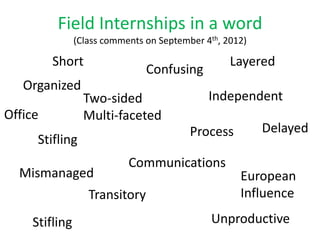
Field Internships in a word
               (Class comments on September 4th, 2012)

         Short                                    Layered
                               Confusing
   Organized
                 Two-sided                   Independent
Office           Multi-faceted
                                         Process         Delayed
     Stifling
                           Communications
  Mismanaged                                        European
                  Transitory                        Influence

    Stifling                                  Unproductive
"I know a planet where there is a certain red-faced gentleman. He has
    never smelled a flower. He has never looked at a star. He has never
    loved any one. He has never done anything in his life but add up
    figures. And all day he says over and over, just like you: 'I am busy
    with matters of consequence!' And that makes him swell up with
    pride. But he is not a man--he is a mushroom!"
"A what?"
"A mushroom!"
The little prince was now white with rage.
"The flowers have been growing thorns for millions of years. For
    millions of years the sheep have been eating them just the same.
    And is it not a matter of consequence to try to understand why the
    flowers go to so much trouble to grow thorns which are never of any
    use to them? Is the warfare between the sheep and the flowers not
    important? Is this not of more consequence than a fat red-faced
    gentleman's sums? And if I know--I, myself--one flower which is
    unique in the world, which grows nowhere but on my planet, but
    which one little sheep can destroy in a single bite some morning,
    without even noticing what he is doing--Oh! You think that is not
    important!"
                               The Little Prince, Antoine de Saint Exupery
Session 2 – Accountability and
             Effectiveness
A. Continue our discussion on power (40 mins)
B. Discussion on power, accountability, and back
   to substantialist and relationist (40 mins)
C. Break (10 minutes)
D. The Moore Framework – Strategic Triangle..
   Move to mutual responsibility (40 mins)
E. Group work and presentations (30 minutes)
F. Journaling – Top three insights – top three
   questions
Ways to understand Accountability
DFID understands ‘accountability’ as one of the
 three requirements of good governance and
 briefly defines it as ‘the process by which people
 are able to hold government to account’

The World Bank’s Social Development Department
  describes it as ‘the obligation of power holders
  to account for or take responsibility for their
  action’
Ways to understand Accountability
Answerability for performance is also how official
  aid agencies tend to see it, associating it with
  the ‘managing for results’ commitment of the
  Paris Declaration. Accountability is about
  holding organizations responsible for
  performance against pre-established objectives.

Tend toward a focus on PRINCIPAL – AGENT
  ACCOUNTABILITY
Ways to understand Accountability -
       The Paris Declaration
A set of commitments by donor governments, multilateral
  agencies, aid recipient governments, to make
  international aid more efficient and effective
Recipient government ownership of the policies they are
  implementing
Donors aligning policies and resources in relation to these
Donors harmonising procedures and strategies
Mutual focus on time bound and measurable results
Donors and recipients accountable to each other and to
  constituents for use of resources and securing results
Assessing progress on commitments through mutual
  country level mechanisms
The Paris Declaration - Accountability
Horizontal Accountability: Between institutions of the
  state
Vertical Accountability: Between citizens/ societal
  actors and the state
External Accountability: Between state and
  international actors (donors, treaty bodies)

NGO discourse – Upward Accountability (to donors)
 and Downward Accountability (to program
 participants)
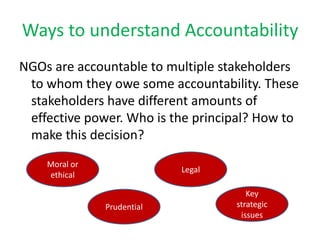
Ways to understand Accountability
NGOs are accountable to multiple stakeholders
 to whom they owe some accountability. These
 stakeholders have different amounts of
 effective power. Who is the principal? How to
 make this decision?
    Moral or
                            Legal
    ethical

                                       Key
               Prudential           strategic
                                     issues
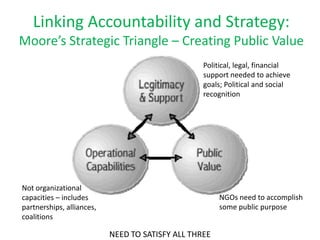
Linking Accountability and Strategy:
Moore’s Strategic Triangle – Creating Public Value
                                                  Political, legal, financial
                                                  support needed to achieve
                                                  goals; Political and social
                                                  recognition


Not organizational
capacities – includes                                  NGOs need to accomplish
partnerships, alliances,                               some public purpose
coalitions

                           NEED TO SATISFY ALL THREE
Working through accountability dilemmas
 (Different stakeholders and different
       organizational purposes)
 How do stakeholders and accountabilities shift for
   different kinds of organizations? (Brown and
   Moore: Service Delivery INGOs, Capacity
   Strengthening INGOs, and Policy and institutional
   influencing INGOs)

 Who are the different stakeholders in different
  corners of the triangle? How do we align
  interests?
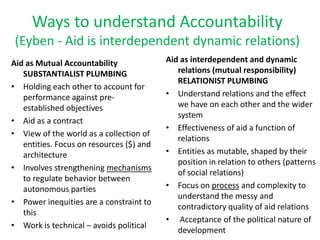
Ways to understand Accountability
 (Eyben - Aid is interdependent dynamic relations)
Aid as Mutual Accountability              Aid as interdependent and dynamic
   SUBSTANTIALIST PLUMBING                   relations (mutual responsibility)
                                             RELATIONIST PLUMBING
• Holding each other to account for
   performance against pre-               • Understand relations and the effect
   established objectives                    we have on each other and the wider
                                             system
• Aid as a contract
                                          • Effectiveness of aid a function of
• View of the world as a collection of
                                             relations
   entities. Focus on resources ($) and
   architecture                           • Entities as mutable, shaped by their
                                             position in relation to others (patterns
• Involves strengthening mechanisms
                                             of social relations)
   to regulate behavior between
   autonomous parties                     • Focus on process and complexity to
                                             understand the messy and
• Power inequities are a constraint to
                                             contradictory quality of aid relations
   this
                                          • Acceptance of the political nature of
• Work is technical – avoids political
                                             development
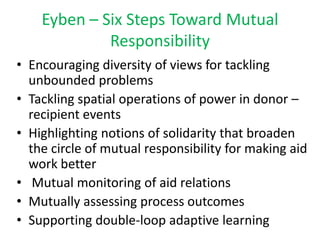
Eyben – Six Steps Toward Mutual
             Responsibility
• Encouraging diversity of views for tackling
  unbounded problems
• Tackling spatial operations of power in donor –
  recipient events
• Highlighting notions of solidarity that broaden
  the circle of mutual responsibility for making aid
  work better
• Mutual monitoring of aid relations
• Mutually assessing process outcomes
• Supporting double-loop adaptive learning
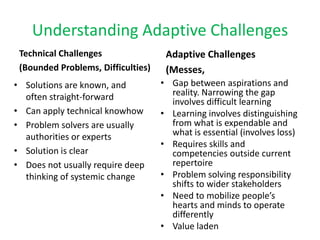
Understanding Adaptive Challenges
 Technical Challenges                Adaptive Challenges
 (Bounded Problems, Difficulties)    (Messes,
• Solutions are known, and          • Gap between aspirations and
  often straight-forward              reality. Narrowing the gap
                                      involves difficult learning
• Can apply technical knowhow       • Learning involves distinguishing
• Problem solvers are usually         from what is expendable and
  authorities or experts              what is essential (involves loss)
                                    • Requires skills and
• Solution is clear                   competencies outside current
• Does not usually require deep       repertoire
  thinking of systemic change       • Problem solving responsibility
                                      shifts to wider stakeholders
                                    • Need to mobilize people’s
                                      hearts and minds to operate
                                      differently
                                    • Value laden
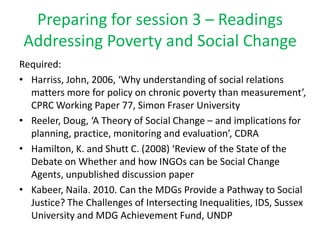
Preparing for session 3 – Readings
 Addressing Poverty and Social Change
Required:
• Harriss, John, 2006, ‘Why understanding of social relations
  matters more for policy on chronic poverty than measurement’,
  CPRC Working Paper 77, Simon Fraser University
• Reeler, Doug, ‘A Theory of Social Change – and implications for
  planning, practice, monitoring and evaluation’, CDRA
• Hamilton, K. and Shutt C. (2008) ‘Review of the State of the
  Debate on Whether and how INGOs can be Social Change
  Agents, unpublished discussion paper
• Kabeer, Naila. 2010. Can the MDGs Provide a Pathway to Social
  Justice? The Challenges of Intersecting Inequalities, IDS, Sussex
  University and MDG Achievement Fund, UNDP
Assignments
Assignment 1: Short analysis of organization you have
  worked with recently (preferably summer
  internship)
Present an analysis of the organization (or sub-unit in
  the organization) drawing on the themes, topics and
  tools used in MDP 511. Your voice/ analysis and
  questions must come through
No recommended format
Length: 6-8 pages, single spaced but no more
Submission – electronic, by October 1st to my email
  (arodericks@yahoo.com)
The Elephant in the Room
• NGOs lacked innovation in levering change in systems and
  structures
• Little change in power relations (gender, class, race) at scale
• NGOs have not faced up to challenges of internal change
  (attitudes, behaviors, values)
• Have not established strong connections with social movements
• Have not come to grips with religion as a powerful force of
  change in the world
• Lacked innovation in form and nature of organizational
  relationships (downward accountability, local diverse sources of
  funds for NGOs, spreading functions appropriately)
• Institutional imperatives of growth and market share still
  dominate the development imperatives of individual,
  organizational and social transformation

Mdp 511 2012 organizations in development - session 1-2

  • 1.
    Considering the Snail The snail pushes through a green night, for the grass is heavy with water and meets over the bright path he makes, where rain has darkened the earth’s dark. He moves in a wood of desire, pale antlers barely stirring as he hunts. I cannot tell what power is at work, drenched there with purpose, knowing nothing. What is a snail’s fury? All I think is that if later I parted the blades above the tunnel and saw the thin trail of broken white across litter, I would never have imagined the slow passion to that deliberate progress. Thom Gunn
  • 2.
  • 3.
    Session 1 Plan A.Introductions and welcome B. Why Organizations in Development – Review of the session’s readings C. Brief overview of the course • Objectives • Themes and the snail • Trajectory of the course D. Organizational landscape E. Power
  • 4.
    Introductions and LearningInfluences Organization and country name One word that describes your summer internship experience Think about the people who were an important part of your learning over the course of your field internship.…. Can you identify a specific person or group of people that you learned a lot from or learned together with?
  • 5.
    Paying Attention toLanguage Substantialist Words Relationist Words • Money • Patterns • Technical assistance • Systems • Catalyst • Processes • Aid architecture • Waves • Incentives • Networks • Targets • Emergent change • Mechanisms • Uncertainty • Outcomes • Relativity
  • 6.
    RELATIONSHIPS DRENCHED WITH PURPOSE HUMILITY ENDURANCE DESIRE KNOWING SLOW PASSION NOTHING FURY LEARNING DELIBERATE PROGRESS
  • 7.
    Trajectory of thecourse 1. Contexts, Actors, 2. Effective- 10. Wither Power ness, organizations in Accounta- development bility 3. Poverty, 9. Contested ORGANIZATIONS IN Social Perspectives change DEVELOPMENT 4. Forces at work (global, 8. Learning, local), leadership, partners change 5. Facing 7. Strategic up to Planning complexity 6. Org theory
  • 8.
    Objectives • Types oforganizations in development and how they relate to each other and operate in different social change contexts. • Major issues, challenges and trends facing these organizations as the operating context and the civil societies they are a part of evolve, and to explore questions for their future. • Introduction to organizational theory, applied to organizations in development and power in organizations. • Options for the future, which types of organizations might flourish best, and forms of interaction between them. • Your questions concerning organizations in development
  • 9.
    Key Themes • Powerand power relations • Engagement in complex processes of social change (what we say and what we do) • Effectiveness and accountability • Organizational learning, leadership and change • Diversity and differentiation
  • 10.
    Organizational Landscape Group Exercise Group 1: Anna E, Connor, Kristin, James, Larissa, Miriam, Trinity, Nafisa Group 2: Aliya, Anna T, Esther, Jiabing, Linling, Sarah, Kalie Assign a timekeeper and a facilitator Brainstorm organizations that formed part of the development actor landscape in the context you worked in over the summer. As you brainstorm, place them at the appropriate level on the diagram, clustering them into whatever categories seem relevant. Don’t forget to draw your office and yourself in there (30 minutes) Try to cluster your organizations if possible into organization/ actor types. Label your clusters and get them up on flip chart/s (10 minutes) Talk about some of the relationships between the various actors/ organizations on your diagram Present your charts with clusters to the larger group for discussion (15 minutes)
  • 11.
    Organizational Landscape Your Office/ Team Communities Local Environment National Environment International Environment
  • 14.
    Understanding Power (JASS) Dynamic,Relational, Multi-dimensional • Power over – repression, force, coercion, discrimination, corruption, abuse. Those who control resources and decisions have power over those who do not. (Controlling) But there are other more collaborative ways of exercising and using power affirming people’s capacity to act collaboratively and creatively
  • 15.
    Understanding Power (JASS) •Power with: Finding common ground among different interests to build collective strength. Engenders mutual support, collaboration, solidarity, recognition and respect for differences • Power to: Unique potential of every person/ group to shape his or her life in the world – new skills, knowledge, awareness. • Power within: Self-worth and self-knowledge; the capacity to imagine and to have hope
  • 16.
    Dimensions of PowerOver • Visible power: Observable unrepresentative decision making • Hidden power: Controlling who gets to make decisions. Excludes/ devalues concerns of less powerful groups. Framing the narrative and process behind the scenes • Invisible power: Shapes the psychological and ideological boundaries of change. Prevent issues from being put on the table
  • 17.
    Intersecting Realms –Understanding layers of experience with power PUBLIC: Women, men at work and in their communities PRIVATE: Relationships/ roles among family, friends, sexual partners, marriage INTIMATE: Sense of self-worth, confidence, relationship to body
  • 18.
    Preparing for week2 – Readings Effectiveness and Accountability Required: Edwards, Michael, 2005, ‘Have NGOs “Made a difference”? From Manchester to Birmingham with an elephant in the room’, University of Manchester, 27-29 June 2005 Eyben, Rosalind, May 2008, ‘Power, Mutual Accountability and Responsibility in the Practice of International Aid Ho, Wenny, 2011. From Reimagining to Repositioning Accountability, IDS Bulletin, September 2011 Brown, David L. and Mark H. Moore, Accountability, Strategy and International Nongovernmental Organizations, Nonprofit and Voluntary Sector Quarterly 2001 30: 569
  • 19.
    Field Internships ina word (Class comments on September 4th, 2012) Short Layered Confusing Organized Two-sided Independent Office Multi-faceted Process Delayed Stifling Communications Mismanaged European Transitory Influence Stifling Unproductive
  • 21.
    "I know aplanet where there is a certain red-faced gentleman. He has never smelled a flower. He has never looked at a star. He has never loved any one. He has never done anything in his life but add up figures. And all day he says over and over, just like you: 'I am busy with matters of consequence!' And that makes him swell up with pride. But he is not a man--he is a mushroom!" "A what?" "A mushroom!" The little prince was now white with rage. "The flowers have been growing thorns for millions of years. For millions of years the sheep have been eating them just the same. And is it not a matter of consequence to try to understand why the flowers go to so much trouble to grow thorns which are never of any use to them? Is the warfare between the sheep and the flowers not important? Is this not of more consequence than a fat red-faced gentleman's sums? And if I know--I, myself--one flower which is unique in the world, which grows nowhere but on my planet, but which one little sheep can destroy in a single bite some morning, without even noticing what he is doing--Oh! You think that is not important!" The Little Prince, Antoine de Saint Exupery
  • 22.
    Session 2 –Accountability and Effectiveness A. Continue our discussion on power (40 mins) B. Discussion on power, accountability, and back to substantialist and relationist (40 mins) C. Break (10 minutes) D. The Moore Framework – Strategic Triangle.. Move to mutual responsibility (40 mins) E. Group work and presentations (30 minutes) F. Journaling – Top three insights – top three questions
  • 23.
    Ways to understandAccountability DFID understands ‘accountability’ as one of the three requirements of good governance and briefly defines it as ‘the process by which people are able to hold government to account’ The World Bank’s Social Development Department describes it as ‘the obligation of power holders to account for or take responsibility for their action’
  • 24.
    Ways to understandAccountability Answerability for performance is also how official aid agencies tend to see it, associating it with the ‘managing for results’ commitment of the Paris Declaration. Accountability is about holding organizations responsible for performance against pre-established objectives. Tend toward a focus on PRINCIPAL – AGENT ACCOUNTABILITY
  • 25.
    Ways to understandAccountability - The Paris Declaration A set of commitments by donor governments, multilateral agencies, aid recipient governments, to make international aid more efficient and effective Recipient government ownership of the policies they are implementing Donors aligning policies and resources in relation to these Donors harmonising procedures and strategies Mutual focus on time bound and measurable results Donors and recipients accountable to each other and to constituents for use of resources and securing results Assessing progress on commitments through mutual country level mechanisms
  • 26.
    The Paris Declaration- Accountability Horizontal Accountability: Between institutions of the state Vertical Accountability: Between citizens/ societal actors and the state External Accountability: Between state and international actors (donors, treaty bodies) NGO discourse – Upward Accountability (to donors) and Downward Accountability (to program participants)
  • 27.
    Ways to understandAccountability NGOs are accountable to multiple stakeholders to whom they owe some accountability. These stakeholders have different amounts of effective power. Who is the principal? How to make this decision? Moral or Legal ethical Key Prudential strategic issues
  • 28.
    Linking Accountability andStrategy: Moore’s Strategic Triangle – Creating Public Value Political, legal, financial support needed to achieve goals; Political and social recognition Not organizational capacities – includes NGOs need to accomplish partnerships, alliances, some public purpose coalitions NEED TO SATISFY ALL THREE
  • 29.
    Working through accountabilitydilemmas (Different stakeholders and different organizational purposes) How do stakeholders and accountabilities shift for different kinds of organizations? (Brown and Moore: Service Delivery INGOs, Capacity Strengthening INGOs, and Policy and institutional influencing INGOs) Who are the different stakeholders in different corners of the triangle? How do we align interests?
  • 30.
    Ways to understandAccountability (Eyben - Aid is interdependent dynamic relations) Aid as Mutual Accountability Aid as interdependent and dynamic SUBSTANTIALIST PLUMBING relations (mutual responsibility) RELATIONIST PLUMBING • Holding each other to account for performance against pre- • Understand relations and the effect established objectives we have on each other and the wider system • Aid as a contract • Effectiveness of aid a function of • View of the world as a collection of relations entities. Focus on resources ($) and architecture • Entities as mutable, shaped by their position in relation to others (patterns • Involves strengthening mechanisms of social relations) to regulate behavior between autonomous parties • Focus on process and complexity to understand the messy and • Power inequities are a constraint to contradictory quality of aid relations this • Acceptance of the political nature of • Work is technical – avoids political development
  • 31.
    Eyben – SixSteps Toward Mutual Responsibility • Encouraging diversity of views for tackling unbounded problems • Tackling spatial operations of power in donor – recipient events • Highlighting notions of solidarity that broaden the circle of mutual responsibility for making aid work better • Mutual monitoring of aid relations • Mutually assessing process outcomes • Supporting double-loop adaptive learning
  • 32.
    Understanding Adaptive Challenges Technical Challenges Adaptive Challenges (Bounded Problems, Difficulties) (Messes, • Solutions are known, and • Gap between aspirations and often straight-forward reality. Narrowing the gap involves difficult learning • Can apply technical knowhow • Learning involves distinguishing • Problem solvers are usually from what is expendable and authorities or experts what is essential (involves loss) • Requires skills and • Solution is clear competencies outside current • Does not usually require deep repertoire thinking of systemic change • Problem solving responsibility shifts to wider stakeholders • Need to mobilize people’s hearts and minds to operate differently • Value laden
  • 33.
    Preparing for session3 – Readings Addressing Poverty and Social Change Required: • Harriss, John, 2006, ‘Why understanding of social relations matters more for policy on chronic poverty than measurement’, CPRC Working Paper 77, Simon Fraser University • Reeler, Doug, ‘A Theory of Social Change – and implications for planning, practice, monitoring and evaluation’, CDRA • Hamilton, K. and Shutt C. (2008) ‘Review of the State of the Debate on Whether and how INGOs can be Social Change Agents, unpublished discussion paper • Kabeer, Naila. 2010. Can the MDGs Provide a Pathway to Social Justice? The Challenges of Intersecting Inequalities, IDS, Sussex University and MDG Achievement Fund, UNDP
  • 34.
    Assignments Assignment 1: Shortanalysis of organization you have worked with recently (preferably summer internship) Present an analysis of the organization (or sub-unit in the organization) drawing on the themes, topics and tools used in MDP 511. Your voice/ analysis and questions must come through No recommended format Length: 6-8 pages, single spaced but no more Submission – electronic, by October 1st to my email (arodericks@yahoo.com)
  • 36.
    The Elephant inthe Room • NGOs lacked innovation in levering change in systems and structures • Little change in power relations (gender, class, race) at scale • NGOs have not faced up to challenges of internal change (attitudes, behaviors, values) • Have not established strong connections with social movements • Have not come to grips with religion as a powerful force of change in the world • Lacked innovation in form and nature of organizational relationships (downward accountability, local diverse sources of funds for NGOs, spreading functions appropriately) • Institutional imperatives of growth and market share still dominate the development imperatives of individual, organizational and social transformation

Editor's Notes

  • #7 Words/ phrases from the poem on the snail
  • #22 Session 2– Accountability and Effectiveness
  • #23 Will return to SII if there is time