The Metric System
The Language of Science
Origins of the Metric System
 Before the 17th
century, the systems of weights and
measures in Europe were very confusing.
 Units of length, land area, and weight varied from region
to region.
Solution?
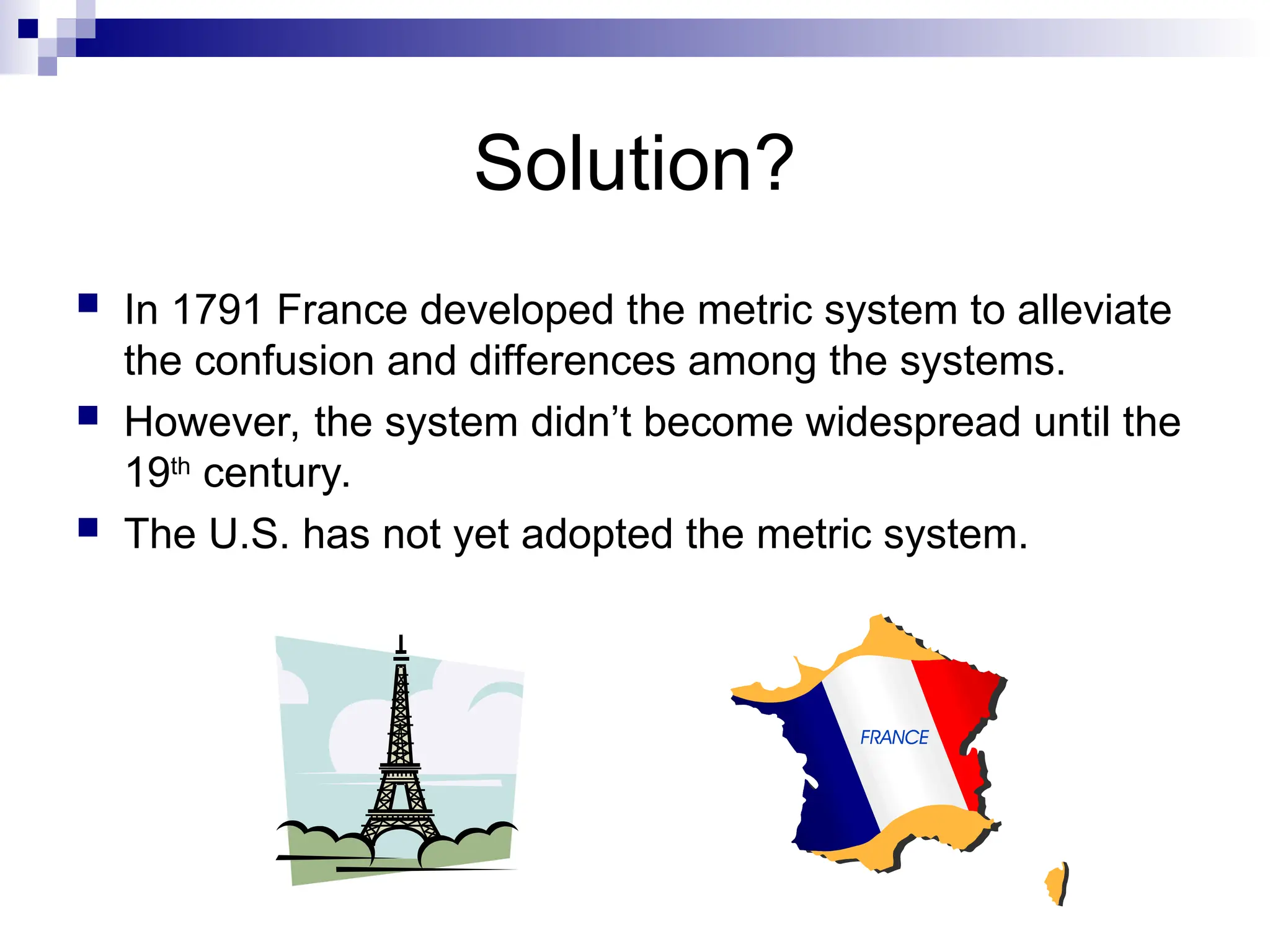
 In 1791 France developed the metric system to alleviate
the confusion and differences among the systems.
 However, the system didn’t become widespread until the
19th
century.
 The U.S. has not yet adopted the metric system.
The SI System
The SI System
 To keep track of conversions between all
the different systems, the SI system was
created.
The SI System
The SI System
 All systems of weights and measures are linked
through the International System of Units.
 It’s called the SI system from the French term
Système International d'Unités.
 The SI system has an
approved set of prefixes and
base units that are the same
all over the world.
Base SI Units
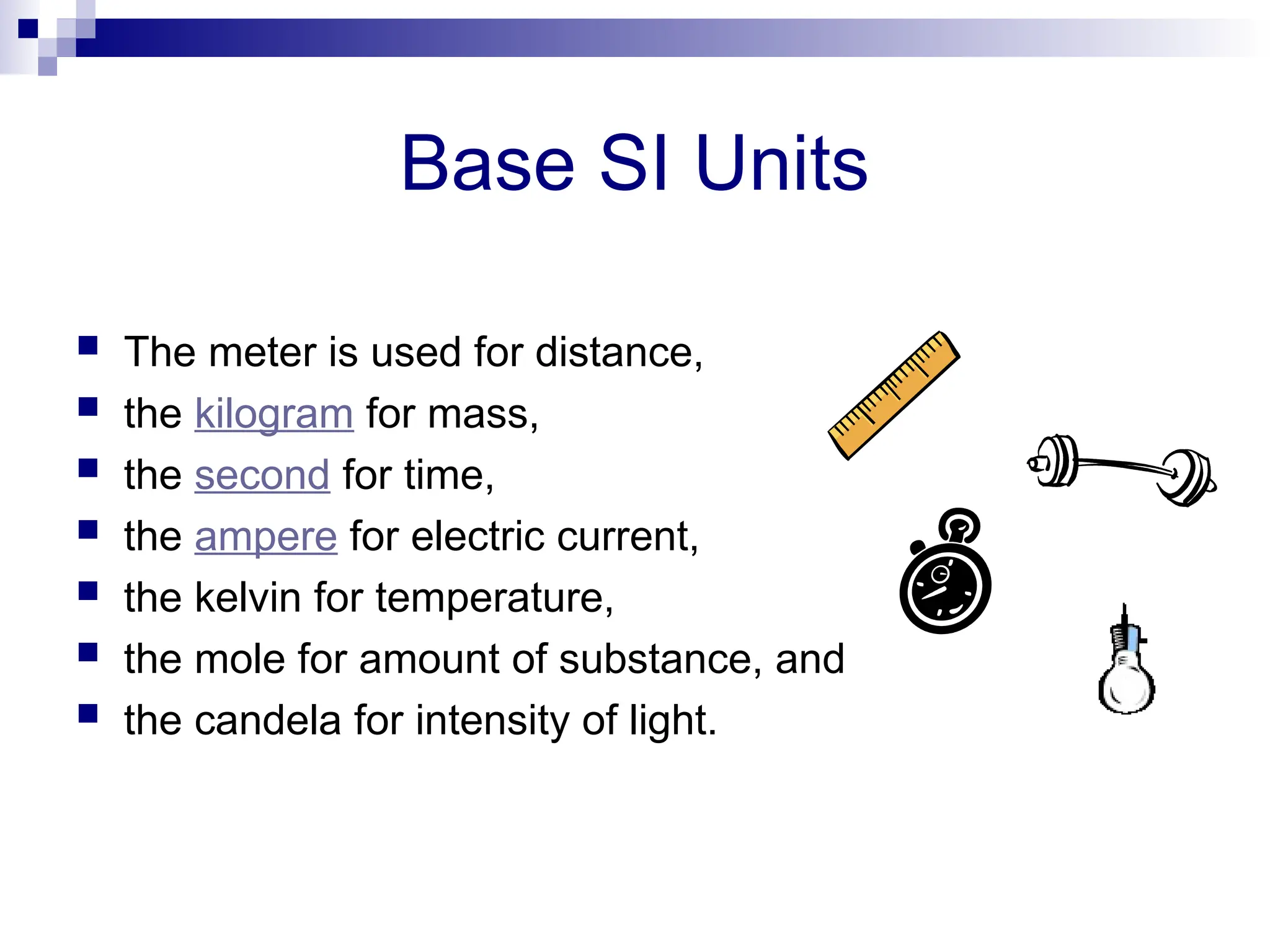
 The meter is used for distance,
 the kilogram for mass,
 the second for time,
 the ampere for electric current,
 the kelvin for temperature,
 the mole for amount of substance, and
 the candela for intensity of light.
Derivation of the Base SI Units
 The meter is defined as one ten-millionth of the distance
from the Equator to the North Pole.
 Also, the kilogram was designated as the weight of one
liter of water.
 Of course these are very difficult to measure, so the
French were a little off.
SI Prefixes
giga- (G-)109
billion
mega- (M-)106
million
kilo- (k-)103
thousand
hecto- (h-)102
hundred
deka- (da-) 101
ten
(base unit)
deci- (d-)10-1
tenth
centi- (c-)10-2
hundredth
milli- (m-)10-3
thousandth
micro- (µ-)10-6
millionth
nano- (n-)10-9
billionth
 If you combine the prefix and the base
unit, you get the complete unit.
Examples:
decigram, kilometer, millisecond
Conversions
 To convert from one unit to another, you
must pay attention to the prefixes.
 The simplest way to convert is to convert
back to the base unit first, and then go to
the desired unit.
 See the next page for an example.
Proceed to activities/worksheets

Metric-System of Measurements - Grade 7.ppt

  • 1.
    The Metric System TheLanguage of Science
  • 2.
    Origins of theMetric System  Before the 17th century, the systems of weights and measures in Europe were very confusing.  Units of length, land area, and weight varied from region to region.
  • 3.
    Solution?  In 1791France developed the metric system to alleviate the confusion and differences among the systems.  However, the system didn’t become widespread until the 19th century.  The U.S. has not yet adopted the metric system.
  • 4.
    The SI System TheSI System  To keep track of conversions between all the different systems, the SI system was created.
  • 5.
    The SI System TheSI System  All systems of weights and measures are linked through the International System of Units.  It’s called the SI system from the French term Système International d'Unités.  The SI system has an approved set of prefixes and base units that are the same all over the world.
  • 6.
    Base SI Units The meter is used for distance,  the kilogram for mass,  the second for time,  the ampere for electric current,  the kelvin for temperature,  the mole for amount of substance, and  the candela for intensity of light.
  • 7.
    Derivation of theBase SI Units  The meter is defined as one ten-millionth of the distance from the Equator to the North Pole.  Also, the kilogram was designated as the weight of one liter of water.  Of course these are very difficult to measure, so the French were a little off.
  • 8.
    SI Prefixes giga- (G-)109 billion mega-(M-)106 million kilo- (k-)103 thousand hecto- (h-)102 hundred deka- (da-) 101 ten (base unit) deci- (d-)10-1 tenth centi- (c-)10-2 hundredth milli- (m-)10-3 thousandth micro- (µ-)10-6 millionth nano- (n-)10-9 billionth
  • 9.
     If youcombine the prefix and the base unit, you get the complete unit. Examples: decigram, kilometer, millisecond
  • 10.
    Conversions  To convertfrom one unit to another, you must pay attention to the prefixes.  The simplest way to convert is to convert back to the base unit first, and then go to the desired unit.  See the next page for an example.
  • 12.

Editor's Notes

  • #3 The US does use the metric system, but it is not the major system.
  • #6 If you don’t feel it is important for them to know about the candela or the ampere, feel free to delete them. The links will take you to a site that I used as a resource while making this presentation. It just provides a definition.
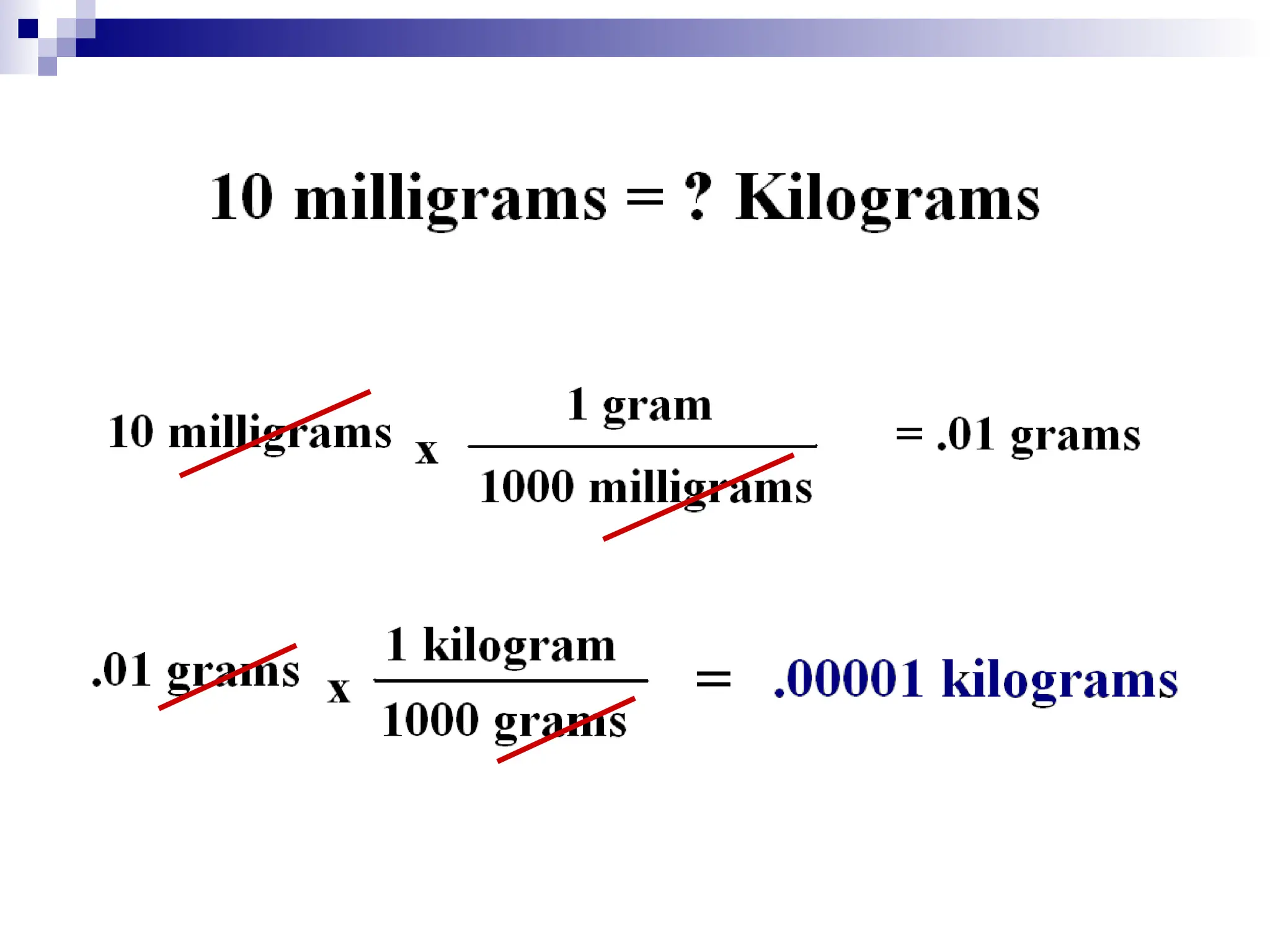
  • #11 First you want to multiply from milligrams and take it back to the base unit, grams. To do this, you want to act as if you are multiplying by one. Since you want to go to grams, put it in the numerator position. You are converting from milligrams, and since 1000 milligrams equals one gram, put 1000 milligrams in the denominator. Make sure to show that the units cancel. This gives you .01 grams. Now you want to take this to kilograms. Use the same method as before, putting kilograms on top and finding out how many grams are in a kilogram (1000) and putting that in the denominator. Once you cancel the units, you will have your answer.
  • #12 This site has a lot of great activities/worksheets: http://sciencespot.net/Pages/classmetric.html I found the following to be really good: http://sciencespot.net/Media/metricchall.pdf http://sciencespot.net/Media/metricmaniapg.pdf http://sciencespot.net/Media/lengthlab.pdf http://www.sciencespot.net/Media/metriccnvsn2.pdf Another good worksheet: http://www.middleschoolscience.com/metricnotes.pdf