The METRIC SYSTEM
& CONVERSIONS
MSJC ~ San Jacinto Campus
Math Center Workshop Series

Janice Levasseur
The Metric System
• The metric system is an internationally
standardized system of units of
measurement.
• The metric system is based on a base
unit and prefixes.
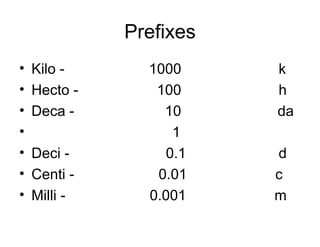
Prefixes
•
•
•
•
•
•
•

Kilo Hecto Deca Deci Centi Milli -

1000
100
10
1
0.1
0.01
0.001

k
h
da
d
c
m
Length
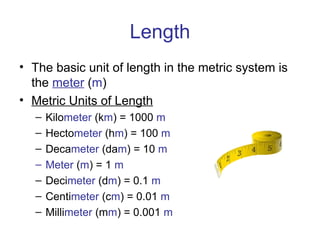
• The basic unit of length in the metric system is
the meter (m)
• Metric Units of Length
–
–
–
–
–
–
–

Kilometer (km) = 1000 m
Hectometer (hm) = 100 m
Decameter (dam) = 10 m
Meter (m) = 1 m
Decimeter (dm) = 0.1 m
Centimeter (cm) = 0.01 m
Millimeter (mm) = 0.001 m
Mass
• Weight is a measure of how strongly
gravity is pulling on an object (decreases
as elevation increases)
• Mass is the amount of material in an
object (doesn’t change)
• Note: on Earth, weight and mass are
used interchangeably
Mass
• The basic unit of mass in the metric system is a
gram (g)
• 1 g = mass of water in a cube that measures 1
cm x 1 cm x 1cm
• Metric Units of Mass
–
–
–
–
–
–
–

Kilogram (kg) = 1000 g
Hectogram (hg) = 100 g
Decagram (dag) = 10 g
Gram (g) = 1 g
Decigram (dg) = 0.1 g
Centigram (cg) = 0.01 g
Milligram (mg) = 0.001 g
Capacity
• Liquid substances are measured in units of capacity.
• The basic unit of mass in the metric system is a liter (L)
• 1 L = capacity of a cube that measures 10 cm x 10 cm
x 10 cm
• Metric Units of Capacity
–
–
–
–
–
–
–

Kiloliter (kL) = 1000 L
Hectoliter (hL) = 100 L
Decaliter (daL) = 10 L
Liter (L) = 1 L
Deciliter (dL) = 0.1 L
Centiliter (cL) = 0.01 L
Milliliter (mL) = 0.001 L
Conversions within the Metric
System
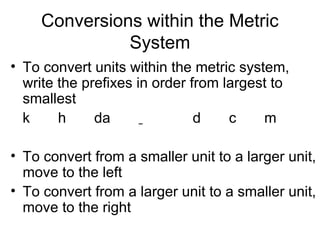
• To convert units within the metric system,
write the prefixes in order from largest to
smallest
k
h
da
d
c
m
• To convert from a smaller unit to a larger unit,
move to the left
• To convert from a larger unit to a smaller unit,
move to the right
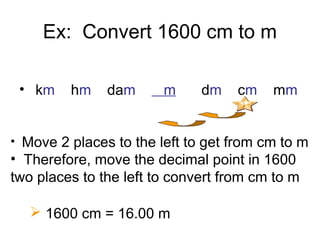
Ex: Convert 1600 cm to m
• km

hm

dam

m

dm

cm

mm

• Move 2 places to the left to get from cm to m

• Therefore, move the decimal point in 1600
two places to the left to convert from cm to m
 1600 cm = 16.00 m
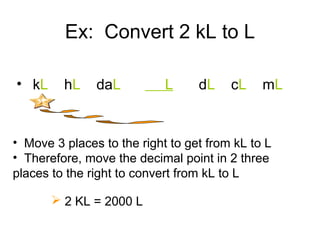
Ex: Convert 2 kL to L
• kL

hL

daL

L

dL

cL

mL

• Move 3 places to the right to get from kL to L
• Therefore, move the decimal point in 2 three
places to the right to convert from kL to L
 2 KL = 2000 L
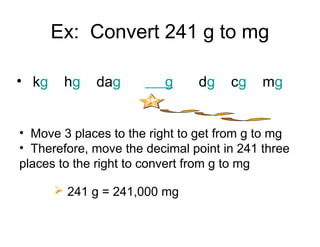
Ex: Convert 241 g to mg
• kg

hg

dag

g

dg

cg

mg

• Move 3 places to the right to get from g to mg
• Therefore, move the decimal point in 241 three
places to the right to convert from g to mg
 241 g = 241,000 mg
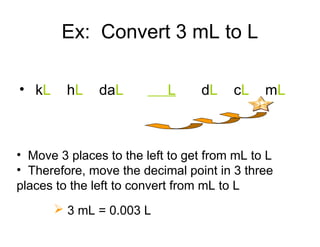
Ex: Convert 3 mL to L
• kL

hL

daL

L

dL

cL

mL

• Move 3 places to the left to get from mL to L
• Therefore, move the decimal point in 3 three
places to the left to convert from mL to L
 3 mL = 0.003 L
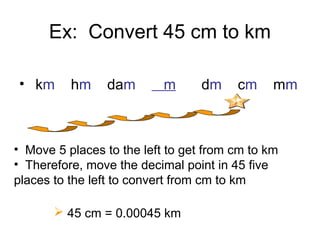
Ex: Convert 45 cm to km
• km

hm

dam

m

dm

cm

mm

• Move 5 places to the left to get from cm to km
• Therefore, move the decimal point in 45 five
places to the left to convert from cm to km
 45 cm = 0.00045 km
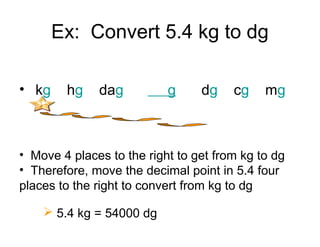
Ex: Convert 5.4 kg to dg
• kg

hg

dag

g

dg

cg

mg

• Move 4 places to the right to get from kg to dg
• Therefore, move the decimal point in 5.4 four
places to the right to convert from kg to dg
 5.4 kg = 54000 dg

Powerpoint presentation measurements

  • 1.
    The METRIC SYSTEM &CONVERSIONS MSJC ~ San Jacinto Campus Math Center Workshop Series Janice Levasseur
  • 2.
    The Metric System •The metric system is an internationally standardized system of units of measurement. • The metric system is based on a base unit and prefixes.
  • 3.
    Prefixes • • • • • • • Kilo Hecto DecaDeci Centi Milli - 1000 100 10 1 0.1 0.01 0.001 k h da d c m
  • 4.
    Length • The basicunit of length in the metric system is the meter (m) • Metric Units of Length – – – – – – – Kilometer (km) = 1000 m Hectometer (hm) = 100 m Decameter (dam) = 10 m Meter (m) = 1 m Decimeter (dm) = 0.1 m Centimeter (cm) = 0.01 m Millimeter (mm) = 0.001 m
  • 5.
    Mass • Weight isa measure of how strongly gravity is pulling on an object (decreases as elevation increases) • Mass is the amount of material in an object (doesn’t change) • Note: on Earth, weight and mass are used interchangeably
  • 6.
    Mass • The basicunit of mass in the metric system is a gram (g) • 1 g = mass of water in a cube that measures 1 cm x 1 cm x 1cm • Metric Units of Mass – – – – – – – Kilogram (kg) = 1000 g Hectogram (hg) = 100 g Decagram (dag) = 10 g Gram (g) = 1 g Decigram (dg) = 0.1 g Centigram (cg) = 0.01 g Milligram (mg) = 0.001 g
  • 7.
    Capacity • Liquid substancesare measured in units of capacity. • The basic unit of mass in the metric system is a liter (L) • 1 L = capacity of a cube that measures 10 cm x 10 cm x 10 cm • Metric Units of Capacity – – – – – – – Kiloliter (kL) = 1000 L Hectoliter (hL) = 100 L Decaliter (daL) = 10 L Liter (L) = 1 L Deciliter (dL) = 0.1 L Centiliter (cL) = 0.01 L Milliliter (mL) = 0.001 L
  • 8.
    Conversions within theMetric System • To convert units within the metric system, write the prefixes in order from largest to smallest k h da d c m • To convert from a smaller unit to a larger unit, move to the left • To convert from a larger unit to a smaller unit, move to the right
  • 9.
    Ex: Convert 1600cm to m • km hm dam m dm cm mm • Move 2 places to the left to get from cm to m • Therefore, move the decimal point in 1600 two places to the left to convert from cm to m  1600 cm = 16.00 m
  • 10.
    Ex: Convert 2kL to L • kL hL daL L dL cL mL • Move 3 places to the right to get from kL to L • Therefore, move the decimal point in 2 three places to the right to convert from kL to L  2 KL = 2000 L
  • 11.
    Ex: Convert 241g to mg • kg hg dag g dg cg mg • Move 3 places to the right to get from g to mg • Therefore, move the decimal point in 241 three places to the right to convert from g to mg  241 g = 241,000 mg
  • 12.
    Ex: Convert 3mL to L • kL hL daL L dL cL mL • Move 3 places to the left to get from mL to L • Therefore, move the decimal point in 3 three places to the left to convert from mL to L  3 mL = 0.003 L
  • 13.
    Ex: Convert 45cm to km • km hm dam m dm cm mm • Move 5 places to the left to get from cm to km • Therefore, move the decimal point in 45 five places to the left to convert from cm to km  45 cm = 0.00045 km
  • 14.
    Ex: Convert 5.4kg to dg • kg hg dag g dg cg mg • Move 4 places to the right to get from kg to dg • Therefore, move the decimal point in 5.4 four places to the right to convert from kg to dg  5.4 kg = 54000 dg