Innovations in Teaching Learning:
Teaching Process and Methods of Teaching
Presented by
Prof. Suwarna Mahesh Patil
(DSM, M. A. (English/History), M. Ed., SET
A)Teaching Process
Concept ofTeaching:
“Teaching includes all activities of providing education to other and it
concerned with the activities of guidance”.
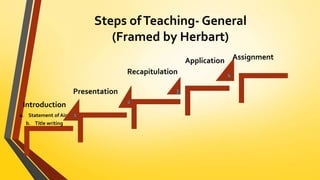
Steps ofTeaching- General
(Framed by Herbart)
Introduction
a. Statement of Aim
b. Title writing
1
Presentation
2
Recapitulation
3
Application
4
Assignment
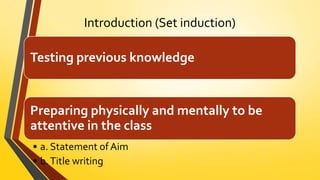
Introduction (Set induction)
Testing previous knowledge
Preparing physically and mentally to be
attentive in the class
• a. Statement of Aim
• b.Title writing
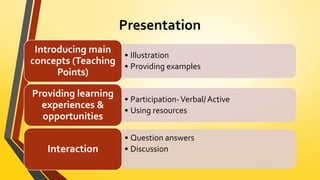
Presentation
• Illustration
• Providing examples
Introducing main
concepts (Teaching
Points)
• Participation-Verbal/Active
• Using resources
Providing learning
experiences &
opportunities
• Question answers
• DiscussionInteraction
Recapitulation
1.Testing acquired knowledge with the help of
content based questions.
2.Few questions should be based on Knowledge and
few must be on comprehension.
3.It’s an overall conclusion whether the objectives are
fulfilled or not.
4.It should be done at the end of the every task
(Lecture).
Application
• It is the testing of ability whether the student can apply acquired
knowledge in the subject, to solve the problems/questions, to
resolve the condition or to use it in daily life.
• Learning means not just storing the knowledge , it is applying the
knowledge in concerned area.
Assignment
•It is an important step of scientific teaching.
•Here some important task should be given to do at home
related to the taught topic.
•This task should be based on skill.
•Example: Report writing, small project, sketching
diagrams, collecting information etc.
Methods ofTeaching
• Method: A method is an instrument and should be regarded as
such. It should play the role of a willing servant rather than of a
tyrannical master.
• A method determines what and how much is taught, the order in
which it is taught, how the meaning and form are conveyed and
what is done to make the use of the language unconscious.
• The term method includes selection and gradation of the material
to be taught.
Selecting an Appropriate Method
• Selection of the Method: The choice of a suitable method by a teacher
depends upon many factors such as the learner, the nature of the subject
and the topic, the facilities available and above all the attitudes of the
teacher.
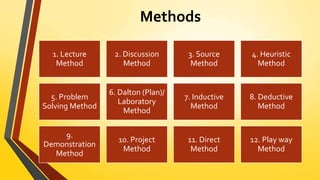
Methods
1. Lecture
Method
2. Discussion
Method
3. Source
Method
4. Heuristic
Method
5. Problem
Solving Method
6. Dalton (Plan)/
Laboratory
Method
7. Inductive
Method
8. Deductive
Method
9.
Demonstration
Method
10. Project
Method
11. Direct
Method
12. Play way
Method
Methods to teach
Languages/Communication Skills
GrammarTranslation Method
Direct Method
Dr. West’s Reading Method
Substitution Method
Eclectic Method
Bilingual Method
GrammarTranslation Method
• It is an Old method . This method has no psychological basis but has
philosophical basis. i.e. A foreign language can be easily learnt through
translation.
• “Under the translation method, the meaning of English Words, phrases and
sentences is taught by means of word translation into the mother-tongue”.
• It is also called asTranslation method.
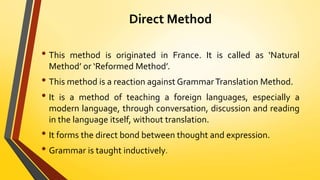
Direct Method
• This method is originated in France. It is called as ‘Natural
Method’ or ‘Reformed Method’.
• This method is a reaction against GrammarTranslation Method.
• It is a method of teaching a foreign languages, especially a
modern language, through conversation, discussion and reading
in the language itself, without translation.
• It forms the direct bond between thought and expression.
• Grammar is taught inductively.
Dr. West’s Reading Method
•‘The bilingual child does not so much need to
speak his second language (English) but rather to
read it.’
•This method lays more emphasis on the
development of reading abilities, improvement of
vocabulary.
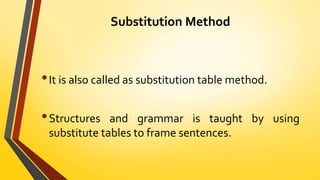
Substitution Method
•It is also called as substitution table method.
•Structures and grammar is taught by using
substitute tables to frame sentences.
Bilingual Method
•Learning of language with the help of two languages
simultaneously .
•Translation is not required here.
•Substitute words are used to get the most appropriate
meaning.
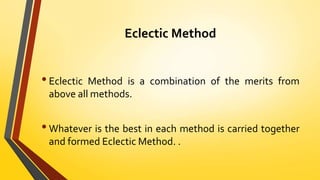
Eclectic Method
•Eclectic Method is a combination of the merits from
above all methods.
•Whatever is the best in each method is carried together
and formed Eclectic Method. .
Methods to teach other Subjects
Lecture Method
Discussion Method
Project Method
Excursion Method
Heuristic Method
Problem solving Method
Dalton/Laboratory
Inductive & Deductive Method
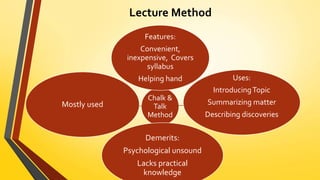
Lecture Method
Chalk &
Talk
Method
Features:
Convenient,
inexpensive, Covers
syllabus
Helping hand Uses:
IntroducingTopic
Summarizing matter
Describing discoveries
Demerits:
Psychological unsound
Lacks practical
knowledge
Mostly used
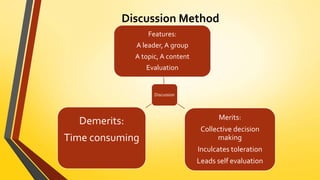
Discussion Method
Discussion
Features:
A leader, A group
A topic, A content
Evaluation
Merits:
Collective decision
making
Inculcates toleration
Leads self evaluation
Demerits:
Time consuming
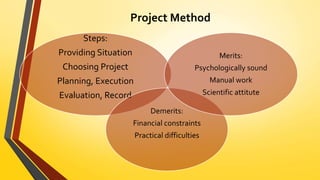
Project Method
Steps:
Providing Situation
Choosing Project
Planning, Execution
Evaluation, Record
Demerits:
Financial constraints
Practical difficulties
Merits:
Psychologically sound
Manual work
Scientific attitute
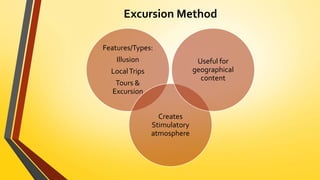
Excursion Method
Features/Types:
Illusion
LocalTrips
Tours &
Excursion
Creates
Stimulatory
atmosphere
Useful for
geographical
content
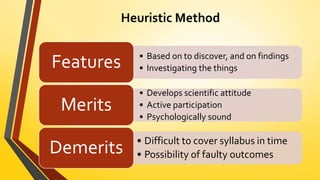
Heuristic Method
• Based on to discover, and on findings
• Investigating the thingsFeatures
• Develops scientific attitude
• Active participation
• Psychologically sound
Merits
• Difficult to cover syllabus in time
• Possibility of faulty outcomesDemerits
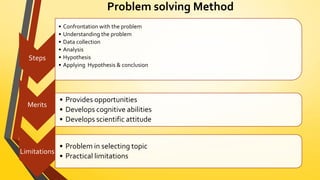
Problem solving Method
Steps
• Confrontation with the problem
• Understanding the problem
• Data collection
• Analysis
• Hypothesis
• Applying Hypothesis & conclusion
Merits
• Provides opportunities
• Develops cognitive abilities
• Develops scientific attitude
Limitations
• Problem in selecting topic
• Practical limitations
Dalton/Laboratory
• Features :
1. Experiments ca be performed in the laboratory.
2. Teacher only act as guide.
3. Student handle apparatus in presence of a teacher.
• Merits:
1. Learning by doing
2. Make discoveries
3. Builds confidence & self-reliance
• Limitations:
1. Time consuming
2. Ill equipped laboratories
Inductive & Deductive Method
• Inductive Method: Proceeds from examples to rule
• Deductive Method:Vice versa
Teaching process & Methods  of Teaching

Teaching process & Methods of Teaching

  • 1.
    Innovations in TeachingLearning: Teaching Process and Methods of Teaching Presented by Prof. Suwarna Mahesh Patil (DSM, M. A. (English/History), M. Ed., SET
  • 2.
    A)Teaching Process Concept ofTeaching: “Teachingincludes all activities of providing education to other and it concerned with the activities of guidance”.
  • 3.
    Steps ofTeaching- General (Framedby Herbart) Introduction a. Statement of Aim b. Title writing 1 Presentation 2 Recapitulation 3 Application 4 Assignment
  • 4.
    Introduction (Set induction) Testingprevious knowledge Preparing physically and mentally to be attentive in the class • a. Statement of Aim • b.Title writing
  • 5.
    Presentation • Illustration • Providingexamples Introducing main concepts (Teaching Points) • Participation-Verbal/Active • Using resources Providing learning experiences & opportunities • Question answers • DiscussionInteraction
  • 6.
    Recapitulation 1.Testing acquired knowledgewith the help of content based questions. 2.Few questions should be based on Knowledge and few must be on comprehension. 3.It’s an overall conclusion whether the objectives are fulfilled or not. 4.It should be done at the end of the every task (Lecture).
  • 7.
    Application • It isthe testing of ability whether the student can apply acquired knowledge in the subject, to solve the problems/questions, to resolve the condition or to use it in daily life. • Learning means not just storing the knowledge , it is applying the knowledge in concerned area.
  • 8.
    Assignment •It is animportant step of scientific teaching. •Here some important task should be given to do at home related to the taught topic. •This task should be based on skill. •Example: Report writing, small project, sketching diagrams, collecting information etc.
  • 9.
    Methods ofTeaching • Method:A method is an instrument and should be regarded as such. It should play the role of a willing servant rather than of a tyrannical master. • A method determines what and how much is taught, the order in which it is taught, how the meaning and form are conveyed and what is done to make the use of the language unconscious. • The term method includes selection and gradation of the material to be taught.
  • 10.
    Selecting an AppropriateMethod • Selection of the Method: The choice of a suitable method by a teacher depends upon many factors such as the learner, the nature of the subject and the topic, the facilities available and above all the attitudes of the teacher.
  • 11.
    Methods 1. Lecture Method 2. Discussion Method 3.Source Method 4. Heuristic Method 5. Problem Solving Method 6. Dalton (Plan)/ Laboratory Method 7. Inductive Method 8. Deductive Method 9. Demonstration Method 10. Project Method 11. Direct Method 12. Play way Method
  • 12.
    Methods to teach Languages/CommunicationSkills GrammarTranslation Method Direct Method Dr. West’s Reading Method Substitution Method Eclectic Method Bilingual Method
  • 13.
    GrammarTranslation Method • Itis an Old method . This method has no psychological basis but has philosophical basis. i.e. A foreign language can be easily learnt through translation. • “Under the translation method, the meaning of English Words, phrases and sentences is taught by means of word translation into the mother-tongue”. • It is also called asTranslation method.
  • 14.
    Direct Method • Thismethod is originated in France. It is called as ‘Natural Method’ or ‘Reformed Method’. • This method is a reaction against GrammarTranslation Method. • It is a method of teaching a foreign languages, especially a modern language, through conversation, discussion and reading in the language itself, without translation. • It forms the direct bond between thought and expression. • Grammar is taught inductively.
  • 15.
    Dr. West’s ReadingMethod •‘The bilingual child does not so much need to speak his second language (English) but rather to read it.’ •This method lays more emphasis on the development of reading abilities, improvement of vocabulary.
  • 16.
    Substitution Method •It isalso called as substitution table method. •Structures and grammar is taught by using substitute tables to frame sentences.
  • 17.
    Bilingual Method •Learning oflanguage with the help of two languages simultaneously . •Translation is not required here. •Substitute words are used to get the most appropriate meaning.
  • 18.
    Eclectic Method •Eclectic Methodis a combination of the merits from above all methods. •Whatever is the best in each method is carried together and formed Eclectic Method. .
  • 19.
    Methods to teachother Subjects Lecture Method Discussion Method Project Method Excursion Method Heuristic Method Problem solving Method Dalton/Laboratory Inductive & Deductive Method
  • 20.
    Lecture Method Chalk & Talk Method Features: Convenient, inexpensive,Covers syllabus Helping hand Uses: IntroducingTopic Summarizing matter Describing discoveries Demerits: Psychological unsound Lacks practical knowledge Mostly used
  • 21.
    Discussion Method Discussion Features: A leader,A group A topic, A content Evaluation Merits: Collective decision making Inculcates toleration Leads self evaluation Demerits: Time consuming
  • 22.
    Project Method Steps: Providing Situation ChoosingProject Planning, Execution Evaluation, Record Demerits: Financial constraints Practical difficulties Merits: Psychologically sound Manual work Scientific attitute
  • 23.
  • 24.
    Heuristic Method • Basedon to discover, and on findings • Investigating the thingsFeatures • Develops scientific attitude • Active participation • Psychologically sound Merits • Difficult to cover syllabus in time • Possibility of faulty outcomesDemerits
  • 25.
    Problem solving Method Steps •Confrontation with the problem • Understanding the problem • Data collection • Analysis • Hypothesis • Applying Hypothesis & conclusion Merits • Provides opportunities • Develops cognitive abilities • Develops scientific attitude Limitations • Problem in selecting topic • Practical limitations
  • 26.
    Dalton/Laboratory • Features : 1.Experiments ca be performed in the laboratory. 2. Teacher only act as guide. 3. Student handle apparatus in presence of a teacher. • Merits: 1. Learning by doing 2. Make discoveries 3. Builds confidence & self-reliance • Limitations: 1. Time consuming 2. Ill equipped laboratories
  • 27.
    Inductive & DeductiveMethod • Inductive Method: Proceeds from examples to rule • Deductive Method:Vice versa