Methacholine
Challenge Test
Presented By:Marij Noor
Table of Contents
Results Analysis
Introduction Test Mechanism
Limitations
01
03
02
04
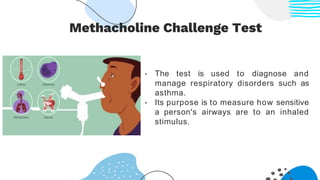
• The test is used to diagnose and
manage respiratory disorders such as
asthma.
• Its purpose is to measure how sensitive
a person's airways are to an inhaled
stimulus.
Methacholine Challenge Test
Mechanism
• It involves the administration of methacholine, a synthetic cholinergic
agonist, via inhalation to provoke a temporary narrowing of the airways
in order to evaluate the presence and severity of bronchial
hyperresponsiveness.
• Methacholine acts on specific receptors known as muscarinic
receptors, particularly the M3 receptors, which are abundantly present
in the smooth muscle of the airways. When inhaled, methacholine
stimulates these receptors, causing smooth muscle contraction and
resulting in airway narrowing.
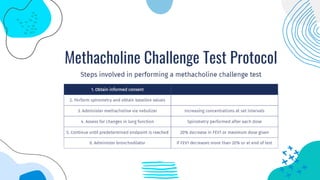
• The MCT typically follows a standardized protocol involving
incremental dosages of methacholine. The initial doses are relatively
low, and the concentration is gradually increased until a predetermined
endpoint is reached. The endpoint is defined by a clinically significant
decrease in lung function parameters or a specific level of airway
responsiveness.
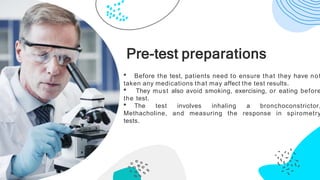
• Before the test, patients need to ensure that they have not
taken any medications that may affect the test results.
• They must also avoid smoking, exercising, or eating before
the test.
• The test involves inhaling a bronchoconstrictor,
Methacholine, and measuring the response in spirometry
tests.
Pre-test preparations
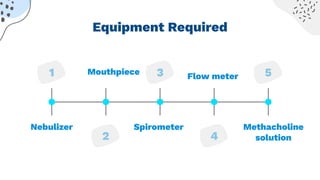
Equipment Required
Mouthpiece
Nebulizer Methacholine
solution
Flow meter
Spirometer
1 3 5
2 4
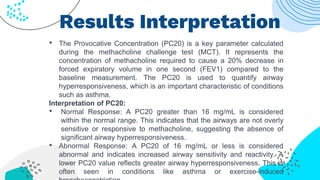
Results Interpretation
• The Provocative Concentration (PC20) is a key parameter calculated
during the methacholine challenge test (MCT). It represents the
concentration of methacholine required to cause a 20% decrease in
forced expiratory volume in one second (FEV1) compared to the
baseline measurement. The PC20 is used to quantify airway
hyperresponsiveness, which is an important characteristic of conditions
such as asthma.
Interpretation of PC20:
• Normal Response: A PC20 greater than 16 mg/mL is considered
within the normal range. This indicates that the airways are not overly
sensitive or responsive to methacholine, suggesting the absence of
significant airway hyperresponsiveness.
• Abnormal Response: A PC20 of 16 mg/mL or less is considered
abnormal and indicates increased airway sensitivity and reactivity. A
lower PC20 value reflects greater airway hyperresponsiveness. This is
often seen in conditions like asthma or exercise-induced
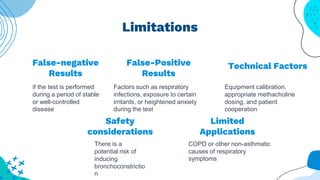
False-negative
Results
Equipment calibration,
appropriate methacholine
dosing, and patient
cooperation
There is a
potential risk of
inducing
bronchoconstrictio
n
Limitations
if the test is performed
during a period of stable
or well-controlled
disease
Technical Factors
Safety
considerations
False-Positive
Results
Factors such as respiratory
infections, exposure to certain
irritants, or heightened anxiety
during the test
Limited
Applications
COPD or other non-asthmatic
causes of respiratory
symptoms
Thank you

methacholine challenge.pptx

  • 1.
  • 2.
    Table of Contents ResultsAnalysis Introduction Test Mechanism Limitations 01 03 02 04
  • 3.
    • The testis used to diagnose and manage respiratory disorders such as asthma. • Its purpose is to measure how sensitive a person's airways are to an inhaled stimulus. Methacholine Challenge Test
  • 5.
    Mechanism • It involvesthe administration of methacholine, a synthetic cholinergic agonist, via inhalation to provoke a temporary narrowing of the airways in order to evaluate the presence and severity of bronchial hyperresponsiveness. • Methacholine acts on specific receptors known as muscarinic receptors, particularly the M3 receptors, which are abundantly present in the smooth muscle of the airways. When inhaled, methacholine stimulates these receptors, causing smooth muscle contraction and resulting in airway narrowing. • The MCT typically follows a standardized protocol involving incremental dosages of methacholine. The initial doses are relatively low, and the concentration is gradually increased until a predetermined endpoint is reached. The endpoint is defined by a clinically significant decrease in lung function parameters or a specific level of airway responsiveness.
  • 6.
    • Before thetest, patients need to ensure that they have not taken any medications that may affect the test results. • They must also avoid smoking, exercising, or eating before the test. • The test involves inhaling a bronchoconstrictor, Methacholine, and measuring the response in spirometry tests. Pre-test preparations
  • 7.
  • 9.
    Results Interpretation • TheProvocative Concentration (PC20) is a key parameter calculated during the methacholine challenge test (MCT). It represents the concentration of methacholine required to cause a 20% decrease in forced expiratory volume in one second (FEV1) compared to the baseline measurement. The PC20 is used to quantify airway hyperresponsiveness, which is an important characteristic of conditions such as asthma. Interpretation of PC20: • Normal Response: A PC20 greater than 16 mg/mL is considered within the normal range. This indicates that the airways are not overly sensitive or responsive to methacholine, suggesting the absence of significant airway hyperresponsiveness. • Abnormal Response: A PC20 of 16 mg/mL or less is considered abnormal and indicates increased airway sensitivity and reactivity. A lower PC20 value reflects greater airway hyperresponsiveness. This is often seen in conditions like asthma or exercise-induced
  • 10.
    False-negative Results Equipment calibration, appropriate methacholine dosing,and patient cooperation There is a potential risk of inducing bronchoconstrictio n Limitations if the test is performed during a period of stable or well-controlled disease Technical Factors Safety considerations False-Positive Results Factors such as respiratory infections, exposure to certain irritants, or heightened anxiety during the test Limited Applications COPD or other non-asthmatic causes of respiratory symptoms
  • 11.