Kristopher R. Maday, MS, PA-C
University of Tennessee Health Science Center
Physician Assistant Program
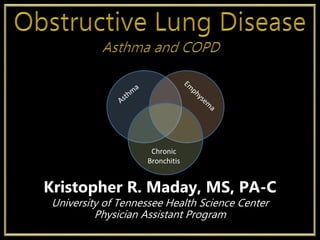
Chronic
Bronchitis
Greek: noisy breathing, panting
• Very common disease
– Affects approximately 7-10% of the
population
– More common in male children and female
adults
• (+) genetic predisposition
• Prevalence, hospitalizations, and fatal
asthma exacerbations have all increased in
the past 20 years
– 500,000 hospitalizations each year
– 4500 deaths each year
http://www.aaaai.org/about-the-aaaai/newsroom/asthma-statistics.aspx
• Risk Factors
– Atopy
• Hypersensitivity to IgE release
– Obesity
• Precipitants
– Inhaled allergens
• House dust mites, cockroaches, cat dander, seasonal
pollens
– Exercise
– Upper respiratory tract infection
– Tobacco smoke
– Occupational exposures
– GERD
National Asthma Education and Prevention Program: Expert Panel Report III (EPR-3) - 2007
• Upper Airway Disorders
– Vocal cord paralysis, vocal cord dysfunction, foreign
body aspiration, laryngotracheal masses, tracheal
narrowing, tracheomalacia, airway edema
• Lower Airway Disorders
– Non-asthmatic COPD, bronchiectasis, cystic fibrosis,
bronchopulmonary dysplasia
• Systemic Vasculitides
– Churge-Strauss, Wegeners granulomatosis
• Psychiatric
– Conversion disorders, emotional laryngeal wheezing
• GERD
National Asthma Education and Prevention Program: Expert Panel Report III (EPR-3) - 2007
• Focused history is paramount
– Physical exam is relatively insensitive
– Most patients report episodic wheezing,
dyspnea, chest tightness, productive cough at
some point
– Frequency of these symptoms are highly
variable
– History of rashes
– History of allergies
– History of activity limitations
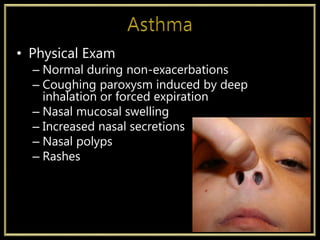
• Physical Exam
– Normal during non-exacerbations
– Coughing paroxysm induced by deep
inhalation or forced expiration
– Nasal mucosal swelling
– Increased nasal secretions
– Nasal polyps
– Rashes
• Physical Exam during exacerbation
– Tachypnea and tachycardia are ubiquitous
• 25% may have RR > 30 and HR > 130
– Diffuse musical wheezes
• Begins when peak flow decreased by 25%
• Presence and intensity does not reliably predict severity
• Greater airway obstruction with:
– Wheezing during both inspiration and expiration
– Audible without stethoscope
– High pitched
– Wheezing is absent
– Prolonged expiratory phase
– Chest hyperinflation
– Accessory muscle use or retractions
Mannam P, Siegel MD. J Intensive Care Med. 2010;25(1):3-15.
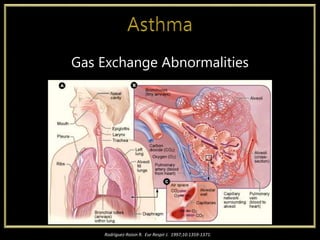
Gas Exchange Abnormalities
Rodriguez-Roisin R. Eur Respir J. 1997;10:1359-1371.
• Pulmonary Function Testing
– 2 reasons for testing
• Assess severity
• Assess reversibility
– Spirometry
• Measured before and 20 minutes after bronchodilator
• Measurements
– Forced Expiratory Volume in 1 second (FEV1)
» Increase by 12% and 200mL
– Forced Vital Capacity (FVC)
» Increase by 15% and 200mL
– Peak Expiratory Flow
• Diurnal variation > 20% supports asthma diagnosis
National Asthma Education and Prevention Program: Expert Panel Report III (EPR-3) - 2007
• Used in patients with suspected lung
pathology but normal spirometry
measures in the office
• 2 types
– Methacholine challenge
– Exercise challenge
• Exclusion criteria
• Positive test is a reduction of FEV1 > 20%
of baseline
Wilken LA, Joo MJ. Pulmonary Function and Related Tests. In: Basic Skills in Interpreting Laboratory Data. 2009:191-206.
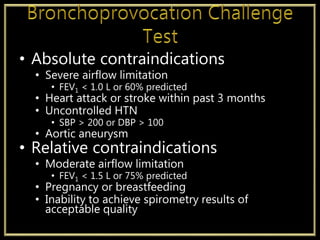
• Absolute contraindications
• Severe airflow limitation
• FEV1 < 1.0 L or 60% predicted
• Heart attack or stroke within past 3 months
• Uncontrolled HTN
• SBP > 200 or DBP > 100
• Aortic aneurysm
• Relative contraindications
• Moderate airflow limitation
• FEV1 < 1.5 L or 75% predicted
• Pregnancy or breastfeeding
• Inability to achieve spirometry results of
acceptable quality
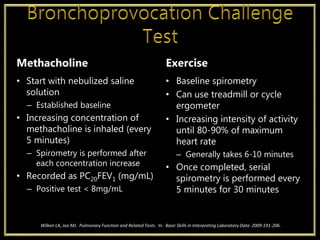
Methacholine
• Start with nebulized saline
solution
– Established baseline
• Increasing concentration of
methacholine is inhaled (every
5 minutes)
– Spirometry is performed after
each concentration increase
• Recorded as PC20FEV1 (mg/mL)
– Positive test < 8mg/mL
Exercise
• Baseline spirometry
• Can use treadmill or cycle
ergometer
• Increasing intensity of activity
until 80-90% of maximum
heart rate
– Generally takes 6-10 minutes
• Once completed, serial
spirometry is performed every
5 minutes for 30 minutes
Wilken LA, Joo MJ. Pulmonary Function and Related Tests. In: Basic Skills in Interpreting Laboratory Data. 2009:191-206.
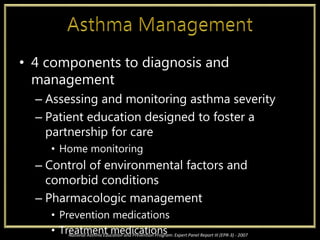
• 4 components to diagnosis and
management
– Assessing and monitoring asthma severity
– Patient education designed to foster a
partnership for care
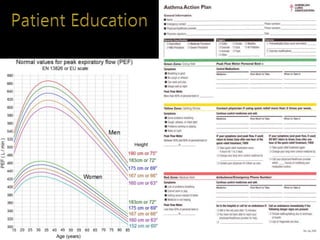
• Home monitoring
– Control of environmental factors and
comorbid conditions
– Pharmacologic management
• Prevention medications
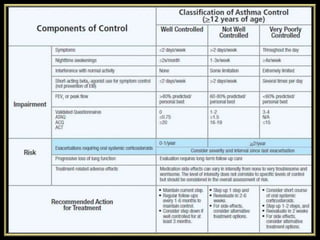
• Treatment medicationsNational Asthma Education and Prevention Program: Expert Panel Report III (EPR-3) - 2007
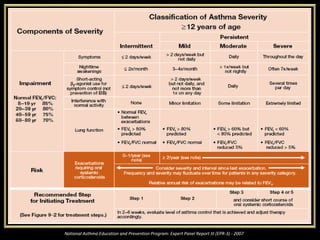
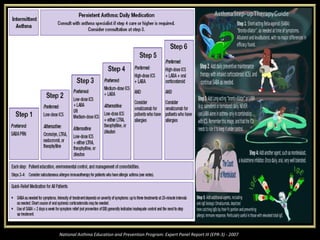
National Asthma Education and Prevention Program: Expert Panel Report III (EPR-3) - 2007
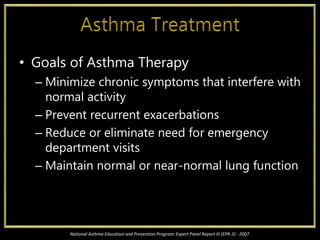
• Goals of Asthma Therapy
– Minimize chronic symptoms that interfere with
normal activity
– Prevent recurrent exacerbations
– Reduce or eliminate need for emergency
department visits
– Maintain normal or near-normal lung function
National Asthma Education and Prevention Program: Expert Panel Report III (EPR-3) - 2007
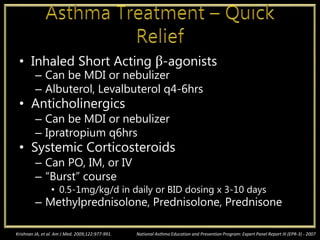
• Inhaled Short Acting β-agonists
– Can be MDI or nebulizer
– Albuterol, Levalbuterol q4-6hrs
• Anticholinergics
– Can be MDI or nebulizer
– Ipratropium q6hrs
• Systemic Corticosteroids
– Can PO, IM, or IV
– “Burst” course
• 0.5-1mg/kg/d in daily or BID dosing x 3-10 days
– Methylprednisolone, Prednisolone, Prednisone
National Asthma Education and Prevention Program: Expert Panel Report III (EPR-3) - 2007Krishnan JA, et al. Am J Med. 2009;122:977-991.
• Anti-Inflammatory Agents
– Inhaled corticosteroids (ICS) preferred
• Beclomethasone, Budesonide, Flunisolide,
Fluticasone, Mometasone
• BID or daily dosing
• Side effects
– Hoarseness, dysphonia, cough, oral candidiasis
National Asthma Education and Prevention Program: Expert Panel Report III (EPR-3) - 2007
• Bronchodilators
– Long Acting β-agonist
• Salmeterol, Formoterol
• BID dosing
• Never used as
monotherapy
– Often combined in MDI
with ICS
– Anticholinergic
• Tiotropium
• Similar response to LABA
– Phosphodiesterase
Inhibitor
• Theophylline
• Narrow therapeutic
window
• Mediator Modulators
– Mast Cell Stabilizer
• Cromolyn, Nedocromil
– Leukotriene Modifier
• Montelukast, Zafirlukast,
Zileuton
– Immunomodulator
• Binds free IgE
• SQ injection q2-4 weeks
• Omalizumab
National Asthma Education and Prevention Program: Expert Panel Report III (EPR-3) - 2007
• Determine severity
• Supplemental oxygen if:
– SaO2 < 95%
– PaO2 < 80 mmHg
• High dose delivery (nebulizer) of:
– Inhaled short acting β-agonist (albuterol)
• Home – 2-4 puffs/1 neb every 20 minutes x 2
• ED/Office - 3 doses in 1 hour or continuous 1 hour treatment
– Anticholinergic (ipratropium)
• Systemic corticosteroids
– 0.5-1mg/kg IM or IV
• Magnesium Sulfate
– 1-2g IV over 30 minutes
Lazarus SC. N Engl J Med. 2010;363:755-764.
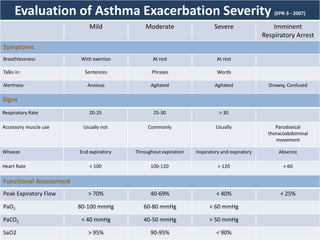
Evaluation of Asthma Exacerbation Severity (EPR-3 - 2007)
Mild Moderate Severe Imminent
Respiratory Arrest
Symptoms
Breathlessness With exertion At rest At rest
Talks in: Sentences Phrases Words
Alertness Anxious Agitated Agitated Drowsy, Confused
Signs
Respiratory Rate 20-25 25-30 > 30
Accessory muscle use Usually not Commonly Usually Parodoxical
thoracoabdominal
movement
Wheeze End expiratory Throughout expiration Inspiratory and expiratory Absence
Heart Rate < 100 100-120 > 120 < 60
Functional Assessment
Peak Expiratory Flow > 70% 40-69% < 40% < 25%
PaO2 80-100 mmHg 60-80 mmHg < 60 mmHg
PaCO2 < 40 mmHg 40-50 mmHg > 50 mmHg
SaO2 > 95% 90-95% < 90%
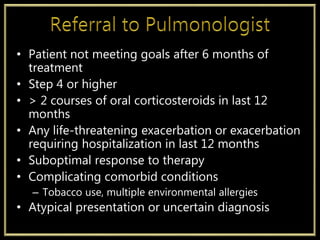
• Patient not meeting goals after 6 months of
treatment
• Step 4 or higher
• > 2 courses of oral corticosteroids in last 12
months
• Any life-threatening exacerbation or exacerbation
requiring hospitalization in last 12 months
• Suboptimal response to therapy
• Complicating comorbid conditions
– Tobacco use, multiple environmental allergies
• Atypical presentation or uncertain diagnosis
Greek: to smoke
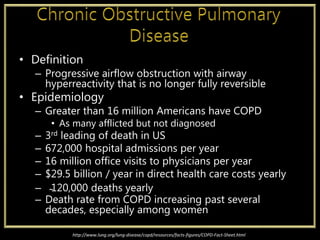
• Definition
– Progressive airflow obstruction with airway
hyperreactivity that is no longer fully reversible
• Epidemiology
– Greater than 16 million Americans have COPD
• As many afflicted but not diagnosed
– 3rd leading of death in US
– 672,000 hospital admissions per year
– 16 million office visits to physicians per year
– $29.5 billion / year in direct health care costs yearly
– ̴120,000 deaths yearly
– Death rate from COPD increasing past several
decades, especially among women
http://www.lung.org/lung-disease/copd/resources/facts-figures/COPD-Fact-Sheet.html
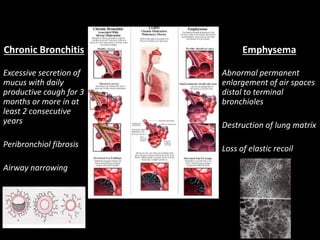
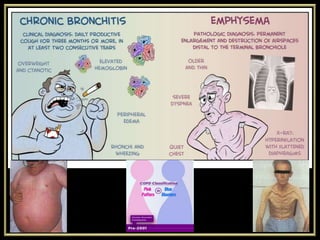
Emphysema
Abnormal permanent
enlargement of air spaces
distal to terminal
bronchioles
Destruction of lung matrix
Loss of elastic recoil
Chronic Bronchitis
Excessive secretion of
mucus with daily
productive cough for 3
months or more in at
least 2 consecutive
years
Peribronchiol fibrosis
Airway narrowing
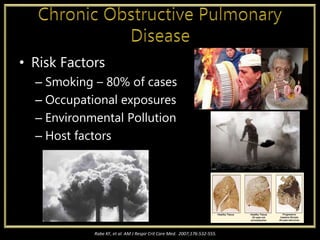
• Risk Factors
– Smoking – 80% of cases
– Occupational exposures
– Environmental Pollution
– Host factors
Rabe KF, et al. AM J Respir Crit Care Med. 2007;176:532-555.
• Signs and Symptoms
– Typically present in 5th and 6th decade
• Though symptoms have been present for up to 10
years prior
– Dyspnea
– Cough
– Sputum production
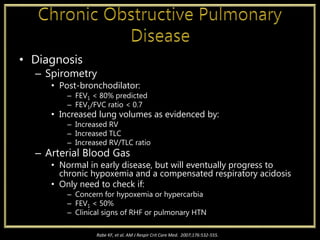
• Diagnosis
– Spirometry
• Post-bronchodilator:
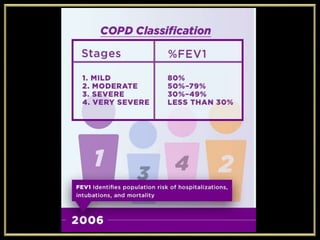
– FEV1 < 80% predicted
– FEV1/FVC ratio < 0.7
• Increased lung volumes as evidenced by:
– Increased RV
– Increased TLC
– Increased RV/TLC ratio
– Arterial Blood Gas
• Normal in early disease, but will eventually progress to
chronic hypoxemia and a compensated respiratory acidosis
• Only need to check if:
– Concern for hypoxemia or hypercarbia
– FEV1 < 50%
– Clinical signs of RHF or pulmonary HTN
Rabe KF, et al. AM J Respir Crit Care Med. 2007;176:532-555.
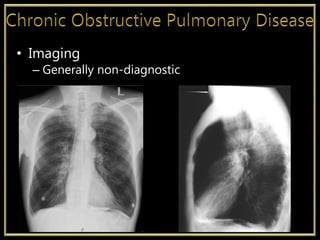
• Imaging
– Generally non-diagnostic
• Treatment
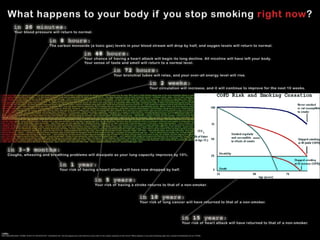
– Stop smoking
– Stop smoking
– Stop smoking
– Supplemental Oxygen
– Medications
– Pulmonary Rehabilitation
– Surgery
• Home Oxygen Therapy
– Only drug therapy that improves the natural history of
COPD
• Increased survival
– After 36 months:
» Continuous – 65% survival
» Nocturnal – 45% survival
• Reduced hospitalization
• Better quality of life
– Medicare Requirements
• PaO2 < 55 mmHg or SaO2 < 88% at rest on room air
• PaO2 56-59 mmHg or SaO2 89% if evidence of:
– Dependent edema
– Pulmonary HTN
– HCT > 56%
Centers for Medicare and Medicaid Services. 1993. 100-3;240.2.Stoller JK, et al. CHEST. 2010;138(1):179-187.
• Medications
– Short-Acting Inhaled Therapy
• Do not alter decline in lung function
• Albuterol - less expensive, faster acting
• Ipratropium – preferred first line
– Longer duration and lack of sympathomimetic effects
– Long Acting Inhaled Therapy
• Triple Inhaler Therapy
Rabe KF, et al. AM J Respir Crit Care Med. 2007;176:532-555.
• Long Acting Beta Agonist (LABA)
– Formoterol, Salmeterol, Oldaterol
• Long Acting Muscarinic Agent (LAMA)
– Tiotropium
• Inhaled Corticosteroid (ICS)
– Budesonide, Beclomethasone, Fluticasone
• Medications
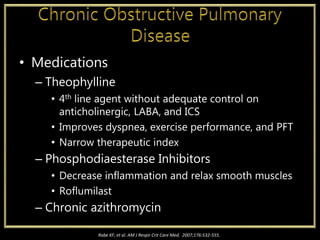
– Theophylline
• 4th line agent without adequate control on
anticholinergic, LABA, and ICS
• Improves dyspnea, exercise performance, and PFT
• Narrow therapeutic index
– Phosphodiaesterase Inhibitors
• Decrease inflammation and relax smooth muscles
• Roflumilast
– Chronic azithromycin
Rabe KF, et al. AM J Respir Crit Care Med. 2007;176:532-555.
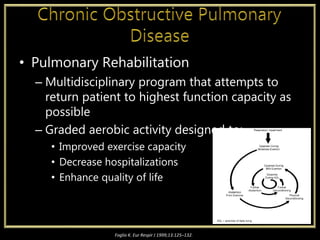
• Pulmonary Rehabilitation
– Multidisciplinary program that attempts to
return patient to highest function capacity as
possible
– Graded aerobic activity designed to:
• Improved exercise capacity
• Decrease hospitalizations
• Enhance quality of life
Foglio K. Eur Respir J 1999;13:125–132.
• Surgery
– Lung Transplantation
• 2 year survival – 75%
• Requirements:
– Severe lung disease, limited ADLs, exhaustion of medical
therapy, adequate other organ function
– Lung Volume Reduction Surgery
• Benefits only a select population
• Bilateral resection of 20-30% of TLV
• Improves functional capacity and exercise
tolerance, but no change in mortality when
compared to medical therapy only
Martinez FJ, Change A. Semin Respir Crit Care Med. 2005;25(2):167-191.
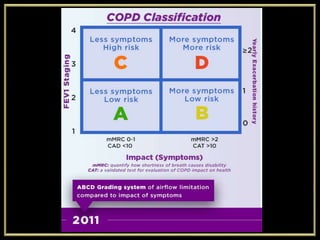
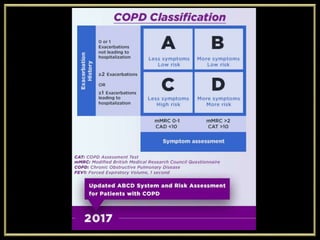
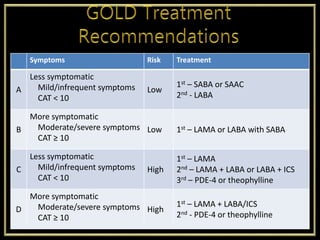
Symptoms Risk Treatment
A
Less symptomatic
Mild/infrequent symptoms
CAT < 10
Low
1st – SABA or SAAC
2nd - LABA
B
More symptomatic
Moderate/severe symptoms
CAT ≥ 10
Low 1st – LAMA or LABA with SABA
C
Less symptomatic
Mild/infrequent symptoms
CAT < 10
High
1st – LAMA
2nd – LAMA + LABA or LABA + ICS
3rd – PDE-4 or theophylline
D
More symptomatic
Moderate/severe symptoms
CAT ≥ 10
High
1st – LAMA + LABA/ICS
2nd - PDE-4 or theophylline
• Often a prodrome of symptoms up to 7
days before the acute exacerbation
– Leads to a sub-acute decrease in lung function
• Causes
– Respiratory infection
• Most frequent cause
• Viral
– More severe symptoms and longer duration
• Bacterial
– S.pneumoniae, H.influenza, M.catarrhalis
– P.aeruginosa more prevalent in advanced stages
Rabe KF, et al. Global Strategy for Diagnosis, Management, and
Prevention of Chronic Obstructive Pulmonary Disease: GOLD Executive
Summary. AM J Respir Crit Care Med. 2007;176:532-555.
• Treatment
– Admission
• Severe symptoms, co-morbidities, advanced disease
– Supplemental oxygen
– Inhaled Medications
• Albuterol and Ipratropium q6hr
– Antibiotics
• Depends on local biotagram
• Needs to cover MRSA, S.pneumoniae, and P.aeruginosa
• Duration of therapy 3-7 days
– Corticosteroids
• IV Solumedrol 125mg BID
– Noninvasive Positive Pressure Ventilation for
hypercapnic respiratory failure
Rabe KF, et al. Global Strategy for Diagnosis, Management, and
Prevention of Chronic Obstructive Pulmonary Disease: GOLD Executive
Summary. AM J Respir Crit Care Med. 2007;176:532-555.
Daniels JM, et al. Antibiotics in Addition to Systemic
Corticosteroids for Acute Exacerbations of Chronic Obstructive
Pulmonary Disease. Am J Respir Crit Care Med.
2010;181:150-157.
• Severe (Stage C or D) or rapidly
progressing disease
• COPD before age 40
• 2 or more exacerbation per year despite
optimal therapy
• Symptoms out of proportion to airway
obstruction severity
• Need for long-term oxygen therapy
• Comorbid conditions
– CHF, lung cancer, CAD
w w w . p a i n e p o d c a s t . c o m

Obstructive Lung Disease

  • 1.
    Kristopher R. Maday,MS, PA-C University of Tennessee Health Science Center Physician Assistant Program Chronic Bronchitis
  • 2.
  • 3.
    • Very commondisease – Affects approximately 7-10% of the population – More common in male children and female adults • (+) genetic predisposition • Prevalence, hospitalizations, and fatal asthma exacerbations have all increased in the past 20 years – 500,000 hospitalizations each year – 4500 deaths each year http://www.aaaai.org/about-the-aaaai/newsroom/asthma-statistics.aspx
  • 5.
    • Risk Factors –Atopy • Hypersensitivity to IgE release – Obesity • Precipitants – Inhaled allergens • House dust mites, cockroaches, cat dander, seasonal pollens – Exercise – Upper respiratory tract infection – Tobacco smoke – Occupational exposures – GERD National Asthma Education and Prevention Program: Expert Panel Report III (EPR-3) - 2007
  • 6.
    • Upper AirwayDisorders – Vocal cord paralysis, vocal cord dysfunction, foreign body aspiration, laryngotracheal masses, tracheal narrowing, tracheomalacia, airway edema • Lower Airway Disorders – Non-asthmatic COPD, bronchiectasis, cystic fibrosis, bronchopulmonary dysplasia • Systemic Vasculitides – Churge-Strauss, Wegeners granulomatosis • Psychiatric – Conversion disorders, emotional laryngeal wheezing • GERD National Asthma Education and Prevention Program: Expert Panel Report III (EPR-3) - 2007
  • 7.
    • Focused historyis paramount – Physical exam is relatively insensitive – Most patients report episodic wheezing, dyspnea, chest tightness, productive cough at some point – Frequency of these symptoms are highly variable – History of rashes – History of allergies – History of activity limitations
  • 8.
    • Physical Exam –Normal during non-exacerbations – Coughing paroxysm induced by deep inhalation or forced expiration – Nasal mucosal swelling – Increased nasal secretions – Nasal polyps – Rashes
  • 9.
    • Physical Examduring exacerbation – Tachypnea and tachycardia are ubiquitous • 25% may have RR > 30 and HR > 130 – Diffuse musical wheezes • Begins when peak flow decreased by 25% • Presence and intensity does not reliably predict severity • Greater airway obstruction with: – Wheezing during both inspiration and expiration – Audible without stethoscope – High pitched – Wheezing is absent – Prolonged expiratory phase – Chest hyperinflation – Accessory muscle use or retractions Mannam P, Siegel MD. J Intensive Care Med. 2010;25(1):3-15.
  • 10.
    Gas Exchange Abnormalities Rodriguez-RoisinR. Eur Respir J. 1997;10:1359-1371.
  • 11.
    • Pulmonary FunctionTesting – 2 reasons for testing • Assess severity • Assess reversibility – Spirometry • Measured before and 20 minutes after bronchodilator • Measurements – Forced Expiratory Volume in 1 second (FEV1) » Increase by 12% and 200mL – Forced Vital Capacity (FVC) » Increase by 15% and 200mL – Peak Expiratory Flow • Diurnal variation > 20% supports asthma diagnosis National Asthma Education and Prevention Program: Expert Panel Report III (EPR-3) - 2007
  • 12.
    • Used inpatients with suspected lung pathology but normal spirometry measures in the office • 2 types – Methacholine challenge – Exercise challenge • Exclusion criteria • Positive test is a reduction of FEV1 > 20% of baseline Wilken LA, Joo MJ. Pulmonary Function and Related Tests. In: Basic Skills in Interpreting Laboratory Data. 2009:191-206.
  • 13.
    • Absolute contraindications •Severe airflow limitation • FEV1 < 1.0 L or 60% predicted • Heart attack or stroke within past 3 months • Uncontrolled HTN • SBP > 200 or DBP > 100 • Aortic aneurysm • Relative contraindications • Moderate airflow limitation • FEV1 < 1.5 L or 75% predicted • Pregnancy or breastfeeding • Inability to achieve spirometry results of acceptable quality
  • 14.
    Methacholine • Start withnebulized saline solution – Established baseline • Increasing concentration of methacholine is inhaled (every 5 minutes) – Spirometry is performed after each concentration increase • Recorded as PC20FEV1 (mg/mL) – Positive test < 8mg/mL Exercise • Baseline spirometry • Can use treadmill or cycle ergometer • Increasing intensity of activity until 80-90% of maximum heart rate – Generally takes 6-10 minutes • Once completed, serial spirometry is performed every 5 minutes for 30 minutes Wilken LA, Joo MJ. Pulmonary Function and Related Tests. In: Basic Skills in Interpreting Laboratory Data. 2009:191-206.
  • 15.
    • 4 componentsto diagnosis and management – Assessing and monitoring asthma severity – Patient education designed to foster a partnership for care • Home monitoring – Control of environmental factors and comorbid conditions – Pharmacologic management • Prevention medications • Treatment medicationsNational Asthma Education and Prevention Program: Expert Panel Report III (EPR-3) - 2007
  • 16.
    National Asthma Educationand Prevention Program: Expert Panel Report III (EPR-3) - 2007
  • 19.
    • Goals ofAsthma Therapy – Minimize chronic symptoms that interfere with normal activity – Prevent recurrent exacerbations – Reduce or eliminate need for emergency department visits – Maintain normal or near-normal lung function National Asthma Education and Prevention Program: Expert Panel Report III (EPR-3) - 2007
  • 20.
    • Inhaled ShortActing β-agonists – Can be MDI or nebulizer – Albuterol, Levalbuterol q4-6hrs • Anticholinergics – Can be MDI or nebulizer – Ipratropium q6hrs • Systemic Corticosteroids – Can PO, IM, or IV – “Burst” course • 0.5-1mg/kg/d in daily or BID dosing x 3-10 days – Methylprednisolone, Prednisolone, Prednisone National Asthma Education and Prevention Program: Expert Panel Report III (EPR-3) - 2007Krishnan JA, et al. Am J Med. 2009;122:977-991.
  • 21.
    • Anti-Inflammatory Agents –Inhaled corticosteroids (ICS) preferred • Beclomethasone, Budesonide, Flunisolide, Fluticasone, Mometasone • BID or daily dosing • Side effects – Hoarseness, dysphonia, cough, oral candidiasis National Asthma Education and Prevention Program: Expert Panel Report III (EPR-3) - 2007
  • 22.
    • Bronchodilators – LongActing β-agonist • Salmeterol, Formoterol • BID dosing • Never used as monotherapy – Often combined in MDI with ICS – Anticholinergic • Tiotropium • Similar response to LABA – Phosphodiesterase Inhibitor • Theophylline • Narrow therapeutic window • Mediator Modulators – Mast Cell Stabilizer • Cromolyn, Nedocromil – Leukotriene Modifier • Montelukast, Zafirlukast, Zileuton – Immunomodulator • Binds free IgE • SQ injection q2-4 weeks • Omalizumab National Asthma Education and Prevention Program: Expert Panel Report III (EPR-3) - 2007
  • 23.
    National Asthma Educationand Prevention Program: Expert Panel Report III (EPR-3) - 2007
  • 24.
    • Determine severity •Supplemental oxygen if: – SaO2 < 95% – PaO2 < 80 mmHg • High dose delivery (nebulizer) of: – Inhaled short acting β-agonist (albuterol) • Home – 2-4 puffs/1 neb every 20 minutes x 2 • ED/Office - 3 doses in 1 hour or continuous 1 hour treatment – Anticholinergic (ipratropium) • Systemic corticosteroids – 0.5-1mg/kg IM or IV • Magnesium Sulfate – 1-2g IV over 30 minutes Lazarus SC. N Engl J Med. 2010;363:755-764.
  • 25.
    Evaluation of AsthmaExacerbation Severity (EPR-3 - 2007) Mild Moderate Severe Imminent Respiratory Arrest Symptoms Breathlessness With exertion At rest At rest Talks in: Sentences Phrases Words Alertness Anxious Agitated Agitated Drowsy, Confused Signs Respiratory Rate 20-25 25-30 > 30 Accessory muscle use Usually not Commonly Usually Parodoxical thoracoabdominal movement Wheeze End expiratory Throughout expiration Inspiratory and expiratory Absence Heart Rate < 100 100-120 > 120 < 60 Functional Assessment Peak Expiratory Flow > 70% 40-69% < 40% < 25% PaO2 80-100 mmHg 60-80 mmHg < 60 mmHg PaCO2 < 40 mmHg 40-50 mmHg > 50 mmHg SaO2 > 95% 90-95% < 90%
  • 26.
    • Patient notmeeting goals after 6 months of treatment • Step 4 or higher • > 2 courses of oral corticosteroids in last 12 months • Any life-threatening exacerbation or exacerbation requiring hospitalization in last 12 months • Suboptimal response to therapy • Complicating comorbid conditions – Tobacco use, multiple environmental allergies • Atypical presentation or uncertain diagnosis
  • 27.
  • 28.
    • Definition – Progressiveairflow obstruction with airway hyperreactivity that is no longer fully reversible • Epidemiology – Greater than 16 million Americans have COPD • As many afflicted but not diagnosed – 3rd leading of death in US – 672,000 hospital admissions per year – 16 million office visits to physicians per year – $29.5 billion / year in direct health care costs yearly – ̴120,000 deaths yearly – Death rate from COPD increasing past several decades, especially among women http://www.lung.org/lung-disease/copd/resources/facts-figures/COPD-Fact-Sheet.html
  • 29.
    Emphysema Abnormal permanent enlargement ofair spaces distal to terminal bronchioles Destruction of lung matrix Loss of elastic recoil Chronic Bronchitis Excessive secretion of mucus with daily productive cough for 3 months or more in at least 2 consecutive years Peribronchiol fibrosis Airway narrowing
  • 31.
    • Risk Factors –Smoking – 80% of cases – Occupational exposures – Environmental Pollution – Host factors Rabe KF, et al. AM J Respir Crit Care Med. 2007;176:532-555.
  • 32.
    • Signs andSymptoms – Typically present in 5th and 6th decade • Though symptoms have been present for up to 10 years prior – Dyspnea – Cough – Sputum production
  • 33.
    • Diagnosis – Spirometry •Post-bronchodilator: – FEV1 < 80% predicted – FEV1/FVC ratio < 0.7 • Increased lung volumes as evidenced by: – Increased RV – Increased TLC – Increased RV/TLC ratio – Arterial Blood Gas • Normal in early disease, but will eventually progress to chronic hypoxemia and a compensated respiratory acidosis • Only need to check if: – Concern for hypoxemia or hypercarbia – FEV1 < 50% – Clinical signs of RHF or pulmonary HTN Rabe KF, et al. AM J Respir Crit Care Med. 2007;176:532-555.
  • 37.
  • 38.
    • Treatment – Stopsmoking – Stop smoking – Stop smoking – Supplemental Oxygen – Medications – Pulmonary Rehabilitation – Surgery
  • 40.
    • Home OxygenTherapy – Only drug therapy that improves the natural history of COPD • Increased survival – After 36 months: » Continuous – 65% survival » Nocturnal – 45% survival • Reduced hospitalization • Better quality of life – Medicare Requirements • PaO2 < 55 mmHg or SaO2 < 88% at rest on room air • PaO2 56-59 mmHg or SaO2 89% if evidence of: – Dependent edema – Pulmonary HTN – HCT > 56% Centers for Medicare and Medicaid Services. 1993. 100-3;240.2.Stoller JK, et al. CHEST. 2010;138(1):179-187.
  • 41.
    • Medications – Short-ActingInhaled Therapy • Do not alter decline in lung function • Albuterol - less expensive, faster acting • Ipratropium – preferred first line – Longer duration and lack of sympathomimetic effects – Long Acting Inhaled Therapy • Triple Inhaler Therapy Rabe KF, et al. AM J Respir Crit Care Med. 2007;176:532-555.
  • 42.
    • Long ActingBeta Agonist (LABA) – Formoterol, Salmeterol, Oldaterol • Long Acting Muscarinic Agent (LAMA) – Tiotropium • Inhaled Corticosteroid (ICS) – Budesonide, Beclomethasone, Fluticasone
  • 43.
    • Medications – Theophylline •4th line agent without adequate control on anticholinergic, LABA, and ICS • Improves dyspnea, exercise performance, and PFT • Narrow therapeutic index – Phosphodiaesterase Inhibitors • Decrease inflammation and relax smooth muscles • Roflumilast – Chronic azithromycin Rabe KF, et al. AM J Respir Crit Care Med. 2007;176:532-555.
  • 44.
    • Pulmonary Rehabilitation –Multidisciplinary program that attempts to return patient to highest function capacity as possible – Graded aerobic activity designed to: • Improved exercise capacity • Decrease hospitalizations • Enhance quality of life Foglio K. Eur Respir J 1999;13:125–132.
  • 45.
    • Surgery – LungTransplantation • 2 year survival – 75% • Requirements: – Severe lung disease, limited ADLs, exhaustion of medical therapy, adequate other organ function – Lung Volume Reduction Surgery • Benefits only a select population • Bilateral resection of 20-30% of TLV • Improves functional capacity and exercise tolerance, but no change in mortality when compared to medical therapy only Martinez FJ, Change A. Semin Respir Crit Care Med. 2005;25(2):167-191.
  • 46.
    Symptoms Risk Treatment A Lesssymptomatic Mild/infrequent symptoms CAT < 10 Low 1st – SABA or SAAC 2nd - LABA B More symptomatic Moderate/severe symptoms CAT ≥ 10 Low 1st – LAMA or LABA with SABA C Less symptomatic Mild/infrequent symptoms CAT < 10 High 1st – LAMA 2nd – LAMA + LABA or LABA + ICS 3rd – PDE-4 or theophylline D More symptomatic Moderate/severe symptoms CAT ≥ 10 High 1st – LAMA + LABA/ICS 2nd - PDE-4 or theophylline
  • 47.
    • Often aprodrome of symptoms up to 7 days before the acute exacerbation – Leads to a sub-acute decrease in lung function • Causes – Respiratory infection • Most frequent cause • Viral – More severe symptoms and longer duration • Bacterial – S.pneumoniae, H.influenza, M.catarrhalis – P.aeruginosa more prevalent in advanced stages Rabe KF, et al. Global Strategy for Diagnosis, Management, and Prevention of Chronic Obstructive Pulmonary Disease: GOLD Executive Summary. AM J Respir Crit Care Med. 2007;176:532-555.
  • 48.
    • Treatment – Admission •Severe symptoms, co-morbidities, advanced disease – Supplemental oxygen – Inhaled Medications • Albuterol and Ipratropium q6hr – Antibiotics • Depends on local biotagram • Needs to cover MRSA, S.pneumoniae, and P.aeruginosa • Duration of therapy 3-7 days – Corticosteroids • IV Solumedrol 125mg BID – Noninvasive Positive Pressure Ventilation for hypercapnic respiratory failure Rabe KF, et al. Global Strategy for Diagnosis, Management, and Prevention of Chronic Obstructive Pulmonary Disease: GOLD Executive Summary. AM J Respir Crit Care Med. 2007;176:532-555. Daniels JM, et al. Antibiotics in Addition to Systemic Corticosteroids for Acute Exacerbations of Chronic Obstructive Pulmonary Disease. Am J Respir Crit Care Med. 2010;181:150-157.
  • 49.
    • Severe (StageC or D) or rapidly progressing disease • COPD before age 40 • 2 or more exacerbation per year despite optimal therapy • Symptoms out of proportion to airway obstruction severity • Need for long-term oxygen therapy • Comorbid conditions – CHF, lung cancer, CAD
  • 50.
    w w w. p a i n e p o d c a s t . c o m

Editor's Notes

  • #5 Pathophysiology Inflammatory cell infiltration with eosinophils, neutrophils, and T-lymphocytes Mast cell activation leading to histamine release Microvascular leakage and airway edema Goblet cell hyperplasia with excessive mucous secretion Collagen deposition under basement membrane Hypertrophy of bronchial smooth muscle Denudation of airway epithelium
  • #10 Average RR-27 bpm Average HR-100 bpm
  • #11 When obstruction worsens and FEV1 approaches 15-20% of predicted, PCO2 normalizes (concerning) CO2 retention occurs when FEV1 < 15% predicted (Absolute FEV1 < 0.5L) Mechanism = V/Q mismatch, but now with increased deadspace and wasted ventilation
  • #15 Provocation concentration to reach 20% reduction in FEV1 EIA rarely occurs during activity due to bronchodilation of exercise
  • #23 Mediator modulators – helpful in blunting allergic response LABA – increased risk of severe or fatal athma attack
  • #34 Increased RV/TLC suggestes air trapping
  • #38 Only show peribronchial and perivascular markings with flattened diaphragms and increased AP diamtere
  • #44 250mg 3x per week
  • #49 Doxy, azithromycin, levaquin