COLD STRESS
Dathan C S
STRESS
An adverse force or a condition, which
inhibits the normal functioning and well
being of a biological system such as plants.
VARIOUS TYPES ARE
Cold, heat, drought, flood, salinity, etc.
Low temperature stress
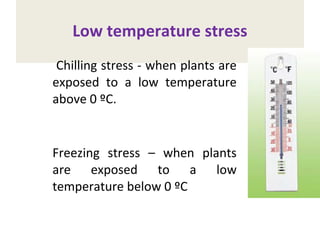
Chilling stress - when plants are
exposed to a low temperature
above 0 ºC.
Freezing stress – when plants
are exposed to a low
temperature below 0 ºC
CHILLING STRESS
Plants may develop physiological disorders
when exposed to low but non-freezing
temperatures.
The German plant physiologist Molisch
suggested the term ‘chilling injury’ as long ago
as 1897 to describe this phenomenon.
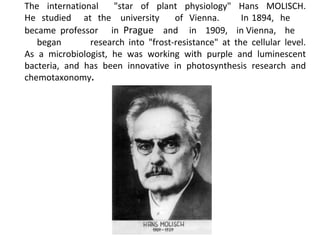
The international "star of plant physiology" Hans MOLISCH.
He studied at the university of Vienna. In 1894, he
became professor in Prague and in 1909, in Vienna, he
began research into "frost-resistance" at the cellular level.
As a microbiologist, he was working with purple and luminescent
bacteria, and has been innovative in photosynthesis research and
chemotaxonomy.
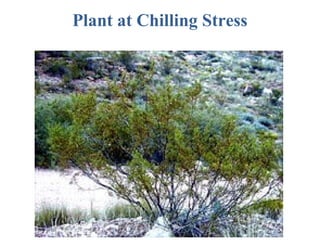
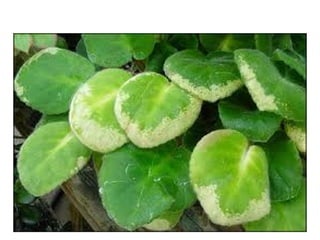
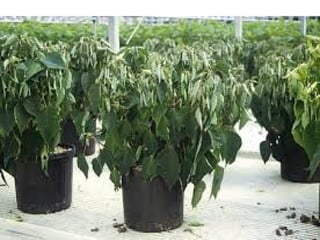
Plant at Chilling Stress
Chilling Injury
• Plant chilling injury refers to an injury that is caused
by a temperature drop to below to 10 to 15°C but
above the freezing point.
• Among crops, maize, Phaseolus bean, rice, tomato,
cucumber, sweet potato, and cotton are chilling
sensitive. Passiflora, Coleus, and Gloxinia are
examples of susceptible ornamentals.
• The most common site implicated for chilling injury is
the plasma membrane.
• The consequences of this change may lead to cell
leakage or disruption.
• Changes in membrane permeability are often invoked
as a cause of the loss of cell turgor
Symptoms of Chilling injury
• Cellular changes : Changes in membrane structure and
composition, decreased protoplasmic streaming, electrolyte
leakage and plasmolysis.
• Altered metabolism : Increased or reduced respiration,
depending on severity of stress, production of abnormal
metabolites due to anaerobic condition.
• Common Symptoms
– Reduced plant growth and death
– Surface lesions on leaves and fruits
– Abnormal curling, lobbing and crinkling of leaves
– Water soaking of tissues
– Cracking, splitting and dieback of stems
– Internal discolouration (vascular browning)
– Increased susceptibility to decay
– Failure to ripen normally
– Loss of vigour (potato lose the ability to sprout if chilled)
Symptoms of Chilling injury
• Most common symptoms of chilling stress is
Rapid wilting followed by water soaked patches which
develop into sunken pits that reflect cells tissue collapse.
Following warming, the sunken pits usually dry up, leaving
necrotic patches of tissues on the leaf surface.
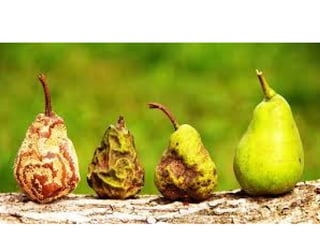
• Chilling symptoms in fruits vary and include
• Sunken pits in cucumber
• Browning of skins and degradation of pulp tissue in banana
• Blackheart of pine apple (Wilson, 1987)
Chilling Injury
• Occurs at Low temperature but nonfreezing
temperatures
• Chilling injury occurs in
• Tropical and subtropical plants at10 0
C to
250
C
• Temperate plants at 0 to 150
C
• Chilling Effect is manifested by physiological and
cytological changes
• Cytological changes may be reversible or
irreversible depending upon time of exposure to
low temperature
Affects on plants
Chilling injury causes several metabolic or physiological
dysfunctions to the plant including
• disruption of the conversion of starch to sugars
(amylotytic activity)
• decreased carbon dioxide exchange
• reduction in net photosynthesis
• the destruction/degradation of chlorophyll
Affects on plants
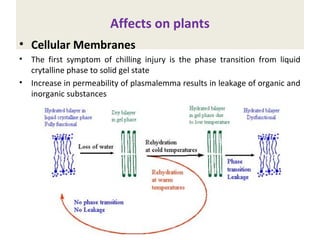
• Cellular Membranes
• The first symptom of chilling injury is the phase transition from liquid
crytalline phase to solid gel state
• Increase in permeability of plasmalemma results in leakage of organic and
inorganic substances
Affects on plants
Cellular Membranes(contd..)
• Plasmolysis: Plasmolemma- pressed against the tonoplast and
deleted into the vacuole as sac like intrusions
• Formation of crystalline deposits in root cells, epidermal, mesophyll
and vascular cells of leaves -leading to tonoplast disruption.
• Tonoplast injury is irreversible
• During hardening at low or above zero temp the lipid bodies
accumulate in cytoplasm in close association with plasmalemma.
Lipid composition
– Ratio of Unsaturated to saturated fatty acids is higher in chilling
resistant plants
– Increase in activity of fatty acid de-saturases was found in chilling
resistant plants
Cytological Changes
• Swelling of plastid membranes and mitochondrial
membranes
• Swelling of chloroplast thylakoids
• Decrease in size and no. of starch grains
• Grana disintegration and increase in size and no.of
plastoglobules
• Mitochondria with reduced cristae and
transparent matrix
• Mitochondria – double the volume
• Extensive dilation and vesiculation of smooth ER
cisternae
Cytological Changes
• Rough ER completely disappears ie.,Ribosomes are
lost from the membrane
• Dilated Vesicular ER cisternae – Accumulation of
cryoprotective substances
• Transformation of rough ER into vacuolated
smooth ER-represents early stage of chilling
• Since ER-most dynamic structure-full reversibility
of ER ultrastructure is possible
• Swelling of dictyosomes
• Longer exposure to chilling-disintegration of
dictyosomes
Causes of Chilling injury
• The primary cause has been found to be the
opening (and locking) of the leaf stomata when
the permeability of the roots to water is low.
• The leaves lose water faster than it can be
replaced and they become dehydrated.
• In some plants, the stomata behave properly at
chilling temperatures and the injury is said to be
metabolic.
• A decrease in respiration, photosynthesis and
fatty acid synthesis may all contribute to the chill-
starvation of some plants.
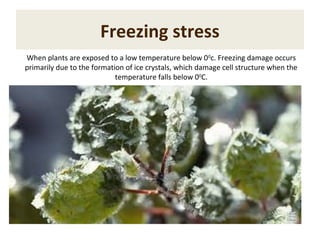
Freezing stress
When plants are exposed to a low temperature below 00
c. Freezing damage occurs
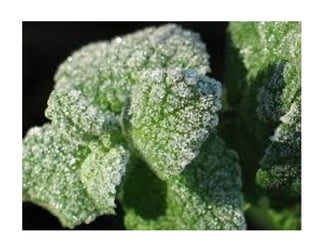
primarily due to the formation of ice crystals, which damage cell structure when the
temperature falls below 00
C.
Freezing stress
Freezing injury in plants can be from two sources:
1.Freezing of soil water
The soil water that is available to plants is found in the
porous regions between soil particles. It freezes at about -2°C,
depriving the plant of its source of water.
2. Freezing of the fluids within the plant.
Freezing of water within the plant can cause disruption
of structure and function of cells and tissues. Ice usually forms
first in the cell walls and intercellular spaces. Damage occurs
when ice crystals grow and puncture into the cytoplasm.
Symptoms of Freezing injury
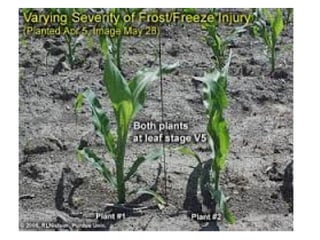
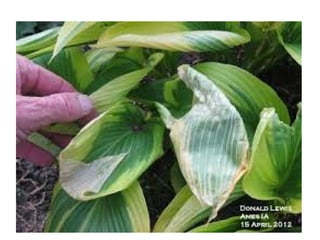
• Desiccation or burning of foliage
• Water-soaked areas that progress to necrotic spots on
leaves, stems or fruit and death of sections of the plant
or the entire plant.
• Close examination of woody plants several days or weeks
after freezing may reveal a dead or weakened root
system or split bark on stems or branches.
• Obvious symptoms on plant foliage may not be present
until after the plant has been stressed by warm
temperatures.
• Wilting and/or desiccation, as caused by direct drought
stress.
Formation of ice intracellularly may be due to
•By internal nucleation (certain large polysaccharides /proteins
serve as nucleating agents to form ice)
•By penetration of external ice crystals into the cells
•Intracellular ice formation is very lethal which causes
immediate disruption of cells.
•It spreads from cell to cell through plasmodesmata
•Formed in the cell wall adjacent to the intercellular spaces
•Originates spontaneously from centers of nucleation in the
cytoplasm.
Membrane changes
• Intact cellular membranes act as effective barrier to the
propagation of ice. This depends upon temperature and cold
hardening .Cellular Membranes are more susceptible to
freezing damage than soluble enzymes.
• Plasmalemma is the major site of lethal injury. Leakage of
ions from thawed tissues occurs due to protoplasmic swelling
and alteration in permeability to K+ions.
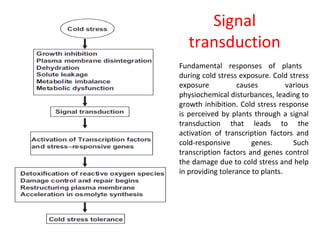
Signal
transduction
Fundamental responses of plants
during cold stress exposure. Cold stress
exposure causes various
physiochemical disturbances, leading to
growth inhibition. Cold stress response
is perceived by plants through a signal
transduction that leads to the
activation of transcription factors and
cold-responsive genes. Such
transcription factors and genes control
the damage due to cold stress and help
in providing tolerance to plants.
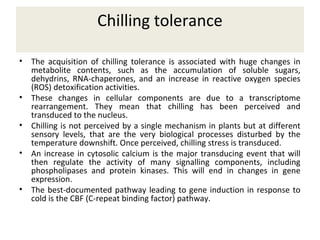
Chilling tolerance
• The acquisition of chilling tolerance is associated with huge changes in
metabolite contents, such as the accumulation of soluble sugars,
dehydrins, RNA-chaperones, and an increase in reactive oxygen species
(ROS) detoxification activities.
• These changes in cellular components are due to a transcriptome
rearrangement. They mean that chilling has been perceived and
transduced to the nucleus.
• Chilling is not perceived by a single mechanism in plants but at different
sensory levels, that are the very biological processes disturbed by the
temperature downshift. Once perceived, chilling stress is transduced.
• An increase in cytosolic calcium is the major transducing event that will
then regulate the activity of many signalling components, including
phospholipases and protein kinases. This will end in changes in gene
expression.
• The best-documented pathway leading to gene induction in response to
cold is the CBF (C-repeat binding factor) pathway.
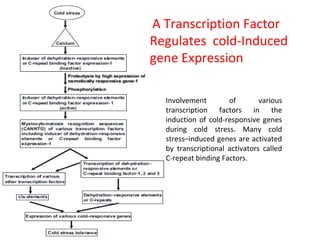
A Transcription Factor
Regulates cold-Induced
gene Expression
Involvement of various
transcription factors in the
induction of cold-responsive genes
during cold stress. Many cold
stress–induced genes are activated
by transcriptional activators called
C-repeat binding Factors.
Prevention & Protection
Cold hardening
• Cold hardening alters the behavior of the stomata
so that they close under the same conditions; the
root permeability is also increased.
• Cold hardening affects the lipid content of cell
membranes and has been found to lower the
optimum temperature for photosynthesis and
respiration.
Prevention & Protection
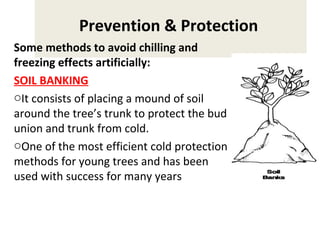
Some methods to avoid chilling and
freezing effects artificially:
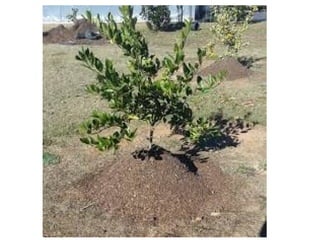
SOIL BANKING
oIt consists of placing a mound of soil
around the tree’s trunk to protect the bud
union and trunk from cold.
oOne of the most efficient cold protection
methods for young trees and has been
used with success for many years
Prevention & Protection
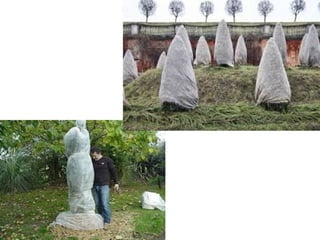
Wrapping
•Most tree wraps can be attached anytime during
the year and left on the tree throughout the year or
even for several years.
•Wraps should be properly positioned and fastened
around the trunk for best results.
•It is important to cover the entire lower trunk,
especially at the base.
Prevention & Protection
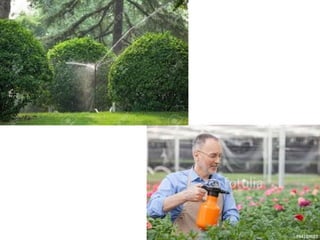
Sprinkling
•It can be used to moderate temperatures above freezing
because of sensible heat in water and can maintain plant leaf
temperature at 1 to 2°C degrees or more.
•Water applied to aisles of shade structures or greenhouses
increases the moisture content of the air and soil
surrounding the plants, thus slowing the rate of temperature
drop.
•The water absorbs heat during the day which is released
slowly at night.
Prevention & Protection
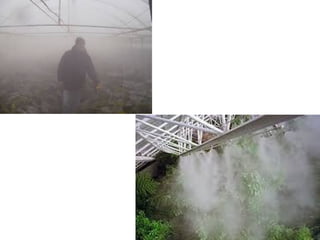
Fogging
•Fog also retards the loss of heat from soil and plant surfaces to
the atmosphere
•Fog can provide up to 4°C (8°F) of protection outdoors during
radiational cooling
•Applying ground water with an average temperature of 21°C
(70°F) to a greenhouse can create a ground fog if the ground
surface is several degrees cooler than the water.
•The applied water adds heat to the plant environment and/or
buffers temperature change by increased humidity.
•Temperatures can be elevated as much as 5°C (9°F) in these
unheated structures
Prevention & Protection
Supplementary Heat supply
Air movement method:
•Wind machines have been used for many years in
citrus and vegetable industries and recently in the
ornamental industry as a means of cold protection
•Air movement also helps distribute and circulate heat
added by orchard heaters or other sources.
Warm water movement:
•Circulation of warm water (43 to 54°C, 110 to 130°F),
not hot water, in enclosed growing and/or storage areas
is effective to prevent cold injuries
SURVIVAL STRATEGIES
Anti freeze proteins (AFP)
- Declines rate of ice crystal growth
- Lowers the efficiency of ice nucleation sites
- Lowers temp. at which ice forms
Osmoprotectants
- Osmolytes- quarternary amines, amino acids, sugar alcohols
- Balances the osmotic potential of externally increased
osmotic pressure
ABA
- Plants develop freezing resistance when treated with
exogenous ABA
Thank u

Cold stress in plants

  • 1.
  • 2.
    STRESS An adverse forceor a condition, which inhibits the normal functioning and well being of a biological system such as plants. VARIOUS TYPES ARE Cold, heat, drought, flood, salinity, etc.
  • 3.
    Low temperature stress Chillingstress - when plants are exposed to a low temperature above 0 ºC. Freezing stress – when plants are exposed to a low temperature below 0 ºC
  • 4.
    CHILLING STRESS Plants maydevelop physiological disorders when exposed to low but non-freezing temperatures. The German plant physiologist Molisch suggested the term ‘chilling injury’ as long ago as 1897 to describe this phenomenon.
  • 5.
    The international "starof plant physiology" Hans MOLISCH. He studied at the university of Vienna. In 1894, he became professor in Prague and in 1909, in Vienna, he began research into "frost-resistance" at the cellular level. As a microbiologist, he was working with purple and luminescent bacteria, and has been innovative in photosynthesis research and chemotaxonomy.
  • 6.
  • 7.
    Chilling Injury • Plantchilling injury refers to an injury that is caused by a temperature drop to below to 10 to 15°C but above the freezing point. • Among crops, maize, Phaseolus bean, rice, tomato, cucumber, sweet potato, and cotton are chilling sensitive. Passiflora, Coleus, and Gloxinia are examples of susceptible ornamentals. • The most common site implicated for chilling injury is the plasma membrane. • The consequences of this change may lead to cell leakage or disruption. • Changes in membrane permeability are often invoked as a cause of the loss of cell turgor
  • 8.
    Symptoms of Chillinginjury • Cellular changes : Changes in membrane structure and composition, decreased protoplasmic streaming, electrolyte leakage and plasmolysis. • Altered metabolism : Increased or reduced respiration, depending on severity of stress, production of abnormal metabolites due to anaerobic condition. • Common Symptoms – Reduced plant growth and death – Surface lesions on leaves and fruits – Abnormal curling, lobbing and crinkling of leaves – Water soaking of tissues – Cracking, splitting and dieback of stems – Internal discolouration (vascular browning) – Increased susceptibility to decay – Failure to ripen normally – Loss of vigour (potato lose the ability to sprout if chilled)
  • 12.
    Symptoms of Chillinginjury • Most common symptoms of chilling stress is Rapid wilting followed by water soaked patches which develop into sunken pits that reflect cells tissue collapse. Following warming, the sunken pits usually dry up, leaving necrotic patches of tissues on the leaf surface. • Chilling symptoms in fruits vary and include • Sunken pits in cucumber • Browning of skins and degradation of pulp tissue in banana • Blackheart of pine apple (Wilson, 1987)
  • 13.
    Chilling Injury • Occursat Low temperature but nonfreezing temperatures • Chilling injury occurs in • Tropical and subtropical plants at10 0 C to 250 C • Temperate plants at 0 to 150 C • Chilling Effect is manifested by physiological and cytological changes • Cytological changes may be reversible or irreversible depending upon time of exposure to low temperature
  • 14.
    Affects on plants Chillinginjury causes several metabolic or physiological dysfunctions to the plant including • disruption of the conversion of starch to sugars (amylotytic activity) • decreased carbon dioxide exchange • reduction in net photosynthesis • the destruction/degradation of chlorophyll
  • 15.
    Affects on plants •Cellular Membranes • The first symptom of chilling injury is the phase transition from liquid crytalline phase to solid gel state • Increase in permeability of plasmalemma results in leakage of organic and inorganic substances
  • 16.
    Affects on plants CellularMembranes(contd..) • Plasmolysis: Plasmolemma- pressed against the tonoplast and deleted into the vacuole as sac like intrusions • Formation of crystalline deposits in root cells, epidermal, mesophyll and vascular cells of leaves -leading to tonoplast disruption. • Tonoplast injury is irreversible • During hardening at low or above zero temp the lipid bodies accumulate in cytoplasm in close association with plasmalemma. Lipid composition – Ratio of Unsaturated to saturated fatty acids is higher in chilling resistant plants – Increase in activity of fatty acid de-saturases was found in chilling resistant plants
  • 17.
    Cytological Changes • Swellingof plastid membranes and mitochondrial membranes • Swelling of chloroplast thylakoids • Decrease in size and no. of starch grains • Grana disintegration and increase in size and no.of plastoglobules • Mitochondria with reduced cristae and transparent matrix • Mitochondria – double the volume • Extensive dilation and vesiculation of smooth ER cisternae
  • 18.
    Cytological Changes • RoughER completely disappears ie.,Ribosomes are lost from the membrane • Dilated Vesicular ER cisternae – Accumulation of cryoprotective substances • Transformation of rough ER into vacuolated smooth ER-represents early stage of chilling • Since ER-most dynamic structure-full reversibility of ER ultrastructure is possible • Swelling of dictyosomes • Longer exposure to chilling-disintegration of dictyosomes
  • 19.
    Causes of Chillinginjury • The primary cause has been found to be the opening (and locking) of the leaf stomata when the permeability of the roots to water is low. • The leaves lose water faster than it can be replaced and they become dehydrated. • In some plants, the stomata behave properly at chilling temperatures and the injury is said to be metabolic. • A decrease in respiration, photosynthesis and fatty acid synthesis may all contribute to the chill- starvation of some plants.
  • 20.
    Freezing stress When plantsare exposed to a low temperature below 00 c. Freezing damage occurs primarily due to the formation of ice crystals, which damage cell structure when the temperature falls below 00 C.
  • 25.
    Freezing stress Freezing injuryin plants can be from two sources: 1.Freezing of soil water The soil water that is available to plants is found in the porous regions between soil particles. It freezes at about -2°C, depriving the plant of its source of water. 2. Freezing of the fluids within the plant. Freezing of water within the plant can cause disruption of structure and function of cells and tissues. Ice usually forms first in the cell walls and intercellular spaces. Damage occurs when ice crystals grow and puncture into the cytoplasm.
  • 26.
    Symptoms of Freezinginjury • Desiccation or burning of foliage • Water-soaked areas that progress to necrotic spots on leaves, stems or fruit and death of sections of the plant or the entire plant. • Close examination of woody plants several days or weeks after freezing may reveal a dead or weakened root system or split bark on stems or branches. • Obvious symptoms on plant foliage may not be present until after the plant has been stressed by warm temperatures. • Wilting and/or desiccation, as caused by direct drought stress.
  • 27.
    Formation of iceintracellularly may be due to •By internal nucleation (certain large polysaccharides /proteins serve as nucleating agents to form ice) •By penetration of external ice crystals into the cells •Intracellular ice formation is very lethal which causes immediate disruption of cells. •It spreads from cell to cell through plasmodesmata •Formed in the cell wall adjacent to the intercellular spaces •Originates spontaneously from centers of nucleation in the cytoplasm.
  • 28.
    Membrane changes • Intactcellular membranes act as effective barrier to the propagation of ice. This depends upon temperature and cold hardening .Cellular Membranes are more susceptible to freezing damage than soluble enzymes. • Plasmalemma is the major site of lethal injury. Leakage of ions from thawed tissues occurs due to protoplasmic swelling and alteration in permeability to K+ions.
  • 29.
    Signal transduction Fundamental responses ofplants during cold stress exposure. Cold stress exposure causes various physiochemical disturbances, leading to growth inhibition. Cold stress response is perceived by plants through a signal transduction that leads to the activation of transcription factors and cold-responsive genes. Such transcription factors and genes control the damage due to cold stress and help in providing tolerance to plants.
  • 30.
    Chilling tolerance • Theacquisition of chilling tolerance is associated with huge changes in metabolite contents, such as the accumulation of soluble sugars, dehydrins, RNA-chaperones, and an increase in reactive oxygen species (ROS) detoxification activities. • These changes in cellular components are due to a transcriptome rearrangement. They mean that chilling has been perceived and transduced to the nucleus. • Chilling is not perceived by a single mechanism in plants but at different sensory levels, that are the very biological processes disturbed by the temperature downshift. Once perceived, chilling stress is transduced. • An increase in cytosolic calcium is the major transducing event that will then regulate the activity of many signalling components, including phospholipases and protein kinases. This will end in changes in gene expression. • The best-documented pathway leading to gene induction in response to cold is the CBF (C-repeat binding factor) pathway.
  • 31.
    A Transcription Factor Regulatescold-Induced gene Expression Involvement of various transcription factors in the induction of cold-responsive genes during cold stress. Many cold stress–induced genes are activated by transcriptional activators called C-repeat binding Factors.
  • 32.
    Prevention & Protection Coldhardening • Cold hardening alters the behavior of the stomata so that they close under the same conditions; the root permeability is also increased. • Cold hardening affects the lipid content of cell membranes and has been found to lower the optimum temperature for photosynthesis and respiration.
  • 34.
    Prevention & Protection Somemethods to avoid chilling and freezing effects artificially: SOIL BANKING oIt consists of placing a mound of soil around the tree’s trunk to protect the bud union and trunk from cold. oOne of the most efficient cold protection methods for young trees and has been used with success for many years
  • 36.
    Prevention & Protection Wrapping •Mosttree wraps can be attached anytime during the year and left on the tree throughout the year or even for several years. •Wraps should be properly positioned and fastened around the trunk for best results. •It is important to cover the entire lower trunk, especially at the base. Prevention & Protection
  • 38.
    Prevention & Protection Sprinkling •Itcan be used to moderate temperatures above freezing because of sensible heat in water and can maintain plant leaf temperature at 1 to 2°C degrees or more. •Water applied to aisles of shade structures or greenhouses increases the moisture content of the air and soil surrounding the plants, thus slowing the rate of temperature drop. •The water absorbs heat during the day which is released slowly at night.
  • 40.
    Prevention & Protection Fogging •Fogalso retards the loss of heat from soil and plant surfaces to the atmosphere •Fog can provide up to 4°C (8°F) of protection outdoors during radiational cooling •Applying ground water with an average temperature of 21°C (70°F) to a greenhouse can create a ground fog if the ground surface is several degrees cooler than the water. •The applied water adds heat to the plant environment and/or buffers temperature change by increased humidity. •Temperatures can be elevated as much as 5°C (9°F) in these unheated structures
  • 42.
    Prevention & Protection SupplementaryHeat supply Air movement method: •Wind machines have been used for many years in citrus and vegetable industries and recently in the ornamental industry as a means of cold protection •Air movement also helps distribute and circulate heat added by orchard heaters or other sources. Warm water movement: •Circulation of warm water (43 to 54°C, 110 to 130°F), not hot water, in enclosed growing and/or storage areas is effective to prevent cold injuries
  • 43.
    SURVIVAL STRATEGIES Anti freezeproteins (AFP) - Declines rate of ice crystal growth - Lowers the efficiency of ice nucleation sites - Lowers temp. at which ice forms Osmoprotectants - Osmolytes- quarternary amines, amino acids, sugar alcohols - Balances the osmotic potential of externally increased osmotic pressure ABA - Plants develop freezing resistance when treated with exogenous ABA
  • 44.