Ilyas (15006)
Mithun (15010)
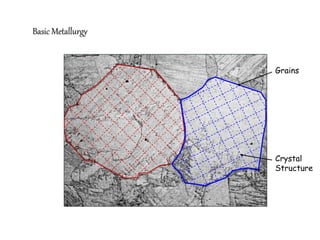
Grains
Crystal
Structure
Basic Metallurgy
X
Y
Z
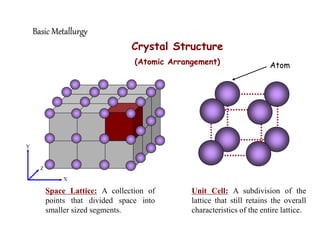
Space Lattice: A collection of
points that divided space into
smaller sized segments.
Unit Cell: A subdivision of the
lattice that still retains the overall
characteristics of the entire lattice.
Crystal Structure
(Atomic Arrangement)
Basic Metallurgy
Atom
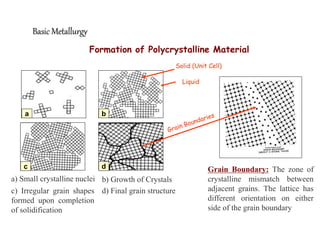
Formation of Polycrystalline Material
Liquid
a b
c d
Solid (Unit Cell)
a) Small crystalline nuclei b) Growth of Crystals
c) Irregular grain shapes
formed upon completion
of solidification
d) Final grain structure
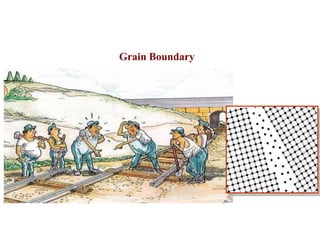
Grain Boundary: The zone of
crystalline mismatch between
adjacent grains. The lattice has
different orientation on either
side of the grain boundary
Basic Metallurgy
Grain Boundary
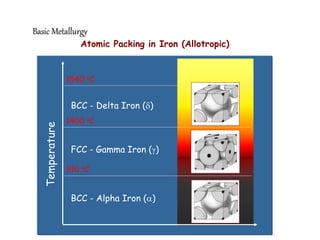
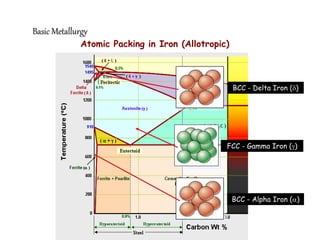
BCC - Delta Iron (d)
FCC - Gamma Iron (g)
BCC - Alpha Iron (a)
1540 oC
1400 oC
910 oC
Atomic Packing in Iron (Allotropic)
Basic Metallurgy
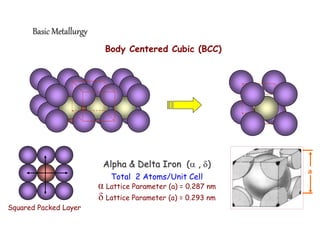
Body Centered Cubic (BCC)
Alpha & Delta Iron (a , d)
Total 2 Atoms/Unit Cell
α Lattice Parameter (a) = 0.287 nm
δ Lattice Parameter (a) = 0.293 nm
a
Squared Packed Layer
Basic Metallurgy
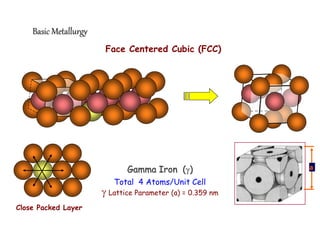
Face Centered Cubic (FCC)
Gamma Iron (g)
Total 4 Atoms/Unit Cell
g Lattice Parameter (a) = 0.359 nm
a
Close Packed Layer
Basic Metallurgy
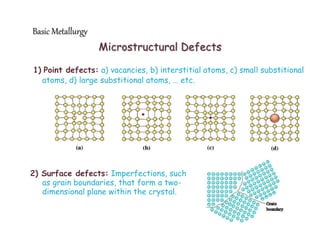
1) Point defects: a) vacancies, b) interstitial atoms, c) small substitional
atoms, d) large substitional atoms, … etc.
2) Surface defects: Imperfections, such
as grain boundaries, that form a two-
dimensional plane within the crystal.
Microstructural Defects
Basic Metallurgy
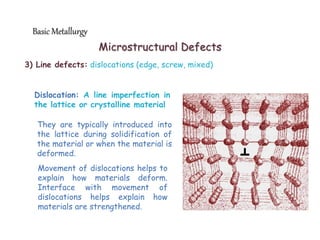
3) Line defects: dislocations (edge, screw, mixed)
Dislocation: A line imperfection in
the lattice or crystalline material
Movement of dislocations helps to
explain how materials deform.
Interface with movement of
dislocations helps explain how
materials are strengthened.
They are typically introduced into
the lattice during solidification of
the material or when the material is
deformed.
Microstructural Defects
Basic Metallurgy
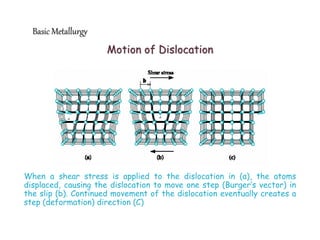
Motion of Dislocation
When a shear stress is applied to the dislocation in (a), the atoms
displaced, causing the dislocation to move one step (Burger’s vector) in
the slip (b). Continued movement of the dislocation eventually creates a
step (deformation) direction (C)
Basic Metallurgy
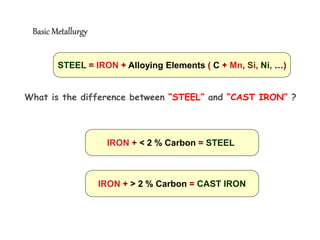
STEEL = IRON + Alloying Elements ( C + Mn, Si, Ni, …)
IRON + < 2 % Carbon = STEEL
IRON + > 2 % Carbon = CAST IRON
What is the difference between “STEEL” and “CAST IRON” ?
Basic Metallurgy
Atomic Packing in Iron (Allotropic)
BCC - Delta Iron (d)
FCC - Gamma Iron (g)
BCC - Alpha Iron (a)
Basic Metallurgy
14
15
Basic Metallurgy
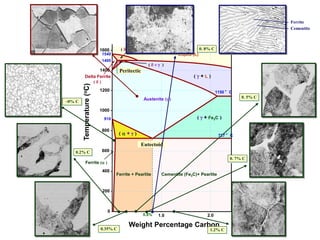
Weight Percentage Carbon
Temperature(oC)
( g + Fe3C )
( g + L )
Austenite (g )
Liquid (L)1540
1495
727 °C
910
Cementite (Fe3C)+ Pearlite
( a + g )
Ferrite + Pearlite
Ferrite (a )
1000 -
1200 -
1400 -
1600 -
1.0
800 -
2.0
400 -
600 -
200 -
0 -
0.8%
Eutectoid
Delta Ferrite
( d )
( d + g )
Peritectic
( d + L )
1150 °C
Ferrite
Cementite
~0% C
0.2% C
0.35% C
0. 5% C
0. 7% C
0. 8% C
1.2% C
17
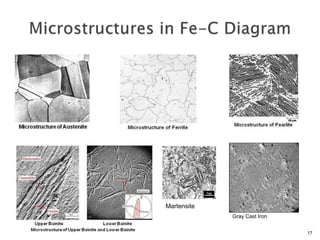
Martensite
Gray Cast Iron
18
19

Metallurgical structures

  • 1.
  • 2.
  • 3.
    X Y Z Space Lattice: Acollection of points that divided space into smaller sized segments. Unit Cell: A subdivision of the lattice that still retains the overall characteristics of the entire lattice. Crystal Structure (Atomic Arrangement) Basic Metallurgy Atom
  • 4.
    Formation of PolycrystallineMaterial Liquid a b c d Solid (Unit Cell) a) Small crystalline nuclei b) Growth of Crystals c) Irregular grain shapes formed upon completion of solidification d) Final grain structure Grain Boundary: The zone of crystalline mismatch between adjacent grains. The lattice has different orientation on either side of the grain boundary Basic Metallurgy
  • 5.
  • 6.
    BCC - DeltaIron (d) FCC - Gamma Iron (g) BCC - Alpha Iron (a) 1540 oC 1400 oC 910 oC Atomic Packing in Iron (Allotropic) Basic Metallurgy
  • 7.
    Body Centered Cubic(BCC) Alpha & Delta Iron (a , d) Total 2 Atoms/Unit Cell α Lattice Parameter (a) = 0.287 nm δ Lattice Parameter (a) = 0.293 nm a Squared Packed Layer Basic Metallurgy
  • 8.
    Face Centered Cubic(FCC) Gamma Iron (g) Total 4 Atoms/Unit Cell g Lattice Parameter (a) = 0.359 nm a Close Packed Layer Basic Metallurgy
  • 9.
    1) Point defects:a) vacancies, b) interstitial atoms, c) small substitional atoms, d) large substitional atoms, … etc. 2) Surface defects: Imperfections, such as grain boundaries, that form a two- dimensional plane within the crystal. Microstructural Defects Basic Metallurgy
  • 10.
    3) Line defects:dislocations (edge, screw, mixed) Dislocation: A line imperfection in the lattice or crystalline material Movement of dislocations helps to explain how materials deform. Interface with movement of dislocations helps explain how materials are strengthened. They are typically introduced into the lattice during solidification of the material or when the material is deformed. Microstructural Defects Basic Metallurgy
  • 11.
    Motion of Dislocation Whena shear stress is applied to the dislocation in (a), the atoms displaced, causing the dislocation to move one step (Burger’s vector) in the slip (b). Continued movement of the dislocation eventually creates a step (deformation) direction (C) Basic Metallurgy
  • 12.
    STEEL = IRON+ Alloying Elements ( C + Mn, Si, Ni, …) IRON + < 2 % Carbon = STEEL IRON + > 2 % Carbon = CAST IRON What is the difference between “STEEL” and “CAST IRON” ? Basic Metallurgy
  • 13.
    Atomic Packing inIron (Allotropic) BCC - Delta Iron (d) FCC - Gamma Iron (g) BCC - Alpha Iron (a) Basic Metallurgy
  • 14.
  • 15.
  • 16.
    Basic Metallurgy Weight PercentageCarbon Temperature(oC) ( g + Fe3C ) ( g + L ) Austenite (g ) Liquid (L)1540 1495 727 °C 910 Cementite (Fe3C)+ Pearlite ( a + g ) Ferrite + Pearlite Ferrite (a ) 1000 - 1200 - 1400 - 1600 - 1.0 800 - 2.0 400 - 600 - 200 - 0 - 0.8% Eutectoid Delta Ferrite ( d ) ( d + g ) Peritectic ( d + L ) 1150 °C Ferrite Cementite ~0% C 0.2% C 0.35% C 0. 5% C 0. 7% C 0. 8% C 1.2% C
  • 17.
  • 18.
  • 19.