Assignment
Topic:- Parts feeder
submitted by:-
Ilyas hussain
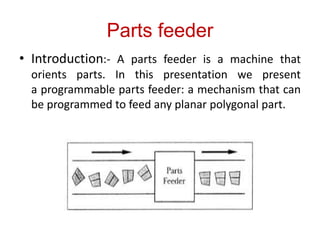
• Introduction:- A parts feeder is a machine that
orients parts. In this presentation we present
a programmable parts feeder: a mechanism that can
be programmed to feed any planar polygonal part.
Parts feeder
Components of programmable
part feeder
• Feeding mechanism: A device that can orient parts
under software control.
• Planning algorithm: A method for transforming a
geomertrical part description into a programme for
the mechanism.
Mechanism
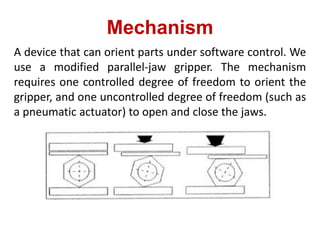
A device that can orient parts under software control. We
use a modified parallel-jaw gripper. The mechanism
requires one controlled degree of freedom to orient the
gripper, and one uncontrolled degree of freedom (such as
a pneumatic actuator) to open and close the jaws.
Advantages of programmable parts feeder
• The key advantage of a programmable parts feeder is
flexibility.
• Flexible manufacturing systems can be used for a
variety of products.
• Flexibility reduces the number of machines required
and lead time for manufacturing new products.
• A programmable parts feeder can be reprogrammed
rather than physically modified when part geometry
changes.
Conical bowl feeder
Conical bowl feeder
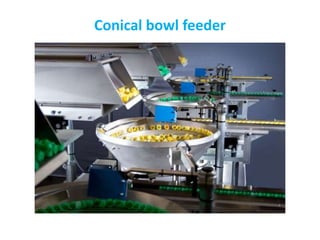
• Introduction:- Vibratory bowl feeders are used to
feed individual component parts for assembly on
industrial production line.
• They are used when bulk package of small
components must be fed into another machine one-
by-one, oriented in a particular direction.
• Vibratory feeders are self-contained systems,
comprising of a specially tooled bowl feeder that
orients the components.
Construction and mechanism
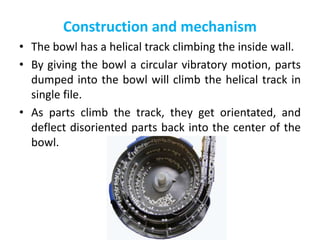
• The bowl has a helical track climbing the inside wall.
• By giving the bowl a circular vibratory motion, parts
dumped into the bowl will climb the helical track in
single file.
• As parts climb the track, they get orientated, and
deflect disoriented parts back into the center of the
bowl.
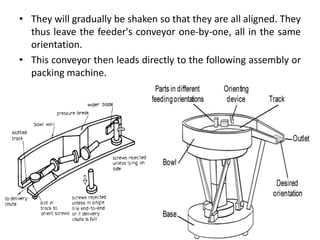
• They will gradually be shaken so that they are all aligned. They
thus leave the feeder's conveyor one-by-one, all in the same
orientation.
• This conveyor then leads directly to the following assembly or
packing machine.
Accessories
• Coating: Bowl feeder coatings minimise wear and
tear, reduces noise and damage to parts.
• Sound enclosure/cover: A foam-lined structure that
absorbs the noise created by the vibratory feeder.
• Base plates: Enable easy mounting of the drive unit
to the machine bed.
• Hopper: Large, bulk container that stores material
and regulates parts flow into the vibratory feeder
system.
Applications
• Vibratory feeders are utilized in many industries
including, pharmaceutical, automotive, electronic,
food, Fast Moving Consumable Goods (FMCG),
packaging and metal working industries.
• It also serves other industries such as glass, foundry,
steel, construction, recycling, pulp and paper, and
plastics.
• vibratory feeders offer a cost-effective alternative to
manual labour, saving manufacturer’s time and
labour costs.
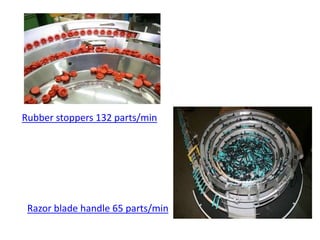
Rubber stoppers 132 parts/min
Razor blade handle 65 parts/min
Thank you

Assignment parts feeder

  • 1.
  • 2.
    • Introduction:- Aparts feeder is a machine that orients parts. In this presentation we present a programmable parts feeder: a mechanism that can be programmed to feed any planar polygonal part. Parts feeder
  • 3.
    Components of programmable partfeeder • Feeding mechanism: A device that can orient parts under software control. • Planning algorithm: A method for transforming a geomertrical part description into a programme for the mechanism.
  • 4.
    Mechanism A device thatcan orient parts under software control. We use a modified parallel-jaw gripper. The mechanism requires one controlled degree of freedom to orient the gripper, and one uncontrolled degree of freedom (such as a pneumatic actuator) to open and close the jaws.
  • 5.
    Advantages of programmableparts feeder • The key advantage of a programmable parts feeder is flexibility. • Flexible manufacturing systems can be used for a variety of products. • Flexibility reduces the number of machines required and lead time for manufacturing new products. • A programmable parts feeder can be reprogrammed rather than physically modified when part geometry changes.
  • 6.
  • 7.
    Conical bowl feeder •Introduction:- Vibratory bowl feeders are used to feed individual component parts for assembly on industrial production line. • They are used when bulk package of small components must be fed into another machine one- by-one, oriented in a particular direction. • Vibratory feeders are self-contained systems, comprising of a specially tooled bowl feeder that orients the components.
  • 8.
    Construction and mechanism •The bowl has a helical track climbing the inside wall. • By giving the bowl a circular vibratory motion, parts dumped into the bowl will climb the helical track in single file. • As parts climb the track, they get orientated, and deflect disoriented parts back into the center of the bowl.
  • 9.
    • They willgradually be shaken so that they are all aligned. They thus leave the feeder's conveyor one-by-one, all in the same orientation. • This conveyor then leads directly to the following assembly or packing machine.
  • 10.
    Accessories • Coating: Bowlfeeder coatings minimise wear and tear, reduces noise and damage to parts. • Sound enclosure/cover: A foam-lined structure that absorbs the noise created by the vibratory feeder. • Base plates: Enable easy mounting of the drive unit to the machine bed. • Hopper: Large, bulk container that stores material and regulates parts flow into the vibratory feeder system.
  • 11.
    Applications • Vibratory feedersare utilized in many industries including, pharmaceutical, automotive, electronic, food, Fast Moving Consumable Goods (FMCG), packaging and metal working industries. • It also serves other industries such as glass, foundry, steel, construction, recycling, pulp and paper, and plastics. • vibratory feeders offer a cost-effective alternative to manual labour, saving manufacturer’s time and labour costs.
  • 12.
    Rubber stoppers 132parts/min Razor blade handle 65 parts/min
  • 13.