COPPER / TAMBA
COPPER
• It is a brown colour metal
• As a metal it is non poisonous
• Important integral of enzymes
Action:
– high affinity for sulphhydryl and amino groups.
– May also target nucleic acids
Toxic compounds and its uses:
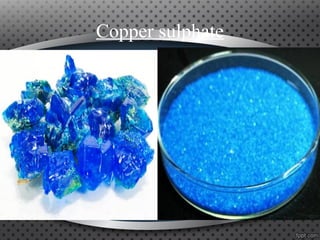
• Copper sulphate (CuSO4, blue vitriol, neela tutia):
– Large blue crystals, soluble in water and styptic taste
– Used in algaecides, fungicides, electroplating, leather
tanning, hide preservation to impart rich green colour and
for preservation of fruits and vegetables and also usedas
emetic except in arsenic.
– It is used as an antidote in phosphorus poisoning where it
forms cupric phosphide (non toxic substance).
Copper sulphate
• Copper subacetate (verdigris / zangal) :
– Bluish green powder formed by the action of
vegetable acids on improperly tined copper
cooking vessels.
– Used in arts and external medicine
• Copper carbonate
– fungicide
Exposure, Absorption and Excretion:
• Principal route of exposure is through
– Ingestion,
– Inhalation of fumes and dust and also
– Exposure of skin
• Maximum absorption occurs in stomach and GIT and
then transported to liver to bond with ceruloplasmin
• Excreted in feces, bile and urine
• F.D.: copper subacetate: 15 gm
copper sulphate: 20 gm
• F.P. : 1- 2 days.
Signs and symptoms: Acute
• GIT: Metallic taste, ptyalism, thirst, colicky
abdominal pain, nausea, eructation, repeated vomiting
(blue/green). Diarrhea (brown) with much straining
• Hemolytic tendencies due to increased concentration
of copper in the erythrocytes, resulting in
haemetemesis and Melaena.
• Hepatic: jaundice
– Renal: oliguria, haematuria, uraemia
– MS: cramps/spasm of legs, paralysis
– Inhalation of fumes: sore throat, cough;
conjunctivitis; perforation of nasal mucosa
– Skin exposure: contact dermatitis
Treatment :
– No need to use emetic as vomiting occurs in 5-10 min
– Gastric lavage 1% potassium ferrocyanide as it form
insoluble cupric ferrocyanide
– Demulcents: egg white or milk
– Castor oil
– Chelating agents: D-pencillamine (2 gm / day in four
divided doses orally), EDTA or BAL
– Morphine and diuretics
– Symptomatic
– For severe cases: cortisone 50- 100 mg thrice daily
Post mortem findings:
– Skin yellow d/t jaundice
– Greenish blue froth from mouth
– Greenish blue tinge in the mucus membrane of GIT.
– Liver : soft and fatty; shows centri-lobular necrosis
and biliary stasis
– Kidneys : degenerative changes in proximal tubules,
Hb casts
Chronic poisoning :
• Seen in factory workers
• It result from, preservation and cooking of food in
unclean copper utensils may result in poisoning as it
is contaminated with verdigris.
• Chronic consumption of fruits and vegetables
preserved and coloured with copper sulphate.
– Greenish or purple line on gums at its junction
with the teeth called Clapton’s line.
– Giddiness and headache
– laryngitis and bronchitis
– Metal fume fever
– Progressive emaciation with anemia malaise and
debility
– Conjunctivitis and corneal ulcers
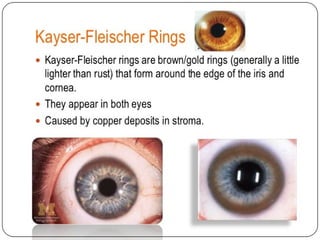
– Bronze diabetes m/b present
• Treatment: Symptomatic management
Signs and symptoms:
PM findings
• Liver: fatty degeneration
• Kidneys: degeneration of epithelial cells
Medico Legal Aspects
– Suicide: common
– Accidental: eating food coked in copper utensils,
children
– Copper used in IUCDs and haemodailysis
equipment.
– Copper is used as antidote in phosphorus
poisoning and wound debridement
– Cattle poison
– Homicide is rare
IRON
– Incidence usually d/t overdose and in children less
than 6 yrs of age
– M O A: taken up by parenchymal cells of liver,
causes mitochondrial damage and cellular
dysfunction l/t
• Metabolic acidosis and Necrosis,
• Liver failure,
• Hypoglycemia,
• Coagulopathy and death.
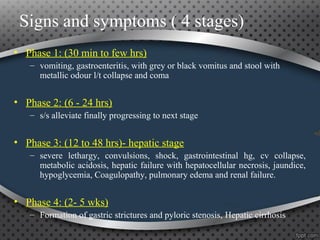
Signs and symptoms ( 4 stages)
• Phase 1: (30 min to few hrs)
– vomiting, gastroenteritis, with grey or black vomitus and stool with
metallic odour l/t collapse and coma
• Phase 2: (6 - 24 hrs)
– s/s alleviate finally progressing to next stage
• Phase 3: (12 to 48 hrs)- hepatic stage
– severe lethargy, convulsions, shock, gastrointestinal hg, cv collapse,
metabolic acidosis, hepatic failure with hepatocellular necrosis, jaundice,
hypoglycemia, Coagulopathy, pulmonary edema and renal failure.
• Phase 4: (2- 5 wks)
– Formation of gastric strictures and pyloric stenosis, Hepatic cirrhosis
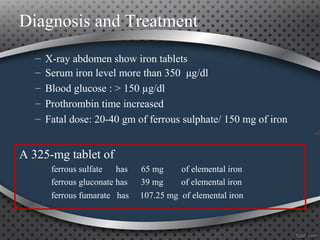
Diagnosis and Treatment
– X-ray abdomen show iron tablets
– Serum iron level more than 350 μg/dl
– Blood glucose : > 150 µg/dl
– Prothrombin time increased
– Fatal dose: 20-40 gm of ferrous sulphate/ 150 mg of iron
A 325-mg tablet of
ferrous sulfate has 65 mg of elemental iron
ferrous gluconate has 39 mg of elemental iron
ferrous fumarate has 107.25 mg of elemental iron
Treatment:
– GL with sodium bicarbonate
– Demulscents
– Antidote: desferoxamine: iv at the rate of 15- 80
mg /kg BW/hr
THALLIUM
– Heavy metal with lustrous colour on exposure to air form
thallous oxide
– It is a cumulative poison
– All salts as well as metal are poisonous.
• Toxic compounds and uses:
Thallium acetate: depillatory creams, fire works,
rodenticides and insecticides
Thallium sulphate: rodenticides and insecticides
Absorption and Excretion
• Abs through all routes
• Deposited in epididymis, liver, kidneys,
muscles and bones.
• Excreted through kidneys and in breast milk
Signs and symptoms
• Acute:
– Metallic taste, nausea vomiting, colic, diarrhoea,
– Conjunctivitis, scotoma, blindness,
– Polyneuritis, peripheral neuropathy- (burning feet
syndrome), ataxia coma, encephalopathy
– Loss of hair, mees lines and deafness,
– Maculo-papular skin eruptions on face with butterfly
distribution,
• F.D.: 1 gm
• F.P.: 2-3 days
Chronic Poisoning
• Alopecia
• Skin rashes
• Painful peripheral neuropathy
• Mental confusion with lethargy
Diagnosis and Treatment
• Eosinophilia
• Urine m/b green
• thallium > 40 μgm % in blood and > 150 μgm/l in urine
• Opacity in liver on X-ray
• Signs of gastric irritability and loss of hair.
Treatment:
– Stomach wash with 1% sodium or potassium
iodide
– Prussian blue (potassium ferric hexacyanoferrate)
orally 250 mg/kg/day in 2-4 divided doses
– BAL and EDTA are contraindicated
– Pilocarpine is physiological antidote
– Hemodialysis/ peritoneal dialysis
– Symptomatic
MLI:
• Ideal homicidal poison: more prevalent in European
countries.
• Chronic poisoning in industries.
• Accidental poisoning d/t therapeutic over usage.
MANGANESE
• Important compounds are Potassium
permanganate and manganese dioxide.
• Potassium permanganate :
• Dark purple slender crystals with astringent
taste. powerful antioxidant and disinfectant.
• MOA: causes coagulation necrosis and brown
discolouration of mucus mb., paralysis of heart
Signs And Symptoms:
– Burning pain from mouth to stomach, thirst,
colicky abdominal pain, nausea, eructation,
repeated vomiting, difficulty in swallowing,
dyspnoea , stridor, cough.
– Discolouration initially purple brown but later
changes to brown then coal black d/t formation of
manganese dioxide
– F.D.: 10- 20 gm
– F.P.: few hrs
Treatment:
• GL
• Demulscents
• Charcoal
• Symptomatic
PM appearance:
• necrosis , Hg and corrosion
• Liver and kidneys show degensrative changes
MLI:
– Usually suicidal poisoning
– M/b accidental in case of children
– Abortificient: inserted into vagina- causes
ulceration ( acute, localised, punched out with
raised edges and granular black base)
– Fictious injury: when applied to skin for 10 -20
min causes ulcer resembling syphilis.

Metalic (Cu,fe,th,mg) poisoning

  • 1.
  • 2.
    COPPER • It isa brown colour metal • As a metal it is non poisonous • Important integral of enzymes Action: – high affinity for sulphhydryl and amino groups. – May also target nucleic acids
  • 3.
    Toxic compounds andits uses: • Copper sulphate (CuSO4, blue vitriol, neela tutia): – Large blue crystals, soluble in water and styptic taste – Used in algaecides, fungicides, electroplating, leather tanning, hide preservation to impart rich green colour and for preservation of fruits and vegetables and also usedas emetic except in arsenic. – It is used as an antidote in phosphorus poisoning where it forms cupric phosphide (non toxic substance).
  • 4.
  • 5.
    • Copper subacetate(verdigris / zangal) : – Bluish green powder formed by the action of vegetable acids on improperly tined copper cooking vessels. – Used in arts and external medicine • Copper carbonate – fungicide
  • 6.
    Exposure, Absorption andExcretion: • Principal route of exposure is through – Ingestion, – Inhalation of fumes and dust and also – Exposure of skin • Maximum absorption occurs in stomach and GIT and then transported to liver to bond with ceruloplasmin • Excreted in feces, bile and urine
  • 7.
    • F.D.: coppersubacetate: 15 gm copper sulphate: 20 gm • F.P. : 1- 2 days.
  • 8.
    Signs and symptoms:Acute • GIT: Metallic taste, ptyalism, thirst, colicky abdominal pain, nausea, eructation, repeated vomiting (blue/green). Diarrhea (brown) with much straining • Hemolytic tendencies due to increased concentration of copper in the erythrocytes, resulting in haemetemesis and Melaena. • Hepatic: jaundice
  • 9.
    – Renal: oliguria,haematuria, uraemia – MS: cramps/spasm of legs, paralysis – Inhalation of fumes: sore throat, cough; conjunctivitis; perforation of nasal mucosa – Skin exposure: contact dermatitis
  • 10.
    Treatment : – Noneed to use emetic as vomiting occurs in 5-10 min – Gastric lavage 1% potassium ferrocyanide as it form insoluble cupric ferrocyanide – Demulcents: egg white or milk – Castor oil – Chelating agents: D-pencillamine (2 gm / day in four divided doses orally), EDTA or BAL – Morphine and diuretics – Symptomatic – For severe cases: cortisone 50- 100 mg thrice daily
  • 11.
    Post mortem findings: –Skin yellow d/t jaundice – Greenish blue froth from mouth – Greenish blue tinge in the mucus membrane of GIT. – Liver : soft and fatty; shows centri-lobular necrosis and biliary stasis – Kidneys : degenerative changes in proximal tubules, Hb casts
  • 12.
    Chronic poisoning : •Seen in factory workers • It result from, preservation and cooking of food in unclean copper utensils may result in poisoning as it is contaminated with verdigris. • Chronic consumption of fruits and vegetables preserved and coloured with copper sulphate.
  • 13.
    – Greenish orpurple line on gums at its junction with the teeth called Clapton’s line. – Giddiness and headache – laryngitis and bronchitis – Metal fume fever – Progressive emaciation with anemia malaise and debility – Conjunctivitis and corneal ulcers – Bronze diabetes m/b present • Treatment: Symptomatic management Signs and symptoms:
  • 15.
    PM findings • Liver:fatty degeneration • Kidneys: degeneration of epithelial cells
  • 16.
    Medico Legal Aspects –Suicide: common – Accidental: eating food coked in copper utensils, children – Copper used in IUCDs and haemodailysis equipment. – Copper is used as antidote in phosphorus poisoning and wound debridement – Cattle poison – Homicide is rare
  • 17.
    IRON – Incidence usuallyd/t overdose and in children less than 6 yrs of age – M O A: taken up by parenchymal cells of liver, causes mitochondrial damage and cellular dysfunction l/t • Metabolic acidosis and Necrosis, • Liver failure, • Hypoglycemia, • Coagulopathy and death.
  • 18.
    Signs and symptoms( 4 stages) • Phase 1: (30 min to few hrs) – vomiting, gastroenteritis, with grey or black vomitus and stool with metallic odour l/t collapse and coma • Phase 2: (6 - 24 hrs) – s/s alleviate finally progressing to next stage • Phase 3: (12 to 48 hrs)- hepatic stage – severe lethargy, convulsions, shock, gastrointestinal hg, cv collapse, metabolic acidosis, hepatic failure with hepatocellular necrosis, jaundice, hypoglycemia, Coagulopathy, pulmonary edema and renal failure. • Phase 4: (2- 5 wks) – Formation of gastric strictures and pyloric stenosis, Hepatic cirrhosis
  • 19.
    Diagnosis and Treatment –X-ray abdomen show iron tablets – Serum iron level more than 350 μg/dl – Blood glucose : > 150 µg/dl – Prothrombin time increased – Fatal dose: 20-40 gm of ferrous sulphate/ 150 mg of iron A 325-mg tablet of ferrous sulfate has 65 mg of elemental iron ferrous gluconate has 39 mg of elemental iron ferrous fumarate has 107.25 mg of elemental iron
  • 20.
    Treatment: – GL withsodium bicarbonate – Demulscents – Antidote: desferoxamine: iv at the rate of 15- 80 mg /kg BW/hr
  • 21.
    THALLIUM – Heavy metalwith lustrous colour on exposure to air form thallous oxide – It is a cumulative poison – All salts as well as metal are poisonous. • Toxic compounds and uses: Thallium acetate: depillatory creams, fire works, rodenticides and insecticides Thallium sulphate: rodenticides and insecticides
  • 22.
    Absorption and Excretion •Abs through all routes • Deposited in epididymis, liver, kidneys, muscles and bones. • Excreted through kidneys and in breast milk
  • 23.
    Signs and symptoms •Acute: – Metallic taste, nausea vomiting, colic, diarrhoea, – Conjunctivitis, scotoma, blindness, – Polyneuritis, peripheral neuropathy- (burning feet syndrome), ataxia coma, encephalopathy – Loss of hair, mees lines and deafness, – Maculo-papular skin eruptions on face with butterfly distribution, • F.D.: 1 gm • F.P.: 2-3 days
  • 24.
    Chronic Poisoning • Alopecia •Skin rashes • Painful peripheral neuropathy • Mental confusion with lethargy
  • 25.
    Diagnosis and Treatment •Eosinophilia • Urine m/b green • thallium > 40 μgm % in blood and > 150 μgm/l in urine • Opacity in liver on X-ray • Signs of gastric irritability and loss of hair.
  • 26.
    Treatment: – Stomach washwith 1% sodium or potassium iodide – Prussian blue (potassium ferric hexacyanoferrate) orally 250 mg/kg/day in 2-4 divided doses – BAL and EDTA are contraindicated – Pilocarpine is physiological antidote – Hemodialysis/ peritoneal dialysis – Symptomatic
  • 27.
    MLI: • Ideal homicidalpoison: more prevalent in European countries. • Chronic poisoning in industries. • Accidental poisoning d/t therapeutic over usage.
  • 28.
    MANGANESE • Important compoundsare Potassium permanganate and manganese dioxide. • Potassium permanganate : • Dark purple slender crystals with astringent taste. powerful antioxidant and disinfectant. • MOA: causes coagulation necrosis and brown discolouration of mucus mb., paralysis of heart
  • 29.
    Signs And Symptoms: –Burning pain from mouth to stomach, thirst, colicky abdominal pain, nausea, eructation, repeated vomiting, difficulty in swallowing, dyspnoea , stridor, cough. – Discolouration initially purple brown but later changes to brown then coal black d/t formation of manganese dioxide – F.D.: 10- 20 gm – F.P.: few hrs
  • 30.
    Treatment: • GL • Demulscents •Charcoal • Symptomatic PM appearance: • necrosis , Hg and corrosion • Liver and kidneys show degensrative changes
  • 31.
    MLI: – Usually suicidalpoisoning – M/b accidental in case of children – Abortificient: inserted into vagina- causes ulceration ( acute, localised, punched out with raised edges and granular black base) – Fictious injury: when applied to skin for 10 -20 min causes ulcer resembling syphilis.