FM 9.3
Mercury and
other miscellaneous poisons
Mercury
Characteristics
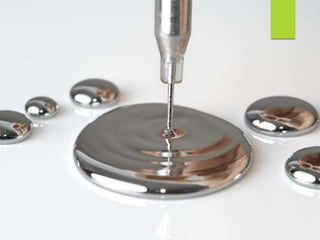
 Liquid metal
 Bright silvery appearance
 Volatile at room temperature
Organic Salts Compounds
 Organic Salts
Methyl mercury
Dimethyl Mercury
Ethyl Mercury
Phenyl Mercury
Inorganic Salts Compounds
 Mercuric (Hg ++)
 Soluble & poisonous
 Mercuric chloride (corrosive sublimate)
 Mercuric cyanide (pharaoh’s serpent aka Diwali
poison)
 Mercuric sulphide (Sindoor, Vermilion)
 Mercurous ( Hg+)
 Less soluble  less poisonous
 Mercurous chloride ( Calomel )
Uses
Medicine
 Disinfectant
 Dental amalgam
 Purgative
 Thimerosal , a
preservative (DTP.,
Hep B.)
Industry
 Thermometer,
 Barometer,
 Calibration
Instruments,
 Fluorescent And
Mercury Vapor Lamp,
 Electrical Equipment,
 Explosives And
Fireworks
Action
 Mercury binds with sulfhydryl groups resulting in
enzyme inhibition and pathological alteration of
cellular membranes.
 Elemental mercury and methyl mercury are toxic to
the CNS.
Action
 Metallic mercury vapor is also a pulmonary
irritant.
 corrosive to the skin, eyes and GIT, and
nephrotoxic.
 contact dermatitis.
Absorption and Excretion
 It is absorbed through the GIT and respiratory
tract.
 After absorption, mercury gets deposited in all
tissues, particularly in the liver, kidneys, spleen
and bones.
 When inhaled, the maximum concentration occurs
in the brain.
Absorption and Excretion
 Mainly excreted through the kidneys (urine), liver
(bile) and colonic mucous membrane (feces).
 It passes rapidly to the fetus through placental
circulation.
Fatal dose and Fatal period
Fatal Dose : One to 2 g. of mercuric chloride.
Fatal Period : Three to five days.
Acute poisoning
Symptoms
 First phase
Acrid metallic taste
Constriction of throat, hoarse voice, difficulty in
breathing
Mouth, tongue and fauces corroded
Symptoms
 First phase
Nausea and vomiting with greyish-white
coating, blood, slimy mucoid material and
shreds of mucous membrane
Blood stained diarrhoea
Circulatory collapse
Symptoms
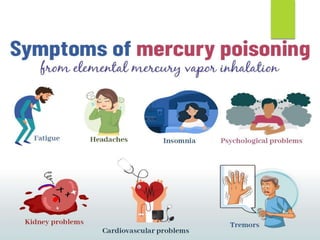
 Acute exposure to elemental mercury vapour
Corrosive bronchitis
Fever, chills and dyspnoea
Progress to pulmonary oedema and fibrosis
Nervous symptoms e.g. Ataxia, paresis, delirium
etc.
Symptoms
 Second phase (if person survives)
 Begins in 1 to 3 days
 24 to 36 hrs
glossitis & ulcerative gingivitis
Loosening of teeth, infection and necrosis of jaw
 2 to 3 days
Renal tubular necrosis
Albuminuria, uraemia and acidosis
Symptoms
 Recovery may occur within 10- 14 days
 i.m. Inj. 
abscess with ulceration
 i.v. Inj. 
mecurialism (thrombophlebitis, granuloma,
pulmonary embolism and hemoptysis)
Treatment
 Gastric lavage
Milk
Egg white
2-5 % sodium bicarbonate
 Activated charcoal – uncertain benefit
 Whole bowel irrigation – beneficial
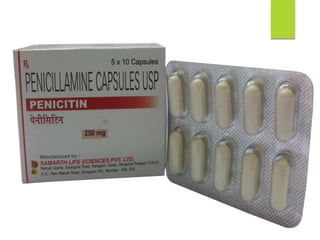
Penicillamine
 Useful in
 Less severe mercury vapour poisoning
 Inorganic mercury poisoning
 Orally 100 mg every 6 hours for 5 days in children
 Orally 250 mg every 6 hours for 5 days in adults
 Chronic poisoning
 25 to 40 mg twice a day in children
 250 mg twice a day in adults
 Until URINARY mercury levels < 50 µg/l
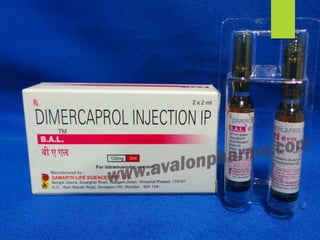
BAL
 Chelating agent of choice
 400 to 800 mg on first day every 6 hours
 200 to 400 mg on second and third day, every 6
hours
 100 to 200 mg 7 to 10 days 12 hourly OR until urine
level < 50 µg in a 24 hour specimen
BAL
 BAL and penicillamine not used together 
formation of toxic compound
 Urine must be kept alkaline
 High colonic lavage with 1:1000 solution of
sulphoxylate twice daily
 Hemodialysis in renal failure
Post mortem appearances
 Mucosa of GIT
 Inflammation,Congestion,Coagulation,Corrosion
 If person survives
 Necrosis of large intestine due to re-excretion of
mercury into large bowel
 Acute tubular and glomerular degeneration or
haemorrhagic glomerular nephritis
 Liver congested and cloudy swelling or fatty change
seen
Chronic poisoning
Chronic Poisoning
(Hydrargyrism)
1. Continuous accidental absorption by industrial
workers
2. Excessive therapeutic use (ointment)
3. Recovery from acute poisoning by large dose
Triad of chronic poisoning
 Elemental mercury causes triad of
Gingivitis and salivation
Tremors
Neuropsychiatric changes
Clinical Features
 Salivation
 Inflammation of gums
 Blue line at junction of gums and teeth
 Sore mouth and throat
 Anaemia and anorexia
 Loss of weight
 Chronic renal inflammation  uraemia
Tremors
Danbury tremors / mercurial Tremors
First in hands
Progress to lips and tongue
Static / intentional
Later involves arms and legs
Moderately coarse and interspersed by jerky
movements
Tremors
Hatter’s shakes
 The advanced condition is called hatter's shakes or·
glass-blower's shakes
 unable to dress himself. write legibly or walk
properly.
 They are common in persons working in glass-
blowing and hat industries.
Tremors
Concussio Mercurialis
 The most severe form is known as concussio
mercurialis, in which no activity is possible.
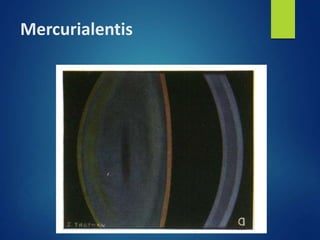
Mercurialentis
 Peculiar eye change due to exposure to the vapour
of mercury.
 Brownish deposit of mercury through the cornea
on the anterior lens capsule
Mercurialentis
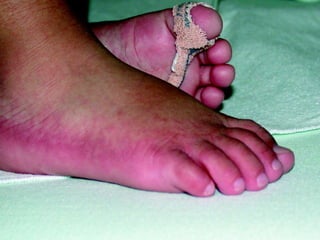
Acrodynia or pink disease
 characterised by a generalised body rash
hypersensitivity reaction particularly seen in
children
 Hands and feet become puffy, pinkish,painful,
paraesthetic with peeling of skin.
Treatment
 Removal of patient from further exposure.
 Demulcents.
 Saline purgatives
 Oral hygiene.
 Chelation therapy
Minimata disease
 Minimata disease is a type of organic mercurial
poisoning due to eating of fish poisoned by
mercury.
 This disease occurred as a disaster in Japan in 1956
by eating contaminated fish from Minimata Bay.
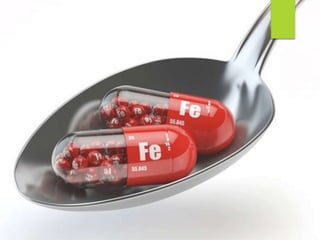
Iron
Poisonous iron salts
Iron sulphate (ferrous sulphate)
• Also known as green vitriol
• Green monosymmetric crystals
Ferric chloride (perchloride of iron)
• It is water soluble and irritant
• When water is evaporated, yellow crystals are
formed.
Mechanism of Action
 In concentrated form it acts as corrosive and in
dilute form act as irritant.
 It increases capillary permeability
 After absorption, when serum iron level exceeds
the body’s binding capacity, the free iron produces
an increase in reactive oxygen species (ROS) or free
radicals.
Mechanism of Action
 cellular damage.
 It inhibits mitochondrial functions.
 It also causes hepatic damage, hypoglycemia and
hypoprothrombinemia.
Clinical Features
Four stages are identified and are:
 Stage I: Stage of Gastrointestinal Toxicity
 Stage II: Stage of Apparent Stabilization or
Quiescent Phase
 Stage III: Stage of Mitochondrial Toxicity and
Hepatic Necrosis
 Stage IV: Stage of Recovery and/or Gastric Scarring
Stage I: Stage of
Gastrointestinal Toxicity
• Metallic taste
• Vomiting and diarrhea
• Abdominal pain
• Pallor
• Shock
• Lethargy
• Acidosis
• Hematemesis
• Black stool
Stage II: Stage of Apparent
Stabilization or Quiescent Phase
• Headache
• Confusion
• Delirium
Stage III: Stage of Mitochondrial
Toxicity and Hepatic Necrosis
• Hepatic failure
• Hypovolaemia
• Hypotension
• Multiorgan failure
• Coagulopathy
• Hypoglycemia
• Jaundice
• Convulsions
• Coma
IV: Stage of Recovery and/or
Gastric Scarring
• Recovery may occur
• Gastric scarring
• Pyloric obstruction.
Fatal dose and Fatal period
 Fatal dose: ferrous sulphate – 20 to 40 gm
 Fatal period: variable.
Management
 Gastric lavage with normal saline
 Activated charcoal
 Whole bowel irrigation
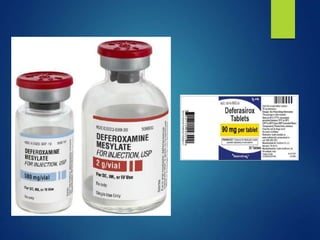
 Chelation – Desferrioxamine is used as specific
antidote..
Autopsy Findings
 Hemorrhagic necrosis or corrosion of
gastrointestinal mucosa
 In ferrous sulfate – greenish-blue colour of mucosa
 Hepatic and renal necrosis
 Jaundice
 Pyloric stenosis
Medicolegal Importance
 Accidental poisoning
 Homicide/suicide – rare
 Use to procure criminal abortion.
Antimony
Poisonous forms
 Antimony tartarum
 Antimony trioxide
 Antimony trichloride
 Antimony trisulphide
Clinical Features
 Vomiting
 Abdominal pain
 Diarrhea
 Hematemesis
 Dermatitis
 Renal failure and oliguria
 Hepatic failure
Management
 Gastric lavage
 Chelation with BAL
 Hemodialysis
 Supportive treatment
Fatal Dose and Fatal period
 Fatal Dose
• Antimony tartarum – 90 to 180 mg
• Antimony trichloride – 8 to 12 ml
 Fatal period: 24 hours
Medicolegal Importance
 Accidental poisoning – common
 Suicide/homicide – rare
Thallium
Properties
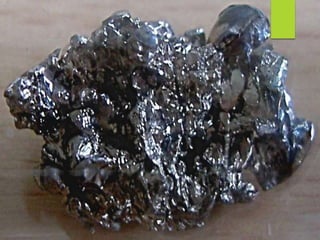
 Thallium is soft and pliable metal
 Have tin-white colour but tarnishes the surface on
exposure to air due to formation of black thallous
oxide
 Thallium sulfate is odourless and tasteless.
Toxic Compounds of Thallium
1. Thallium sulfate
2. Thallium acetate
3. Thallium iodide
4. Thallium nitrate
5. Thallium carbonate.
Uses
1. Dye industry
2. Optical glass
3. Imitation jewelry
4. Rodenticide
5. Depilatory agent
6. Fire works.
Mechanism
 Exact mechanism is unclear but postulated that
thallium results in ligand formation with protein
sulphydryl group of enzymes and inhibits cellular
respiration.
 It disrupts calcium homeostasis
 Interaction with riboflavin and riboflavin based
cofactors
Clinical Features - Acute
Poisoning
 • Pain in abdomen
 • Features of gastroenteritis
 • Hematemesis
 • Hematochezia
 • Headache
 • Confusion
 • Disorientation
 • Paraesthesia
 • Hallucinations
 • Convulsions
 • Retrobulbar neuritis
 • Ophthalmoplegia
 • Peripheral neuropathy
Clinical Features - Chronic
Poisoning
 Chronic Poisoning
 Alopecia
 Skin rash
 Acneform eruptions
 Dystrophy of nails
 Ascending sensorimotor
neuropathy
 Ataxia
 Optic neuropathy
 Encephalopathy
 Ptosis
 Nystagmus
Thallium triad
 Combination of
alopecia and skin rash,
painful peripheral neuropathy
mental confusion with lethargy
Fatal dose and Fatal period
 Fatal dose: 12 mg/kg body weight
 Fatal period: 24 to 30 hours
Management
 Gastric lavage with ferric ferrocyanide (Prussian
blue).
 Prussian blue binds thallium in the intestine and
enhances its fecal excretion.
 Hemodialysis
 Forced diuresis
 Supportive measures.
Autopsy Findings
• alopecia
• Stomatitis
• Fatty degeneration of liver and heart
• Tubular necrosis
• Pulmonary edema
• Cerebral edema
Medicolegal Importance
 Popular as ideal homicidal agent.
 Also consumed as suicidal agent.
Barium
Physical properties
 It is a heavy, white, tasteless, odorless powder and
insoluble in water.
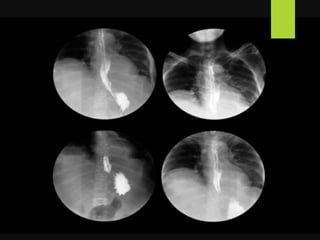
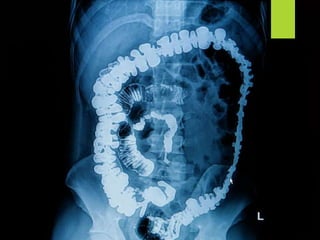
 Barium sulfate is used for the X-ray examination of
the GIT (‘barium-meal’).
Toxic compounds
 Soluble salts are most toxic.
 These are
barium chloride
barium nitrate
barium carbonate (rodenticide)
barium sulphide
Action
 It acts locally as an irritant poison.
 After absorption it acts both on voluntary and
involuntary muscles.
 Barium seems to act as potassium antagonist and
calcium agonist
Absorption
 Toxicity of barium compounds depends on their
solubility.
 The free ion is absorbed from the lungs and GIT,
but barium sulfate remains unabsorbed.
 After absorption, it accumulates in the skeleton
and in pigmented parts of the eye.
Signs and Symptoms
On ingestion
 The most characteristic features are areflexia and
paralysis (Ba2+ ion is a muscle poison).
On inhalation
 Inhalation of barium sulfate dust causes a benign
pneumoconiosis (‘baritosis’)
Fatal dose and Fatal period
 Fatal dose:
 About 0.8–1 g of barium chloride/sulfide/
nitrate.
 Fatal period:
Usually within 12 h.
Treatment
 Wash-out the stomach and give sulphate of soda or
magnesium sulphate
 10 ml. of 10% sodium sulphate i.v. every 15
minutes
 Purging with magnesium sulphate and repeated
bowel wash.
 Symptomatic.
Postmortem findings
 Non-specific.
 Submucosal hemorrhages may be seen in the GIT.
Medico-legal Aspects
 Suicidal cases may be seen.
 Homicidal cases are rare.
 Accidental poisoning with barium sulfide may
occur, if taken by mistake as barium sulfate for X-
ray examination.
Thank you

MERCURY POISONING.pptx

  • 1.
  • 5.
  • 6.
  • 7.
    Characteristics  Liquid metal Bright silvery appearance  Volatile at room temperature
  • 8.
    Organic Salts Compounds Organic Salts Methyl mercury Dimethyl Mercury Ethyl Mercury Phenyl Mercury
  • 9.
    Inorganic Salts Compounds Mercuric (Hg ++)  Soluble & poisonous  Mercuric chloride (corrosive sublimate)  Mercuric cyanide (pharaoh’s serpent aka Diwali poison)  Mercuric sulphide (Sindoor, Vermilion)  Mercurous ( Hg+)  Less soluble  less poisonous  Mercurous chloride ( Calomel )
  • 10.
    Uses Medicine  Disinfectant  Dentalamalgam  Purgative  Thimerosal , a preservative (DTP., Hep B.) Industry  Thermometer,  Barometer,  Calibration Instruments,  Fluorescent And Mercury Vapor Lamp,  Electrical Equipment,  Explosives And Fireworks
  • 11.
    Action  Mercury bindswith sulfhydryl groups resulting in enzyme inhibition and pathological alteration of cellular membranes.  Elemental mercury and methyl mercury are toxic to the CNS.
  • 12.
    Action  Metallic mercuryvapor is also a pulmonary irritant.  corrosive to the skin, eyes and GIT, and nephrotoxic.  contact dermatitis.
  • 13.
    Absorption and Excretion It is absorbed through the GIT and respiratory tract.  After absorption, mercury gets deposited in all tissues, particularly in the liver, kidneys, spleen and bones.  When inhaled, the maximum concentration occurs in the brain.
  • 14.
    Absorption and Excretion Mainly excreted through the kidneys (urine), liver (bile) and colonic mucous membrane (feces).  It passes rapidly to the fetus through placental circulation.
  • 15.
    Fatal dose andFatal period Fatal Dose : One to 2 g. of mercuric chloride. Fatal Period : Three to five days.
  • 16.
  • 18.
    Symptoms  First phase Acridmetallic taste Constriction of throat, hoarse voice, difficulty in breathing Mouth, tongue and fauces corroded
  • 19.
    Symptoms  First phase Nauseaand vomiting with greyish-white coating, blood, slimy mucoid material and shreds of mucous membrane Blood stained diarrhoea Circulatory collapse
  • 20.
    Symptoms  Acute exposureto elemental mercury vapour Corrosive bronchitis Fever, chills and dyspnoea Progress to pulmonary oedema and fibrosis Nervous symptoms e.g. Ataxia, paresis, delirium etc.
  • 21.
    Symptoms  Second phase(if person survives)  Begins in 1 to 3 days  24 to 36 hrs glossitis & ulcerative gingivitis Loosening of teeth, infection and necrosis of jaw  2 to 3 days Renal tubular necrosis Albuminuria, uraemia and acidosis
  • 22.
    Symptoms  Recovery mayoccur within 10- 14 days  i.m. Inj.  abscess with ulceration  i.v. Inj.  mecurialism (thrombophlebitis, granuloma, pulmonary embolism and hemoptysis)
  • 23.
    Treatment  Gastric lavage Milk Eggwhite 2-5 % sodium bicarbonate  Activated charcoal – uncertain benefit  Whole bowel irrigation – beneficial
  • 25.
    Penicillamine  Useful in Less severe mercury vapour poisoning  Inorganic mercury poisoning  Orally 100 mg every 6 hours for 5 days in children  Orally 250 mg every 6 hours for 5 days in adults  Chronic poisoning  25 to 40 mg twice a day in children  250 mg twice a day in adults  Until URINARY mercury levels < 50 µg/l
  • 27.
    BAL  Chelating agentof choice  400 to 800 mg on first day every 6 hours  200 to 400 mg on second and third day, every 6 hours  100 to 200 mg 7 to 10 days 12 hourly OR until urine level < 50 µg in a 24 hour specimen
  • 28.
    BAL  BAL andpenicillamine not used together  formation of toxic compound  Urine must be kept alkaline  High colonic lavage with 1:1000 solution of sulphoxylate twice daily  Hemodialysis in renal failure
  • 29.
    Post mortem appearances Mucosa of GIT  Inflammation,Congestion,Coagulation,Corrosion  If person survives  Necrosis of large intestine due to re-excretion of mercury into large bowel  Acute tubular and glomerular degeneration or haemorrhagic glomerular nephritis  Liver congested and cloudy swelling or fatty change seen
  • 30.
  • 31.
    Chronic Poisoning (Hydrargyrism) 1. Continuousaccidental absorption by industrial workers 2. Excessive therapeutic use (ointment) 3. Recovery from acute poisoning by large dose
  • 32.
    Triad of chronicpoisoning  Elemental mercury causes triad of Gingivitis and salivation Tremors Neuropsychiatric changes
  • 33.
    Clinical Features  Salivation Inflammation of gums  Blue line at junction of gums and teeth  Sore mouth and throat  Anaemia and anorexia  Loss of weight  Chronic renal inflammation  uraemia
  • 34.
    Tremors Danbury tremors /mercurial Tremors First in hands Progress to lips and tongue Static / intentional Later involves arms and legs Moderately coarse and interspersed by jerky movements
  • 35.
    Tremors Hatter’s shakes  Theadvanced condition is called hatter's shakes or· glass-blower's shakes  unable to dress himself. write legibly or walk properly.  They are common in persons working in glass- blowing and hat industries.
  • 36.
    Tremors Concussio Mercurialis  Themost severe form is known as concussio mercurialis, in which no activity is possible.
  • 37.
    Mercurialentis  Peculiar eyechange due to exposure to the vapour of mercury.  Brownish deposit of mercury through the cornea on the anterior lens capsule
  • 38.
  • 41.
    Acrodynia or pinkdisease  characterised by a generalised body rash hypersensitivity reaction particularly seen in children  Hands and feet become puffy, pinkish,painful, paraesthetic with peeling of skin.
  • 42.
    Treatment  Removal ofpatient from further exposure.  Demulcents.  Saline purgatives  Oral hygiene.  Chelation therapy
  • 43.
    Minimata disease  Minimatadisease is a type of organic mercurial poisoning due to eating of fish poisoned by mercury.  This disease occurred as a disaster in Japan in 1956 by eating contaminated fish from Minimata Bay.
  • 45.
  • 46.
    Poisonous iron salts Ironsulphate (ferrous sulphate) • Also known as green vitriol • Green monosymmetric crystals Ferric chloride (perchloride of iron) • It is water soluble and irritant • When water is evaporated, yellow crystals are formed.
  • 47.
    Mechanism of Action In concentrated form it acts as corrosive and in dilute form act as irritant.  It increases capillary permeability  After absorption, when serum iron level exceeds the body’s binding capacity, the free iron produces an increase in reactive oxygen species (ROS) or free radicals.
  • 48.
    Mechanism of Action cellular damage.  It inhibits mitochondrial functions.  It also causes hepatic damage, hypoglycemia and hypoprothrombinemia.
  • 49.
    Clinical Features Four stagesare identified and are:  Stage I: Stage of Gastrointestinal Toxicity  Stage II: Stage of Apparent Stabilization or Quiescent Phase  Stage III: Stage of Mitochondrial Toxicity and Hepatic Necrosis  Stage IV: Stage of Recovery and/or Gastric Scarring
  • 50.
    Stage I: Stageof Gastrointestinal Toxicity • Metallic taste • Vomiting and diarrhea • Abdominal pain • Pallor • Shock • Lethargy • Acidosis • Hematemesis • Black stool
  • 51.
    Stage II: Stageof Apparent Stabilization or Quiescent Phase • Headache • Confusion • Delirium
  • 52.
    Stage III: Stageof Mitochondrial Toxicity and Hepatic Necrosis • Hepatic failure • Hypovolaemia • Hypotension • Multiorgan failure • Coagulopathy • Hypoglycemia • Jaundice • Convulsions • Coma
  • 53.
    IV: Stage ofRecovery and/or Gastric Scarring • Recovery may occur • Gastric scarring • Pyloric obstruction.
  • 54.
    Fatal dose andFatal period  Fatal dose: ferrous sulphate – 20 to 40 gm  Fatal period: variable.
  • 55.
    Management  Gastric lavagewith normal saline  Activated charcoal  Whole bowel irrigation  Chelation – Desferrioxamine is used as specific antidote..
  • 57.
    Autopsy Findings  Hemorrhagicnecrosis or corrosion of gastrointestinal mucosa  In ferrous sulfate – greenish-blue colour of mucosa  Hepatic and renal necrosis  Jaundice  Pyloric stenosis
  • 58.
    Medicolegal Importance  Accidentalpoisoning  Homicide/suicide – rare  Use to procure criminal abortion.
  • 59.
  • 60.
    Poisonous forms  Antimonytartarum  Antimony trioxide  Antimony trichloride  Antimony trisulphide
  • 61.
    Clinical Features  Vomiting Abdominal pain  Diarrhea  Hematemesis  Dermatitis  Renal failure and oliguria  Hepatic failure
  • 62.
    Management  Gastric lavage Chelation with BAL  Hemodialysis  Supportive treatment
  • 63.
    Fatal Dose andFatal period  Fatal Dose • Antimony tartarum – 90 to 180 mg • Antimony trichloride – 8 to 12 ml  Fatal period: 24 hours
  • 64.
    Medicolegal Importance  Accidentalpoisoning – common  Suicide/homicide – rare
  • 65.
  • 66.
    Properties  Thallium issoft and pliable metal  Have tin-white colour but tarnishes the surface on exposure to air due to formation of black thallous oxide  Thallium sulfate is odourless and tasteless.
  • 67.
    Toxic Compounds ofThallium 1. Thallium sulfate 2. Thallium acetate 3. Thallium iodide 4. Thallium nitrate 5. Thallium carbonate.
  • 68.
    Uses 1. Dye industry 2.Optical glass 3. Imitation jewelry 4. Rodenticide 5. Depilatory agent 6. Fire works.
  • 69.
    Mechanism  Exact mechanismis unclear but postulated that thallium results in ligand formation with protein sulphydryl group of enzymes and inhibits cellular respiration.  It disrupts calcium homeostasis  Interaction with riboflavin and riboflavin based cofactors
  • 70.
    Clinical Features -Acute Poisoning  • Pain in abdomen  • Features of gastroenteritis  • Hematemesis  • Hematochezia  • Headache  • Confusion  • Disorientation  • Paraesthesia  • Hallucinations  • Convulsions  • Retrobulbar neuritis  • Ophthalmoplegia  • Peripheral neuropathy
  • 71.
    Clinical Features -Chronic Poisoning  Chronic Poisoning  Alopecia  Skin rash  Acneform eruptions  Dystrophy of nails  Ascending sensorimotor neuropathy  Ataxia  Optic neuropathy  Encephalopathy  Ptosis  Nystagmus
  • 72.
    Thallium triad  Combinationof alopecia and skin rash, painful peripheral neuropathy mental confusion with lethargy
  • 73.
    Fatal dose andFatal period  Fatal dose: 12 mg/kg body weight  Fatal period: 24 to 30 hours
  • 74.
    Management  Gastric lavagewith ferric ferrocyanide (Prussian blue).  Prussian blue binds thallium in the intestine and enhances its fecal excretion.  Hemodialysis  Forced diuresis  Supportive measures.
  • 75.
    Autopsy Findings • alopecia •Stomatitis • Fatty degeneration of liver and heart • Tubular necrosis • Pulmonary edema • Cerebral edema
  • 76.
    Medicolegal Importance  Popularas ideal homicidal agent.  Also consumed as suicidal agent.
  • 80.
  • 81.
    Physical properties  Itis a heavy, white, tasteless, odorless powder and insoluble in water.  Barium sulfate is used for the X-ray examination of the GIT (‘barium-meal’).
  • 82.
    Toxic compounds  Solublesalts are most toxic.  These are barium chloride barium nitrate barium carbonate (rodenticide) barium sulphide
  • 83.
    Action  It actslocally as an irritant poison.  After absorption it acts both on voluntary and involuntary muscles.  Barium seems to act as potassium antagonist and calcium agonist
  • 84.
    Absorption  Toxicity ofbarium compounds depends on their solubility.  The free ion is absorbed from the lungs and GIT, but barium sulfate remains unabsorbed.  After absorption, it accumulates in the skeleton and in pigmented parts of the eye.
  • 85.
    Signs and Symptoms Oningestion  The most characteristic features are areflexia and paralysis (Ba2+ ion is a muscle poison). On inhalation  Inhalation of barium sulfate dust causes a benign pneumoconiosis (‘baritosis’)
  • 86.
    Fatal dose andFatal period  Fatal dose:  About 0.8–1 g of barium chloride/sulfide/ nitrate.  Fatal period: Usually within 12 h.
  • 87.
    Treatment  Wash-out thestomach and give sulphate of soda or magnesium sulphate  10 ml. of 10% sodium sulphate i.v. every 15 minutes  Purging with magnesium sulphate and repeated bowel wash.  Symptomatic.
  • 88.
    Postmortem findings  Non-specific. Submucosal hemorrhages may be seen in the GIT.
  • 89.
    Medico-legal Aspects  Suicidalcases may be seen.  Homicidal cases are rare.  Accidental poisoning with barium sulfide may occur, if taken by mistake as barium sulfate for X- ray examination.
  • 90.

Editor's Notes

  • #83 In Kiating, China, a subacute form of barium poisoning (pa-ping) was endemic because of use of contaminated table salt.