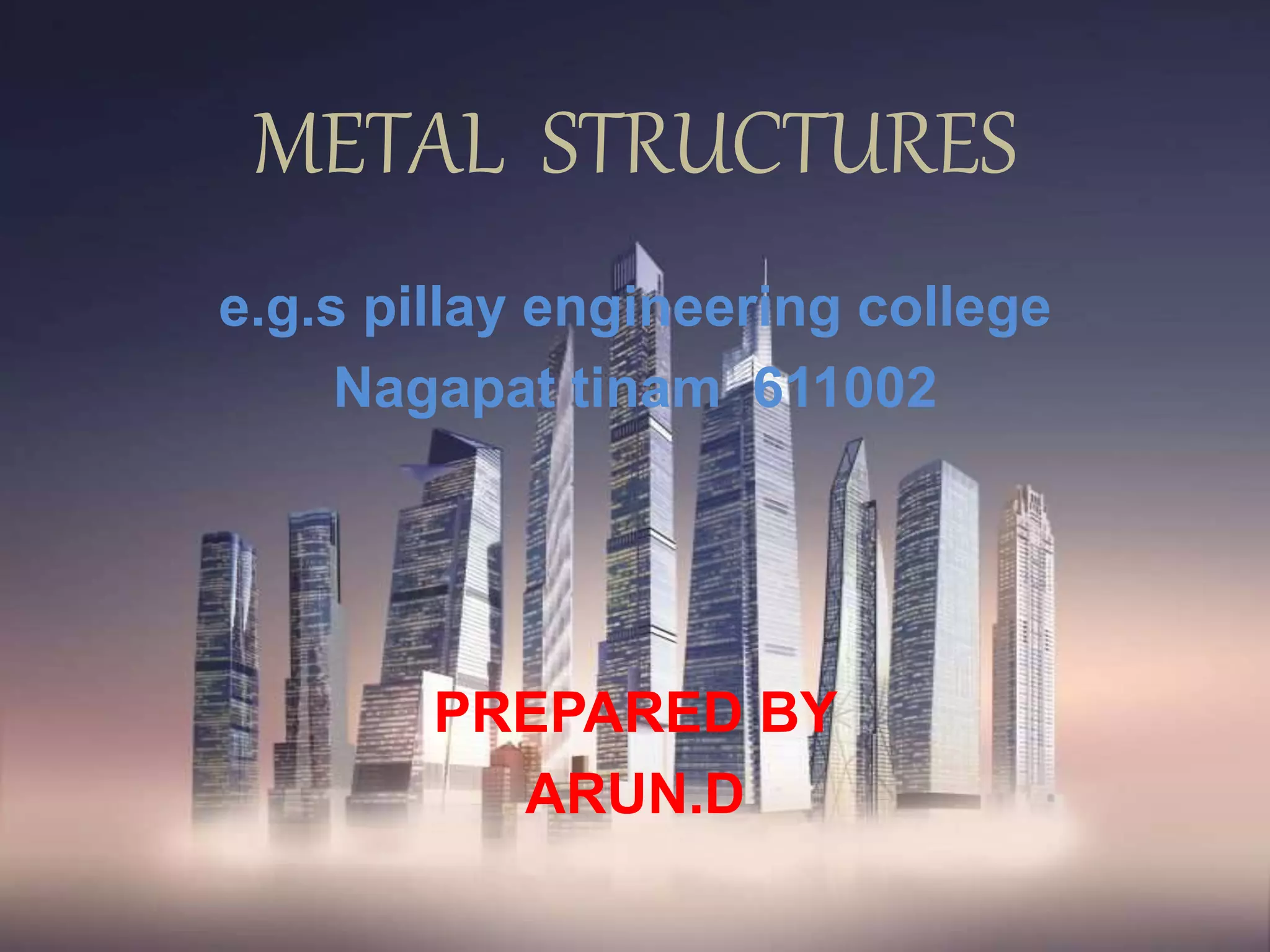
METAL STRUCTURES
e.g.s pillay engineering college
Nagapat tinam 611002
PREPARED BY
ARUN.D
INTRODUCTION
A solid material which is typically hard, shiny,
malleable, fusible and ductile, with good
electrical and thermal conductivity (e.g. iron,
gold, silver, aluminium, and alloys such as
steel).
STEEL
Steel is an alloy of iron & carbon
Iron is the major ore of steel
Steel contains 0.002% to 2.1% of carbon
Carbon provides necessary strength
PROPERTIES …
Strength
Toughness
Ductility
Durability
Weldability
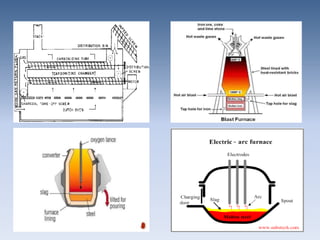
 MANUFACTURING OF STEEL
Carbonization of Coke
Blast furnace
Basic oxygen steel making
Electric arc method
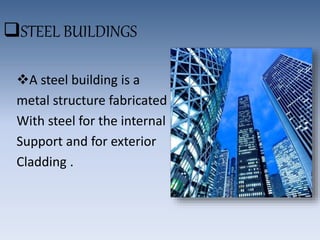
STEEL BUILDINGS
A steel building is a
metal structure fabricated
With steel for the internal
Support and for exterior
Cladding .
STEEL IN CONSTRUCTION TODAY
Nowadays , most of the buildings were
constructed using steel .
Steel provides more strength .
Architects have more flexibility in designing .
Can be combined with other materials .
100% recyclable .
MAIN USES OF STEEL BUILDINGS
Storage Buildings
Skyscrapers
Office Buildings & Commercial Buildings
Temporary Buildings
Tower Structures
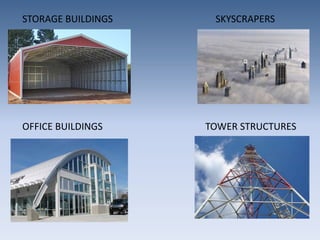
STORAGE BUILDINGS SKYSCRAPERS
OFFICE BUILDINGS TOWER STRUCTURES
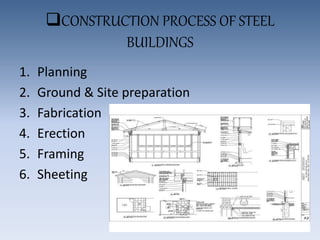
CONSTRUCTION PROCESS OF STEEL
BUILDINGS
1. Planning
2. Ground & Site preparation
3. Fabrication
4. Erection
5. Framing
6. Sheeting
SITE INVESTIGATIONS
The main purpose of site investigation
To determine the nature of the sub soil .
To determine the bearing capacity of the soil .
To determine the possibility of the ground
movement .
FABRICATION
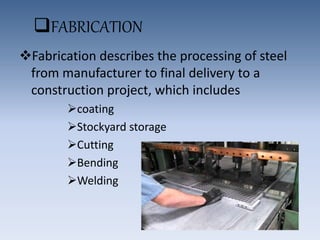
Fabrication describes the processing of steel
from manufacturer to final delivery to a
construction project, which includes
coating
Stockyard storage
Cutting
Bending
Welding
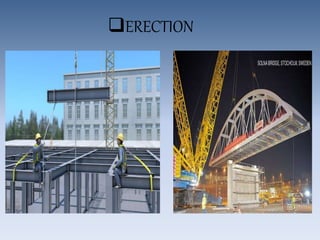
ERECTION
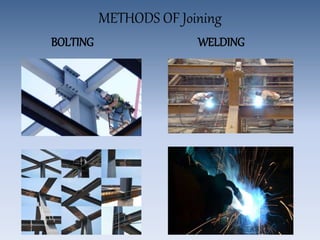
METHODS OF Joining
BOLTING WELDING
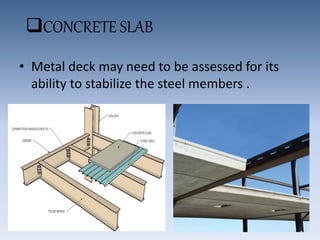
CONCRETE SLAB
• Metal deck may need to be assessed for its
ability to stabilize the steel members .
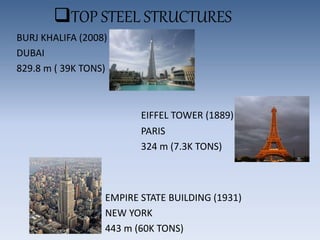
TOP STEEL STRUCTURES
BURJ KHALIFA (2008)
DUBAI
829.8 m ( 39K TONS)
EIFFEL TOWER (1889)
PARIS
324 m (7.3K TONS)
EMPIRE STATE BUILDING (1931)
NEW YORK
443 m (60K TONS)
IS STANDARDS
• IS: 800 : 2007 – Code of Practice for general construction in
Steel
• IS: 802 Part 2 : 1978 – Code of Practice for use of Structural
Steel in Overhead Transmission Towers-Fabrication,
Galvanizing, Inspection and Packing
• IS: 806 : 1968 – Code of Practice for USE OF Steel Tubes in
General Building Construction
• IS: 808 : 1989 – Dimensions for Hot Rolled Steel Beam,
Column, Channel and Angle Sections
• IS:814 : 2004 – Covered Electrodes for Manual Metal Arc
Welding of Carbon and Carbon Manganese Steel
Specification
• IS:816 : 1969 – Code of Practice for use of Metal Arc
Welding for General Construction in Mild Steel.
• IS:1161 : 1998 – Specification For Steel Tubes for Structural
Purposes.
IN INDIA
Like the concrete technology .
Rare steel structures .
As re-bars but not complete steel structures .
Major reasons were…
Cost
Installation & Transportation
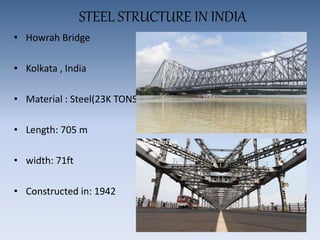
STEEL STRUCTURE IN INDIA
• Howrah Bridge
• Kolkata , India
• Material : Steel(23K TONS
• Length: 705 m
• width: 71ft
• Constructed in: 1942
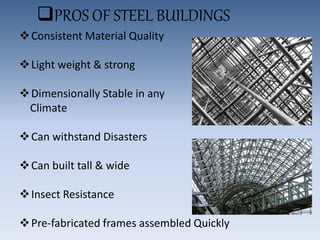
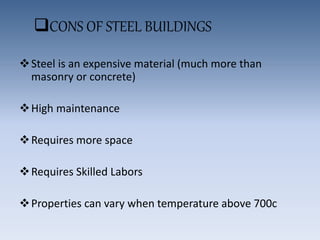
PROS OF STEEL BUILDINGS
Consistent Material Quality
Light weight & strong
Dimensionally Stable in any
Climate
Can withstand Disasters
Can built tall & wide
Insect Resistance
Pre-fabricated frames assembled Quickly
CONS OF STEEL BUILDINGS
Steel is an expensive material (much more than
masonry or concrete)
High maintenance
Requires more space
Requires Skilled Labors
Properties can vary when temperature above 700c
CONCRETE STRUCTURE VS STEEL STRUCTURE
CONCRETE STRUCTURE
• More Durable
• Less resistance to Durable
• Low load carrying capacity
• Scrap value is nil
• Self wt. is very high
• Foundation should be
strong
• Simple process
• Low cost
STEEL STRUCTURE
• Less Durable
• More resistance to Disasters
• High load carrying capacity
• Scrap value is good
• Self wt. is 60% less than
concrete
• Structure can be made
without foundation
• Requires skilled labors
• Cost is high
CONCLUSION
• Steel structures demand greater precision
than those built with masonry or concrete
frame, which cannot be guaranteed by all
contractors .
• Factors weighing against them like cost and
energy may appear less important than site
value or project period .
THANK YOU…..

Metal structures

  • 1.
    METAL STRUCTURES e.g.s pillayengineering college Nagapat tinam 611002 PREPARED BY ARUN.D
  • 2.
    INTRODUCTION A solid materialwhich is typically hard, shiny, malleable, fusible and ductile, with good electrical and thermal conductivity (e.g. iron, gold, silver, aluminium, and alloys such as steel).
  • 3.
    STEEL Steel is analloy of iron & carbon Iron is the major ore of steel Steel contains 0.002% to 2.1% of carbon Carbon provides necessary strength
  • 4.
  • 5.
     MANUFACTURING OFSTEEL Carbonization of Coke Blast furnace Basic oxygen steel making Electric arc method
  • 7.
    STEEL BUILDINGS A steelbuilding is a metal structure fabricated With steel for the internal Support and for exterior Cladding .
  • 8.
    STEEL IN CONSTRUCTIONTODAY Nowadays , most of the buildings were constructed using steel . Steel provides more strength . Architects have more flexibility in designing . Can be combined with other materials . 100% recyclable .
  • 9.
    MAIN USES OFSTEEL BUILDINGS Storage Buildings Skyscrapers Office Buildings & Commercial Buildings Temporary Buildings Tower Structures
  • 10.
    STORAGE BUILDINGS SKYSCRAPERS OFFICEBUILDINGS TOWER STRUCTURES
  • 11.
    CONSTRUCTION PROCESS OFSTEEL BUILDINGS 1. Planning 2. Ground & Site preparation 3. Fabrication 4. Erection 5. Framing 6. Sheeting
  • 12.
    SITE INVESTIGATIONS The mainpurpose of site investigation To determine the nature of the sub soil . To determine the bearing capacity of the soil . To determine the possibility of the ground movement .
  • 13.
    FABRICATION Fabrication describes theprocessing of steel from manufacturer to final delivery to a construction project, which includes coating Stockyard storage Cutting Bending Welding
  • 14.
  • 15.
  • 16.
    CONCRETE SLAB • Metaldeck may need to be assessed for its ability to stabilize the steel members .
  • 17.
    TOP STEEL STRUCTURES BURJKHALIFA (2008) DUBAI 829.8 m ( 39K TONS) EIFFEL TOWER (1889) PARIS 324 m (7.3K TONS) EMPIRE STATE BUILDING (1931) NEW YORK 443 m (60K TONS)
  • 18.
    IS STANDARDS • IS:800 : 2007 – Code of Practice for general construction in Steel • IS: 802 Part 2 : 1978 – Code of Practice for use of Structural Steel in Overhead Transmission Towers-Fabrication, Galvanizing, Inspection and Packing • IS: 806 : 1968 – Code of Practice for USE OF Steel Tubes in General Building Construction • IS: 808 : 1989 – Dimensions for Hot Rolled Steel Beam, Column, Channel and Angle Sections • IS:814 : 2004 – Covered Electrodes for Manual Metal Arc Welding of Carbon and Carbon Manganese Steel Specification • IS:816 : 1969 – Code of Practice for use of Metal Arc Welding for General Construction in Mild Steel. • IS:1161 : 1998 – Specification For Steel Tubes for Structural Purposes.
  • 19.
    IN INDIA Like theconcrete technology . Rare steel structures . As re-bars but not complete steel structures . Major reasons were… Cost Installation & Transportation
  • 20.
    STEEL STRUCTURE ININDIA • Howrah Bridge • Kolkata , India • Material : Steel(23K TONS • Length: 705 m • width: 71ft • Constructed in: 1942
  • 21.
    PROS OF STEELBUILDINGS Consistent Material Quality Light weight & strong Dimensionally Stable in any Climate Can withstand Disasters Can built tall & wide Insect Resistance Pre-fabricated frames assembled Quickly
  • 22.
    CONS OF STEELBUILDINGS Steel is an expensive material (much more than masonry or concrete) High maintenance Requires more space Requires Skilled Labors Properties can vary when temperature above 700c
  • 23.
    CONCRETE STRUCTURE VSSTEEL STRUCTURE CONCRETE STRUCTURE • More Durable • Less resistance to Durable • Low load carrying capacity • Scrap value is nil • Self wt. is very high • Foundation should be strong • Simple process • Low cost STEEL STRUCTURE • Less Durable • More resistance to Disasters • High load carrying capacity • Scrap value is good • Self wt. is 60% less than concrete • Structure can be made without foundation • Requires skilled labors • Cost is high
  • 24.
    CONCLUSION • Steel structuresdemand greater precision than those built with masonry or concrete frame, which cannot be guaranteed by all contractors . • Factors weighing against them like cost and energy may appear less important than site value or project period .
  • 25.