Dr Seshu Adluri
Dr. Seshu Adluri
ENG 7704
Structural Steel Design
Introduction
Introduction
Assignments 10%
Labs 5%
Mid term test 25%
Final Examination 60%
http://www.engr.mun.ca/~adluri/courses/steel/outline.htm
Contact: 12:00-2:00 p.m.
p
Monday (EN 3044)
Steel Design - Dr. Seshu Adluri
Brute Strength To Amazing Grace
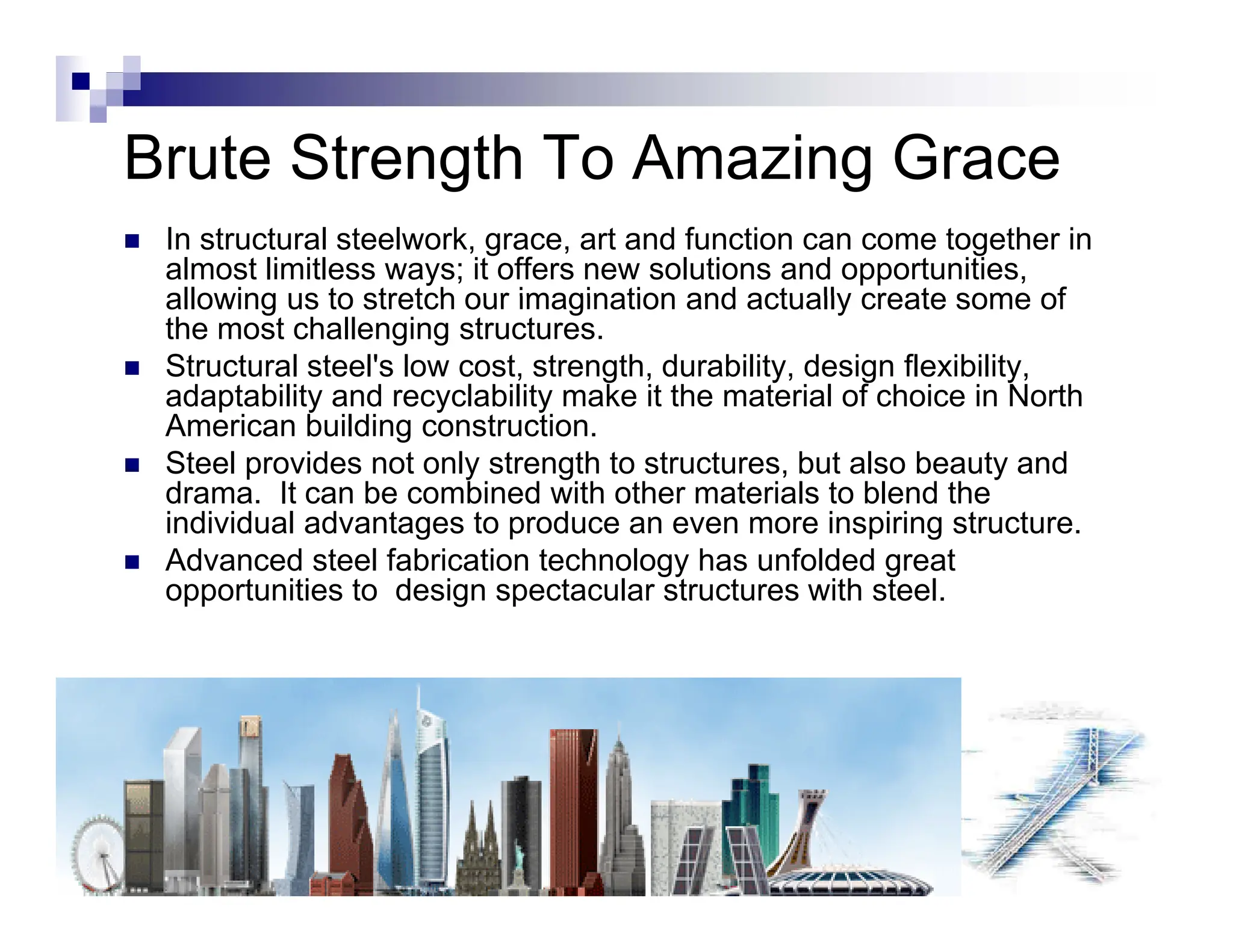
 In structural steelwork, grace, art and function can come together in
almost limitless ways; it offers new solutions and opportunities,
allowing us to stretch our imagination and actually create some of
the most challenging structures.
 Structural steel's low cost, strength, durability, design flexibility,
adaptability and recyclability make it the material of choice in North
A i b ildi t ti
American building construction.
 Steel provides not only strength to structures, but also beauty and
drama. It can be combined with other materials to blend the
individual advantages to produce an even more inspiring structure.
g p p g
 Advanced steel fabrication technology has unfolded great
opportunities to design spectacular structures with steel.
Steel Design - Dr. Seshu Adluri
Materials for ENG 7704
Structural Steel Design
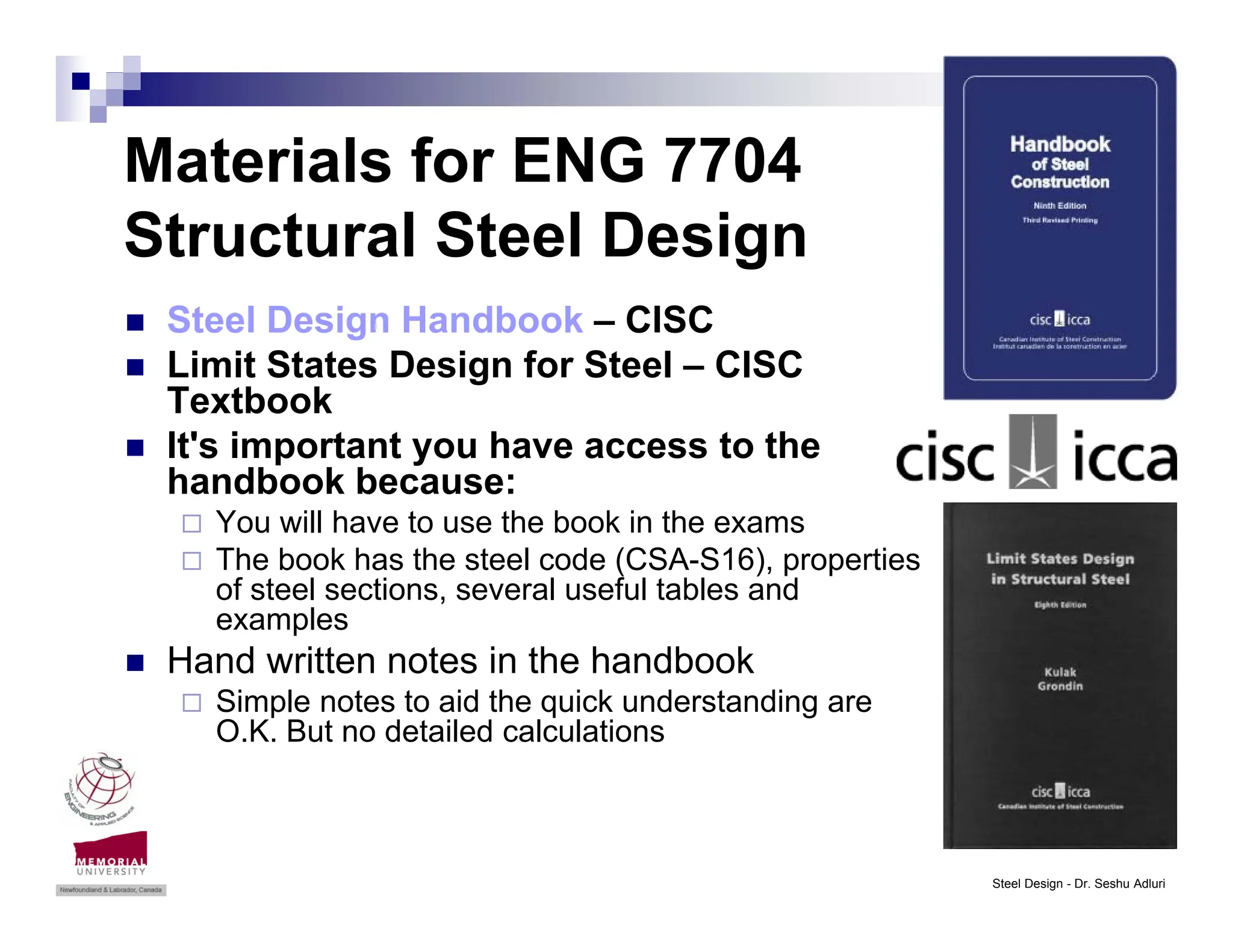
 Steel Design Handbook – CISC
 Limit States Design for Steel – CISC
Textbook
 It's important you have access to the
handbook because:
 You will have to use the book in the exams
 The book has the steel code (CSA-S16), properties
of steel sections, several useful tables and
examples
 Hand written notes in the handbook
 Simple notes to aid the quick understanding are
O.K. But no detailed calculations
Steel Design - Dr. Seshu Adluri
Materials for ENG 7704
Structural Steel Design
 Important:
Ask questions!
Ask questions!
If you don’t, I will have
no choice but to assume
that you understood
(either that, or that you
don’t care)!
Steel Design - Dr. Seshu Adluri
Additi l
Additional resources
 Companion Website — This website from CISC
Companion Website This website from CISC
provides other online resources. Visit
http://www.cisc-icca.ca/
Al i it AISC b it d b f th it
 Also visit AISC website and a number of other sites
for steel structures to get information on famous
structures, history, economics and technical details
, y,
Steel Design - Dr. Seshu Adluri
C T i
Course Topics
 Introduction
 Introduction
 Design of Members and Connections
 Tension Members –yielding, rupture, shear lag, design
 Bolted Joints –failure modes, limit strength, design for different
configurations shear and moment eccentric connections etc
configurations, shear and moment, eccentric connections, etc.
 Welded Joints -types, failure modes, direct load, eccentric
connections, etc.
 Compression Members – Effective Length, Torsional-flexural
buckling built up members local buckling
buckling, built-up members, local buckling
 Compression member design
 Flexural Members – Beams, failure modes, classification,
lateral-torsional buckling, bracing
B d i f h d t
 Beam design for shear and moment
 Beam-Columns -different checks for design
 Plate Girder Design
 Composite Construction –composite beams, failure modes, design
Steel Design - Dr. Seshu Adluri
Co pos te Co st uct o co pos te bea s, a u e odes, des g
 Serviceability: Introductions to Deflections, etc.
L b
Labs
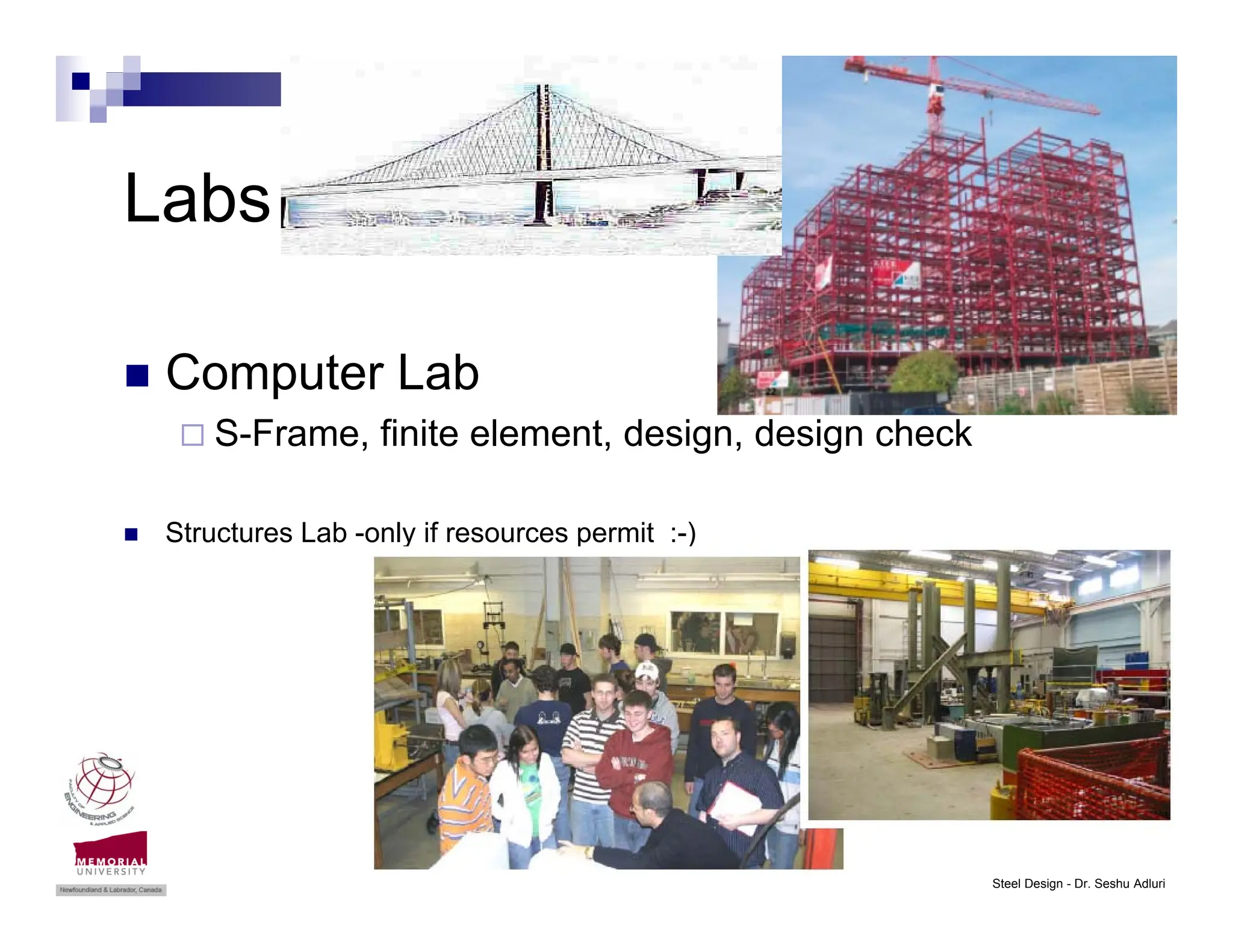
 Computer Lab
 S-Frame, finite element, design, design check
 Structures Lab -only if resources permit :-)
Steel Design - Dr. Seshu Adluri
I t d ti
Introduction
Structural design may be defined as a mixture of art
and science combining the intuitive feeling for the
b h i f t t ith ti l i i l f
behaviour of a structure with rational principles of
mechanics (statics, solid mechanics, dynamics, etc.)
and structural analysis to produce a safe and
economical structure to serve its intended purposes.
Steel is one of the most important building materials in
the modern era. It is used solely or in combination
with other materials such as concrete, timber,
composites etc for a variety of purposes
Steel Design - Dr. Seshu Adluri
composites, etc., for a variety of purposes.
Ad t f St l
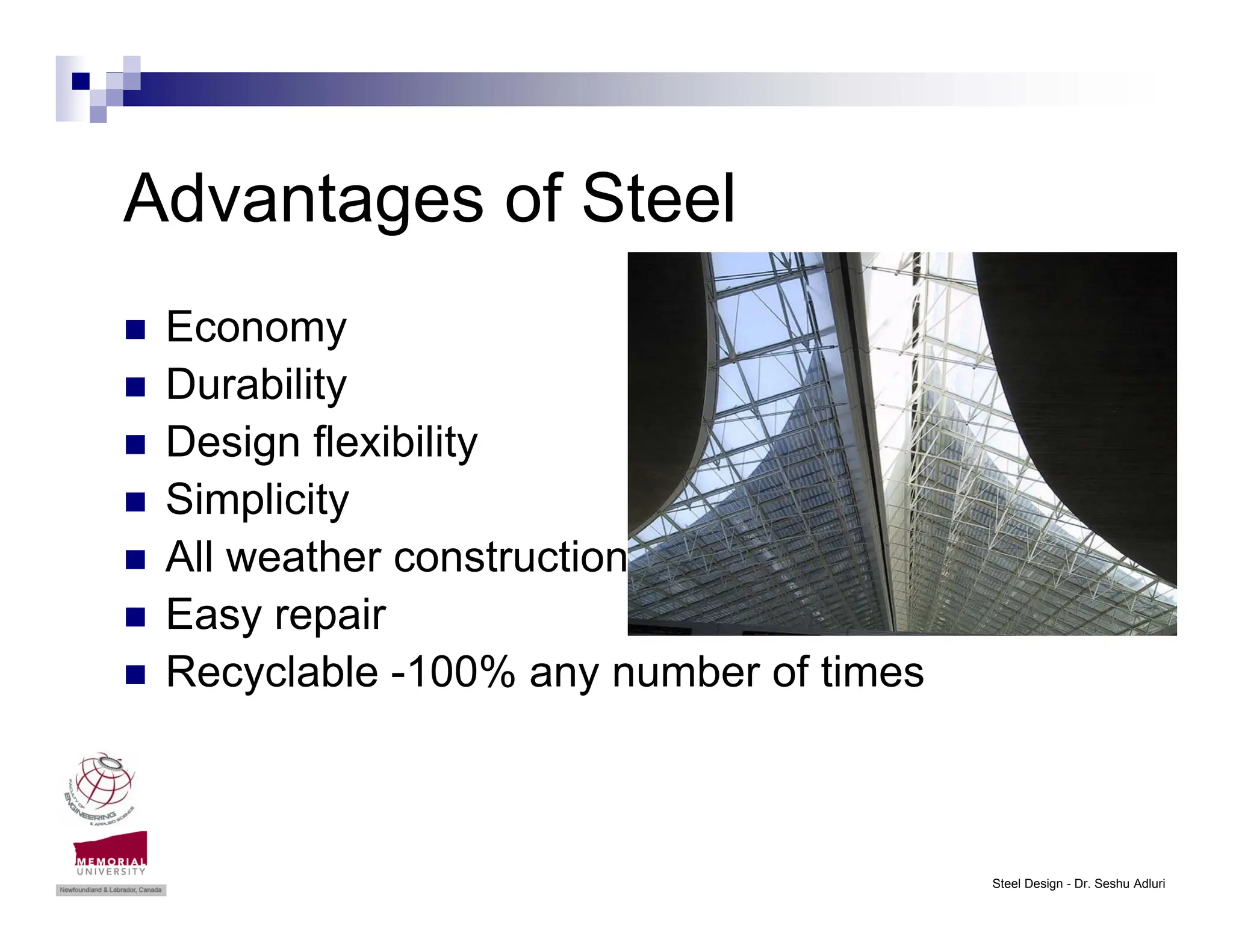
Advantages of Steel
 Economy
 Durability
 Design flexibility
 Simplicity
 All weather construction
 Easy repair
R l bl 100% b f i
 Recyclable -100% any number of times
Steel Design - Dr. Seshu Adluri
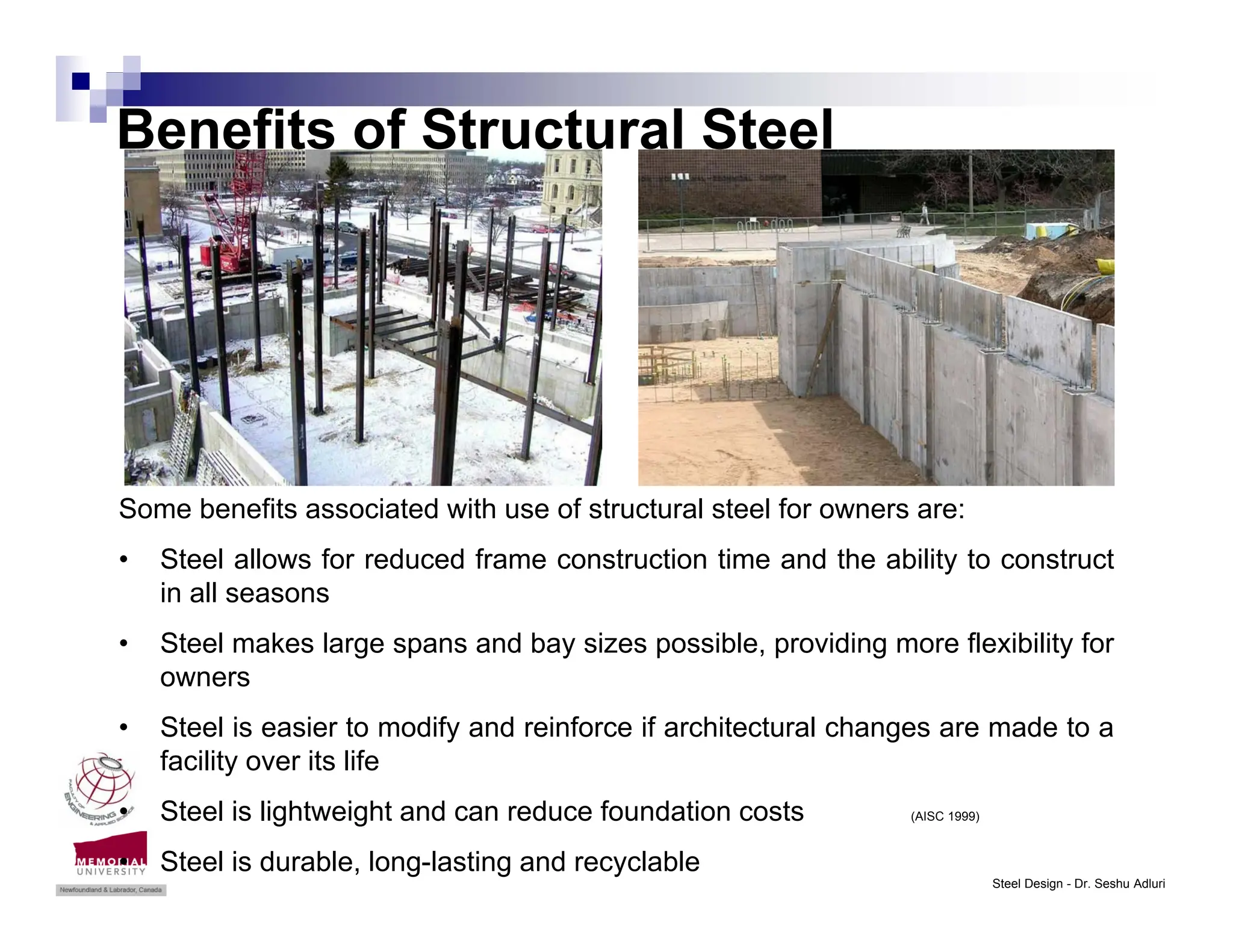
Benefits of Structural Steel
Some benefits associated with use of structural steel for owners are:
• Steel allows for reduced frame construction time and the ability to construct
in all seasons
• Steel makes large spans and bay sizes possible, providing more flexibility for
g p y p , p g y
owners
• Steel is easier to modify and reinforce if architectural changes are made to a
facility over its life
Steel Design - Dr. Seshu Adluri
y
• Steel is lightweight and can reduce foundation costs (AISC 1999)
• Steel is durable, long-lasting and recyclable
Unique Aspects of Steel Construction
Procurement and management of structural steel is similar to other materials,
but there are some unique aspects to steel construction:
• Steel is fabricated off-site (above left)
• On-site erection is a rapid process (above right)
• This gives use of structural steel some scheduling advantages
Steel Design - Dr. Seshu Adluri
This gives use of structural steel some scheduling advantages
• Coordination of all parties is essential for achieving potential advantages
(AISC 1999)
Just couldn’t resist!
Just couldn t resist!

Moon Light,
Maritimes and
Steel tower!
Steel Design - Dr. Seshu Adluri
Wow!
 Steel is not
just for
just for
structures
Chicago's Millennium Park has the modern art sculpture officially
titled Cloud Gate, although locals quickly dubbed it -the Bean.
Designed by Canadian Frank Gehry. See also Chicago's Millennium
Park pavilion with the curved steel elements.
Steel Design - Dr. Seshu Adluri
Hi t
http://www.dedroidify.com/pillar.htm
History
 Wootz is a steel developed in
India around 300 BC. The word
wootz is a mistranscription of ukku,
the word for steel in telugu
the word for steel in telugu.
 The pillar is fabricated in 310 A.D.
in India. It has all along been
outside as an astronomical
observatory aid. It never rusted.
 7.21 m (incl. buried), 41 cm diam.,
6 tons
6 tons
 Made by forge welding!
Steel Design - Dr. Seshu Adluri
Hi t
History
 Damascus steel is a hot-forged steel
used in Middle Eastern sword
making from about 1100 to 1700 AD.
 Damascus swords were of legendary
sharpness and strength and were
sharpness and strength, and were
apocryphally claimed to be able to
cut through lesser quality European
swords and even rock
swords and even rock.
 The foundation for Damascus Steel
is Wootz Steel, which originated in
India and later spread to Persia
India and later spread to Persia.
Steel Design - Dr. Seshu Adluri
Pattern welded "Damascened steel" pocket knife
Hi t
History
 Japanese sword making from
special steel forging is
legendary.
 It is still practiced with very
labour intensive process
labour intensive process.
 China also has had a very
ancient steel industry for
sword making, guns and other
weaponry.
Steel Design - Dr. Seshu Adluri
Engraving of the Edo era depicting forge scenes
Hi t
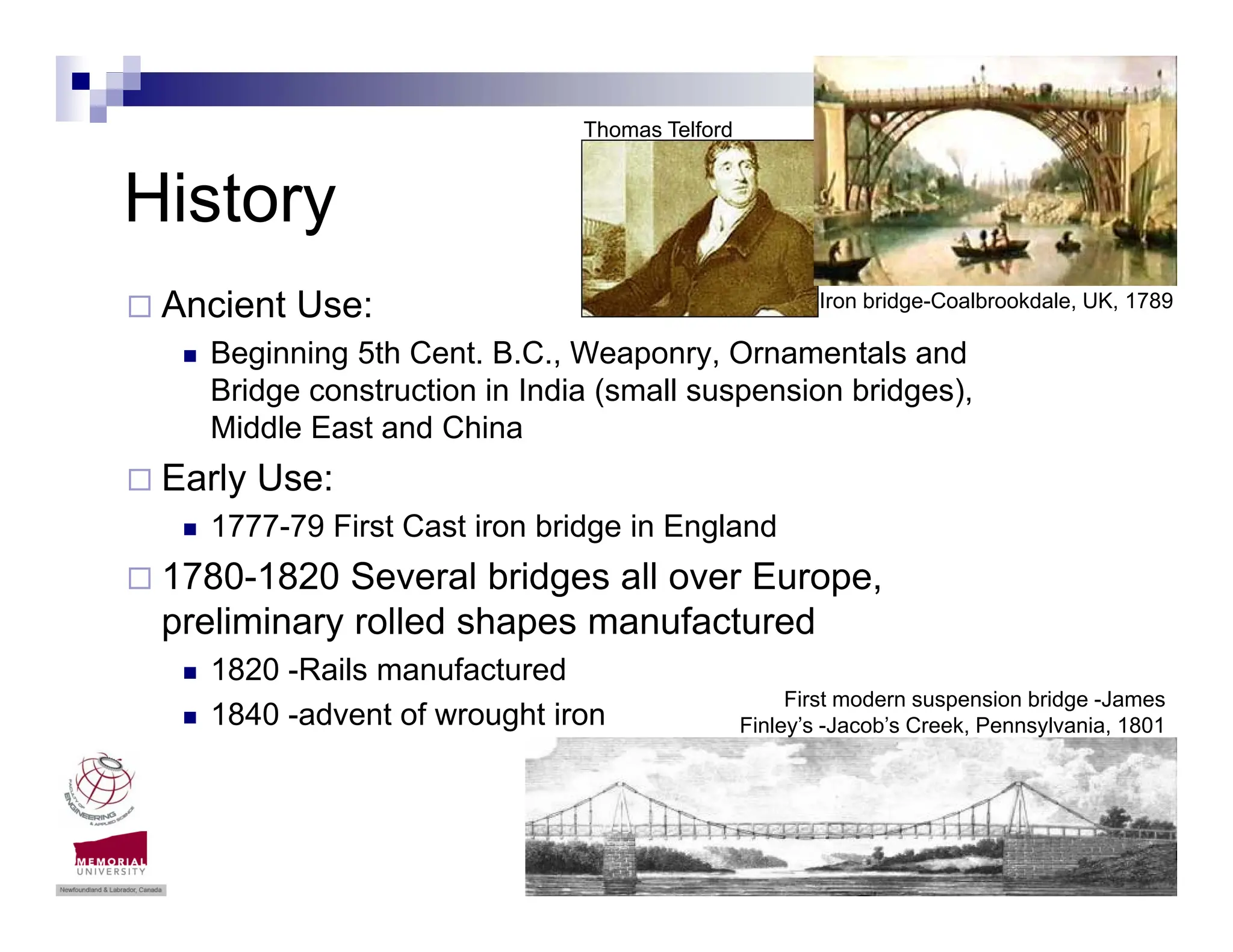
Thomas Telford
History
 A i t U I b id C lb kd l UK 1789
 Ancient Use:
 Beginning 5th Cent. B.C., Weaponry, Ornamentals and
Bridge construction in India (small suspension bridges),
C
Iron bridge-Coalbrookdale, UK, 1789
Middle East and China
 Early Use:
 1777-79 First Cast iron bridge in England
1777 79 First Cast iron bridge in England
 1780-1820 Several bridges all over Europe,
preliminary rolled shapes manufactured
 1820 -Rails manufactured
 1840 -advent of wrought iron
First modern suspension bridge -James
Finley’s -Jacob’s Creek, Pennsylvania, 1801
Steel Design - Dr. Seshu Adluri
1907 Quebec Bridge
Hi t
History …
 Bessemer Process invented in 1855.
Bessemer converter introduced in 1870.
STEEL INTRODUCED
 1890 Steel replaces all other forms
 1890 Steel replaces all other forms.
 Early Structures:
y
 1870s Brooklyn Bridge
 1880s Eiffel Tower (330 m), steel bridges in Pittsburgh,
several steel buildings in Chicago (rebuilt after the great fire)
Home Insurance bldg, 1885-1931
several steel buildings in Chicago (rebuilt after the great fire)
 1890sSeveral steel buildings in NY and Europe
 1907 Quebec Bridge followed by several bridges in
Steel Design - Dr. Seshu Adluri
North America
History...
y
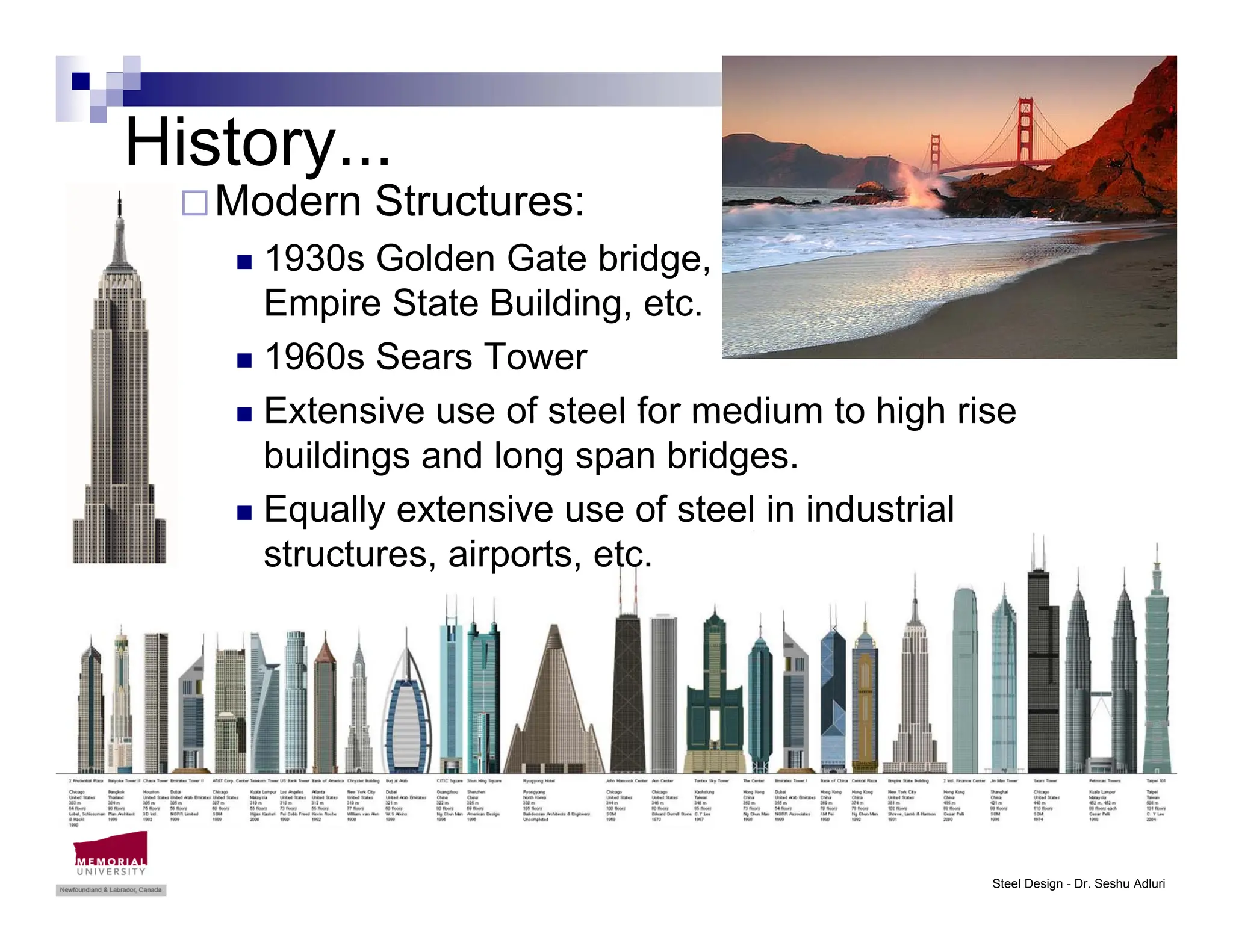
Modern Structures:
 1930s Golden Gate bridge,
Empire State B ilding etc
Empire State Building, etc.
 1960s Sears Tower
 Extensive use of steel for medium to high rise
buildings and long span bridges.
 Equally extensive use of steel in industrial
structures, airports, etc.
Steel Design - Dr. Seshu Adluri
N
Now….
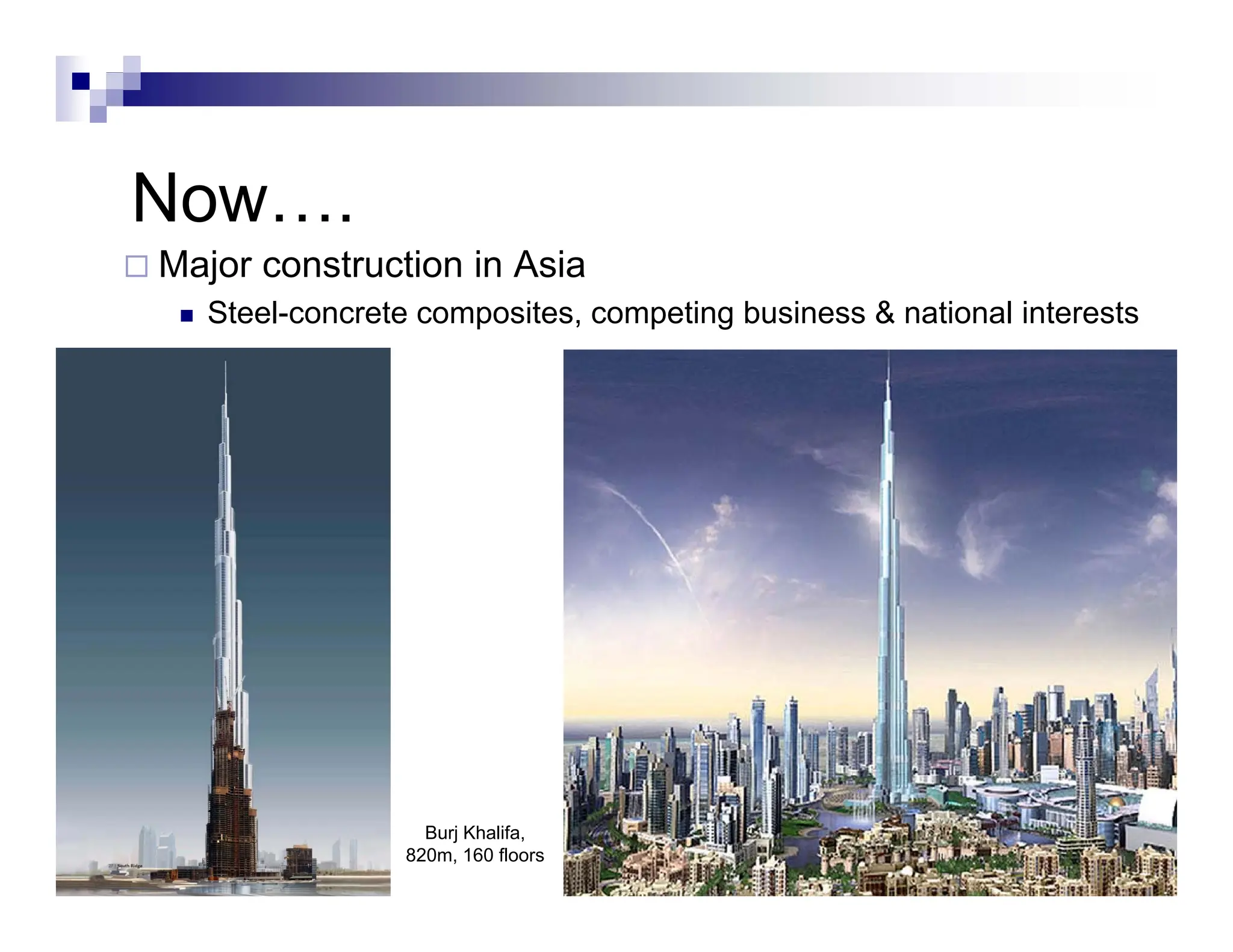
 Major construction in Asia
 Steel-concrete composites, competing business & national interests
Steel Design - Dr. Seshu Adluri
Burj Khalifa,
820m, 160 floors
N
Now….

Steel Design - Dr. Seshu Adluri
F t
Future...
 There is major drop in North America steel building activity
 Asia is booming, Africa and South America might catch-up
 Millennium Tower in Japan and other futuristic projects are
possible (the tower was meant to be about 840 m high, stand alone in Tokyo Bay, isolated, a city of its own
population up to 50 000), to be reached by causeway and boats. Never made it since the late 1980s)
Steel Design - Dr. Seshu Adluri
Bionic Tower, 1228m
Shanghai -proposed
F t
Future...

A comparison of the Burj Khalifa
Steel Design - Dr. Seshu Adluri
p j
and the proposed Nakheel Tower
St l D i
Petronas towers, Kualalampur
Steel Design
 Structures or structural
t i il d f
components primarily made of
steel members attached to each
other appropriately.
pp p y
 Steel is excellent in both tension
and compression.
 Since steel is primarily made of thin plate like
elements, they are susceptible to buckling (local
and overall).
 Connections in steel are considerably different from
those in concrete. In steel, the members are
‘discrete’ or rolled (fabricated) separately and are
attached to each other using appropriate
Steel Design - Dr. Seshu Adluri
Shanghai world finance centre
attached to each other using appropriate
connections.
Li it St t D i R S
φ ≥
Limit States Design
 Ultimate Limit States - usually means that structural safety has been
i d i i l i l d i bili (
i i
R S
φ α
≥
compromised in a certain way - ultimate load capacity, stability (e.g.,
local or over all buckling, or overturning), sliding, fracture (due to
fatigue), etc.
 Serviceability Limit States - usually means that the functionality of the
y y y
structure is effected in some way, i.e., it is rendered unsatisfactory in
terms of operating conditions - Excessive deflection (could be
vertical, horizontal, or skew), vibration, permanent deformation, etc.
 We deal mainly with ultimate strength limit states in this course
 We deal mainly with ultimate strength limit states in this course.
 Clause 7 (CSA-S16), Table 13
 Statistically, φ = resistance factor, α = load factor
 D, L, S, W, T = Effects of dead live, snow, and wind loads (also
, , , , , , (
temperature, creep, relaxation, shrinkage, settlement effects)
Steel Design - Dr. Seshu Adluri
For more info’ refer to the textbook
D f P i i
Degree of Precision
 The accuracy of engineering data is less than ¼ percent
(20.5 kN, not 20.55 kN or worse, 20.55125 kN).
R t fi l l ti l i ll t
 Represent final solution values numerically to an
accuracy of three significant digits.
 If the number begins with 1, then use four significant digits.
g g g
 Examples: 4.78, 728, 1.724, 0.1781, 32.1, 88300, 0.00968,
1056.
 Intermediate values are computed to five significant
digits to avoid rounding errors.
Steel Design - Dr. Seshu Adluri
For more info’, refer to http://en.wikipedia.org/wiki/Significant_figures
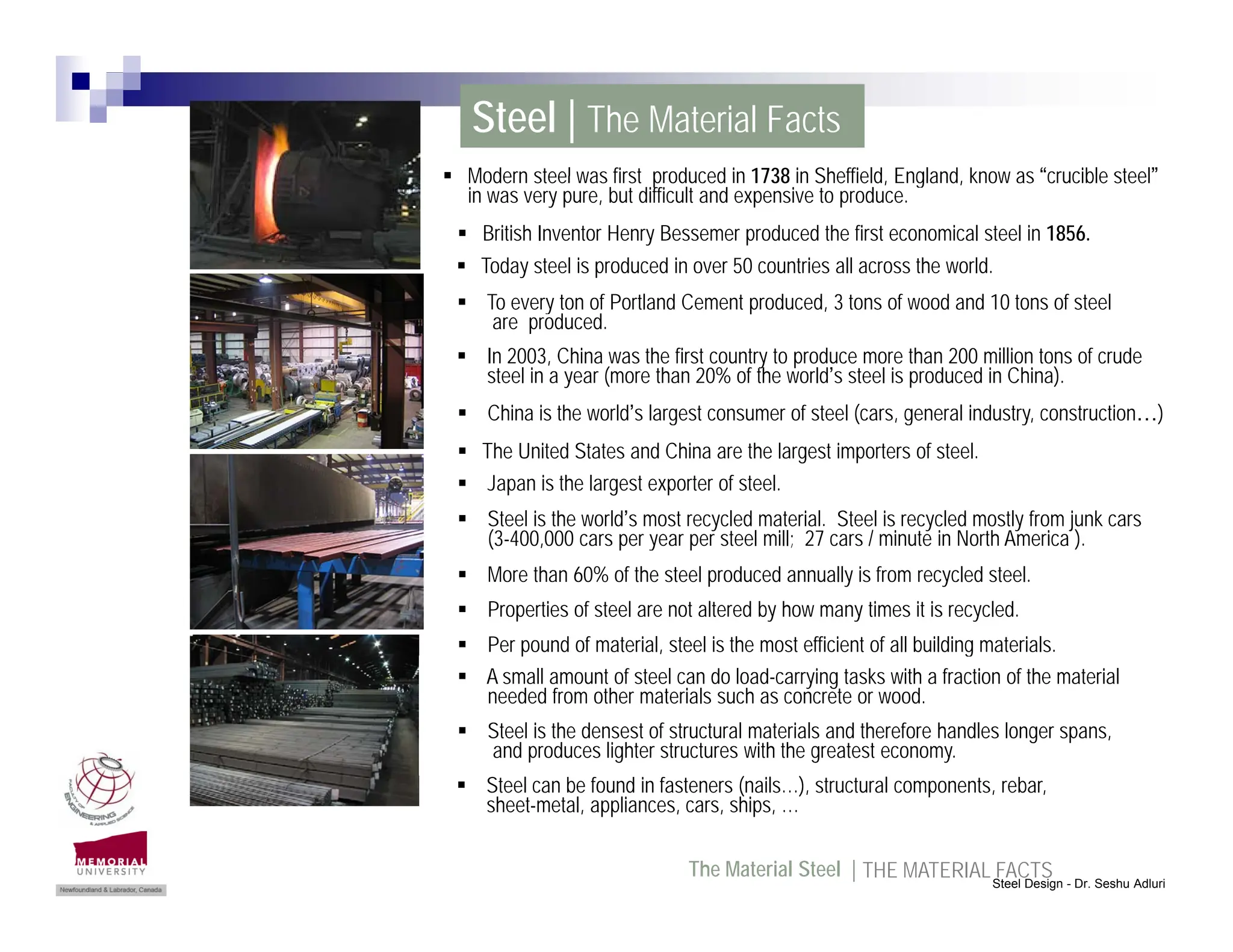
Steel | The Material Facts
 Modern steel was first produced in 1738 in Sheffield England know as “crucible steel”
 Today steel is produced in over 50 countries all across the world.
T t f P tl d C t d d 3 t f d d 10 t f t l
 British Inventor Henry Bessemer produced the first economical steel in 1856.
 Modern steel was first produced in 1738 in Sheffield, England, know as crucible steel
in was very pure, but difficult and expensive to produce.
 In 2003, China was the first country to produce more than 200 million tons of crude
steel in a year (more than 20% of the world’s steel is produced in China).
 China is the world’s largest consumer of steel (cars general industry construction )
 To every ton of Portland Cement produced, 3 tons of wood and 10 tons of steel
are produced.
China is the world s largest consumer of steel (cars, general industry, construction…)
 Japan is the largest exporter of steel.
 The United States and China are the largest importers of steel.
 Steel is the world’s most recycled material. Steel is recycled mostly from junk cars
(3 400 000 cars per year per steel mill; 27 cars / minute in North America )
 More than 60% of the steel produced annually is from recycled steel.
 Properties of steel are not altered by how many times it is recycled.
 Per pound of material, steel is the most efficient of all building materials.
(3-400,000 cars per year per steel mill; 27 cars / minute in North America ).
p g
 A small amount of steel can do load-carrying tasks with a fraction of the material
needed from other materials such as concrete or wood.
 Steel is the densest of structural materials and therefore handles longer spans,
and produces lighter structures with the greatest economy.
Steel Design - Dr. Seshu Adluri
 Steel can be found in fasteners (nails…), structural components, rebar,
sheet-metal, appliances, cars, ships, …
THE MATERIAL FACTS
The Material Steel |
Steel | Chemical Composition
Wrought Iron Cast Iron
< 0.2 % Carbon < 3 - 4 % Carbon
Steel
0.2 - 2 % Carbon
Soft & Malleable Hard & Brittle
+
Controlled amounts of:
Manganese, Phosphorous
Sili S lf O
Carbon Steel
Mild Steel
0.2 - 0.25 % Carbon
Medium Steel
Combinations of:
+
Silicon, Sulfur, Oxygen
Carbon Steel
Medium Steel
0.25 - 0.45 % Carbon
Hard Steel
0.45 - 0.85 % Carbon
Alloy Steel
Chromium, Cobalt, Copper,
Molybdenum, Nickel,
Tungsten, Vanadium
+
Spring Steel
0.85 - 1.85 % Carbon
Alloy Steel
Stainless Steel
Weathering Steel
Steel Design - Dr. Seshu Adluri
CHEMICAL COMPOSITION
The Material Steel |
St l i ll f I C b ( 2%) d M ( 1%)
Steel | Chemical Composition
 Steel is an alloy of Iron, Carbon (<2%), and Manganese (<1%).
It also contains small amounts of Phosphorous, Silicon,
Sulfur and Oxygen
h h i l l ll d
C b St l
Carbon content greatly affects the properties of steel
More Carbon increases : strength, hardness, corrosion-resistance
 these chemical elements are controlled
to provide consistent quality and grade of steel
Carbon Steel
g , ,
More Carbon decreases : malleability, ductility, and weldability
The amount of Carbon does NOT affect the Modulus of Elasticity (E)
of the Steel
i C b St l t hi h h i l
Alloy Steel
Stainless Steel
 is Carbon Steel to which one or more chemical
elements have been added to achieve certain physical or chemical
properties
Alloy Steel
Adding 15-18% Chromium and 7-8% Nickel produces
corrosion-resistant steel
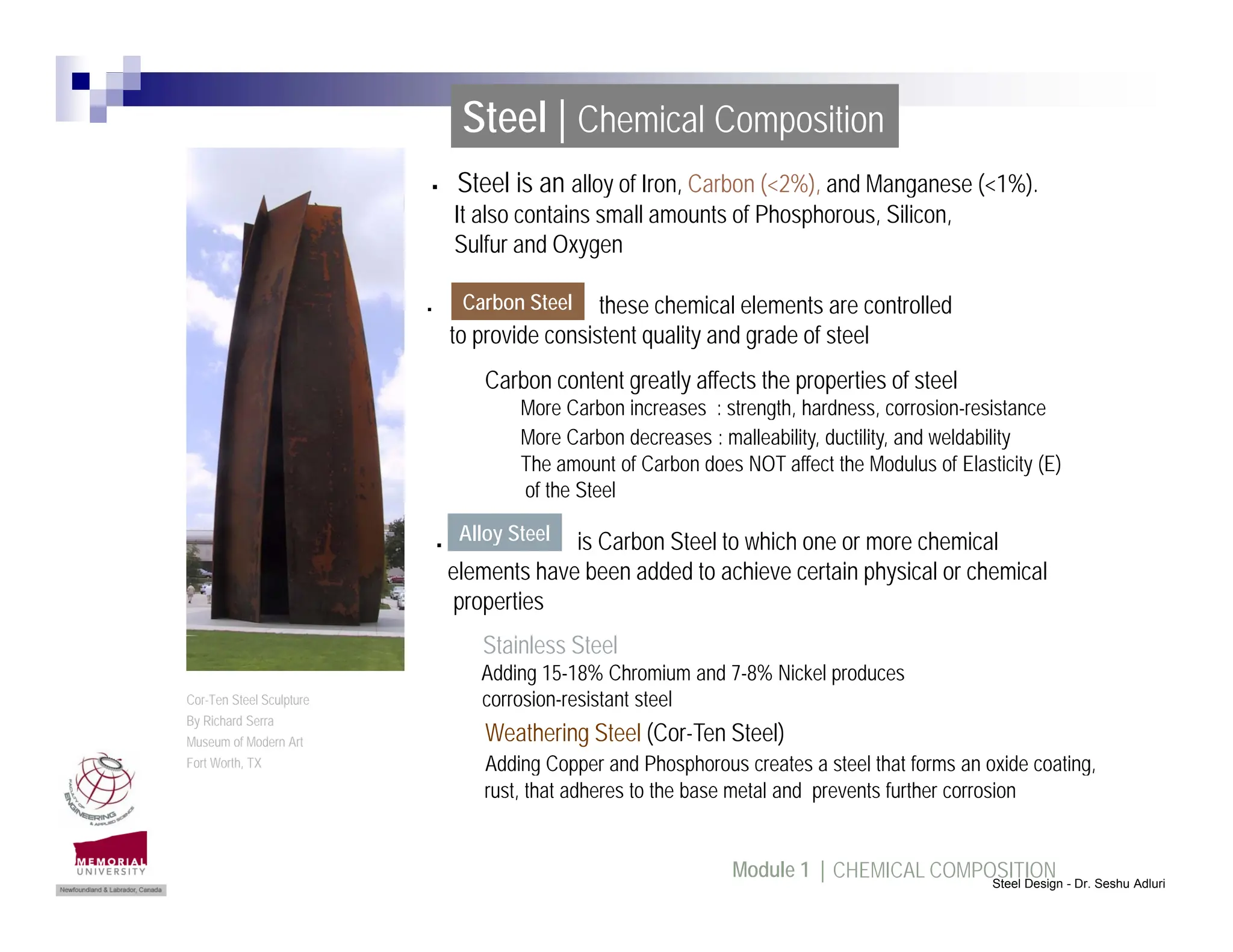
Cor-Ten Steel Sculpture
By Richard Serra
Museum of Modern Art
Fort Worth, TX
Weathering Steel (Cor-Ten Steel)
Adding Copper and Phosphorous creates a steel that forms an oxide coating,
Steel Design - Dr. Seshu Adluri
rust, that adheres to the base metal and prevents further corrosion
CHEMICAL COMPOSITION
Module 1 |
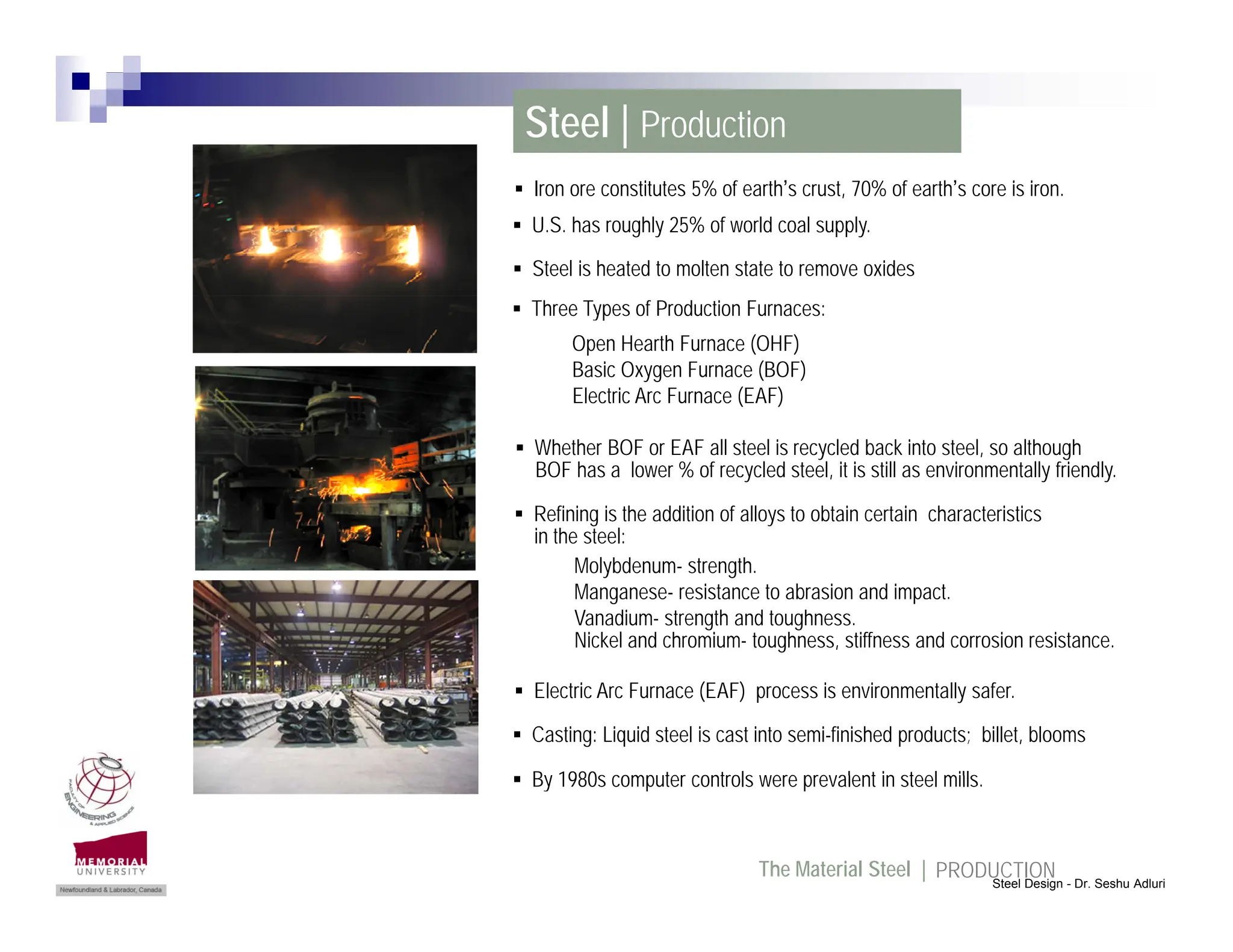
Steel | Production
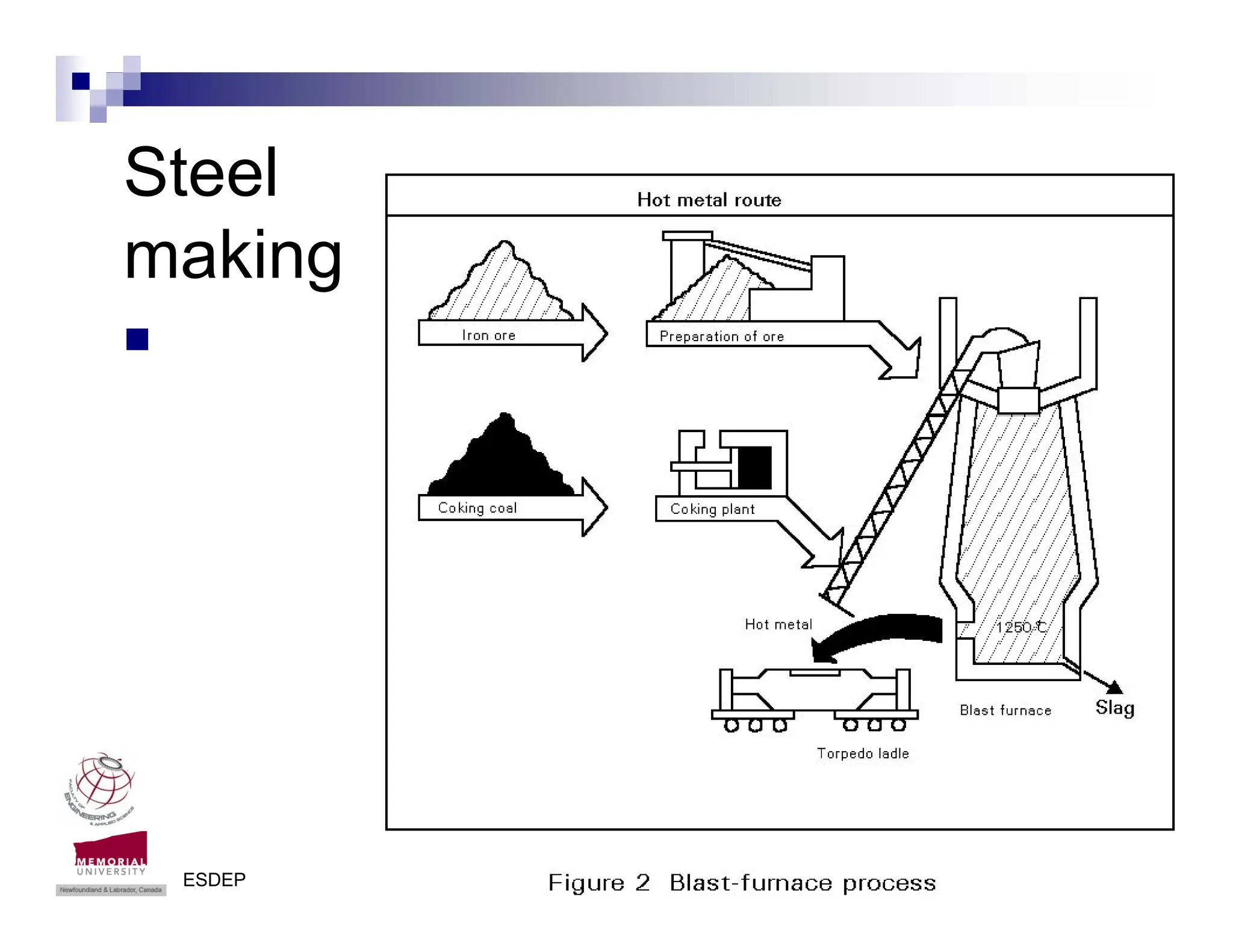
 U.S. has roughly 25% of world coal supply.
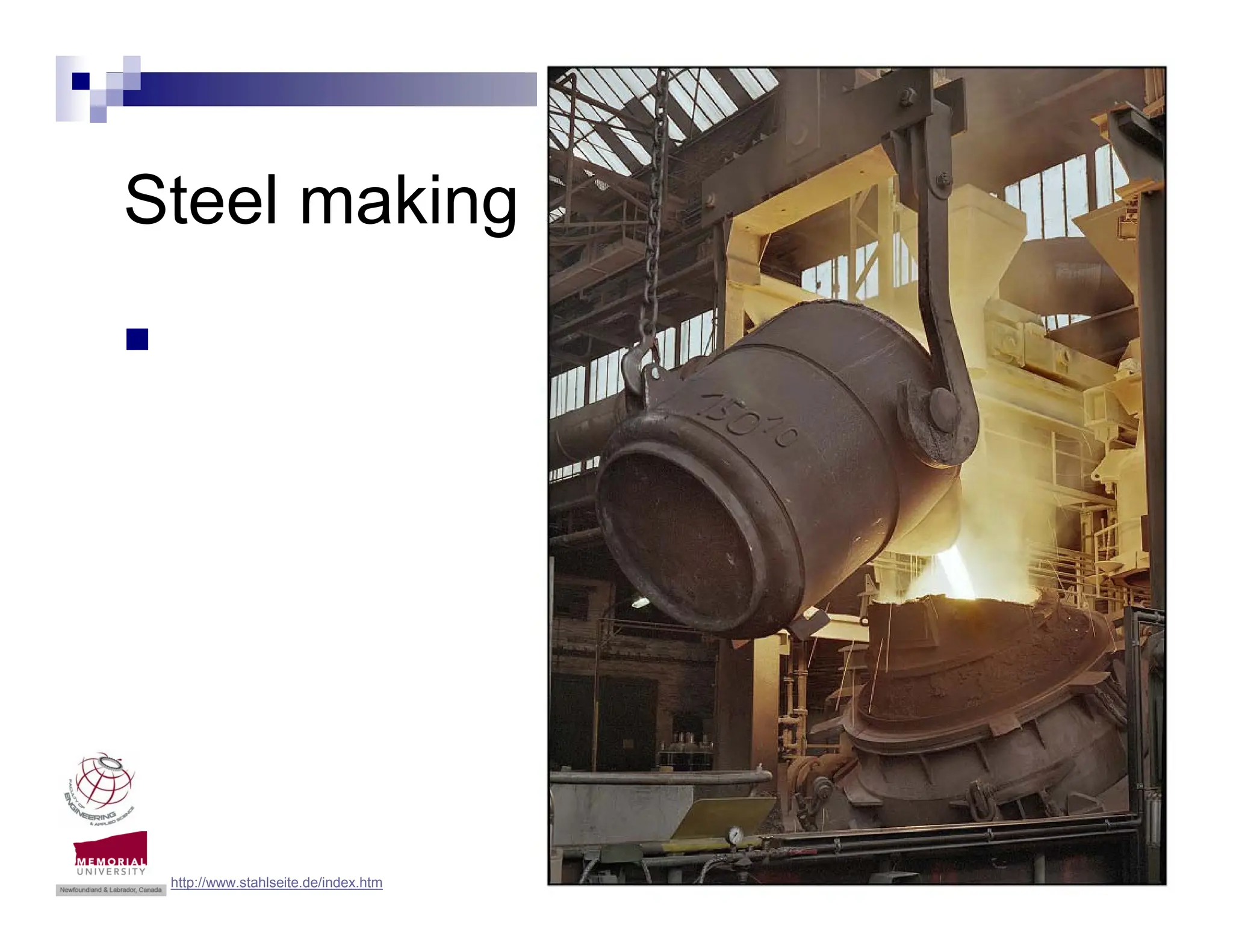
 Steel is heated to molten state to remove oxides
 Iron ore constitutes 5% of earth’s crust, 70% of earth’s core is iron.
Open Hearth Furnace (OHF)
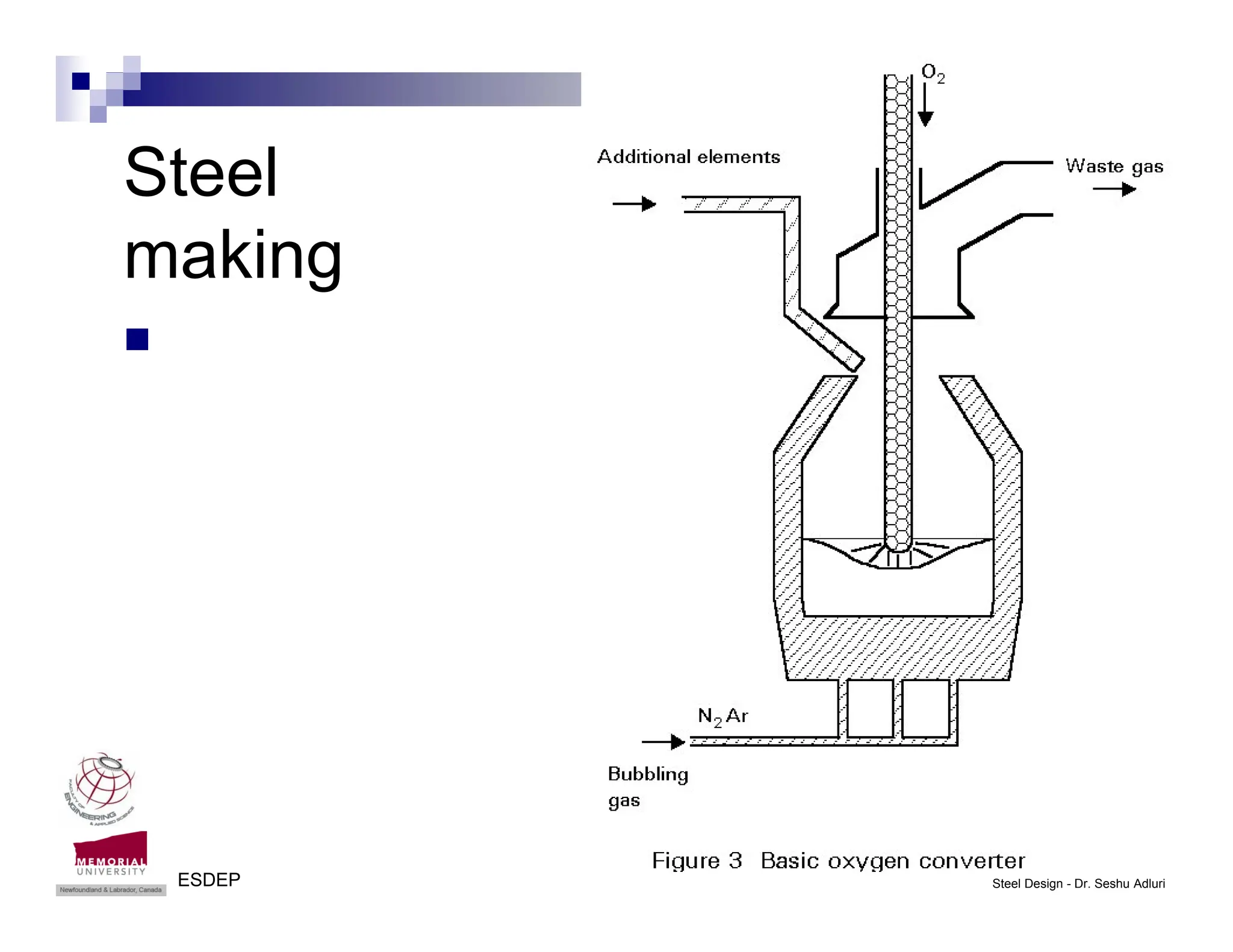
Basic Oxygen Furnace (BOF)
Electric Arc Furnace (EAF)
 Three Types of Production Furnaces:
 Refining is the addition of alloys to obtain certain characteristics
in the steel:
 Whether BOF or EAF all steel is recycled back into steel, so although
BOF has a lower % of recycled steel, it is still as environmentally friendly.
in the steel:
Molybdenum- strength.
Manganese- resistance to abrasion and impact.
Vanadium- strength and toughness.
Nickel and chromium- toughness, stiffness and corrosion resistance.
 Electric Arc Furnace (EAF) process is environmentally safer.
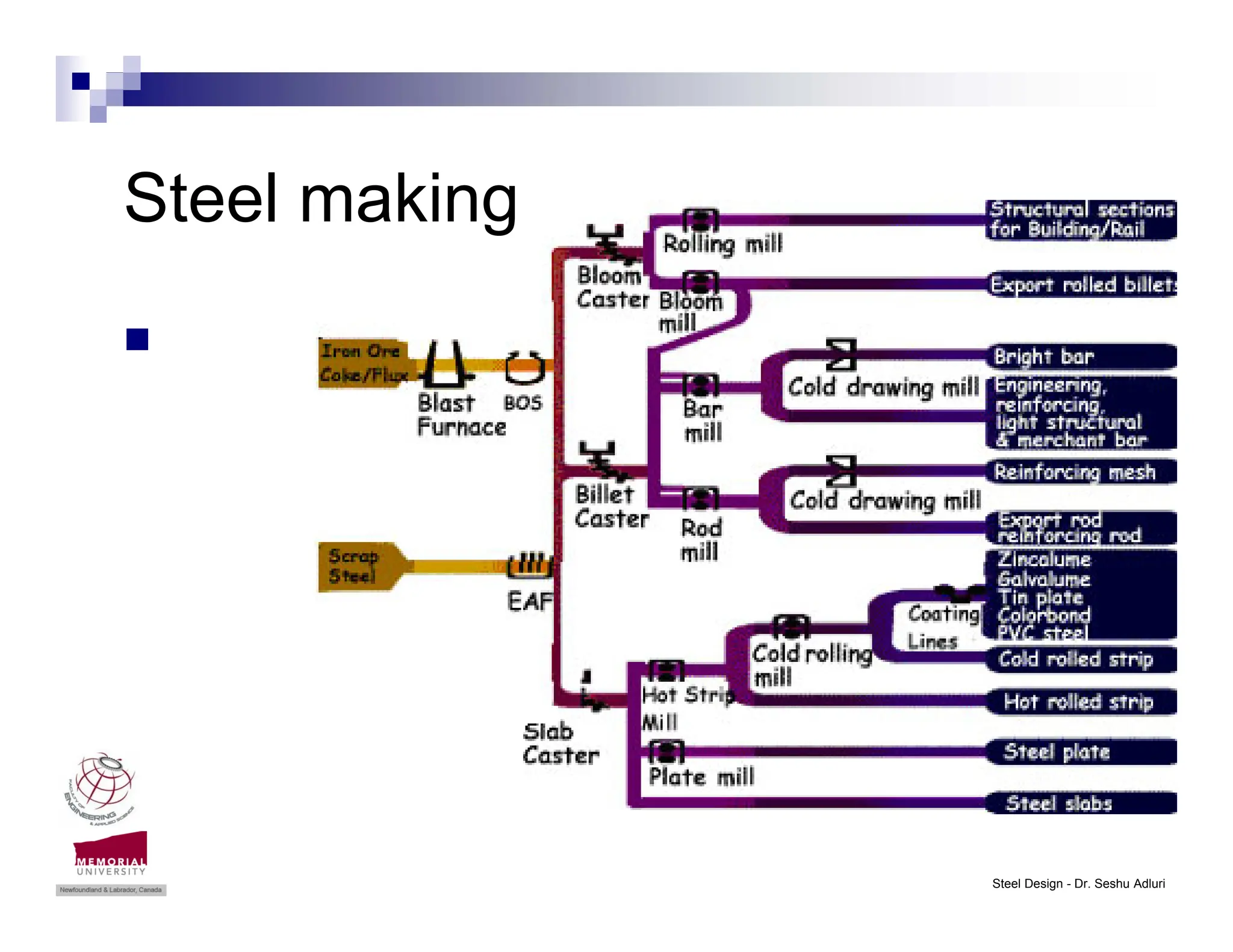
 Casting: Liquid steel is cast into semi-finished products; billet, blooms
By 1980s computer controls were prevalent in steel mills
Steel Design - Dr. Seshu Adluri
 By 1980s computer controls were prevalent in steel mills.
PRODUCTION
The Material Steel |
Open Hearth Furnace (OHF):
 Discontinued in USA due to OSHA and EPA regulations,
it wasted energy and manpower.
 Last Open Hearth Furnace in U.S. was closed down in 1980s.
 Extreme heat burned out impurities in iron.
 Accepts variable amounts of scraps (20-80%) .
 3000°F minimum temperature required 10 hours to accomplish
 3000 F minimum temperature required, 10 hours to accomplish.
 Worldwide, 3.6% of steel produced in 2003 was OHF.
Steel Design - Dr. Seshu Adluri
PRODUCTION
The Material Steel |
St l ki
Steel making

Steel Design - Dr. Seshu Adluri
St l ki
Steel making

Steel Design - Dr. Seshu Adluri
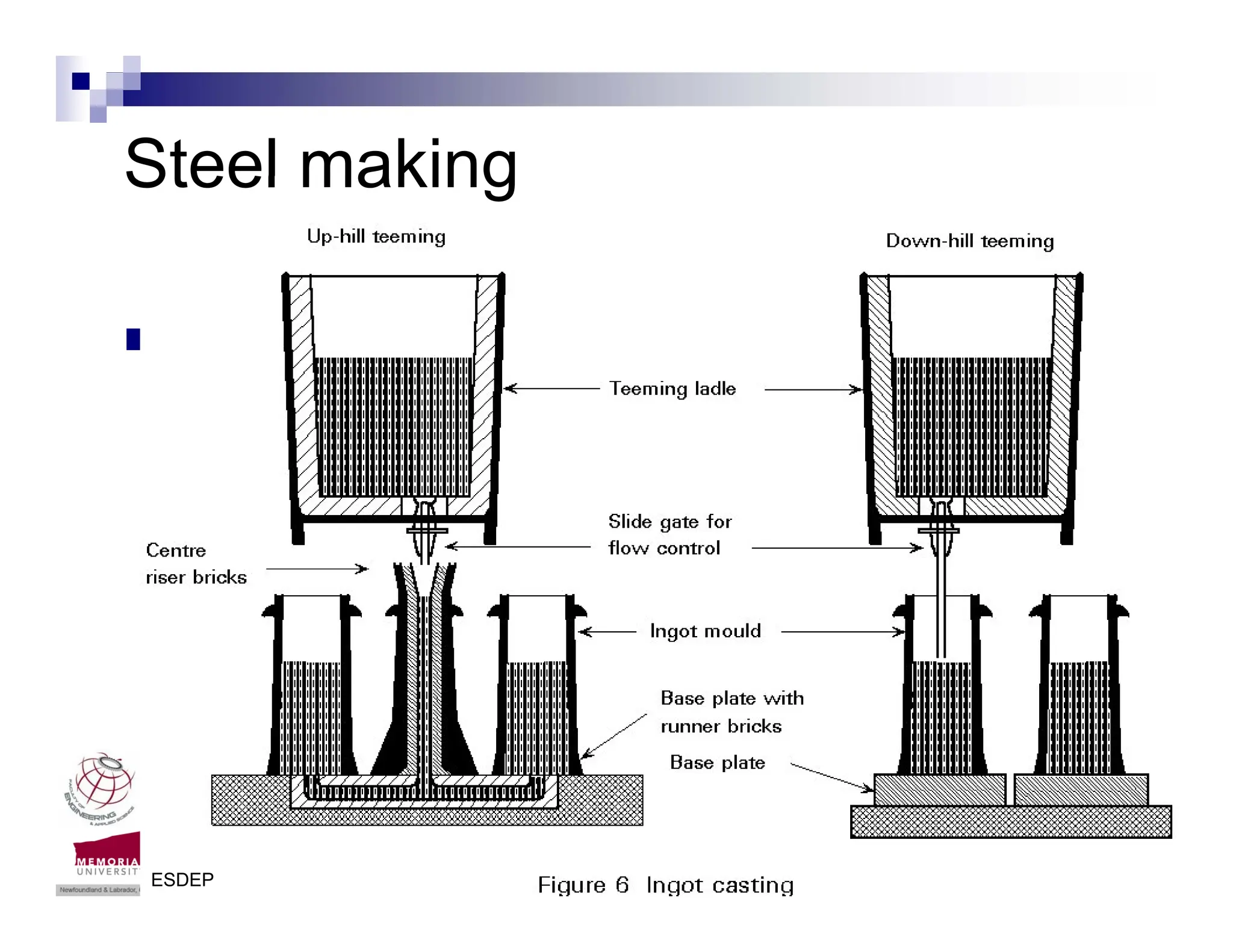
ESDEP
Steel
Steel
making

Steel Design - Dr. Seshu Adluri
ESDEP
Steel
Steel
making

Steel Design - Dr. Seshu Adluri
ESDEP
Steel
Steel
making

Steel Design - Dr. Seshu Adluri
ESDEP
Steel making
g

Steel Design - Dr. Seshu Adluri
ESDEP
Steel making
Steel making

Steel Design - Dr. Seshu Adluri
ESDEP
Steel
Steel
making
g

Steel Design - Dr. Seshu Adluri
ESDEP
Steel
Steel
making

Steel Design - Dr. Seshu Adluri
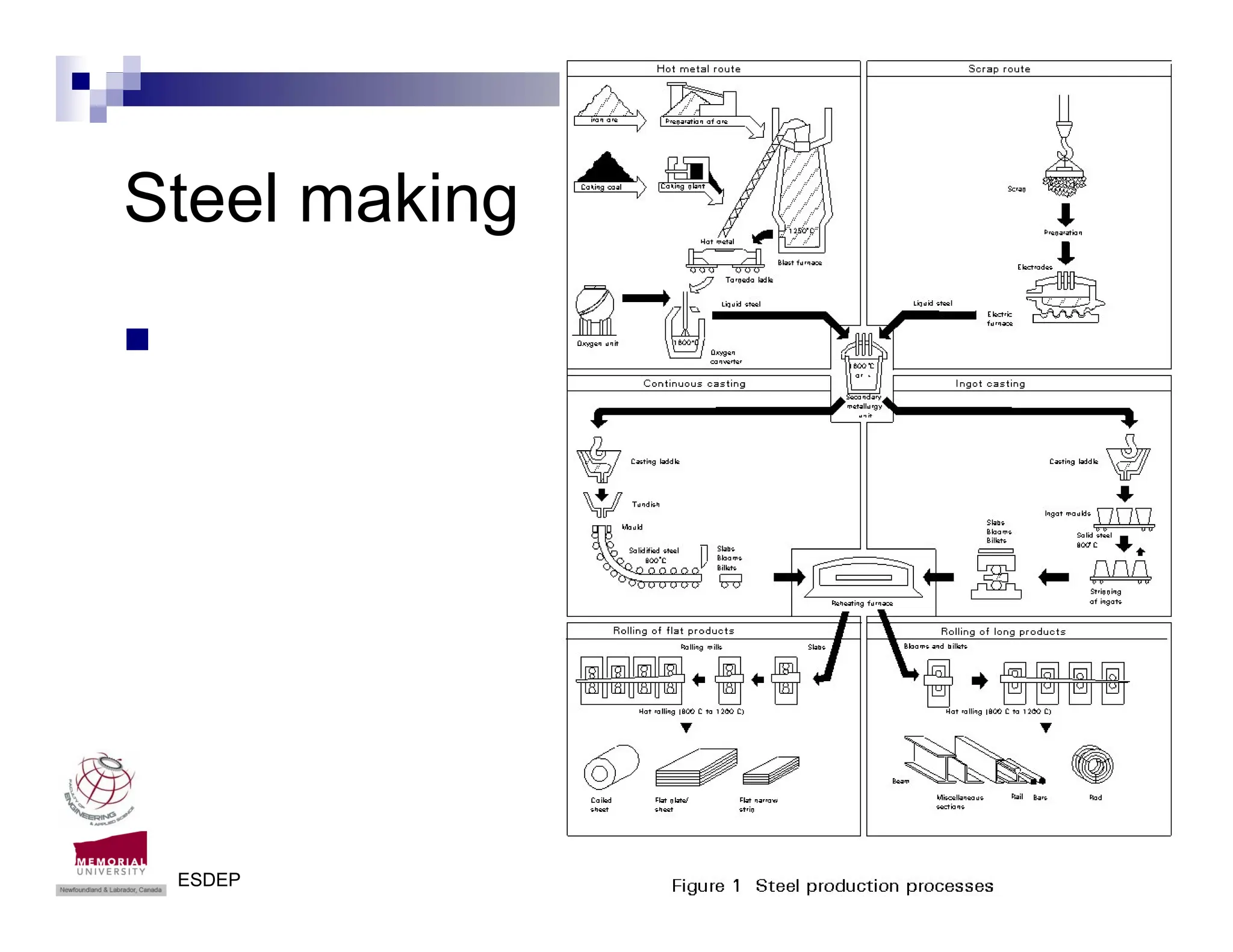
Hot-rolling &
Continuous
casting
casting
 Continuous casting (right, red arrows) is a method of working steel
that conveys steel from its molten state to blooms, ingots, or slabs.
The white hot metal is poured into open ended moulds and continues
The white-hot metal is poured into open-ended moulds and continues
on through rollers cooled by water. A series of guide rollers further
shapes the steel into the desired form.
 However, hot rolling (left, blue arrows) is still the primary means of
illi t l Thi b i ith h d t l l b hi h
milling steel. This process begins with pre-shaped steel slabs, which
are reheated in a soaking pit. The steel passes through a series of
mills: the blooming mill, the roughing mill, and the finishing mill, which
make it progressively thinner.
Steel Design - Dr. Seshu Adluri
 Finally, the steel is wound into coils and transported elsewhere for
further processing.
Steel
Steel
making
g

Steel Design - Dr. Seshu Adluri
St l ki
Steel making

Steel Design - Dr. Seshu Adluri
ESDEP
St l ki
Steel making

Steel Design - Dr. Seshu Adluri
http://www.stahlseite.de/index.htm
Steel making
Steel making
 Continuous
 Continuous
caster
Steel Design - Dr. Seshu Adluri
http://www.stahlseite.de/index.htm
Steel making
Steel making
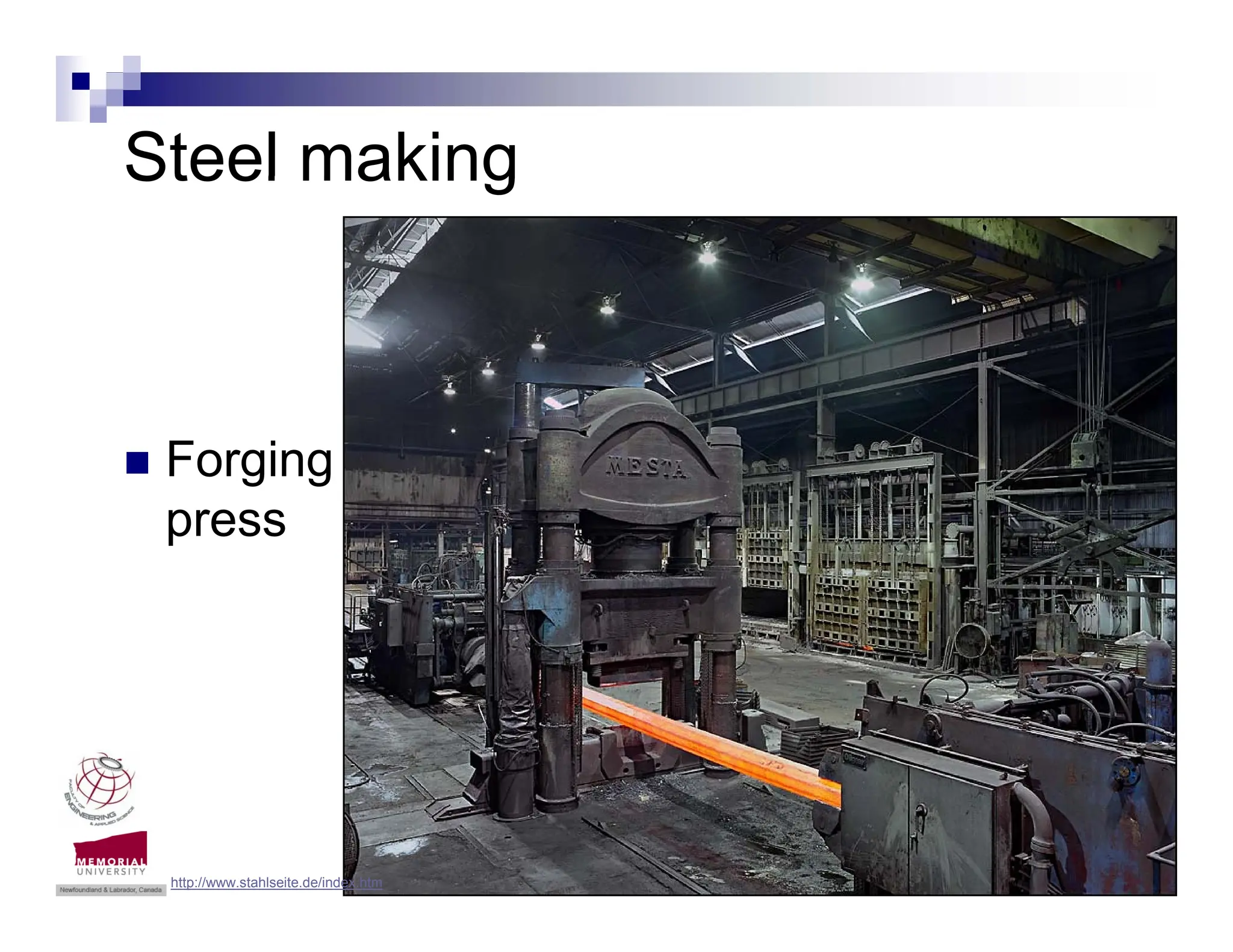
 Forging
press
press
Steel Design - Dr. Seshu Adluri
http://www.stahlseite.de/index.htm
Steel making
Steel making
 Precision Forging m/c
Steel Design - Dr. Seshu Adluri
http://www.stahlseite.de/index.htm
Steel
Steel
making
g
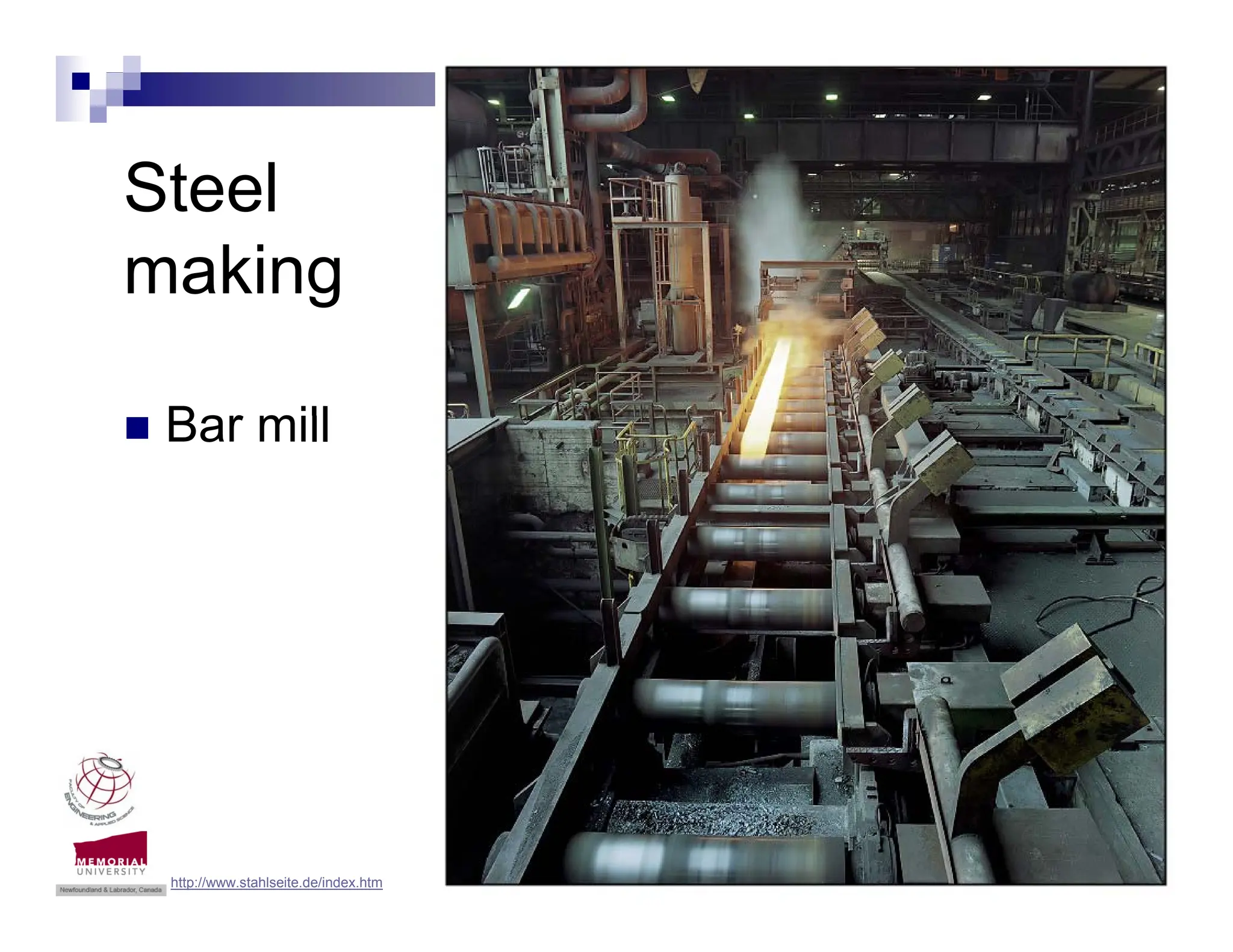
Bar mill
 Bar mill
Steel Design - Dr. Seshu Adluri
http://www.stahlseite.de/index.htm
Steel making
Steel making
 Coil box
 Coil box
Steel Design - Dr. Seshu Adluri
http://www.stahlseite.de/index.htm
Steel making
Steel making
 Cooling
g
beds
Steel Design - Dr. Seshu Adluri
http://www.stahlseite.de/index.htm
Steel making
Steel making
 Cooling
 Cooling
beds
Steel Design - Dr. Seshu Adluri
http://www.stahlseite.de/index.htm
Steel making
Steel making
 Heat
Heat
treatment
Steel Design - Dr. Seshu Adluri
http://www.stahlseite.de/index.htm
St l R lli
Steel Rolling
 Cast steel is a relatively weak mass of coarse, uneven metal crystals, or
'grains'. Rolling causes this coarse grain structure to re-crystallize into a
much finer grain structure, giving greater toughness, shock resistance and
tensile (stress) strength.
 Rolling is the main method used to shape steel into different products after it
has been cast. There are two types of rolling - hot and cold.
 The rolling process (for both hot and cold) consists of passing the steel
between two rolls revolving at the same speed but in opposite directions.
Th b t th ll i ll th th t l b i ll d th t th
The gap between the rolls is smaller than the steel being rolled, so that the
steel is reduced in thickness and at the same time lengthened
 One set of rollers is called a stand, and in any one mill there can be a
number of stands. One length of steel can pass through a stand a number
of times so that it is gradually reduced in size and progressively rolled to the
desired shape. A slab 230mm thick can end up only 1.5mm thick, but many
times longer, after the hot rolling process
Steel Design - Dr. Seshu Adluri
St l R lli
Steel Rolling
 Hot Rolling
 Before hot rolling, slabs, blooms and billets are heated in a furnace
to about 1200°C. This makes it easier to roll the steel and removes
the rough flaky surface or scale
the rough, flaky surface, or scale.
 Cold Rolling
 Certain types of steel are also cold rolled after hot rolling. Before
cold rolling the steel is cleaned with acid (pickled) to remove the
scale.
 Cold rolling is carried out at room temperature and is rolled at very
fast speeds using lubricants to reduce friction. Cold rolling increases
strength, makes steel thinner and produces a bright smooth surface.
st e gt , a es stee t e a d p oduces a b g t s oot su ace
Steel Design - Dr. Seshu Adluri
Steel
Steel
making
g

Steel Design - Dr. Seshu Adluri
ESDEP
Steel
Steel
making
g

Steel Design - Dr. Seshu Adluri
ESDEP
Steel
Steel
making
g

Steel Design - Dr. Seshu Adluri
ESDEP
C ld lli ft h t lli
Cold-rolling after hot-rolling
 Cold Rolling is undertaken to :-
 Reduce the thickness
 Improve the surface
finish
 Improve the thickness tolerances
 To offer a range of "tempers"
 As a preparation for surface coating
Steel Design - Dr. Seshu Adluri
R lli d f i
Rolling and forming

Steel Design - Dr. Seshu Adluri
R lli d f i
Rolling and forming

Steel Design - Dr. Seshu Adluri
R lli d f i
Rolling and forming

Steel Design - Dr. Seshu Adluri
HSS f i
HSS forming

Electric Resistance Welding (ERW) Process
Form-Square Weld-Square (ERW) Process
Electric Resistance Welding (ERW) Process
Steel Design - Dr. Seshu Adluri
Submerged Arc Weld (SAW) Process
The Steel Tube Institute of North America http://www.steeltubeinstitute.org/pdf/brochures/dimension_brochure.pdf
St l t t ti
Steel structure erection

Steel Design - Dr. Seshu Adluri
St l
Its cheesy cartoon time! 
Steel
 Steel
 Not just for
structures
structures
 It makes
cartoon
people too!
people too!
Steel Design - Dr. Seshu Adluri
Man and Lady of steel! - 
M t i l b h i
Material behaviour

Steel Design - Dr. Seshu Adluri
R.C. Hibbeler, Mechanics of Materials, 7th Ed, Prentice Hall
M t i l b h i
Material behaviour

Burj Dubai
Burj Dubai
Steel Design - Dr. Seshu Adluri
R.C. Hibbeler, Mechanics of Materials, 7th Ed, Prentice Hall
M t i l b h i
Material behaviour

Steel Design - Dr. Seshu Adluri
R.C. Hibbeler, Mechanics of Materials, 7th Ed, Prentice Hall
M t i l b h i
Material behaviour

Taipei 101
Steel Design - Dr. Seshu Adluri
R.C. Hibbeler, Mechanics of Materials, 7th Ed, Prentice Hall
M t i l b h i
Material behaviour

New York Freedom tower
(proposed)
Steel Design - Dr. Seshu Adluri
R.C. Hibbeler, Mechanics of Materials, 7th Ed, Prentice Hall
M t i l b h i
Material behaviour
 Temperature
effects on
material
ti
properties
Steel Design - Dr. Seshu Adluri
ESDEP
T i l St l U
Typical Steel Use

Sydney harbour
Steel Design - Dr. Seshu Adluri
2003 Lamborghini Murcilago
St l U
Steel Use

Hybernia platform (Grand banks, NL)
topsides are steel
Steel Design - Dr. Seshu Adluri
T i l St l U
Typical Steel Use

Steel Design - Dr. Seshu Adluri
R.C. Hibbeler, Mechanics of Materials, 7th Ed, Prentice Hall
Typical Steel Frame Structure

Steel Design - Dr. Seshu Adluri
R.C. Hibbeler, Mechanics of Materials, 7th Ed, Prentice Hall
Typical Steel Frame Structure

Steel Design - Dr. Seshu Adluri
AISC
T i l St l F St t
Typical Steel Frame Structure

Steel Design - Dr. Seshu Adluri
Mumbai Airport
Chhatrapati Shivaji International Airport, Mumbai, India
St t
Structures

Steel Design - Dr. Seshu Adluri
St t
Structures…..

Steel Design - Dr. Seshu Adluri
St t
Structures….

Steel Design - Dr. Seshu Adluri
St l St t
Steel Structures

Steel Design - Dr. Seshu Adluri
Structures
Structures …..
Crystal Cathedral (1980) - Garden Grove CA

Crystal Cathedral (1980) Garden Grove, CA
Steel Design - Dr. Seshu Adluri
Flatiron Building
(Fuller Building) (1903)
Flatiron Building
(Fuller Building) (1903)
Structures….
Walt Disney Concert Hall (2003) - Los Angeles, CA; Frank Gehry

Steel Design - Dr. Seshu Adluri
Time Warner Center (2003) - New York
Structures….

St. Louis Arch, 192mx192m
Steel Design - Dr. Seshu Adluri
Seattle Public Library (2004)
Bridges
Bridges

Glen canyon, Colorado
Steel Design - Dr. Seshu Adluri
B id
Bridges
New River Gorge Bridge the largest single span steel arch bridge in the western hemisphere. It measures 876 ft.
f th b id t th b tt f th
 Old Nanpu Bridge (double loop ramp),
Shanghai,
from the bridge to the bottom of the gorge
Steel Design - Dr. Seshu Adluri
Bridges

Bridges in San Francisco
http://www.wunderground.com/blog/ozcazz/comment.ht
ml?entrynum=11&tstamp=200611
Steel Design - Dr. Seshu Adluri
St l St t
Steel Structures

Steel Design - Dr. Seshu Adluri
Steel gives the flexibility to create the desired aesthetic
g y
effect using the structural members
Steel Design - Dr. Seshu Adluri
Orient railway station, Lisbon, Portugal Architect: Santiago Calatrava
Exposed steel will require special processing
that will impact the cost and schedule
Steel Design - Dr. Seshu Adluri
Airport terminal, Lyon, France Architect: Santiago Calatrava
Architecturally Exposed Structural Steel -
AESS
Steel Design - Dr. Seshu Adluri
Roof of the Santa Fe Opera Theatre, Santa Fe, New Mexico Architects: Polshek Partnership, LLP
T i l A li ti
Typical Applications
 The entire structure or key portions may
use AESS
 Popular applications include
Hanging walkways
Hanging walkways
Framing in atriums and lobbies
Office interiors
Office interiors
Canopies
Ai t t i l
Steel Design - Dr. Seshu Adluri
Airport terminals
AESS
Canopy and
Hanging
Hanging
Walkway
Steel Design - Dr. Seshu Adluri
Portland International Airport (PDX) Roadway Canopy and
Pedestrian Bridges, Portland, Oregon, Architects: Zimmer
Gunsul Frasca Partnership
AWSS Atriums and Lobbies
Steel Design - Dr. Seshu Adluri
Gaylord Opryland Hotel Texas, Lake Grapevine near Dallas, TX Architects: Hnedak Bobo Group, Memphis, TN, Photo by Glen Patterson
AESS Offi I t i
AESS Office Interiors
Lindhout Associates Headquarters, Brighton, MI
Steel Design - Dr. Seshu Adluri
Herman Miller Marketplace, Zeeland, MI Architects: Integrated Architecture, Grand Rapids, MI Photo by Hedrick Blessing
AESS
Airport
Terminals
Terminals
Steel Design - Dr. Seshu Adluri
The United Airlines Terminal, Chicago, IL Architects:
Murphy/Jahn and A. Epstein & Sons Int’l
AESS O W b B
AESS Open Web Beams
Open web beams are lighter and
th ti ll tt ti
aesthetically attractive.
Computer-controlled
cutters provide design
Steel Design - Dr. Seshu Adluri
cutters provide design
flexibility.
T i l St l C t St t
Typical Steel-Concrete Structure

Steel Design - Dr. Seshu Adluri
St t l St l h
Structural Steel shapes
 Hot Rolled shapes –Section 6, CISC Handbook
 (W) W-shapes (Wide Flange)
(S) S ti
 (S) Sections
 (L) Angles
 (C) Channels
 (C) Channels
 (WT) Structural Tees
 HSS
 Plates, …………….
 Built-up members
Steel Design - Dr. Seshu Adluri
St t l St l h
Structural Steel shapes

Steel Design - Dr. Seshu Adluri
ESDEP
Structural Steel shapes
p

Steel Design - Dr. Seshu Adluri
Fabrication
facilities
facilities
Cambering machine
Fabrication bay
Steel Design - Dr. Seshu Adluri
Fabrication
Fabrication
facilities

Fabrication bay
Steel Design - Dr. Seshu Adluri
R id l t
Residual stresses
 Stresses can be left behind in steel
shapes after certain events
p
Hot-rolling (due to differential cooling)
Welding (due to differential cooling)
Cold-forming (due to plastic deformation)
Excessive deformation
Etc.
Steel Design - Dr. Seshu Adluri
Residual
stresses
stresses
 Welding residual
g
stresses
Steel Design - Dr. Seshu Adluri
ESDEP
Residual
stresses
stresses
 Hot-rolled stress contours
Steel Design - Dr. Seshu Adluri
Residual
Residual
stresses
Id li d id l
 Idealized residual
stresses in Hot-rolled
shapes
p
Steel Design - Dr. Seshu Adluri
R f
References
 Many pictures in this file are taken from various sources such as CISC, AISC, etc. The copyrights
for those materials are with the original sources. No copyright is claimed or implied by Dr. Seshu
Adluri for things that are already under copyright protection. This file is for teaching purposes
only.
Steel Design - Dr. Seshu Adluri

dokumen.tips_structural-steel-design-ppt.pdf

  • 1.
    Dr Seshu Adluri Dr.Seshu Adluri ENG 7704 Structural Steel Design
  • 2.
    Introduction Introduction Assignments 10% Labs 5% Midterm test 25% Final Examination 60% Final Examination 60% http://www.engr.mun.ca/~adluri/courses/steel/outline.htm Contact: 12:00-2:00 p.m. p Monday (EN 3044) Steel Design - Dr. Seshu Adluri
  • 3.
    Brute Strength ToAmazing Grace Brute Strength To Amazing Grace  In structural steelwork, grace, art and function can come together in almost limitless ways; it offers new solutions and opportunities, allowing us to stretch our imagination and actually create some of allowing us to stretch our imagination and actually create some of the most challenging structures.  Structural steel's low cost, strength, durability, design flexibility, adaptability and recyclability make it the material of choice in North A i b ildi t ti American building construction.  Steel provides not only strength to structures, but also beauty and drama. It can be combined with other materials to blend the individual advantages to produce an even more inspiring structure. g p p g  Advanced steel fabrication technology has unfolded great opportunities to design spectacular structures with steel. Steel Design - Dr. Seshu Adluri
  • 4.
    Materials for ENG7704 Materials for ENG 7704 Structural Steel Design  Steel Design Handbook – CISC  Limit States Design for Steel – CISC Textbook  It's important you have access to the handbook because:  You will have to use the book in the exams  The book has the steel code (CSA-S16), properties of steel sections, several useful tables and examples  Hand written notes in the handbook  Hand written notes in the handbook  Simple notes to aid the quick understanding are O.K. But no detailed calculations Steel Design - Dr. Seshu Adluri
  • 5.
    Materials for ENG7704 Materials for ENG 7704 Structural Steel Design  Important: Ask questions! Ask questions! If you don’t, I will have no choice but to assume no choice but to assume that you understood (either that, or that you don’t care)! Steel Design - Dr. Seshu Adluri
  • 6.
    Additi l Additional resources Companion Website — This website from CISC Companion Website This website from CISC provides other online resources. Visit http://www.cisc-icca.ca/ Al i it AISC b it d b f th it  Also visit AISC website and a number of other sites for steel structures to get information on famous structures, history, economics and technical details , y, Steel Design - Dr. Seshu Adluri
  • 7.
    C T i CourseTopics  Introduction  Introduction  Design of Members and Connections  Tension Members –yielding, rupture, shear lag, design  Bolted Joints –failure modes, limit strength, design for different configurations shear and moment eccentric connections etc configurations, shear and moment, eccentric connections, etc.  Welded Joints -types, failure modes, direct load, eccentric connections, etc.  Compression Members – Effective Length, Torsional-flexural buckling built up members local buckling buckling, built-up members, local buckling  Compression member design  Flexural Members – Beams, failure modes, classification, lateral-torsional buckling, bracing B d i f h d t  Beam design for shear and moment  Beam-Columns -different checks for design  Plate Girder Design  Composite Construction –composite beams, failure modes, design Steel Design - Dr. Seshu Adluri Co pos te Co st uct o co pos te bea s, a u e odes, des g  Serviceability: Introductions to Deflections, etc.
  • 8.
    L b Labs  ComputerLab  S-Frame, finite element, design, design check  Structures Lab -only if resources permit :-)  Structures Lab -only if resources permit :-) Steel Design - Dr. Seshu Adluri
  • 9.
    I t dti Introduction Structural design may be defined as a mixture of art and science combining the intuitive feeling for the b h i f t t ith ti l i i l f behaviour of a structure with rational principles of mechanics (statics, solid mechanics, dynamics, etc.) and structural analysis to produce a safe and and structural analysis to produce a safe and economical structure to serve its intended purposes. Steel is one of the most important building materials in the modern era. It is used solely or in combination with other materials such as concrete, timber, composites etc for a variety of purposes Steel Design - Dr. Seshu Adluri composites, etc., for a variety of purposes.
  • 10.
    Ad t fSt l Advantages of Steel  Economy  Durability  Design flexibility  Simplicity  All weather construction  Easy repair R l bl 100% b f i  Recyclable -100% any number of times Steel Design - Dr. Seshu Adluri
  • 11.
    Benefits of StructuralSteel Some benefits associated with use of structural steel for owners are: • Steel allows for reduced frame construction time and the ability to construct in all seasons • Steel makes large spans and bay sizes possible, providing more flexibility for g p y p , p g y owners • Steel is easier to modify and reinforce if architectural changes are made to a facility over its life Steel Design - Dr. Seshu Adluri y • Steel is lightweight and can reduce foundation costs (AISC 1999) • Steel is durable, long-lasting and recyclable
  • 12.
    Unique Aspects ofSteel Construction Procurement and management of structural steel is similar to other materials, but there are some unique aspects to steel construction: • Steel is fabricated off-site (above left) • On-site erection is a rapid process (above right) • This gives use of structural steel some scheduling advantages Steel Design - Dr. Seshu Adluri This gives use of structural steel some scheduling advantages • Coordination of all parties is essential for achieving potential advantages (AISC 1999)
  • 13.
    Just couldn’t resist! Justcouldn t resist!  Moon Light, Maritimes and Steel tower! Steel Design - Dr. Seshu Adluri
  • 14.
    Wow!  Steel isnot just for just for structures Chicago's Millennium Park has the modern art sculpture officially titled Cloud Gate, although locals quickly dubbed it -the Bean. Designed by Canadian Frank Gehry. See also Chicago's Millennium Park pavilion with the curved steel elements. Steel Design - Dr. Seshu Adluri
  • 15.
    Hi t http://www.dedroidify.com/pillar.htm History  Wootzis a steel developed in  Wootz is a steel developed in India around 300 BC. The word wootz is a mistranscription of ukku, the word for steel in telugu the word for steel in telugu.  The pillar is fabricated in 310 A.D. in India. It has all along been outside as an astronomical outside as an astronomical observatory aid. It never rusted.  7.21 m (incl. buried), 41 cm diam., 6 tons 6 tons  Made by forge welding! Steel Design - Dr. Seshu Adluri
  • 16.
    Hi t History  Damascussteel is a hot-forged steel used in Middle Eastern sword used in Middle Eastern sword making from about 1100 to 1700 AD.  Damascus swords were of legendary sharpness and strength and were sharpness and strength, and were apocryphally claimed to be able to cut through lesser quality European swords and even rock swords and even rock.  The foundation for Damascus Steel is Wootz Steel, which originated in India and later spread to Persia India and later spread to Persia. Steel Design - Dr. Seshu Adluri Pattern welded "Damascened steel" pocket knife
  • 17.
    Hi t History  Japanesesword making from special steel forging is special steel forging is legendary.  It is still practiced with very labour intensive process labour intensive process.  China also has had a very ancient steel industry for sword making, guns and other weaponry. Steel Design - Dr. Seshu Adluri Engraving of the Edo era depicting forge scenes
  • 18.
    Hi t Thomas Telford History A i t U I b id C lb kd l UK 1789  Ancient Use:  Beginning 5th Cent. B.C., Weaponry, Ornamentals and Bridge construction in India (small suspension bridges), C Iron bridge-Coalbrookdale, UK, 1789 Middle East and China  Early Use:  1777-79 First Cast iron bridge in England 1777 79 First Cast iron bridge in England  1780-1820 Several bridges all over Europe, preliminary rolled shapes manufactured  1820 -Rails manufactured  1840 -advent of wrought iron First modern suspension bridge -James Finley’s -Jacob’s Creek, Pennsylvania, 1801 Steel Design - Dr. Seshu Adluri
  • 19.
    1907 Quebec Bridge Hit History …  Bessemer Process invented in 1855. Bessemer converter introduced in 1870. STEEL INTRODUCED  1890 Steel replaces all other forms  1890 Steel replaces all other forms.  Early Structures: y  1870s Brooklyn Bridge  1880s Eiffel Tower (330 m), steel bridges in Pittsburgh, several steel buildings in Chicago (rebuilt after the great fire) Home Insurance bldg, 1885-1931 several steel buildings in Chicago (rebuilt after the great fire)  1890sSeveral steel buildings in NY and Europe  1907 Quebec Bridge followed by several bridges in Steel Design - Dr. Seshu Adluri North America
  • 20.
    History... y Modern Structures:  1930sGolden Gate bridge, Empire State B ilding etc Empire State Building, etc.  1960s Sears Tower  Extensive use of steel for medium to high rise  Extensive use of steel for medium to high rise buildings and long span bridges.  Equally extensive use of steel in industrial structures, airports, etc. Steel Design - Dr. Seshu Adluri
  • 21.
    N Now….  Major constructionin Asia  Steel-concrete composites, competing business & national interests Steel Design - Dr. Seshu Adluri Burj Khalifa, 820m, 160 floors
  • 22.
  • 23.
    F t Future...  Thereis major drop in North America steel building activity  Asia is booming, Africa and South America might catch-up  Millennium Tower in Japan and other futuristic projects are possible (the tower was meant to be about 840 m high, stand alone in Tokyo Bay, isolated, a city of its own population up to 50 000), to be reached by causeway and boats. Never made it since the late 1980s) Steel Design - Dr. Seshu Adluri Bionic Tower, 1228m Shanghai -proposed
  • 24.
    F t Future...  A comparisonof the Burj Khalifa Steel Design - Dr. Seshu Adluri p j and the proposed Nakheel Tower
  • 25.
    St l Di Petronas towers, Kualalampur Petronas towers, Kualalampur Steel Design  Structures or structural t i il d f components primarily made of steel members attached to each other appropriately. pp p y  Steel is excellent in both tension and compression.  Since steel is primarily made of thin plate like elements, they are susceptible to buckling (local and overall).  Connections in steel are considerably different from those in concrete. In steel, the members are ‘discrete’ or rolled (fabricated) separately and are attached to each other using appropriate Steel Design - Dr. Seshu Adluri Shanghai world finance centre attached to each other using appropriate connections.
  • 26.
    Li it Stt D i R S φ ≥ Limit States Design  Ultimate Limit States - usually means that structural safety has been i d i i l i l d i bili ( i i R S φ α ≥ compromised in a certain way - ultimate load capacity, stability (e.g., local or over all buckling, or overturning), sliding, fracture (due to fatigue), etc.  Serviceability Limit States - usually means that the functionality of the y y y structure is effected in some way, i.e., it is rendered unsatisfactory in terms of operating conditions - Excessive deflection (could be vertical, horizontal, or skew), vibration, permanent deformation, etc.  We deal mainly with ultimate strength limit states in this course  We deal mainly with ultimate strength limit states in this course.  Clause 7 (CSA-S16), Table 13  Statistically, φ = resistance factor, α = load factor  D, L, S, W, T = Effects of dead live, snow, and wind loads (also , , , , , , ( temperature, creep, relaxation, shrinkage, settlement effects) Steel Design - Dr. Seshu Adluri For more info’ refer to the textbook
  • 27.
    D f Pi i Degree of Precision  The accuracy of engineering data is less than ¼ percent (20.5 kN, not 20.55 kN or worse, 20.55125 kN). R t fi l l ti l i ll t  Represent final solution values numerically to an accuracy of three significant digits.  If the number begins with 1, then use four significant digits. g g g  Examples: 4.78, 728, 1.724, 0.1781, 32.1, 88300, 0.00968, 1056.  Intermediate values are computed to five significant  Intermediate values are computed to five significant digits to avoid rounding errors. Steel Design - Dr. Seshu Adluri For more info’, refer to http://en.wikipedia.org/wiki/Significant_figures
  • 28.
    Steel | TheMaterial Facts  Modern steel was first produced in 1738 in Sheffield England know as “crucible steel”  Today steel is produced in over 50 countries all across the world. T t f P tl d C t d d 3 t f d d 10 t f t l  British Inventor Henry Bessemer produced the first economical steel in 1856.  Modern steel was first produced in 1738 in Sheffield, England, know as crucible steel in was very pure, but difficult and expensive to produce.  In 2003, China was the first country to produce more than 200 million tons of crude steel in a year (more than 20% of the world’s steel is produced in China).  China is the world’s largest consumer of steel (cars general industry construction )  To every ton of Portland Cement produced, 3 tons of wood and 10 tons of steel are produced. China is the world s largest consumer of steel (cars, general industry, construction…)  Japan is the largest exporter of steel.  The United States and China are the largest importers of steel.  Steel is the world’s most recycled material. Steel is recycled mostly from junk cars (3 400 000 cars per year per steel mill; 27 cars / minute in North America )  More than 60% of the steel produced annually is from recycled steel.  Properties of steel are not altered by how many times it is recycled.  Per pound of material, steel is the most efficient of all building materials. (3-400,000 cars per year per steel mill; 27 cars / minute in North America ). p g  A small amount of steel can do load-carrying tasks with a fraction of the material needed from other materials such as concrete or wood.  Steel is the densest of structural materials and therefore handles longer spans, and produces lighter structures with the greatest economy. Steel Design - Dr. Seshu Adluri  Steel can be found in fasteners (nails…), structural components, rebar, sheet-metal, appliances, cars, ships, … THE MATERIAL FACTS The Material Steel |
  • 29.
    Steel | ChemicalComposition Wrought Iron Cast Iron < 0.2 % Carbon < 3 - 4 % Carbon Steel 0.2 - 2 % Carbon Soft & Malleable Hard & Brittle + Controlled amounts of: Manganese, Phosphorous Sili S lf O Carbon Steel Mild Steel 0.2 - 0.25 % Carbon Medium Steel Combinations of: + Silicon, Sulfur, Oxygen Carbon Steel Medium Steel 0.25 - 0.45 % Carbon Hard Steel 0.45 - 0.85 % Carbon Alloy Steel Chromium, Cobalt, Copper, Molybdenum, Nickel, Tungsten, Vanadium + Spring Steel 0.85 - 1.85 % Carbon Alloy Steel Stainless Steel Weathering Steel Steel Design - Dr. Seshu Adluri CHEMICAL COMPOSITION The Material Steel |
  • 30.
    St l ill f I C b ( 2%) d M ( 1%) Steel | Chemical Composition  Steel is an alloy of Iron, Carbon (<2%), and Manganese (<1%). It also contains small amounts of Phosphorous, Silicon, Sulfur and Oxygen h h i l l ll d C b St l Carbon content greatly affects the properties of steel More Carbon increases : strength, hardness, corrosion-resistance  these chemical elements are controlled to provide consistent quality and grade of steel Carbon Steel g , , More Carbon decreases : malleability, ductility, and weldability The amount of Carbon does NOT affect the Modulus of Elasticity (E) of the Steel i C b St l t hi h h i l Alloy Steel Stainless Steel  is Carbon Steel to which one or more chemical elements have been added to achieve certain physical or chemical properties Alloy Steel Adding 15-18% Chromium and 7-8% Nickel produces corrosion-resistant steel Cor-Ten Steel Sculpture By Richard Serra Museum of Modern Art Fort Worth, TX Weathering Steel (Cor-Ten Steel) Adding Copper and Phosphorous creates a steel that forms an oxide coating, Steel Design - Dr. Seshu Adluri rust, that adheres to the base metal and prevents further corrosion CHEMICAL COMPOSITION Module 1 |
  • 31.
    Steel | Production U.S. has roughly 25% of world coal supply.  Steel is heated to molten state to remove oxides  Iron ore constitutes 5% of earth’s crust, 70% of earth’s core is iron. Open Hearth Furnace (OHF) Basic Oxygen Furnace (BOF) Electric Arc Furnace (EAF)  Three Types of Production Furnaces:  Refining is the addition of alloys to obtain certain characteristics in the steel:  Whether BOF or EAF all steel is recycled back into steel, so although BOF has a lower % of recycled steel, it is still as environmentally friendly. in the steel: Molybdenum- strength. Manganese- resistance to abrasion and impact. Vanadium- strength and toughness. Nickel and chromium- toughness, stiffness and corrosion resistance.  Electric Arc Furnace (EAF) process is environmentally safer.  Casting: Liquid steel is cast into semi-finished products; billet, blooms By 1980s computer controls were prevalent in steel mills Steel Design - Dr. Seshu Adluri  By 1980s computer controls were prevalent in steel mills. PRODUCTION The Material Steel |
  • 32.
    Open Hearth Furnace(OHF):  Discontinued in USA due to OSHA and EPA regulations, it wasted energy and manpower.  Last Open Hearth Furnace in U.S. was closed down in 1980s.  Extreme heat burned out impurities in iron.  Accepts variable amounts of scraps (20-80%) .  3000°F minimum temperature required 10 hours to accomplish  3000 F minimum temperature required, 10 hours to accomplish.  Worldwide, 3.6% of steel produced in 2003 was OHF. Steel Design - Dr. Seshu Adluri PRODUCTION The Material Steel |
  • 33.
    St l ki Steelmaking  Steel Design - Dr. Seshu Adluri
  • 34.
    St l ki Steelmaking  Steel Design - Dr. Seshu Adluri ESDEP
  • 35.
  • 36.
  • 37.
  • 38.
    Steel making g  Steel Design- Dr. Seshu Adluri ESDEP
  • 39.
    Steel making Steel making  SteelDesign - Dr. Seshu Adluri ESDEP
  • 40.
  • 41.
  • 42.
    Hot-rolling & Continuous casting casting  Continuouscasting (right, red arrows) is a method of working steel that conveys steel from its molten state to blooms, ingots, or slabs. The white hot metal is poured into open ended moulds and continues The white-hot metal is poured into open-ended moulds and continues on through rollers cooled by water. A series of guide rollers further shapes the steel into the desired form.  However, hot rolling (left, blue arrows) is still the primary means of illi t l Thi b i ith h d t l l b hi h milling steel. This process begins with pre-shaped steel slabs, which are reheated in a soaking pit. The steel passes through a series of mills: the blooming mill, the roughing mill, and the finishing mill, which make it progressively thinner. Steel Design - Dr. Seshu Adluri  Finally, the steel is wound into coils and transported elsewhere for further processing.
  • 43.
  • 44.
    St l ki Steelmaking  Steel Design - Dr. Seshu Adluri ESDEP
  • 45.
    St l ki Steelmaking  Steel Design - Dr. Seshu Adluri http://www.stahlseite.de/index.htm
  • 46.
    Steel making Steel making Continuous  Continuous caster Steel Design - Dr. Seshu Adluri http://www.stahlseite.de/index.htm
  • 47.
    Steel making Steel making Forging press press Steel Design - Dr. Seshu Adluri http://www.stahlseite.de/index.htm
  • 48.
    Steel making Steel making Precision Forging m/c Steel Design - Dr. Seshu Adluri http://www.stahlseite.de/index.htm
  • 49.
    Steel Steel making g Bar mill  Barmill Steel Design - Dr. Seshu Adluri http://www.stahlseite.de/index.htm
  • 50.
    Steel making Steel making Coil box  Coil box Steel Design - Dr. Seshu Adluri http://www.stahlseite.de/index.htm
  • 51.
    Steel making Steel making Cooling g beds Steel Design - Dr. Seshu Adluri http://www.stahlseite.de/index.htm
  • 52.
    Steel making Steel making Cooling  Cooling beds Steel Design - Dr. Seshu Adluri http://www.stahlseite.de/index.htm
  • 53.
    Steel making Steel making Heat Heat treatment Steel Design - Dr. Seshu Adluri http://www.stahlseite.de/index.htm
  • 54.
    St l Rlli Steel Rolling  Cast steel is a relatively weak mass of coarse, uneven metal crystals, or 'grains'. Rolling causes this coarse grain structure to re-crystallize into a much finer grain structure, giving greater toughness, shock resistance and tensile (stress) strength.  Rolling is the main method used to shape steel into different products after it has been cast. There are two types of rolling - hot and cold.  The rolling process (for both hot and cold) consists of passing the steel between two rolls revolving at the same speed but in opposite directions. Th b t th ll i ll th th t l b i ll d th t th The gap between the rolls is smaller than the steel being rolled, so that the steel is reduced in thickness and at the same time lengthened  One set of rollers is called a stand, and in any one mill there can be a number of stands. One length of steel can pass through a stand a number of times so that it is gradually reduced in size and progressively rolled to the of times so that it is gradually reduced in size and progressively rolled to the desired shape. A slab 230mm thick can end up only 1.5mm thick, but many times longer, after the hot rolling process Steel Design - Dr. Seshu Adluri
  • 55.
    St l Rlli Steel Rolling  Hot Rolling  Before hot rolling, slabs, blooms and billets are heated in a furnace to about 1200°C. This makes it easier to roll the steel and removes the rough flaky surface or scale the rough, flaky surface, or scale.  Cold Rolling  Certain types of steel are also cold rolled after hot rolling. Before cold rolling the steel is cleaned with acid (pickled) to remove the scale.  Cold rolling is carried out at room temperature and is rolled at very fast speeds using lubricants to reduce friction. Cold rolling increases strength, makes steel thinner and produces a bright smooth surface. st e gt , a es stee t e a d p oduces a b g t s oot su ace Steel Design - Dr. Seshu Adluri
  • 56.
  • 57.
  • 58.
  • 59.
    C ld llift h t lli Cold-rolling after hot-rolling  Cold Rolling is undertaken to :-  Reduce the thickness  Improve the surface finish  Improve the thickness tolerances  Improve the thickness tolerances  To offer a range of "tempers"  As a preparation for surface coating  As a preparation for surface coating Steel Design - Dr. Seshu Adluri
  • 60.
    R lli df i Rolling and forming  Steel Design - Dr. Seshu Adluri
  • 61.
    R lli df i Rolling and forming  Steel Design - Dr. Seshu Adluri
  • 62.
    R lli df i Rolling and forming  Steel Design - Dr. Seshu Adluri
  • 63.
    HSS f i HSSforming  Electric Resistance Welding (ERW) Process Form-Square Weld-Square (ERW) Process Electric Resistance Welding (ERW) Process Steel Design - Dr. Seshu Adluri Submerged Arc Weld (SAW) Process The Steel Tube Institute of North America http://www.steeltubeinstitute.org/pdf/brochures/dimension_brochure.pdf
  • 64.
    St l tt ti Steel structure erection  Steel Design - Dr. Seshu Adluri
  • 65.
    St l Its cheesycartoon time!  Steel  Steel  Not just for structures structures  It makes cartoon people too! people too! Steel Design - Dr. Seshu Adluri Man and Lady of steel! - 
  • 66.
    M t il b h i Material behaviour  Steel Design - Dr. Seshu Adluri R.C. Hibbeler, Mechanics of Materials, 7th Ed, Prentice Hall
  • 67.
    M t il b h i Material behaviour  Burj Dubai Burj Dubai Steel Design - Dr. Seshu Adluri R.C. Hibbeler, Mechanics of Materials, 7th Ed, Prentice Hall
  • 68.
    M t il b h i Material behaviour  Steel Design - Dr. Seshu Adluri R.C. Hibbeler, Mechanics of Materials, 7th Ed, Prentice Hall
  • 69.
    M t il b h i Material behaviour  Taipei 101 Steel Design - Dr. Seshu Adluri R.C. Hibbeler, Mechanics of Materials, 7th Ed, Prentice Hall
  • 70.
    M t il b h i Material behaviour  New York Freedom tower (proposed) Steel Design - Dr. Seshu Adluri R.C. Hibbeler, Mechanics of Materials, 7th Ed, Prentice Hall
  • 71.
    M t il b h i Material behaviour  Temperature effects on material ti properties Steel Design - Dr. Seshu Adluri ESDEP
  • 72.
    T i lSt l U Typical Steel Use  Sydney harbour Steel Design - Dr. Seshu Adluri 2003 Lamborghini Murcilago
  • 73.
    St l U SteelUse  Hybernia platform (Grand banks, NL) topsides are steel Steel Design - Dr. Seshu Adluri
  • 74.
    T i lSt l U Typical Steel Use  Steel Design - Dr. Seshu Adluri R.C. Hibbeler, Mechanics of Materials, 7th Ed, Prentice Hall
  • 75.
    Typical Steel FrameStructure Typical Steel Frame Structure  Steel Design - Dr. Seshu Adluri R.C. Hibbeler, Mechanics of Materials, 7th Ed, Prentice Hall
  • 76.
    Typical Steel FrameStructure Typical Steel Frame Structure  Steel Design - Dr. Seshu Adluri AISC
  • 77.
    T i lSt l F St t Typical Steel Frame Structure  Steel Design - Dr. Seshu Adluri Mumbai Airport Chhatrapati Shivaji International Airport, Mumbai, India
  • 78.
  • 79.
  • 80.
  • 81.
    St l Stt Steel Structures  Steel Design - Dr. Seshu Adluri
  • 82.
    Structures Structures ….. Crystal Cathedral(1980) - Garden Grove CA  Crystal Cathedral (1980) Garden Grove, CA Steel Design - Dr. Seshu Adluri Flatiron Building (Fuller Building) (1903) Flatiron Building (Fuller Building) (1903)
  • 83.
    Structures…. Walt Disney ConcertHall (2003) - Los Angeles, CA; Frank Gehry  Steel Design - Dr. Seshu Adluri Time Warner Center (2003) - New York
  • 84.
    Structures….  St. Louis Arch,192mx192m Steel Design - Dr. Seshu Adluri Seattle Public Library (2004)
  • 85.
  • 86.
    B id Bridges New RiverGorge Bridge the largest single span steel arch bridge in the western hemisphere. It measures 876 ft. f th b id t th b tt f th  Old Nanpu Bridge (double loop ramp), Shanghai, from the bridge to the bottom of the gorge Steel Design - Dr. Seshu Adluri
  • 87.
    Bridges  Bridges in SanFrancisco http://www.wunderground.com/blog/ozcazz/comment.ht ml?entrynum=11&tstamp=200611 Steel Design - Dr. Seshu Adluri
  • 88.
    St l Stt Steel Structures  Steel Design - Dr. Seshu Adluri
  • 89.
    Steel gives theflexibility to create the desired aesthetic g y effect using the structural members Steel Design - Dr. Seshu Adluri Orient railway station, Lisbon, Portugal Architect: Santiago Calatrava
  • 90.
    Exposed steel willrequire special processing Exposed steel will require special processing that will impact the cost and schedule Steel Design - Dr. Seshu Adluri Airport terminal, Lyon, France Architect: Santiago Calatrava
  • 91.
    Architecturally Exposed StructuralSteel - AESS Steel Design - Dr. Seshu Adluri Roof of the Santa Fe Opera Theatre, Santa Fe, New Mexico Architects: Polshek Partnership, LLP
  • 92.
    T i lA li ti Typical Applications  The entire structure or key portions may use AESS  Popular applications include Hanging walkways Hanging walkways Framing in atriums and lobbies Office interiors Office interiors Canopies Ai t t i l Steel Design - Dr. Seshu Adluri Airport terminals
  • 93.
    AESS Canopy and Hanging Hanging Walkway Steel Design- Dr. Seshu Adluri Portland International Airport (PDX) Roadway Canopy and Pedestrian Bridges, Portland, Oregon, Architects: Zimmer Gunsul Frasca Partnership
  • 94.
    AWSS Atriums andLobbies AWSS Atriums and Lobbies Steel Design - Dr. Seshu Adluri Gaylord Opryland Hotel Texas, Lake Grapevine near Dallas, TX Architects: Hnedak Bobo Group, Memphis, TN, Photo by Glen Patterson
  • 95.
    AESS Offi It i AESS Office Interiors Lindhout Associates Headquarters, Brighton, MI Steel Design - Dr. Seshu Adluri Herman Miller Marketplace, Zeeland, MI Architects: Integrated Architecture, Grand Rapids, MI Photo by Hedrick Blessing
  • 96.
    AESS Airport Terminals Terminals Steel Design -Dr. Seshu Adluri The United Airlines Terminal, Chicago, IL Architects: Murphy/Jahn and A. Epstein & Sons Int’l
  • 97.
    AESS O Wb B AESS Open Web Beams Open web beams are lighter and th ti ll tt ti aesthetically attractive. Computer-controlled cutters provide design Steel Design - Dr. Seshu Adluri cutters provide design flexibility.
  • 98.
    T i lSt l C t St t Typical Steel-Concrete Structure  Steel Design - Dr. Seshu Adluri
  • 99.
    St t lSt l h Structural Steel shapes  Hot Rolled shapes –Section 6, CISC Handbook  (W) W-shapes (Wide Flange) (S) S ti  (S) Sections  (L) Angles  (C) Channels  (C) Channels  (WT) Structural Tees  HSS  Plates, …………….  Built-up members Steel Design - Dr. Seshu Adluri
  • 100.
    St t lSt l h Structural Steel shapes  Steel Design - Dr. Seshu Adluri ESDEP
  • 101.
    Structural Steel shapes p  SteelDesign - Dr. Seshu Adluri
  • 102.
  • 103.
  • 104.
    R id lt Residual stresses  Stresses can be left behind in steel shapes after certain events p Hot-rolling (due to differential cooling) Welding (due to differential cooling) Welding (due to differential cooling) Cold-forming (due to plastic deformation) Excessive deformation Excessive deformation Etc. Steel Design - Dr. Seshu Adluri
  • 105.
  • 106.
    Residual stresses stresses  Hot-rolled stresscontours Steel Design - Dr. Seshu Adluri
  • 107.
    Residual Residual stresses Id li did l  Idealized residual stresses in Hot-rolled shapes p Steel Design - Dr. Seshu Adluri
  • 108.
    R f References  Manypictures in this file are taken from various sources such as CISC, AISC, etc. The copyrights for those materials are with the original sources. No copyright is claimed or implied by Dr. Seshu Adluri for things that are already under copyright protection. This file is for teaching purposes only. Steel Design - Dr. Seshu Adluri