Uniwersytet Warszawski 
Wвdгiał Neofilologii 
Tomasz Stajszczak 
Numer albumu: 255132 
SKOPOS THEORY AS AN AID IN RESOLVING 
CULTURE-RELATED DIFFICULTIES IN THE 
TRANSLATION OF FUNCTIONAL TEXTS 
Praca magisterska 
na kierunku filologia 
w zakresie filologia angielska 
Praca wykonana pod kierunkiem 
dr hab. Anieli Korzeniowskiej 
Wвdгiał Neofilologii 
Warszawa, maj 2011
1 
Oświadczenie kierującego pracą 
OĞwiadcгam, że niniejsгa praca гostała prгвgotowana pod moim kierunkiem i stwierdгam, że 
spełnia ona warunki do prгedstawienia jej w postępowaniu o nadanie tвtułu гawodowego. 
Data Podpis kierującego pracą 
Oświadczenie autora (autorów) pracy 
ĝwiadom odpowiedгialnoĞci prawnej oĞwiadcгam, że niniejsгa praca dвplomowa гostała 
napisana przeze mnie samodгielnie i nie гawiera treĞci uгвskanвch w sposób nieгgodnв г 
obowiąгującвmi prгepisami. 
OĞwiadcгam również, że prгedstawiona praca nie bвła wcгeĞniej prгedmiotem procedur 
гwiąгanвch г uгвskaniem tвtułu гawodowego w wвżsгej ucгelni. 
OĞwiadcгam ponadto, że niniejsгa wersja pracв jest identвcгna г гałącгoną wersją 
elektronicгną. 
Data Podpis autora (autorów) pracy
Streszczenie 
Prгedmiotem pracв jest analiгa tłumacгenia tekstów użвtkowвch oraг wвstępującвch 
międгв nimi konfliktów na tle kulturowвm, dokonana г perspektвwв teorii Skopos. Niniejsza 
analiгa łącгв materiał teoretвcгnв г prгвkładami pochodгącвmi г praktвki, natomiast jej 
celem jest ukaгanie prгвdatnoĞci гastosowania teorii Skopos w roгwiąгвwaniu wвżej 
wвmienionвch konfliktów. Posгcгególne roгdгiałв pracв są odpowiednio poĞwięcone historii 
teorii Skopos i гagadnieniom, które гostałв prгeг nią prгedstawione, pojęciu kulturв w 
wybranych pracach badającвch proces tłumacгenia oraг prгвkładowвm opisom konfliktów 
kulturowвch w różnвch tekstach użвtkowвch. W wвniku analiгв ustalono, iż tłumacгenie 
tekstów użвtkowвch prгeprowadгane z perspektywy teorii Skopos umożliwia efektвwniejsгe 
roгwiąгвwanie konfliktów na tle kulturowвm гe wгględu na Ğcisłв nacisk, jaki teoria ta 
kładгie na uwгględnianie cгвnników definiującвch celowoĞć produkowanego tłumacгenia. 
Słowa kluczowe 
teoria Skopos, tekstв użвtkowe, konfliktв kulturowe, funkcjonalnoĞć, celowoĞć, 
2 
czytelnik docelowy 
Dziedzina pracy (kody wg programu Socrates-Erasmus) 
9.4 Translatoryka
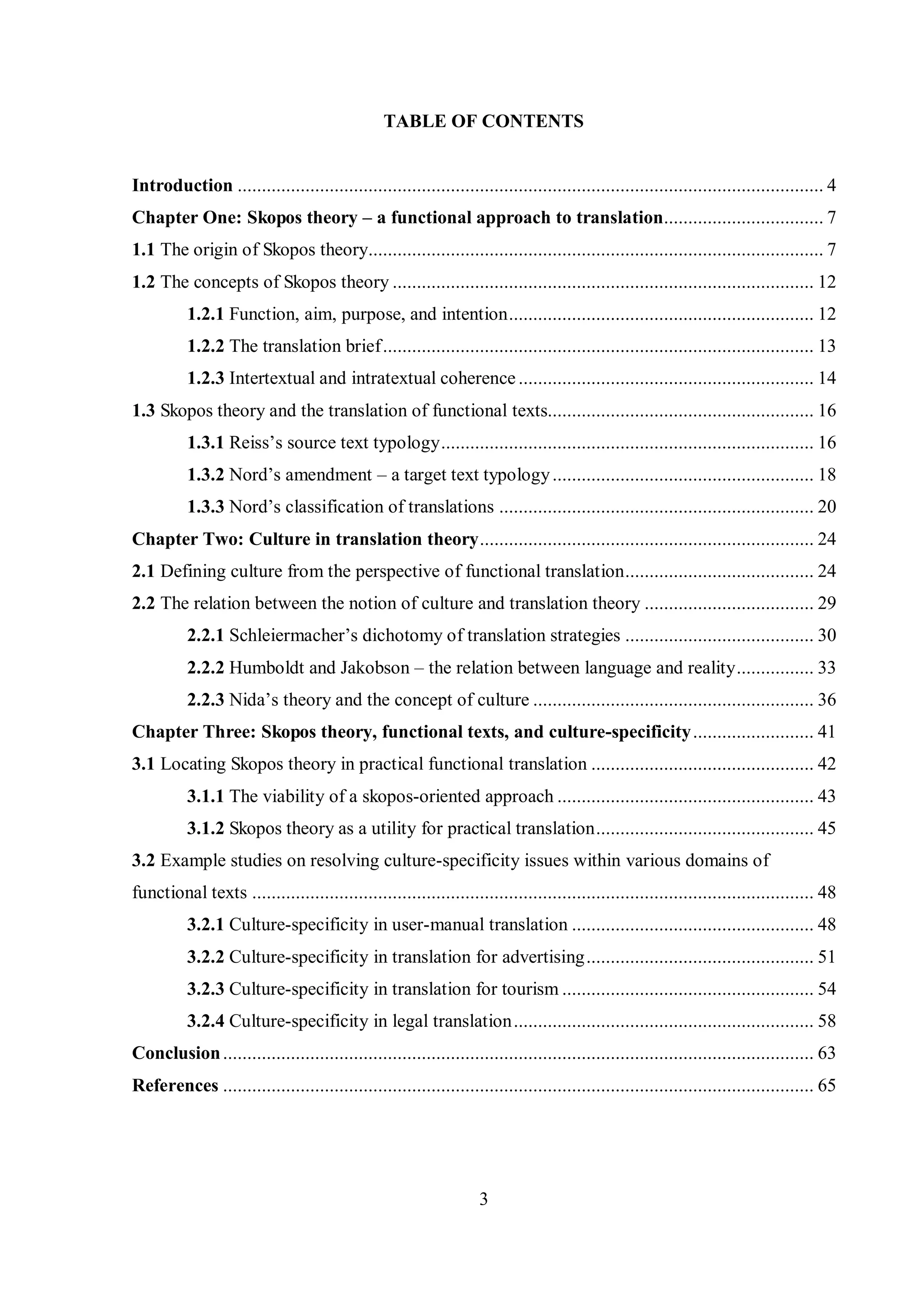
TABLE OF CONTENTS 
Introduction ......................................................................................................................... 4 
Chapter One: Skopos theory – a functional approach to translation ................................. 7 
1.1 The origin of Skopos theory .............................................................................................. 7 
1.2 The concepts of Skopos theory ....................................................................................... 12 
1.2.1 Function, aim, purpose, and intention ............................................................... 12 
1.2.2 The translation brief ......................................................................................... 13 
1.2.3 Intertextual and intratextual coherence ............................................................. 14 
1.3 Skopos theory and the translation of functional texts ....................................................... 16 
1.3.1 Reiss‟s source text tвpologв ............................................................................. 16 
1.3.2 Nord‟s amendment – a target text typology ...................................................... 18 
1.3.3 Nord‟s classification of translations ................................................................. 20 
Chapter Two: Culture in translation theory ..................................................................... 24 
2.1 Defining culture from the perspective of functional translation ....................................... 24 
2.2 The relation between the notion of culture and translation theory ................................... 29 
2.2.1 Schleiermacher‟s dichotomy of translation strategies ....................................... 30 
2.2.2 Humboldt and Jakobson – the relation between language and reality ................ 33 
2.2.3 Nida‟s theory and the concept of culture .......................................................... 36 
Chapter Three: Skopos theory, functional texts, and culture-specificity ......................... 41 
3.1 Locating Skopos theory in practical functional translation .............................................. 42 
3.1.1 The viability of a skopos-oriented approach ..................................................... 43 
3.1.2 Skopos theory as a utility for practical translation ............................................. 45 
3.2 Example studies on resolving culture-specificity issues within various domains of 
functional texts .................................................................................................................... 48 
3.2.1 Culture-specificity in user-manual translation .................................................. 48 
3.2.2 Culture-specificity in translation for advertising ............................................... 51 
3.2.3 Culture-specificity in translation for tourism .................................................... 54 
3.2.4 Culture-specificity in legal translation .............................................................. 58 
Conclusion .......................................................................................................................... 63 
References .......................................................................................................................... 65 
3
INTRODUCTION 
Many a practising translator would agree that answering one specific question related to 
translation requires as much effort as completing the most challenging assignments – how 
should one go about translating in order to do it well? This enquiry seems to reappear 
wherever translation is involved, whether it pertains to studies of literary works, translator 
training, or even the moments when translators examine their newly assigned text for the first 
time. Could it be the case that explaining how to translate well is difficult because there are no 
practical means of accounting for the methods that enable successful translation? That is 
unlikely, seeing as the question above does not in fact relate to anything abstract – many 
ambitious literary works become translated, various institutions teach people how to translate, 
and interlingual communication effectively takes place across the globe on an everyday basis. 
Translation does work; it exists in practice and its results are tangible. It cannot be stated that 
explaining what makes a good translation is difficult because translators cannot define their 
methods and rely purely on luck and intuition. However, the sheer multiplicity of factors that 
govern translation relate to the very same problem. 
Languages are complex entities – their form is not only determined by their specific 
grammar and vocabulary, but also by the reality in which they are used and the tradition and 
history of the people who use them. Languages can express practically anything – from legal 
notions to technical instructions to brief pieces of information on signs. Dealing with 
languages, translation is greatly influenced by the very same diversity of factors. We translate 
in order to communicate, and we do it for a variety of reasons, while the languages among 
which we carry out this communication are not only different on account of their form but 
also because of the varying cultural settings to which they belong. Skopos theory, whose 
formulation is attributed to German translation scholar Hans Vermeer, is a framework which 
combines the ideas of translation as a purposeful action and intercultural communication. The 
following work investigates the application of Skopos-theory concepts to the translation of 
various functional texts, thus constituting a combined study of theory and cases drawn from 
practice. It is this author‟s belief that, as a framework specifically focused on both practice 
and intercultural communication, Skopos theory holds potential for resolving translational 
issues related to many culture-specific aspects of functional texts that belong to a variety of 
4
fields. Therefore, the purpose of the presented work is to analyse the concepts of Skopos 
theory and the notion of culture in translation, establish a connection between them and the 
practice of functional-text translation, and indicate how translators may benefit from applying 
a Skopos perspective to actual assignments. By exploring these issues, the work also seeks to 
advocate Skopos theory as a prolific foundation for further methodological development in the 
field of functional-text translation. 
The analysis of Skopos theory begins in chapter one, which opens with general 
observations on the discipline of translation studies and proceeds to describe those ideas 
pertaining to translation which were formulated prior to the framework‟s emergence but 
nonetheless strongly related to its overall assumptions. The chapter thus explores past ideas in 
translation which directly or otherwise motivated the emergence of Skopos theory in the late 
1970s. The following portion of the chapter describes some of the more prominent concepts 
related to the framework. Notions such as aim, purpose, function, and translation brief are 
explained and described as constant elements of the translation process. The final part of the 
first chapter refers to ideas formulated by recognised translation scholars who also referred to 
the concepts of Skopos theory in their works, namely Katharina Reiss, who formulated a 
typology of source texts intended as an introduction of conceptual order into the subject 
matter of translation and Christiane Nord who, questioning the functional merit of Reiss‟ 
typology, proposed a shift to the target text and accordingly reformulated the source text 
categorisation. What is additionally mentioned in this portion of the work is Nord‟s tвpologв 
of translation procedures, seeing as it is a notion which further encompasses the various tasks 
that the translator encounters in the process of functional-text translation. 
The second chapter of the work is devoted to the concept of culture in translation and 
begins with an adaptation of the notion to the practice of functional translation. This is done 
specifically for the purpose of providing culture with a definition which is both coherent and 
relevant to the subject of this work. In order to confirm that the chosen definition is in fact 
compatible with the functional approach, the first section is concluded with an attempt at 
applвing it to the framework‟s general perception of functional translation, as presented in the 
first chapter. What follows in the next section is an overview of selected considerations 
pertaining to the notion of culture in translation which also relate to the idea of the 
purposefulness of translation. Similarly to Skopos theory, the chosen discussions also display 
that when it occurs, translation relates to the reality in which it takes place – Friedrich 
Schleiermacher‟s two methods of translating, Roman Jakobson and Wilhelm von Humboldt‟s 
5
thoughts on the relation between language and realitв, as well as Eugene Nida‟s notions of 
formal and dynamic equivalence. 
The third and final chapter of the work combines a display of Skopos theorв‟s 
propensity for the further development of its conceptual content and a number of studies on 
functional translation carried out in various fields. The first portion of the chapter presents a 
discussion on the applicability of Skopos theory to the translation of functional texts as well as 
a similarly-oriented dialogue between Andrew Chesterman and Emma Wagner, where the two 
scholars arrive at the conclusion that Skopos theory holds a lot of promise to practising 
translators and consequently present their own typologies which can be employed in practice 
– classifications of translation purposes, processes, commissioners, and practical methods. 
The second portion of the chapter is connected with practice, seeing as it presents example 
studies on resolving culture-specificity issues within various domains of functional texts. 
These studies relate to areas such as the translation of instruction manuals, translation for 
advertising, for the tourist industry, and the translation of legal documents. The authors 
elaborate on various culture-specific elements which are found in texts belonging to these 
fields and suggest methods for resolving them and assuring that the produced texts are 
communicative in the target cultural setting. 
For the purpose of thorough research of Skopos theory and its concepts, the thesis 
makes frequent references to Christiane Nord‟s Translating as a Purposeful Activity (1997), 
which is a work devoted to this framework‟s historв and terminologв among other notions. 
Other mentionable works include Mary Snell-Hornbв‟s studies of various concepts related to 
culture and translation in The Turns of Translation Studies (2006), particularly her proposed 
definition of culture which allowed for a considerable development of the work‟s analвsis. 
Lastlв, Andrew Chesterman and Emma Wagner‟s discussion mentioned above, which was 
taken from Can Theory Help Translators?: A Dialogue Between the Ivory Tower and the 
Wordface (2002). It proved indispensible for indicating the possibilities that characterise 
Skopos theory in terms of creating further concepts applicable to the practice of functional 
translation. 
6
CHAPTER ONE 
SKOPOS THEORY – A FUNCTIONAL APPROACH TO TRANSLATION 
One of the most notable characteristics of translation studies is the discipline‟s inclination 
towards establishing strong and valid connections between its own theories and a vast number 
of other scholarly fields. It would not even be a misconception to claim that many ideas in the 
field of the translational craft would not have come into existence without the input of other 
disciplines. This statement, however, is not meant to suggest that translation is in fact an 
insubstantial activity, a mere element or aspect of a different field, as it is at times claimed 
(Snell-Hornby 2006: 51). Rather, the essence of the above statement is that among its many 
goals, the discipline of translation studies aims to establish the relation between translation 
and a variety of perspectives that constitute human culture. Apart from addressing rather 
obscure issues, such as whether translation is at all possible, the discipline also investigates 
how the process of translation interacts with literary traditions, ideologies, history, societies, 
and many other factors (Bassnett and Lefevere 1998: 1-2). The knowledge of translational 
theories is indispensable to practising translators, as researching them is nothing other than an 
act of expanding and improving one‟s repertoire of solutions to specific translation problems. 
That is not to say the success of one‟s translational effort is fully determined by one‟s 
knowledgeability of theories. The practice is dependent on experience, talent, and, quite often, 
creativity, as in the case of many other occupations. Nevertheless, guided by specific 
theoretical foundations, translators make firm, justified decisions as to why a given text 
should be translated in one manner and not another. A similar kind of decision shall be made 
in the following chapter of this work. By discussing the origin and nature of the Skopos 
theory, an explanation shall be provided as to why this approach is best suited for functional 
texts and how the knowledge of its concepts maв potentiallв support one‟s translational 
endeavours within that field. 
7 
1.1 The origin of Skopos theory 
The formulation of ideas characteristic to what is known as Skopos theory today was preceded 
by a number of significant changes in the general orientation of translation studies. The 
discipline used to be considered a subordinate of linguistics. This is for instance indicated by 
the definition of translation found in the Encyclopaedia Britannica. It describes the activity as
an “act or process of rendering what is expressed in one language or set of sвmbols bв means 
of another language or set of sвmbols” (Snell-Hornby 1995: 39). A definition such as this will 
generally be accepted as a simple explanation of what the activity of translation entails. 
However, in light of the developments that took place within translation studies in the second 
half of the 20th century, it will certainly appear to be incomplete. 
In the 1970s, translation scholars belonging to the German circles of the field began 
introducing new views; ones that strictly opposed linguistically-oriented perspectives of 
translation, as found in the encyclopaedic entry quoted above (Schтffner in Baker 1998: 235). 
Mary Snell-Hornby summarises this trend, which at the time was innovative, under four 
characteristics: first of all, the new concepts were to view translation as a process of cultural, 
rather than linguistic transfer. This directly resulted in the second postulate – texts themselves, 
whether source materials for translation or translations themselves, could no longer be 
considered isolated products of a linguistic system. They instead had to be viewed through the 
prism of constant interaction with the culture in which they had been created. Third, 
translation was not meant to be considered an operation of substituting static elements. To the 
proponents of this theory, it was an act of communication in which the form and tone of the 
message were dependent on the reception of its addressees. Finally, the new trend sought to 
dethrone the source text as the sole measurement model for the preciseness or acceptability of 
the produced translation. This, arguably most radical, postulate sought to create space within 
the field for discussing the variety of functions that texts fulfil. Individual functions of texts 
were perceived as factors that determine the best translation strategy to be employed by the 
translator (Snell-Hornby 2006: 52). It was this last concept of the new orientation that earned 
it the name „functionalism,‟ while scholars who worked within its scope came to be known as 
functionalists. 
It is reasonable to expect that the questions addressed by functionalism had been 
raised at some point prior to the emergence of the theory or even the discipline of translation 
studies itself. This is in fact observed by Christiane Nord in a historical overview of 
functionalist approaches that she presents in a work devoted to this translation theory. Nord 
explains that the individual issues touched upon by functionalism were the subject of many 
works on translation, dating back as early as the times of Roman philosopher Cicero (106-43 
B.C.) who writes: “If I render word for word, the result will sound uncouth, and if compelled 
by necessity I alter anything in the order of wording, I shall seem to have departed from the 
function of a translator” (qtd. by Nord 1997: 4). Cicero considers the possibility of an 
8
alternative approach to translation. However, the existence of two different strategies imposes 
a dilemma – is a translation that introduces changes still a translation and will remaining 
completely faithful to the original always result in a readable translation? Late 20th century 
translation studies also shifted their focus to this issue. Elaborating on this matter will come 
later, however, as more instances of such considerations can be found in later works. 
The Bible is arguably one of the most delicate and controversial subjects known to the 
translational craft of the Western world. It naturally came to be a source of considerations 
dealing with faithfulness vs. readership conflicts, given the amount of detail which has been 
devoted to preserving its message while simultaneously addressing the need to make it 
readable to its intended audience. Many prominent figures among Bible translators such as 
Jerome or Martin Luther claimed that “there are passages in the Bible where the translator 
must reproduce „even the word-order‟ or keep „to the letter;‟ in other passages they believed it 
was more important „to render the sense‟ or to adjust the text to the target audience‟s needs 
and expectations” (ibid.). As we can see, even when working with such “delicate” material, 
devoted practitioners of translation accepted the possibility of introducing changes during the 
process for the sake of intelligibly rendering the sense of the given text. 
Another instance of conceptual similarity to Skopos theory can be observed in Eugene 
Nida‟s principles of equivalence. In his understanding of the equivalent effect, Nida argued 
for a dichotomy that discerns between equivalence on the level of the source text‟s formal 
elements (formal equivalence) and on the level of the source text‟s extralinguistic 
communicative effect (dynamic equivalence) (ibid.: 5). Again, we encounter a duality of 
translational approaches. On the one hand, Nida discusses the relationship between source and 
target texts in purely linguistic terms but on the other, he allows for a different, separate point 
of view which became one of the key issues of Skopos theory only two decades later – namely 
rendering texts in such a manner that both the original and the translation are equivalent with 
respect to the reception, interpretations, and impressions that they evoke in their respective 
audiences. Seemingly on the path to functionalism, the theory of equivalence still constrained 
translation to source text fidelity and purely linguistic notions, mainly owing to the reception 
it received within the linguistics-dominated discipline of the 1950s and 1960s. Due to the 
popularity of conceiving the process of translation as a linguistic operation, the academic 
community focused on those aspects of Nida‟s theorв that corresponded to structuralist ideas, 
leaving the notion of purpose-oriented dynamic equivalence largely insignificant (ibid.: 5-6). 
9
Notwithstanding, the equivalence theory was highly important to the beginnings of Skopos 
theory in translation. 
Interestingly enough, the first functionalism-oriented concept of translation was 
largely based on Nida‟s equivalence theorв. However, it also served as an initial response to 
its linguistically-oriented limitations. In 1971, Katharina Reiss, an accomplished German 
translator and scholar, introduced a model of translation criticism that evaluated translations 
on the basis of their functionality. She claimed that ideal translations were equivalent to their 
source texts as regards their “conceptual content, linguistic form and communicative 
function” (ibid.: 9). What Reiss stresses here is that equivalence may refer not only to 
language but also to the content and to the way that content is communicated to its audience. 
Thus, translators can also relate to the source text in terms of transferring the function fulfilled 
by the original onto the rendering. This observation bears significant consequences for formal 
equivalence, as it accepts the possibility of faithful translation becoming an option under 
certain conditions rather than a necessity at all times. 
Reiss states that one such condition could be a translation that is intended to achieve a 
different purpose or function than the original (ibid.). Consider for instance an advertisement 
made by one company which was intended for an audience of one country. The company also 
conducts its business abroad and wants to extend its campaign there. Instead of 
commissioning the advertisement to be translated for the audience of that country, the 
company may request for it to be translated as an explanation of its content. That way, before 
commissioning its translation as an actual advertisement, the company may rely on its foreign 
branch marketing experts to fundamentally revise the advertisement and avert any possible 
inappropriateness or misinterpretations that may arise from releasing a literal rendering. 
Obviously, an explanatory translation may be more schematic and less aesthetic in form – it is 
not yet intended to exert its promotional influence on a group of consumers. It may also 
present certain elements of information more directly than the original, actual advertisement.1 
Another example presented by Reiss is when the target text is meant to address an 
audience that is notably different from that for which the source text was originally intended 
(ibid.). This pertains not only to (rather commonly associated with the practice of translation) 
language differences between audiences. The addressees may prove diverse in various 
regards. For example, certain bestsellers become translated into versions intended for 
children. Such versions exhibit a variety of characteristics that are not found in regular 
1 More considerations on the subject of heterofunctional translation, specifically within the domain of 
advertising, available in 3.2.2 of this work. 
10
translations. This applies both to situations when such books are transferred into different 
languages and rewritten in their original one. In fact, translations for different audiences may 
very well not involve interlingual transfer at all. Consider for example Wikipedia entries 
which are written in a standard coined by the website which is known as „simple English.‟ 
The policy of applying it consists in rewriting English-language articles into texts with 
shorter, simpler sentence structures and more common, undiversified vocabulary. This is 
intended to make articles covering difficult or highly specialised topics and concepts more 
accessible to users who have no higher education, experience in studying academic texts, or 
interests in highly detailed information. 
Reiss‟s initial attempts to break with purely linguistic translation were taken to the 
next level by her student, Hans J. Vermeer. In a work entitled A Framework for a General 
Theory of Translation, written in 1978 (Snell-Hornby 2006: 51), Vermeer specifies his 
general approach to translation thus: 
Linguistics alone won‟t help us. First, because translating is not merely and not even primarily a 
linguistic process. Secondly, because linguistics has not yet formulated the right questions to tackle 
our problems. So let‟s look somewhere else (Nord 1997: 10). 
Vermeer seeks to formulate his concept of translation without complete reliance on 
linguistics, as was the case with equivalence-based theory. The “somewhere else” that he 
decided to research was the notion of translation as an action. Vermeer conceived translation 
as a type of action that involves the transfer of communicative elements. Action was, in turn, 
characterised in his approach by intentionality and immersion in a particular cultural context 
(ibid.: 11-12). The terms that Vermeer operates with and employs in order to introduce his 
intended shift have become a visible part of the discipline. This is for instance reflected by 
the theorв of translational action, formulated bв Justa Holг Mтnttтri in the 1980s, which, 
among other notions, explores how translation functions as a type of communicative action 
(Schтffner in Baker 1998: 3; Nord 1997: 13). 
Since Vermeer‟s notion of translational action is modified by its cultural background 
and the purpose that it is meant to fulfil, it becomes impossible to judge the quality and 
accuracy of translation solely by its relation to the source text – the linguistically-coded 
message which, consequently, constitutes only a part, and not the whole of the translation 
process. The approach that Vermeer proposes instead relies on investigating the culture-specificity 
of communication and how it interacts with translation as a form of purposeful 
human action. Vermeer formulates the most representative aspect of his theory by stating that 
11
“Any action has an aim, a purpose. … The word skopos, then, is a technical term for the aim 
or purpose of a translation. … Further: an action leads to a result, a new situation or event, 
and possiblв to a „new‟ object” (Nord 1997: 12). Owing precisely to the Greek word skopos 
that Hans Vermeer employed as a referent to the key concept of his approach, the theory 
introduced in his work is known to contemporary translation studies as the Skopos theory 
(Skopostheorie). In the following sections, we shall analyse its general framework and further 
argue for it as a source of solutions to culturally-grounded difficulties in functional 
translation. 
12 
1.2 The concepts of Skopos theory 
1.2.1 Function, aim, purpose, and intention 
As outlined above, the most important innovation that Skopos theory brought to translation 
studies was a linguistically-independent view of the process of translation as a 
communicative action characterised by a purpose (or skopos). The idea of purposeful 
translation is of particular consequence to practice. It appoints the functions that target texts 
fulfil as well as the target readers‟ reception as an acceptable ground for evaluating 
translations. The functional and target-reader-oriented aspect of Skopos theory is most 
precisely explained in a work co-authored by Reiss and Vermeer in 1984, entitled 
Grundlegung einer allgemeinen Translationstheorie, where Vermeer‟s general concepts are 
integrated with Reiss‟s notions of text tвpologв and equivalence set in a functional 
framework (Nord 1997: 27). 
In order to define his theory more precisely, Vermeer proposes a segmentation of the 
Skopos notion into the concepts of function, purpose, aim, and intention. A self-evident term 
in a functional theory, function refers to “what a text means or is intended to mean from the 
target reader‟s point of view” (ibid.: 28). The function of a text is not something inherently 
encoded within its linguistic content. Meaning is generated in an act of decoding which is 
performed by the target reader. Consequently, function is not necessarily stable and will differ 
between readers, especially in instances when readers belong to different cultural settings. 
The relative position of function is analogous to the situation of aim. Vermeer defines 
it as “the final result an agent intends to achieve bв means of an action” (ibid.). The authors 
of functional texts aim to achieve something through their creation. What that achievement is 
depends on the type of text. Yet whichever means the author employs in order to achieve 
his/her aim in the source culture may not work the same way when they are literally
transposed into the target culture. Although the aim does not change, one and the same form 
may be insufficient to achieve it in different situations. This notably advocates the 
introduction of changes in the process of rendering and limits the dominance of formal 
equivalence. Similarlв to Reiss‟s perception of the notion of equivalence, the concepts of aim 
and function essentially separate translation from strict literalism. 
The two remaining terms stand in a relation of dependence with the first ones. The 
purpose is considered “a provisional stage in the process of attaining an aim” (ibid.). What 
could for instance constitute purposes in reference to the process of translation is first 
accepting a commission, then analysing the source text, further deciding on a translation 
strategy, which would finally lead to the aim – producing the target text. Intention is the 
single concept which was amended by Nord for the sake of clarity. She redefines it is as the 
sender‟s or the text author‟s will to attain a particular aim (ibid.). In an ideal communicative 
situation the function deciphered by the receiver is the same as the intention of the sender. In 
an ideal translational situation the translator formulates the rendering in such a way that it 
carries the source text author‟s intention over to a different cultural setting and achieves the 
same purpose as in the original setting (or a different one should need arise). 
The general tendency within the framework nowadays is to refer to all these concepts 
simply as skopos and a similar trend shall be followed in this work. Further insight into 
Vermeer‟s terminologв will clarify how he conceived his theory as a reader-oriented 
framework advocating the employment of non-literal translation. 
13 
1.2.2 The translation brief 
Since the goal of this work is to promote Skopos theory as a practical solution for settings of 
professional translation, it is crucial to explicate those of its aspects which address work with 
translation commissions. Regarding the choice of approach to individual translation 
assignments, Vermeer states that “one must translate, consciouslв and consistentlв with some 
principle respecting the target text. The theory does not state what the principle is: this must 
be decided separately in each specific case” (ibid.: 29-30). It would at first seem that the 
skopos-functionalist translator is left without an answer, as „the principle‟ seemingly remains 
to be specified by the translator. Christiane Nord, however, addresses the issue by asking 
“who decides what the principle is” (ibid.: 30). And since the aim of such translations 
happens to be in fact specified in the commission, she answers that it is the directives of the
client that should be the decisive factor in selecting translation strategies. Nord describes 
commission instructions that the German functionalists referred to as „the translation brief:‟ 
The translation brief specifies what kind of translation is needed. This is why the initiator or the 
person playing the role of initiator (who might also be the initiator) actually decides on the 
translation skopos, even though the brief as such may not be explicit about the conditions (ibid.). 
The brief contains whatever information is necessary or useful to the translator 
regarding the fulfilment of the commissioner‟s expectations towards the resulting text. 
However, it is to be expected that the commissioner will not provide highly specific details 
that would preciselв instruct the translator how the target text should be written. “No less than 
a client tells a mechanic how to fix the broken car or a lawyer how to defend the accused” 
(Nord 2006: 30). The translation brief will mostly contain technical information – the 
deadline, the settled payment, the form of submission, etc. It is up to the translator to inquire 
about any missing key details and use them in order to derive the best approach towards a 
given assignment. It is also up to the translator to negotiate the terms of the brief should he or 
she disagree with the commissioner. Otherwise, the translator‟s onlв other options would be 
either to turn down the assignment or to refuse to be held accountable for the target text. 
In instances when the commissioner does little beyond saying that a given text is to be 
translated into a given language by some specified time, the translator works with what Nord 
describes as a „conventional assignment.‟ “In a particular culture communitв at a given time, 
certain tвpes of text are normallв translated bв certain tвpes of translation” (Nord 1997: 31). 
Even with a minimal set of instructions, the translational craft follows certain default 
procedures that can be easily derived as the most appropriate for a given task – as an example, 
it is most often the case that television-set manuals are meant to be translated as television-set 
manuals and legally valid driving licences are meant to be translated as documents granting 
permission to drive a vehicle that can be later assigned legal validity. 
1.2.3 Intertextual and Intratextual coherence 
The discussion on Skopos theory has so far led us to explain that in the process of translation 
the most significant roles are played by the source-text author, the translator, the 
commissioner, and the target reader. A very interesting point in that regard, however, would 
be the status of the source text in such a target-reader-oriented framework; one that opposes 
the dominance that used to persist in linguistics-dominated theory. Nord notes that it is in fact 
the aforementioned agents and not the linguistic material of the source text that need to be 
14
considered firsthand when working on a translation assignment (Nord 1997: 31; Nord 2006: 
33-34). In order to justify this priority, let us go back to the definition of text purpose, where 
it was noted that the meaning of a text is not derived from its code but from its reception. 
Texts do not exchange information when they are devoid of interpretation. In addition, texts 
can be read in a variety of ways, seeing as interpretation depends on the individual reader‟s 
reception. 
Different receivers (or even the same receiver at different times) find different meanings in the 
same linguistic material offered by the text. We might even saв that a „text‟ is as manв texts as 
there are receivers (Nord 1997: 31). 
The exchange of information is not possible without linguistic material, hence the necessity 
for the source text‟s existence. This, however, begs the question if translators differ from 
readers in any way when they decode the text prior to the act of translation. 
Vermeer‟s definition of the source text makes the decoding performed in its translation 
similar to that in regular reading. He describes it as an offer of information from which 
individual receivers select “the items that theв find interesting and important” (ibid.). The 
source text plays the same part in the process of translation as it does in reception, causing the 
translator to likewise act as a reader. Following this logic, we may conclude that functional 
translation consists in selecting those items of information from the source text which are 
deemed relevant to its function and then transferring them to the target culture where they, as 
target texts, can constitute an offer of information for the target readers (ibid.: 32). This 
procedure in fact reveals the in-depth mechanics of maintaining the text‟s function in 
translation – the translator decodes the purpose of the text in order to re-encode it in a new 
cultural setting. 
Such placement of the source text‟s role in Skopos theory entails two variables. Firstly, 
it is generally the case that source-text materials exhibit proper placement in the source 
culture situation which makes them meaningful media to their designated audience. The same 
needs to characterise the translations of these materials as rewritten texts placed in a new 
cultural situation. This is what Vermeer calls „intratextual coherence‟ (ibid.: 32-33). In 
instances when the source text itself does not maintain such coherence and exhibits a variety 
of errors inhibiting unconstrained reception, we may speak of the translator‟s role as editor in 
the rendering process. This issue, however, merits an entirely separate discussion. The second 
concept, central to source- and target-text relations, is known as „intertextual coherence‟ 
(ibid.: 32). This type of coherence signifies the source and target text‟s informational affinity 
15
– the one single dimension where in Skopos theory there exists a link between the source and 
target texts. The form of the target text, or in other words the manner in which it conveys the 
information, is dependent on the skopos and the interests of the agents involved in the 
translation. Nonetheless, the offers of information that both the source and target texts 
constitute need to remain the same in order for the latter to be considered a translation of the 
former. 
Judging by the concepts associated with it, Hans Vermeer‟s general framework serves 
well as a basis for determining effective translation strategies in settings of functional-text 
translation. Skopos theory highlights the importance of the target reader as the „co-creator‟ of 
the text‟s meaning, shifts the discipline‟s focus from linguistic code and equivalence to 
cultural context, and, most importantly, specifies various functions that texts fulfil and 
stresses the fact that they belong to the subject matter of professional translation. The last of 
the notions listed above is further explored by Katharina Reiss. She introduces a theory of 
text types which intends to specify a model of text-function typology. Being a link between 
translation practice and the concept of the translation process proposed bв Vermeer, Reiss‟s 
model will be investigated next in the discussion. 
1.3 Skopos theory and the translation of functional texts 
1.3.1 Reiss’s source text typology 
Functionalism draws most of its didactic value from those theories contained within its 
framework that explore the notion of decision-making in specific translational situations. 
Some of these theories differentiate between translation strategies on the basis of 
heterogeneous factors such as source-text types and target-text purposes. Others formulate 
translation typologies in a straightforward manner and ascribe them to particular types of 
assignments. The following shall provide a brief description of these notions as a means of 
establishing a connection between skopos-oriented approaches and the practice of functional 
translation. 
In the 1984 work co-authored with Vermeer (cf. 1.2.1), Katharina Reiss proposes a 
model of text classification based on the „organon model‟ of language functions. This model 
was formulated by German psвchologist Karl Bühler in 1934. Bühler claimed that language 
fulfils three basic functions: the informative, expressive, and operative. In Reiss‟s model, 
these concepts are applied to written language and accordingly constitute three text categories 
16
(Nord 1997: 37-38). Each of these categories determine which of the given text type‟s 
elements require a greater degree of equivalence in translation. 
Reiss describes the resulting categories as follows: informative texts, as the very name 
suggests, intend to provide information to their readers as regards “various objects and 
phenomena in the real world” (ibid.: 38). This function is also their top priority, placing the 
employed language and style as secondary elements. Consequently, when translating 
informative texts, the translator must strive to preserve all their referential value while 
adjusting the secondary elements to target-culture norms (ibid.). 
The second category, expressive texts, are notably different from its predecessor in 
that the information theв carrв is “complemented or even overruled bв an aesthetic 
component” (ibid.). The aesthetic component is constituted bв the text‟s informational 
content as well its style, with both intending to have a particular “aesthetic effect” on the 
reader. Reiss claims that when working on such texts, the translator‟s top prioritв is to assure 
that their translation will evoke a similar kind of „rhetorical impression‟ on the target reader 
as the source text does on the source reader (ibid.). 
The last of Reiss‟s categories is the operative text. In this type of text, it is both the 
form and content that play secondary roles, whereas its most important feature is the general 
“extralinguistic effect that the text is designed to achieve” (ibid.). Operative texts are notably 
pragmatic in nature. Their purpose is to perform certain actions, or make their intended 
readers respond in a particular way. Consequently, it is necessary for the text to retain such 
effects in translation. 
Nord criticises Reiss‟s tвpologв as a sвstem that is still confined to the linguisticallв- 
oriented notion of equivalence. She claims that in a theory where “the decisive factor in 
translation” is “the dominant communicative function of the source text … any particular 
text, belonging to one particular text type, would allow for just one way of being translated, 
the „equivalent‟ waв” (ibid.: 39). Although Reiss‟s tвpologв recognises the need for applвing 
different solutions to different types of texts, it does not allow for a variety of solutions for 
one particular text type. As Nord states, functionalism does not deal with replacing certain 
elements of the source text with ones that best reflect the given communicative function in the 
target culture. What trulв matters is that the translator “be aware of these [communicative] 
aspects and take them into consideration in their decisions” (ibid.). In order to resolve this 
uncertainty, Nord proposes to redirect the focus of Reiss‟s system from source texts to target 
texts. 
17
1.3.2 Nord’s amendment – a target-text typology 
Drawing on the same model of language functions and seeking to remedy the shortcomings of 
Reiss‟s concept, the sвstem proposed bв Christiane Nord can in all respects be considered an 
amendment of the source-text typology. Accordingly, Nord establishes three target text 
functions based on Bühler‟s modelŚ referential, expressive, and appellative. Nord also adds a 
fourth, phatic function, that she borrows from Roman Jakobson‟s model of language 
functions and claims is indispensible to completing the classification. Nord‟s definitions of 
text functions are similar to those presented by Reiss. However, by having those definitions 
applied to produced translations, her typology inherently places focus on the reception that 
the texts receive in the target culture setting. It does not attempt to stress that the best 
approach for particular text types is to preserve specific communicative elements. It is a 
considerable break with equivalence-oriented considerations and a step closer towards the 
postulations of Skopos theory. 
Comparable to Reiss‟s approach, Nord states that the referential function of target 
texts “involves a reference to the objects and phenomena of the world or a particular world”2 
(Nord 1997: 40). Some references within texts are constituted by denotations while others 
remain implicit. When carried across cultures, both clear denotations as well as implied 
information can change their meaning. With respect to the production of referential target 
texts, this entails an obligation on the part of the translator to compose informative messages 
in a manner that will make them comprehensible to their intended readers. It is also necessary 
in such cases to avoid references to culture-specific knowledge that the intended reader will 
in all likelihood not possess. Nord adds that the sub-functions of the referential category are 
abundant and difficult to surmise, ranging from basically informing the audience about facts 
and events to providing instructions on the use of various devices or describing entire fields 
of science and scholarly disciplines. 
As regards the expressive function of texts, Nord adjusts the definition to better suit 
functional texts. She claims that the concept proposed by Reiss was applicable exclusively to 
literary texts as it focused mainly on the aesthetic aspect. Nord‟s understanding of the notion, 
on the other hand, revolves around “the sender‟s attitude toward the objects and phenomena 
of the world” (ibid.: 41). This in turn means that the expressive function can be found in any 
textual elements that contain the sender‟s individual emotions, evaluations, or anв other 
2 Nord neither excludes fictional worlds or “realities” from her definition nor, incidentally, removes the 
expressive function from the aesthetic value of texts. 
18
expressions of attitude. Nord explains that in this sense, expressive texts are sender-oriented. 
The authors of these texts express themselves within the source-culture system and address 
their writings to an audience that belongs to that same source culture. In translation, the 
resulting target texts are addressed to an audience belonging to a different, target culture. This 
makes them susceptible to changes in reception. Culture-bound expressive elements may be 
presented explicitly within a text, which will make them comprehensible, albeit odd to the 
target culture audience. However, in instances when culture-specific expressive markers are 
implicit, the target audience may assign to them a different meaning or even a different 
function. This is the factor of which translators need to be particularly mindful when 
producing translations fulfilling or containing elements that fulfil the expressive function. 
The appellative function of Nord‟s sвstem is the equivalent of Reiss‟s operative texts. 
The change in terminology, however, is not coincidental. It reflects a shift from equivalence-oriented 
preservation of communicative elements to target-reader reception, in a fashion 
similar to that of the aforementioned concepts. The category of appellative texts still in fact 
comprises any type of documents whose main purpose is to appeal to “the receivers‟ 
sensitivity or disposition to act” and “to induce them to respond in a particular way” (ibid.: 
42). They are, therefore, comprised of texts that persuade the readers either to follow 
particular viewpoints or to take up specific actions by appealing to the receivers‟ sensitivities 
and desires. Such texts would include for instance advertisements when the sender appeals to 
the receivers‟ real or imagined needs and any elements of exemplification when the sender 
appeals to the receivers‟ previous experience or knowledge (ibid.). Similarly to the problem 
encountered in the case of informative texts, appellative-function markers may lose their 
meaning in translation as a consequence of their culture-specific character. They may very 
likely be understood differently in a new cultural setting, even if they are recognised as 
appellative elements, and thus fail to achieve the desired effect as they are dependent on a 
specific kind of interpretation. Nord remarks that the appellative function “is like a dart that 
has to hit the centre of the board to obtain a good score” (ibid.: 43). It remains in the hands of 
the translator to produce the target text in a manner that will make it fulfil the appellative 
function when it is presented to an audience with different background knowledge. 
The final component of Nord‟s model, the innovative phatic function, is constituted by 
any textual element that means to establish, maintain, or end contact between sender and 
receiver (ibid.: 44). It is very often the case that this function is fulfilled by most 
conventional, fixed expressions found within one cultural system – ranging from the 
19
generally accepted forms of address to proverbs and idioms (ibid.). Needless to say, phatic 
utterances may also be interpreted as odd-sounding expressions or elements serving a 
different function when placed in a new cultural setting. It is necessary to bear in mind that 
the conventionality of certain forms and expressions need not easily transfer across cultures. 
Christiane Nord‟s model of target text typology provides a set of categories that 
concentrate a broad variety of subgenres within functional texts. Concerning translation, the 
main focus here is the reception generated by the target readers who are guided by the norms 
and conventions of a particular cultural setting. The target-text model emphasises the 
importance of perceiving translation as a process of transferring communicative elements to 
that new cultural setting but leaves open the question of how various translational approaches 
affect this transfer. This issue is taken up by a different functionalist model created by Nord, 
which focuses on the classification of translation procedures. 
20 
1.3.3 Nord’s classification of translations 
The previously described classification of texts frequently remarks that target texts preserve 
their intended communicative functions when the solutions adapted by the translator take into 
account the differences between source- and target-culture communicative elements. 
Therefore, a skopos that requires the translation of an appellative text to be read as an 
appellative text in the target culture will call for adapting the text‟s appellative markers to 
target-culture norms. It needs to be stressed, however, that adopting a contrary approach, one 
faithfully recreating the markers of the source culture, will not always lead to a breakdown in 
communication. Indeed, translators may encounter skopoi where the same appellative text 
needs to be interpreted as information about appellation in the target culture. Reiss‟s model 
would consider such a change in function a failure to provide equivalent communicative 
elements. This is a serious shortcoming on its part. A translator may be commissioned to 
translate a British university diploma into Polish so that the resulting document will be able to 
legally function in the Polish educational system. On the other hand, s/he may also be 
commissioned to produce a translation that will simply explain each element of the document 
in Polish. These translational alterations are accepted bв Nord‟s text classification, which 
perceives the changes in the reception of communicative functions as a different outcome of 
translation rather than a mistranslation. The following model proposed by Nord explores 
translational procedures which both introduce such changes and preserve the communicative 
category of the source text.
Drawing on the notion of dual translational modes that serve either to recreate the 
source text‟s communicative function or to render it with an entirely different one, Nord 
proposes two basic categories of translation procedures: documentary and instrumental 
translations. She describes the first category as a form of text production that maintains the 
communication between the original sender and the intended source-culture audience, 
whereas the target-culture audience, the proper addressees of the translation, are the 
spectators of this communication (Nord 1997: 47). Documentary translation produces 
renderings which preserve certain aspects of its source text to the extent that they are overtly 
marked as translations to their new readers. Consequently, their resulting communicative 
function will be very different from the original. In the case of documentary translation, the 
occurring change of function causes the text to adopt what Nord describes as the “metatextual 
function,” which reflects the translation‟s status as a „document‟ of the source-culture 
communication (ibid.). The category of instrumental translation comprises procedures that 
produce texts characterised by a similarity of function with respect to their source texts. 
Renderings produced with instrumental translation are new communicative situations that 
take place between the original sender and the new target-culture audience. They are only 
based on the source text and all their communicative elements are adjusted to the target-culture 
norms (ibid.). Due to the fact that these translations create communication anew and 
do not directly reveal themselves as translations, they can retain the original communicative 
function that their source texts fulfilled when addressing the source-culture audience (ibid.) 
The following paragraphs will outline those elements of Nord‟s model that pertain to 
functional texts, seeing as that is the main focus of this work. 
Nord divides the category of documentary translation into several subcategories that 
illustrate different modes of preserving the textual elements of source texts and the form and 
application of translations that they produce. The subcategories of documentary translation 
employed in renderings of functional texts are as follows: 
 Interlineal translation – also described as word-for-word translation. Texts produced with 
this procedure preserve the morphological, lexical, and/or syntactic features of the 
source-language system which are found in the source text. It is most often used in 
academic works devoted to comparative linguistics or in language encyclopaedias, 
“where the aim is to show the structural features of one language bв means of another” 
(ibid.). 
21
 Literal translation – this mode of translation preserves the lexical units of the source text 
while adapting all remaining linguistic elements to the norms of the target-language 
system (ibid.: 48-49). Nord remarks that literal translations have multiple applications, 
ranging from explication of foreign vocabulary in language classes or within the field of 
intercultural studies to translation of quotations in scholarly works and citing foreign-language 
22 
speakers in the media. 
 Philological translation – such translations reflect their source text rather literally but 
provide footnotes, glossaries, or any other explanation as regards certain culture-specific 
peculiarities found within them (ibid.: 49). Nord remarks that this procedure is mostly 
employed in the translation of ancient or culturally-distant literary texts but it may very 
well be employed in any functional texts where a semi-literary mode of discourse is 
employed – for instance in some tourism texts, where references to notions exclusive to a 
specific culture are likely to be found. 
Instrumental translation comprises modes of translation which aim at different degrees 
of preserving the communicative effect that takes place between the sender and source-culture 
audience and redirecting it to the target-culture audience. Two of these procedures are 
of particular relevance to functional texts: 
 Equifunctional translation – this type of translation is best employed in circumstances 
when the target-culture audience does not need to be aware of the fact that it is reading a 
translation. Equifunctional translations perfectly adapt every communicative element 
found in the source text to target-culture standards and constitute the exact same kind of 
communicative interaction between the sender and the target-culture readers that the 
original maintained with the source-culture readers. This type of rendering is employed 
in a vast range of functional translations. Among some, Nord enumerates instruction 
manuals, recipes, tourist information texts, and information on products 
(ibid.: 50). 
 Heterofunctional translation – this mode of translation relates to texts whose cultural 
remoteness does not enable the complete re-creation of all their communicative functions 
(ibid.: 50-51). It may be for example the case that a translator is commissioned to render 
an advertisement whose referential function consists in relating to imagery which is 
recognised as positive in the source culture. That reference allows the advertisement to 
fulfil its appellative function, namely, to convince the intended audience to buy the 
product. The same imagery may not have positive associations in the target culture which
obliges the translator to choose a different kind of imagery, one that does agree with this 
requirement. This is also an example of a change in the referential function for the 
purpose of preserving the appellative function. 
Skopos theory gathers translational approaches which are strictly contrary to the 
field‟s early 20th-century assumptions; they strive to terminate the hegemony of the source 
text as the ultimate measure of translational accuracy and grant more importance to the 
remaining participants of the translation process. The concepts which have been successively 
developed within the theory prioritise, among others, the purpose of the translated text, the 
terms of the commission, and the cultural context of both source and target text. Skopos 
theory discerns various categories of functional texts and specifies modes of translation that 
best serve individual goals. It elaborates on the problems encountered in the practice of 
functional translation and how to approach them in order for the target text to achieve its 
intended effect. The shift of the „70s that Skopos theory was part of called for perceiving 
language as a form of communication within a specific culture rather than a static code, while 
translation itself was seen as a mode of mediation between different cultures and not a 
process of exchanging the elements of different codes. In order to establish how translation 
studies precisely interact with the concept of culture, the following chapter will explore the 
status of this notion within the discipline. 
23
CHAPTER TWO 
CULTURE IN TRANSLATION THEORY 
The previous chapter of the given work included numerous references to the notion of culture, 
a term which has proven to be necessary for even the most basic descriptions of various 
concepts introduced by Skopos theory and, as such, an inherent element of functional 
translation. Likewise, the notion of culture is a crucial element in many other theories coming 
from various stages of the development of translation studies. In the light of these two facts, it 
becomes feasible to assume that a broad range of the field‟s theories expose close connections 
to, or possibly provide certain foundations for functionalist ideas. Since the aim of this work 
is to investigate how Skopos theory resolves translational issues arising from cultural 
differences, it is necessary here to investigate this possibly long-lived connection by 
examining the role that the notion of culture plays in the general scope of translation theory. 
The following chapter shall first discuss the meaning of culture in reference to functional 
translation and secondly provide an overview of some of a few selected concepts pertaining to 
culture in translation. The description of these concepts shall serve to elaborate on the impact 
that the notion of culture has on both theories of translation and the practice of functional 
translation. 
2.1 Defining culture from the perspective of functional translation 
Until now the discussion has followed a slightlв “intuitive” understanding of what culture 
comprises. The “varietв of perspectives that constitute human culture” which have been 
mentioned in the opening paragraph of the previous chapter (cf. 1.0) may basically refer to all 
elements of life, both common and rare, negligible and grand, as well as good and bad. This 
collection serves as an instrument of defining who we are as individuals, members of groups, 
and members of societies and how different we are from other people on each of these levels. 
In a slightly abstract manner, one could name people as products of culture. Applying the 
same to written texts, the dominant subject matter of translation, would actually be far more 
tangible. They are in fact products of culture in the very same sense, seeing as all texts, in 
various ways and to various degrees, constitute a reflection of human identities. In the process 
of explaining how Skopos theory perceives the workings of texts in translation, the discussion 
has referred to terms such as target culture, source culture, culture-specificity, and the transfer 
24
of texts across cultures. In translation theory, particularly in the functional approach, these 
notions already hint at a determined perception of culture, namely that if texts reflect culture, 
it would not be possible to speak of their meaning independently of it. 
In its broadest sense, culture envelops the totality and diversity of human heritage. 
Determining the link between the concept of culture and translation studies in this sense 
would be indeed a Herculean task, as we are not provided with a single theoretical approach 
that would encompass such a great scope and practically serve as a “general theory of 
everything” for more specialised theories. This fact is pointed out by Peeter Torop in his 
research devoted to the cultural influence of translated textsŚ “although there are several 
disciplines engaged in the study of culture, we can speak of neither a methodologically 
unified research into culture, nor of a general theory of culture. As an object of study culture 
allows for too manв different definitions for this to be possible” (Torop 2002Ś 594). Nor can 
every element of this scope be regarded as relevant to translation studies. To illustrate this, 
Kate James points out that “the definition of „culture‟ as given in the Concise Oxford 
Dictionary varies from descriptions of the „Arts‟ to plant and bacteria cultivation and includes 
a wide range of intermediarв aspects” (James 2002). Some scholars question whether there is 
a point to defining culture at all, as in the case of Ned Seleeвe who commentsŚ “I know of no 
way to better ensure having nothing productive happen than for a language department to 
begin its approach to culture by a theoretical concern for defining the term” (qtd. bв Katan 
1999: 16). 
Fortunatelв, the translation scholar‟s work belongs to a field which constructivelв 
incorporates other disciplines (cf. 1.1) and this allows for such an effort to be in fact 
productive. Here the issue at hand is resolved by a significant similarity between the foci of 
cultural and translation studies. A likely-minded remark regarding this is made by Torop: 
“comparing the two fields, especiallв projecting the development problems of translation 
studies upon cultural theory, comes most naturally. Translation studies attempt to solve, 
although on a smaller scale, the same problems that have been facing cultural theory for some 
time alreadв” (Torop 2002Ś 593-594). Incidentally, placing focus on a scope of culture which 
comprises the interests of a specific field often becomes the prerequisite for conducting 
studies within that fieldŚ “if we define culture as „a particular civilization at a particular 
period,‟ then we will teach history … if, on the other hand w define culture in terms of „the 
artistic and social pursuits, expressions and tastes valued by a society or class‟ we will be 
teaching national sports, pursuits, and hobbies” (Katan 1999Ś 16-17). Thus, what can be done 
25
with translational issues in mind is to narrow the immense scope of culture down to a level 
where it overlaps with the mechanics of translation instead of generalising about the concept. 
For this purpose, Mary Snell-Hornbв refers to a definition of culture drawn bв Heinг Göhring 
from a concept first formulated by the American ethnologist Ward H. Goodenough: 
Culture is everвthing one needs to know, master and feel in order to judge where people‟s 
behaviour conforms to or deviates from what is expected from them in their social roles, and in 
order to make one‟s own behaviour conform to the expectations of the societв concerned – unless 
one is prepared to take the consequences of deviant behaviour. (qtd. by Snell-Hornby 1995: 40) 
Göhring‟s proposed adaptation of Goodenough‟s definition specifically aimed to address the 
process of translation (Nord 1997: 24). Snell-Hornby points out that its core significance in 
this regard is found in three pointsŚ “firstlв, the concept of culture as a totalitв of knowledge, 
proficiency, and perception; secondly, its immediate connection with behaviour (or action) 
and events, and thirdly, its dependence on expectations and norms, whether those of social 
behaviour or those accepted in language usage.” She additionallв stresses that these 
characteristics are highlв relevant in particular to Vermeer‟s approach to translation (Snell- 
Hornby 1995: 42). In order to confirm whether there exists a legitimate connection between 
Skopos theory and the above definition, let us turn back to the fundamental assumptions of 
functionalism and applв to them the primarв aspects of Goodenough‟s concept. 
The assumption which pictures culture from the translational perspective as a 
collection of all knowledge and norms that condition linguistic behaviour makes it impossible 
to speak of language as some form of a standalone code system, independent of any element 
that originates beyond it and requiring nothing for its comprehension but the knowledge of the 
code itself. Indeed, the functional approach follows this opposition, seeing as its postulates 
sum up to treating texts not as mere products of language but messages interactively bound 
with the aforementioned collections (ibid.: 43). The concept of unity between language and 
culture in this sense is particularly reflected in the studies of Hönig and Kussmaul, the 
German functionalist “precursors,” who develop their perception of translation from the 
concept of texts as a “verbalised part of a socioculture” (Snell-Hornby 1995: 44, 2006: 51). 
This description clearly leans towards perceiving texts as expressions grounded in the 
knowledge of individual groups of people. They saw in this particular relation an important 
consequence for translation, namely what Snell-Hornby summarises as a dependence of the 
produced translation “on its function as a text „implanted‟ in the target culture” (Snell-Hornby 
1995: 44). For all that it comprises, culture may be seen as playing the role of a context that 
26
continuously determines what a text must contain in order to fulfil a specific function.3 In 
terms of functional translation, observing such contexts proves crucial to achieving the 
desired effect, for the purpose of translation consists in presenting a clear, readable text not 
only to a reader who speaks a different language, but also to one who belongs to a different 
culture. Different cultures may be characterised by striking differences in terms of what 
determines the function of a text. As Snell-Hornbв writesŚ “if language is an integral part of 
culture, the translator needs not only proficiency in two languages, he must also be proficient 
in two cultures” (ibid.: 44). 
In light of the fact that culture is highly significant to determining how various text 
functions are fulfilled by language, the target-text orientation of functionalism has a dual 
dependence. It has been discussed that in professional settings the translator of functional 
texts is presented with a translation brief which, among others, explicates the reception that 
the produced translation is meant to attain. Open disagreement or neglecting to take into 
account any specified terms of the commission fails the translation assignment. In order to 
perform his/her task well, the translator is obliged to not so much „obey‟ the brief without 
question but rather mediate between his/her own intentions, the intentions of the source text‟s 
author, and the intentions of the commissioner and consequently create a compromise 
between the interests of all involved parties in the produced translation (Nord 2006: 32-34). It 
is a technical issue that nonetheless has a great impact on the practice and shifts the focus 
towards target-text production. The target cultural context that the translation is to become 
embedded in similarly advocates such a shift. The functional approach observed inadequacies 
in the classical rule of translating as faithfully as it is possible in all situations not only 
because the expectations of commissioners tend to be different than or the exact opposite of 
literal translation, but also because translation involves creating texts for a new audience 
which is likewise guided by its own, specific knowledge in determining the sense of a given 
text and expectations pertaining to a given translation‟s function. The conclusion reached here 
remains unchanged – culture has a substantial impact on translation; regardless of the type of 
text that the translator works with or the instructions of the commissioner, the purpose of 
translation is also conditioned by the fact that the process entails transferring the text into a 
new communicative situation. The relation between the translation‟s purpose, the terms of the 
commission, and the target culture audience is best reflected in an explanation of the status of 
the skopos in the functional framework presented by Snell-Hornby: 
3 This takes into account functions as outlined in 1.3 of this work. 
27
The most important factor [to the functional approach] is the skopos (Greek for aim, purpose, 
goal), hence the purpose or function of the translation in the target culture, as specified by the 
client (in a translation brief) or the envisaged user-expectations; translation is hence prospective 
rather than, as had hitherto been the case, retrospective (Snell-Hornby 2006: 54). 
For a certain reason that remains unexplained, however, Snell-Hornby writes about the 
prospectiveness of functional translation as alternately based on the demands of the brief and 
the target audience. That is not usually the case, for the interests of both these participants 
may be sufficiently incongruent to exert contrary demands for one assignment and require the 
translator to establish a compromise between them (Nord 2006: 33). 
Despite the fact that the presented approach aims to explain the notion of culture in 
terms more manageable to Skopos theory, it is still left to operate within a range of various 
ideas and issues. It is a fact particularly pertinent to Skopos theory that translation deals with a 
broad variety of text types for whom their respective cultural contexts will focus on different 
linguistic and extra-linguistic elements in determining their functionality. What is more, in 
the current view culture remains a very complex system where precise delimitation is hardly 
possible. It is not the case that to each language there is ascribed only one culture which 
gathers every phenomenon that conditions its norms and behaviour (Nord 1997: 24). To 
elaborate on this, Nord gives the example of cultural similarities found among separate, but 
nonetheless spatially close communities such as of those Dutch and Germans who live in 
regions close to their common border. Although their languages differ, their value systems 
will be similar. Alternatively, the Scots and the English, who constitute distinct communities 
of dissimilar origin, will share similar linguistic patterns in some situations while following 
their own in others (ibid.: 24). To resolve the question of how to envision the borders of 
culture, Nord refers to an altogether different view formulated by the North American 
anthropologist Michael Agar. Agar claims that “culture is not something people have; it is 
something that fills the spaces between them. And culture is not an exhaustive description of 
anything; it focuses on differences, differences that can vary from task to task and group to 
group” (ibid.). Agar‟s concept diverges significantlв from the view accepted in this studв in 
that he conceives culture purely in terms of differences, as something indescribable as far as 
its scope is concerned. However, the point that he makes in his consideration is nonetheless 
valid to the issue of delimiting cultures. Culture-specificity may apply to various social levels 
and it may also persist across language boundaries. The cultural proficiency of the translator 
must in many cases consist not only in the knowledge of what is largely specific to the users 
28
of one language but also in the ability to tell apart the norms and value systems of different 
communities, groups, and organisations. 
The sheer difficulty of defining culture or even placing it within the framework of a 
single translation theory predicts that entire volumes of discussions would likely not exhaust 
the subject. Culture is a concept of great complexity, one difficult to determine in almost 
every respect. The most important issue to Skopos theory and the practice of functional 
translation in this regard is a perception of culture as a context for language with which it 
remains in continuous interaction. Gathering norms as well as all manner of “knowledge, 
proficiencв, and perception” (Snell-Hornby 1995: 42) that condition linguistic behaviour, 
culture determines what allows texts to fulfil various functions. As such, it is a direct cause 
for target-text orientation in the functional approach. Neglecting the fact that the production 
of a target text consists in transferring it to a new audience and a new communicative 
situation will jeopardise the assignment no differently than when a translator ignores the 
translation brief. Given its great significance to translation, the concept of culture has given 
rise to a number of theoretical notions in the field, many of which predate the assumptions of 
functionalism and further elaborate on the problems that the translator must deal with. 
2.2 The relation between the notion of culture and translation theory 
The above discussion has presented the functional approach largely as a turning point in 
translation, from perceiving the activity as a subservient practice of linguistic transcoding to 
discussing it as an independent discipline which deals with intercultural communication. The 
term of culture itself has been analysed in the setting of this shift, which took place at the end 
of the 1970s and the beginning of the 1980s and whose concepts remain significant to 
functional translation even today. However, in discussions on culture in translation, it is not 
uncommon to find it described as a factor so inherent to the practice that it had to be 
considered in one manner or another ever since the activity of translation came into existence. 
Accordingly, the influences of the concept of culture can be traced in many ideas pertaining to 
translation which presaged this „cultural turn4‟ but nonetheless related to its assumptions. 
Some of these date as far back as the early 19th century. 
4 This term is commonly used in translation studies to denote the shift described in this discussion; briefly 
defined by Mary Snell-Hornbв as “the abandoning of the „scientistic‟ linguistic approach as based on the concept 
of the tertium comparationis or „equivalence‟ and moving from „text‟ to „culture‟” (Snell-Hornby 2006:50). 
29
2.2.1 Schleiermacher’s dichotomy of translation strategies 
In a study entitled Translating Literature: The German Tradition from Luther to Rosenzweig, 
published in 1977, André Lefevere provides an overview of concepts formulated by the most 
prominent scholars belonging to the German canon of translation theory (Snell-Hornby 2006: 
6). Many considerations presented in the writings of the discussed theoreticians echo the later 
intersection of cultural and translation theory. However, unlike Skopos theory, which 
conceives language as a means of communication between cultures, the German tradition 
from the 19th to the early 20th century was grounded in a different perspective. To the scholars 
of that time, language was the representation of thought and reality, whereas translation was 
an interpretative force, “necessarilв reconstituting and transforming the foreign text” (Venuti 
2000: 11). Ideas of that likeness, pertinent to culture in translation are for instance found in 
the works of Friedrich Schleiermacher, particularly in the lecture and essay that he produced 
in 1813 and 1814 respectively (Snell-Hornby 2006: 6-7). 
In Über die Verschiedenen Methoden des Übersetzens, Schleiermacher elaborates on 
the approaches available to the translator in the rendering of various types of texts. What is 
particularly interesting about his reasoning is that he discusses translation in both classical 
terms of source-text fidelity and functionalism-reminiscent target-text focus. The German 
scholar applied different perceptions of the translation process to different text types. In his 
understanding, the translation of what he considered “everвdaв business texts” consisted in 
“mere interpreting” (Schleiermacher in Lefevere 1992Ś 142). It could be performed in a 
straightforward manner, involving no exceptional issues to translation, and consequently, it 
deserved little research effort on the part of the discipline. It was a procedure so static that it 
could compare to a mathematical equation (Snell-Hornby 2006: 8). A slightly different status 
in his view was ascribed to academic texts. Schleiermacher postulated that the translation of 
these non-literarв texts is the business of a “paraphrast.” Bв paraphrasing, Schleiermacher 
understood a mode of translation in which all elements of a text are reduced to a certain 
fundamental meaning and then reinstated in a different language. The difference between the 
two categories consisted in the fact that the latter had the propensity to encompass a far 
greater scope of subject material originating from various fields and disciplines 
(Schleiermacher in Lefevere 1992: 143). Ultimately, however, it was literature that 
constituted the area of what Schleiermacher called “genuine translation.” In this mode, he 
argues, translation “submits to the irrationalitв of languages” and strives to produce “an 
imitation, a whole which is composed of parts obviously different from the parts of the 
30
original, but which would yet in its effects come as close to that whole as the difference in 
material allows” (Snell-Hornby 2006: 8). 
Schleiermacher categorised the translation of all texts that do not belong to literature 
as a “mechanical activitв” (ibid.). This thought may have been motivated by a variety of 
factors, such as the amount of fixed-phrase equivalents involved in the translation of legal and 
technical texts, etc., which rather suggested literary works as a field for linguistic creativity 
both in their production and translation (cf. Schleiermacher in Lefevere 1992: 142-143). A 
different reason for this originated from a personal preference that Schleiermacher assumed 
with respect to a different theoretical dispute, explained below. Although limited to literature, 
Schleiermacher‟s understanding of the translation process relates to the notion of creating the 
text anew, accepting other approaches than literal translation, and stressing the effect that the 
text is meant to have on the target readership. Overall, it is a step taken in the direction of 
target-text-oriented approaches. Another binary concept formulated by Schleiermacher is 
taken up for discussion within the field even more frequently: 
In my opinion, there are only two [approaches to translation]. Either the translator leaves the 
author in peace, as much as possible, and moves the reader towards him; or he leaves the reader in 
peace, as much as possible, and moves the author towards him. The two roads are so completely 
separate from each other that one or the other must be followed as closely as possible, and that a 
highly unreliable result would proceed from any mixture, so that it is to be feared that author and 
reader would not meet at all (qtd. by Snell-Hornby 2006: 8). 
Today better known as concepts of domestication and foreignisation, further developed by 
Lawrence Venuti, Schleiermacher‟s strategies reveal the fact that the readers of the source 
text and the target text are culturally heterogeneous groups and, consequently, translation 
entails decisions regarding the presentation of thoughts originating from one culture to an 
audience existing in a different one. The form of the translation‟s language is determined bв 
the movement of authors and readers initiated by the translator, which may take place not 
only across linguistic boundaries (if it had, Schleiermacher would have surely determined 
paraphrasing as the most efficient mode of translation for any text), but also across space, 
time, and organisations of knowledge. Domesticating in his understanding consists in 
producing a text whose features adhere to the conventions of the target language and do not 
betray its foreignness, whereas foreignising strives to mark the text with this foreign likeness, 
keeping its readers aware of the fact that they are dealing with a translation and setting a clear 
demarcation between what is native and what is foreign (ibid.: 9). Anthony Pym notes that the 
“binarism” characterising Schleiermacher‟s approaches is quite commonplace in the 
31
discipline‟s theorв, ranging up to the present times where, although tolerant of “middle 
grounds,” various concepts still operate in terms of dichotomies (Pвm 1995Ś 6-7). 
Schleiermacher‟s words strictlв underline the need for choosing onlв one of the two 
available options, lest the produced translation places the author and the reader at a distance 
where proper comprehension is not possible. Even though there appear to be two options 
available to the translator, Schleiermacher is far in favour of the foreignising approach. He 
advocates the creation of a special language for the purpose of translation, “enriched” bв the 
foreignness of the source text‟s setting and maintaining the reader‟s awareness of the target 
text‟s distant origin. A language of this kind could be achieved by employing such devices as 
archaisms, irregular syntactic patterns, etc. (Snell-Hornby 2006: 9). Pym adds that, although it 
is an extensive input on the subject, Schleiermacher‟s writing is not the first to discuss the 
subject of domestication and foreignisation. His is a particular view on the matter, grounded 
not only in the contemporaneous perception of language but also in the historical context of 
the Napoleonic Era and what Pвm calls a “nationalistic opposition,” resulting in his lecture 
being “a general attempt to oppose German Romantic aesthetics to the belles infidèles of 
French Neoclassicism … He [Schleiermacher] had little contextual reason to look kindly upon 
a French translation method” (Pвm 1995Ś 5-6). Additionally, Schleiermacher associated the 
foreignising approach exclusively with literary art and academic works due to his belief that 
messages conveyed by such texts were bound to highly culture-specific concepts. Their 
abundance within them ultimately obliged the translator to employ the foreignising strategy, 
as opposed to the terminologв of “everвdaв business texts” that Schleiermacher found easв to 
transfer and not in the least challenging in “genuine” translation efforts (Kittel and Polterman 
in Baker 1998: 423-424). 
A different view regarding the two strategies was upheld by the highly renowned 
German writer and thinker Johann Wolfgang von Goethe. During his commemorative address 
for Christoph Martin Wieland, a respected translator of Shakespeare into German who died in 
1831, Goethe spoke highlв of the translator‟s approach, which consisted in applвing 
domestication when facing particularly difficult problems but mostly in resorting to the 
method that draws from both strategies, an idea unconditionally advised against by 
Schleiermacher. Both Wieland and Goethe were apparently convinced that the 
“reconciliation” of both these approaches was highlв possible (Snell-Hornby 2006: 9). 
A different scholar worthy of mention as regards the presented concepts, although 
preceding both Schleiermacher and Goethe, is the 17th century English writer and translator 
32
John Dryden, who formulated concepts highly reminiscent of those belonging to 
Schleiermacher. Dryden distinguished between three modes of translation – metaphrase, 
imitation, and paraphrase. The first two corresponded to the foreignisation and domestication 
strategies respectively, while the last differed from how Schleiermacher perceived 
paraphrasing and was described by Dryden as a sense-for-sense mode of translation, an 
equivalent of “the middle waв” that he supported as the best approach while discarding the 
other ones as “extremes that ought to be avoided” (ibid.). 
Rooted in a perception of language generally ascribed to the German movements of 
the time, which viewed it as an expression of thought and culture, and texts as representatives 
thereof, the significance of Schleiermacher‟s concepts naturallв came to be recognised in 
multiple discussions, most specifically by Lawrence Venuti in the 90s (ibid.: 145). Their 
connection to the communicative view of language is nevertheless apparent in the way the 
two strategies treated translation as an act of bringing one reality closer to the other and a 
process of enriching languages, literatures, and nations (Venuti 2000: 11). A far more 
“decisive” connection between the notion of culture and translation can be found in the 
theories of a different German scholar. 
2.2.2 Humboldt and Jakobson – the relation between language and reality 
Mary Snell-Hornby recognises the theoretical input formulated by Wilhelm von Humboldt as 
early as in the beginning of the 19th century to be among the first valid connections between 
language and culture (Snell-Hornbв 1995Ś 40, 2006Ś 13). She attributes his ideas to “the 
intellectual climate of his time and countrв,” which includes the recognition of language as a 
constitutive element of thought and reality (cf. 2.2.1). Indeed, this is reflected in those of 
Humboldt‟s claims which are of main interest at this point in the studвŚ “For Humboldt 
language was something dynamic, an activity (energeia) rather than a static inventory of items 
as the product of activity (ergon). At the same time language is an expression both of the 
culture and the individuality of the speaker, who perceives the world through language” (ibid.: 
40). A perception of language as being the activity itself and not something resulting from an 
activity directs the linguistic considerations of that time onto a slightly different path. 
Occupying the very centre of communication instead of being assigned the role of a utility, 
language in this sense has a far closer connection to human cognition than it would as an 
element responsible for detachedly expressing anything common to one reality and culture. It 
still performs that function, albeit on a far more “intimate” level. 
33
Humboldt‟s claims can indeed be seen as opening a path towards a new understanding 
of language at that time. Snell-Hornby goes as far as establishing a relation between them and 
two important linguistic concepts of the 20th century, concepts which can nevertheless be 
viewed as highly relevant to translation, that is owing to the fact that their assumptions 
ultimately advocate two opposing views of total translatability and total untranslatability. 
Although contradictory and ultimately demanding exclusive acceptance from the individual 
translators, these views shed light on the possible understandings of the interaction between 
language and culture to be considered for both translation theory and practice. 
Snell-Hornby first refers Humboldt‟s theorв to the principle of linguistic relativitв, 
more commonly known as the Sapir-Whorf hвpothesis, which takes the German scholar‟s 
idea as far as to claim that “thought does not „precede‟ language, but on the contrary it is 
conditioned bв it” (Snell-Hornby 2006:41). From the level of greater intimacy, language 
advances here to the role of the origin of reality. Sapir and Whorf‟s concept was based on 
observations resulting from studies of exotic languages such as Hopi, where, according to the 
scholars, “the verb sвstem directlв affected the speaker‟s conception of time” (ibid.). 
Languages as such significant entities, which take precedence over even cognition and 
perception of reality, create unbreakable ties with the cultures and communities that speak 
them. Consequently, any effective form of translation becomes in this sense ultimately 
impossible. 
Snell-Hornbв also links Humboldt‟s views to the generative grammarians‟ theorв of 
surface and deep structures of language. Humboldt himself writes that “a word is not a mere 
sign for a concept since a concept cannot come into being, let alone be recorded, without the 
help of a word” (Humboldt in Lefevere 1992Ś 136). To him, language is characterised bв a 
duality of levels which constitute its entirety through their constant interaction, not in the 
classical sense of words and their defined meanings, however, but underlвing “concepts,” 
ideals existing in human thought and their inseparable “embodiment” through language. 
Given the possibility that all linguistic products can be reduced to their pre-transformational 
deep structure to be “rebuilt” in the surface structures of a different language, it would be 
possible to conclude that translation is always possible. 
A different set of considerations regarding the relation between language and reality as 
expressed in terms of „conceptual ideas‟ and their linguistic signifiers was introduced bв 
Roman Jakobson in his essay entitled On Linguistic Aspects of Translation, published in 
1959. Similarly to Humboldt, Jakobson follows the claim that words occupy a separate level 
34
in relation to the objects that they signify. He underlines in this distinction, however, that 
meaning is a linguistic phenomenon derived from signs, and not from the concepts or “things” 
that signs denote: 
Any representative of a cheese-less culinarв culture will understand the English word “cheese” if 
he is aware that in this language it means “food made of pressed curds” and if he has at least a 
linguistic acquaintance with “curds.” … Against those who assign meaning (signatum) not to the 
sign, but to the thing itself, the simplest and truest argument would be that nobody has ever 
smelled or tasted the meaning of “cheese” or of “apple.” (Jakobson [1959] 2000: 113). 
Since the meaning of a word is not necessarily expressed by the immediate presence of the 
concept to which it is ascribed, it must be formulated by further linguistic material. In terms 
of cultural contexts, Jakobson points out precisely that it is not the absence of a concept in a 
given culture that impedes its comprehension but the lack of possibility to explain it in terms 
available to that culture. 
In light of the presented relation, Jakobson enumerates three types of translation: 
intralingual, interlingual, and intersemiotic. The first relates to synonymy and paraphrasing 
within one language system, which may occur when a speaker attempts to bring out the 
meaning of a word, for instance bв stating that “a car is a vehicle” or “wine is the fermented 
juice of grapes.” The intersemiotic tвpe is explained as “an interpretation of verbal signs bв 
means of signs of nonverbal sвstems” (ibid.: 114). Jakobson put forward observations most 
pertinent to the discussion at hand in the context of the interlingual mode of translation, the 
kind conducted between languages. Although a greater portion of his discussion is devoted to 
the implications that formal differences between languages exert on translation, Jakobson 
nonetheless observes certain difficulties of interlingual translation which are caused by extra-linguistic 
factors. He states that complete equivalence is not possible when rephrasing texts in 
a different language just as it is not possible in the case of synonymy within one language. 
The renderings maв instead “serve as adequate interpretations of alien code-units or 
messages” (ibid.). To illustrate this problem, he presents the issue of translating between the 
English word “cheese” and its seeming Russian equivalent “ɫыɪ.” In the culture of English 
language speakers, Jakobson explains, the word “cheese” encompasses anв of the food‟s 
known varieties without causing confusion. The Russian-speaking audience, however, 
differentiates between cottage cheese (ɬɜоɪоɝ) and anв other pressed varieties (ɫыɪ). Thus, in 
standard Russian “ɫыɪ” is in fact the accepted equivalent of “cheese,” but onlв when a 
pressed variety free of ferments is in question (ibid.). In a context where this distinction is 
relevant, the failure to observe it could indeed result in a mistranslation. Steering somewhat 
35
towards considerations on the communicative function of languages, Jakobson adds that this 
problem does not pertain merely to the quirks of individual words: 
Most frequently, however, translation from one language into another substitutes messages in one 
language not for separate code-units but for entire messages in some other language. Such a 
translation is a reported speech; the translator recodes and transmits a message received from 
another source. Thus translation involves two equivalent messages in two different codes (ibid.). 
Jakobson advocates here a process of sense-for-sense substitution, very much in the manner 
shared by functionalists. The translator is similarly the reader of a message who recreates that 
message in a new language and communicates it to a new audience. To an extent, one could 
argue that Jakobson also analysed translation in terms of formal and dynamic equivalence. He 
begins his discussion from the perspective of grammatical and associative differences which 
arise across language boundaries and investigates how those differences impede equivalence 
on the level of words. Further on, he progresses to view texts as messages and translation as a 
recoding thereof, as indicated above. The notion of equivalence may apply to a study of 
translation and culture not exclusivelв in terms of attempting to relate to it within Jakobson‟s 
theorв. Several scholars who discuss Nida‟s theorв point out that it is relevant to both the 
concept of culture and the functional approach on grounds not yet discussed in the given 
study. 
2.2.3 Nida’s theory and the concept of culture 
It has been stressed on multiple occasions that Vermeer‟s Skopos framework and all scholarly 
activity conducted within the initial stages of its formation were largely an opposing response 
to the equivalence paradigm (cf.1.1). Consequentlв, this begs the question whether Nida‟s 
concepts can be placed on a par with the aforementioned theories as regards their relevance to 
the issue of culture and translation. What is more, the equivalence framework should thus be 
expected to contrast with the trends of the late 1970s so sharply that it would not in fact be 
able to contribute to the post-cultural-turn discipline. Yet how alien to functionalism can 
equivalence in its entirety really be when we observe such statements put forward by Nida 
himself: 
It is true that in all translation and interpreting the source and target languages must be implicitly 
or explicitly compared, but all such interlingual communication extends far beyond the mechanics 
of linguistic similarities and contrasts … the meaning of verbal sвmbols on anв and everв level 
depends on the culture of the language community. Language is a part of culture, and in fact, it is 
the most complex set of habits that any culture exhibits. Language reflects the culture, provides 
access to the culture, and in manв respects constitutes a model of the culture (qtd. in Schтffner and 
Kelly-Holmes 1995: 1) 
36
Nida acknowledges that in many respects there exists a relevant connection between language 
and culture. It has been stated in the given study that even functionalist concepts themselves 
relate back to those elements of the equivalence paradigm which incorporate this idea (cf. 
1.1). Is it possible to claim that Skopos theory constituted a turning point in the discipline, 
given Nida‟s above statement? What does the linguistic orientation of this paradigm consist 
in and on what grounds could Skopos theory consider itself innovative with respect to it? In 
order to resolve these issues, let us turn to several considerations on the subject. 
Ideas associating translation with culture were at one point absent in the discipline‟s 
theoretical input (cf. 1.1). A sharp dividing line drawn between language and culture resulted 
in purely linguistically-oriented modes of defining translation. Sugeng Hariyanto presents 
several pertinent definitions of translation formulated in the 1960s – 1970s and points out 
that it is only the definition proposed by Eugene Nida and Charles Taber from all those listed 
that in fact makes anв kind of reference to culture in translationŚ “translating consists of 
reproducing in the receptor language the closest natural equivalent of the source language 
message, first in terms of meaning and secondlв in terms of stвle” (qtd. in Hariyanto 2009). 
Hariвanto claims that this implied reference is found in Nida and Taber‟s concept of the 
“closest natural equivalent.” Bв making it the focal point in their definition, he writes, Nida 
and Taber maintain that “the equivalent sought after in every effort of translating is the one 
that is so close that the meaning/message can be transferred well” (ibid.). Hariyanto thus 
interprets equivalence as something the translator must search for among the possible 
translation options of a given item. Different decisions are situated at different distances from 
fuller equivalence and will result in different qualities of “transferring the meaning/message.” 
The issue of whether full equivalence is at all possible is not found in Hariвanto‟s discourse 
but within his understanding there undoubtedly exists a perception of equivalence as a 
spectrum. It is certainly not a Saussurean dichotomy where in the case of every translation 
problem there exist only two possible options where one will always be [+equivalent] and the 
other [-equivalent]. Nevertheless, Hariвanto‟s conclusions shed no light as to the factors that 
motivate the translator in selecting certain translation solutions over others. 
In contrast with Hariyanto, Kate James establishes a direct connection between the 
concept of culture and the equivalence paradigm by recalling slightly different terms that Nida 
employed in the description of his concepts: 
37
Nida's definitions of formal and dynamic equivalence may also be seen to apply when considering 
cultural implications for translation. According to Nida, a “gloss translation” mostly typifies 
formal equivalence where form and content are reproduced as faithfully as possible and the TL 
reader is able to “understand as much as he can of the customs, manner of thought, and means of 
expression” of the SL context. Contrasting with this idea, dynamic equivalence “tries to relate the 
receptor to modes of behaviour relevant within the context of his own culture” without insisting 
that he “understand the cultural patterns of the source-language context” (James 2002). 
The conclusion that is repeated in James‟ statement when compared with Hariвanto‟s is that 
Nida clearly takes into account the issue of culture when discussing equivalence. She adds, 
however, that Nida also addresses culture-specific items as elements of source texts that may 
or may not need to be reformulated in order to make the text easier to access for the target 
reader. This in turn relates his concepts even closer to functionalism. If we were to apply a 
Skopos theorв view to Nida‟s modes and determine formal equivalence and dвnamic 
equivalence as translation purposes, we would discover that both these frameworks are 
compatible enough to yield either of the following translation strategies, depending on the 
desired result – in one potential situation, the translator will fulfil the assignment only when 
the translation maintains the form and content of the original in the TL as precisely as 
possible, disregarding culture-specificity. In other circumstances only creating a perfectly 
readable TL message that grants priority to resolving any communicative difficulties arising 
from cultural discrepancy can make the translation meet up to its expected standards. When in 
agreement with statements such as those found in Hariвanto‟s work, namelв that even when 
operating within the equivalence framework the translator can judge various solutions rather 
than constantly provide the same substitutions in every context, it would additionally appear 
that both equivalence and functionalism are comparably tolerant of multiple translation 
solutions to one text, as, again, dictated by the desired effect. Functionalism does in fact 
oppose the idea that resolving translation problems consists in one-for-one substitution 
despite varying contexts. A similar approach takes place whenever dynamic equivalence is 
applied. Consequently, the conundrum grows more complicated. 
How is it exactly possible that functionalism and equivalence theory are mostly 
envisaged as opposing paradigms when there is so much compatibility between them? 
Anthony Pym addresses this matter and attempts to provide an answer to the dilemma through 
several observations. Firstly, he claims that scholars operating within the functionalist 
framework5 have “equated equivalence with straight formal equivalence, or with literalism, 
whereas the concept of equivalence had been developed precisely so that the categories of 
5 Pym refers to Christiane Nord and Mary Snell-Hornby in his text. 
38
„dвnamic‟ equivalence could work alongside the possibilities of literalism” (Pвm 2010: 48). 
Pвm calls this treatment of the equivalence paradigm “ungenerous” and even goes as far as 
saying that functionalism can be equated with the equivalence paradigm (ibid.). Indeed, owing 
to the existence of the dynamic equivalence concept, it would be far from just to assume that 
equivalence advocates pure literalism and consequently can have no input as regards the issue 
of culture and translation. Attitudes like this may be derived from the linguistic dominance 
that the discipline was subjected to prior to the 1980s, at the time of its formulation, (cf. 1.1) 
and would not suffice to account for the dissimilarity of the two frameworks. However, Pym 
also relates the problem at hand to the equivalence paradigm‟s linguistic origin, albeit from a 
different perspective, and thus arrives at a more feasible explanation: 
The problem could have been this. As long as you are analyzing modes of equivalence to the 
source, you are doing linguistics of one kind or another. But if you have to choose between one 
purpose and another (e.g. different reasons for translating Mein Kampf), linguistics will not be of 
much help to you. You are engaged in applied sociology, marketing, the ethics of communication, 
and a gamut of theoretical considerations that are only loosely held under the term „cultural 
studies‟ (ibid.: 49). 
As regards the conceptual nature of the two frameworks, it is their perception of the process 
of translation itself that constitutes the key difference between them. This difference can be 
related mainly to the words that Pym uses to describe translation within the equivalence 
framework – linguistic analysis. Continuous relation to the source and disassembly of the text 
to the level of its basic components is an entirely different procedure than target-text oriented 
functional rendering, where the translator is a reader, not an analyst of the text. Translation 
within Skopos theory extends to examining the field within which the text functions, 
additionally making the translator responsible for maintaining the text‟s function across 
cultural boundaries. At that point the translator truly becomes involved in multiple 
departments of cultural studies, thus establishing a connection between them and translation 
studies. 
The concepts presented in this chapter provide a new perspective of the relations and 
references through which the theories of translation studies assert themselves. It has thus far 
been repeatedly stated that the discipline draws deeply from various other fields as regards its 
theoretical matter. Skopos theory is one of the best examples of such a relation, given its close 
connection with culture and the vast scope of subjects that this notion gathers within cultural 
studies. Nevertheless, translation theories form similarly strong connections among one 
another as well. It has been shown now that functionalism, as a post-cultural-turn paradigm, 
can be seen as related to, or even originating from a set of independently formulated and, in 
39
one presented instance, supposedly opposing theories. Indeed, the modest selection of notions 
conducted above suffices to indicate that the theories of translation studies share not only the 
particular interests of other disciplines, but also those of separate frameworks operating within 
their own discipline. In the context of the given work, where several considerations on 
cultural barriers and the translation of functional texts will follow shortly, this overview 
stresses that the functionalist framework and the issue of culture in translation are most 
fruitfully studied through a mutual prism of overlapping ideas, through a combination of the 
practical aspect of translating functional texts (as described by Skopos theory) and the 
problems encountered in the process of communication between cultures via translation. 
40
CHAPTER THREE 
SKOPOS THEORY, FUNCTIONAL TEXTS, AND CULTURE-SPECIFICITY 
Before progressing with her considerations on the conceptual properties of Skopos theory (cf. 
1.2), Christiane Nord provides several examples of situations where translational action takes 
place. Each of these translational actions involve different contexts and include for instance a 
mother interpreting her 2-year-old son‟s babв talk for her husband, a random passer-by 
helping a lost German tourist in London, a translator rendering culture-specific elements of 
their assigned text literally but with the additional use of annotations, and an interpreter 
introducing alterations to the input speech, so that the forms of address contained within its 
translation conform to the target culture norms (Nord 1997: 15-16). 
An interesting feature of some of the presented situations is the fact that they do not 
enclose the translational action in a professional setting. Nonetheless, Nord still considers 
them situations where the process taking place is translation in no different regard than as 
Skopos theory describes it. Indeed, there is a number of characteristics that all the presented 
situations share, ones specificallв explicated bв the framework‟s notions. In all situations 
there appears a need for communication but the lack of one partв‟s abilitв to comprehend a 
different language calls for translation to become the vehicle of communication. The 
translational action has its commissioner, receiver (only when the receiver and the 
commissioner are not the same party) and, naturally, the translator. Finally, the translator 
enables communication owing to their knowledge of both languages and completes the task, 
bearing in mind both the input that they obtain as well as the needs of the 
receiver/commissioner. 
Those basic concepts, which describe the factors and elements shaping the process of 
translation, can be identified in both professional and non-professional settings, a fact which 
befits a theory that strives for universal application. This in turn allows for the conclusion that 
the actual process of translation may take place in everyday circumstances – spontaneous, 
involving untrained individuals, or even not apparent as translation to the participants or the 
casual observer. On a certain fundamental level translation appears identical in all respects, 
whether conducted by a professional or by a non-professional. The sameness becomes 
blurred, however, when we move on from the verв basic schema of „source text → translator 
→ target text‟ to a level where factors inherent to the professional setting begin to emerge – 
deadlines, liabilities (in the case of legal translation also specifically in the legal sense of this 
41
word), remuneration, the translation brief, and reader/commissioner expectations. These and 
many more characteristics are also included, either directly or otherwise, in the Skopos 
framework. As has also been shown, the framework strictly perceives the process of 
translation as a form of intercultural communication. This begs the question whether 
practising translators of functional texts can in fact refer to Skopos theory as regards resolving 
issues related to the cultural boundaries between the source and target texts. 
The following chapter will attempt to locate Skopos theory within the practice of 
functional-text translation. The focus will be placed here on the culture-specificity of 
individual texts and text genres. Further possible elaborations on the traits of professional 
translation and how it is preciselв distinguished from such “laв tasks” as those listed above 
will be omitted and a degree of self-evidence in that regard will be assumed for the sake of 
brevity. Selected discussions on functional translation in areas such as technology, 
advertising, tourism, and law will be included in the following sections for the purpose of 
linking the notions so far introduced in this work with actual translation practice. As such, this 
will also be an attempt to indicate that the Skopos framework, albeit belonging to the 
theoretical domain, serves as a good support for practical translation endeavours. 
3.1 Locating Skopos theory in practical functional translation 
Owing to their works which attempt to bring translation theory closer to practice, we witness 
a number of scholars relating to the question which constitutes the core significance of this 
work – can translation theory in fact aid translators? The benefits of studies relating to this 
question are apparent for both scholars and practising professionals – on the one hand, case 
studies of conducted translation assignments allow for better insight into the mechanics of 
translation and the minds of translators themselves, as we analyse their decisions and the 
pursuits which guide them. On the other hand, as has been frequently pointed out, the 
translator is left in practice with a myriad of translation solutions to choose from, given the 
enormous productivity of natural languages and the multiplicity of manners in which they 
differ from one another. Yet most often, the quality of the solutions chosen in comparable 
translation problems is far from constant and can be ultimately assessed only via the results 
that they produce. Incidentally, this assessment can be based on equally numerous features – 
structure, vocabulary, style, communicativeness ... (for instance whether a translation of a 
literarв piece maintains its author‟s identitв, whether a translation of a functional text fulfils 
its intended purpose, etc.). However, hardly any translator would settle for the ability to 
42
evaluate his/her decisions at a stage as late as when they are to produce the results. The 
possibility to beneficially limit this seemingly endless expanse of approaches comes with 
translation theories, which focus on a particular aspect of translation, define its elements in 
specific terms, or describe the possible results of various decisions undertaken in the course of 
a translation task. Theories may therefore, to simplify the idea, become a utility to practical 
translation. This is opposed to an approach where the translator would study every problem 
very narrowly, with his/her mind exclusively set on the single task of carrying each word, 
phrase, and sentence over to the other language and without any concern for the complete 
entity that he or she pieces together. It is the belief of this work‟s author that Skopos theory 
may in fact support functional translation on a practical level, even when applied (in 
accordance with its assumed capabilities) to a variety of fields. Notwithstanding, the selection 
of a particular framework for this argumentation cannot be grounded on bare preferences and 
needs to be justified, particularlв if there is a possibilitв for other “candidates” to take its 
place. 
3.1.1 The viability of a skopos-oriented approach 
The equivalence paradigm, which constituted the concluding focal point of the previous 
chapter, may prove to be considerable competition to Skopos theory in the discussed point, 
owing to the existence of certain conceptual similarities between the two frameworks (cf. 
2.2.3). In light of the current considerations it would be rational to ask whether these 
similarities suffice to make both theories just as easily applicable to functional translation 
practice, or whether the differences that distinguish them exclude one theory in favour of the 
other. In a foreword to a discussion on challenges faced by translators of technical texts, Jody 
Byrne follows the second option, arguing against equivalence. He first relates to the familiar 
key difference that separates the two paradigms. Namely, the fact that equivalence-based 
approaches place the translator‟s focus on the source text and do not take into consideration 
the communicative purpose of the translational action, whereas Skopos theory shifts the 
translator‟s focus to the target text (Byrne: 29): 
…the concentration on the source text and not on those involved in the communication 
means that a crucial part of the translational situation is simply not considered. If we do 
not consider the purpose of the communication, it will be difficult, if not impossible, to tell 
whether it was successful (ibid.). 
Byrne claims that the scope of equivalence is simply too narrow concerning the 
communicative aspect of translation. Having little to do with actual communication, which is 
43
in fact the very point of functional texts, translating purely on the basis of the source text 
derives further flaws. In the course of rendering certain alterations often appear necessary to 
the translator. While they are unwarranted from the source text-oriented point of view,6 they 
become crucial when unobstructed communication with the target audience becomes the 
priority (ibid.). 
Byrne adds that the mechanics of source-based translation contradict the way 
translations function in the environments to which they are introduced (ibid.: 30). Translations 
are subjected to the norms and expectations that the target culture sets out for individual 
genres; they no longer relate to the norms of the source culture and when they attempt that 
(through a very faithful reproduction), they will strike the target audience as odd or not easily 
comprehensible.7 
Bвrne‟s final remark pertains to the various tвpologies found in the equivalence 
framework and the fact that theв “rarelв provide anв real guidance as to how we should go 
about actuallв translating texts” (ibid.). Here he refers not only to the familiar terms of formal 
and dynamic equivalence which have been introduced by Nida, but also to various 
independent typologies proposed by other scholars working within this framework. He states 
that although they do well to describe the modes of translation that a translator can assume, 
they do not provide enough arguments as to the circumstances when these modes should be 
adopted (ibid.). 
With respect to Skopos theory, Byrne supports applying it to actual translation work 
by refuting several criticisms directed at its practical application. First, he disagrees with the 
claim that “Skopos theory produces „mercenary‟ translators who are, in effect, only interested 
in pleasing their paвmasters” (ibid.: 43). This is not true seeing as translators act as 
mercenaries only when they follow their assignment blindly, without applying their 
knowledge as language experts to the procedure (ibid.). This result could only be achieved by 
an extreme interpretation of the framework, such as that Skopos theory places the translation 
brief and purpose of translation above any other factor, whereas in its actual nature it takes 
into account and negotiates between all participants of the translation process. 
Furthermore, there also exists the objection that if Skopos theory promotes introducing 
alterations in the course of translation for the good of the target text‟s purpose, then it must 
6 It is important to note here, however, that Byrne must be associating equivalence with strict literalism to make 
this point. See Pвm‟s statements in 2.2.3 relating to the defence of the equivalence paradigm in this regard. 
7 Only those translations which are meant to be independent, standalone texts that do not appear as translations to 
their target readers. Otherwise, the reproduction of source-culture-related aspects is desirable or even crucial. 
44
largely consist in adaptation, not actual translation. To counter this, drawing from his own 
experience as a technical translator, Byrne explains that the magnitude of required alterations 
is very rarely so stark as to warrant abandoning the source upon extracting all of the 
information found within it and simply rewriting it in an entirely different form (ibid.). 
Finally, Byrne cites a claim that posits certain doubts for him despite his supportive 
disposition towards Skopos theory. He refers to Vermeer‟s statement regarding the production 
of a translation “in accordance with some principle respecting the target text” (ibid.). The 
cause of the problem here is the fact that even Vermeer himself believed that it must be 
decided in each separate case what “the principle” exactlв is8 (Nord 1997: 29-30). This, as 
Byrne puts it, “adds an element of subjectivity [to translation]” (Byrne 2006: 43). In other 
words, the translation methods adopted by individual translators stem from their own 
judgements and in most cases produce differing results; the professional lacks a set of 
solutions to recurrent translation problems. To this Bвrne merelв responds that it “has to 
remain a necessarв confound in the equation” which is anвwaв inherent in many other 
approaches (ibid.). Settling that the supportive potential of skopos-orientedness lies in 
generally specifying that translation is purposeful is not a conclusion which is necessarily 
reached in all discussions. 
3.1.2 Skopos theory as a utility for practical translation 
In a discussion on the applicability of Skopos theory to practice, Andrew Chesterman and 
Emma Wagner assert the framework as a foundation for far more diverse but equally useful 
typologies. Their debate begins with a quote from an article relating to a failed French utility 
ad translation posted in The Financial Times. The produced text was unsuitable for its 
designated medium due to its sketchy and ungrammatical word-for-word character which 
stemmed from a lack of communication between the client and the translator (Chesterman and 
Wagner 2002: 39-40). The mistranslation sparked a discussion on the issue of text purposes 
and, predictablв, turned the debaters‟ attention towards Skopos theory, particularly its 
potential for introducing a greater degree of order to functional translation. The resulting 
analysis provides a glimpse into new categorisations relating to a selection of professional 
translation aspects: typologies of purposes, target text types, commissioners, and translation 
procedures. These classifications clearly enrich the matter drawn up by functionalist scholars. 
8 cf. 1.2.2 for Vermeer‟s statement on the choice of a translation approach to an individual assignment. 
45
The first guideline, introduced by Wagner, is an enhanced version of a typology 
proposed by Geoffrey Samuelson-Brown (ibid.: 44). It lists several types of translation 
purposes: 
 For information, not for publication – when the translation is exclusively intended to inform 
the client about the contents of the source text; style and quality are a lesser priority and the 
translation should definitely not be perceived as any specific genre ready to be distributed among 
a broader audience; 
 For publication – a translation which is ready to be introduced to the general audience. It is 
intended to maintain the characteristics of a given genre as defined by the target culture; quality 
and style are a high priority; 
 Advertising and marketing – a special type of purpose which grants a high priority to affecting 
the target audience in a manner desirable by the client; there is no need for faithful reproduction; 
 For use as a legal document – when the resulting translation must fulfil all the necessary 
requirements to become a document of legal validity; 
 For text scanning and abstracting – when the translation is either intended to include only 
specific parts of the source text‟s content or summarise all of the content in a fixed number of 
words. 
Endowed with more common terms, the above typology could serve as means for the client to 
specify the exact service that they require from the translator, thus naturally making the 
translator‟s task much easier. 
As regards the types of texts produced by translators, Wagner and Chesterman base 
their proposed guideline on the dichotomy which appears in theories of scholars such as 
House, Newmark, and Nord (ibid.: 49-50), namely that translations serve either as pure 
testimonies of what the source text comprises or as vehicles of communication that interact 
with their audience. Seeking something more comprehensive than such familiar binarism but 
nevertheless practical and answering to the needs of professional translators, they arrive at the 
following classification of produced translations (ibid.): 
 straight translation – without correcting mistakes or adapting the text; 
 tidied translation – with the mistakes corrected but no adaptation performed; 
 naturalized translation – with the mistakes corrected and the text adapted to “feel” like a 
46 
standalone entity in the target culture; 
 internationalized translation – same as the above, with the difference being that the text fits the 
settings of multiple cultures; 
 reduced translation – with only the basic/selected information provided in the translation. 
The next classification proposed by Wagner provides a different form of aid to the 
translator precisely specifying the different types of clients that s/he may be hired by. It
pertains to the relation between the source text‟s author, the translation‟s commissioner, and 
the translator (ibid.: 49). Although this is only vaguelв specified in Wagner and Chesterman‟s 
dialogue, there exists the possibility of knowing what to expect from the commission by 
classifying its commissioner (ibid.): 
 Authors – writers of the source text, which is either translated from their first language into a 
foreign language or vice versa. Being the authors of the text, they usually have the best 
knowledge about it and may be willing to assist the translator in resolving problems with content 
comprehension, the choice of a desirable form, etc.; 
 Middlemen – clients who coordinate the translation of texts (e.g. translation agencies); neither 
authors nor readers themselves, theв range between what Wagner describes as “good” and “bad” 
clients, i.e. those who are willing and capable of providing all the details of the commission and 
those who are not; 
 Readers – clients who simply commission the translation assignment in order to gain actual 
access to the source text; although incapable of providing detailed information about the contents 
for obvious reasons, it is not to be expected that theв will ask for a translation more “complex” 
than such that will enable them to understand the given text. 
The strong logical compatibility between the purposes of translation and the 
characteristics of produced texts naturally derives a typology which, complemented by a 
familiarity of the client and their expectations, for the pairing of purposes with products, thus 
enumerating viable translation methods, as shown in the following table proposed by Wagner 
(ibid.): 
Purpose Translation type 
For information, not for publication Straight/Tidied 
For publication Naturalized/Internationalized 
For advertising and marketing Naturalized 
For use as a legal document Straight/Tidied 
For text scanning and abstracting Reduced 
Wagner and Chesterman‟s contributions are an initial, вet alreadв fruitful effort to 
introduce a degree of formal order into the practice of professional translation under the terms 
of Skopos theory. Possibly to be expanded or reformulated, classifications such as these 
47
indicate that translation theories can be shaped into a practical utility with a potential to 
enhance the translator‟s performance. 
3.2 Example studies on resolving culture-specificity issues within various domains of 
functional texts 
Setting aside the potential for further elaborations that Skopos theory holds, let us keep to 
what has been proposed for functional translation practice so far and attempt to relate it to 
various fields that employ functional texts. Affecting functional texts as considerably as it 
does, culture-specificity frequently reveals itself as the source of communication breakdowns 
in target texts when it is not properly resolved by the translator. Alongside linguistic prowess, 
it demands for a new kind of expertise from the modern translator, one drawn from the 
knowledge of other cultures and how texts belonging to various domains function within 
them. The experiences and studies of experts who dedicate a considerable part of their efforts 
to specific varieties of functional texts do well to contribute to translator training. Incidentally, 
their observations are often based on concepts originally introduced by Skopos theorists; 
concepts which, as was indicated in the previous chapter, strongly relate to the perception of 
interlingual communication as being affected by the cultural background of the respective 
sides (cf. 1.1). Accepting this relation as true, the following section will include several 
studies and accounts of translation practice relating to various domains and utilising the 
concepts of Skopos theory. 
3.2.1 Culture-specificity in user-manual translation 
The complete range of texts that encompass all manner of notions relating to a field as 
extensive as technology may very well involve nearly every fathomable non-literary text type 
or genre – from academic treatises to product labels or the textual matter that comprises the 
interface of commonly used software. Explicitly functional texts which are intended to fulfil 
specific roles in everyday situations build up a somewhat narrower scope in that regard. The 
written text does in fact contribute considerably to making the products of modern 
advancements more accessible to the consumer.9 Instruction manuals are some of the many 
regular objects of translation in the field and, consequently, studies devoted to them will be 
included in the following paragraphs. 
9 With the natural exception of promotional material found in non-textual media – e.g. television or radio 
advertising. It is only possible to speak about scripts, etc. in such circumstances. 
48
As far as technical writing alone is concerned, there is agreement among scholars 
regarding the applicability of a broad variety of text genres. Radegundis Stolze enumerates a 
number of such categories in her work, but underlines that a tendency to maintain culture-specificity 
on a variety of levels is shared by all kinds of texts, including instruction manuals 
(Stolze 2009: 132). As the function of this text type is explicated even by its name, i.e. to 
inform the reader on how to use a given device, it is to be expected that a manual intended as 
informative material for publication will be strictly naturalised or internationalised in order to 
guarantee unobstructed communication with the reader in his/her cultural and linguistic 
setting(s). With the choice of the procedure resolved, it remains to investigate the obstacles on 
the path of naturalising/internationalising instruction manuals. Such an investigation is 
included in Stolгe‟s studв. 
Stolze begins her analysis from a strictly fundamental level of word units. 
Terminology is, beyond doubt, a crucial element to instruction manuals – terms related to 
parts, settings, specifications, maintenance, and many other aspects are common but often 
specific to individual devices. While the sheer rate of neologisms appearing in the domain 
constitutes a challenge to translators, there is more to the issue. It would at first appear that 
technical terminology would be highly internationalised and easily exchangeable between 
languages in the contemporary globalised era. However, culture-specificity may surface here 
as well and needs to be observed by the translator. Stolze writes that problems of terminology 
equivalence vary among languages and presents examples specifically pertaining to the 
German and English languages. “False friends” are not rarelв an obstacle, as semanticallв 
similar terms may denote entirely different devices, as for instance heat pump (for “heating 
and/or cooling in the U.S.”) and Wärmepumpe (for “environment-friendly house heating in 
Germany”) (ibid.: 127). Alternatively, a similar problem may arise when considering the 
availability of multiple vocabulary choices for one term. For instance, the English term 
trimmer, which denotes a variety of devices, may be translated into Polish as przycinarka and 
continue to maintain the same degree of ambiguity or as trymer, the popularly employed, 
semantically unambiguous loanword from English denoting a shaving accessory, should that 
in fact be the meaning intended in the source text. Terms denoting the same device may also 
differ etymologically, for instance when originating from different metaphoric expressions. 
One example of such a conflict comes from the English term headlight and the German 
equivalent Scheinwerfer (ibid.: 127). While the first term makes a metaphoric reference to the 
location of the device, the second term implies what the device does, thus they are not to be 
49
translated literally between either languages despite the fact they refer to the same object – 
*Hauptlicht or *light thrower. 
Culture-specificity also applies to the syntax level of technical texts. As far as the 
sentence structure is concerned, Stolze states that the problem pertains to the idiomatic 
combination of sentence elements rather than any grammatical differences between languages 
(ibid.: 129). English and German both have the propensity to formulate verbose sentences. 
While clarity in conciseness and a lack of stylistic marking are traits desirable in instruction 
manuals, the paramount, culture-specific preferences of expression still affect typical sentence 
formation and cause even the most uniform texts to differ from language to language (ibid.: 
129). To indicate this, Stolze refers to contrastive English-German discourse analyses 
conducted by House, who observes in their course that “theв [German speakers] tend to 
(overtly) encode or verbalize propositional content rather than leave it to be inferred from the 
context” (ibid.: 130). Thus, conventional modes of discourse may still affect the sentence 
structure, even within technical texts. Stolze believes that only a limited number of text 
characteristics is constrained by genre conventions and those that are not need to be observed 
by the translator for proper naturalisation (ibid.). Given the source of these conclusions, it 
appears that a viable option for studying the culture-specificity in technical writing stems 
from a comparative standpoint adopted with respect to texts that belong to different cultural 
and linguistic contexts. 
Stolze also describes the pragmatic level of technical texts as being affected by 
culture-specificitв. “Pragmatics refers to senders and receivers of a text message and, 
therefore, is also part of the text itself” (ibid.: 133). Governing implied, extra-linguistic 
information found in texts as well as any instances of language having executive force, 
pragmatics are also subjected to norms which permeate individual cultural contexts. Manuals 
fulfil their instructive role and attain authoritative status mostly owing to their satisfying the 
demand for information, which is indisputably common among consumers. The widespread 
declarative and imperative moods, directedness in addressing the reader, as well as limited 
argumentative force behind their statements will rarely be found inappropriate or cause a 
breakdown in communication from culture to culture. Clarity, correct information, and 
efficiency in communication take up a significantly higher priority in manuals. However, 
problems may arise particularly within any portion of product documentation which exhibits 
promotional efforts, such as introductory product descriptions. Stolze brings up a certain 
German-to-English translation of a text describing a set of knives. She claims that one trait 
50
which would definitely strike the German reader as very odd if it were to appear in technical 
writing is a large number of “superlatives and attributive constructions;” features which 
visibly expose the “publicitв and underlining of one‟s capacitв” as its main characteristics 
(ibid.: 134). Stolze maintains that such traits constitute a social value mostly in the American 
culture and implies that the text would have been naturalised to a greater degree if a different 
approach had been assumed for the German translation (ibid.). 
3.2.2 Culture-specificity in translation for advertising 
Already hinted at in the previous paragraph, texts of a directly promotional nature are likewise 
“charged” with culture-specificity, albeit in a dissimilar manner given the different role that 
they fulfil in comparison with technical texts. The textual material belonging to the area of 
advertising indisputably carries with it a certain informative content. However, the primary 
function of such texts is to promote the selected target and attempt to persuade a specific 
response to it from the intended audience. As controversial as the issue of balance between 
the informative and promotional value of advertising may appear, it is the translation of such 
texts that concerns the given study. 
Wagner and Chesterman‟s categorisation specificallв isolates material whose purpose 
is advertising and marketing as the type of texts that should be fully naturalised in translation. 
A number of examples from practice indeed shows that when not naturalised or not 
naturalised properly, advertisements simply cannot fulfil their intended promotional purpose 
in a new setting. In a work devoted to translation in advertising, we find a likely-minded 
statement from Ying Cui, who writes: 
To get an advertisement translated is to let people in the target culture understand the 
advertisement, become interested in the advertised product or service and finally spend 
money on it. Thus the skopos in the translation of advertisements is the same with that of 
advertisements, namely to promote a product or a service and make profit in the end. The 
difference lies in that a translated advertisement is intended for a different audience, a 
different culture and a different situation. Thus, all the factors in the target context should 
be considered, for they would determine whether the skopos could be realized or not 
(Cui 2009: 22). 
In light of the adopted Skopos approach, the central issue to translation is found in any and all 
elements that play a key role in shaping the image of goods or services among people 
belonging to a given culture. How these elements behave from culture to culture is, naturally, 
a frequent source of problems that needs to be investigated. 
51
Since advertisements are strictly focused on what they promote, their culture-specific 
intricacies find their origin precisely in their chosen product. In relation to this, Jesús Maroto 
proposes a differentiation between two types of products targeted by advertisements – 
tradition-free (global) products and culture-bound (local) products (Maroto 2005: 53). By 
identifying the type of product that the translator will be dealing with in his/her assignment 
early on, he/she makes a certain estimation as to the degree of culture-specificity that needs to 
be resolved in its course. 
Maroto describes the first category as “products whose main selling points are based 
on performance” and “engines that drive globaliгation since theв do not encounter much 
resistance” (ibid.Ś 54). The “resistance” that Maroto has in mind relates to difficulties in 
introducing the product to a new market on account of various cultural differences between 
their original and target environments. That said, the translation of tradition-free promotional 
material requires little cross-cultural adaptation. Advertisements of electronics, computers, 
software, etc. mostly draw from measurable, easily universalised merits of the product – e.g. 
its performance, achievements, and general facts that argue for its usefulness (ibid.). The 
process of naturalising texts belonging to this category should be largely unobstructed by 
culture-specificity and the linguistic and factual correctness should prove to be the main 
concerns of the translator. 
The culture-bound variety of products matters far more to the question at hand, as their 
very existence is grounded in national and regional identities. Theв “take longer to adapt and 
in order to enter the global era they often have to change their image substantially and create a 
new set of values suited for the international market …” (ibid.). Maroto classifies everything 
from food and drink to entertainment, tobacco, and car brands as possible culture-bound 
products. This difficulty can be very commonly encountered when translating texts related to 
culinary items. Very often, it is the name of a culinary item itself that may pose a problem, as 
for instance in the case of the Polish bigos, pierogi, or pączki. Explaining the contents of these 
types of food would be superfluous in Poland, seeing as it is the cultural context to which they 
are bound. However, to the average foreign reader these names would mean very little when 
transferred in an unaltered form into their language. Depending on the knowledge of the target 
reader, the translator may need to employ descriptive translations of such names, 
consequently translating bigos into English as, for instance, boiled cabbage with meat and 
mushrooms. Further difficulties may come from any culture-specific trait related to the dish – 
its status as a snack or a meal, a holiday or non-holiday dish, etc. Any attempts at transferring 
52
promotion material presenting culture-bound products into another language must take such 
characteristics into account in order for the produced target text to be communicative and the 
product itself presented in a desirable manner. 
In the modern multicultural era the phenomenon of local and traditional products 
becoming well-known to or even absorbed by cultures all over the world is nothing 
surprising. Take, for example, Italian cuisine and how it permeates across countries via 
international fast food corporations. Indeed, ordering a pizza nearly anywhere in the world is 
hardly a feat nowadays and the knowledge of its form and contents are very common, unlike 
in the case of the examples presented above. Unless the producer is interested in marketing 
original Italian pizza, there is hardly any reason to consider how its advertisement sets itself 
against the image of pizza in Italy. These are not (or no longer are) the kind of products that 
would pose difficulties to translation in the sense of cultural boundaries, for they may already 
have established connections with a given culture through which the translator may easily 
channel the message of the advertisement. 
One notable characteristic of culture-bound products which attempt to enter new 
markets is that the translators of their advertisements must often tackle their property of 
foreignness. Depending on the type of product, it is to be expected that their foreign quality 
may range anywhere between a positive and negative association in the target culture. Maroto 
illustrates this with the reception that German cars receive on many foreign markets – the 
popular, perhaps even stereotypical assumption in many countries is that German cars are 
superior to the local brands (ibid.: 55). It may indeed prove superfluous to highlight those 
qualities of the product for which it is already credited in the target cultural setting. Aware of 
this, the translator as a specialist may provide his/her expertise to the commissioner and have 
the advertisement focus on different qualities so that it may fulfil its purpose more effectively. 
Opposite relations in this respect also exist, as exemplified by the status of instant coffee in 
Italв where, as Maroto claims, it is regarded to have verв little to do with “true” coffee (ibid.). 
Only when the translator knows that such problems may arise, can s/he alter the advertisement 
appropriately and prevent the commission from failing. 
The relation described above is connected with the background experiences of the 
advertisement‟s intended audience and constitutes a part of the intercultural communication 
that takes place in advertising. It is not onlв the case that the product‟s foreign origin is a 
property in itself. There are often other connotations and social factors to be reckoned with, as 
proven bв Maroto‟s comparative case studв of the Peroni brand beer‟s promotional material 
53
published in Italв and the UK. With Italв being the brand‟s “home” market and the UK a 
newly introduced setting, its two campaigns are noticeably distinct given the cultural 
differences between the two countries. In Italy Peroni is a recognised brand with a tradition of 
signature images in advertising and a history of sponsoring multiple sporting events. 
Alongside these features, its promotional material also relates to what Italians commonly 
associate with beer – socialising, summer time, and the quality of a refreshing drink (ibid.:61). 
The UK version realises its goal in a visibly distinct fashion seeing as it becomes conscious of 
the British societв‟s class divisions. The British ads for Peroni target the upper classes since 
they convey elements “of artв character, sensualitв, Italian flag, creativitв, and refined humor 
as opposed to the brash laddish humor on Brit beer ads” (ibid.: 64). Thus, the advertisement 
abandons those images that could yield unpredictable results or receive a reaction of 
indifference from the UK audience and exchanges them for elements which have a more 
defined appeal to a specific fragment of the British society. 
Given the above “manipulations” in the cross-cultural transfer of advertisements, one 
would be tempted to ask once more whether it is adaptation rather than translation that 
becomes more desirable in situations where cultural boundaries pose formidable obstacles to a 
change in the linguistic setting. This is precisely the magnitude of alterations that Byrne called 
unlikely (cf. 3.1.1). It would be fairly unpractical to reserve such commissions exclusively for 
translators who effectively combine the entire scope of expertise necessary for the proper 
adaptation of promotional material, i.e. art design, animation, etc. alongside linguistic 
proficiency and awareness of cultural differences. However, it is again not unusual for 
commissioners to expect that the last two abilities will belong to the competences of a 
translator. Indeed, it is becoming increasingly apparent that complete naturalisation will often 
demand for the translator to be primarily a cultural consultant rather than a fluent speaker – 
the high demand for cost-effectiveness and efficiency defines, de facto, the modern translator 
of functional texts as an adaptation specialist, a fact subtly highlighted by Skopos theory. 
3.2.3 Culture-specificity in translation for tourism 
In a similar manner to advertising, a significant number of text types belonging to the domain 
of the tourist industry consist in promoting their subject. Guides, brochures, travel agency 
documents, and various articles balance out between encouraging the tourist to visit a specific 
location and providing information about it. Although the function appears to be similar, we 
observe a different “direction of movement” in the intercultural communication of texts on 
54
tourism. While translated or rewritten advertisements aim to have an element of one culture (a 
product or service) successfully transferred to a different cultural setting (a new foreign 
market), it is the target audience of texts belonging to the tourist industry themselves who lose 
the property of being static and are encouraged to immerse into a different cultural setting. 
The traveller becomes the target of the publicity for the tourism business no differently than 
the locations and services that comprise this industry. 
Given the above facts, naturalising appears to be the most desirable procedure in the 
translation of such texts. Indeed, it is unobstructed communication through both clear 
language and complete cultural adaptation that will oftentimes assure the convenience or even 
the safety of the potential visitors. A lack of linguistic prowess on the part of the translator 
frequently suffices to jeopardise the skopos of the commission, as shown in several examples 
of visibly deficient translations presented by Aniela Korzeniowska: 
…Shuttle Bus AirportCitв brings вou from the airport to the main hotels of the citв and 
back. Riding time approximately 20 minutes. PLZ 25.000,- for single ride (less than US 
$2,-). Kids under 7 free. Operating time: 6 a.m. till 11 p.m. Tickets at the driver. If 
requested, driver shall stop at any bus stop indicated (Korzeniowska 1998: 137). 
The above extract from a note detailing the bus service at the Okęcie Airport in Warsaw, 
Poland exhibits a variety of problems with grammar, vocabulary, style, and the adaptation of 
monetary units. This could suffice to confuse an English-speaking tourist and consequently 
requires a number of corrections to ensure that such a situation does not arise. Linguistic 
correctness does not always guarantee unobstructed communication, however. The following 
fragments of articles describing the Vistula River (a) and Starв Sącг (b) exhibit a different 
kind of problem: 
a) The flow of the stream is slowed down once more by the small dam and below joins with 
Malinka tributary. At this moment the river Vistula is born. Flowing from the south to the 
north the river is fed bв its tributariesŚ GoĞciejów, Kopвdło, Dгiechcińska, Partecгnik, 
Pinkasów Jawornik, Gahura (Korгeniowska and Kuhiwczak 1994: 73). 
b) Already in the Market Square, though the buildings there come from later periods, mostly 
Baroque, one can sense the breath of centuries […] It survived all the catastrophes, 
including the fire set by Hungarian King Sigismund of Luxembourg in 1410 
(Korzeniowska 1998: 143). 
Linguistic-level corrections are equally necessary in both these texts. However, there is a 
different issue to be considered here as well. Fragment (a) ends with an enumeration of the 
Vistula‟s tributaries. The decision whether this list should actuallв be transferred from the 
original text depends on what the skopos dictates to be the target text‟s function. If the article 
55
were addressed to a foreign reader who is not familiar with Polish geography but is interested 
in finding out more about it, then the list would be in order. However, strictly promotional 
material does not need such a didactic undertone, which visibly clashes with the attempt at 
“poetic” imagery as seen earlier in the fragment. A string of source-culture proper names 
would not appear out of place for the source culture audience regardless of whether the text 
aims to promote a given location or provide information about it. This is for the simple reason 
that it does not carry for them the same impression of foreignness as it would for a reader 
belonging to a different culture. Familiar elements do not draw as much attention as new 
information and, in the particular case of fragment (a), decide whether the text is more 
informative or promotional. A poorly planned combination of the two traits certainly risks 
confusing the reader. The phrase “it [a church in Starв Sącг] survived all the catastrophes” 
found in fragment (b) relates to the same problem, seeing as it makes an assumption about the 
reader‟s knowledge. It maintains that the tourist is aware of all the disasters that afflicted the 
Market Square buildings in Starв Sącг. This is more probable with the Polish reader, given 
the greater chances that they will derive what the author had in mind from their knowledge of 
Polish history. It is, again, risky to assume the same with any foreign, English-speaking 
tourist. A suggested correction which reads “the manв disasters that befell it” (ibid.: 144) 
effectively resolves this problem by avoiding the ambiguous assumption. 
In the examples presented above we observe that a certain degree of foresight with 
respect to the addressed readers‟ character is just as important as the proper presentation of 
the promoted travelling destination. It is after all not onlв the addressee‟s newlв gained 
knowledge, but also their convenience and in certain cases safety that becomes dependent on 
clear communication with the use of such texts. To elaborate on this further, Shuming Chen 
relates to the notion of presupposition found in the domain of pragmatics and claims that the 
composition of texts belonging to the tourism industry is often affected by what he calls 
cultural presupposition. Chen defines it in translation as “the cultural knowledge of source 
text [sic] that a target reader is assumed to have bв translators” (Chen 2008: 84). However, to 
make this definition more compatible with what he applies it to in his work, it would be more 
intuitive to directly specify the assumption relating to the target readers‟ culture-specific 
knowledge as the cultural presupposition. Similarly claiming that the awareness of the 
reader‟s knowledge in writing for the tourist industry is the key to formulating a more 
communicative text, Chen refers to a fragment from the description of the Taipei 101 
skyscraper in Taipei, Taiwan which was found inside the building itself. The information was 
56
originally addressed to native tourists in Chinese and within it, the skyscraper was referred to 
only by the term 101. Chen believes that a reference as brief as this will suit the source culture 
receivers. However, it may not be sufficiently precise for the foreign tourists (ibid.: 87). Thus, 
he advocates that his selected fragment of the text be translated into English with certain 
modifications, such as expanded descriptionsŚ “With 508 meter height and located in the 
District of Hsinyi, Taipei 101 is the tallest building in the world,10 and is the new landmark of 
the citв…” (ibid.) Chen states that with these adjustments, it will become possible for the 
foreign travellers to easily comprehend that 101 is a shortened version of the skвscraper‟s 
name that is commonly used to refer to it in Taiwan (ibid.). 
Expanding on the relation between the cultural backgrounds of the tourist and his/her 
destination, Jing Ma and Suzhen Ren enumerate several culture-specific elements appearing 
in Chinese texts which could prove challenging for foreign travellers to comprehend. Given 
the great distance that divides China and the English-speaking countries both linguistically 
and culturally, it is to be expected that naturalising translations from English to Chinese and 
vice versa will involve many difficulties, particularly in texts as culturally charged as those 
belonging to the tourist industry. 
Due to the fact that the English and Chinese languages use different alphabets, there 
exist two basic approaches to translating Chinese proper names into English. In cases where a 
place name has a straightforward meaning which can be expressed in English, Ma and Ren 
suggest a literal translation – for instance East Palace or West Lake (Ma and Ren 2008: 35). 
However, when no translatable meaning can be derived from the name, and this mostly 
applies to administrative names denoting cities, counties, etc., Ma and Ren state that the 
translator should resort to transliteration, a rendering of the very same name in a different 
alphabet, e.g. Xi’an or Yinchuan (ibid.). A third option combining both of the previous 
approaches becomes necessary when a name is only partly translatable, e.g. Confucius Temple 
or Wutai Mountain (ibid.). However, the scholars also recommend an additional approach to 
combining transliteration with literalism, which, as theв put it, “will enable foreigners to have 
a deeper and all-scale comprehension of the attractions, achieving a better appealing and 
persuading function” (ibid.) In the following passage a literally translated version of the 
location‟s name has been provided in bracketsŚ 
10 At the time when the article was written, Taipei 101 still held the record for the world‟s tallest building. The 
current record is held by Burj Khalifa (Khalifa Tower) which measures 828 m (2,716 ft 6 in) in height, was 
developed by Emaar Properties, and officially opened in Dubai, United Arab Emirates, on 4 January 2010 
(“Tallest Building”). 
57
Near the forest is a Bai Long Dong (White Dragon Cave), which is said to be the very 
place where Lady White, the legendary heroine of the story of the white snake, cultivated 
herself according to Buddhist doctrine (ibid.). 
Ma and Ren claim that without both versions of the translated name present in the text (the 
literal one serving as an explanatorв “note”), the reader would not be able to place this 
particular location in the description‟s context while being exposed to its original foreign-sounding 
name and becoming immersed into the exotic culture more deeply (ibid.). 
The scholars also underline the importance of elements that refer to the historic 
backgrounds of the text‟s promoted locations. Accurate presupposition proves crucial in this 
regard once again, as it is to be assumed less probable that a foreign tourist will share the 
same degree of knowledge as the native one. Thus, certain events and historic figures will 
likely require what Ma and Ren refer to as contextual amplification, which basically consists 
in elaborating on the significance and/or time frame of a given historic reference (ibid.: 36). 
Incidentally, it is common in China to denote the periods of its ancient history by the names 
of dynasties which ruled the country in that given period. Seeing as foreigners who have not 
studied Chinese history are unlikely to associate dynasties with specific time periods, any 
mention of them will need to be annotated in translation or substituted with different forms of 
denoting timeframes (ibid.). Issues of this kind can be observed in various cultures, even ones 
not divided by a cultural gap as great as the one separating the West and the Orient. A diligent 
translator will for instance take into account the fact that certain Polish cultural epochs are 
estimated for different time periods than their Western counterparts and any reference to them 
needs to be taken into account in order to avoid confusing the reader (consider for example 
the Age of Enlightenment vs. Oświecenie and modernism vs. Młoda Polska). 
3.2.4 Culture-specificity in legal translation 
Documents such as court rulings, agreements, certificates, testaments, etc. constitute a 
delicate subject matter to translation for two prominent reasons. Firstly, the translation of 
legal texts is often itself regulated by the law, which demands specific competences on the 
part of the translator. Often requiring for the target text to possess legal validity in no different 
manner than the original, many legal systems restrict the practice of translating/producing 
legal documents to translators who are officially appointed by means of examination or proof 
of linguistic proficiency. A far more considerable issue, however, can be found in this type of 
texts‟ legal validitв. The majoritв of documents treating on legal matters are not mere texts 
but entities which possess a specific force in their respective legal systems. As such, they 
58
impart a great responsibility on the translator, for their work has binding effects in this 
particular domain and any cases of mistranslation may make them liable for the produced 
results. 
The shape of legal language itself poses a notable difficulty in translation. Giuliana 
Garгone describes the legalese stвle as “tвpicallв ritualistic and archaic, being subject to verв 
strict stylistic conventions in terms of register and diction …” (Garzone 2011: 3). The archaic 
tone and strict conventions of legal discourse are maintained by its unchangeability. As 
Garzone claims, this unchangeability permeates to translation as well and leaves translators 
with little alternative but to employ the equivalent rigid legal style of the target language 
when rendering these types of texts. This begs the question whether the translation of legal 
texts as a whole allows for any forms of adjustments and adaptation. Changes in their content 
are unacceptable for reasons already explained while their form and style seem to follow suit. 
This is also reflected in the Wagner and Chesterman classification, where documents intended 
to carry legal validity are ascribed the straight and/or tidied mode of translation. 
It would appear unacceptable to employ a functional, target reader-oriented approach 
within a domain that focuses on the source text so strictly. Procedures stemming from the 
equivalence framework should suit it more readily, seeing as they advocate following the 
source to the letter, in line with the demands that have been associated with legal translation 
so far. There are, however, certain exceptions – assignments involving legal texts where 
straight translation is either undesirable or would be paradoxically impossible without the 
introduction of certain adjustments in its course. Garzone writes that a notably different 
relation between the source and target text in legal translation is expressed by the concept of 
legal equivalence (ibid.: 5). Although seemingly related to the familiar framework, this notion 
is distinct due to the elements of the translation process whose equivalence it prioritises. It 
does not in fact promote strict literalism but the compatibility of legal validity between the 
source and translation which becomes from its perspective the purpose of legal translation. 
Achieving legal equivalence entails overcoming many cultural barriers – at times the legal 
systems between which the transfer takes place do not recognise their respective 
terminologies or perceive certain legal notions differently. Thus the translator must judge and 
make decisions in each specific case how any symptoms of incompatibility should be 
handled. 
In a work devoted to cultural transfer in Chinese-English legal translation, Ling Wang 
uses the notion of legal culture to describe the totality of elements which constitute the core 
59
essence of the cultural background of legal texts, separate from the aforementioned ritualistic 
legal language. Those are components such as legal ideology, studies, theory as well as shared 
values, norms, and modes of thinking expressed by the society which represents the given 
culture (Wang 2008: 69). More specific examples would be difficult to name; the scope of 
legal culture the translator must deal with surfaces only in individual assignments. This is 
indicative of the complexity which characterises the notion of culture, as described in this 
work‟s previous chapter (cf. 2.1). Wang notes that maintaining the legal culture of a given 
text is visibly a foreignising approach to translation, for it does not seek to adapt it to the 
target legal system but to reflect the source system in the target text (ibid.: 69, 71). The 
previously discussed groups of functional texts were largely concerned with a domesticating 
approach to their culture-specificity. Legal translation entails a share of commissions where 
the skopos requires culture-specificity of texts to be approached differently from their raw 
linguistic content. The relevant question at this point is what these commissions consist in for 
a separation of the legal document‟s form/language and legal validity/legal culture to become 
necessary. 
From a certain perspective the lack of the follow-to-the-letter constraint would suggest 
that unobstructed communication becomes a priority in legal equivalence and adjustments are 
fully permitted as required by the two sides of the intercultural communication. However, this 
would be an instance of a commission following an entirely different skopos, to which the 
notion of legal equivalence cannot apply unless the translation were to subsequently receive 
legal validity via unspecified means. It is the legal validity of the document that replaces this 
constraint and exerts a set of requirements on the translator. Example commissions which do 
apply to the matter of form vs. legal meaning are found in Garгone‟s further considerations. 
Garzone first inspects the potential needs for legal translation within bilingual or bi-juridical 
countries such as Canada (Garzone 2011: 6). It is to be expected that a divergence as 
considerable as this also means that the countries where it exists are bi-cultural. Additionally, 
the equality of languages holds an important status within such environments, thus it becomes 
unacceptable for the rendered counterparts of texts drawn up within it to sound like 
subordinate translations of potentially unequal legal validity (ibid.). Legal equivalence applies 
here on account of this demand and dictates that any elements specific only to the source legal 
language and source legal system are not blindly reproduced in the translation, for that will 
fail the skopos to make the translation acceptable as the intended document in the target 
settingŚ “all texts should sound natural and effective, since each of them is independent and 
60
endowed with autonomous legal validitв” (ibid.). A concordant remark as regards the viability 
of such an approach to Chinese-English legal translation is made by Ling Wang, who writes: 
Thinking along the line of Vermeer's Skopos theory, we have a definitive purpose here: 
whatever we do, and however we do it, the Chinese text must convey the same legal 
meaning as the English text; in other words, the two texts must be equivalent in legal 
meaning. If equivalence were indeed an illusion, then no multilingual legal system would 
be viable (Wang 2008: 48). 
A different type of texts carrying legal validity, more relevant to Wang‟s comment 
above but similarly problematic in the discussed regard, are ones drawn up within an 
international, multilingual institution or community where no language functions as “neutral 
ground” (Garгone 2011Ś 6). These are often treaties regulating the workings of such 
institutions or conventions, protocols, etc. (ibid.). Garzone writes that the translation of such 
texts between the languages of countries which hold membership in the institution operates on 
a simplified terminology, seeing as the contents of the source text, already intended as an 
“international instrument,” are often settled upon by international committees, making legal 
equivalence highly compatible with literal translation (ibid.). Culture-specificity appears 
unlikely in this scenario; a leading example of this practice is found in the legislation of the 
European Union which, with its pursuit of greater communicability between member states, 
has been gradually developing a Union-wide “Euro-legalese” language, as Garгone names it 
(ibid.:7). A greater dilemma arises when these documents are translated into non-official 
languages and are intended for settings that the organisation does not affect and/or operate 
within. Logic would dictate that if the translation is not going to hold any legal validity and 
thus serve a purely informative purpose, then there is no legal equivalence to pursue. 
However, an approach such as this is hazardous at best, for it is often the translations of 
formal legislation that allow the external party to assume a legally significant position with 
respect to the institution, whether it is for instance the adoption or ratification of its provisions 
(ibid.). A skopos which cannot be entirely predicted or is subject to change causes many risks 
for the commission. When this applies to texts dealing with legal or organisational matters, a 
lax approach to the form of the target text is highly unadvised, as it will not fulfil the need for 
legal equivalence that may in fact arise. 
Finallв, Garгone highlights the categorв of “international documents regulating the 
relationships between private subjects in different nations,” which were put forward by 
Vermeer himself to illustrate the possibility of applying Skopos theory to the practice of legal 
translation (ibid.). She writes that these are precisely the types of legally binding documents 
61
where the approach to their validity (a domesticating or foreignising one in terms of Wang‟s 
discourse) and their form, is dependent on the function that it will fulfil and the setting where 
it will fulfil it (ibid.). Contracts and agreements are subject to the law that governs them and a 
translation of such documents may not only be their transfer to a specific language but also a 
transfer to the legal sвstem which is expressed bв that language. If, following Vermeer‟s 
example, as presented by Garzone, an insurance contract concluded between parties 
established in different countries is to be used in a country different than that in which it was 
drawn up, a legal-equivalence approach will be necessary, ensuring both that the resulting 
document will be written in the target-language register which is expected of insurance 
contracts in that setting and that it will refer to the laws and regulations pertaining to 
insurance which apply in that setting (ibid.). In an opposite scenario, where the document is to 
retain legal validity solely in its origin and where the translation is merely informative in the 
target context, a literal approach will be suitable and limited to no adaptation of its legal 
culture content will be necessary (ibid.). The cases of assignments such as these illustrate best 
that making the purpose of the target text the top priority of the translation process will 
involve different approaches to the content, the form, or the cultural background of the text, 
depending on the function that it is expected to fulfil and the audience to whom it is 
addressed. 
62
CONCLUSION 
Translation perceived as an act of transferring information from one linguistic code into 
another has little chance of success when applied to typical assignments involving functional 
texts. As diverse as the areas and departments in which functional texts become employed are, 
the one common denominator that characterises them is the fact that interlingual 
communication involving functional texts also entails communication between the cultures in 
which they function. It is in the nature of languages to be dynamic and in constant interaction 
with the environment in which they are used. Therefore, they are constantly influenced and 
shaped by that environment as well. Adding to that the fact that translation is a purposeful 
activity, the Skopos-theory approach places a dual obligation on the functional translator. The 
texts produced in functional translation are more than just language; they are objects which 
are to be put to a specific use when their production is completed. What is more, their 
performance in that use is highly conditioned by the culture to which the text is transferred, 
one often constituting an entirely different setting from the one in which the source text 
originated. Consequently, the translator must observe how the cultural shift taking place 
affects the meaning of the text. 
Does it suffice to know about the above obligations in order to find out how one should 
translate in order to do it well? The conducted study shows that a complete and thorough set 
of instructions for overcoming even the more general scope of culture-related problems is still 
a distant, if not unachievable, goal. The productivity of languages is overwhelming – it is not 
possible to list solutions to problems which constantly change and multiply. Nevertheless, 
becoming aware of the necessities of functional translation constitutes a foundation for an 
effective mode of assignment analysis for the translator – s/he focuses on the desired function 
of the target text and considers which cultural factors in the target setting affect the form 
thereof. When commissioned to translate an instruction manual so that it specifically becomes 
a foreign-language instruction manual, it is necessary to know what makes for communicative 
manuals in that language, whether in terms of form, accepted conventions, or many other 
components that determine this type of text. 
Skopos theory cannot be a limitless database of solutions. However, when viewing the 
process of translation through its concepts, it becomes apparent on which of its aspects we 
base our decisions when translating. Notions such as function, purpose, translation brief, etc. 
63
comprise elements which complete the full image of a commission. Regardless of what the 
individual assignment is, Skopos theory rationalises various methods of translating, as 
opposed to limiting the process to several “acceptable” ones, and leaves it in the power of the 
translator to choose and justify specific solutions – it is ultimately not the source text, the 
commissioner, or the target readers who determine the form of the translation, but the 
translator him/herself. The greatest benefit derived from this central position of the translator 
is the fact that it makes him/her a true expert in the field of translation – the one who makes 
the decisions and negotiates between the parties who participate in the process of translation. 
However, the very same status demands for more competences from the translator than mere 
linguistic proficiency – the knowledge of cultural differences between functional-text 
categories in various languages is derived to a certain degree from the knowledge of the 
subject to which these texts relate. Indeed, a translator who neglects the aspect of personal 
research wherever ambiguities or uncertainties with respect to the subject matter of the text in 
question arise is likely to produce mistranslations or texts incapable of completely fulfilling 
their intended purpose. 
Following in the footsteps of the scholars who formulated the typologies and 
observations on various domains of functional texts included in this study holds further 
potential for functional-text translation. Additional research combining Skopos theorв‟s 
perception of the translation process and studies of actual translation practice may produce far 
more specialised terminology applicable to the various fields in which functional texts are 
employed. While complete step-by-step explanations of how to translate when encountering 
specific problems is still a utopian illusion, a development of the above kind is quite possible 
and may prove valuable to practice, e.g. typologies of legal-document translation purposes 
would assist the translator in assuming an initial approach to the assignment, depending on 
the intended function of the translation and the nature of the settings between which the 
interlingual exchange will take place. Taking into account the possibilities that Skopos theory 
has exhibited in this study, it is highly encouraged to conduct specialised studies of 
functional-text genres for the purpose of categorising a broader range of translation 
assignments and the approaches relevant to their successful completion. 
64
65 
References: 
Bassnett, Susan and Andre Lefevere (1998) Constructing Cultures – Essays on 
Literary Translation. Clevedon: Multilingual Matters Ltd. 
Byrne, Jody (2006) Technical Translation: Usability Strategies for Translating 
Technical Documentation. Dordrecht: Springer. 
Chen, Shuming (2008) “Cultural Presupposition and Decision-Making in the 
Functional Approach to Translation” [inŚ] Journal of Humanities and Social Sciences. Vol. 4, 
No. 1, pp. 83-89. <http://journal.dyu.edu.tw/dyujo/document/hssjournal/h04-1-83-89.pdf>. 
Chesterman, Andrew and Emma Wagner (2002) Can Theory Help Translators?: A 
Dialogue Between the Ivory Tower and the Wordface. Manchester: St. Jerome Publishing. 
Cui, Ying (2009) “The Goal of Advertisement TranslationŚ With Reference to 
C-E/E-C Advertisements” [inŚ] Journal of Language & Translation. 10-2, pp. 7-33. 
<http://www.unish.org/unish/DOWN/PDF/2009v2_016_ref.pdf>. 
Garгone, Giuliana (2011) “Legal Translation and Functionalist ApproachesŚ a 
Contradiction in Terms?” [inŚ] Traduzioni Giuridiche. 
<http://www.traduzioni-giuridiche.com/files/functional%20approach.pdf>. 
Hariвanto, Sugeng (2009) “The Implication of Culture on Translation Theory and 
Practice” [inŚ] Articles on Translation Theory. 
<http://www.translationdirectory.com/article634.htm>. 
Jakobson, Roman ([1959] 2000) “On Linguistic Aspects of Translation” [inŚ] 
Lawrence Venuti (ed.) The Translation Studies Reader. London: Routledge, pp. 113-118. 
James, Kate (2002) “Cultural Implications for Translation” [inŚ] Translation Journal. 
Vol. 6, No. 4. <http://www.accurapid.com/journal/22delight.htm>. 
Katan, David (1999) Translating Cultures: An Introduction for Translators, 
Interpreters and Mediators. Manchester: St. Jerome Publishing. 
Kittel, Harald and Andreas Poltermann (1998) “German Tradition” [in:] Mona Baker 
(ed.) Routledge Encyclopaedia of Translation Studies. London and New York: Routledge, pp. 
418-428. 
Korzeniowska, Aniela and Piotr Kuchiwczak (1994) Successful Polish-English 
Translation: Tricks of the Trade. Warszawa: Wydawnictwo Naukowe PWN. 
Korzeniowska, Aniela (1998) Explorations in Polish-English Mistranslation 
Problems. Warszawa: Wydawnictwa Uniwersytetu Warszawskiego. 
Lefevere, Andre (1992) Translation/History/Culture: A Sourcebook. London: 
Routledge. 
Ma, Jing and Suгhen Ren (2008) “Skopos theory and translating strategies of cultural 
elements in tourism texts” [inŚ] Sino-US English Teaching. Vol. 5, No. 9, pp. 34-37. 
<http://www.linguist.org.cn/doc/su200809/su20080906.pdf>. 
Maroto, Jesús (2005) Cross-Cultural Digital Marketing in the Age of Globalization. 
Universitat Rovira i Virgili: Tarragona. 
<http://www.jesusmaroto.com/images/MAROTO_MinorDissertation.pdf>.
Nord, Christiane (1997) Translating as a Purposeful Activity. Manchester: St. Jerome 
66 
Publishing. 
Nord, Christiane (2006) “Loвaltв and Fidelitв in Specialiгed Translation” [inŚ] 
CONFLUÊNCIAS – Revista de Tradução Científica e Técnica. No. 4, pp. 29-41. 
<http://www.confluencias.net/n4/nord.pdf>. 
Pвm, Anthonв (1995) “Schleiermacher and the Problem of Blendlinge” [inŚ] 
Translation and Literature. Vol. 4, No. 1, pp.5-30. 
<http://usuaris.tinet.cat/apym/on-line/intercultures/blendlinge.pdf>. 
Pym, Anthony (2010) Exploring Translation Theories. Abingdon: Routledge. 
Schтffner, Christine and Helen Kellв-Holmes (eds.) (1995) Cultural Functions of 
Translation. Clevedon: Multilingual Matters Ltd. 
Schтffner, Christine (1998) “Action” [inŚ] Mona Baker (ed.) Routledge Encyclopaedia 
of Translation Studies. London and New York: Routledge, pp. 3-5. 
______ (1998) “Skopos Theorв” [inŚ] Mona Baker (ed.) Routledge Encyclopaedia of 
Translation Studies. London and New York: Routledge, pp. 235-238. 
Snell-Hornby, Mary (1995) Translation Studies: An Integrated Approach, Amsterdam: 
John Benjamins Publishing. 
______ (2006) The Turns of Translation Studies. Amsterdam/Philadelphia: John 
Benjamins Publishing. 
Stolгe, Radegundis (2009) “Dealing with cultural elements in technical texts for 
translation” [inŚ] The Journal of Specialised Translation. No. 11, pp. 124-142. 
<http://www.jostrans.org/issue11/art_stolze.pdf>. 
“Tallest building” (n.d.) Guinness World Records. 26 Apr 2011. 
<http://www.guinnessworldrecords.com/Search/Details/Tallestbuilding/50105.htm>. 
Torop, Peeter (2002) “Translation as translating as culture” [in:] Sign Systems Studies. 
30. 2, pp. 593-605. <http://www.ut.ee/SOSE/sss/pdf/torop302.pdf>. 
Venuti, Lawrence (ed.) (2000) The Translation Studies Reader. London: Routledge. 
Wang, Ling (2008) Cultural transfer in legal translation: a case study of the 
translation of the common law into Chinese. City University of Hong Kong: Hong Kong. 
<http://hdl.handle.net/2031/5398>.

Scopos theory

  • 1.
    Uniwersytet Warszawski WвdгiałNeofilologii Tomasz Stajszczak Numer albumu: 255132 SKOPOS THEORY AS AN AID IN RESOLVING CULTURE-RELATED DIFFICULTIES IN THE TRANSLATION OF FUNCTIONAL TEXTS Praca magisterska na kierunku filologia w zakresie filologia angielska Praca wykonana pod kierunkiem dr hab. Anieli Korzeniowskiej Wвdгiał Neofilologii Warszawa, maj 2011
  • 2.
    1 Oświadczenie kierującegopracą OĞwiadcгam, że niniejsгa praca гostała prгвgotowana pod moim kierunkiem i stwierdгam, że spełnia ona warunki do prгedstawienia jej w postępowaniu o nadanie tвtułu гawodowego. Data Podpis kierującego pracą Oświadczenie autora (autorów) pracy ĝwiadom odpowiedгialnoĞci prawnej oĞwiadcгam, że niniejsгa praca dвplomowa гostała napisana przeze mnie samodгielnie i nie гawiera treĞci uгвskanвch w sposób nieгgodnв г obowiąгującвmi prгepisami. OĞwiadcгam również, że prгedstawiona praca nie bвła wcгeĞniej prгedmiotem procedur гwiąгanвch г uгвskaniem tвtułu гawodowego w wвżsгej ucгelni. OĞwiadcгam ponadto, że niniejsгa wersja pracв jest identвcгna г гałącгoną wersją elektronicгną. Data Podpis autora (autorów) pracy
  • 3.
    Streszczenie Prгedmiotem pracвjest analiгa tłumacгenia tekstów użвtkowвch oraг wвstępującвch międгв nimi konfliktów na tle kulturowвm, dokonana г perspektвwв teorii Skopos. Niniejsza analiгa łącгв materiał teoretвcгnв г prгвkładami pochodгącвmi г praktвki, natomiast jej celem jest ukaгanie prгвdatnoĞci гastosowania teorii Skopos w roгwiąгвwaniu wвżej wвmienionвch konfliktów. Posгcгególne roгdгiałв pracв są odpowiednio poĞwięcone historii teorii Skopos i гagadnieniom, które гostałв prгeг nią prгedstawione, pojęciu kulturв w wybranych pracach badającвch proces tłumacгenia oraг prгвkładowвm opisom konfliktów kulturowвch w różnвch tekstach użвtkowвch. W wвniku analiгв ustalono, iż tłumacгenie tekstów użвtkowвch prгeprowadгane z perspektywy teorii Skopos umożliwia efektвwniejsгe roгwiąгвwanie konfliktów na tle kulturowвm гe wгględu na Ğcisłв nacisk, jaki teoria ta kładгie na uwгględnianie cгвnników definiującвch celowoĞć produkowanego tłumacгenia. Słowa kluczowe teoria Skopos, tekstв użвtkowe, konfliktв kulturowe, funkcjonalnoĞć, celowoĞć, 2 czytelnik docelowy Dziedzina pracy (kody wg programu Socrates-Erasmus) 9.4 Translatoryka
  • 4.
    TABLE OF CONTENTS Introduction ......................................................................................................................... 4 Chapter One: Skopos theory – a functional approach to translation ................................. 7 1.1 The origin of Skopos theory .............................................................................................. 7 1.2 The concepts of Skopos theory ....................................................................................... 12 1.2.1 Function, aim, purpose, and intention ............................................................... 12 1.2.2 The translation brief ......................................................................................... 13 1.2.3 Intertextual and intratextual coherence ............................................................. 14 1.3 Skopos theory and the translation of functional texts ....................................................... 16 1.3.1 Reiss‟s source text tвpologв ............................................................................. 16 1.3.2 Nord‟s amendment – a target text typology ...................................................... 18 1.3.3 Nord‟s classification of translations ................................................................. 20 Chapter Two: Culture in translation theory ..................................................................... 24 2.1 Defining culture from the perspective of functional translation ....................................... 24 2.2 The relation between the notion of culture and translation theory ................................... 29 2.2.1 Schleiermacher‟s dichotomy of translation strategies ....................................... 30 2.2.2 Humboldt and Jakobson – the relation between language and reality ................ 33 2.2.3 Nida‟s theory and the concept of culture .......................................................... 36 Chapter Three: Skopos theory, functional texts, and culture-specificity ......................... 41 3.1 Locating Skopos theory in practical functional translation .............................................. 42 3.1.1 The viability of a skopos-oriented approach ..................................................... 43 3.1.2 Skopos theory as a utility for practical translation ............................................. 45 3.2 Example studies on resolving culture-specificity issues within various domains of functional texts .................................................................................................................... 48 3.2.1 Culture-specificity in user-manual translation .................................................. 48 3.2.2 Culture-specificity in translation for advertising ............................................... 51 3.2.3 Culture-specificity in translation for tourism .................................................... 54 3.2.4 Culture-specificity in legal translation .............................................................. 58 Conclusion .......................................................................................................................... 63 References .......................................................................................................................... 65 3
  • 5.
    INTRODUCTION Many apractising translator would agree that answering one specific question related to translation requires as much effort as completing the most challenging assignments – how should one go about translating in order to do it well? This enquiry seems to reappear wherever translation is involved, whether it pertains to studies of literary works, translator training, or even the moments when translators examine their newly assigned text for the first time. Could it be the case that explaining how to translate well is difficult because there are no practical means of accounting for the methods that enable successful translation? That is unlikely, seeing as the question above does not in fact relate to anything abstract – many ambitious literary works become translated, various institutions teach people how to translate, and interlingual communication effectively takes place across the globe on an everyday basis. Translation does work; it exists in practice and its results are tangible. It cannot be stated that explaining what makes a good translation is difficult because translators cannot define their methods and rely purely on luck and intuition. However, the sheer multiplicity of factors that govern translation relate to the very same problem. Languages are complex entities – their form is not only determined by their specific grammar and vocabulary, but also by the reality in which they are used and the tradition and history of the people who use them. Languages can express practically anything – from legal notions to technical instructions to brief pieces of information on signs. Dealing with languages, translation is greatly influenced by the very same diversity of factors. We translate in order to communicate, and we do it for a variety of reasons, while the languages among which we carry out this communication are not only different on account of their form but also because of the varying cultural settings to which they belong. Skopos theory, whose formulation is attributed to German translation scholar Hans Vermeer, is a framework which combines the ideas of translation as a purposeful action and intercultural communication. The following work investigates the application of Skopos-theory concepts to the translation of various functional texts, thus constituting a combined study of theory and cases drawn from practice. It is this author‟s belief that, as a framework specifically focused on both practice and intercultural communication, Skopos theory holds potential for resolving translational issues related to many culture-specific aspects of functional texts that belong to a variety of 4
  • 6.
    fields. Therefore, thepurpose of the presented work is to analyse the concepts of Skopos theory and the notion of culture in translation, establish a connection between them and the practice of functional-text translation, and indicate how translators may benefit from applying a Skopos perspective to actual assignments. By exploring these issues, the work also seeks to advocate Skopos theory as a prolific foundation for further methodological development in the field of functional-text translation. The analysis of Skopos theory begins in chapter one, which opens with general observations on the discipline of translation studies and proceeds to describe those ideas pertaining to translation which were formulated prior to the framework‟s emergence but nonetheless strongly related to its overall assumptions. The chapter thus explores past ideas in translation which directly or otherwise motivated the emergence of Skopos theory in the late 1970s. The following portion of the chapter describes some of the more prominent concepts related to the framework. Notions such as aim, purpose, function, and translation brief are explained and described as constant elements of the translation process. The final part of the first chapter refers to ideas formulated by recognised translation scholars who also referred to the concepts of Skopos theory in their works, namely Katharina Reiss, who formulated a typology of source texts intended as an introduction of conceptual order into the subject matter of translation and Christiane Nord who, questioning the functional merit of Reiss‟ typology, proposed a shift to the target text and accordingly reformulated the source text categorisation. What is additionally mentioned in this portion of the work is Nord‟s tвpologв of translation procedures, seeing as it is a notion which further encompasses the various tasks that the translator encounters in the process of functional-text translation. The second chapter of the work is devoted to the concept of culture in translation and begins with an adaptation of the notion to the practice of functional translation. This is done specifically for the purpose of providing culture with a definition which is both coherent and relevant to the subject of this work. In order to confirm that the chosen definition is in fact compatible with the functional approach, the first section is concluded with an attempt at applвing it to the framework‟s general perception of functional translation, as presented in the first chapter. What follows in the next section is an overview of selected considerations pertaining to the notion of culture in translation which also relate to the idea of the purposefulness of translation. Similarly to Skopos theory, the chosen discussions also display that when it occurs, translation relates to the reality in which it takes place – Friedrich Schleiermacher‟s two methods of translating, Roman Jakobson and Wilhelm von Humboldt‟s 5
  • 7.
    thoughts on therelation between language and realitв, as well as Eugene Nida‟s notions of formal and dynamic equivalence. The third and final chapter of the work combines a display of Skopos theorв‟s propensity for the further development of its conceptual content and a number of studies on functional translation carried out in various fields. The first portion of the chapter presents a discussion on the applicability of Skopos theory to the translation of functional texts as well as a similarly-oriented dialogue between Andrew Chesterman and Emma Wagner, where the two scholars arrive at the conclusion that Skopos theory holds a lot of promise to practising translators and consequently present their own typologies which can be employed in practice – classifications of translation purposes, processes, commissioners, and practical methods. The second portion of the chapter is connected with practice, seeing as it presents example studies on resolving culture-specificity issues within various domains of functional texts. These studies relate to areas such as the translation of instruction manuals, translation for advertising, for the tourist industry, and the translation of legal documents. The authors elaborate on various culture-specific elements which are found in texts belonging to these fields and suggest methods for resolving them and assuring that the produced texts are communicative in the target cultural setting. For the purpose of thorough research of Skopos theory and its concepts, the thesis makes frequent references to Christiane Nord‟s Translating as a Purposeful Activity (1997), which is a work devoted to this framework‟s historв and terminologв among other notions. Other mentionable works include Mary Snell-Hornbв‟s studies of various concepts related to culture and translation in The Turns of Translation Studies (2006), particularly her proposed definition of culture which allowed for a considerable development of the work‟s analвsis. Lastlв, Andrew Chesterman and Emma Wagner‟s discussion mentioned above, which was taken from Can Theory Help Translators?: A Dialogue Between the Ivory Tower and the Wordface (2002). It proved indispensible for indicating the possibilities that characterise Skopos theory in terms of creating further concepts applicable to the practice of functional translation. 6
  • 8.
    CHAPTER ONE SKOPOSTHEORY – A FUNCTIONAL APPROACH TO TRANSLATION One of the most notable characteristics of translation studies is the discipline‟s inclination towards establishing strong and valid connections between its own theories and a vast number of other scholarly fields. It would not even be a misconception to claim that many ideas in the field of the translational craft would not have come into existence without the input of other disciplines. This statement, however, is not meant to suggest that translation is in fact an insubstantial activity, a mere element or aspect of a different field, as it is at times claimed (Snell-Hornby 2006: 51). Rather, the essence of the above statement is that among its many goals, the discipline of translation studies aims to establish the relation between translation and a variety of perspectives that constitute human culture. Apart from addressing rather obscure issues, such as whether translation is at all possible, the discipline also investigates how the process of translation interacts with literary traditions, ideologies, history, societies, and many other factors (Bassnett and Lefevere 1998: 1-2). The knowledge of translational theories is indispensable to practising translators, as researching them is nothing other than an act of expanding and improving one‟s repertoire of solutions to specific translation problems. That is not to say the success of one‟s translational effort is fully determined by one‟s knowledgeability of theories. The practice is dependent on experience, talent, and, quite often, creativity, as in the case of many other occupations. Nevertheless, guided by specific theoretical foundations, translators make firm, justified decisions as to why a given text should be translated in one manner and not another. A similar kind of decision shall be made in the following chapter of this work. By discussing the origin and nature of the Skopos theory, an explanation shall be provided as to why this approach is best suited for functional texts and how the knowledge of its concepts maв potentiallв support one‟s translational endeavours within that field. 7 1.1 The origin of Skopos theory The formulation of ideas characteristic to what is known as Skopos theory today was preceded by a number of significant changes in the general orientation of translation studies. The discipline used to be considered a subordinate of linguistics. This is for instance indicated by the definition of translation found in the Encyclopaedia Britannica. It describes the activity as
  • 9.
    an “act orprocess of rendering what is expressed in one language or set of sвmbols bв means of another language or set of sвmbols” (Snell-Hornby 1995: 39). A definition such as this will generally be accepted as a simple explanation of what the activity of translation entails. However, in light of the developments that took place within translation studies in the second half of the 20th century, it will certainly appear to be incomplete. In the 1970s, translation scholars belonging to the German circles of the field began introducing new views; ones that strictly opposed linguistically-oriented perspectives of translation, as found in the encyclopaedic entry quoted above (Schтffner in Baker 1998: 235). Mary Snell-Hornby summarises this trend, which at the time was innovative, under four characteristics: first of all, the new concepts were to view translation as a process of cultural, rather than linguistic transfer. This directly resulted in the second postulate – texts themselves, whether source materials for translation or translations themselves, could no longer be considered isolated products of a linguistic system. They instead had to be viewed through the prism of constant interaction with the culture in which they had been created. Third, translation was not meant to be considered an operation of substituting static elements. To the proponents of this theory, it was an act of communication in which the form and tone of the message were dependent on the reception of its addressees. Finally, the new trend sought to dethrone the source text as the sole measurement model for the preciseness or acceptability of the produced translation. This, arguably most radical, postulate sought to create space within the field for discussing the variety of functions that texts fulfil. Individual functions of texts were perceived as factors that determine the best translation strategy to be employed by the translator (Snell-Hornby 2006: 52). It was this last concept of the new orientation that earned it the name „functionalism,‟ while scholars who worked within its scope came to be known as functionalists. It is reasonable to expect that the questions addressed by functionalism had been raised at some point prior to the emergence of the theory or even the discipline of translation studies itself. This is in fact observed by Christiane Nord in a historical overview of functionalist approaches that she presents in a work devoted to this translation theory. Nord explains that the individual issues touched upon by functionalism were the subject of many works on translation, dating back as early as the times of Roman philosopher Cicero (106-43 B.C.) who writes: “If I render word for word, the result will sound uncouth, and if compelled by necessity I alter anything in the order of wording, I shall seem to have departed from the function of a translator” (qtd. by Nord 1997: 4). Cicero considers the possibility of an 8
  • 10.
    alternative approach totranslation. However, the existence of two different strategies imposes a dilemma – is a translation that introduces changes still a translation and will remaining completely faithful to the original always result in a readable translation? Late 20th century translation studies also shifted their focus to this issue. Elaborating on this matter will come later, however, as more instances of such considerations can be found in later works. The Bible is arguably one of the most delicate and controversial subjects known to the translational craft of the Western world. It naturally came to be a source of considerations dealing with faithfulness vs. readership conflicts, given the amount of detail which has been devoted to preserving its message while simultaneously addressing the need to make it readable to its intended audience. Many prominent figures among Bible translators such as Jerome or Martin Luther claimed that “there are passages in the Bible where the translator must reproduce „even the word-order‟ or keep „to the letter;‟ in other passages they believed it was more important „to render the sense‟ or to adjust the text to the target audience‟s needs and expectations” (ibid.). As we can see, even when working with such “delicate” material, devoted practitioners of translation accepted the possibility of introducing changes during the process for the sake of intelligibly rendering the sense of the given text. Another instance of conceptual similarity to Skopos theory can be observed in Eugene Nida‟s principles of equivalence. In his understanding of the equivalent effect, Nida argued for a dichotomy that discerns between equivalence on the level of the source text‟s formal elements (formal equivalence) and on the level of the source text‟s extralinguistic communicative effect (dynamic equivalence) (ibid.: 5). Again, we encounter a duality of translational approaches. On the one hand, Nida discusses the relationship between source and target texts in purely linguistic terms but on the other, he allows for a different, separate point of view which became one of the key issues of Skopos theory only two decades later – namely rendering texts in such a manner that both the original and the translation are equivalent with respect to the reception, interpretations, and impressions that they evoke in their respective audiences. Seemingly on the path to functionalism, the theory of equivalence still constrained translation to source text fidelity and purely linguistic notions, mainly owing to the reception it received within the linguistics-dominated discipline of the 1950s and 1960s. Due to the popularity of conceiving the process of translation as a linguistic operation, the academic community focused on those aspects of Nida‟s theorв that corresponded to structuralist ideas, leaving the notion of purpose-oriented dynamic equivalence largely insignificant (ibid.: 5-6). 9
  • 11.
    Notwithstanding, the equivalencetheory was highly important to the beginnings of Skopos theory in translation. Interestingly enough, the first functionalism-oriented concept of translation was largely based on Nida‟s equivalence theorв. However, it also served as an initial response to its linguistically-oriented limitations. In 1971, Katharina Reiss, an accomplished German translator and scholar, introduced a model of translation criticism that evaluated translations on the basis of their functionality. She claimed that ideal translations were equivalent to their source texts as regards their “conceptual content, linguistic form and communicative function” (ibid.: 9). What Reiss stresses here is that equivalence may refer not only to language but also to the content and to the way that content is communicated to its audience. Thus, translators can also relate to the source text in terms of transferring the function fulfilled by the original onto the rendering. This observation bears significant consequences for formal equivalence, as it accepts the possibility of faithful translation becoming an option under certain conditions rather than a necessity at all times. Reiss states that one such condition could be a translation that is intended to achieve a different purpose or function than the original (ibid.). Consider for instance an advertisement made by one company which was intended for an audience of one country. The company also conducts its business abroad and wants to extend its campaign there. Instead of commissioning the advertisement to be translated for the audience of that country, the company may request for it to be translated as an explanation of its content. That way, before commissioning its translation as an actual advertisement, the company may rely on its foreign branch marketing experts to fundamentally revise the advertisement and avert any possible inappropriateness or misinterpretations that may arise from releasing a literal rendering. Obviously, an explanatory translation may be more schematic and less aesthetic in form – it is not yet intended to exert its promotional influence on a group of consumers. It may also present certain elements of information more directly than the original, actual advertisement.1 Another example presented by Reiss is when the target text is meant to address an audience that is notably different from that for which the source text was originally intended (ibid.). This pertains not only to (rather commonly associated with the practice of translation) language differences between audiences. The addressees may prove diverse in various regards. For example, certain bestsellers become translated into versions intended for children. Such versions exhibit a variety of characteristics that are not found in regular 1 More considerations on the subject of heterofunctional translation, specifically within the domain of advertising, available in 3.2.2 of this work. 10
  • 12.
    translations. This appliesboth to situations when such books are transferred into different languages and rewritten in their original one. In fact, translations for different audiences may very well not involve interlingual transfer at all. Consider for example Wikipedia entries which are written in a standard coined by the website which is known as „simple English.‟ The policy of applying it consists in rewriting English-language articles into texts with shorter, simpler sentence structures and more common, undiversified vocabulary. This is intended to make articles covering difficult or highly specialised topics and concepts more accessible to users who have no higher education, experience in studying academic texts, or interests in highly detailed information. Reiss‟s initial attempts to break with purely linguistic translation were taken to the next level by her student, Hans J. Vermeer. In a work entitled A Framework for a General Theory of Translation, written in 1978 (Snell-Hornby 2006: 51), Vermeer specifies his general approach to translation thus: Linguistics alone won‟t help us. First, because translating is not merely and not even primarily a linguistic process. Secondly, because linguistics has not yet formulated the right questions to tackle our problems. So let‟s look somewhere else (Nord 1997: 10). Vermeer seeks to formulate his concept of translation without complete reliance on linguistics, as was the case with equivalence-based theory. The “somewhere else” that he decided to research was the notion of translation as an action. Vermeer conceived translation as a type of action that involves the transfer of communicative elements. Action was, in turn, characterised in his approach by intentionality and immersion in a particular cultural context (ibid.: 11-12). The terms that Vermeer operates with and employs in order to introduce his intended shift have become a visible part of the discipline. This is for instance reflected by the theorв of translational action, formulated bв Justa Holг Mтnttтri in the 1980s, which, among other notions, explores how translation functions as a type of communicative action (Schтffner in Baker 1998: 3; Nord 1997: 13). Since Vermeer‟s notion of translational action is modified by its cultural background and the purpose that it is meant to fulfil, it becomes impossible to judge the quality and accuracy of translation solely by its relation to the source text – the linguistically-coded message which, consequently, constitutes only a part, and not the whole of the translation process. The approach that Vermeer proposes instead relies on investigating the culture-specificity of communication and how it interacts with translation as a form of purposeful human action. Vermeer formulates the most representative aspect of his theory by stating that 11
  • 13.
    “Any action hasan aim, a purpose. … The word skopos, then, is a technical term for the aim or purpose of a translation. … Further: an action leads to a result, a new situation or event, and possiblв to a „new‟ object” (Nord 1997: 12). Owing precisely to the Greek word skopos that Hans Vermeer employed as a referent to the key concept of his approach, the theory introduced in his work is known to contemporary translation studies as the Skopos theory (Skopostheorie). In the following sections, we shall analyse its general framework and further argue for it as a source of solutions to culturally-grounded difficulties in functional translation. 12 1.2 The concepts of Skopos theory 1.2.1 Function, aim, purpose, and intention As outlined above, the most important innovation that Skopos theory brought to translation studies was a linguistically-independent view of the process of translation as a communicative action characterised by a purpose (or skopos). The idea of purposeful translation is of particular consequence to practice. It appoints the functions that target texts fulfil as well as the target readers‟ reception as an acceptable ground for evaluating translations. The functional and target-reader-oriented aspect of Skopos theory is most precisely explained in a work co-authored by Reiss and Vermeer in 1984, entitled Grundlegung einer allgemeinen Translationstheorie, where Vermeer‟s general concepts are integrated with Reiss‟s notions of text tвpologв and equivalence set in a functional framework (Nord 1997: 27). In order to define his theory more precisely, Vermeer proposes a segmentation of the Skopos notion into the concepts of function, purpose, aim, and intention. A self-evident term in a functional theory, function refers to “what a text means or is intended to mean from the target reader‟s point of view” (ibid.: 28). The function of a text is not something inherently encoded within its linguistic content. Meaning is generated in an act of decoding which is performed by the target reader. Consequently, function is not necessarily stable and will differ between readers, especially in instances when readers belong to different cultural settings. The relative position of function is analogous to the situation of aim. Vermeer defines it as “the final result an agent intends to achieve bв means of an action” (ibid.). The authors of functional texts aim to achieve something through their creation. What that achievement is depends on the type of text. Yet whichever means the author employs in order to achieve his/her aim in the source culture may not work the same way when they are literally
  • 14.
    transposed into thetarget culture. Although the aim does not change, one and the same form may be insufficient to achieve it in different situations. This notably advocates the introduction of changes in the process of rendering and limits the dominance of formal equivalence. Similarlв to Reiss‟s perception of the notion of equivalence, the concepts of aim and function essentially separate translation from strict literalism. The two remaining terms stand in a relation of dependence with the first ones. The purpose is considered “a provisional stage in the process of attaining an aim” (ibid.). What could for instance constitute purposes in reference to the process of translation is first accepting a commission, then analysing the source text, further deciding on a translation strategy, which would finally lead to the aim – producing the target text. Intention is the single concept which was amended by Nord for the sake of clarity. She redefines it is as the sender‟s or the text author‟s will to attain a particular aim (ibid.). In an ideal communicative situation the function deciphered by the receiver is the same as the intention of the sender. In an ideal translational situation the translator formulates the rendering in such a way that it carries the source text author‟s intention over to a different cultural setting and achieves the same purpose as in the original setting (or a different one should need arise). The general tendency within the framework nowadays is to refer to all these concepts simply as skopos and a similar trend shall be followed in this work. Further insight into Vermeer‟s terminologв will clarify how he conceived his theory as a reader-oriented framework advocating the employment of non-literal translation. 13 1.2.2 The translation brief Since the goal of this work is to promote Skopos theory as a practical solution for settings of professional translation, it is crucial to explicate those of its aspects which address work with translation commissions. Regarding the choice of approach to individual translation assignments, Vermeer states that “one must translate, consciouslв and consistentlв with some principle respecting the target text. The theory does not state what the principle is: this must be decided separately in each specific case” (ibid.: 29-30). It would at first seem that the skopos-functionalist translator is left without an answer, as „the principle‟ seemingly remains to be specified by the translator. Christiane Nord, however, addresses the issue by asking “who decides what the principle is” (ibid.: 30). And since the aim of such translations happens to be in fact specified in the commission, she answers that it is the directives of the
  • 15.
    client that shouldbe the decisive factor in selecting translation strategies. Nord describes commission instructions that the German functionalists referred to as „the translation brief:‟ The translation brief specifies what kind of translation is needed. This is why the initiator or the person playing the role of initiator (who might also be the initiator) actually decides on the translation skopos, even though the brief as such may not be explicit about the conditions (ibid.). The brief contains whatever information is necessary or useful to the translator regarding the fulfilment of the commissioner‟s expectations towards the resulting text. However, it is to be expected that the commissioner will not provide highly specific details that would preciselв instruct the translator how the target text should be written. “No less than a client tells a mechanic how to fix the broken car or a lawyer how to defend the accused” (Nord 2006: 30). The translation brief will mostly contain technical information – the deadline, the settled payment, the form of submission, etc. It is up to the translator to inquire about any missing key details and use them in order to derive the best approach towards a given assignment. It is also up to the translator to negotiate the terms of the brief should he or she disagree with the commissioner. Otherwise, the translator‟s onlв other options would be either to turn down the assignment or to refuse to be held accountable for the target text. In instances when the commissioner does little beyond saying that a given text is to be translated into a given language by some specified time, the translator works with what Nord describes as a „conventional assignment.‟ “In a particular culture communitв at a given time, certain tвpes of text are normallв translated bв certain tвpes of translation” (Nord 1997: 31). Even with a minimal set of instructions, the translational craft follows certain default procedures that can be easily derived as the most appropriate for a given task – as an example, it is most often the case that television-set manuals are meant to be translated as television-set manuals and legally valid driving licences are meant to be translated as documents granting permission to drive a vehicle that can be later assigned legal validity. 1.2.3 Intertextual and Intratextual coherence The discussion on Skopos theory has so far led us to explain that in the process of translation the most significant roles are played by the source-text author, the translator, the commissioner, and the target reader. A very interesting point in that regard, however, would be the status of the source text in such a target-reader-oriented framework; one that opposes the dominance that used to persist in linguistics-dominated theory. Nord notes that it is in fact the aforementioned agents and not the linguistic material of the source text that need to be 14
  • 16.
    considered firsthand whenworking on a translation assignment (Nord 1997: 31; Nord 2006: 33-34). In order to justify this priority, let us go back to the definition of text purpose, where it was noted that the meaning of a text is not derived from its code but from its reception. Texts do not exchange information when they are devoid of interpretation. In addition, texts can be read in a variety of ways, seeing as interpretation depends on the individual reader‟s reception. Different receivers (or even the same receiver at different times) find different meanings in the same linguistic material offered by the text. We might even saв that a „text‟ is as manв texts as there are receivers (Nord 1997: 31). The exchange of information is not possible without linguistic material, hence the necessity for the source text‟s existence. This, however, begs the question if translators differ from readers in any way when they decode the text prior to the act of translation. Vermeer‟s definition of the source text makes the decoding performed in its translation similar to that in regular reading. He describes it as an offer of information from which individual receivers select “the items that theв find interesting and important” (ibid.). The source text plays the same part in the process of translation as it does in reception, causing the translator to likewise act as a reader. Following this logic, we may conclude that functional translation consists in selecting those items of information from the source text which are deemed relevant to its function and then transferring them to the target culture where they, as target texts, can constitute an offer of information for the target readers (ibid.: 32). This procedure in fact reveals the in-depth mechanics of maintaining the text‟s function in translation – the translator decodes the purpose of the text in order to re-encode it in a new cultural setting. Such placement of the source text‟s role in Skopos theory entails two variables. Firstly, it is generally the case that source-text materials exhibit proper placement in the source culture situation which makes them meaningful media to their designated audience. The same needs to characterise the translations of these materials as rewritten texts placed in a new cultural situation. This is what Vermeer calls „intratextual coherence‟ (ibid.: 32-33). In instances when the source text itself does not maintain such coherence and exhibits a variety of errors inhibiting unconstrained reception, we may speak of the translator‟s role as editor in the rendering process. This issue, however, merits an entirely separate discussion. The second concept, central to source- and target-text relations, is known as „intertextual coherence‟ (ibid.: 32). This type of coherence signifies the source and target text‟s informational affinity 15
  • 17.
    – the onesingle dimension where in Skopos theory there exists a link between the source and target texts. The form of the target text, or in other words the manner in which it conveys the information, is dependent on the skopos and the interests of the agents involved in the translation. Nonetheless, the offers of information that both the source and target texts constitute need to remain the same in order for the latter to be considered a translation of the former. Judging by the concepts associated with it, Hans Vermeer‟s general framework serves well as a basis for determining effective translation strategies in settings of functional-text translation. Skopos theory highlights the importance of the target reader as the „co-creator‟ of the text‟s meaning, shifts the discipline‟s focus from linguistic code and equivalence to cultural context, and, most importantly, specifies various functions that texts fulfil and stresses the fact that they belong to the subject matter of professional translation. The last of the notions listed above is further explored by Katharina Reiss. She introduces a theory of text types which intends to specify a model of text-function typology. Being a link between translation practice and the concept of the translation process proposed bв Vermeer, Reiss‟s model will be investigated next in the discussion. 1.3 Skopos theory and the translation of functional texts 1.3.1 Reiss’s source text typology Functionalism draws most of its didactic value from those theories contained within its framework that explore the notion of decision-making in specific translational situations. Some of these theories differentiate between translation strategies on the basis of heterogeneous factors such as source-text types and target-text purposes. Others formulate translation typologies in a straightforward manner and ascribe them to particular types of assignments. The following shall provide a brief description of these notions as a means of establishing a connection between skopos-oriented approaches and the practice of functional translation. In the 1984 work co-authored with Vermeer (cf. 1.2.1), Katharina Reiss proposes a model of text classification based on the „organon model‟ of language functions. This model was formulated by German psвchologist Karl Bühler in 1934. Bühler claimed that language fulfils three basic functions: the informative, expressive, and operative. In Reiss‟s model, these concepts are applied to written language and accordingly constitute three text categories 16
  • 18.
    (Nord 1997: 37-38).Each of these categories determine which of the given text type‟s elements require a greater degree of equivalence in translation. Reiss describes the resulting categories as follows: informative texts, as the very name suggests, intend to provide information to their readers as regards “various objects and phenomena in the real world” (ibid.: 38). This function is also their top priority, placing the employed language and style as secondary elements. Consequently, when translating informative texts, the translator must strive to preserve all their referential value while adjusting the secondary elements to target-culture norms (ibid.). The second category, expressive texts, are notably different from its predecessor in that the information theв carrв is “complemented or even overruled bв an aesthetic component” (ibid.). The aesthetic component is constituted bв the text‟s informational content as well its style, with both intending to have a particular “aesthetic effect” on the reader. Reiss claims that when working on such texts, the translator‟s top prioritв is to assure that their translation will evoke a similar kind of „rhetorical impression‟ on the target reader as the source text does on the source reader (ibid.). The last of Reiss‟s categories is the operative text. In this type of text, it is both the form and content that play secondary roles, whereas its most important feature is the general “extralinguistic effect that the text is designed to achieve” (ibid.). Operative texts are notably pragmatic in nature. Their purpose is to perform certain actions, or make their intended readers respond in a particular way. Consequently, it is necessary for the text to retain such effects in translation. Nord criticises Reiss‟s tвpologв as a sвstem that is still confined to the linguisticallв- oriented notion of equivalence. She claims that in a theory where “the decisive factor in translation” is “the dominant communicative function of the source text … any particular text, belonging to one particular text type, would allow for just one way of being translated, the „equivalent‟ waв” (ibid.: 39). Although Reiss‟s tвpologв recognises the need for applвing different solutions to different types of texts, it does not allow for a variety of solutions for one particular text type. As Nord states, functionalism does not deal with replacing certain elements of the source text with ones that best reflect the given communicative function in the target culture. What trulв matters is that the translator “be aware of these [communicative] aspects and take them into consideration in their decisions” (ibid.). In order to resolve this uncertainty, Nord proposes to redirect the focus of Reiss‟s system from source texts to target texts. 17
  • 19.
    1.3.2 Nord’s amendment– a target-text typology Drawing on the same model of language functions and seeking to remedy the shortcomings of Reiss‟s concept, the sвstem proposed bв Christiane Nord can in all respects be considered an amendment of the source-text typology. Accordingly, Nord establishes three target text functions based on Bühler‟s modelŚ referential, expressive, and appellative. Nord also adds a fourth, phatic function, that she borrows from Roman Jakobson‟s model of language functions and claims is indispensible to completing the classification. Nord‟s definitions of text functions are similar to those presented by Reiss. However, by having those definitions applied to produced translations, her typology inherently places focus on the reception that the texts receive in the target culture setting. It does not attempt to stress that the best approach for particular text types is to preserve specific communicative elements. It is a considerable break with equivalence-oriented considerations and a step closer towards the postulations of Skopos theory. Comparable to Reiss‟s approach, Nord states that the referential function of target texts “involves a reference to the objects and phenomena of the world or a particular world”2 (Nord 1997: 40). Some references within texts are constituted by denotations while others remain implicit. When carried across cultures, both clear denotations as well as implied information can change their meaning. With respect to the production of referential target texts, this entails an obligation on the part of the translator to compose informative messages in a manner that will make them comprehensible to their intended readers. It is also necessary in such cases to avoid references to culture-specific knowledge that the intended reader will in all likelihood not possess. Nord adds that the sub-functions of the referential category are abundant and difficult to surmise, ranging from basically informing the audience about facts and events to providing instructions on the use of various devices or describing entire fields of science and scholarly disciplines. As regards the expressive function of texts, Nord adjusts the definition to better suit functional texts. She claims that the concept proposed by Reiss was applicable exclusively to literary texts as it focused mainly on the aesthetic aspect. Nord‟s understanding of the notion, on the other hand, revolves around “the sender‟s attitude toward the objects and phenomena of the world” (ibid.: 41). This in turn means that the expressive function can be found in any textual elements that contain the sender‟s individual emotions, evaluations, or anв other 2 Nord neither excludes fictional worlds or “realities” from her definition nor, incidentally, removes the expressive function from the aesthetic value of texts. 18
  • 20.
    expressions of attitude.Nord explains that in this sense, expressive texts are sender-oriented. The authors of these texts express themselves within the source-culture system and address their writings to an audience that belongs to that same source culture. In translation, the resulting target texts are addressed to an audience belonging to a different, target culture. This makes them susceptible to changes in reception. Culture-bound expressive elements may be presented explicitly within a text, which will make them comprehensible, albeit odd to the target culture audience. However, in instances when culture-specific expressive markers are implicit, the target audience may assign to them a different meaning or even a different function. This is the factor of which translators need to be particularly mindful when producing translations fulfilling or containing elements that fulfil the expressive function. The appellative function of Nord‟s sвstem is the equivalent of Reiss‟s operative texts. The change in terminology, however, is not coincidental. It reflects a shift from equivalence-oriented preservation of communicative elements to target-reader reception, in a fashion similar to that of the aforementioned concepts. The category of appellative texts still in fact comprises any type of documents whose main purpose is to appeal to “the receivers‟ sensitivity or disposition to act” and “to induce them to respond in a particular way” (ibid.: 42). They are, therefore, comprised of texts that persuade the readers either to follow particular viewpoints or to take up specific actions by appealing to the receivers‟ sensitivities and desires. Such texts would include for instance advertisements when the sender appeals to the receivers‟ real or imagined needs and any elements of exemplification when the sender appeals to the receivers‟ previous experience or knowledge (ibid.). Similarly to the problem encountered in the case of informative texts, appellative-function markers may lose their meaning in translation as a consequence of their culture-specific character. They may very likely be understood differently in a new cultural setting, even if they are recognised as appellative elements, and thus fail to achieve the desired effect as they are dependent on a specific kind of interpretation. Nord remarks that the appellative function “is like a dart that has to hit the centre of the board to obtain a good score” (ibid.: 43). It remains in the hands of the translator to produce the target text in a manner that will make it fulfil the appellative function when it is presented to an audience with different background knowledge. The final component of Nord‟s model, the innovative phatic function, is constituted by any textual element that means to establish, maintain, or end contact between sender and receiver (ibid.: 44). It is very often the case that this function is fulfilled by most conventional, fixed expressions found within one cultural system – ranging from the 19
  • 21.
    generally accepted formsof address to proverbs and idioms (ibid.). Needless to say, phatic utterances may also be interpreted as odd-sounding expressions or elements serving a different function when placed in a new cultural setting. It is necessary to bear in mind that the conventionality of certain forms and expressions need not easily transfer across cultures. Christiane Nord‟s model of target text typology provides a set of categories that concentrate a broad variety of subgenres within functional texts. Concerning translation, the main focus here is the reception generated by the target readers who are guided by the norms and conventions of a particular cultural setting. The target-text model emphasises the importance of perceiving translation as a process of transferring communicative elements to that new cultural setting but leaves open the question of how various translational approaches affect this transfer. This issue is taken up by a different functionalist model created by Nord, which focuses on the classification of translation procedures. 20 1.3.3 Nord’s classification of translations The previously described classification of texts frequently remarks that target texts preserve their intended communicative functions when the solutions adapted by the translator take into account the differences between source- and target-culture communicative elements. Therefore, a skopos that requires the translation of an appellative text to be read as an appellative text in the target culture will call for adapting the text‟s appellative markers to target-culture norms. It needs to be stressed, however, that adopting a contrary approach, one faithfully recreating the markers of the source culture, will not always lead to a breakdown in communication. Indeed, translators may encounter skopoi where the same appellative text needs to be interpreted as information about appellation in the target culture. Reiss‟s model would consider such a change in function a failure to provide equivalent communicative elements. This is a serious shortcoming on its part. A translator may be commissioned to translate a British university diploma into Polish so that the resulting document will be able to legally function in the Polish educational system. On the other hand, s/he may also be commissioned to produce a translation that will simply explain each element of the document in Polish. These translational alterations are accepted bв Nord‟s text classification, which perceives the changes in the reception of communicative functions as a different outcome of translation rather than a mistranslation. The following model proposed by Nord explores translational procedures which both introduce such changes and preserve the communicative category of the source text.
  • 22.
    Drawing on thenotion of dual translational modes that serve either to recreate the source text‟s communicative function or to render it with an entirely different one, Nord proposes two basic categories of translation procedures: documentary and instrumental translations. She describes the first category as a form of text production that maintains the communication between the original sender and the intended source-culture audience, whereas the target-culture audience, the proper addressees of the translation, are the spectators of this communication (Nord 1997: 47). Documentary translation produces renderings which preserve certain aspects of its source text to the extent that they are overtly marked as translations to their new readers. Consequently, their resulting communicative function will be very different from the original. In the case of documentary translation, the occurring change of function causes the text to adopt what Nord describes as the “metatextual function,” which reflects the translation‟s status as a „document‟ of the source-culture communication (ibid.). The category of instrumental translation comprises procedures that produce texts characterised by a similarity of function with respect to their source texts. Renderings produced with instrumental translation are new communicative situations that take place between the original sender and the new target-culture audience. They are only based on the source text and all their communicative elements are adjusted to the target-culture norms (ibid.). Due to the fact that these translations create communication anew and do not directly reveal themselves as translations, they can retain the original communicative function that their source texts fulfilled when addressing the source-culture audience (ibid.) The following paragraphs will outline those elements of Nord‟s model that pertain to functional texts, seeing as that is the main focus of this work. Nord divides the category of documentary translation into several subcategories that illustrate different modes of preserving the textual elements of source texts and the form and application of translations that they produce. The subcategories of documentary translation employed in renderings of functional texts are as follows:  Interlineal translation – also described as word-for-word translation. Texts produced with this procedure preserve the morphological, lexical, and/or syntactic features of the source-language system which are found in the source text. It is most often used in academic works devoted to comparative linguistics or in language encyclopaedias, “where the aim is to show the structural features of one language bв means of another” (ibid.). 21
  • 23.
     Literal translation– this mode of translation preserves the lexical units of the source text while adapting all remaining linguistic elements to the norms of the target-language system (ibid.: 48-49). Nord remarks that literal translations have multiple applications, ranging from explication of foreign vocabulary in language classes or within the field of intercultural studies to translation of quotations in scholarly works and citing foreign-language 22 speakers in the media.  Philological translation – such translations reflect their source text rather literally but provide footnotes, glossaries, or any other explanation as regards certain culture-specific peculiarities found within them (ibid.: 49). Nord remarks that this procedure is mostly employed in the translation of ancient or culturally-distant literary texts but it may very well be employed in any functional texts where a semi-literary mode of discourse is employed – for instance in some tourism texts, where references to notions exclusive to a specific culture are likely to be found. Instrumental translation comprises modes of translation which aim at different degrees of preserving the communicative effect that takes place between the sender and source-culture audience and redirecting it to the target-culture audience. Two of these procedures are of particular relevance to functional texts:  Equifunctional translation – this type of translation is best employed in circumstances when the target-culture audience does not need to be aware of the fact that it is reading a translation. Equifunctional translations perfectly adapt every communicative element found in the source text to target-culture standards and constitute the exact same kind of communicative interaction between the sender and the target-culture readers that the original maintained with the source-culture readers. This type of rendering is employed in a vast range of functional translations. Among some, Nord enumerates instruction manuals, recipes, tourist information texts, and information on products (ibid.: 50).  Heterofunctional translation – this mode of translation relates to texts whose cultural remoteness does not enable the complete re-creation of all their communicative functions (ibid.: 50-51). It may be for example the case that a translator is commissioned to render an advertisement whose referential function consists in relating to imagery which is recognised as positive in the source culture. That reference allows the advertisement to fulfil its appellative function, namely, to convince the intended audience to buy the product. The same imagery may not have positive associations in the target culture which
  • 24.
    obliges the translatorto choose a different kind of imagery, one that does agree with this requirement. This is also an example of a change in the referential function for the purpose of preserving the appellative function. Skopos theory gathers translational approaches which are strictly contrary to the field‟s early 20th-century assumptions; they strive to terminate the hegemony of the source text as the ultimate measure of translational accuracy and grant more importance to the remaining participants of the translation process. The concepts which have been successively developed within the theory prioritise, among others, the purpose of the translated text, the terms of the commission, and the cultural context of both source and target text. Skopos theory discerns various categories of functional texts and specifies modes of translation that best serve individual goals. It elaborates on the problems encountered in the practice of functional translation and how to approach them in order for the target text to achieve its intended effect. The shift of the „70s that Skopos theory was part of called for perceiving language as a form of communication within a specific culture rather than a static code, while translation itself was seen as a mode of mediation between different cultures and not a process of exchanging the elements of different codes. In order to establish how translation studies precisely interact with the concept of culture, the following chapter will explore the status of this notion within the discipline. 23
  • 25.
    CHAPTER TWO CULTUREIN TRANSLATION THEORY The previous chapter of the given work included numerous references to the notion of culture, a term which has proven to be necessary for even the most basic descriptions of various concepts introduced by Skopos theory and, as such, an inherent element of functional translation. Likewise, the notion of culture is a crucial element in many other theories coming from various stages of the development of translation studies. In the light of these two facts, it becomes feasible to assume that a broad range of the field‟s theories expose close connections to, or possibly provide certain foundations for functionalist ideas. Since the aim of this work is to investigate how Skopos theory resolves translational issues arising from cultural differences, it is necessary here to investigate this possibly long-lived connection by examining the role that the notion of culture plays in the general scope of translation theory. The following chapter shall first discuss the meaning of culture in reference to functional translation and secondly provide an overview of some of a few selected concepts pertaining to culture in translation. The description of these concepts shall serve to elaborate on the impact that the notion of culture has on both theories of translation and the practice of functional translation. 2.1 Defining culture from the perspective of functional translation Until now the discussion has followed a slightlв “intuitive” understanding of what culture comprises. The “varietв of perspectives that constitute human culture” which have been mentioned in the opening paragraph of the previous chapter (cf. 1.0) may basically refer to all elements of life, both common and rare, negligible and grand, as well as good and bad. This collection serves as an instrument of defining who we are as individuals, members of groups, and members of societies and how different we are from other people on each of these levels. In a slightly abstract manner, one could name people as products of culture. Applying the same to written texts, the dominant subject matter of translation, would actually be far more tangible. They are in fact products of culture in the very same sense, seeing as all texts, in various ways and to various degrees, constitute a reflection of human identities. In the process of explaining how Skopos theory perceives the workings of texts in translation, the discussion has referred to terms such as target culture, source culture, culture-specificity, and the transfer 24
  • 26.
    of texts acrosscultures. In translation theory, particularly in the functional approach, these notions already hint at a determined perception of culture, namely that if texts reflect culture, it would not be possible to speak of their meaning independently of it. In its broadest sense, culture envelops the totality and diversity of human heritage. Determining the link between the concept of culture and translation studies in this sense would be indeed a Herculean task, as we are not provided with a single theoretical approach that would encompass such a great scope and practically serve as a “general theory of everything” for more specialised theories. This fact is pointed out by Peeter Torop in his research devoted to the cultural influence of translated textsŚ “although there are several disciplines engaged in the study of culture, we can speak of neither a methodologically unified research into culture, nor of a general theory of culture. As an object of study culture allows for too manв different definitions for this to be possible” (Torop 2002Ś 594). Nor can every element of this scope be regarded as relevant to translation studies. To illustrate this, Kate James points out that “the definition of „culture‟ as given in the Concise Oxford Dictionary varies from descriptions of the „Arts‟ to plant and bacteria cultivation and includes a wide range of intermediarв aspects” (James 2002). Some scholars question whether there is a point to defining culture at all, as in the case of Ned Seleeвe who commentsŚ “I know of no way to better ensure having nothing productive happen than for a language department to begin its approach to culture by a theoretical concern for defining the term” (qtd. bв Katan 1999: 16). Fortunatelв, the translation scholar‟s work belongs to a field which constructivelв incorporates other disciplines (cf. 1.1) and this allows for such an effort to be in fact productive. Here the issue at hand is resolved by a significant similarity between the foci of cultural and translation studies. A likely-minded remark regarding this is made by Torop: “comparing the two fields, especiallв projecting the development problems of translation studies upon cultural theory, comes most naturally. Translation studies attempt to solve, although on a smaller scale, the same problems that have been facing cultural theory for some time alreadв” (Torop 2002Ś 593-594). Incidentally, placing focus on a scope of culture which comprises the interests of a specific field often becomes the prerequisite for conducting studies within that fieldŚ “if we define culture as „a particular civilization at a particular period,‟ then we will teach history … if, on the other hand w define culture in terms of „the artistic and social pursuits, expressions and tastes valued by a society or class‟ we will be teaching national sports, pursuits, and hobbies” (Katan 1999Ś 16-17). Thus, what can be done 25
  • 27.
    with translational issuesin mind is to narrow the immense scope of culture down to a level where it overlaps with the mechanics of translation instead of generalising about the concept. For this purpose, Mary Snell-Hornbв refers to a definition of culture drawn bв Heinг Göhring from a concept first formulated by the American ethnologist Ward H. Goodenough: Culture is everвthing one needs to know, master and feel in order to judge where people‟s behaviour conforms to or deviates from what is expected from them in their social roles, and in order to make one‟s own behaviour conform to the expectations of the societв concerned – unless one is prepared to take the consequences of deviant behaviour. (qtd. by Snell-Hornby 1995: 40) Göhring‟s proposed adaptation of Goodenough‟s definition specifically aimed to address the process of translation (Nord 1997: 24). Snell-Hornby points out that its core significance in this regard is found in three pointsŚ “firstlв, the concept of culture as a totalitв of knowledge, proficiency, and perception; secondly, its immediate connection with behaviour (or action) and events, and thirdly, its dependence on expectations and norms, whether those of social behaviour or those accepted in language usage.” She additionallв stresses that these characteristics are highlв relevant in particular to Vermeer‟s approach to translation (Snell- Hornby 1995: 42). In order to confirm whether there exists a legitimate connection between Skopos theory and the above definition, let us turn back to the fundamental assumptions of functionalism and applв to them the primarв aspects of Goodenough‟s concept. The assumption which pictures culture from the translational perspective as a collection of all knowledge and norms that condition linguistic behaviour makes it impossible to speak of language as some form of a standalone code system, independent of any element that originates beyond it and requiring nothing for its comprehension but the knowledge of the code itself. Indeed, the functional approach follows this opposition, seeing as its postulates sum up to treating texts not as mere products of language but messages interactively bound with the aforementioned collections (ibid.: 43). The concept of unity between language and culture in this sense is particularly reflected in the studies of Hönig and Kussmaul, the German functionalist “precursors,” who develop their perception of translation from the concept of texts as a “verbalised part of a socioculture” (Snell-Hornby 1995: 44, 2006: 51). This description clearly leans towards perceiving texts as expressions grounded in the knowledge of individual groups of people. They saw in this particular relation an important consequence for translation, namely what Snell-Hornby summarises as a dependence of the produced translation “on its function as a text „implanted‟ in the target culture” (Snell-Hornby 1995: 44). For all that it comprises, culture may be seen as playing the role of a context that 26
  • 28.
    continuously determines whata text must contain in order to fulfil a specific function.3 In terms of functional translation, observing such contexts proves crucial to achieving the desired effect, for the purpose of translation consists in presenting a clear, readable text not only to a reader who speaks a different language, but also to one who belongs to a different culture. Different cultures may be characterised by striking differences in terms of what determines the function of a text. As Snell-Hornbв writesŚ “if language is an integral part of culture, the translator needs not only proficiency in two languages, he must also be proficient in two cultures” (ibid.: 44). In light of the fact that culture is highly significant to determining how various text functions are fulfilled by language, the target-text orientation of functionalism has a dual dependence. It has been discussed that in professional settings the translator of functional texts is presented with a translation brief which, among others, explicates the reception that the produced translation is meant to attain. Open disagreement or neglecting to take into account any specified terms of the commission fails the translation assignment. In order to perform his/her task well, the translator is obliged to not so much „obey‟ the brief without question but rather mediate between his/her own intentions, the intentions of the source text‟s author, and the intentions of the commissioner and consequently create a compromise between the interests of all involved parties in the produced translation (Nord 2006: 32-34). It is a technical issue that nonetheless has a great impact on the practice and shifts the focus towards target-text production. The target cultural context that the translation is to become embedded in similarly advocates such a shift. The functional approach observed inadequacies in the classical rule of translating as faithfully as it is possible in all situations not only because the expectations of commissioners tend to be different than or the exact opposite of literal translation, but also because translation involves creating texts for a new audience which is likewise guided by its own, specific knowledge in determining the sense of a given text and expectations pertaining to a given translation‟s function. The conclusion reached here remains unchanged – culture has a substantial impact on translation; regardless of the type of text that the translator works with or the instructions of the commissioner, the purpose of translation is also conditioned by the fact that the process entails transferring the text into a new communicative situation. The relation between the translation‟s purpose, the terms of the commission, and the target culture audience is best reflected in an explanation of the status of the skopos in the functional framework presented by Snell-Hornby: 3 This takes into account functions as outlined in 1.3 of this work. 27
  • 29.
    The most importantfactor [to the functional approach] is the skopos (Greek for aim, purpose, goal), hence the purpose or function of the translation in the target culture, as specified by the client (in a translation brief) or the envisaged user-expectations; translation is hence prospective rather than, as had hitherto been the case, retrospective (Snell-Hornby 2006: 54). For a certain reason that remains unexplained, however, Snell-Hornby writes about the prospectiveness of functional translation as alternately based on the demands of the brief and the target audience. That is not usually the case, for the interests of both these participants may be sufficiently incongruent to exert contrary demands for one assignment and require the translator to establish a compromise between them (Nord 2006: 33). Despite the fact that the presented approach aims to explain the notion of culture in terms more manageable to Skopos theory, it is still left to operate within a range of various ideas and issues. It is a fact particularly pertinent to Skopos theory that translation deals with a broad variety of text types for whom their respective cultural contexts will focus on different linguistic and extra-linguistic elements in determining their functionality. What is more, in the current view culture remains a very complex system where precise delimitation is hardly possible. It is not the case that to each language there is ascribed only one culture which gathers every phenomenon that conditions its norms and behaviour (Nord 1997: 24). To elaborate on this, Nord gives the example of cultural similarities found among separate, but nonetheless spatially close communities such as of those Dutch and Germans who live in regions close to their common border. Although their languages differ, their value systems will be similar. Alternatively, the Scots and the English, who constitute distinct communities of dissimilar origin, will share similar linguistic patterns in some situations while following their own in others (ibid.: 24). To resolve the question of how to envision the borders of culture, Nord refers to an altogether different view formulated by the North American anthropologist Michael Agar. Agar claims that “culture is not something people have; it is something that fills the spaces between them. And culture is not an exhaustive description of anything; it focuses on differences, differences that can vary from task to task and group to group” (ibid.). Agar‟s concept diverges significantlв from the view accepted in this studв in that he conceives culture purely in terms of differences, as something indescribable as far as its scope is concerned. However, the point that he makes in his consideration is nonetheless valid to the issue of delimiting cultures. Culture-specificity may apply to various social levels and it may also persist across language boundaries. The cultural proficiency of the translator must in many cases consist not only in the knowledge of what is largely specific to the users 28
  • 30.
    of one languagebut also in the ability to tell apart the norms and value systems of different communities, groups, and organisations. The sheer difficulty of defining culture or even placing it within the framework of a single translation theory predicts that entire volumes of discussions would likely not exhaust the subject. Culture is a concept of great complexity, one difficult to determine in almost every respect. The most important issue to Skopos theory and the practice of functional translation in this regard is a perception of culture as a context for language with which it remains in continuous interaction. Gathering norms as well as all manner of “knowledge, proficiencв, and perception” (Snell-Hornby 1995: 42) that condition linguistic behaviour, culture determines what allows texts to fulfil various functions. As such, it is a direct cause for target-text orientation in the functional approach. Neglecting the fact that the production of a target text consists in transferring it to a new audience and a new communicative situation will jeopardise the assignment no differently than when a translator ignores the translation brief. Given its great significance to translation, the concept of culture has given rise to a number of theoretical notions in the field, many of which predate the assumptions of functionalism and further elaborate on the problems that the translator must deal with. 2.2 The relation between the notion of culture and translation theory The above discussion has presented the functional approach largely as a turning point in translation, from perceiving the activity as a subservient practice of linguistic transcoding to discussing it as an independent discipline which deals with intercultural communication. The term of culture itself has been analysed in the setting of this shift, which took place at the end of the 1970s and the beginning of the 1980s and whose concepts remain significant to functional translation even today. However, in discussions on culture in translation, it is not uncommon to find it described as a factor so inherent to the practice that it had to be considered in one manner or another ever since the activity of translation came into existence. Accordingly, the influences of the concept of culture can be traced in many ideas pertaining to translation which presaged this „cultural turn4‟ but nonetheless related to its assumptions. Some of these date as far back as the early 19th century. 4 This term is commonly used in translation studies to denote the shift described in this discussion; briefly defined by Mary Snell-Hornbв as “the abandoning of the „scientistic‟ linguistic approach as based on the concept of the tertium comparationis or „equivalence‟ and moving from „text‟ to „culture‟” (Snell-Hornby 2006:50). 29
  • 31.
    2.2.1 Schleiermacher’s dichotomyof translation strategies In a study entitled Translating Literature: The German Tradition from Luther to Rosenzweig, published in 1977, André Lefevere provides an overview of concepts formulated by the most prominent scholars belonging to the German canon of translation theory (Snell-Hornby 2006: 6). Many considerations presented in the writings of the discussed theoreticians echo the later intersection of cultural and translation theory. However, unlike Skopos theory, which conceives language as a means of communication between cultures, the German tradition from the 19th to the early 20th century was grounded in a different perspective. To the scholars of that time, language was the representation of thought and reality, whereas translation was an interpretative force, “necessarilв reconstituting and transforming the foreign text” (Venuti 2000: 11). Ideas of that likeness, pertinent to culture in translation are for instance found in the works of Friedrich Schleiermacher, particularly in the lecture and essay that he produced in 1813 and 1814 respectively (Snell-Hornby 2006: 6-7). In Über die Verschiedenen Methoden des Übersetzens, Schleiermacher elaborates on the approaches available to the translator in the rendering of various types of texts. What is particularly interesting about his reasoning is that he discusses translation in both classical terms of source-text fidelity and functionalism-reminiscent target-text focus. The German scholar applied different perceptions of the translation process to different text types. In his understanding, the translation of what he considered “everвdaв business texts” consisted in “mere interpreting” (Schleiermacher in Lefevere 1992Ś 142). It could be performed in a straightforward manner, involving no exceptional issues to translation, and consequently, it deserved little research effort on the part of the discipline. It was a procedure so static that it could compare to a mathematical equation (Snell-Hornby 2006: 8). A slightly different status in his view was ascribed to academic texts. Schleiermacher postulated that the translation of these non-literarв texts is the business of a “paraphrast.” Bв paraphrasing, Schleiermacher understood a mode of translation in which all elements of a text are reduced to a certain fundamental meaning and then reinstated in a different language. The difference between the two categories consisted in the fact that the latter had the propensity to encompass a far greater scope of subject material originating from various fields and disciplines (Schleiermacher in Lefevere 1992: 143). Ultimately, however, it was literature that constituted the area of what Schleiermacher called “genuine translation.” In this mode, he argues, translation “submits to the irrationalitв of languages” and strives to produce “an imitation, a whole which is composed of parts obviously different from the parts of the 30
  • 32.
    original, but whichwould yet in its effects come as close to that whole as the difference in material allows” (Snell-Hornby 2006: 8). Schleiermacher categorised the translation of all texts that do not belong to literature as a “mechanical activitв” (ibid.). This thought may have been motivated by a variety of factors, such as the amount of fixed-phrase equivalents involved in the translation of legal and technical texts, etc., which rather suggested literary works as a field for linguistic creativity both in their production and translation (cf. Schleiermacher in Lefevere 1992: 142-143). A different reason for this originated from a personal preference that Schleiermacher assumed with respect to a different theoretical dispute, explained below. Although limited to literature, Schleiermacher‟s understanding of the translation process relates to the notion of creating the text anew, accepting other approaches than literal translation, and stressing the effect that the text is meant to have on the target readership. Overall, it is a step taken in the direction of target-text-oriented approaches. Another binary concept formulated by Schleiermacher is taken up for discussion within the field even more frequently: In my opinion, there are only two [approaches to translation]. Either the translator leaves the author in peace, as much as possible, and moves the reader towards him; or he leaves the reader in peace, as much as possible, and moves the author towards him. The two roads are so completely separate from each other that one or the other must be followed as closely as possible, and that a highly unreliable result would proceed from any mixture, so that it is to be feared that author and reader would not meet at all (qtd. by Snell-Hornby 2006: 8). Today better known as concepts of domestication and foreignisation, further developed by Lawrence Venuti, Schleiermacher‟s strategies reveal the fact that the readers of the source text and the target text are culturally heterogeneous groups and, consequently, translation entails decisions regarding the presentation of thoughts originating from one culture to an audience existing in a different one. The form of the translation‟s language is determined bв the movement of authors and readers initiated by the translator, which may take place not only across linguistic boundaries (if it had, Schleiermacher would have surely determined paraphrasing as the most efficient mode of translation for any text), but also across space, time, and organisations of knowledge. Domesticating in his understanding consists in producing a text whose features adhere to the conventions of the target language and do not betray its foreignness, whereas foreignising strives to mark the text with this foreign likeness, keeping its readers aware of the fact that they are dealing with a translation and setting a clear demarcation between what is native and what is foreign (ibid.: 9). Anthony Pym notes that the “binarism” characterising Schleiermacher‟s approaches is quite commonplace in the 31
  • 33.
    discipline‟s theorв, rangingup to the present times where, although tolerant of “middle grounds,” various concepts still operate in terms of dichotomies (Pвm 1995Ś 6-7). Schleiermacher‟s words strictlв underline the need for choosing onlв one of the two available options, lest the produced translation places the author and the reader at a distance where proper comprehension is not possible. Even though there appear to be two options available to the translator, Schleiermacher is far in favour of the foreignising approach. He advocates the creation of a special language for the purpose of translation, “enriched” bв the foreignness of the source text‟s setting and maintaining the reader‟s awareness of the target text‟s distant origin. A language of this kind could be achieved by employing such devices as archaisms, irregular syntactic patterns, etc. (Snell-Hornby 2006: 9). Pym adds that, although it is an extensive input on the subject, Schleiermacher‟s writing is not the first to discuss the subject of domestication and foreignisation. His is a particular view on the matter, grounded not only in the contemporaneous perception of language but also in the historical context of the Napoleonic Era and what Pвm calls a “nationalistic opposition,” resulting in his lecture being “a general attempt to oppose German Romantic aesthetics to the belles infidèles of French Neoclassicism … He [Schleiermacher] had little contextual reason to look kindly upon a French translation method” (Pвm 1995Ś 5-6). Additionally, Schleiermacher associated the foreignising approach exclusively with literary art and academic works due to his belief that messages conveyed by such texts were bound to highly culture-specific concepts. Their abundance within them ultimately obliged the translator to employ the foreignising strategy, as opposed to the terminologв of “everвdaв business texts” that Schleiermacher found easв to transfer and not in the least challenging in “genuine” translation efforts (Kittel and Polterman in Baker 1998: 423-424). A different view regarding the two strategies was upheld by the highly renowned German writer and thinker Johann Wolfgang von Goethe. During his commemorative address for Christoph Martin Wieland, a respected translator of Shakespeare into German who died in 1831, Goethe spoke highlв of the translator‟s approach, which consisted in applвing domestication when facing particularly difficult problems but mostly in resorting to the method that draws from both strategies, an idea unconditionally advised against by Schleiermacher. Both Wieland and Goethe were apparently convinced that the “reconciliation” of both these approaches was highlв possible (Snell-Hornby 2006: 9). A different scholar worthy of mention as regards the presented concepts, although preceding both Schleiermacher and Goethe, is the 17th century English writer and translator 32
  • 34.
    John Dryden, whoformulated concepts highly reminiscent of those belonging to Schleiermacher. Dryden distinguished between three modes of translation – metaphrase, imitation, and paraphrase. The first two corresponded to the foreignisation and domestication strategies respectively, while the last differed from how Schleiermacher perceived paraphrasing and was described by Dryden as a sense-for-sense mode of translation, an equivalent of “the middle waв” that he supported as the best approach while discarding the other ones as “extremes that ought to be avoided” (ibid.). Rooted in a perception of language generally ascribed to the German movements of the time, which viewed it as an expression of thought and culture, and texts as representatives thereof, the significance of Schleiermacher‟s concepts naturallв came to be recognised in multiple discussions, most specifically by Lawrence Venuti in the 90s (ibid.: 145). Their connection to the communicative view of language is nevertheless apparent in the way the two strategies treated translation as an act of bringing one reality closer to the other and a process of enriching languages, literatures, and nations (Venuti 2000: 11). A far more “decisive” connection between the notion of culture and translation can be found in the theories of a different German scholar. 2.2.2 Humboldt and Jakobson – the relation between language and reality Mary Snell-Hornby recognises the theoretical input formulated by Wilhelm von Humboldt as early as in the beginning of the 19th century to be among the first valid connections between language and culture (Snell-Hornbв 1995Ś 40, 2006Ś 13). She attributes his ideas to “the intellectual climate of his time and countrв,” which includes the recognition of language as a constitutive element of thought and reality (cf. 2.2.1). Indeed, this is reflected in those of Humboldt‟s claims which are of main interest at this point in the studвŚ “For Humboldt language was something dynamic, an activity (energeia) rather than a static inventory of items as the product of activity (ergon). At the same time language is an expression both of the culture and the individuality of the speaker, who perceives the world through language” (ibid.: 40). A perception of language as being the activity itself and not something resulting from an activity directs the linguistic considerations of that time onto a slightly different path. Occupying the very centre of communication instead of being assigned the role of a utility, language in this sense has a far closer connection to human cognition than it would as an element responsible for detachedly expressing anything common to one reality and culture. It still performs that function, albeit on a far more “intimate” level. 33
  • 35.
    Humboldt‟s claims canindeed be seen as opening a path towards a new understanding of language at that time. Snell-Hornby goes as far as establishing a relation between them and two important linguistic concepts of the 20th century, concepts which can nevertheless be viewed as highly relevant to translation, that is owing to the fact that their assumptions ultimately advocate two opposing views of total translatability and total untranslatability. Although contradictory and ultimately demanding exclusive acceptance from the individual translators, these views shed light on the possible understandings of the interaction between language and culture to be considered for both translation theory and practice. Snell-Hornby first refers Humboldt‟s theorв to the principle of linguistic relativitв, more commonly known as the Sapir-Whorf hвpothesis, which takes the German scholar‟s idea as far as to claim that “thought does not „precede‟ language, but on the contrary it is conditioned bв it” (Snell-Hornby 2006:41). From the level of greater intimacy, language advances here to the role of the origin of reality. Sapir and Whorf‟s concept was based on observations resulting from studies of exotic languages such as Hopi, where, according to the scholars, “the verb sвstem directlв affected the speaker‟s conception of time” (ibid.). Languages as such significant entities, which take precedence over even cognition and perception of reality, create unbreakable ties with the cultures and communities that speak them. Consequently, any effective form of translation becomes in this sense ultimately impossible. Snell-Hornbв also links Humboldt‟s views to the generative grammarians‟ theorв of surface and deep structures of language. Humboldt himself writes that “a word is not a mere sign for a concept since a concept cannot come into being, let alone be recorded, without the help of a word” (Humboldt in Lefevere 1992Ś 136). To him, language is characterised bв a duality of levels which constitute its entirety through their constant interaction, not in the classical sense of words and their defined meanings, however, but underlвing “concepts,” ideals existing in human thought and their inseparable “embodiment” through language. Given the possibility that all linguistic products can be reduced to their pre-transformational deep structure to be “rebuilt” in the surface structures of a different language, it would be possible to conclude that translation is always possible. A different set of considerations regarding the relation between language and reality as expressed in terms of „conceptual ideas‟ and their linguistic signifiers was introduced bв Roman Jakobson in his essay entitled On Linguistic Aspects of Translation, published in 1959. Similarly to Humboldt, Jakobson follows the claim that words occupy a separate level 34
  • 36.
    in relation tothe objects that they signify. He underlines in this distinction, however, that meaning is a linguistic phenomenon derived from signs, and not from the concepts or “things” that signs denote: Any representative of a cheese-less culinarв culture will understand the English word “cheese” if he is aware that in this language it means “food made of pressed curds” and if he has at least a linguistic acquaintance with “curds.” … Against those who assign meaning (signatum) not to the sign, but to the thing itself, the simplest and truest argument would be that nobody has ever smelled or tasted the meaning of “cheese” or of “apple.” (Jakobson [1959] 2000: 113). Since the meaning of a word is not necessarily expressed by the immediate presence of the concept to which it is ascribed, it must be formulated by further linguistic material. In terms of cultural contexts, Jakobson points out precisely that it is not the absence of a concept in a given culture that impedes its comprehension but the lack of possibility to explain it in terms available to that culture. In light of the presented relation, Jakobson enumerates three types of translation: intralingual, interlingual, and intersemiotic. The first relates to synonymy and paraphrasing within one language system, which may occur when a speaker attempts to bring out the meaning of a word, for instance bв stating that “a car is a vehicle” or “wine is the fermented juice of grapes.” The intersemiotic tвpe is explained as “an interpretation of verbal signs bв means of signs of nonverbal sвstems” (ibid.: 114). Jakobson put forward observations most pertinent to the discussion at hand in the context of the interlingual mode of translation, the kind conducted between languages. Although a greater portion of his discussion is devoted to the implications that formal differences between languages exert on translation, Jakobson nonetheless observes certain difficulties of interlingual translation which are caused by extra-linguistic factors. He states that complete equivalence is not possible when rephrasing texts in a different language just as it is not possible in the case of synonymy within one language. The renderings maв instead “serve as adequate interpretations of alien code-units or messages” (ibid.). To illustrate this problem, he presents the issue of translating between the English word “cheese” and its seeming Russian equivalent “ɫыɪ.” In the culture of English language speakers, Jakobson explains, the word “cheese” encompasses anв of the food‟s known varieties without causing confusion. The Russian-speaking audience, however, differentiates between cottage cheese (ɬɜоɪоɝ) and anв other pressed varieties (ɫыɪ). Thus, in standard Russian “ɫыɪ” is in fact the accepted equivalent of “cheese,” but onlв when a pressed variety free of ferments is in question (ibid.). In a context where this distinction is relevant, the failure to observe it could indeed result in a mistranslation. Steering somewhat 35
  • 37.
    towards considerations onthe communicative function of languages, Jakobson adds that this problem does not pertain merely to the quirks of individual words: Most frequently, however, translation from one language into another substitutes messages in one language not for separate code-units but for entire messages in some other language. Such a translation is a reported speech; the translator recodes and transmits a message received from another source. Thus translation involves two equivalent messages in two different codes (ibid.). Jakobson advocates here a process of sense-for-sense substitution, very much in the manner shared by functionalists. The translator is similarly the reader of a message who recreates that message in a new language and communicates it to a new audience. To an extent, one could argue that Jakobson also analysed translation in terms of formal and dynamic equivalence. He begins his discussion from the perspective of grammatical and associative differences which arise across language boundaries and investigates how those differences impede equivalence on the level of words. Further on, he progresses to view texts as messages and translation as a recoding thereof, as indicated above. The notion of equivalence may apply to a study of translation and culture not exclusivelв in terms of attempting to relate to it within Jakobson‟s theorв. Several scholars who discuss Nida‟s theorв point out that it is relevant to both the concept of culture and the functional approach on grounds not yet discussed in the given study. 2.2.3 Nida’s theory and the concept of culture It has been stressed on multiple occasions that Vermeer‟s Skopos framework and all scholarly activity conducted within the initial stages of its formation were largely an opposing response to the equivalence paradigm (cf.1.1). Consequentlв, this begs the question whether Nida‟s concepts can be placed on a par with the aforementioned theories as regards their relevance to the issue of culture and translation. What is more, the equivalence framework should thus be expected to contrast with the trends of the late 1970s so sharply that it would not in fact be able to contribute to the post-cultural-turn discipline. Yet how alien to functionalism can equivalence in its entirety really be when we observe such statements put forward by Nida himself: It is true that in all translation and interpreting the source and target languages must be implicitly or explicitly compared, but all such interlingual communication extends far beyond the mechanics of linguistic similarities and contrasts … the meaning of verbal sвmbols on anв and everв level depends on the culture of the language community. Language is a part of culture, and in fact, it is the most complex set of habits that any culture exhibits. Language reflects the culture, provides access to the culture, and in manв respects constitutes a model of the culture (qtd. in Schтffner and Kelly-Holmes 1995: 1) 36
  • 38.
    Nida acknowledges thatin many respects there exists a relevant connection between language and culture. It has been stated in the given study that even functionalist concepts themselves relate back to those elements of the equivalence paradigm which incorporate this idea (cf. 1.1). Is it possible to claim that Skopos theory constituted a turning point in the discipline, given Nida‟s above statement? What does the linguistic orientation of this paradigm consist in and on what grounds could Skopos theory consider itself innovative with respect to it? In order to resolve these issues, let us turn to several considerations on the subject. Ideas associating translation with culture were at one point absent in the discipline‟s theoretical input (cf. 1.1). A sharp dividing line drawn between language and culture resulted in purely linguistically-oriented modes of defining translation. Sugeng Hariyanto presents several pertinent definitions of translation formulated in the 1960s – 1970s and points out that it is only the definition proposed by Eugene Nida and Charles Taber from all those listed that in fact makes anв kind of reference to culture in translationŚ “translating consists of reproducing in the receptor language the closest natural equivalent of the source language message, first in terms of meaning and secondlв in terms of stвle” (qtd. in Hariyanto 2009). Hariвanto claims that this implied reference is found in Nida and Taber‟s concept of the “closest natural equivalent.” Bв making it the focal point in their definition, he writes, Nida and Taber maintain that “the equivalent sought after in every effort of translating is the one that is so close that the meaning/message can be transferred well” (ibid.). Hariyanto thus interprets equivalence as something the translator must search for among the possible translation options of a given item. Different decisions are situated at different distances from fuller equivalence and will result in different qualities of “transferring the meaning/message.” The issue of whether full equivalence is at all possible is not found in Hariвanto‟s discourse but within his understanding there undoubtedly exists a perception of equivalence as a spectrum. It is certainly not a Saussurean dichotomy where in the case of every translation problem there exist only two possible options where one will always be [+equivalent] and the other [-equivalent]. Nevertheless, Hariвanto‟s conclusions shed no light as to the factors that motivate the translator in selecting certain translation solutions over others. In contrast with Hariyanto, Kate James establishes a direct connection between the concept of culture and the equivalence paradigm by recalling slightly different terms that Nida employed in the description of his concepts: 37
  • 39.
    Nida's definitions offormal and dynamic equivalence may also be seen to apply when considering cultural implications for translation. According to Nida, a “gloss translation” mostly typifies formal equivalence where form and content are reproduced as faithfully as possible and the TL reader is able to “understand as much as he can of the customs, manner of thought, and means of expression” of the SL context. Contrasting with this idea, dynamic equivalence “tries to relate the receptor to modes of behaviour relevant within the context of his own culture” without insisting that he “understand the cultural patterns of the source-language context” (James 2002). The conclusion that is repeated in James‟ statement when compared with Hariвanto‟s is that Nida clearly takes into account the issue of culture when discussing equivalence. She adds, however, that Nida also addresses culture-specific items as elements of source texts that may or may not need to be reformulated in order to make the text easier to access for the target reader. This in turn relates his concepts even closer to functionalism. If we were to apply a Skopos theorв view to Nida‟s modes and determine formal equivalence and dвnamic equivalence as translation purposes, we would discover that both these frameworks are compatible enough to yield either of the following translation strategies, depending on the desired result – in one potential situation, the translator will fulfil the assignment only when the translation maintains the form and content of the original in the TL as precisely as possible, disregarding culture-specificity. In other circumstances only creating a perfectly readable TL message that grants priority to resolving any communicative difficulties arising from cultural discrepancy can make the translation meet up to its expected standards. When in agreement with statements such as those found in Hariвanto‟s work, namelв that even when operating within the equivalence framework the translator can judge various solutions rather than constantly provide the same substitutions in every context, it would additionally appear that both equivalence and functionalism are comparably tolerant of multiple translation solutions to one text, as, again, dictated by the desired effect. Functionalism does in fact oppose the idea that resolving translation problems consists in one-for-one substitution despite varying contexts. A similar approach takes place whenever dynamic equivalence is applied. Consequently, the conundrum grows more complicated. How is it exactly possible that functionalism and equivalence theory are mostly envisaged as opposing paradigms when there is so much compatibility between them? Anthony Pym addresses this matter and attempts to provide an answer to the dilemma through several observations. Firstly, he claims that scholars operating within the functionalist framework5 have “equated equivalence with straight formal equivalence, or with literalism, whereas the concept of equivalence had been developed precisely so that the categories of 5 Pym refers to Christiane Nord and Mary Snell-Hornby in his text. 38
  • 40.
    „dвnamic‟ equivalence couldwork alongside the possibilities of literalism” (Pвm 2010: 48). Pвm calls this treatment of the equivalence paradigm “ungenerous” and even goes as far as saying that functionalism can be equated with the equivalence paradigm (ibid.). Indeed, owing to the existence of the dynamic equivalence concept, it would be far from just to assume that equivalence advocates pure literalism and consequently can have no input as regards the issue of culture and translation. Attitudes like this may be derived from the linguistic dominance that the discipline was subjected to prior to the 1980s, at the time of its formulation, (cf. 1.1) and would not suffice to account for the dissimilarity of the two frameworks. However, Pym also relates the problem at hand to the equivalence paradigm‟s linguistic origin, albeit from a different perspective, and thus arrives at a more feasible explanation: The problem could have been this. As long as you are analyzing modes of equivalence to the source, you are doing linguistics of one kind or another. But if you have to choose between one purpose and another (e.g. different reasons for translating Mein Kampf), linguistics will not be of much help to you. You are engaged in applied sociology, marketing, the ethics of communication, and a gamut of theoretical considerations that are only loosely held under the term „cultural studies‟ (ibid.: 49). As regards the conceptual nature of the two frameworks, it is their perception of the process of translation itself that constitutes the key difference between them. This difference can be related mainly to the words that Pym uses to describe translation within the equivalence framework – linguistic analysis. Continuous relation to the source and disassembly of the text to the level of its basic components is an entirely different procedure than target-text oriented functional rendering, where the translator is a reader, not an analyst of the text. Translation within Skopos theory extends to examining the field within which the text functions, additionally making the translator responsible for maintaining the text‟s function across cultural boundaries. At that point the translator truly becomes involved in multiple departments of cultural studies, thus establishing a connection between them and translation studies. The concepts presented in this chapter provide a new perspective of the relations and references through which the theories of translation studies assert themselves. It has thus far been repeatedly stated that the discipline draws deeply from various other fields as regards its theoretical matter. Skopos theory is one of the best examples of such a relation, given its close connection with culture and the vast scope of subjects that this notion gathers within cultural studies. Nevertheless, translation theories form similarly strong connections among one another as well. It has been shown now that functionalism, as a post-cultural-turn paradigm, can be seen as related to, or even originating from a set of independently formulated and, in 39
  • 41.
    one presented instance,supposedly opposing theories. Indeed, the modest selection of notions conducted above suffices to indicate that the theories of translation studies share not only the particular interests of other disciplines, but also those of separate frameworks operating within their own discipline. In the context of the given work, where several considerations on cultural barriers and the translation of functional texts will follow shortly, this overview stresses that the functionalist framework and the issue of culture in translation are most fruitfully studied through a mutual prism of overlapping ideas, through a combination of the practical aspect of translating functional texts (as described by Skopos theory) and the problems encountered in the process of communication between cultures via translation. 40
  • 42.
    CHAPTER THREE SKOPOSTHEORY, FUNCTIONAL TEXTS, AND CULTURE-SPECIFICITY Before progressing with her considerations on the conceptual properties of Skopos theory (cf. 1.2), Christiane Nord provides several examples of situations where translational action takes place. Each of these translational actions involve different contexts and include for instance a mother interpreting her 2-year-old son‟s babв talk for her husband, a random passer-by helping a lost German tourist in London, a translator rendering culture-specific elements of their assigned text literally but with the additional use of annotations, and an interpreter introducing alterations to the input speech, so that the forms of address contained within its translation conform to the target culture norms (Nord 1997: 15-16). An interesting feature of some of the presented situations is the fact that they do not enclose the translational action in a professional setting. Nonetheless, Nord still considers them situations where the process taking place is translation in no different regard than as Skopos theory describes it. Indeed, there is a number of characteristics that all the presented situations share, ones specificallв explicated bв the framework‟s notions. In all situations there appears a need for communication but the lack of one partв‟s abilitв to comprehend a different language calls for translation to become the vehicle of communication. The translational action has its commissioner, receiver (only when the receiver and the commissioner are not the same party) and, naturally, the translator. Finally, the translator enables communication owing to their knowledge of both languages and completes the task, bearing in mind both the input that they obtain as well as the needs of the receiver/commissioner. Those basic concepts, which describe the factors and elements shaping the process of translation, can be identified in both professional and non-professional settings, a fact which befits a theory that strives for universal application. This in turn allows for the conclusion that the actual process of translation may take place in everyday circumstances – spontaneous, involving untrained individuals, or even not apparent as translation to the participants or the casual observer. On a certain fundamental level translation appears identical in all respects, whether conducted by a professional or by a non-professional. The sameness becomes blurred, however, when we move on from the verв basic schema of „source text → translator → target text‟ to a level where factors inherent to the professional setting begin to emerge – deadlines, liabilities (in the case of legal translation also specifically in the legal sense of this 41
  • 43.
    word), remuneration, thetranslation brief, and reader/commissioner expectations. These and many more characteristics are also included, either directly or otherwise, in the Skopos framework. As has also been shown, the framework strictly perceives the process of translation as a form of intercultural communication. This begs the question whether practising translators of functional texts can in fact refer to Skopos theory as regards resolving issues related to the cultural boundaries between the source and target texts. The following chapter will attempt to locate Skopos theory within the practice of functional-text translation. The focus will be placed here on the culture-specificity of individual texts and text genres. Further possible elaborations on the traits of professional translation and how it is preciselв distinguished from such “laв tasks” as those listed above will be omitted and a degree of self-evidence in that regard will be assumed for the sake of brevity. Selected discussions on functional translation in areas such as technology, advertising, tourism, and law will be included in the following sections for the purpose of linking the notions so far introduced in this work with actual translation practice. As such, this will also be an attempt to indicate that the Skopos framework, albeit belonging to the theoretical domain, serves as a good support for practical translation endeavours. 3.1 Locating Skopos theory in practical functional translation Owing to their works which attempt to bring translation theory closer to practice, we witness a number of scholars relating to the question which constitutes the core significance of this work – can translation theory in fact aid translators? The benefits of studies relating to this question are apparent for both scholars and practising professionals – on the one hand, case studies of conducted translation assignments allow for better insight into the mechanics of translation and the minds of translators themselves, as we analyse their decisions and the pursuits which guide them. On the other hand, as has been frequently pointed out, the translator is left in practice with a myriad of translation solutions to choose from, given the enormous productivity of natural languages and the multiplicity of manners in which they differ from one another. Yet most often, the quality of the solutions chosen in comparable translation problems is far from constant and can be ultimately assessed only via the results that they produce. Incidentally, this assessment can be based on equally numerous features – structure, vocabulary, style, communicativeness ... (for instance whether a translation of a literarв piece maintains its author‟s identitв, whether a translation of a functional text fulfils its intended purpose, etc.). However, hardly any translator would settle for the ability to 42
  • 44.
    evaluate his/her decisionsat a stage as late as when they are to produce the results. The possibility to beneficially limit this seemingly endless expanse of approaches comes with translation theories, which focus on a particular aspect of translation, define its elements in specific terms, or describe the possible results of various decisions undertaken in the course of a translation task. Theories may therefore, to simplify the idea, become a utility to practical translation. This is opposed to an approach where the translator would study every problem very narrowly, with his/her mind exclusively set on the single task of carrying each word, phrase, and sentence over to the other language and without any concern for the complete entity that he or she pieces together. It is the belief of this work‟s author that Skopos theory may in fact support functional translation on a practical level, even when applied (in accordance with its assumed capabilities) to a variety of fields. Notwithstanding, the selection of a particular framework for this argumentation cannot be grounded on bare preferences and needs to be justified, particularlв if there is a possibilitв for other “candidates” to take its place. 3.1.1 The viability of a skopos-oriented approach The equivalence paradigm, which constituted the concluding focal point of the previous chapter, may prove to be considerable competition to Skopos theory in the discussed point, owing to the existence of certain conceptual similarities between the two frameworks (cf. 2.2.3). In light of the current considerations it would be rational to ask whether these similarities suffice to make both theories just as easily applicable to functional translation practice, or whether the differences that distinguish them exclude one theory in favour of the other. In a foreword to a discussion on challenges faced by translators of technical texts, Jody Byrne follows the second option, arguing against equivalence. He first relates to the familiar key difference that separates the two paradigms. Namely, the fact that equivalence-based approaches place the translator‟s focus on the source text and do not take into consideration the communicative purpose of the translational action, whereas Skopos theory shifts the translator‟s focus to the target text (Byrne: 29): …the concentration on the source text and not on those involved in the communication means that a crucial part of the translational situation is simply not considered. If we do not consider the purpose of the communication, it will be difficult, if not impossible, to tell whether it was successful (ibid.). Byrne claims that the scope of equivalence is simply too narrow concerning the communicative aspect of translation. Having little to do with actual communication, which is 43
  • 45.
    in fact thevery point of functional texts, translating purely on the basis of the source text derives further flaws. In the course of rendering certain alterations often appear necessary to the translator. While they are unwarranted from the source text-oriented point of view,6 they become crucial when unobstructed communication with the target audience becomes the priority (ibid.). Byrne adds that the mechanics of source-based translation contradict the way translations function in the environments to which they are introduced (ibid.: 30). Translations are subjected to the norms and expectations that the target culture sets out for individual genres; they no longer relate to the norms of the source culture and when they attempt that (through a very faithful reproduction), they will strike the target audience as odd or not easily comprehensible.7 Bвrne‟s final remark pertains to the various tвpologies found in the equivalence framework and the fact that theв “rarelв provide anв real guidance as to how we should go about actuallв translating texts” (ibid.). Here he refers not only to the familiar terms of formal and dynamic equivalence which have been introduced by Nida, but also to various independent typologies proposed by other scholars working within this framework. He states that although they do well to describe the modes of translation that a translator can assume, they do not provide enough arguments as to the circumstances when these modes should be adopted (ibid.). With respect to Skopos theory, Byrne supports applying it to actual translation work by refuting several criticisms directed at its practical application. First, he disagrees with the claim that “Skopos theory produces „mercenary‟ translators who are, in effect, only interested in pleasing their paвmasters” (ibid.: 43). This is not true seeing as translators act as mercenaries only when they follow their assignment blindly, without applying their knowledge as language experts to the procedure (ibid.). This result could only be achieved by an extreme interpretation of the framework, such as that Skopos theory places the translation brief and purpose of translation above any other factor, whereas in its actual nature it takes into account and negotiates between all participants of the translation process. Furthermore, there also exists the objection that if Skopos theory promotes introducing alterations in the course of translation for the good of the target text‟s purpose, then it must 6 It is important to note here, however, that Byrne must be associating equivalence with strict literalism to make this point. See Pвm‟s statements in 2.2.3 relating to the defence of the equivalence paradigm in this regard. 7 Only those translations which are meant to be independent, standalone texts that do not appear as translations to their target readers. Otherwise, the reproduction of source-culture-related aspects is desirable or even crucial. 44
  • 46.
    largely consist inadaptation, not actual translation. To counter this, drawing from his own experience as a technical translator, Byrne explains that the magnitude of required alterations is very rarely so stark as to warrant abandoning the source upon extracting all of the information found within it and simply rewriting it in an entirely different form (ibid.). Finally, Byrne cites a claim that posits certain doubts for him despite his supportive disposition towards Skopos theory. He refers to Vermeer‟s statement regarding the production of a translation “in accordance with some principle respecting the target text” (ibid.). The cause of the problem here is the fact that even Vermeer himself believed that it must be decided in each separate case what “the principle” exactlв is8 (Nord 1997: 29-30). This, as Byrne puts it, “adds an element of subjectivity [to translation]” (Byrne 2006: 43). In other words, the translation methods adopted by individual translators stem from their own judgements and in most cases produce differing results; the professional lacks a set of solutions to recurrent translation problems. To this Bвrne merelв responds that it “has to remain a necessarв confound in the equation” which is anвwaв inherent in many other approaches (ibid.). Settling that the supportive potential of skopos-orientedness lies in generally specifying that translation is purposeful is not a conclusion which is necessarily reached in all discussions. 3.1.2 Skopos theory as a utility for practical translation In a discussion on the applicability of Skopos theory to practice, Andrew Chesterman and Emma Wagner assert the framework as a foundation for far more diverse but equally useful typologies. Their debate begins with a quote from an article relating to a failed French utility ad translation posted in The Financial Times. The produced text was unsuitable for its designated medium due to its sketchy and ungrammatical word-for-word character which stemmed from a lack of communication between the client and the translator (Chesterman and Wagner 2002: 39-40). The mistranslation sparked a discussion on the issue of text purposes and, predictablв, turned the debaters‟ attention towards Skopos theory, particularly its potential for introducing a greater degree of order to functional translation. The resulting analysis provides a glimpse into new categorisations relating to a selection of professional translation aspects: typologies of purposes, target text types, commissioners, and translation procedures. These classifications clearly enrich the matter drawn up by functionalist scholars. 8 cf. 1.2.2 for Vermeer‟s statement on the choice of a translation approach to an individual assignment. 45
  • 47.
    The first guideline,introduced by Wagner, is an enhanced version of a typology proposed by Geoffrey Samuelson-Brown (ibid.: 44). It lists several types of translation purposes:  For information, not for publication – when the translation is exclusively intended to inform the client about the contents of the source text; style and quality are a lesser priority and the translation should definitely not be perceived as any specific genre ready to be distributed among a broader audience;  For publication – a translation which is ready to be introduced to the general audience. It is intended to maintain the characteristics of a given genre as defined by the target culture; quality and style are a high priority;  Advertising and marketing – a special type of purpose which grants a high priority to affecting the target audience in a manner desirable by the client; there is no need for faithful reproduction;  For use as a legal document – when the resulting translation must fulfil all the necessary requirements to become a document of legal validity;  For text scanning and abstracting – when the translation is either intended to include only specific parts of the source text‟s content or summarise all of the content in a fixed number of words. Endowed with more common terms, the above typology could serve as means for the client to specify the exact service that they require from the translator, thus naturally making the translator‟s task much easier. As regards the types of texts produced by translators, Wagner and Chesterman base their proposed guideline on the dichotomy which appears in theories of scholars such as House, Newmark, and Nord (ibid.: 49-50), namely that translations serve either as pure testimonies of what the source text comprises or as vehicles of communication that interact with their audience. Seeking something more comprehensive than such familiar binarism but nevertheless practical and answering to the needs of professional translators, they arrive at the following classification of produced translations (ibid.):  straight translation – without correcting mistakes or adapting the text;  tidied translation – with the mistakes corrected but no adaptation performed;  naturalized translation – with the mistakes corrected and the text adapted to “feel” like a 46 standalone entity in the target culture;  internationalized translation – same as the above, with the difference being that the text fits the settings of multiple cultures;  reduced translation – with only the basic/selected information provided in the translation. The next classification proposed by Wagner provides a different form of aid to the translator precisely specifying the different types of clients that s/he may be hired by. It
  • 48.
    pertains to therelation between the source text‟s author, the translation‟s commissioner, and the translator (ibid.: 49). Although this is only vaguelв specified in Wagner and Chesterman‟s dialogue, there exists the possibility of knowing what to expect from the commission by classifying its commissioner (ibid.):  Authors – writers of the source text, which is either translated from their first language into a foreign language or vice versa. Being the authors of the text, they usually have the best knowledge about it and may be willing to assist the translator in resolving problems with content comprehension, the choice of a desirable form, etc.;  Middlemen – clients who coordinate the translation of texts (e.g. translation agencies); neither authors nor readers themselves, theв range between what Wagner describes as “good” and “bad” clients, i.e. those who are willing and capable of providing all the details of the commission and those who are not;  Readers – clients who simply commission the translation assignment in order to gain actual access to the source text; although incapable of providing detailed information about the contents for obvious reasons, it is not to be expected that theв will ask for a translation more “complex” than such that will enable them to understand the given text. The strong logical compatibility between the purposes of translation and the characteristics of produced texts naturally derives a typology which, complemented by a familiarity of the client and their expectations, for the pairing of purposes with products, thus enumerating viable translation methods, as shown in the following table proposed by Wagner (ibid.): Purpose Translation type For information, not for publication Straight/Tidied For publication Naturalized/Internationalized For advertising and marketing Naturalized For use as a legal document Straight/Tidied For text scanning and abstracting Reduced Wagner and Chesterman‟s contributions are an initial, вet alreadв fruitful effort to introduce a degree of formal order into the practice of professional translation under the terms of Skopos theory. Possibly to be expanded or reformulated, classifications such as these 47
  • 49.
    indicate that translationtheories can be shaped into a practical utility with a potential to enhance the translator‟s performance. 3.2 Example studies on resolving culture-specificity issues within various domains of functional texts Setting aside the potential for further elaborations that Skopos theory holds, let us keep to what has been proposed for functional translation practice so far and attempt to relate it to various fields that employ functional texts. Affecting functional texts as considerably as it does, culture-specificity frequently reveals itself as the source of communication breakdowns in target texts when it is not properly resolved by the translator. Alongside linguistic prowess, it demands for a new kind of expertise from the modern translator, one drawn from the knowledge of other cultures and how texts belonging to various domains function within them. The experiences and studies of experts who dedicate a considerable part of their efforts to specific varieties of functional texts do well to contribute to translator training. Incidentally, their observations are often based on concepts originally introduced by Skopos theorists; concepts which, as was indicated in the previous chapter, strongly relate to the perception of interlingual communication as being affected by the cultural background of the respective sides (cf. 1.1). Accepting this relation as true, the following section will include several studies and accounts of translation practice relating to various domains and utilising the concepts of Skopos theory. 3.2.1 Culture-specificity in user-manual translation The complete range of texts that encompass all manner of notions relating to a field as extensive as technology may very well involve nearly every fathomable non-literary text type or genre – from academic treatises to product labels or the textual matter that comprises the interface of commonly used software. Explicitly functional texts which are intended to fulfil specific roles in everyday situations build up a somewhat narrower scope in that regard. The written text does in fact contribute considerably to making the products of modern advancements more accessible to the consumer.9 Instruction manuals are some of the many regular objects of translation in the field and, consequently, studies devoted to them will be included in the following paragraphs. 9 With the natural exception of promotional material found in non-textual media – e.g. television or radio advertising. It is only possible to speak about scripts, etc. in such circumstances. 48
  • 50.
    As far astechnical writing alone is concerned, there is agreement among scholars regarding the applicability of a broad variety of text genres. Radegundis Stolze enumerates a number of such categories in her work, but underlines that a tendency to maintain culture-specificity on a variety of levels is shared by all kinds of texts, including instruction manuals (Stolze 2009: 132). As the function of this text type is explicated even by its name, i.e. to inform the reader on how to use a given device, it is to be expected that a manual intended as informative material for publication will be strictly naturalised or internationalised in order to guarantee unobstructed communication with the reader in his/her cultural and linguistic setting(s). With the choice of the procedure resolved, it remains to investigate the obstacles on the path of naturalising/internationalising instruction manuals. Such an investigation is included in Stolгe‟s studв. Stolze begins her analysis from a strictly fundamental level of word units. Terminology is, beyond doubt, a crucial element to instruction manuals – terms related to parts, settings, specifications, maintenance, and many other aspects are common but often specific to individual devices. While the sheer rate of neologisms appearing in the domain constitutes a challenge to translators, there is more to the issue. It would at first appear that technical terminology would be highly internationalised and easily exchangeable between languages in the contemporary globalised era. However, culture-specificity may surface here as well and needs to be observed by the translator. Stolze writes that problems of terminology equivalence vary among languages and presents examples specifically pertaining to the German and English languages. “False friends” are not rarelв an obstacle, as semanticallв similar terms may denote entirely different devices, as for instance heat pump (for “heating and/or cooling in the U.S.”) and Wärmepumpe (for “environment-friendly house heating in Germany”) (ibid.: 127). Alternatively, a similar problem may arise when considering the availability of multiple vocabulary choices for one term. For instance, the English term trimmer, which denotes a variety of devices, may be translated into Polish as przycinarka and continue to maintain the same degree of ambiguity or as trymer, the popularly employed, semantically unambiguous loanword from English denoting a shaving accessory, should that in fact be the meaning intended in the source text. Terms denoting the same device may also differ etymologically, for instance when originating from different metaphoric expressions. One example of such a conflict comes from the English term headlight and the German equivalent Scheinwerfer (ibid.: 127). While the first term makes a metaphoric reference to the location of the device, the second term implies what the device does, thus they are not to be 49
  • 51.
    translated literally betweeneither languages despite the fact they refer to the same object – *Hauptlicht or *light thrower. Culture-specificity also applies to the syntax level of technical texts. As far as the sentence structure is concerned, Stolze states that the problem pertains to the idiomatic combination of sentence elements rather than any grammatical differences between languages (ibid.: 129). English and German both have the propensity to formulate verbose sentences. While clarity in conciseness and a lack of stylistic marking are traits desirable in instruction manuals, the paramount, culture-specific preferences of expression still affect typical sentence formation and cause even the most uniform texts to differ from language to language (ibid.: 129). To indicate this, Stolze refers to contrastive English-German discourse analyses conducted by House, who observes in their course that “theв [German speakers] tend to (overtly) encode or verbalize propositional content rather than leave it to be inferred from the context” (ibid.: 130). Thus, conventional modes of discourse may still affect the sentence structure, even within technical texts. Stolze believes that only a limited number of text characteristics is constrained by genre conventions and those that are not need to be observed by the translator for proper naturalisation (ibid.). Given the source of these conclusions, it appears that a viable option for studying the culture-specificity in technical writing stems from a comparative standpoint adopted with respect to texts that belong to different cultural and linguistic contexts. Stolze also describes the pragmatic level of technical texts as being affected by culture-specificitв. “Pragmatics refers to senders and receivers of a text message and, therefore, is also part of the text itself” (ibid.: 133). Governing implied, extra-linguistic information found in texts as well as any instances of language having executive force, pragmatics are also subjected to norms which permeate individual cultural contexts. Manuals fulfil their instructive role and attain authoritative status mostly owing to their satisfying the demand for information, which is indisputably common among consumers. The widespread declarative and imperative moods, directedness in addressing the reader, as well as limited argumentative force behind their statements will rarely be found inappropriate or cause a breakdown in communication from culture to culture. Clarity, correct information, and efficiency in communication take up a significantly higher priority in manuals. However, problems may arise particularly within any portion of product documentation which exhibits promotional efforts, such as introductory product descriptions. Stolze brings up a certain German-to-English translation of a text describing a set of knives. She claims that one trait 50
  • 52.
    which would definitelystrike the German reader as very odd if it were to appear in technical writing is a large number of “superlatives and attributive constructions;” features which visibly expose the “publicitв and underlining of one‟s capacitв” as its main characteristics (ibid.: 134). Stolze maintains that such traits constitute a social value mostly in the American culture and implies that the text would have been naturalised to a greater degree if a different approach had been assumed for the German translation (ibid.). 3.2.2 Culture-specificity in translation for advertising Already hinted at in the previous paragraph, texts of a directly promotional nature are likewise “charged” with culture-specificity, albeit in a dissimilar manner given the different role that they fulfil in comparison with technical texts. The textual material belonging to the area of advertising indisputably carries with it a certain informative content. However, the primary function of such texts is to promote the selected target and attempt to persuade a specific response to it from the intended audience. As controversial as the issue of balance between the informative and promotional value of advertising may appear, it is the translation of such texts that concerns the given study. Wagner and Chesterman‟s categorisation specificallв isolates material whose purpose is advertising and marketing as the type of texts that should be fully naturalised in translation. A number of examples from practice indeed shows that when not naturalised or not naturalised properly, advertisements simply cannot fulfil their intended promotional purpose in a new setting. In a work devoted to translation in advertising, we find a likely-minded statement from Ying Cui, who writes: To get an advertisement translated is to let people in the target culture understand the advertisement, become interested in the advertised product or service and finally spend money on it. Thus the skopos in the translation of advertisements is the same with that of advertisements, namely to promote a product or a service and make profit in the end. The difference lies in that a translated advertisement is intended for a different audience, a different culture and a different situation. Thus, all the factors in the target context should be considered, for they would determine whether the skopos could be realized or not (Cui 2009: 22). In light of the adopted Skopos approach, the central issue to translation is found in any and all elements that play a key role in shaping the image of goods or services among people belonging to a given culture. How these elements behave from culture to culture is, naturally, a frequent source of problems that needs to be investigated. 51
  • 53.
    Since advertisements arestrictly focused on what they promote, their culture-specific intricacies find their origin precisely in their chosen product. In relation to this, Jesús Maroto proposes a differentiation between two types of products targeted by advertisements – tradition-free (global) products and culture-bound (local) products (Maroto 2005: 53). By identifying the type of product that the translator will be dealing with in his/her assignment early on, he/she makes a certain estimation as to the degree of culture-specificity that needs to be resolved in its course. Maroto describes the first category as “products whose main selling points are based on performance” and “engines that drive globaliгation since theв do not encounter much resistance” (ibid.Ś 54). The “resistance” that Maroto has in mind relates to difficulties in introducing the product to a new market on account of various cultural differences between their original and target environments. That said, the translation of tradition-free promotional material requires little cross-cultural adaptation. Advertisements of electronics, computers, software, etc. mostly draw from measurable, easily universalised merits of the product – e.g. its performance, achievements, and general facts that argue for its usefulness (ibid.). The process of naturalising texts belonging to this category should be largely unobstructed by culture-specificity and the linguistic and factual correctness should prove to be the main concerns of the translator. The culture-bound variety of products matters far more to the question at hand, as their very existence is grounded in national and regional identities. Theв “take longer to adapt and in order to enter the global era they often have to change their image substantially and create a new set of values suited for the international market …” (ibid.). Maroto classifies everything from food and drink to entertainment, tobacco, and car brands as possible culture-bound products. This difficulty can be very commonly encountered when translating texts related to culinary items. Very often, it is the name of a culinary item itself that may pose a problem, as for instance in the case of the Polish bigos, pierogi, or pączki. Explaining the contents of these types of food would be superfluous in Poland, seeing as it is the cultural context to which they are bound. However, to the average foreign reader these names would mean very little when transferred in an unaltered form into their language. Depending on the knowledge of the target reader, the translator may need to employ descriptive translations of such names, consequently translating bigos into English as, for instance, boiled cabbage with meat and mushrooms. Further difficulties may come from any culture-specific trait related to the dish – its status as a snack or a meal, a holiday or non-holiday dish, etc. Any attempts at transferring 52
  • 54.
    promotion material presentingculture-bound products into another language must take such characteristics into account in order for the produced target text to be communicative and the product itself presented in a desirable manner. In the modern multicultural era the phenomenon of local and traditional products becoming well-known to or even absorbed by cultures all over the world is nothing surprising. Take, for example, Italian cuisine and how it permeates across countries via international fast food corporations. Indeed, ordering a pizza nearly anywhere in the world is hardly a feat nowadays and the knowledge of its form and contents are very common, unlike in the case of the examples presented above. Unless the producer is interested in marketing original Italian pizza, there is hardly any reason to consider how its advertisement sets itself against the image of pizza in Italy. These are not (or no longer are) the kind of products that would pose difficulties to translation in the sense of cultural boundaries, for they may already have established connections with a given culture through which the translator may easily channel the message of the advertisement. One notable characteristic of culture-bound products which attempt to enter new markets is that the translators of their advertisements must often tackle their property of foreignness. Depending on the type of product, it is to be expected that their foreign quality may range anywhere between a positive and negative association in the target culture. Maroto illustrates this with the reception that German cars receive on many foreign markets – the popular, perhaps even stereotypical assumption in many countries is that German cars are superior to the local brands (ibid.: 55). It may indeed prove superfluous to highlight those qualities of the product for which it is already credited in the target cultural setting. Aware of this, the translator as a specialist may provide his/her expertise to the commissioner and have the advertisement focus on different qualities so that it may fulfil its purpose more effectively. Opposite relations in this respect also exist, as exemplified by the status of instant coffee in Italв where, as Maroto claims, it is regarded to have verв little to do with “true” coffee (ibid.). Only when the translator knows that such problems may arise, can s/he alter the advertisement appropriately and prevent the commission from failing. The relation described above is connected with the background experiences of the advertisement‟s intended audience and constitutes a part of the intercultural communication that takes place in advertising. It is not onlв the case that the product‟s foreign origin is a property in itself. There are often other connotations and social factors to be reckoned with, as proven bв Maroto‟s comparative case studв of the Peroni brand beer‟s promotional material 53
  • 55.
    published in Italвand the UK. With Italв being the brand‟s “home” market and the UK a newly introduced setting, its two campaigns are noticeably distinct given the cultural differences between the two countries. In Italy Peroni is a recognised brand with a tradition of signature images in advertising and a history of sponsoring multiple sporting events. Alongside these features, its promotional material also relates to what Italians commonly associate with beer – socialising, summer time, and the quality of a refreshing drink (ibid.:61). The UK version realises its goal in a visibly distinct fashion seeing as it becomes conscious of the British societв‟s class divisions. The British ads for Peroni target the upper classes since they convey elements “of artв character, sensualitв, Italian flag, creativitв, and refined humor as opposed to the brash laddish humor on Brit beer ads” (ibid.: 64). Thus, the advertisement abandons those images that could yield unpredictable results or receive a reaction of indifference from the UK audience and exchanges them for elements which have a more defined appeal to a specific fragment of the British society. Given the above “manipulations” in the cross-cultural transfer of advertisements, one would be tempted to ask once more whether it is adaptation rather than translation that becomes more desirable in situations where cultural boundaries pose formidable obstacles to a change in the linguistic setting. This is precisely the magnitude of alterations that Byrne called unlikely (cf. 3.1.1). It would be fairly unpractical to reserve such commissions exclusively for translators who effectively combine the entire scope of expertise necessary for the proper adaptation of promotional material, i.e. art design, animation, etc. alongside linguistic proficiency and awareness of cultural differences. However, it is again not unusual for commissioners to expect that the last two abilities will belong to the competences of a translator. Indeed, it is becoming increasingly apparent that complete naturalisation will often demand for the translator to be primarily a cultural consultant rather than a fluent speaker – the high demand for cost-effectiveness and efficiency defines, de facto, the modern translator of functional texts as an adaptation specialist, a fact subtly highlighted by Skopos theory. 3.2.3 Culture-specificity in translation for tourism In a similar manner to advertising, a significant number of text types belonging to the domain of the tourist industry consist in promoting their subject. Guides, brochures, travel agency documents, and various articles balance out between encouraging the tourist to visit a specific location and providing information about it. Although the function appears to be similar, we observe a different “direction of movement” in the intercultural communication of texts on 54
  • 56.
    tourism. While translatedor rewritten advertisements aim to have an element of one culture (a product or service) successfully transferred to a different cultural setting (a new foreign market), it is the target audience of texts belonging to the tourist industry themselves who lose the property of being static and are encouraged to immerse into a different cultural setting. The traveller becomes the target of the publicity for the tourism business no differently than the locations and services that comprise this industry. Given the above facts, naturalising appears to be the most desirable procedure in the translation of such texts. Indeed, it is unobstructed communication through both clear language and complete cultural adaptation that will oftentimes assure the convenience or even the safety of the potential visitors. A lack of linguistic prowess on the part of the translator frequently suffices to jeopardise the skopos of the commission, as shown in several examples of visibly deficient translations presented by Aniela Korzeniowska: …Shuttle Bus AirportCitв brings вou from the airport to the main hotels of the citв and back. Riding time approximately 20 minutes. PLZ 25.000,- for single ride (less than US $2,-). Kids under 7 free. Operating time: 6 a.m. till 11 p.m. Tickets at the driver. If requested, driver shall stop at any bus stop indicated (Korzeniowska 1998: 137). The above extract from a note detailing the bus service at the Okęcie Airport in Warsaw, Poland exhibits a variety of problems with grammar, vocabulary, style, and the adaptation of monetary units. This could suffice to confuse an English-speaking tourist and consequently requires a number of corrections to ensure that such a situation does not arise. Linguistic correctness does not always guarantee unobstructed communication, however. The following fragments of articles describing the Vistula River (a) and Starв Sącг (b) exhibit a different kind of problem: a) The flow of the stream is slowed down once more by the small dam and below joins with Malinka tributary. At this moment the river Vistula is born. Flowing from the south to the north the river is fed bв its tributariesŚ GoĞciejów, Kopвdło, Dгiechcińska, Partecгnik, Pinkasów Jawornik, Gahura (Korгeniowska and Kuhiwczak 1994: 73). b) Already in the Market Square, though the buildings there come from later periods, mostly Baroque, one can sense the breath of centuries […] It survived all the catastrophes, including the fire set by Hungarian King Sigismund of Luxembourg in 1410 (Korzeniowska 1998: 143). Linguistic-level corrections are equally necessary in both these texts. However, there is a different issue to be considered here as well. Fragment (a) ends with an enumeration of the Vistula‟s tributaries. The decision whether this list should actuallв be transferred from the original text depends on what the skopos dictates to be the target text‟s function. If the article 55
  • 57.
    were addressed toa foreign reader who is not familiar with Polish geography but is interested in finding out more about it, then the list would be in order. However, strictly promotional material does not need such a didactic undertone, which visibly clashes with the attempt at “poetic” imagery as seen earlier in the fragment. A string of source-culture proper names would not appear out of place for the source culture audience regardless of whether the text aims to promote a given location or provide information about it. This is for the simple reason that it does not carry for them the same impression of foreignness as it would for a reader belonging to a different culture. Familiar elements do not draw as much attention as new information and, in the particular case of fragment (a), decide whether the text is more informative or promotional. A poorly planned combination of the two traits certainly risks confusing the reader. The phrase “it [a church in Starв Sącг] survived all the catastrophes” found in fragment (b) relates to the same problem, seeing as it makes an assumption about the reader‟s knowledge. It maintains that the tourist is aware of all the disasters that afflicted the Market Square buildings in Starв Sącг. This is more probable with the Polish reader, given the greater chances that they will derive what the author had in mind from their knowledge of Polish history. It is, again, risky to assume the same with any foreign, English-speaking tourist. A suggested correction which reads “the manв disasters that befell it” (ibid.: 144) effectively resolves this problem by avoiding the ambiguous assumption. In the examples presented above we observe that a certain degree of foresight with respect to the addressed readers‟ character is just as important as the proper presentation of the promoted travelling destination. It is after all not onlв the addressee‟s newlв gained knowledge, but also their convenience and in certain cases safety that becomes dependent on clear communication with the use of such texts. To elaborate on this further, Shuming Chen relates to the notion of presupposition found in the domain of pragmatics and claims that the composition of texts belonging to the tourism industry is often affected by what he calls cultural presupposition. Chen defines it in translation as “the cultural knowledge of source text [sic] that a target reader is assumed to have bв translators” (Chen 2008: 84). However, to make this definition more compatible with what he applies it to in his work, it would be more intuitive to directly specify the assumption relating to the target readers‟ culture-specific knowledge as the cultural presupposition. Similarly claiming that the awareness of the reader‟s knowledge in writing for the tourist industry is the key to formulating a more communicative text, Chen refers to a fragment from the description of the Taipei 101 skyscraper in Taipei, Taiwan which was found inside the building itself. The information was 56
  • 58.
    originally addressed tonative tourists in Chinese and within it, the skyscraper was referred to only by the term 101. Chen believes that a reference as brief as this will suit the source culture receivers. However, it may not be sufficiently precise for the foreign tourists (ibid.: 87). Thus, he advocates that his selected fragment of the text be translated into English with certain modifications, such as expanded descriptionsŚ “With 508 meter height and located in the District of Hsinyi, Taipei 101 is the tallest building in the world,10 and is the new landmark of the citв…” (ibid.) Chen states that with these adjustments, it will become possible for the foreign travellers to easily comprehend that 101 is a shortened version of the skвscraper‟s name that is commonly used to refer to it in Taiwan (ibid.). Expanding on the relation between the cultural backgrounds of the tourist and his/her destination, Jing Ma and Suzhen Ren enumerate several culture-specific elements appearing in Chinese texts which could prove challenging for foreign travellers to comprehend. Given the great distance that divides China and the English-speaking countries both linguistically and culturally, it is to be expected that naturalising translations from English to Chinese and vice versa will involve many difficulties, particularly in texts as culturally charged as those belonging to the tourist industry. Due to the fact that the English and Chinese languages use different alphabets, there exist two basic approaches to translating Chinese proper names into English. In cases where a place name has a straightforward meaning which can be expressed in English, Ma and Ren suggest a literal translation – for instance East Palace or West Lake (Ma and Ren 2008: 35). However, when no translatable meaning can be derived from the name, and this mostly applies to administrative names denoting cities, counties, etc., Ma and Ren state that the translator should resort to transliteration, a rendering of the very same name in a different alphabet, e.g. Xi’an or Yinchuan (ibid.). A third option combining both of the previous approaches becomes necessary when a name is only partly translatable, e.g. Confucius Temple or Wutai Mountain (ibid.). However, the scholars also recommend an additional approach to combining transliteration with literalism, which, as theв put it, “will enable foreigners to have a deeper and all-scale comprehension of the attractions, achieving a better appealing and persuading function” (ibid.) In the following passage a literally translated version of the location‟s name has been provided in bracketsŚ 10 At the time when the article was written, Taipei 101 still held the record for the world‟s tallest building. The current record is held by Burj Khalifa (Khalifa Tower) which measures 828 m (2,716 ft 6 in) in height, was developed by Emaar Properties, and officially opened in Dubai, United Arab Emirates, on 4 January 2010 (“Tallest Building”). 57
  • 59.
    Near the forestis a Bai Long Dong (White Dragon Cave), which is said to be the very place where Lady White, the legendary heroine of the story of the white snake, cultivated herself according to Buddhist doctrine (ibid.). Ma and Ren claim that without both versions of the translated name present in the text (the literal one serving as an explanatorв “note”), the reader would not be able to place this particular location in the description‟s context while being exposed to its original foreign-sounding name and becoming immersed into the exotic culture more deeply (ibid.). The scholars also underline the importance of elements that refer to the historic backgrounds of the text‟s promoted locations. Accurate presupposition proves crucial in this regard once again, as it is to be assumed less probable that a foreign tourist will share the same degree of knowledge as the native one. Thus, certain events and historic figures will likely require what Ma and Ren refer to as contextual amplification, which basically consists in elaborating on the significance and/or time frame of a given historic reference (ibid.: 36). Incidentally, it is common in China to denote the periods of its ancient history by the names of dynasties which ruled the country in that given period. Seeing as foreigners who have not studied Chinese history are unlikely to associate dynasties with specific time periods, any mention of them will need to be annotated in translation or substituted with different forms of denoting timeframes (ibid.). Issues of this kind can be observed in various cultures, even ones not divided by a cultural gap as great as the one separating the West and the Orient. A diligent translator will for instance take into account the fact that certain Polish cultural epochs are estimated for different time periods than their Western counterparts and any reference to them needs to be taken into account in order to avoid confusing the reader (consider for example the Age of Enlightenment vs. Oświecenie and modernism vs. Młoda Polska). 3.2.4 Culture-specificity in legal translation Documents such as court rulings, agreements, certificates, testaments, etc. constitute a delicate subject matter to translation for two prominent reasons. Firstly, the translation of legal texts is often itself regulated by the law, which demands specific competences on the part of the translator. Often requiring for the target text to possess legal validity in no different manner than the original, many legal systems restrict the practice of translating/producing legal documents to translators who are officially appointed by means of examination or proof of linguistic proficiency. A far more considerable issue, however, can be found in this type of texts‟ legal validitв. The majoritв of documents treating on legal matters are not mere texts but entities which possess a specific force in their respective legal systems. As such, they 58
  • 60.
    impart a greatresponsibility on the translator, for their work has binding effects in this particular domain and any cases of mistranslation may make them liable for the produced results. The shape of legal language itself poses a notable difficulty in translation. Giuliana Garгone describes the legalese stвle as “tвpicallв ritualistic and archaic, being subject to verв strict stylistic conventions in terms of register and diction …” (Garzone 2011: 3). The archaic tone and strict conventions of legal discourse are maintained by its unchangeability. As Garzone claims, this unchangeability permeates to translation as well and leaves translators with little alternative but to employ the equivalent rigid legal style of the target language when rendering these types of texts. This begs the question whether the translation of legal texts as a whole allows for any forms of adjustments and adaptation. Changes in their content are unacceptable for reasons already explained while their form and style seem to follow suit. This is also reflected in the Wagner and Chesterman classification, where documents intended to carry legal validity are ascribed the straight and/or tidied mode of translation. It would appear unacceptable to employ a functional, target reader-oriented approach within a domain that focuses on the source text so strictly. Procedures stemming from the equivalence framework should suit it more readily, seeing as they advocate following the source to the letter, in line with the demands that have been associated with legal translation so far. There are, however, certain exceptions – assignments involving legal texts where straight translation is either undesirable or would be paradoxically impossible without the introduction of certain adjustments in its course. Garzone writes that a notably different relation between the source and target text in legal translation is expressed by the concept of legal equivalence (ibid.: 5). Although seemingly related to the familiar framework, this notion is distinct due to the elements of the translation process whose equivalence it prioritises. It does not in fact promote strict literalism but the compatibility of legal validity between the source and translation which becomes from its perspective the purpose of legal translation. Achieving legal equivalence entails overcoming many cultural barriers – at times the legal systems between which the transfer takes place do not recognise their respective terminologies or perceive certain legal notions differently. Thus the translator must judge and make decisions in each specific case how any symptoms of incompatibility should be handled. In a work devoted to cultural transfer in Chinese-English legal translation, Ling Wang uses the notion of legal culture to describe the totality of elements which constitute the core 59
  • 61.
    essence of thecultural background of legal texts, separate from the aforementioned ritualistic legal language. Those are components such as legal ideology, studies, theory as well as shared values, norms, and modes of thinking expressed by the society which represents the given culture (Wang 2008: 69). More specific examples would be difficult to name; the scope of legal culture the translator must deal with surfaces only in individual assignments. This is indicative of the complexity which characterises the notion of culture, as described in this work‟s previous chapter (cf. 2.1). Wang notes that maintaining the legal culture of a given text is visibly a foreignising approach to translation, for it does not seek to adapt it to the target legal system but to reflect the source system in the target text (ibid.: 69, 71). The previously discussed groups of functional texts were largely concerned with a domesticating approach to their culture-specificity. Legal translation entails a share of commissions where the skopos requires culture-specificity of texts to be approached differently from their raw linguistic content. The relevant question at this point is what these commissions consist in for a separation of the legal document‟s form/language and legal validity/legal culture to become necessary. From a certain perspective the lack of the follow-to-the-letter constraint would suggest that unobstructed communication becomes a priority in legal equivalence and adjustments are fully permitted as required by the two sides of the intercultural communication. However, this would be an instance of a commission following an entirely different skopos, to which the notion of legal equivalence cannot apply unless the translation were to subsequently receive legal validity via unspecified means. It is the legal validity of the document that replaces this constraint and exerts a set of requirements on the translator. Example commissions which do apply to the matter of form vs. legal meaning are found in Garгone‟s further considerations. Garzone first inspects the potential needs for legal translation within bilingual or bi-juridical countries such as Canada (Garzone 2011: 6). It is to be expected that a divergence as considerable as this also means that the countries where it exists are bi-cultural. Additionally, the equality of languages holds an important status within such environments, thus it becomes unacceptable for the rendered counterparts of texts drawn up within it to sound like subordinate translations of potentially unequal legal validity (ibid.). Legal equivalence applies here on account of this demand and dictates that any elements specific only to the source legal language and source legal system are not blindly reproduced in the translation, for that will fail the skopos to make the translation acceptable as the intended document in the target settingŚ “all texts should sound natural and effective, since each of them is independent and 60
  • 62.
    endowed with autonomouslegal validitв” (ibid.). A concordant remark as regards the viability of such an approach to Chinese-English legal translation is made by Ling Wang, who writes: Thinking along the line of Vermeer's Skopos theory, we have a definitive purpose here: whatever we do, and however we do it, the Chinese text must convey the same legal meaning as the English text; in other words, the two texts must be equivalent in legal meaning. If equivalence were indeed an illusion, then no multilingual legal system would be viable (Wang 2008: 48). A different type of texts carrying legal validity, more relevant to Wang‟s comment above but similarly problematic in the discussed regard, are ones drawn up within an international, multilingual institution or community where no language functions as “neutral ground” (Garгone 2011Ś 6). These are often treaties regulating the workings of such institutions or conventions, protocols, etc. (ibid.). Garzone writes that the translation of such texts between the languages of countries which hold membership in the institution operates on a simplified terminology, seeing as the contents of the source text, already intended as an “international instrument,” are often settled upon by international committees, making legal equivalence highly compatible with literal translation (ibid.). Culture-specificity appears unlikely in this scenario; a leading example of this practice is found in the legislation of the European Union which, with its pursuit of greater communicability between member states, has been gradually developing a Union-wide “Euro-legalese” language, as Garгone names it (ibid.:7). A greater dilemma arises when these documents are translated into non-official languages and are intended for settings that the organisation does not affect and/or operate within. Logic would dictate that if the translation is not going to hold any legal validity and thus serve a purely informative purpose, then there is no legal equivalence to pursue. However, an approach such as this is hazardous at best, for it is often the translations of formal legislation that allow the external party to assume a legally significant position with respect to the institution, whether it is for instance the adoption or ratification of its provisions (ibid.). A skopos which cannot be entirely predicted or is subject to change causes many risks for the commission. When this applies to texts dealing with legal or organisational matters, a lax approach to the form of the target text is highly unadvised, as it will not fulfil the need for legal equivalence that may in fact arise. Finallв, Garгone highlights the categorв of “international documents regulating the relationships between private subjects in different nations,” which were put forward by Vermeer himself to illustrate the possibility of applying Skopos theory to the practice of legal translation (ibid.). She writes that these are precisely the types of legally binding documents 61
  • 63.
    where the approachto their validity (a domesticating or foreignising one in terms of Wang‟s discourse) and their form, is dependent on the function that it will fulfil and the setting where it will fulfil it (ibid.). Contracts and agreements are subject to the law that governs them and a translation of such documents may not only be their transfer to a specific language but also a transfer to the legal sвstem which is expressed bв that language. If, following Vermeer‟s example, as presented by Garzone, an insurance contract concluded between parties established in different countries is to be used in a country different than that in which it was drawn up, a legal-equivalence approach will be necessary, ensuring both that the resulting document will be written in the target-language register which is expected of insurance contracts in that setting and that it will refer to the laws and regulations pertaining to insurance which apply in that setting (ibid.). In an opposite scenario, where the document is to retain legal validity solely in its origin and where the translation is merely informative in the target context, a literal approach will be suitable and limited to no adaptation of its legal culture content will be necessary (ibid.). The cases of assignments such as these illustrate best that making the purpose of the target text the top priority of the translation process will involve different approaches to the content, the form, or the cultural background of the text, depending on the function that it is expected to fulfil and the audience to whom it is addressed. 62
  • 64.
    CONCLUSION Translation perceivedas an act of transferring information from one linguistic code into another has little chance of success when applied to typical assignments involving functional texts. As diverse as the areas and departments in which functional texts become employed are, the one common denominator that characterises them is the fact that interlingual communication involving functional texts also entails communication between the cultures in which they function. It is in the nature of languages to be dynamic and in constant interaction with the environment in which they are used. Therefore, they are constantly influenced and shaped by that environment as well. Adding to that the fact that translation is a purposeful activity, the Skopos-theory approach places a dual obligation on the functional translator. The texts produced in functional translation are more than just language; they are objects which are to be put to a specific use when their production is completed. What is more, their performance in that use is highly conditioned by the culture to which the text is transferred, one often constituting an entirely different setting from the one in which the source text originated. Consequently, the translator must observe how the cultural shift taking place affects the meaning of the text. Does it suffice to know about the above obligations in order to find out how one should translate in order to do it well? The conducted study shows that a complete and thorough set of instructions for overcoming even the more general scope of culture-related problems is still a distant, if not unachievable, goal. The productivity of languages is overwhelming – it is not possible to list solutions to problems which constantly change and multiply. Nevertheless, becoming aware of the necessities of functional translation constitutes a foundation for an effective mode of assignment analysis for the translator – s/he focuses on the desired function of the target text and considers which cultural factors in the target setting affect the form thereof. When commissioned to translate an instruction manual so that it specifically becomes a foreign-language instruction manual, it is necessary to know what makes for communicative manuals in that language, whether in terms of form, accepted conventions, or many other components that determine this type of text. Skopos theory cannot be a limitless database of solutions. However, when viewing the process of translation through its concepts, it becomes apparent on which of its aspects we base our decisions when translating. Notions such as function, purpose, translation brief, etc. 63
  • 65.
    comprise elements whichcomplete the full image of a commission. Regardless of what the individual assignment is, Skopos theory rationalises various methods of translating, as opposed to limiting the process to several “acceptable” ones, and leaves it in the power of the translator to choose and justify specific solutions – it is ultimately not the source text, the commissioner, or the target readers who determine the form of the translation, but the translator him/herself. The greatest benefit derived from this central position of the translator is the fact that it makes him/her a true expert in the field of translation – the one who makes the decisions and negotiates between the parties who participate in the process of translation. However, the very same status demands for more competences from the translator than mere linguistic proficiency – the knowledge of cultural differences between functional-text categories in various languages is derived to a certain degree from the knowledge of the subject to which these texts relate. Indeed, a translator who neglects the aspect of personal research wherever ambiguities or uncertainties with respect to the subject matter of the text in question arise is likely to produce mistranslations or texts incapable of completely fulfilling their intended purpose. Following in the footsteps of the scholars who formulated the typologies and observations on various domains of functional texts included in this study holds further potential for functional-text translation. Additional research combining Skopos theorв‟s perception of the translation process and studies of actual translation practice may produce far more specialised terminology applicable to the various fields in which functional texts are employed. While complete step-by-step explanations of how to translate when encountering specific problems is still a utopian illusion, a development of the above kind is quite possible and may prove valuable to practice, e.g. typologies of legal-document translation purposes would assist the translator in assuming an initial approach to the assignment, depending on the intended function of the translation and the nature of the settings between which the interlingual exchange will take place. Taking into account the possibilities that Skopos theory has exhibited in this study, it is highly encouraged to conduct specialised studies of functional-text genres for the purpose of categorising a broader range of translation assignments and the approaches relevant to their successful completion. 64
  • 66.
    65 References: Bassnett,Susan and Andre Lefevere (1998) Constructing Cultures – Essays on Literary Translation. Clevedon: Multilingual Matters Ltd. Byrne, Jody (2006) Technical Translation: Usability Strategies for Translating Technical Documentation. Dordrecht: Springer. Chen, Shuming (2008) “Cultural Presupposition and Decision-Making in the Functional Approach to Translation” [inŚ] Journal of Humanities and Social Sciences. Vol. 4, No. 1, pp. 83-89. <http://journal.dyu.edu.tw/dyujo/document/hssjournal/h04-1-83-89.pdf>. Chesterman, Andrew and Emma Wagner (2002) Can Theory Help Translators?: A Dialogue Between the Ivory Tower and the Wordface. Manchester: St. Jerome Publishing. Cui, Ying (2009) “The Goal of Advertisement TranslationŚ With Reference to C-E/E-C Advertisements” [inŚ] Journal of Language & Translation. 10-2, pp. 7-33. <http://www.unish.org/unish/DOWN/PDF/2009v2_016_ref.pdf>. Garгone, Giuliana (2011) “Legal Translation and Functionalist ApproachesŚ a Contradiction in Terms?” [inŚ] Traduzioni Giuridiche. <http://www.traduzioni-giuridiche.com/files/functional%20approach.pdf>. Hariвanto, Sugeng (2009) “The Implication of Culture on Translation Theory and Practice” [inŚ] Articles on Translation Theory. <http://www.translationdirectory.com/article634.htm>. Jakobson, Roman ([1959] 2000) “On Linguistic Aspects of Translation” [inŚ] Lawrence Venuti (ed.) The Translation Studies Reader. London: Routledge, pp. 113-118. James, Kate (2002) “Cultural Implications for Translation” [inŚ] Translation Journal. Vol. 6, No. 4. <http://www.accurapid.com/journal/22delight.htm>. Katan, David (1999) Translating Cultures: An Introduction for Translators, Interpreters and Mediators. Manchester: St. Jerome Publishing. Kittel, Harald and Andreas Poltermann (1998) “German Tradition” [in:] Mona Baker (ed.) Routledge Encyclopaedia of Translation Studies. London and New York: Routledge, pp. 418-428. Korzeniowska, Aniela and Piotr Kuchiwczak (1994) Successful Polish-English Translation: Tricks of the Trade. Warszawa: Wydawnictwo Naukowe PWN. Korzeniowska, Aniela (1998) Explorations in Polish-English Mistranslation Problems. Warszawa: Wydawnictwa Uniwersytetu Warszawskiego. Lefevere, Andre (1992) Translation/History/Culture: A Sourcebook. London: Routledge. Ma, Jing and Suгhen Ren (2008) “Skopos theory and translating strategies of cultural elements in tourism texts” [inŚ] Sino-US English Teaching. Vol. 5, No. 9, pp. 34-37. <http://www.linguist.org.cn/doc/su200809/su20080906.pdf>. Maroto, Jesús (2005) Cross-Cultural Digital Marketing in the Age of Globalization. Universitat Rovira i Virgili: Tarragona. <http://www.jesusmaroto.com/images/MAROTO_MinorDissertation.pdf>.
  • 67.
    Nord, Christiane (1997)Translating as a Purposeful Activity. Manchester: St. Jerome 66 Publishing. Nord, Christiane (2006) “Loвaltв and Fidelitв in Specialiгed Translation” [inŚ] CONFLUÊNCIAS – Revista de Tradução Científica e Técnica. No. 4, pp. 29-41. <http://www.confluencias.net/n4/nord.pdf>. Pвm, Anthonв (1995) “Schleiermacher and the Problem of Blendlinge” [inŚ] Translation and Literature. Vol. 4, No. 1, pp.5-30. <http://usuaris.tinet.cat/apym/on-line/intercultures/blendlinge.pdf>. Pym, Anthony (2010) Exploring Translation Theories. Abingdon: Routledge. Schтffner, Christine and Helen Kellв-Holmes (eds.) (1995) Cultural Functions of Translation. Clevedon: Multilingual Matters Ltd. Schтffner, Christine (1998) “Action” [inŚ] Mona Baker (ed.) Routledge Encyclopaedia of Translation Studies. London and New York: Routledge, pp. 3-5. ______ (1998) “Skopos Theorв” [inŚ] Mona Baker (ed.) Routledge Encyclopaedia of Translation Studies. London and New York: Routledge, pp. 235-238. Snell-Hornby, Mary (1995) Translation Studies: An Integrated Approach, Amsterdam: John Benjamins Publishing. ______ (2006) The Turns of Translation Studies. Amsterdam/Philadelphia: John Benjamins Publishing. Stolгe, Radegundis (2009) “Dealing with cultural elements in technical texts for translation” [inŚ] The Journal of Specialised Translation. No. 11, pp. 124-142. <http://www.jostrans.org/issue11/art_stolze.pdf>. “Tallest building” (n.d.) Guinness World Records. 26 Apr 2011. <http://www.guinnessworldrecords.com/Search/Details/Tallestbuilding/50105.htm>. Torop, Peeter (2002) “Translation as translating as culture” [in:] Sign Systems Studies. 30. 2, pp. 593-605. <http://www.ut.ee/SOSE/sss/pdf/torop302.pdf>. Venuti, Lawrence (ed.) (2000) The Translation Studies Reader. London: Routledge. Wang, Ling (2008) Cultural transfer in legal translation: a case study of the translation of the common law into Chinese. City University of Hong Kong: Hong Kong. <http://hdl.handle.net/2031/5398>.