NOTES ON MARY MASSOUD’S MONOGRAPH: 
TRANSLATE TO COMMUNICATE - A GUIDE FOR 
TRANSLATORS 
C O M P I L E D B Y : I M A D H A S S A N E I N
THE AUTHOR – MARY MASSOUD 
 Egyptian writer 
 Teaches English & comparative literature at Ain 
Shams 
 Often translator of her own work 
 Schooling , Scripture Translation (Bible into modern 
Arabic) 
 Involved in workshops & translation consultancy.
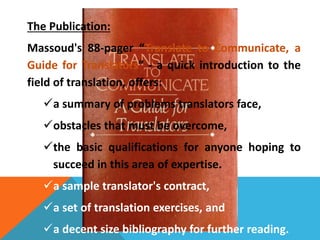
The Publication: 
Massoud's 88-pager “Translate to Communicate, a 
Guide for Translators” - a quick introduction to the 
field of translation, offers: 
a summary of problems translators face, 
obstacles that must be overcome, 
the basic qualifications for anyone hoping to 
succeed in this area of expertise. 
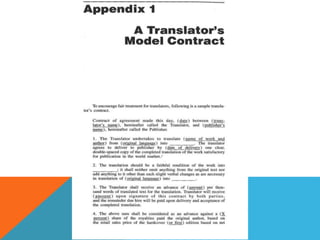
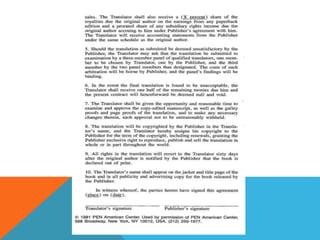
a sample translator's contract, 
a set of translation exercises, and 
a decent size bibliography for further reading.
Brief Overview – Part One
i. Introduction: 
History of translation : 
>Septuagint > Arabs >Post-Rosetta Stone Era > “Age of Instant 
Translation”. 
Defines two types of 
translation: 
[1] “Translation Bureaux” 
facilitates rendering of SL into TL 
in few hours at expense of 
quality. 
[2] “Sound & Effective Translation” (SET) 
 Culture sensitive, 
 Readership awareness 
 Subtlety of language 
Monograph objective: Assist translators to produce translations that 
communicate intended message in authentic style. 
Specifically designed for new translators and experienced ones with little formal 
training. 
Concludes with Nainggolan’s quotation referring to the third world countries’ 
need for good translators, "training of good and productive translators can be a 
matter of life and death for the nation."
Section 1 To Be a Translator (A): 
Translation is investment so we need to consider 
beforehand aspects pertaining to the product: 
 Has the product already been translated and 
 if so, the quality of that translation. 
 The cost factor needs to be considered. 
 Guidelines to assist in determining the need for 
translations, including, inter alia, 
o weighing the needs in the light of the publisher’s goals, 
o whether the product is acceptable to the readers, 
o the anticipated political or other sensitivities and 
some levels of market research.
Section 1 To Be a Translator (B): 
Translation is investment so we need to consider 
beforehand aspects pertaining to the translator: 
o the translator’s capacities, seeking consultation 
and 
o recruiting translators who should be: 
bilingual, - bicultural, - aware of historical and linguistic 
considerations, 
- & with excellent basic qualifications and abilities such as: 
(a) writing skills, (b) reading, (c) comprehension, 
(d) team spirit, (e) integrity, (f) organization and 
energy. Mary reiterates crucial role of translation in society, so recruiting the 
wrong translator could be dangerous or self-defeating. This conclusion 
is supported with various good examples and elaborations.
Section 2 Watch What You Say: 
The intended “meaning of a translation should be 
conveyed in a style that is authentic and as close to 
the original as possible”. 
Many excellent bilinguals fail as translators either 
because their work is incomprehensible or worse; it is 
comprehensible but conveys the unintended meaning. 
This mainly stems from certain factors such as: 
 “insufficient knowledge of the culture, 
 lack of awareness of historical changes in the 
meaning of words, or 
 unsophisticated understanding of a language”, 
especially where metaphors and idioms are 
concerned.
The intended “meaning of a translation should be 
conveyed in a style that is authentic and as close to 
the original as possible”. 
This is attainable by responding to the translator’s two 
questions: 
1.What is the author trying to say to the reader? 
2. How can this be said in a style that is both authentic 
and as close as possible to the original? 
The translator’s work and style should seem so natural to 
the target readers that finished product won’t sound like a 
translation, but as an indigenous and original piece of 
writing. Only then will the translator succeed in his/her task 
and become a communicator. ” 
Section 2 Watch What You Say:
Section 3 Apply the Tests for a Good Translation: 
A good translator today is one 
who seeks to communicate to the 
reader both the meaning and the 
spirit of the original message in a 
style that seems quite natural.
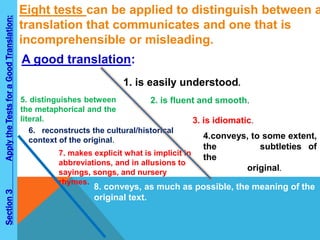
Eight tests can be applied to distinguish between a 
translation that communicates and one that is 
incomprehensible or misleading. 
A good translation: 
1. is easily understood. 
2. is fluent and smooth. 
3. is idiomatic. 
4.conveys, to some extent, 
the literary subtleties of 
the 
original. 
5. distinguishes between 
the metaphorical and the 
literal. 
6. reconstructs the cultural/historical 
context of the original. 
7. makes explicit what is implicit in 
abbreviations, and in allusions to 
sayings, songs, and nursery 
rhymes. 
8. conveys, as much as possible, the meaning of the 
original text. 
Section 3 Apply the Tests for a Good Translation:
Section 4 Observe Translators in Action: 
Section four stresses that “translation skills can be 
sharpened by observing and working with experienced 
translators.” Through a set of four examples of 
translation excerpts from four literary works Mary 
shows how the translator in each case has asked the 
two essential questions: 
1. What is the author trying to say to the reader? 
2. How can this be said in a style that is both 
authentic and as close as possible to the original?
Section 4 Observe Translators in Action: 
The author then discusses the overarching concepts of good 
translation: 
The first sample is her friend’s translation of an Arabic 
novel into English, “Qaryah Zalimah قرية ظالمة ” to illustrate how 
the translator wrestled with the daunting task of translating the 
title and two special expressions with no identical equivalents 
in the target language. 
In the second, an excerpt from Miramar, another Egyptian 
novel, the experienced translator, acting on the publisher’s request 
for clarity, decides to render a rather lengthy sentence into a group 
shorter sentences thus showing a good example of a successful 
restructuring. The translator has also managed to replace a 
metaphoric string from the SL into a parallel clause in TL that retains 
the intended meaning of the original but is not based on the literal 
translation of the original.
Section 4 Observe Translators in Action: 
The third illustration is based on an extract from a 
renowned autobiography – Al-Ayyam الأيام . Again the 
translator struggled here with certain words of unique 
meanings in Arabic and resorted to translate them either 
into phrases, give notes or use prose instead of poetry to 
bypass the arduous task and convey the meaning he 
believed right to each of the three situations. 
The fourth example Mary suggested gradual exercises of longer passages 
ranging from: 
1. Simple exposition or narrative, 
2. Description, 
3. Writing involving abstract thinking as in philosophy, 
4. and finally, poetry (if the translator is a poet).
Section 4 Observe Translators in Action: 
In fact the assignment she proposes the readers practise on is 
characterised by involving all of these four categories. It is recommended 
that the translation should be undertaken with the elaborate discussion 
she offers in mind. This discussion raises a number of technical 
questions and gives answers based on her expertise and the translation 
principles she discussed in the previous three paragraphs. 
In the end of the section the author comes to a logical conclusion that 
“good translators do not try to reproduce the formal order of words or 
phrases, nor do they try to find one-for-one sets of verbal 
correspondence. What they do aim at is a faithful reproduction of the 
original so that the meaning of the message and its spirit may be 
satisfactorily communicated.”
Brief Overview – Part Two
Section 5 
- 
Be Alert to 
Special Problems
Rules of thumb for solving two 
major translators’ problems: 
individual and textual. 
Section 5 - Be Alert to 
Special Problems
Rules of thumb for solving two major translators’ problems: individual and 
Ptreoxtuball.e ms Related to the Translator: 
(1) Too much knowledge of the subject 
matter (translate over the heads of their 
readers), 
(2) Too much interest in linguistic subtleties 
at the expense of clarity, 
(3) Too little respect for the reader and try to 
oversimplify, 
(4) Wrong focus on too small a unit or too 
large discourse. 
(5) Too little respect for the source text 
imposing one’s views and twisting words. 
(6) Too little knowledge of words that are 
identical but have different meanings 
Section 5 - Be Alert to 
Special Problems
Rules of thumb for solving two major translators’ problems: individual and 
textual. 
Problems that Stem from the Text: 
1. Linguistic problems: 
Construction, prepositions, verbs, pronouns, 
common nouns, proper nouns and adjectives 
denoting unknown objects, names of people & 
italics & dashes. 
2. Problems of restructuring: proverbs and 
messages originally meant for specialists, but now 
intended for the general reader. 
Section 5 - Be Alert to 
Special Problems
Some Rules of Thumb for Solving Individual and Textual Problems: 
1. Focus on the paragraph as related to the whole, not on the word or 
the sentence. 
2. Respect your source text. Do not impose on it your own 
interpretation. 
3. Use simple words, phrases, and sentences instead of technical 
terminology and involved statements. 
4. Do not go too far in trying to reproduce minute formal linguistic 
subtleties; these will only confuse your readers. Of course, a certain 
amount of linguistic subtlety can be conveyed. 
5. Respect your readers, remembering that although they may not be 
your peers, they probably have more imagination than you give them 
credit for. Do not oversimplify. 
Section 5 - Be Alert to 
Special Problems
Some Rules of Thumb for Solving Individual and Textual Problems: 
6. If you are not fluent in the language of a source text, be sure to 
work in close collaboration with a specialist in that language. 
7. If you have a problem with prepositions, verb forms, or tenses, 
be sure to consult someone else, possibly a linguist. 
8. Whenever the original refers to an object that is unfamiliar to 
the intended readers of the translation, be sure to qualify that 
object by an explanatory word or phrase. 
9. When translating a text that contains a proverb, use its known 
equivalent in the other language if there is one. 
10.Be sure to edit a message originally meant for specialists, but 
now intended for a wider and less homogenous group. 
Section 5 - Be Alert to 
Special Problems
Section 6 - 
Match Your Project with 
Your Skills.
Section 6 - Match Your Project with Your Skills. 
Massoud says that the 
translator and project must 
match, and identifies four 
different kinds of projects:
Section 6 - Match Your Project with Your Skills. 
6.1 Scientific and technical texts: the easiest to translate 
because they require the least restructuring – the most 
important translator’s tools here are: 
(1) Ability to think and write in precise, scientific language. 
(2) Some knowledge of the scientific field under consideration. 
(3) A good dictionary of scientific technical terms. 
Then Massoud very briefly reviewed prospects for utilizing 
machine translation (MT*) in this category of translation. 
*Or what is now known as Computer Assisted Translation (CAT)
Section 6 - Match Your Project with Your Skills. 
6.2 Business letters: Translators of business letters must be: 
 flexible, 
 alert, 
 and knowledgeable of cultural differences 
because a business letter will often require a substantial 
amount of restructuring since the forms of business 
etiquette differ widely in various parts of the world.
Section 6 - Match Your Project with Your Skills. 
6.3 Literary works: 
To translate literary works satisfactorily, translators must 
have artistic, literary ability in the form in which they are 
working i.e. 
 must be a poet to translate poetry, 
 a fiction writer to translate fiction, 
 a playwright to translate drama, and so on. 
To a large extent, literary capacity is a matter of training, 
talent alone is not enough where translation is concerned.
Section 6 - Match Your Project with Your Skills. 
The language of literature, whether prose 
or poetry, employs imagery, unlike the 
language of science. In terms of imagery, 
the general principle is that the translation 
should give the same meaning as the 
original and should produce the same 
emotive effect.
Section 6 - Match Your Project with Your Skills. 
Prose in literary works consists of four, major 
types: 
 narrative, 
 dialogue, 
 description, and 
 argument. 
Hence, the translator needs skills in these areas.
Section 6 - Match Your Project with Your Skills. 
Poetry is distinguished from prose not 
merely in its use of meter and verse 
patterns, but also in possessing a certain 
novelty, complexity, and compression. 
To translate poetry effectively, translators must 
be poets, familiar with the metrical systems and 
poetic forms of both languages concerned. But this 
is not all; translator-poets also need sensitivity to 
know when to translate a poem into poetry, and 
when to translate it into prose.
Section 6 - Match Your Project with Your Skills. 
6.4 Biblical literature: In many countries, 
the best translators of general literature are 
the ones who have had their schooling in 
Scripture translation. Translating the Bible 
takes versatility from every kind of 
translator for it contains all the forms of 
literature.
Section 6 - Match Your Project with Your Skills. 
Can oral interpreters be translators? 
The question often comes up when planning projects: 
A person who can interpret orally may not necessarily be able to produce a 
satisfactory written translation. Nor is one who can produce satisfactory written 
translations necessarily able to interpret well orally. The skills required by the one 
are not identical to those required by the other. 
This is important to keep in mind when considering translation work. Before 
beginning to work, ask yourself the questions: 
 Are you the right person for the project? 
 Do you have the necessary knowledge and skills? 
Whether the project is scientific matter, business letters, literary works, Biblical 
(religious) literature, or any other kind of work, 
translator and project must match.
Section 7 
Know Your 
Reader:
Section 7 Know Your Reader: 
The reader's 
background, 
interests, and 
reading level 
are key factors in translation 
work.
The principle to follow 
Simply, before you translate, know your reader. 
That is, know the 
 educational, 
 social, and 
 cultural background of your read-ers, 
 their interests, and 
 their reading level. 
This will affect not only how you translate but 
what. 
Section 7 Know Your Reader:
Keep the focus on the reader 
As the translation project proceeds, it is important to keep 
thinking of the reader. 
Massoud then questions the limits the translator can reach to 
respond to the special needs of the reader: how far from the 
original is the translator allowed to stray? 
• Is it legitimate to replace an object unknown in a certain 
region with another that is known there? 
• Is it legitimate to adapt "urban" material to "rural" 
material and vice versa? 
• Further, is it legitimate to take a highly complicated 
original and reduce it down for the general reader? 
Contemporary expert opinion puts much emphasis on content 
and would answer all these questions in the affirmative. 
The important thing is to communicate to the intended reader 
the message of the original. 
Section 7 Know Your Reader:
When the readers are 
children 
Today's children know much more than those 
of a quarter of a century ago. 
This is because of the widespread use of 
television and other mass media. 
However, when one is selecting translation 
projects for children, one must choose texts 
that are specifically written for children. 
Section 7 Know Your Reader:
A rule of thumb 
For most translations, it is best to use the language level of persons from 
25 to 35 years of age. As Nida and Taber have pointed out in The Theory 
and Practice of Translation: 
With the rapid changes which are affecting so many languages in the 
world, the forms used by the older people are rapidly becoming 
obsolescent. If in translating, one insists on using primarily the speech 
of the elders, many of the words and expressions are likely to appear 
strange within a few years. At the same time, one should not accept 
the language of children as a norm, for this does not have sufficient 
status as to be fully acceptable. Such forms are often rejected by the 
children themselves, who may be offended by being addressed 
in a style which seems substandard or paternalistic. 
Section 7 Know Your Reader:
What about speech and dialogue? 
A translator translating dialogue or spoken words should be able 
to suit the language to the occasion and also to the relationships 
between speakers. Accordingly, the language may be formal, 
informal, or casual. 
If one wishes to be understood by the general reader, one cannot 
use a form that is comprehended only by the literary elite. On the 
whole, translators do best to use a form of "common language" 
that represents a satisfactory overlap, based on consumer 
language. 
Section 7 Know Your Reader:
Section 8 
Sharpen Your Skills 
at a Workshop
Translators can benefit from 
workshops that provide 
principles of translation as well 
as practical experience. 
Here is a brief outline of what 
might be involved in a workshop 
for a translation project: 
Section 8 Sharpen Your Skills at aWorkshop
Choosing the participants 
The first step is to choose those who will be trained 
at the workshop. Invite experienced translators or 
staff members with potential, recruit new talents 
[with a notice in the papers, and another to (a) 
university (-ies)]. 
It is recommended to start with a consultation 
session during which a brief explanation of basic 
principles, procedures, and problems of translation 
is given. (These are presented in this book.) 
This leads to an Informal Translating Test to assess 
which of the participants have potential to become 
good translators. These are selected for training at 
the workshop. 
Section 8 Sharpen Your Skills at aWorkshop
Establishing objectives for the 
workshop 
A translators’ workshop usually 
has three objectives: To train 
participants 
to do basic translation work. 
for revision. 
to work in teams. 
Section 8 Sharpen Your Skills at aWorkshop
Length of the workshop 
The length of the workshop will vary in proportion to 
the experience of participants. If the participants are 
beginners who have not yet had much experience in 
writing for publication, the workshop should be five 
weeks long, divided as follows: 
 Weeks 1 and 2: Training in writing 
 Weeks 3 and 4: Training in translation 
 Week 5: Revision 
Section 8 Sharpen Your Skills at aWorkshop
Section 8 Sharpen Your Skills at aWorkshop 
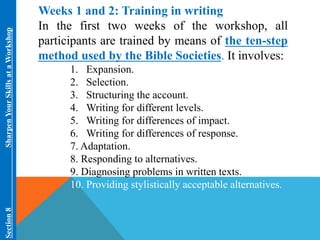
Weeks 1 and 2: Training in writing 
In the first two weeks of the workshop, all 
participants are trained by means of the ten-step 
method used by the Bible Societies. It involves: 
1. Expansion. 
2. Selection. 
3. Structuring the account. 
4. Writing for different levels. 
5. Writing for differences of impact. 
6. Writing for differences of response. 
7. Adaptation. 
8. Responding to alternatives. 
9. Diagnosing problems in written texts. 
10. Providing stylistically acceptable alternatives.
Section 8 Sharpen Your Skills at aWorkshop 
Weeks 3 and 4: Training in translation 
In the next two weeks the participants will be 
trained in the basics of translation work.
Section 8 Sharpen Your Skills at aWorkshop 
Discussion, then practice 
Using this book as a training tool, one session each 
day can be devoted to: 
 the basic essentials of a translator's job, 
 the qualities of a good translation, 
 what problems to expect, 
 how to deal with them, 
 and so on (chapters 1-7). 
The passages in appendix 2 provide additional 
illustrations and/or exercises for these sessions.
Section 8 Sharpen Your Skills at aWorkshop 
A note on teamwork 
Teamwork is necessary: 
a. when a translator lacks sufficient knowledge of SL, its cultural 
context, or any specialized field referred to in the original text. 
b. in the second stage of translation, when the work is to be revised 
and a final draft prepared. 
To achieve the best results in teamwork, follow these guidelines: 
1. Small team, not exceeding three persons. 
2. Members can communicate with one another, even if the 
communication has to be in a language other than that of the 
original text or the new one. 
3. Members of a team must enjoy working together.
Section 8 Sharpen Your Skills at aWorkshop 
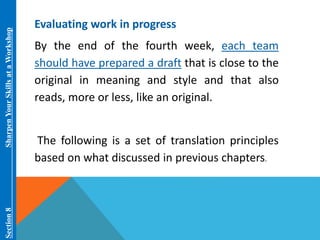
Evaluating work in progress 
By the end of the fourth week, each team 
should have prepared a draft that is close to the 
original in meaning and style and that also 
reads, more or less, like an original. 
The following is a set of translation principles 
based on what discussed in previous chapters.
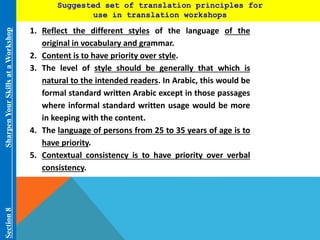
Suggested set of translation principles for 
use in translation workshops 
Section 8 Sharpen Your Skills at aWorkshop 
1. Reflect the different styles of the language of the 
original in vocabulary and grammar. 
2. Content is to have priority over style. 
3. The level of style should be generally that which is 
natural to the intended readers. In Arabic, this would be 
formal standard written Arabic except in those passages 
where informal standard written usage would be more 
in keeping with the content. 
4. The language of persons from 25 to 35 years of age is to 
have priority. 
5. Contextual consistency is to have priority over verbal 
consistency.
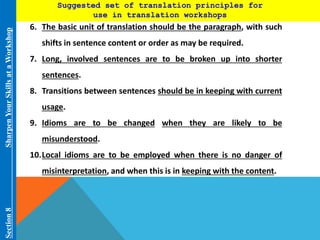
Suggested set of translation principles for 
use in translation workshops 
Section 8 Sharpen Your Skills at aWorkshop 
6. The basic unit of translation should be the paragraph, with such 
shifts in sentence content or order as may be required. 
7. Long, involved sentences are to be broken up into shorter 
sentences. 
8. Transitions between sentences should be in keeping with current 
usage. 
9. Idioms are to be changed when they are likely to be 
misunderstood. 
10.Local idioms are to be employed when there is no danger of 
misinterpretation, and when this is in keeping with the content.
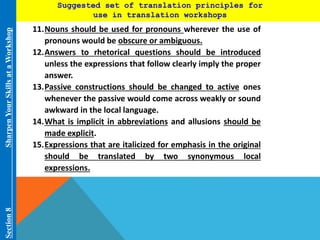
Suggested set of translation principles for 
use in translation workshops 
Section 8 Sharpen Your Skills at aWorkshop 
11.Nouns should be used for pronouns wherever the use of 
pronouns would be obscure or ambiguous. 
12.Answers to rhetorical questions should be introduced 
unless the expressions that follow clearly imply the proper 
answer. 
13.Passive constructions should be changed to active ones 
whenever the passive would come across weakly or sound 
awkward in the local language. 
14.What is implicit in abbreviations and allusions should be 
made explicit. 
15.Expressions that are italicized for emphasis in the original 
should be translated by two synonymous local 
expressions.
Suggested set of translation principles for 
use in translation workshops 
Section 8 Sharpen Your Skills at aWorkshop 
16. A dash in an original text conveying the meaning "that is to say" should be 
translated by a word or words in the local language. 
17. In the case of genuine ambiguity in the original text, one alternative 
should be given in the translated text, and the other in a footnote. 
18. All technical terms or unfamiliar terms for weights, measures, and the like 
should be explained in footnotes. This would also be true for plays on 
words, historical details, or cultural differences. 
19. Keep the spelling for translations or transliterations of proper names 
already in wide use. Be alert for exceptions. Proper names in Arabic 
should, in general, be transcribed on the basis of Arabic phonological 
structures, taking into consideration syllabic patterns, sequence of vowels, 
and length of words. 
20. If a proverb already has a well-known equivalent in the local language, 
that equivalent should be used.
Section 8 Sharpen Your Skills at aWorkshop 
Week 5: Revision 
o The teams would exchange drafts with comments from 
another team. These are then compiled returning it for a 
revised draft. 
o The revised drafts are then tested orally to the participants. 
o Reactions are noted. 
o An Arabic expert then comments on each of individual final 
drafts, looking for any unnatural expression or awkward 
construction that might have escaped notice. 
o Finally, the publishable versions are prepared.
Section 8 Sharpen Your Skills at aWorkshop 
Follow-up 
Make every possible provision for the continuing education of translators. Follow-up, 
therefore, should be part of an ongoing process in the upkeep of translators. The 
following list of Do's and Do Not's might serve as a guide: 
Do's 
i. Be sure to organize translation workshops and/or brief in-house training 
programs for translators at regular intervals. 
ii. Encourage senior translators to help in teaching the junior ones. We learn most 
by teaching others. 
iii. Translators must have access to a good selection of books on translation and 
related subjects, 
iv. as well as periodicals. Start with this monograph and some of the works 
listed in the Bibliography at the end. 
v. Translators need to attempt more ambitious projects. 
vi. The best way to sharpen a skill is to give it enough exercise.
Section 8 Sharpen Your Skills at aWorkshop 
Do Not's 
• Do not deny time off to attend a conference or 
symposium on translation as these are 
always enriching and will lead to better quality 
work. 
• Do not expect translators to accomplish the 
impossible. 
• Do not overwork, and/or underpay translators. 
Fatigue and dissatisfaction are not conducive 
to good quality work.
Section 8 Sharpen Your Skills at aWorkshop 
How often should a translation workshop be repeated? 
Several factors determine this among which are: 
the financial resources of the sponsoring organization, 
the availability of consultants, 
and the readiness and/or ability of the participants with fulltime jobs to take 
time off to attend such a workshop. 
Ideally, any organization that has engaged translators should 
arrange for them to attend follow-up workshops at least once 
every two years. 
Workshops help sharpen skills and alert one to what is new in the world of 
translation. In the workshop, participants learn from one another, 
Not only that, a group working together generates a communal sense of excitement. 
This encourages a feeling of urgency that can lead to better translating. It can also 
lead to the creation of an art appropriate to its time that crosses barriers between 
the different peoples of the world.
Any 
Questio 
ns

Overview mary massoud's translate to communicate

  • 1.
    NOTES ON MARYMASSOUD’S MONOGRAPH: TRANSLATE TO COMMUNICATE - A GUIDE FOR TRANSLATORS C O M P I L E D B Y : I M A D H A S S A N E I N
  • 2.
    THE AUTHOR –MARY MASSOUD  Egyptian writer  Teaches English & comparative literature at Ain Shams  Often translator of her own work  Schooling , Scripture Translation (Bible into modern Arabic)  Involved in workshops & translation consultancy.
  • 3.
    The Publication: Massoud's88-pager “Translate to Communicate, a Guide for Translators” - a quick introduction to the field of translation, offers: a summary of problems translators face, obstacles that must be overcome, the basic qualifications for anyone hoping to succeed in this area of expertise. a sample translator's contract, a set of translation exercises, and a decent size bibliography for further reading.
  • 4.
  • 5.
    i. Introduction: Historyof translation : >Septuagint > Arabs >Post-Rosetta Stone Era > “Age of Instant Translation”. Defines two types of translation: [1] “Translation Bureaux” facilitates rendering of SL into TL in few hours at expense of quality. [2] “Sound & Effective Translation” (SET)  Culture sensitive,  Readership awareness  Subtlety of language Monograph objective: Assist translators to produce translations that communicate intended message in authentic style. Specifically designed for new translators and experienced ones with little formal training. Concludes with Nainggolan’s quotation referring to the third world countries’ need for good translators, "training of good and productive translators can be a matter of life and death for the nation."
  • 6.
    Section 1 ToBe a Translator (A): Translation is investment so we need to consider beforehand aspects pertaining to the product:  Has the product already been translated and  if so, the quality of that translation.  The cost factor needs to be considered.  Guidelines to assist in determining the need for translations, including, inter alia, o weighing the needs in the light of the publisher’s goals, o whether the product is acceptable to the readers, o the anticipated political or other sensitivities and some levels of market research.
  • 7.
    Section 1 ToBe a Translator (B): Translation is investment so we need to consider beforehand aspects pertaining to the translator: o the translator’s capacities, seeking consultation and o recruiting translators who should be: bilingual, - bicultural, - aware of historical and linguistic considerations, - & with excellent basic qualifications and abilities such as: (a) writing skills, (b) reading, (c) comprehension, (d) team spirit, (e) integrity, (f) organization and energy. Mary reiterates crucial role of translation in society, so recruiting the wrong translator could be dangerous or self-defeating. This conclusion is supported with various good examples and elaborations.
  • 8.
    Section 2 WatchWhat You Say: The intended “meaning of a translation should be conveyed in a style that is authentic and as close to the original as possible”. Many excellent bilinguals fail as translators either because their work is incomprehensible or worse; it is comprehensible but conveys the unintended meaning. This mainly stems from certain factors such as:  “insufficient knowledge of the culture,  lack of awareness of historical changes in the meaning of words, or  unsophisticated understanding of a language”, especially where metaphors and idioms are concerned.
  • 9.
    The intended “meaningof a translation should be conveyed in a style that is authentic and as close to the original as possible”. This is attainable by responding to the translator’s two questions: 1.What is the author trying to say to the reader? 2. How can this be said in a style that is both authentic and as close as possible to the original? The translator’s work and style should seem so natural to the target readers that finished product won’t sound like a translation, but as an indigenous and original piece of writing. Only then will the translator succeed in his/her task and become a communicator. ” Section 2 Watch What You Say:
  • 10.
    Section 3 Applythe Tests for a Good Translation: A good translator today is one who seeks to communicate to the reader both the meaning and the spirit of the original message in a style that seems quite natural.
  • 11.
    Eight tests canbe applied to distinguish between a translation that communicates and one that is incomprehensible or misleading. A good translation: 1. is easily understood. 2. is fluent and smooth. 3. is idiomatic. 4.conveys, to some extent, the literary subtleties of the original. 5. distinguishes between the metaphorical and the literal. 6. reconstructs the cultural/historical context of the original. 7. makes explicit what is implicit in abbreviations, and in allusions to sayings, songs, and nursery rhymes. 8. conveys, as much as possible, the meaning of the original text. Section 3 Apply the Tests for a Good Translation:
  • 12.
    Section 4 ObserveTranslators in Action: Section four stresses that “translation skills can be sharpened by observing and working with experienced translators.” Through a set of four examples of translation excerpts from four literary works Mary shows how the translator in each case has asked the two essential questions: 1. What is the author trying to say to the reader? 2. How can this be said in a style that is both authentic and as close as possible to the original?
  • 13.
    Section 4 ObserveTranslators in Action: The author then discusses the overarching concepts of good translation: The first sample is her friend’s translation of an Arabic novel into English, “Qaryah Zalimah قرية ظالمة ” to illustrate how the translator wrestled with the daunting task of translating the title and two special expressions with no identical equivalents in the target language. In the second, an excerpt from Miramar, another Egyptian novel, the experienced translator, acting on the publisher’s request for clarity, decides to render a rather lengthy sentence into a group shorter sentences thus showing a good example of a successful restructuring. The translator has also managed to replace a metaphoric string from the SL into a parallel clause in TL that retains the intended meaning of the original but is not based on the literal translation of the original.
  • 14.
    Section 4 ObserveTranslators in Action: The third illustration is based on an extract from a renowned autobiography – Al-Ayyam الأيام . Again the translator struggled here with certain words of unique meanings in Arabic and resorted to translate them either into phrases, give notes or use prose instead of poetry to bypass the arduous task and convey the meaning he believed right to each of the three situations. The fourth example Mary suggested gradual exercises of longer passages ranging from: 1. Simple exposition or narrative, 2. Description, 3. Writing involving abstract thinking as in philosophy, 4. and finally, poetry (if the translator is a poet).
  • 15.
    Section 4 ObserveTranslators in Action: In fact the assignment she proposes the readers practise on is characterised by involving all of these four categories. It is recommended that the translation should be undertaken with the elaborate discussion she offers in mind. This discussion raises a number of technical questions and gives answers based on her expertise and the translation principles she discussed in the previous three paragraphs. In the end of the section the author comes to a logical conclusion that “good translators do not try to reproduce the formal order of words or phrases, nor do they try to find one-for-one sets of verbal correspondence. What they do aim at is a faithful reproduction of the original so that the meaning of the message and its spirit may be satisfactorily communicated.”
  • 16.
  • 17.
    Section 5 - Be Alert to Special Problems
  • 18.
    Rules of thumbfor solving two major translators’ problems: individual and textual. Section 5 - Be Alert to Special Problems
  • 19.
    Rules of thumbfor solving two major translators’ problems: individual and Ptreoxtuball.e ms Related to the Translator: (1) Too much knowledge of the subject matter (translate over the heads of their readers), (2) Too much interest in linguistic subtleties at the expense of clarity, (3) Too little respect for the reader and try to oversimplify, (4) Wrong focus on too small a unit or too large discourse. (5) Too little respect for the source text imposing one’s views and twisting words. (6) Too little knowledge of words that are identical but have different meanings Section 5 - Be Alert to Special Problems
  • 20.
    Rules of thumbfor solving two major translators’ problems: individual and textual. Problems that Stem from the Text: 1. Linguistic problems: Construction, prepositions, verbs, pronouns, common nouns, proper nouns and adjectives denoting unknown objects, names of people & italics & dashes. 2. Problems of restructuring: proverbs and messages originally meant for specialists, but now intended for the general reader. Section 5 - Be Alert to Special Problems
  • 21.
    Some Rules ofThumb for Solving Individual and Textual Problems: 1. Focus on the paragraph as related to the whole, not on the word or the sentence. 2. Respect your source text. Do not impose on it your own interpretation. 3. Use simple words, phrases, and sentences instead of technical terminology and involved statements. 4. Do not go too far in trying to reproduce minute formal linguistic subtleties; these will only confuse your readers. Of course, a certain amount of linguistic subtlety can be conveyed. 5. Respect your readers, remembering that although they may not be your peers, they probably have more imagination than you give them credit for. Do not oversimplify. Section 5 - Be Alert to Special Problems
  • 22.
    Some Rules ofThumb for Solving Individual and Textual Problems: 6. If you are not fluent in the language of a source text, be sure to work in close collaboration with a specialist in that language. 7. If you have a problem with prepositions, verb forms, or tenses, be sure to consult someone else, possibly a linguist. 8. Whenever the original refers to an object that is unfamiliar to the intended readers of the translation, be sure to qualify that object by an explanatory word or phrase. 9. When translating a text that contains a proverb, use its known equivalent in the other language if there is one. 10.Be sure to edit a message originally meant for specialists, but now intended for a wider and less homogenous group. Section 5 - Be Alert to Special Problems
  • 23.
    Section 6 - Match Your Project with Your Skills.
  • 24.
    Section 6 -Match Your Project with Your Skills. Massoud says that the translator and project must match, and identifies four different kinds of projects:
  • 25.
    Section 6 -Match Your Project with Your Skills. 6.1 Scientific and technical texts: the easiest to translate because they require the least restructuring – the most important translator’s tools here are: (1) Ability to think and write in precise, scientific language. (2) Some knowledge of the scientific field under consideration. (3) A good dictionary of scientific technical terms. Then Massoud very briefly reviewed prospects for utilizing machine translation (MT*) in this category of translation. *Or what is now known as Computer Assisted Translation (CAT)
  • 26.
    Section 6 -Match Your Project with Your Skills. 6.2 Business letters: Translators of business letters must be:  flexible,  alert,  and knowledgeable of cultural differences because a business letter will often require a substantial amount of restructuring since the forms of business etiquette differ widely in various parts of the world.
  • 27.
    Section 6 -Match Your Project with Your Skills. 6.3 Literary works: To translate literary works satisfactorily, translators must have artistic, literary ability in the form in which they are working i.e.  must be a poet to translate poetry,  a fiction writer to translate fiction,  a playwright to translate drama, and so on. To a large extent, literary capacity is a matter of training, talent alone is not enough where translation is concerned.
  • 28.
    Section 6 -Match Your Project with Your Skills. The language of literature, whether prose or poetry, employs imagery, unlike the language of science. In terms of imagery, the general principle is that the translation should give the same meaning as the original and should produce the same emotive effect.
  • 29.
    Section 6 -Match Your Project with Your Skills. Prose in literary works consists of four, major types:  narrative,  dialogue,  description, and  argument. Hence, the translator needs skills in these areas.
  • 30.
    Section 6 -Match Your Project with Your Skills. Poetry is distinguished from prose not merely in its use of meter and verse patterns, but also in possessing a certain novelty, complexity, and compression. To translate poetry effectively, translators must be poets, familiar with the metrical systems and poetic forms of both languages concerned. But this is not all; translator-poets also need sensitivity to know when to translate a poem into poetry, and when to translate it into prose.
  • 31.
    Section 6 -Match Your Project with Your Skills. 6.4 Biblical literature: In many countries, the best translators of general literature are the ones who have had their schooling in Scripture translation. Translating the Bible takes versatility from every kind of translator for it contains all the forms of literature.
  • 32.
    Section 6 -Match Your Project with Your Skills. Can oral interpreters be translators? The question often comes up when planning projects: A person who can interpret orally may not necessarily be able to produce a satisfactory written translation. Nor is one who can produce satisfactory written translations necessarily able to interpret well orally. The skills required by the one are not identical to those required by the other. This is important to keep in mind when considering translation work. Before beginning to work, ask yourself the questions:  Are you the right person for the project?  Do you have the necessary knowledge and skills? Whether the project is scientific matter, business letters, literary works, Biblical (religious) literature, or any other kind of work, translator and project must match.
  • 33.
    Section 7 KnowYour Reader:
  • 34.
    Section 7 KnowYour Reader: The reader's background, interests, and reading level are key factors in translation work.
  • 35.
    The principle tofollow Simply, before you translate, know your reader. That is, know the  educational,  social, and  cultural background of your read-ers,  their interests, and  their reading level. This will affect not only how you translate but what. Section 7 Know Your Reader:
  • 36.
    Keep the focuson the reader As the translation project proceeds, it is important to keep thinking of the reader. Massoud then questions the limits the translator can reach to respond to the special needs of the reader: how far from the original is the translator allowed to stray? • Is it legitimate to replace an object unknown in a certain region with another that is known there? • Is it legitimate to adapt "urban" material to "rural" material and vice versa? • Further, is it legitimate to take a highly complicated original and reduce it down for the general reader? Contemporary expert opinion puts much emphasis on content and would answer all these questions in the affirmative. The important thing is to communicate to the intended reader the message of the original. Section 7 Know Your Reader:
  • 37.
    When the readersare children Today's children know much more than those of a quarter of a century ago. This is because of the widespread use of television and other mass media. However, when one is selecting translation projects for children, one must choose texts that are specifically written for children. Section 7 Know Your Reader:
  • 38.
    A rule ofthumb For most translations, it is best to use the language level of persons from 25 to 35 years of age. As Nida and Taber have pointed out in The Theory and Practice of Translation: With the rapid changes which are affecting so many languages in the world, the forms used by the older people are rapidly becoming obsolescent. If in translating, one insists on using primarily the speech of the elders, many of the words and expressions are likely to appear strange within a few years. At the same time, one should not accept the language of children as a norm, for this does not have sufficient status as to be fully acceptable. Such forms are often rejected by the children themselves, who may be offended by being addressed in a style which seems substandard or paternalistic. Section 7 Know Your Reader:
  • 39.
    What about speechand dialogue? A translator translating dialogue or spoken words should be able to suit the language to the occasion and also to the relationships between speakers. Accordingly, the language may be formal, informal, or casual. If one wishes to be understood by the general reader, one cannot use a form that is comprehended only by the literary elite. On the whole, translators do best to use a form of "common language" that represents a satisfactory overlap, based on consumer language. Section 7 Know Your Reader:
  • 40.
    Section 8 SharpenYour Skills at a Workshop
  • 41.
    Translators can benefitfrom workshops that provide principles of translation as well as practical experience. Here is a brief outline of what might be involved in a workshop for a translation project: Section 8 Sharpen Your Skills at aWorkshop
  • 42.
    Choosing the participants The first step is to choose those who will be trained at the workshop. Invite experienced translators or staff members with potential, recruit new talents [with a notice in the papers, and another to (a) university (-ies)]. It is recommended to start with a consultation session during which a brief explanation of basic principles, procedures, and problems of translation is given. (These are presented in this book.) This leads to an Informal Translating Test to assess which of the participants have potential to become good translators. These are selected for training at the workshop. Section 8 Sharpen Your Skills at aWorkshop
  • 43.
    Establishing objectives forthe workshop A translators’ workshop usually has three objectives: To train participants to do basic translation work. for revision. to work in teams. Section 8 Sharpen Your Skills at aWorkshop
  • 44.
    Length of theworkshop The length of the workshop will vary in proportion to the experience of participants. If the participants are beginners who have not yet had much experience in writing for publication, the workshop should be five weeks long, divided as follows:  Weeks 1 and 2: Training in writing  Weeks 3 and 4: Training in translation  Week 5: Revision Section 8 Sharpen Your Skills at aWorkshop
  • 45.
    Section 8 SharpenYour Skills at aWorkshop Weeks 1 and 2: Training in writing In the first two weeks of the workshop, all participants are trained by means of the ten-step method used by the Bible Societies. It involves: 1. Expansion. 2. Selection. 3. Structuring the account. 4. Writing for different levels. 5. Writing for differences of impact. 6. Writing for differences of response. 7. Adaptation. 8. Responding to alternatives. 9. Diagnosing problems in written texts. 10. Providing stylistically acceptable alternatives.
  • 46.
    Section 8 SharpenYour Skills at aWorkshop Weeks 3 and 4: Training in translation In the next two weeks the participants will be trained in the basics of translation work.
  • 47.
    Section 8 SharpenYour Skills at aWorkshop Discussion, then practice Using this book as a training tool, one session each day can be devoted to:  the basic essentials of a translator's job,  the qualities of a good translation,  what problems to expect,  how to deal with them,  and so on (chapters 1-7). The passages in appendix 2 provide additional illustrations and/or exercises for these sessions.
  • 48.
    Section 8 SharpenYour Skills at aWorkshop A note on teamwork Teamwork is necessary: a. when a translator lacks sufficient knowledge of SL, its cultural context, or any specialized field referred to in the original text. b. in the second stage of translation, when the work is to be revised and a final draft prepared. To achieve the best results in teamwork, follow these guidelines: 1. Small team, not exceeding three persons. 2. Members can communicate with one another, even if the communication has to be in a language other than that of the original text or the new one. 3. Members of a team must enjoy working together.
  • 49.
    Section 8 SharpenYour Skills at aWorkshop Evaluating work in progress By the end of the fourth week, each team should have prepared a draft that is close to the original in meaning and style and that also reads, more or less, like an original. The following is a set of translation principles based on what discussed in previous chapters.
  • 50.
    Suggested set oftranslation principles for use in translation workshops Section 8 Sharpen Your Skills at aWorkshop 1. Reflect the different styles of the language of the original in vocabulary and grammar. 2. Content is to have priority over style. 3. The level of style should be generally that which is natural to the intended readers. In Arabic, this would be formal standard written Arabic except in those passages where informal standard written usage would be more in keeping with the content. 4. The language of persons from 25 to 35 years of age is to have priority. 5. Contextual consistency is to have priority over verbal consistency.
  • 51.
    Suggested set oftranslation principles for use in translation workshops Section 8 Sharpen Your Skills at aWorkshop 6. The basic unit of translation should be the paragraph, with such shifts in sentence content or order as may be required. 7. Long, involved sentences are to be broken up into shorter sentences. 8. Transitions between sentences should be in keeping with current usage. 9. Idioms are to be changed when they are likely to be misunderstood. 10.Local idioms are to be employed when there is no danger of misinterpretation, and when this is in keeping with the content.
  • 52.
    Suggested set oftranslation principles for use in translation workshops Section 8 Sharpen Your Skills at aWorkshop 11.Nouns should be used for pronouns wherever the use of pronouns would be obscure or ambiguous. 12.Answers to rhetorical questions should be introduced unless the expressions that follow clearly imply the proper answer. 13.Passive constructions should be changed to active ones whenever the passive would come across weakly or sound awkward in the local language. 14.What is implicit in abbreviations and allusions should be made explicit. 15.Expressions that are italicized for emphasis in the original should be translated by two synonymous local expressions.
  • 53.
    Suggested set oftranslation principles for use in translation workshops Section 8 Sharpen Your Skills at aWorkshop 16. A dash in an original text conveying the meaning "that is to say" should be translated by a word or words in the local language. 17. In the case of genuine ambiguity in the original text, one alternative should be given in the translated text, and the other in a footnote. 18. All technical terms or unfamiliar terms for weights, measures, and the like should be explained in footnotes. This would also be true for plays on words, historical details, or cultural differences. 19. Keep the spelling for translations or transliterations of proper names already in wide use. Be alert for exceptions. Proper names in Arabic should, in general, be transcribed on the basis of Arabic phonological structures, taking into consideration syllabic patterns, sequence of vowels, and length of words. 20. If a proverb already has a well-known equivalent in the local language, that equivalent should be used.
  • 54.
    Section 8 SharpenYour Skills at aWorkshop Week 5: Revision o The teams would exchange drafts with comments from another team. These are then compiled returning it for a revised draft. o The revised drafts are then tested orally to the participants. o Reactions are noted. o An Arabic expert then comments on each of individual final drafts, looking for any unnatural expression or awkward construction that might have escaped notice. o Finally, the publishable versions are prepared.
  • 55.
    Section 8 SharpenYour Skills at aWorkshop Follow-up Make every possible provision for the continuing education of translators. Follow-up, therefore, should be part of an ongoing process in the upkeep of translators. The following list of Do's and Do Not's might serve as a guide: Do's i. Be sure to organize translation workshops and/or brief in-house training programs for translators at regular intervals. ii. Encourage senior translators to help in teaching the junior ones. We learn most by teaching others. iii. Translators must have access to a good selection of books on translation and related subjects, iv. as well as periodicals. Start with this monograph and some of the works listed in the Bibliography at the end. v. Translators need to attempt more ambitious projects. vi. The best way to sharpen a skill is to give it enough exercise.
  • 56.
    Section 8 SharpenYour Skills at aWorkshop Do Not's • Do not deny time off to attend a conference or symposium on translation as these are always enriching and will lead to better quality work. • Do not expect translators to accomplish the impossible. • Do not overwork, and/or underpay translators. Fatigue and dissatisfaction are not conducive to good quality work.
  • 57.
    Section 8 SharpenYour Skills at aWorkshop How often should a translation workshop be repeated? Several factors determine this among which are: the financial resources of the sponsoring organization, the availability of consultants, and the readiness and/or ability of the participants with fulltime jobs to take time off to attend such a workshop. Ideally, any organization that has engaged translators should arrange for them to attend follow-up workshops at least once every two years. Workshops help sharpen skills and alert one to what is new in the world of translation. In the workshop, participants learn from one another, Not only that, a group working together generates a communal sense of excitement. This encourages a feeling of urgency that can lead to better translating. It can also lead to the creation of an art appropriate to its time that crosses barriers between the different peoples of the world.
  • 60.