+


    From OBO to OWL and
    back again – a tutorial
    David Osumi-Sutherland, Virtual Fly
    Brain/FlyBase
    Chris Mungall – GO/LBL
+


     Links
          to software downloads and tutorial ontology
     can be found here:
        http://www.bioontology.org/wiki/index.php?title=From_OBO_t
         o_OWL_and_back


     Pleasenote that the tutorial ontology has been
     designed for teaching purposes and should NOT be
     used as a reference for classes or relations.
+
    I use OBO, why should I care about
    OWL?
       OWL 2 is a W3C standard with a large and growing ecosystem of
        developers.

       Using OWL ontologies in Protégé 4 you can use fast reasoners to:
           Query your ontology
             This could be the basis for sophisticated queries on your website
           Quickly find mistakes
           Automate classification

       Non-lossy round tripping from OBO to OWL and back is now easy
           continue developing in OBO while taking advantage of OWL and
            Protégé for reasoning
           This may be a first step to developing in OWL/Protégé
+
    Oort

       OBO ontology release tool:
           Starting from ontology requiring a reasoner, uses OWL reasoning to:
               Roll OBO file that needs no reasoner – supporting current users.
               Automatically make slims
+
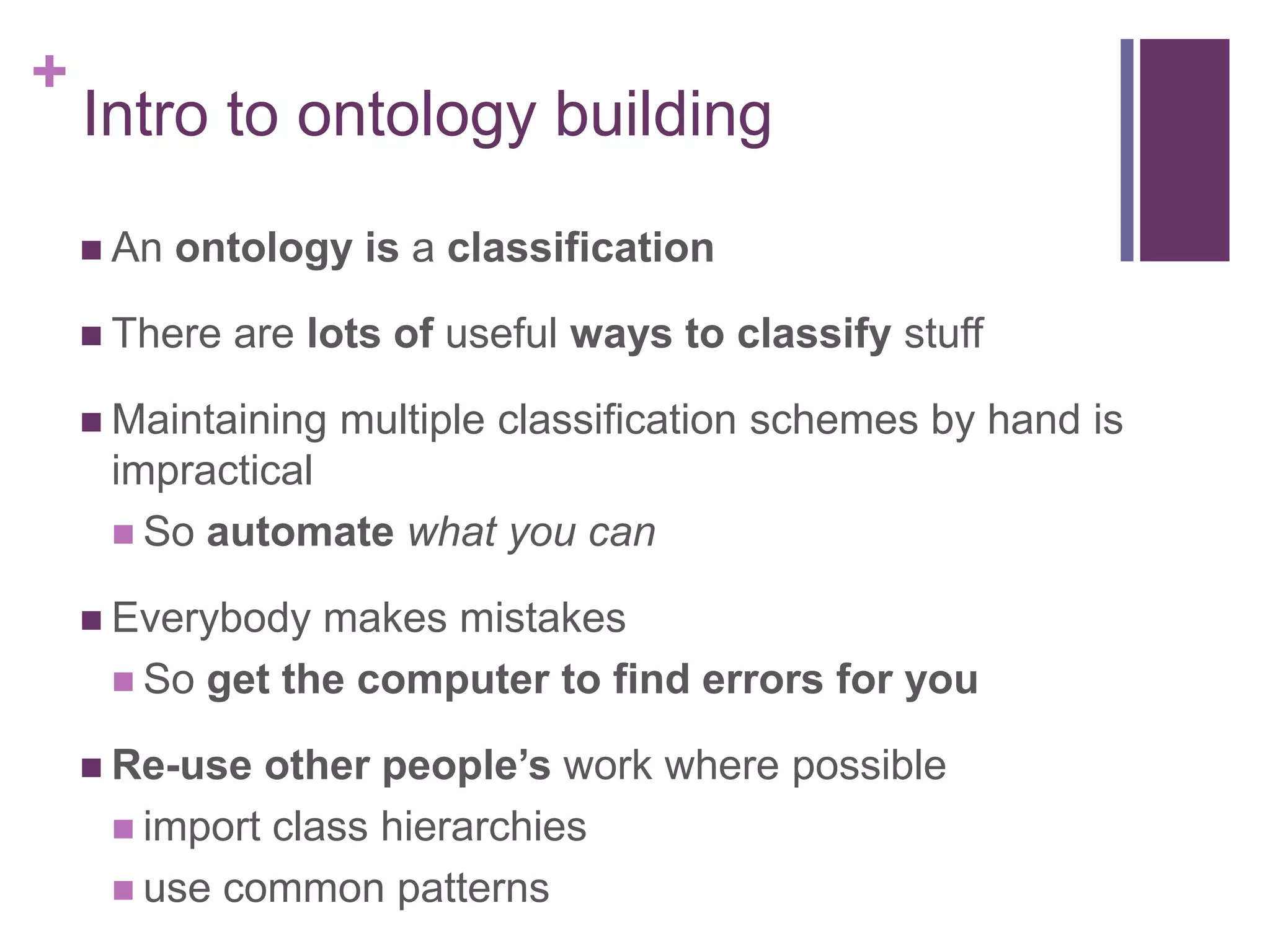
    Intro to ontology building
     An   ontology is a classification

     There   are lots of useful ways to classify stuff

     Maintaining   multiple classification schemes by hand is
     impractical
      So automate what you can

     Everybody makes mistakes
      So get the computer to find errors for you

     Re-use other people’s work where possible
      import class hierarchies
      use common patterns
+
    Reasoning in Protégé 4.1 with the
    Drosophila anatomy ontology


Live demo of www.virtualflybrain.org and underlying queries
+
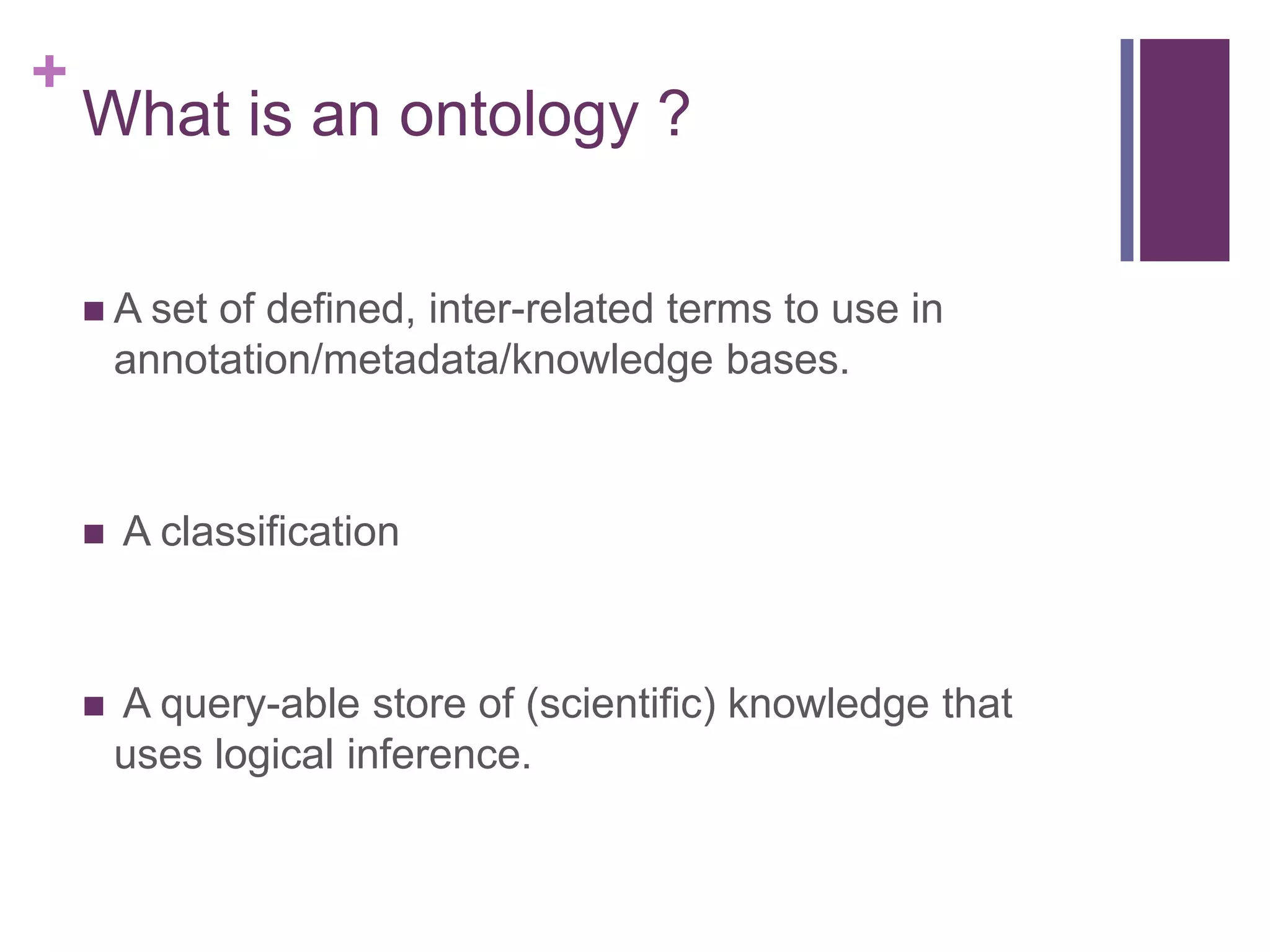
    What is an ontology ?

     A set  of defined, inter-related terms to use in
        annotation/metadata/knowledge bases.


       A classification


       A query-able store of (scientific) knowledge that
        uses logical inference.
+
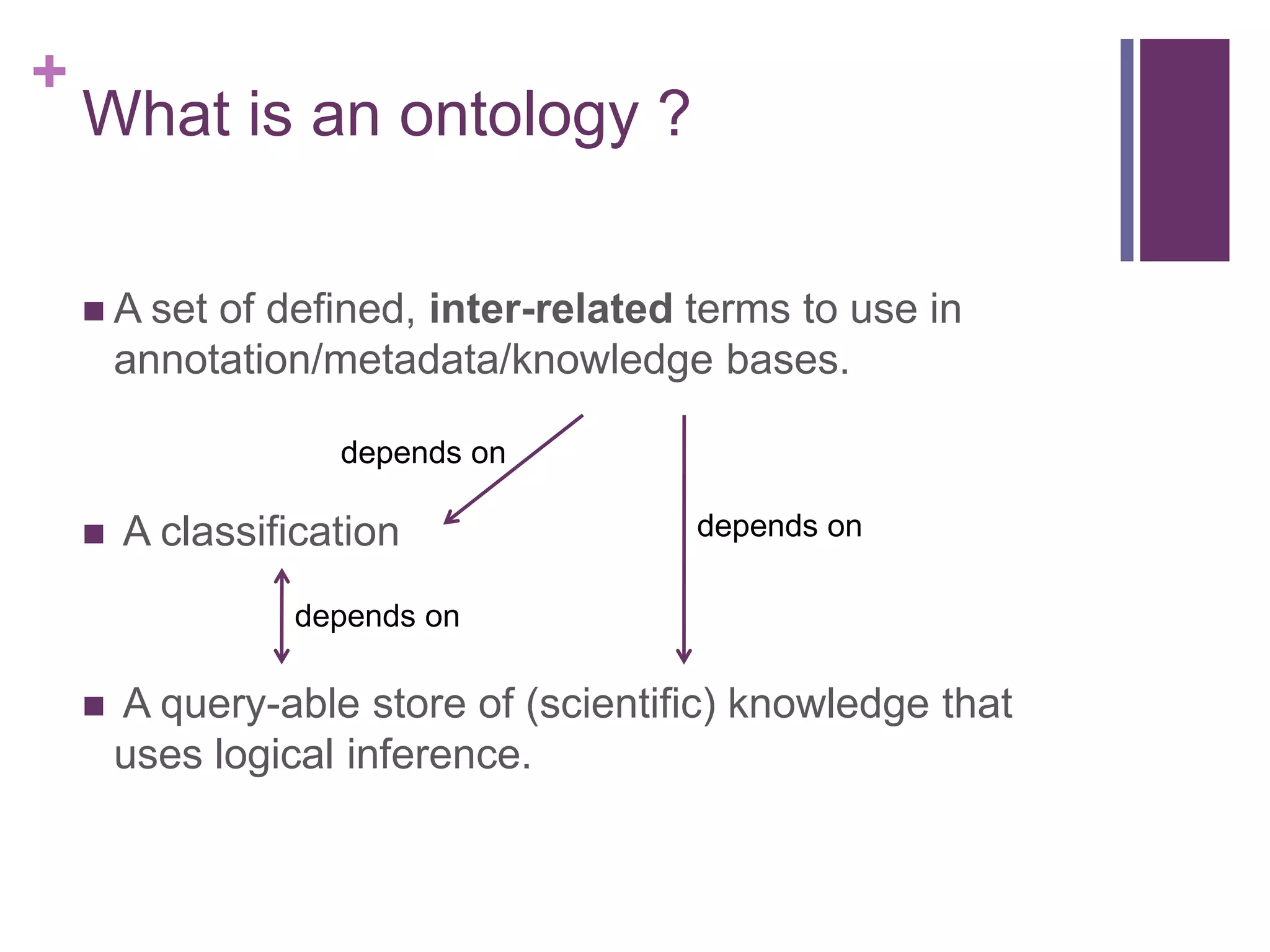
    What is an ontology ?

     A set  of defined, inter-related terms to use in
        annotation/metadata/knowledge bases.

                    depends on

       A classification               depends on

                 depends on

       A query-able store of (scientific) knowledge that
        uses logical inference.
+
    What (use) is an ontology?


     A set
          of defined, inter-related terms to use in
     annotation.


      Relationsbetween terms allow annotations to be
       grouped in scientifically meaningful ways

        requires  an ontology to be an accurate and
        scientifically meaningful classification and store of
        scientific knowledge.
+
    What is an ontology ?

       A classification
           There are lots of scientifically useful ways to classify a
            bit of anatomy.
               its parts and their arrangement
               its relation to other structures
                   what is it: part of; connected to; adjacent to, overlapping?
               its shape
               its function
               its developmental origins
               its species or clade
               its evolutionary history?
+
    What is an ontology ?

     The scientific knowledge an ontology contains can
     make the reasons for classification explicit.
      e.g.
        Any sense organ that functions in the detection of
         smell is an olfactory sense organ
        All large basiconicsensilla of the antenna function
         in detection of smell
        Therefore all large basiconicsensilla of the
         antenna are are olfactory sense organs
+
    What is an (OBO-foundry) ontology ?
       An ontology contains terms

       Terms refer to (denote) types
        (classes)
       Types are classifications of things
        (instances) in the real world, based on
        some set of criteria.
           My left hand is an instance of the type hand

       The criteria for class membership is
        recorded using textual definitions, at
        least some elements of which are
        formalized as relationships.
           name: hand
           def: “An anatomical structure that has four
            fingers and a thumb and is attached to the
            end of an arm.” [reference: DOS]
           relationship: hand has_part finger
           relationship: hand has_part thumb
           relationship: part_of arm

                                                           Image from Gray’s Anatomy (copyright expired)
+
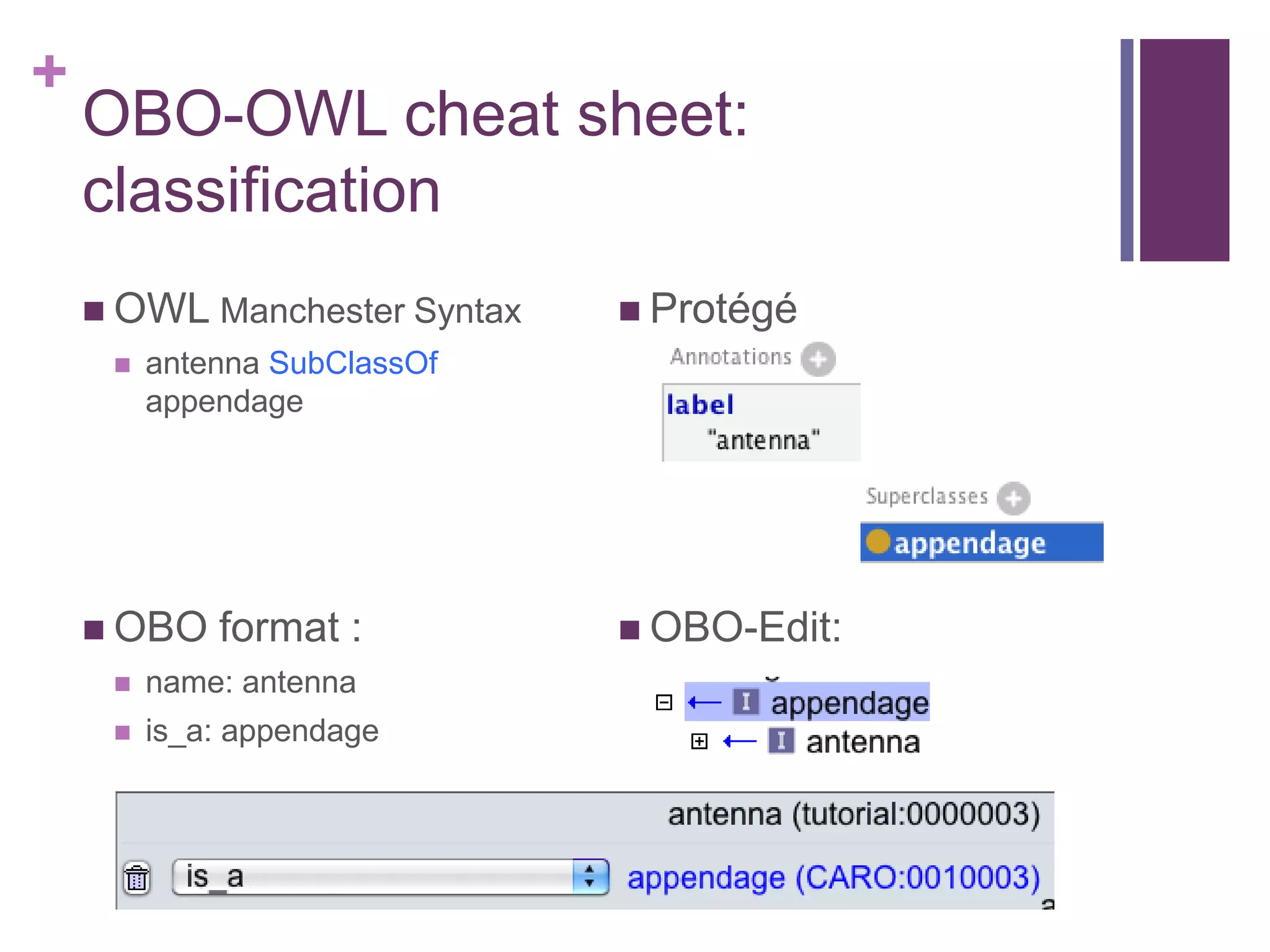
    OBO-OWL cheat sheet:
    classification
     OWL Manchester Syntax    Protégé
        antenna SubClassOf
         appendage


     OBO    format :          OBO-Edit:
        name: antenna
        is_a: appendage
+
    class – class relationships are
    quantified
     Class:Class   relationships are many to many
      Does the relation apply to all or just some of the
       class ?
        we specify this with quantifiers:
          ∀: for all, all, only, every
          ∃: there exists, some
+
    relationships specify necessary
    conditions for class membership

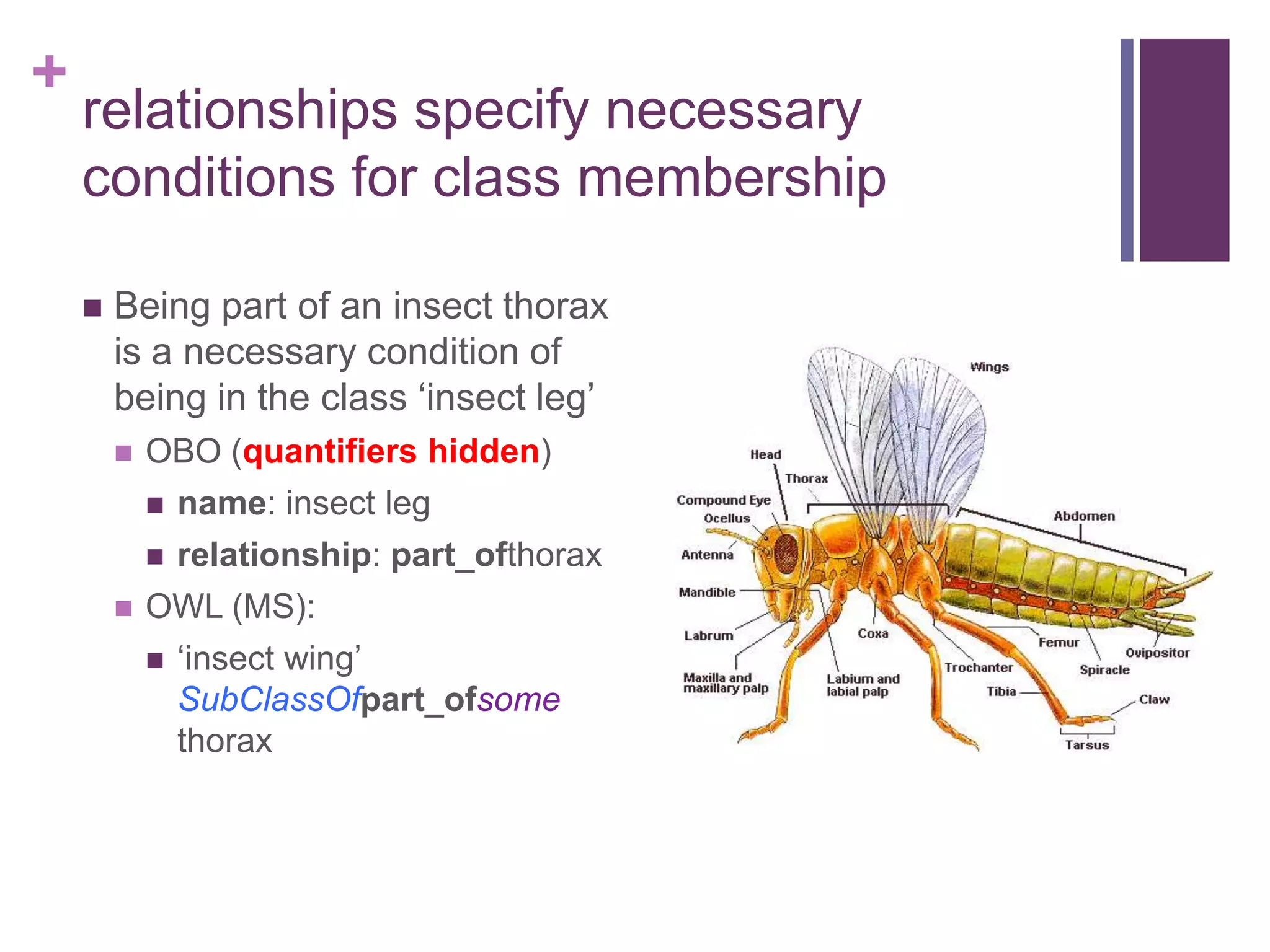
       Being part of an insect thorax
        is a necessary condition of
        being in the class „insect leg‟
           OBO (quantifiers hidden)
               name: insect leg
               relationship: part_ofthorax
           OWL (MS):
               „insect wing‟
                SubClassOfpart_ofsome
                thorax
+
    relationships specify necessary
    conditions for class membership

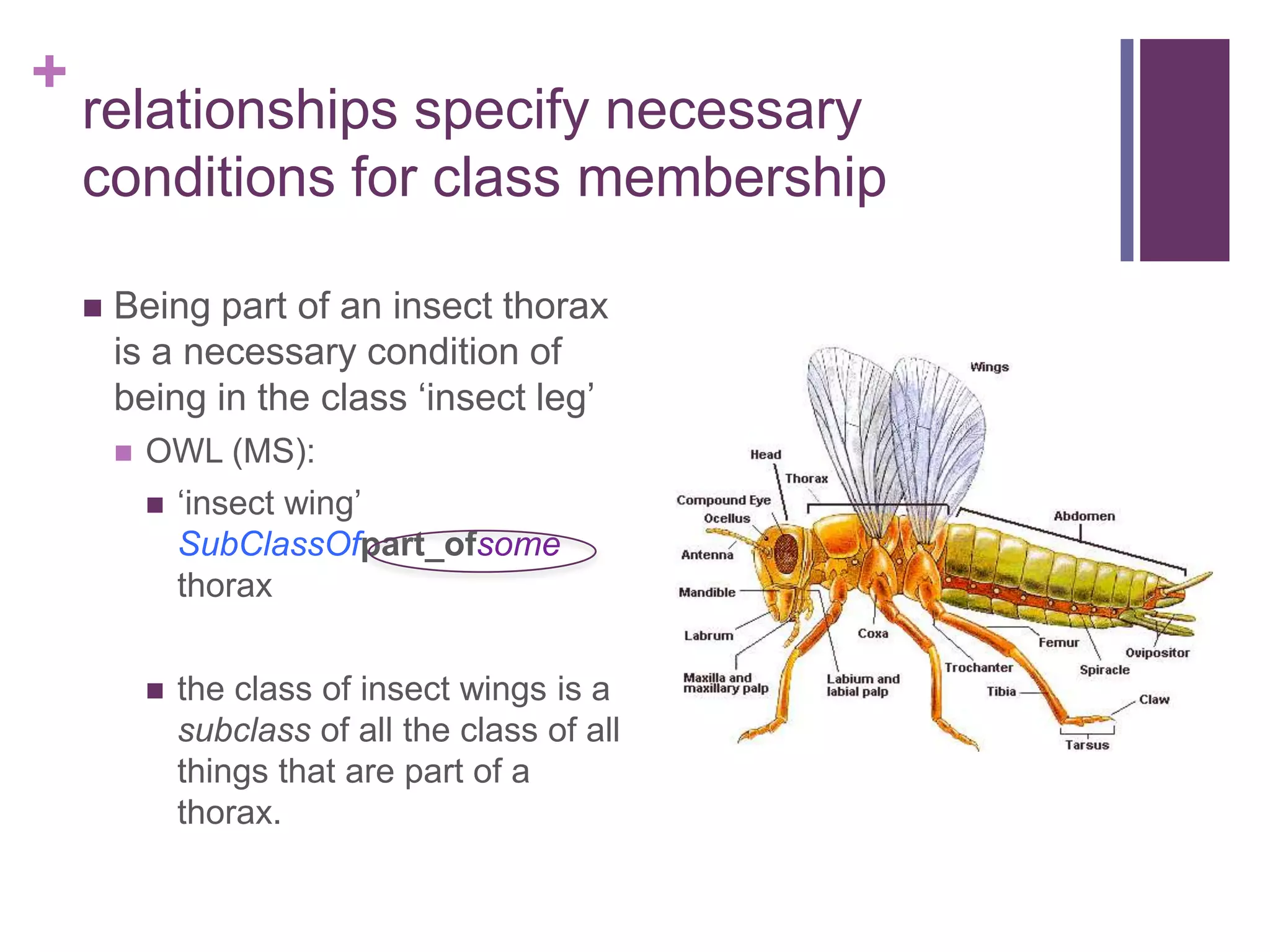
       Being part of an insect thorax
        is a necessary condition of
        being in the class „insect leg‟
           OWL (MS):
               „insect wing‟
                SubClassOfpart_ofsome
                thorax


               the class of insect wings is a
                subclass of all the class of all
                things that are part of a
                thorax.
+
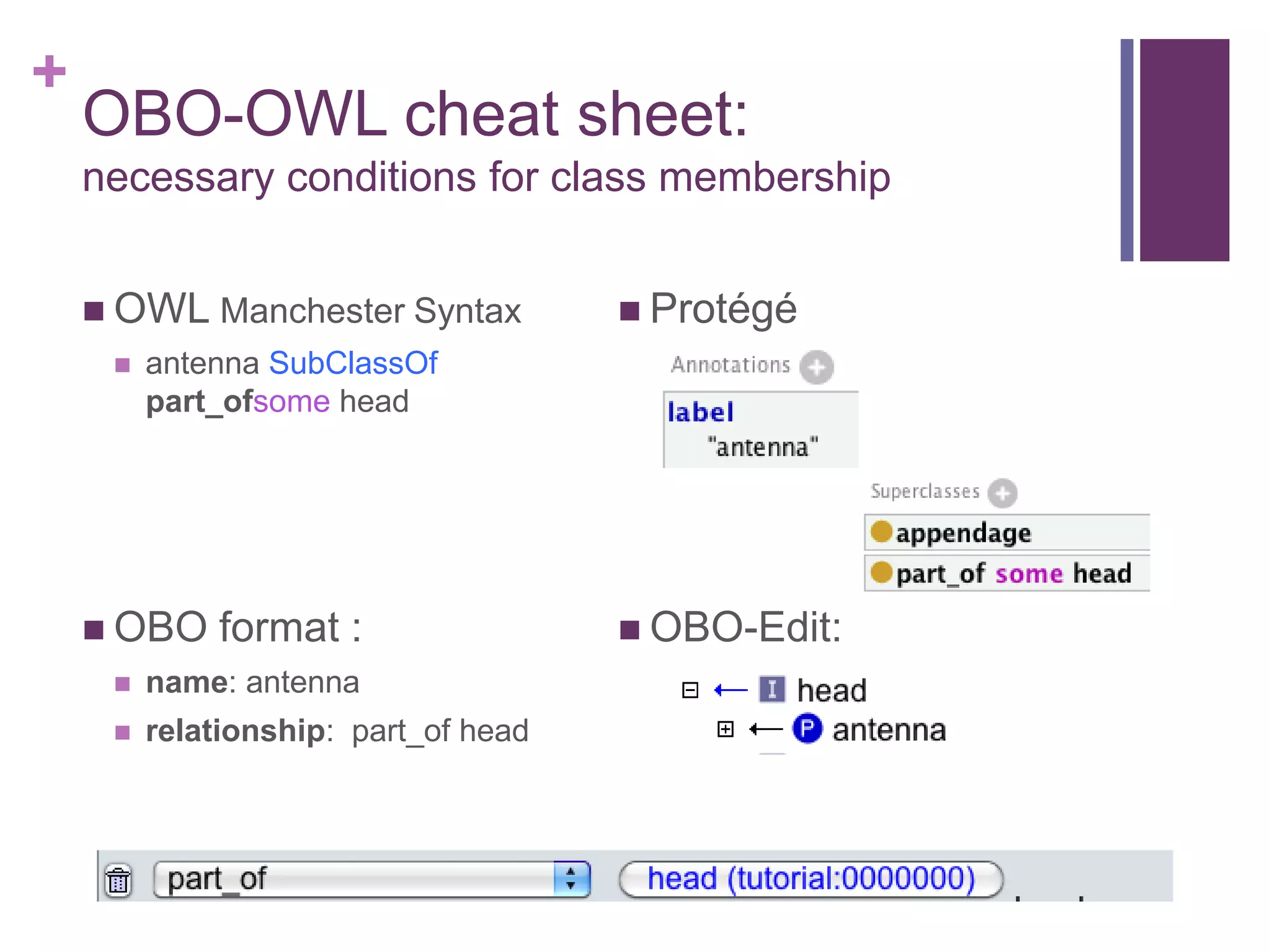
    OBO-OWL cheat sheet:
    necessary conditions for class membership


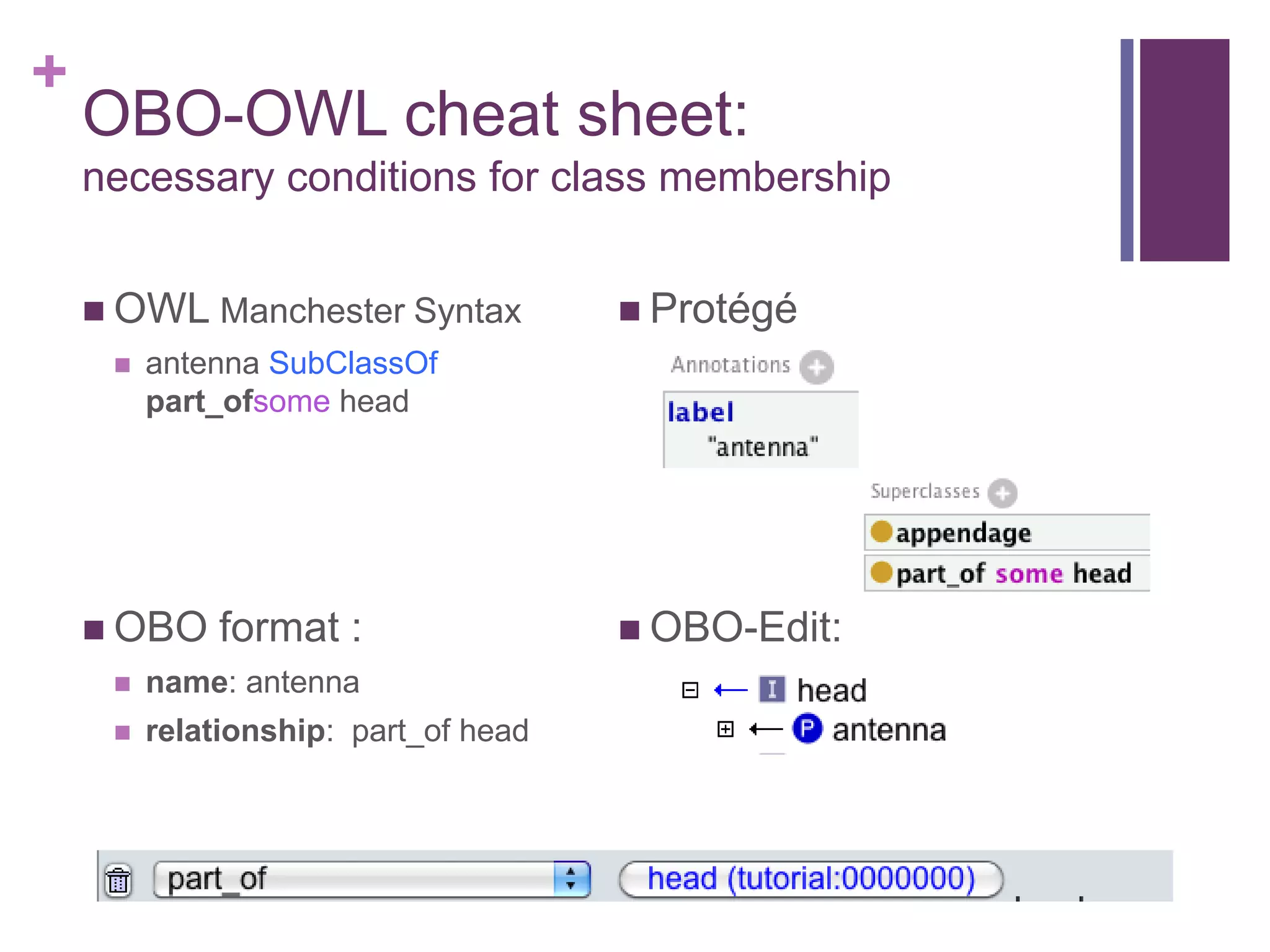
     OWL Manchester Syntax            Protégé
        antenna SubClassOf
         part_ofsome head


     OBO    format :                  OBO-Edit:
        name: antenna
        relationship: part_of head
+
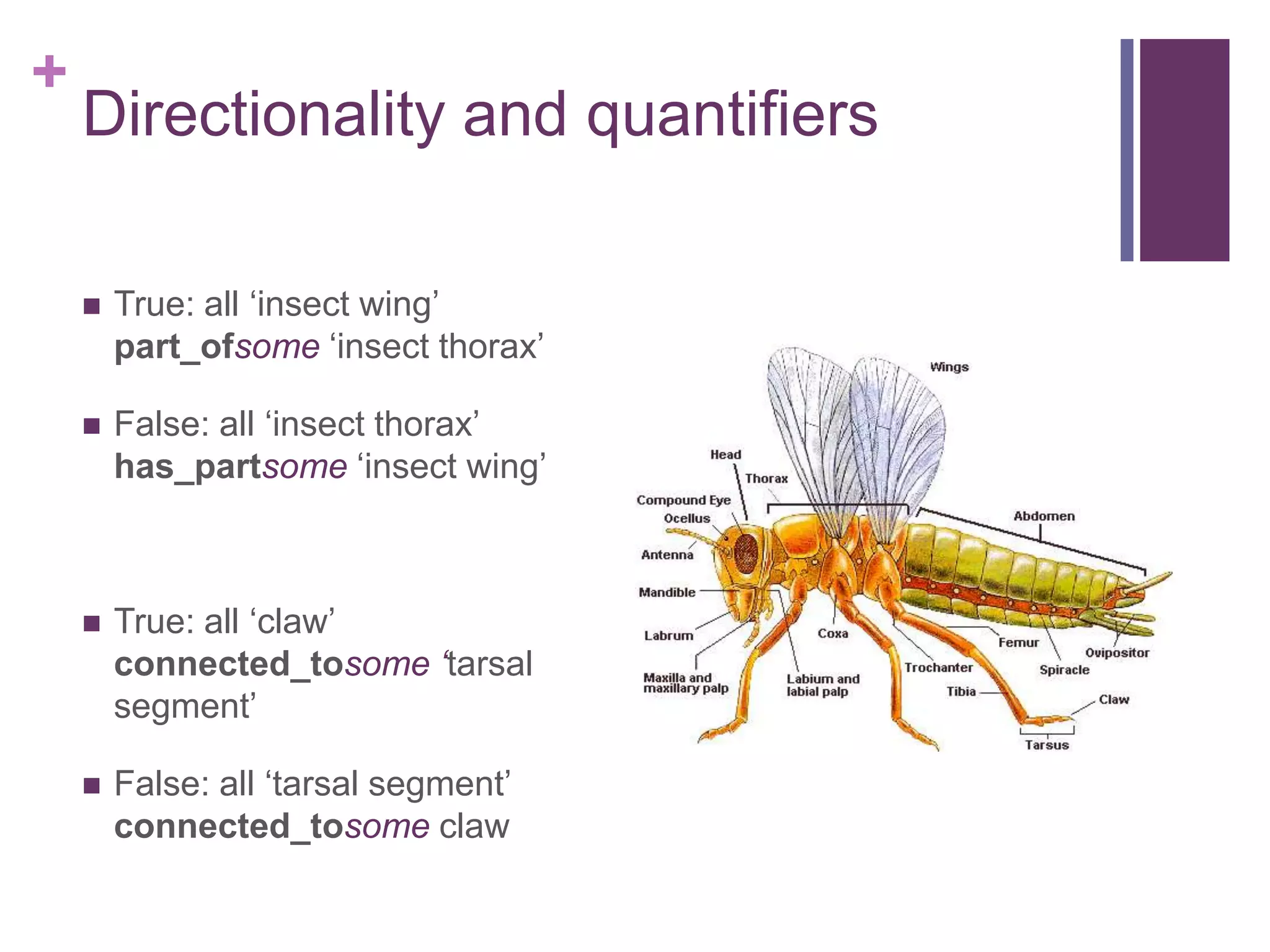
    Directionality and quantifiers

       True: all „insect wing‟
        part_ofsome „insect thorax‟

       False: all „insect thorax‟
        has_partsome „insect wing‟


       True: all „claw‟
        connected_tosome ‘tarsal
        segment‟

       False: all „tarsal segment‟
        connected_tosome claw
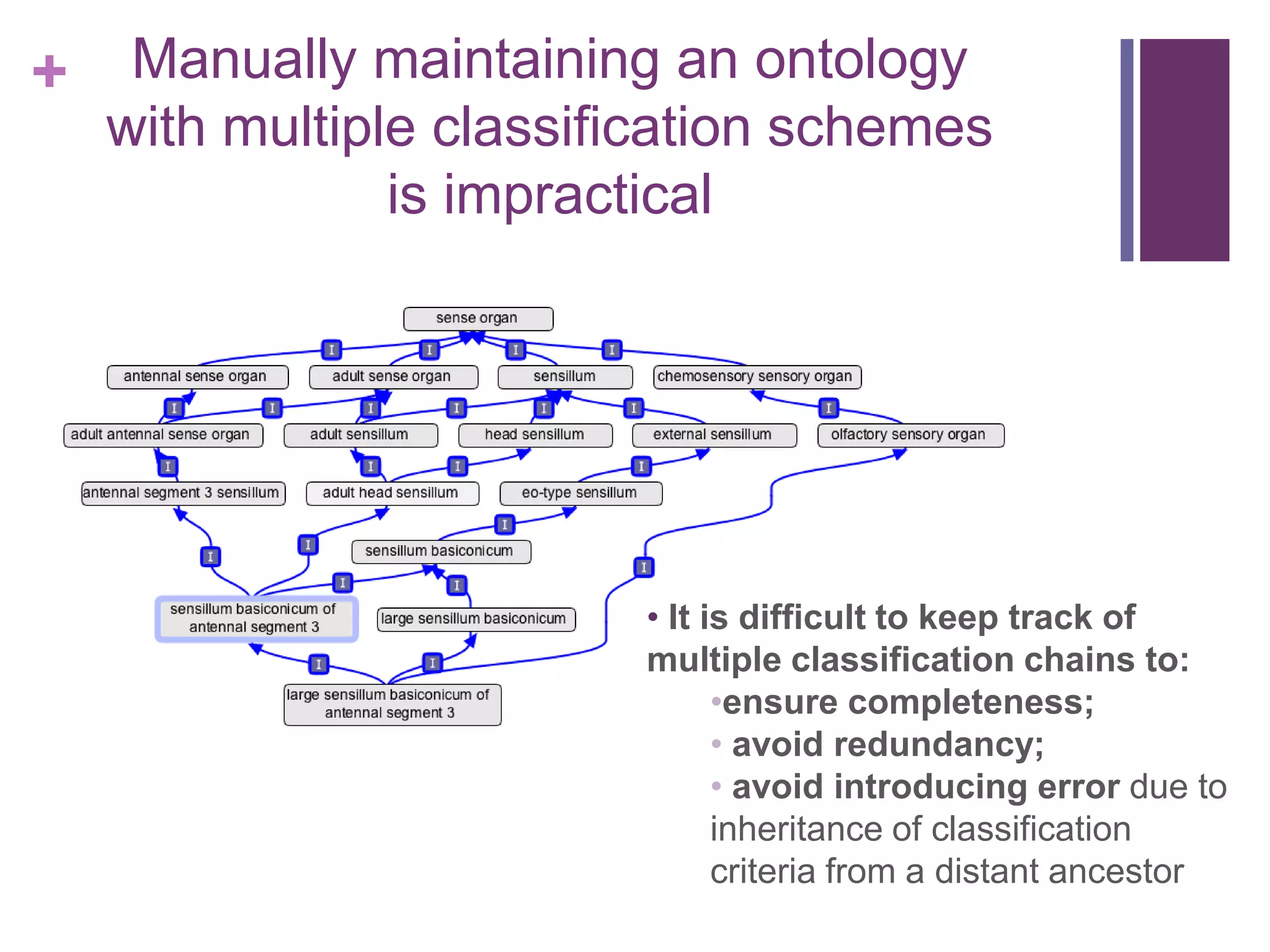
+    Manually maintaining an ontology
    with multiple classification schemes
                is impractical


                         • It is difficult to keep track of
                         multiple classification chains to:
                               •ensure completeness;
                               • avoid redundancy;
                               • avoid introducing error due to
                               inheritance of classification
                               criteria from a distant ancestor
+
    Automating multiple classification.

     The scientific knowledge an ontology contains can
     make the reasons for classification explicit.
      e.g.
        Any sense organ that functions in the detection of
         smell is an olfactory sense organ
        All large basiconicsensilla of the antenna function
         in detection of smell
        Therefore all large basiconicsensilla of the
         antenna are are olfactory sense organs
+
    Automating multiple classification.

       We can specify that some set of necessary conditions for class
        membership are sufficient to determine class membership
         English
           Any sense organ that functions in the detection of smell is an
            olfactory sense organ
         OWL (MS):
           olfactory sense organ‟ EquivalentTo: sense organ that
            capable_ofsome „detection of chemical stimulus involved in
            sensory perception of smell‟
           OBO
             name: olfactory sense organ
             intersection_of: sense organ
             intersection_of: capable_of „detection of chemical stimulus
               involved in sensory perception of smell‟
+
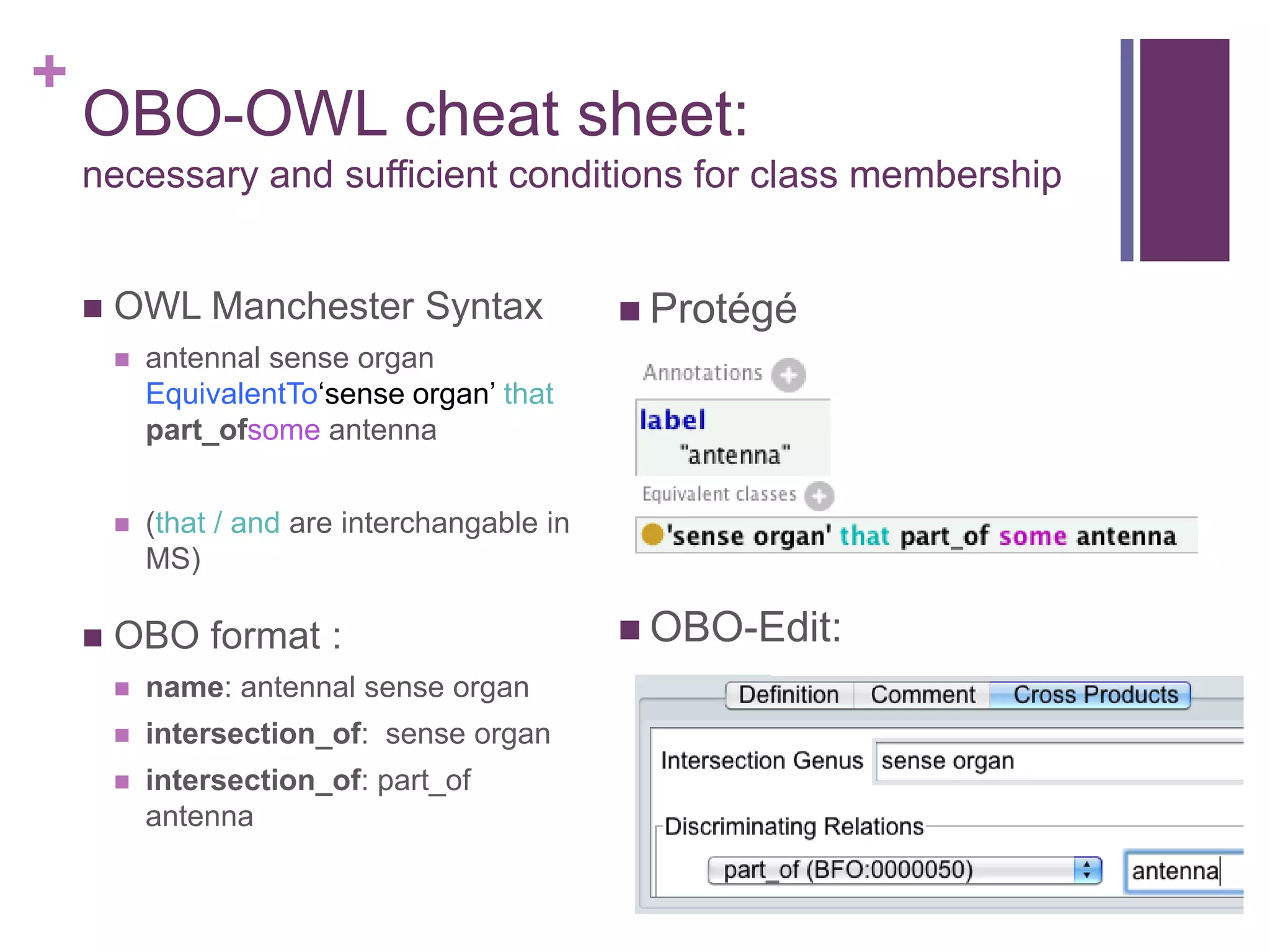
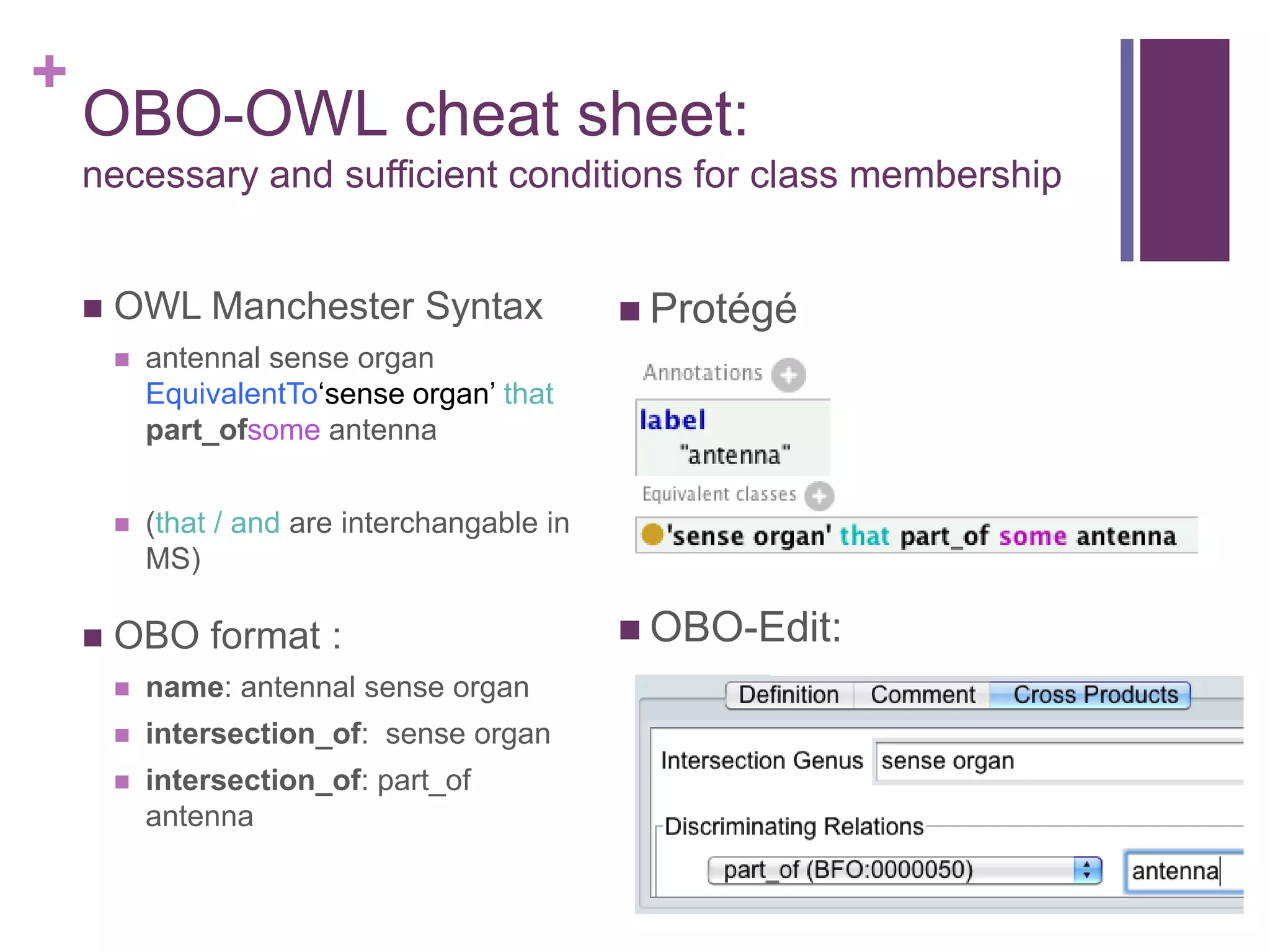
    OBO-OWL cheat sheet:
    necessary and sufficient conditions for class membership


       OWL Manchester Syntax                    Protégé
           antennal sense organ
            EquivalentTo„sense organ‟ that
            part_ofsome antenna


           (that / and are interchangable in
            MS)

       OBO format :                             OBO-Edit:
           name: antennal sense organ
           intersection_of: sense organ
           intersection_of: part_of
            antenna
+
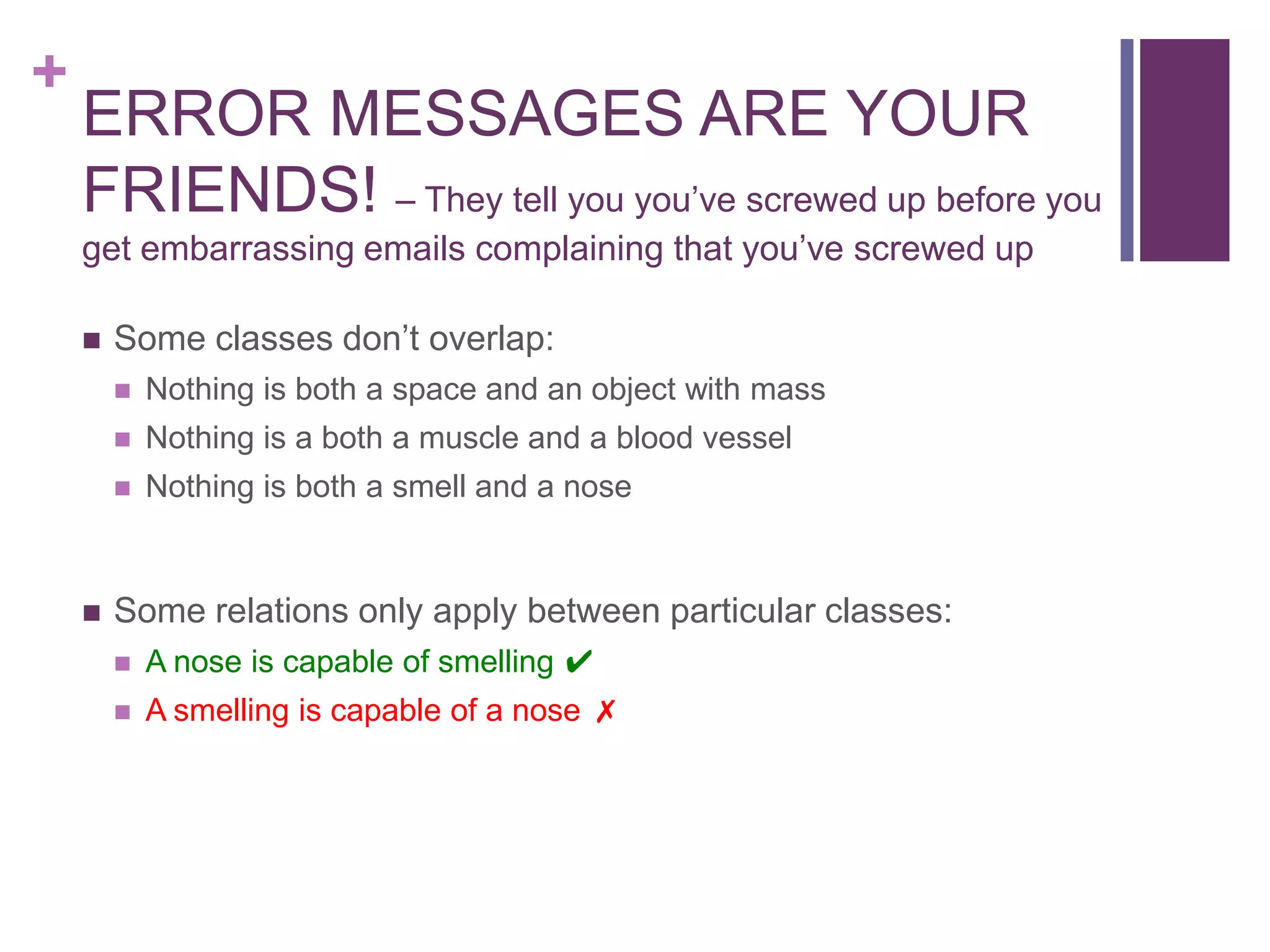
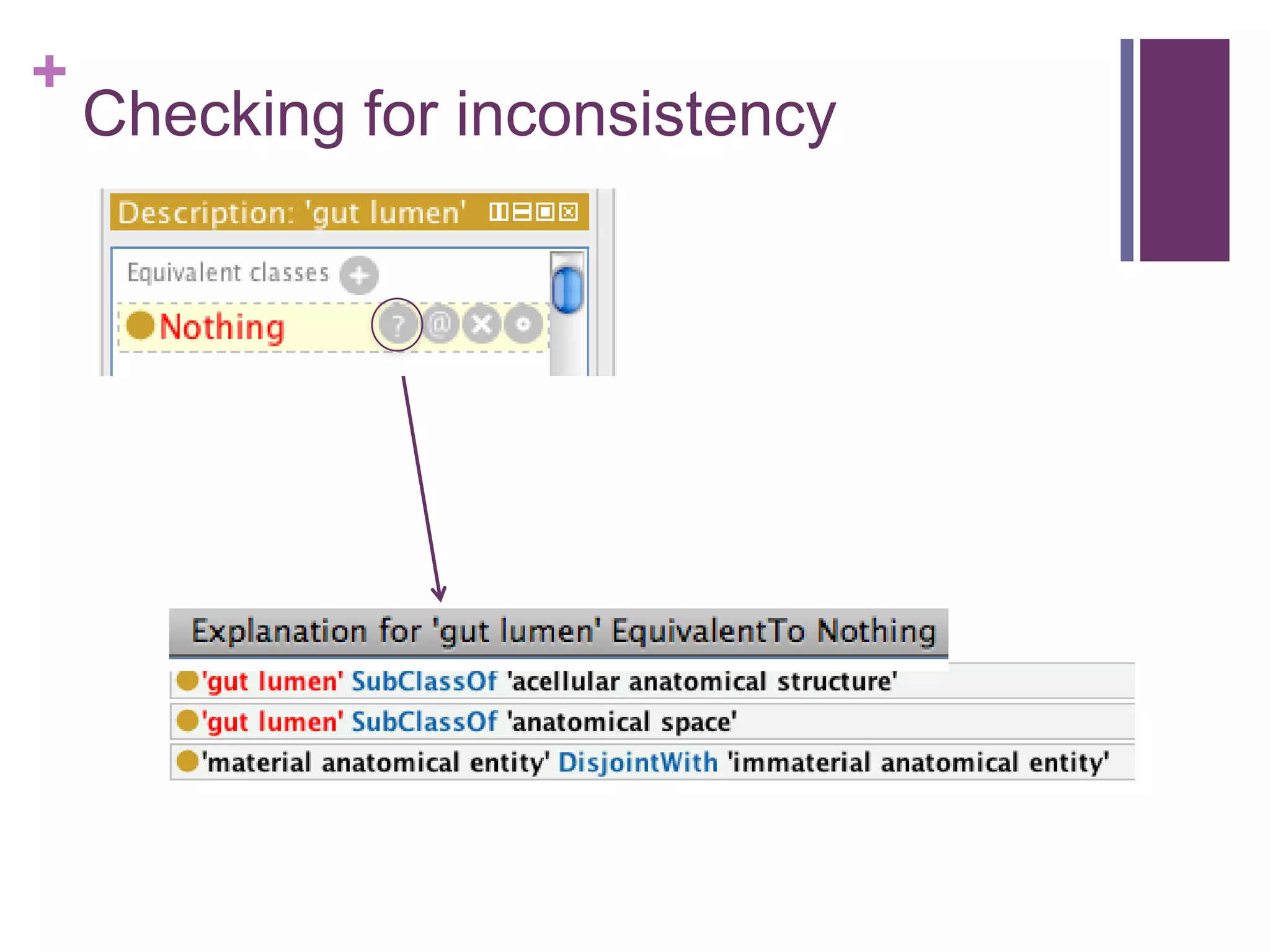
    ERROR MESSAGES ARE YOUR
    FRIENDS! – They tell you you‟ve screwed up before you
    get embarrassing emails complaining that you‟ve screwed up

       Some classes don‟t overlap:
           Nothing is both a space and an object with mass
           Nothing is a both a muscle and a blood vessel
           Nothing is both a smell and a nose


       Some relations only apply between particular classes:
           A nose is capable of smelling ✔
           A smelling is capable of a nose ✗
+
    ERROR MESSAGES ARE YOUR
    FRIENDS! – They tell you you‟ve screwed up before you
    get embarrassing emails complaining that you‟ve screwed up

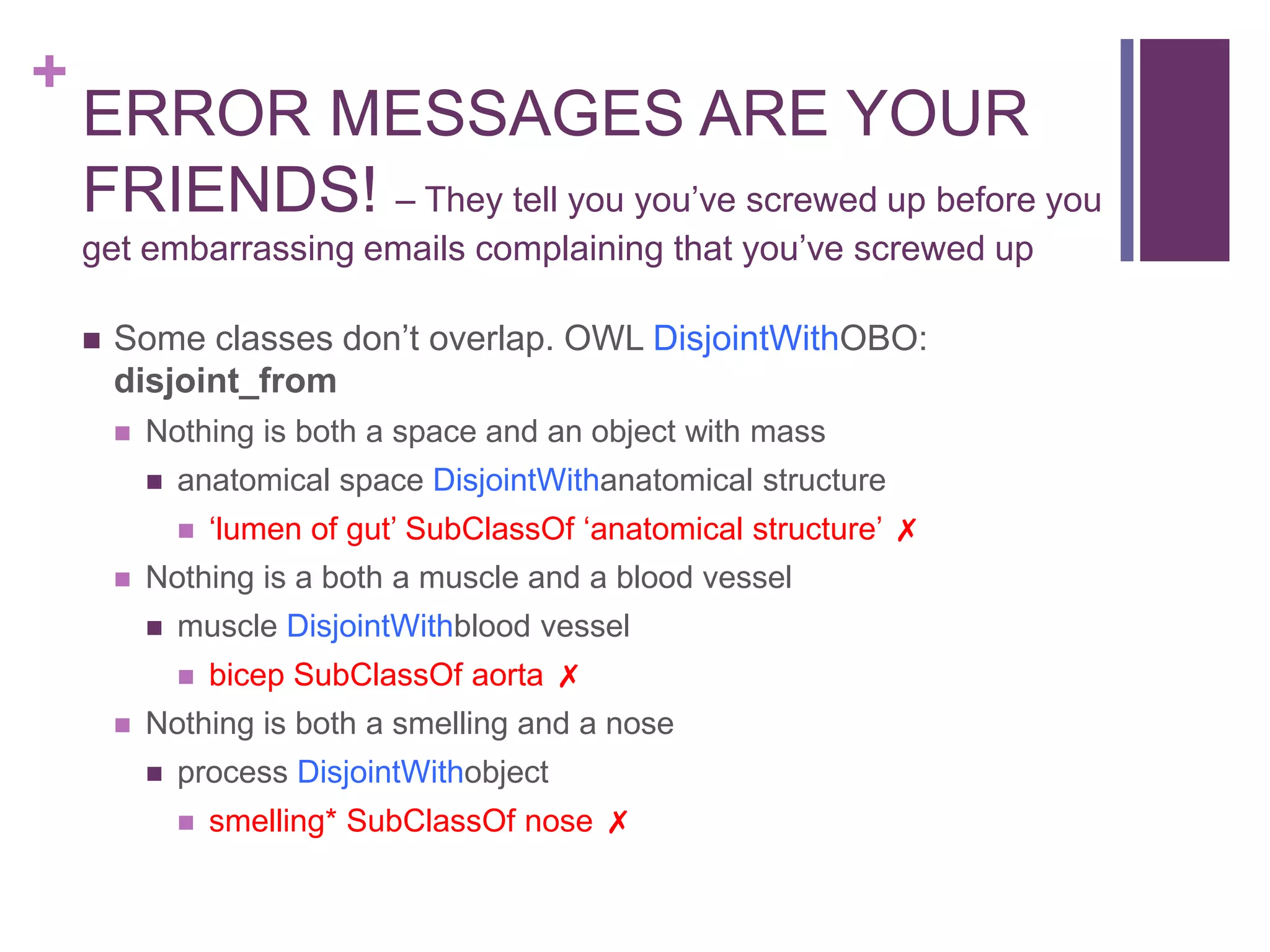
       Some classes don‟t overlap. OWL DisjointWithOBO:
        disjoint_from
           Nothing is both a space and an object with mass
               anatomical space DisjointWithanatomical structure
                   „lumen of gut‟ SubClassOf „anatomical structure‟ ✗
           Nothing is a both a muscle and a blood vessel
               muscle DisjointWithblood vessel
                   bicep SubClassOf aorta ✗
           Nothing is both a smelling and a nose
               process DisjointWithobject
                   smelling* SubClassOf nose ✗
+
    ERROR MESSAGES ARE YOUR
    FRIENDS! – They tell you you‟ve screwed up before you
    get embarrassing emails complaining that you‟ve screwed up

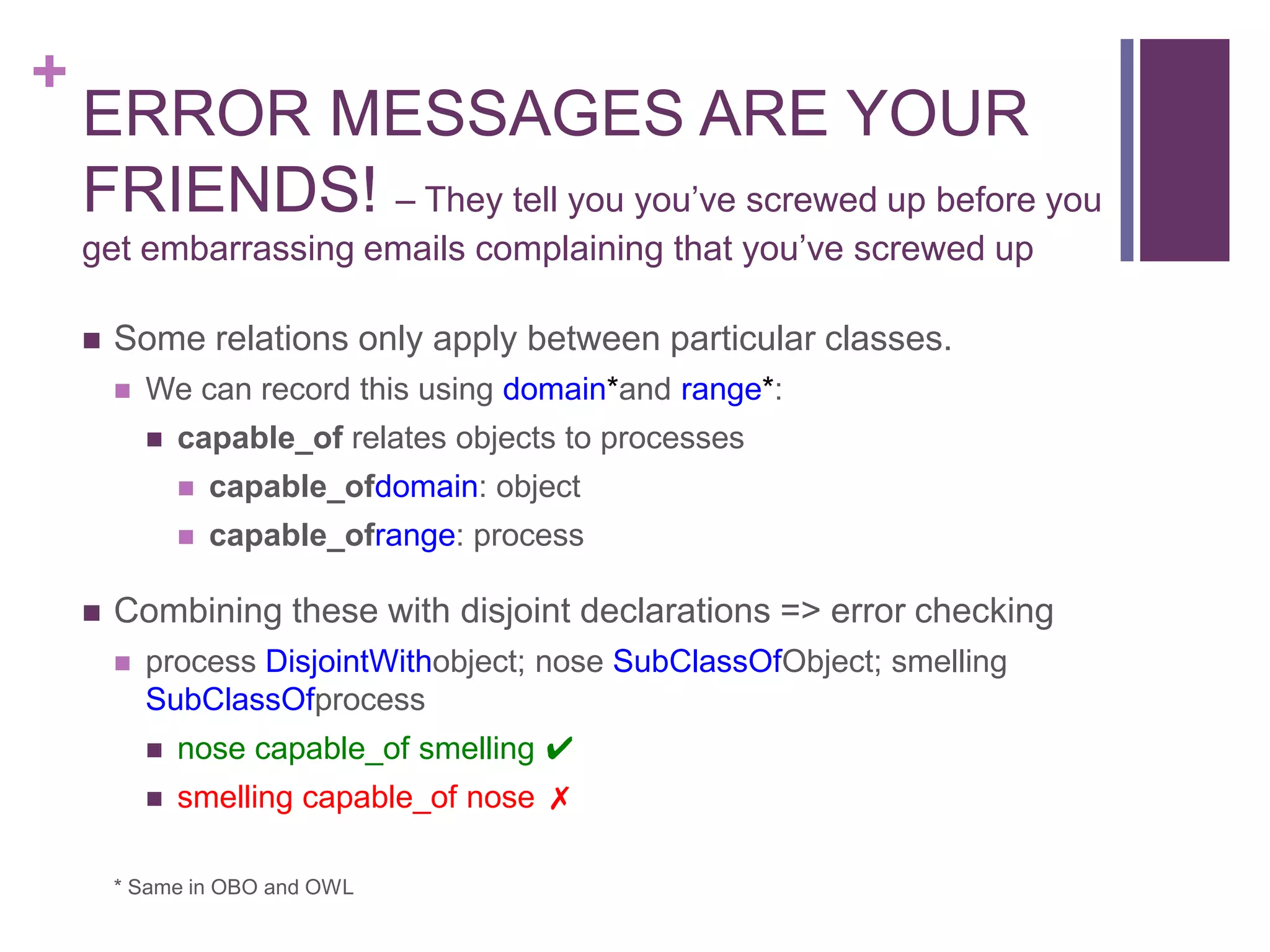
       Some relations only apply between particular classes.
           We can record this using domain*and range*:
               capable_of relates objects to processes
                   capable_ofdomain: object
                   capable_ofrange: process

       Combining these with disjoint declarations => error checking
           process DisjointWithobject; nose SubClassOfObject; smelling
            SubClassOfprocess
               nose capable_of smelling ✔
               smelling capable_of nose ✗

        * Same in OBO and OWL
+


    Quick guide to OBO-Edit
+
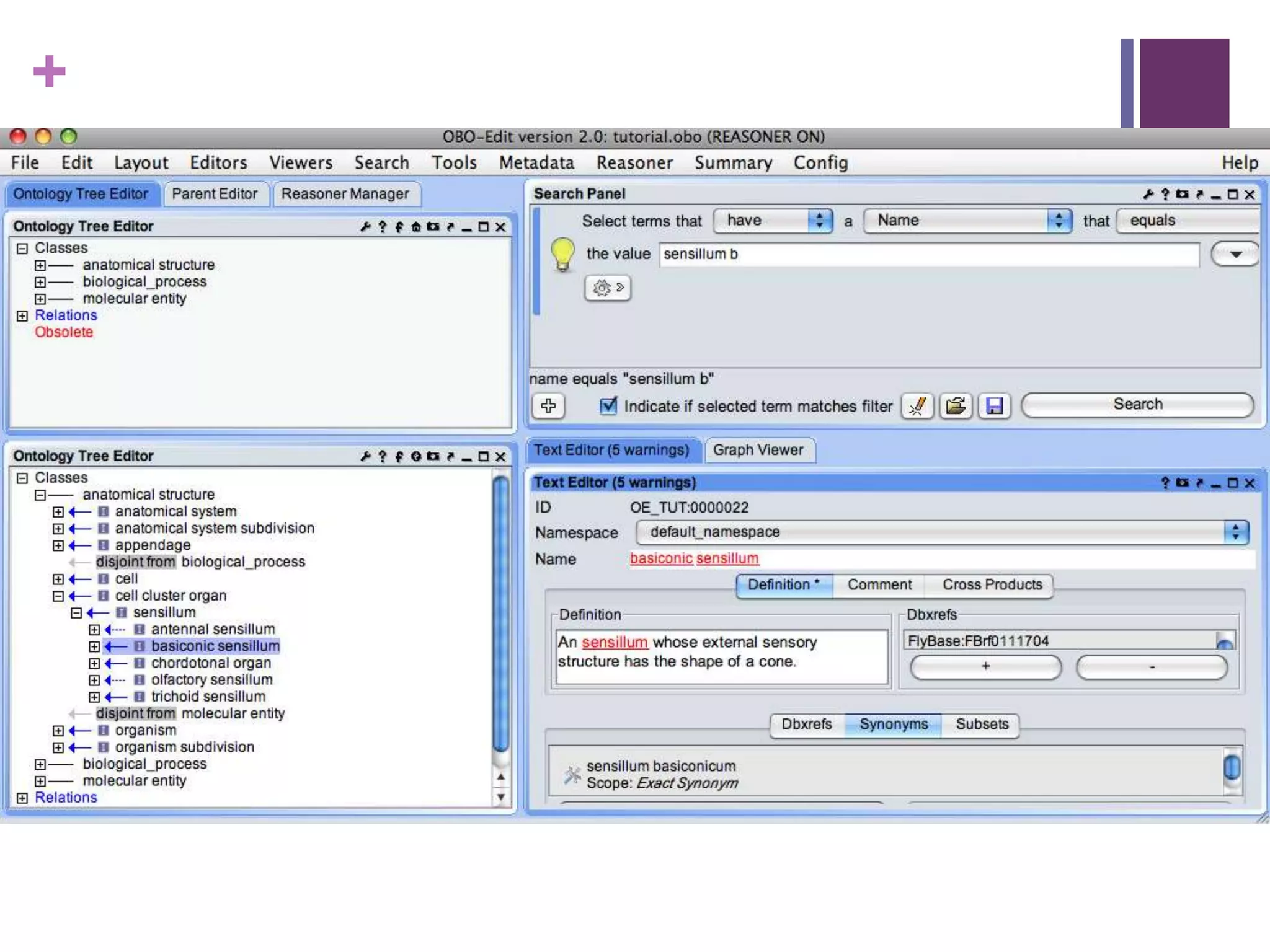
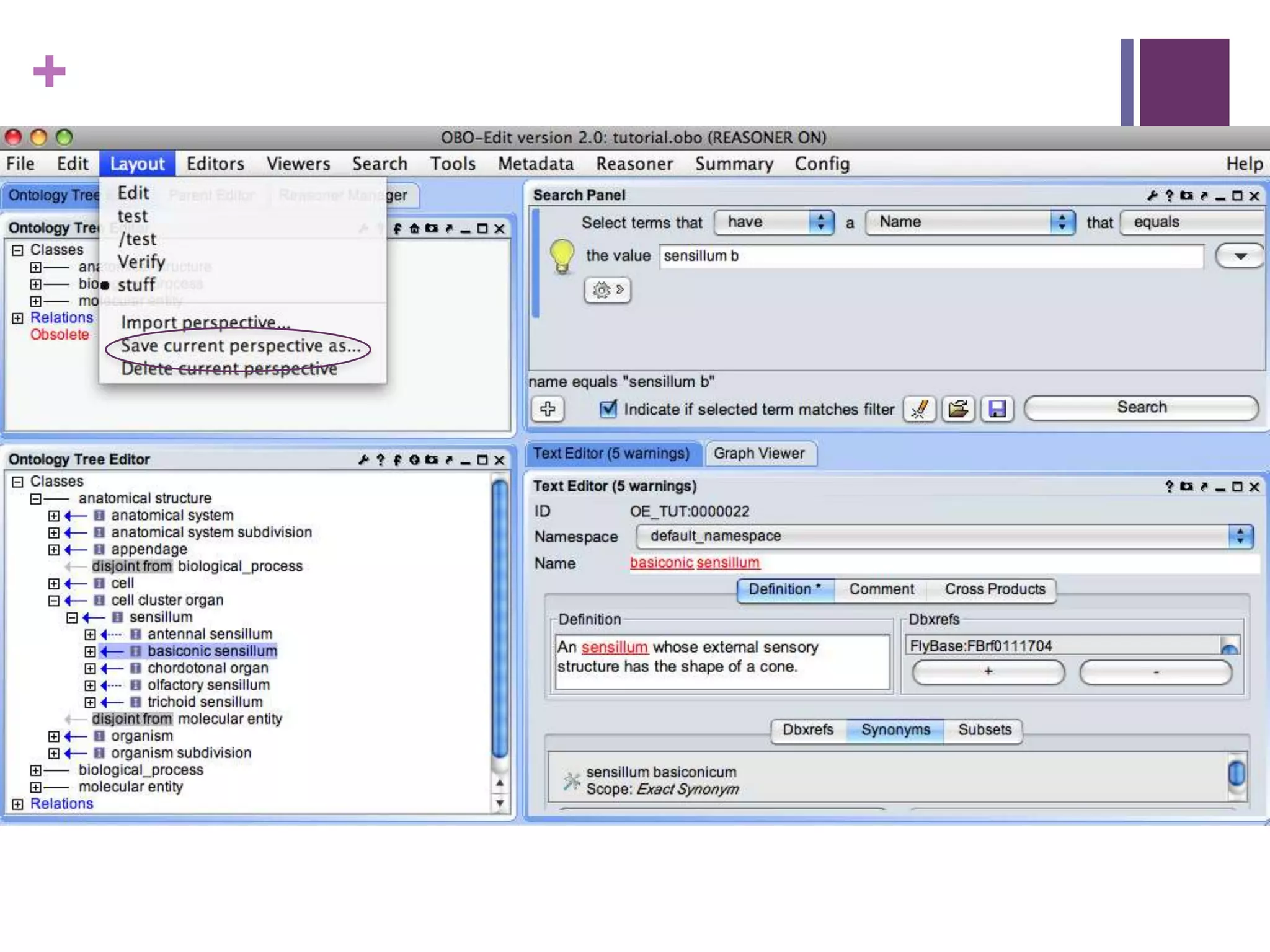
    Basic OBO-Edit2 editing setup

       - 2 x Ontology Tree Editor (OTE)

       - One parent editor

       - One text editor

       - One search panel

       - One reasoner manager
+
+
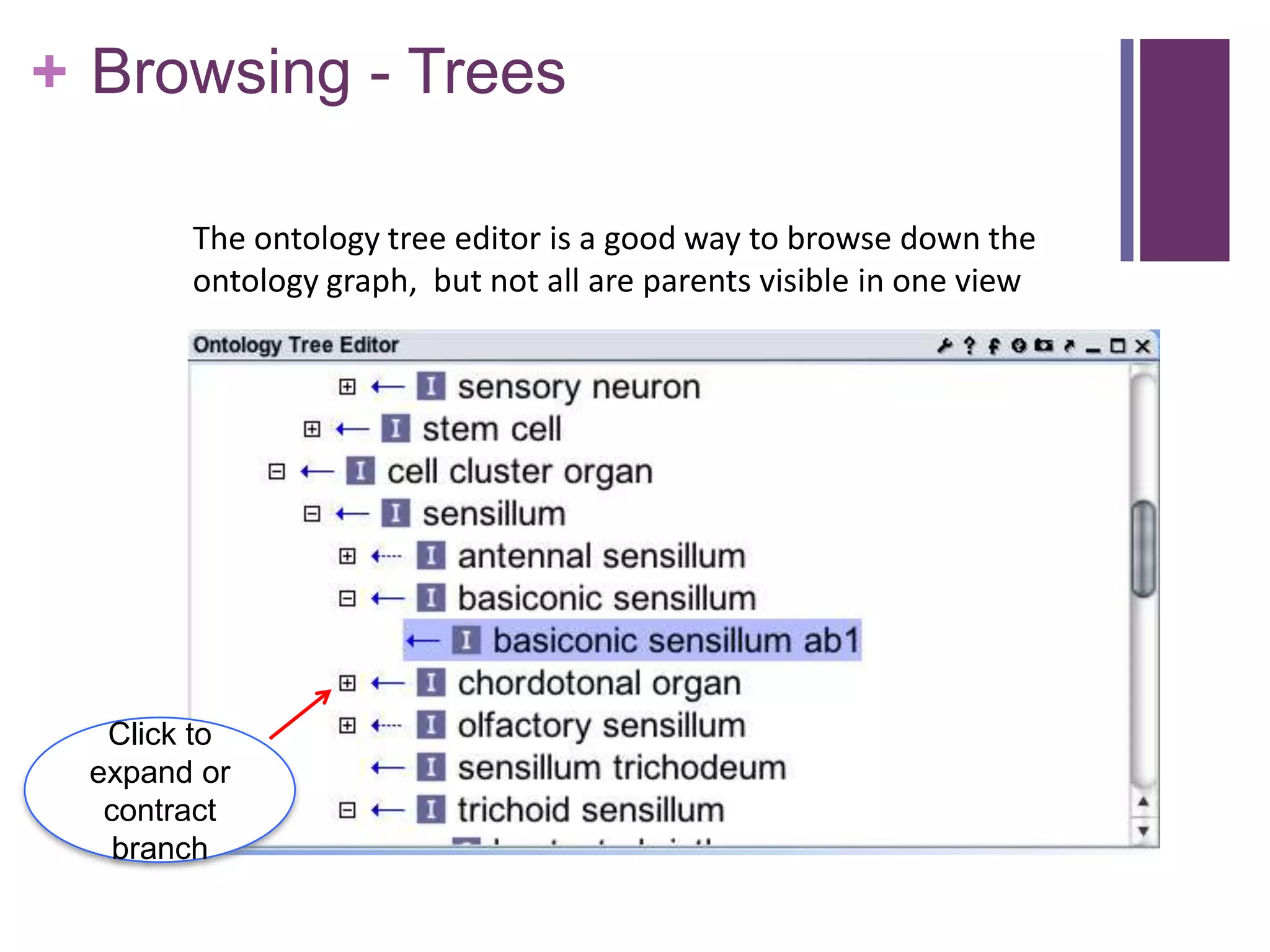
+ Browsing - Trees

       The ontology tree editor is a good way to browse down the
       ontology graph, but not all are parents visible in one view


  Click to
 expand or
  contract
   branch
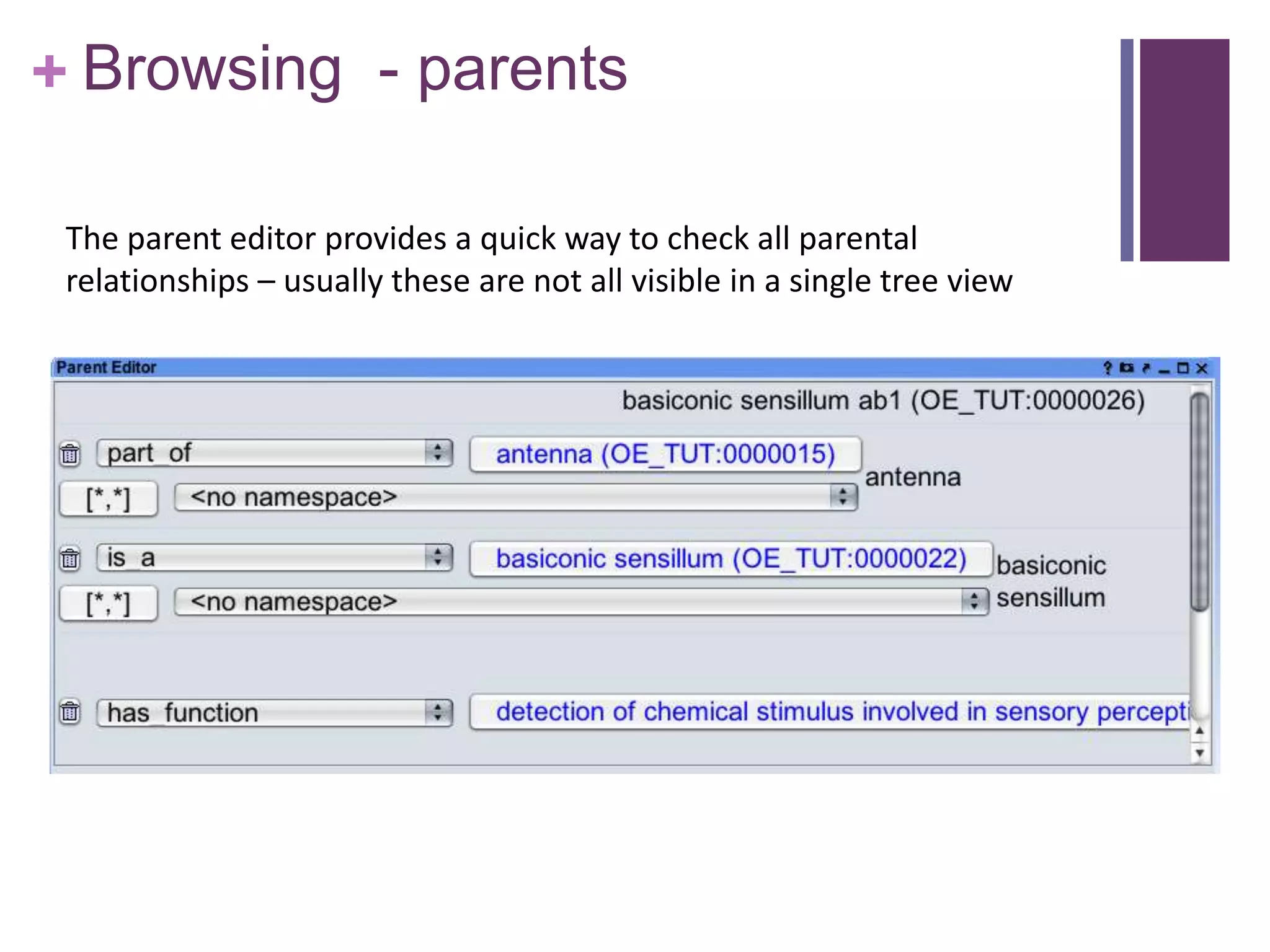
+ Browsing - parents

 The parent editor provides a quick way to check all parental
 relationships – usually these are not all visible in a single tree view
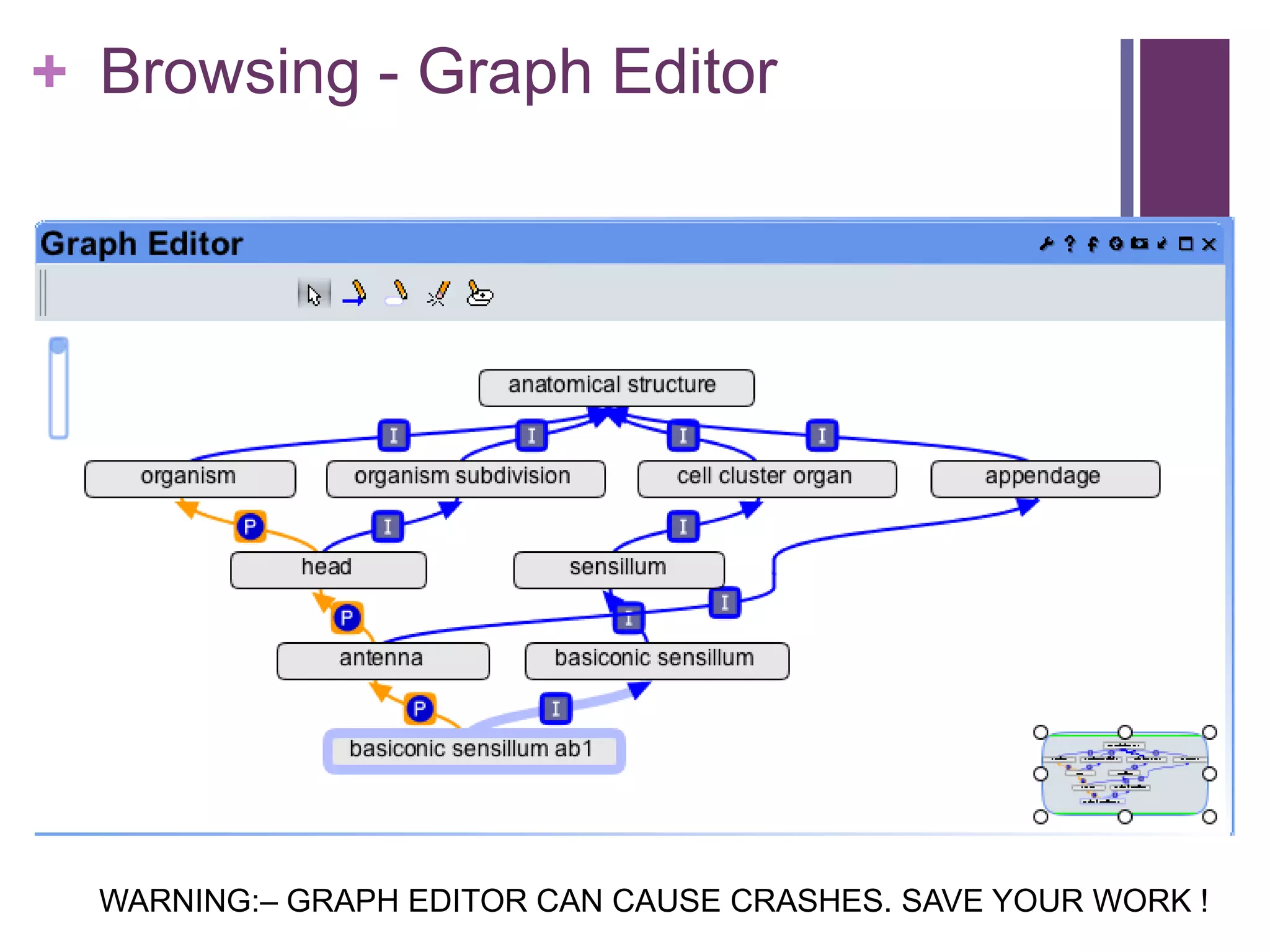
+ Browsing - Graph Editor


  WARNING:– GRAPH EDITOR CAN CAUSE CRASHES. SAVE YOUR WORK !
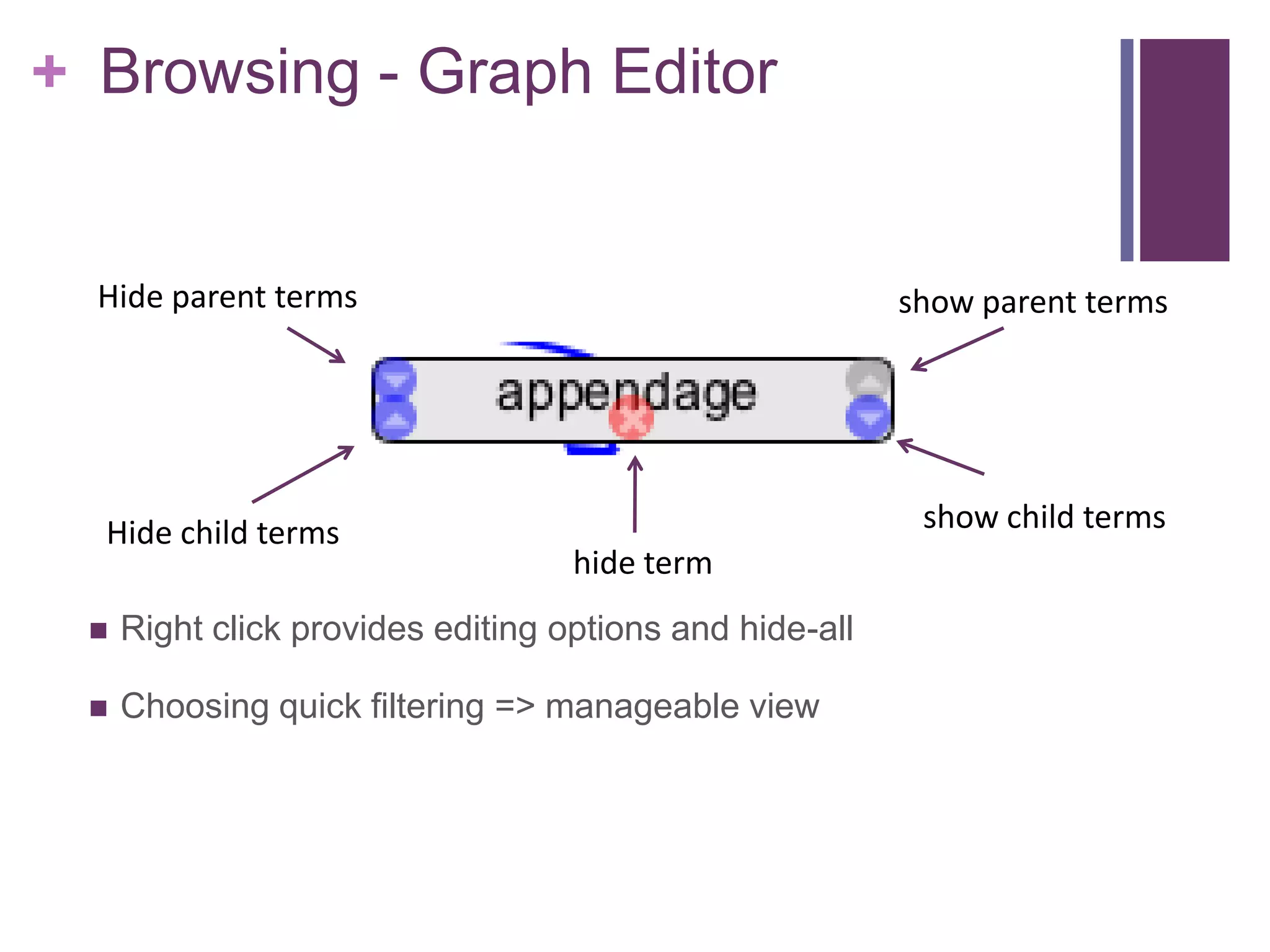
+ Browsing - Graph Editor


  Hide parent terms                                      show parent terms


  Hide child terms                                        show child terms
                                   hide term
    Right click provides editing options and hide-all

    Choosing quick filtering => manageable view
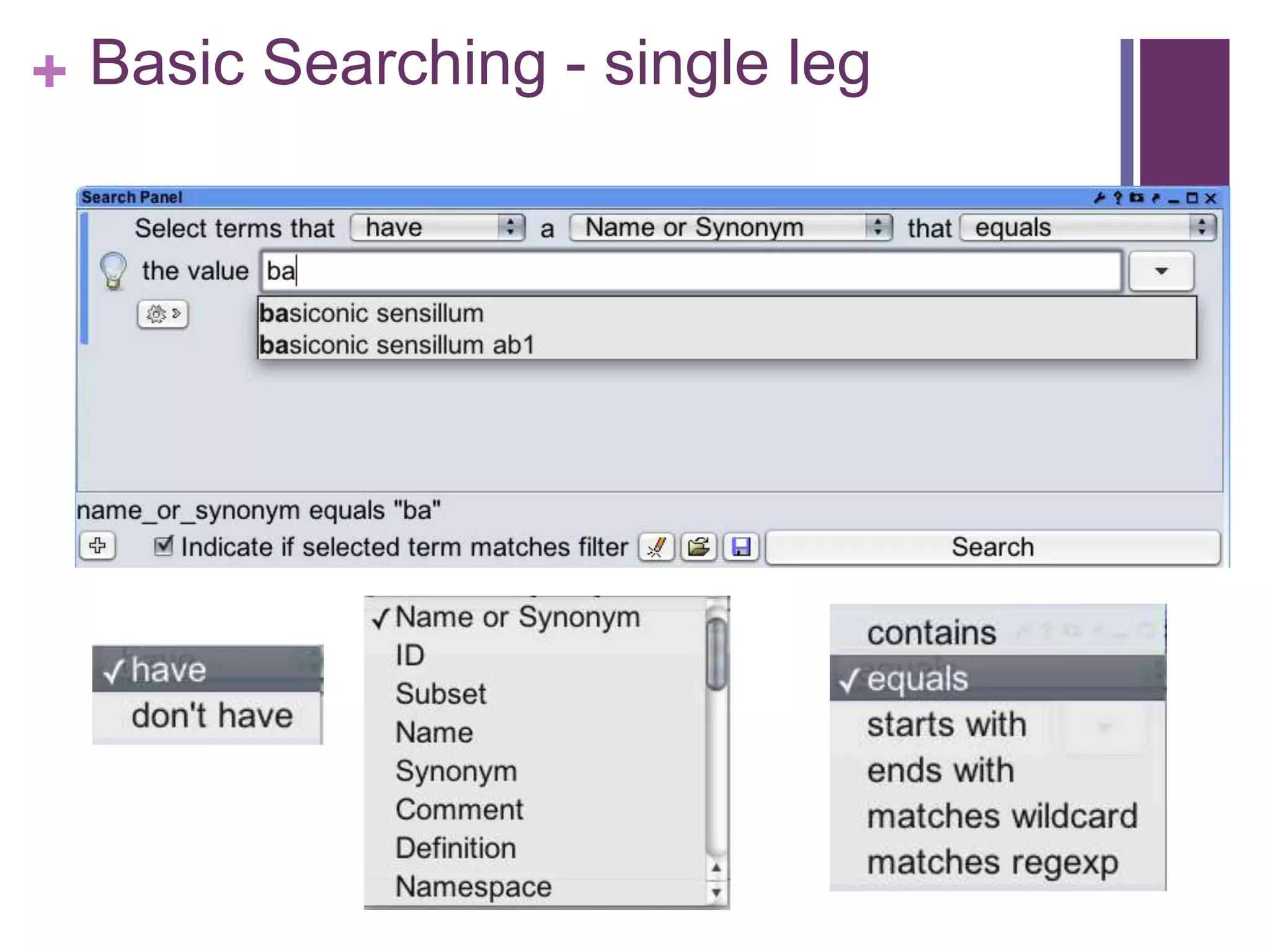
+ Basic Searching - single leg
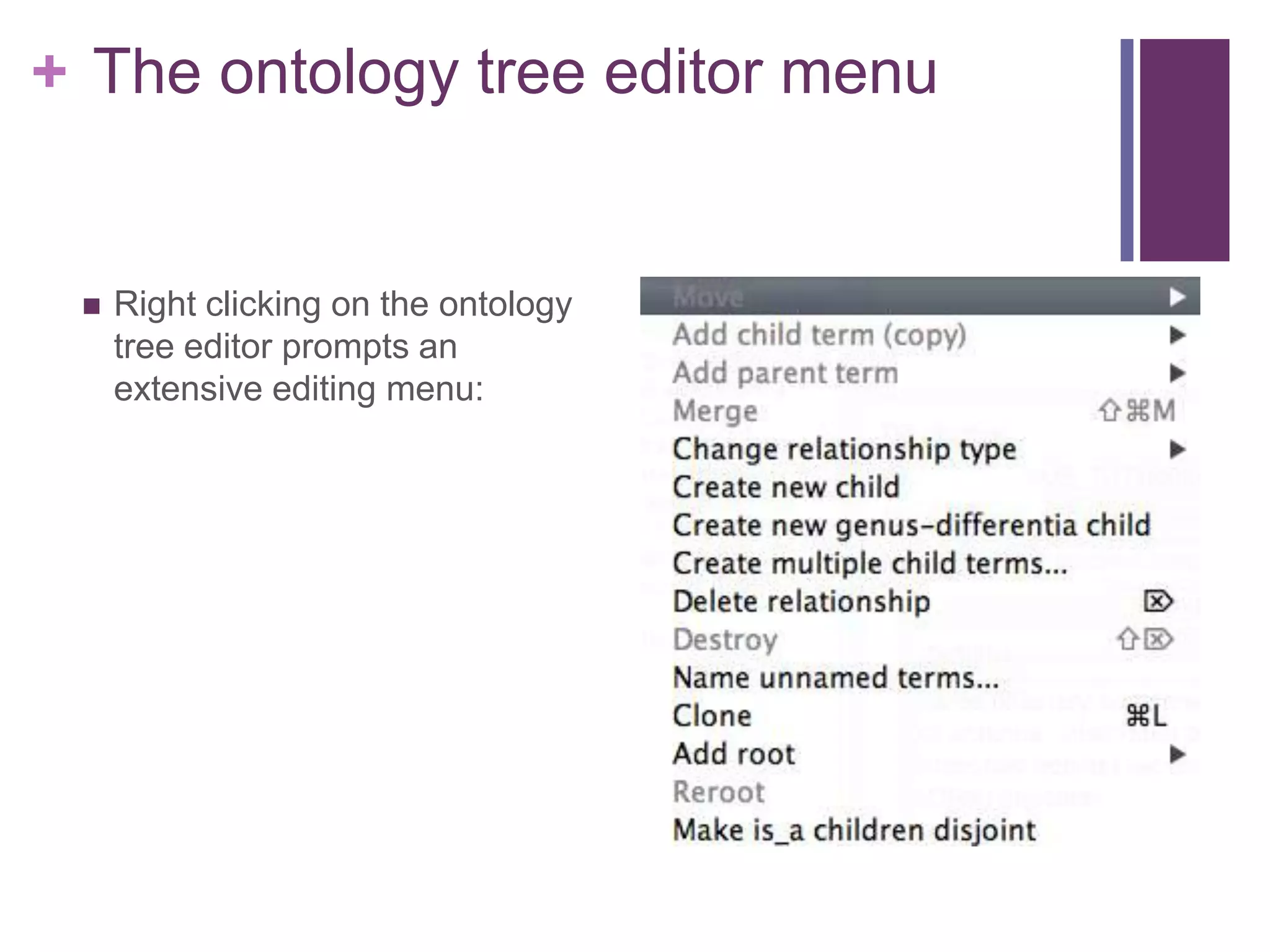
+ The ontology tree editor menu


    Right clicking on the ontology
     tree editor prompts an
     extensive editing menu:
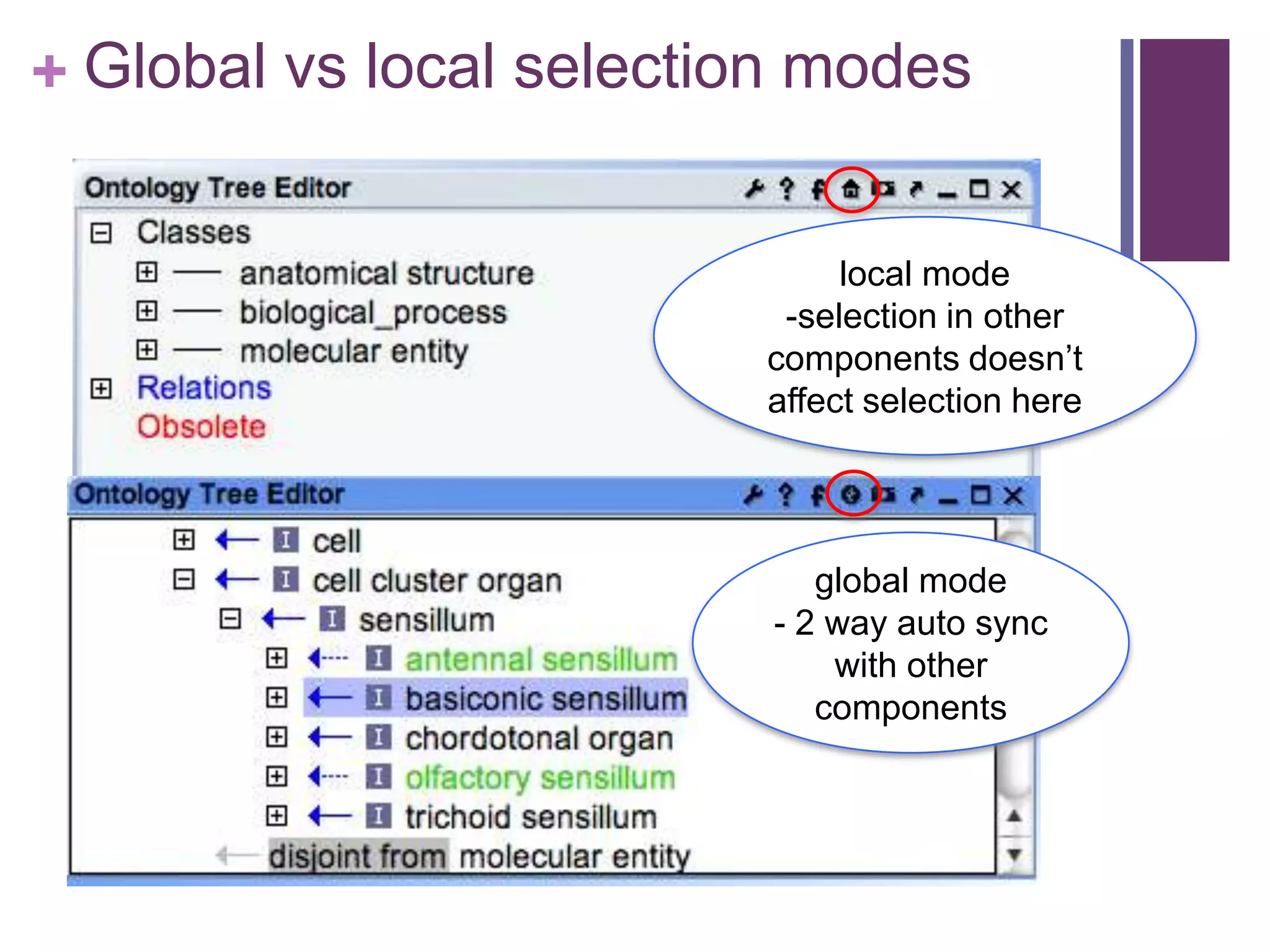
+ Global vs local selection modes


                              local mode
                          -selection in other
                         components doesn‟t
                         affect selection here


                             global mode
                          - 2 way auto sync
                              with other
                             components
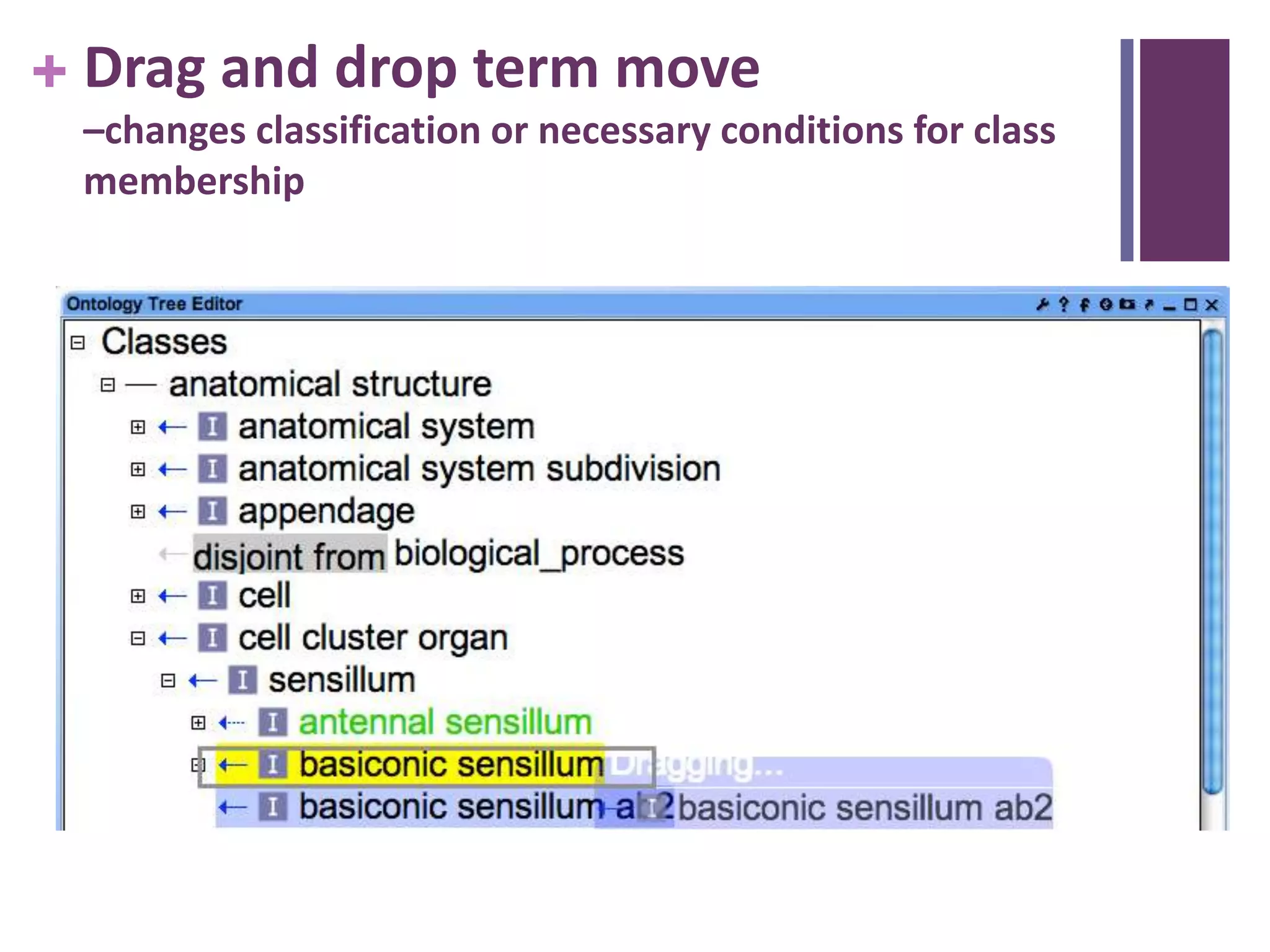
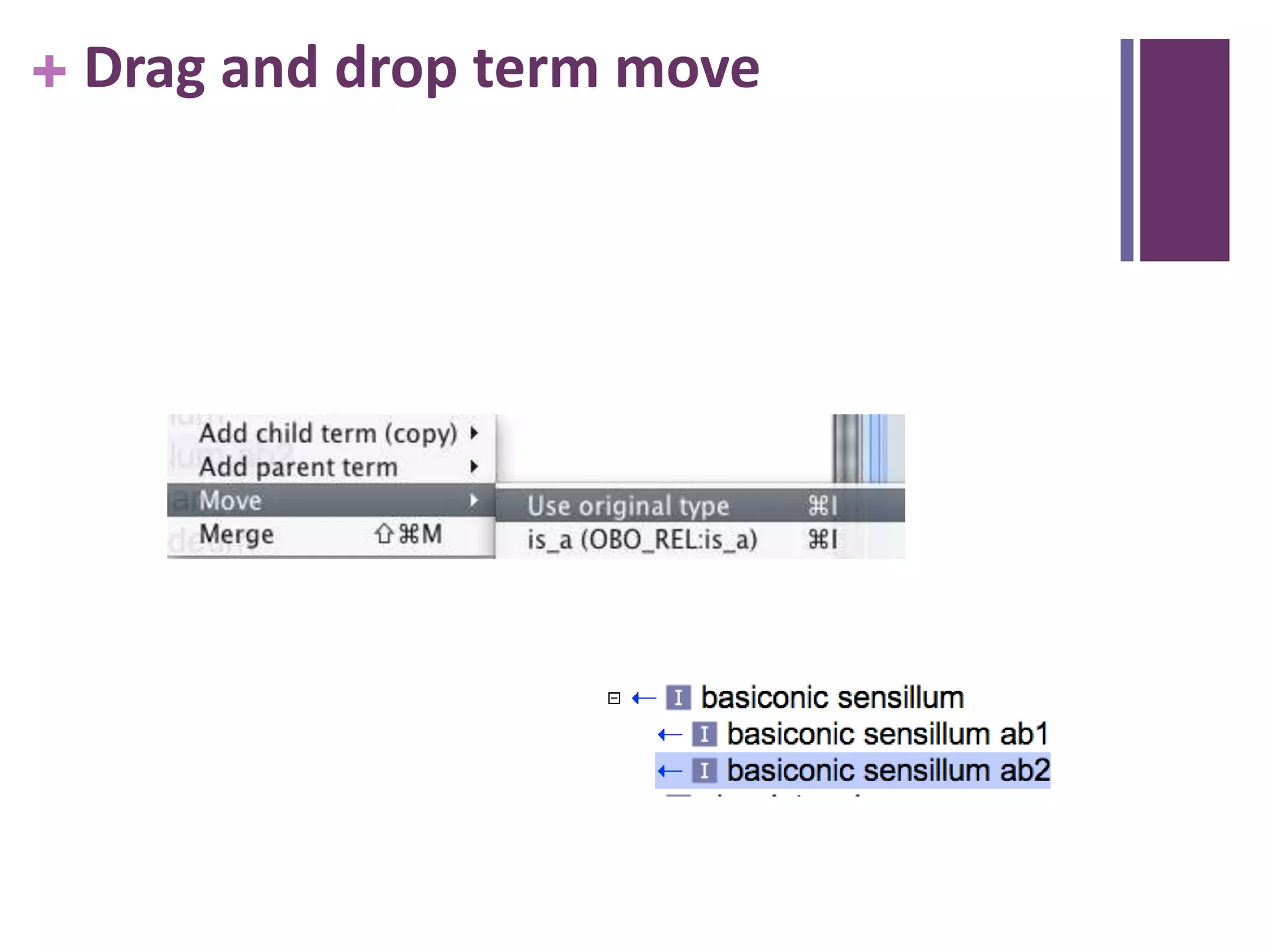
+ Drag and drop term move
 –changes classification or necessary conditions for class
 membership
+ Drag and drop term move
+
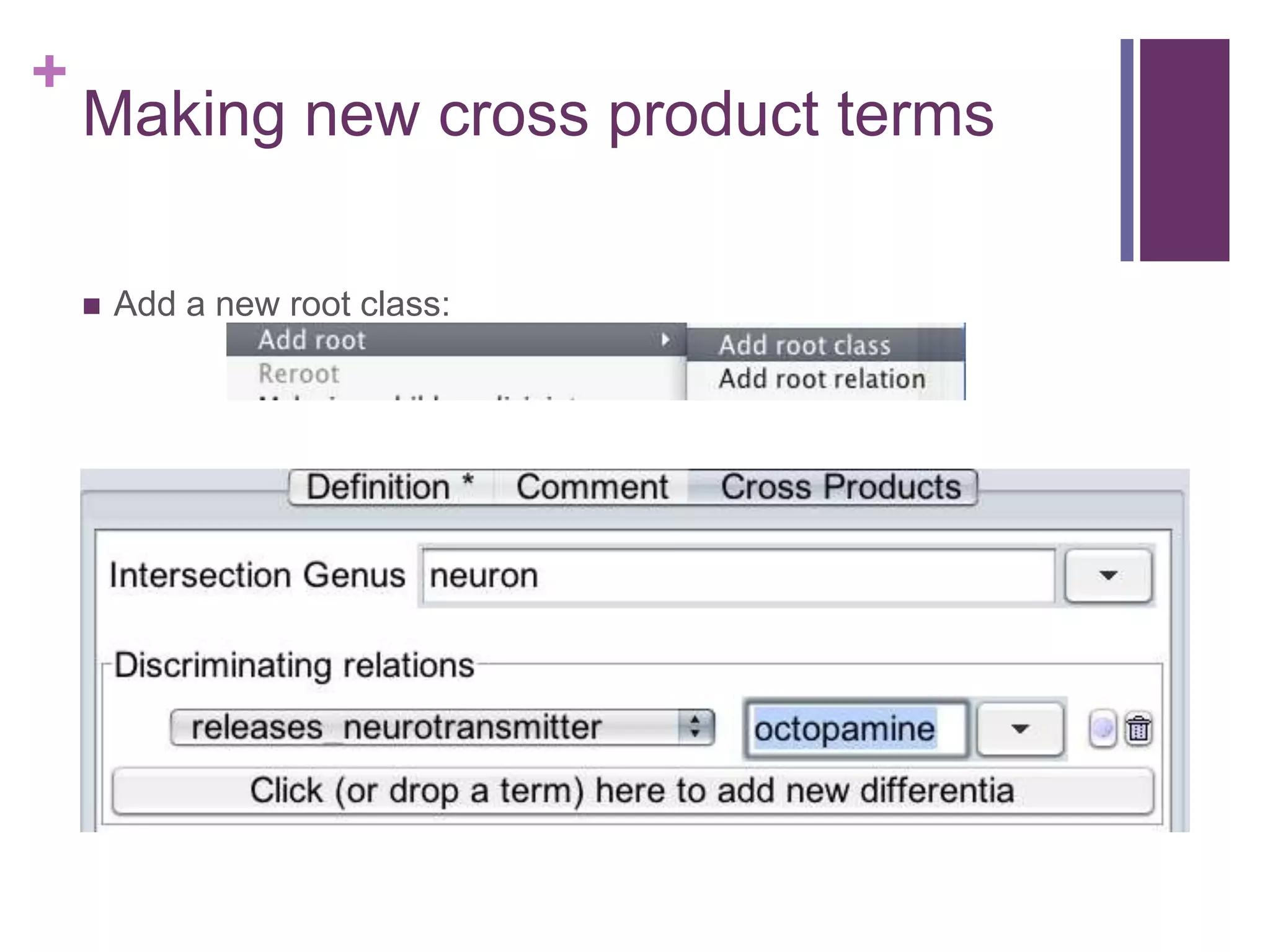
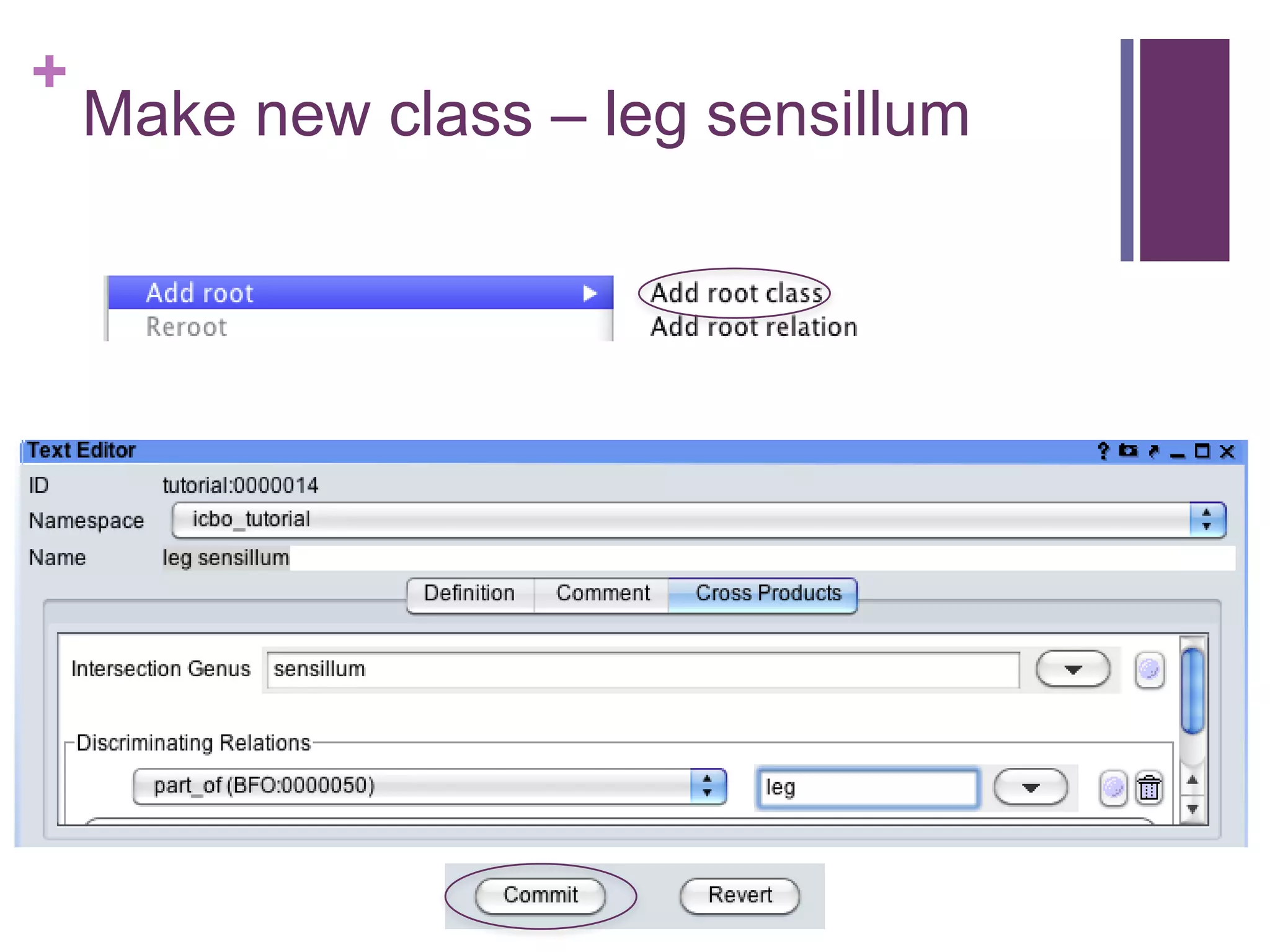
    Making new cross product terms

       Add a new root class:
+


    Very Quick Guide to Protégé
+
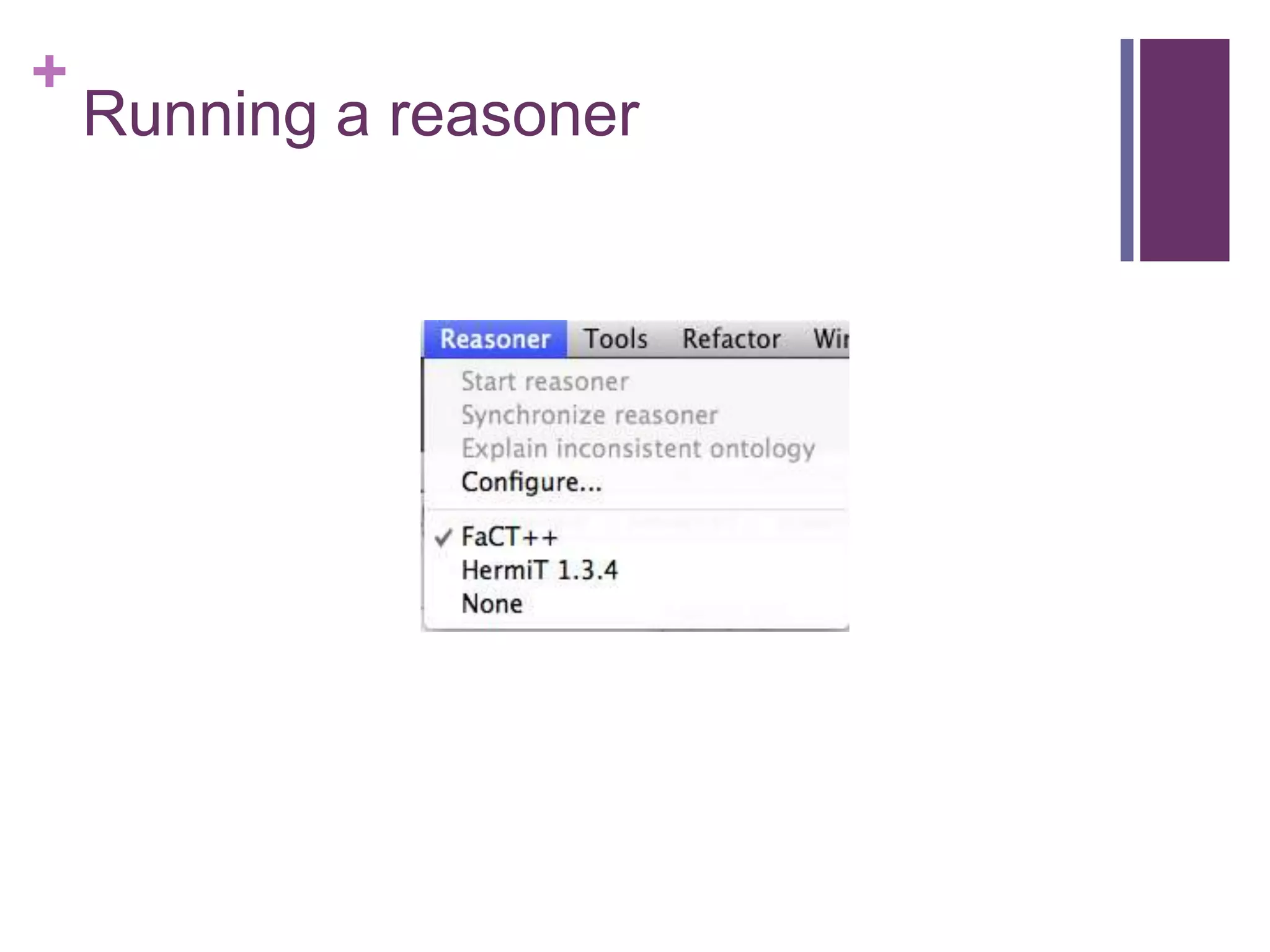
    Running a reasoner
+
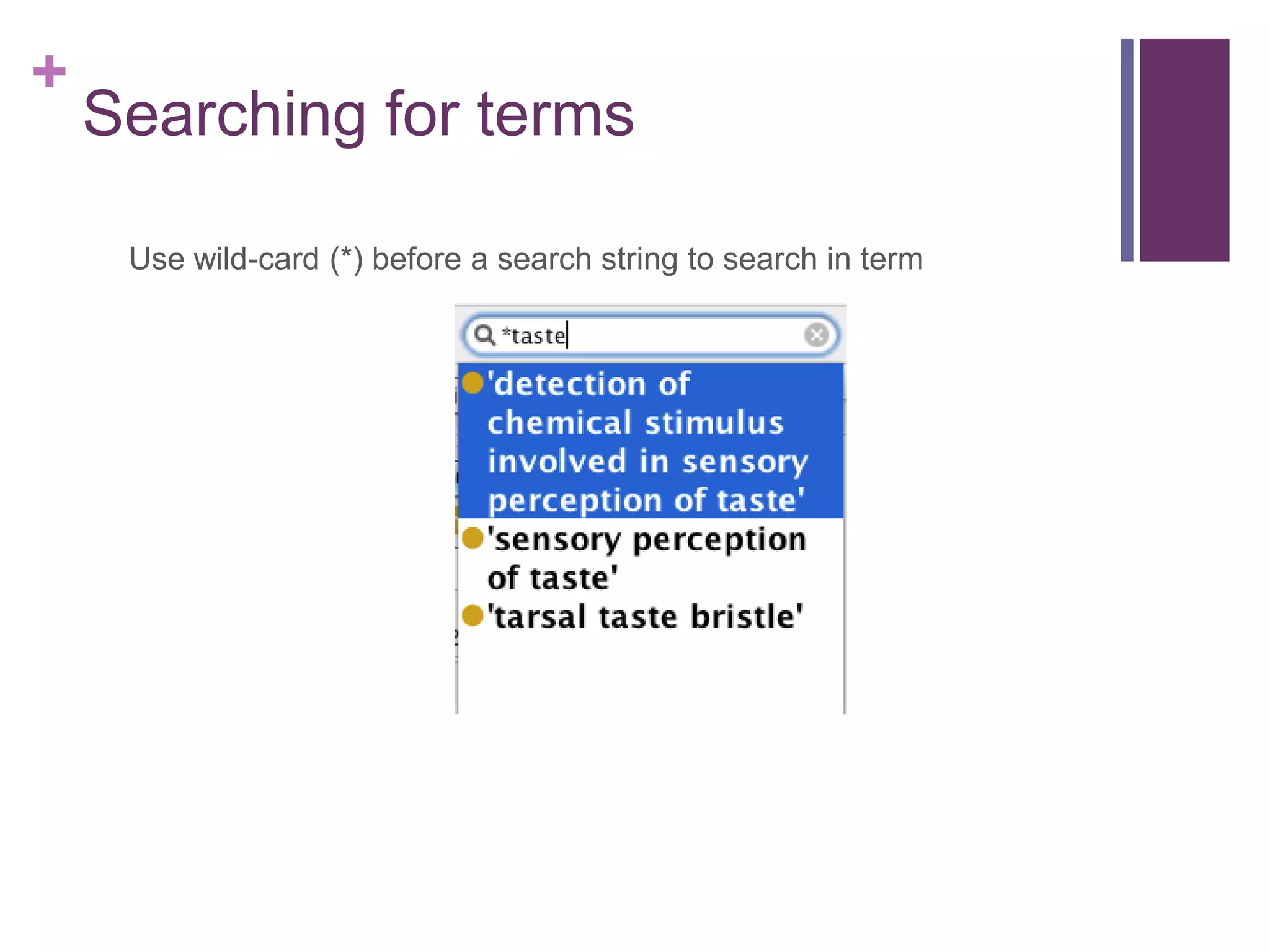
    Searching for terms

     Use wild-card (*) before a search string to search in term
+
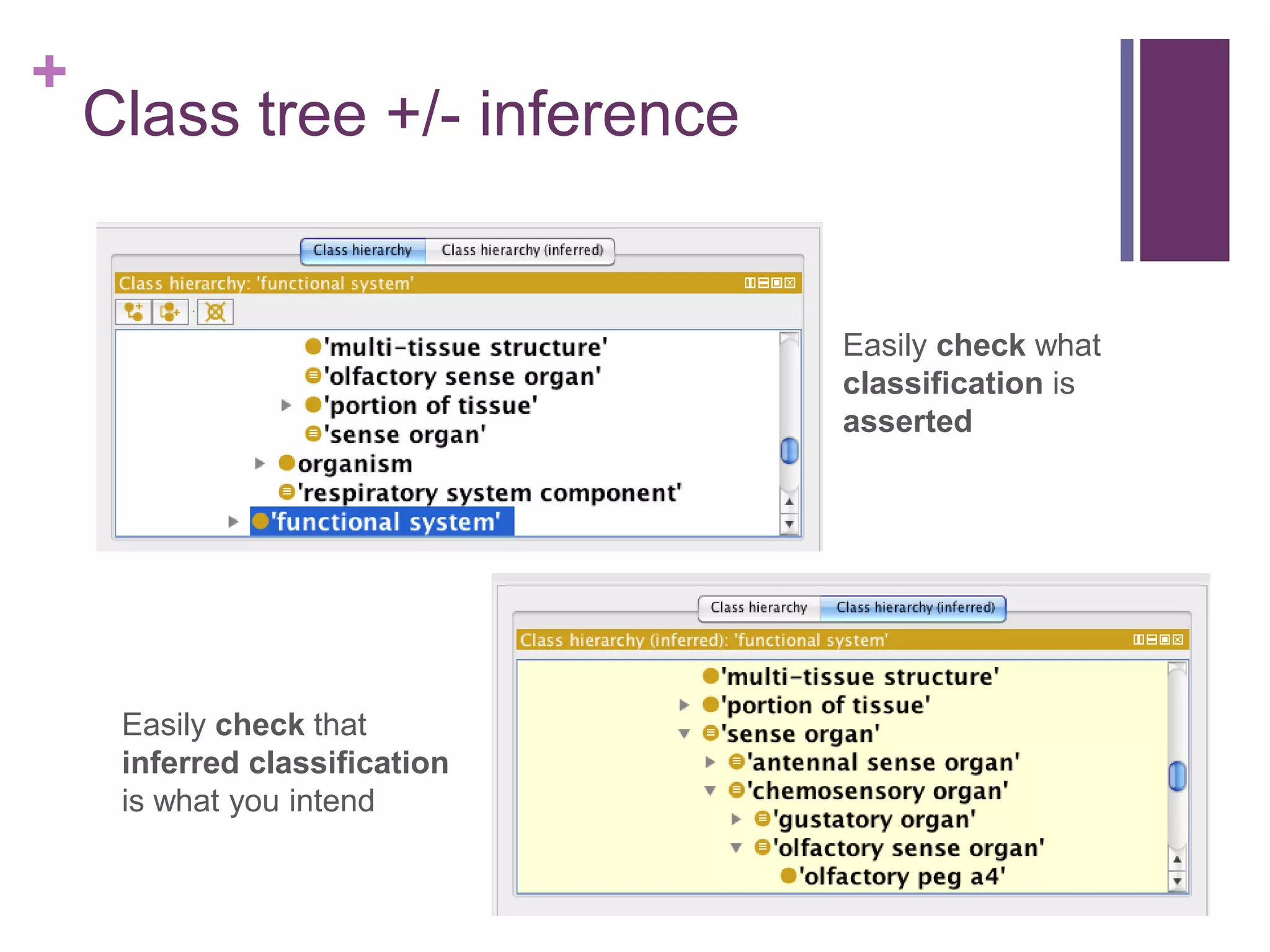
    Class tree +/- inference


                               Easily check what
                               classification is
                               asserted


     Easily check that
     inferred classification
     is what you intend
+


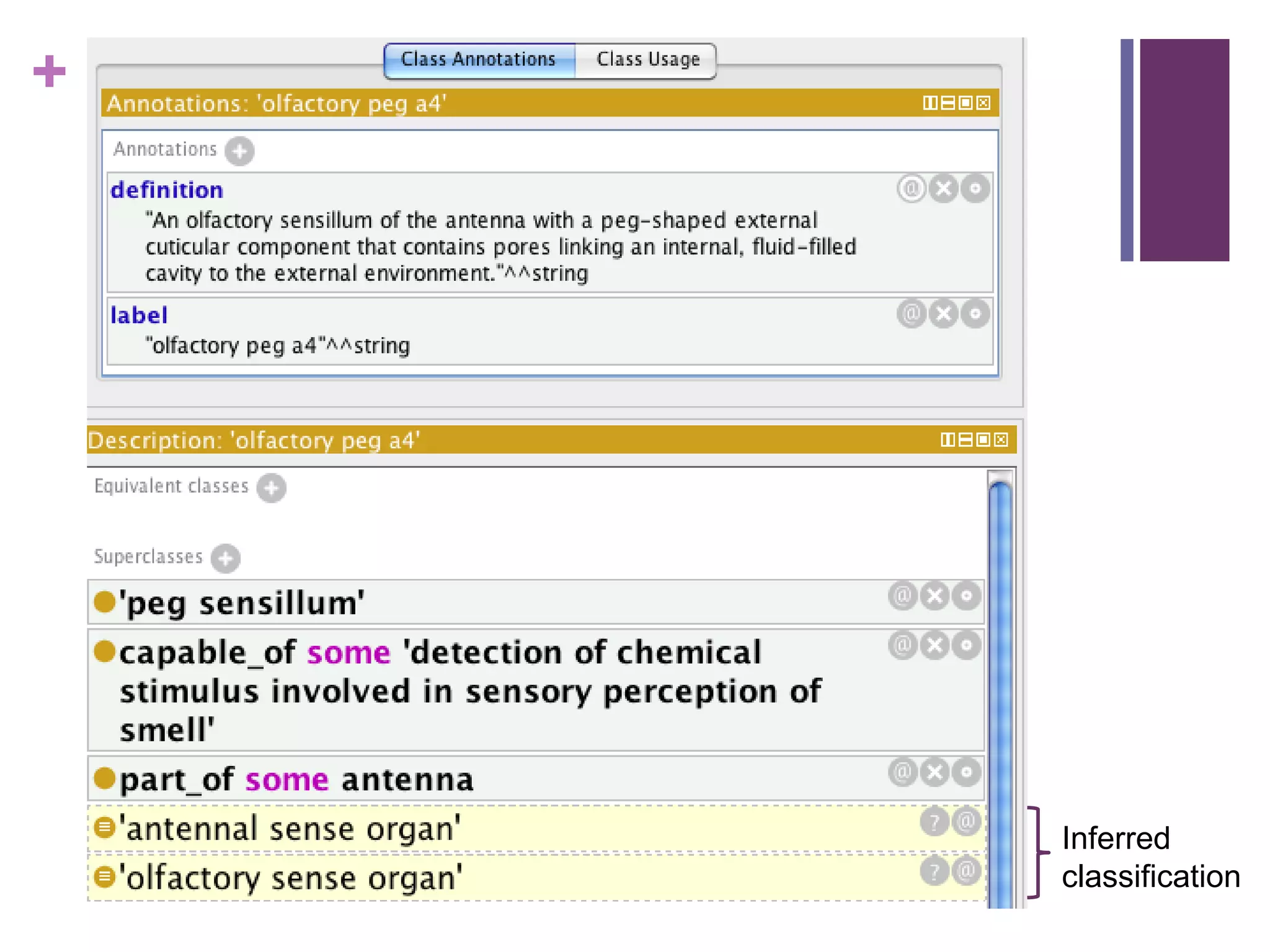
    Inferred
    classification
+
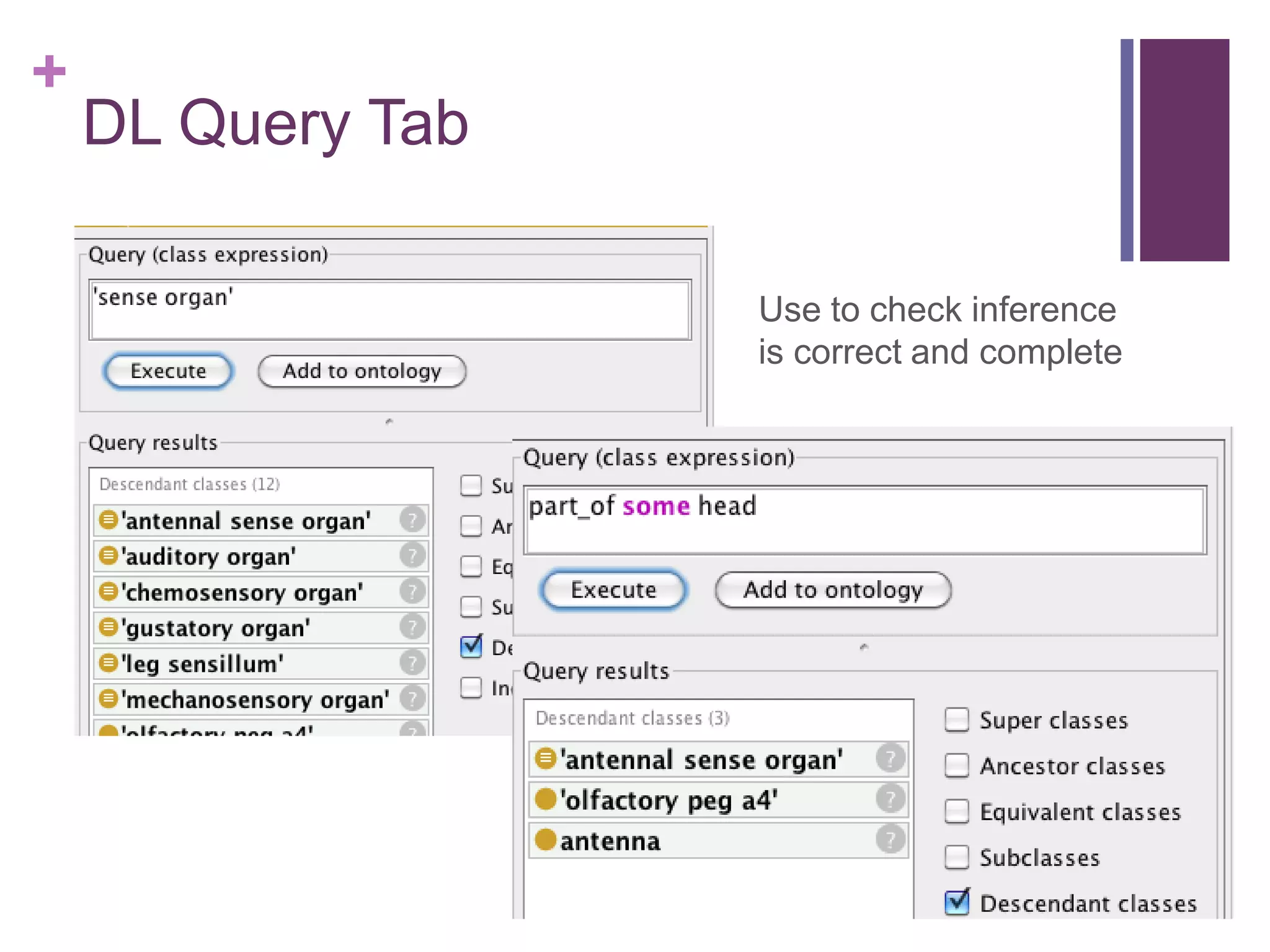
    DL Query Tab

                   Use to check inference
                   is correct and complete
+
    Editing in Protégé


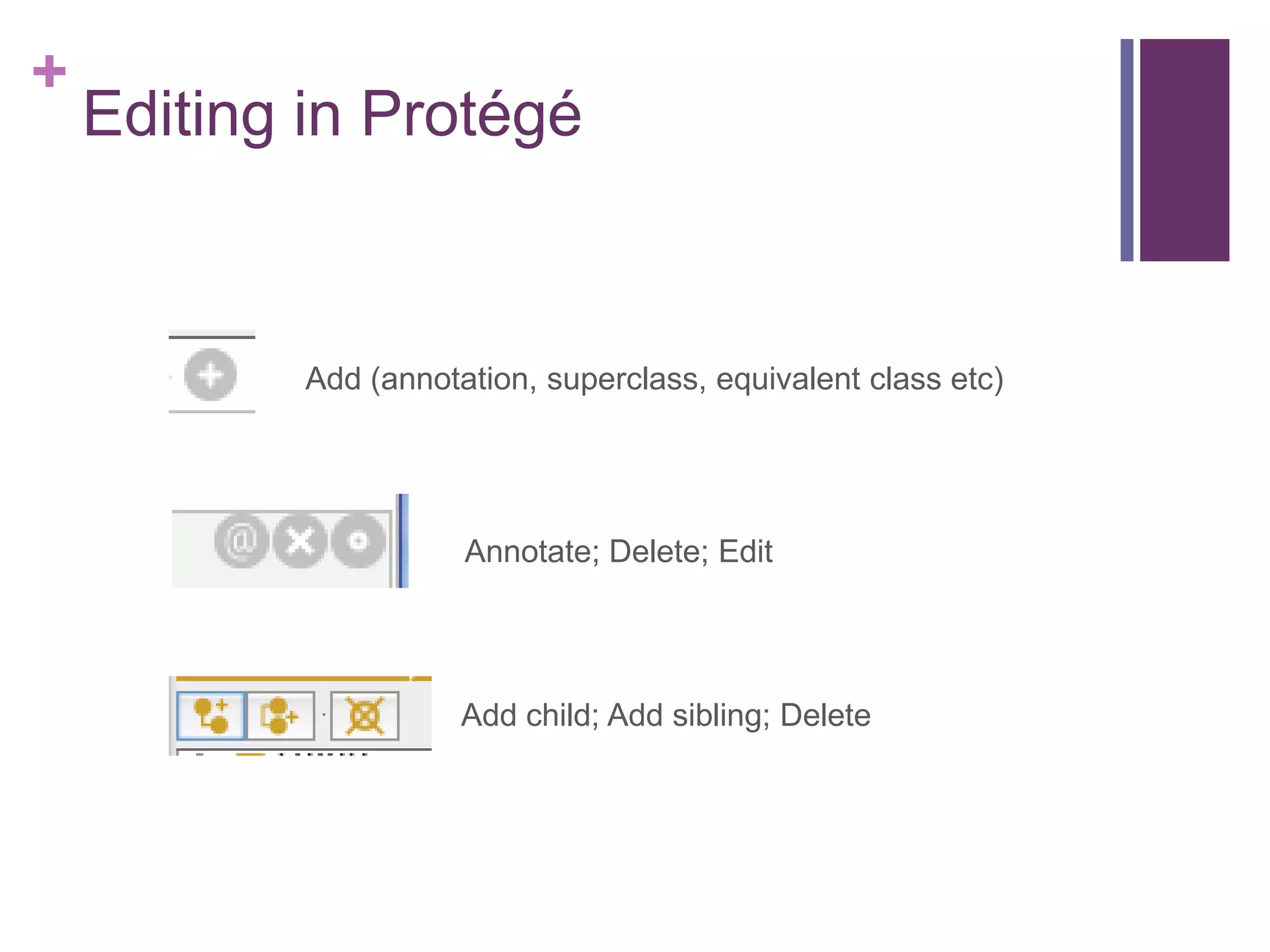
            Add (annotation, superclass, equivalent class etc)


                       Annotate; Delete; Edit


                       Add child; Add sibling; Delete
+
    Editing in Protégé


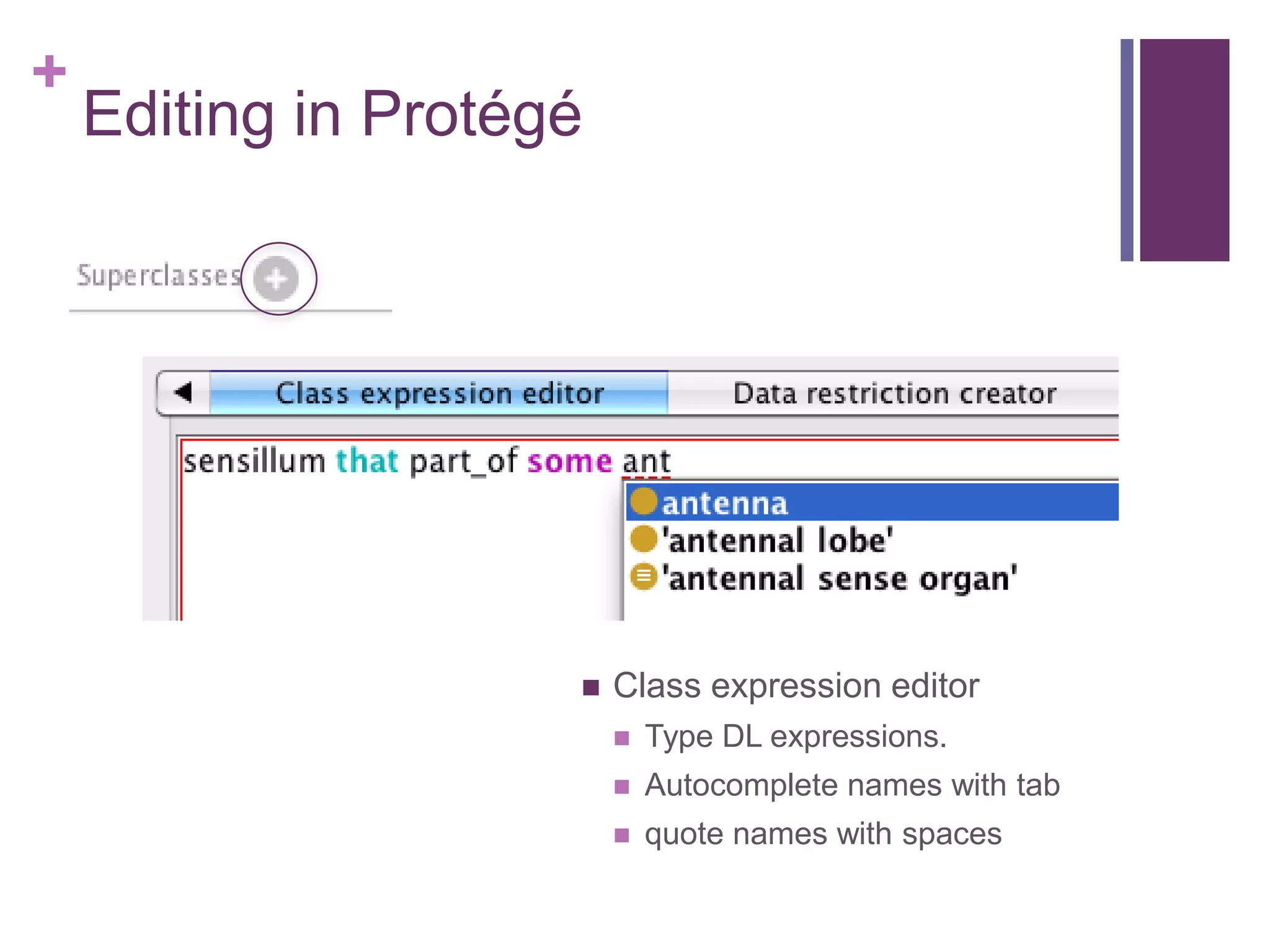
                        Class expression editor
                            Type DL expressions.
                            Autocomplete names with tab
                            quote names with spaces
+
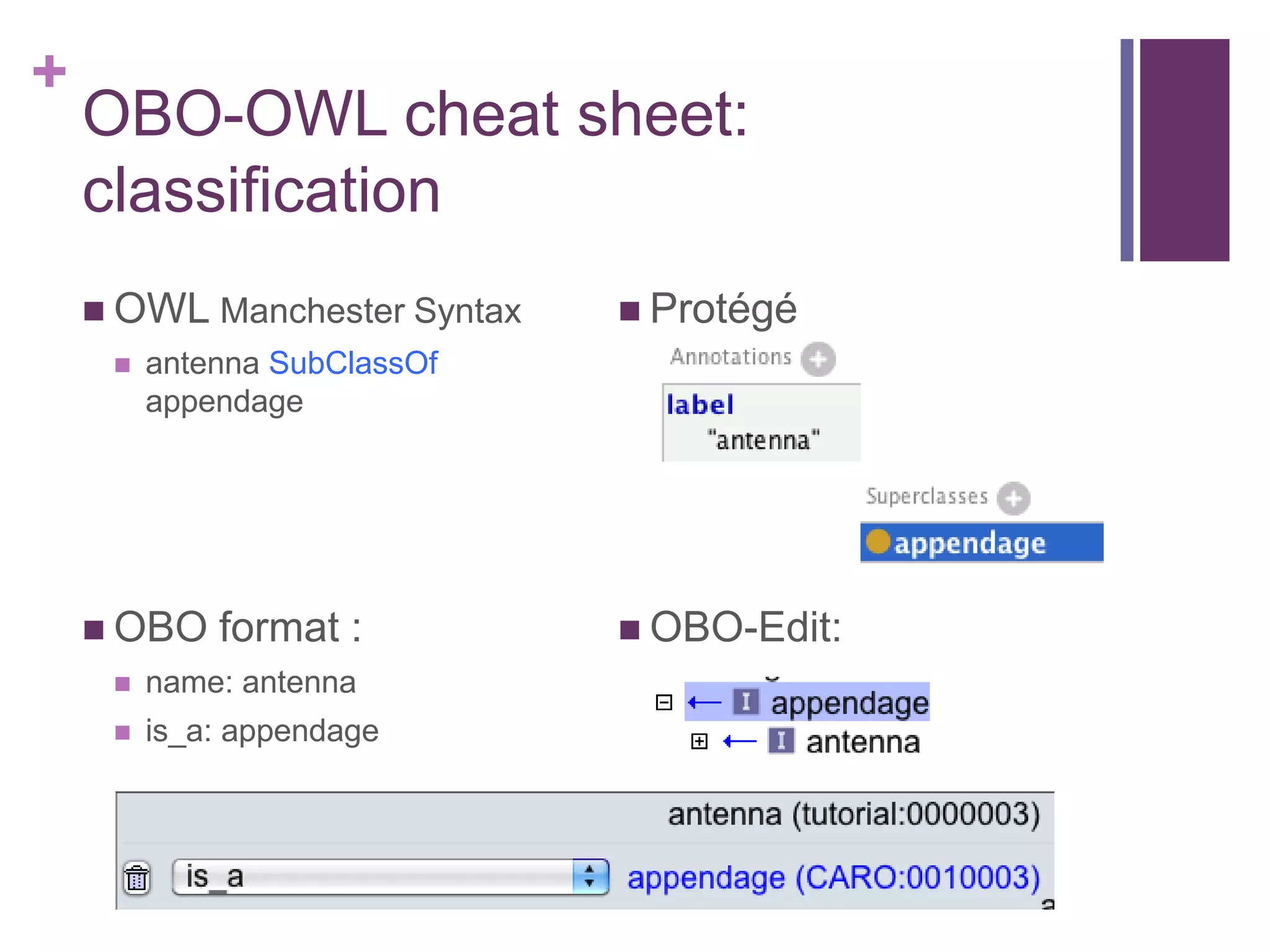
    OBO-OWL cheat sheet:
    classification
     OWL Manchester Syntax    Protégé
        antenna SubClassOf
         appendage


     OBO    format :          OBO-Edit:
        name: antenna
        is_a: appendage
+
    OBO-OWL cheat sheet:
    necessary conditions for class membership


     OWL Manchester Syntax            Protégé
        antenna SubClassOf
         part_ofsome head


     OBO    format :                  OBO-Edit:
        name: antenna
        relationship: part_of head
+
    OBO-OWL cheat sheet:
    necessary and sufficient conditions for class membership


       OWL Manchester Syntax                    Protégé
           antennal sense organ
            EquivalentTo„sense organ‟ that
            part_ofsome antenna


           (that / and are interchangable in
            MS)

       OBO format :                             OBO-Edit:
           name: antennal sense organ
           intersection_of: sense organ
           intersection_of: part_of
            antenna
+
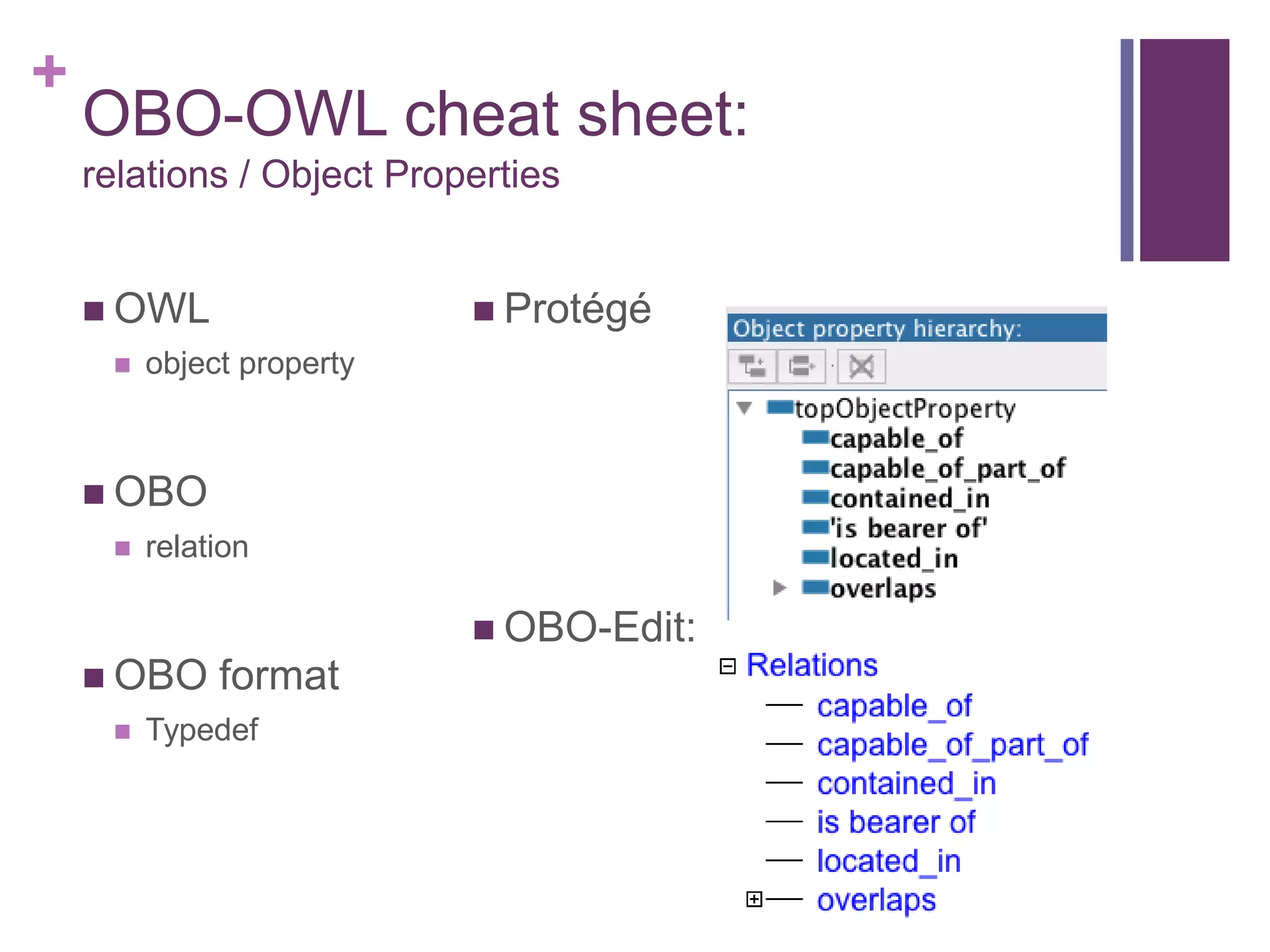
    OBO-OWL cheat sheet:
    relations / Object Properties


     OWL                   Protégé
        object property


     OBO
        relation

                            OBO-Edit:
     OBO     format
        Typedef
+
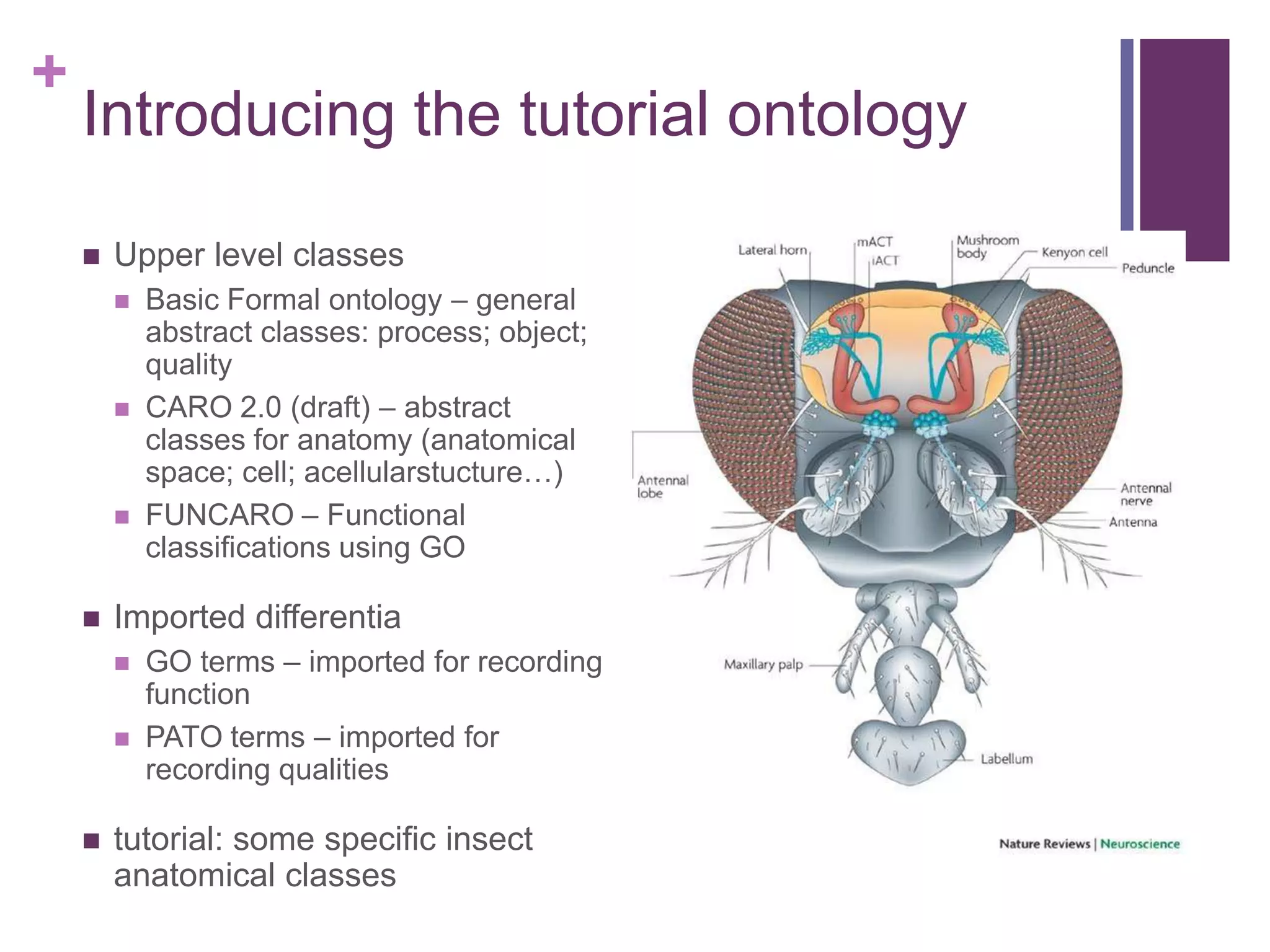
    Introducing the tutorial ontology

       Upper level classes
           Basic Formal ontology – general
            abstract classes: process; object;
            quality
           CARO 2.0 (draft) – abstract
            classes for anatomy (anatomical
            space; cell; acellularstucture…)
           FUNCARO – Functional
            classifications using GO

       Imported differentia
           GO terms – imported for recording
            function
           PATO terms – imported for
            recording qualities

       tutorial: some specific insect
        anatomical classes
+


    Exercise 1 – Tracing multiple
    classification of single sense organ

          Please open:
    OBO format converter
                OBO-Edit with tutorial.obo open
                Protégé 4.1
+
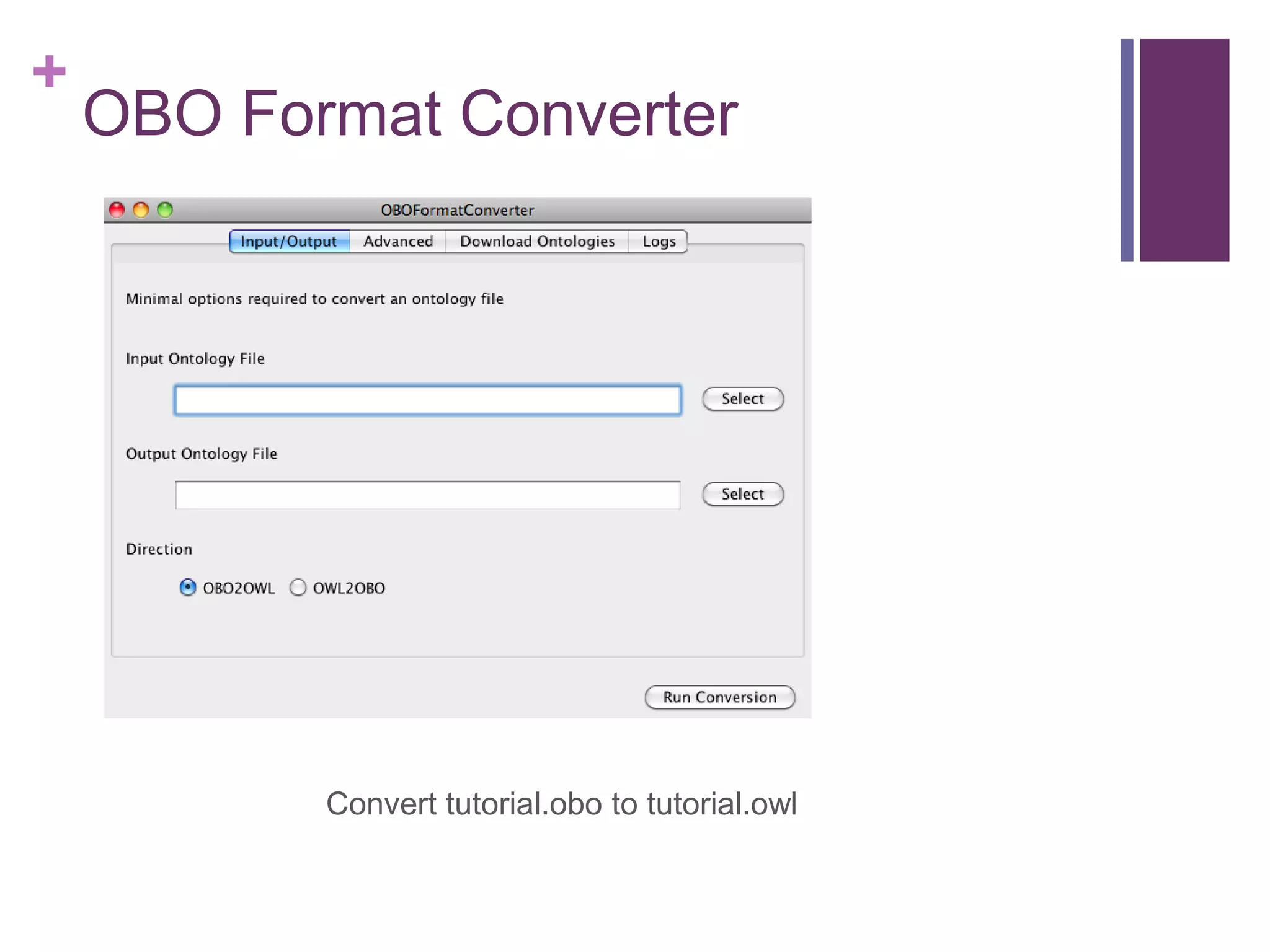
    OBO Format Converter


           Convert tutorial.obo to tutorial.owl
+


    Quick live demo
+
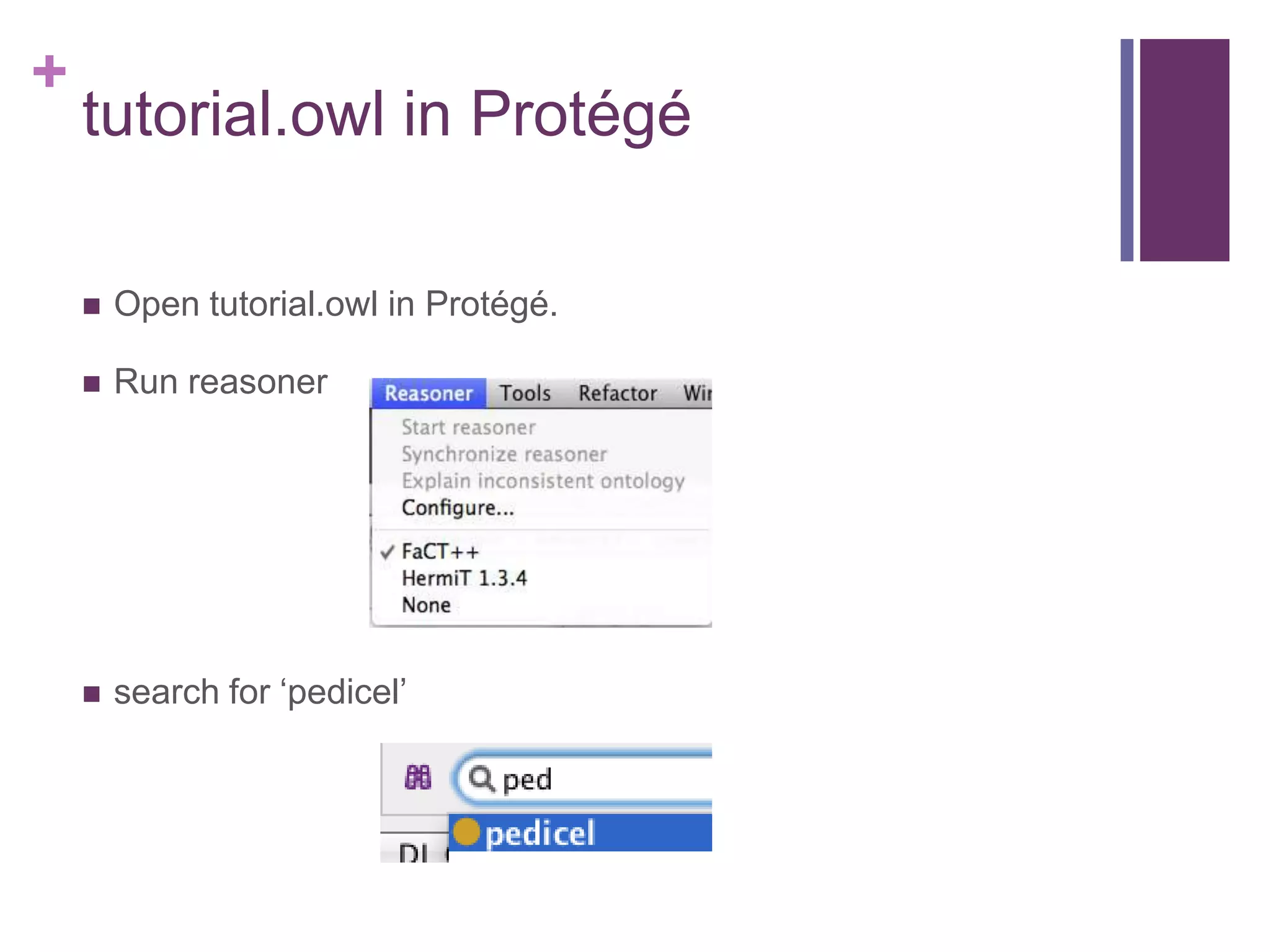
    tutorial.owl in Protégé

       Open tutorial.owl in Protégé.

       Run reasoner


       search for „pedicel‟
+
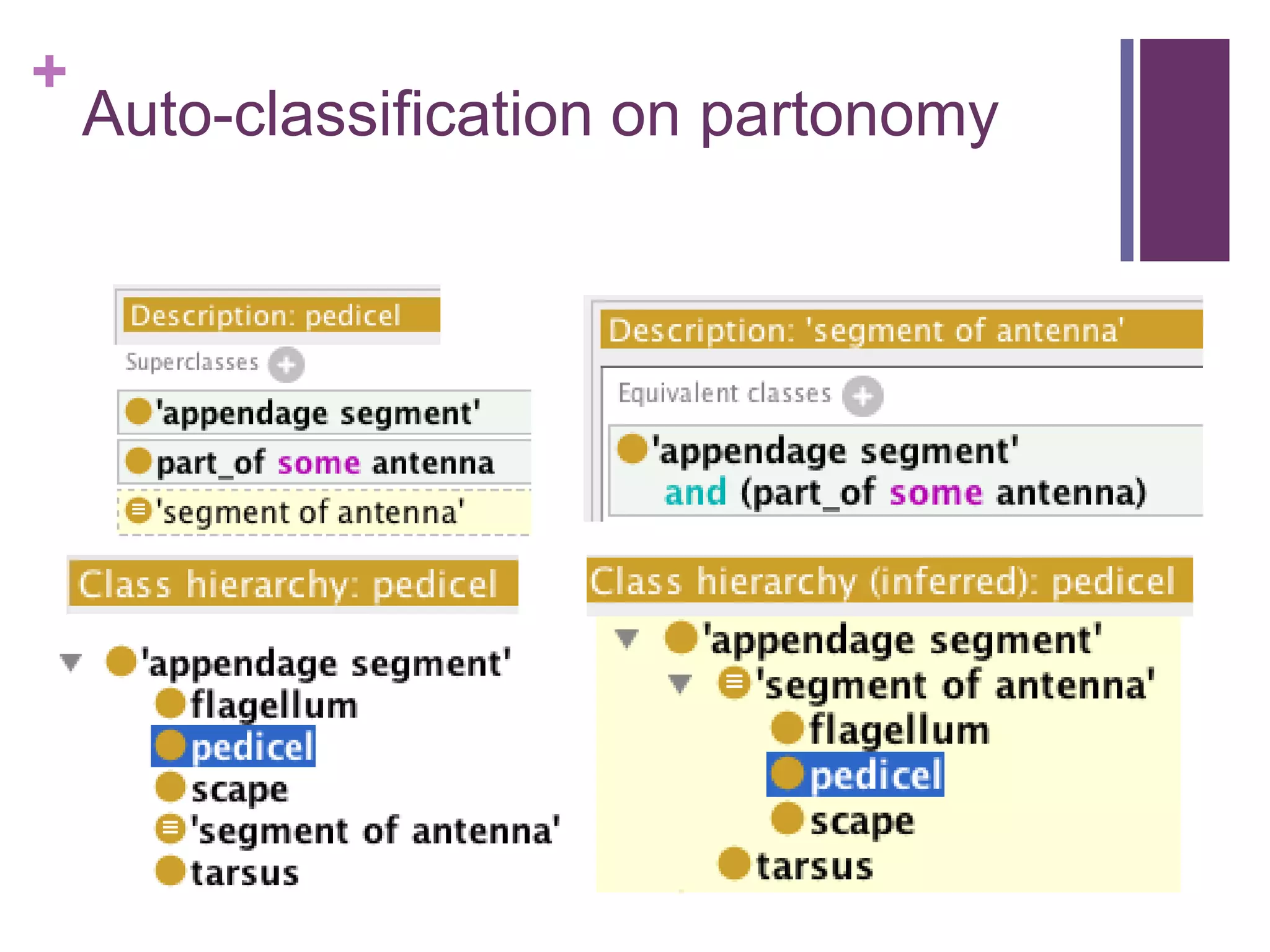
    Auto-classification on partonomy
+
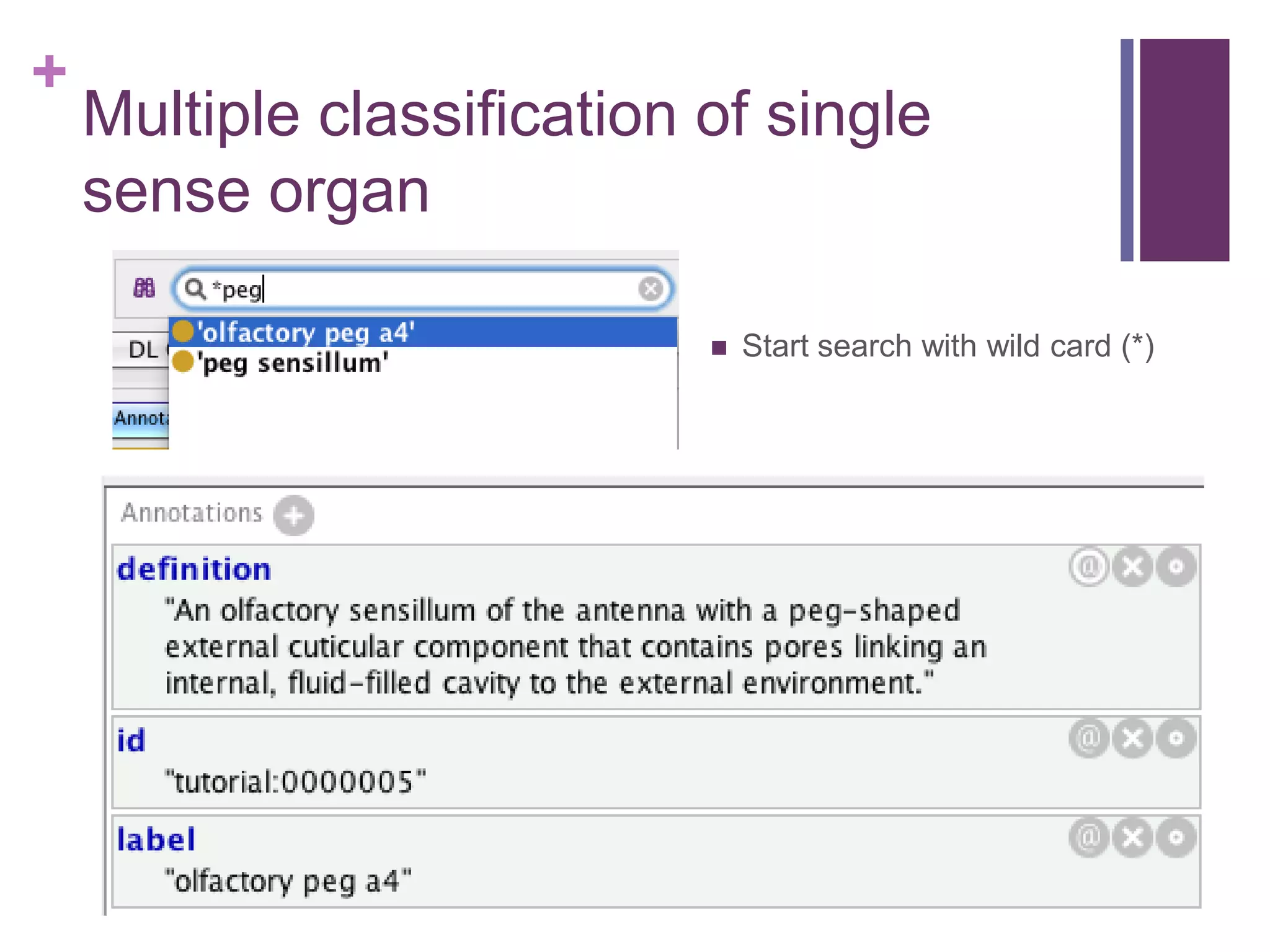
    Multiple classification of single
    sense organ

                               Start search with wild card (*)
+
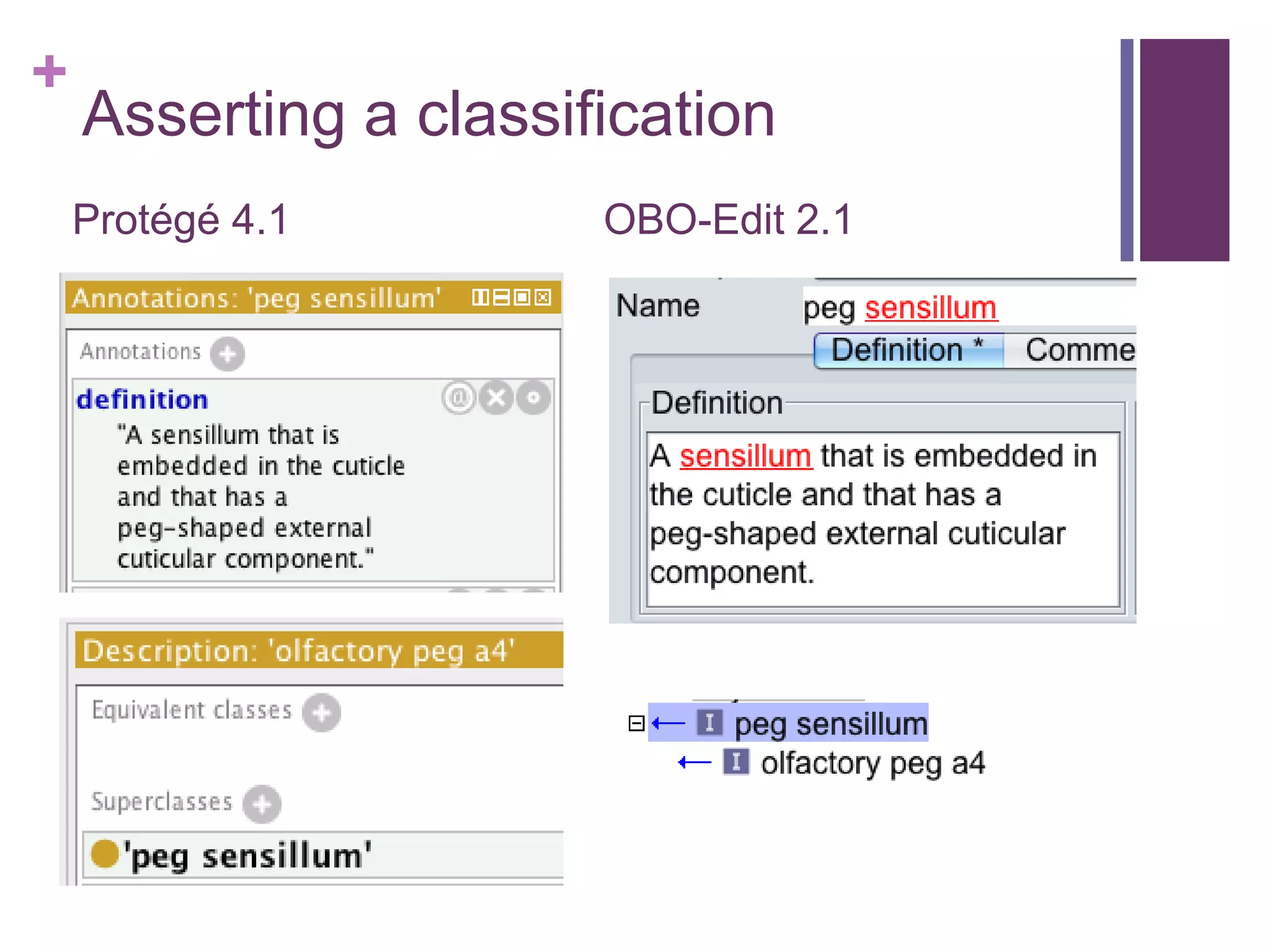
    Asserting a classification
    Protégé 4.1        OBO-Edit 2.1
+
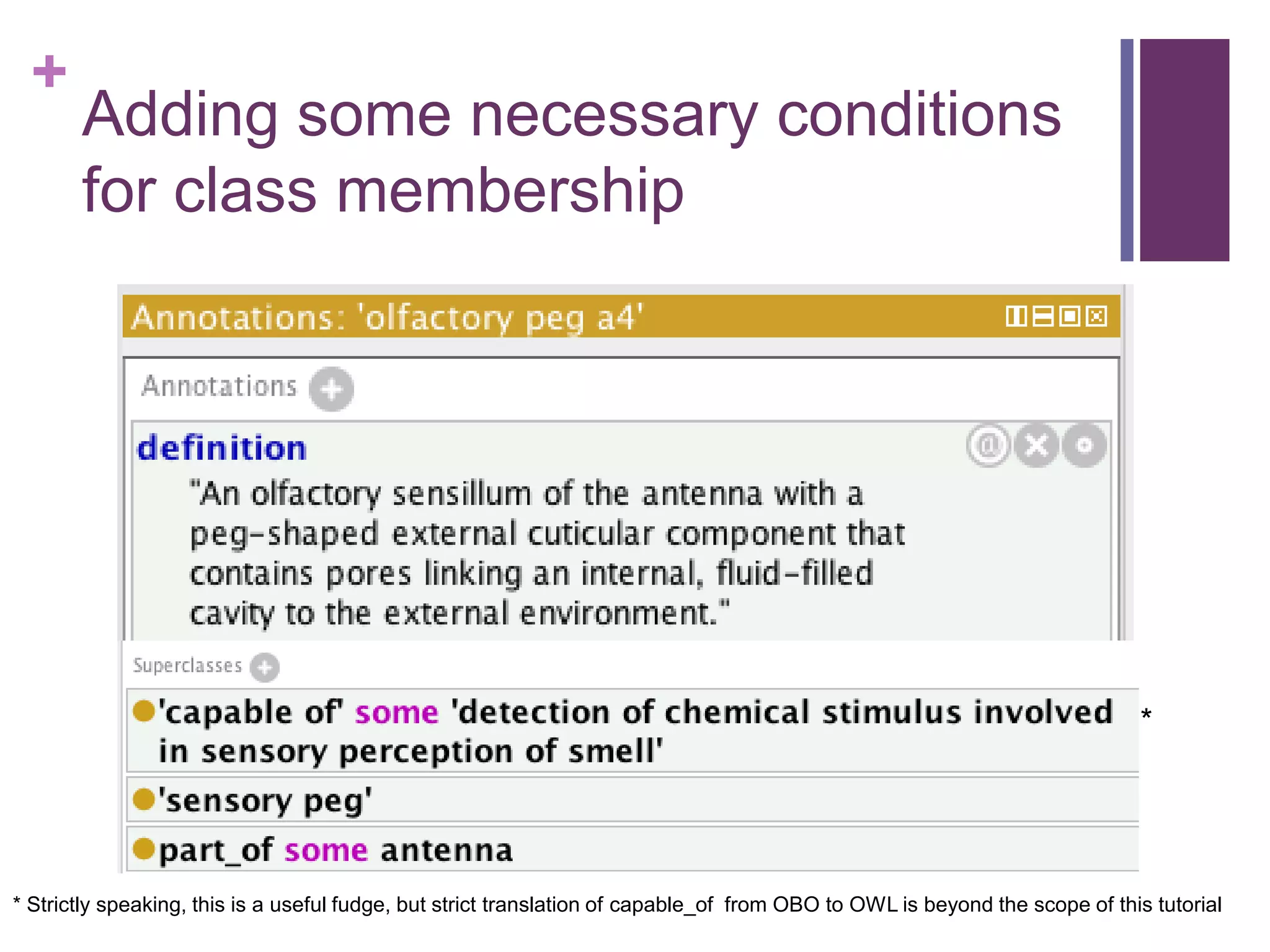
       Adding some necessary conditions
       for class membership


                                                                                                                            *


* Strictly speaking, this is a useful fudge, but strict translation of capable_of from OBO to OWL is beyond the scope of this tutorial
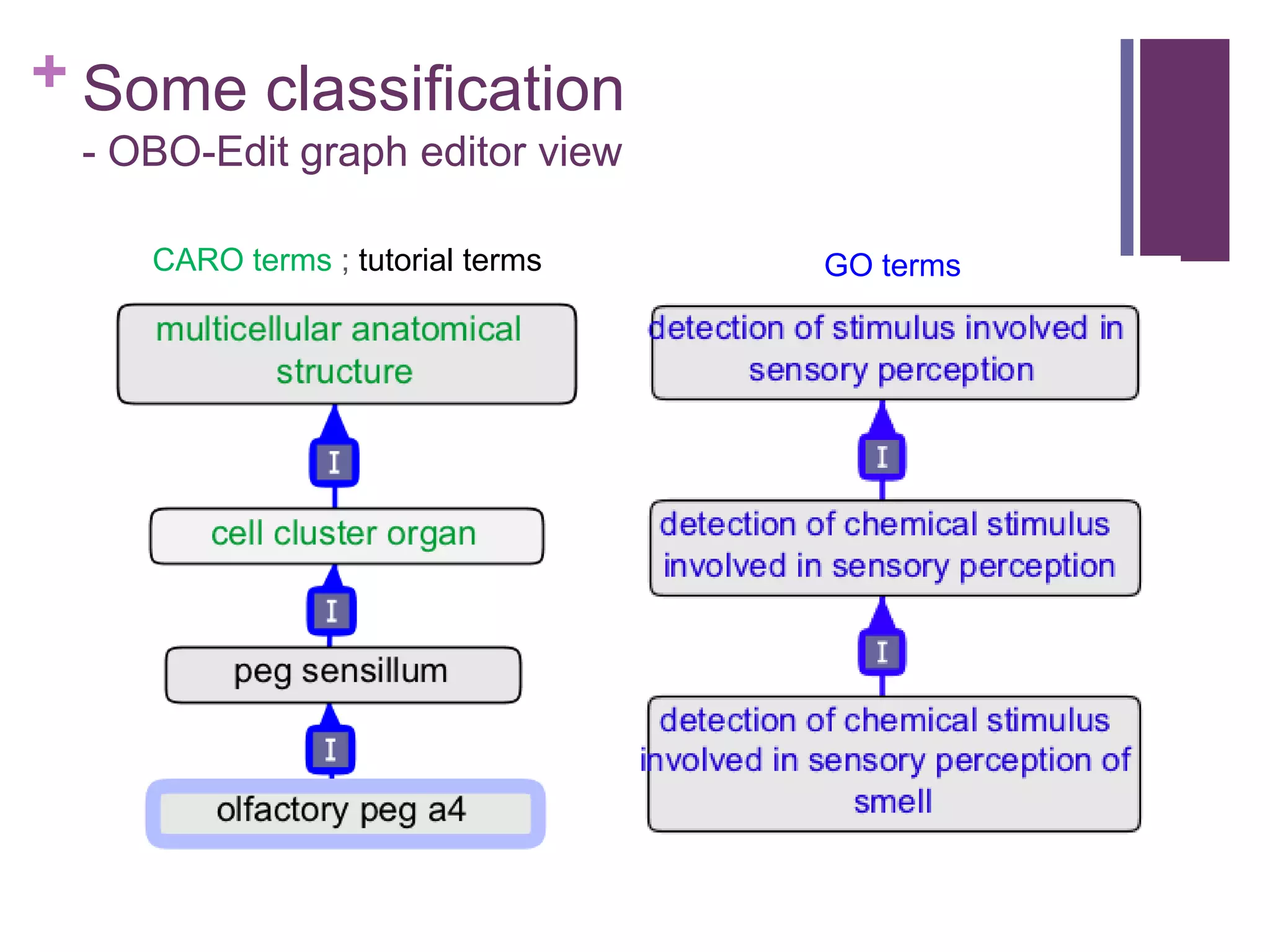
+ Some classification
 - OBO-Edit graph editor view

    CARO terms ; tutorial terms   GO terms
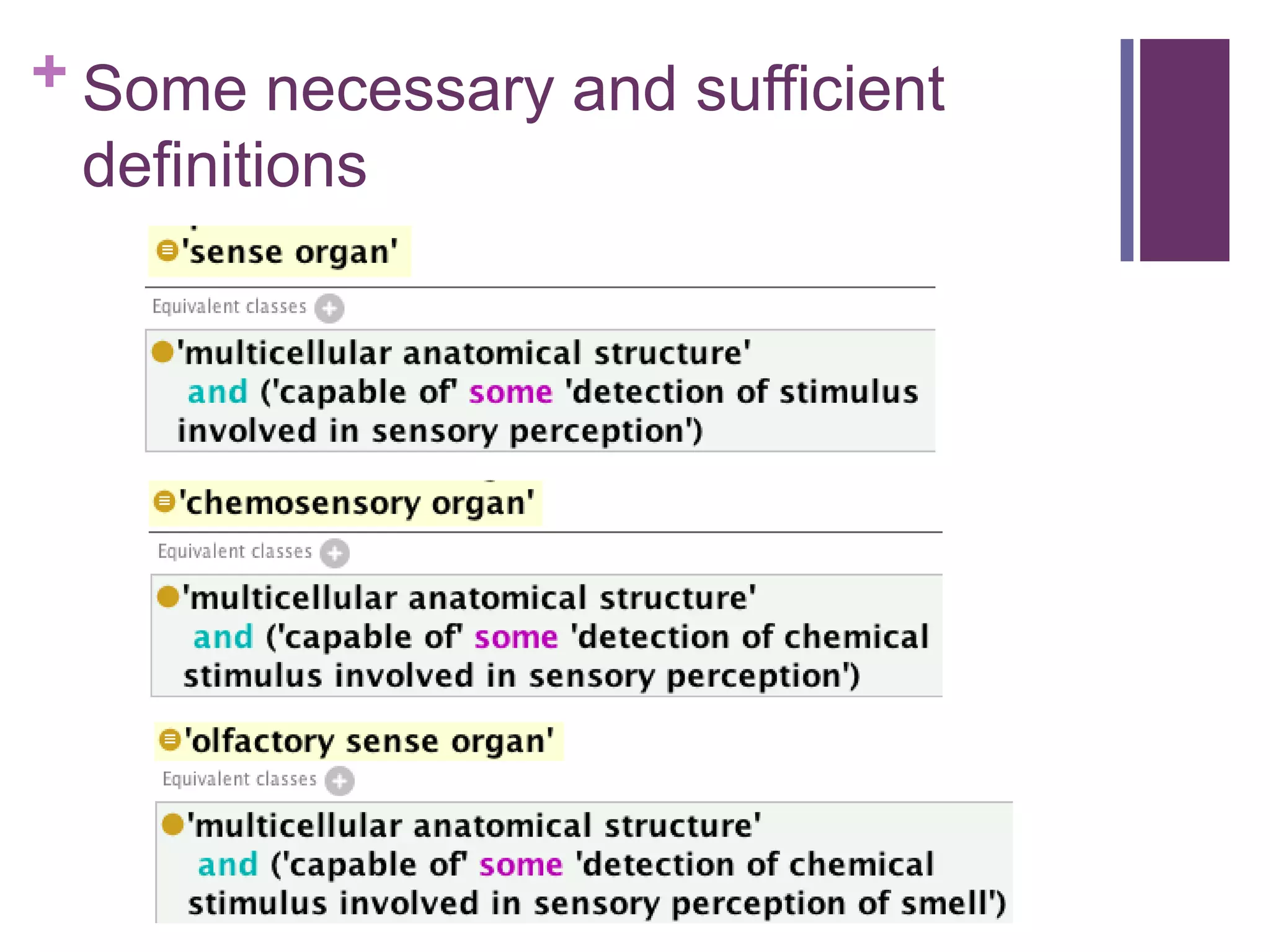
+ Some necessary and sufficient
  definitions
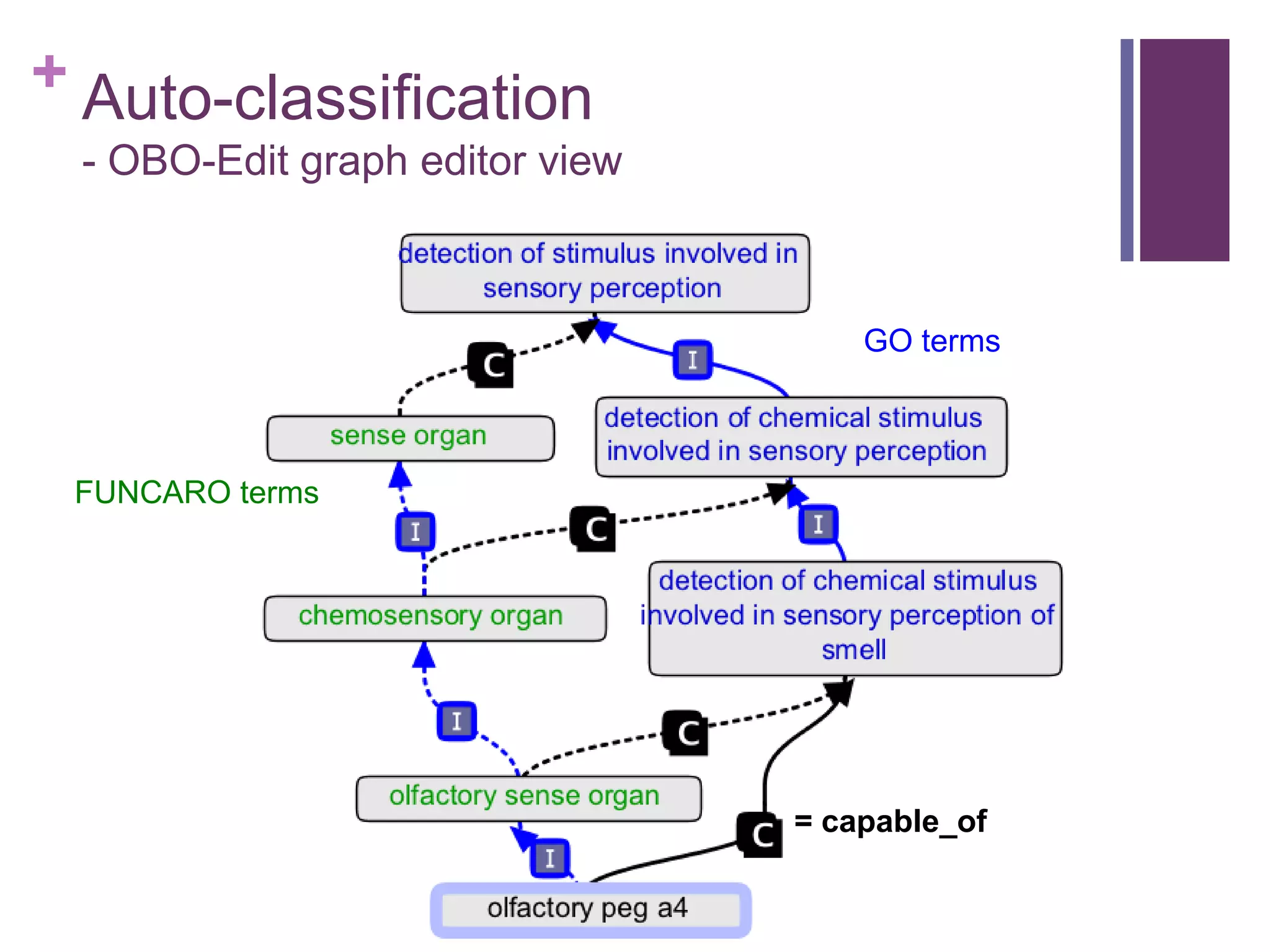
+ Auto-classification
 - OBO-Edit graph editor view


                                    GO terms


 FUNCARO terms


                                = capable_of
+
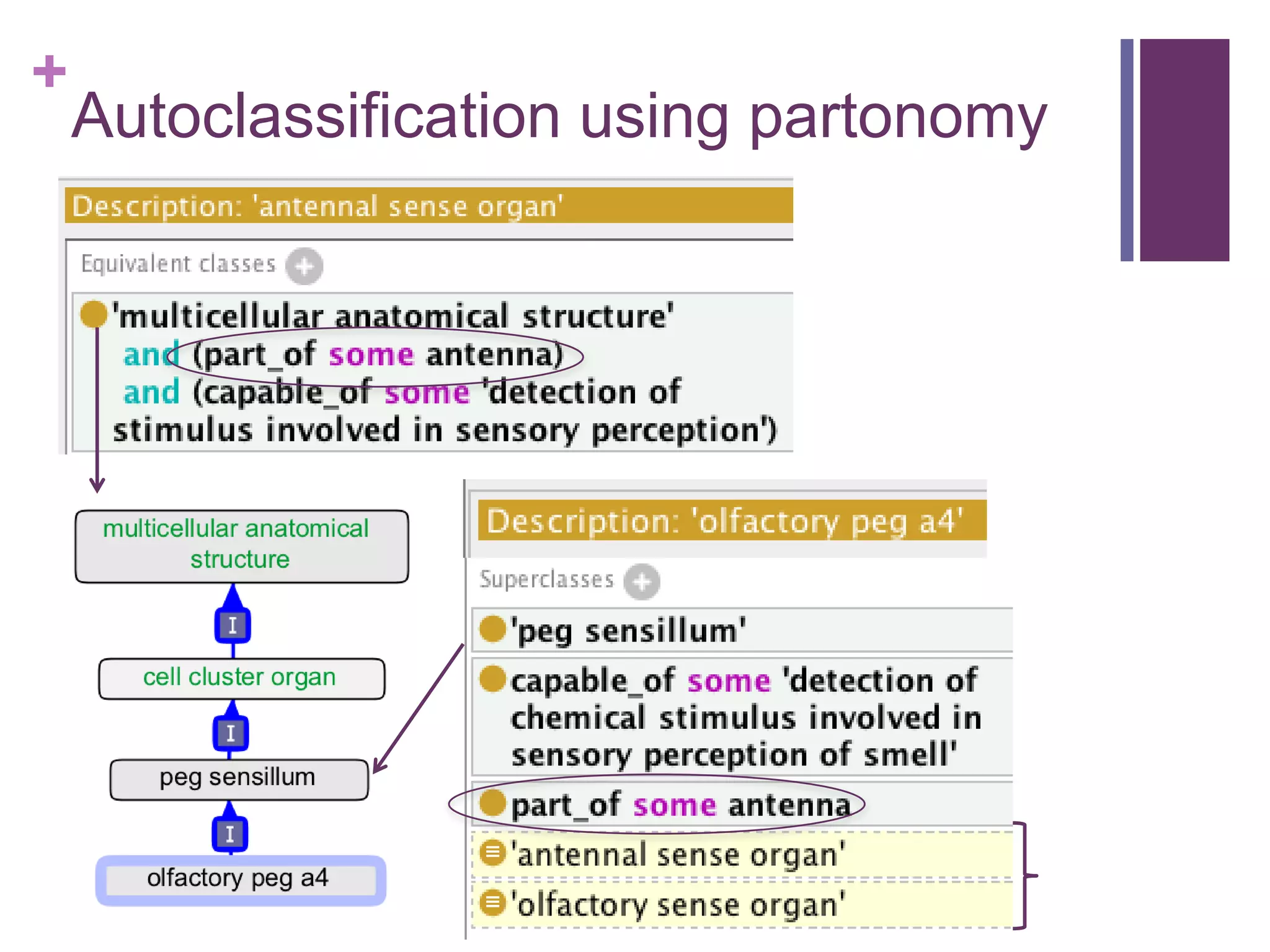
    Autoclassification using partonomy
+
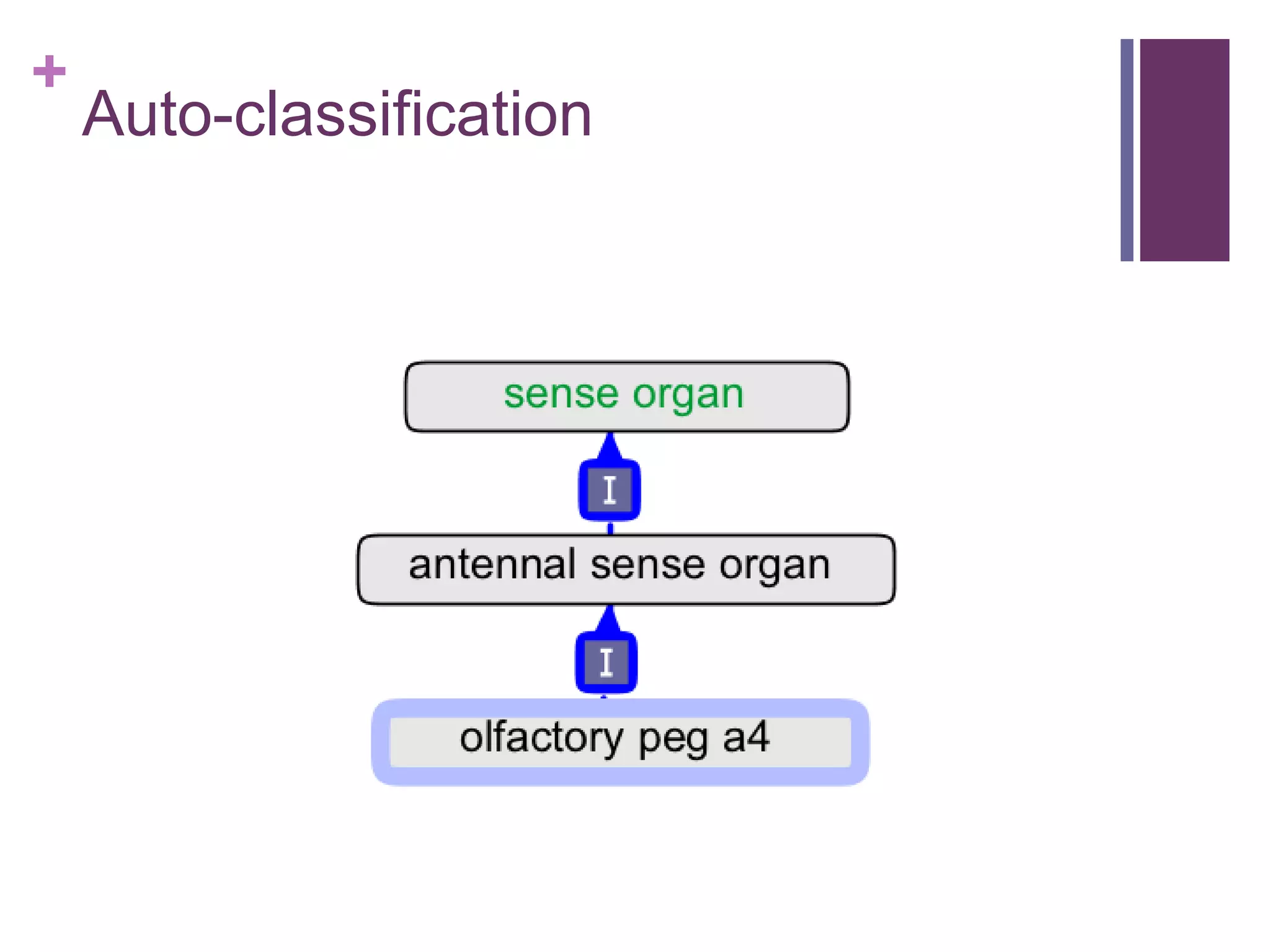
    Auto-classification
+
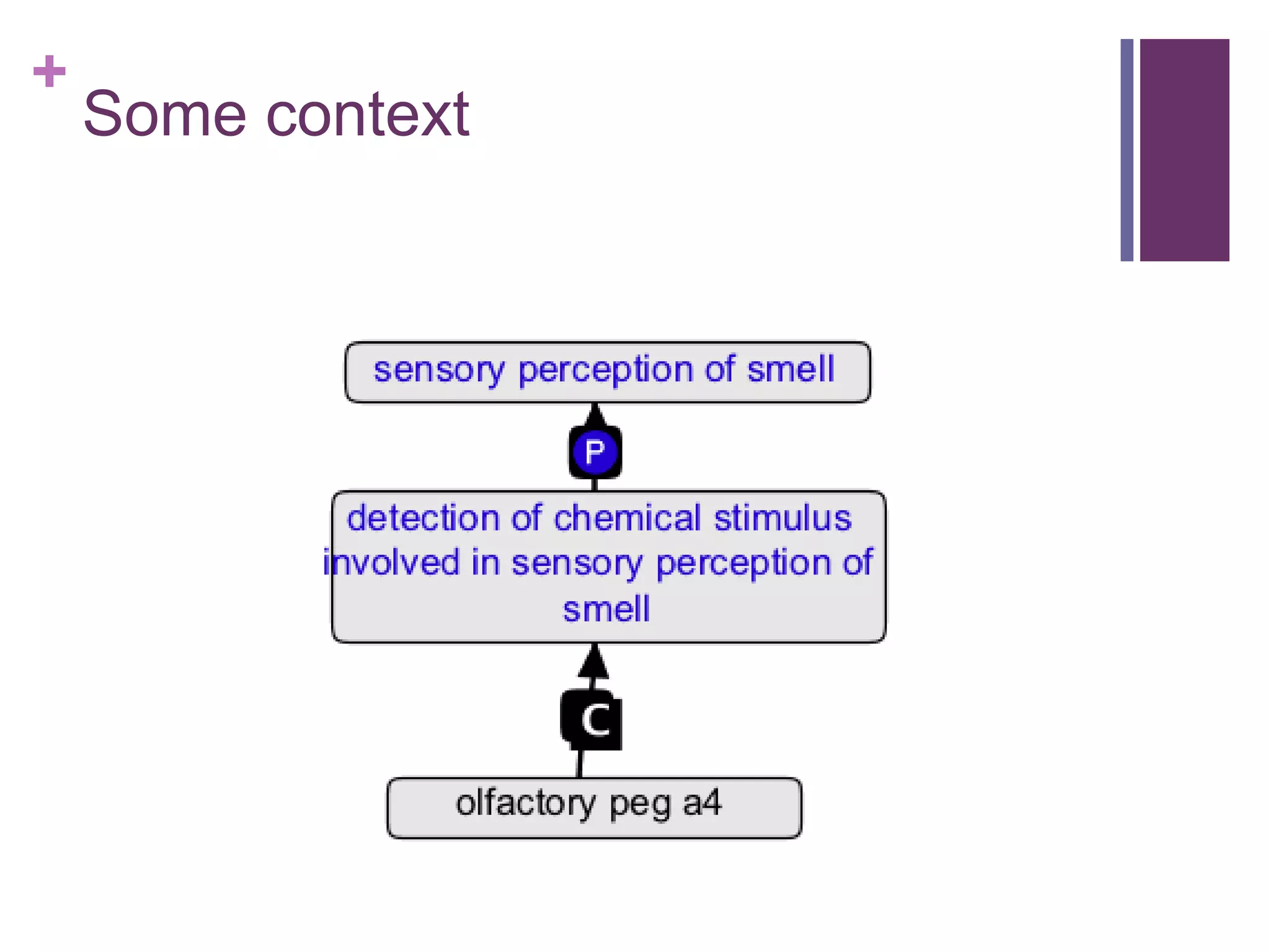
    Some context
+
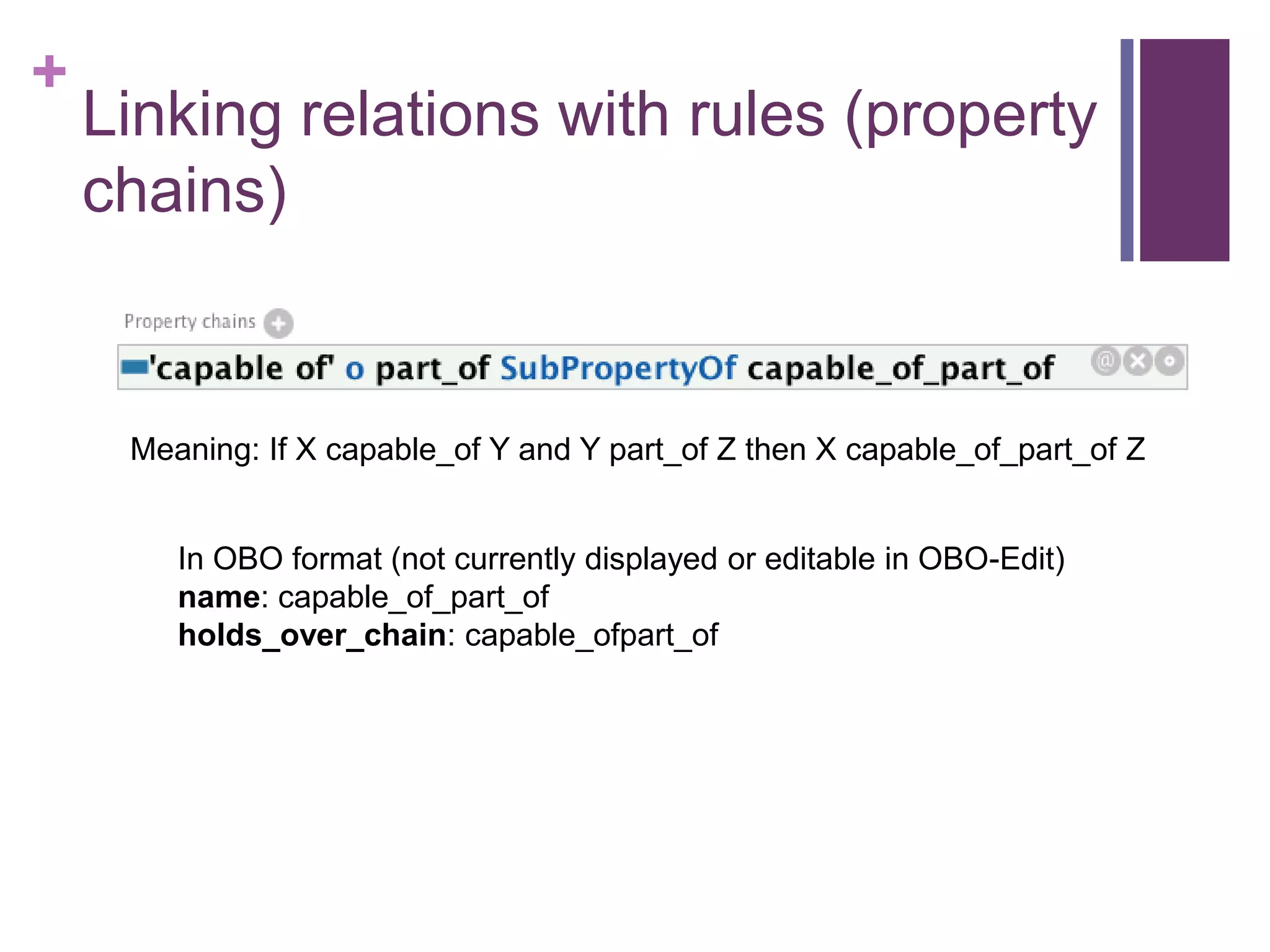
    Linking relations with rules (property
    chains)


     Meaning: If X capable_of Y and Y part_of Z then X capable_of_part_of Z


        In OBO format (not currently displayed or editable in OBO-Edit)
        name: capable_of_part_of
        holds_over_chain: capable_ofpart_of
+
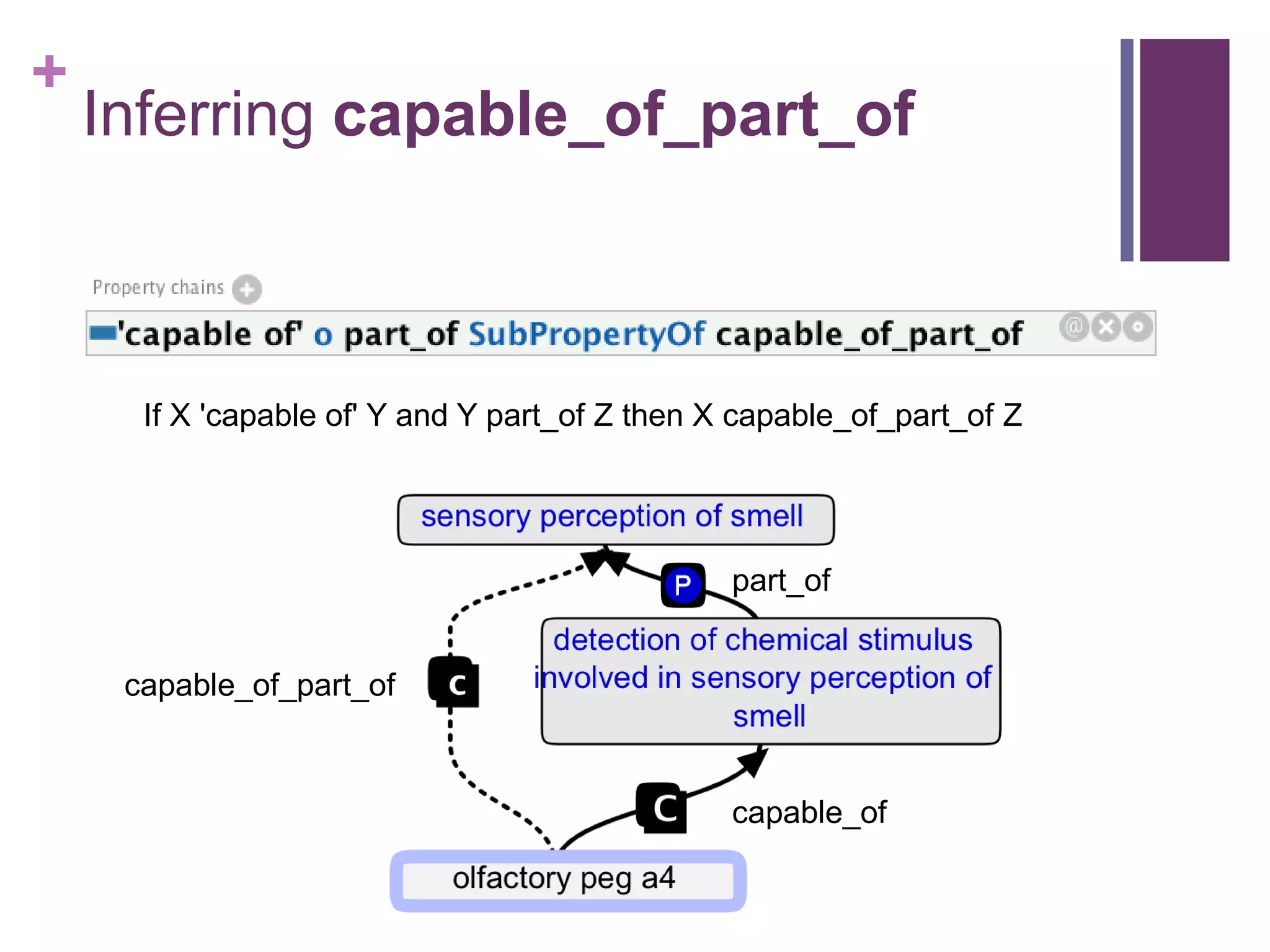
    Inferring capable_of_part_of


      If X 'capable of' Y and Y part_of Z then X capable_of_part_of Z


                                                part_of


     capable_of_part_of


                                                capable_of
+
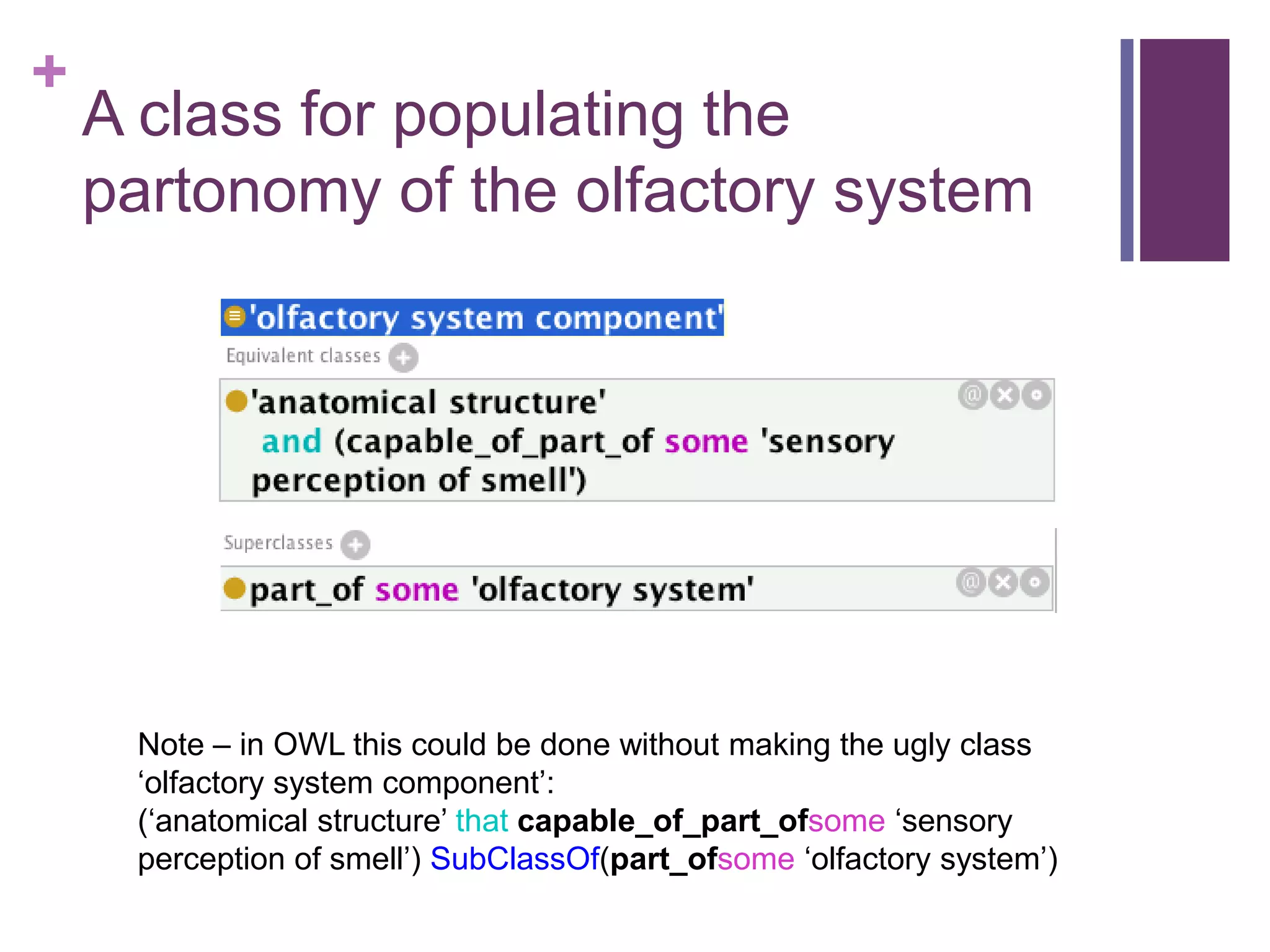
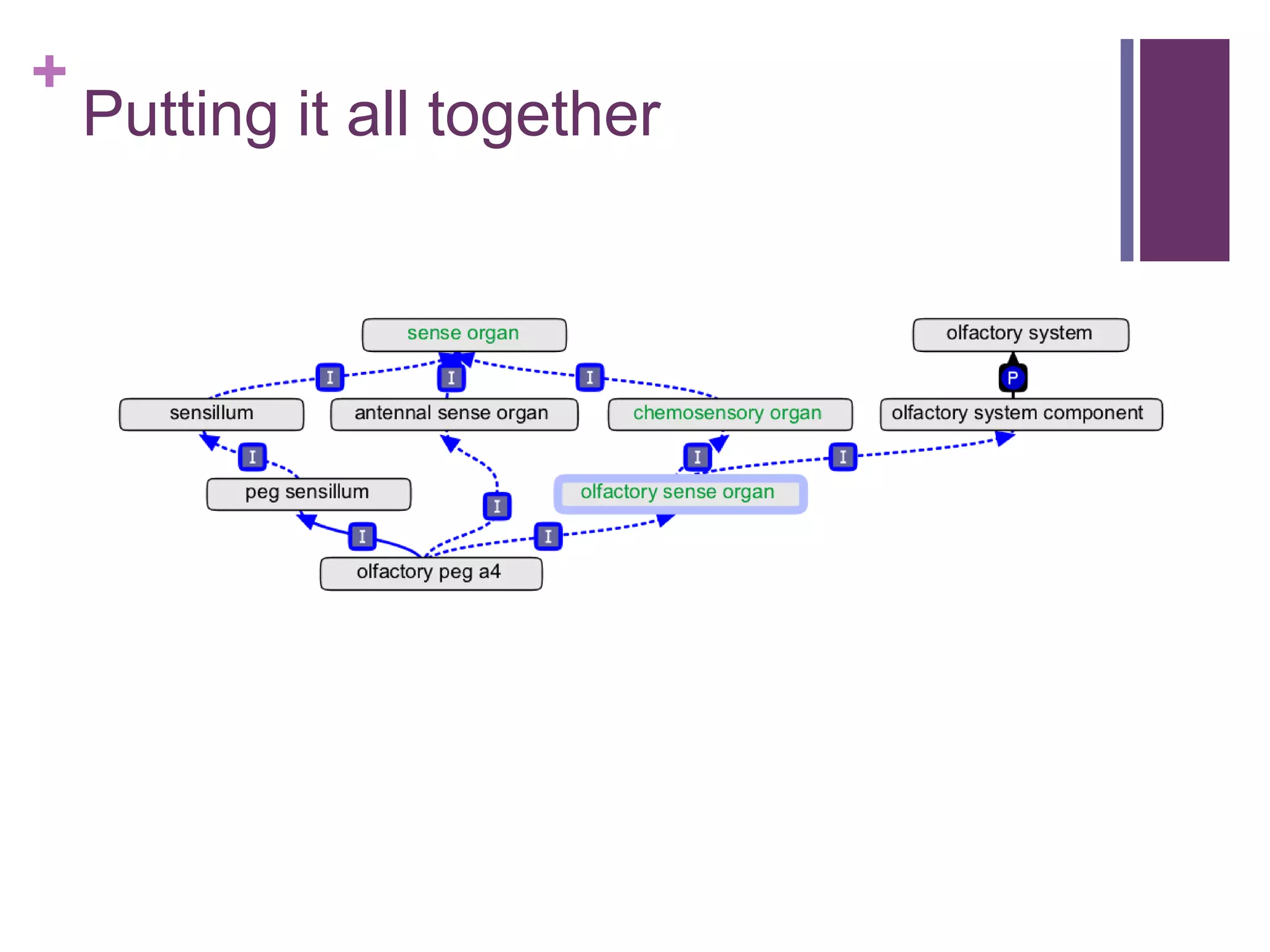
    A class for populating the
    partonomy of the olfactory system


     Note – in OWL this could be done without making the ugly class
     „olfactory system component‟:
     („anatomical structure‟ that capable_of_part_ofsome „sensory
     perception of smell‟) SubClassOf(part_ofsome „olfactory system‟)
+
+
    Putting it all together
+
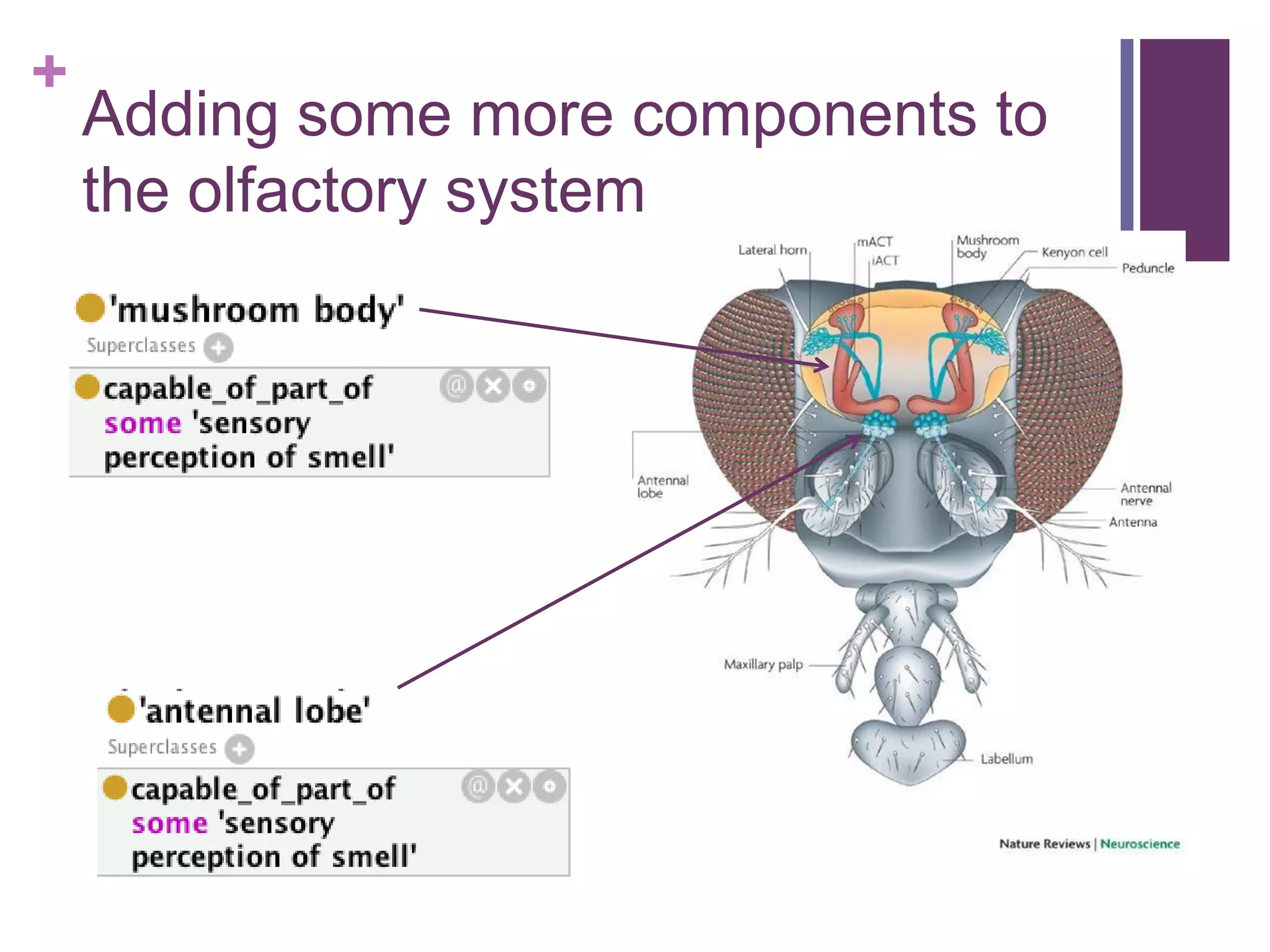
    Adding some more components to
    the olfactory system
+
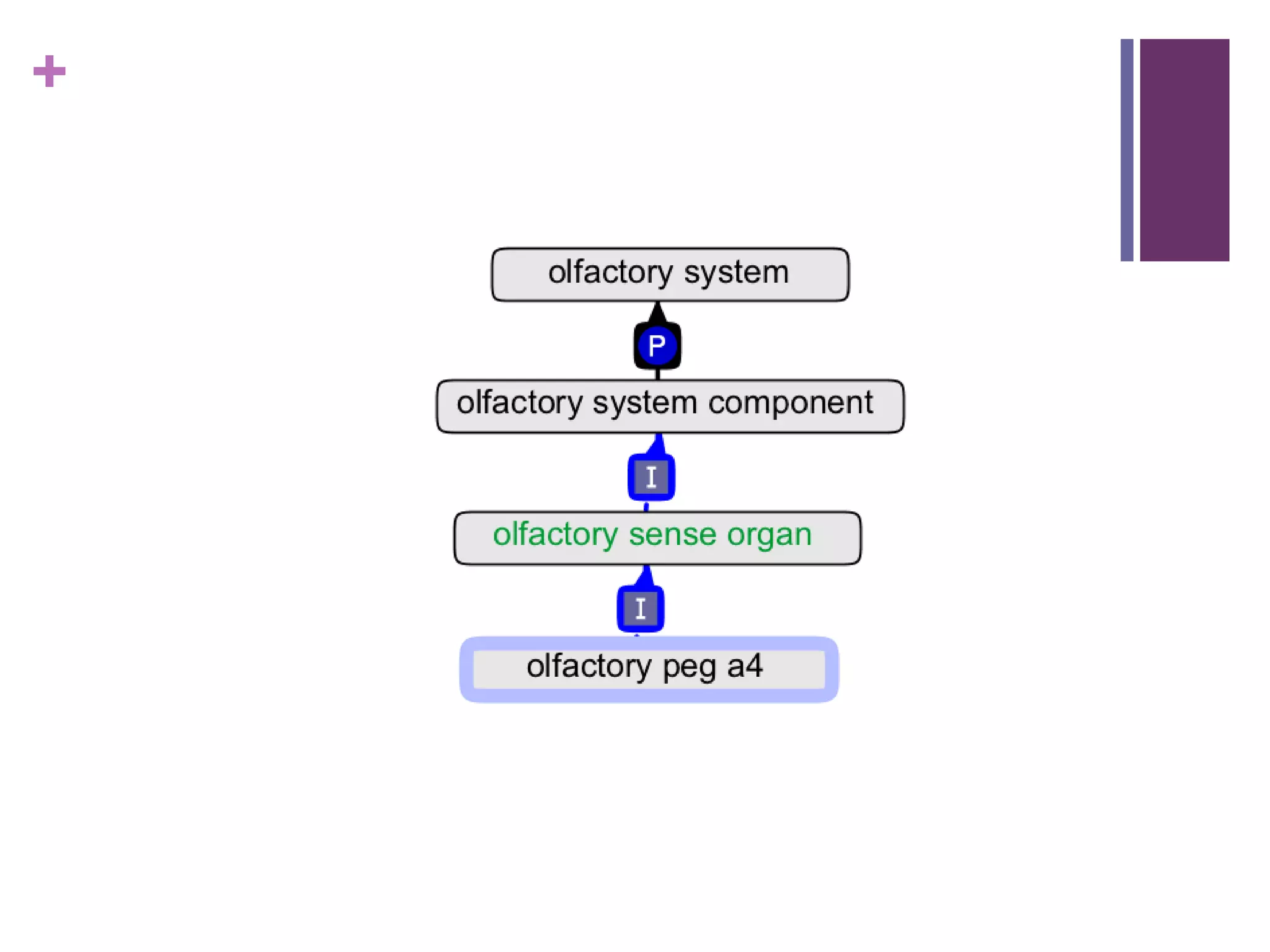
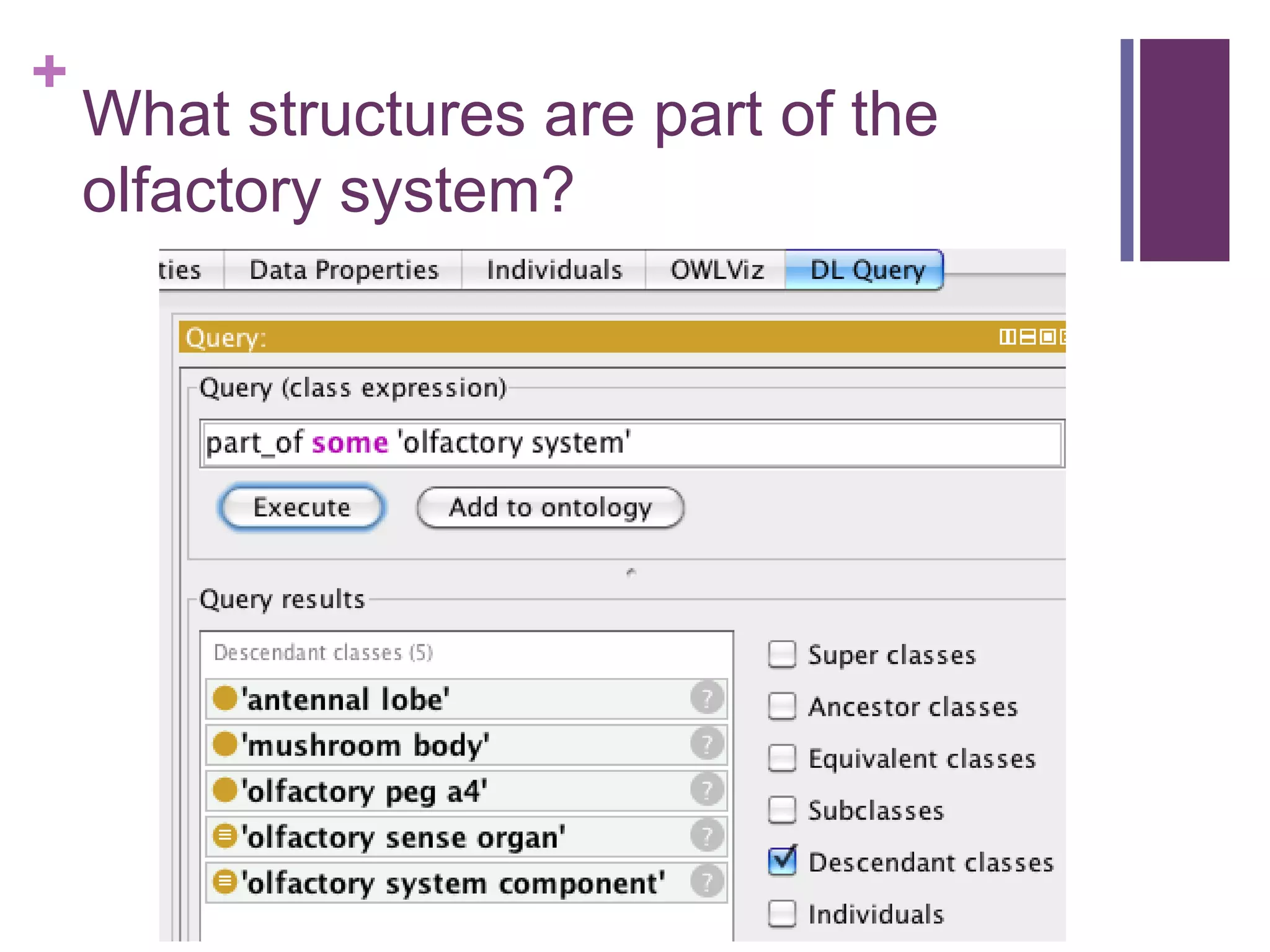
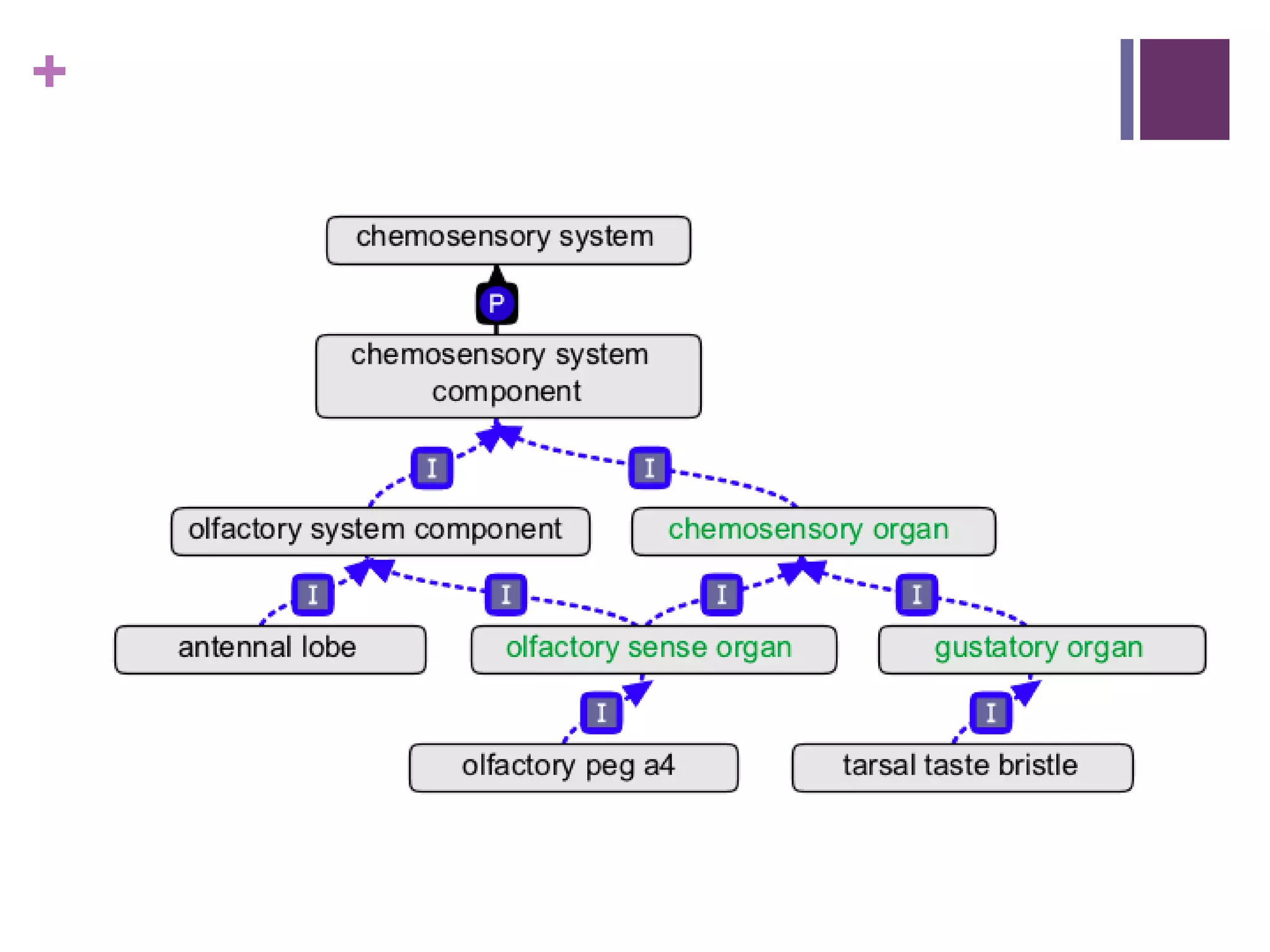
    What structures are part of the
    olfactory system?
+
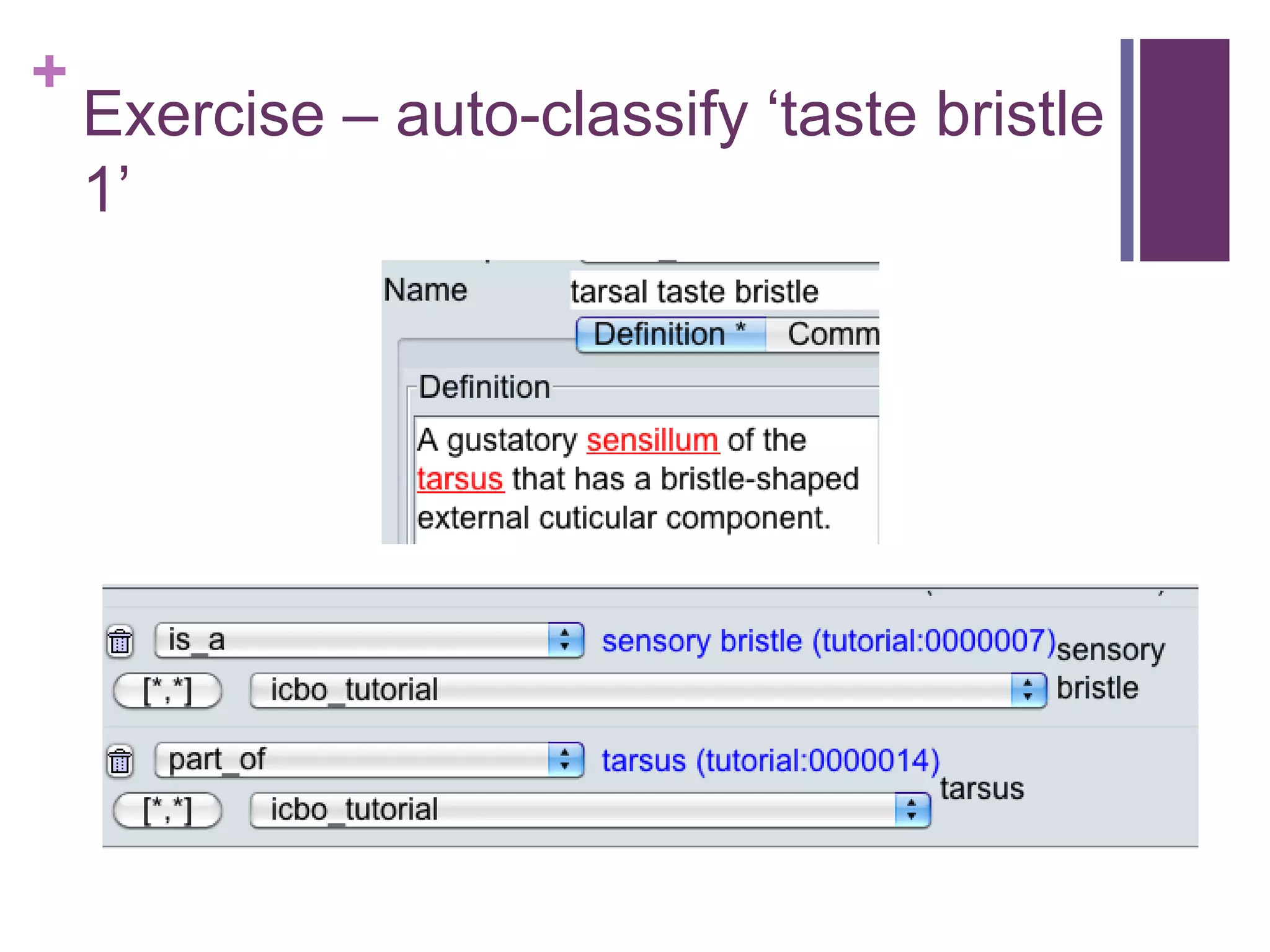
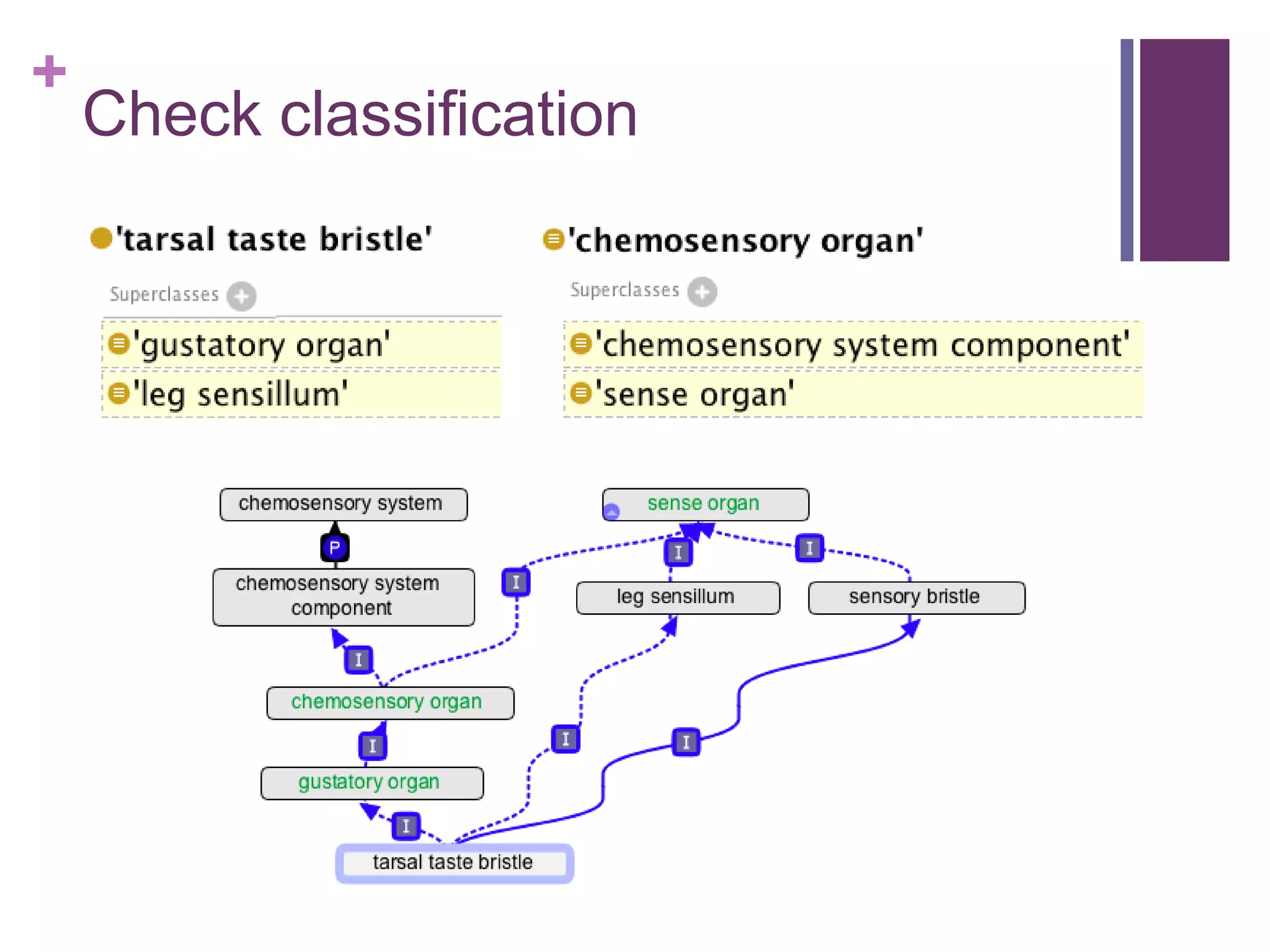
    Exercise – auto-classify „taste bristle
    1‟
+
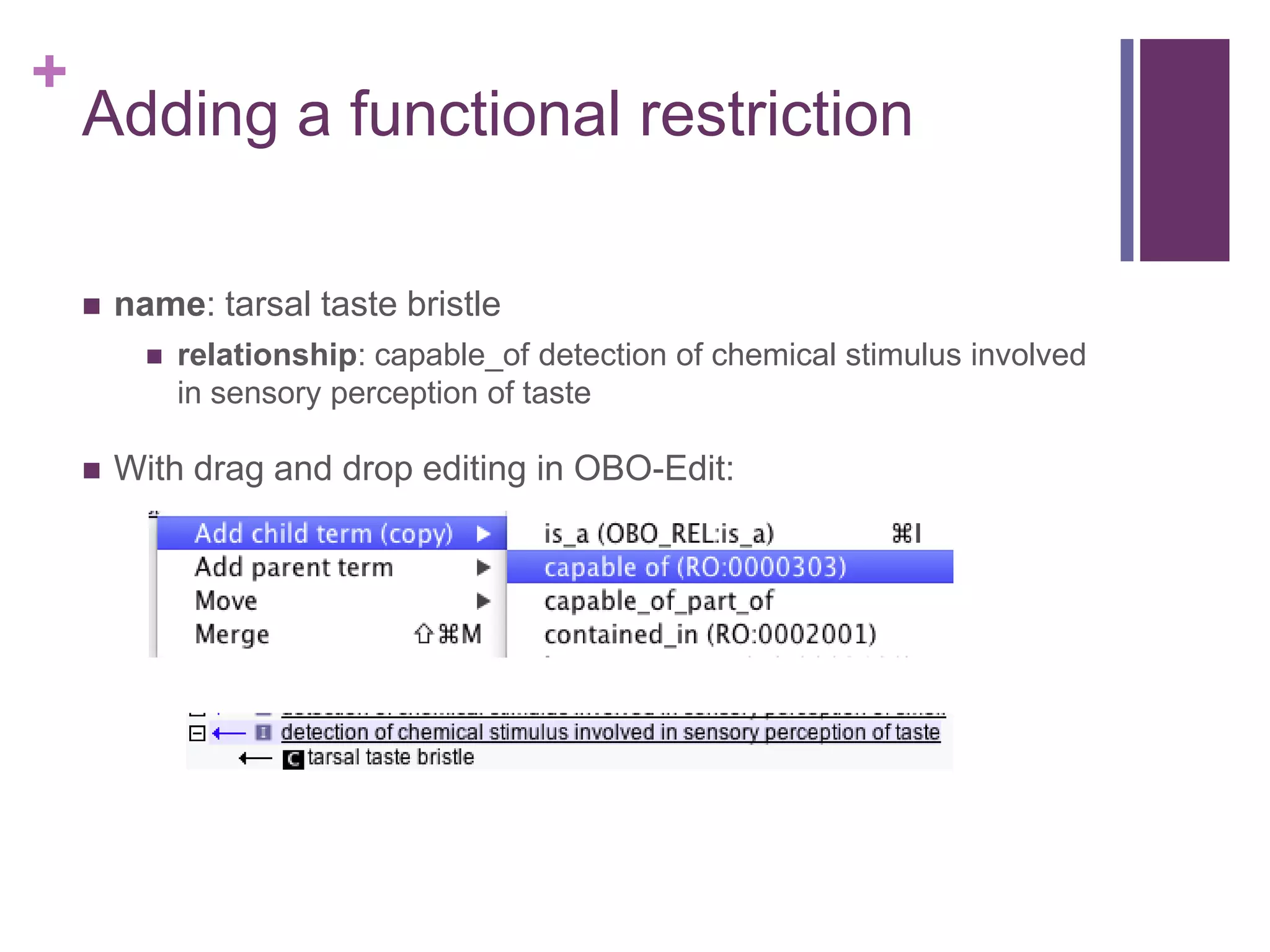
    Adding a functional restriction

       name: tarsal taste bristle
             relationship: capable_of detection of chemical stimulus involved
              in sensory perception of taste

       With drag and drop editing in OBO-Edit:
+
    Make new class – leg sensillum
+

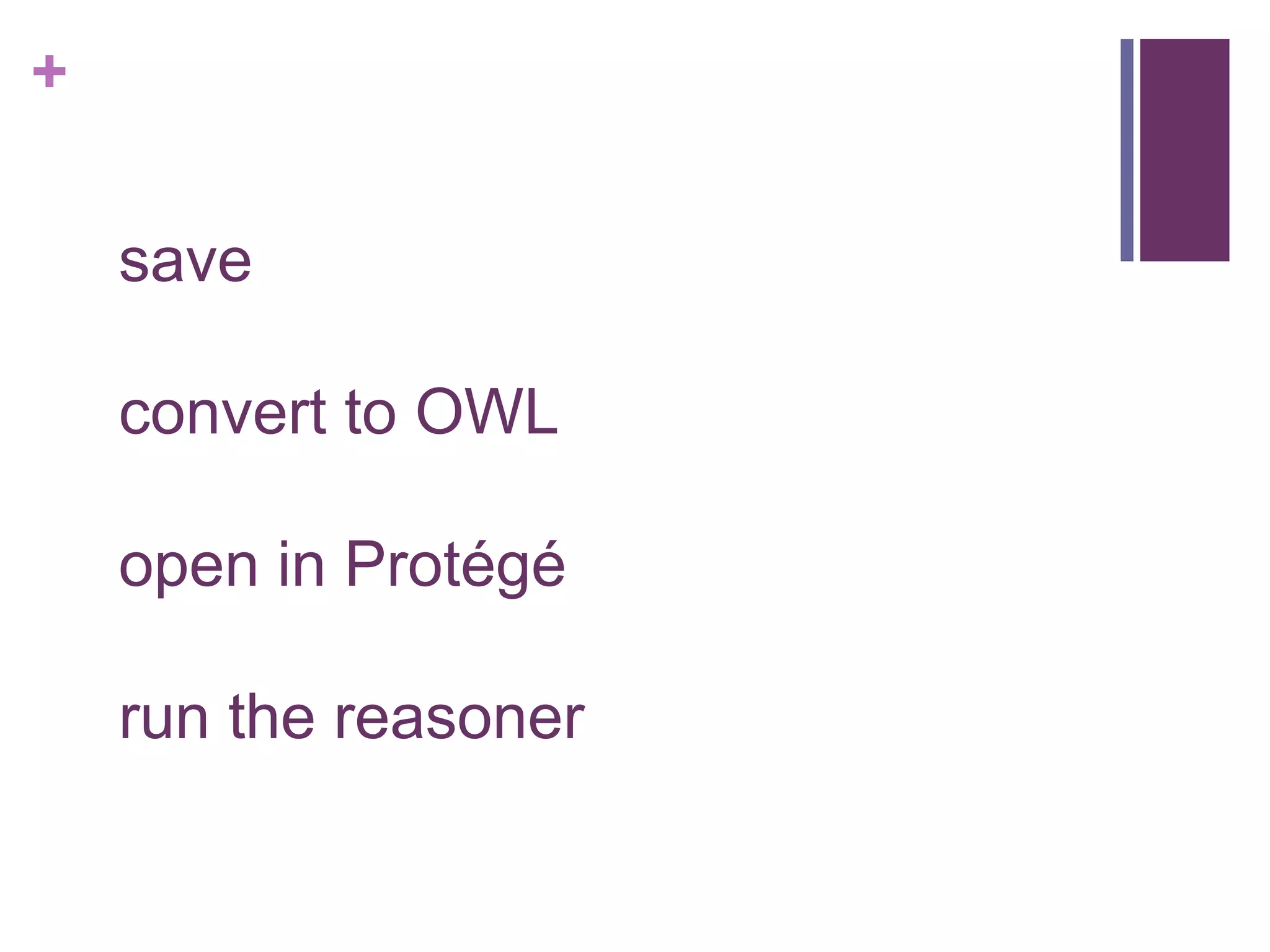
    save

    convert to OWL

    open in Protégé

    run the reasoner
+


    Quick live demo
+
    Check classification
+
+
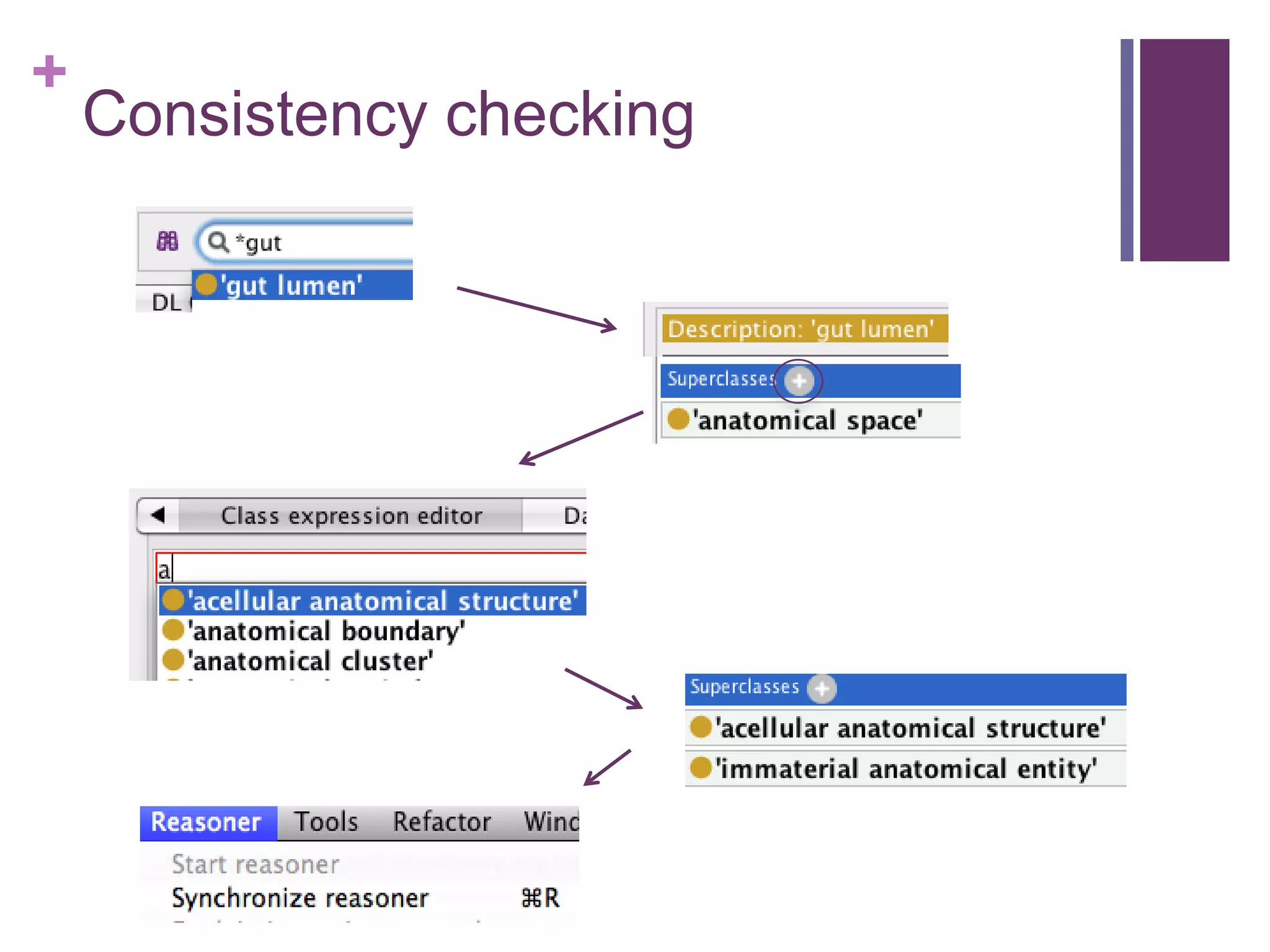
    Consistency checking
+
    Checking for inconsistency
+
    Checking for inconsistency

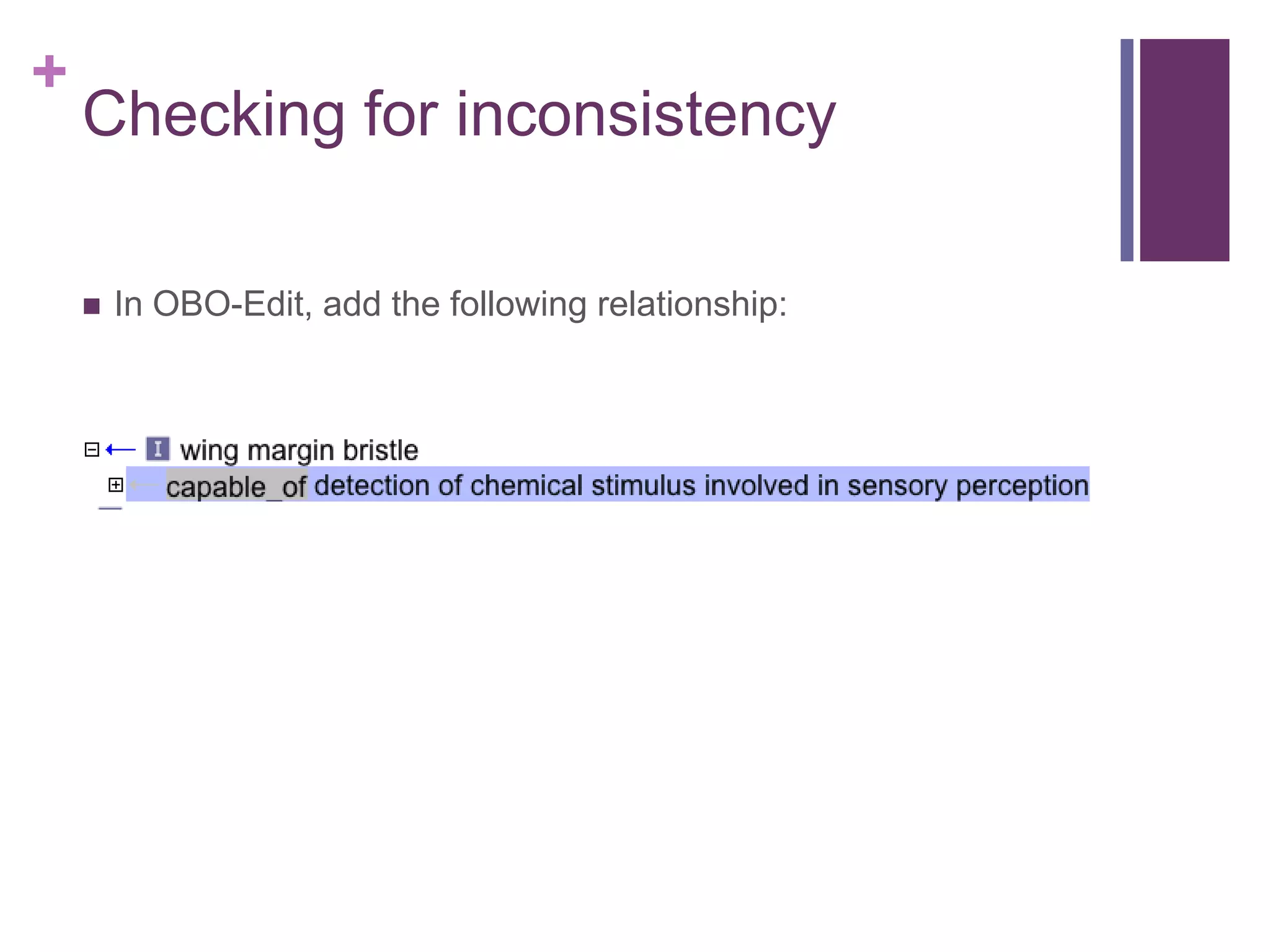
       In OBO-Edit, add the following relationship:
+

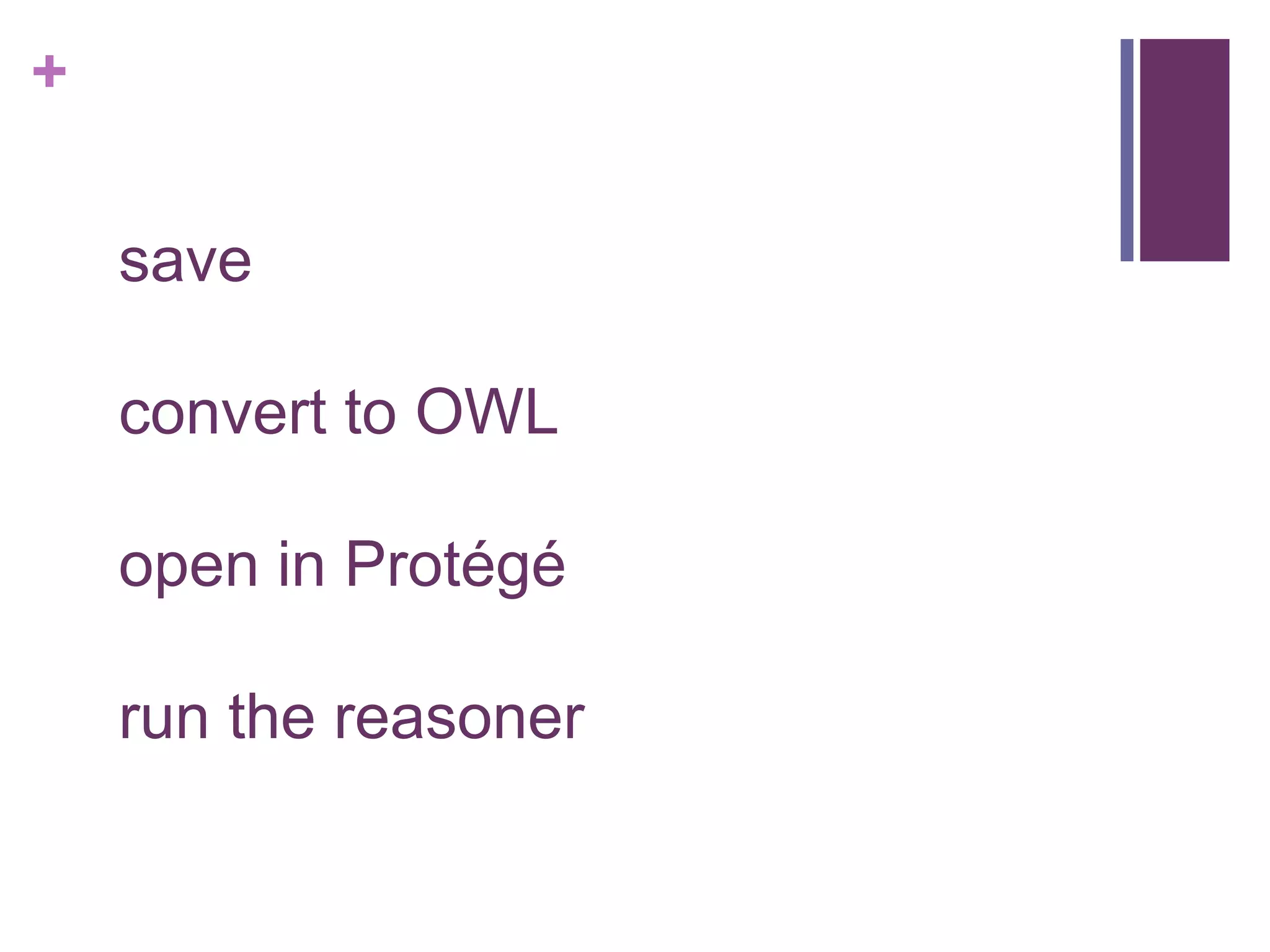
    save

    convert to OWL

    open in Protégé

    run the reasoner
+
    Checking for inconsistency


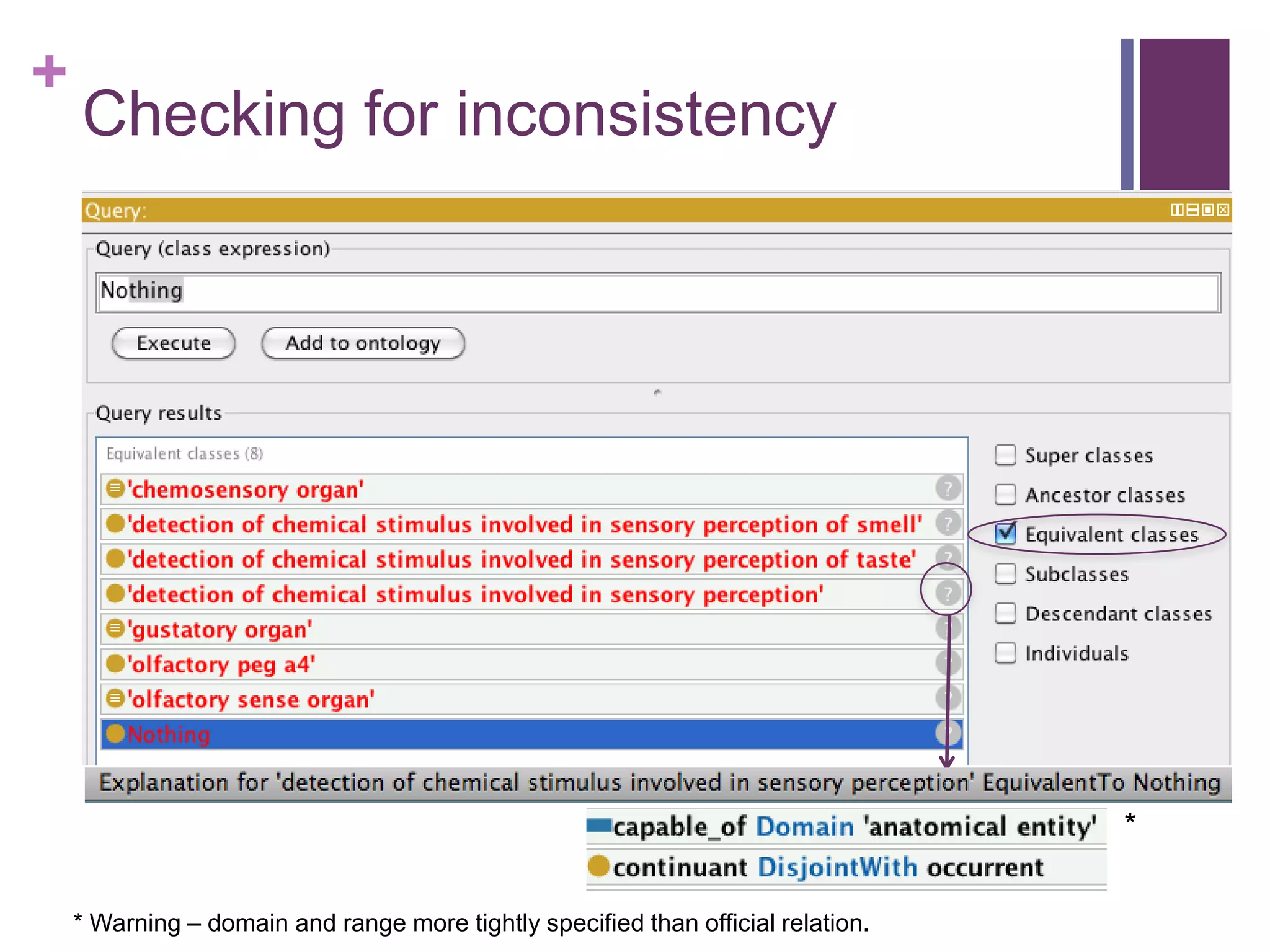
                                                                                  *


    * Warning – domain and range more tightly specified than official relation.
+
    Release manager

       Over to Chris - using OWL (behind the scenes) to make a pre-
        reasoned release.
+
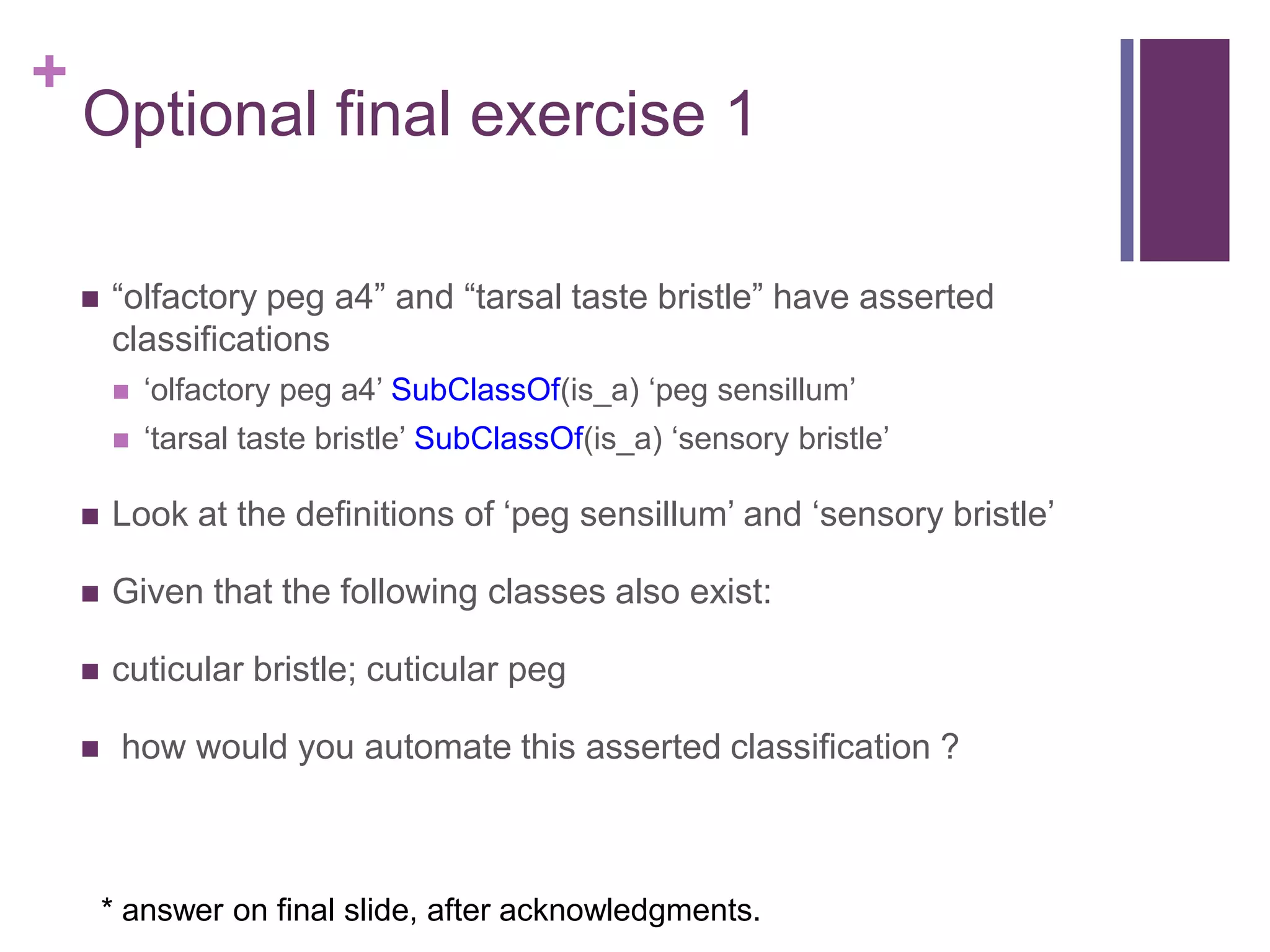
    Optional final exercise 1

       “olfactory peg a4” and “tarsal taste bristle” have asserted
        classifications
           „olfactory peg a4‟ SubClassOf(is_a) „peg sensillum‟
           „tarsal taste bristle‟ SubClassOf(is_a) „sensory bristle‟

       Look at the definitions of „peg sensillum‟ and „sensory bristle‟

       Given that the following classes also exist:

       cuticular bristle; cuticular peg

        how would you automate this asserted classification ?


        * answer on final slide, after acknowledgments.
+
    Optional final exercise 2

       Try adding some terms from your own anatomy ontology, using
        CARO2 to classify, and perhaps auto-classifying with
        FUNCARO.
+
    Acknowledgments

       Michael Ashburner; Suzi Lewis

       OBO converter and Oort developers:
           ShahidManzoor
           HeikoDeitze

       OBO-Edit developers
           Current: Chris Mungall; Nomi Harris
           Former: Amina Abdulla; John Day-Richter

       Discussion and comments:
           Alan Ruttenberg; Melissa Haendel; Terry Meehan
+
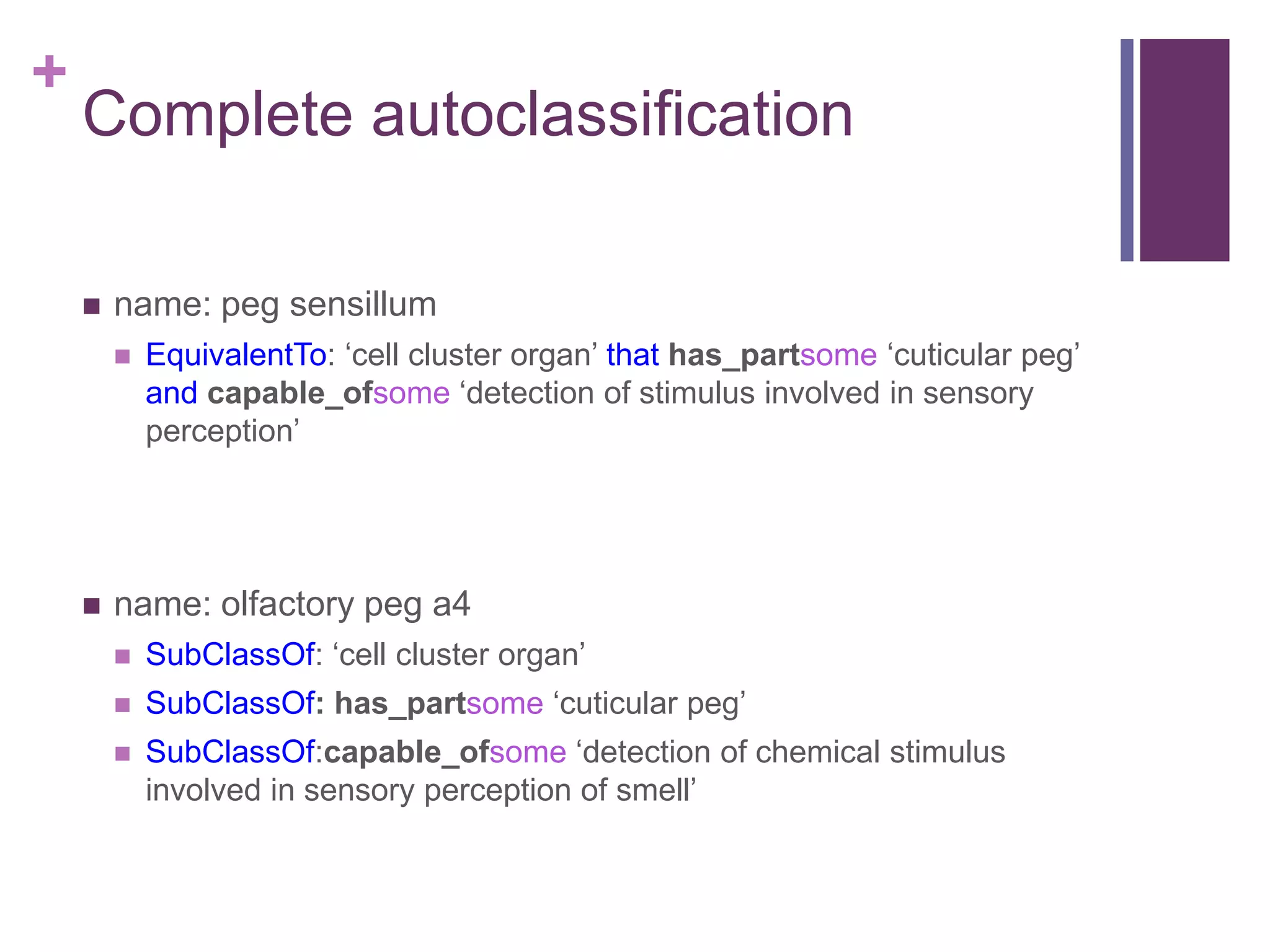
    Complete autoclassification

       name: peg sensillum
           EquivalentTo: „cell cluster organ‟ that has_partsome „cuticular peg‟
            and capable_ofsome „detection of stimulus involved in sensory
            perception‟


       name: olfactory peg a4
           SubClassOf: „cell cluster organ‟
           SubClassOf: has_partsome „cuticular peg‟
           SubClassOf:capable_ofsome „detection of chemical stimulus
            involved in sensory perception of smell‟

From OBO to OWL and back - building scalable ontologies

  • 1.
    + From OBO to OWL and back again – a tutorial David Osumi-Sutherland, Virtual Fly Brain/FlyBase Chris Mungall – GO/LBL
  • 2.
    +  Links to software downloads and tutorial ontology can be found here:  http://www.bioontology.org/wiki/index.php?title=From_OBO_t o_OWL_and_back  Pleasenote that the tutorial ontology has been designed for teaching purposes and should NOT be used as a reference for classes or relations.
  • 3.
    + I use OBO, why should I care about OWL?  OWL 2 is a W3C standard with a large and growing ecosystem of developers.  Using OWL ontologies in Protégé 4 you can use fast reasoners to:  Query your ontology  This could be the basis for sophisticated queries on your website  Quickly find mistakes  Automate classification  Non-lossy round tripping from OBO to OWL and back is now easy  continue developing in OBO while taking advantage of OWL and Protégé for reasoning  This may be a first step to developing in OWL/Protégé
  • 4.
    + Oort  OBO ontology release tool:  Starting from ontology requiring a reasoner, uses OWL reasoning to:  Roll OBO file that needs no reasoner – supporting current users.  Automatically make slims
  • 5.
    + Intro to ontology building  An ontology is a classification  There are lots of useful ways to classify stuff  Maintaining multiple classification schemes by hand is impractical  So automate what you can  Everybody makes mistakes  So get the computer to find errors for you  Re-use other people’s work where possible  import class hierarchies  use common patterns
  • 6.
    + Reasoning in Protégé 4.1 with the Drosophila anatomy ontology Live demo of www.virtualflybrain.org and underlying queries
  • 7.
    + What is an ontology ?  A set of defined, inter-related terms to use in annotation/metadata/knowledge bases.  A classification  A query-able store of (scientific) knowledge that uses logical inference.
  • 8.
    + What is an ontology ?  A set of defined, inter-related terms to use in annotation/metadata/knowledge bases. depends on  A classification depends on depends on  A query-able store of (scientific) knowledge that uses logical inference.
  • 9.
    + What (use) is an ontology?  A set of defined, inter-related terms to use in annotation.  Relationsbetween terms allow annotations to be grouped in scientifically meaningful ways  requires an ontology to be an accurate and scientifically meaningful classification and store of scientific knowledge.
  • 10.
    + What is an ontology ?  A classification  There are lots of scientifically useful ways to classify a bit of anatomy.  its parts and their arrangement  its relation to other structures  what is it: part of; connected to; adjacent to, overlapping?  its shape  its function  its developmental origins  its species or clade  its evolutionary history?
  • 11.
    + What is an ontology ?  The scientific knowledge an ontology contains can make the reasons for classification explicit.  e.g.  Any sense organ that functions in the detection of smell is an olfactory sense organ  All large basiconicsensilla of the antenna function in detection of smell  Therefore all large basiconicsensilla of the antenna are are olfactory sense organs
  • 12.
    + What is an (OBO-foundry) ontology ?  An ontology contains terms  Terms refer to (denote) types (classes)  Types are classifications of things (instances) in the real world, based on some set of criteria.  My left hand is an instance of the type hand  The criteria for class membership is recorded using textual definitions, at least some elements of which are formalized as relationships.  name: hand  def: “An anatomical structure that has four fingers and a thumb and is attached to the end of an arm.” [reference: DOS]  relationship: hand has_part finger  relationship: hand has_part thumb  relationship: part_of arm Image from Gray’s Anatomy (copyright expired)
  • 13.
    + OBO-OWL cheat sheet: classification  OWL Manchester Syntax  Protégé  antenna SubClassOf appendage  OBO format :  OBO-Edit:  name: antenna  is_a: appendage
  • 14.
    + class – class relationships are quantified  Class:Class relationships are many to many  Does the relation apply to all or just some of the class ?  we specify this with quantifiers:  ∀: for all, all, only, every  ∃: there exists, some
  • 15.
    + relationships specify necessary conditions for class membership  Being part of an insect thorax is a necessary condition of being in the class „insect leg‟  OBO (quantifiers hidden)  name: insect leg  relationship: part_ofthorax  OWL (MS):  „insect wing‟ SubClassOfpart_ofsome thorax
  • 16.
    + relationships specify necessary conditions for class membership  Being part of an insect thorax is a necessary condition of being in the class „insect leg‟  OWL (MS):  „insect wing‟ SubClassOfpart_ofsome thorax  the class of insect wings is a subclass of all the class of all things that are part of a thorax.
  • 17.
    + OBO-OWL cheat sheet: necessary conditions for class membership  OWL Manchester Syntax  Protégé  antenna SubClassOf part_ofsome head  OBO format :  OBO-Edit:  name: antenna  relationship: part_of head
  • 18.
    + Directionality and quantifiers  True: all „insect wing‟ part_ofsome „insect thorax‟  False: all „insect thorax‟ has_partsome „insect wing‟  True: all „claw‟ connected_tosome ‘tarsal segment‟  False: all „tarsal segment‟ connected_tosome claw
  • 19.
    + Manually maintaining an ontology with multiple classification schemes is impractical • It is difficult to keep track of multiple classification chains to: •ensure completeness; • avoid redundancy; • avoid introducing error due to inheritance of classification criteria from a distant ancestor
  • 20.
    + Automating multiple classification.  The scientific knowledge an ontology contains can make the reasons for classification explicit.  e.g.  Any sense organ that functions in the detection of smell is an olfactory sense organ  All large basiconicsensilla of the antenna function in detection of smell  Therefore all large basiconicsensilla of the antenna are are olfactory sense organs
  • 21.
    + Automating multiple classification.  We can specify that some set of necessary conditions for class membership are sufficient to determine class membership  English  Any sense organ that functions in the detection of smell is an olfactory sense organ  OWL (MS):  olfactory sense organ‟ EquivalentTo: sense organ that capable_ofsome „detection of chemical stimulus involved in sensory perception of smell‟  OBO  name: olfactory sense organ  intersection_of: sense organ  intersection_of: capable_of „detection of chemical stimulus involved in sensory perception of smell‟
  • 22.
    + OBO-OWL cheat sheet: necessary and sufficient conditions for class membership  OWL Manchester Syntax  Protégé  antennal sense organ EquivalentTo„sense organ‟ that part_ofsome antenna  (that / and are interchangable in MS)  OBO format :  OBO-Edit:  name: antennal sense organ  intersection_of: sense organ  intersection_of: part_of antenna
  • 23.
    + ERROR MESSAGES ARE YOUR FRIENDS! – They tell you you‟ve screwed up before you get embarrassing emails complaining that you‟ve screwed up  Some classes don‟t overlap:  Nothing is both a space and an object with mass  Nothing is a both a muscle and a blood vessel  Nothing is both a smell and a nose  Some relations only apply between particular classes:  A nose is capable of smelling ✔  A smelling is capable of a nose ✗
  • 24.
    + ERROR MESSAGES ARE YOUR FRIENDS! – They tell you you‟ve screwed up before you get embarrassing emails complaining that you‟ve screwed up  Some classes don‟t overlap. OWL DisjointWithOBO: disjoint_from  Nothing is both a space and an object with mass  anatomical space DisjointWithanatomical structure  „lumen of gut‟ SubClassOf „anatomical structure‟ ✗  Nothing is a both a muscle and a blood vessel  muscle DisjointWithblood vessel  bicep SubClassOf aorta ✗  Nothing is both a smelling and a nose  process DisjointWithobject  smelling* SubClassOf nose ✗
  • 25.
    + ERROR MESSAGES ARE YOUR FRIENDS! – They tell you you‟ve screwed up before you get embarrassing emails complaining that you‟ve screwed up  Some relations only apply between particular classes.  We can record this using domain*and range*:  capable_of relates objects to processes  capable_ofdomain: object  capable_ofrange: process  Combining these with disjoint declarations => error checking  process DisjointWithobject; nose SubClassOfObject; smelling SubClassOfprocess  nose capable_of smelling ✔  smelling capable_of nose ✗ * Same in OBO and OWL
  • 26.
    + Quick guide to OBO-Edit
  • 27.
    + Basic OBO-Edit2 editing setup  - 2 x Ontology Tree Editor (OTE)  - One parent editor  - One text editor  - One search panel  - One reasoner manager
  • 28.
  • 29.
  • 30.
    + Browsing -Trees The ontology tree editor is a good way to browse down the ontology graph, but not all are parents visible in one view Click to expand or contract branch
  • 31.
    + Browsing -parents The parent editor provides a quick way to check all parental relationships – usually these are not all visible in a single tree view
  • 32.
    + Browsing -Graph Editor WARNING:– GRAPH EDITOR CAN CAUSE CRASHES. SAVE YOUR WORK !
  • 33.
    + Browsing -Graph Editor Hide parent terms show parent terms Hide child terms show child terms hide term  Right click provides editing options and hide-all  Choosing quick filtering => manageable view
  • 34.
    + Basic Searching- single leg
  • 35.
    + The ontologytree editor menu  Right clicking on the ontology tree editor prompts an extensive editing menu:
  • 36.
    + Global vslocal selection modes local mode -selection in other components doesn‟t affect selection here global mode - 2 way auto sync with other components
  • 37.
    + Drag anddrop term move –changes classification or necessary conditions for class membership
  • 38.
    + Drag anddrop term move
  • 39.
    + Making new cross product terms  Add a new root class:
  • 40.
    + Very Quick Guide to Protégé
  • 41.
    + Running a reasoner
  • 42.
    + Searching for terms Use wild-card (*) before a search string to search in term
  • 43.
    + Class tree +/- inference Easily check what classification is asserted Easily check that inferred classification is what you intend
  • 44.
    + Inferred classification
  • 45.
    + DL Query Tab Use to check inference is correct and complete
  • 46.
    + Editing in Protégé Add (annotation, superclass, equivalent class etc) Annotate; Delete; Edit Add child; Add sibling; Delete
  • 47.
    + Editing in Protégé  Class expression editor  Type DL expressions.  Autocomplete names with tab  quote names with spaces
  • 48.
    + OBO-OWL cheat sheet: classification  OWL Manchester Syntax  Protégé  antenna SubClassOf appendage  OBO format :  OBO-Edit:  name: antenna  is_a: appendage
  • 49.
    + OBO-OWL cheat sheet: necessary conditions for class membership  OWL Manchester Syntax  Protégé  antenna SubClassOf part_ofsome head  OBO format :  OBO-Edit:  name: antenna  relationship: part_of head
  • 50.
    + OBO-OWL cheat sheet: necessary and sufficient conditions for class membership  OWL Manchester Syntax  Protégé  antennal sense organ EquivalentTo„sense organ‟ that part_ofsome antenna  (that / and are interchangable in MS)  OBO format :  OBO-Edit:  name: antennal sense organ  intersection_of: sense organ  intersection_of: part_of antenna
  • 51.
    + OBO-OWL cheat sheet: relations / Object Properties  OWL  Protégé  object property  OBO  relation  OBO-Edit:  OBO format  Typedef
  • 52.
    + Introducing the tutorial ontology  Upper level classes  Basic Formal ontology – general abstract classes: process; object; quality  CARO 2.0 (draft) – abstract classes for anatomy (anatomical space; cell; acellularstucture…)  FUNCARO – Functional classifications using GO  Imported differentia  GO terms – imported for recording function  PATO terms – imported for recording qualities  tutorial: some specific insect anatomical classes
  • 53.
    + Exercise 1 – Tracing multiple classification of single sense organ Please open: OBO format converter OBO-Edit with tutorial.obo open Protégé 4.1
  • 54.
    + OBO Format Converter Convert tutorial.obo to tutorial.owl
  • 55.
    + Quick live demo
  • 56.
    + tutorial.owl in Protégé  Open tutorial.owl in Protégé.  Run reasoner  search for „pedicel‟
  • 57.
    + Auto-classification on partonomy
  • 58.
    + Multiple classification of single sense organ  Start search with wild card (*)
  • 59.
    + Asserting a classification Protégé 4.1 OBO-Edit 2.1
  • 60.
    + Adding some necessary conditions for class membership * * Strictly speaking, this is a useful fudge, but strict translation of capable_of from OBO to OWL is beyond the scope of this tutorial
  • 61.
    + Some classification - OBO-Edit graph editor view CARO terms ; tutorial terms GO terms
  • 62.
    + Some necessaryand sufficient definitions
  • 63.
    + Auto-classification -OBO-Edit graph editor view GO terms FUNCARO terms = capable_of
  • 64.
    + Autoclassification using partonomy
  • 65.
    + Auto-classification
  • 66.
    + Some context
  • 67.
    + Linking relations with rules (property chains) Meaning: If X capable_of Y and Y part_of Z then X capable_of_part_of Z In OBO format (not currently displayed or editable in OBO-Edit) name: capable_of_part_of holds_over_chain: capable_ofpart_of
  • 68.
    + Inferring capable_of_part_of If X 'capable of' Y and Y part_of Z then X capable_of_part_of Z part_of capable_of_part_of capable_of
  • 69.
    + A class for populating the partonomy of the olfactory system Note – in OWL this could be done without making the ugly class „olfactory system component‟: („anatomical structure‟ that capable_of_part_ofsome „sensory perception of smell‟) SubClassOf(part_ofsome „olfactory system‟)
  • 70.
  • 71.
    + Putting it all together
  • 72.
    + Adding some more components to the olfactory system
  • 73.
    + What structures are part of the olfactory system?
  • 74.
    + Exercise – auto-classify „taste bristle 1‟
  • 75.
    + Adding a functional restriction  name: tarsal taste bristle  relationship: capable_of detection of chemical stimulus involved in sensory perception of taste  With drag and drop editing in OBO-Edit:
  • 76.
    + Make new class – leg sensillum
  • 77.
    + save convert to OWL open in Protégé run the reasoner
  • 78.
    + Quick live demo
  • 79.
    + Check classification
  • 80.
  • 81.
    + Consistency checking
  • 82.
    + Checking for inconsistency
  • 83.
    + Checking for inconsistency  In OBO-Edit, add the following relationship:
  • 84.
    + save convert to OWL open in Protégé run the reasoner
  • 85.
    + Checking for inconsistency * * Warning – domain and range more tightly specified than official relation.
  • 86.
    + Release manager  Over to Chris - using OWL (behind the scenes) to make a pre- reasoned release.
  • 87.
    + Optional final exercise 1  “olfactory peg a4” and “tarsal taste bristle” have asserted classifications  „olfactory peg a4‟ SubClassOf(is_a) „peg sensillum‟  „tarsal taste bristle‟ SubClassOf(is_a) „sensory bristle‟  Look at the definitions of „peg sensillum‟ and „sensory bristle‟  Given that the following classes also exist:  cuticular bristle; cuticular peg  how would you automate this asserted classification ? * answer on final slide, after acknowledgments.
  • 88.
    + Optional final exercise 2  Try adding some terms from your own anatomy ontology, using CARO2 to classify, and perhaps auto-classifying with FUNCARO.
  • 89.
    + Acknowledgments  Michael Ashburner; Suzi Lewis  OBO converter and Oort developers:  ShahidManzoor  HeikoDeitze  OBO-Edit developers  Current: Chris Mungall; Nomi Harris  Former: Amina Abdulla; John Day-Richter  Discussion and comments:  Alan Ruttenberg; Melissa Haendel; Terry Meehan
  • 90.
    + Complete autoclassification  name: peg sensillum  EquivalentTo: „cell cluster organ‟ that has_partsome „cuticular peg‟ and capable_ofsome „detection of stimulus involved in sensory perception‟  name: olfactory peg a4  SubClassOf: „cell cluster organ‟  SubClassOf: has_partsome „cuticular peg‟  SubClassOf:capable_ofsome „detection of chemical stimulus involved in sensory perception of smell‟