Semantic Web Technologies:Changing Bibliographic Futures?
Stuart WeibelSenior Research ScientistOCLC ResearchDublin CoreWorking in SeattleCollaboration with UWNSF DataNet proposal    for curation of scientific    data
What’s this I hear about the Semantic Web?What is the Semantic Web?What does it have to do with bibliography?Does it make life better for patrons?Does it strengthen libraries?Is it practical?Where can we get some?
What is the Semantic Web?An approach to embedding structure in web resources to facilitate the extraction of meaning by machines and people.A set of technologiesRDF: Resource Description Framework (a metadata architecture for the Web)OWLSKOSLinked Data
Semantic Web Technologies:RDFRDFa syntax for making assertions on the webA structure to support inference by machinesRDF assertions are always expressed as triplesAn RDF assertion has a subject, a predicate, and and object:
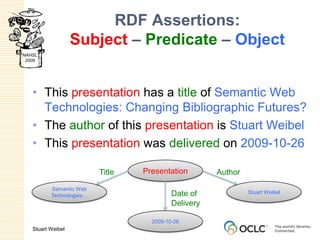
RDF Assertions:Subject – Predicate – ObjectThis presentation has a title of Semantic Web Technologies: Changing Bibliographic Futures?The author of this presentation is Stuart WeibelThis presentation was delivered on 2009-10-26PresentationTitleAuthorSemantic Web Technologies…Stuart WeibelDate of Delivery2009-10-26
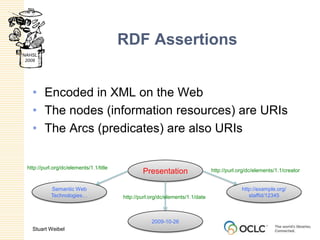
RDF AssertionsEncoded in XML on the WebThe nodes (information resources) are URIsThe Arcs (predicates) are also URIsPresentationhttp://purl.org/dc/elements/1.1/titlehttp://purl.org/dc/elements/1.1/creatorSemantic Web Technologies…http://example.org/staffid/12345http://purl.org/dc/elements/1.1/date2009-10-26
The only thing you need to know…RDF provides a web language for declaring relationships among information resourcesIt is a bit like sentence diagramming The important thing is to identify all the bits with globally unique, persistent Identifiers (URIs)
OWLWeb Ontology LanguageW3C standard for expressing ontology relationshipsOntologies are important tools for knowledge representationThe importance of knowledge representation diminishes rapidly as the scope of representation increasesStill largely undemonstrated general impact
SKOSSimple Knowledge Organization SystemW3C standards designed to support the declaration of controlled vocabularies and classification systems using the idioms of the semantic web (RDF).SKOS is simpler than OWLLess expertise required to deploy structured terminologies
Linked DataWhat's all the fuss about?The web is all about links: Anything new here?A web of data versus a web of documentsPartly about granularity of resourcesAddressable assertions as opposed to addressable documentsPartly about doing inference on the webMaking machines do more of the work of interpreting data
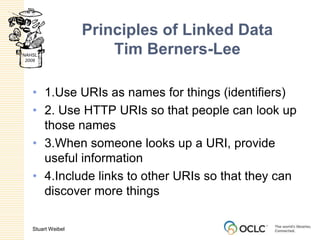
Principles of Linked DataTim Berners-Lee1.Use URIs as names for things (identifiers)2. Use HTTP URIs so that people can look up those names3.When someone looks up a URI, provide useful information4.Include links to other URIs so that they can discover more things
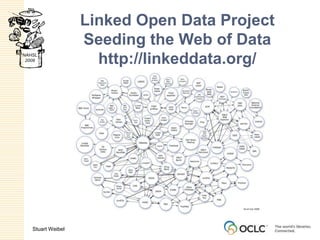
Linked Open Data ProjectSeeding the Web of Datahttp://linkeddata.org/
Linked Data and BibliographyLinked Data is a natural approach for bibliographic data:                                   Why?Because FRBR provides us with a coherent conceptual map of data about library assets
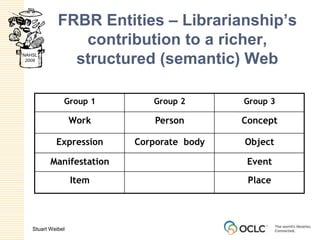
FRBR Entities – Librarianship’s contribution to a richer, structured (semantic) Web
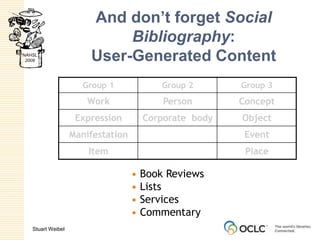
And don’t forget Social Bibliography:User-Generated Content  Book Reviews
 Lists
 Services
 CommentaryHook everything together with the right sort of identifiersA coherent identifier infrastructure is essential to establishing a rich and dynamic scaffolding of interconnected information resources to support “users and uses of bibliographic data”Broad dissemination of canonical, globally-scoped public identifiers serves the library collaborative and is the single most compelling means of making library assets visible on the Web
Some Design Parameters for Identifiers in theGlobal Library Community Canonical identification Branding Usability Granularity and the   FRBR model Persistence Universal accessibility Global scoping Search Engine    Optimization
PersistenceNot technological, but rather, a function of the commitment of organizations
Libraries and other cultural memory organizations do this well
Harder to do in the digital era, but the community is up to the taskUniversal access and global scopingOpen to all: public identifiers in a public Web
Should work in Myanmar, Melbourne, and Minneapolis alike
WorldCat is the first globally-scoped identifier architecture for library assets in which the global surrogate is mapped to locality
Holdings data turns out to be critical in supporting the last mile problemSearch Engine Optimization and Canonical IdentifiersVisibility of assets in the global library is diluted by the multiplicity of identifiersMany competing identifier schemesLocalized versions of identifiersAgreement on a canonical identifier Raises search engine rankingConcentrates aggregation of social contentSimplifies supply-chain processingIs Item X the same as…related to… relevant to… Item Y?
Usability of URIsURIs should be designed for people as well as machinesURIs should be ‘speakable’URIs should be a short as can be managedURIs should have a predictable pattern that makes them ‘hackable’ and ‘truncatable’
Is Linked Data Good for Libraries?Linked data can help users navigate authors, articles, concepts, organizations, and their relationship to other resources on the WebLinked data can help fix library assets in the context of other data on the WebLinked data can help reduce the barriers between traditional catalogs and the open Web
Social Networking SoftwareIt isn’t new… only the technical manifestation isLibrary services in emerging social networks Motivate people to participateTaggingBook ReviewsEmergent relationships, evident from data about what people buy and borrow, like and dislike (business intelligence)Link to the people as well
Linked Data will help fix library assets in their larger contextTags, book reviews, recommendation data is an increasingly important component of bibliographyCrowd-sourced data need not go in our catalogsReliable, canonical identifiers will help tie together heterogeneous content
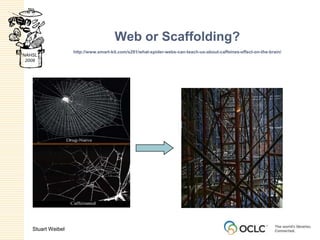
Web is a wonderful metaphor, but perhaps something a bit more durable?We want moreCoherence and contextDurable environments that help us preserve and fix resources in the context of cultureLibrarianship embedded in the emerging technologies of a social, semantic WebLinked data
Web or Scaffolding?http://www.smart-kit.com/s291/what-spider-webs-can-teach-us-about-caffeines-effect-on-the-brain/

Semantic Web Technologies: Changing Bibliographic Descriptions?

  • 1.
  • 2.
    Stuart WeibelSenior ResearchScientistOCLC ResearchDublin CoreWorking in SeattleCollaboration with UWNSF DataNet proposal for curation of scientific data
  • 3.
    What’s this Ihear about the Semantic Web?What is the Semantic Web?What does it have to do with bibliography?Does it make life better for patrons?Does it strengthen libraries?Is it practical?Where can we get some?
  • 4.
    What is theSemantic Web?An approach to embedding structure in web resources to facilitate the extraction of meaning by machines and people.A set of technologiesRDF: Resource Description Framework (a metadata architecture for the Web)OWLSKOSLinked Data
  • 5.
    Semantic Web Technologies:RDFRDFasyntax for making assertions on the webA structure to support inference by machinesRDF assertions are always expressed as triplesAn RDF assertion has a subject, a predicate, and and object:
  • 6.
    RDF Assertions:Subject –Predicate – ObjectThis presentation has a title of Semantic Web Technologies: Changing Bibliographic Futures?The author of this presentation is Stuart WeibelThis presentation was delivered on 2009-10-26PresentationTitleAuthorSemantic Web Technologies…Stuart WeibelDate of Delivery2009-10-26
  • 7.
    RDF AssertionsEncoded inXML on the WebThe nodes (information resources) are URIsThe Arcs (predicates) are also URIsPresentationhttp://purl.org/dc/elements/1.1/titlehttp://purl.org/dc/elements/1.1/creatorSemantic Web Technologies…http://example.org/staffid/12345http://purl.org/dc/elements/1.1/date2009-10-26
  • 8.
    The only thingyou need to know…RDF provides a web language for declaring relationships among information resourcesIt is a bit like sentence diagramming The important thing is to identify all the bits with globally unique, persistent Identifiers (URIs)
  • 9.
    OWLWeb Ontology LanguageW3Cstandard for expressing ontology relationshipsOntologies are important tools for knowledge representationThe importance of knowledge representation diminishes rapidly as the scope of representation increasesStill largely undemonstrated general impact
  • 10.
    SKOSSimple Knowledge OrganizationSystemW3C standards designed to support the declaration of controlled vocabularies and classification systems using the idioms of the semantic web (RDF).SKOS is simpler than OWLLess expertise required to deploy structured terminologies
  • 11.
    Linked DataWhat's allthe fuss about?The web is all about links: Anything new here?A web of data versus a web of documentsPartly about granularity of resourcesAddressable assertions as opposed to addressable documentsPartly about doing inference on the webMaking machines do more of the work of interpreting data
  • 12.
    Principles of LinkedDataTim Berners-Lee1.Use URIs as names for things (identifiers)2. Use HTTP URIs so that people can look up those names3.When someone looks up a URI, provide useful information4.Include links to other URIs so that they can discover more things
  • 13.
    Linked Open DataProjectSeeding the Web of Datahttp://linkeddata.org/
  • 14.
    Linked Data andBibliographyLinked Data is a natural approach for bibliographic data: Why?Because FRBR provides us with a coherent conceptual map of data about library assets
  • 15.
    FRBR Entities –Librarianship’s contribution to a richer, structured (semantic) Web
  • 16.
    And don’t forgetSocial Bibliography:User-Generated Content Book Reviews
  • 17.
  • 18.
  • 19.
    CommentaryHook everythingtogether with the right sort of identifiersA coherent identifier infrastructure is essential to establishing a rich and dynamic scaffolding of interconnected information resources to support “users and uses of bibliographic data”Broad dissemination of canonical, globally-scoped public identifiers serves the library collaborative and is the single most compelling means of making library assets visible on the Web
  • 20.
    Some Design Parametersfor Identifiers in theGlobal Library Community Canonical identification Branding Usability Granularity and the FRBR model Persistence Universal accessibility Global scoping Search Engine Optimization
  • 21.
    PersistenceNot technological, butrather, a function of the commitment of organizations
  • 22.
    Libraries and othercultural memory organizations do this well
  • 23.
    Harder to doin the digital era, but the community is up to the taskUniversal access and global scopingOpen to all: public identifiers in a public Web
  • 24.
    Should work inMyanmar, Melbourne, and Minneapolis alike
  • 25.
    WorldCat is thefirst globally-scoped identifier architecture for library assets in which the global surrogate is mapped to locality
  • 26.
    Holdings data turnsout to be critical in supporting the last mile problemSearch Engine Optimization and Canonical IdentifiersVisibility of assets in the global library is diluted by the multiplicity of identifiersMany competing identifier schemesLocalized versions of identifiersAgreement on a canonical identifier Raises search engine rankingConcentrates aggregation of social contentSimplifies supply-chain processingIs Item X the same as…related to… relevant to… Item Y?
  • 27.
    Usability of URIsURIsshould be designed for people as well as machinesURIs should be ‘speakable’URIs should be a short as can be managedURIs should have a predictable pattern that makes them ‘hackable’ and ‘truncatable’
  • 28.
    Is Linked DataGood for Libraries?Linked data can help users navigate authors, articles, concepts, organizations, and their relationship to other resources on the WebLinked data can help fix library assets in the context of other data on the WebLinked data can help reduce the barriers between traditional catalogs and the open Web
  • 29.
    Social Networking SoftwareItisn’t new… only the technical manifestation isLibrary services in emerging social networks Motivate people to participateTaggingBook ReviewsEmergent relationships, evident from data about what people buy and borrow, like and dislike (business intelligence)Link to the people as well
  • 30.
    Linked Data willhelp fix library assets in their larger contextTags, book reviews, recommendation data is an increasingly important component of bibliographyCrowd-sourced data need not go in our catalogsReliable, canonical identifiers will help tie together heterogeneous content
  • 31.
    Web is awonderful metaphor, but perhaps something a bit more durable?We want moreCoherence and contextDurable environments that help us preserve and fix resources in the context of cultureLibrarianship embedded in the emerging technologies of a social, semantic WebLinked data
  • 32.