GETAN EH ALEM U , P HD
I S K O U K A G M M E E T I N G : M E T A D A T A , T A X O N O M I E S A N D R E T R I E V A L
L O N D O N , A P R I L 5 T H 2 0 1 9
METADATA ENRICHING & FILTERING
FOR ENHANCED COLLECTION DISCOVERABILITY
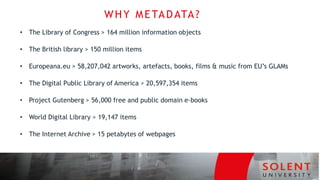
• The Library of Congress > 164 million information objects
• The British library > 150 million items
• Europeana.eu > 58,207,042 artworks, artefacts, books, films & music from EU’s GLAMs
• The Digital Public Library of America > 20,597,354 items
• Project Gutenberg > 56,000 free and public domain e-books
• World Digital Library > 19,147 items
• The Internet Archive > 15 petabytes of webpages
WHY METADATA?
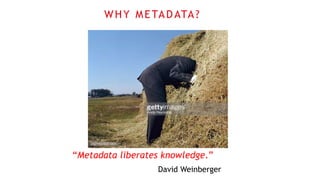
“Metadata liberates knowledge.”
David Weinberger
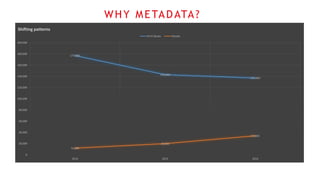
WHY METADATA?
177,000
143,000
137,000
12,000
20,000
34,000
0
20,000
40,000
60,000
80,000
100,000
120,000
140,000
160,000
180,000
200,000
2014 2015 2016
Shifting patterns
Print Books Ebooks
WHY METADATA?
WHY METADATA?
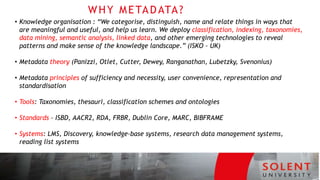
• Knowledge organisation : “We categorise, distinguish, name and relate things in ways that
are meaningful and useful, and help us learn. We deploy classification, indexing, taxonomies,
data mining, semantic analysis, linked data, and other emerging technologies to reveal
patterns and make sense of the knowledge landscape.” (ISKO - UK)
• Metadata theory (Panizzi, Otlet, Cutter, Dewey, Ranganathan, Lubetzky, Svenonius)
• Metadata principles of sufficiency and necessity, user convenience, representation and
standardisation
• Tools: Taxonomies, thesauri, classification schemes and ontologies
• Standards – ISBD, AACR2, RDA, FRBR, Dublin Core, MARC, BIBFRAME
• Systems: LMS, Discovery, knowledge-base systems, research data management systems,
reading list systems
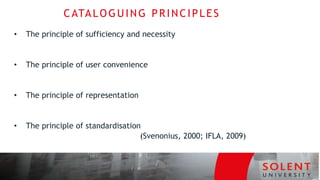
CATALOGUING PRINCIPLES
• The principle of sufficiency and necessity
• The principle of user convenience
• The principle of representation
• The principle of standardisation
(Svenonius, 2000; IFLA, 2009)
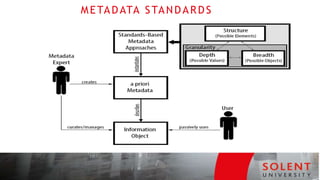
METADATA STANDARDS
CHALLENGES
• Disparity between controlled vocabularies and terminologies used by user
• Metadata as a social construct ((Bowker & Star, 1999; Shirky, 2008; Weinberger,
2007; Gartner, 2016)
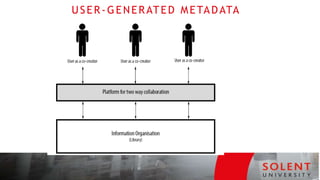
USER-GENERATED METADATA
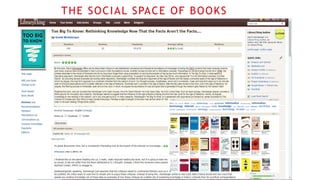
THE SOCIAL SPACE OF BOOKS
• A mixed metadata approach where both the experts and users continually
enhancing metadata
• From the principle of metadata simplicity to the principle of metadata enriching
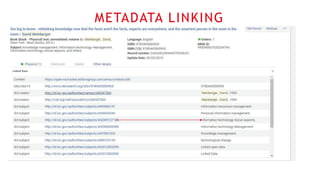
• From human-readable metadata to structured, uniquely identified and interlinked
metadata (metadata linking)
• From metadata silos to metadata openness enabling metadata sharing and re-use
(metadata openness)
• From a single interface to user-led, re-configurable interface (metadata filtering)
METAD ATA EN R I C H I N G & F I LT ER I N G
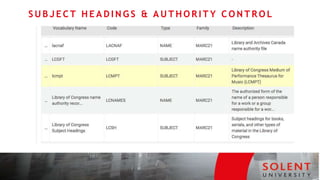
S U B J E C T H E A D I N G S & A U T H O R I T Y C O N T R O L
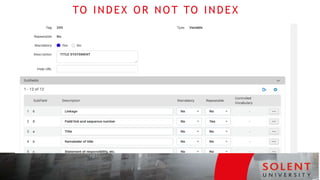
TO INDEX OR NOT TO INDEX
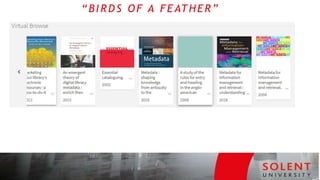
“BIRDS OF A FEATHER”
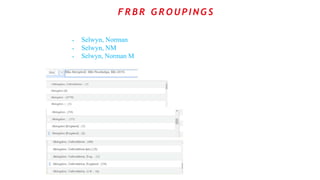
F R B R G R O U P I N G S
 Selwyn, Norman
 Selwyn, NM
 Selwyn, Norman M
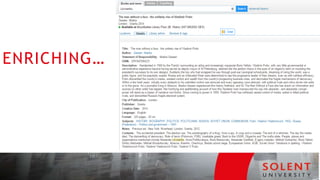
ENRICHING…
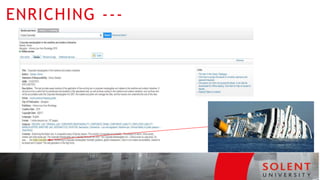
ENRICHING ---
METADATA LINKING
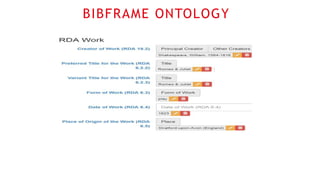
BIBFRAME ONTOLOGY
METADATA FILTERING
 Separation of metadata content (enriching) and interface (filtering)
 Enriching as a continuous process
 From user-centred to user-driven metadata enriching and filtering
 Metadata diversity better conforming to users’ needs
 Seamless linking
 ‘Useful’ rather than ‘perfect’ metadata
 Post-hoc user-driven filtering
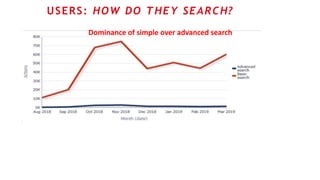
USERS: HOW DO THEY SEARCH?
Dominance of simple over advanced search
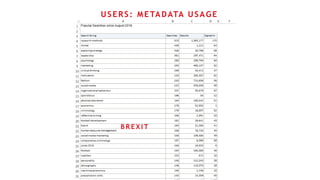
USERS: METADATA USAGE
B R E X I T
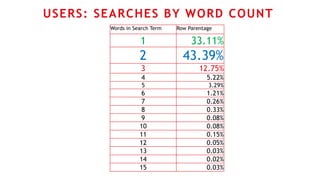
USERS: SEARCHES BY WORD COUNT
Words in Search Term Row Parentage
1 33.11%
2 43.39%
3 12.75%
4 5.22%
5 3.29%
6 1.21%
7 0.26%
8 0.33%
9 0.08%
10 0.08%
11 0.15%
12 0.05%
13 0.03%
14 0.02%
15 0.03%
Source: (Statista)
USERS: SEARCHES BY WORD COUNT
USERS: HOW OFTEN DO THEY CLICK ON FACETS?
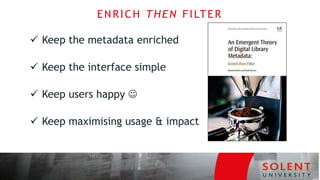
ENRICH THEN FILTER
 Keep the metadata enriched
 Keep the interface simple
 Keep users happy 
 Keep maximising usage & impact
THE FUTURE OF METADATA:
E N R I C H E D , L I N K E D , O P E N A N D F I LT E R E D
BIBLIOGRAPHY
• Alemu, G., & Stevens, B. (2015). An emergent theory of digital library metadata: Enrich then filter. Waltham, Massachusetts: Chandos Publishing.
• Anderson, C. (2006). The long tail: How endless choice is creating unlimitted demand. London: Random House Business Books.
• Boulton, J. (2014). In J. Boulton, 100 ideas that changed the web. London, UK: Laurence King. Retrieved from
http://search.credoreference.com/content/entry/lkingideas/metadata/0
• Bush, V. (1945). As we may think. The Atlantic Monthly (July 1945 issue). Retrieved from: https://www.theatlantic.com/magazine/archive/1945/07/as-we-may-
think/303881/
• Calhoun, K. (2014). Exploring digital libraries: Foundations, practice, prospects. London: Facet Publishing.
• Cameron, F., & Kenderdine, S. (2007). Theorizing digital cultural heritage: A critical discourse. Cambridge, Mass. ; London: Mit.
• Carletti, L. (2016). Participatory heritage: Scaffolding citizen scholarship. International Information & Library Review, 48(3), 196-203. doi:10.1080/10572317.2016.1205367
• Casey, M. E., & Savastinuk, L. C. (2006). Web 2.0: Service for the next-generation library. Library Journal,
• Chan, L. M., & Zeng, M. L. (2006). Metadata interoperability and standardization – A study of methodology part I :Achieving interoperability at the schema level. D-Lib
Magazine, 12(6).
• Charmaz, K. (2006). Constructing grounded theory: A practical guide through qualitative analysis. London: SAGE Publications.
• de Boer, V., Melgar, L., Inel, O., Ortiz, C. M., Aroyo, L., & Oomen, J. (2017). Enriching media collections for event-based exploration. In E. Garoufallou, S. Virkus, R. Siatri
& D. Koutsomiha (Eds.), Metadata and semantic research: 11th international conference, MTSR 2017, tallinn, estonia, november 28 – december 1, 2017, proceedings (pp.
189-201). Cham: Springer International Publishing. doi:10.1007/978-3-319-70863-8_18
• EU (2017). Decision (EU) 2017/864 of The European Parliament and of The Council of 17 May 2017 on a European Year of Cultural Heritage (2018). Official Journal of the
European Union, L 131/1. Available from http://eur-lex.europa.eu/legal-content/EN/TXT/PDF/?uri=CELEX:32017D0864&from=EN
• Floridi, L. (2000). On defining library and information science as applied philosophy of information. Social Epistemology, 16(1), 37–49.
• Gartner, R. (2008). Metadata for digital libraries: State of the art and future directions. (). Bristol: JISC Technology & Standards Watch.
• Gartner, R. (2016). Metadata: Shaping knowledge from antiquity to the semantic web. Cham, Switzerland: Springer.
• Gruber, T. (2007). Ontology of folsonomy: A mash-up of apples and oranges. International Journal on Semantic Web & Information Systems, 3(2)
• Haynes, D. (2018). Metadata for information management and retrieval : Understanding metadata and its use. London: Facet Publishing.
• Hedstrom, M., Ross, S., Ashley, K., Christensen-Dalsgaard, B., Duff, W., Gladney, H., . . . Neuhold, E. (2003). Invest to save: Report and recommendations of the NSF-
DELOS working group on digital archiving and preservation.
• Howard, K. (2015) Educating cultural heritage information professionals for Australia's galleries, libraries, archives and museums: A grounded Delphi study. PhD thesis,
Queensland University of Technology. Retrieved from http://apo.org.au/system/files/57651/apo-nid57651-60986.pdf
• Howe, J. (2009). Crowdsourcing: Why the power of the crowd is driving the future of business. New York: Three Rivers Press.
• Kefalidou, Genovefa, Mercourios Georgiadis, Bryn Alexander Coles and Suchith Anand. 'Crowdsourcing Our Cultural Heritage'. In: Clare Mills, Michael Pidd and Esther
Ward. Proceedings of the Digital Humanities Congress 2012. Studies in the Digital Humanities. Sheffield: HRI Online Publications, 2014. Available online at:
<https://www.dhi.ac.uk/openbook/chapter/dhc2012-kefalidou>
BIBLIOGRAPHY
• Kalay, Y. E., Kvan, T., & Affleck, J. (2008). New heritage: New media and cultural heritage. London: Routledge. Retrieved from
http://lib.myilibrary.com?id=106295&entityid=https://idp1.solent.ac.uk/idp/shibboleth; http://portal.solent.ac.uk/library/help/eresources/ebooks-help.aspx
• Kärberg, T. and Saarevet. K. (2016). Transforming User Knowledge into Archival Knowledge D-Lib Magazine, Vol. 22, No. 3/4. Retrieved from:
http://www.dlib.org/dlib/march16/karberg/03karberg.html
• Lagoze, C. (2010). Lost identity: The assimilation of digital libraries into the web Available from Lost Identity: the Assimilation of Digital Libraries into the Web.
• Lankes, R. D. (2016). The new librarianship field guide. Cambridge, Massachusetts: The MIT Press.
• Lim, S., & Liew, C. L. (2010). (2010). GLAM metadata interoperability. Paper presented at the The Role of Digital Libraries in a Time of Global Change, 140-143.
• Lim, S., & Liew, C. L. (2011). Metadata quality and interoperability of GLAM digital images. Ap, 63(5), 484-498. doi:10.1108/00012531111164978
• Lourdi, I., Papatheodorou, C., Doerr, M.: Semantic integration of collection description. D-Lib Magazine. 15 (2009) retrieved from
http://www.dlib.org/dlib/july09/papatheodorou/07papatheodorou.html
• Maness, J. M. (2006). Library 2.0 theory: Web 2.0 and its implications for libraries. Webology, 3(2)
• Miller, P. (2005). Web 2.0: Building the new library. Ariadne, 45
• NISO. (2004). Understanding metadata. Retrieved from: https://www.lter.uaf.edu/metadata_files/UnderstandingMetadata.pdf
• O'Reilly, T. (2005). What is web 2.0: Design patterns and business models for the next generation of software.
• Shirky, C. (2005). Ontology is overrated: Categories, links, and tags. Clay Shirky's Writings about the Internet,
• Shirky, C. (2008). Here comes everybody: The power of organizing without organizations. London: Allen Lane.
• Smith-Yoshimura, Karen and Cyndi Shein. 2011. Social Metadata for Libraries, Archives and Museums Part 1: Site Reviews. Dublin, Ohio: OCLC Research.
http://www.oclc.org/research/publications/library/2011/2011-02.pdf.
• Surowiecki, J. (2004). The wisdom of crowds : Why the many are smarter than the few. London: Abacus.
• Svenonius, E. (2000). The intellectual foundation of information organization. Cambridge, Mass. ; London: MIT Press.
• Tammaro, A. M. (2016). Heritage curation in the digital age: Professional challenges and opportunities. International Information & Library Review, 48(2), 122-128.
doi:10.1080/10572317.2016.1176454
• UNESCO. (2003). Charter on the preservation of digital heritage. Retrieved from http://portal.unesco.org/en/ev.php-
URL_ID=17721&URL_DO=DO_TOPIC&URL_SECTION=201.html
• Vander Wal, T. (2007, February 2). Folksonomy coinage and definition [Web log post]. Retrieved from http://vanderwal.net/folksonomy.html
• Weinberger, D. (2005). Tagging and Why It Matters. Retrieved from http://cyber.law.harvard.edu/sites/cyber.law.harvard.edu/files/07-WhyTaggingMatters.pdf
• Weinberger, D. (2007). Everything is miscellaneous: The power of the new digital disorder. New York, N.Y.: Henry Holt.
• Weinberger, D. (2014). Too big to know: Rethinking knowledge now that the facts aren't the facts, experts are everywhere, and the smartest person in the room is the
room. New York: Basic Books.
• Wright, A. (2014). Cataloging the world: Paul Otlet and the birth of the information age. New York: Oxford University Press.
• Wright, A. (2007). Glut: Mastering information through the ages. Washington, District of Columbia: Joseph Henry Press.
• Zeng, M. L., & Qin, J. (2016). Metadata (2nd ed.). London: Facet Publishing.
THANK YOU

Metadata enriching and filtering for enhanced collection discoverability

  • 1.
    GETAN EH ALEMU , P HD I S K O U K A G M M E E T I N G : M E T A D A T A , T A X O N O M I E S A N D R E T R I E V A L L O N D O N , A P R I L 5 T H 2 0 1 9 METADATA ENRICHING & FILTERING FOR ENHANCED COLLECTION DISCOVERABILITY
  • 2.
    • The Libraryof Congress > 164 million information objects • The British library > 150 million items • Europeana.eu > 58,207,042 artworks, artefacts, books, films & music from EU’s GLAMs • The Digital Public Library of America > 20,597,354 items • Project Gutenberg > 56,000 free and public domain e-books • World Digital Library > 19,147 items • The Internet Archive > 15 petabytes of webpages WHY METADATA?
  • 3.
  • 4.
  • 5.
    WHY METADATA? • Knowledgeorganisation : “We categorise, distinguish, name and relate things in ways that are meaningful and useful, and help us learn. We deploy classification, indexing, taxonomies, data mining, semantic analysis, linked data, and other emerging technologies to reveal patterns and make sense of the knowledge landscape.” (ISKO - UK) • Metadata theory (Panizzi, Otlet, Cutter, Dewey, Ranganathan, Lubetzky, Svenonius) • Metadata principles of sufficiency and necessity, user convenience, representation and standardisation • Tools: Taxonomies, thesauri, classification schemes and ontologies • Standards – ISBD, AACR2, RDA, FRBR, Dublin Core, MARC, BIBFRAME • Systems: LMS, Discovery, knowledge-base systems, research data management systems, reading list systems
  • 6.
    CATALOGUING PRINCIPLES • Theprinciple of sufficiency and necessity • The principle of user convenience • The principle of representation • The principle of standardisation (Svenonius, 2000; IFLA, 2009)
  • 7.
  • 8.
    CHALLENGES • Disparity betweencontrolled vocabularies and terminologies used by user • Metadata as a social construct ((Bowker & Star, 1999; Shirky, 2008; Weinberger, 2007; Gartner, 2016)
  • 9.
  • 10.
  • 11.
    • A mixedmetadata approach where both the experts and users continually enhancing metadata • From the principle of metadata simplicity to the principle of metadata enriching • From human-readable metadata to structured, uniquely identified and interlinked metadata (metadata linking) • From metadata silos to metadata openness enabling metadata sharing and re-use (metadata openness) • From a single interface to user-led, re-configurable interface (metadata filtering) METAD ATA EN R I C H I N G & F I LT ER I N G
  • 12.
    METAD ATA ENR I C H I N G & F I LT ER I N G
  • 13.
    S U BJ E C T H E A D I N G S & A U T H O R I T Y C O N T R O L
  • 14.
    TO INDEX ORNOT TO INDEX
  • 15.
    “BIRDS OF AFEATHER”
  • 16.
    F R BR G R O U P I N G S  Selwyn, Norman  Selwyn, NM  Selwyn, Norman M
  • 17.
  • 18.
  • 19.
  • 20.
  • 21.
    METADATA FILTERING  Separationof metadata content (enriching) and interface (filtering)  Enriching as a continuous process  From user-centred to user-driven metadata enriching and filtering  Metadata diversity better conforming to users’ needs  Seamless linking  ‘Useful’ rather than ‘perfect’ metadata  Post-hoc user-driven filtering
  • 22.
    USERS: HOW DOTHEY SEARCH? Dominance of simple over advanced search
  • 23.
  • 24.
    USERS: SEARCHES BYWORD COUNT Words in Search Term Row Parentage 1 33.11% 2 43.39% 3 12.75% 4 5.22% 5 3.29% 6 1.21% 7 0.26% 8 0.33% 9 0.08% 10 0.08% 11 0.15% 12 0.05% 13 0.03% 14 0.02% 15 0.03%
  • 25.
  • 26.
    USERS: HOW OFTENDO THEY CLICK ON FACETS?
  • 27.
    ENRICH THEN FILTER Keep the metadata enriched  Keep the interface simple  Keep users happy   Keep maximising usage & impact
  • 28.
    THE FUTURE OFMETADATA: E N R I C H E D , L I N K E D , O P E N A N D F I LT E R E D
  • 29.
    BIBLIOGRAPHY • Alemu, G.,& Stevens, B. (2015). An emergent theory of digital library metadata: Enrich then filter. Waltham, Massachusetts: Chandos Publishing. • Anderson, C. (2006). The long tail: How endless choice is creating unlimitted demand. London: Random House Business Books. • Boulton, J. (2014). In J. Boulton, 100 ideas that changed the web. London, UK: Laurence King. Retrieved from http://search.credoreference.com/content/entry/lkingideas/metadata/0 • Bush, V. (1945). As we may think. The Atlantic Monthly (July 1945 issue). Retrieved from: https://www.theatlantic.com/magazine/archive/1945/07/as-we-may- think/303881/ • Calhoun, K. (2014). Exploring digital libraries: Foundations, practice, prospects. London: Facet Publishing. • Cameron, F., & Kenderdine, S. (2007). Theorizing digital cultural heritage: A critical discourse. Cambridge, Mass. ; London: Mit. • Carletti, L. (2016). Participatory heritage: Scaffolding citizen scholarship. International Information & Library Review, 48(3), 196-203. doi:10.1080/10572317.2016.1205367 • Casey, M. E., & Savastinuk, L. C. (2006). Web 2.0: Service for the next-generation library. Library Journal, • Chan, L. M., & Zeng, M. L. (2006). Metadata interoperability and standardization – A study of methodology part I :Achieving interoperability at the schema level. D-Lib Magazine, 12(6). • Charmaz, K. (2006). Constructing grounded theory: A practical guide through qualitative analysis. London: SAGE Publications. • de Boer, V., Melgar, L., Inel, O., Ortiz, C. M., Aroyo, L., & Oomen, J. (2017). Enriching media collections for event-based exploration. In E. Garoufallou, S. Virkus, R. Siatri & D. Koutsomiha (Eds.), Metadata and semantic research: 11th international conference, MTSR 2017, tallinn, estonia, november 28 – december 1, 2017, proceedings (pp. 189-201). Cham: Springer International Publishing. doi:10.1007/978-3-319-70863-8_18 • EU (2017). Decision (EU) 2017/864 of The European Parliament and of The Council of 17 May 2017 on a European Year of Cultural Heritage (2018). Official Journal of the European Union, L 131/1. Available from http://eur-lex.europa.eu/legal-content/EN/TXT/PDF/?uri=CELEX:32017D0864&from=EN • Floridi, L. (2000). On defining library and information science as applied philosophy of information. Social Epistemology, 16(1), 37–49. • Gartner, R. (2008). Metadata for digital libraries: State of the art and future directions. (). Bristol: JISC Technology & Standards Watch. • Gartner, R. (2016). Metadata: Shaping knowledge from antiquity to the semantic web. Cham, Switzerland: Springer. • Gruber, T. (2007). Ontology of folsonomy: A mash-up of apples and oranges. International Journal on Semantic Web & Information Systems, 3(2) • Haynes, D. (2018). Metadata for information management and retrieval : Understanding metadata and its use. London: Facet Publishing. • Hedstrom, M., Ross, S., Ashley, K., Christensen-Dalsgaard, B., Duff, W., Gladney, H., . . . Neuhold, E. (2003). Invest to save: Report and recommendations of the NSF- DELOS working group on digital archiving and preservation. • Howard, K. (2015) Educating cultural heritage information professionals for Australia's galleries, libraries, archives and museums: A grounded Delphi study. PhD thesis, Queensland University of Technology. Retrieved from http://apo.org.au/system/files/57651/apo-nid57651-60986.pdf • Howe, J. (2009). Crowdsourcing: Why the power of the crowd is driving the future of business. New York: Three Rivers Press. • Kefalidou, Genovefa, Mercourios Georgiadis, Bryn Alexander Coles and Suchith Anand. 'Crowdsourcing Our Cultural Heritage'. In: Clare Mills, Michael Pidd and Esther Ward. Proceedings of the Digital Humanities Congress 2012. Studies in the Digital Humanities. Sheffield: HRI Online Publications, 2014. Available online at: <https://www.dhi.ac.uk/openbook/chapter/dhc2012-kefalidou>
  • 30.
    BIBLIOGRAPHY • Kalay, Y.E., Kvan, T., & Affleck, J. (2008). New heritage: New media and cultural heritage. London: Routledge. Retrieved from http://lib.myilibrary.com?id=106295&entityid=https://idp1.solent.ac.uk/idp/shibboleth; http://portal.solent.ac.uk/library/help/eresources/ebooks-help.aspx • Kärberg, T. and Saarevet. K. (2016). Transforming User Knowledge into Archival Knowledge D-Lib Magazine, Vol. 22, No. 3/4. Retrieved from: http://www.dlib.org/dlib/march16/karberg/03karberg.html • Lagoze, C. (2010). Lost identity: The assimilation of digital libraries into the web Available from Lost Identity: the Assimilation of Digital Libraries into the Web. • Lankes, R. D. (2016). The new librarianship field guide. Cambridge, Massachusetts: The MIT Press. • Lim, S., & Liew, C. L. (2010). (2010). GLAM metadata interoperability. Paper presented at the The Role of Digital Libraries in a Time of Global Change, 140-143. • Lim, S., & Liew, C. L. (2011). Metadata quality and interoperability of GLAM digital images. Ap, 63(5), 484-498. doi:10.1108/00012531111164978 • Lourdi, I., Papatheodorou, C., Doerr, M.: Semantic integration of collection description. D-Lib Magazine. 15 (2009) retrieved from http://www.dlib.org/dlib/july09/papatheodorou/07papatheodorou.html • Maness, J. M. (2006). Library 2.0 theory: Web 2.0 and its implications for libraries. Webology, 3(2) • Miller, P. (2005). Web 2.0: Building the new library. Ariadne, 45 • NISO. (2004). Understanding metadata. Retrieved from: https://www.lter.uaf.edu/metadata_files/UnderstandingMetadata.pdf • O'Reilly, T. (2005). What is web 2.0: Design patterns and business models for the next generation of software. • Shirky, C. (2005). Ontology is overrated: Categories, links, and tags. Clay Shirky's Writings about the Internet, • Shirky, C. (2008). Here comes everybody: The power of organizing without organizations. London: Allen Lane. • Smith-Yoshimura, Karen and Cyndi Shein. 2011. Social Metadata for Libraries, Archives and Museums Part 1: Site Reviews. Dublin, Ohio: OCLC Research. http://www.oclc.org/research/publications/library/2011/2011-02.pdf. • Surowiecki, J. (2004). The wisdom of crowds : Why the many are smarter than the few. London: Abacus. • Svenonius, E. (2000). The intellectual foundation of information organization. Cambridge, Mass. ; London: MIT Press. • Tammaro, A. M. (2016). Heritage curation in the digital age: Professional challenges and opportunities. International Information & Library Review, 48(2), 122-128. doi:10.1080/10572317.2016.1176454 • UNESCO. (2003). Charter on the preservation of digital heritage. Retrieved from http://portal.unesco.org/en/ev.php- URL_ID=17721&URL_DO=DO_TOPIC&URL_SECTION=201.html • Vander Wal, T. (2007, February 2). Folksonomy coinage and definition [Web log post]. Retrieved from http://vanderwal.net/folksonomy.html • Weinberger, D. (2005). Tagging and Why It Matters. Retrieved from http://cyber.law.harvard.edu/sites/cyber.law.harvard.edu/files/07-WhyTaggingMatters.pdf • Weinberger, D. (2007). Everything is miscellaneous: The power of the new digital disorder. New York, N.Y.: Henry Holt. • Weinberger, D. (2014). Too big to know: Rethinking knowledge now that the facts aren't the facts, experts are everywhere, and the smartest person in the room is the room. New York: Basic Books. • Wright, A. (2014). Cataloging the world: Paul Otlet and the birth of the information age. New York: Oxford University Press. • Wright, A. (2007). Glut: Mastering information through the ages. Washington, District of Columbia: Joseph Henry Press. • Zeng, M. L., & Qin, J. (2016). Metadata (2nd ed.). London: Facet Publishing.
  • 31.

Editor's Notes

  • #8 Alemu, G., Stevens, B., Ross, P. (2012). Towards a conceptual framework for user-driven semantic metadata interoperability in digital libraries: A social constructivist approach. New Library World. 113 (1/2), 38-54 Alemu, G., Stevens, B., & Ross, P. (2011). A constructivist grounded theory approach to semantic metadata interoperability in digital libraries: preliminary reflections. Paper presented at QQML 2011, Athens. Alemu, G., Stevens, B., Ross, P., & Chandler, J. (2015). The Use of a Constructivist Grounded Theory Method to Explore the Role of Socially-Constructed Metadata (Web 2.0) Approaches. QQML Journal, September 2015 Issue (pp. 517-540).
  • #9 (Coyle, 2010; Coyle & Hillmann, 2007; Lagoze, 2010; Mathes, 2004; Shirky, 2005; Veltman, 2001; Weinberger, 2005, 2007; Wright, 2007; Lehmann, 2010; Andersen & Skouvig, 2006.; Floridi, 2000; Hjorland, 2000)
  • #10 Alemu, G., Stevens, B., Ross, P. (2012). Towards a conceptual framework for user-driven semantic metadata interoperability in digital libraries: A social constructivist approach. New Library World. 113 (1/2), 38-54 Alemu, G., Stevens, B., & Ross, P. (2011). A constructivist grounded theory approach to semantic metadata interoperability in digital libraries: preliminary reflections. Paper presented at QQML 2011, Athens. Alemu, G., Stevens, B., Ross, P., & Chandler, J. (2015). The Use of a Constructivist Grounded Theory Method to Explore the Role of Socially-Constructed Metadata (Web 2.0) Approaches. QQML Journal, September 2015 Issue (pp. 517-540).
  • #28 As part of my PhD which I completed in June 2014, using constructivist grounded research method, I developed a theory of metadata enriching and filtering. The theory includes four overarching principles, namely the principle of metadata enriching, linking, openness and filtering. My PhD is two words: enriching and filtering.  The theory of metadata enriching and filtering espouses that metadata should be enriched through standardised and socially-constructed metadata approaches. ... In theory, metadata creation and enhancement (metadata enriching) is a continuous process and it involves authors, publishers, suppliers, librarians and users.