Senthil Natesan
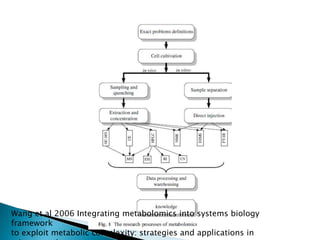
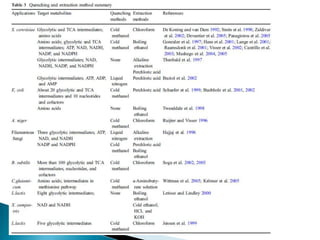
   The ultimate starting point of a metabolomic
    experiment is to quantify all of the
    metabolites in a cellular system (i.e. the cell
    or tissue in a given state at a given point in
    time).
   The main challenges are the chemical
    complexity and heterogeneity of
    metabolites, the dynamic range of the
    measuring technique, the throughput of the
    measurements, and the extraction protocols.
   Metabolites are chemical entities and can be
    analysed by the standard tools of chemical
    analysis such as molecular spectroscopy and MS.
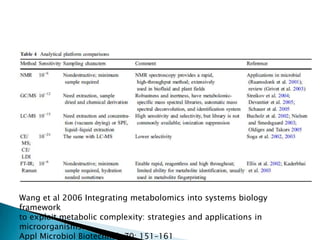
   The resolution, sensitivity and selectivity of these
    technologies can be enhanced or modified by
    coupling them to gas chromatograpy (GC) or
    liquid chromatography (LC) steps
   NMR spectroscopy has been shown to provide
    valuable information on metabolites, typically
    directly from biofluids with little or no sample
    preparation steps
   Gas-chromatography-mass-spectrometry (GC-MS), gas-
    chromatography- time-of-flight-mass-spectrometry (GC-TOF-MS).GC-
    MS technologies enable the identification and robust quantification of a
    few hundred primary metabolites within a single extract.
   However, only volatile compounds (boiling point below 3008C) like
    ketones and alcohols can be examined directly by GC–MS. Analysis of
    Semi-volatile compounds such as amino acids and lipids require
    additional chemical derivatization processes (typically silylation or
    alkylation)

   Liquid-chromatography-mass-spectrometry (LC-MS) are currently the
    standard mass-spectrometry methods for metabolite analyses. LC-MS
    offers several distinct advantages, chiefly its adaptability to measure a
    far broader range of metabolites encompassing both primary and
    secondary metabolites.
   With the „„soft‟‟ ionization method of ESI, seamless interfacing of LC–MS
    can be achieved. Thus, even non-volatile metabolites can be directly
    subjected to mass analysis in this method
   Compared to the genome, transcriptome and
    proteome, the metabolome is of much more
    complexity, since a large diversity of molecules are
    produced through metabolism and many of which
    may participate in several different metabolic or
    regulatory Pathways
   Two strategies for metabolomic studies, that
    is, target analysis involves identification and
    quantification of specific analytes while metabolite
    profiling focuses on the characterization of a large
    number of molecules either intracellularly (metabolic
    fingerprinting) or extracellularly (metabolic
    footprinting) (Allen et al., 2003, 2004) serving as an
    unambiguous marker correlated to certain cellular
    status
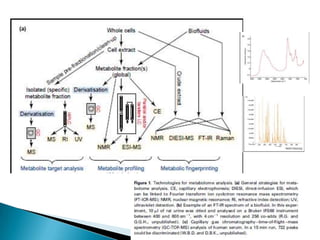
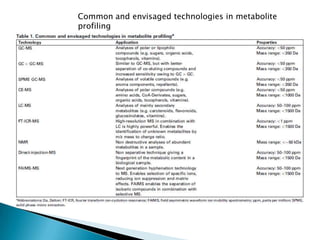
Common and envisaged technologies in metabolite
profiling
Wang et al 2006 Integrating metabolomics into systems biology
framework
to exploit metabolic complexity: strategies and applications in
microorganisms.
Appl Microbiol Biotechnol 70: 151–161
Wang et al 2006 Integrating metabolomics into systems biology
framework
to exploit metabolic complexity: strategies and applications in
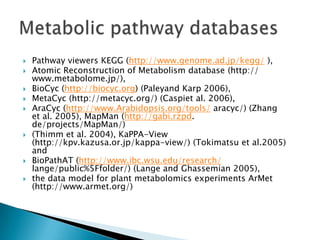
   Pathway viewers KEGG (http://www.genome.ad.jp/kegg/ ),
   Atomic Reconstruction of Metabolism database (http://
    www.metabolome.jp/),
   BioCyc (http://biocyc.org) (Paleyand Karp 2006),
   MetaCyc (http://metacyc.org/) (Caspiet al. 2006),
   AraCyc (http://www.Arabidopsis.org/tools/ aracyc/) (Zhang
    et al. 2005), MapMan (http://gabi.rzpd.
    de/projects/MapMan/)
   (Thimm et al. 2004), KaPPA-View
    (http://kpv.kazusa.or.jp/kappa-view/) (Tokimatsu et al.2005)
    and
   BioPathAT (http://www.ibc.wsu.edu/research/
    lange/public%5Ffolder/) (Lange and Ghassemian 2005),
   the data model for plant metabolomics experiments ArMet
    (http://www.armet.org/)
   A clear difference between the metabolome
    patterns (NMR-based study) of chamomile tea
    drinkers before and after dosing was
    demonstrated, and the results suggested that the
    effects of tea drinking lasted for at least two
    weeks post-dosing.
   population and toxicogenomic studies should
    benefit from the combination of “omics”, by
    allowing connections to be drawn between
    environmental factors in terms of diet and
    exposure to toxicity and environmental induced
    diseases
   One significant challenge for plant metabolomics is
    the lack of a fully described and annotated
    metabolome for any plant species. Estimates are that
    the plant kingdom produce 90 000–200 000 different
    metabolites
   Owing to technical limitations, researchers
    traditionally focused on a single or, at most, a
    handful of metabolic traits that were of greatest
    importance either for industrial or nutritional value.

    Prime examples of these targeted approaches
    include carotenoid content of tomato, protein content
    of maize and starch content of potato and rice
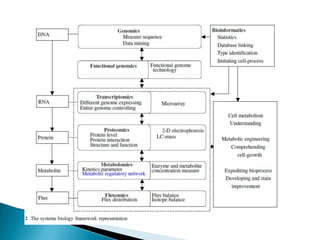
   Metabolomics in systems biology mainly focus on quantifying
    metabolite levels and flows in primary metabolism.
    By relying on predefined connections between genetic
    sequences and metabolites, the information observed by
    acquiring a snapshot of the cellular metabolic composition is
    upgraded
   The use of LC-MS, for example, has been exploited to map
    metabolic activity and flexibility through dynamic analysis of
    intracellular metabolites during the yeast cell-cycle (Wittmann et
    al. 2005) and the effect of culture age on metabolite pools
   To quantify metabolites containing an amino or carboxylic acid
    group, Villas-Bôas et al. (2005) applied a sensitive GC-MS
    method coupled to a statistical data-mining strategy for the
    integrated analysis of clearly identified and quantified intra- and
    extracellular metabolites in S. cerevisiae
   In yeast, the intracellular metabolites were
    used to identify the phenotypes of several
    silent mutants (Raamsdonk et al. 2001).
   Comparative comprehensive metabolite
    studies were also used in authentication of
    other strains (de Nijs et al. 1997).
   This level of qualification and quantification is of
         increasing importance, as the significance of more
         biosynthetic pathways is elucidated. GC-MS applications
         have benefited from large databases such as the NIST
         database.
        For LC-MS these databases are still in their infancy plant
         metabolomic experiments this will be more
         problematic, since the metabolite number and the
         structural diversity of the metabolites that plants produce
         is much greater
        Identification of specific metabolites in complex mixtures
         by NMR is also problematic. However, it has been
         demonstrated that many common metabolites can be
         identified by the application of 2D NMR experiments
        Data analysis and integration remains problematic.


Simone Rochfort,2005 Metabolomics Reviewed: A New “Omics” Platform Technolo
Biology and Implications for Natural Products Research J. Nat. Prod. 68, 1813-182

Metabolomics

  • 1.
  • 2.
    The ultimate starting point of a metabolomic experiment is to quantify all of the metabolites in a cellular system (i.e. the cell or tissue in a given state at a given point in time).  The main challenges are the chemical complexity and heterogeneity of metabolites, the dynamic range of the measuring technique, the throughput of the measurements, and the extraction protocols.
  • 4.
    Metabolites are chemical entities and can be analysed by the standard tools of chemical analysis such as molecular spectroscopy and MS.  The resolution, sensitivity and selectivity of these technologies can be enhanced or modified by coupling them to gas chromatograpy (GC) or liquid chromatography (LC) steps  NMR spectroscopy has been shown to provide valuable information on metabolites, typically directly from biofluids with little or no sample preparation steps
  • 5.
    Gas-chromatography-mass-spectrometry (GC-MS), gas- chromatography- time-of-flight-mass-spectrometry (GC-TOF-MS).GC- MS technologies enable the identification and robust quantification of a few hundred primary metabolites within a single extract.  However, only volatile compounds (boiling point below 3008C) like ketones and alcohols can be examined directly by GC–MS. Analysis of Semi-volatile compounds such as amino acids and lipids require additional chemical derivatization processes (typically silylation or alkylation)  Liquid-chromatography-mass-spectrometry (LC-MS) are currently the standard mass-spectrometry methods for metabolite analyses. LC-MS offers several distinct advantages, chiefly its adaptability to measure a far broader range of metabolites encompassing both primary and secondary metabolites.  With the „„soft‟‟ ionization method of ESI, seamless interfacing of LC–MS can be achieved. Thus, even non-volatile metabolites can be directly subjected to mass analysis in this method
  • 6.
    Compared to the genome, transcriptome and proteome, the metabolome is of much more complexity, since a large diversity of molecules are produced through metabolism and many of which may participate in several different metabolic or regulatory Pathways  Two strategies for metabolomic studies, that is, target analysis involves identification and quantification of specific analytes while metabolite profiling focuses on the characterization of a large number of molecules either intracellularly (metabolic fingerprinting) or extracellularly (metabolic footprinting) (Allen et al., 2003, 2004) serving as an unambiguous marker correlated to certain cellular status
  • 7.
    Common and envisagedtechnologies in metabolite profiling
  • 9.
    Wang et al2006 Integrating metabolomics into systems biology framework to exploit metabolic complexity: strategies and applications in microorganisms. Appl Microbiol Biotechnol 70: 151–161
  • 10.
    Wang et al2006 Integrating metabolomics into systems biology framework to exploit metabolic complexity: strategies and applications in
  • 12.
    Pathway viewers KEGG (http://www.genome.ad.jp/kegg/ ),  Atomic Reconstruction of Metabolism database (http:// www.metabolome.jp/),  BioCyc (http://biocyc.org) (Paleyand Karp 2006),  MetaCyc (http://metacyc.org/) (Caspiet al. 2006),  AraCyc (http://www.Arabidopsis.org/tools/ aracyc/) (Zhang et al. 2005), MapMan (http://gabi.rzpd. de/projects/MapMan/)  (Thimm et al. 2004), KaPPA-View (http://kpv.kazusa.or.jp/kappa-view/) (Tokimatsu et al.2005) and  BioPathAT (http://www.ibc.wsu.edu/research/ lange/public%5Ffolder/) (Lange and Ghassemian 2005),  the data model for plant metabolomics experiments ArMet (http://www.armet.org/)
  • 13.
    A clear difference between the metabolome patterns (NMR-based study) of chamomile tea drinkers before and after dosing was demonstrated, and the results suggested that the effects of tea drinking lasted for at least two weeks post-dosing.  population and toxicogenomic studies should benefit from the combination of “omics”, by allowing connections to be drawn between environmental factors in terms of diet and exposure to toxicity and environmental induced diseases
  • 14.
    One significant challenge for plant metabolomics is the lack of a fully described and annotated metabolome for any plant species. Estimates are that the plant kingdom produce 90 000–200 000 different metabolites  Owing to technical limitations, researchers traditionally focused on a single or, at most, a handful of metabolic traits that were of greatest importance either for industrial or nutritional value.  Prime examples of these targeted approaches include carotenoid content of tomato, protein content of maize and starch content of potato and rice
  • 15.
    Metabolomics in systems biology mainly focus on quantifying metabolite levels and flows in primary metabolism.  By relying on predefined connections between genetic sequences and metabolites, the information observed by acquiring a snapshot of the cellular metabolic composition is upgraded  The use of LC-MS, for example, has been exploited to map metabolic activity and flexibility through dynamic analysis of intracellular metabolites during the yeast cell-cycle (Wittmann et al. 2005) and the effect of culture age on metabolite pools  To quantify metabolites containing an amino or carboxylic acid group, Villas-Bôas et al. (2005) applied a sensitive GC-MS method coupled to a statistical data-mining strategy for the integrated analysis of clearly identified and quantified intra- and extracellular metabolites in S. cerevisiae
  • 16.
    In yeast, the intracellular metabolites were used to identify the phenotypes of several silent mutants (Raamsdonk et al. 2001).  Comparative comprehensive metabolite studies were also used in authentication of other strains (de Nijs et al. 1997).
  • 17.
    This level of qualification and quantification is of increasing importance, as the significance of more biosynthetic pathways is elucidated. GC-MS applications have benefited from large databases such as the NIST database.  For LC-MS these databases are still in their infancy plant metabolomic experiments this will be more problematic, since the metabolite number and the structural diversity of the metabolites that plants produce is much greater  Identification of specific metabolites in complex mixtures by NMR is also problematic. However, it has been demonstrated that many common metabolites can be identified by the application of 2D NMR experiments  Data analysis and integration remains problematic. Simone Rochfort,2005 Metabolomics Reviewed: A New “Omics” Platform Technolo Biology and Implications for Natural Products Research J. Nat. Prod. 68, 1813-182