Plant Metabolomics
The Missing Link in Functional Genomic Strategies
Presented by:
Farheen Zafar
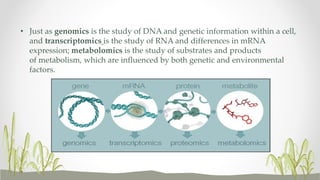
• Just as genomics is the study of DNA and genetic information within a cell,
and transcriptomics is the study of RNA and differences in mRNA
expression; metabolomics is the study of substrates and products
of metabolism, which are influenced by both genetic and environmental
factors.
Introduction:
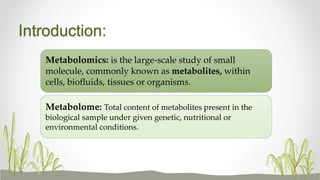
Metabolomics: is the large-scale study of small
molecule, commonly known as metabolites, within
cells, biofluids, tissues or organisms.
Metabolome: Total content of metabolites present in the
biological sample under given genetic, nutritional or
environmental conditions.
Plant Metabolomics:
• Plants produce large numbers of metabolites of diversified
structures.
• Metabolites are the end products of cellular regulatory
processes, and their levels can be regarded as the ultimate
response of biological systems to genetic or environmental
changes.
• Metabolites are also highly dynamic in time and space and
show massive range of structures raising the challenges for
analytical procedures in their measurement.
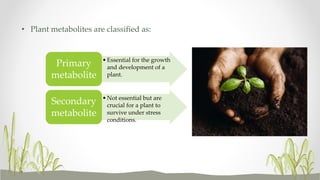
• Plant metabolites are classified as:
•Essential for the growth
and development of a
plant.
Primary
metabolite
•Not essential but are
crucial for a plant to
survive under stress
conditions.
Secondary
metabolite
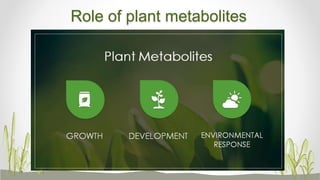
Role of plant metabolites
• Plant metabolites are involved in many resistance and stress
responses and also contribute to the color, taste, aroma, and scent
of fruits and flowers.
• Metabolomics study help us to understand:
o The complex interactive nature of plant metabolic networks and
their response to environmental and genetic change.
o Fundamental nature of plant phenotype in relation to
development, physiology, tissue identity, resistance to stress and
biodiversity.
o Plant biology and physiology from the perspective of small
chemical molecules.
Objective of the study:
Plant growth,
Development, & Stress
Response
Crop Quality
Development
Food Safety Assessment Plant Metabolic
Engineering
Technology development
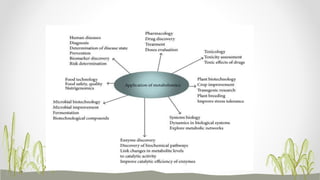
• The ultimate goal of metabolomics is the ability to detect and
quantify every metabolite present in a plant extract.
• The modern metabolomics platforms involve generation of
metabolome data using two important techniques for
quantitative detection of metabolite profiling.
1. Gas chromatography-MS(GC-MS)
2. NMR analysis of crude extracts
Gas chromatography-MS(GC-MS):
• The GC-MS platform is widely used for non-targeted
analysis. It consists of six steps:
1) Extraction of metabolites from biological sample.
2) Derivatization of samples which makes the compounds
volatile so that they can easily be used in GC.
3) Separation by Gas chromatography.
4) Ionization of compounds as they eluted from GC. Electron
impact ionization is most commonly used.
5) Detection of molecular fragments ions. Mass separation and detection can be
achieved by different mass detection devices for example:
• Sector field detectors
• Quadrople detectors (QUAID)
• Ion trap technology
• Time of flight detectors (TOF)
• GC-MS with QUAID is most commonly used. Ion trap technology allows
MS-MS analysis of structural elucidation. TOF detection either tuned for fast
scanning rates or to high mass precision.
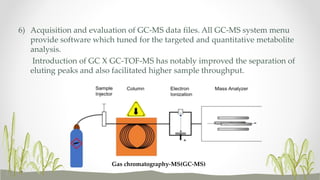
6) Acquisition and evaluation of GC-MS data files. All GC-MS system menu
provide software which tuned for the targeted and quantitative metabolite
analysis.
Introduction of GC X GC-TOF-MS has notably improved the separation of
eluting peaks and also facilitated higher sample throughput.
Gas chromatography-MS(GC-MS)
NMR analysis of crude extracts
• Nuclear Magnetic Resonance (NMR) spectroscopy is an analytical
chemistry technique used in quality control and research for
determining the content and purity of a sample as well as its
molecular structure such as plant extracts. For example, NMR can
quantitatively analyze mixtures containing known compounds.
• It is based on the absorption of electromagnetic radiation in the
radio frequency.
Principle of NMR:
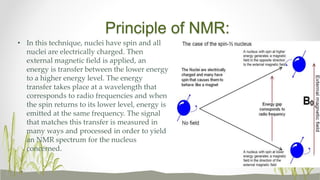
• In this technique, nuclei have spin and all
nuclei are electrically charged. Then
external magnetic field is applied, an
energy is transfer between the lower energy
to a higher energy level. The energy
transfer takes place at a wavelength that
corresponds to radio frequencies and when
the spin returns to its lower level, energy is
emitted at the same frequency. The signal
that matches this transfer is measured in
many ways and processed in order to yield
an NMR spectrum for the nucleus
concerned.
• The NMR based metabolite detection relies upon the
utilization of magnetic properties of nuclei of atoms under
magnetic field.
• The NMR is a non-destructive method extensively used to
identify metabolites with smaller molecular weight (<50
kDa) for diverse applications like metabolite fingerprinting,
profiling, metabolic flux and extracting the atomic
structural information of compound present in the
biological samples.
• NMR spectroscopy can be utilized to compare crude leaf
extract at different levels of light stress, allowing an analysis
of these compounds.
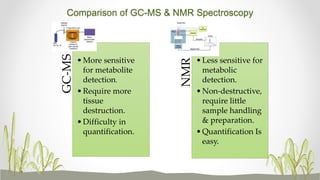
GC-MS
•More sensitive
for metabolite
detection.
•Require more
tissue
destruction.
•Difficulty in
quantification.
NMR
•Less sensitive for
metabolic
detection.
•Non-destructive,
require little
sample handling
& preparation.
•Quantification Is
easy.
Comparison of GC-MS & NMR Spectroscopy
Metabolic Profiling & Fingerprinting
• Metabolite fingerprinting is a comparative high-throughput analysis with the
intention to identify metabolite markers for genetic or environmental disturbances.
• Metabolite profiling aims at a quantitative assessment of a predefined number of
target metabolites.
• For this the metabolic state of a plant under different experimental conditions is
analyzed and compared (wild type vs. mutant or treated vs. non-treated).
• All metabolites possible are extracted and analyzed by Ultra Performance Liquid
Chromatography coupled to a Time-of-Flight Mass Spectrometer (UPLC ESI-TOF-
MS).
• Features which are showing intensity profiles of interest (e.g. higher amounts in
treated plants), are further analyzed and identified.
Metabolite Fingerprinting
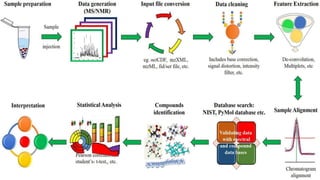
• The metabolite fingerprinting analysis can be divided into five major steps:
1) Extraction of the metabolites from the biological samples.
2) Data acquisition by UPLC ESI-TOF-MS.
3) Peak picking and peak alignment for the generation of comprehensive
data matrices.
4) Data processing and identification of metabolite markers
• 5) Verification of the tentative identities of the metabolite markers by MS/MS
or comparable methods.
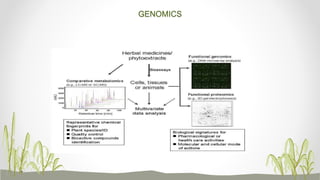
GENOMICS
Challenges to Plant Metabolomics
• limitations such as the no availability of reference compounds.
• The need for appropriate, dedicated bioinformatics tools represent major
challenges, and these can be approached effectively with sufficient speed
only through a coordinated and collaborative effort.
Future Perspectives
• Plant metabolomics is in its infancy and that there is still a great deal to do
• metabolomics World Wide Web site (www.metabolomics. nl)
• In the future, metabolomics will play a key role in complementing data sets
obtained from the existing “-omics” technologies.
Plant Metabolomics-Applications:
• We can study the mechanism of plant diseases
• Mechanism of insect resistance in plants
• Mechanism of plant stress resistance (drought, salt, heavy metals)
• Plant gene function
• Plant microbial interaction research
• Plant primary and secondary metabolic pathways
• Some secondary metabolites produced in plants are of therapeutic
importance (Anti-cancer drugs, cardiovascular diseases etc.)

Plant metabolomics

  • 1.
    Plant Metabolomics The MissingLink in Functional Genomic Strategies Presented by: Farheen Zafar
  • 2.
    • Just asgenomics is the study of DNA and genetic information within a cell, and transcriptomics is the study of RNA and differences in mRNA expression; metabolomics is the study of substrates and products of metabolism, which are influenced by both genetic and environmental factors.
  • 3.
    Introduction: Metabolomics: is thelarge-scale study of small molecule, commonly known as metabolites, within cells, biofluids, tissues or organisms. Metabolome: Total content of metabolites present in the biological sample under given genetic, nutritional or environmental conditions.
  • 5.
    Plant Metabolomics: • Plantsproduce large numbers of metabolites of diversified structures. • Metabolites are the end products of cellular regulatory processes, and their levels can be regarded as the ultimate response of biological systems to genetic or environmental changes. • Metabolites are also highly dynamic in time and space and show massive range of structures raising the challenges for analytical procedures in their measurement.
  • 7.
    • Plant metabolitesare classified as: •Essential for the growth and development of a plant. Primary metabolite •Not essential but are crucial for a plant to survive under stress conditions. Secondary metabolite
  • 8.
    Role of plantmetabolites
  • 9.
    • Plant metabolitesare involved in many resistance and stress responses and also contribute to the color, taste, aroma, and scent of fruits and flowers. • Metabolomics study help us to understand: o The complex interactive nature of plant metabolic networks and their response to environmental and genetic change. o Fundamental nature of plant phenotype in relation to development, physiology, tissue identity, resistance to stress and biodiversity. o Plant biology and physiology from the perspective of small chemical molecules.
  • 10.
    Objective of thestudy: Plant growth, Development, & Stress Response Crop Quality Development Food Safety Assessment Plant Metabolic Engineering
  • 11.
    Technology development • Theultimate goal of metabolomics is the ability to detect and quantify every metabolite present in a plant extract. • The modern metabolomics platforms involve generation of metabolome data using two important techniques for quantitative detection of metabolite profiling. 1. Gas chromatography-MS(GC-MS) 2. NMR analysis of crude extracts
  • 12.
    Gas chromatography-MS(GC-MS): • TheGC-MS platform is widely used for non-targeted analysis. It consists of six steps: 1) Extraction of metabolites from biological sample. 2) Derivatization of samples which makes the compounds volatile so that they can easily be used in GC. 3) Separation by Gas chromatography. 4) Ionization of compounds as they eluted from GC. Electron impact ionization is most commonly used.
  • 13.
    5) Detection ofmolecular fragments ions. Mass separation and detection can be achieved by different mass detection devices for example: • Sector field detectors • Quadrople detectors (QUAID) • Ion trap technology • Time of flight detectors (TOF) • GC-MS with QUAID is most commonly used. Ion trap technology allows MS-MS analysis of structural elucidation. TOF detection either tuned for fast scanning rates or to high mass precision.
  • 14.
    6) Acquisition andevaluation of GC-MS data files. All GC-MS system menu provide software which tuned for the targeted and quantitative metabolite analysis. Introduction of GC X GC-TOF-MS has notably improved the separation of eluting peaks and also facilitated higher sample throughput. Gas chromatography-MS(GC-MS)
  • 15.
    NMR analysis ofcrude extracts • Nuclear Magnetic Resonance (NMR) spectroscopy is an analytical chemistry technique used in quality control and research for determining the content and purity of a sample as well as its molecular structure such as plant extracts. For example, NMR can quantitatively analyze mixtures containing known compounds. • It is based on the absorption of electromagnetic radiation in the radio frequency.
  • 16.
    Principle of NMR: •In this technique, nuclei have spin and all nuclei are electrically charged. Then external magnetic field is applied, an energy is transfer between the lower energy to a higher energy level. The energy transfer takes place at a wavelength that corresponds to radio frequencies and when the spin returns to its lower level, energy is emitted at the same frequency. The signal that matches this transfer is measured in many ways and processed in order to yield an NMR spectrum for the nucleus concerned.
  • 17.
    • The NMRbased metabolite detection relies upon the utilization of magnetic properties of nuclei of atoms under magnetic field. • The NMR is a non-destructive method extensively used to identify metabolites with smaller molecular weight (<50 kDa) for diverse applications like metabolite fingerprinting, profiling, metabolic flux and extracting the atomic structural information of compound present in the biological samples. • NMR spectroscopy can be utilized to compare crude leaf extract at different levels of light stress, allowing an analysis of these compounds.
  • 19.
    GC-MS •More sensitive for metabolite detection. •Requiremore tissue destruction. •Difficulty in quantification. NMR •Less sensitive for metabolic detection. •Non-destructive, require little sample handling & preparation. •Quantification Is easy. Comparison of GC-MS & NMR Spectroscopy
  • 20.
    Metabolic Profiling &Fingerprinting • Metabolite fingerprinting is a comparative high-throughput analysis with the intention to identify metabolite markers for genetic or environmental disturbances. • Metabolite profiling aims at a quantitative assessment of a predefined number of target metabolites. • For this the metabolic state of a plant under different experimental conditions is analyzed and compared (wild type vs. mutant or treated vs. non-treated). • All metabolites possible are extracted and analyzed by Ultra Performance Liquid Chromatography coupled to a Time-of-Flight Mass Spectrometer (UPLC ESI-TOF- MS). • Features which are showing intensity profiles of interest (e.g. higher amounts in treated plants), are further analyzed and identified.
  • 21.
    Metabolite Fingerprinting • Themetabolite fingerprinting analysis can be divided into five major steps: 1) Extraction of the metabolites from the biological samples. 2) Data acquisition by UPLC ESI-TOF-MS. 3) Peak picking and peak alignment for the generation of comprehensive data matrices. 4) Data processing and identification of metabolite markers • 5) Verification of the tentative identities of the metabolite markers by MS/MS or comparable methods.
  • 23.
  • 24.
    Challenges to PlantMetabolomics • limitations such as the no availability of reference compounds. • The need for appropriate, dedicated bioinformatics tools represent major challenges, and these can be approached effectively with sufficient speed only through a coordinated and collaborative effort.
  • 25.
    Future Perspectives • Plantmetabolomics is in its infancy and that there is still a great deal to do • metabolomics World Wide Web site (www.metabolomics. nl) • In the future, metabolomics will play a key role in complementing data sets obtained from the existing “-omics” technologies.
  • 26.
    Plant Metabolomics-Applications: • Wecan study the mechanism of plant diseases • Mechanism of insect resistance in plants • Mechanism of plant stress resistance (drought, salt, heavy metals) • Plant gene function • Plant microbial interaction research • Plant primary and secondary metabolic pathways • Some secondary metabolites produced in plants are of therapeutic importance (Anti-cancer drugs, cardiovascular diseases etc.)