APPROACH TO JAUNDICE
Dr Bikal Lamichhane
1st year resident
Internal medicine, NAMS
INTRODUCTION
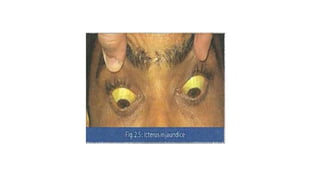
• Yellowish discoloration of skin and mucous membranes
resulting from an increase in bilirubin concentration in body
fluids when serum bilirubin concentration exceeds 3 mg/dl
• Latent Jaundice - clinically non-evident
- only detected by serum analysis
- when the serum bilirubin level is in between
1-3 mg/dl.
Sites to be examined in a patient of jaundice :
Jaundice is always seen in bright natural daylight
1.Upper bulbar conjunctiva
- sclera is examined by retracting the upper eyelids upwards and
asking the patient to look downwards - both eyes at a time
2. Undersurface of tongue (sublingual mucosa)
3. Palate
4. Palms and soles
5. General skin surface
Differential diagnosis of jaundice
1. Carotenaemia (carotenoderma)
—Skin is yellow (mainly the palms and soles) but the sclera and mucous
membrane are unaffected. The serum is also yellow in colour; the stool
and urine are of normal colour.
2. Atabrine toxicity
—previously used in malaria and tapeworm infestations
—Skin, urine and eyes (only the regions of the sclera exposed to light) are
yellow.
3. Diffuse xanthomatosis—Skin takes a yellowish-orange tinge.
4. Muddy sclera—Exposed part of sclera looks dirty yellow; non-pathological
REFERENCE RANGES
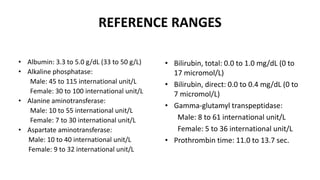
• Albumin: 3.3 to 5.0 g/dL (33 to 50 g/L)
• Alkaline phosphatase:
Male: 45 to 115 international unit/L
Female: 30 to 100 international unit/L
• Alanine aminotransferase:
Male: 10 to 55 international unit/L
Female: 7 to 30 international unit/L
• Aspartate aminotransferase:
Male: 10 to 40 international unit/L
Female: 9 to 32 international unit/L
• Bilirubin, total: 0.0 to 1.0 mg/dL (0 to
17 micromol/L)
• Bilirubin, direct: 0.0 to 0.4 mg/dL (0 to
7 micromol/L)
• Gamma-glutamyl transpeptidase:
Male: 8 to 61 international unit/L
Female: 5 to 36 international unit/L
• Prothrombin time: 11.0 to 13.7 sec.
Types
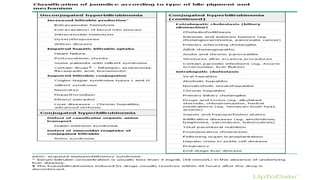
1. Haemolytic (prehepatic)
2. Hepatocellular jaundice (hepatic)
3. Obstructive (posthepatic).
APPROACH
history
• Use of medications, herbal medications, dietary supplements, and
recreational drugs
• Use of alcohol
• Hepatitis risk factors (eg, travel, possible parenteral exposures)
• History of abdominal operations, including gallbladder surgery
• History of inherited disorders, including liver diseases and hemolytic
disorders
• HIV status
• Exposure to toxic substances
• Associated symptoms
- fever, particularly when associated with chills or right upper quadrant pain
and/or a history of prior biliary surgery, is suggestive of acute cholangitis.
- anorexia, malaise, and myalgias may suggest viral hepatitis.
- Right upper quadrant pain suggests extrahepatic biliary obstruction.
- Acholic stool (also termed clay colored stool) can be seen in the acute
cholestatic phase of viral hepatitis and in prolonged near-complete
common bile duct obstruction from cancer of the pancreatic head or the
duodenal ampulla.
Physical examination
 suggest the presence of liver disease and may point to the underlying cause of the
liver disease.
- temporal and proximal muscle wasting suggest longstanding disease.
- Stigmata of liver disease include spider nevi, palmar erythema, gynecomastia, and
caput medusae.
- Ascites or hepatic encephalopathy may be seen in patients with decompensated
cirrhosis.
- Dupuytren's contractures, parotid gland enlargement, and testicular atrophy are
commonly seen in advanced alcoholic cirrhosis and occasionally in other types of
cirrhosis.
- An enlarged left supraclavicular node (Virchow's node) or
periumbilical nodule (Sister Mary Joseph's nodule) suggest an
abdominal malignancy.
- Increased jugular venous pressure, a sign of right-sided heart
failure, suggests hepatic congestion
- A right pleural effusion, in the absence of clinically apparent
ascites, may be seen in advanced cirrhosis.
- Neurologic and psychiatric signs and symptoms may be seen in
patients with Wilson disease.
• The abdominal examination
- size and consistency of the liver
- size of the spleen (a palpable spleen is two to threefold enlarged)
- assessment for ascites (usually by determining whether there is a fluid
wave, shifting dullness, or bulging of the flanks)
• A grossly enlarged, hard, nodular liver or an obvious abdominal mass suggests malignancy.
• An enlarged, tender liver could be due to viral or alcoholic hepatitis or, less often, an acutely
congested liver secondary to right-sided heart failure or Budd-Chiari syndrome
• Severe right upper quadrant tenderness with a positive Murphy's sign (respiratory arrest on
inspiration while pressing on the right upper quadrant) suggests cholecystitis occasionally,
ascending cholangitis.
• Ascites in the presence of jaundice suggests either cirrhosis or malignancy with peritoneal
spread
• Courvoisier sign
- a palpable gallbladder, caused by obstruction distal to the takeoff of the cystic duct by
malignancy
Initial laboratory tests
• serum total and unconjugated bilirubin,
• alkaline phosphatase
• aminotransferases (aspartate aminotransferase [AST] and
alanine aminotransferase [ALT]),
• prothrombin time/international normalized ratio (INR)
• albumin
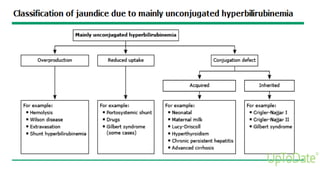
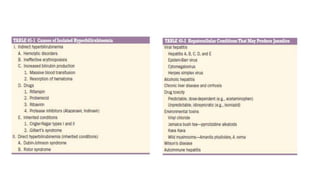
Unconjugated hyperbilirubinemia
- The evaluation of unconjugated hyperbilirubinemia typically
involves evaluation for hemolytic anemia, drugs that impair
hepatic uptake of bilirubin, and Gilbert syndrome
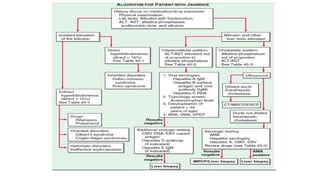
Conjugated hyperbilirubinemia —
• the evaluation will be based on whether the abnormalities are
likely due to biliary obstruction, intrahepatic cholestasis,
hepatocellular injury, or an inherited condition
• Normal alkaline phosphatase and aminotransferases
— the jaundice is likely not due to hepatic injury or biliary tract disease
• Predominant alkaline phosphatase elevation
— biliary obstruction or intrahepatic cholestasis
— granulomatous liver diseases, such as tuberculosis or sarcoidosis
• Predominant aminotransferase elevation
— jaundice is caused by intrinsic hepatocellular disease
— alcoholic hepatitis is associated with a disproportionate elevation of the AST compared with
the ALT
• Elevated INR
— An elevated INR that corrects with vitamin K administration suggests impaired intestinal
absorption of fat-soluble vitamins and is compatible with obstructive jaundice.
— elevated INR that does not correct with vitamin K suggests moderate to severe
hepatocellular disease with impaired synthetic function
• suspected biliary obstruction or intrahepatic cholestasis
— ultrasound, magnetic resonance cholangiopancreatography [MRCP],
endoscopic retrograde cholangiopancreatography [ERCP]) to look for
evidence of intra- or extrahepatic bile duct dilation
• If imaging is negative, the evaluation typically will also include obtaining an
antimitochondrial antibody to evaluate for primary biliary cholangitis
• In the patient with
— low probability of obstruction: abdominal CT should be performed
— dilated biliary ducts are visualized: direct imaging of the biliary tree (eg,
with ERCP) should be performed.
— extrahepatic obstruction : endoscopic ultrasound (EUS) or ERCP
• Suspected hepatocellular injury
- Serologic tests for viral hepatitis
- Measurement of antimitochondrial antibodies (for primary biliary cholangitis)
- Measurement of antinuclear anti-smooth muscle and liver-kidney microsomal
antibodies (for autoimmune hepatitis)
- Serum levels of iron, transferrin, and ferritin (for hemochromatosis)
- Thyroid function tests
- Antibody screening for celiac disease
- Serum levels of ceruloplasmin (for Wilson disease)
- Measurement of alpha-1 antitrypsin activity (for alpha-1 antitrypsin deficiency)
- Testing for adrenal insufficiency
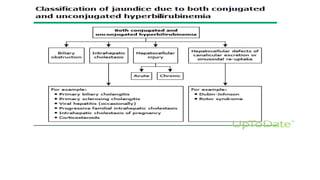
• Isolated conjugated hyperbilirubinemia
- Conjugated hyperbilirubinemia without other routine liver test
abnormalities
- Dubin-Johnson syndrome and Rotor syndrome.
THANK YOU

Approach to jaundice bikal

  • 1.
    APPROACH TO JAUNDICE DrBikal Lamichhane 1st year resident Internal medicine, NAMS
  • 2.
    INTRODUCTION • Yellowish discolorationof skin and mucous membranes resulting from an increase in bilirubin concentration in body fluids when serum bilirubin concentration exceeds 3 mg/dl • Latent Jaundice - clinically non-evident - only detected by serum analysis - when the serum bilirubin level is in between 1-3 mg/dl.
  • 4.
    Sites to beexamined in a patient of jaundice : Jaundice is always seen in bright natural daylight 1.Upper bulbar conjunctiva - sclera is examined by retracting the upper eyelids upwards and asking the patient to look downwards - both eyes at a time 2. Undersurface of tongue (sublingual mucosa) 3. Palate 4. Palms and soles 5. General skin surface
  • 6.
    Differential diagnosis ofjaundice 1. Carotenaemia (carotenoderma) —Skin is yellow (mainly the palms and soles) but the sclera and mucous membrane are unaffected. The serum is also yellow in colour; the stool and urine are of normal colour. 2. Atabrine toxicity —previously used in malaria and tapeworm infestations —Skin, urine and eyes (only the regions of the sclera exposed to light) are yellow. 3. Diffuse xanthomatosis—Skin takes a yellowish-orange tinge. 4. Muddy sclera—Exposed part of sclera looks dirty yellow; non-pathological
  • 7.
    REFERENCE RANGES • Albumin:3.3 to 5.0 g/dL (33 to 50 g/L) • Alkaline phosphatase: Male: 45 to 115 international unit/L Female: 30 to 100 international unit/L • Alanine aminotransferase: Male: 10 to 55 international unit/L Female: 7 to 30 international unit/L • Aspartate aminotransferase: Male: 10 to 40 international unit/L Female: 9 to 32 international unit/L • Bilirubin, total: 0.0 to 1.0 mg/dL (0 to 17 micromol/L) • Bilirubin, direct: 0.0 to 0.4 mg/dL (0 to 7 micromol/L) • Gamma-glutamyl transpeptidase: Male: 8 to 61 international unit/L Female: 5 to 36 international unit/L • Prothrombin time: 11.0 to 13.7 sec.
  • 8.
    Types 1. Haemolytic (prehepatic) 2.Hepatocellular jaundice (hepatic) 3. Obstructive (posthepatic).
  • 10.
    APPROACH history • Use ofmedications, herbal medications, dietary supplements, and recreational drugs • Use of alcohol • Hepatitis risk factors (eg, travel, possible parenteral exposures) • History of abdominal operations, including gallbladder surgery • History of inherited disorders, including liver diseases and hemolytic disorders • HIV status • Exposure to toxic substances • Associated symptoms
  • 11.
    • Associated symptoms -fever, particularly when associated with chills or right upper quadrant pain and/or a history of prior biliary surgery, is suggestive of acute cholangitis. - anorexia, malaise, and myalgias may suggest viral hepatitis. - Right upper quadrant pain suggests extrahepatic biliary obstruction. - Acholic stool (also termed clay colored stool) can be seen in the acute cholestatic phase of viral hepatitis and in prolonged near-complete common bile duct obstruction from cancer of the pancreatic head or the duodenal ampulla.
  • 12.
    Physical examination  suggestthe presence of liver disease and may point to the underlying cause of the liver disease. - temporal and proximal muscle wasting suggest longstanding disease. - Stigmata of liver disease include spider nevi, palmar erythema, gynecomastia, and caput medusae. - Ascites or hepatic encephalopathy may be seen in patients with decompensated cirrhosis. - Dupuytren's contractures, parotid gland enlargement, and testicular atrophy are commonly seen in advanced alcoholic cirrhosis and occasionally in other types of cirrhosis.
  • 13.
    - An enlargedleft supraclavicular node (Virchow's node) or periumbilical nodule (Sister Mary Joseph's nodule) suggest an abdominal malignancy. - Increased jugular venous pressure, a sign of right-sided heart failure, suggests hepatic congestion - A right pleural effusion, in the absence of clinically apparent ascites, may be seen in advanced cirrhosis. - Neurologic and psychiatric signs and symptoms may be seen in patients with Wilson disease.
  • 14.
    • The abdominalexamination - size and consistency of the liver - size of the spleen (a palpable spleen is two to threefold enlarged) - assessment for ascites (usually by determining whether there is a fluid wave, shifting dullness, or bulging of the flanks)
  • 15.
    • A grosslyenlarged, hard, nodular liver or an obvious abdominal mass suggests malignancy. • An enlarged, tender liver could be due to viral or alcoholic hepatitis or, less often, an acutely congested liver secondary to right-sided heart failure or Budd-Chiari syndrome • Severe right upper quadrant tenderness with a positive Murphy's sign (respiratory arrest on inspiration while pressing on the right upper quadrant) suggests cholecystitis occasionally, ascending cholangitis. • Ascites in the presence of jaundice suggests either cirrhosis or malignancy with peritoneal spread • Courvoisier sign - a palpable gallbladder, caused by obstruction distal to the takeoff of the cystic duct by malignancy
  • 16.
    Initial laboratory tests •serum total and unconjugated bilirubin, • alkaline phosphatase • aminotransferases (aspartate aminotransferase [AST] and alanine aminotransferase [ALT]), • prothrombin time/international normalized ratio (INR) • albumin
  • 17.
    Unconjugated hyperbilirubinemia - Theevaluation of unconjugated hyperbilirubinemia typically involves evaluation for hemolytic anemia, drugs that impair hepatic uptake of bilirubin, and Gilbert syndrome
  • 19.
    Conjugated hyperbilirubinemia — •the evaluation will be based on whether the abnormalities are likely due to biliary obstruction, intrahepatic cholestasis, hepatocellular injury, or an inherited condition
  • 21.
    • Normal alkalinephosphatase and aminotransferases — the jaundice is likely not due to hepatic injury or biliary tract disease • Predominant alkaline phosphatase elevation — biliary obstruction or intrahepatic cholestasis — granulomatous liver diseases, such as tuberculosis or sarcoidosis • Predominant aminotransferase elevation — jaundice is caused by intrinsic hepatocellular disease — alcoholic hepatitis is associated with a disproportionate elevation of the AST compared with the ALT • Elevated INR — An elevated INR that corrects with vitamin K administration suggests impaired intestinal absorption of fat-soluble vitamins and is compatible with obstructive jaundice. — elevated INR that does not correct with vitamin K suggests moderate to severe hepatocellular disease with impaired synthetic function
  • 22.
    • suspected biliaryobstruction or intrahepatic cholestasis — ultrasound, magnetic resonance cholangiopancreatography [MRCP], endoscopic retrograde cholangiopancreatography [ERCP]) to look for evidence of intra- or extrahepatic bile duct dilation • If imaging is negative, the evaluation typically will also include obtaining an antimitochondrial antibody to evaluate for primary biliary cholangitis • In the patient with — low probability of obstruction: abdominal CT should be performed — dilated biliary ducts are visualized: direct imaging of the biliary tree (eg, with ERCP) should be performed. — extrahepatic obstruction : endoscopic ultrasound (EUS) or ERCP
  • 23.
    • Suspected hepatocellularinjury - Serologic tests for viral hepatitis - Measurement of antimitochondrial antibodies (for primary biliary cholangitis) - Measurement of antinuclear anti-smooth muscle and liver-kidney microsomal antibodies (for autoimmune hepatitis) - Serum levels of iron, transferrin, and ferritin (for hemochromatosis) - Thyroid function tests - Antibody screening for celiac disease - Serum levels of ceruloplasmin (for Wilson disease) - Measurement of alpha-1 antitrypsin activity (for alpha-1 antitrypsin deficiency) - Testing for adrenal insufficiency
  • 24.
    • Isolated conjugatedhyperbilirubinemia - Conjugated hyperbilirubinemia without other routine liver test abnormalities - Dubin-Johnson syndrome and Rotor syndrome.
  • 27.