Diversification into other sources of energy. Negligible Greenhouse Gases effects Abundant reserves of Thorium in India & modest reserves of natural uranium. Thorium deposits in India can sustain about 300,000 MWe of power generation for 300 years.  Proven and safe technologies but requires stringent Safety and Quality norms Energy Security Reasons for India's foray into Nuclear Power   J S Arora
GLOBAL  ENERGY SCENARIO J S Arora
World Production of Electricity by the Fuel   J S Arora
Global status of Nuclear power (Source: IAEA) Projections for 2030 Low case Scenario 473 GWe (27% higher) High case Scenario 748 GWe (100% higher) J S Arora In operation Under construction No of reactors 439 nos 38 nos Capacity 372 GWe 32.6 GWe
Reactors in operation Source: IAEA Status as in Oct-2008 J S Arora
Nuclear share in domestic electricity generation Source: IAEA Status as in Dec-2007 J S Arora
INDIA’S ENERGY SCENARIO J S Arora
India’s total installed Power generation capacity Installed capacity : 147 GW Status as on 30.04.09 Source : CEA J S Arora
Demand Projections J S Arora Year Projected Peak Demand (GW) Installed Capacity Reqd (GW) 2011-12 158 220 2021-22 335 441 2031-32 655 861 2041-42 1054 1381 2051-52 1415 1854
Optimistic scenario in 2050 J S Arora Installed capacity to meet demand 18  Lakh MW Nuclear Power 2.75 Lakh MW Hydro Power 3.00 Lakh MW Renewables 2.50 Lakh MW Lignite and Gas 1.50  Lakh MW Coal 8.25  Lakh MW
Optimistic scenario in 2050 J S Arora
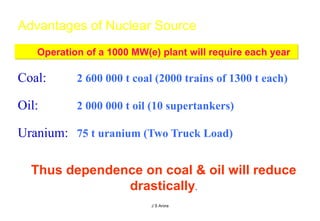
Advantages of Nuclear Source Coal:   2 600 000 t coal (2000 trains of 1300 t each) Oil:   2 000 000 t oil (10 supertankers) Uranium:   75 t uranium (Two Truck Load) Thus dependence on coal & oil will reduce drastically . Operation of a 1000 MW(e) plant will require each year J S Arora
CDM benefits of Nuclear Power CDM : Clean Development Mechanism J S Arora     THERMAL (2000 MW) NUCLEAR (2000 MW) GHG intensity in gm of CO 2 /Kwh 941 60 Total annual emission in tonnes of CO 2 14013372 893520 Emission reduction in comparison to thermal  0 13119852 Total annual benefit in million dollars taking  $10/CER 0 131.19 Total annual benefit in crores of  Rs (1USD= Rs 50) 0 655.95
NUCLEAR REACTOR TECHNOLOGIES J S Arora
Splitting or breaking an atom nucleus into parts . Fission Vs Fusion Joining nuclei together to  form a heavier nucleus J S Arora
Can Undergo Fission Fissile Vs Fertile Materials Uranium-235  Plutonium-239 Uranium-233 Thorium-232  Uranium-234  Uranium-238 Cannot Undergo Fission Gets convered to   Fissile material FISSILE FERTILE J S Arora
A slow moving neutron induces fission  in Uranium 235 J S Arora
Nuclear Chain Reaction J S Arora
Moderator Velocity 13800-30000 km/s Velocity 3 km/s J S Arora
Control Rods J S Arora Control rods Fuel  Assemblies Withdraw control rods, reaction increases Insert control rods, reaction decreases
Basic functional requirements a fuel such as U-235 a moderator to thermalize (i.e., slow down) the fast neutrons  a coolant to remove the heat  a control system to control the number of neutrons  a shielding system to protect equipment and people from radiation  a system that pulls all this together into a workable device. J S Arora
Generation of Reactors / III + J S Arora
PWR (Pressurized Water Reactor) BWR (Boiling Water Reactor) PHWR (Pressurized Heavy Water Reactor) HTGCR (High Temperature Gas Cooled Reactor) e) LMCR (Liquid Metal Cooled Reactor) Types of Reactors J S Arora
Pressurized light water reactor J S Arora Parameter Value Heat Capacity – per SG in 4 loop system 750 MWt Steam Generation 1449 T/h Primary Water Temp - Inlet 322 0  C Primary Water Temp - Outlet 290 0  C Primary water pressure 16 Mpa Steam pressure – Outlet 6.4 Mpa Feed water temp - Inlet 220 +/- 5 0  C Steam Temp - Outlet 280 0  C
Types of modern pressurized water reactors J S Arora Make Type Certification Status 1 Westinghouse (USA) AP–1000 (1100 MWe) Design Certification done in Dec 2005.  Being built in China. 2 Areva (France) EPR (1600 -1750 MWe) Being built in France ,Finland and  China. Under design certification in US. 3 Gidopress (Russia) VVER 1000 (1000 MWe) Two being built in Kudankulam, India. VVER 1200 (1200 MWe) Replacement for existing plants in  Russia. Operation to start in 2013. 4 Korean Reactors System 80+ (1300 MWe) Design derived from Westinghouse.  Design Certification obtained in May -97 APR – 1400 (1450 MWe) Design derived from Westinghouse. First  unit expected by 2012.
AP 1000 Building cut away J S Arora
Boiling water reactors J S Arora
Types of modern boiling water reactors J S Arora Make Type Certification Status 1 GE- Hitachi (USA) ABWR(1350 MWe) Under Operation in Japan since 1996-97. US  NRC Design Certification obtained in May 1997 2 GE - USA ESBWR(1560 MWe) At pre-application stage for NRC design  certification in the USA 3 Hitachi- Japan ABWR(600-1700 MWe) Design completed in  Japan. At pre application  stage for certification. 4 Areva- France SWR – 1000 (1200-1290 MWe) Design completed in  1999. Application submitted \ for US – NRC certification. 5 Westinghouse(USA) BWR 90+ (1500 MWe) Under design development.
Pressurized Heavy Water Reactors (PHWRs) J S Arora
Types of pressurized heavy water reactors J S Arora SN Make Type Certification Status 1 AECL Canada CANDU-6 (750 MWe) Enhanced model Licensing approval 1997 2 CANDU-9  (925 MWe) 3 ACR 700 (700 MWe) Undergoing certification in Canada  4 ACR 1000 (1000-1200 MWe) 5 India PHWR  540 MWe In operation 6 PHWR- 700 MWe Modified version of 540MWe PHWRs. Yet to be built 7 AHWR- 300 MWe Under Design  to use Thorium – Uranium oxide and Thorium Plutonium oxide fuel.
High temperature gas cooled reactors J S Arora
Fast  breeder  reactors J S Arora
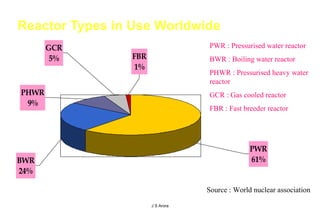
Reactor Types in Use Worldwide PWR : Pressurised water reactor BWR : Boiling water reactor PHWR : Pressurised heavy water reactor GCR : Gas cooled reactor FBR : Fast breeder reactor Source : World nuclear association J S Arora
NUCLEAR FUEL CYCLE J S Arora
Nuclear Fuel Cycle J S Arora
Nuclear Fuel Bundle (typical) No of fuel rods in each bundle=312 nos No of fuel bundles=163 nos J S Arora
Fuel bundles in reactor core LPRM : Local power range monitor J S Arora
High level Waste Includes spent fuel used in reactor & highly radioactive Must be cooled for 3-5 years in pools inside the plant  Should be kept safely isolated from the environment for very long periods for hundreds of thousands of years Low level Waste From reactors, hospitals etc Less radioactive shipped to low-level waste disposal facilities. There, it is packaged, buried in trenches and covered with soil.  Nuclear waste J S Arora
NUCLEAR RADIATION  EXPOSURE J S Arora
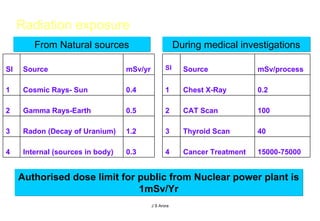
Radiation exposure ) - From Natural sources During medical investigations Authorised dose limit for public from Nuclear power plant is 1mSv/Yr J S Arora Sl Source mSv/yr 1 Cosmic Rays- Sun 0.4 2 Gamma Rays-Earth 0.5 3 Radon (Decay of Uranium) 1.2 4 Internal (sources in body) 0.3 Sl Source mSv/process 1 Chest X-Ray 0.2 2 CAT Scan 100 3 Thyroid Scan 40 4 Cancer Treatment 15000-75000
Radiation Doses Life Threatening Dose is illustrated as height of Eiffel Tower,  Dose limit for Occupational Worker as height of man  Dose limit for public as thickness of a brick 0.075 Meters J S Arora
Safety barriers J S Arora
NUCLEAR POWER IN INDIA J S Arora
Three stage  nuclear power program of India J S Arora
Stage – III(U233-Th) POTENTIAL    Very Large.  Stage – I (Natural U) POTENTIAL    10 GWe Current status of the Three stage program Stage – II (Pu-Th) POTENTIAL     350 GWe PHWRs  –  in operation LWRs  –  under construction FBRs  –  under construction/ planning AHWRs  –  under planning J S Arora
Signing of 123 Agreement- Aug 2007 Safeguards agreement – August 2008 Nuclear Security Group (NSG) waiver - September 2008 Bilateral agreement with France -  September 2008  Approval by US senate - October 2008 Bilateral agreement with Russia - December 2008 Steps towards civilian Nuclear cooperation J S Arora
Indian Nuclear Power Program- Targets Planned capacity by 2020 : 21780 MWe Target capacity by 2030 : 63000 MWe J S Arora Reactors Capacity (MWe) Cum Capacity (MWe) In Operation 4120 4120 Under Constn. (3*220 + 2*1000 + 1*500) 3100 6780
Differences Nuclear Vs Thermal Power Plants J S Arora
Differences- Nuclear versus Thermal J S Arora
Upto 1.6 km radius     - No public habitation From 1.6 km to 5 km radius   - Maximum population < = 20,000 From 5 km to 10 km radius   - Population centres with population < 10,000 -Population density < 2/3 rd of State Average From 10 km to 30 km radius   - Population centres with population <  1,00,000   The distances mentioned  in km are from reactor centre Comparison of siting criteria J S Arora
Population Criteria contd… Google Earth  Software Global position  survey instrument GPS J S Arora
Comparison of seismotectonic requirements J S Arora
Comparison of  land requirements For 6 x 1000 MW units Main  plant  : 500 acres Grand Total  :  3000 acres(*)   (*)  includes area covered by1.6 km (Exclusion zone) &  land for township located outside the 5 km zone. Source : CEA report For 5 x 800 MW units Main  plant  : 1170 acres Grand Total  :  2770 acres(*)   (*)  includes land for township . J S Arora
Comparison of water requirements J S Arora Nuclear(2000 MW) Thermal (2000 MW) Once through system (Sea water) 4,00,000 m 3 /hr 2,40,000 m 3 /hr Fresh water Make up 1000 m 3 /hr 700 m 3 /hr Closed system  –  CT  30000  m 3 /hr 12000  m 3 /hr
Comparison  of Fuel requirements 500 MW plant operating continuously for 24 hours generates 12 million Units of Electricity requires 36 kg of Enriched  Uranium Or 288 kg of Natural Uranium Or 8400 mt of Coal J S Arora
Comparison of steam parameters J S Arora Plant type Main Steam Pr Main Steam Temp Efficiency   Kg/sq cm Deg C % Coal-Conventional 165 538 ~ 37 Coal- Supercritical 290 580 ~ 39 Coal- Ultra supercritical 365 700 ~ 42 Nuclear-PWR 60 284 ~ 34 Nuclear-BWR 70 290 ~ 34 Nuclear-PHWR 44 253 ~ 32 500 MW Coal fired 1725 tonnes/hr 500 MW Nuclear 2777 tonnes/hr
Comparison of steam turbines J S Arora
Comparison of layout J S Arora Facilities only in NPP Reactor Wet steam turbines Spent fuel storage Waste management Stack-45 m Auxillary control room Facilities only in TPP Steam generator Mills Fans Coal handling plant Ash handling plant Ash dyke Chimney-275 m
Comparison of Civil works J S Arora Nuclear Thermal Foundation  Preferably on rock- may go even up to a depth of 20m ~4 m Use of piling Not preferred  Allowed Concrete grade M 60 M 25- M 30 Excavation and concreting (500 MW ) 6,00,000 cu m ~2,00,000 cum
Comparison of costs It is estimated that decommissioning costs represent 10-15% of capital cost of nuclear plant and is built into the tariff. Economics of nuclear power would be improved in the near term if nuclear were  elegible for carbon trading schemes associated with reduction of GHG J S Arora Nuclear Thermal Fixed cost 75% 50-60% Variable cost 25% 40-50%
India And Nuclear Power J S Arora
CAPACITY MIX - 2012 (50,000 MW) CAPACITY MIX - 2017 (75,000 MW) CAPACITY MIX - TODAY (30,144 MW) INSTALLED CAPACITY CAGR FOR INDIA –  9.6% INSTALLED CAPACITY CAGR FOR India  – 10.6% Diversifying Fuel Mix  J S Arora COAL 40000 GAS 8000 HYDRO 2000 COAL 24709 GAS 5435 COAL 53000 GAS 10000 HYDRO 9000 NUCLEAR 2000 RENEWABLE 1000
NUCLEAR POWER  KEY ISSUES AND CHALLENGES J S Arora
Nuclear power capacity addition- Key issues   Amendement of Civil nuclear liability act Fuel policy of Govt of India Availability of Nuclear sites Availability of Skilled Manpower FDI in Nuclear utilities Augmentation in domestic manufacturing capabilities Amendment of Atomic Energy Act J S Arora

Nuclear power scenerio

  • 1.
    Diversification into othersources of energy. Negligible Greenhouse Gases effects Abundant reserves of Thorium in India & modest reserves of natural uranium. Thorium deposits in India can sustain about 300,000 MWe of power generation for 300 years. Proven and safe technologies but requires stringent Safety and Quality norms Energy Security Reasons for India's foray into Nuclear Power J S Arora
  • 2.
    GLOBAL ENERGYSCENARIO J S Arora
  • 3.
    World Production ofElectricity by the Fuel J S Arora
  • 4.
    Global status ofNuclear power (Source: IAEA) Projections for 2030 Low case Scenario 473 GWe (27% higher) High case Scenario 748 GWe (100% higher) J S Arora In operation Under construction No of reactors 439 nos 38 nos Capacity 372 GWe 32.6 GWe
  • 5.
    Reactors in operationSource: IAEA Status as in Oct-2008 J S Arora
  • 6.
    Nuclear share indomestic electricity generation Source: IAEA Status as in Dec-2007 J S Arora
  • 7.
  • 8.
    India’s total installedPower generation capacity Installed capacity : 147 GW Status as on 30.04.09 Source : CEA J S Arora
  • 9.
    Demand Projections JS Arora Year Projected Peak Demand (GW) Installed Capacity Reqd (GW) 2011-12 158 220 2021-22 335 441 2031-32 655 861 2041-42 1054 1381 2051-52 1415 1854
  • 10.
    Optimistic scenario in2050 J S Arora Installed capacity to meet demand 18 Lakh MW Nuclear Power 2.75 Lakh MW Hydro Power 3.00 Lakh MW Renewables 2.50 Lakh MW Lignite and Gas 1.50 Lakh MW Coal 8.25 Lakh MW
  • 11.
    Optimistic scenario in2050 J S Arora
  • 12.
    Advantages of NuclearSource Coal: 2 600 000 t coal (2000 trains of 1300 t each) Oil: 2 000 000 t oil (10 supertankers) Uranium: 75 t uranium (Two Truck Load) Thus dependence on coal & oil will reduce drastically . Operation of a 1000 MW(e) plant will require each year J S Arora
  • 13.
    CDM benefits ofNuclear Power CDM : Clean Development Mechanism J S Arora     THERMAL (2000 MW) NUCLEAR (2000 MW) GHG intensity in gm of CO 2 /Kwh 941 60 Total annual emission in tonnes of CO 2 14013372 893520 Emission reduction in comparison to thermal 0 13119852 Total annual benefit in million dollars taking $10/CER 0 131.19 Total annual benefit in crores of Rs (1USD= Rs 50) 0 655.95
  • 14.
  • 15.
    Splitting or breakingan atom nucleus into parts . Fission Vs Fusion Joining nuclei together to form a heavier nucleus J S Arora
  • 16.
    Can Undergo FissionFissile Vs Fertile Materials Uranium-235 Plutonium-239 Uranium-233 Thorium-232 Uranium-234 Uranium-238 Cannot Undergo Fission Gets convered to Fissile material FISSILE FERTILE J S Arora
  • 17.
    A slow movingneutron induces fission in Uranium 235 J S Arora
  • 18.
  • 19.
    Moderator Velocity 13800-30000km/s Velocity 3 km/s J S Arora
  • 20.
    Control Rods JS Arora Control rods Fuel Assemblies Withdraw control rods, reaction increases Insert control rods, reaction decreases
  • 21.
    Basic functional requirementsa fuel such as U-235 a moderator to thermalize (i.e., slow down) the fast neutrons a coolant to remove the heat a control system to control the number of neutrons a shielding system to protect equipment and people from radiation a system that pulls all this together into a workable device. J S Arora
  • 22.
    Generation of Reactors/ III + J S Arora
  • 23.
    PWR (Pressurized WaterReactor) BWR (Boiling Water Reactor) PHWR (Pressurized Heavy Water Reactor) HTGCR (High Temperature Gas Cooled Reactor) e) LMCR (Liquid Metal Cooled Reactor) Types of Reactors J S Arora
  • 24.
    Pressurized light waterreactor J S Arora Parameter Value Heat Capacity – per SG in 4 loop system 750 MWt Steam Generation 1449 T/h Primary Water Temp - Inlet 322 0 C Primary Water Temp - Outlet 290 0 C Primary water pressure 16 Mpa Steam pressure – Outlet 6.4 Mpa Feed water temp - Inlet 220 +/- 5 0 C Steam Temp - Outlet 280 0 C
  • 25.
    Types of modernpressurized water reactors J S Arora Make Type Certification Status 1 Westinghouse (USA) AP–1000 (1100 MWe) Design Certification done in Dec 2005. Being built in China. 2 Areva (France) EPR (1600 -1750 MWe) Being built in France ,Finland and China. Under design certification in US. 3 Gidopress (Russia) VVER 1000 (1000 MWe) Two being built in Kudankulam, India. VVER 1200 (1200 MWe) Replacement for existing plants in Russia. Operation to start in 2013. 4 Korean Reactors System 80+ (1300 MWe) Design derived from Westinghouse. Design Certification obtained in May -97 APR – 1400 (1450 MWe) Design derived from Westinghouse. First unit expected by 2012.
  • 26.
    AP 1000 Buildingcut away J S Arora
  • 27.
  • 28.
    Types of modernboiling water reactors J S Arora Make Type Certification Status 1 GE- Hitachi (USA) ABWR(1350 MWe) Under Operation in Japan since 1996-97. US NRC Design Certification obtained in May 1997 2 GE - USA ESBWR(1560 MWe) At pre-application stage for NRC design certification in the USA 3 Hitachi- Japan ABWR(600-1700 MWe) Design completed in Japan. At pre application stage for certification. 4 Areva- France SWR – 1000 (1200-1290 MWe) Design completed in 1999. Application submitted \ for US – NRC certification. 5 Westinghouse(USA) BWR 90+ (1500 MWe) Under design development.
  • 29.
    Pressurized Heavy WaterReactors (PHWRs) J S Arora
  • 30.
    Types of pressurizedheavy water reactors J S Arora SN Make Type Certification Status 1 AECL Canada CANDU-6 (750 MWe) Enhanced model Licensing approval 1997 2 CANDU-9 (925 MWe) 3 ACR 700 (700 MWe) Undergoing certification in Canada 4 ACR 1000 (1000-1200 MWe) 5 India PHWR 540 MWe In operation 6 PHWR- 700 MWe Modified version of 540MWe PHWRs. Yet to be built 7 AHWR- 300 MWe Under Design to use Thorium – Uranium oxide and Thorium Plutonium oxide fuel.
  • 31.
    High temperature gascooled reactors J S Arora
  • 32.
    Fast breeder reactors J S Arora
  • 33.
    Reactor Types inUse Worldwide PWR : Pressurised water reactor BWR : Boiling water reactor PHWR : Pressurised heavy water reactor GCR : Gas cooled reactor FBR : Fast breeder reactor Source : World nuclear association J S Arora
  • 34.
  • 35.
  • 36.
    Nuclear Fuel Bundle(typical) No of fuel rods in each bundle=312 nos No of fuel bundles=163 nos J S Arora
  • 37.
    Fuel bundles inreactor core LPRM : Local power range monitor J S Arora
  • 38.
    High level WasteIncludes spent fuel used in reactor & highly radioactive Must be cooled for 3-5 years in pools inside the plant Should be kept safely isolated from the environment for very long periods for hundreds of thousands of years Low level Waste From reactors, hospitals etc Less radioactive shipped to low-level waste disposal facilities. There, it is packaged, buried in trenches and covered with soil. Nuclear waste J S Arora
  • 39.
    NUCLEAR RADIATION EXPOSURE J S Arora
  • 40.
    Radiation exposure )- From Natural sources During medical investigations Authorised dose limit for public from Nuclear power plant is 1mSv/Yr J S Arora Sl Source mSv/yr 1 Cosmic Rays- Sun 0.4 2 Gamma Rays-Earth 0.5 3 Radon (Decay of Uranium) 1.2 4 Internal (sources in body) 0.3 Sl Source mSv/process 1 Chest X-Ray 0.2 2 CAT Scan 100 3 Thyroid Scan 40 4 Cancer Treatment 15000-75000
  • 41.
    Radiation Doses LifeThreatening Dose is illustrated as height of Eiffel Tower, Dose limit for Occupational Worker as height of man Dose limit for public as thickness of a brick 0.075 Meters J S Arora
  • 42.
  • 43.
    NUCLEAR POWER ININDIA J S Arora
  • 44.
    Three stage nuclear power program of India J S Arora
  • 45.
    Stage – III(U233-Th)POTENTIAL  Very Large. Stage – I (Natural U) POTENTIAL  10 GWe Current status of the Three stage program Stage – II (Pu-Th) POTENTIAL  350 GWe PHWRs – in operation LWRs – under construction FBRs – under construction/ planning AHWRs – under planning J S Arora
  • 46.
    Signing of 123Agreement- Aug 2007 Safeguards agreement – August 2008 Nuclear Security Group (NSG) waiver - September 2008 Bilateral agreement with France - September 2008 Approval by US senate - October 2008 Bilateral agreement with Russia - December 2008 Steps towards civilian Nuclear cooperation J S Arora
  • 47.
    Indian Nuclear PowerProgram- Targets Planned capacity by 2020 : 21780 MWe Target capacity by 2030 : 63000 MWe J S Arora Reactors Capacity (MWe) Cum Capacity (MWe) In Operation 4120 4120 Under Constn. (3*220 + 2*1000 + 1*500) 3100 6780
  • 48.
    Differences Nuclear VsThermal Power Plants J S Arora
  • 49.
    Differences- Nuclear versusThermal J S Arora
  • 50.
    Upto 1.6 kmradius - No public habitation From 1.6 km to 5 km radius - Maximum population < = 20,000 From 5 km to 10 km radius - Population centres with population < 10,000 -Population density < 2/3 rd of State Average From 10 km to 30 km radius - Population centres with population < 1,00,000 The distances mentioned in km are from reactor centre Comparison of siting criteria J S Arora
  • 51.
    Population Criteria contd…Google Earth Software Global position survey instrument GPS J S Arora
  • 52.
    Comparison of seismotectonicrequirements J S Arora
  • 53.
    Comparison of land requirements For 6 x 1000 MW units Main plant : 500 acres Grand Total : 3000 acres(*) (*) includes area covered by1.6 km (Exclusion zone) & land for township located outside the 5 km zone. Source : CEA report For 5 x 800 MW units Main plant : 1170 acres Grand Total : 2770 acres(*) (*) includes land for township . J S Arora
  • 54.
    Comparison of waterrequirements J S Arora Nuclear(2000 MW) Thermal (2000 MW) Once through system (Sea water) 4,00,000 m 3 /hr 2,40,000 m 3 /hr Fresh water Make up 1000 m 3 /hr 700 m 3 /hr Closed system – CT 30000 m 3 /hr 12000 m 3 /hr
  • 55.
    Comparison ofFuel requirements 500 MW plant operating continuously for 24 hours generates 12 million Units of Electricity requires 36 kg of Enriched Uranium Or 288 kg of Natural Uranium Or 8400 mt of Coal J S Arora
  • 56.
    Comparison of steamparameters J S Arora Plant type Main Steam Pr Main Steam Temp Efficiency   Kg/sq cm Deg C % Coal-Conventional 165 538 ~ 37 Coal- Supercritical 290 580 ~ 39 Coal- Ultra supercritical 365 700 ~ 42 Nuclear-PWR 60 284 ~ 34 Nuclear-BWR 70 290 ~ 34 Nuclear-PHWR 44 253 ~ 32 500 MW Coal fired 1725 tonnes/hr 500 MW Nuclear 2777 tonnes/hr
  • 57.
    Comparison of steamturbines J S Arora
  • 58.
    Comparison of layoutJ S Arora Facilities only in NPP Reactor Wet steam turbines Spent fuel storage Waste management Stack-45 m Auxillary control room Facilities only in TPP Steam generator Mills Fans Coal handling plant Ash handling plant Ash dyke Chimney-275 m
  • 59.
    Comparison of Civilworks J S Arora Nuclear Thermal Foundation Preferably on rock- may go even up to a depth of 20m ~4 m Use of piling Not preferred Allowed Concrete grade M 60 M 25- M 30 Excavation and concreting (500 MW ) 6,00,000 cu m ~2,00,000 cum
  • 60.
    Comparison of costsIt is estimated that decommissioning costs represent 10-15% of capital cost of nuclear plant and is built into the tariff. Economics of nuclear power would be improved in the near term if nuclear were elegible for carbon trading schemes associated with reduction of GHG J S Arora Nuclear Thermal Fixed cost 75% 50-60% Variable cost 25% 40-50%
  • 61.
    India And NuclearPower J S Arora
  • 62.
    CAPACITY MIX -2012 (50,000 MW) CAPACITY MIX - 2017 (75,000 MW) CAPACITY MIX - TODAY (30,144 MW) INSTALLED CAPACITY CAGR FOR INDIA – 9.6% INSTALLED CAPACITY CAGR FOR India – 10.6% Diversifying Fuel Mix J S Arora COAL 40000 GAS 8000 HYDRO 2000 COAL 24709 GAS 5435 COAL 53000 GAS 10000 HYDRO 9000 NUCLEAR 2000 RENEWABLE 1000
  • 63.
    NUCLEAR POWER KEY ISSUES AND CHALLENGES J S Arora
  • 64.
    Nuclear power capacityaddition- Key issues Amendement of Civil nuclear liability act Fuel policy of Govt of India Availability of Nuclear sites Availability of Skilled Manpower FDI in Nuclear utilities Augmentation in domestic manufacturing capabilities Amendment of Atomic Energy Act J S Arora

Editor's Notes

  • #16 Everyone is familiar with Einstein’s formula E = mc2 , which is more accurately expressed as: This formula states that mass and energy are two forms of the same reality that can be interchanged under certain conditions, The total mass of a nucleus is thus lower than the sum of the masses of all the protons and all the neutrons that make it up, and the difference in mass is the binding energy of the nucleus The most stable combination of nucleons happens to be a medium-sized nucleus. This means that if two light nuclei can be fused to form a medium-sized nucleus, some binding energy will be released, and if a heavy nucleus can be split into two medium-sized nuclei, this energy can also be harnessed. These two phenomena are known respectively as thermonuclear fusion and fission.
  • #17 Fissile Fertile
  • #18 Fission energy released from 1 Kg of U 235 is equivalent to combusion of 3000 MT of coal or 1000 cu m of oil.
  • #19 Fission energy released from 1 Kg of U 235 is equivalent to combusion of 3000 MT of coal or 1000 cu m of oil.
  • #20 If the neutron travels very fast it may not strike another U-235 nuclei and the chain reaction may not be sustained. Hence a moderator is used to slow down the neutrons. Moderators used are Light water Heavy Water Graphite.
  • #21 Control rods are concentrated neutron absorbers which can be moved into or out of the core to change the rate of fissioning in the reactor. Rod insertion adds neutron poisons to the core area, which makes fewer neutrons available to cause fission. This causes the fission rate to decrease, which results in a reduction in heat production and power. Pulling the control rods out of the core removes poisons from the core area allowing more neutrons to cause fissions and increasing reactor power and heat production.
  • #39 Low-level waste includes slightly contaminated clothing and items that comes from places such as nuclear medicine wards in hospitals, research laboratories and nuclear plants. Low-level waste contains only small amounts of radioactivity that decays away in hours or days. After the radioactivity has decayed, low-level waste can be treated like ordinary garbage. Intermediate-level wastes mostly come from the nuclear industry. They include used reactor components and contaminated materials from reactor decommissioning. Typically these wastes are embedded in concrete for disposal and buried. High-level waste generally describes spent fuel from nuclear reactors. Spent nuclear fuel from nuclear power plants is initially stored in large water-filled pools. The water provides shielding from the radiation and cooling to remove the heat, which continues to be generated by the radioactive material in the spent fuel. After several years, when the radioactivity and its associated heat have diminished, the fuel is transferred to medium-term storage near the nuclear power plants. The nuclear industry is evaluating long-term storage of high-level waste. While spent fuel is safely stored at nuclear plant sites today, the storage facilities were never intended for permanent storage. Countries operating nuclear power reactors are conducting extensive studies on how high-level wastes should be disposed. Research indicates the ideal permanent storage disposal is in deep underground caverns in stable geological formations.
  • #41 Becquerel : Number of disintegration/decay of radioactive atoms per second Gray : Quantity of radioactivity absorbed per unit mass of body (Joule/kg) Sievet :Takes into account biological effects of different kinds of radiation.Gray is multiplied by radiation type dependent factor to get Sievet.
  • #49 Nuclear Reactors - The heart of the Nuclear plant is a specially designed equipment to initiate , maintain and control a nuclear fission chain reaction so that the accompanying heat can be used fruitfully. In other words the nuclear reactor can be portrayed as a furnace in which heat is produced because of fission chain reaction. The reactor building has a height of 72 m and 46 m diameter And dome shaped structure in the top
  • #50 Life Explained On the first day. God created the cow. God said “You must go to the field along with the farmer all day long and suffer under the hot sun, give birth to calves and also give milk to farmer. I will give you a life span of 60 years. The cow replied “ That is a tough life which you want me to lead” So please allot me only 20 year life span and take back 40 years. God agreed. On the second day god created the monkey. He said Do monkey tricks, Entertain people, and make them laugh. I will give you a life span of 20 years. The monkey replied “ How boring to perform monkey tricks for 20 years”. So please allot me only 10 year life span and take back 10 years. God agreed. On the third day god created the dog. Sit in all day by the door of your house and bark at anyone who passes by. I will give you a life span of 20 years. The dog replied “ 20 years is too long a period for barking”. So please allot me only 10 year life span and take back 10 years. God agreed. On the fourth day god created man. He said you have to do nothing. Eat sleep and enjoy. I will give you a life span of 20 years The man replied What only 20. I will take the 40 left by the cow and 10 each left by monkey and dog. That makes man’s life span 80. God agreed. So it is in the first twenty years we enjoy life. For the next 40 years we slave in the sun to support our family. For the next 10 years we do monkey tricks to entertain our grandchildren. For the last 10 years we sit in front of the porch and bark at everyone. Life has now been explained.
  • #52 Toposheet Mark 2 km X 1 km area Draw circles Note down villages and find population We have Google earth software- Helpful in preliminary location GPS instrument gives the latitude/longitude and helpful in site survey (Rs 10000-Rs 80000)
  • #53 Most other, nuclear plants are designed to withstand earthquakes, and in the event of major earth movement, to shut down safely. A fault is said to be capable if it shows evidence of movement at or near the surface within the past one half million years. Investigations An assessment of seismotectonic analysis by an expert agency. This has to be in combination with geological assessment. Initial stage analysis shall ensure that the site does not suffer any rejection criteria and the plant can be engineered safely meeting the AERB criteria. At later stage, seismic instruments may also be required to be set up to assess tectonic activity for a period of one year. For study of faults in ocean area expert agencies like NIO can be associated.
  • #54 It may be noted that the land required for reactor and auxillaries (6 x 1000 mw ) is only 500 acres as compared to 1170 acres required for locating main plant of 5 x 800 mw coal plant. However in view of exclusion zone requirements in case of Nuclear the overall land requirement is almost same as thermal It may be noted that township is placed outside the 5 km zone
  • #55 The cooling water system for nuclear power plants will be larger and more expensive than for fossil fuel facilities due to lower efficiencies of the nuclear plant. Typically 1.5 times the requirement in thermal plants Besides in nuclear there is a requirement of ultimate heat sink (*)Typical water requirements in case of an emergency after an accident is in the range of 2000 to 7000 m3/hr For an inland site this water is sourced from a nearby water body called Ultimate heat sink which needs to provide cooling water for 30 days after the accident.
  • #57 Steam flow(T/hr) PWR-1000 MW 1910 BWR-1000 MW 7500 PHWR-220 MW 1172 PHWR-540 MW 2777
  • #58 Steam flow(T/hr) PWR-1000 MW 1910 BWR-1000 MW 7500 PHWR-220 MW 1172 PHWR-540 MW 2777 In view of large steam flow at saturated conditions the steam turbines are large and bulky and more costly Kudan 1 hp + 3 lp The exhaust steam from the high-pressure turbine is dried and superheated as it flows through the two combined moisture separator reheaters standing on either side of the high-pressure turbine to reduce the final moisture in the low pressure turbine. The heating steam for reheating is taken from the main steam downstream of the turbine emergency stop valves
  • #63 While projects totaling 4,000 MW have already been commissioned during the first 4 years of the Xth plan period, projects totaling 9470 MW are at various stages of implementation. Another 5080 MW is under development. In addition, India would diversify its generation portfolio with increasing presence in Gas and Hydro projects.
  • #65 In July 2008, the DAE said that the large energy gap projected for 2050 could be bridged if 40 GWe capacity PWRs plus Uranium to fuel them were imported during 2012-20. This would sideline the 3 stage indigenous thorium based policy. Used fuel from these PWRs would be reprocessed and the Plutonium used to launch a series of FBRs, which would largely eliminate the energy deficit in 2050.