Condition Monitoring (CM)
Condition monitoring is the use of advanced
technologies to determine the condition of
equipment and predict its failure.  This in turn
should inform predictive maintenance (PM) or
reliability-centred maintenance (RCM). 
Techniques that can be used include:
• the Human Senses
  – look, listen, smell, taste, feel etc.
• Motor Current Analysis
• Oil Analysis and Tribology
• Non-destructive testing (NDT)
1. Integrated condition monitoring
service (ICMS)
proposes that "integrated condition
monitoring helps optimise maintenance by
judging the health of machinery using non-
invasive sensing technology". 
The benefits of an ICMS approach
 are:
• early detection of impending machinery failure to
  help lower the risk of unscheduled downtime
• scheduling and utilisation of maintenance
  resources is more efficient
• reductions in time spent in dry dock, if a pre-dry-
  docking fault locating survey is performed
• reduced likelihood of ‘maintenance induced’
  failures
• availability of global condition monitoring data.
2. Risk-Based Inspection (RBI)
• a method for deciding which components
  to inspect. 
• instead of a fixed inspection interval, RBI
  considers the risk of an item of plant,
  or of a component, failing and decides the
  inspection interval on that basis. 
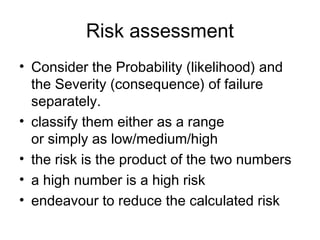
Risk assessment
• Consider the Probability (likelihood) and
  the Severity (consequence) of failure
  separately.
• classify them either as a range
  or simply as low/medium/high
• the risk is the product of the two numbers
• a high number is a high risk
• endeavour to reduce the calculated risk
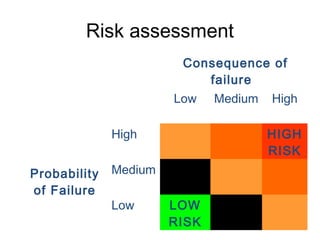
Risk assessment
                         Consequence of
                            failure
                       Low    Medium   High

              High                     HIGH
                                       RISK
Probability   Medium
of Failure
              Low      LOW
                       RISK
3. Structural Health Monitoring (SHM)


• a damage detection process used for
  aerospace, civil and mechanical
  engineering infrastructure which monitors
  the system over time. 
• typically, an array of sensors collects
  dynamic response measurements either
  continuously or at regular intervals. 
So how might we monitor:
• an earth filled masonry arch bridge carrying a
  road or railway
• cracking at joints in an offshore oil exploitation
  rig jacket
• corrosion of a liquid storage tank
  while full of hazardous chemicals
• barely visible impact damage
  (dropped tools on CFRP aircraft wings)
The options include:
• mechanical/dead-weight loading with
  measurement of deflections
• modes and frequencies of vibration
• embedded sensors
• non-destructive testing technologies

Condition monitoring

  • 1.
    Condition Monitoring (CM) Conditionmonitoring is the use of advanced technologies to determine the condition of equipment and predict its failure.  This in turn should inform predictive maintenance (PM) or reliability-centred maintenance (RCM). 
  • 2.
    Techniques that canbe used include: • the Human Senses – look, listen, smell, taste, feel etc. • Motor Current Analysis • Oil Analysis and Tribology • Non-destructive testing (NDT)
  • 3.
    1. Integrated conditionmonitoring service (ICMS) proposes that "integrated condition monitoring helps optimise maintenance by judging the health of machinery using non- invasive sensing technology". 
  • 4.
    The benefits ofan ICMS approach are: • early detection of impending machinery failure to help lower the risk of unscheduled downtime • scheduling and utilisation of maintenance resources is more efficient • reductions in time spent in dry dock, if a pre-dry- docking fault locating survey is performed • reduced likelihood of ‘maintenance induced’ failures • availability of global condition monitoring data.
  • 5.
    2. Risk-Based Inspection(RBI) • a method for deciding which components to inspect.  • instead of a fixed inspection interval, RBI considers the risk of an item of plant, or of a component, failing and decides the inspection interval on that basis. 
  • 6.
    Risk assessment • Considerthe Probability (likelihood) and the Severity (consequence) of failure separately. • classify them either as a range or simply as low/medium/high • the risk is the product of the two numbers • a high number is a high risk • endeavour to reduce the calculated risk
  • 7.
    Risk assessment  Consequence of failure Low Medium High High HIGH RISK Probability Medium of Failure Low LOW RISK
  • 8.
    3. Structural HealthMonitoring (SHM) • a damage detection process used for aerospace, civil and mechanical engineering infrastructure which monitors the system over time.  • typically, an array of sensors collects dynamic response measurements either continuously or at regular intervals. 
  • 9.
    So how mightwe monitor: • an earth filled masonry arch bridge carrying a road or railway • cracking at joints in an offshore oil exploitation rig jacket • corrosion of a liquid storage tank while full of hazardous chemicals • barely visible impact damage (dropped tools on CFRP aircraft wings)
  • 10.
    The options include: •mechanical/dead-weight loading with measurement of deflections • modes and frequencies of vibration • embedded sensors • non-destructive testing technologies