MS. POOJA SEN
NURSING LECTURER (MHN)
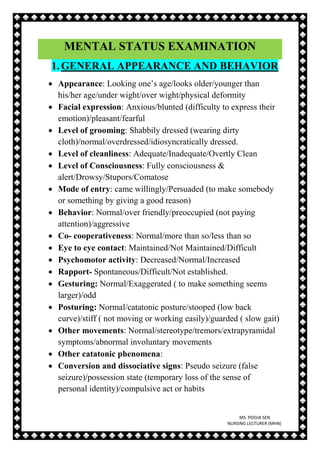
MENTAL STATUS EXAMINATION
1.GENERAL APPEARANCE AND BEHAVIOR
 Appearance: Looking one’s age/looks older/younger than
his/her age/under wight/over wight/physical deformity
 Facial expression: Anxious/blunted (difficulty to express their
emotion)/pleasant/fearful
 Level of grooming: Shabbily dressed (wearing dirty
cloth)/normal/overdressed/idiosyncratically dressed.
 Level of cleanliness: Adequate/Inadequate/Overtly Clean
 Level of Consciousness: Fully consciousness &
alert/Drowsy/Stupors/Comatose
 Mode of entry: came willingly/Persuaded (to make somebody
or something by giving a good reason)
 Behavior: Normal/over friendly/preoccupied (not paying
attention)/aggressive
 Co- cooperativeness: Normal/more than so/less than so
 Eye to eye contact: Maintained/Not Maintained/Difficult
 Psychomotor activity: Decreased/Normal/Increased
 Rapport- Spontaneous/Difficult/Not established.
 Gesturing: Normal/Exaggerated ( to make something seems
larger)/odd
 Posturing: Normal/catatonic posture/stooped (low back
curve)/stiff ( not moving or working easily)/guarded ( slow gait)
 Other movements: Normal/stereotype/tremors/extrapyramidal
symptoms/abnormal involuntary movements
 Other catatonic phenomena:
 Conversion and dissociative signs: Pseudo seizure (false
seizure)/possession state (temporary loss of the sense of
personal identity)/compulsive act or habits
MS. POOJA SEN
NURSING LECTURER (MHN)
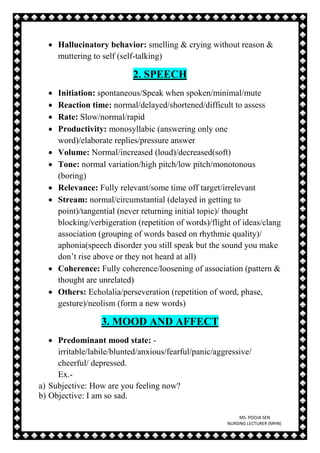
 Hallucinatory behavior: smelling & crying without reason &
muttering to self (self-talking)
2. SPEECH
 Initiation: spontaneous/Speak when spoken/minimal/mute
 Reaction time: normal/delayed/shortened/difficult to assess
 Rate: Slow/normal/rapid
 Productivity: monosyllabic (answering only one
word)/elaborate replies/pressure answer
 Volume: Normal/increased (loud)/decreased(soft)
 Tone: normal variation/high pitch/low pitch/monotonous
(boring)
 Relevance: Fully relevant/some time off target/irrelevant
 Stream: normal/circumstantial (delayed in getting to
point)/tangential (never returning initial topic)/ thought
blocking/verbigeration (repetition of words)/flight of ideas/clang
association (grouping of words based on rhythmic quality)/
aphonia(speech disorder you still speak but the sound you make
don’t rise above or they not heard at all)
 Coherence: Fully coherence/loosening of association (pattern &
thought are unrelated)
 Others: Echolalia/perseveration (repetition of word, phase,
gesture)/neolism (form a new words)
3. MOOD AND AFFECT
 Predominant mood state: -
irritable/labile/blunted/anxious/fearful/panic/aggressive/
cheerful/ depressed.
Ex.-
a) Subjective: How are you feeling now?
b) Objective: I am so sad.
MS. POOJA SEN
NURSING LECTURER (MHN)
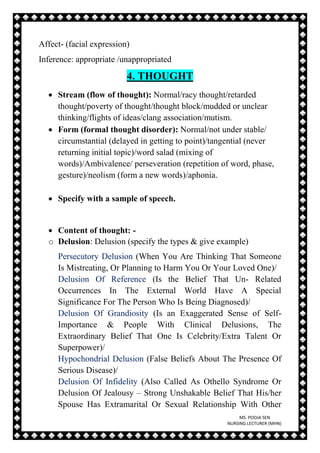
Affect- (facial expression)
Inference: appropriate /unappropriated
4. THOUGHT
 Stream (flow of thought): Normal/racy thought/retarded
thought/poverty of thought/thought block/mudded or unclear
thinking/flights of ideas/clang association/mutism.
 Form (formal thought disorder): Normal/not under stable/
circumstantial (delayed in getting to point)/tangential (never
returning initial topic)/word salad (mixing of
words)/Ambivalence/ perseveration (repetition of word, phase,
gesture)/neolism (form a new words)/aphonia.
 Specify with a sample of speech.
 Content of thought: -
o Delusion: Delusion (specify the types & give example)
Persecutory Delusion (When You Are Thinking That Someone
Is Mistreating, Or Planning to Harm You Or Your Loved One)/
Delusion Of Reference (Is the Belief That Un- Related
Occurrences In The External World Have A Special
Significance For The Person Who Is Being Diagnosed)/
Delusion Of Grandiosity (Is an Exaggerated Sense of Self-
Importance & People With Clinical Delusions, The
Extraordinary Belief That One Is Celebrity/Extra Talent Or
Superpower)/
Hypochondrial Delusion (False Beliefs About The Presence Of
Serious Disease)/
Delusion Of Infidelity (Also Called As Othello Syndrome Or
Delusion Of Jealousy – Strong Unshakable Belief That His/her
Spouse Has Extramarital Or Sexual Relationship With Other
MS. POOJA SEN
NURSING LECTURER (MHN)
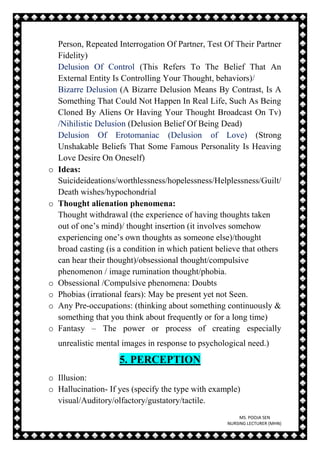
Person, Repeated Interrogation Of Partner, Test Of Their Partner
Fidelity)
Delusion Of Control (This Refers To The Belief That An
External Entity Is Controlling Your Thought, behaviors)/
Bizarre Delusion (A Bizarre Delusion Means By Contrast, Is A
Something That Could Not Happen In Real Life, Such As Being
Cloned By Aliens Or Having Your Thought Broadcast On Tv)
/Nihilistic Delusion (Delusion Belief Of Being Dead)
Delusion Of Erotomaniac (Delusion of Love) (Strong
Unshakable Beliefs That Some Famous Personality Is Heaving
Love Desire On Oneself)
o Ideas:
Suicideideations/worthlessness/hopelessness/Helplessness/Guilt/
Death wishes/hypochondrial
o Thought alienation phenomena:
Thought withdrawal (the experience of having thoughts taken
out of one’s mind)/ thought insertion (it involves somehow
experiencing one’s own thoughts as someone else)/thought
broad casting (is a condition in which patient believe that others
can hear their thought)/obsessional thought/compulsive
phenomenon / image rumination thought/phobia.
o Obsessional /Compulsive phenomena: Doubts
o Phobias (irrational fears): May be present yet not Seen.
o Any Pre-occupations: (thinking about something continuously &
something that you think about frequently or for a long time)
o Fantasy – The power or process of creating especially
unrealistic mental images in response to psychological need.)
5. PERCEPTION
o Illusion:
o Hallucination- If yes (specify the type with example)
visual/Auditory/olfactory/gustatory/tactile.
MS. POOJA SEN
NURSING LECTURER (MHN)
6. COGNITIVE FUNCTION
(neuro psychic assessment)
a) Consciousness: Conscious/stupor/comatose
b) Orientation:
a. Orientation to time
Q: what is the time now? (11:00AM)
A: afternoon
b. Orientation to place
Q: which place is this?
A: Agra
c. Orientation to person
Q: who am I?
A: you are coming for disturbing me
Remark: Not fully oriented to time, place and person
c) Attention:
Q. How many fingers is this? (5)
A. There are 3 fingers, No it is 4, No it is 5.
Inference:
d) Concentration:
Q: Count from 100 to 10 by subtracting 10 to each
A: 100, 90, 91, 92, 93,83 …
Q: Count from 1 to 10
A: 1, 2, 3, 4, 5, 6, 7, 8, 9, 10, 11, 12…
Inference:
MS. POOJA SEN
NURSING LECTURER (MHN)
e) Memory:
a. Immediate memory
Q: what you have for your breakfast?
A: Tea
b. Recent memory
Q: when did you slept during night?
A: Not answering (Looking sharply)
c. Remote memory
Q: Where did you studied?
A: Not Answering
Inference:
f) Intelligence
Q: Who is the president of India
A: I don’t know
Q: add 19 with 10
A: 29
Q: subtract 23 from 64
A: 41
Inference: Intelligence is intact.
g) Abstract thinking
Proverb
Q: tell me the meaning of “barking dog seldom bite”, jab jaago
tabhi sawera means?
MS. POOJA SEN
NURSING LECTURER (MHN)
A: not responding (looking sharply)
Similarities
Q: what is the similarity between a table and a bed?
A: not responding (become angry)
Differences
Q: what is the difference between a apple and orange
A: apple is soft and orange is juice
Inference:
h) Judgment
o personal judgment
o social judgement
Q: what you will do when you are in a house on firing
A: Oh, I will look and see (laughing)
Remark: Judgment is impaired.
7. INSIGHT
o Complete denial to illness
o Slight awareness
o Awareness being sick but blaming it on external factor, medical
or another unknown factor.
o Awareness of being sick but cause is unknown.
MS. POOJA SEN
NURSING LECTURER (MHN)
o Intellectual insight – awareness of being ill and the the
symptoms/failure in social adjustment are due to own irritational
feeling/thought.
o True emotional insight- it is different from intellectual insight in
the awareness leads to significant basic changes in the future
behavior.
Q: How are you?
A: nothing. You are coming for disturb me?
Q: for what reason you came here?
A: I don’t know.
Inference: Insight is poor may not be aware of mental illness
Diagnosis: This is the first episode of illness to client. He had history
of social withdrawal in the last 2 month and suicidal ideation before 1
month. He had no history of any major illness like hypertension,
endocrine problems, metabolic problems and any other communicable
or non- communicable diseases. This is the first episode of illness to
client. He had history of social withdrawal since 2 month and suicidal
ideation before 1 month. He had no history of any major illness like
hypertension, endocrine problems, metabolic problems and any other
communicable or non- communicable diseases.

MENTAL STATUS EXAMINATION format.docx

  • 1.
    MS. POOJA SEN NURSINGLECTURER (MHN) MENTAL STATUS EXAMINATION 1.GENERAL APPEARANCE AND BEHAVIOR  Appearance: Looking one’s age/looks older/younger than his/her age/under wight/over wight/physical deformity  Facial expression: Anxious/blunted (difficulty to express their emotion)/pleasant/fearful  Level of grooming: Shabbily dressed (wearing dirty cloth)/normal/overdressed/idiosyncratically dressed.  Level of cleanliness: Adequate/Inadequate/Overtly Clean  Level of Consciousness: Fully consciousness & alert/Drowsy/Stupors/Comatose  Mode of entry: came willingly/Persuaded (to make somebody or something by giving a good reason)  Behavior: Normal/over friendly/preoccupied (not paying attention)/aggressive  Co- cooperativeness: Normal/more than so/less than so  Eye to eye contact: Maintained/Not Maintained/Difficult  Psychomotor activity: Decreased/Normal/Increased  Rapport- Spontaneous/Difficult/Not established.  Gesturing: Normal/Exaggerated ( to make something seems larger)/odd  Posturing: Normal/catatonic posture/stooped (low back curve)/stiff ( not moving or working easily)/guarded ( slow gait)  Other movements: Normal/stereotype/tremors/extrapyramidal symptoms/abnormal involuntary movements  Other catatonic phenomena:  Conversion and dissociative signs: Pseudo seizure (false seizure)/possession state (temporary loss of the sense of personal identity)/compulsive act or habits
  • 2.
    MS. POOJA SEN NURSINGLECTURER (MHN)  Hallucinatory behavior: smelling & crying without reason & muttering to self (self-talking) 2. SPEECH  Initiation: spontaneous/Speak when spoken/minimal/mute  Reaction time: normal/delayed/shortened/difficult to assess  Rate: Slow/normal/rapid  Productivity: monosyllabic (answering only one word)/elaborate replies/pressure answer  Volume: Normal/increased (loud)/decreased(soft)  Tone: normal variation/high pitch/low pitch/monotonous (boring)  Relevance: Fully relevant/some time off target/irrelevant  Stream: normal/circumstantial (delayed in getting to point)/tangential (never returning initial topic)/ thought blocking/verbigeration (repetition of words)/flight of ideas/clang association (grouping of words based on rhythmic quality)/ aphonia(speech disorder you still speak but the sound you make don’t rise above or they not heard at all)  Coherence: Fully coherence/loosening of association (pattern & thought are unrelated)  Others: Echolalia/perseveration (repetition of word, phase, gesture)/neolism (form a new words) 3. MOOD AND AFFECT  Predominant mood state: - irritable/labile/blunted/anxious/fearful/panic/aggressive/ cheerful/ depressed. Ex.- a) Subjective: How are you feeling now? b) Objective: I am so sad.
  • 3.
    MS. POOJA SEN NURSINGLECTURER (MHN) Affect- (facial expression) Inference: appropriate /unappropriated 4. THOUGHT  Stream (flow of thought): Normal/racy thought/retarded thought/poverty of thought/thought block/mudded or unclear thinking/flights of ideas/clang association/mutism.  Form (formal thought disorder): Normal/not under stable/ circumstantial (delayed in getting to point)/tangential (never returning initial topic)/word salad (mixing of words)/Ambivalence/ perseveration (repetition of word, phase, gesture)/neolism (form a new words)/aphonia.  Specify with a sample of speech.  Content of thought: - o Delusion: Delusion (specify the types & give example) Persecutory Delusion (When You Are Thinking That Someone Is Mistreating, Or Planning to Harm You Or Your Loved One)/ Delusion Of Reference (Is the Belief That Un- Related Occurrences In The External World Have A Special Significance For The Person Who Is Being Diagnosed)/ Delusion Of Grandiosity (Is an Exaggerated Sense of Self- Importance & People With Clinical Delusions, The Extraordinary Belief That One Is Celebrity/Extra Talent Or Superpower)/ Hypochondrial Delusion (False Beliefs About The Presence Of Serious Disease)/ Delusion Of Infidelity (Also Called As Othello Syndrome Or Delusion Of Jealousy – Strong Unshakable Belief That His/her Spouse Has Extramarital Or Sexual Relationship With Other
  • 4.
    MS. POOJA SEN NURSINGLECTURER (MHN) Person, Repeated Interrogation Of Partner, Test Of Their Partner Fidelity) Delusion Of Control (This Refers To The Belief That An External Entity Is Controlling Your Thought, behaviors)/ Bizarre Delusion (A Bizarre Delusion Means By Contrast, Is A Something That Could Not Happen In Real Life, Such As Being Cloned By Aliens Or Having Your Thought Broadcast On Tv) /Nihilistic Delusion (Delusion Belief Of Being Dead) Delusion Of Erotomaniac (Delusion of Love) (Strong Unshakable Beliefs That Some Famous Personality Is Heaving Love Desire On Oneself) o Ideas: Suicideideations/worthlessness/hopelessness/Helplessness/Guilt/ Death wishes/hypochondrial o Thought alienation phenomena: Thought withdrawal (the experience of having thoughts taken out of one’s mind)/ thought insertion (it involves somehow experiencing one’s own thoughts as someone else)/thought broad casting (is a condition in which patient believe that others can hear their thought)/obsessional thought/compulsive phenomenon / image rumination thought/phobia. o Obsessional /Compulsive phenomena: Doubts o Phobias (irrational fears): May be present yet not Seen. o Any Pre-occupations: (thinking about something continuously & something that you think about frequently or for a long time) o Fantasy – The power or process of creating especially unrealistic mental images in response to psychological need.) 5. PERCEPTION o Illusion: o Hallucination- If yes (specify the type with example) visual/Auditory/olfactory/gustatory/tactile.
  • 5.
    MS. POOJA SEN NURSINGLECTURER (MHN) 6. COGNITIVE FUNCTION (neuro psychic assessment) a) Consciousness: Conscious/stupor/comatose b) Orientation: a. Orientation to time Q: what is the time now? (11:00AM) A: afternoon b. Orientation to place Q: which place is this? A: Agra c. Orientation to person Q: who am I? A: you are coming for disturbing me Remark: Not fully oriented to time, place and person c) Attention: Q. How many fingers is this? (5) A. There are 3 fingers, No it is 4, No it is 5. Inference: d) Concentration: Q: Count from 100 to 10 by subtracting 10 to each A: 100, 90, 91, 92, 93,83 … Q: Count from 1 to 10 A: 1, 2, 3, 4, 5, 6, 7, 8, 9, 10, 11, 12… Inference:
  • 6.
    MS. POOJA SEN NURSINGLECTURER (MHN) e) Memory: a. Immediate memory Q: what you have for your breakfast? A: Tea b. Recent memory Q: when did you slept during night? A: Not answering (Looking sharply) c. Remote memory Q: Where did you studied? A: Not Answering Inference: f) Intelligence Q: Who is the president of India A: I don’t know Q: add 19 with 10 A: 29 Q: subtract 23 from 64 A: 41 Inference: Intelligence is intact. g) Abstract thinking Proverb Q: tell me the meaning of “barking dog seldom bite”, jab jaago tabhi sawera means?
  • 7.
    MS. POOJA SEN NURSINGLECTURER (MHN) A: not responding (looking sharply) Similarities Q: what is the similarity between a table and a bed? A: not responding (become angry) Differences Q: what is the difference between a apple and orange A: apple is soft and orange is juice Inference: h) Judgment o personal judgment o social judgement Q: what you will do when you are in a house on firing A: Oh, I will look and see (laughing) Remark: Judgment is impaired. 7. INSIGHT o Complete denial to illness o Slight awareness o Awareness being sick but blaming it on external factor, medical or another unknown factor. o Awareness of being sick but cause is unknown.
  • 8.
    MS. POOJA SEN NURSINGLECTURER (MHN) o Intellectual insight – awareness of being ill and the the symptoms/failure in social adjustment are due to own irritational feeling/thought. o True emotional insight- it is different from intellectual insight in the awareness leads to significant basic changes in the future behavior. Q: How are you? A: nothing. You are coming for disturb me? Q: for what reason you came here? A: I don’t know. Inference: Insight is poor may not be aware of mental illness Diagnosis: This is the first episode of illness to client. He had history of social withdrawal in the last 2 month and suicidal ideation before 1 month. He had no history of any major illness like hypertension, endocrine problems, metabolic problems and any other communicable or non- communicable diseases. This is the first episode of illness to client. He had history of social withdrawal since 2 month and suicidal ideation before 1 month. He had no history of any major illness like hypertension, endocrine problems, metabolic problems and any other communicable or non- communicable diseases.