MENTAL STATUS
EXAMINATI
ON
Shrijana Kayastha
Master nursing
Mental Status
Examination
Mental status is the total expression of a
person's emotional responses, mood,
cognitive function, and personality. It is
closely linked to the individuals executive
functioning
i.e. motivation, initiative, goal formation,
planning and performing, self-monitoring,
and integration of feedback.
Introductio
n
The MSE is one component of exam and may
be viewed as the psychological equivalent of
the physical exam. It is an important
component to a neurological evaluation.
It is made up of our observation and objective
question to the client. Behavior aspect are
observed. Cognitive aspect are tested .
Introductio
n
Concernedwith symptoms, sign and behavior during the
interview;
It is usually conducted after the history. Somewhat
blurring distinction between history and mental state
examination. Uses a standard series headings under
which the relevant phenomena, or their absence, are
recorded
It provides much of the key diagnostic information .
Introductio
n
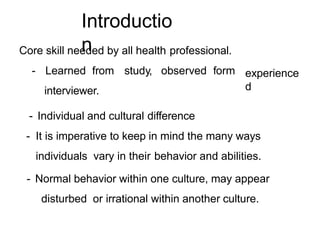
Core skill needed by all health professional.
- Learned from study, observed form
interviewer.
experience
d
- Individual and cultural difference
- It is imperative to keep in mind the many ways
individuals vary in their behavior and abilities.
- Normal behavior within one culture, may appear
disturbed or irrational within another culture.
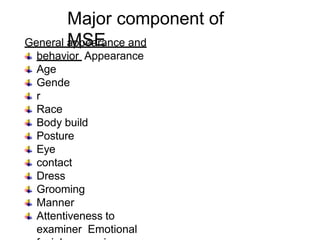
Major component of
MSE
General appearance and
behavior Appearance
Age
Gende
r
Race
Body build
Posture
Eye
contact
Dress
Grooming
Manner
Attentiveness to
examiner Emotional
Description of
components
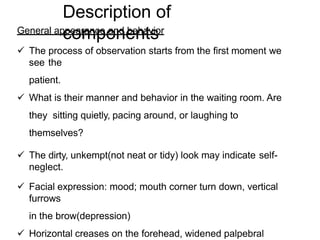
General appearance and behavior
 The process of observation starts from the first moment we
see the
patient.
 What is their manner and behavior in the waiting room. Are
they sitting quietly, pacing around, or laughing to
themselves?
 The dirty, unkempt(not neat or tidy) look may indicate self-
neglect.
 Facial expression: mood; mouth corner turn down, vertical
furrows
in the brow(depression)
 Horizontal creases on the forehead, widened palpebral
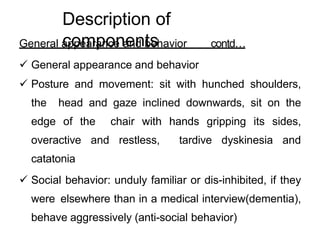
General appearance and behavior contd…
 General appearance and behavior
 Posture and movement: sit with hunched shoulders,
the head and gaze inclined downwards, sit on the
edge of the chair with hands gripping its sides,
overactive and restless, tardive dyskinesia and
catatonia
 Social behavior: unduly familiar or dis-inhibited, if they
were elsewhere than in a medical interview(dementia),
behave aggressively (anti-social behavior)
Description of
components
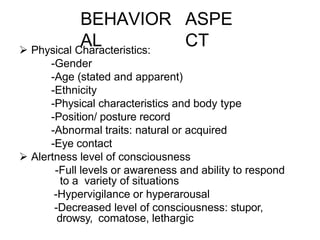
BEHAVIOR
AL
ASPE
CT
 Physical Characteristics:
-Gender
-Age (stated and apparent)
-Ethnicity
-Physical characteristics and body type
-Position/ posture record
-Abnormal traits: natural or acquired
-Eye contact
 Alertness level of consciousness
-Full levels or awareness and ability to respond
to a variety of situations
-Hypervigilance or hyperarousal
-Decreased level of consciousness: stupor,
drowsy, comatose, lethargic
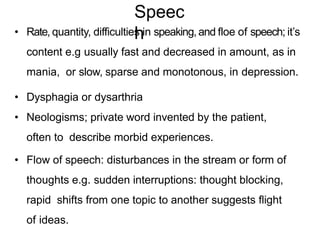
• Rate, quantity, difficulties in speaking, and floe of speech; it’s
content e.g usually fast and decreased in amount, as in
mania, or slow, sparse and monotonous, in depression.
• Dysphagia or dysarthria
• Neologisms; private word invented by the patient,
often to describe morbid experiences.
• Flow of speech: disturbances in the stream or form of
thoughts e.g. sudden interruptions: thought blocking,
rapid shifts from one topic to another suggests flight
of ideas.
Speec
h
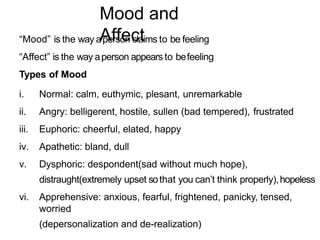
Mood and
Affect
“Mood” is the way aperson claims to be feeling
“Affect” is the way aperson appears to befeeling
Types of Mood
i. Normal: calm, euthymic, plesant, unremarkable
ii. Angry: belligerent, hostile, sullen (bad tempered), frustrated
iii. Euphoric: cheerful, elated, happy
iv. Apathetic: bland, dull
v. Dysphoric: despondent(sad without much hope),
distraught(extremely upset sothat you can’t think properly),hopeless
vi. Apprehensive: anxious, fearful, frightened, panicky, tensed,
worried
(depersonalization and de-realization)
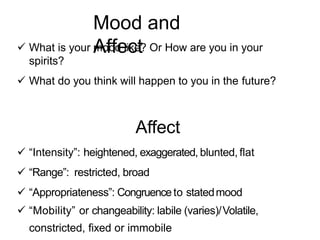
Mood and
Affect
 What is your mood like? Or How are you in your
spirits?
 What do you think will happen to you in the future?
Affect
 “Intensity”: heightened, exaggerated, blunted, flat
 “Range”: restricted, broad
 “Appropriateness”: Congruenceto statedmood
 “Mobility” or changeability: labile (varies)/Volatile,
constricted, fixed or immobile
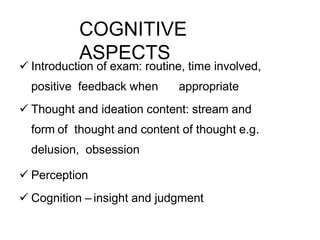
COGNITIVE
ASPECTS
 Introduction of exam: routine, time involved,
positive feedback when appropriate
 Thought and ideation content: stream and
form of thought and content of thought e.g.
delusion, obsession
 Perception
 Cognition – insight and judgment
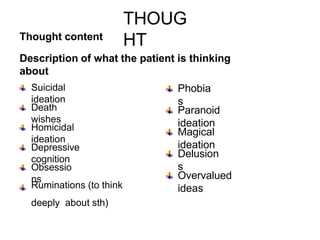
THOUG
HT
Thought content
Description of what the patient is thinking
about
Suicidal
ideation
Death
wishes
Homicidal
ideation
Depressive
cognition
Obsessio
ns
Ruminations (to think
deeply about sth)
Phobia
s
Paranoid
ideation
Magical
ideation
Delusion
s
Overvalued
ideas
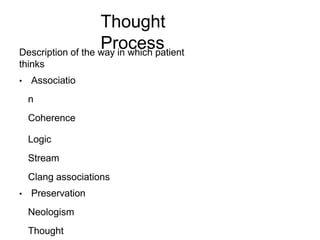
Thought
Process
Description of the way in which patient
thinks
• Associatio
n
Coherence
Logic
Stream
Clang associations
• Preservation
Neologism
Thought
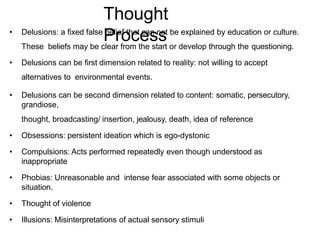
• Delusions: a fixed false belief that can not be explained by education or culture.
These beliefs may be clear from the start or develop through the questioning.
• Delusions can be first dimension related to reality: not willing to accept
alternatives to environmental events.
• Delusions can be second dimension related to content: somatic, persecutory,
grandiose,
thought, broadcasting/ insertion, jealousy, death, idea of reference
• Obsessions: persistent ideation which is ego-dystonic
• Compulsions: Acts performed repeatedly even though understood as
inappropriate
• Phobias: Unreasonable and intense fear associated with some objects or
situation.
• Thought of violence
• Illusions: Misinterpretations of actual sensory stimuli
Thought
Process
Perceptio
n
• Perceptual disturbances include hallucinations and illusions
-Hallucinations may occur in any sensory modality, but are
most commonly auditory(visual, tactile, gustatory, and
olfactory)
-Illusions have some basis in reality
-Depersonalization: feeling of identity loss (self experienced as
unreal)
-Derealization: feeling reality has changed (environment
experienced as unreal)
• Dejavu
• jamaisvu
Orientatio
n
Orientation and consciousness refers to aclient’s awarenessof
his/her self and situation
• Clients are evaluated in terms of their Orientation to
person,
place and time
Consciousness is rated from Alert to Comatose
•
• Delirium (clouding of
consciousness)
• Dementia (global intellectual/ mental
decline clouding of consciousness)
without
Memory and
Intelligence
It can be quiet risky to assess Memory and
intelligence is a short interview, but some general
statements are usually made
• Remote, recent and immediate memory can be
assed (amnesia, confabulation)
• Because intelligence is often based on verbal facility,
special care should be taken when working with
diverse clients
-General knowledge, simple arithmatic calculation
and reading, writing
• Attention and concentration
Distractibility
Procedures: Serial 7s and 3s, digits
forwards and backwards (days months in
reverse order)
• Abstract thinking/Concrete
By proverb testing
Similarities and difference between
familiar objects
INSIGHT AND
JUDGEMENT
• Insight: self understanding regarding current circumstances
(awareness of
illness)
- None ( there is no problem, denial of illness)
- Superficial (some minimum awareness of a difficulty but still using
denial)
- Situational Focus ( external factors are the problem)
- Intellectual (Intellectualization and rationalization without true
emotional connection)
- True Insight (understanding situation with the emotional impetus to
master situation)
• Judgment: ability to decide on the appropriate course action to

Mental status examination (1) converted

  • 1.
  • 2.
    Mental Status Examination Mental statusis the total expression of a person's emotional responses, mood, cognitive function, and personality. It is closely linked to the individuals executive functioning i.e. motivation, initiative, goal formation, planning and performing, self-monitoring, and integration of feedback.
  • 3.
    Introductio n The MSE isone component of exam and may be viewed as the psychological equivalent of the physical exam. It is an important component to a neurological evaluation. It is made up of our observation and objective question to the client. Behavior aspect are observed. Cognitive aspect are tested .
  • 4.
    Introductio n Concernedwith symptoms, signand behavior during the interview; It is usually conducted after the history. Somewhat blurring distinction between history and mental state examination. Uses a standard series headings under which the relevant phenomena, or their absence, are recorded It provides much of the key diagnostic information .
  • 5.
    Introductio n Core skill neededby all health professional. - Learned from study, observed form interviewer. experience d - Individual and cultural difference - It is imperative to keep in mind the many ways individuals vary in their behavior and abilities. - Normal behavior within one culture, may appear disturbed or irrational within another culture.
  • 6.
    Major component of MSE Generalappearance and behavior Appearance Age Gende r Race Body build Posture Eye contact Dress Grooming Manner Attentiveness to examiner Emotional
  • 7.
    Description of components General appearanceand behavior  The process of observation starts from the first moment we see the patient.  What is their manner and behavior in the waiting room. Are they sitting quietly, pacing around, or laughing to themselves?  The dirty, unkempt(not neat or tidy) look may indicate self- neglect.  Facial expression: mood; mouth corner turn down, vertical furrows in the brow(depression)  Horizontal creases on the forehead, widened palpebral
  • 8.
    General appearance andbehavior contd…  General appearance and behavior  Posture and movement: sit with hunched shoulders, the head and gaze inclined downwards, sit on the edge of the chair with hands gripping its sides, overactive and restless, tardive dyskinesia and catatonia  Social behavior: unduly familiar or dis-inhibited, if they were elsewhere than in a medical interview(dementia), behave aggressively (anti-social behavior) Description of components
  • 9.
    BEHAVIOR AL ASPE CT  Physical Characteristics: -Gender -Age(stated and apparent) -Ethnicity -Physical characteristics and body type -Position/ posture record -Abnormal traits: natural or acquired -Eye contact  Alertness level of consciousness -Full levels or awareness and ability to respond to a variety of situations -Hypervigilance or hyperarousal -Decreased level of consciousness: stupor, drowsy, comatose, lethargic
  • 10.
    • Rate, quantity,difficulties in speaking, and floe of speech; it’s content e.g usually fast and decreased in amount, as in mania, or slow, sparse and monotonous, in depression. • Dysphagia or dysarthria • Neologisms; private word invented by the patient, often to describe morbid experiences. • Flow of speech: disturbances in the stream or form of thoughts e.g. sudden interruptions: thought blocking, rapid shifts from one topic to another suggests flight of ideas. Speec h
  • 11.
    Mood and Affect “Mood” isthe way aperson claims to be feeling “Affect” is the way aperson appears to befeeling Types of Mood i. Normal: calm, euthymic, plesant, unremarkable ii. Angry: belligerent, hostile, sullen (bad tempered), frustrated iii. Euphoric: cheerful, elated, happy iv. Apathetic: bland, dull v. Dysphoric: despondent(sad without much hope), distraught(extremely upset sothat you can’t think properly),hopeless vi. Apprehensive: anxious, fearful, frightened, panicky, tensed, worried (depersonalization and de-realization)
  • 12.
    Mood and Affect  Whatis your mood like? Or How are you in your spirits?  What do you think will happen to you in the future? Affect  “Intensity”: heightened, exaggerated, blunted, flat  “Range”: restricted, broad  “Appropriateness”: Congruenceto statedmood  “Mobility” or changeability: labile (varies)/Volatile, constricted, fixed or immobile
  • 13.
    COGNITIVE ASPECTS  Introduction ofexam: routine, time involved, positive feedback when appropriate  Thought and ideation content: stream and form of thought and content of thought e.g. delusion, obsession  Perception  Cognition – insight and judgment
  • 14.
    THOUG HT Thought content Description ofwhat the patient is thinking about Suicidal ideation Death wishes Homicidal ideation Depressive cognition Obsessio ns Ruminations (to think deeply about sth) Phobia s Paranoid ideation Magical ideation Delusion s Overvalued ideas
  • 15.
    Thought Process Description of theway in which patient thinks • Associatio n Coherence Logic Stream Clang associations • Preservation Neologism Thought
  • 16.
    • Delusions: afixed false belief that can not be explained by education or culture. These beliefs may be clear from the start or develop through the questioning. • Delusions can be first dimension related to reality: not willing to accept alternatives to environmental events. • Delusions can be second dimension related to content: somatic, persecutory, grandiose, thought, broadcasting/ insertion, jealousy, death, idea of reference • Obsessions: persistent ideation which is ego-dystonic • Compulsions: Acts performed repeatedly even though understood as inappropriate • Phobias: Unreasonable and intense fear associated with some objects or situation. • Thought of violence • Illusions: Misinterpretations of actual sensory stimuli Thought Process
  • 17.
    Perceptio n • Perceptual disturbancesinclude hallucinations and illusions -Hallucinations may occur in any sensory modality, but are most commonly auditory(visual, tactile, gustatory, and olfactory) -Illusions have some basis in reality -Depersonalization: feeling of identity loss (self experienced as unreal) -Derealization: feeling reality has changed (environment experienced as unreal) • Dejavu • jamaisvu
  • 18.
    Orientatio n Orientation and consciousnessrefers to aclient’s awarenessof his/her self and situation • Clients are evaluated in terms of their Orientation to person, place and time Consciousness is rated from Alert to Comatose • • Delirium (clouding of consciousness) • Dementia (global intellectual/ mental decline clouding of consciousness) without
  • 19.
    Memory and Intelligence It canbe quiet risky to assess Memory and intelligence is a short interview, but some general statements are usually made • Remote, recent and immediate memory can be assed (amnesia, confabulation) • Because intelligence is often based on verbal facility, special care should be taken when working with diverse clients -General knowledge, simple arithmatic calculation and reading, writing
  • 20.
    • Attention andconcentration Distractibility Procedures: Serial 7s and 3s, digits forwards and backwards (days months in reverse order) • Abstract thinking/Concrete By proverb testing Similarities and difference between familiar objects
  • 21.
    INSIGHT AND JUDGEMENT • Insight:self understanding regarding current circumstances (awareness of illness) - None ( there is no problem, denial of illness) - Superficial (some minimum awareness of a difficulty but still using denial) - Situational Focus ( external factors are the problem) - Intellectual (Intellectualization and rationalization without true emotional connection) - True Insight (understanding situation with the emotional impetus to master situation) • Judgment: ability to decide on the appropriate course action to