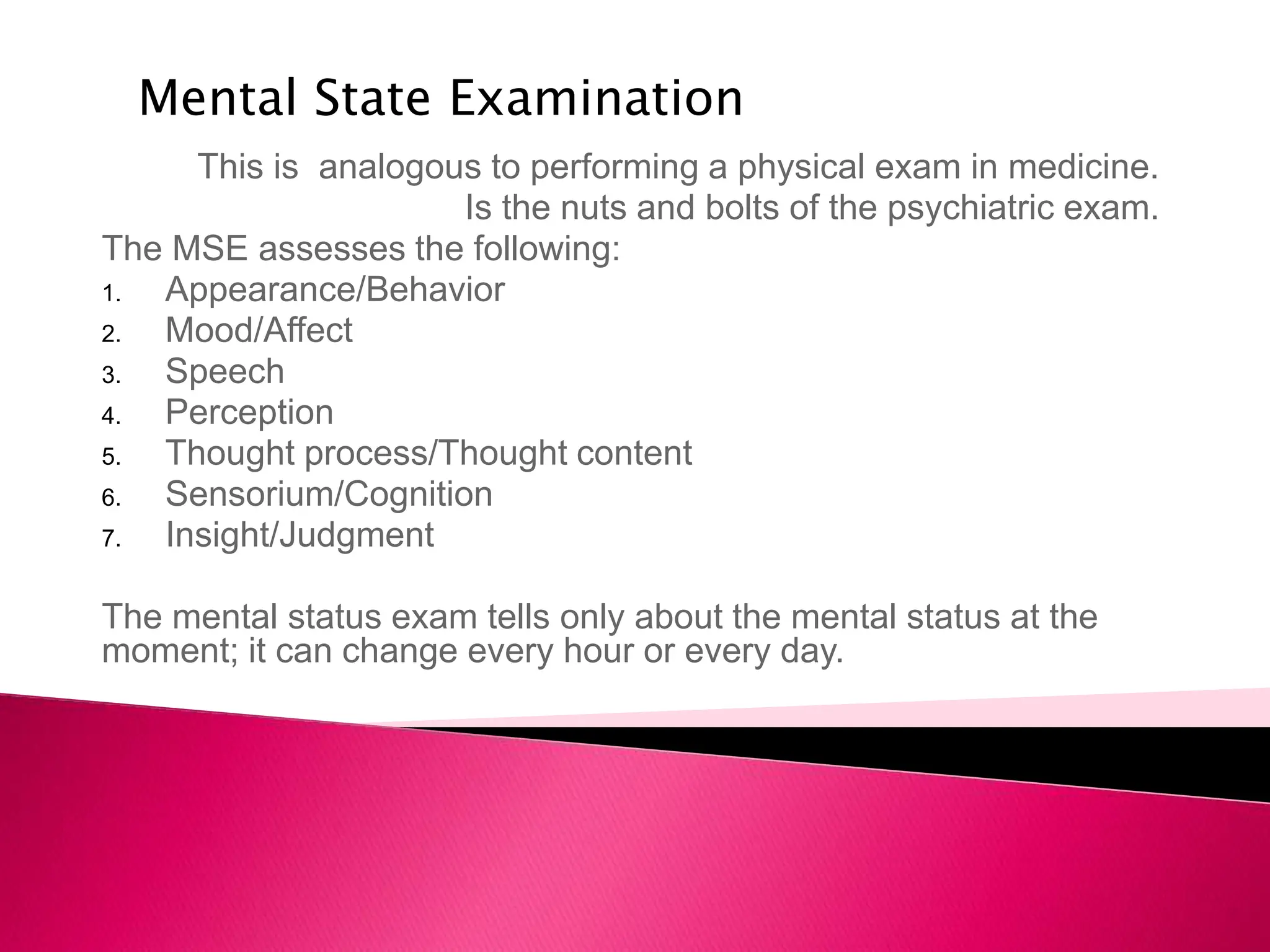
This is analogous to performing a physical exam in medicine.
Is the nuts and bolts of the psychiatric exam.
The MSE assesses the following:
1. Appearance/Behavior
2. Mood/Affect
3. Speech
4. Perception
5. Thought process/Thought content
6. Sensorium/Cognition
7. Insight/Judgment
The mental status exam tells only about the mental status at the
moment; it can change every hour or every day.
Mental State Examination
 Physical appearance: clothing, hygiene, posture,
grooming
 Behavior: mannerism, tics, eye contact
 Attitude: cooperative, hostile, guarded, seductive,
apathetic.
 Rate: slow, average, rapid, or pressured,
(Pressured speech is continuous, fast, and
uninterruptible.)
 Volume: soft, average, or loud
 Articulation: well articulated v/s lisp, stutter,
mumbling.
 Tone: angry v/s pleading, etc.
Mood: Is the emotion that the patient tells you he feels or is conveyed
nonverbally.
Affect: Is in assessment of how the patient’s mood appears to the
examiner, including the amount and range of emotional expression. It
is described with the following dimensions:
 Quality: (describes the depth and range of the feelings shown):
 Flat: (none) E.g. A patient who remains expressionless even when discussing
extremely sad or happy moments in his life.
 Blunted (shallow)
 Constricted (limited)
 Full (average)
 Intense (more than normal)
 Motility: (describes how quickly a person appears to shift emotional states):
 Sluggish, supple or labile (patient is laughing after one second is crying)
 Appropriateness to content: (describes whether the affect is congruent with the
subject of conversation):
 Appropriate/ not appropriate (A patient giggles after saying he set fire to his
house and is facing criminal charges.
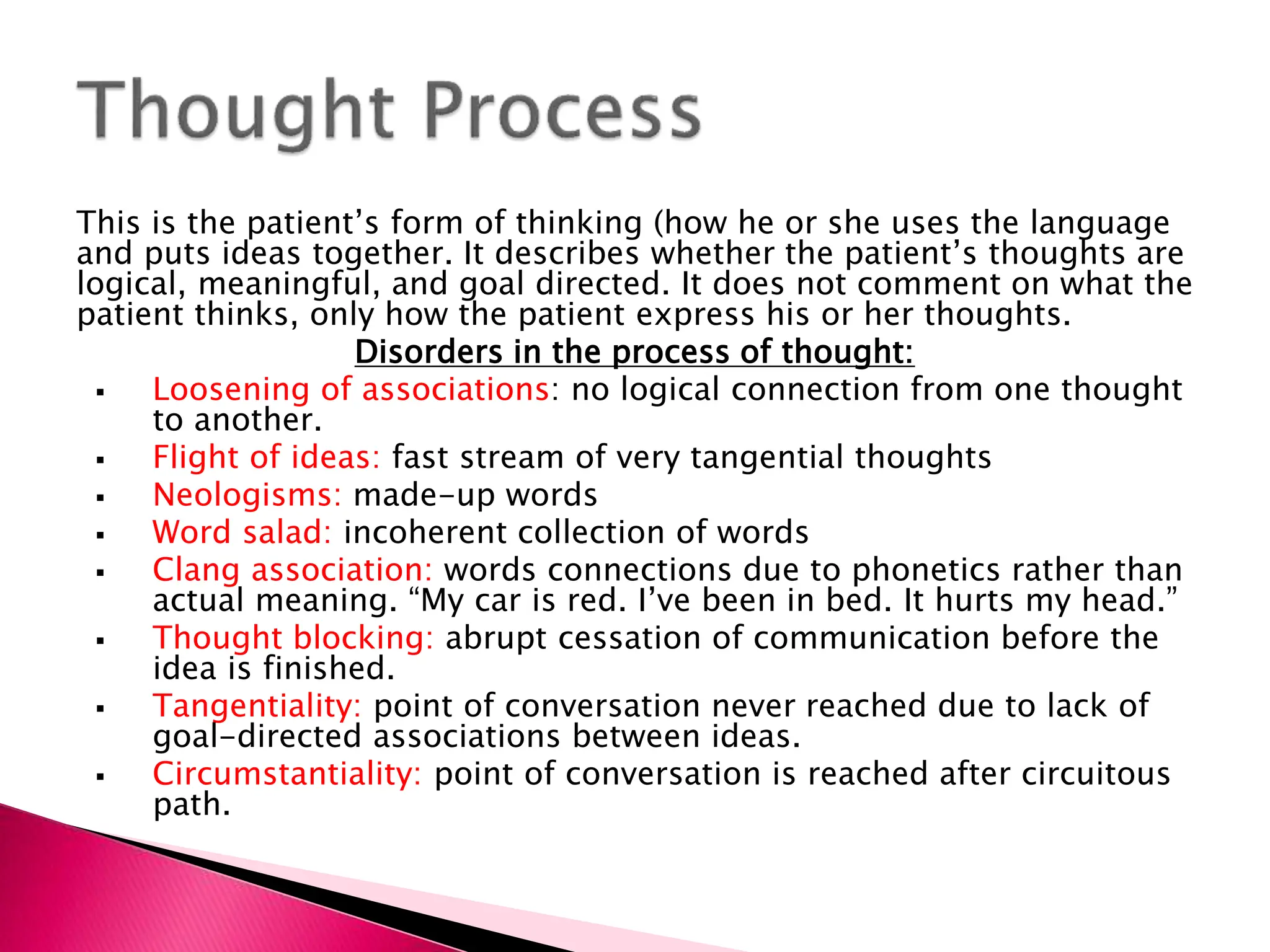
This is the patient’s form of thinking (how he or she uses the language
and puts ideas together. It describes whether the patient’s thoughts are
logical, meaningful, and goal directed. It does not comment on what the
patient thinks, only how the patient express his or her thoughts.
Disorders in the process of thought:
 Loosening of associations: no logical connection from one thought
to another.
 Flight of ideas: fast stream of very tangential thoughts
 Neologisms: made-up words
 Word salad: incoherent collection of words
 Clang association: words connections due to phonetics rather than
actual meaning. “My car is red. I’ve been in bed. It hurts my head.”
 Thought blocking: abrupt cessation of communication before the
idea is finished.
 Tangentiality: point of conversation never reached due to lack of
goal-directed associations between ideas.
 Circumstantiality: point of conversation is reached after circuitous
path.
It describes the types of ideas expressed by the patient.
Disorders in the content of thought:
 Poverty of thought v/s overabundance: too few v/s too
many ideas expressed.
 Delusions: False beliefs that are not shared by the
person’s culture and can not be changed by reasoning.
 Phobias: Persistent, irrational fears.
 Obsessions: repetitive, intrusive thoughts
 Compulsions: repetitive behaviors (usually linked with
obsessive thought
 Suicidal and homicidal thoughts: the patient feels like
harming him/herself or others.
 Grandeur: belief that one has special powers
or is someone important (Jesus, President)
 Paranoid: belief that one is being persecuted
 Reference: belief that some event is uniquely
related to patient (e.g. a TV show character is
sending patient messages)
 Thought broadcasting: belief that one’s
thoughts can be heard by others
 Religious: conventional beliefs exaggerated
(e.g. Jesus talks to me)
 Hallucinations: sensory perceptions not based
in reality (visual, auditory, tactile, gustatory,
olfactory)
 Illusions: inaccurate perception of existing
sensory stimuli (Ex wall appears as if it’s
moving)
 Consciousness: Patient’s level of awareness; possible range includes: (alert,
drowsy, lethargic, stuporous, coma.
 Orientation: To person, place and time.
 Calculation: ability to add/subtract
 Memory:
1. Immediate: can repeat several digits or recall three words 5 minutes later
2. Recent: events within past few days
3. Recent past: events within past few months
4. Remote: events from childhood
 Fund of knowledge: level of knowledge in the context of the patient’s culture
and education (Who is President? Who was Picasso?)
 Attention/Concentration: ability to subtract serial 7s from 100 or to spell “world”
backwards
 Reading/Writing: simple sentences (must make sure the patient is literate first).
 Abstract concepts: ability to explain similarities between objects and understand
the meaning of simple proverbs.
Insight: Is the patient’s level of awareness and
understanding of his or her problems. (e.g.
complete denial of illness or blaming it on
something else)
Judgment: Is the patient’s ability to understand
the outcome of his or her actions and use this
awareness in decision making

psychiatry 2-Mental State examination.pptx

  • 1.
    This is analogousto performing a physical exam in medicine. Is the nuts and bolts of the psychiatric exam. The MSE assesses the following: 1. Appearance/Behavior 2. Mood/Affect 3. Speech 4. Perception 5. Thought process/Thought content 6. Sensorium/Cognition 7. Insight/Judgment The mental status exam tells only about the mental status at the moment; it can change every hour or every day. Mental State Examination
  • 2.
     Physical appearance:clothing, hygiene, posture, grooming  Behavior: mannerism, tics, eye contact  Attitude: cooperative, hostile, guarded, seductive, apathetic.
  • 3.
     Rate: slow,average, rapid, or pressured, (Pressured speech is continuous, fast, and uninterruptible.)  Volume: soft, average, or loud  Articulation: well articulated v/s lisp, stutter, mumbling.  Tone: angry v/s pleading, etc.
  • 4.
    Mood: Is theemotion that the patient tells you he feels or is conveyed nonverbally. Affect: Is in assessment of how the patient’s mood appears to the examiner, including the amount and range of emotional expression. It is described with the following dimensions:  Quality: (describes the depth and range of the feelings shown):  Flat: (none) E.g. A patient who remains expressionless even when discussing extremely sad or happy moments in his life.  Blunted (shallow)  Constricted (limited)  Full (average)  Intense (more than normal)  Motility: (describes how quickly a person appears to shift emotional states):  Sluggish, supple or labile (patient is laughing after one second is crying)  Appropriateness to content: (describes whether the affect is congruent with the subject of conversation):  Appropriate/ not appropriate (A patient giggles after saying he set fire to his house and is facing criminal charges.
  • 5.
    This is thepatient’s form of thinking (how he or she uses the language and puts ideas together. It describes whether the patient’s thoughts are logical, meaningful, and goal directed. It does not comment on what the patient thinks, only how the patient express his or her thoughts. Disorders in the process of thought:  Loosening of associations: no logical connection from one thought to another.  Flight of ideas: fast stream of very tangential thoughts  Neologisms: made-up words  Word salad: incoherent collection of words  Clang association: words connections due to phonetics rather than actual meaning. “My car is red. I’ve been in bed. It hurts my head.”  Thought blocking: abrupt cessation of communication before the idea is finished.  Tangentiality: point of conversation never reached due to lack of goal-directed associations between ideas.  Circumstantiality: point of conversation is reached after circuitous path.
  • 6.
    It describes thetypes of ideas expressed by the patient. Disorders in the content of thought:  Poverty of thought v/s overabundance: too few v/s too many ideas expressed.  Delusions: False beliefs that are not shared by the person’s culture and can not be changed by reasoning.  Phobias: Persistent, irrational fears.  Obsessions: repetitive, intrusive thoughts  Compulsions: repetitive behaviors (usually linked with obsessive thought  Suicidal and homicidal thoughts: the patient feels like harming him/herself or others.
  • 7.
     Grandeur: beliefthat one has special powers or is someone important (Jesus, President)  Paranoid: belief that one is being persecuted  Reference: belief that some event is uniquely related to patient (e.g. a TV show character is sending patient messages)  Thought broadcasting: belief that one’s thoughts can be heard by others  Religious: conventional beliefs exaggerated (e.g. Jesus talks to me)
  • 8.
     Hallucinations: sensoryperceptions not based in reality (visual, auditory, tactile, gustatory, olfactory)  Illusions: inaccurate perception of existing sensory stimuli (Ex wall appears as if it’s moving)
  • 9.
     Consciousness: Patient’slevel of awareness; possible range includes: (alert, drowsy, lethargic, stuporous, coma.  Orientation: To person, place and time.  Calculation: ability to add/subtract  Memory: 1. Immediate: can repeat several digits or recall three words 5 minutes later 2. Recent: events within past few days 3. Recent past: events within past few months 4. Remote: events from childhood  Fund of knowledge: level of knowledge in the context of the patient’s culture and education (Who is President? Who was Picasso?)  Attention/Concentration: ability to subtract serial 7s from 100 or to spell “world” backwards  Reading/Writing: simple sentences (must make sure the patient is literate first).  Abstract concepts: ability to explain similarities between objects and understand the meaning of simple proverbs.
  • 10.
    Insight: Is thepatient’s level of awareness and understanding of his or her problems. (e.g. complete denial of illness or blaming it on something else) Judgment: Is the patient’s ability to understand the outcome of his or her actions and use this awareness in decision making