MENTAL STATUS
EXAMINATION
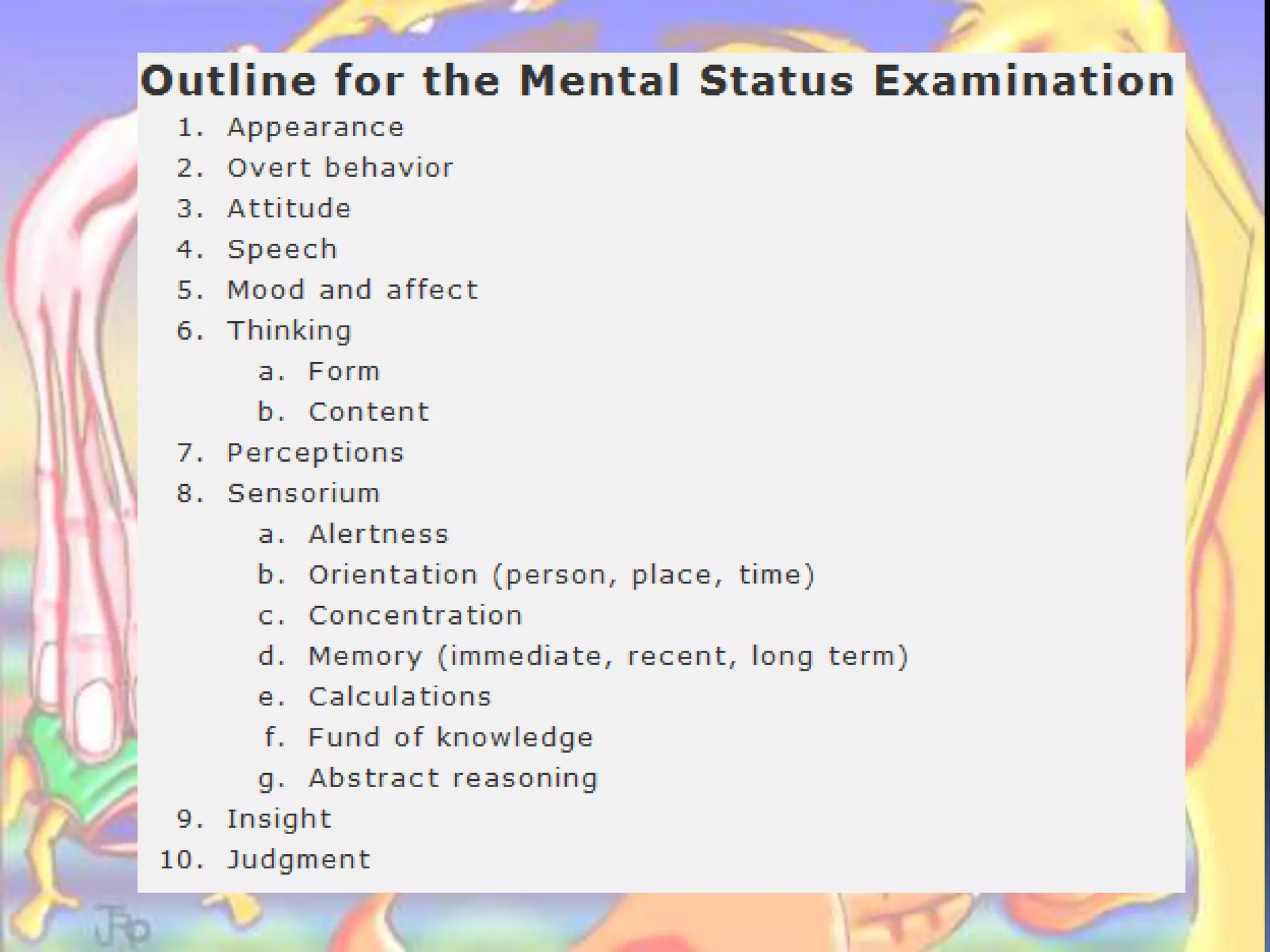
MENTAL STATUS EXAMINATION
 describes the sum total of the examiner’s
observations and impressions of the
psychiatric patient at the time of the interview
 the description of the patient’s appearance,
speech, actions, and thoughts during the
interview
Appearance
Bizarre??
 Has anyone ever commented
on your look?
 How would you describe how
you look?
 Can you help me understand
some of the choices you
make in how you look?
 overall physical impression
 posture, poise, clothing, and grooming
Attitude toward examiner
 cooperative, friendly, attentive, interested,
frank, seductive, defensive, contemptuous,
perplexed, apathetic, hostile, playful,
ingratiating, evasive, or guarded
Speech characteristics
 physical characteristics of speech in terms of
its quantity, rate of production, and quality
 talkative, garrulous, voluble, taciturn,
unspontaneous, or normally responsive to
cues from the interviewer
 can be rapid or slow, pressured, hesitant,
emotional, dramatic, monotonous, loud,
whispered, slurred, staccato, or mumbled
Speech characteristics
 Speech impairments
 Any unusual rhythms (termed dysprosody) or
accent should be noted
Overt behavior and psychomotor
activity
 describes both the quantitative and qualitative
aspects of the patient's motor behavior
 mannerisms, tics, gestures, twitches, stereotyped
behavior, echopraxia, hyperactivity, agitation,
combativeness, flexibility, rigidity, gait, and agility
 restlessness, wringing of hands, pacing, and other
physical manifestations
Overt behavior and psychomotor
activity
 psychomotor retardation or generalized
slowing of body movements
 aimless, purposeless activity
Mood
 defined as a pervasive and sustained emotion
that colors the person's perception of the
world
 depth, intensity, duration, and fluctuations
 depressed, despairing, irritable, anxious,
angry, expansive, euphoric, empty, guilty,
hopeless, futile, self-contemptuous,
frightened, and perplexed
 can be labile, fluctuating or alternating rapidly
between extremes
Affect
 Defined as the patient's present emotional responsiveness,
inferred from the patient's facial expression, including the
amount and the range of expressive behaviour
 NORMAL - variation in facial expression, tone of voice,
use of hands, and body movements
 CONSTRICTED - range and intensity of expression are
reduced
 BLUNTED - emotional expression is further reduced
 FLAT - no signs of affective expression should be
present; the patient's voice should be monotonous and
the face should be immobile
 difficulty in initiating, sustaining, or terminating an
emotional response
Appropriateness of Affect
 delusion of persecution - angry or frightened
about the experiences they believe are
happening to them
 inappropriate affect for a quality of response
found in some schizophrenia patients, in
which the patient's affect is incongruent with
what the patient is saying
Perception
 Hallucinations and illusions
 Hypnagogic hallucinations - occurring as a
person falls asleep
 Hypnopompic hallucinations - occurring as a
person awakens
 Feelings of depersonalization and derealization
 Formication - seen in cocainism
Thought content and mental
trends
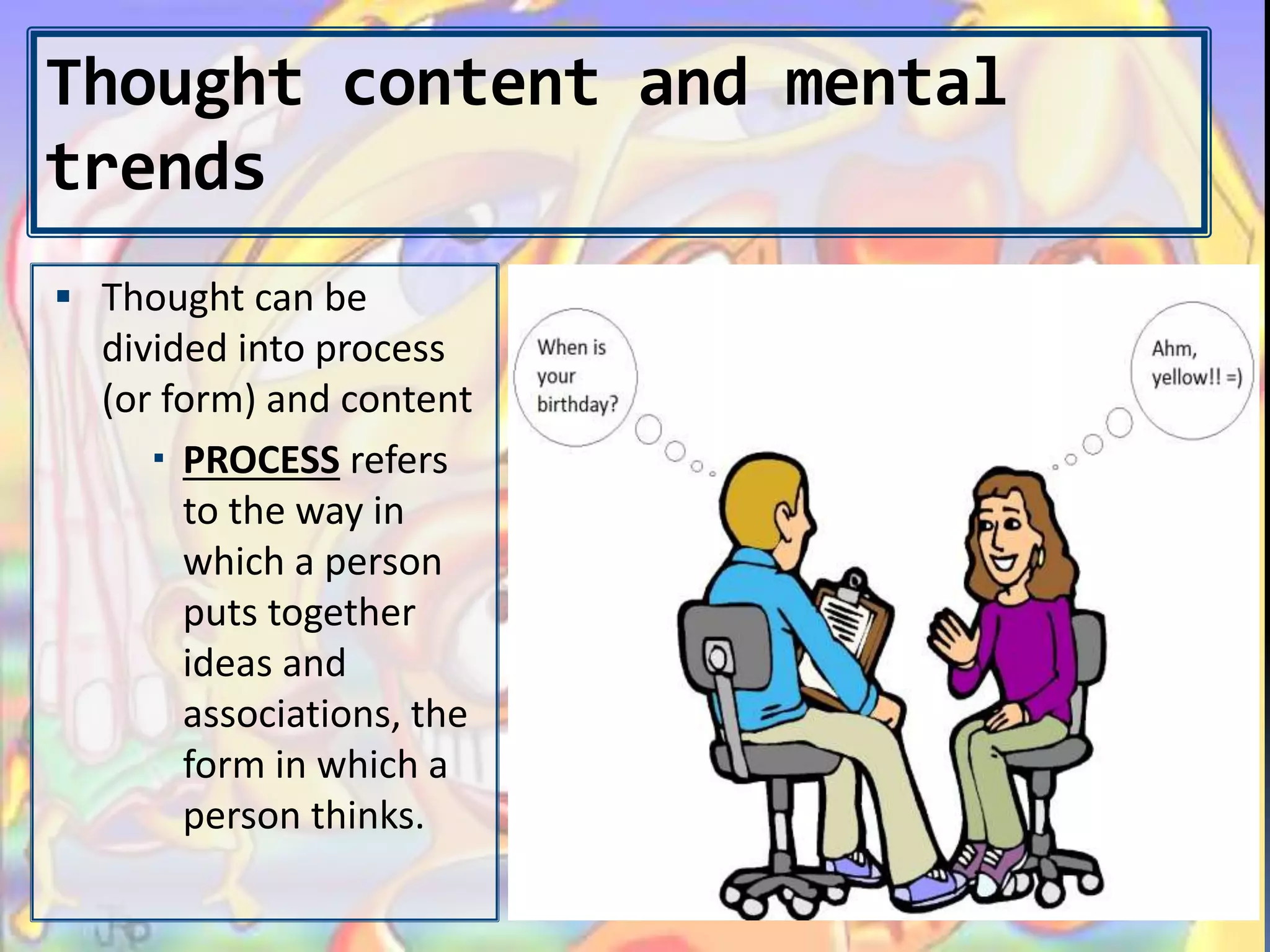
 Thought can be
divided into process
(or form) and content
 PROCESS refers
to the way in
which a person
puts together
ideas and
associations, the
form in which a
person thinks.
Thought content and mental
trends
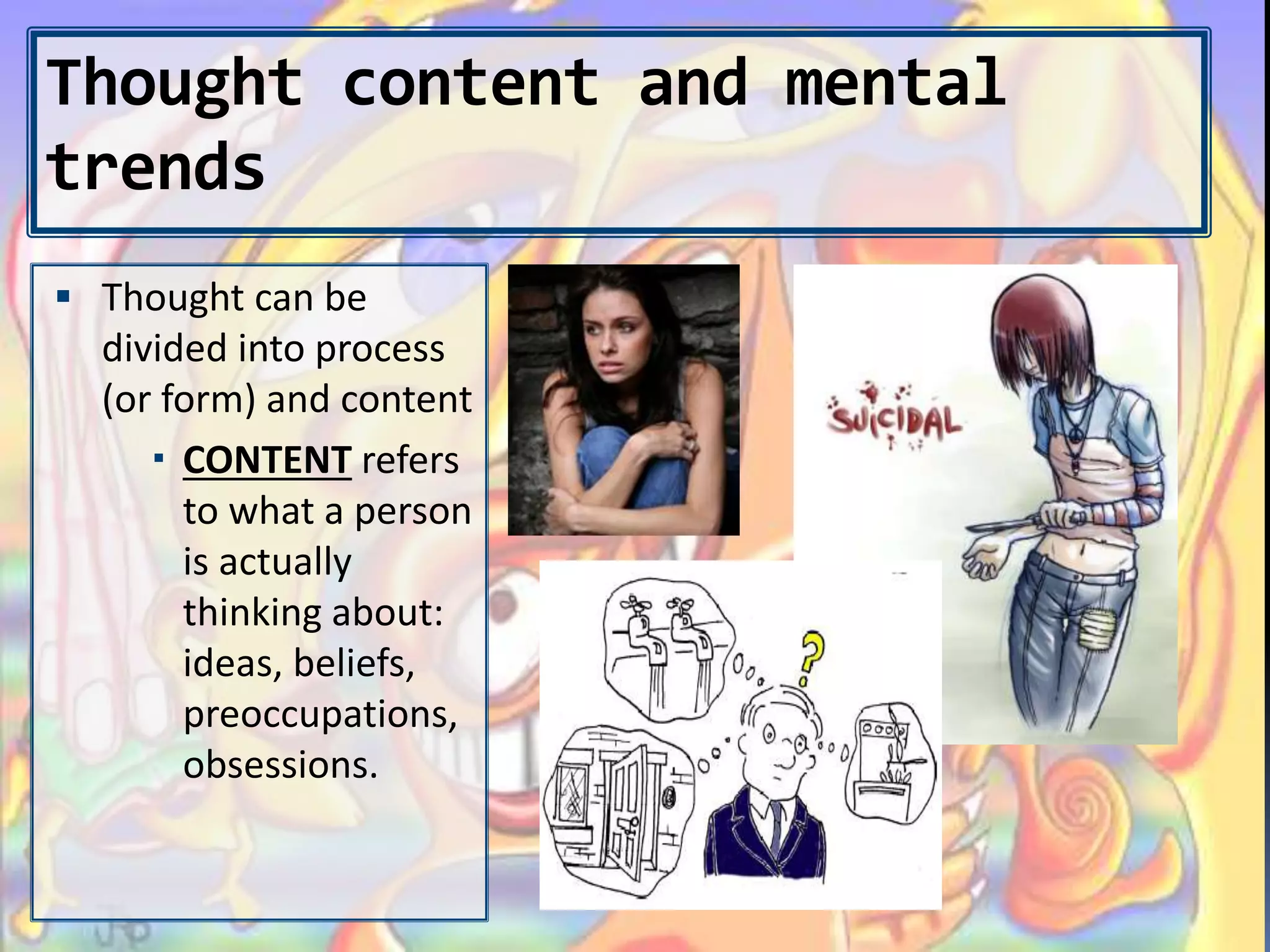
 Thought can be
divided into process
(or form) and content
 CONTENT refers
to what a person
is actually
thinking about:
ideas, beliefs,
preoccupations,
obsessions.
FORMAL THOUGHT DISORDERS
Circumstantiality Overinclusion of trivial or irrelevant details that impede
the sense of getting to the point.
Clang associations Thoughts are associated by the sound of words rather
than by their meaning (e.g., through rhyming or
assonance).
Derailment (Synonymous with loose
associations)
A breakdown in both the logical connection between
ideas and the overall sense of goal-directedness. The
words make sentences, but the sentences do not make
sense.
Flight of ideas succession of multiple associations so that thoughts
seem to move abruptly from idea to idea; often (but
not invariably) expressed through rapid, pressured
speech.
Neologism The invention of new words or phrases or the use of
conventional words in idiosyncratic ways.
Perseveration Repetition of out of context of words, phrases, or
ideas.
Tangentiality In response to a question, the patient gives a reply that
is appropriate to the general topic without actually
answering the question.
Thought blocking A sudden disruption of thought or a break in the flow
of ideas.
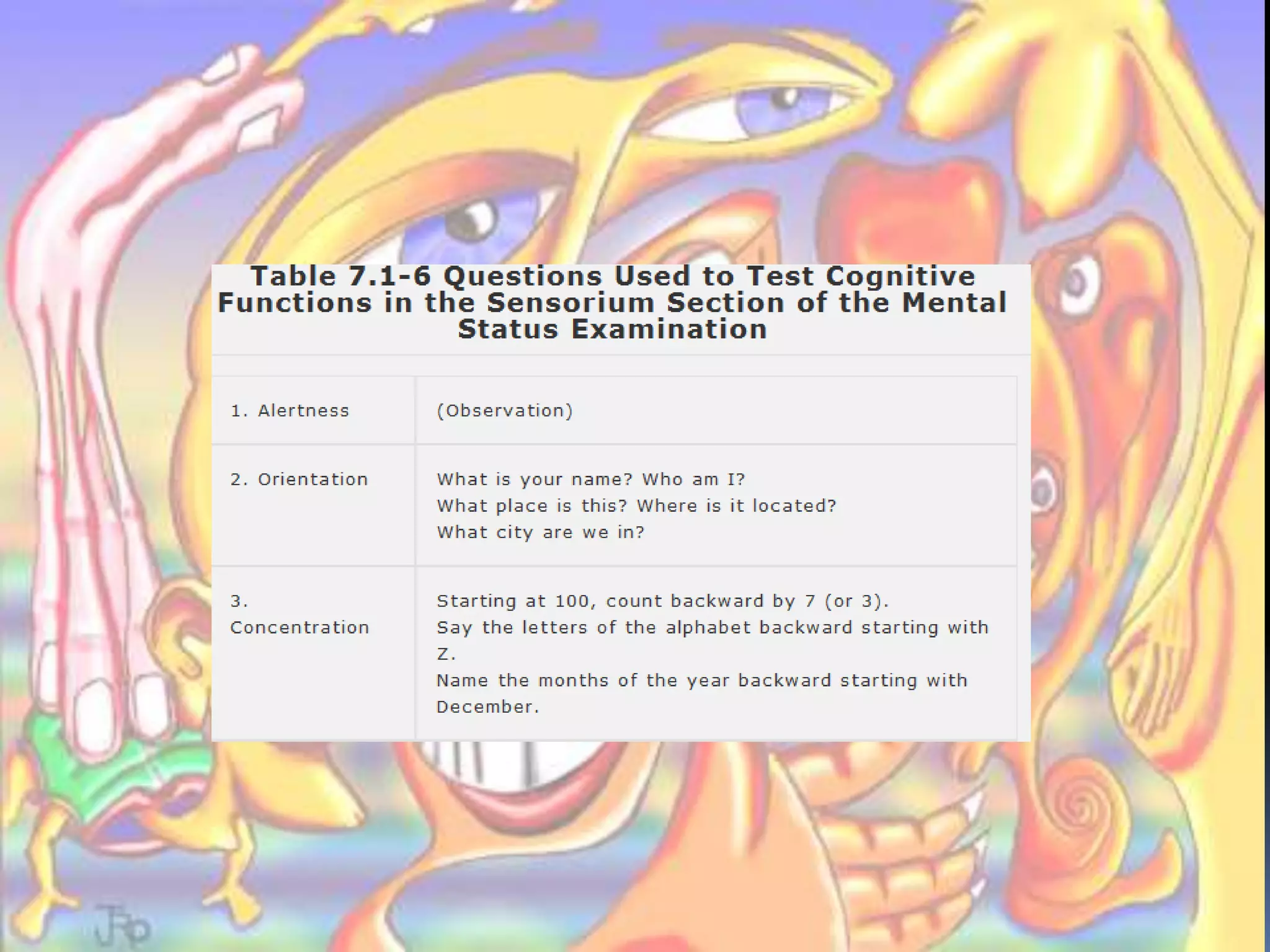
Sensorium and Cognition
 The sensorium and
cognition portion
of the mental
status examination
seeks to assess
brain function,
including
intelligence,
capacity for
abstract thought,
and level of insight
and judgment.
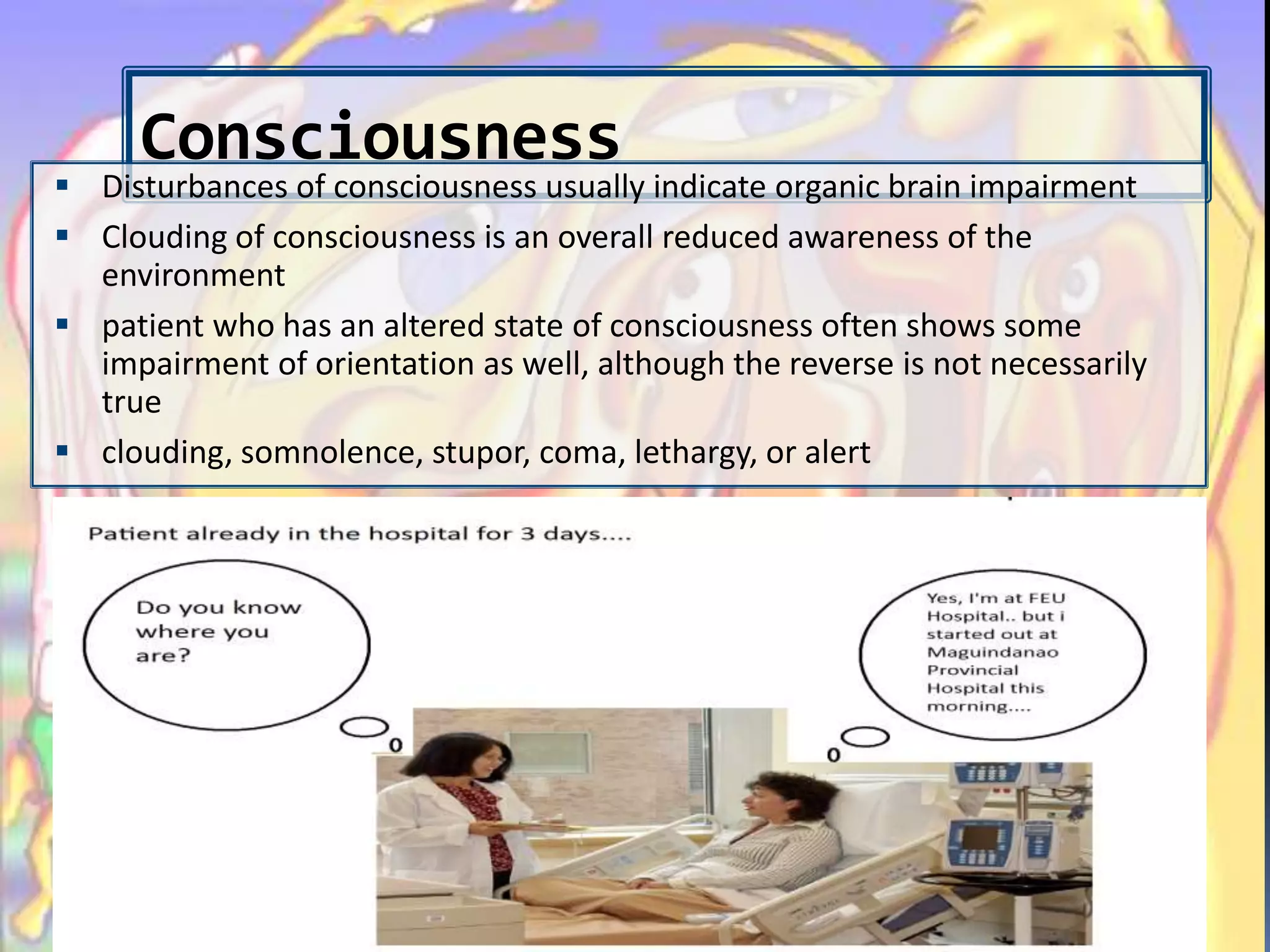
Consciousness
 Disturbances of consciousness usually indicate organic brain impairment
 Clouding of consciousness is an overall reduced awareness of the
environment
 patient who has an altered state of consciousness often shows some
impairment of orientation as well, although the reverse is not necessarily
true
 clouding, somnolence, stupor, coma, lethargy, or alert
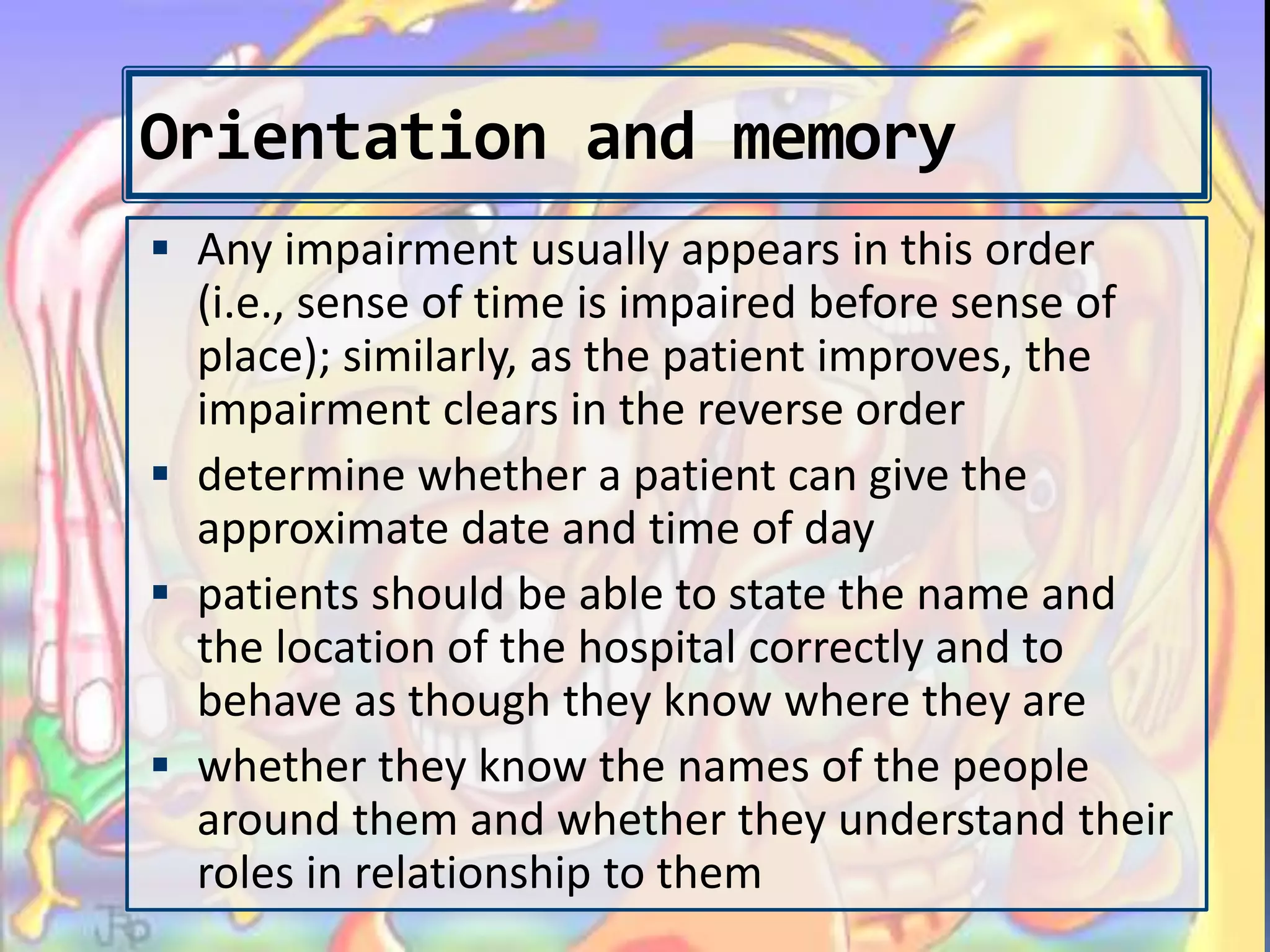
Orientation and memory
 Any impairment usually appears in this order
(i.e., sense of time is impaired before sense of
place); similarly, as the patient improves, the
impairment clears in the reverse order
 determine whether a patient can give the
approximate date and time of day
 patients should be able to state the name and
the location of the hospital correctly and to
behave as though they know where they are
 whether they know the names of the people
around them and whether they understand their
roles in relationship to them
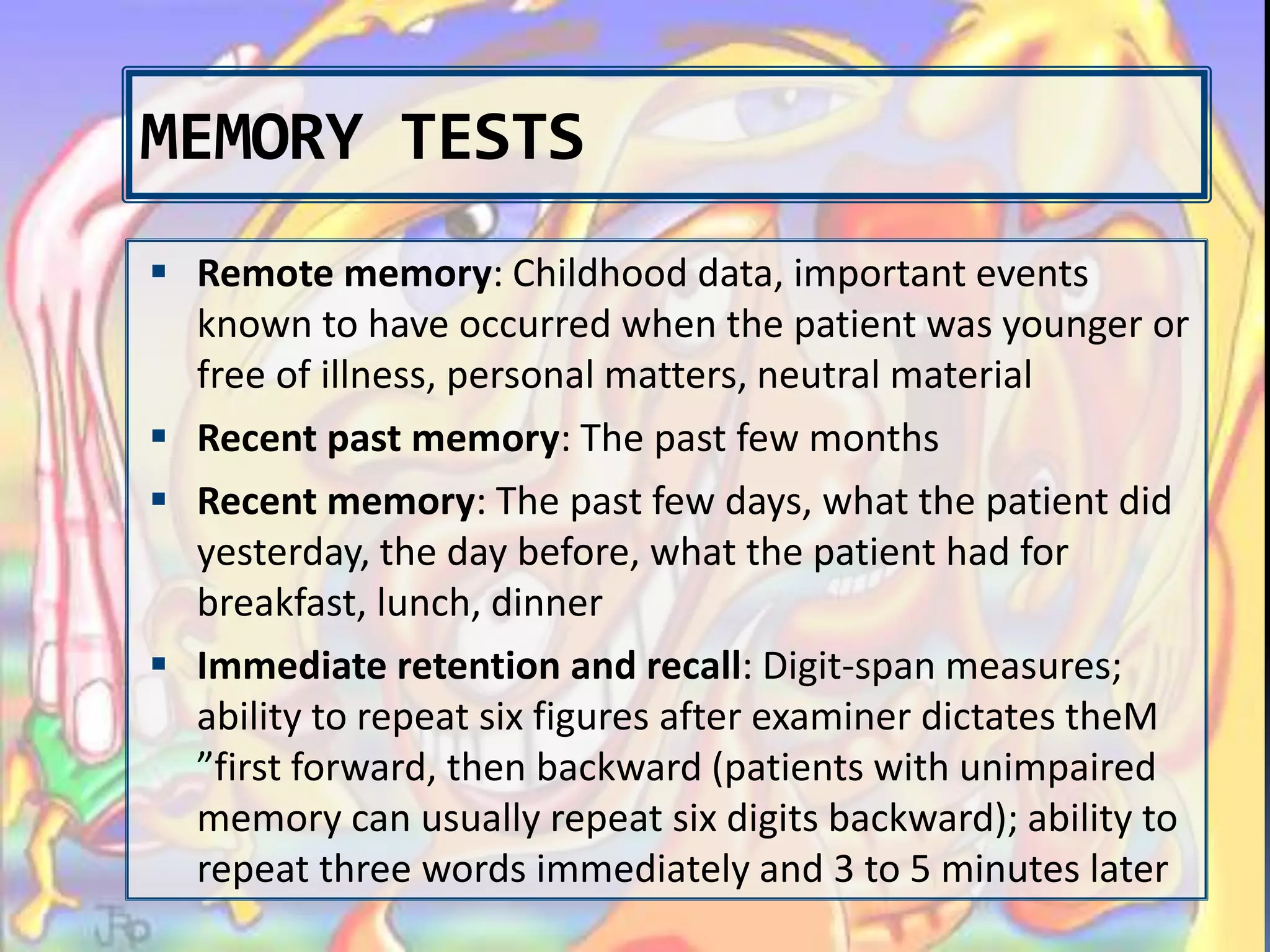
MEMORY TESTS
 Remote memory: Childhood data, important events
known to have occurred when the patient was younger or
free of illness, personal matters, neutral material
 Recent past memory: The past few months
 Recent memory: The past few days, what the patient did
yesterday, the day before, what the patient had for
breakfast, lunch, dinner
 Immediate retention and recall: Digit-span measures;
ability to repeat six figures after examiner dictates theM
”first forward, then backward (patients with unimpaired
memory can usually repeat six digits backward); ability to
repeat three words immediately and 3 to 5 minutes later
Concentration and attention
 A cognitive disorder, anxiety, depression, and internal
stimuli, such as auditory hallucinations, can all
contribute to impaired concentration
 Subtracting serial 7s from 100 is a simple task that
requires intact concentration and cognitive capacities
 Could the patient subtract 7 from 100 and keep
subtracting 7s? If the patient could not subtract
7s, could 3s be subtracted?
 always assess whether anxiety, some disturbance of
mood or consciousness, or a learning deficit
(dyscalculia) is responsible for the difficulty
Concentration and attention
 Attention is assessed by calculations or by asking the
patient to spell the word world (or others) backward.
The patient can also be asked to name five things
that start with a particular letter.
Reading and writing
 ask the patient to read a sentence
 patient should also be asked to write a simple but
complete sentence
Visuospatial ability
 should be asked to copy a figure, such as a clock face
or interlocking pentagons
Abstract thought
 ability to deal with concepts
 Can the patient explain similarities, such as those
between an apple and a pear or between truth
and beauty?
 Are the meanings of simple proverbs, such as A
rolling stone gathers no moss, understood?
 Answers can be concrete (giving specific examples to
illustrate the meaning) or overly abstract (giving too
generalized an explanation).
 In a catastrophic reaction, brain-damaged patients
become extremely emotional and cannot think
abstractly.
Information and intelligence
 Does the patient have trouble with mental tasks
 patient's intelligence is related to vocabulary and
general fund of knowledge
 patient's educational level (both formal and self-
education) and socioeconomic status must be taken
into account
 psychiatrist estimates the patient's intellectual
capability and capacity to function at the level of
basic endowment
Impulsivity
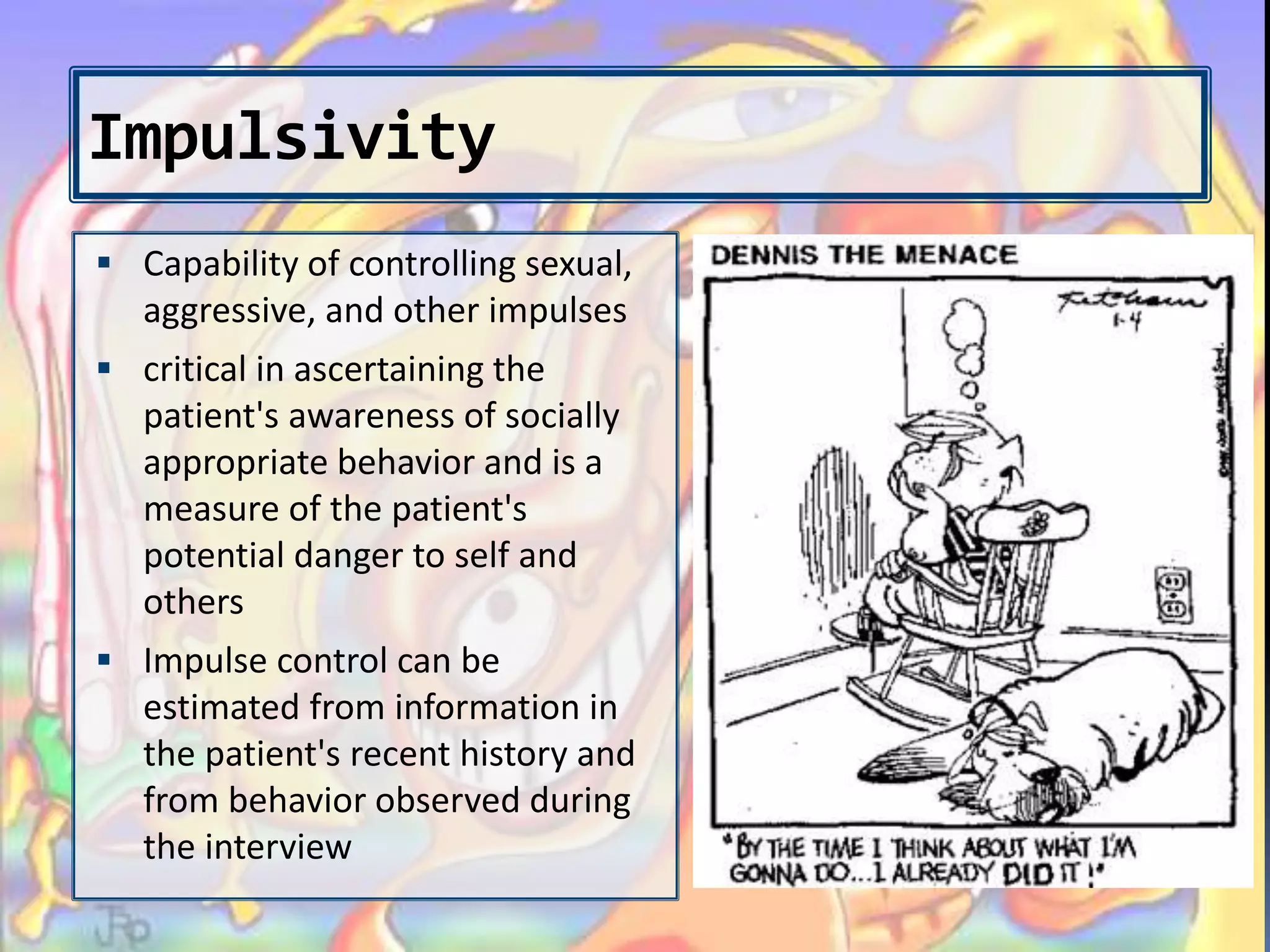
 Capability of controlling sexual,
aggressive, and other impulses
 critical in ascertaining the
patient's awareness of socially
appropriate behavior and is a
measure of the patient's
potential danger to self and
others
 Impulse control can be
estimated from information in
the patient's recent history and
from behavior observed during
the interview
Judgment
 Does the patient understand the likely outcome of
his or her behavior, and is he or she influenced by
this understanding?
 Can the patient predict what he or she would do in
imaginary situations (e.g., smelling smoke in a
crowded movie theater)?
Insight
 Degree of awareness and understanding about being ill
 A summary of six levels of insight follows:
1.Complete denial of illness
2.Slight awareness of being sick and needing
help, but denying it at the same time
3.Awareness of being sick but blaming it on
others, on external factors, or on organic factors
4.Awareness that illness is caused by something
unknown in the patient
Insight
5. Intellectual insight: admission that the patient is ill
and that symptoms or failures in social adjustment
are caused by the patient's own particular irrational
feelings or disturbances without applying this
knowledge to future experiences
6. True emotional insight: emotional awareness of the
motives and feelings within the patient and the
important persons in his or her life, which can lead to
basic changes in behavior.
Reliability
 with the psychiatrist's impressions of the patient's
reliability and capacity to report his or her situation
accurately
 includes an estimate of the psychiatrist's impression
of the patient's truthfulness or veracity

Mental Status Examination.ppt

  • 1.
  • 2.
    MENTAL STATUS EXAMINATION describes the sum total of the examiner’s observations and impressions of the psychiatric patient at the time of the interview  the description of the patient’s appearance, speech, actions, and thoughts during the interview
  • 4.
    Appearance Bizarre??  Has anyoneever commented on your look?  How would you describe how you look?  Can you help me understand some of the choices you make in how you look?  overall physical impression  posture, poise, clothing, and grooming
  • 5.
    Attitude toward examiner cooperative, friendly, attentive, interested, frank, seductive, defensive, contemptuous, perplexed, apathetic, hostile, playful, ingratiating, evasive, or guarded
  • 6.
    Speech characteristics  physicalcharacteristics of speech in terms of its quantity, rate of production, and quality  talkative, garrulous, voluble, taciturn, unspontaneous, or normally responsive to cues from the interviewer  can be rapid or slow, pressured, hesitant, emotional, dramatic, monotonous, loud, whispered, slurred, staccato, or mumbled
  • 7.
    Speech characteristics  Speechimpairments  Any unusual rhythms (termed dysprosody) or accent should be noted
  • 8.
    Overt behavior andpsychomotor activity  describes both the quantitative and qualitative aspects of the patient's motor behavior  mannerisms, tics, gestures, twitches, stereotyped behavior, echopraxia, hyperactivity, agitation, combativeness, flexibility, rigidity, gait, and agility  restlessness, wringing of hands, pacing, and other physical manifestations
  • 9.
    Overt behavior andpsychomotor activity  psychomotor retardation or generalized slowing of body movements  aimless, purposeless activity
  • 10.
    Mood  defined asa pervasive and sustained emotion that colors the person's perception of the world  depth, intensity, duration, and fluctuations  depressed, despairing, irritable, anxious, angry, expansive, euphoric, empty, guilty, hopeless, futile, self-contemptuous, frightened, and perplexed  can be labile, fluctuating or alternating rapidly between extremes
  • 11.
    Affect  Defined asthe patient's present emotional responsiveness, inferred from the patient's facial expression, including the amount and the range of expressive behaviour  NORMAL - variation in facial expression, tone of voice, use of hands, and body movements  CONSTRICTED - range and intensity of expression are reduced  BLUNTED - emotional expression is further reduced  FLAT - no signs of affective expression should be present; the patient's voice should be monotonous and the face should be immobile  difficulty in initiating, sustaining, or terminating an emotional response
  • 12.
    Appropriateness of Affect delusion of persecution - angry or frightened about the experiences they believe are happening to them  inappropriate affect for a quality of response found in some schizophrenia patients, in which the patient's affect is incongruent with what the patient is saying
  • 13.
    Perception  Hallucinations andillusions  Hypnagogic hallucinations - occurring as a person falls asleep  Hypnopompic hallucinations - occurring as a person awakens  Feelings of depersonalization and derealization  Formication - seen in cocainism
  • 14.
    Thought content andmental trends  Thought can be divided into process (or form) and content  PROCESS refers to the way in which a person puts together ideas and associations, the form in which a person thinks.
  • 15.
    Thought content andmental trends  Thought can be divided into process (or form) and content  CONTENT refers to what a person is actually thinking about: ideas, beliefs, preoccupations, obsessions.
  • 16.
    FORMAL THOUGHT DISORDERS CircumstantialityOverinclusion of trivial or irrelevant details that impede the sense of getting to the point. Clang associations Thoughts are associated by the sound of words rather than by their meaning (e.g., through rhyming or assonance). Derailment (Synonymous with loose associations) A breakdown in both the logical connection between ideas and the overall sense of goal-directedness. The words make sentences, but the sentences do not make sense. Flight of ideas succession of multiple associations so that thoughts seem to move abruptly from idea to idea; often (but not invariably) expressed through rapid, pressured speech. Neologism The invention of new words or phrases or the use of conventional words in idiosyncratic ways. Perseveration Repetition of out of context of words, phrases, or ideas. Tangentiality In response to a question, the patient gives a reply that is appropriate to the general topic without actually answering the question. Thought blocking A sudden disruption of thought or a break in the flow of ideas.
  • 17.
    Sensorium and Cognition The sensorium and cognition portion of the mental status examination seeks to assess brain function, including intelligence, capacity for abstract thought, and level of insight and judgment.
  • 20.
    Consciousness  Disturbances ofconsciousness usually indicate organic brain impairment  Clouding of consciousness is an overall reduced awareness of the environment  patient who has an altered state of consciousness often shows some impairment of orientation as well, although the reverse is not necessarily true  clouding, somnolence, stupor, coma, lethargy, or alert
  • 21.
    Orientation and memory Any impairment usually appears in this order (i.e., sense of time is impaired before sense of place); similarly, as the patient improves, the impairment clears in the reverse order  determine whether a patient can give the approximate date and time of day  patients should be able to state the name and the location of the hospital correctly and to behave as though they know where they are  whether they know the names of the people around them and whether they understand their roles in relationship to them
  • 22.
    MEMORY TESTS  Remotememory: Childhood data, important events known to have occurred when the patient was younger or free of illness, personal matters, neutral material  Recent past memory: The past few months  Recent memory: The past few days, what the patient did yesterday, the day before, what the patient had for breakfast, lunch, dinner  Immediate retention and recall: Digit-span measures; ability to repeat six figures after examiner dictates theM ”first forward, then backward (patients with unimpaired memory can usually repeat six digits backward); ability to repeat three words immediately and 3 to 5 minutes later
  • 23.
    Concentration and attention A cognitive disorder, anxiety, depression, and internal stimuli, such as auditory hallucinations, can all contribute to impaired concentration  Subtracting serial 7s from 100 is a simple task that requires intact concentration and cognitive capacities  Could the patient subtract 7 from 100 and keep subtracting 7s? If the patient could not subtract 7s, could 3s be subtracted?  always assess whether anxiety, some disturbance of mood or consciousness, or a learning deficit (dyscalculia) is responsible for the difficulty
  • 24.
    Concentration and attention Attention is assessed by calculations or by asking the patient to spell the word world (or others) backward. The patient can also be asked to name five things that start with a particular letter.
  • 25.
    Reading and writing ask the patient to read a sentence  patient should also be asked to write a simple but complete sentence
  • 26.
    Visuospatial ability  shouldbe asked to copy a figure, such as a clock face or interlocking pentagons
  • 27.
    Abstract thought  abilityto deal with concepts  Can the patient explain similarities, such as those between an apple and a pear or between truth and beauty?  Are the meanings of simple proverbs, such as A rolling stone gathers no moss, understood?  Answers can be concrete (giving specific examples to illustrate the meaning) or overly abstract (giving too generalized an explanation).  In a catastrophic reaction, brain-damaged patients become extremely emotional and cannot think abstractly.
  • 28.
    Information and intelligence Does the patient have trouble with mental tasks  patient's intelligence is related to vocabulary and general fund of knowledge  patient's educational level (both formal and self- education) and socioeconomic status must be taken into account  psychiatrist estimates the patient's intellectual capability and capacity to function at the level of basic endowment
  • 29.
    Impulsivity  Capability ofcontrolling sexual, aggressive, and other impulses  critical in ascertaining the patient's awareness of socially appropriate behavior and is a measure of the patient's potential danger to self and others  Impulse control can be estimated from information in the patient's recent history and from behavior observed during the interview
  • 30.
    Judgment  Does thepatient understand the likely outcome of his or her behavior, and is he or she influenced by this understanding?  Can the patient predict what he or she would do in imaginary situations (e.g., smelling smoke in a crowded movie theater)?
  • 31.
    Insight  Degree ofawareness and understanding about being ill  A summary of six levels of insight follows: 1.Complete denial of illness 2.Slight awareness of being sick and needing help, but denying it at the same time 3.Awareness of being sick but blaming it on others, on external factors, or on organic factors 4.Awareness that illness is caused by something unknown in the patient
  • 32.
    Insight 5. Intellectual insight:admission that the patient is ill and that symptoms or failures in social adjustment are caused by the patient's own particular irrational feelings or disturbances without applying this knowledge to future experiences 6. True emotional insight: emotional awareness of the motives and feelings within the patient and the important persons in his or her life, which can lead to basic changes in behavior.
  • 33.
    Reliability  with thepsychiatrist's impressions of the patient's reliability and capacity to report his or her situation accurately  includes an estimate of the psychiatrist's impression of the patient's truthfulness or veracity

Editor's Notes

  • #30 Do you ever find yourself suddenly doing something before you have really had a chance to think about it? Do you ever do things you had decided not to do, and don't know why? Does money "burn a hole in your pocket"?