Mental status assessment
DR SUHA OMRAN
HEBA ALSAQER
2021
We believe that every human being
deserves to live a meaningful life. What we
consider meaningful depends on our
personal values and gives us the strength
to cope with adversities, including
traumatic experiences and difficult life-
transitions.
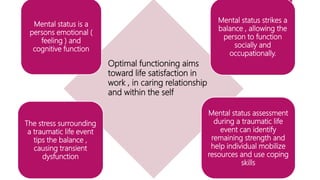
Mental status is a
persons emotional (
feeling ) and

cognitive function
Mental status strikes a
balance , allowing the
person to function
socially and
occupationally.
The stress surrounding
a traumatic life event
tips the balance ,
causing transient
dysfunction
Mental status assessment
during a traumatic life
event can identify
remaining strength and
help individual mobilize
resources and use coping
skills
Optimal functioning aims
toward life satisfaction in
work , in caring relationship
and within the self
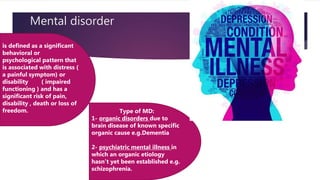
Mental disorder
is defined as a significant
behavioral or
psychological pattern that
is associated with distress (
a painful symptom) or
disability ( impaired
functioning ) and has a
significant risk of pain,
disability , death or loss of
freedom. Type of MD:
1- organic disorders due to
brain disease of known specific
organic cause e.g.Dementia
2- psychiatric mental illness in
which an organic etiology
hasn’t yet been established e.g.
schizophrenia.
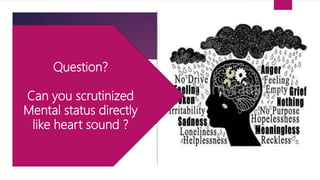
Question?
Can you scrutinized
Mental status directly
like heart sound ?
“
”
Assessment of individual
behaviors
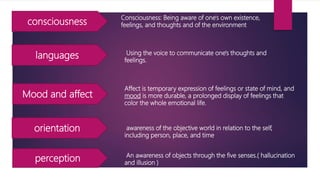
consciousness
languages
Mood and affect
orientation
perception
Consciousness: Being aware of one's own existence,
feelings, and thoughts and of the environment
Using the voice to communicate one's thoughts and
feelings.
Affect is temporary expression of feelings or state of mind, and
mood is more durable, a prolonged display of feelings that
color the whole emotional life.
awareness of the objective world in relation to the self,
including person, place, and time.
An awareness of objects through the five senses.( hallucination
and illusion )
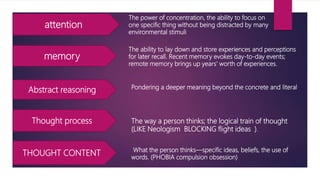
attention
memory
Abstract reasoning
Thought process
THOUGHT CONTENT
The power of concentration, the ability to focus on
one specific thing without being distracted by many
environmental stimuli
The ability to lay down and store experiences and perceptions
for later recall. Recent memory evokes day-to-day events;
remote memory brings up years' worth of experiences.
Pondering a deeper meaning beyond the concrete and literal
The way a person thinks; the logical train of thought
(LIKE Neologism BLOCKING flight ideas ).
What the person thinks—specific ideas, beliefs, the use of
words. (PHOBIA compulsion obsession)
“
”
Developmental Competence
Emotional and cognitive functioning mature progressively from
simple reflex behavior into complex logical and abstract thought
Example :-
 Consciousness : develops along with language so that, by(
18 to 24) months, the child learns that he or she is separate
from objects in the environment and has words to express
this.
 Attention gradually increases( preschool years )
 thinking At( 7 years) becomes more logical and systematic,
and the child is able to reason
 Abstract thinking , the ability to consider a hypothetical
situation, usually develops between ( 12 and 15 years).
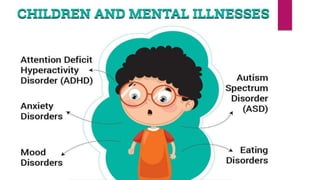
. Adolescents ages childhood
mental disorder is one that is
diagnosed and begins in
childhood (e.g., attention
deficit/hyperactivity disorder
[ADHD], behavioral or conduct
problems, anxiety, depression,
autism spectrum disorders)
Anxiety and depression among school students in Jordan: Prevalence, risk
factors, and predictors
Purpose: to assess the prevalence of anxiety and depression, examine their
relationships with sociodemographic factors and Internet addiction, and identify their
main predictors among Jordanian school students aged 12-18 years.
Design and methods: A descriptive correlational study was conducted on a random
sample of 800 students from 10 public schools in Amman 2017 . Symptom Checklist-
anxiety, Center for Epidemiological Studies Depression Scale for Children, and Young's
Internet Addiction Tool were used for the purpose.
Findings: Overall, 42.1 and 73.8% of the students were experiencing anxiety and
depression. Risk factors for both problems were school class and Internet addiction,
with the latter being the main predictor
.
Practice implications: Increasing students' and stakeholders' awareness of mental
illnesses and health programs and developing counseling centers to meet the
students' needs are necessary.
Pup med wipe site
The Aging Adult
* Age-related changes in sensory perception can affect mental status. For
example, vision loss ) may result in apathy, social isolation, and depression.
* chronic diseases (e.g., heart failure, cancer, diabetes, osteoporosis)
may increase the fear of loss of independence or of death.
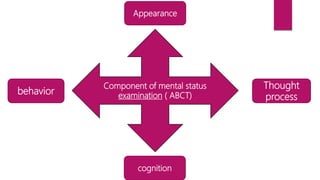
Component of mental status
examination ( ABCT)
behavior
Appearance
Thought
process
cognition
when to perform a full mental status exam :
- initial brief screening suggests anxiety disorder or depression
family members are concerned
-brain lesions (trauma, tumor, CVA)
-aphasia ( the impairment of language ability secondary to brain
damage).
- symptoms of psychiatric mental illness.
factors that could affect interpretation of MSE:
1- known illness or health problems (alcoholism, renal disease)
2- current medications whose side effects may cause
depression or confusion.
3- the usual educational and behavioral level.
4- responses to personal history questions indicating current
stress, drug use, sleep habits etc.
Objective
data…
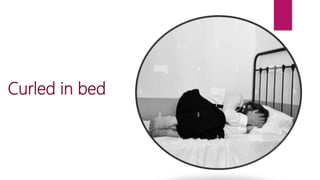
1-POSTURE - erect and position is relaxed
abnormal : curled in bed ,restlessness with
hyperthyroidism or anxiety;
slumped in chair with depression or
organic brain disease
Appearance
Slumped in chair
Curled in bed
2- BODY MOVEMENTS
-voluntary, deliberate, coordinated, smooth and
even.
- abnormal : restless ,hyperkinetic with anxiety ,
bizarre gesture with schizophrenia.
Bizarre posture
Hyperkinetic
3- DRESS
appropriate for season, age, gender, setting
abnormal : inappropriate dress with organic
brain syndrome; eccentric dress with
schizophrenia or mania syndrome.
Eccentric dress
Old women dress
girl dress
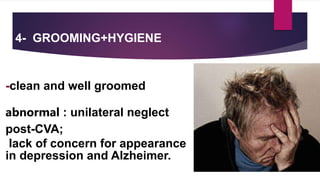
4- GROOMING+HYGIENE :
-clean and well groomed
abnormal : unilateral neglect
post-CVA;
lack of concern for appearance
in depression and Alzheimer.
Behavior
1-LEVEL OF CONSCIOUSNESS - awake alert aware
Abnormal : confused loos track of conversation
2-SPEECH – quality of speech by noting that the person makes laryngeal
sounds effortlessly and sharing conversation appropriately , the pace of
conversation moderate , articulation ( ability to form words) is clear.
Abnormal : silent un communicative
3-MOOD+AFFECT –
appropriate; ask(( how do u feel today?))
abnormal : mood swings with mania; bizarre with schizophrenia
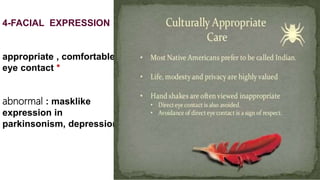
4-FACIAL EXPRESSION
appropriate , comfortable
eye contact *
abnormal : masklike
expression in
parkinsonism, depression
Cognitive functioning
1-ORIENTATION - knows date, place, time
abnormal : w/delirium and dementia
2-ATTENTION SPAN -
abnormal : digression from initial thought, irrelevant replies to
questions
3-RECENT MEMORY - can recall 24 hrs
abnormal : dementia, delirium, Korsakoffs syndrome
4-REMOTE MEMORY - recalls events in past
abn: lost when cortical storage area for memory is damaged
(Alzheimer
, trauma to brain region)
5-NEW LEARNING - 4 unrelated words test
abn: Alzheimer's, dementia, anxiety, depression
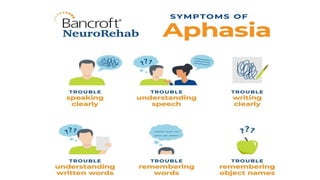
additional tests for aphasia
 word comprehension - point at objects and ask person to
name them
 reading - ask to read print.
 writing - ask to write a sentence.
tests for higher intellectual function
 measure problem solving and reasoning abilities
ex: count back from 100 by 7s
 - must be assessed considering cultural and educational
background
 - can be used to discriminate between organic brain disease and
psychiatric disorders (errors on test = organic dysfunction)
)) little evidence that they are valid to detect brain disease((
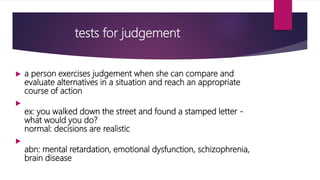
tests for judgement
 a person exercises judgement when she can compare and
evaluate alternatives in a situation and reach an appropriate
course of action

ex: you walked down the street and found a stamped letter -
what would you do?
normal: decisions are realistic

abn: mental retardation, emotional dysfunction, schizophrenia,
brain disease
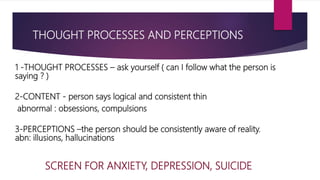
THOUGHT PROCESSES AND PERCEPTIONS
1 -THOUGHT PROCESSES – ask yourself ( can I follow what the person is
saying ? )
2-CONTENT - person says logical and consistent thin
abnormal : obsessions, compulsions
3-PERCEPTIONS –the person should be consistently aware of reality.
abn: illusions, hallucinations
SCREEN FOR ANXIETY, DEPRESSION, SUICIDE
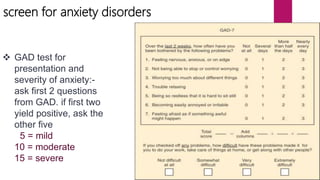
screen for anxiety disorders
 GAD test for
presentation and
severity of anxiety:-
ask first 2 questions
from GAD. if first two
yield positive, ask the
other five
5 = mild
10 = moderate
15 = severe
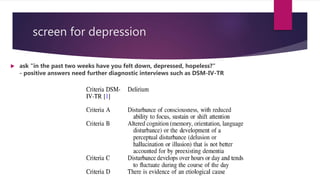
screen for depression
 ask "in the past two weeks have you felt down, depressed, hopeless?"
- positive answers need further diagnostic interviews such as DSM-IV-TR
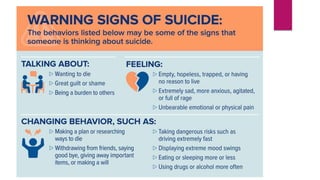
screen for suicidal thoughts
When person expresses feelings of sadness, hopelessness or grief.
One in 100 deaths is by suicide according to Who IN Jan 2021.
it is important to assess any possible risk of physical harm to
himself or herself by starting with general questions then get
specific if you hear affirmative answer for example :
.Have you ever felt so blue that you
thought of hurting yourself?
 Do you feel like hurting yourself now?
 Do you have a plan to hurt yourself?
 What would happen if you were dead?
 How would other people react if you
were dead?
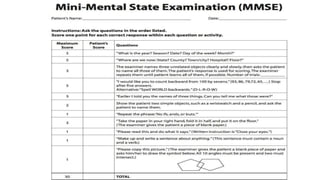
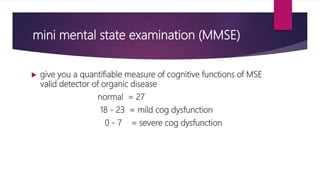
 give you a quantifiable measure of cognitive functions of MSE
valid detector of organic disease
normal = 27
18 - 23 = mild cog dysfunction
0 - 7 = severe cog dysfunction
mini mental state examination (MMSE)
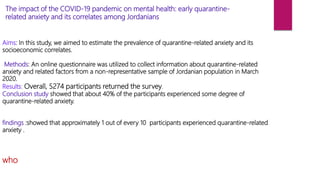
Aims: In this study, we aimed to estimate the prevalence of quarantine-related anxiety and its
socioeconomic correlates.
Methods: An online questionnaire was utilized to collect information about quarantine-related
anxiety and related factors from a non-representative sample of Jordanian population in March
2020.
Results: Overall, 5274 participants returned the survey.
Conclusion study showed that about 40% of the participants experienced some degree of
quarantine-related anxiety.
findings :showed that approximately 1 out of every 10 participants experienced quarantine-related
anxiety .
who
The impact of the COVID-19 pandemic on mental health: early quarantine-
related anxiety and its correlates among Jordanians
Spiritual Needs
Meaning and purpose in life
Faith or trust in someone or something beyond ourselves
Hope and Love
Forgiveness
 If someone is hopeless they have a spiritual need
Nursing Diagnosis Categories
Health Promotion
Nutrition
Activity/Rest
Coping/Stress Tolerance
Safety/Protection
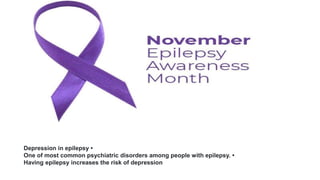
Depression in epilepsy •
One of most common psychiatric disorders among people with epilepsy. •
Having epilepsy increases the risk of depression
any question‫؟‬
THANKS……

Mental status assessment presentation

  • 1.
    Mental status assessment DRSUHA OMRAN HEBA ALSAQER 2021
  • 2.
    We believe thatevery human being deserves to live a meaningful life. What we consider meaningful depends on our personal values and gives us the strength to cope with adversities, including traumatic experiences and difficult life- transitions.
  • 4.
    Mental status isa persons emotional ( feeling ) and cognitive function Mental status strikes a balance , allowing the person to function socially and occupationally. The stress surrounding a traumatic life event tips the balance , causing transient dysfunction Mental status assessment during a traumatic life event can identify remaining strength and help individual mobilize resources and use coping skills Optimal functioning aims toward life satisfaction in work , in caring relationship and within the self
  • 5.
    Mental disorder is definedas a significant behavioral or psychological pattern that is associated with distress ( a painful symptom) or disability ( impaired functioning ) and has a significant risk of pain, disability , death or loss of freedom. Type of MD: 1- organic disorders due to brain disease of known specific organic cause e.g.Dementia 2- psychiatric mental illness in which an organic etiology hasn’t yet been established e.g. schizophrenia.
  • 6.
    Question? Can you scrutinized Mentalstatus directly like heart sound ?
  • 7.
  • 8.
    consciousness languages Mood and affect orientation perception Consciousness:Being aware of one's own existence, feelings, and thoughts and of the environment Using the voice to communicate one's thoughts and feelings. Affect is temporary expression of feelings or state of mind, and mood is more durable, a prolonged display of feelings that color the whole emotional life. awareness of the objective world in relation to the self, including person, place, and time. An awareness of objects through the five senses.( hallucination and illusion )
  • 9.
    attention memory Abstract reasoning Thought process THOUGHTCONTENT The power of concentration, the ability to focus on one specific thing without being distracted by many environmental stimuli The ability to lay down and store experiences and perceptions for later recall. Recent memory evokes day-to-day events; remote memory brings up years' worth of experiences. Pondering a deeper meaning beyond the concrete and literal The way a person thinks; the logical train of thought (LIKE Neologism BLOCKING flight ideas ). What the person thinks—specific ideas, beliefs, the use of words. (PHOBIA compulsion obsession)
  • 10.
  • 11.
    Emotional and cognitivefunctioning mature progressively from simple reflex behavior into complex logical and abstract thought Example :-  Consciousness : develops along with language so that, by( 18 to 24) months, the child learns that he or she is separate from objects in the environment and has words to express this.  Attention gradually increases( preschool years )  thinking At( 7 years) becomes more logical and systematic, and the child is able to reason  Abstract thinking , the ability to consider a hypothetical situation, usually develops between ( 12 and 15 years).
  • 12.
    . Adolescents ageschildhood mental disorder is one that is diagnosed and begins in childhood (e.g., attention deficit/hyperactivity disorder [ADHD], behavioral or conduct problems, anxiety, depression, autism spectrum disorders)
  • 14.
    Anxiety and depressionamong school students in Jordan: Prevalence, risk factors, and predictors Purpose: to assess the prevalence of anxiety and depression, examine their relationships with sociodemographic factors and Internet addiction, and identify their main predictors among Jordanian school students aged 12-18 years. Design and methods: A descriptive correlational study was conducted on a random sample of 800 students from 10 public schools in Amman 2017 . Symptom Checklist- anxiety, Center for Epidemiological Studies Depression Scale for Children, and Young's Internet Addiction Tool were used for the purpose. Findings: Overall, 42.1 and 73.8% of the students were experiencing anxiety and depression. Risk factors for both problems were school class and Internet addiction, with the latter being the main predictor . Practice implications: Increasing students' and stakeholders' awareness of mental illnesses and health programs and developing counseling centers to meet the students' needs are necessary. Pup med wipe site
  • 15.
    The Aging Adult *Age-related changes in sensory perception can affect mental status. For example, vision loss ) may result in apathy, social isolation, and depression. * chronic diseases (e.g., heart failure, cancer, diabetes, osteoporosis) may increase the fear of loss of independence or of death.
  • 16.
    Component of mentalstatus examination ( ABCT) behavior Appearance Thought process cognition
  • 17.
    when to performa full mental status exam : - initial brief screening suggests anxiety disorder or depression family members are concerned -brain lesions (trauma, tumor, CVA) -aphasia ( the impairment of language ability secondary to brain damage). - symptoms of psychiatric mental illness.
  • 18.
    factors that couldaffect interpretation of MSE: 1- known illness or health problems (alcoholism, renal disease) 2- current medications whose side effects may cause depression or confusion. 3- the usual educational and behavioral level. 4- responses to personal history questions indicating current stress, drug use, sleep habits etc.
  • 19.
  • 20.
    1-POSTURE - erectand position is relaxed abnormal : curled in bed ,restlessness with hyperthyroidism or anxiety; slumped in chair with depression or organic brain disease Appearance
  • 21.
  • 22.
  • 23.
    2- BODY MOVEMENTS -voluntary,deliberate, coordinated, smooth and even. - abnormal : restless ,hyperkinetic with anxiety , bizarre gesture with schizophrenia.
  • 24.
  • 25.
  • 26.
    3- DRESS appropriate forseason, age, gender, setting abnormal : inappropriate dress with organic brain syndrome; eccentric dress with schizophrenia or mania syndrome.
  • 27.
  • 28.
  • 29.
    4- GROOMING+HYGIENE : -cleanand well groomed abnormal : unilateral neglect post-CVA; lack of concern for appearance in depression and Alzheimer.
  • 30.
    Behavior 1-LEVEL OF CONSCIOUSNESS- awake alert aware Abnormal : confused loos track of conversation 2-SPEECH – quality of speech by noting that the person makes laryngeal sounds effortlessly and sharing conversation appropriately , the pace of conversation moderate , articulation ( ability to form words) is clear. Abnormal : silent un communicative 3-MOOD+AFFECT – appropriate; ask(( how do u feel today?)) abnormal : mood swings with mania; bizarre with schizophrenia
  • 31.
    4-FACIAL EXPRESSION appropriate ,comfortable eye contact * abnormal : masklike expression in parkinsonism, depression
  • 32.
    Cognitive functioning 1-ORIENTATION -knows date, place, time abnormal : w/delirium and dementia 2-ATTENTION SPAN - abnormal : digression from initial thought, irrelevant replies to questions 3-RECENT MEMORY - can recall 24 hrs abnormal : dementia, delirium, Korsakoffs syndrome
  • 34.
    4-REMOTE MEMORY -recalls events in past abn: lost when cortical storage area for memory is damaged (Alzheimer , trauma to brain region) 5-NEW LEARNING - 4 unrelated words test abn: Alzheimer's, dementia, anxiety, depression
  • 35.
    additional tests foraphasia  word comprehension - point at objects and ask person to name them  reading - ask to read print.  writing - ask to write a sentence.
  • 37.
    tests for higherintellectual function  measure problem solving and reasoning abilities ex: count back from 100 by 7s  - must be assessed considering cultural and educational background  - can be used to discriminate between organic brain disease and psychiatric disorders (errors on test = organic dysfunction) )) little evidence that they are valid to detect brain disease((
  • 38.
    tests for judgement a person exercises judgement when she can compare and evaluate alternatives in a situation and reach an appropriate course of action  ex: you walked down the street and found a stamped letter - what would you do? normal: decisions are realistic  abn: mental retardation, emotional dysfunction, schizophrenia, brain disease
  • 39.
    THOUGHT PROCESSES ANDPERCEPTIONS 1 -THOUGHT PROCESSES – ask yourself ( can I follow what the person is saying ? ) 2-CONTENT - person says logical and consistent thin abnormal : obsessions, compulsions 3-PERCEPTIONS –the person should be consistently aware of reality. abn: illusions, hallucinations SCREEN FOR ANXIETY, DEPRESSION, SUICIDE
  • 40.
    screen for anxietydisorders  GAD test for presentation and severity of anxiety:- ask first 2 questions from GAD. if first two yield positive, ask the other five 5 = mild 10 = moderate 15 = severe
  • 41.
    screen for depression ask "in the past two weeks have you felt down, depressed, hopeless?" - positive answers need further diagnostic interviews such as DSM-IV-TR
  • 42.
    screen for suicidalthoughts When person expresses feelings of sadness, hopelessness or grief. One in 100 deaths is by suicide according to Who IN Jan 2021. it is important to assess any possible risk of physical harm to himself or herself by starting with general questions then get specific if you hear affirmative answer for example :
  • 43.
    .Have you everfelt so blue that you thought of hurting yourself?  Do you feel like hurting yourself now?  Do you have a plan to hurt yourself?  What would happen if you were dead?  How would other people react if you were dead?
  • 46.
     give youa quantifiable measure of cognitive functions of MSE valid detector of organic disease normal = 27 18 - 23 = mild cog dysfunction 0 - 7 = severe cog dysfunction mini mental state examination (MMSE)
  • 47.
    Aims: In thisstudy, we aimed to estimate the prevalence of quarantine-related anxiety and its socioeconomic correlates. Methods: An online questionnaire was utilized to collect information about quarantine-related anxiety and related factors from a non-representative sample of Jordanian population in March 2020. Results: Overall, 5274 participants returned the survey. Conclusion study showed that about 40% of the participants experienced some degree of quarantine-related anxiety. findings :showed that approximately 1 out of every 10 participants experienced quarantine-related anxiety . who The impact of the COVID-19 pandemic on mental health: early quarantine- related anxiety and its correlates among Jordanians
  • 48.
    Spiritual Needs Meaning andpurpose in life Faith or trust in someone or something beyond ourselves Hope and Love Forgiveness  If someone is hopeless they have a spiritual need
  • 49.
    Nursing Diagnosis Categories HealthPromotion Nutrition Activity/Rest Coping/Stress Tolerance Safety/Protection
  • 50.
    Depression in epilepsy• One of most common psychiatric disorders among people with epilepsy. • Having epilepsy increases the risk of depression
  • 52.
  • 53.