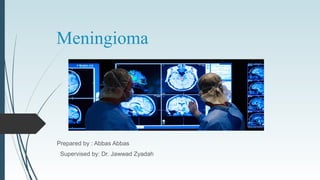
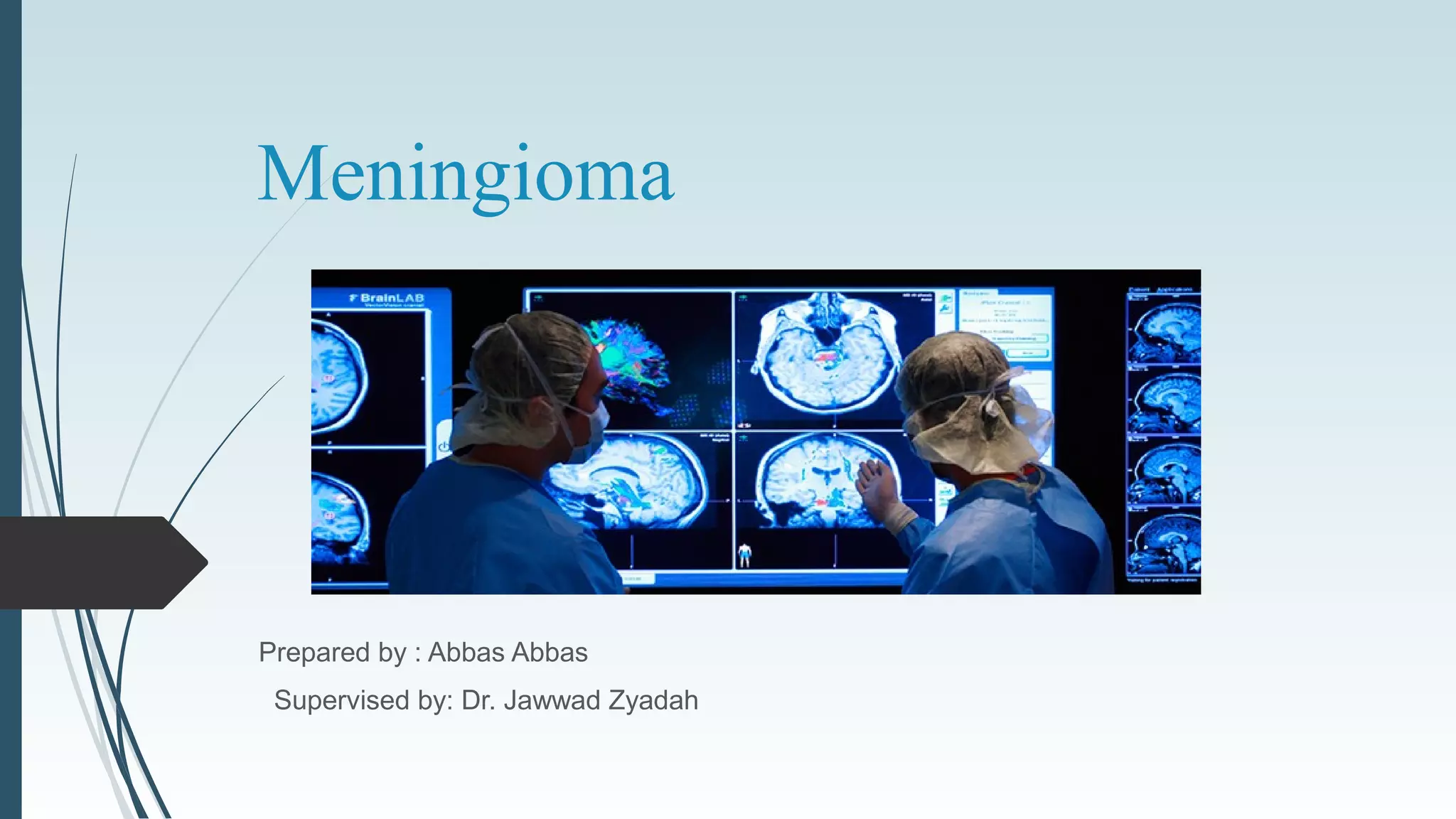
Meningioma
Prepared by : Abbas Abbas
Supervised by: Dr. Jawwad Zyadah
Definition
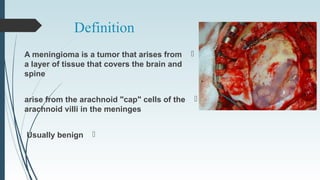
A meningioma is a tumor that arises from
a layer of tissue that covers the brain and
spine
arise from the arachnoid "cap" cells of the
arachnoid villi in the meninges
Usually benign
Causes
Most are sporadic, some familial
More common in women
Radiation increase risk of developing meningioma
Trauma and viruses. However, no definitive proof has yet been
found
The role of inflammation (eg, posttraumatic insult) resulting in
the upregulation of COX-2
Cell phone use increases the risk of meningiomas
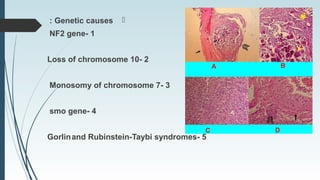
Genetic causes:
1-NF2 gene
2-Loss of chromosome 10
3-Monosomy of chromosome 7
4-smo gene
5-Gorlinand Rubinstein-Taybi syndromes
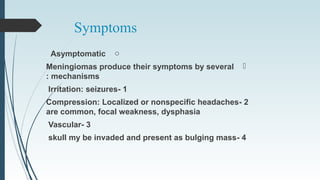
Symptoms
oAsymptomatic
Meningiomas produce their symptoms by several
mechanisms:
1-Irritation: seizures
2-Compression: Localized or nonspecific headaches
are common, focal weakness, dysphasia
3-Vascular
4-skull my be invaded and present as bulging mass
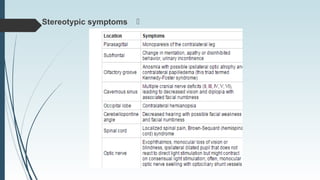
Stereotypic symptoms
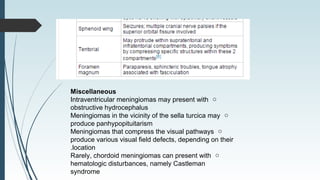
Miscellaneous
oIntraventricular meningiomas may present with
obstructive hydrocephalus
oMeningiomas in the vicinity of the sella turcica may
produce panhypopituitarism
oMeningiomas that compress the visual pathways
produce various visual field defects, depending on their
location.
oRarely, chordoid meningiomas can present with
hematologic disturbances, namely Castleman
syndrome
Locations
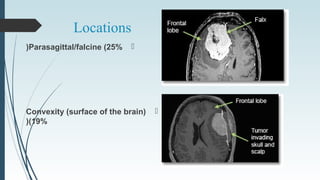
Parasagittal/falcine (25%(
Convexity (surface of the brain(
(19%(
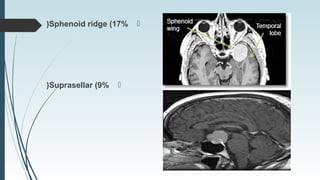
Sphenoid ridge (17%(
Suprasellar (9%(
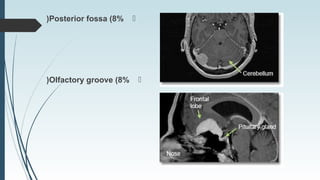
Posterior fossa (8%(
Olfactory groove (8%(
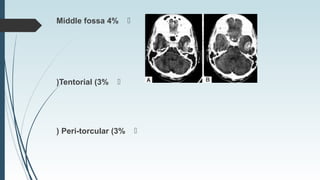
Middle fossa 4%
Tentorial (3%(
Peri-torcular (3%(
Workup
Laparotomy studies : No specific laboratory tests are
used to screen for meningioma.
Imaging study:
oCT scan
oMRI
oAngiography
oPET
Workup
Histology
oGrade 1 - Benign: These very slow-growing tumors
oGrade 2 - Atypical: Usually slow-growing but can recur
oGrade 3 - Anaplastic: More malignant, faster-growing
Treatment
Observation: Meningiomas are often slow growing, increasing
is size only 1-2 mm per year.
oPatients with small tumors and mild or minimal symptoms,
no impact on quality of life, and little or no swelling in
adjacent brain areas.
oOlder patients with very slowly progressing
symptoms. Related seizures can be controlled with
medication.
Treatment
Medical care
It is restricted either to perioperative drugs or to medications
that are used after all other means of treatment have failed
ocorticosteroids
oAntiepileptic
ochemotherapy
oRadiotherapy
oStereotactic radiosurgery
Treatment
Surgical care:
The constant principles in meningioma resection are the following:
oIf possible, all involved or hyperostotic bone should be removed
oThe dura involved by the tumor as well as a dural rim that is free from
tumor should be resected
oDural tails that are apparent on MRI are best removed, even though
some may not be involved with the tumor
oMake a provision for harvesting a suitable dural substitute
(pericranium or fascia lata). The surgeon also can use commercially
available dural substitutes
oIf feasible, always start by coagulating the arterial feeders to the
meningioma
Treatment
Minimally invasive surgical options
Endoscopic removal of meningiomas through the nose
oolfactory groove meningiomas
otuberculum sella meningiomas
osellar meningiomas
Keyhole microsurgical removal using eyebrow incision
oolfactory groove meningiomas
osphenoid wing meningiomas
Endoport removal
ointraventricular meningiomas
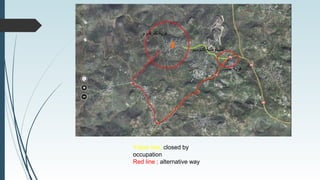
Yalow line; closed by
occupation
Red line ; alternative way
‫لكم‬ ‫شكرا‬

Meningioma

  • 1.
    Meningioma Prepared by :Abbas Abbas Supervised by: Dr. Jawwad Zyadah
  • 2.
    Definition A meningioma isa tumor that arises from a layer of tissue that covers the brain and spine arise from the arachnoid "cap" cells of the arachnoid villi in the meninges Usually benign
  • 3.
    Causes Most are sporadic,some familial More common in women Radiation increase risk of developing meningioma Trauma and viruses. However, no definitive proof has yet been found The role of inflammation (eg, posttraumatic insult) resulting in the upregulation of COX-2 Cell phone use increases the risk of meningiomas
  • 4.
    Genetic causes: 1-NF2 gene 2-Lossof chromosome 10 3-Monosomy of chromosome 7 4-smo gene 5-Gorlinand Rubinstein-Taybi syndromes
  • 5.
    Symptoms oAsymptomatic Meningiomas produce theirsymptoms by several mechanisms: 1-Irritation: seizures 2-Compression: Localized or nonspecific headaches are common, focal weakness, dysphasia 3-Vascular 4-skull my be invaded and present as bulging mass
  • 6.
  • 7.
    Miscellaneous oIntraventricular meningiomas maypresent with obstructive hydrocephalus oMeningiomas in the vicinity of the sella turcica may produce panhypopituitarism oMeningiomas that compress the visual pathways produce various visual field defects, depending on their location. oRarely, chordoid meningiomas can present with hematologic disturbances, namely Castleman syndrome
  • 8.
  • 9.
  • 10.
  • 11.
    Middle fossa 4% Tentorial(3%( Peri-torcular (3%(
  • 12.
    Workup Laparotomy studies :No specific laboratory tests are used to screen for meningioma. Imaging study: oCT scan oMRI oAngiography oPET
  • 13.
    Workup Histology oGrade 1 -Benign: These very slow-growing tumors oGrade 2 - Atypical: Usually slow-growing but can recur oGrade 3 - Anaplastic: More malignant, faster-growing
  • 14.
    Treatment Observation: Meningiomas areoften slow growing, increasing is size only 1-2 mm per year. oPatients with small tumors and mild or minimal symptoms, no impact on quality of life, and little or no swelling in adjacent brain areas. oOlder patients with very slowly progressing symptoms. Related seizures can be controlled with medication.
  • 15.
    Treatment Medical care It isrestricted either to perioperative drugs or to medications that are used after all other means of treatment have failed ocorticosteroids oAntiepileptic ochemotherapy oRadiotherapy oStereotactic radiosurgery
  • 16.
    Treatment Surgical care: The constantprinciples in meningioma resection are the following: oIf possible, all involved or hyperostotic bone should be removed oThe dura involved by the tumor as well as a dural rim that is free from tumor should be resected oDural tails that are apparent on MRI are best removed, even though some may not be involved with the tumor oMake a provision for harvesting a suitable dural substitute (pericranium or fascia lata). The surgeon also can use commercially available dural substitutes oIf feasible, always start by coagulating the arterial feeders to the meningioma
  • 17.
    Treatment Minimally invasive surgicaloptions Endoscopic removal of meningiomas through the nose oolfactory groove meningiomas otuberculum sella meningiomas osellar meningiomas Keyhole microsurgical removal using eyebrow incision oolfactory groove meningiomas osphenoid wing meningiomas Endoport removal ointraventricular meningiomas
  • 18.
    Yalow line; closedby occupation Red line ; alternative way
  • 19.

Editor's Notes

  • #3 Malignant called typical meningiomas or anaplastic meningiomas Benign == slow growing and low potential to spread
  • #4 Radiation to scalp, teeth x ray , tinea capitis
  • #5 Nf2 code tumor suppresser gene merlin Smoothened is a G protein-coupled receptor
  • #13 On plain head CT scans, meningiomas are usually dural-based tumors that are isoattenuating to slightly hyperattenuating. On T1- and T2-weighted MRIs, the tumors have variable signal intensity. If a meningioma is suspected, obtaining an enhanced MRI is imperative.
  • #14 WHO classification system. Benign (Grade I) – (90%) – meningothelial, fibrous, transitional, psammomatous, angioblastic Atypical (Grade II) – (7%) – chordoid, clear cell, atypical (includes brain invasion) Anaplastic/malignant (Grade III) – (2%) – papillary, rhabdoid, anaplastic (most aggressive)