CHORDOMA
Ade Wijaya, MD
January 2019
Outline:
• Introduction
• Epidemiology
• Predilection
• Pathogenesis
• Clinical presentation
• Diagnosis
• Management
• Summary
Introduction
• Rare
• 1-4 % of bone malignancies
• Histologically  a low-grade neoplasm, but highly recurrent, making their clinical
progression very similar to that of malignant tumours
• Slow growing, radioresistant tumours that are locally aggressive and invasive
Healey JH, Lane JM. Chordoma: a critical review of diagnosis and treatment. Orthop Clin North Am 1989; 20: 417–26.
Bergh P, Kindblom LG, Gunterberg B, Remotti F, Ryd W, Meis-Kindblom JM. Prognostic factors in chordoma of the sacrum and mobile spine: a study of 39 patients. Cancer 2000; 88: 2122–34.
Schwab JH, Boland PJ, Agaram NP, et al. Chordoma and chondrosarcoma gene profi le: implications for immunotherapy. Cancer Immunol Immunother 2009; 58: 339–49.
Epidemiology
• Incidence: 0.08 per 100.000
• M > F
• Peak incidence: 50-60 years old
• Very low incidence in < 40 years old
• Rarely affect children and adolescents
McMaster ML, Goldstein AM, Bromley CM, Ishibe N, Parry DM. Chordoma: incidence and survival patterns in the United States, 1973–1995. Cancer Causes Control 2001; 12: 1–11
Predilection
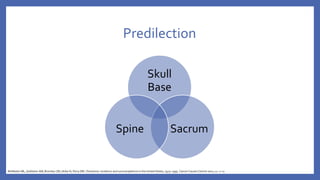
Skull
Base
SacrumSpine
McMaster ML, Goldstein AM, Bromley CM, Ishibe N, Parry DM. Chordoma: incidence and survival patterns in the United States, 1973–1995. Cancer Causes Control 2001; 12: 1–11
Pathogenesis
• Chordomas were first characterised microscopically byVirchow in 1857
• Unique, intracellular, bubble-like vacuoles that he referred to as physaliferous
• Ribbert first introduced the term chordoma in the 1890s
• Derived from undifferentiated notochordal remnants that reside within the
vertebral bodies and throughout the axial skeleton
• Gene duplication in the transcription factorT gene (brachyury) in familial
chordoma
Virchow RL. Untersuchungen ueber die Entwicklung des Schaedelgrundes. Berlin: G Rimer, 1857.
Horten BC, Montague SR. In vitro characteristics of a sacrococcygeal chordoma maintained in tissue and organ culture systems. Acta Neuropathol 1976; 35: 13–25.
Ribbert H. Uber die Ecchondosis physaliphora phenooccipitalis. Centralbl Allg Pathol Anat 1894; 5: 457–61
Yang XR, Ng D, Alcorta DA, et al. T (brachyury) gene duplication confers major susceptibility to familial chordoma. Nat Genet 2009; 41: 1176–78
Clinical Presentation
• Indolent, slow growing  clinically silent until late stage of the diseases
• Skull base chordoma: cranial nerve palsies, endocrinopathy, epistaxis, intracranial
hemorrhage
• Spinal & sacral chordoma: pain and radiculopathies symptoms; late: bladder and
bowel dysfunction. Cervical  airway obstruction & dysphagia
• 5% of chordomas show metastasis to the lungs, bone, skin, and brain at the time
of initial presentation, and as high as 65% are metastatic in very advanced disease
Walcott BP, Nahed BV, Mohyeldin A, Coumans JV, Kahle KT, Ferreira MJ. Chordoma: current concepts, management, and future directions. The lancet oncology. 2012 Feb 1;13(2):e69-76.
Diagnosis
• Neuroimaging: xray, CT, MRI
• Biopsy: classical (conventional), chondroid, or dedifferentiated
• immunoreactivity for S-100 and epithelial markers such as epithelial membrane
antigen (MUC1) and cytokeratins
Chugh R, Tawbi H, Lucas DR, Biermann JS, Schuetze SM, Baker LH. Chordoma: the nonsarcoma primary bone tumor. Oncologist 2007; 12: 1344–50.
Crapanzano JP, Ali SZ, Ginsberg MS, Zakowski MF. Chordoma: a cytologic study with histologic and radiologic correlation. Cancer 2001; 93: 40–51
Mitchell A, Scheithauer BW, Unni KK, Forsyth PJ, Wold LE, McGivney DJ. Chordoma and chondroid neoplasms of the spheno-occiput. An immunohistochemical study of 41 cases with prognostic and nosologic implications. Cancer 1993; 72: 2943–49.
Abenoza P, Sibley RK. Chordoma: an immunohistologic study. Hum Pathol 1986; 17: 744–47
Management
• Surgery
• Radiation therapy
• Medical treatment: on research
• Multidisciplinary approach
SURVIVAL: 5 year, 10 year, and 20 year survival dropping precipitously to 67·6%,
39·9%, and 13·1%, respectively, across all races and sex
Walcott BP, Nahed BV, Mohyeldin A, Coumans JV, Kahle KT, Ferreira MJ. Chordoma: current concepts, management, and future directions. The lancet oncology. 2012 Feb 1;13(2):e69-76.
Management
• The gold standard treatment for chordomas of the mobile spine and sacrum is en-
bloc excision with wide margins and postoperative external-beam radiation
therapy.
• Treatment of clival chordomas is unique from other locations with an enhanced
emphasis on preservation of neurological function, typified by a general paradigm
of maximally safe cytoreductive surgery and advanced radiation delivery
techniques
Walcott BP, Nahed BV, Mohyeldin A, Coumans JV, Kahle KT, Ferreira MJ. Chordoma: current concepts, management, and future directions. The lancet oncology. 2012 Feb 1;13(2):e69-76.
Summary
• Chordoma is a rare bone cancer that is aggressive, locally invasive, and has a poor
prognosis
• Arise from transformed remnants of notochord and have a predilection for the
axial skeleton, with the most common sites being the sacrum, skull base, and
spine
• Management: multidisciplinary (surgery + radiation)
Chordoma

Chordoma

  • 1.
  • 2.
    Outline: • Introduction • Epidemiology •Predilection • Pathogenesis • Clinical presentation • Diagnosis • Management • Summary
  • 3.
    Introduction • Rare • 1-4% of bone malignancies • Histologically  a low-grade neoplasm, but highly recurrent, making their clinical progression very similar to that of malignant tumours • Slow growing, radioresistant tumours that are locally aggressive and invasive Healey JH, Lane JM. Chordoma: a critical review of diagnosis and treatment. Orthop Clin North Am 1989; 20: 417–26. Bergh P, Kindblom LG, Gunterberg B, Remotti F, Ryd W, Meis-Kindblom JM. Prognostic factors in chordoma of the sacrum and mobile spine: a study of 39 patients. Cancer 2000; 88: 2122–34. Schwab JH, Boland PJ, Agaram NP, et al. Chordoma and chondrosarcoma gene profi le: implications for immunotherapy. Cancer Immunol Immunother 2009; 58: 339–49.
  • 4.
    Epidemiology • Incidence: 0.08per 100.000 • M > F • Peak incidence: 50-60 years old • Very low incidence in < 40 years old • Rarely affect children and adolescents McMaster ML, Goldstein AM, Bromley CM, Ishibe N, Parry DM. Chordoma: incidence and survival patterns in the United States, 1973–1995. Cancer Causes Control 2001; 12: 1–11
  • 5.
    Predilection Skull Base SacrumSpine McMaster ML, GoldsteinAM, Bromley CM, Ishibe N, Parry DM. Chordoma: incidence and survival patterns in the United States, 1973–1995. Cancer Causes Control 2001; 12: 1–11
  • 6.
    Pathogenesis • Chordomas werefirst characterised microscopically byVirchow in 1857 • Unique, intracellular, bubble-like vacuoles that he referred to as physaliferous • Ribbert first introduced the term chordoma in the 1890s • Derived from undifferentiated notochordal remnants that reside within the vertebral bodies and throughout the axial skeleton • Gene duplication in the transcription factorT gene (brachyury) in familial chordoma Virchow RL. Untersuchungen ueber die Entwicklung des Schaedelgrundes. Berlin: G Rimer, 1857. Horten BC, Montague SR. In vitro characteristics of a sacrococcygeal chordoma maintained in tissue and organ culture systems. Acta Neuropathol 1976; 35: 13–25. Ribbert H. Uber die Ecchondosis physaliphora phenooccipitalis. Centralbl Allg Pathol Anat 1894; 5: 457–61 Yang XR, Ng D, Alcorta DA, et al. T (brachyury) gene duplication confers major susceptibility to familial chordoma. Nat Genet 2009; 41: 1176–78
  • 7.
    Clinical Presentation • Indolent,slow growing  clinically silent until late stage of the diseases • Skull base chordoma: cranial nerve palsies, endocrinopathy, epistaxis, intracranial hemorrhage • Spinal & sacral chordoma: pain and radiculopathies symptoms; late: bladder and bowel dysfunction. Cervical  airway obstruction & dysphagia • 5% of chordomas show metastasis to the lungs, bone, skin, and brain at the time of initial presentation, and as high as 65% are metastatic in very advanced disease Walcott BP, Nahed BV, Mohyeldin A, Coumans JV, Kahle KT, Ferreira MJ. Chordoma: current concepts, management, and future directions. The lancet oncology. 2012 Feb 1;13(2):e69-76.
  • 8.
    Diagnosis • Neuroimaging: xray,CT, MRI • Biopsy: classical (conventional), chondroid, or dedifferentiated • immunoreactivity for S-100 and epithelial markers such as epithelial membrane antigen (MUC1) and cytokeratins Chugh R, Tawbi H, Lucas DR, Biermann JS, Schuetze SM, Baker LH. Chordoma: the nonsarcoma primary bone tumor. Oncologist 2007; 12: 1344–50. Crapanzano JP, Ali SZ, Ginsberg MS, Zakowski MF. Chordoma: a cytologic study with histologic and radiologic correlation. Cancer 2001; 93: 40–51 Mitchell A, Scheithauer BW, Unni KK, Forsyth PJ, Wold LE, McGivney DJ. Chordoma and chondroid neoplasms of the spheno-occiput. An immunohistochemical study of 41 cases with prognostic and nosologic implications. Cancer 1993; 72: 2943–49. Abenoza P, Sibley RK. Chordoma: an immunohistologic study. Hum Pathol 1986; 17: 744–47
  • 9.
    Management • Surgery • Radiationtherapy • Medical treatment: on research • Multidisciplinary approach SURVIVAL: 5 year, 10 year, and 20 year survival dropping precipitously to 67·6%, 39·9%, and 13·1%, respectively, across all races and sex Walcott BP, Nahed BV, Mohyeldin A, Coumans JV, Kahle KT, Ferreira MJ. Chordoma: current concepts, management, and future directions. The lancet oncology. 2012 Feb 1;13(2):e69-76.
  • 10.
    Management • The goldstandard treatment for chordomas of the mobile spine and sacrum is en- bloc excision with wide margins and postoperative external-beam radiation therapy. • Treatment of clival chordomas is unique from other locations with an enhanced emphasis on preservation of neurological function, typified by a general paradigm of maximally safe cytoreductive surgery and advanced radiation delivery techniques Walcott BP, Nahed BV, Mohyeldin A, Coumans JV, Kahle KT, Ferreira MJ. Chordoma: current concepts, management, and future directions. The lancet oncology. 2012 Feb 1;13(2):e69-76.
  • 11.
    Summary • Chordoma isa rare bone cancer that is aggressive, locally invasive, and has a poor prognosis • Arise from transformed remnants of notochord and have a predilection for the axial skeleton, with the most common sites being the sacrum, skull base, and spine • Management: multidisciplinary (surgery + radiation)

Editor's Notes

  • #2 Are your classroom colors different than what you see in this template? That’s OK! Click on Design -> Variants (the down arrow) -> Pick the color scheme that works for you! Feel free to change any “You will…” and “I will…” statements to ensure they align with your classroom procedures and rules!