Treatment Controversies in Meniere’s Disease Shashidhar S. Reddy, MD, MPH Shawn D. Newlands, MD, PhD UTMB Otolaryngology  Grand Rounds May 18, 2005
Outline History and Meniere’s Definition of Meniere’s Physiology, Pathophysiology of Meniere’s Medical Management of Meniere’s Meniet Device Intratympanic Gentamicin Endolymphatic Sac Surgery Vestibular Nerve Section Conclusions
History of Meniere’s 1861 – Prosper Meniere describes classic symptoms and attributes to labyrinth 1871 – Knappin theorizes dilatation of membranous Labyrinth 1938 – Hallpike and Portman confirm endolymphatic hydrops via temporal bone histology 1995 – Latest revision of AAOHNS definition
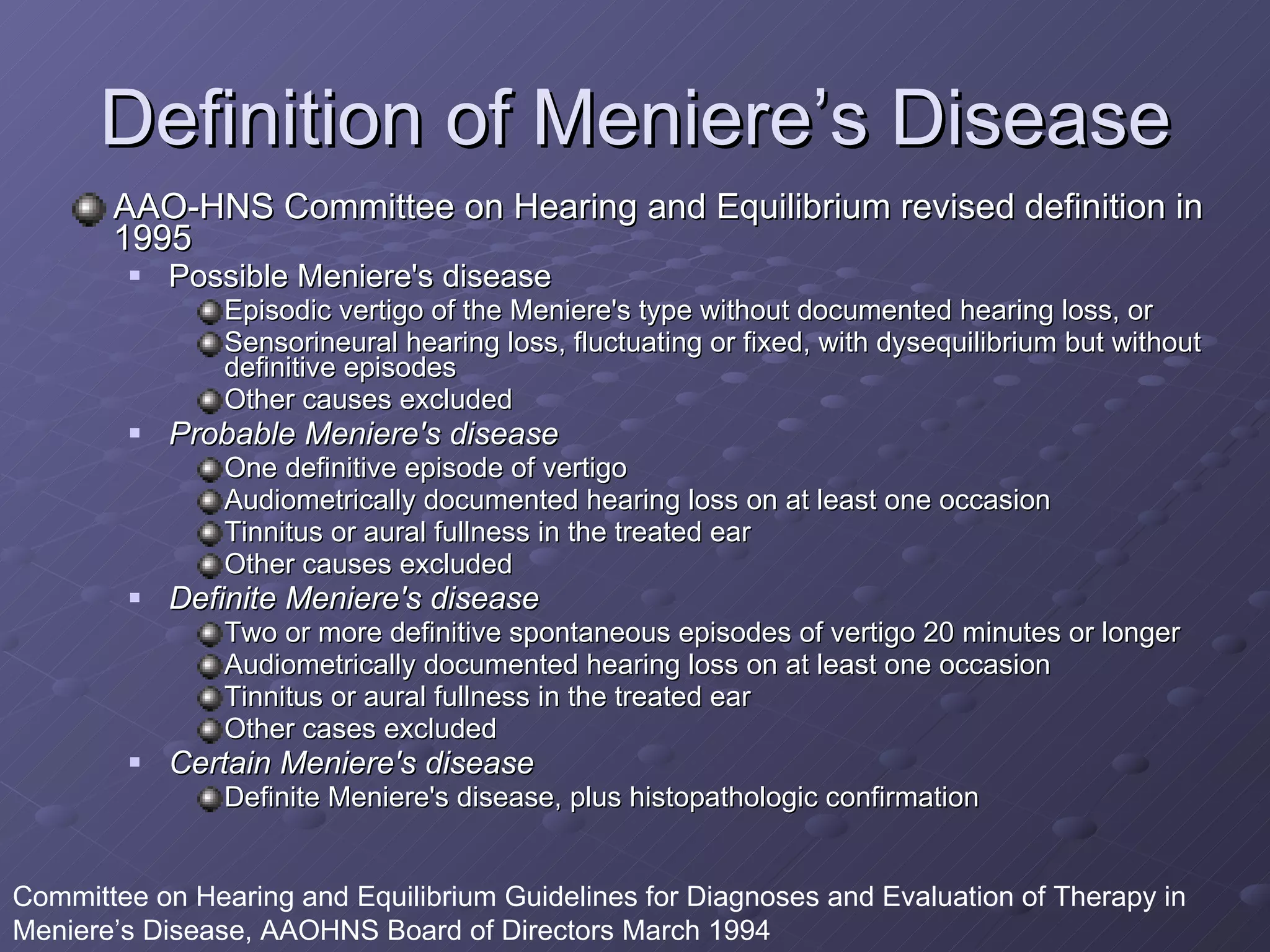
Definition of Meniere’s Disease AAO-HNS Committee on Hearing and Equilibrium revised definition in 1995   Possible Meniere's disease Episodic vertigo of the Meniere's type without documented hearing loss, or Sensorineural hearing loss, fluctuating or fixed, with dysequilibrium but without definitive episodes Other causes excluded Probable Meniere's disease One definitive episode of vertigo Audiometrically documented hearing loss on at least one occasion Tinnitus or aural fullness in the treated ear Other causes excluded  Definite Meniere's disease Two or more definitive spontaneous episodes of vertigo 20 minutes or longer Audiometrically documented hearing loss on at least one occasion Tinnitus or aural fullness in the treated ear Other cases excluded  Certain Meniere's disease Definite Meniere's disease, plus histopathologic confirmation Committee on Hearing and Equilibrium Guidelines for Diagnoses and Evaluation of Therapy in Meniere’s Disease, AAOHNS Board of Directors March 1994
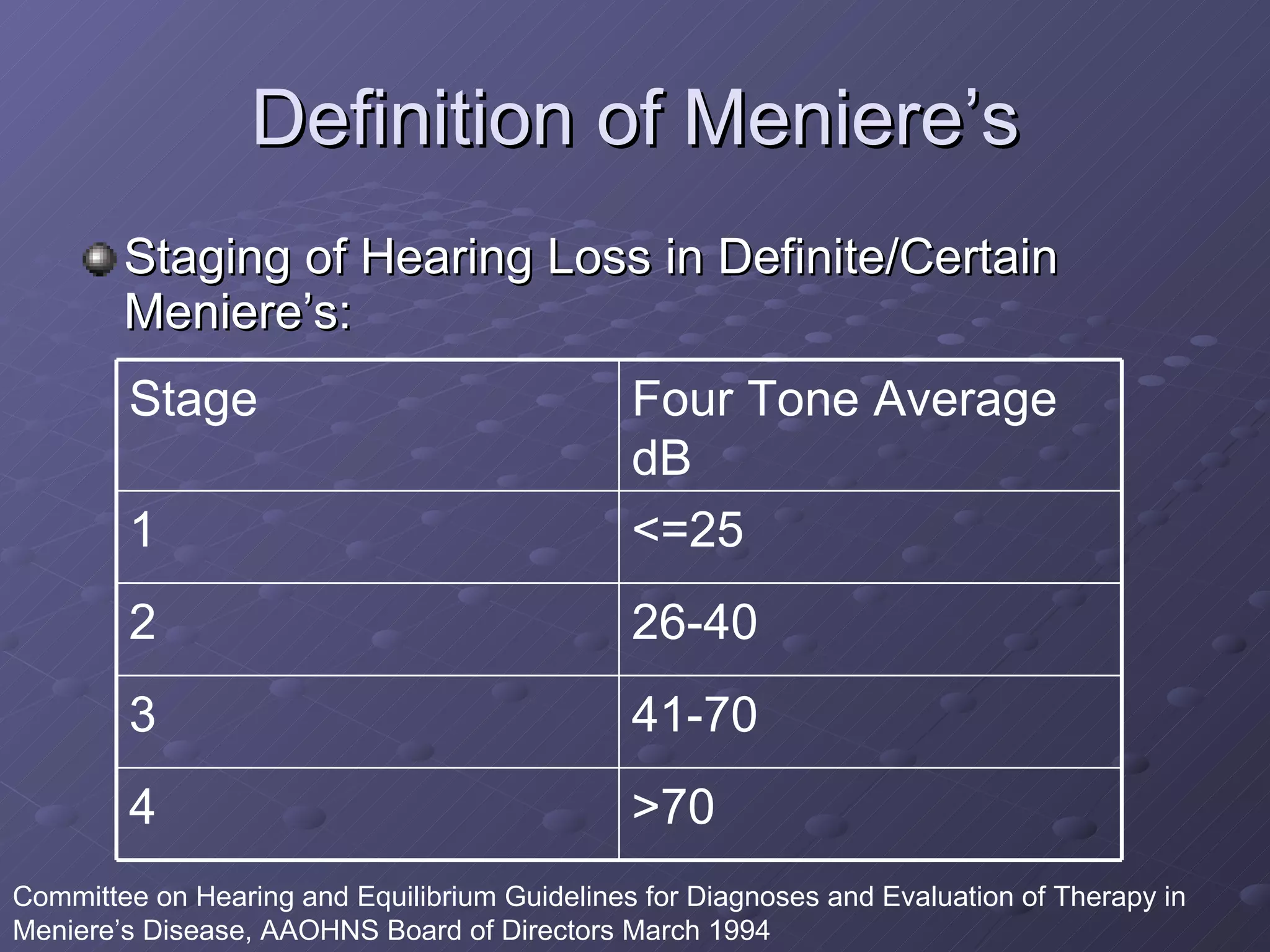
Definition of Meniere’s Staging of Hearing Loss in Definite/Certain Meniere’s: Committee on Hearing and Equilibrium Guidelines for Diagnoses and Evaluation of Therapy in Meniere’s Disease, AAOHNS Board of Directors March 1994 >70 4 41-70 3 26-40 2 <=25 1 Four Tone Average dB Stage
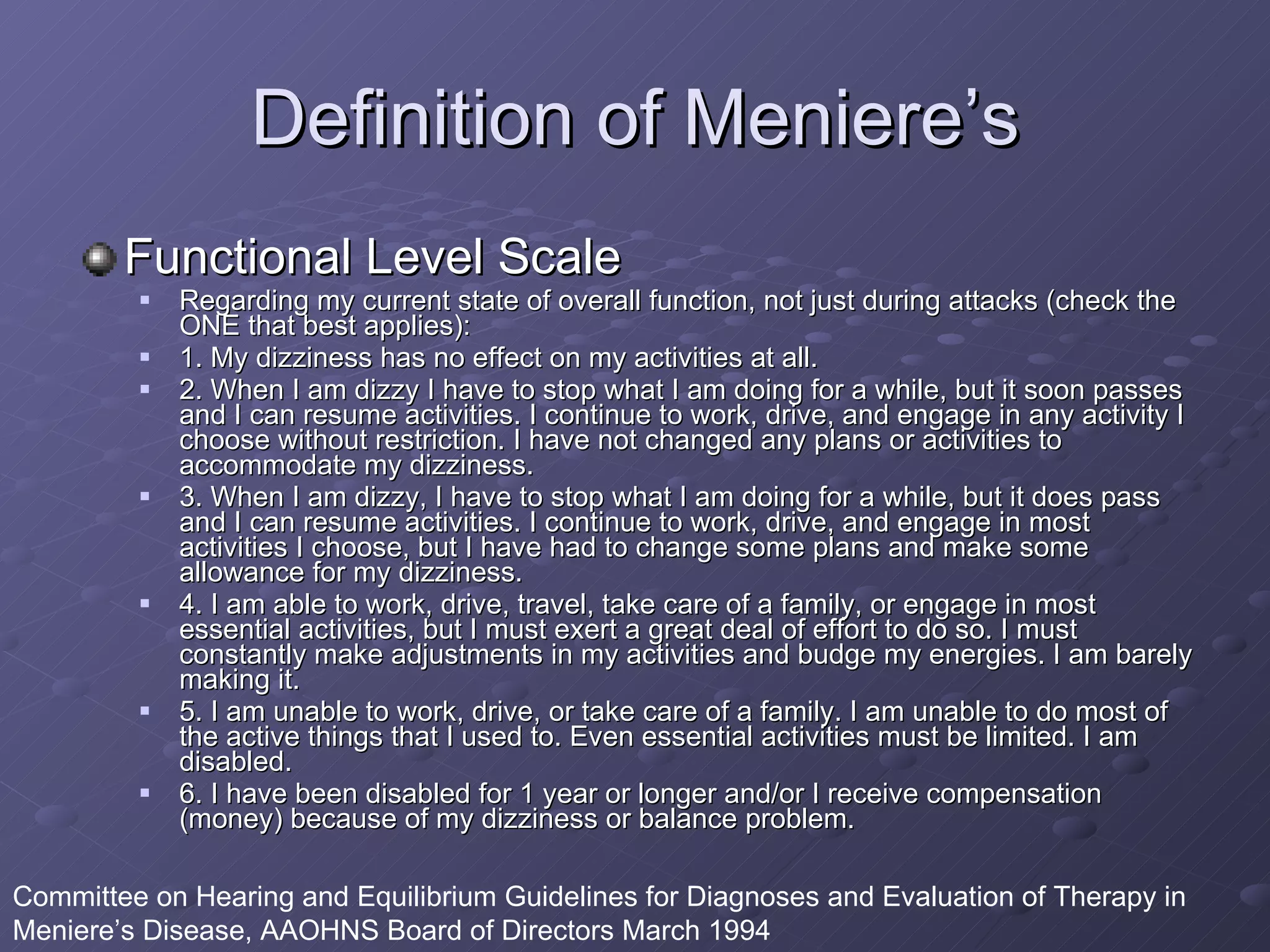
Definition of Meniere’s Functional Level Scale Regarding my current state of overall function, not just during attacks (check the ONE that best applies): 1. My dizziness has no effect on my activities at all. 2. When I am dizzy I have to stop what I am doing for a while, but it soon passes and I can resume activities. I continue to work, drive, and engage in any activity I choose without restriction. I have not changed any plans or activities to accommodate my dizziness. 3. When I am dizzy, I have to stop what I am doing for a while, but it does pass and I can resume activities. I continue to work, drive, and engage in most activities I choose, but I have had to change some plans and make some allowance for my dizziness. 4. I am able to work, drive, travel, take care of a family, or engage in most essential activities, but I must exert a great deal of effort to do so. I must constantly make adjustments in my activities and budge my energies. I am barely making it. 5. I am unable to work, drive, or take care of a family. I am unable to do most of the active things that I used to. Even essential activities must be limited. I am disabled. 6. I have been disabled for 1 year or longer and/or I receive compensation (money) because of my dizziness or balance problem. Committee on Hearing and Equilibrium Guidelines for Diagnoses and Evaluation of Therapy in Meniere’s Disease, AAOHNS Board of Directors March 1994
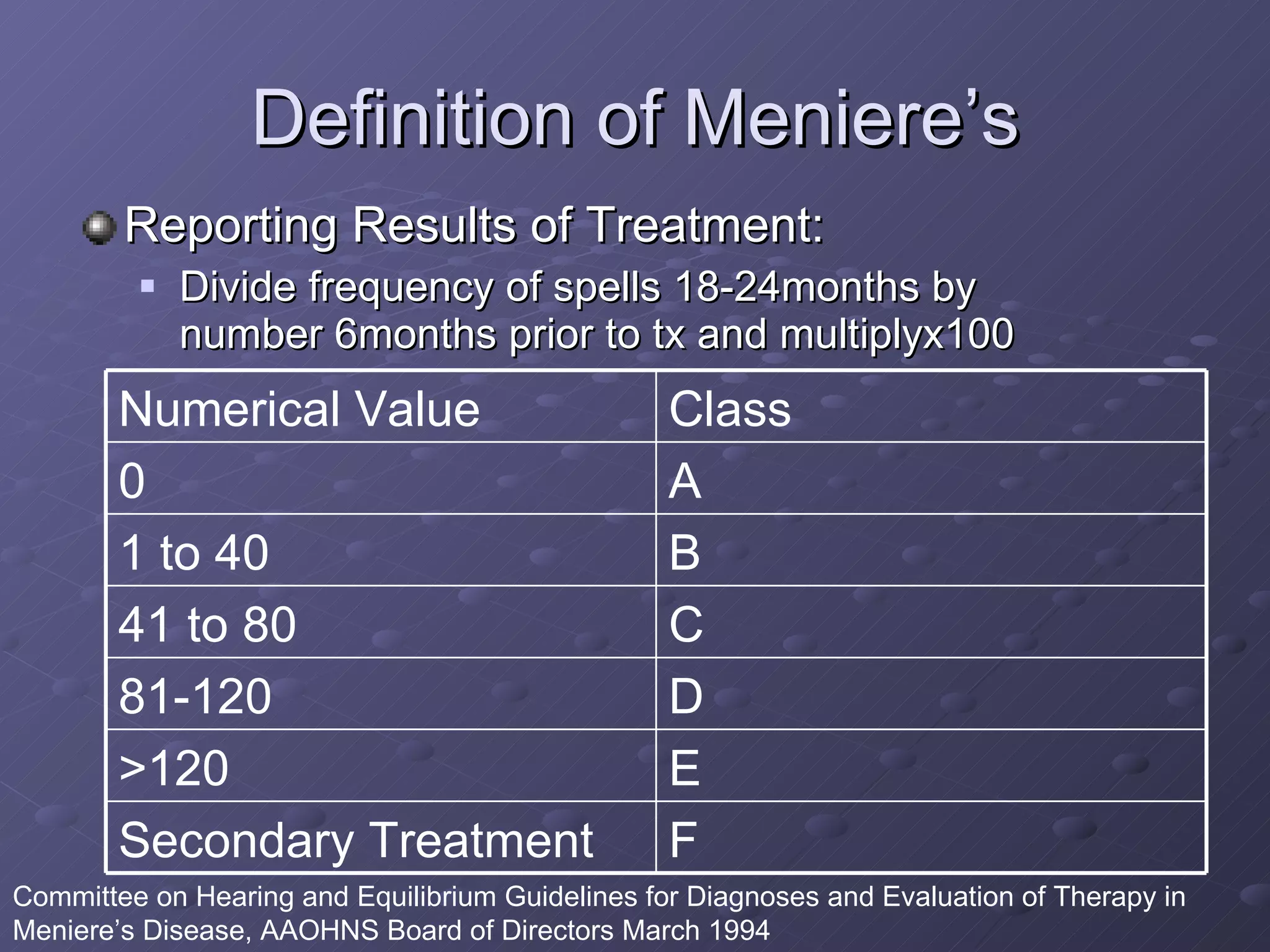
Definition of Meniere’s Reporting Results of Treatment: Divide frequency of spells 18-24months by number 6months prior to tx and multiplyx100 Committee on Hearing and Equilibrium Guidelines for Diagnoses and Evaluation of Therapy in Meniere’s Disease, AAOHNS Board of Directors March 1994 E >120 F Secondary Treatment D 81-120 C 41 to 80 B 1 to 40 A 0 Class Numerical Value
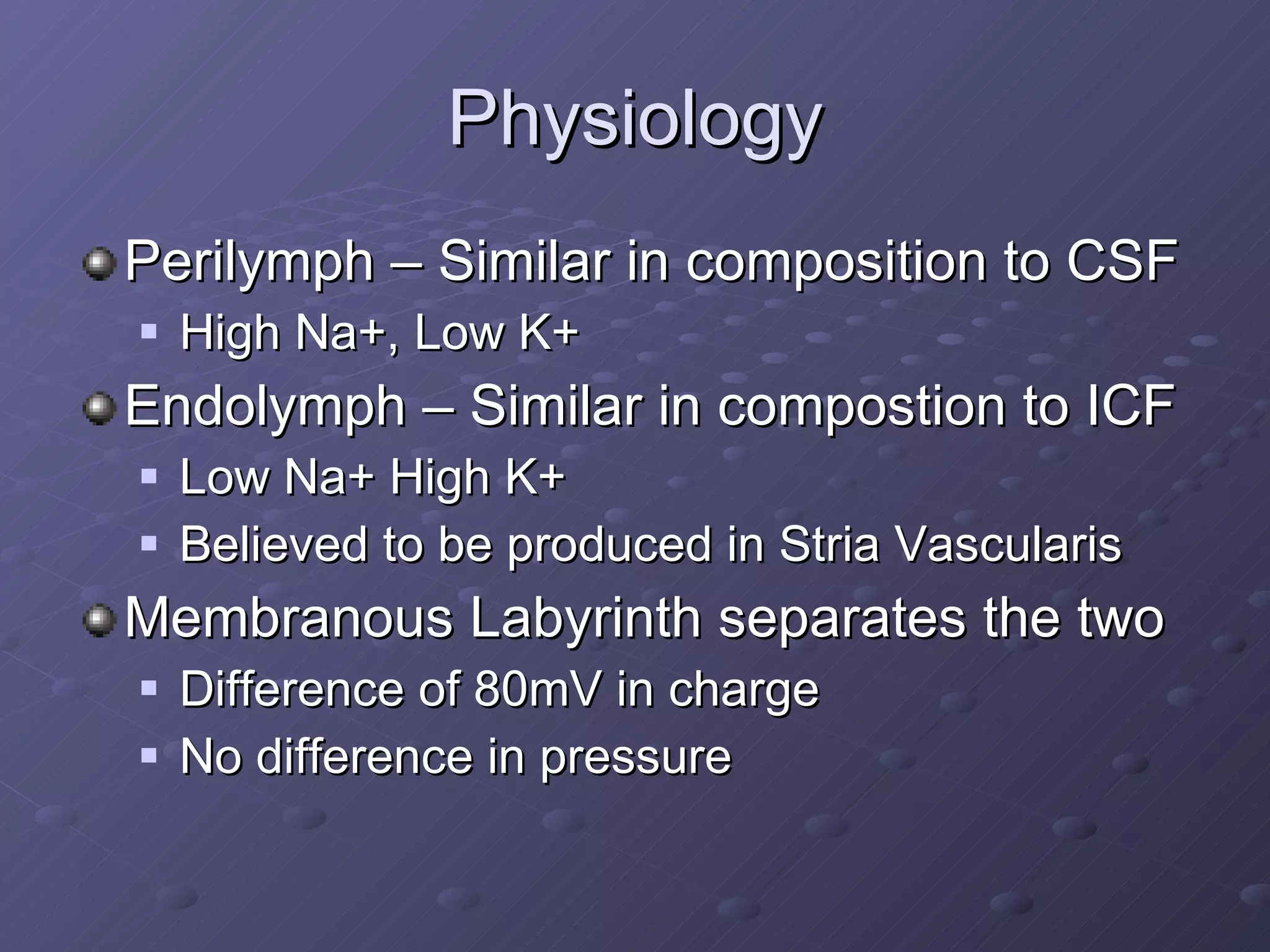
Physiology Perilymph – Similar in composition to CSF High Na+, Low K+ Endolymph – Similar in compostion to ICF Low Na+ High K+ Believed to be produced in Stria Vascularis Membranous Labyrinth separates the two Difference of 80mV in charge No difference in pressure
Physiology Production and flow of Endolymph - Theories Longitudinal – produced in membranous labyrinth, flows to endolymphatic sac, then to dural venous sinuses Diffuse – produced and absorbed along the membranous labyrinth Periodic Flow – endolymph flows only with changes in volume or pressure Andrews, JC, Intralabyrinthine fluid dynamics: Meniere disease 12(5) Oct 2004 pp408-412
Pathophysiology Endolymphatic hydrops leads to distortion of membranous labyrinth
Pathophysiology Build up in pressure may lead to micro-ruptures of membranous labyrinth (Minor  et al ) Ruptures are confirmed by various histologic studies May responsible for episodic nature of attacks Healing of ruptures may account for return of hearing Review Article: Minor, Lloyd  et al , Meniere’s Disease, Current Opinion in Neurology 17(1) Feb2004
Pathophysiology What causes hydrops? Obstruction of endolymphatic duct/sac Obstruction of endolymphatic sac in does not cause hydrops in all animals and causes vertigo in few Alteration of absorption of endolymph Immunologic insult to inner ear Elevated levels of IG’s in endolymph
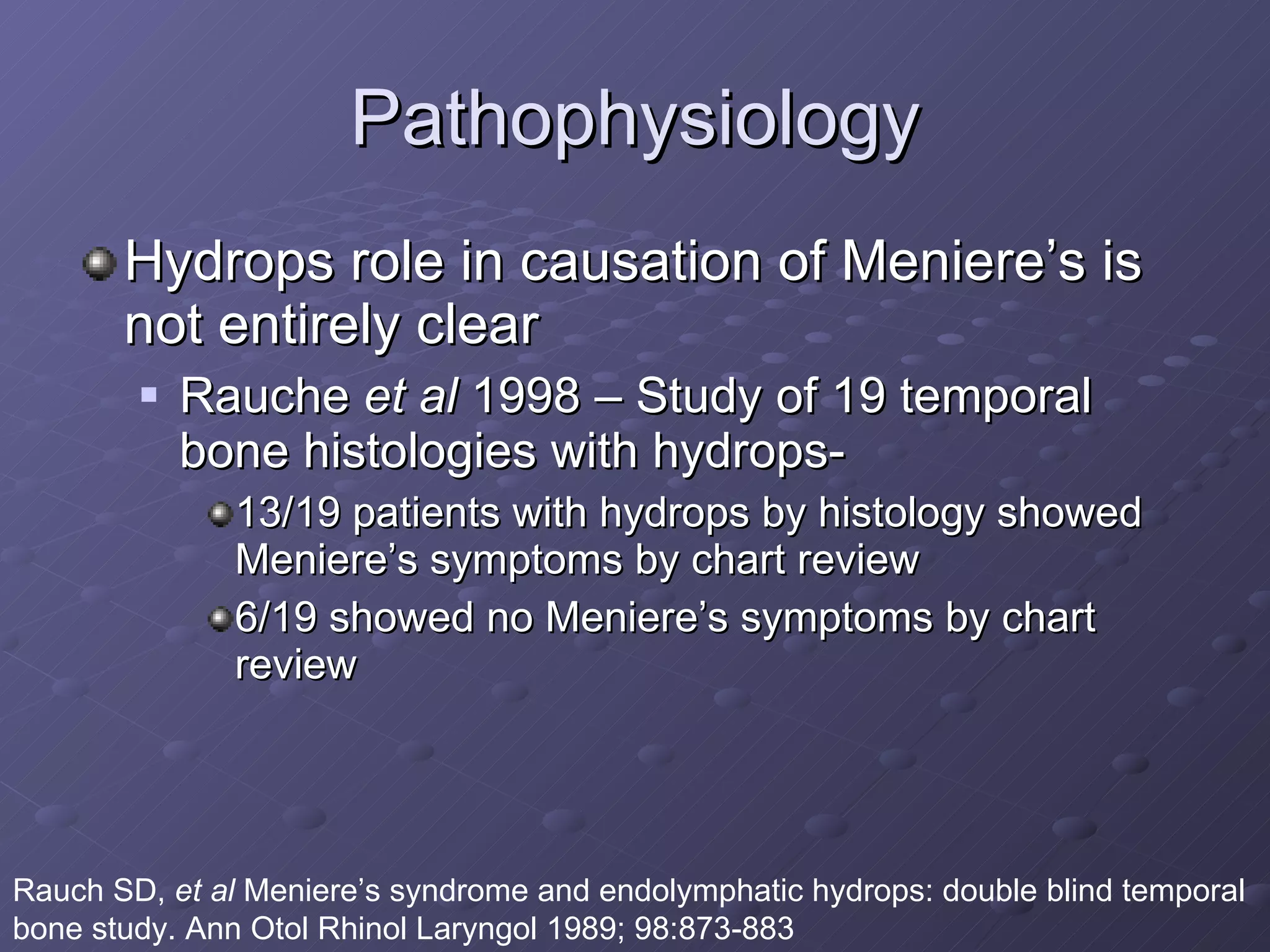
Pathophysiology Hydrops role in causation of Meniere’s is not entirely clear Rauche  et al  1998 – Study of 19 temporal bone histologies with hydrops- 13/19 patients with hydrops by histology showed Meniere’s symptoms by chart review 6/19 showed no Meniere’s symptoms by chart review Rauch SD,  et al  Meniere’s syndrome and endolymphatic hydrops: double blind temporal bone study. Ann Otol Rhinol Laryngol 1989; 98:873-883
Pathophysiology Silverstein  et al  found that in pts. who refused surgical tx., there was resolution of vestibular symptoms  57-60% of patients in 2 years 71% at eight years. Long term PTA in affected ear is 50dB Speech discrimination is 53% Caloric response reduction is 50% Silverstein H., Smouha E. & Jones R. (1989) Natural history vs surgery for Ménière's disease. Otolaryngol. Head Neck Surg. 100, 6-16
Medical Management Acute Therapy Maintenance Therapy
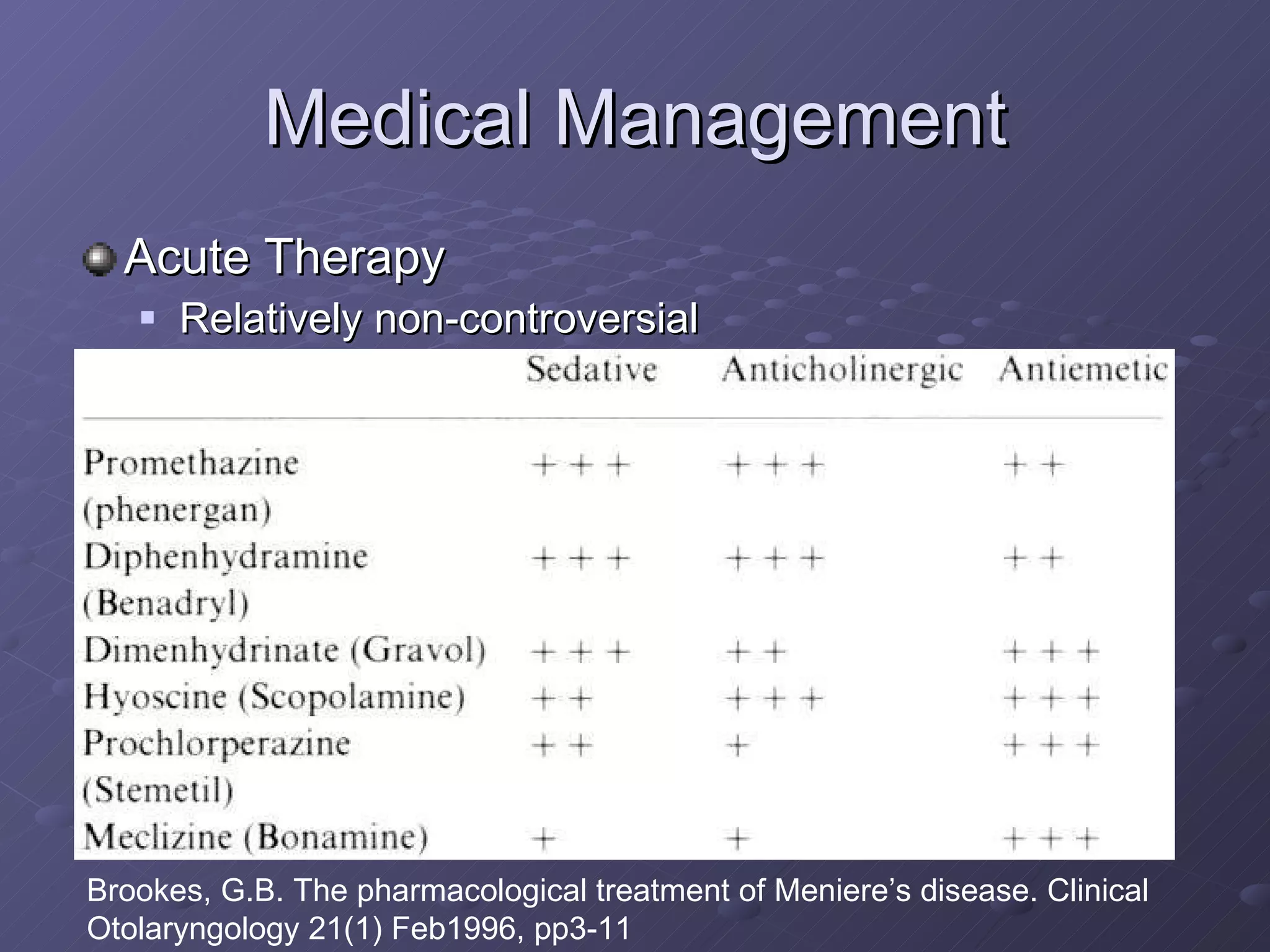
Medical Management Acute Therapy Relatively non-controversial Brookes, G.B. The pharmacological treatment of Meniere’s disease. Clinical Otolaryngology 21(1) Feb1996, pp3-11
Medical Management Maintenance Therapy No conclusive studies show efficacy of drugs intended to alter disease course of Meniere’s
Medical Management Diuretics and Salt restriction ? Alter fluid balance in inner ear leading to depletion of endolymph Shinkawa/Kimura unable to demonstrate beneficial effect on hydrops in animal model Shinkawa H. & Kimura R.S. (1986) Effect of diuretics on endolymphatic hydrops. Acta. Otolaryngol. (Stockh.)101, 43-52
Medical Management Diuretics and Salt Restriction Ruckenstein  et al  evaluated data from two double blind studies by Klockhoff and Lindblom on HCTZ vs. Placebo and showed no difference in Diuretics vs. placebo Ruckenstein M.J., Rutka J.A. & Hawke M. (1991) The treatment of Meniere's disease: Torok revisited. Laryngoscope101, 211-218
Medical Management Osmotic Diuretics (Urea, Glycerol) Have been consistently shown to reduce symptoms in a proportion of patients, but the effects only last for a few hours Objective data includes alteration of the SP:AP ratio on Electrocochleography Acetazolamide – was actually shown to increase hydrops and hearing loss when given IV and had no benefit p.o.
Medical Management Vasodilators Purported to work by decreasing ischemia in the inner ear and allowing better metabolism of endolymph Betahistine is a popular choice, with several studies showing decreased vertigo with use Cochrane Database Review (2004) – Only one Grade B study and four Grade C studies, none of which produced convincing evidence for use. James, AL,  et al . Betahistine for Meniere’s disease or syndrome. Cochrane Database of Systematic Reviews (2) 2005
Medical Management Immunologic Management Systemic steroids and intratympanic dexamethasone have been studied and showed no conclusive benefit. Double-blinded prospective crossover study by Silverstein  et al  showed no difference from placebo with intratympanic dexamethasone injections Silverstein, Herbert  et al  Dexamethasone inner ear perfusion for the treatment of meniere’s disease: a prospective, randomized, double-blind, crossover trial. American Journal of Otology. 1998. 19:196-201
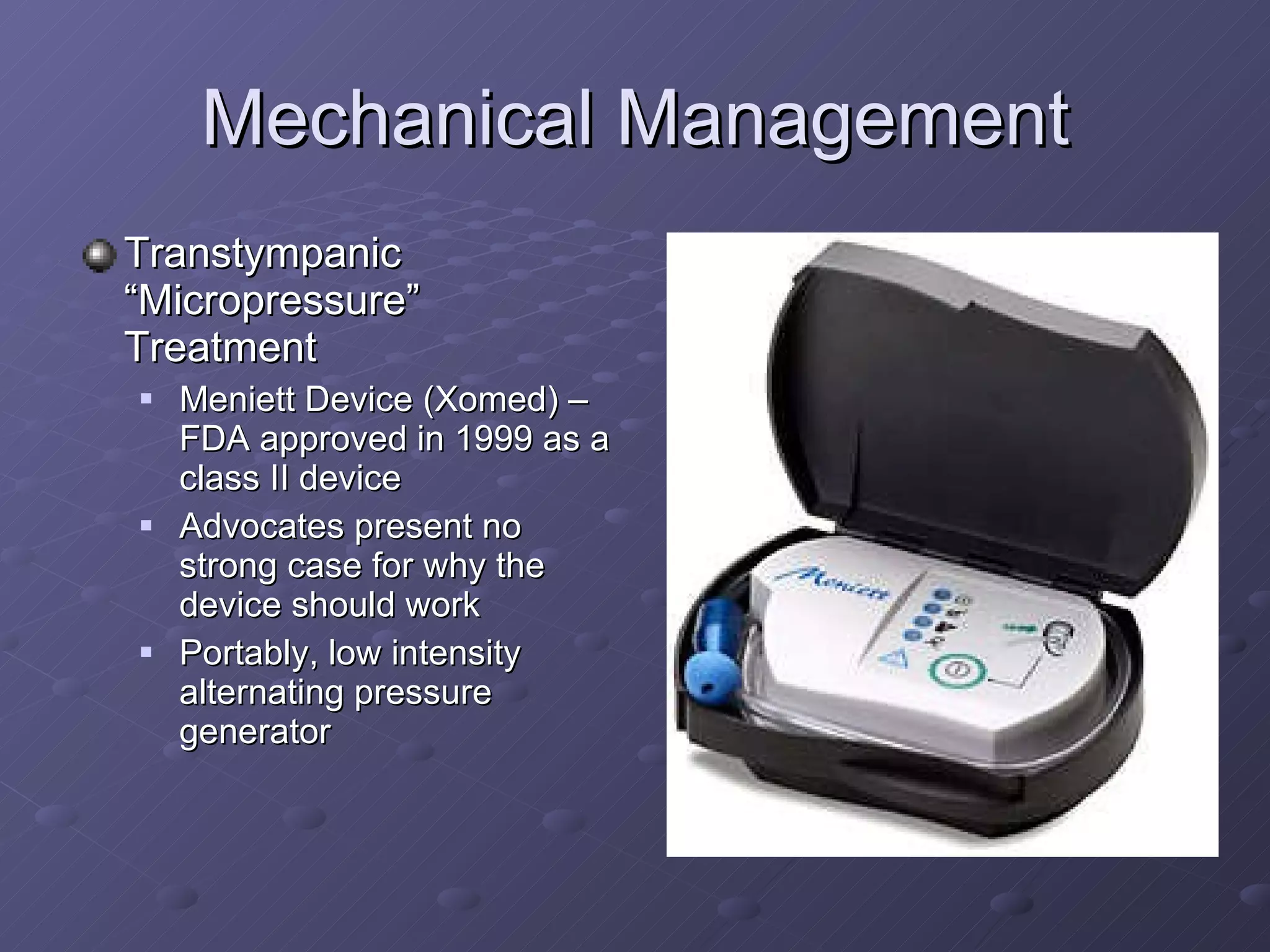
Mechanical Management Transtympanic “Micropressure” Treatment Meniett Device (Xomed) – FDA approved in 1999 as a class II device Advocates present no strong case for why the device should work Portably, low intensity alternating pressure generator
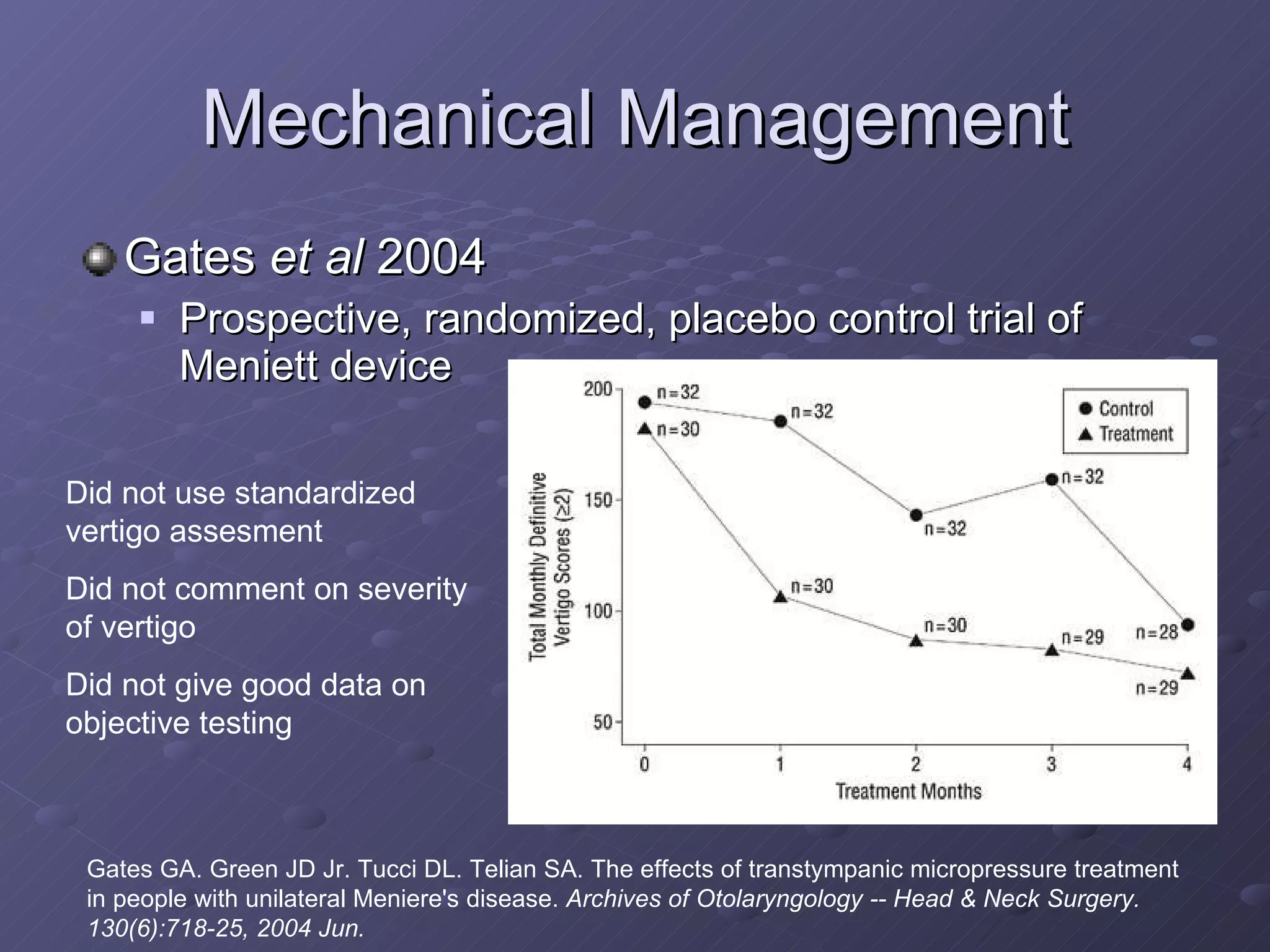
Mechanical Management Gates  et al  2004  Prospective, randomized, placebo control trial of Meniett device Gates GA. Green JD Jr. Tucci DL. Telian SA. The effects of transtympanic micropressure treatment in people with unilateral Meniere's disease.  Archives of Otolaryngology -- Head & Neck Surgery. 130(6):718-25, 2004 Jun.   Did not use standardized vertigo assesment Did not comment on severity of vertigo Did not give good data on objective testing
Intratympanic Therapy Goal is to maximize local effects in inner ear while minimizing systemic effects Round window is point of diffusion to inner ear Intratympanic dexamethasone already discussed Aminoglycoside Antibiotics: affect hair cells of crista, ampulla, and cochlea
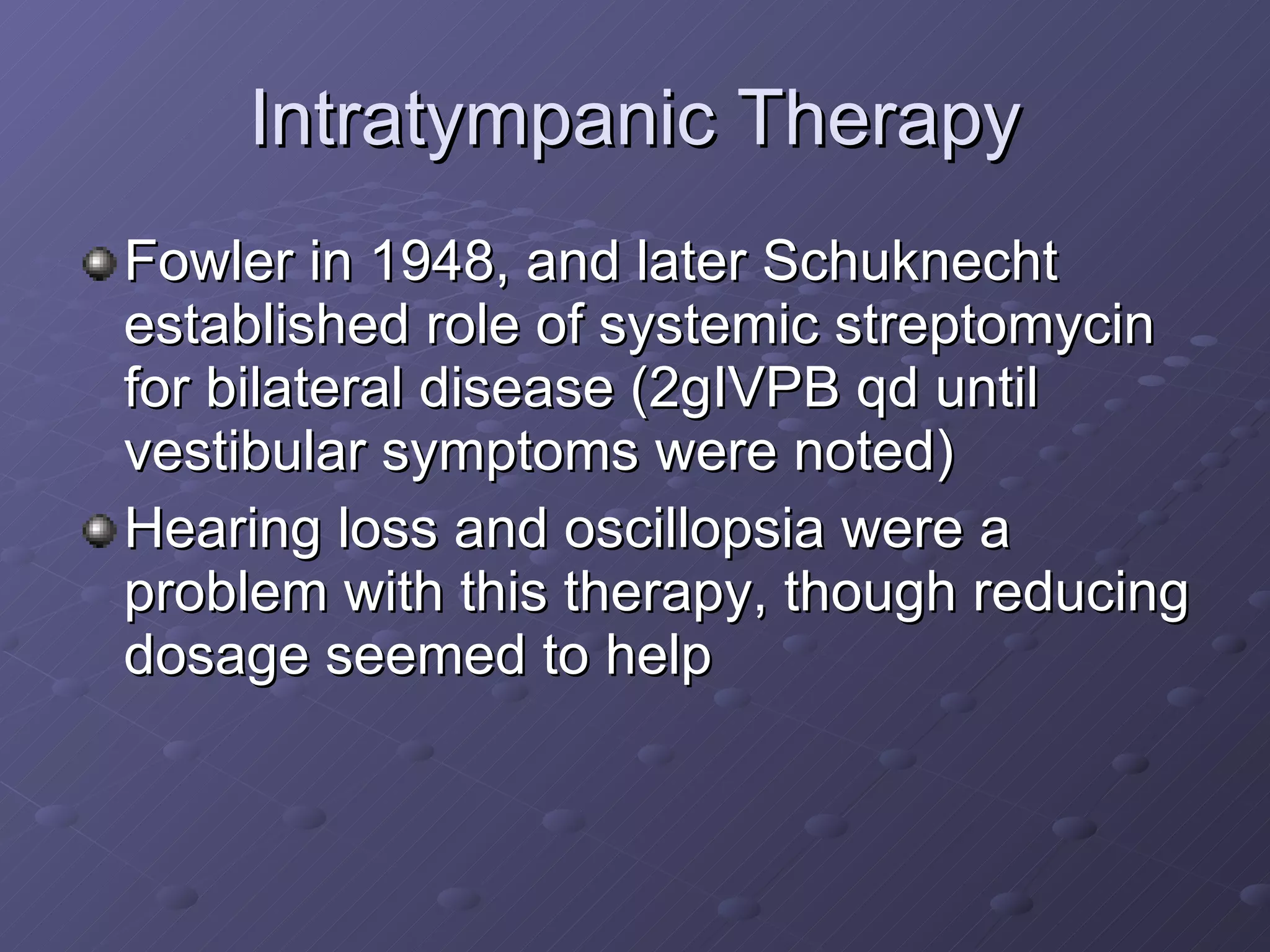
Intratympanic Therapy Fowler in 1948, and later Schuknecht established role of systemic streptomycin for bilateral disease (2gIVPB qd until vestibular symptoms were noted) Hearing loss and oscillopsia were a problem with this therapy, though reducing dosage seemed to help
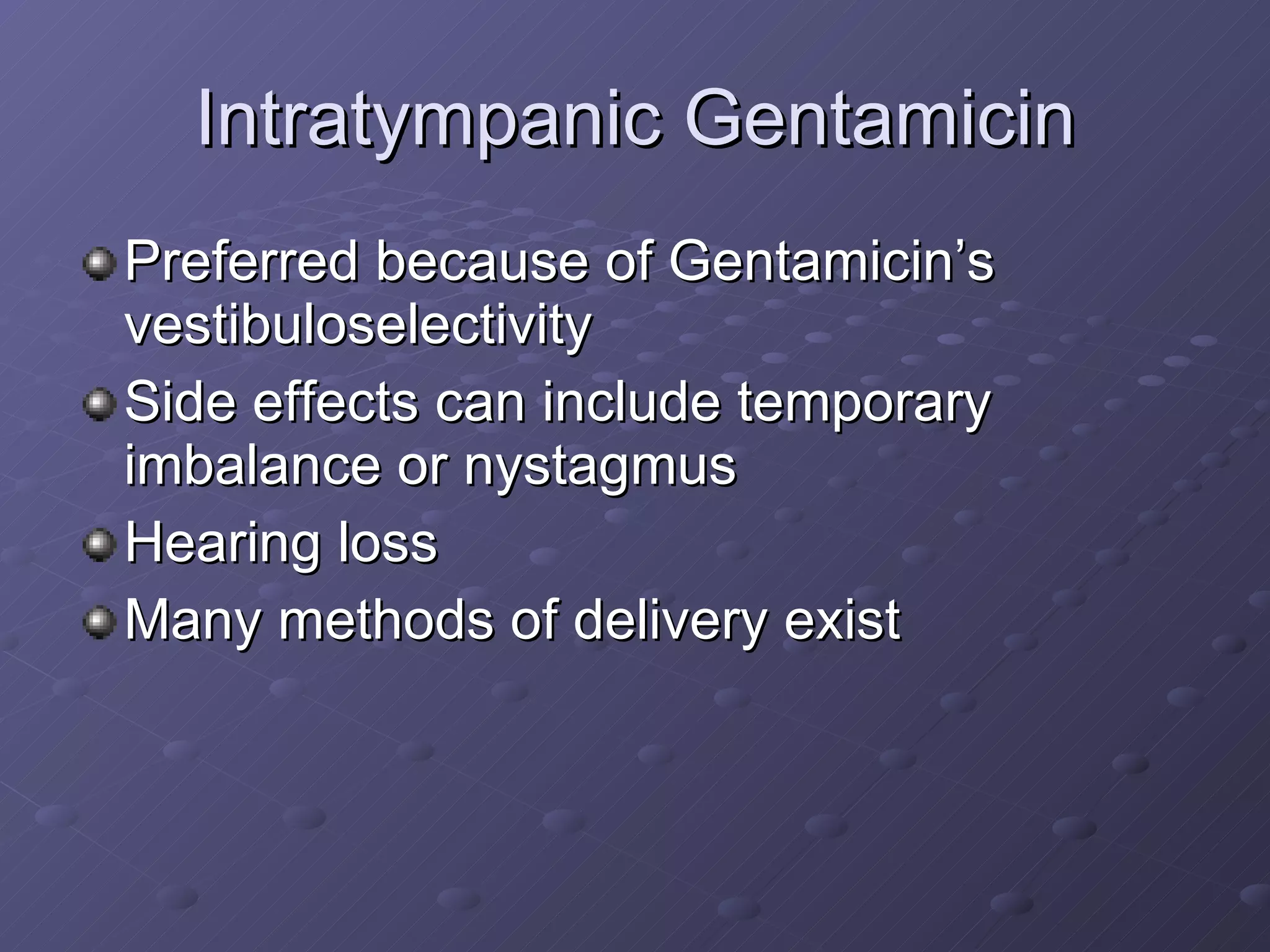
Intratympanic Gentamicin Preferred because of Gentamicin’s vestibuloselectivity Side effects can include temporary imbalance or nystagmus Hearing loss Many methods of delivery exist
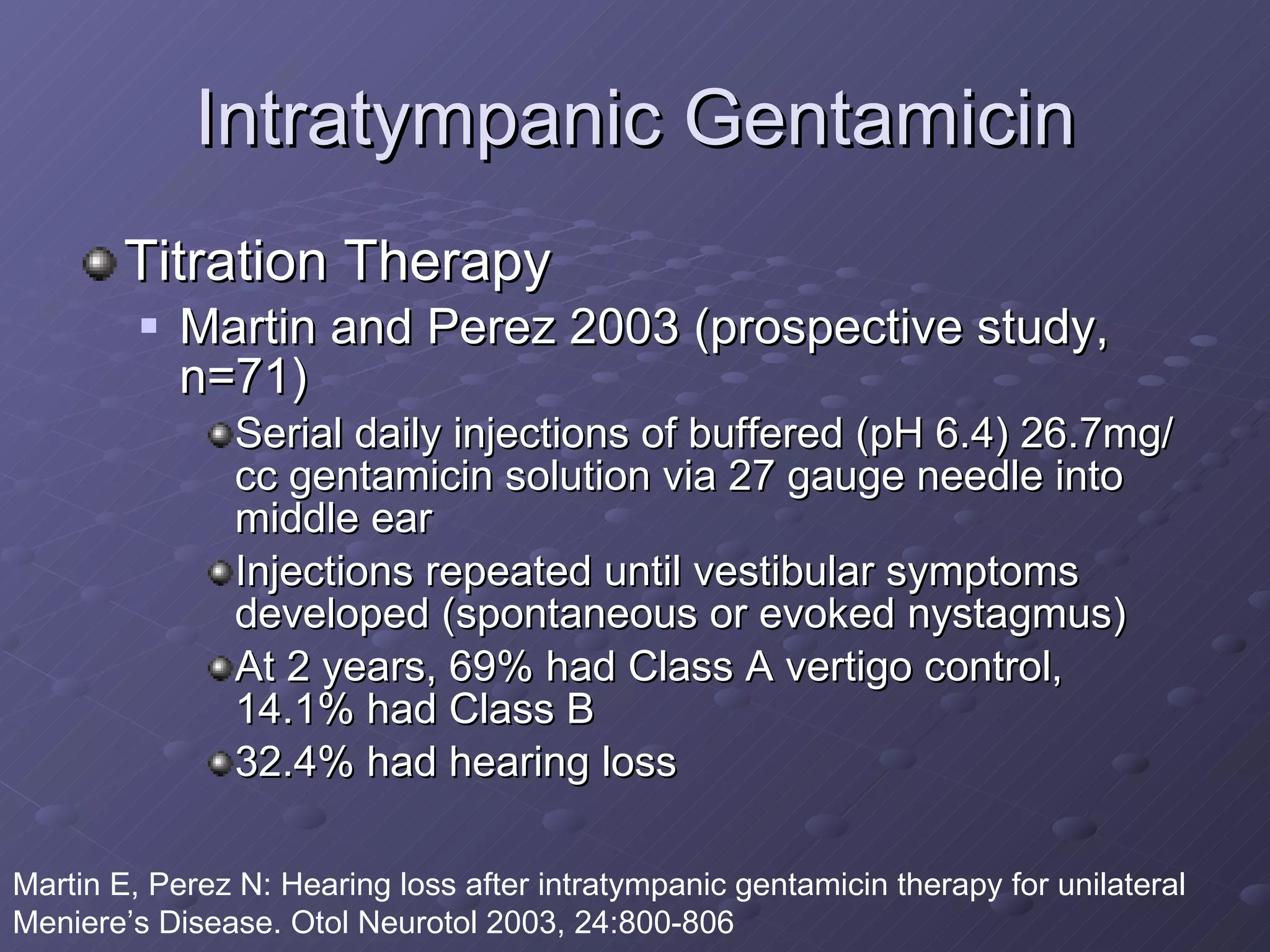
Intratympanic Gentamicin Titration Therapy Martin and Perez 2003 (prospective study, n=71) Serial daily injections of buffered (pH 6.4) 26.7mg/cc gentamicin solution via 27 gauge needle into middle ear Injections repeated until vestibular symptoms developed (spontaneous or evoked nystagmus) At 2 years, 69% had Class A vertigo control, 14.1% had Class B 32.4% had hearing loss Martin E, Perez N: Hearing loss after intratympanic gentamicin therapy for unilateral Meniere’s Disease. Otol Neurotol 2003, 24:800-806
Intratympanic Gentamicin Ablation via Multiple Daily Dosing Jackson and Silverstein – Study on 92 patients who underwent myringotomy and wick placement through to round window niche. Pts. self-administered gentamicin drops TID until 100% reduction on ENG of vestibular response 85% relief of vertigo, 67% improvement in aural pressure 36% hearing loss Jackson, LE; Silverstein, H: Chemical perfusion of the inner ear. Otolaryngol Clin North Am 2002, 35:639-653
Intratympanic Gentamicin Low dose therapy Harner  et al  2001 – retrospective study of 51 patients who received 1 dose of 40mg/mL injection and were re-evaluated in 1 month and given another if needed At 2 years, 86% had vertigo class A or B He reported minimal change in PTA but drop in SRT’s Claimed better hearing preservation with this Harner, Stephen  et al : Long-term follow-up of transtympanic gentamicin for Meniere’s Syndrome.  Otology & Neurotol 22:210-214, 2001
Intratympanic Gentamicin Other methods of delivery Weekly administration Single dose of gentamicin once a week for four treatments Continuous administration Microcatheter delivery of gentamicin using a continuous perfusion method Results in extremely variable amount of gentamicin delivery Better perfusion techniques may be needed
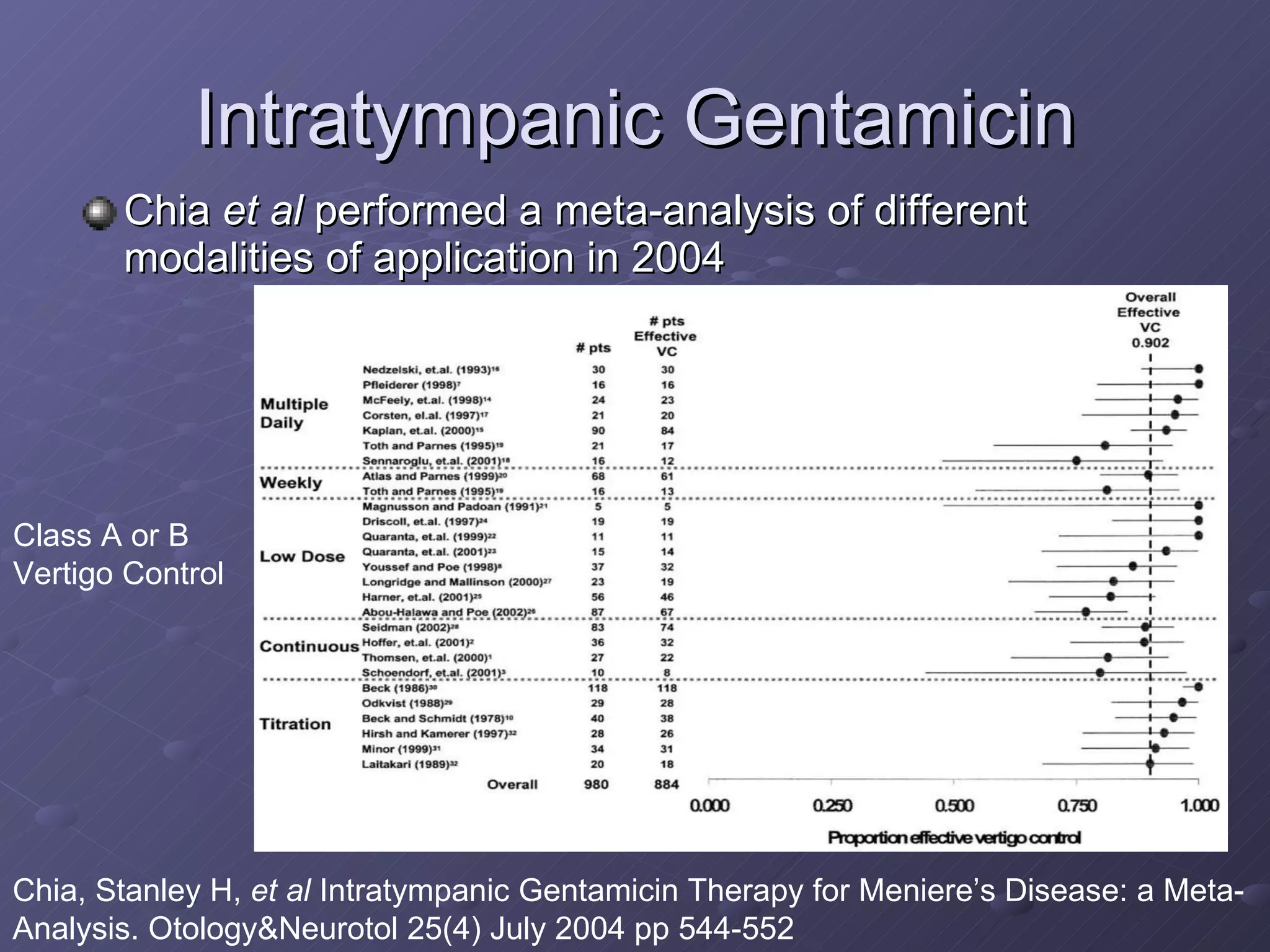
Intratympanic Gentamicin Chia  et al  performed a meta-analysis of different modalities of application in 2004 Chia, Stanley H,  et al  Intratympanic Gentamicin Therapy for Meniere’s Disease: a Meta-Analysis. Otology&Neurotol 25(4) July 2004 pp 544-552 Class A or B Vertigo Control
Intratympanic Gentamicin Hearing loss was greatest for multiple daily dosing Hearing loss was least for titration therapy Hearing loss was not lower than average for low-dose therapy
Endolymphatic Sac Surgery Purported to address the site of obstruction causing hydrops 4 types: Decompression – removal of bone around the sac Shunting – placement of synthetic shunt to drain endolymph into mastoid Drainage – incision of the sac to allow drainage Removal of sac – to address the possibility that the sac may actually play a role in endolymph production
Endolymphatic Sac Surgery Coker, Newton J.  et al   Atlas of Otologic Surgery .  W.B. Saunders 2001
Endolymphatic Sac Surgery Jens Thomsen  et al  1981 Double-blinded placebo-control study with sham surgery (cortical mastoidectomy) vs endolymphatic shunt placement in 30 patients No difference in any outcome between sham surgery and endolymphatic sac shunt group Thomsen, Jen  et al . Placebo Effect in Surgery for Meniere’s Disease. Arch Otolaryngol – Vol 107, May 1981, pp271-277
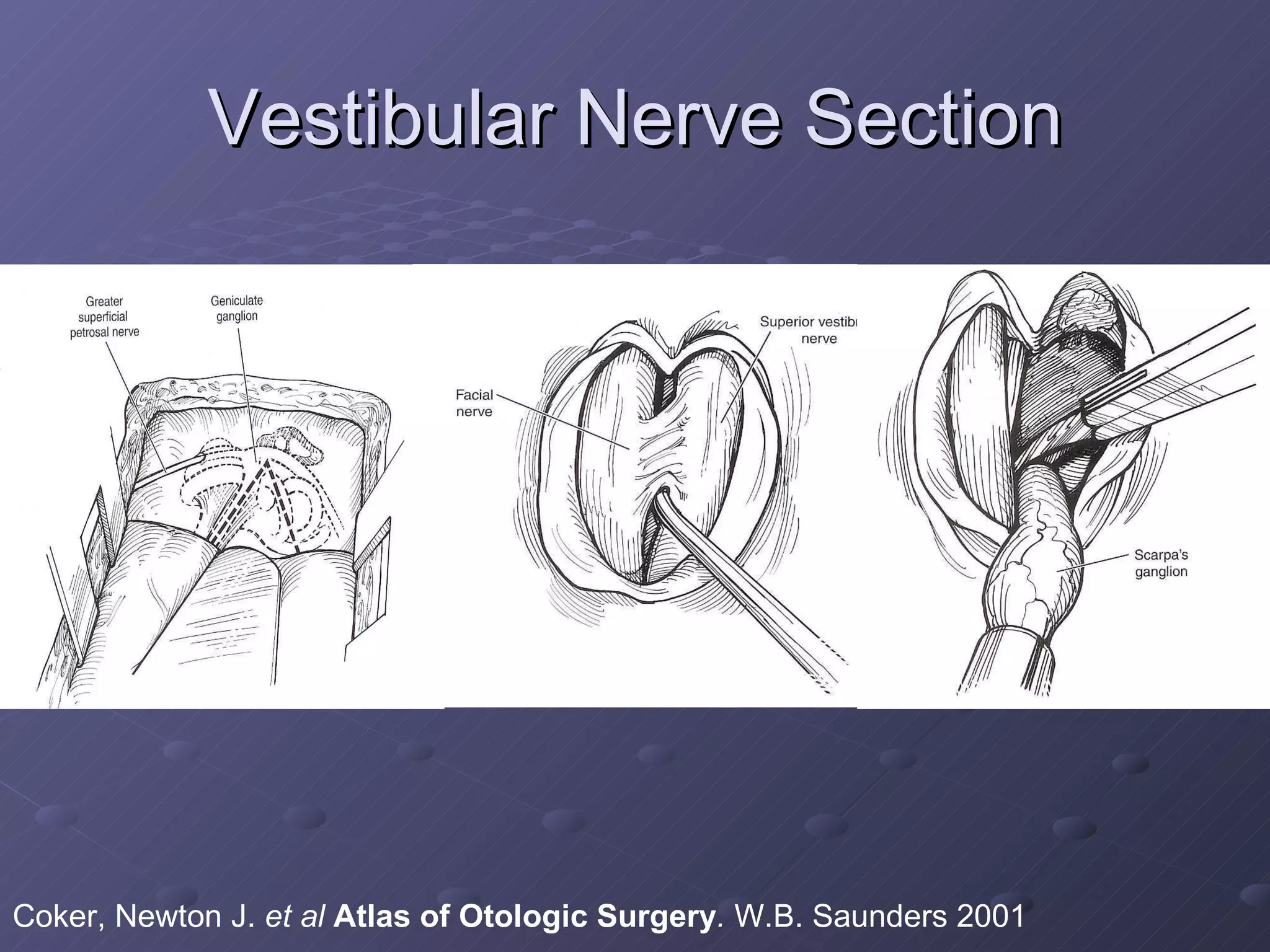
Vestibular Nerve Section Can achieve vestibular suppression without any effect on hearing Single step procedure Can have intraoperative complications of damage to facial nerve, cochlear nerve, or CSF leak (rate of CSF leak is about 13%) Approaches: Middle Fossa, Retrolabyrinthine/Retrosigmoid
Vestibular Nerve Section Coker, Newton J.  et al   Atlas of Otologic Surgery .  W.B. Saunders 2001
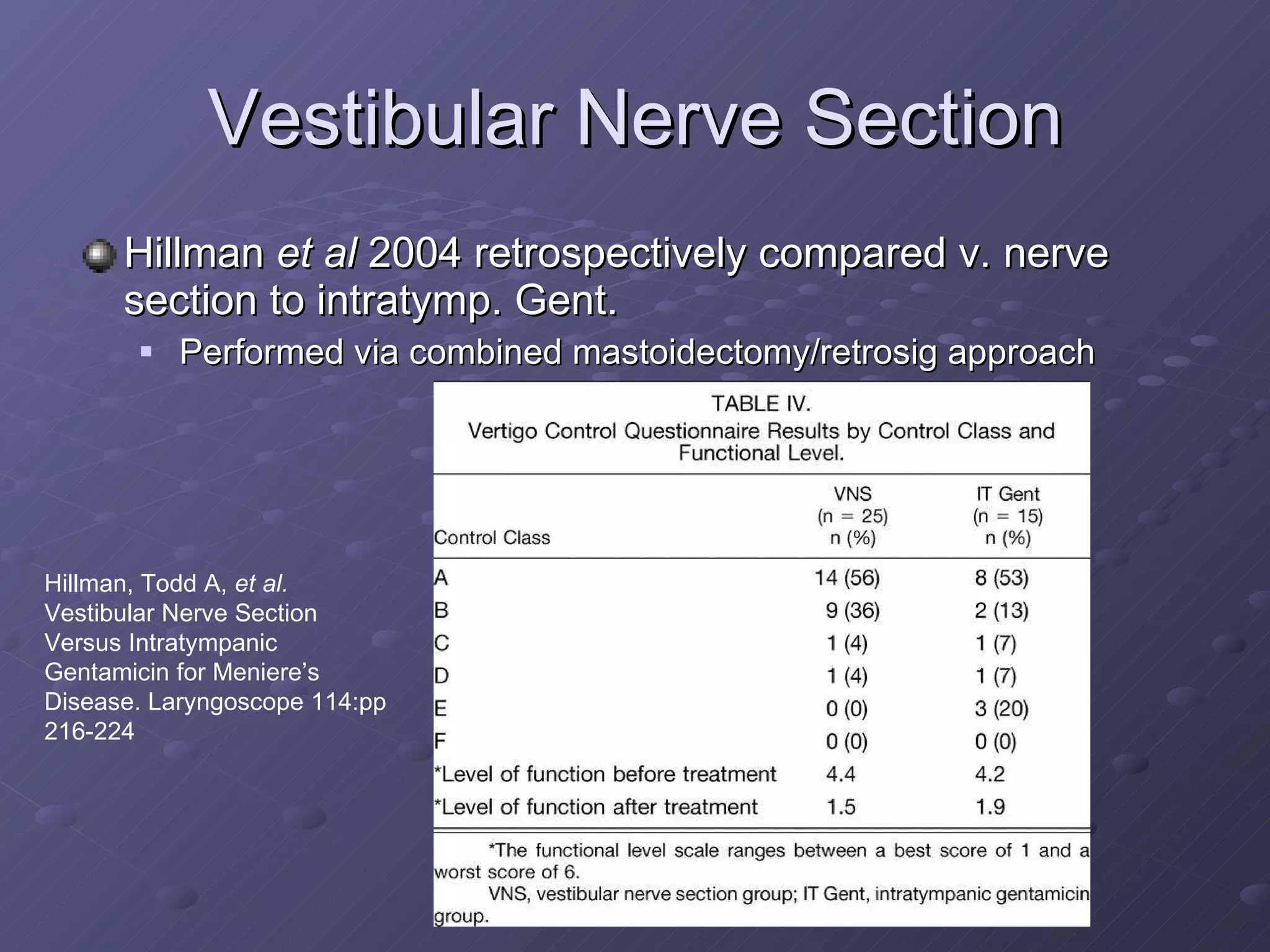
Vestibular Nerve Section Hillman  et al  2004 retrospectively compared v. nerve section to intratymp. Gent. Performed via combined mastoidectomy/retrosig approach Hillman, Todd A,  et al.  Vestibular Nerve Section Versus Intratympanic Gentamicin for Meniere’s Disease. Laryngoscope 114:pp 216-224
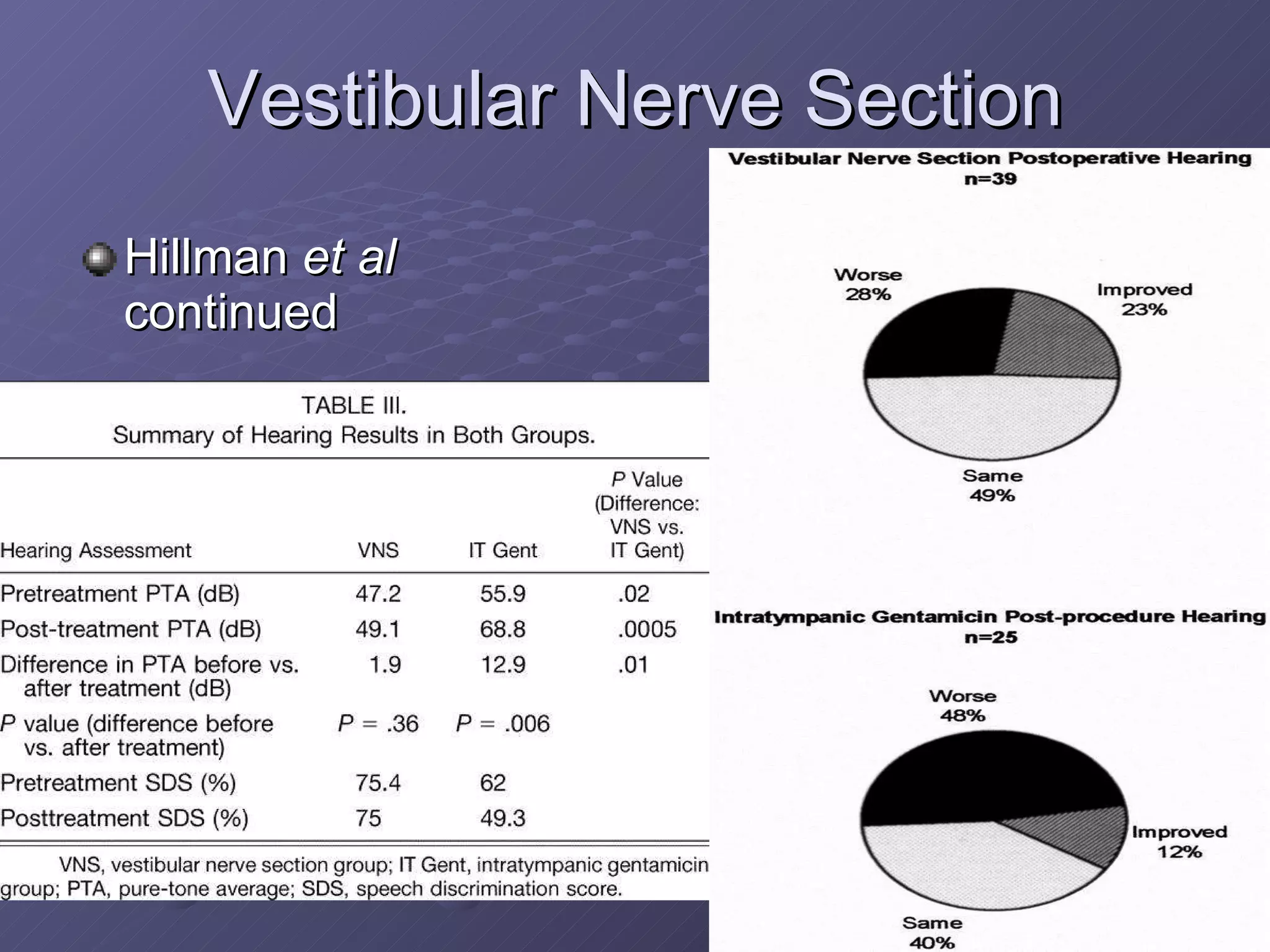
Vestibular Nerve Section Hillman  et al  continued
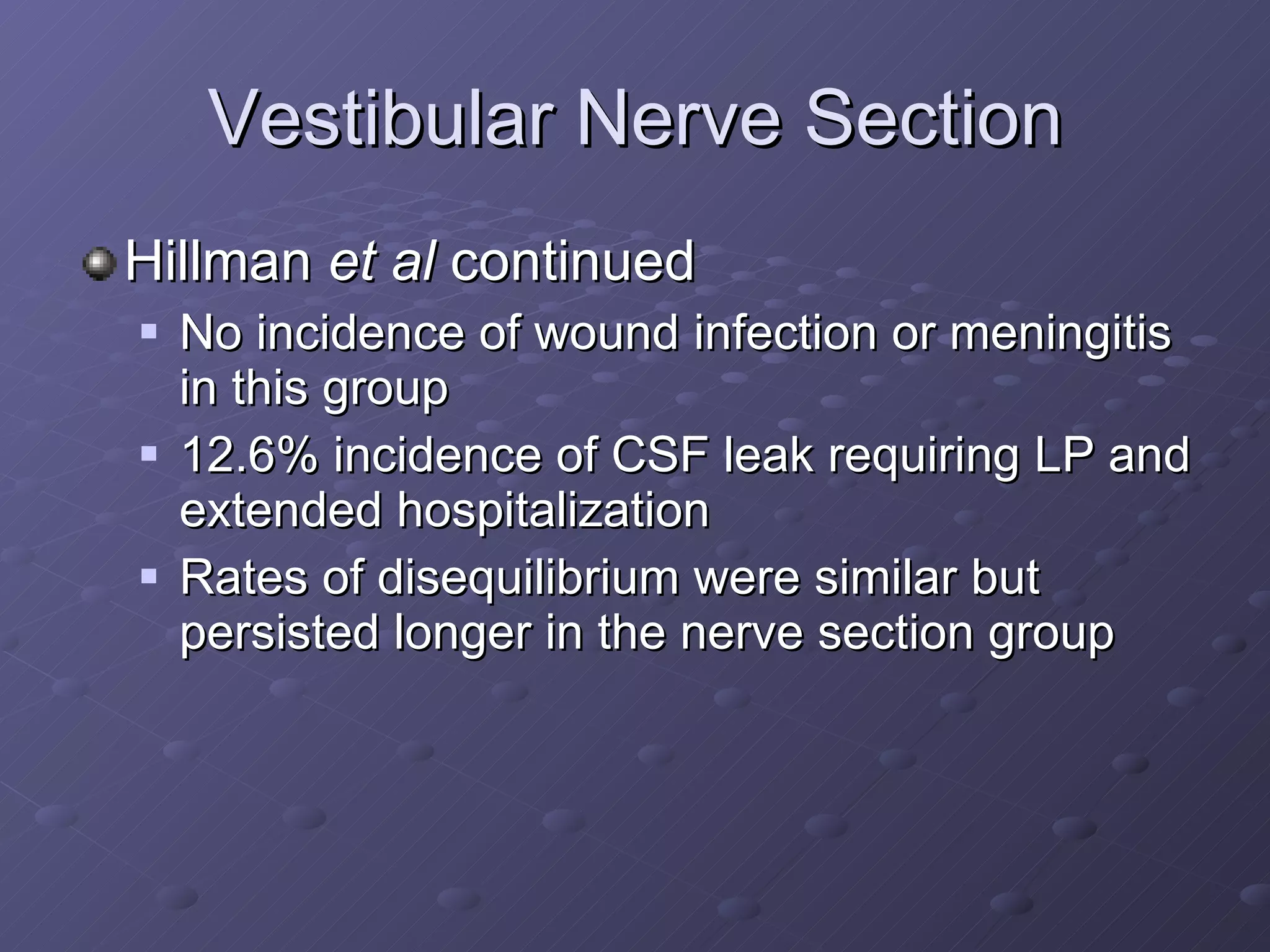
Vestibular Nerve Section Hillman  et al  continued No incidence of wound infection or meningitis in this group 12.6% incidence of CSF leak requiring LP and extended hospitalization Rates of disequilibrium were similar but  persisted longer in the nerve section group
Other Ablative Surgeries Labyrinthectomy Useful in patients with no serviceable hearing and those who cannot tolerate intracranial procedure Similar in efficacy to vestibular nerve section
Conclusions Therapies that definitely reduce vertigo in Meniere’s Disease: Vestibular suppressant medications Intratympanic Gentamicin (especially when titrated) Vestibular Nerve Section Labyrinthectomy Other therapies discussed are unproven or controversial

Menieres slides-050518

  • 1.
    Treatment Controversies inMeniere’s Disease Shashidhar S. Reddy, MD, MPH Shawn D. Newlands, MD, PhD UTMB Otolaryngology Grand Rounds May 18, 2005
  • 2.
    Outline History andMeniere’s Definition of Meniere’s Physiology, Pathophysiology of Meniere’s Medical Management of Meniere’s Meniet Device Intratympanic Gentamicin Endolymphatic Sac Surgery Vestibular Nerve Section Conclusions
  • 3.
    History of Meniere’s1861 – Prosper Meniere describes classic symptoms and attributes to labyrinth 1871 – Knappin theorizes dilatation of membranous Labyrinth 1938 – Hallpike and Portman confirm endolymphatic hydrops via temporal bone histology 1995 – Latest revision of AAOHNS definition
  • 4.
    Definition of Meniere’sDisease AAO-HNS Committee on Hearing and Equilibrium revised definition in 1995 Possible Meniere's disease Episodic vertigo of the Meniere's type without documented hearing loss, or Sensorineural hearing loss, fluctuating or fixed, with dysequilibrium but without definitive episodes Other causes excluded Probable Meniere's disease One definitive episode of vertigo Audiometrically documented hearing loss on at least one occasion Tinnitus or aural fullness in the treated ear Other causes excluded  Definite Meniere's disease Two or more definitive spontaneous episodes of vertigo 20 minutes or longer Audiometrically documented hearing loss on at least one occasion Tinnitus or aural fullness in the treated ear Other cases excluded  Certain Meniere's disease Definite Meniere's disease, plus histopathologic confirmation Committee on Hearing and Equilibrium Guidelines for Diagnoses and Evaluation of Therapy in Meniere’s Disease, AAOHNS Board of Directors March 1994
  • 5.
    Definition of Meniere’sStaging of Hearing Loss in Definite/Certain Meniere’s: Committee on Hearing and Equilibrium Guidelines for Diagnoses and Evaluation of Therapy in Meniere’s Disease, AAOHNS Board of Directors March 1994 >70 4 41-70 3 26-40 2 <=25 1 Four Tone Average dB Stage
  • 6.
    Definition of Meniere’sFunctional Level Scale Regarding my current state of overall function, not just during attacks (check the ONE that best applies): 1. My dizziness has no effect on my activities at all. 2. When I am dizzy I have to stop what I am doing for a while, but it soon passes and I can resume activities. I continue to work, drive, and engage in any activity I choose without restriction. I have not changed any plans or activities to accommodate my dizziness. 3. When I am dizzy, I have to stop what I am doing for a while, but it does pass and I can resume activities. I continue to work, drive, and engage in most activities I choose, but I have had to change some plans and make some allowance for my dizziness. 4. I am able to work, drive, travel, take care of a family, or engage in most essential activities, but I must exert a great deal of effort to do so. I must constantly make adjustments in my activities and budge my energies. I am barely making it. 5. I am unable to work, drive, or take care of a family. I am unable to do most of the active things that I used to. Even essential activities must be limited. I am disabled. 6. I have been disabled for 1 year or longer and/or I receive compensation (money) because of my dizziness or balance problem. Committee on Hearing and Equilibrium Guidelines for Diagnoses and Evaluation of Therapy in Meniere’s Disease, AAOHNS Board of Directors March 1994
  • 7.
    Definition of Meniere’sReporting Results of Treatment: Divide frequency of spells 18-24months by number 6months prior to tx and multiplyx100 Committee on Hearing and Equilibrium Guidelines for Diagnoses and Evaluation of Therapy in Meniere’s Disease, AAOHNS Board of Directors March 1994 E >120 F Secondary Treatment D 81-120 C 41 to 80 B 1 to 40 A 0 Class Numerical Value
  • 8.
    Physiology Perilymph –Similar in composition to CSF High Na+, Low K+ Endolymph – Similar in compostion to ICF Low Na+ High K+ Believed to be produced in Stria Vascularis Membranous Labyrinth separates the two Difference of 80mV in charge No difference in pressure
  • 9.
    Physiology Production andflow of Endolymph - Theories Longitudinal – produced in membranous labyrinth, flows to endolymphatic sac, then to dural venous sinuses Diffuse – produced and absorbed along the membranous labyrinth Periodic Flow – endolymph flows only with changes in volume or pressure Andrews, JC, Intralabyrinthine fluid dynamics: Meniere disease 12(5) Oct 2004 pp408-412
  • 10.
    Pathophysiology Endolymphatic hydropsleads to distortion of membranous labyrinth
  • 11.
    Pathophysiology Build upin pressure may lead to micro-ruptures of membranous labyrinth (Minor et al ) Ruptures are confirmed by various histologic studies May responsible for episodic nature of attacks Healing of ruptures may account for return of hearing Review Article: Minor, Lloyd et al , Meniere’s Disease, Current Opinion in Neurology 17(1) Feb2004
  • 12.
    Pathophysiology What causeshydrops? Obstruction of endolymphatic duct/sac Obstruction of endolymphatic sac in does not cause hydrops in all animals and causes vertigo in few Alteration of absorption of endolymph Immunologic insult to inner ear Elevated levels of IG’s in endolymph
  • 13.
    Pathophysiology Hydrops rolein causation of Meniere’s is not entirely clear Rauche et al 1998 – Study of 19 temporal bone histologies with hydrops- 13/19 patients with hydrops by histology showed Meniere’s symptoms by chart review 6/19 showed no Meniere’s symptoms by chart review Rauch SD, et al Meniere’s syndrome and endolymphatic hydrops: double blind temporal bone study. Ann Otol Rhinol Laryngol 1989; 98:873-883
  • 14.
    Pathophysiology Silverstein et al found that in pts. who refused surgical tx., there was resolution of vestibular symptoms 57-60% of patients in 2 years 71% at eight years. Long term PTA in affected ear is 50dB Speech discrimination is 53% Caloric response reduction is 50% Silverstein H., Smouha E. & Jones R. (1989) Natural history vs surgery for Ménière's disease. Otolaryngol. Head Neck Surg. 100, 6-16
  • 15.
    Medical Management AcuteTherapy Maintenance Therapy
  • 16.
    Medical Management AcuteTherapy Relatively non-controversial Brookes, G.B. The pharmacological treatment of Meniere’s disease. Clinical Otolaryngology 21(1) Feb1996, pp3-11
  • 17.
    Medical Management MaintenanceTherapy No conclusive studies show efficacy of drugs intended to alter disease course of Meniere’s
  • 18.
    Medical Management Diureticsand Salt restriction ? Alter fluid balance in inner ear leading to depletion of endolymph Shinkawa/Kimura unable to demonstrate beneficial effect on hydrops in animal model Shinkawa H. & Kimura R.S. (1986) Effect of diuretics on endolymphatic hydrops. Acta. Otolaryngol. (Stockh.)101, 43-52
  • 19.
    Medical Management Diureticsand Salt Restriction Ruckenstein et al evaluated data from two double blind studies by Klockhoff and Lindblom on HCTZ vs. Placebo and showed no difference in Diuretics vs. placebo Ruckenstein M.J., Rutka J.A. & Hawke M. (1991) The treatment of Meniere's disease: Torok revisited. Laryngoscope101, 211-218
  • 20.
    Medical Management OsmoticDiuretics (Urea, Glycerol) Have been consistently shown to reduce symptoms in a proportion of patients, but the effects only last for a few hours Objective data includes alteration of the SP:AP ratio on Electrocochleography Acetazolamide – was actually shown to increase hydrops and hearing loss when given IV and had no benefit p.o.
  • 21.
    Medical Management VasodilatorsPurported to work by decreasing ischemia in the inner ear and allowing better metabolism of endolymph Betahistine is a popular choice, with several studies showing decreased vertigo with use Cochrane Database Review (2004) – Only one Grade B study and four Grade C studies, none of which produced convincing evidence for use. James, AL, et al . Betahistine for Meniere’s disease or syndrome. Cochrane Database of Systematic Reviews (2) 2005
  • 22.
    Medical Management ImmunologicManagement Systemic steroids and intratympanic dexamethasone have been studied and showed no conclusive benefit. Double-blinded prospective crossover study by Silverstein et al showed no difference from placebo with intratympanic dexamethasone injections Silverstein, Herbert et al Dexamethasone inner ear perfusion for the treatment of meniere’s disease: a prospective, randomized, double-blind, crossover trial. American Journal of Otology. 1998. 19:196-201
  • 23.
    Mechanical Management Transtympanic“Micropressure” Treatment Meniett Device (Xomed) – FDA approved in 1999 as a class II device Advocates present no strong case for why the device should work Portably, low intensity alternating pressure generator
  • 24.
    Mechanical Management Gates et al 2004 Prospective, randomized, placebo control trial of Meniett device Gates GA. Green JD Jr. Tucci DL. Telian SA. The effects of transtympanic micropressure treatment in people with unilateral Meniere's disease. Archives of Otolaryngology -- Head & Neck Surgery. 130(6):718-25, 2004 Jun. Did not use standardized vertigo assesment Did not comment on severity of vertigo Did not give good data on objective testing
  • 25.
    Intratympanic Therapy Goalis to maximize local effects in inner ear while minimizing systemic effects Round window is point of diffusion to inner ear Intratympanic dexamethasone already discussed Aminoglycoside Antibiotics: affect hair cells of crista, ampulla, and cochlea
  • 26.
    Intratympanic Therapy Fowlerin 1948, and later Schuknecht established role of systemic streptomycin for bilateral disease (2gIVPB qd until vestibular symptoms were noted) Hearing loss and oscillopsia were a problem with this therapy, though reducing dosage seemed to help
  • 27.
    Intratympanic Gentamicin Preferredbecause of Gentamicin’s vestibuloselectivity Side effects can include temporary imbalance or nystagmus Hearing loss Many methods of delivery exist
  • 28.
    Intratympanic Gentamicin TitrationTherapy Martin and Perez 2003 (prospective study, n=71) Serial daily injections of buffered (pH 6.4) 26.7mg/cc gentamicin solution via 27 gauge needle into middle ear Injections repeated until vestibular symptoms developed (spontaneous or evoked nystagmus) At 2 years, 69% had Class A vertigo control, 14.1% had Class B 32.4% had hearing loss Martin E, Perez N: Hearing loss after intratympanic gentamicin therapy for unilateral Meniere’s Disease. Otol Neurotol 2003, 24:800-806
  • 29.
    Intratympanic Gentamicin Ablationvia Multiple Daily Dosing Jackson and Silverstein – Study on 92 patients who underwent myringotomy and wick placement through to round window niche. Pts. self-administered gentamicin drops TID until 100% reduction on ENG of vestibular response 85% relief of vertigo, 67% improvement in aural pressure 36% hearing loss Jackson, LE; Silverstein, H: Chemical perfusion of the inner ear. Otolaryngol Clin North Am 2002, 35:639-653
  • 30.
    Intratympanic Gentamicin Lowdose therapy Harner et al 2001 – retrospective study of 51 patients who received 1 dose of 40mg/mL injection and were re-evaluated in 1 month and given another if needed At 2 years, 86% had vertigo class A or B He reported minimal change in PTA but drop in SRT’s Claimed better hearing preservation with this Harner, Stephen et al : Long-term follow-up of transtympanic gentamicin for Meniere’s Syndrome. Otology & Neurotol 22:210-214, 2001
  • 31.
    Intratympanic Gentamicin Othermethods of delivery Weekly administration Single dose of gentamicin once a week for four treatments Continuous administration Microcatheter delivery of gentamicin using a continuous perfusion method Results in extremely variable amount of gentamicin delivery Better perfusion techniques may be needed
  • 32.
    Intratympanic Gentamicin Chia et al performed a meta-analysis of different modalities of application in 2004 Chia, Stanley H, et al Intratympanic Gentamicin Therapy for Meniere’s Disease: a Meta-Analysis. Otology&Neurotol 25(4) July 2004 pp 544-552 Class A or B Vertigo Control
  • 33.
    Intratympanic Gentamicin Hearingloss was greatest for multiple daily dosing Hearing loss was least for titration therapy Hearing loss was not lower than average for low-dose therapy
  • 34.
    Endolymphatic Sac SurgeryPurported to address the site of obstruction causing hydrops 4 types: Decompression – removal of bone around the sac Shunting – placement of synthetic shunt to drain endolymph into mastoid Drainage – incision of the sac to allow drainage Removal of sac – to address the possibility that the sac may actually play a role in endolymph production
  • 35.
    Endolymphatic Sac SurgeryCoker, Newton J. et al Atlas of Otologic Surgery . W.B. Saunders 2001
  • 36.
    Endolymphatic Sac SurgeryJens Thomsen et al 1981 Double-blinded placebo-control study with sham surgery (cortical mastoidectomy) vs endolymphatic shunt placement in 30 patients No difference in any outcome between sham surgery and endolymphatic sac shunt group Thomsen, Jen et al . Placebo Effect in Surgery for Meniere’s Disease. Arch Otolaryngol – Vol 107, May 1981, pp271-277
  • 37.
    Vestibular Nerve SectionCan achieve vestibular suppression without any effect on hearing Single step procedure Can have intraoperative complications of damage to facial nerve, cochlear nerve, or CSF leak (rate of CSF leak is about 13%) Approaches: Middle Fossa, Retrolabyrinthine/Retrosigmoid
  • 38.
    Vestibular Nerve SectionCoker, Newton J. et al Atlas of Otologic Surgery . W.B. Saunders 2001
  • 39.
    Vestibular Nerve SectionHillman et al 2004 retrospectively compared v. nerve section to intratymp. Gent. Performed via combined mastoidectomy/retrosig approach Hillman, Todd A, et al. Vestibular Nerve Section Versus Intratympanic Gentamicin for Meniere’s Disease. Laryngoscope 114:pp 216-224
  • 40.
    Vestibular Nerve SectionHillman et al continued
  • 41.
    Vestibular Nerve SectionHillman et al continued No incidence of wound infection or meningitis in this group 12.6% incidence of CSF leak requiring LP and extended hospitalization Rates of disequilibrium were similar but persisted longer in the nerve section group
  • 42.
    Other Ablative SurgeriesLabyrinthectomy Useful in patients with no serviceable hearing and those who cannot tolerate intracranial procedure Similar in efficacy to vestibular nerve section
  • 43.
    Conclusions Therapies thatdefinitely reduce vertigo in Meniere’s Disease: Vestibular suppressant medications Intratympanic Gentamicin (especially when titrated) Vestibular Nerve Section Labyrinthectomy Other therapies discussed are unproven or controversial