prepared by : yousif .I.Jameel

      student at college of pharmacy

      Hawler medical university


determination of melting point of liquid organic
compound


melting point
The temperature at which a solid, given sufficient heat, becomes a liquid.
For a given substance, the melting point of its solid form is the same as the
freezing point of its liquid form, and depends on such factors as the purity
of the substance and the surrounding pressure. The melting point of ice at
a pressure of one atmosphere is 0°C (32°F); that of iron is 1,535°C
(2,795°F).


Equipment / Materials:


     Mel - Temp apparatus                      capillary tubes

     Thermometer                               solid organic compounds

     mortar and pestle (optional)              dropping tubes
Safety:


     Always wear safety glasses in the lab.

     The parts on the top of the Mel - temp are HOT while it is turned on.
     Do not touch these parts or place your eye on the eyepiece, you will
     get burned!!!

     Capillary tubes break very easily, handle them with caution.


Factors that determine melting point:
1. (size of molecule) Larger molecules have higher melting points

  Molecular size affects the melting point. When other factors, such as
polarity, are equal, smaller molecules melt at lower temperature than do
larger molecules. For example, ethyl alcohol liquefies at cryogenic
temperatures, while the large cellulose molecule remains solid at
temperatures well above the boiling point of water. Diamond also has a
high melting point because many carbon atoms unite together to form one
large molecule. However, in the case of ionic compounds, those with
smaller ions have a higher melting point than that of compounds with larger
ions because smaller ions can get closer together and form more stable
bonds.


2.(shape of molecule) More symmetrical compounds will have
highermelting points. (solid arrangement more orderly)
 Molecular shape influences the melting point of a substance. If the shape
of the molecules allows them to be packed together in a compact fashion,
the substance has a higher melting point than does a similar compound
with oddly shaped molecules that do not pack well. For this reason,
symmetrical molecules give neopentane a higher melting point than that of
isopentane, the molecules of which do not pack well, according to the
University                            of                              Iowa.
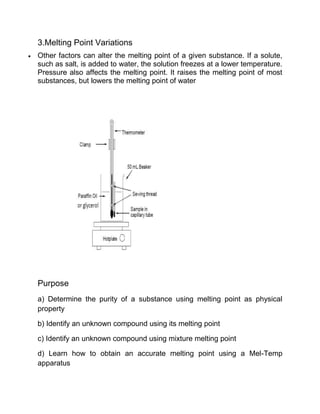
3.Melting Point Variations
Other factors can alter the melting point of a given substance. If a solute,
such as salt, is added to water, the solution freezes at a lower temperature.
Pressure also affects the melting point. It raises the melting point of most
substances, but lowers the melting point of water


Purpose
a) Determine the purity of a substance using melting point as physical
property

b) Identify an unknown compound using its melting point

c) Identify an unknown compound using mixture melting point

d) Learn how to obtain an accurate melting point using a Mel-Temp
apparatus

determination of melting point of liquid organic compound

  • 1.
    prepared by :yousif .I.Jameel student at college of pharmacy Hawler medical university determination of melting point of liquid organic compound melting point The temperature at which a solid, given sufficient heat, becomes a liquid. For a given substance, the melting point of its solid form is the same as the freezing point of its liquid form, and depends on such factors as the purity of the substance and the surrounding pressure. The melting point of ice at a pressure of one atmosphere is 0°C (32°F); that of iron is 1,535°C (2,795°F). Equipment / Materials: Mel - Temp apparatus capillary tubes Thermometer solid organic compounds mortar and pestle (optional) dropping tubes
  • 2.
    Safety: Always wear safety glasses in the lab. The parts on the top of the Mel - temp are HOT while it is turned on. Do not touch these parts or place your eye on the eyepiece, you will get burned!!! Capillary tubes break very easily, handle them with caution. Factors that determine melting point: 1. (size of molecule) Larger molecules have higher melting points Molecular size affects the melting point. When other factors, such as polarity, are equal, smaller molecules melt at lower temperature than do larger molecules. For example, ethyl alcohol liquefies at cryogenic temperatures, while the large cellulose molecule remains solid at temperatures well above the boiling point of water. Diamond also has a high melting point because many carbon atoms unite together to form one large molecule. However, in the case of ionic compounds, those with smaller ions have a higher melting point than that of compounds with larger ions because smaller ions can get closer together and form more stable bonds. 2.(shape of molecule) More symmetrical compounds will have highermelting points. (solid arrangement more orderly) Molecular shape influences the melting point of a substance. If the shape of the molecules allows them to be packed together in a compact fashion, the substance has a higher melting point than does a similar compound with oddly shaped molecules that do not pack well. For this reason, symmetrical molecules give neopentane a higher melting point than that of isopentane, the molecules of which do not pack well, according to the University of Iowa.
  • 3.
    3.Melting Point Variations Otherfactors can alter the melting point of a given substance. If a solute, such as salt, is added to water, the solution freezes at a lower temperature. Pressure also affects the melting point. It raises the melting point of most substances, but lowers the melting point of water Purpose a) Determine the purity of a substance using melting point as physical property b) Identify an unknown compound using its melting point c) Identify an unknown compound using mixture melting point d) Learn how to obtain an accurate melting point using a Mel-Temp apparatus